By
Vlad Shvets
How Fintech Brands Get Visible on the Money Questions Buyers Ask
There is no longer a pool of money answers running on model memory that a brand cannot reach. Every one is assembled live, which makes the citation layer the whole surface, and it has three tiers: publishers you can pitch, a government site you cannot, and your own domain.
There is no longer a pool of money answers running on model memory that a brand cannot reach. Every one is assembled live, which makes the citation layer the whole surface, and it has three tiers: publishers you can pitch, a government site you cannot, and your own domain.
There is no longer a pool of money answers running on model memory that a brand cannot reach. Every one is assembled live, which makes the citation layer the whole surface, and it has three tiers: publishers you can pitch, a government site you cannot, and your own domain.
If you run marketing at a fintech company, you have probably been told there is a ceiling on what visibility work can do for you. The story goes that a large share of money answers come out of the model itself, assembled from whatever it absorbed in training, with no live search behind them and no citation to win. Get into the training data, the advice runs, and hope.
We told you a version of that story ourselves, with a number attached.
So we went back and ran the money questions again, on both engines, and logged what every answer was built from.
The ceiling is gone.
Every answer in this set was assembled from pages fetched at the moment of asking, which means the citation layer is the entire surface you have to work with.
What this can tell you is which pages sat alongside those answers. Whether appearing on one is what puts a brand in the sentence is a separate question, and this was not built to settle it.
There Is No Longer A Pool Of Money Answers You Cannot Reach
Across a targeted set of the money questions people type, run on ChatGPT and Google AI Mode in August 2026, 100.00% of ChatGPT's answers were built on a live search.
Not most of them. All of them, in this set.
Every source figure below is ChatGPT's. We could not resolve what Google AI Mode's answers pointed to here, so nothing in this piece describes its sources.
That number is not new to us, and I would rather say so than present it as a discovery: our roundup work published a rate just under it earlier this month.
What is new is what it does to the plan. When we first measured this vertical the picture supported a two-track approach, one track for the answers that searched and another for the ones that did not.
Different questions and a different month, so read that as us changing our advice rather than as a trend we measured.
The second track has no answers left in it. You do not need a memory strategy and a retrieval strategy. You need to be in the pages the engine is fetching, which is a narrower and far more workable problem.
The rest of this is about what those pages are, because they come in three kinds and the three cost completely different things to reach:
Consumer-finance publishers, which you can pitch
A government authority, which you cannot
Your own domain, which you already control
The Publishers You Can Pitch Are The Top Of It
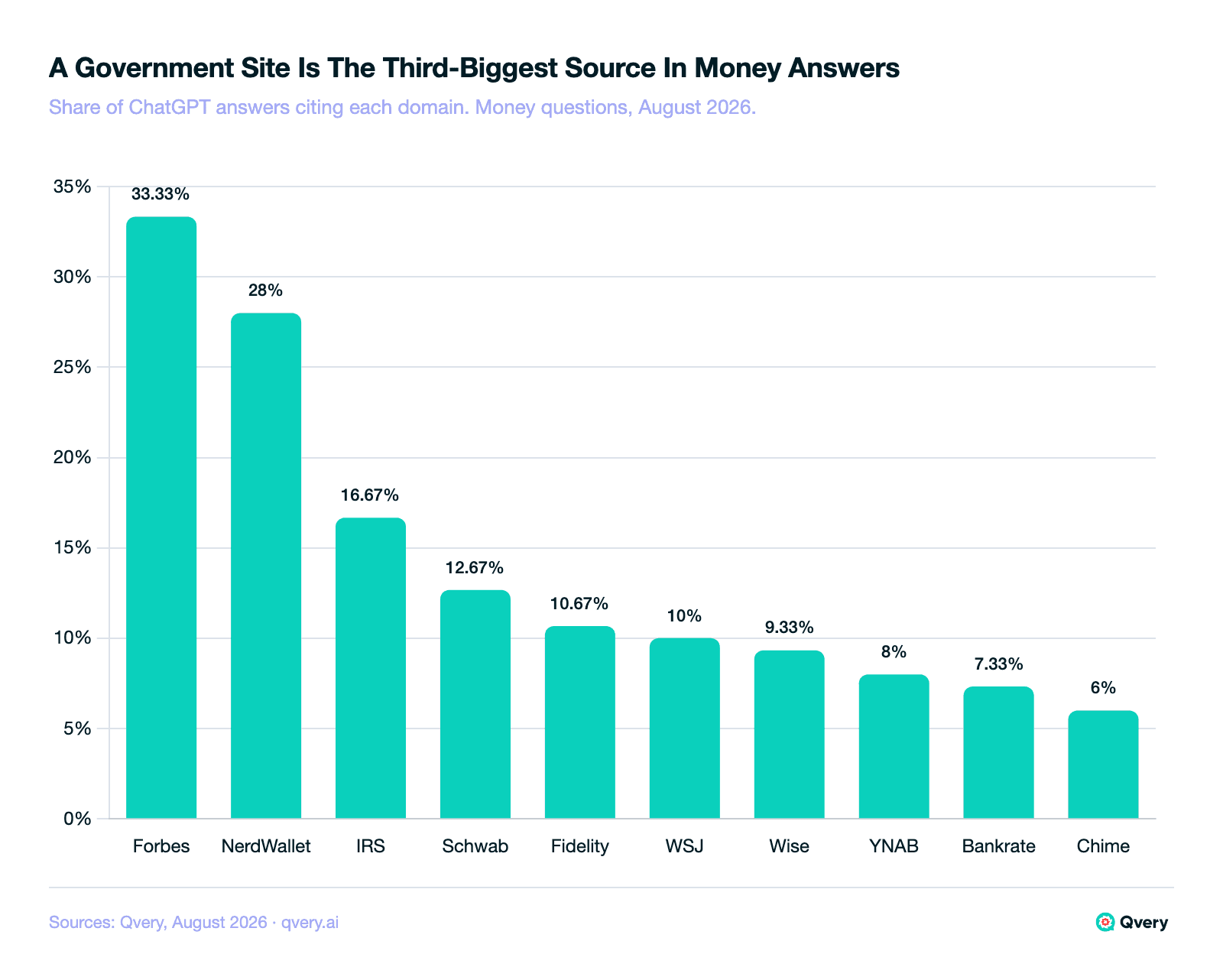
Forbes appears in 33.33% of these answers and NerdWallet in 28.00%, with the Wall Street Journal at 10.00%, then Bankrate, Finder and StockBrokers.
This tier is the one already worked hard by everyone in the category, and it is the one we have written up before: our analysis of the fintech roundup layer covers who occupies it and how to get on the list. I am not going to re-derive it here.
It matters here for one reason: it is the top of the ladder, and it is also the tier where you are bidding against every competitor who read the same advice.
The Third-Biggest Source Is A Government Website
Then the roster does something categories rarely do.
The IRS appears in 16.67% of these answers. Third place.
Ahead of Schwab, ahead of Fidelity, ahead of the Wall Street Journal, and ahead of every brand in the set.
There is no pitch for that. No outreach sequence ends at irs.gov, and no amount of content investment moves it. On any question that touches tax, filing, retirement limits or anything else the government defines, a large piece of the answer is already spoken for before your category is considered at all.
The practical consequence is a ceiling, and it is worth knowing where it sits. On those questions you are competing for the slots left over once the authoritative source has taken its share, and there are fewer of them than the raw roster suggests.
The flip side is that it is stable. An authority citation does not get outbid next quarter.
You Are Already Competing On Your Own Domain
Now the tier most fintech marketers do not realise they are in.
Schwab appears in 12.67% of these answers, Fidelity in 10.67%, Wise in 9.33%, YNAB in 8.00%. Behind them Chime, Intuit, FreeTaxUSA, H&R Block, Capital One and Vanguard, all of them cited on their own domains, in answers about their own category.
These are the companies' own pages: the fee schedule, the help article, the explainer somebody wrote three years ago to answer a support question. Not a press mention among them.
That is the only tier you control completely, and it is the one where a change you make on Monday is live to the engine the same week. No pitch, no relationship, no waiting for an editor.
One absence belongs here too, because it changes what a fintech plan should contain. Reddit reaches a single answer in this entire set. So does YouTube.
The community layer that carries so many other categories is not participating in money answers here. If your visibility plan opens with a subreddit strategy, this set gives you nothing to attach it to.
In most categories the pages you own are the least of your worries and the hardest layer to influence is somebody else's. Money answers invert that: your own estate is in the roster, and the largest third party in it is a government agency.
Work The Tiers In Cost Order
Three moves, in the order the economics suggest rather than the order the tiers rank. This is my read of what the roster implies, not something the collection established.
First, your own pages, because they are free and they are already in the answers. Go and read the pages the engines pull from your competitors: Schwab's fee explainer, Wise's comparison page. Then read yours beside them.
If your equivalent page is a marketing page and theirs answers the question, you have found this quarter's work, and it does not need anyone's permission.
Second, the publisher layer, because it is pitchable and it is the top of the roster. It is also crowded, which is why it goes second rather than first. Everything about how to work it is in the roundup analysis linked above.
Third, plan around the authority layer rather than at it. Identify which of your questions sit near a government definition, accept the lower ceiling on those, and put the effort into the questions where no agency is the reference. That is a targeting decision, and it is cheaper than the content you would have written to fight a losing battle.
Read Your Own Three Tiers In Qvery
You enter your brand, Qvery generates the topics and queries to start from, and you edit them in Qvery Assistant until they read like the money questions your buyers type.
From then on Qvery runs them daily across ChatGPT and Google AI Mode, tracks your visibility, share of voice and average rank against the brands you compete with, and captures every citation tied to the query and the engine that produced it.
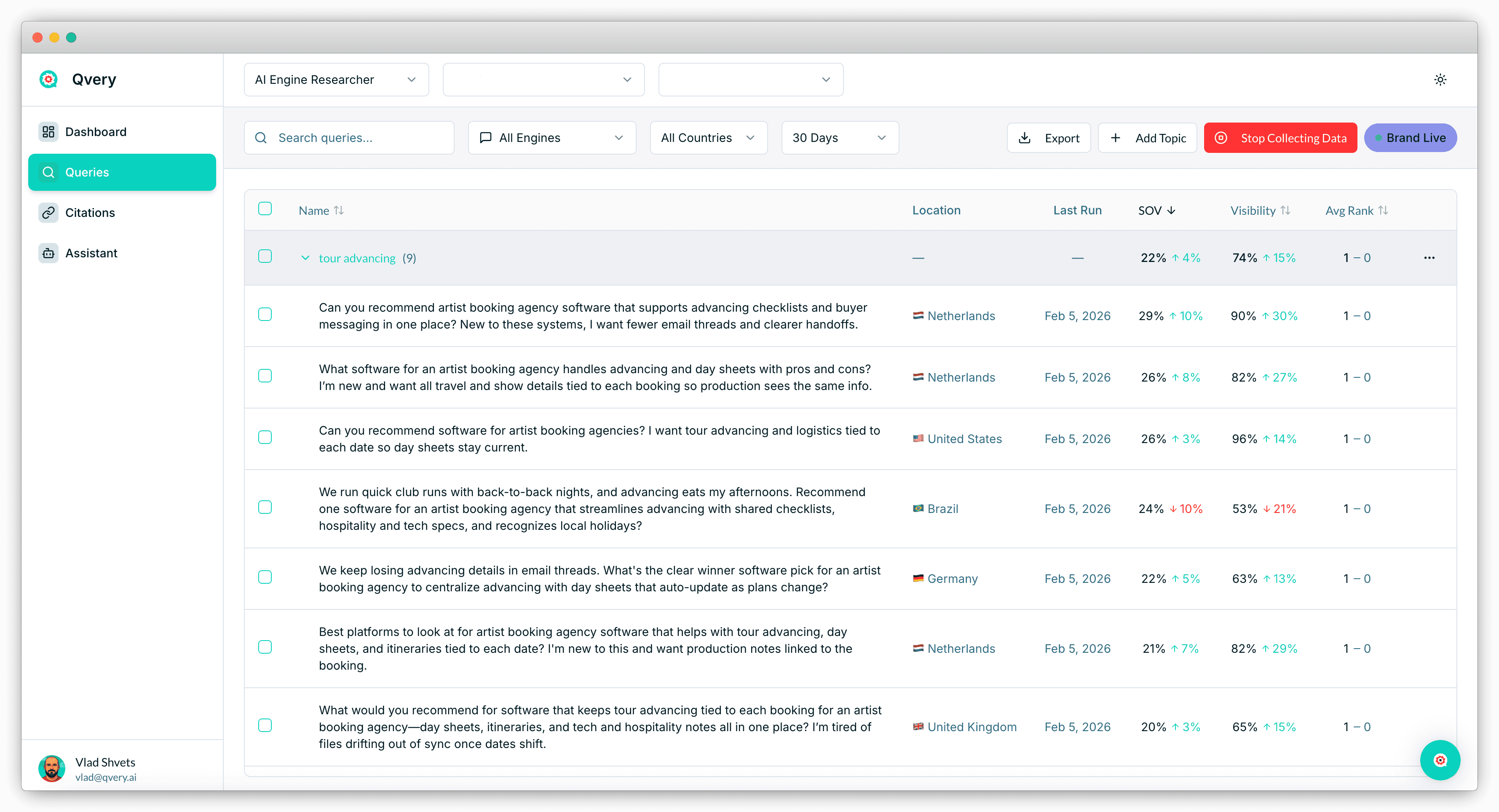
Then open Citations and sort your own three tiers out of the domain list. Publishers, authorities, and companies' own estates each behave differently, and the split tells you where your effort has somewhere to go. If your own domain is missing from a question where three competitors' domains appear, that is the cheapest gap on the page.
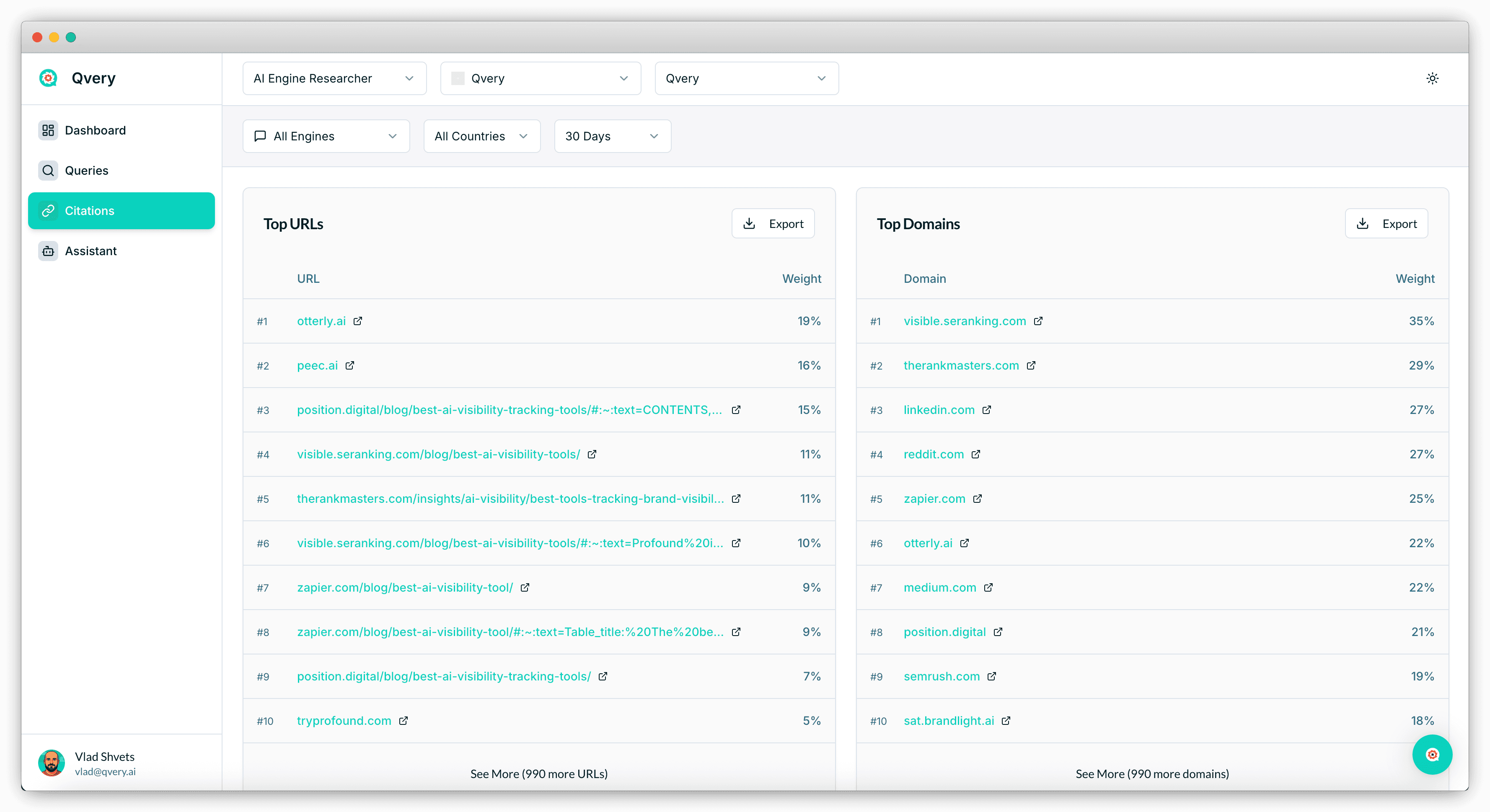
Topic level is where you see whether a whole family of money questions is moving, rather than one query inside it.
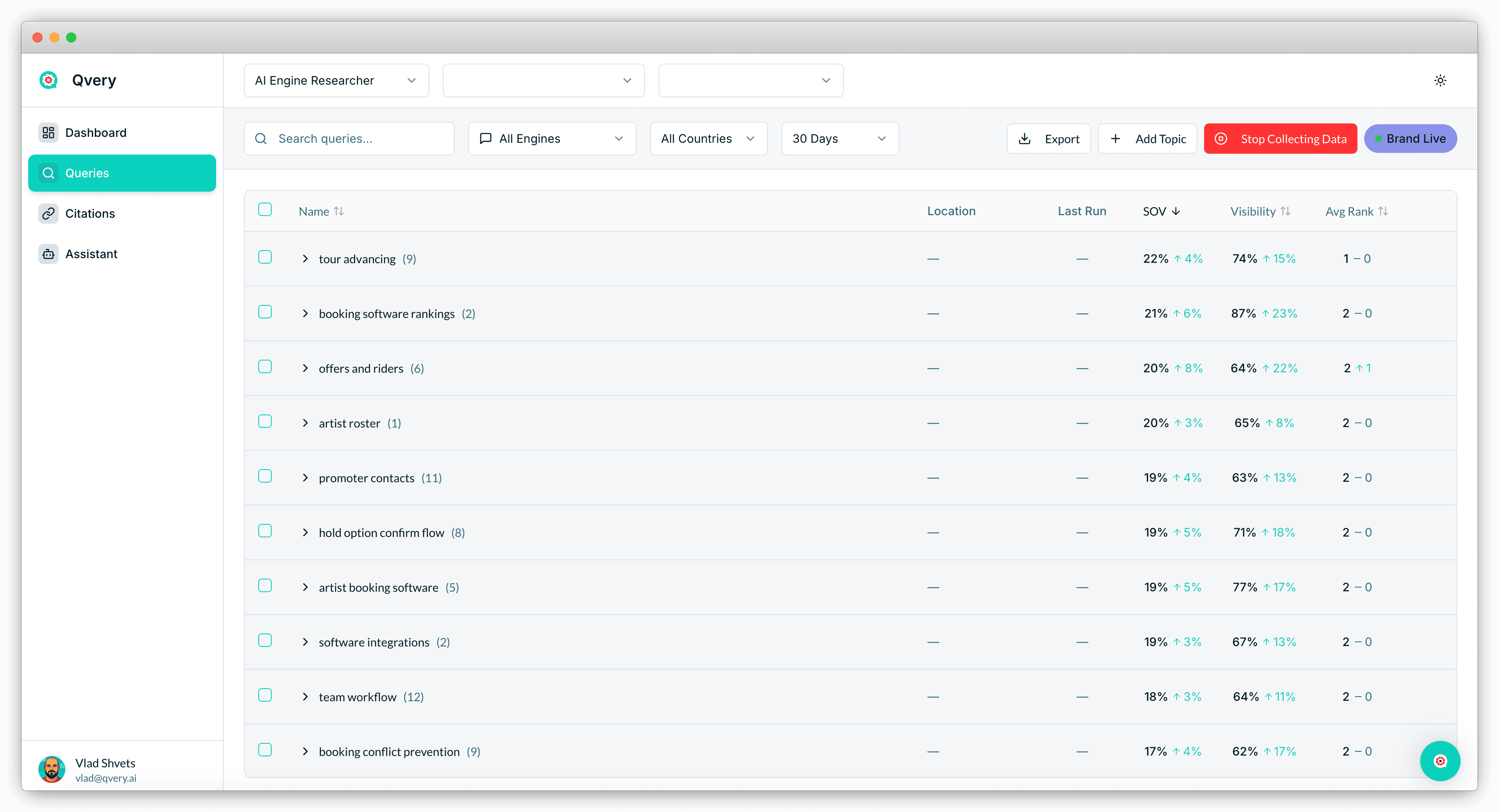
Qvery captures which domains are cited and how often. It will not tell you that irs.gov is an authority and chime.com is a competitor's estate.
That sorting is a person's job, once, on a list you can read in an afternoon.
Start your free trial and pull your first month of money citations by domain.
Read Two Pages Side By Side This Week
Pick the money question closest to your signup, run it on both engines, and note every domain that comes back.
Find the competitor page in that list, open it next to your equivalent page, and ask which one answers the question. In this category the answer is being assembled out of pages exactly like those two, and one of them is yours to rewrite.
If you run marketing at a fintech company, you have probably been told there is a ceiling on what visibility work can do for you. The story goes that a large share of money answers come out of the model itself, assembled from whatever it absorbed in training, with no live search behind them and no citation to win. Get into the training data, the advice runs, and hope.
We told you a version of that story ourselves, with a number attached.
So we went back and ran the money questions again, on both engines, and logged what every answer was built from.
The ceiling is gone.
Every answer in this set was assembled from pages fetched at the moment of asking, which means the citation layer is the entire surface you have to work with.
What this can tell you is which pages sat alongside those answers. Whether appearing on one is what puts a brand in the sentence is a separate question, and this was not built to settle it.
There Is No Longer A Pool Of Money Answers You Cannot Reach
Across a targeted set of the money questions people type, run on ChatGPT and Google AI Mode in August 2026, 100.00% of ChatGPT's answers were built on a live search.
Not most of them. All of them, in this set.
Every source figure below is ChatGPT's. We could not resolve what Google AI Mode's answers pointed to here, so nothing in this piece describes its sources.
That number is not new to us, and I would rather say so than present it as a discovery: our roundup work published a rate just under it earlier this month.
What is new is what it does to the plan. When we first measured this vertical the picture supported a two-track approach, one track for the answers that searched and another for the ones that did not.
Different questions and a different month, so read that as us changing our advice rather than as a trend we measured.
The second track has no answers left in it. You do not need a memory strategy and a retrieval strategy. You need to be in the pages the engine is fetching, which is a narrower and far more workable problem.
The rest of this is about what those pages are, because they come in three kinds and the three cost completely different things to reach:
Consumer-finance publishers, which you can pitch
A government authority, which you cannot
Your own domain, which you already control
The Publishers You Can Pitch Are The Top Of It
Forbes appears in 33.33% of these answers and NerdWallet in 28.00%, with the Wall Street Journal at 10.00%, then Bankrate, Finder and StockBrokers.
This tier is the one already worked hard by everyone in the category, and it is the one we have written up before: our analysis of the fintech roundup layer covers who occupies it and how to get on the list. I am not going to re-derive it here.
It matters here for one reason: it is the top of the ladder, and it is also the tier where you are bidding against every competitor who read the same advice.
The Third-Biggest Source Is A Government Website
Then the roster does something categories rarely do.
The IRS appears in 16.67% of these answers. Third place.
Ahead of Schwab, ahead of Fidelity, ahead of the Wall Street Journal, and ahead of every brand in the set.
There is no pitch for that. No outreach sequence ends at irs.gov, and no amount of content investment moves it. On any question that touches tax, filing, retirement limits or anything else the government defines, a large piece of the answer is already spoken for before your category is considered at all.
The practical consequence is a ceiling, and it is worth knowing where it sits. On those questions you are competing for the slots left over once the authoritative source has taken its share, and there are fewer of them than the raw roster suggests.
The flip side is that it is stable. An authority citation does not get outbid next quarter.
You Are Already Competing On Your Own Domain
Now the tier most fintech marketers do not realise they are in.
Schwab appears in 12.67% of these answers, Fidelity in 10.67%, Wise in 9.33%, YNAB in 8.00%. Behind them Chime, Intuit, FreeTaxUSA, H&R Block, Capital One and Vanguard, all of them cited on their own domains, in answers about their own category.
These are the companies' own pages: the fee schedule, the help article, the explainer somebody wrote three years ago to answer a support question. Not a press mention among them.
That is the only tier you control completely, and it is the one where a change you make on Monday is live to the engine the same week. No pitch, no relationship, no waiting for an editor.
One absence belongs here too, because it changes what a fintech plan should contain. Reddit reaches a single answer in this entire set. So does YouTube.
The community layer that carries so many other categories is not participating in money answers here. If your visibility plan opens with a subreddit strategy, this set gives you nothing to attach it to.
In most categories the pages you own are the least of your worries and the hardest layer to influence is somebody else's. Money answers invert that: your own estate is in the roster, and the largest third party in it is a government agency.
Work The Tiers In Cost Order
Three moves, in the order the economics suggest rather than the order the tiers rank. This is my read of what the roster implies, not something the collection established.
First, your own pages, because they are free and they are already in the answers. Go and read the pages the engines pull from your competitors: Schwab's fee explainer, Wise's comparison page. Then read yours beside them.
If your equivalent page is a marketing page and theirs answers the question, you have found this quarter's work, and it does not need anyone's permission.
Second, the publisher layer, because it is pitchable and it is the top of the roster. It is also crowded, which is why it goes second rather than first. Everything about how to work it is in the roundup analysis linked above.
Third, plan around the authority layer rather than at it. Identify which of your questions sit near a government definition, accept the lower ceiling on those, and put the effort into the questions where no agency is the reference. That is a targeting decision, and it is cheaper than the content you would have written to fight a losing battle.
Read Your Own Three Tiers In Qvery
You enter your brand, Qvery generates the topics and queries to start from, and you edit them in Qvery Assistant until they read like the money questions your buyers type.
From then on Qvery runs them daily across ChatGPT and Google AI Mode, tracks your visibility, share of voice and average rank against the brands you compete with, and captures every citation tied to the query and the engine that produced it.
Then open Citations and sort your own three tiers out of the domain list. Publishers, authorities, and companies' own estates each behave differently, and the split tells you where your effort has somewhere to go. If your own domain is missing from a question where three competitors' domains appear, that is the cheapest gap on the page.
Topic level is where you see whether a whole family of money questions is moving, rather than one query inside it.
Qvery captures which domains are cited and how often. It will not tell you that irs.gov is an authority and chime.com is a competitor's estate.
That sorting is a person's job, once, on a list you can read in an afternoon.
Start your free trial and pull your first month of money citations by domain.
Read Two Pages Side By Side This Week
Pick the money question closest to your signup, run it on both engines, and note every domain that comes back.
Find the competitor page in that list, open it next to your equivalent page, and ask which one answers the question. In this category the answer is being assembled out of pages exactly like those two, and one of them is yours to rewrite.
If you run marketing at a fintech company, you have probably been told there is a ceiling on what visibility work can do for you. The story goes that a large share of money answers come out of the model itself, assembled from whatever it absorbed in training, with no live search behind them and no citation to win. Get into the training data, the advice runs, and hope.
We told you a version of that story ourselves, with a number attached.
So we went back and ran the money questions again, on both engines, and logged what every answer was built from.
The ceiling is gone.
Every answer in this set was assembled from pages fetched at the moment of asking, which means the citation layer is the entire surface you have to work with.
What this can tell you is which pages sat alongside those answers. Whether appearing on one is what puts a brand in the sentence is a separate question, and this was not built to settle it.
There Is No Longer A Pool Of Money Answers You Cannot Reach
Across a targeted set of the money questions people type, run on ChatGPT and Google AI Mode in August 2026, 100.00% of ChatGPT's answers were built on a live search.
Not most of them. All of them, in this set.
Every source figure below is ChatGPT's. We could not resolve what Google AI Mode's answers pointed to here, so nothing in this piece describes its sources.
That number is not new to us, and I would rather say so than present it as a discovery: our roundup work published a rate just under it earlier this month.
What is new is what it does to the plan. When we first measured this vertical the picture supported a two-track approach, one track for the answers that searched and another for the ones that did not.
Different questions and a different month, so read that as us changing our advice rather than as a trend we measured.
The second track has no answers left in it. You do not need a memory strategy and a retrieval strategy. You need to be in the pages the engine is fetching, which is a narrower and far more workable problem.
The rest of this is about what those pages are, because they come in three kinds and the three cost completely different things to reach:
Consumer-finance publishers, which you can pitch
A government authority, which you cannot
Your own domain, which you already control
The Publishers You Can Pitch Are The Top Of It
Forbes appears in 33.33% of these answers and NerdWallet in 28.00%, with the Wall Street Journal at 10.00%, then Bankrate, Finder and StockBrokers.
This tier is the one already worked hard by everyone in the category, and it is the one we have written up before: our analysis of the fintech roundup layer covers who occupies it and how to get on the list. I am not going to re-derive it here.
It matters here for one reason: it is the top of the ladder, and it is also the tier where you are bidding against every competitor who read the same advice.
The Third-Biggest Source Is A Government Website
Then the roster does something categories rarely do.
The IRS appears in 16.67% of these answers. Third place.
Ahead of Schwab, ahead of Fidelity, ahead of the Wall Street Journal, and ahead of every brand in the set.
There is no pitch for that. No outreach sequence ends at irs.gov, and no amount of content investment moves it. On any question that touches tax, filing, retirement limits or anything else the government defines, a large piece of the answer is already spoken for before your category is considered at all.
The practical consequence is a ceiling, and it is worth knowing where it sits. On those questions you are competing for the slots left over once the authoritative source has taken its share, and there are fewer of them than the raw roster suggests.
The flip side is that it is stable. An authority citation does not get outbid next quarter.
You Are Already Competing On Your Own Domain
Now the tier most fintech marketers do not realise they are in.
Schwab appears in 12.67% of these answers, Fidelity in 10.67%, Wise in 9.33%, YNAB in 8.00%. Behind them Chime, Intuit, FreeTaxUSA, H&R Block, Capital One and Vanguard, all of them cited on their own domains, in answers about their own category.
These are the companies' own pages: the fee schedule, the help article, the explainer somebody wrote three years ago to answer a support question. Not a press mention among them.
That is the only tier you control completely, and it is the one where a change you make on Monday is live to the engine the same week. No pitch, no relationship, no waiting for an editor.
One absence belongs here too, because it changes what a fintech plan should contain. Reddit reaches a single answer in this entire set. So does YouTube.
The community layer that carries so many other categories is not participating in money answers here. If your visibility plan opens with a subreddit strategy, this set gives you nothing to attach it to.
In most categories the pages you own are the least of your worries and the hardest layer to influence is somebody else's. Money answers invert that: your own estate is in the roster, and the largest third party in it is a government agency.
Work The Tiers In Cost Order
Three moves, in the order the economics suggest rather than the order the tiers rank. This is my read of what the roster implies, not something the collection established.
First, your own pages, because they are free and they are already in the answers. Go and read the pages the engines pull from your competitors: Schwab's fee explainer, Wise's comparison page. Then read yours beside them.
If your equivalent page is a marketing page and theirs answers the question, you have found this quarter's work, and it does not need anyone's permission.
Second, the publisher layer, because it is pitchable and it is the top of the roster. It is also crowded, which is why it goes second rather than first. Everything about how to work it is in the roundup analysis linked above.
Third, plan around the authority layer rather than at it. Identify which of your questions sit near a government definition, accept the lower ceiling on those, and put the effort into the questions where no agency is the reference. That is a targeting decision, and it is cheaper than the content you would have written to fight a losing battle.
Read Your Own Three Tiers In Qvery
You enter your brand, Qvery generates the topics and queries to start from, and you edit them in Qvery Assistant until they read like the money questions your buyers type.
From then on Qvery runs them daily across ChatGPT and Google AI Mode, tracks your visibility, share of voice and average rank against the brands you compete with, and captures every citation tied to the query and the engine that produced it.
Then open Citations and sort your own three tiers out of the domain list. Publishers, authorities, and companies' own estates each behave differently, and the split tells you where your effort has somewhere to go. If your own domain is missing from a question where three competitors' domains appear, that is the cheapest gap on the page.
Topic level is where you see whether a whole family of money questions is moving, rather than one query inside it.
Qvery captures which domains are cited and how often. It will not tell you that irs.gov is an authority and chime.com is a competitor's estate.
That sorting is a person's job, once, on a list you can read in an afternoon.
Start your free trial and pull your first month of money citations by domain.
Read Two Pages Side By Side This Week
Pick the money question closest to your signup, run it on both engines, and note every domain that comes back.
Find the competitor page in that list, open it next to your equivalent page, and ask which one answers the question. In this category the answer is being assembled out of pages exactly like those two, and one of them is yours to rewrite.
If you run marketing at a fintech company, you have probably been told there is a ceiling on what visibility work can do for you. The story goes that a large share of money answers come out of the model itself, assembled from whatever it absorbed in training, with no live search behind them and no citation to win. Get into the training data, the advice runs, and hope.
We told you a version of that story ourselves, with a number attached.
So we went back and ran the money questions again, on both engines, and logged what every answer was built from.
The ceiling is gone.
Every answer in this set was assembled from pages fetched at the moment of asking, which means the citation layer is the entire surface you have to work with.
What this can tell you is which pages sat alongside those answers. Whether appearing on one is what puts a brand in the sentence is a separate question, and this was not built to settle it.
There Is No Longer A Pool Of Money Answers You Cannot Reach
Across a targeted set of the money questions people type, run on ChatGPT and Google AI Mode in August 2026, 100.00% of ChatGPT's answers were built on a live search.
Not most of them. All of them, in this set.
Every source figure below is ChatGPT's. We could not resolve what Google AI Mode's answers pointed to here, so nothing in this piece describes its sources.
That number is not new to us, and I would rather say so than present it as a discovery: our roundup work published a rate just under it earlier this month.
What is new is what it does to the plan. When we first measured this vertical the picture supported a two-track approach, one track for the answers that searched and another for the ones that did not.
Different questions and a different month, so read that as us changing our advice rather than as a trend we measured.
The second track has no answers left in it. You do not need a memory strategy and a retrieval strategy. You need to be in the pages the engine is fetching, which is a narrower and far more workable problem.
The rest of this is about what those pages are, because they come in three kinds and the three cost completely different things to reach:
Consumer-finance publishers, which you can pitch
A government authority, which you cannot
Your own domain, which you already control
The Publishers You Can Pitch Are The Top Of It
Forbes appears in 33.33% of these answers and NerdWallet in 28.00%, with the Wall Street Journal at 10.00%, then Bankrate, Finder and StockBrokers.
This tier is the one already worked hard by everyone in the category, and it is the one we have written up before: our analysis of the fintech roundup layer covers who occupies it and how to get on the list. I am not going to re-derive it here.
It matters here for one reason: it is the top of the ladder, and it is also the tier where you are bidding against every competitor who read the same advice.
The Third-Biggest Source Is A Government Website
Then the roster does something categories rarely do.
The IRS appears in 16.67% of these answers. Third place.
Ahead of Schwab, ahead of Fidelity, ahead of the Wall Street Journal, and ahead of every brand in the set.
There is no pitch for that. No outreach sequence ends at irs.gov, and no amount of content investment moves it. On any question that touches tax, filing, retirement limits or anything else the government defines, a large piece of the answer is already spoken for before your category is considered at all.
The practical consequence is a ceiling, and it is worth knowing where it sits. On those questions you are competing for the slots left over once the authoritative source has taken its share, and there are fewer of them than the raw roster suggests.
The flip side is that it is stable. An authority citation does not get outbid next quarter.
You Are Already Competing On Your Own Domain
Now the tier most fintech marketers do not realise they are in.
Schwab appears in 12.67% of these answers, Fidelity in 10.67%, Wise in 9.33%, YNAB in 8.00%. Behind them Chime, Intuit, FreeTaxUSA, H&R Block, Capital One and Vanguard, all of them cited on their own domains, in answers about their own category.
These are the companies' own pages: the fee schedule, the help article, the explainer somebody wrote three years ago to answer a support question. Not a press mention among them.
That is the only tier you control completely, and it is the one where a change you make on Monday is live to the engine the same week. No pitch, no relationship, no waiting for an editor.
One absence belongs here too, because it changes what a fintech plan should contain. Reddit reaches a single answer in this entire set. So does YouTube.
The community layer that carries so many other categories is not participating in money answers here. If your visibility plan opens with a subreddit strategy, this set gives you nothing to attach it to.
In most categories the pages you own are the least of your worries and the hardest layer to influence is somebody else's. Money answers invert that: your own estate is in the roster, and the largest third party in it is a government agency.
Work The Tiers In Cost Order
Three moves, in the order the economics suggest rather than the order the tiers rank. This is my read of what the roster implies, not something the collection established.
First, your own pages, because they are free and they are already in the answers. Go and read the pages the engines pull from your competitors: Schwab's fee explainer, Wise's comparison page. Then read yours beside them.
If your equivalent page is a marketing page and theirs answers the question, you have found this quarter's work, and it does not need anyone's permission.
Second, the publisher layer, because it is pitchable and it is the top of the roster. It is also crowded, which is why it goes second rather than first. Everything about how to work it is in the roundup analysis linked above.
Third, plan around the authority layer rather than at it. Identify which of your questions sit near a government definition, accept the lower ceiling on those, and put the effort into the questions where no agency is the reference. That is a targeting decision, and it is cheaper than the content you would have written to fight a losing battle.
Read Your Own Three Tiers In Qvery
You enter your brand, Qvery generates the topics and queries to start from, and you edit them in Qvery Assistant until they read like the money questions your buyers type.
From then on Qvery runs them daily across ChatGPT and Google AI Mode, tracks your visibility, share of voice and average rank against the brands you compete with, and captures every citation tied to the query and the engine that produced it.
Then open Citations and sort your own three tiers out of the domain list. Publishers, authorities, and companies' own estates each behave differently, and the split tells you where your effort has somewhere to go. If your own domain is missing from a question where three competitors' domains appear, that is the cheapest gap on the page.
Topic level is where you see whether a whole family of money questions is moving, rather than one query inside it.
Qvery captures which domains are cited and how often. It will not tell you that irs.gov is an authority and chime.com is a competitor's estate.
That sorting is a person's job, once, on a list you can read in an afternoon.
Start your free trial and pull your first month of money citations by domain.
Read Two Pages Side By Side This Week
Pick the money question closest to your signup, run it on both engines, and note every domain that comes back.
Find the competitor page in that list, open it next to your equivalent page, and ask which one answers the question. In this category the answer is being assembled out of pages exactly like those two, and one of them is yours to rewrite.

© 2026 Qvery AI OÜ