By
Vlad Shvets
How Often AI Answers Cite G2 for SaaS: Mostly on Recommendation Questions
G2 sits beside 8.75% of SaaS recommendation answers in ChatGPT and Google AI Mode and 0.67% of information answers. What that supports, and what it doesn't.
G2 sits beside 8.75% of SaaS recommendation answers in ChatGPT and Google AI Mode and 0.67% of information answers. What that supports, and what it doesn't.
G2 sits beside 8.75% of SaaS recommendation answers in ChatGPT and Google AI Mode and 0.67% of information answers. What that supports, and what it doesn't.
Most SaaS marketing teams pay for a G2 profile, and sooner or later someone asks what it does for AI search. We ran SaaS recommendation questions and SaaS information questions through ChatGPT and Google AI Mode in September 2026 and checked which answers cited g2.com.
G2 was cited in 8.75% of recommendation answers and 0.67% of information answers, each a share of all valid answers of that kind. At least one of the seven named review platforms we tracked showed up in 13.33% of ChatGPT's recommendation answers and 13.89% of Google AI Mode's. That supports one decision, auditing the G2 line on your own recommendation questions. What the line returns in pipeline or revenue is a separate question this data cannot answer.
Key Takeaways
g2.com appeared in 8.75% of recommendation answers and 0.67% of information answers, a recommendation-to-information ratio of 13.13.
At least one of seven named review platforms appeared in 13.33% of ChatGPT recommendation answers and 13.89% of Google AI Mode recommendation answers.
Brand-owned domains appeared in 87.08% of recommendation answers and 68.00% of information answers; that contrast was registered in advance and came out indeterminate.
Residual platform and community domains appeared in 20.42% of recommendation answers and 6.67% of information answers, a ratio of 3.06.
None of this measures spend, conversion, or return. It measures which sites sat beside the answers.
G2 Shows Up on Recommendation Questions
The G2 figure is almost entirely a recommendation-question figure. 8.75% of recommendation answers cited g2.com, against 0.67% of information answers; the ratio, computed from the underlying counts, is 13.13, in the direction we registered before collecting. Both rates are shares of all valid answers of that kind, across ChatGPT and Google AI Mode together.

So an audit of the G2 line starts on recommendation questions, the kind that ask for the best CRM for a ten-person team, each paired with an information question, such as how lead scoring works, as the contrast. A G2 check run only on information questions would find almost nothing and learn nothing.
SE Ranking argues that "Review platforms now influence visibility in AI search, even though users don’t always visit those platforms directly." The data shows G2 sitting beside a share of recommendation answers, which is presence, not influence: it cannot say whether any brand became visible through G2, or whether a profile changed anything.
A second argument goes further. One YouTube framework puts it as "AI build consensus across multiple sources, so you want your brand on every relevant review platform." G2's co-occurrence supports checking G2 for your own category. It does not show that every review platform is necessary, or that a subscription should be kept.
The Review-Platform Line Beside the Rest of Each Engine's Answer
On recommendation questions, the review-platform line is one of four source lines in both engines. The shares below are of all valid recommendation answers from each engine, and no engine comparison was registered or tested.
ChatGPT: review platforms 13.33%, brand-owned 91.11%, residual platform and community 8.70%, everything else 59.81%.
Google AI Mode: review platforms 13.89%, brand-owned 75.00%, residual platform and community 55.56%, everything else 42.78%.
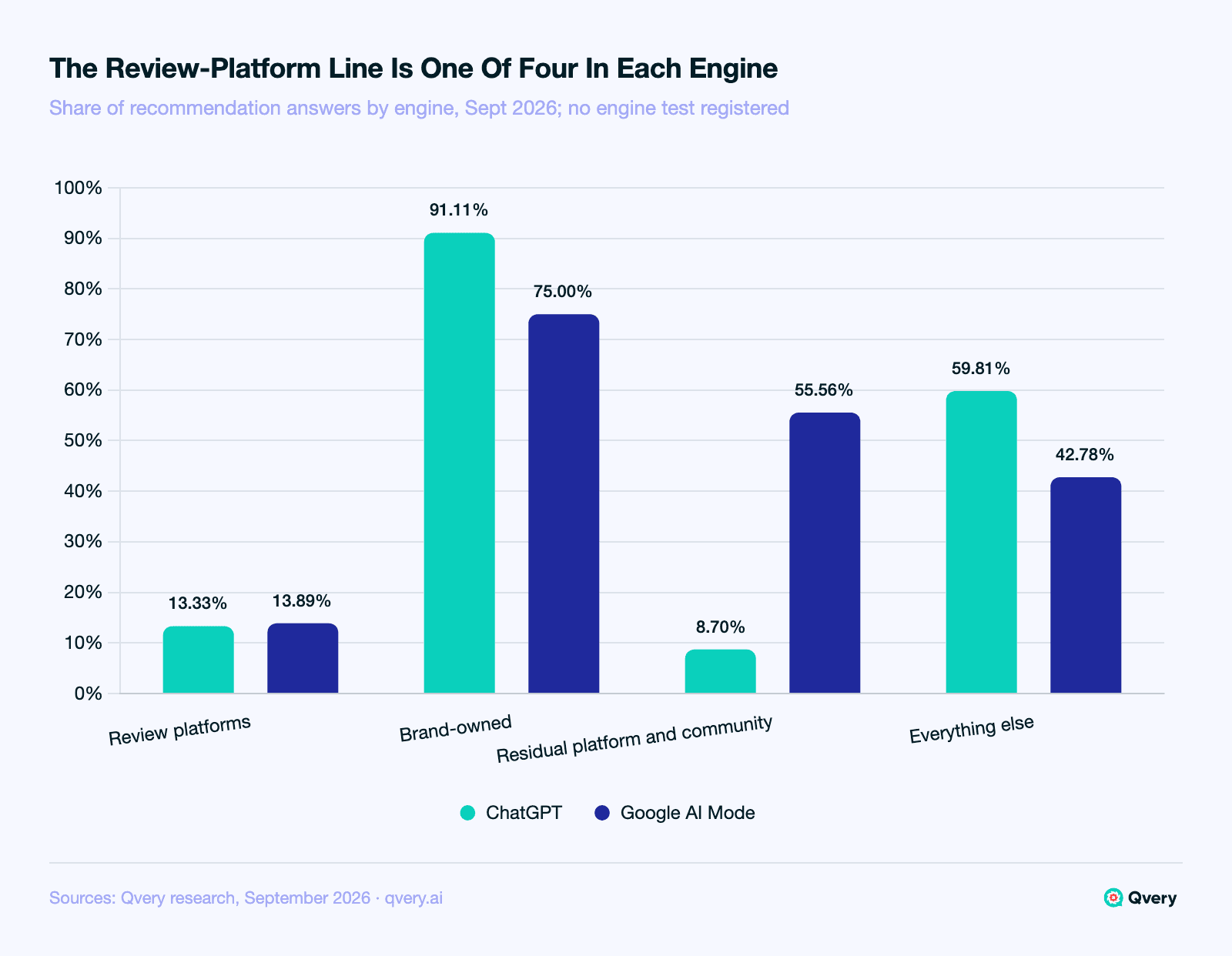
"Review platforms" here means at least one of seven named sites, and only five of them were cited anywhere in this corpus: g2.com, capterra.com, gartner.com, softwareadvice.com, and trustradius.com. The practical point is that the G2 line gets audited next to vendor sites and platforms, not on its own. For how the three lines fit an investment plan, see the pillars of AI engine visibility; for the Reddit side, Reddit marketing for SaaS.
Owned Pages Stay in the Audit
Brand-owned domains appeared in 87.08% of recommendation answers and 68.00% of information answers. We registered a direction for that contrast before collecting, and the result landed in the indeterminate band, so neither kind of question can be said to lean on owned pages. What it does say is that owned pages are present in most answers of both kinds, which is why an audit of G2 never replaces a check of your own site.
Onely makes the case for moving budget the other way: "Investment in third-party presence – review platform optimization, PR and media relations, community engagement – may deliver superior AI visibility ROI than equivalent investment in additional website content." This corpus measures presence, not return, so it neither establishes that investment order nor disproves the ROI claim. It shows both kinds of source in the answers and says nothing about which pays.
Our SaaS category study covers the vendor-site and review-directory picture across SaaS categories in more depth.
G2 Is Not the Whole Third-Party Line
Residual platform and community domains appeared in 20.42% of recommendation answers and 6.67% of information answers, a ratio of 3.06 in the recommendation direction. "Residual" is literal: it is the platform and community group with the named review platforms and brand-owned domains taken out, so it is not a publisher category of its own.
For an audit, that means recording G2 separately from forums, communities, and other platforms, so the review-site line is not credited with what Reddit threads or listicles did. The tactics for those sit in building mentions for SaaS brands.
Audit the G2 Line in Qvery
In Qvery you add and edit the queries you track, so you can set up your recommendation questions in pairs with information questions, the same contrast measured here, and generating LLM tracking queries covers building the pairs.
Qvery tracks visibility, share of voice, and average rank across ChatGPT and Google AI Mode every day, in 200+ countries, and ties every citation to the query and engine that produced it, so you can see whether g2.com is cited on your own questions and beside whom. Qvery Assistant answers plain-language questions about your own data in the app.
The audit shows presence, not what the G2 line returns. Start a free 7-day trial to run it; checkout is self-serve and no credit card is required.
The Limits of These Numbers
This measures one thing: which cited domains sat beside answers in a fresh September 2026 SaaS corpus. It does not measure whether a brand was named or recommended, whether anyone paid a review platform, pricing, conversion, return, or cause, and it draws no comparison over time, across verticals, or between engines.
Google AI Mode's information answers are too few to carry a percentage, so none is printed. The pooled rates count every answer once, and ChatGPT answered more of the questions than Google AI Mode did, so the pooled figures lean toward ChatGPT.
Commission the Audit, Not the Verdict
Run your own recommendation questions, each paired with an information question, in ChatGPT and Google AI Mode, and read whether g2.com is cited beside your brand and your competitors. This evidence supports that audit. It does not support a keep-or-cut decision on the G2 spend, which needs your own revenue data.
Most SaaS marketing teams pay for a G2 profile, and sooner or later someone asks what it does for AI search. We ran SaaS recommendation questions and SaaS information questions through ChatGPT and Google AI Mode in September 2026 and checked which answers cited g2.com.
G2 was cited in 8.75% of recommendation answers and 0.67% of information answers, each a share of all valid answers of that kind. At least one of the seven named review platforms we tracked showed up in 13.33% of ChatGPT's recommendation answers and 13.89% of Google AI Mode's. That supports one decision, auditing the G2 line on your own recommendation questions. What the line returns in pipeline or revenue is a separate question this data cannot answer.
Key Takeaways
g2.com appeared in 8.75% of recommendation answers and 0.67% of information answers, a recommendation-to-information ratio of 13.13.
At least one of seven named review platforms appeared in 13.33% of ChatGPT recommendation answers and 13.89% of Google AI Mode recommendation answers.
Brand-owned domains appeared in 87.08% of recommendation answers and 68.00% of information answers; that contrast was registered in advance and came out indeterminate.
Residual platform and community domains appeared in 20.42% of recommendation answers and 6.67% of information answers, a ratio of 3.06.
None of this measures spend, conversion, or return. It measures which sites sat beside the answers.
G2 Shows Up on Recommendation Questions
The G2 figure is almost entirely a recommendation-question figure. 8.75% of recommendation answers cited g2.com, against 0.67% of information answers; the ratio, computed from the underlying counts, is 13.13, in the direction we registered before collecting. Both rates are shares of all valid answers of that kind, across ChatGPT and Google AI Mode together.
So an audit of the G2 line starts on recommendation questions, the kind that ask for the best CRM for a ten-person team, each paired with an information question, such as how lead scoring works, as the contrast. A G2 check run only on information questions would find almost nothing and learn nothing.
SE Ranking argues that "Review platforms now influence visibility in AI search, even though users don’t always visit those platforms directly." The data shows G2 sitting beside a share of recommendation answers, which is presence, not influence: it cannot say whether any brand became visible through G2, or whether a profile changed anything.
A second argument goes further. One YouTube framework puts it as "AI build consensus across multiple sources, so you want your brand on every relevant review platform." G2's co-occurrence supports checking G2 for your own category. It does not show that every review platform is necessary, or that a subscription should be kept.
The Review-Platform Line Beside the Rest of Each Engine's Answer
On recommendation questions, the review-platform line is one of four source lines in both engines. The shares below are of all valid recommendation answers from each engine, and no engine comparison was registered or tested.
ChatGPT: review platforms 13.33%, brand-owned 91.11%, residual platform and community 8.70%, everything else 59.81%.
Google AI Mode: review platforms 13.89%, brand-owned 75.00%, residual platform and community 55.56%, everything else 42.78%.
"Review platforms" here means at least one of seven named sites, and only five of them were cited anywhere in this corpus: g2.com, capterra.com, gartner.com, softwareadvice.com, and trustradius.com. The practical point is that the G2 line gets audited next to vendor sites and platforms, not on its own. For how the three lines fit an investment plan, see the pillars of AI engine visibility; for the Reddit side, Reddit marketing for SaaS.
Owned Pages Stay in the Audit
Brand-owned domains appeared in 87.08% of recommendation answers and 68.00% of information answers. We registered a direction for that contrast before collecting, and the result landed in the indeterminate band, so neither kind of question can be said to lean on owned pages. What it does say is that owned pages are present in most answers of both kinds, which is why an audit of G2 never replaces a check of your own site.
Onely makes the case for moving budget the other way: "Investment in third-party presence – review platform optimization, PR and media relations, community engagement – may deliver superior AI visibility ROI than equivalent investment in additional website content." This corpus measures presence, not return, so it neither establishes that investment order nor disproves the ROI claim. It shows both kinds of source in the answers and says nothing about which pays.
Our SaaS category study covers the vendor-site and review-directory picture across SaaS categories in more depth.
G2 Is Not the Whole Third-Party Line
Residual platform and community domains appeared in 20.42% of recommendation answers and 6.67% of information answers, a ratio of 3.06 in the recommendation direction. "Residual" is literal: it is the platform and community group with the named review platforms and brand-owned domains taken out, so it is not a publisher category of its own.
For an audit, that means recording G2 separately from forums, communities, and other platforms, so the review-site line is not credited with what Reddit threads or listicles did. The tactics for those sit in building mentions for SaaS brands.
Audit the G2 Line in Qvery
In Qvery you add and edit the queries you track, so you can set up your recommendation questions in pairs with information questions, the same contrast measured here, and generating LLM tracking queries covers building the pairs.
Qvery tracks visibility, share of voice, and average rank across ChatGPT and Google AI Mode every day, in 200+ countries, and ties every citation to the query and engine that produced it, so you can see whether g2.com is cited on your own questions and beside whom. Qvery Assistant answers plain-language questions about your own data in the app.
The audit shows presence, not what the G2 line returns. Start a free 7-day trial to run it; checkout is self-serve and no credit card is required.
The Limits of These Numbers
This measures one thing: which cited domains sat beside answers in a fresh September 2026 SaaS corpus. It does not measure whether a brand was named or recommended, whether anyone paid a review platform, pricing, conversion, return, or cause, and it draws no comparison over time, across verticals, or between engines.
Google AI Mode's information answers are too few to carry a percentage, so none is printed. The pooled rates count every answer once, and ChatGPT answered more of the questions than Google AI Mode did, so the pooled figures lean toward ChatGPT.
Commission the Audit, Not the Verdict
Run your own recommendation questions, each paired with an information question, in ChatGPT and Google AI Mode, and read whether g2.com is cited beside your brand and your competitors. This evidence supports that audit. It does not support a keep-or-cut decision on the G2 spend, which needs your own revenue data.
Most SaaS marketing teams pay for a G2 profile, and sooner or later someone asks what it does for AI search. We ran SaaS recommendation questions and SaaS information questions through ChatGPT and Google AI Mode in September 2026 and checked which answers cited g2.com.
G2 was cited in 8.75% of recommendation answers and 0.67% of information answers, each a share of all valid answers of that kind. At least one of the seven named review platforms we tracked showed up in 13.33% of ChatGPT's recommendation answers and 13.89% of Google AI Mode's. That supports one decision, auditing the G2 line on your own recommendation questions. What the line returns in pipeline or revenue is a separate question this data cannot answer.
Key Takeaways
g2.com appeared in 8.75% of recommendation answers and 0.67% of information answers, a recommendation-to-information ratio of 13.13.
At least one of seven named review platforms appeared in 13.33% of ChatGPT recommendation answers and 13.89% of Google AI Mode recommendation answers.
Brand-owned domains appeared in 87.08% of recommendation answers and 68.00% of information answers; that contrast was registered in advance and came out indeterminate.
Residual platform and community domains appeared in 20.42% of recommendation answers and 6.67% of information answers, a ratio of 3.06.
None of this measures spend, conversion, or return. It measures which sites sat beside the answers.
G2 Shows Up on Recommendation Questions
The G2 figure is almost entirely a recommendation-question figure. 8.75% of recommendation answers cited g2.com, against 0.67% of information answers; the ratio, computed from the underlying counts, is 13.13, in the direction we registered before collecting. Both rates are shares of all valid answers of that kind, across ChatGPT and Google AI Mode together.
So an audit of the G2 line starts on recommendation questions, the kind that ask for the best CRM for a ten-person team, each paired with an information question, such as how lead scoring works, as the contrast. A G2 check run only on information questions would find almost nothing and learn nothing.
SE Ranking argues that "Review platforms now influence visibility in AI search, even though users don’t always visit those platforms directly." The data shows G2 sitting beside a share of recommendation answers, which is presence, not influence: it cannot say whether any brand became visible through G2, or whether a profile changed anything.
A second argument goes further. One YouTube framework puts it as "AI build consensus across multiple sources, so you want your brand on every relevant review platform." G2's co-occurrence supports checking G2 for your own category. It does not show that every review platform is necessary, or that a subscription should be kept.
The Review-Platform Line Beside the Rest of Each Engine's Answer
On recommendation questions, the review-platform line is one of four source lines in both engines. The shares below are of all valid recommendation answers from each engine, and no engine comparison was registered or tested.
ChatGPT: review platforms 13.33%, brand-owned 91.11%, residual platform and community 8.70%, everything else 59.81%.
Google AI Mode: review platforms 13.89%, brand-owned 75.00%, residual platform and community 55.56%, everything else 42.78%.
"Review platforms" here means at least one of seven named sites, and only five of them were cited anywhere in this corpus: g2.com, capterra.com, gartner.com, softwareadvice.com, and trustradius.com. The practical point is that the G2 line gets audited next to vendor sites and platforms, not on its own. For how the three lines fit an investment plan, see the pillars of AI engine visibility; for the Reddit side, Reddit marketing for SaaS.
Owned Pages Stay in the Audit
Brand-owned domains appeared in 87.08% of recommendation answers and 68.00% of information answers. We registered a direction for that contrast before collecting, and the result landed in the indeterminate band, so neither kind of question can be said to lean on owned pages. What it does say is that owned pages are present in most answers of both kinds, which is why an audit of G2 never replaces a check of your own site.
Onely makes the case for moving budget the other way: "Investment in third-party presence – review platform optimization, PR and media relations, community engagement – may deliver superior AI visibility ROI than equivalent investment in additional website content." This corpus measures presence, not return, so it neither establishes that investment order nor disproves the ROI claim. It shows both kinds of source in the answers and says nothing about which pays.
Our SaaS category study covers the vendor-site and review-directory picture across SaaS categories in more depth.
G2 Is Not the Whole Third-Party Line
Residual platform and community domains appeared in 20.42% of recommendation answers and 6.67% of information answers, a ratio of 3.06 in the recommendation direction. "Residual" is literal: it is the platform and community group with the named review platforms and brand-owned domains taken out, so it is not a publisher category of its own.
For an audit, that means recording G2 separately from forums, communities, and other platforms, so the review-site line is not credited with what Reddit threads or listicles did. The tactics for those sit in building mentions for SaaS brands.
Audit the G2 Line in Qvery
In Qvery you add and edit the queries you track, so you can set up your recommendation questions in pairs with information questions, the same contrast measured here, and generating LLM tracking queries covers building the pairs.
Qvery tracks visibility, share of voice, and average rank across ChatGPT and Google AI Mode every day, in 200+ countries, and ties every citation to the query and engine that produced it, so you can see whether g2.com is cited on your own questions and beside whom. Qvery Assistant answers plain-language questions about your own data in the app.
The audit shows presence, not what the G2 line returns. Start a free 7-day trial to run it; checkout is self-serve and no credit card is required.
The Limits of These Numbers
This measures one thing: which cited domains sat beside answers in a fresh September 2026 SaaS corpus. It does not measure whether a brand was named or recommended, whether anyone paid a review platform, pricing, conversion, return, or cause, and it draws no comparison over time, across verticals, or between engines.
Google AI Mode's information answers are too few to carry a percentage, so none is printed. The pooled rates count every answer once, and ChatGPT answered more of the questions than Google AI Mode did, so the pooled figures lean toward ChatGPT.
Commission the Audit, Not the Verdict
Run your own recommendation questions, each paired with an information question, in ChatGPT and Google AI Mode, and read whether g2.com is cited beside your brand and your competitors. This evidence supports that audit. It does not support a keep-or-cut decision on the G2 spend, which needs your own revenue data.
Most SaaS marketing teams pay for a G2 profile, and sooner or later someone asks what it does for AI search. We ran SaaS recommendation questions and SaaS information questions through ChatGPT and Google AI Mode in September 2026 and checked which answers cited g2.com.
G2 was cited in 8.75% of recommendation answers and 0.67% of information answers, each a share of all valid answers of that kind. At least one of the seven named review platforms we tracked showed up in 13.33% of ChatGPT's recommendation answers and 13.89% of Google AI Mode's. That supports one decision, auditing the G2 line on your own recommendation questions. What the line returns in pipeline or revenue is a separate question this data cannot answer.
Key Takeaways
g2.com appeared in 8.75% of recommendation answers and 0.67% of information answers, a recommendation-to-information ratio of 13.13.
At least one of seven named review platforms appeared in 13.33% of ChatGPT recommendation answers and 13.89% of Google AI Mode recommendation answers.
Brand-owned domains appeared in 87.08% of recommendation answers and 68.00% of information answers; that contrast was registered in advance and came out indeterminate.
Residual platform and community domains appeared in 20.42% of recommendation answers and 6.67% of information answers, a ratio of 3.06.
None of this measures spend, conversion, or return. It measures which sites sat beside the answers.
G2 Shows Up on Recommendation Questions
The G2 figure is almost entirely a recommendation-question figure. 8.75% of recommendation answers cited g2.com, against 0.67% of information answers; the ratio, computed from the underlying counts, is 13.13, in the direction we registered before collecting. Both rates are shares of all valid answers of that kind, across ChatGPT and Google AI Mode together.
So an audit of the G2 line starts on recommendation questions, the kind that ask for the best CRM for a ten-person team, each paired with an information question, such as how lead scoring works, as the contrast. A G2 check run only on information questions would find almost nothing and learn nothing.
SE Ranking argues that "Review platforms now influence visibility in AI search, even though users don’t always visit those platforms directly." The data shows G2 sitting beside a share of recommendation answers, which is presence, not influence: it cannot say whether any brand became visible through G2, or whether a profile changed anything.
A second argument goes further. One YouTube framework puts it as "AI build consensus across multiple sources, so you want your brand on every relevant review platform." G2's co-occurrence supports checking G2 for your own category. It does not show that every review platform is necessary, or that a subscription should be kept.
The Review-Platform Line Beside the Rest of Each Engine's Answer
On recommendation questions, the review-platform line is one of four source lines in both engines. The shares below are of all valid recommendation answers from each engine, and no engine comparison was registered or tested.
ChatGPT: review platforms 13.33%, brand-owned 91.11%, residual platform and community 8.70%, everything else 59.81%.
Google AI Mode: review platforms 13.89%, brand-owned 75.00%, residual platform and community 55.56%, everything else 42.78%.
"Review platforms" here means at least one of seven named sites, and only five of them were cited anywhere in this corpus: g2.com, capterra.com, gartner.com, softwareadvice.com, and trustradius.com. The practical point is that the G2 line gets audited next to vendor sites and platforms, not on its own. For how the three lines fit an investment plan, see the pillars of AI engine visibility; for the Reddit side, Reddit marketing for SaaS.
Owned Pages Stay in the Audit
Brand-owned domains appeared in 87.08% of recommendation answers and 68.00% of information answers. We registered a direction for that contrast before collecting, and the result landed in the indeterminate band, so neither kind of question can be said to lean on owned pages. What it does say is that owned pages are present in most answers of both kinds, which is why an audit of G2 never replaces a check of your own site.
Onely makes the case for moving budget the other way: "Investment in third-party presence – review platform optimization, PR and media relations, community engagement – may deliver superior AI visibility ROI than equivalent investment in additional website content." This corpus measures presence, not return, so it neither establishes that investment order nor disproves the ROI claim. It shows both kinds of source in the answers and says nothing about which pays.
Our SaaS category study covers the vendor-site and review-directory picture across SaaS categories in more depth.
G2 Is Not the Whole Third-Party Line
Residual platform and community domains appeared in 20.42% of recommendation answers and 6.67% of information answers, a ratio of 3.06 in the recommendation direction. "Residual" is literal: it is the platform and community group with the named review platforms and brand-owned domains taken out, so it is not a publisher category of its own.
For an audit, that means recording G2 separately from forums, communities, and other platforms, so the review-site line is not credited with what Reddit threads or listicles did. The tactics for those sit in building mentions for SaaS brands.
Audit the G2 Line in Qvery
In Qvery you add and edit the queries you track, so you can set up your recommendation questions in pairs with information questions, the same contrast measured here, and generating LLM tracking queries covers building the pairs.
Qvery tracks visibility, share of voice, and average rank across ChatGPT and Google AI Mode every day, in 200+ countries, and ties every citation to the query and engine that produced it, so you can see whether g2.com is cited on your own questions and beside whom. Qvery Assistant answers plain-language questions about your own data in the app.
The audit shows presence, not what the G2 line returns. Start a free 7-day trial to run it; checkout is self-serve and no credit card is required.
The Limits of These Numbers
This measures one thing: which cited domains sat beside answers in a fresh September 2026 SaaS corpus. It does not measure whether a brand was named or recommended, whether anyone paid a review platform, pricing, conversion, return, or cause, and it draws no comparison over time, across verticals, or between engines.
Google AI Mode's information answers are too few to carry a percentage, so none is printed. The pooled rates count every answer once, and ChatGPT answered more of the questions than Google AI Mode did, so the pooled figures lean toward ChatGPT.
Commission the Audit, Not the Verdict
Run your own recommendation questions, each paired with an information question, in ChatGPT and Google AI Mode, and read whether g2.com is cited beside your brand and your competitors. This evidence supports that audit. It does not support a keep-or-cut decision on the G2 spend, which needs your own revenue data.

© 2026 Qvery AI OÜ