By
Vlad Shvets
The Education Brand AEO Checklist: 10 Moves to Get Cited by ChatGPT and Google AI Mode
Ten AEO moves for education brands, each with an owner and a check, and the test every move has to pass before you spend on it.
Ten AEO moves for education brands, each with an owner and a check, and the test every move has to pass before you spend on it.
Ten AEO moves for education brands, each with an owner and a check, and the test every move has to pass before you spend on it.
This is a ten-move checklist for education brands, and the test each move has to pass before you spend money on it.
If you market courses or an institution, you have probably seen the ten already: aggregator listings, alumni reviews, an outcomes page, Course schema, subreddits, instructor videos, comparison mentions, your own best-of list, entity work, and measurement.
The evidence behind each one is harder to find. So we asked ChatGPT and Google AI Mode course and provider questions and institution questions in September 2026, and checked what the answers cited against what each move claims.
The short version: none of the ten moves is tested by this research, which says nothing against any of them. Each move is a hypothesis until it passes a specific test, and this post gives you the test, the owner, and the check for all ten.
Once a move clears its test, you can do it on evidence; until then, verify it on your own questions before you scale it. One boundary throughout: we measured which domains the answers cited, never what was on the pages.
The Admission Test Every Move Has to Pass
Every move on an AEO checklist makes one of two kinds of claim, and each kind needs its own evidence.
A surface claim says a kind of site gets cited, like aggregators or review sites. It needs the named set of domains written down and hand-checked before anyone reads the answers, so the list cannot bend toward the result.
A page-feature claim says something on a page gets it cited, like schema or an outcomes section. It needs its own page check: which pages count decided before fetching, at least thirty pages in each group you compare, and the unresolved pages reported beside every rate.
This research registered one instrument, over domains: which domains the answers cited. It registered no named set and no page check for any of the ten moves. That is why every move below is untested here, which is different from absent, ineffective or recommended.
Some commentary goes further. One higher education marketing guide says an institution "may earn citations because its program pages, FAQs, admissions information, and website structure provide clear answers to specific questions."
A study of AI Overviews citations reports that "four page-level signals stood out as having the largest independent effect on citation rate: domain authority, schema markup presence, content length, and the presence of named-source citations in the body of the page."
Both are page-level claims. Our data measured which domains were cited, so it can neither confirm nor refute a page-level effect, and no card below leans on either quotation for support.
The Ten Moves, Each With an Owner and a Check
Every card below is untested in this research. Each gives you who owns the evidence and what the check is.
1. Aggregator Listing
Owner: whoever owns off-site listings and distribution. Check: name the aggregator domains you would count before you look at any answer, hand-check that list, then record how often any of them is cited in your own tracked answers.
2. Alumni Reviews
Owner: the reputation or student-communications owner. Check: the same shape, on the review domains you name in advance.
3. Comparison-Layer Mentions
Owner: whoever owns placements and PR. Check: the same shape, on the comparison and roundup domains you name in advance.
4. Subreddit Presence
Owner: the community owner. Check: whether reddit.com is cited in your tracked answers comes straight from citation data. A claim about one particular subreddit is a different unit, and it needs its own measure with its own floor. Do not stretch a domain list to cover subreddits.
5. Named-Instructor YouTube
Owner: the video or content producer. Check: whether youtube.com is cited is available the same way. Whether a cited video names an instructor is a page-feature claim, so it needs the page check from the admission test.
6. Outcomes Page
Owner: the program marketing owner. Check: a page-feature claim. It stays untested until a page check exists, because a citation to a domain never shows what is on the page.
7. Course Schema
Owner: the web or technical owner. Check: a page-feature claim, with the same page check and the same bar.
8. Self-Published Best-Of List
Owner: the content lead. Check: a page-feature claim on a page you own, with the same page check and the same bar.
9. Entity Legitimacy
Owner: the brand owner. Check: nothing in this research measures entity recognition. Before this is a card, it needs its own registered measure, with its unit, floor and denominator written down.
10. Measurement
Owner: the marketing analyst or operations owner. Check: this is the card whose check is the workflow itself. Track paired course and provider questions and institution questions, and read the citations tied to each query and engine. The section on Qvery below shows how.
Two Question Sets, and Why They Cannot Rank the List
What the research does support is narrower, and it is useful: course and provider questions and institution questions draw on different domains, so they are worth verifying separately.
For each question type we built a list of domains, adding at each step the domain that covered the most answers not yet covered, until the list reached 80% of the answers that cited any source.
Course and provider, 48 domains: coursera.org, reddit.com, grow.google, tripleten.com, aapc.com, aws.amazon.com, clinicalskillsinstitute.com, shrm.org, skillcatapp.com, aws.org, cidq.org, domestika.org, examprep.org, pmi.org, aacnnursing.org, accaglobal.com, apprenticeships.gov.uk, autodesk.com, cna-aiic.ca, dslrphotographycourses.com, electricalexam.ca, niccs.cisa.gov, pathunbound.com, apexlearning.org.uk, bookkeepercertprep.com, ccc.edu, cdph.ca.gov, f3usa.org, forbes.com, jobcorps.gov, nccer.org, nsw.gov.au, nurse.com, opensignalpdx.org, sites.google.com, usnews.com, zerotomastery.io, abcva.org, aberdeenphotographygroup.co.uk, academyart.edu, acca.org, accohio.org, adha.org, apps.hhs.texas.gov, ashcandigital.com, ashtoncollege.ca, asid.org, bankersbyday.com.
Institutions, 53 domains: onlineu.com, pennfoster.edu, coursera.org, reddit.com, research.com, coned.georgebrown.ca, lackawanna.edu, online.arizona.edu, osha.gov, cdph.ca.gov, online.colostate.edu, abhes.org, academyart.edu, cida.org, findapprenticeshiptraining.apprenticeships.education.gov.uk, google.com, online.drexel.edu, abcbaltimore.org, agitraining.com, appily.com, arts.ac.uk, aws.org, citylit.ac.uk, classcentral.com, cna-aiic.ca, devry.edu, educations.com, elearning.ontariohealth.ca, gmac.com, hcfl.edu, ivytech.edu, nextgenlearning.org.uk, nursing.georgetown.edu, oregon.gov, ucas.com, aaaconstructionschool.com, academics.charlotte.edu, acca.org, ageuk.org.uk, ahasti.ca, apprenticeships.gov.uk, apps.health.ny.gov, athomeprep.com, austindentalhygiene.org, autodesk.com, bark.com, berkshirecc.edu, bmcc.cuny.edu, bradford.ac.uk, brighton.ac.uk, bsu.edu, cah.ucf.edu, campusnet.uh.edu.
Nine domains sit on both lists: academyart.edu, acca.org, apprenticeships.gov.uk, autodesk.com, aws.org, cdph.ca.gov, cna-aiic.ca, coursera.org and reddit.com.
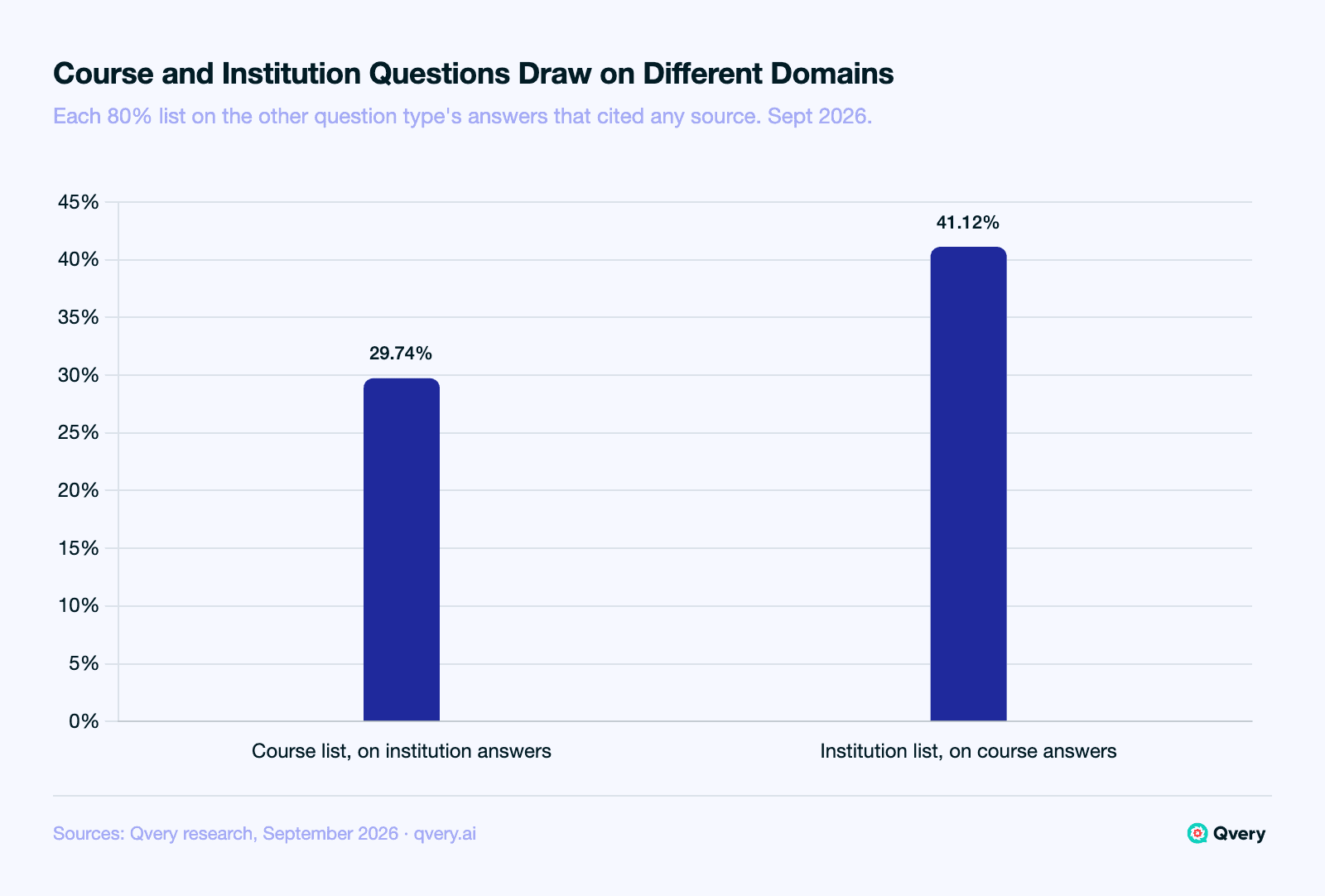
Then we swapped them. The course and provider list covered 29.74% of the institution answers that cited any source. The institution list covered 41.12% of the course and provider answers that cited any source.
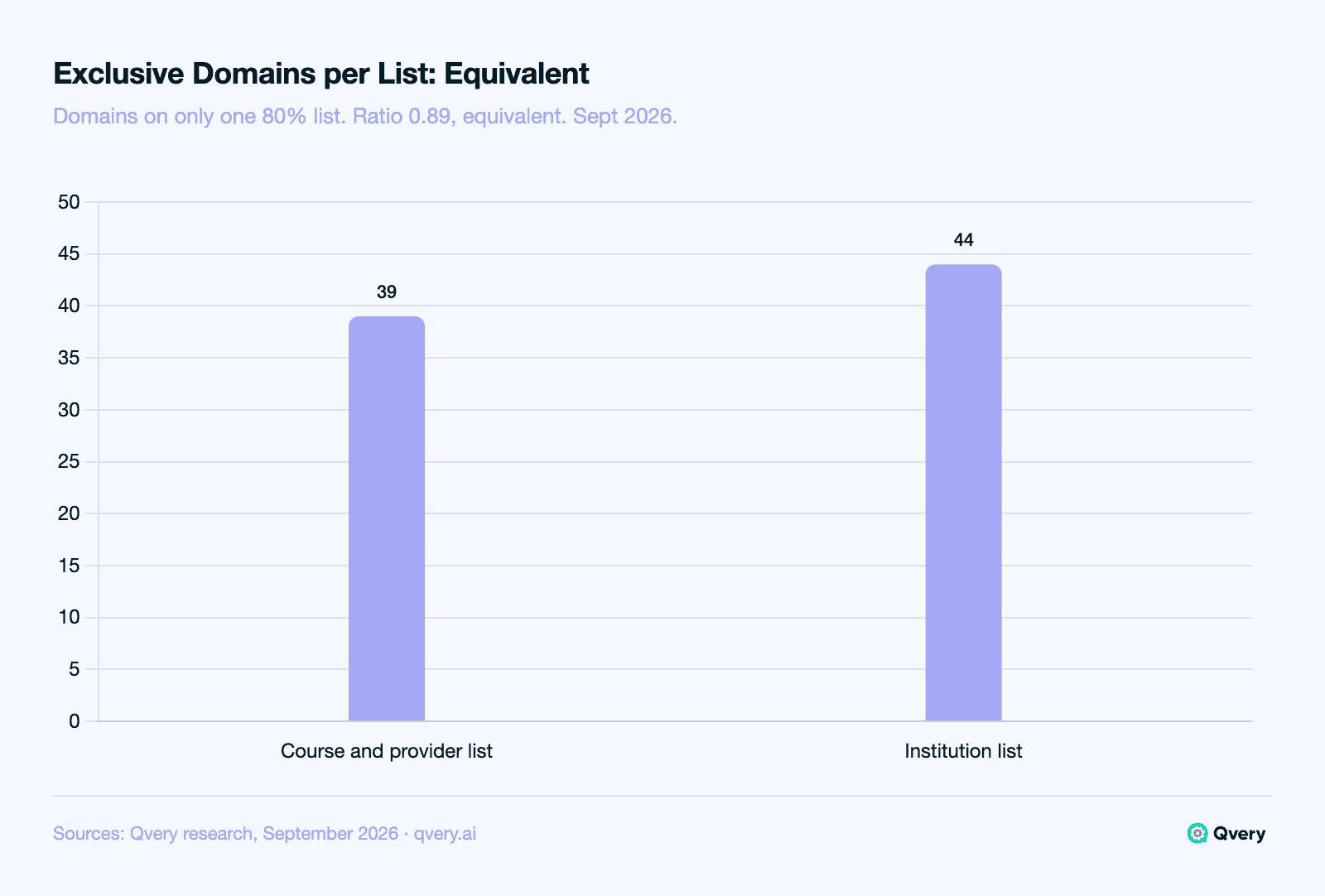
We also counted the domains only one list holds: 39 on the course and provider side, 44 on the institution side. The ratio is 0.89, which sits in the band we set in advance as equivalent. We had predicted the course and provider side would hold far more exclusive domains, and it did not.
Here is the point of this section. A domain's place on either list says nothing about which move, page feature or tactic put it there. So nothing here ranks the checklist, and nothing here tells you which card to do first.
The higher education marketing guide quoted above also makes a measurement point that this data does back: "Measurement is more complex because AI responses can vary by platform, prompt wording, location, personalization, and available sources." Two question types that share only nine domains are a direct case of it.
Whether education brands need one audit list or two is decided in measuring education brand AI visibility, and course-specific tactics are in getting AI search engines to recommend your online course.
Run the Measurement Card in Qvery
The tenth card, measurement, is the one Qvery runs for you.
Set up paired questions: course and provider questions and institution questions for the programs you sell. Building tracking queries covers how, and you add and edit them through Qvery Assistant.
Qvery tracks visibility, share of voice and average rank on those questions daily across ChatGPT and Google AI Mode, in 200+ countries.
Every citation is tied to the query and engine that produced it, so you can see which domains your own questions return, and run the surface checks from the cards on them.
To ask instead of filter, open Qvery Assistant in the app and ask about your own visibility, share of voice or citations in plain language.
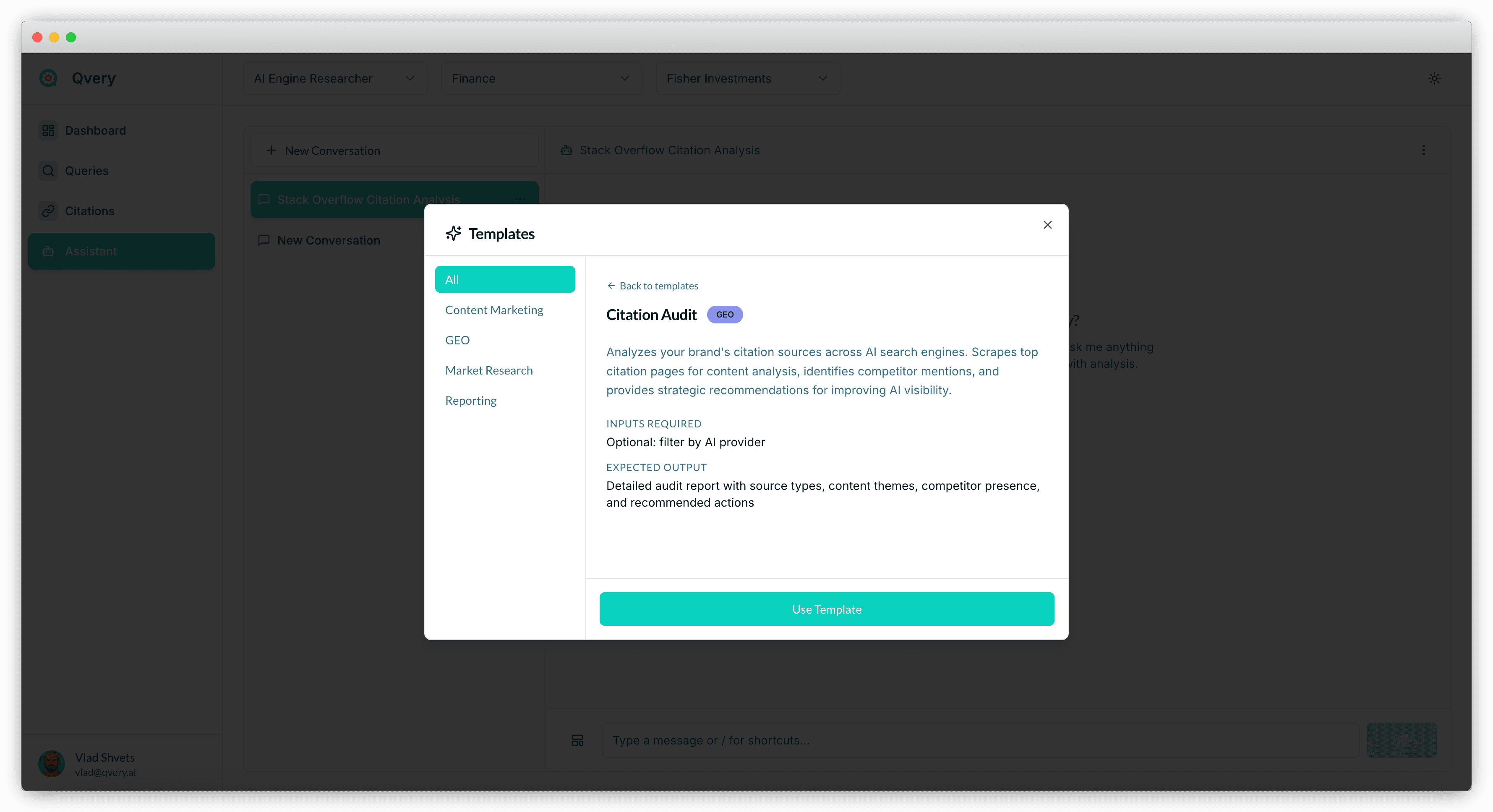
This shows which domains are cited, not what is on their pages, so it feeds the admission test rather than settling a card.
Start a free 7-day trial of Qvery, no credit card required, and put your paired questions in before you fund the next checklist item.
What This Research Cannot Settle
Domains only. It measured which domains the answers cited, for two paired sets of education questions.
No tactic results. It establishes no page feature, no tactic result, no naming or recommendation rate, and no explanation of why a domain was cited.
No engine claim. No Google AI Mode figure prints, because each question type rests on too few of its answers, and no per-engine split is claimed.
ChatGPT-weighted. Pooled figures carry three ChatGPT answers for every two from Google AI Mode.
This month only. Nothing is compared with an earlier month.
Grade Every Move Before You Spend on It
Run every move on this checklist, these ten and any other, through the admission test before you spend on it.
Name the surface or the page feature the move claims, name the owner, name the check, and treat the move as a hypothesis on your own questions until that evidence exists.
This is a ten-move checklist for education brands, and the test each move has to pass before you spend money on it.
If you market courses or an institution, you have probably seen the ten already: aggregator listings, alumni reviews, an outcomes page, Course schema, subreddits, instructor videos, comparison mentions, your own best-of list, entity work, and measurement.
The evidence behind each one is harder to find. So we asked ChatGPT and Google AI Mode course and provider questions and institution questions in September 2026, and checked what the answers cited against what each move claims.
The short version: none of the ten moves is tested by this research, which says nothing against any of them. Each move is a hypothesis until it passes a specific test, and this post gives you the test, the owner, and the check for all ten.
Once a move clears its test, you can do it on evidence; until then, verify it on your own questions before you scale it. One boundary throughout: we measured which domains the answers cited, never what was on the pages.
The Admission Test Every Move Has to Pass
Every move on an AEO checklist makes one of two kinds of claim, and each kind needs its own evidence.
A surface claim says a kind of site gets cited, like aggregators or review sites. It needs the named set of domains written down and hand-checked before anyone reads the answers, so the list cannot bend toward the result.
A page-feature claim says something on a page gets it cited, like schema or an outcomes section. It needs its own page check: which pages count decided before fetching, at least thirty pages in each group you compare, and the unresolved pages reported beside every rate.
This research registered one instrument, over domains: which domains the answers cited. It registered no named set and no page check for any of the ten moves. That is why every move below is untested here, which is different from absent, ineffective or recommended.
Some commentary goes further. One higher education marketing guide says an institution "may earn citations because its program pages, FAQs, admissions information, and website structure provide clear answers to specific questions."
A study of AI Overviews citations reports that "four page-level signals stood out as having the largest independent effect on citation rate: domain authority, schema markup presence, content length, and the presence of named-source citations in the body of the page."
Both are page-level claims. Our data measured which domains were cited, so it can neither confirm nor refute a page-level effect, and no card below leans on either quotation for support.
The Ten Moves, Each With an Owner and a Check
Every card below is untested in this research. Each gives you who owns the evidence and what the check is.
1. Aggregator Listing
Owner: whoever owns off-site listings and distribution. Check: name the aggregator domains you would count before you look at any answer, hand-check that list, then record how often any of them is cited in your own tracked answers.
2. Alumni Reviews
Owner: the reputation or student-communications owner. Check: the same shape, on the review domains you name in advance.
3. Comparison-Layer Mentions
Owner: whoever owns placements and PR. Check: the same shape, on the comparison and roundup domains you name in advance.
4. Subreddit Presence
Owner: the community owner. Check: whether reddit.com is cited in your tracked answers comes straight from citation data. A claim about one particular subreddit is a different unit, and it needs its own measure with its own floor. Do not stretch a domain list to cover subreddits.
5. Named-Instructor YouTube
Owner: the video or content producer. Check: whether youtube.com is cited is available the same way. Whether a cited video names an instructor is a page-feature claim, so it needs the page check from the admission test.
6. Outcomes Page
Owner: the program marketing owner. Check: a page-feature claim. It stays untested until a page check exists, because a citation to a domain never shows what is on the page.
7. Course Schema
Owner: the web or technical owner. Check: a page-feature claim, with the same page check and the same bar.
8. Self-Published Best-Of List
Owner: the content lead. Check: a page-feature claim on a page you own, with the same page check and the same bar.
9. Entity Legitimacy
Owner: the brand owner. Check: nothing in this research measures entity recognition. Before this is a card, it needs its own registered measure, with its unit, floor and denominator written down.
10. Measurement
Owner: the marketing analyst or operations owner. Check: this is the card whose check is the workflow itself. Track paired course and provider questions and institution questions, and read the citations tied to each query and engine. The section on Qvery below shows how.
Two Question Sets, and Why They Cannot Rank the List
What the research does support is narrower, and it is useful: course and provider questions and institution questions draw on different domains, so they are worth verifying separately.
For each question type we built a list of domains, adding at each step the domain that covered the most answers not yet covered, until the list reached 80% of the answers that cited any source.
Course and provider, 48 domains: coursera.org, reddit.com, grow.google, tripleten.com, aapc.com, aws.amazon.com, clinicalskillsinstitute.com, shrm.org, skillcatapp.com, aws.org, cidq.org, domestika.org, examprep.org, pmi.org, aacnnursing.org, accaglobal.com, apprenticeships.gov.uk, autodesk.com, cna-aiic.ca, dslrphotographycourses.com, electricalexam.ca, niccs.cisa.gov, pathunbound.com, apexlearning.org.uk, bookkeepercertprep.com, ccc.edu, cdph.ca.gov, f3usa.org, forbes.com, jobcorps.gov, nccer.org, nsw.gov.au, nurse.com, opensignalpdx.org, sites.google.com, usnews.com, zerotomastery.io, abcva.org, aberdeenphotographygroup.co.uk, academyart.edu, acca.org, accohio.org, adha.org, apps.hhs.texas.gov, ashcandigital.com, ashtoncollege.ca, asid.org, bankersbyday.com.
Institutions, 53 domains: onlineu.com, pennfoster.edu, coursera.org, reddit.com, research.com, coned.georgebrown.ca, lackawanna.edu, online.arizona.edu, osha.gov, cdph.ca.gov, online.colostate.edu, abhes.org, academyart.edu, cida.org, findapprenticeshiptraining.apprenticeships.education.gov.uk, google.com, online.drexel.edu, abcbaltimore.org, agitraining.com, appily.com, arts.ac.uk, aws.org, citylit.ac.uk, classcentral.com, cna-aiic.ca, devry.edu, educations.com, elearning.ontariohealth.ca, gmac.com, hcfl.edu, ivytech.edu, nextgenlearning.org.uk, nursing.georgetown.edu, oregon.gov, ucas.com, aaaconstructionschool.com, academics.charlotte.edu, acca.org, ageuk.org.uk, ahasti.ca, apprenticeships.gov.uk, apps.health.ny.gov, athomeprep.com, austindentalhygiene.org, autodesk.com, bark.com, berkshirecc.edu, bmcc.cuny.edu, bradford.ac.uk, brighton.ac.uk, bsu.edu, cah.ucf.edu, campusnet.uh.edu.
Nine domains sit on both lists: academyart.edu, acca.org, apprenticeships.gov.uk, autodesk.com, aws.org, cdph.ca.gov, cna-aiic.ca, coursera.org and reddit.com.
Then we swapped them. The course and provider list covered 29.74% of the institution answers that cited any source. The institution list covered 41.12% of the course and provider answers that cited any source.
We also counted the domains only one list holds: 39 on the course and provider side, 44 on the institution side. The ratio is 0.89, which sits in the band we set in advance as equivalent. We had predicted the course and provider side would hold far more exclusive domains, and it did not.
Here is the point of this section. A domain's place on either list says nothing about which move, page feature or tactic put it there. So nothing here ranks the checklist, and nothing here tells you which card to do first.
The higher education marketing guide quoted above also makes a measurement point that this data does back: "Measurement is more complex because AI responses can vary by platform, prompt wording, location, personalization, and available sources." Two question types that share only nine domains are a direct case of it.
Whether education brands need one audit list or two is decided in measuring education brand AI visibility, and course-specific tactics are in getting AI search engines to recommend your online course.
Run the Measurement Card in Qvery
The tenth card, measurement, is the one Qvery runs for you.
Set up paired questions: course and provider questions and institution questions for the programs you sell. Building tracking queries covers how, and you add and edit them through Qvery Assistant.
Qvery tracks visibility, share of voice and average rank on those questions daily across ChatGPT and Google AI Mode, in 200+ countries.
Every citation is tied to the query and engine that produced it, so you can see which domains your own questions return, and run the surface checks from the cards on them.
To ask instead of filter, open Qvery Assistant in the app and ask about your own visibility, share of voice or citations in plain language.
This shows which domains are cited, not what is on their pages, so it feeds the admission test rather than settling a card.
Start a free 7-day trial of Qvery, no credit card required, and put your paired questions in before you fund the next checklist item.
What This Research Cannot Settle
Domains only. It measured which domains the answers cited, for two paired sets of education questions.
No tactic results. It establishes no page feature, no tactic result, no naming or recommendation rate, and no explanation of why a domain was cited.
No engine claim. No Google AI Mode figure prints, because each question type rests on too few of its answers, and no per-engine split is claimed.
ChatGPT-weighted. Pooled figures carry three ChatGPT answers for every two from Google AI Mode.
This month only. Nothing is compared with an earlier month.
Grade Every Move Before You Spend on It
Run every move on this checklist, these ten and any other, through the admission test before you spend on it.
Name the surface or the page feature the move claims, name the owner, name the check, and treat the move as a hypothesis on your own questions until that evidence exists.
This is a ten-move checklist for education brands, and the test each move has to pass before you spend money on it.
If you market courses or an institution, you have probably seen the ten already: aggregator listings, alumni reviews, an outcomes page, Course schema, subreddits, instructor videos, comparison mentions, your own best-of list, entity work, and measurement.
The evidence behind each one is harder to find. So we asked ChatGPT and Google AI Mode course and provider questions and institution questions in September 2026, and checked what the answers cited against what each move claims.
The short version: none of the ten moves is tested by this research, which says nothing against any of them. Each move is a hypothesis until it passes a specific test, and this post gives you the test, the owner, and the check for all ten.
Once a move clears its test, you can do it on evidence; until then, verify it on your own questions before you scale it. One boundary throughout: we measured which domains the answers cited, never what was on the pages.
The Admission Test Every Move Has to Pass
Every move on an AEO checklist makes one of two kinds of claim, and each kind needs its own evidence.
A surface claim says a kind of site gets cited, like aggregators or review sites. It needs the named set of domains written down and hand-checked before anyone reads the answers, so the list cannot bend toward the result.
A page-feature claim says something on a page gets it cited, like schema or an outcomes section. It needs its own page check: which pages count decided before fetching, at least thirty pages in each group you compare, and the unresolved pages reported beside every rate.
This research registered one instrument, over domains: which domains the answers cited. It registered no named set and no page check for any of the ten moves. That is why every move below is untested here, which is different from absent, ineffective or recommended.
Some commentary goes further. One higher education marketing guide says an institution "may earn citations because its program pages, FAQs, admissions information, and website structure provide clear answers to specific questions."
A study of AI Overviews citations reports that "four page-level signals stood out as having the largest independent effect on citation rate: domain authority, schema markup presence, content length, and the presence of named-source citations in the body of the page."
Both are page-level claims. Our data measured which domains were cited, so it can neither confirm nor refute a page-level effect, and no card below leans on either quotation for support.
The Ten Moves, Each With an Owner and a Check
Every card below is untested in this research. Each gives you who owns the evidence and what the check is.
1. Aggregator Listing
Owner: whoever owns off-site listings and distribution. Check: name the aggregator domains you would count before you look at any answer, hand-check that list, then record how often any of them is cited in your own tracked answers.
2. Alumni Reviews
Owner: the reputation or student-communications owner. Check: the same shape, on the review domains you name in advance.
3. Comparison-Layer Mentions
Owner: whoever owns placements and PR. Check: the same shape, on the comparison and roundup domains you name in advance.
4. Subreddit Presence
Owner: the community owner. Check: whether reddit.com is cited in your tracked answers comes straight from citation data. A claim about one particular subreddit is a different unit, and it needs its own measure with its own floor. Do not stretch a domain list to cover subreddits.
5. Named-Instructor YouTube
Owner: the video or content producer. Check: whether youtube.com is cited is available the same way. Whether a cited video names an instructor is a page-feature claim, so it needs the page check from the admission test.
6. Outcomes Page
Owner: the program marketing owner. Check: a page-feature claim. It stays untested until a page check exists, because a citation to a domain never shows what is on the page.
7. Course Schema
Owner: the web or technical owner. Check: a page-feature claim, with the same page check and the same bar.
8. Self-Published Best-Of List
Owner: the content lead. Check: a page-feature claim on a page you own, with the same page check and the same bar.
9. Entity Legitimacy
Owner: the brand owner. Check: nothing in this research measures entity recognition. Before this is a card, it needs its own registered measure, with its unit, floor and denominator written down.
10. Measurement
Owner: the marketing analyst or operations owner. Check: this is the card whose check is the workflow itself. Track paired course and provider questions and institution questions, and read the citations tied to each query and engine. The section on Qvery below shows how.
Two Question Sets, and Why They Cannot Rank the List
What the research does support is narrower, and it is useful: course and provider questions and institution questions draw on different domains, so they are worth verifying separately.
For each question type we built a list of domains, adding at each step the domain that covered the most answers not yet covered, until the list reached 80% of the answers that cited any source.
Course and provider, 48 domains: coursera.org, reddit.com, grow.google, tripleten.com, aapc.com, aws.amazon.com, clinicalskillsinstitute.com, shrm.org, skillcatapp.com, aws.org, cidq.org, domestika.org, examprep.org, pmi.org, aacnnursing.org, accaglobal.com, apprenticeships.gov.uk, autodesk.com, cna-aiic.ca, dslrphotographycourses.com, electricalexam.ca, niccs.cisa.gov, pathunbound.com, apexlearning.org.uk, bookkeepercertprep.com, ccc.edu, cdph.ca.gov, f3usa.org, forbes.com, jobcorps.gov, nccer.org, nsw.gov.au, nurse.com, opensignalpdx.org, sites.google.com, usnews.com, zerotomastery.io, abcva.org, aberdeenphotographygroup.co.uk, academyart.edu, acca.org, accohio.org, adha.org, apps.hhs.texas.gov, ashcandigital.com, ashtoncollege.ca, asid.org, bankersbyday.com.
Institutions, 53 domains: onlineu.com, pennfoster.edu, coursera.org, reddit.com, research.com, coned.georgebrown.ca, lackawanna.edu, online.arizona.edu, osha.gov, cdph.ca.gov, online.colostate.edu, abhes.org, academyart.edu, cida.org, findapprenticeshiptraining.apprenticeships.education.gov.uk, google.com, online.drexel.edu, abcbaltimore.org, agitraining.com, appily.com, arts.ac.uk, aws.org, citylit.ac.uk, classcentral.com, cna-aiic.ca, devry.edu, educations.com, elearning.ontariohealth.ca, gmac.com, hcfl.edu, ivytech.edu, nextgenlearning.org.uk, nursing.georgetown.edu, oregon.gov, ucas.com, aaaconstructionschool.com, academics.charlotte.edu, acca.org, ageuk.org.uk, ahasti.ca, apprenticeships.gov.uk, apps.health.ny.gov, athomeprep.com, austindentalhygiene.org, autodesk.com, bark.com, berkshirecc.edu, bmcc.cuny.edu, bradford.ac.uk, brighton.ac.uk, bsu.edu, cah.ucf.edu, campusnet.uh.edu.
Nine domains sit on both lists: academyart.edu, acca.org, apprenticeships.gov.uk, autodesk.com, aws.org, cdph.ca.gov, cna-aiic.ca, coursera.org and reddit.com.
Then we swapped them. The course and provider list covered 29.74% of the institution answers that cited any source. The institution list covered 41.12% of the course and provider answers that cited any source.
We also counted the domains only one list holds: 39 on the course and provider side, 44 on the institution side. The ratio is 0.89, which sits in the band we set in advance as equivalent. We had predicted the course and provider side would hold far more exclusive domains, and it did not.
Here is the point of this section. A domain's place on either list says nothing about which move, page feature or tactic put it there. So nothing here ranks the checklist, and nothing here tells you which card to do first.
The higher education marketing guide quoted above also makes a measurement point that this data does back: "Measurement is more complex because AI responses can vary by platform, prompt wording, location, personalization, and available sources." Two question types that share only nine domains are a direct case of it.
Whether education brands need one audit list or two is decided in measuring education brand AI visibility, and course-specific tactics are in getting AI search engines to recommend your online course.
Run the Measurement Card in Qvery
The tenth card, measurement, is the one Qvery runs for you.
Set up paired questions: course and provider questions and institution questions for the programs you sell. Building tracking queries covers how, and you add and edit them through Qvery Assistant.
Qvery tracks visibility, share of voice and average rank on those questions daily across ChatGPT and Google AI Mode, in 200+ countries.
Every citation is tied to the query and engine that produced it, so you can see which domains your own questions return, and run the surface checks from the cards on them.
To ask instead of filter, open Qvery Assistant in the app and ask about your own visibility, share of voice or citations in plain language.
This shows which domains are cited, not what is on their pages, so it feeds the admission test rather than settling a card.
Start a free 7-day trial of Qvery, no credit card required, and put your paired questions in before you fund the next checklist item.
What This Research Cannot Settle
Domains only. It measured which domains the answers cited, for two paired sets of education questions.
No tactic results. It establishes no page feature, no tactic result, no naming or recommendation rate, and no explanation of why a domain was cited.
No engine claim. No Google AI Mode figure prints, because each question type rests on too few of its answers, and no per-engine split is claimed.
ChatGPT-weighted. Pooled figures carry three ChatGPT answers for every two from Google AI Mode.
This month only. Nothing is compared with an earlier month.
Grade Every Move Before You Spend on It
Run every move on this checklist, these ten and any other, through the admission test before you spend on it.
Name the surface or the page feature the move claims, name the owner, name the check, and treat the move as a hypothesis on your own questions until that evidence exists.
This is a ten-move checklist for education brands, and the test each move has to pass before you spend money on it.
If you market courses or an institution, you have probably seen the ten already: aggregator listings, alumni reviews, an outcomes page, Course schema, subreddits, instructor videos, comparison mentions, your own best-of list, entity work, and measurement.
The evidence behind each one is harder to find. So we asked ChatGPT and Google AI Mode course and provider questions and institution questions in September 2026, and checked what the answers cited against what each move claims.
The short version: none of the ten moves is tested by this research, which says nothing against any of them. Each move is a hypothesis until it passes a specific test, and this post gives you the test, the owner, and the check for all ten.
Once a move clears its test, you can do it on evidence; until then, verify it on your own questions before you scale it. One boundary throughout: we measured which domains the answers cited, never what was on the pages.
The Admission Test Every Move Has to Pass
Every move on an AEO checklist makes one of two kinds of claim, and each kind needs its own evidence.
A surface claim says a kind of site gets cited, like aggregators or review sites. It needs the named set of domains written down and hand-checked before anyone reads the answers, so the list cannot bend toward the result.
A page-feature claim says something on a page gets it cited, like schema or an outcomes section. It needs its own page check: which pages count decided before fetching, at least thirty pages in each group you compare, and the unresolved pages reported beside every rate.
This research registered one instrument, over domains: which domains the answers cited. It registered no named set and no page check for any of the ten moves. That is why every move below is untested here, which is different from absent, ineffective or recommended.
Some commentary goes further. One higher education marketing guide says an institution "may earn citations because its program pages, FAQs, admissions information, and website structure provide clear answers to specific questions."
A study of AI Overviews citations reports that "four page-level signals stood out as having the largest independent effect on citation rate: domain authority, schema markup presence, content length, and the presence of named-source citations in the body of the page."
Both are page-level claims. Our data measured which domains were cited, so it can neither confirm nor refute a page-level effect, and no card below leans on either quotation for support.
The Ten Moves, Each With an Owner and a Check
Every card below is untested in this research. Each gives you who owns the evidence and what the check is.
1. Aggregator Listing
Owner: whoever owns off-site listings and distribution. Check: name the aggregator domains you would count before you look at any answer, hand-check that list, then record how often any of them is cited in your own tracked answers.
2. Alumni Reviews
Owner: the reputation or student-communications owner. Check: the same shape, on the review domains you name in advance.
3. Comparison-Layer Mentions
Owner: whoever owns placements and PR. Check: the same shape, on the comparison and roundup domains you name in advance.
4. Subreddit Presence
Owner: the community owner. Check: whether reddit.com is cited in your tracked answers comes straight from citation data. A claim about one particular subreddit is a different unit, and it needs its own measure with its own floor. Do not stretch a domain list to cover subreddits.
5. Named-Instructor YouTube
Owner: the video or content producer. Check: whether youtube.com is cited is available the same way. Whether a cited video names an instructor is a page-feature claim, so it needs the page check from the admission test.
6. Outcomes Page
Owner: the program marketing owner. Check: a page-feature claim. It stays untested until a page check exists, because a citation to a domain never shows what is on the page.
7. Course Schema
Owner: the web or technical owner. Check: a page-feature claim, with the same page check and the same bar.
8. Self-Published Best-Of List
Owner: the content lead. Check: a page-feature claim on a page you own, with the same page check and the same bar.
9. Entity Legitimacy
Owner: the brand owner. Check: nothing in this research measures entity recognition. Before this is a card, it needs its own registered measure, with its unit, floor and denominator written down.
10. Measurement
Owner: the marketing analyst or operations owner. Check: this is the card whose check is the workflow itself. Track paired course and provider questions and institution questions, and read the citations tied to each query and engine. The section on Qvery below shows how.
Two Question Sets, and Why They Cannot Rank the List
What the research does support is narrower, and it is useful: course and provider questions and institution questions draw on different domains, so they are worth verifying separately.
For each question type we built a list of domains, adding at each step the domain that covered the most answers not yet covered, until the list reached 80% of the answers that cited any source.
Course and provider, 48 domains: coursera.org, reddit.com, grow.google, tripleten.com, aapc.com, aws.amazon.com, clinicalskillsinstitute.com, shrm.org, skillcatapp.com, aws.org, cidq.org, domestika.org, examprep.org, pmi.org, aacnnursing.org, accaglobal.com, apprenticeships.gov.uk, autodesk.com, cna-aiic.ca, dslrphotographycourses.com, electricalexam.ca, niccs.cisa.gov, pathunbound.com, apexlearning.org.uk, bookkeepercertprep.com, ccc.edu, cdph.ca.gov, f3usa.org, forbes.com, jobcorps.gov, nccer.org, nsw.gov.au, nurse.com, opensignalpdx.org, sites.google.com, usnews.com, zerotomastery.io, abcva.org, aberdeenphotographygroup.co.uk, academyart.edu, acca.org, accohio.org, adha.org, apps.hhs.texas.gov, ashcandigital.com, ashtoncollege.ca, asid.org, bankersbyday.com.
Institutions, 53 domains: onlineu.com, pennfoster.edu, coursera.org, reddit.com, research.com, coned.georgebrown.ca, lackawanna.edu, online.arizona.edu, osha.gov, cdph.ca.gov, online.colostate.edu, abhes.org, academyart.edu, cida.org, findapprenticeshiptraining.apprenticeships.education.gov.uk, google.com, online.drexel.edu, abcbaltimore.org, agitraining.com, appily.com, arts.ac.uk, aws.org, citylit.ac.uk, classcentral.com, cna-aiic.ca, devry.edu, educations.com, elearning.ontariohealth.ca, gmac.com, hcfl.edu, ivytech.edu, nextgenlearning.org.uk, nursing.georgetown.edu, oregon.gov, ucas.com, aaaconstructionschool.com, academics.charlotte.edu, acca.org, ageuk.org.uk, ahasti.ca, apprenticeships.gov.uk, apps.health.ny.gov, athomeprep.com, austindentalhygiene.org, autodesk.com, bark.com, berkshirecc.edu, bmcc.cuny.edu, bradford.ac.uk, brighton.ac.uk, bsu.edu, cah.ucf.edu, campusnet.uh.edu.
Nine domains sit on both lists: academyart.edu, acca.org, apprenticeships.gov.uk, autodesk.com, aws.org, cdph.ca.gov, cna-aiic.ca, coursera.org and reddit.com.
Then we swapped them. The course and provider list covered 29.74% of the institution answers that cited any source. The institution list covered 41.12% of the course and provider answers that cited any source.
We also counted the domains only one list holds: 39 on the course and provider side, 44 on the institution side. The ratio is 0.89, which sits in the band we set in advance as equivalent. We had predicted the course and provider side would hold far more exclusive domains, and it did not.
Here is the point of this section. A domain's place on either list says nothing about which move, page feature or tactic put it there. So nothing here ranks the checklist, and nothing here tells you which card to do first.
The higher education marketing guide quoted above also makes a measurement point that this data does back: "Measurement is more complex because AI responses can vary by platform, prompt wording, location, personalization, and available sources." Two question types that share only nine domains are a direct case of it.
Whether education brands need one audit list or two is decided in measuring education brand AI visibility, and course-specific tactics are in getting AI search engines to recommend your online course.
Run the Measurement Card in Qvery
The tenth card, measurement, is the one Qvery runs for you.
Set up paired questions: course and provider questions and institution questions for the programs you sell. Building tracking queries covers how, and you add and edit them through Qvery Assistant.
Qvery tracks visibility, share of voice and average rank on those questions daily across ChatGPT and Google AI Mode, in 200+ countries.
Every citation is tied to the query and engine that produced it, so you can see which domains your own questions return, and run the surface checks from the cards on them.
To ask instead of filter, open Qvery Assistant in the app and ask about your own visibility, share of voice or citations in plain language.
This shows which domains are cited, not what is on their pages, so it feeds the admission test rather than settling a card.
Start a free 7-day trial of Qvery, no credit card required, and put your paired questions in before you fund the next checklist item.
What This Research Cannot Settle
Domains only. It measured which domains the answers cited, for two paired sets of education questions.
No tactic results. It establishes no page feature, no tactic result, no naming or recommendation rate, and no explanation of why a domain was cited.
No engine claim. No Google AI Mode figure prints, because each question type rests on too few of its answers, and no per-engine split is claimed.
ChatGPT-weighted. Pooled figures carry three ChatGPT answers for every two from Google AI Mode.
This month only. Nothing is compared with an earlier month.
Grade Every Move Before You Spend on It
Run every move on this checklist, these ten and any other, through the admission test before you spend on it.
Name the surface or the page feature the move claims, name the owner, name the check, and treat the move as a hypothesis on your own questions until that evidence exists.

© 2026 Qvery AI OÜ