By
Vlad Shvets
8 Best GEO Software Tools (Reviewed)
We reviewed eight GEO software tools and scored each on real Reddit sentiment, with pricing, features, and who each one fits best.
We reviewed eight GEO software tools and scored each on real Reddit sentiment, with pricing, features, and who each one fits best.
We reviewed eight GEO software tools and scored each on real Reddit sentiment, with pricing, features, and who each one fits best.
Right now every brand wants the same thing: to show up when ChatGPT and Google AI Mode start naming tools in their category.
The first step is measuring where you stand, and that means choosing GEO software you will open every week, not software you will admire once and forget. And the format you are reading does a lot of the heavy lifting in AI answers, because listicles make up 45.8% of the classifiable content AI engines cite. Yes, this one too.
We reviewed eight GEO software tools, compared them on features, pricing, and real Reddit sentiment, and pulled actual quotes from people who use them. Qvery is our own product, so it goes first and we are upfront about that. Here is which tool fits which use case.
1. Qvery: AI Agents That Do The Work For You
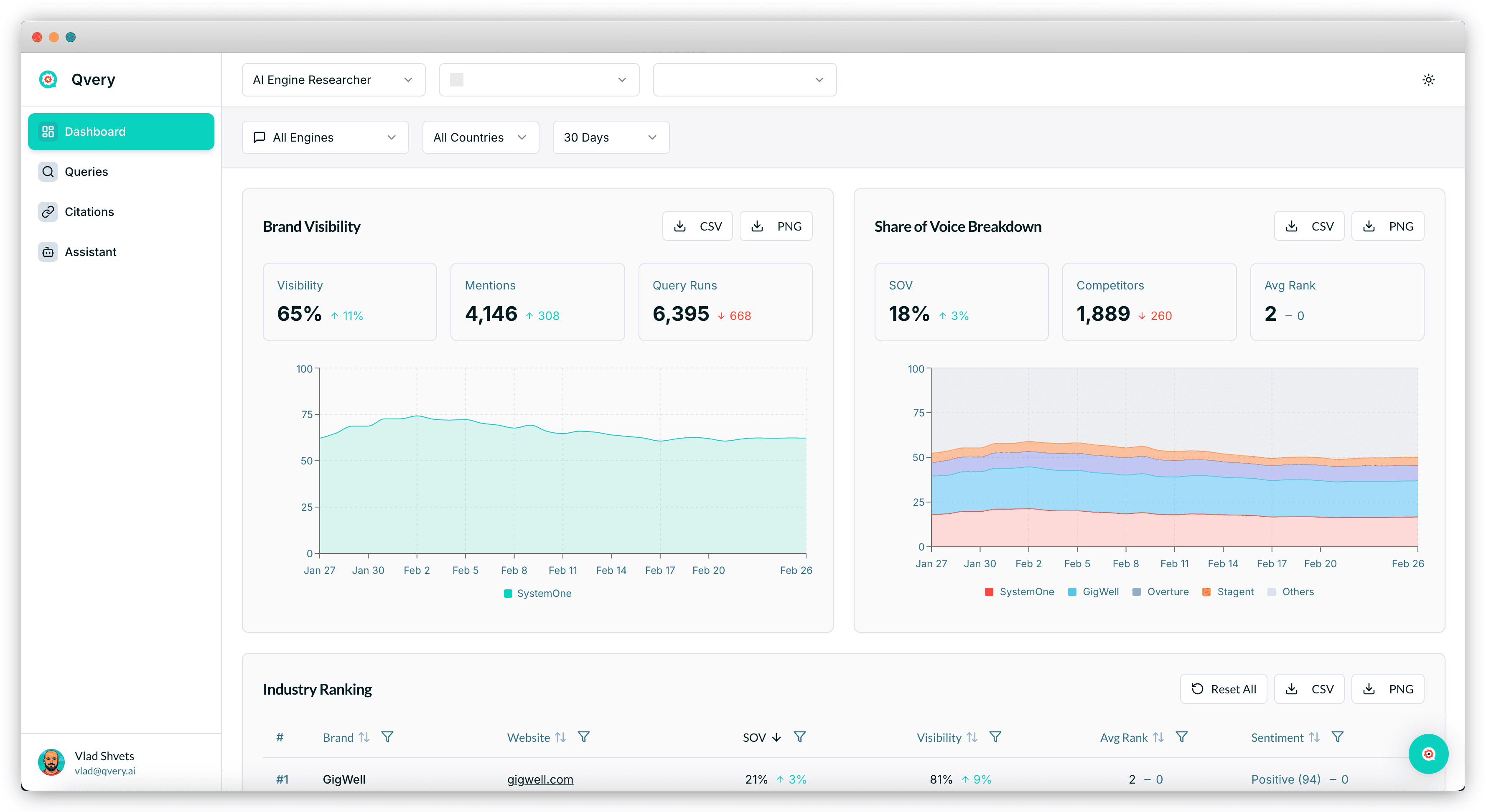
Yes, this is our product, and yes, we're biased. We'll still be straight about where it fits.
Key Features:
The AI Engine Researcher runs daily across ChatGPT and Google AI Mode in 200+ countries, capturing every citation.
The Qvery Assistant is a built-in AI command center: ask it for a content gap analysis, an llms.txt file, or a competitor report in a single prompt.
It tracks the three metrics that separate brands: visibility, share of voice, and average rank, plus sentiment.
Self-serve setup: sign up and see data in about 15 minutes, no sales call required.
Pricing:
Lite: EUR 99/mo (1 brand, 50 queries, daily runs, free trial)
Business: EUR 199/mo (unlimited brands, 100 queries, Slack support, free trial)
Enterprise: Custom (500+ queries, demo required)
Reddit Score: 97% Positive (very positive). What redditors say:
"I use a tool called Qvery, it helps me see content visibility, which gives me a great direction of what genuinely ranks and what doesn't" (r/SEO_LLM)
"I used Qvery to get data and to track AI mentions across relevant queries and I made it show what sources it was drawing from. I saw that I was at about 10% mention rate, which is too low against my competitors" (r/StartupsHelpStartups)
"Checked through Qvery AI, it monitors which AI engines are recommending you and for what queries" (r/Legalmarketing)
The thing that makes Qvery different is the Qvery Assistant. Most software in this category shows you a dashboard and leaves the work to you. Qvery is built around agents that do the work.
Need a content gap analysis or an llms.txt file for your site? One prompt each.
A non-technical marketer gets answers without learning a query language, and an experienced practitioner gets templates, shortcuts, and multi-step workflows that would otherwise eat a full afternoon. Same product, different depth depending on who is driving.
Tools track. Agents work. The question is whether your software hands you a dashboard or hands you the next move.
2. Profound: Best for Enterprise Marketing Teams
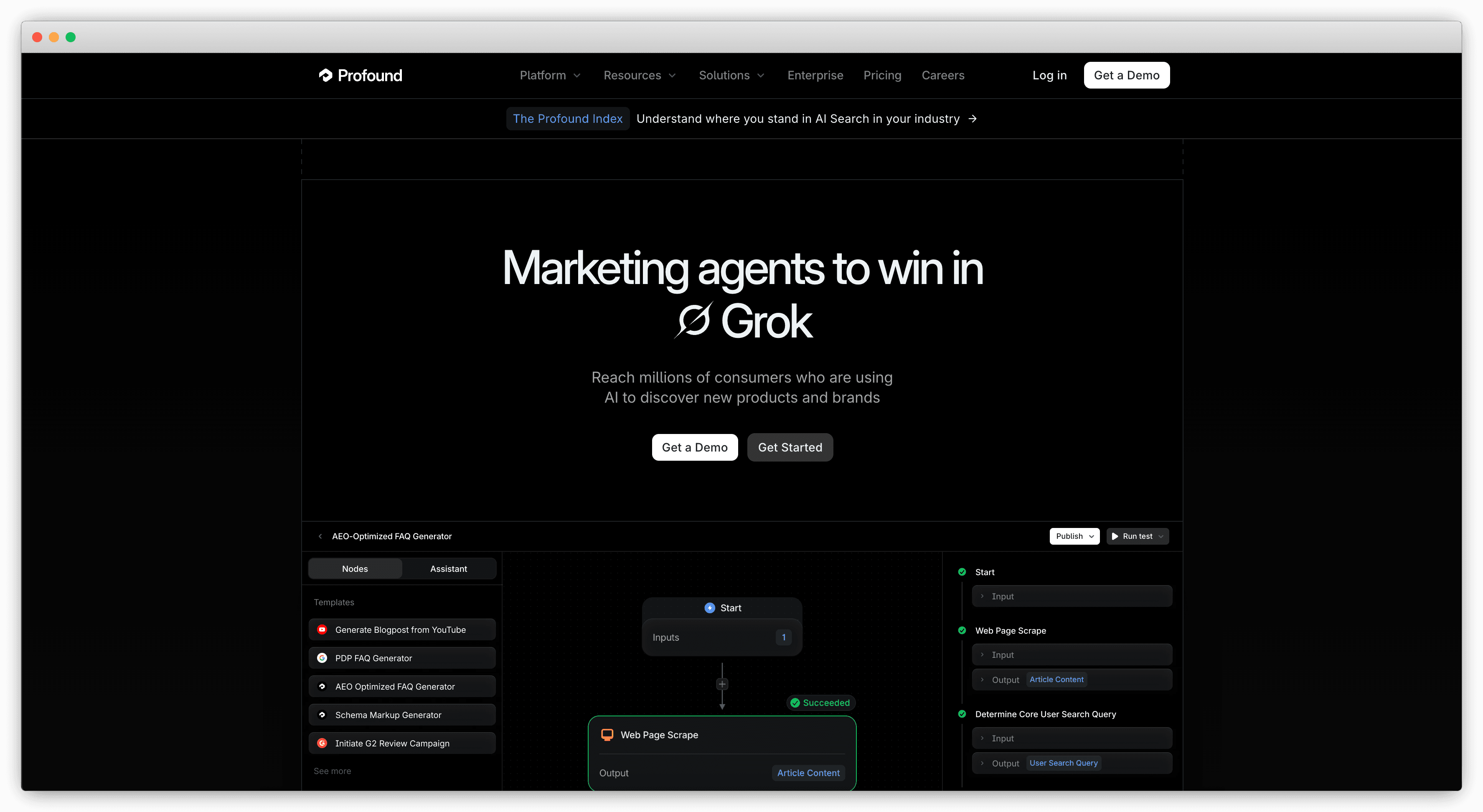
Key Features:
Answer Engine Insights tracks brand and competitor mentions, citations, and sentiment daily across up to 10 AI platforms.
Prompt Volumes shows what millions of users ask AI engines, mapping real demand.
Profound Agents are autonomous workers that generate and optimize AEO content.
Agent Analytics tracks how AI bots crawl and read your site.
Pricing:
Starter: from $99/mo (50 prompts, ChatGPT)
Growth: $399/mo (3 seats included, multiple engines)
Enterprise: Custom (up to 10 engines, API access, SSO, dedicated support)
Reddit Score: 86% Positive. What redditors say:
"The good tools like Profound do this properly with real statistical sampling" (r/AISearchLab)
In enterprise tool discussions, the recurring praise is depth: serious, large-scale tracking that holds up under real scrutiny.
Profound is the most feature-complete tool in this category, and it is built for teams that treat AI visibility as a budget line rather than an experiment. The depth is real: prompt volume intelligence, agent crawl analytics, and content agents under one roof. It has a setting for almost every setting, which is exactly what a large marketing org wants.
The trade-off is that all of that depth is aimed at scale. If you are a Fortune-class brand running AEO across regions and product lines, that scale pays for itself, and Profound is a natural standard to build on. If you are a three-person team, you will grow into a fraction of it.
3. Peec AI: Best for Agencies and Multi-Brand Teams
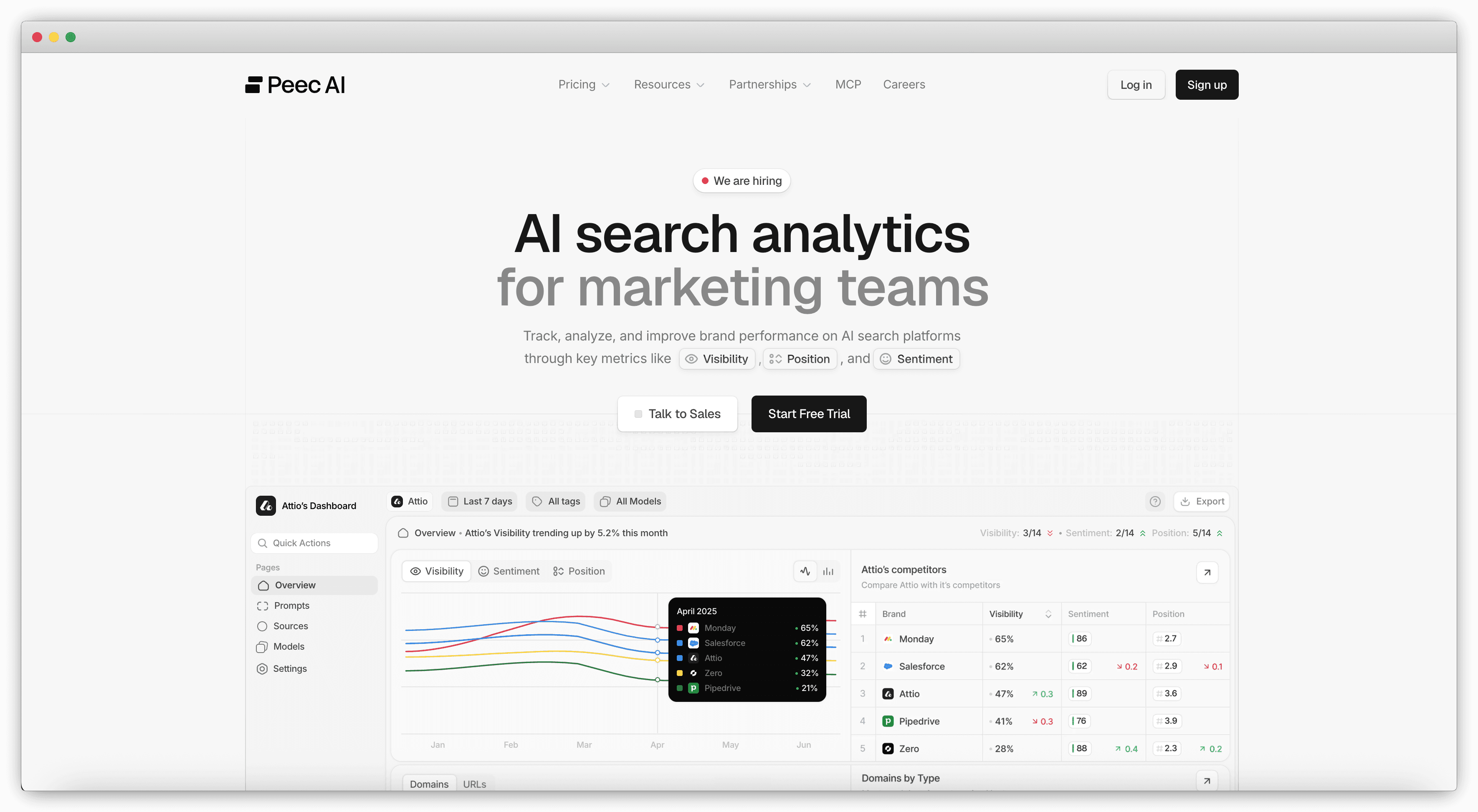
Key Features:
Tracks visibility, sentiment, and position across multiple AI models with a daily refresh.
Competitor benchmarking puts your share of voice and citations next to rivals, prompt by prompt.
Citation analysis shows which URLs and domains AI engines pull from when they answer.
Unlimited seats, 115+ language support, and MCP and API access to pipe data into Looker Studio, n8n, and your own workflows.
Pricing:
Starter: $95/mo (50 prompts, 3 models, unlimited users, 1 project)
Pro: $245/mo (150 prompts, 2 projects)
Advanced: $495/mo (350 prompts, 5 projects, multi-country, Looker Studio)
Enterprise: Custom, with a free trial available
Reddit Score: 85% Positive. What redditors say:
"Absolutely go with Peec. We've used both and the data is excellent. You get SOV, Sentiment, Ranking, and plenty of other info. It's got unlimited seats and better multi-language support too" (r/SEO_for_AI)
"Peec has clear sections and seems more user friendly" (r/SEO_for_AI)
Peec AI has become the agency favorite for a reason. The interface is clean enough that you can put it in front of a client without a translation layer, and the unlimited seats and 115+ language support make multi-brand, multi-market work genuinely manageable. The citation analysis is the standout: seeing which competitor-owned URLs influenced an answer where you were invisible is the kind of insight that reshapes a content plan.
The trade-off is depth on the recommendation side. Peec is excellent at showing you what is happening and very clear about it. Turning that clarity into a week-by-week action plan stays on your side of the table, which suits teams that already know what to do with the data.
4. Otterly.AI: Best for Getting Started Quickly
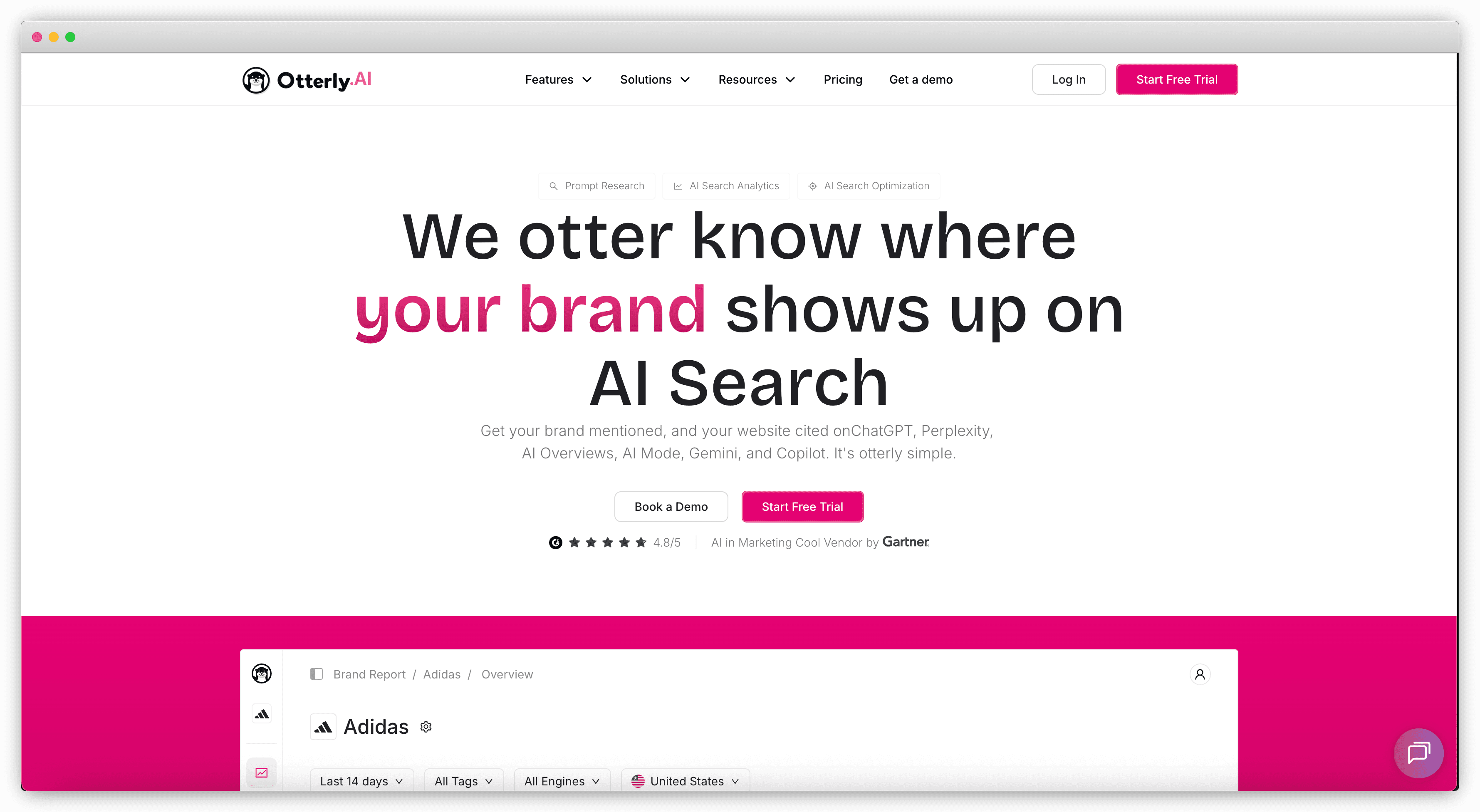
Key Features:
Monitors ChatGPT, Google AI Mode, and the other major AI engines in one place.
A GEO Audit and content briefs help you improve AI readiness page by page.
A free GEO tools suite: AI prompt research, query fan-out, content checks, and AI crawler simulation.
A Google Looker Studio connector for custom reporting.
Pricing:
Lite: $29/mo (15 prompts, 4 engines, unlimited team members, 1,000 GEO URL audits/mo)
Standard: $189/mo (100 prompts, Looker Studio, API access)
Premium: $489/mo (400 prompts, 10,000 audits/mo)
14-day free trial, no credit card required
Reddit Score: 84% Positive. What redditors say:
"For smaller teams or clients who just want simple monitoring, peec or otterly seem like the sensible picks without overcomplicating things" (r/GenerativeSEOstrategy)
"If you only need data monitoring, you can go with Otterly since it's more affordable" (r/SaaS)
If you want to start tracking this week without a budget meeting, Otterly is where you begin. At $29/mo for the entry plan, the barrier to entry is basically a rounding error, and you can be set up in under 10 minutes. It covers all the major engines and adds a surprisingly useful free GEO tools suite that earns its keep even if you never upgrade.
The trade-off is that Otterly is squarely a monitoring tool, built to show you where you stand rather than to execute a strategy for you. For a solo founder or a small team taking their first honest look at AI visibility, that is exactly the right amount of tool.
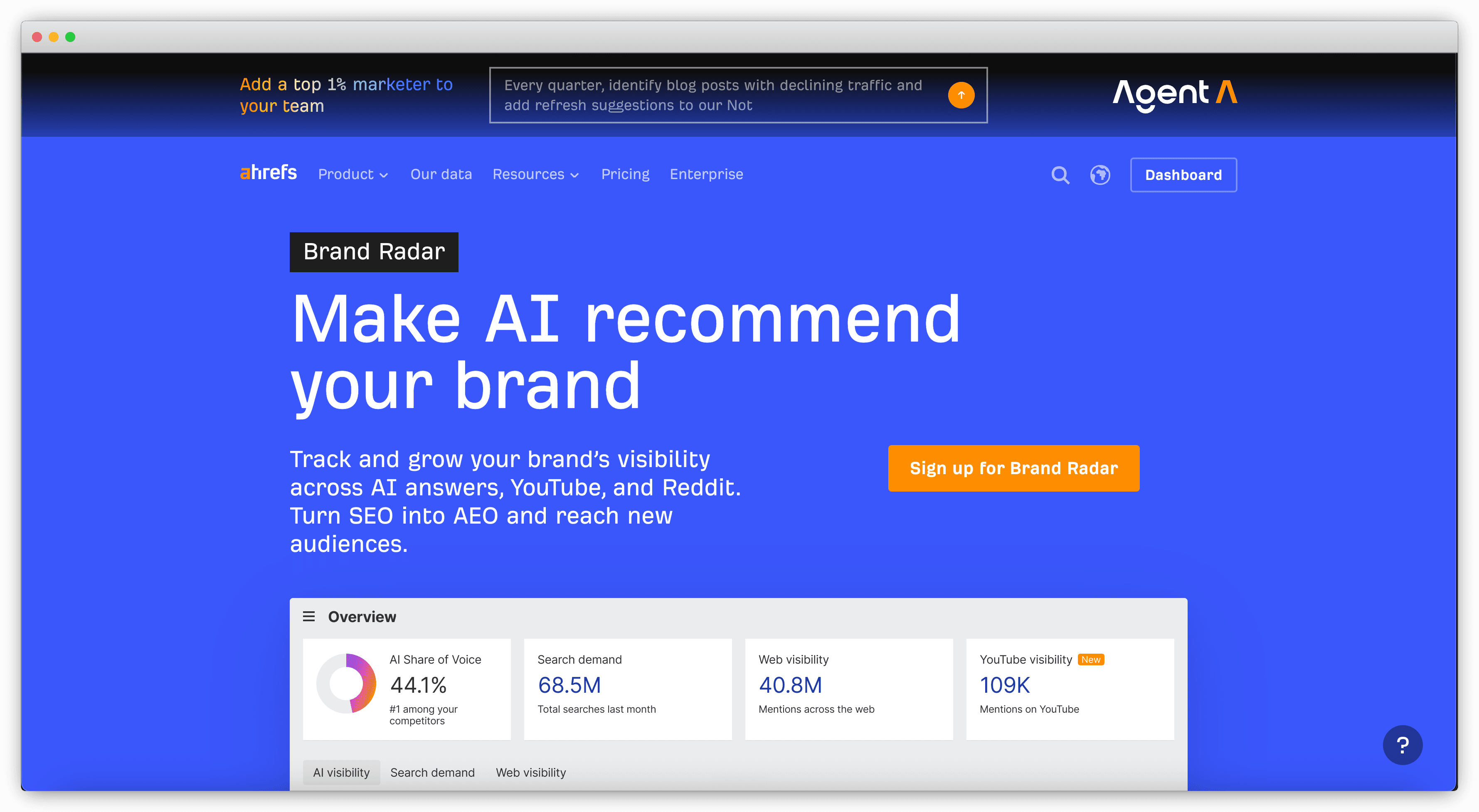
5. Ahrefs Brand Radar: Best for Teams Already Using Ahrefs
Key Features:
Tracks brand mentions and share of voice across ChatGPT, Google AI Mode, and more, drawn from Ahrefs' real query database.
Surfaces which third-party sources AI cites when it mentions your brand.
Includes YouTube, TikTok, and Reddit visibility tracking.
Lives inside the Ahrefs ecosystem, right next to your backlink and keyword data.
Pricing:
Bundled with Ahrefs plans: Lite $129/mo, Standard $249/mo, Advanced $449/mo, Enterprise $1,499/mo, each with tracked-prompt limits.
Brand Radar AI as a standalone add-on: Select platforms $398/mo, all platforms $699/mo (available even without a base Ahrefs plan).
Reddit Score: 83% Positive. What redditors say:
"The recent AI features (like Brand Radar and AI Content Kit) are impressive, definitely feels like you're staying ahead of the curve" (r/bigseo)
Among teams who already run Ahrefs, the recurring praise is convenience: AI visibility sitting next to the SEO data they check daily.
For the millions of teams already living in Ahrefs, Brand Radar is the natural way to add AI visibility without adopting a separate tool. The big advantage is the underlying data: Brand Radar reads from Ahrefs' enormous index of real search queries rather than synthetic prompts, which gives its share-of-voice numbers real weight. Seeing AI mentions next to your backlinks and keywords in one place is genuinely efficient.
The trade-off is that the richest AI data sits in a standalone add-on, so the full picture costs more than the base plan. For an Ahrefs-native team, that ecosystem advantage is the whole point, and it is a strong one.
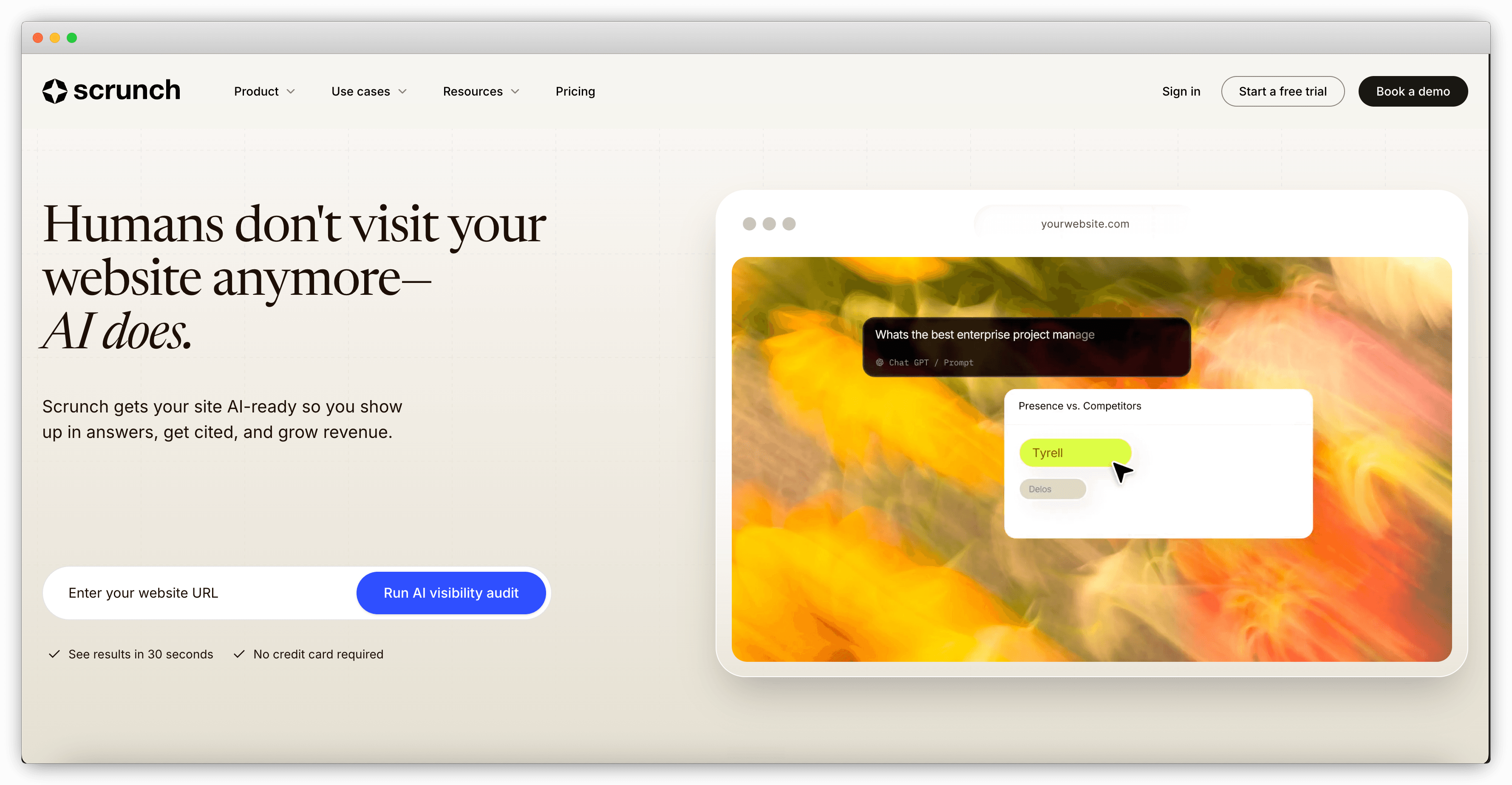
6. Scrunch AI: Best for Enterprise Agent Experience
Key Features:
Tracks citations and share of voice across up to nine LLMs, including ChatGPT and Google AI Mode.
The Agent Experience Platform (AXP) optimizes how AI agents and bots crawl and interpret your site.
Agent traffic analytics and page-level site maps show how AI reads you.
Shopping and SKU-level AI visibility for product catalogs.
Pricing:
Core: $250/mo (125 prompts, 4 engines, 5 site audits/mo, 7-day trial)
Enterprise: Custom (all nine LLMs, the AXP layer, API access, SSO)
Reddit Score: Limited public footprint. Scrunch is enterprise-first, so there are few user reviews on Reddit so far. The third-party signal that does exist is strong: Akamai reported a 364% increase in brand presence for non-branded prompts, and Scrunch was acquired by Sitecore in 2026.
Scrunch AI is interesting because it looks at a problem most tools skip. Beyond whether AI mentions you, Scrunch examines how AI agents read and move through your website. Its Agent Experience Platform optimizes your site structure for the way crawlers and agents consume it, which is a genuinely different angle from citation monitoring alone, and the agent traffic analytics give enterprise teams a view of AI bot behavior that few competitors match.
This is a tool for large brands and agencies with the resources to act on that depth. The Sitecore acquisition ties its roadmap to a major enterprise platform, which is reassuring if you are buying for the long term.
7. AthenaHQ: Best for Data-Driven GEO Teams
Key Features:
Tracks visibility, share of voice, citation rate, and sentiment across more than eight AI engines.
Blindspot detection finds queries where competitors appear and you do not.
Ask Athena is a copilot you can query in plain language over your own AEO data.
Citation source intelligence plus GA4, Google Search Console, and Shopify integrations.
Pricing:
Self-Serve: $295/mo monthly, or $95/mo billed annually (3,600 credits, eight LLMs, unlimited seats)
Enterprise: Custom (Citation Engine, deep research agent, SSO)
Reddit Score: Limited public footprint. Where it does come up, it is recommended as a focused specialist: "I would go for specialized ones such as AthenaHQ" (r/advertising). It is trusted by enterprise brands including Coinbase and SoFi, and is SOC 2 Type 2 certified.
AthenaHQ leans into depth and data. The blindspot detection is the kind of feature that earns its place, because finding the exact queries where rivals win and you are absent is where a real content plan starts. Ask Athena is a smart touch, letting you interrogate your own visibility data in plain language instead of hunting through dashboards.
With YC backing, enterprise logos, and serious security credentials, AthenaHQ is built for teams that want rigor and are ready to act on it. It fits brands that treat GEO as a measurable, data-driven discipline.
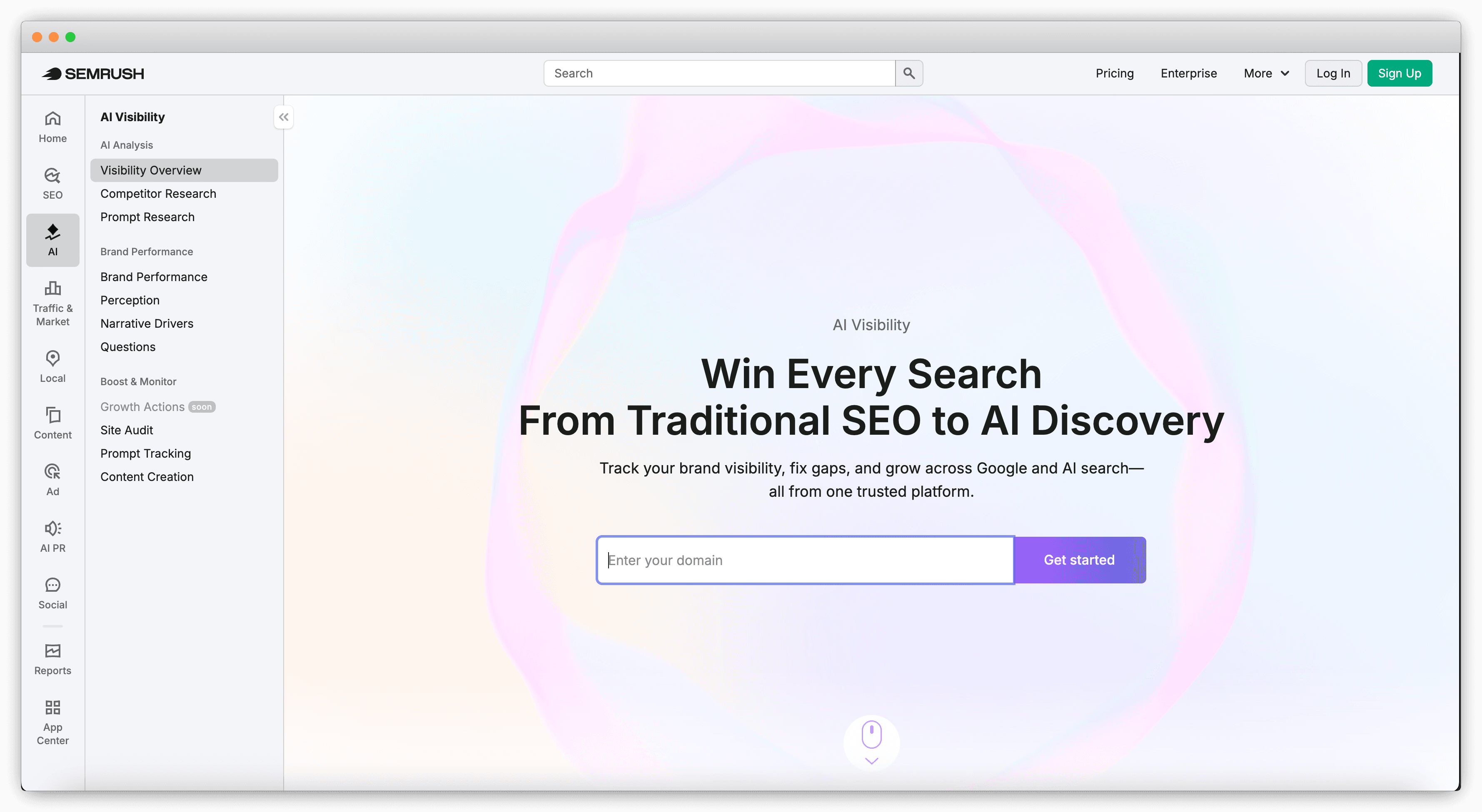
8. Semrush AI Visibility: Best for Existing Semrush Users
Key Features:
Reports a visibility score and share of voice across ChatGPT, Google AI Mode, and other AI engines.
Prompt research and competitor gap analysis for AI answers.
Brand sentiment tracking, engine by engine.
An AI-ready site audit built into the Site Audit you may already run.
Pricing:
SEO plan: $139/mo (basic AI visibility)
Pro+ (SEO + AI Search): $299/mo (100 prompts tracked daily)
Advanced: $549/mo (200 prompts tracked daily)
Enterprise: Custom
Reddit Score: 80% Positive among teams already on Semrush. What redditors say:
"I chose Semrush's AI Visibility Toolkit ... It builds onto the SEO tool ... It's easy to interpret ... it's much cheaper than some of the enterprise-geared tools that can go into thousands per month" (r/SaaS)
The value redditors point to is convenience: one platform for SEO and AI visibility, with reports clients can read.
If your team already lives in Semrush, the AI Visibility Toolkit is the path of least resistance. You get AI brand performance, prompt research, and competitor gaps inside the same suite you use for keywords and audits, and you can fold AI data into the same client reports. For many teams, that integration is worth more than a standalone tool with a steeper learning curve.
The trade-off is that AI visibility is newer than Semrush's core SEO product, so it reads as an addition to a mature suite rather than a purpose-built AEO platform. For an existing Semrush shop that wants one login, that is a fair deal.
How to Pick the Right One
Every tool here is building something real in a category that barely existed two years ago. The right one for you comes down to three questions: how big is your team, what is your budget, and do you want software that shows you data or an agent that does the work. A $29/mo tracker you open every Monday beats a $1,500/mo platform gathering dust until the quarterly review.
I won't pretend anyone has AI search fully figured out, us included, because the engines keep moving, but the teams that start measuring now are the ones who stop guessing. If you are just starting, begin simple and affordable; if you are running AEO across regions and product lines, the enterprise tools earn their price.
And if you want the measuring and the growing handled in one place, that is the gap we built Qvery to close. The longer you wait to start tracking your share of voice, the more invisible your brand becomes in AI search.
Right now every brand wants the same thing: to show up when ChatGPT and Google AI Mode start naming tools in their category.
The first step is measuring where you stand, and that means choosing GEO software you will open every week, not software you will admire once and forget. And the format you are reading does a lot of the heavy lifting in AI answers, because listicles make up 45.8% of the classifiable content AI engines cite. Yes, this one too.
We reviewed eight GEO software tools, compared them on features, pricing, and real Reddit sentiment, and pulled actual quotes from people who use them. Qvery is our own product, so it goes first and we are upfront about that. Here is which tool fits which use case.
1. Qvery: AI Agents That Do The Work For You
Yes, this is our product, and yes, we're biased. We'll still be straight about where it fits.
Key Features:
The AI Engine Researcher runs daily across ChatGPT and Google AI Mode in 200+ countries, capturing every citation.
The Qvery Assistant is a built-in AI command center: ask it for a content gap analysis, an llms.txt file, or a competitor report in a single prompt.
It tracks the three metrics that separate brands: visibility, share of voice, and average rank, plus sentiment.
Self-serve setup: sign up and see data in about 15 minutes, no sales call required.
Pricing:
Lite: EUR 99/mo (1 brand, 50 queries, daily runs, free trial)
Business: EUR 199/mo (unlimited brands, 100 queries, Slack support, free trial)
Enterprise: Custom (500+ queries, demo required)
Reddit Score: 97% Positive (very positive). What redditors say:
"I use a tool called Qvery, it helps me see content visibility, which gives me a great direction of what genuinely ranks and what doesn't" (r/SEO_LLM)
"I used Qvery to get data and to track AI mentions across relevant queries and I made it show what sources it was drawing from. I saw that I was at about 10% mention rate, which is too low against my competitors" (r/StartupsHelpStartups)
"Checked through Qvery AI, it monitors which AI engines are recommending you and for what queries" (r/Legalmarketing)
The thing that makes Qvery different is the Qvery Assistant. Most software in this category shows you a dashboard and leaves the work to you. Qvery is built around agents that do the work.
Need a content gap analysis or an llms.txt file for your site? One prompt each.
A non-technical marketer gets answers without learning a query language, and an experienced practitioner gets templates, shortcuts, and multi-step workflows that would otherwise eat a full afternoon. Same product, different depth depending on who is driving.
Tools track. Agents work. The question is whether your software hands you a dashboard or hands you the next move.
2. Profound: Best for Enterprise Marketing Teams
Key Features:
Answer Engine Insights tracks brand and competitor mentions, citations, and sentiment daily across up to 10 AI platforms.
Prompt Volumes shows what millions of users ask AI engines, mapping real demand.
Profound Agents are autonomous workers that generate and optimize AEO content.
Agent Analytics tracks how AI bots crawl and read your site.
Pricing:
Starter: from $99/mo (50 prompts, ChatGPT)
Growth: $399/mo (3 seats included, multiple engines)
Enterprise: Custom (up to 10 engines, API access, SSO, dedicated support)
Reddit Score: 86% Positive. What redditors say:
"The good tools like Profound do this properly with real statistical sampling" (r/AISearchLab)
In enterprise tool discussions, the recurring praise is depth: serious, large-scale tracking that holds up under real scrutiny.
Profound is the most feature-complete tool in this category, and it is built for teams that treat AI visibility as a budget line rather than an experiment. The depth is real: prompt volume intelligence, agent crawl analytics, and content agents under one roof. It has a setting for almost every setting, which is exactly what a large marketing org wants.
The trade-off is that all of that depth is aimed at scale. If you are a Fortune-class brand running AEO across regions and product lines, that scale pays for itself, and Profound is a natural standard to build on. If you are a three-person team, you will grow into a fraction of it.
3. Peec AI: Best for Agencies and Multi-Brand Teams
Key Features:
Tracks visibility, sentiment, and position across multiple AI models with a daily refresh.
Competitor benchmarking puts your share of voice and citations next to rivals, prompt by prompt.
Citation analysis shows which URLs and domains AI engines pull from when they answer.
Unlimited seats, 115+ language support, and MCP and API access to pipe data into Looker Studio, n8n, and your own workflows.
Pricing:
Starter: $95/mo (50 prompts, 3 models, unlimited users, 1 project)
Pro: $245/mo (150 prompts, 2 projects)
Advanced: $495/mo (350 prompts, 5 projects, multi-country, Looker Studio)
Enterprise: Custom, with a free trial available
Reddit Score: 85% Positive. What redditors say:
"Absolutely go with Peec. We've used both and the data is excellent. You get SOV, Sentiment, Ranking, and plenty of other info. It's got unlimited seats and better multi-language support too" (r/SEO_for_AI)
"Peec has clear sections and seems more user friendly" (r/SEO_for_AI)
Peec AI has become the agency favorite for a reason. The interface is clean enough that you can put it in front of a client without a translation layer, and the unlimited seats and 115+ language support make multi-brand, multi-market work genuinely manageable. The citation analysis is the standout: seeing which competitor-owned URLs influenced an answer where you were invisible is the kind of insight that reshapes a content plan.
The trade-off is depth on the recommendation side. Peec is excellent at showing you what is happening and very clear about it. Turning that clarity into a week-by-week action plan stays on your side of the table, which suits teams that already know what to do with the data.
4. Otterly.AI: Best for Getting Started Quickly
Key Features:
Monitors ChatGPT, Google AI Mode, and the other major AI engines in one place.
A GEO Audit and content briefs help you improve AI readiness page by page.
A free GEO tools suite: AI prompt research, query fan-out, content checks, and AI crawler simulation.
A Google Looker Studio connector for custom reporting.
Pricing:
Lite: $29/mo (15 prompts, 4 engines, unlimited team members, 1,000 GEO URL audits/mo)
Standard: $189/mo (100 prompts, Looker Studio, API access)
Premium: $489/mo (400 prompts, 10,000 audits/mo)
14-day free trial, no credit card required
Reddit Score: 84% Positive. What redditors say:
"For smaller teams or clients who just want simple monitoring, peec or otterly seem like the sensible picks without overcomplicating things" (r/GenerativeSEOstrategy)
"If you only need data monitoring, you can go with Otterly since it's more affordable" (r/SaaS)
If you want to start tracking this week without a budget meeting, Otterly is where you begin. At $29/mo for the entry plan, the barrier to entry is basically a rounding error, and you can be set up in under 10 minutes. It covers all the major engines and adds a surprisingly useful free GEO tools suite that earns its keep even if you never upgrade.
The trade-off is that Otterly is squarely a monitoring tool, built to show you where you stand rather than to execute a strategy for you. For a solo founder or a small team taking their first honest look at AI visibility, that is exactly the right amount of tool.
5. Ahrefs Brand Radar: Best for Teams Already Using Ahrefs
Key Features:
Tracks brand mentions and share of voice across ChatGPT, Google AI Mode, and more, drawn from Ahrefs' real query database.
Surfaces which third-party sources AI cites when it mentions your brand.
Includes YouTube, TikTok, and Reddit visibility tracking.
Lives inside the Ahrefs ecosystem, right next to your backlink and keyword data.
Pricing:
Bundled with Ahrefs plans: Lite $129/mo, Standard $249/mo, Advanced $449/mo, Enterprise $1,499/mo, each with tracked-prompt limits.
Brand Radar AI as a standalone add-on: Select platforms $398/mo, all platforms $699/mo (available even without a base Ahrefs plan).
Reddit Score: 83% Positive. What redditors say:
"The recent AI features (like Brand Radar and AI Content Kit) are impressive, definitely feels like you're staying ahead of the curve" (r/bigseo)
Among teams who already run Ahrefs, the recurring praise is convenience: AI visibility sitting next to the SEO data they check daily.
For the millions of teams already living in Ahrefs, Brand Radar is the natural way to add AI visibility without adopting a separate tool. The big advantage is the underlying data: Brand Radar reads from Ahrefs' enormous index of real search queries rather than synthetic prompts, which gives its share-of-voice numbers real weight. Seeing AI mentions next to your backlinks and keywords in one place is genuinely efficient.
The trade-off is that the richest AI data sits in a standalone add-on, so the full picture costs more than the base plan. For an Ahrefs-native team, that ecosystem advantage is the whole point, and it is a strong one.
6. Scrunch AI: Best for Enterprise Agent Experience
Key Features:
Tracks citations and share of voice across up to nine LLMs, including ChatGPT and Google AI Mode.
The Agent Experience Platform (AXP) optimizes how AI agents and bots crawl and interpret your site.
Agent traffic analytics and page-level site maps show how AI reads you.
Shopping and SKU-level AI visibility for product catalogs.
Pricing:
Core: $250/mo (125 prompts, 4 engines, 5 site audits/mo, 7-day trial)
Enterprise: Custom (all nine LLMs, the AXP layer, API access, SSO)
Reddit Score: Limited public footprint. Scrunch is enterprise-first, so there are few user reviews on Reddit so far. The third-party signal that does exist is strong: Akamai reported a 364% increase in brand presence for non-branded prompts, and Scrunch was acquired by Sitecore in 2026.
Scrunch AI is interesting because it looks at a problem most tools skip. Beyond whether AI mentions you, Scrunch examines how AI agents read and move through your website. Its Agent Experience Platform optimizes your site structure for the way crawlers and agents consume it, which is a genuinely different angle from citation monitoring alone, and the agent traffic analytics give enterprise teams a view of AI bot behavior that few competitors match.
This is a tool for large brands and agencies with the resources to act on that depth. The Sitecore acquisition ties its roadmap to a major enterprise platform, which is reassuring if you are buying for the long term.
7. AthenaHQ: Best for Data-Driven GEO Teams
Key Features:
Tracks visibility, share of voice, citation rate, and sentiment across more than eight AI engines.
Blindspot detection finds queries where competitors appear and you do not.
Ask Athena is a copilot you can query in plain language over your own AEO data.
Citation source intelligence plus GA4, Google Search Console, and Shopify integrations.
Pricing:
Self-Serve: $295/mo monthly, or $95/mo billed annually (3,600 credits, eight LLMs, unlimited seats)
Enterprise: Custom (Citation Engine, deep research agent, SSO)
Reddit Score: Limited public footprint. Where it does come up, it is recommended as a focused specialist: "I would go for specialized ones such as AthenaHQ" (r/advertising). It is trusted by enterprise brands including Coinbase and SoFi, and is SOC 2 Type 2 certified.
AthenaHQ leans into depth and data. The blindspot detection is the kind of feature that earns its place, because finding the exact queries where rivals win and you are absent is where a real content plan starts. Ask Athena is a smart touch, letting you interrogate your own visibility data in plain language instead of hunting through dashboards.
With YC backing, enterprise logos, and serious security credentials, AthenaHQ is built for teams that want rigor and are ready to act on it. It fits brands that treat GEO as a measurable, data-driven discipline.
8. Semrush AI Visibility: Best for Existing Semrush Users
Key Features:
Reports a visibility score and share of voice across ChatGPT, Google AI Mode, and other AI engines.
Prompt research and competitor gap analysis for AI answers.
Brand sentiment tracking, engine by engine.
An AI-ready site audit built into the Site Audit you may already run.
Pricing:
SEO plan: $139/mo (basic AI visibility)
Pro+ (SEO + AI Search): $299/mo (100 prompts tracked daily)
Advanced: $549/mo (200 prompts tracked daily)
Enterprise: Custom
Reddit Score: 80% Positive among teams already on Semrush. What redditors say:
"I chose Semrush's AI Visibility Toolkit ... It builds onto the SEO tool ... It's easy to interpret ... it's much cheaper than some of the enterprise-geared tools that can go into thousands per month" (r/SaaS)
The value redditors point to is convenience: one platform for SEO and AI visibility, with reports clients can read.
If your team already lives in Semrush, the AI Visibility Toolkit is the path of least resistance. You get AI brand performance, prompt research, and competitor gaps inside the same suite you use for keywords and audits, and you can fold AI data into the same client reports. For many teams, that integration is worth more than a standalone tool with a steeper learning curve.
The trade-off is that AI visibility is newer than Semrush's core SEO product, so it reads as an addition to a mature suite rather than a purpose-built AEO platform. For an existing Semrush shop that wants one login, that is a fair deal.
How to Pick the Right One
Every tool here is building something real in a category that barely existed two years ago. The right one for you comes down to three questions: how big is your team, what is your budget, and do you want software that shows you data or an agent that does the work. A $29/mo tracker you open every Monday beats a $1,500/mo platform gathering dust until the quarterly review.
I won't pretend anyone has AI search fully figured out, us included, because the engines keep moving, but the teams that start measuring now are the ones who stop guessing. If you are just starting, begin simple and affordable; if you are running AEO across regions and product lines, the enterprise tools earn their price.
And if you want the measuring and the growing handled in one place, that is the gap we built Qvery to close. The longer you wait to start tracking your share of voice, the more invisible your brand becomes in AI search.
Right now every brand wants the same thing: to show up when ChatGPT and Google AI Mode start naming tools in their category.
The first step is measuring where you stand, and that means choosing GEO software you will open every week, not software you will admire once and forget. And the format you are reading does a lot of the heavy lifting in AI answers, because listicles make up 45.8% of the classifiable content AI engines cite. Yes, this one too.
We reviewed eight GEO software tools, compared them on features, pricing, and real Reddit sentiment, and pulled actual quotes from people who use them. Qvery is our own product, so it goes first and we are upfront about that. Here is which tool fits which use case.
1. Qvery: AI Agents That Do The Work For You
Yes, this is our product, and yes, we're biased. We'll still be straight about where it fits.
Key Features:
The AI Engine Researcher runs daily across ChatGPT and Google AI Mode in 200+ countries, capturing every citation.
The Qvery Assistant is a built-in AI command center: ask it for a content gap analysis, an llms.txt file, or a competitor report in a single prompt.
It tracks the three metrics that separate brands: visibility, share of voice, and average rank, plus sentiment.
Self-serve setup: sign up and see data in about 15 minutes, no sales call required.
Pricing:
Lite: EUR 99/mo (1 brand, 50 queries, daily runs, free trial)
Business: EUR 199/mo (unlimited brands, 100 queries, Slack support, free trial)
Enterprise: Custom (500+ queries, demo required)
Reddit Score: 97% Positive (very positive). What redditors say:
"I use a tool called Qvery, it helps me see content visibility, which gives me a great direction of what genuinely ranks and what doesn't" (r/SEO_LLM)
"I used Qvery to get data and to track AI mentions across relevant queries and I made it show what sources it was drawing from. I saw that I was at about 10% mention rate, which is too low against my competitors" (r/StartupsHelpStartups)
"Checked through Qvery AI, it monitors which AI engines are recommending you and for what queries" (r/Legalmarketing)
The thing that makes Qvery different is the Qvery Assistant. Most software in this category shows you a dashboard and leaves the work to you. Qvery is built around agents that do the work.
Need a content gap analysis or an llms.txt file for your site? One prompt each.
A non-technical marketer gets answers without learning a query language, and an experienced practitioner gets templates, shortcuts, and multi-step workflows that would otherwise eat a full afternoon. Same product, different depth depending on who is driving.
Tools track. Agents work. The question is whether your software hands you a dashboard or hands you the next move.
2. Profound: Best for Enterprise Marketing Teams
Key Features:
Answer Engine Insights tracks brand and competitor mentions, citations, and sentiment daily across up to 10 AI platforms.
Prompt Volumes shows what millions of users ask AI engines, mapping real demand.
Profound Agents are autonomous workers that generate and optimize AEO content.
Agent Analytics tracks how AI bots crawl and read your site.
Pricing:
Starter: from $99/mo (50 prompts, ChatGPT)
Growth: $399/mo (3 seats included, multiple engines)
Enterprise: Custom (up to 10 engines, API access, SSO, dedicated support)
Reddit Score: 86% Positive. What redditors say:
"The good tools like Profound do this properly with real statistical sampling" (r/AISearchLab)
In enterprise tool discussions, the recurring praise is depth: serious, large-scale tracking that holds up under real scrutiny.
Profound is the most feature-complete tool in this category, and it is built for teams that treat AI visibility as a budget line rather than an experiment. The depth is real: prompt volume intelligence, agent crawl analytics, and content agents under one roof. It has a setting for almost every setting, which is exactly what a large marketing org wants.
The trade-off is that all of that depth is aimed at scale. If you are a Fortune-class brand running AEO across regions and product lines, that scale pays for itself, and Profound is a natural standard to build on. If you are a three-person team, you will grow into a fraction of it.
3. Peec AI: Best for Agencies and Multi-Brand Teams
Key Features:
Tracks visibility, sentiment, and position across multiple AI models with a daily refresh.
Competitor benchmarking puts your share of voice and citations next to rivals, prompt by prompt.
Citation analysis shows which URLs and domains AI engines pull from when they answer.
Unlimited seats, 115+ language support, and MCP and API access to pipe data into Looker Studio, n8n, and your own workflows.
Pricing:
Starter: $95/mo (50 prompts, 3 models, unlimited users, 1 project)
Pro: $245/mo (150 prompts, 2 projects)
Advanced: $495/mo (350 prompts, 5 projects, multi-country, Looker Studio)
Enterprise: Custom, with a free trial available
Reddit Score: 85% Positive. What redditors say:
"Absolutely go with Peec. We've used both and the data is excellent. You get SOV, Sentiment, Ranking, and plenty of other info. It's got unlimited seats and better multi-language support too" (r/SEO_for_AI)
"Peec has clear sections and seems more user friendly" (r/SEO_for_AI)
Peec AI has become the agency favorite for a reason. The interface is clean enough that you can put it in front of a client without a translation layer, and the unlimited seats and 115+ language support make multi-brand, multi-market work genuinely manageable. The citation analysis is the standout: seeing which competitor-owned URLs influenced an answer where you were invisible is the kind of insight that reshapes a content plan.
The trade-off is depth on the recommendation side. Peec is excellent at showing you what is happening and very clear about it. Turning that clarity into a week-by-week action plan stays on your side of the table, which suits teams that already know what to do with the data.
4. Otterly.AI: Best for Getting Started Quickly
Key Features:
Monitors ChatGPT, Google AI Mode, and the other major AI engines in one place.
A GEO Audit and content briefs help you improve AI readiness page by page.
A free GEO tools suite: AI prompt research, query fan-out, content checks, and AI crawler simulation.
A Google Looker Studio connector for custom reporting.
Pricing:
Lite: $29/mo (15 prompts, 4 engines, unlimited team members, 1,000 GEO URL audits/mo)
Standard: $189/mo (100 prompts, Looker Studio, API access)
Premium: $489/mo (400 prompts, 10,000 audits/mo)
14-day free trial, no credit card required
Reddit Score: 84% Positive. What redditors say:
"For smaller teams or clients who just want simple monitoring, peec or otterly seem like the sensible picks without overcomplicating things" (r/GenerativeSEOstrategy)
"If you only need data monitoring, you can go with Otterly since it's more affordable" (r/SaaS)
If you want to start tracking this week without a budget meeting, Otterly is where you begin. At $29/mo for the entry plan, the barrier to entry is basically a rounding error, and you can be set up in under 10 minutes. It covers all the major engines and adds a surprisingly useful free GEO tools suite that earns its keep even if you never upgrade.
The trade-off is that Otterly is squarely a monitoring tool, built to show you where you stand rather than to execute a strategy for you. For a solo founder or a small team taking their first honest look at AI visibility, that is exactly the right amount of tool.
5. Ahrefs Brand Radar: Best for Teams Already Using Ahrefs
Key Features:
Tracks brand mentions and share of voice across ChatGPT, Google AI Mode, and more, drawn from Ahrefs' real query database.
Surfaces which third-party sources AI cites when it mentions your brand.
Includes YouTube, TikTok, and Reddit visibility tracking.
Lives inside the Ahrefs ecosystem, right next to your backlink and keyword data.
Pricing:
Bundled with Ahrefs plans: Lite $129/mo, Standard $249/mo, Advanced $449/mo, Enterprise $1,499/mo, each with tracked-prompt limits.
Brand Radar AI as a standalone add-on: Select platforms $398/mo, all platforms $699/mo (available even without a base Ahrefs plan).
Reddit Score: 83% Positive. What redditors say:
"The recent AI features (like Brand Radar and AI Content Kit) are impressive, definitely feels like you're staying ahead of the curve" (r/bigseo)
Among teams who already run Ahrefs, the recurring praise is convenience: AI visibility sitting next to the SEO data they check daily.
For the millions of teams already living in Ahrefs, Brand Radar is the natural way to add AI visibility without adopting a separate tool. The big advantage is the underlying data: Brand Radar reads from Ahrefs' enormous index of real search queries rather than synthetic prompts, which gives its share-of-voice numbers real weight. Seeing AI mentions next to your backlinks and keywords in one place is genuinely efficient.
The trade-off is that the richest AI data sits in a standalone add-on, so the full picture costs more than the base plan. For an Ahrefs-native team, that ecosystem advantage is the whole point, and it is a strong one.
6. Scrunch AI: Best for Enterprise Agent Experience
Key Features:
Tracks citations and share of voice across up to nine LLMs, including ChatGPT and Google AI Mode.
The Agent Experience Platform (AXP) optimizes how AI agents and bots crawl and interpret your site.
Agent traffic analytics and page-level site maps show how AI reads you.
Shopping and SKU-level AI visibility for product catalogs.
Pricing:
Core: $250/mo (125 prompts, 4 engines, 5 site audits/mo, 7-day trial)
Enterprise: Custom (all nine LLMs, the AXP layer, API access, SSO)
Reddit Score: Limited public footprint. Scrunch is enterprise-first, so there are few user reviews on Reddit so far. The third-party signal that does exist is strong: Akamai reported a 364% increase in brand presence for non-branded prompts, and Scrunch was acquired by Sitecore in 2026.
Scrunch AI is interesting because it looks at a problem most tools skip. Beyond whether AI mentions you, Scrunch examines how AI agents read and move through your website. Its Agent Experience Platform optimizes your site structure for the way crawlers and agents consume it, which is a genuinely different angle from citation monitoring alone, and the agent traffic analytics give enterprise teams a view of AI bot behavior that few competitors match.
This is a tool for large brands and agencies with the resources to act on that depth. The Sitecore acquisition ties its roadmap to a major enterprise platform, which is reassuring if you are buying for the long term.
7. AthenaHQ: Best for Data-Driven GEO Teams
Key Features:
Tracks visibility, share of voice, citation rate, and sentiment across more than eight AI engines.
Blindspot detection finds queries where competitors appear and you do not.
Ask Athena is a copilot you can query in plain language over your own AEO data.
Citation source intelligence plus GA4, Google Search Console, and Shopify integrations.
Pricing:
Self-Serve: $295/mo monthly, or $95/mo billed annually (3,600 credits, eight LLMs, unlimited seats)
Enterprise: Custom (Citation Engine, deep research agent, SSO)
Reddit Score: Limited public footprint. Where it does come up, it is recommended as a focused specialist: "I would go for specialized ones such as AthenaHQ" (r/advertising). It is trusted by enterprise brands including Coinbase and SoFi, and is SOC 2 Type 2 certified.
AthenaHQ leans into depth and data. The blindspot detection is the kind of feature that earns its place, because finding the exact queries where rivals win and you are absent is where a real content plan starts. Ask Athena is a smart touch, letting you interrogate your own visibility data in plain language instead of hunting through dashboards.
With YC backing, enterprise logos, and serious security credentials, AthenaHQ is built for teams that want rigor and are ready to act on it. It fits brands that treat GEO as a measurable, data-driven discipline.
8. Semrush AI Visibility: Best for Existing Semrush Users
Key Features:
Reports a visibility score and share of voice across ChatGPT, Google AI Mode, and other AI engines.
Prompt research and competitor gap analysis for AI answers.
Brand sentiment tracking, engine by engine.
An AI-ready site audit built into the Site Audit you may already run.
Pricing:
SEO plan: $139/mo (basic AI visibility)
Pro+ (SEO + AI Search): $299/mo (100 prompts tracked daily)
Advanced: $549/mo (200 prompts tracked daily)
Enterprise: Custom
Reddit Score: 80% Positive among teams already on Semrush. What redditors say:
"I chose Semrush's AI Visibility Toolkit ... It builds onto the SEO tool ... It's easy to interpret ... it's much cheaper than some of the enterprise-geared tools that can go into thousands per month" (r/SaaS)
The value redditors point to is convenience: one platform for SEO and AI visibility, with reports clients can read.
If your team already lives in Semrush, the AI Visibility Toolkit is the path of least resistance. You get AI brand performance, prompt research, and competitor gaps inside the same suite you use for keywords and audits, and you can fold AI data into the same client reports. For many teams, that integration is worth more than a standalone tool with a steeper learning curve.
The trade-off is that AI visibility is newer than Semrush's core SEO product, so it reads as an addition to a mature suite rather than a purpose-built AEO platform. For an existing Semrush shop that wants one login, that is a fair deal.
How to Pick the Right One
Every tool here is building something real in a category that barely existed two years ago. The right one for you comes down to three questions: how big is your team, what is your budget, and do you want software that shows you data or an agent that does the work. A $29/mo tracker you open every Monday beats a $1,500/mo platform gathering dust until the quarterly review.
I won't pretend anyone has AI search fully figured out, us included, because the engines keep moving, but the teams that start measuring now are the ones who stop guessing. If you are just starting, begin simple and affordable; if you are running AEO across regions and product lines, the enterprise tools earn their price.
And if you want the measuring and the growing handled in one place, that is the gap we built Qvery to close. The longer you wait to start tracking your share of voice, the more invisible your brand becomes in AI search.
Right now every brand wants the same thing: to show up when ChatGPT and Google AI Mode start naming tools in their category.
The first step is measuring where you stand, and that means choosing GEO software you will open every week, not software you will admire once and forget. And the format you are reading does a lot of the heavy lifting in AI answers, because listicles make up 45.8% of the classifiable content AI engines cite. Yes, this one too.
We reviewed eight GEO software tools, compared them on features, pricing, and real Reddit sentiment, and pulled actual quotes from people who use them. Qvery is our own product, so it goes first and we are upfront about that. Here is which tool fits which use case.
1. Qvery: AI Agents That Do The Work For You
Yes, this is our product, and yes, we're biased. We'll still be straight about where it fits.
Key Features:
The AI Engine Researcher runs daily across ChatGPT and Google AI Mode in 200+ countries, capturing every citation.
The Qvery Assistant is a built-in AI command center: ask it for a content gap analysis, an llms.txt file, or a competitor report in a single prompt.
It tracks the three metrics that separate brands: visibility, share of voice, and average rank, plus sentiment.
Self-serve setup: sign up and see data in about 15 minutes, no sales call required.
Pricing:
Lite: EUR 99/mo (1 brand, 50 queries, daily runs, free trial)
Business: EUR 199/mo (unlimited brands, 100 queries, Slack support, free trial)
Enterprise: Custom (500+ queries, demo required)
Reddit Score: 97% Positive (very positive). What redditors say:
"I use a tool called Qvery, it helps me see content visibility, which gives me a great direction of what genuinely ranks and what doesn't" (r/SEO_LLM)
"I used Qvery to get data and to track AI mentions across relevant queries and I made it show what sources it was drawing from. I saw that I was at about 10% mention rate, which is too low against my competitors" (r/StartupsHelpStartups)
"Checked through Qvery AI, it monitors which AI engines are recommending you and for what queries" (r/Legalmarketing)
The thing that makes Qvery different is the Qvery Assistant. Most software in this category shows you a dashboard and leaves the work to you. Qvery is built around agents that do the work.
Need a content gap analysis or an llms.txt file for your site? One prompt each.
A non-technical marketer gets answers without learning a query language, and an experienced practitioner gets templates, shortcuts, and multi-step workflows that would otherwise eat a full afternoon. Same product, different depth depending on who is driving.
Tools track. Agents work. The question is whether your software hands you a dashboard or hands you the next move.
2. Profound: Best for Enterprise Marketing Teams
Key Features:
Answer Engine Insights tracks brand and competitor mentions, citations, and sentiment daily across up to 10 AI platforms.
Prompt Volumes shows what millions of users ask AI engines, mapping real demand.
Profound Agents are autonomous workers that generate and optimize AEO content.
Agent Analytics tracks how AI bots crawl and read your site.
Pricing:
Starter: from $99/mo (50 prompts, ChatGPT)
Growth: $399/mo (3 seats included, multiple engines)
Enterprise: Custom (up to 10 engines, API access, SSO, dedicated support)
Reddit Score: 86% Positive. What redditors say:
"The good tools like Profound do this properly with real statistical sampling" (r/AISearchLab)
In enterprise tool discussions, the recurring praise is depth: serious, large-scale tracking that holds up under real scrutiny.
Profound is the most feature-complete tool in this category, and it is built for teams that treat AI visibility as a budget line rather than an experiment. The depth is real: prompt volume intelligence, agent crawl analytics, and content agents under one roof. It has a setting for almost every setting, which is exactly what a large marketing org wants.
The trade-off is that all of that depth is aimed at scale. If you are a Fortune-class brand running AEO across regions and product lines, that scale pays for itself, and Profound is a natural standard to build on. If you are a three-person team, you will grow into a fraction of it.
3. Peec AI: Best for Agencies and Multi-Brand Teams
Key Features:
Tracks visibility, sentiment, and position across multiple AI models with a daily refresh.
Competitor benchmarking puts your share of voice and citations next to rivals, prompt by prompt.
Citation analysis shows which URLs and domains AI engines pull from when they answer.
Unlimited seats, 115+ language support, and MCP and API access to pipe data into Looker Studio, n8n, and your own workflows.
Pricing:
Starter: $95/mo (50 prompts, 3 models, unlimited users, 1 project)
Pro: $245/mo (150 prompts, 2 projects)
Advanced: $495/mo (350 prompts, 5 projects, multi-country, Looker Studio)
Enterprise: Custom, with a free trial available
Reddit Score: 85% Positive. What redditors say:
"Absolutely go with Peec. We've used both and the data is excellent. You get SOV, Sentiment, Ranking, and plenty of other info. It's got unlimited seats and better multi-language support too" (r/SEO_for_AI)
"Peec has clear sections and seems more user friendly" (r/SEO_for_AI)
Peec AI has become the agency favorite for a reason. The interface is clean enough that you can put it in front of a client without a translation layer, and the unlimited seats and 115+ language support make multi-brand, multi-market work genuinely manageable. The citation analysis is the standout: seeing which competitor-owned URLs influenced an answer where you were invisible is the kind of insight that reshapes a content plan.
The trade-off is depth on the recommendation side. Peec is excellent at showing you what is happening and very clear about it. Turning that clarity into a week-by-week action plan stays on your side of the table, which suits teams that already know what to do with the data.
4. Otterly.AI: Best for Getting Started Quickly
Key Features:
Monitors ChatGPT, Google AI Mode, and the other major AI engines in one place.
A GEO Audit and content briefs help you improve AI readiness page by page.
A free GEO tools suite: AI prompt research, query fan-out, content checks, and AI crawler simulation.
A Google Looker Studio connector for custom reporting.
Pricing:
Lite: $29/mo (15 prompts, 4 engines, unlimited team members, 1,000 GEO URL audits/mo)
Standard: $189/mo (100 prompts, Looker Studio, API access)
Premium: $489/mo (400 prompts, 10,000 audits/mo)
14-day free trial, no credit card required
Reddit Score: 84% Positive. What redditors say:
"For smaller teams or clients who just want simple monitoring, peec or otterly seem like the sensible picks without overcomplicating things" (r/GenerativeSEOstrategy)
"If you only need data monitoring, you can go with Otterly since it's more affordable" (r/SaaS)
If you want to start tracking this week without a budget meeting, Otterly is where you begin. At $29/mo for the entry plan, the barrier to entry is basically a rounding error, and you can be set up in under 10 minutes. It covers all the major engines and adds a surprisingly useful free GEO tools suite that earns its keep even if you never upgrade.
The trade-off is that Otterly is squarely a monitoring tool, built to show you where you stand rather than to execute a strategy for you. For a solo founder or a small team taking their first honest look at AI visibility, that is exactly the right amount of tool.
5. Ahrefs Brand Radar: Best for Teams Already Using Ahrefs
Key Features:
Tracks brand mentions and share of voice across ChatGPT, Google AI Mode, and more, drawn from Ahrefs' real query database.
Surfaces which third-party sources AI cites when it mentions your brand.
Includes YouTube, TikTok, and Reddit visibility tracking.
Lives inside the Ahrefs ecosystem, right next to your backlink and keyword data.
Pricing:
Bundled with Ahrefs plans: Lite $129/mo, Standard $249/mo, Advanced $449/mo, Enterprise $1,499/mo, each with tracked-prompt limits.
Brand Radar AI as a standalone add-on: Select platforms $398/mo, all platforms $699/mo (available even without a base Ahrefs plan).
Reddit Score: 83% Positive. What redditors say:
"The recent AI features (like Brand Radar and AI Content Kit) are impressive, definitely feels like you're staying ahead of the curve" (r/bigseo)
Among teams who already run Ahrefs, the recurring praise is convenience: AI visibility sitting next to the SEO data they check daily.
For the millions of teams already living in Ahrefs, Brand Radar is the natural way to add AI visibility without adopting a separate tool. The big advantage is the underlying data: Brand Radar reads from Ahrefs' enormous index of real search queries rather than synthetic prompts, which gives its share-of-voice numbers real weight. Seeing AI mentions next to your backlinks and keywords in one place is genuinely efficient.
The trade-off is that the richest AI data sits in a standalone add-on, so the full picture costs more than the base plan. For an Ahrefs-native team, that ecosystem advantage is the whole point, and it is a strong one.
6. Scrunch AI: Best for Enterprise Agent Experience
Key Features:
Tracks citations and share of voice across up to nine LLMs, including ChatGPT and Google AI Mode.
The Agent Experience Platform (AXP) optimizes how AI agents and bots crawl and interpret your site.
Agent traffic analytics and page-level site maps show how AI reads you.
Shopping and SKU-level AI visibility for product catalogs.
Pricing:
Core: $250/mo (125 prompts, 4 engines, 5 site audits/mo, 7-day trial)
Enterprise: Custom (all nine LLMs, the AXP layer, API access, SSO)
Reddit Score: Limited public footprint. Scrunch is enterprise-first, so there are few user reviews on Reddit so far. The third-party signal that does exist is strong: Akamai reported a 364% increase in brand presence for non-branded prompts, and Scrunch was acquired by Sitecore in 2026.
Scrunch AI is interesting because it looks at a problem most tools skip. Beyond whether AI mentions you, Scrunch examines how AI agents read and move through your website. Its Agent Experience Platform optimizes your site structure for the way crawlers and agents consume it, which is a genuinely different angle from citation monitoring alone, and the agent traffic analytics give enterprise teams a view of AI bot behavior that few competitors match.
This is a tool for large brands and agencies with the resources to act on that depth. The Sitecore acquisition ties its roadmap to a major enterprise platform, which is reassuring if you are buying for the long term.
7. AthenaHQ: Best for Data-Driven GEO Teams
Key Features:
Tracks visibility, share of voice, citation rate, and sentiment across more than eight AI engines.
Blindspot detection finds queries where competitors appear and you do not.
Ask Athena is a copilot you can query in plain language over your own AEO data.
Citation source intelligence plus GA4, Google Search Console, and Shopify integrations.
Pricing:
Self-Serve: $295/mo monthly, or $95/mo billed annually (3,600 credits, eight LLMs, unlimited seats)
Enterprise: Custom (Citation Engine, deep research agent, SSO)
Reddit Score: Limited public footprint. Where it does come up, it is recommended as a focused specialist: "I would go for specialized ones such as AthenaHQ" (r/advertising). It is trusted by enterprise brands including Coinbase and SoFi, and is SOC 2 Type 2 certified.
AthenaHQ leans into depth and data. The blindspot detection is the kind of feature that earns its place, because finding the exact queries where rivals win and you are absent is where a real content plan starts. Ask Athena is a smart touch, letting you interrogate your own visibility data in plain language instead of hunting through dashboards.
With YC backing, enterprise logos, and serious security credentials, AthenaHQ is built for teams that want rigor and are ready to act on it. It fits brands that treat GEO as a measurable, data-driven discipline.
8. Semrush AI Visibility: Best for Existing Semrush Users
Key Features:
Reports a visibility score and share of voice across ChatGPT, Google AI Mode, and other AI engines.
Prompt research and competitor gap analysis for AI answers.
Brand sentiment tracking, engine by engine.
An AI-ready site audit built into the Site Audit you may already run.
Pricing:
SEO plan: $139/mo (basic AI visibility)
Pro+ (SEO + AI Search): $299/mo (100 prompts tracked daily)
Advanced: $549/mo (200 prompts tracked daily)
Enterprise: Custom
Reddit Score: 80% Positive among teams already on Semrush. What redditors say:
"I chose Semrush's AI Visibility Toolkit ... It builds onto the SEO tool ... It's easy to interpret ... it's much cheaper than some of the enterprise-geared tools that can go into thousands per month" (r/SaaS)
The value redditors point to is convenience: one platform for SEO and AI visibility, with reports clients can read.
If your team already lives in Semrush, the AI Visibility Toolkit is the path of least resistance. You get AI brand performance, prompt research, and competitor gaps inside the same suite you use for keywords and audits, and you can fold AI data into the same client reports. For many teams, that integration is worth more than a standalone tool with a steeper learning curve.
The trade-off is that AI visibility is newer than Semrush's core SEO product, so it reads as an addition to a mature suite rather than a purpose-built AEO platform. For an existing Semrush shop that wants one login, that is a fair deal.
How to Pick the Right One
Every tool here is building something real in a category that barely existed two years ago. The right one for you comes down to three questions: how big is your team, what is your budget, and do you want software that shows you data or an agent that does the work. A $29/mo tracker you open every Monday beats a $1,500/mo platform gathering dust until the quarterly review.
I won't pretend anyone has AI search fully figured out, us included, because the engines keep moving, but the teams that start measuring now are the ones who stop guessing. If you are just starting, begin simple and affordable; if you are running AEO across regions and product lines, the enterprise tools earn their price.
And if you want the measuring and the growing handled in one place, that is the gap we built Qvery to close. The longer you wait to start tracking your share of voice, the more invisible your brand becomes in AI search.

© 2026 Qvery AI OÜ