By
Vlad Shvets
AI Search Statistics 2026: 50+ Numbers Behind the Disappearing Click
AI search went mainstream and quietly stopped sending clicks to websites. Here are 50+ verified statistics, from Pew to Gartner to OpenAI, on what really changed.
AI search went mainstream and quietly stopped sending clicks to websites. Here are 50+ verified statistics, from Pew to Gartner to OpenAI, on what really changed.
AI search went mainstream and quietly stopped sending clicks to websites. Here are 50+ verified statistics, from Pew to Gartner to OpenAI, on what really changed.
By February 2026, ChatGPT had more than 900 million weekly active users and over 50 million paying subscribers¹. That is search behavior on the scale of a continent, almost none of which existed three years ago.
We pulled together the most credible, independently verified statistics on AI search we could find: from Pew, Gartner, McKinsey, Bain, OpenAI, Google, academic labs, and the analytics firms that measure where traffic goes.
Every third-party statistic below is footnoted to its original source, and the few figures from our own dataset link to where we published them. Nothing here is an estimate from memory or a figure recycled from another roundup.
Read together, they tell one story. AI search crossed from novelty to default faster than almost anyone planned for, and as it did, it quietly broke the deal the web has run on for two decades: you publish content, search sends you a click. The clicks are drying up. What replaces them is smaller and stranger, but in one specific way far more valuable. Visibility now depends on whether the answer names your brand at all, because few people scroll past it to the links.
Key Takeaways
ChatGPT passed 900 million weekly active users in early 2026¹, and an estimated 2.42 billion active generative-AI users now exist, close to 29% of the planet².
About 18% of U.S. Google searches trigger an AI Overview, and when one appears, people click a traditional link in just 8% of visits, versus 15% without one⁷.
68% of Google searches now end without a click¹¹, and Gartner expects organic search traffic to fall 50% or more by 2028³¹.
ChatGPT referral traffic converts at 7.1%, second only to paid search and ahead of organic, direct, and social¹⁸.
Yet only 16% of consumer brands systematically track how they show up in AI search³².
AI Search Is Already Mainstream, Not Emerging
AI search adoption already happened, even though most coverage still treats it as something on its way. The open questions are how complete the switch is and who made it first.
An estimated 2.42 billion active generative-AI users now exist, equal to about 29.2% of the global population, though that counts user identities rather than guaranteed-unique people².
That base grew by roughly 1.4 billion users in a single year, a 141% jump between April 2025 and April 2026².
49% of U.S. adults now use AI chatbots like ChatGPT, up from 33% in 2024, and about one in four use them daily³.
60% of U.S. adults say they read the AI summaries that appear at the top of search results³.
By July 2025, ChatGPT was reaching around 10% of the world's adults, who together sent roughly 18 billion messages a week⁵.
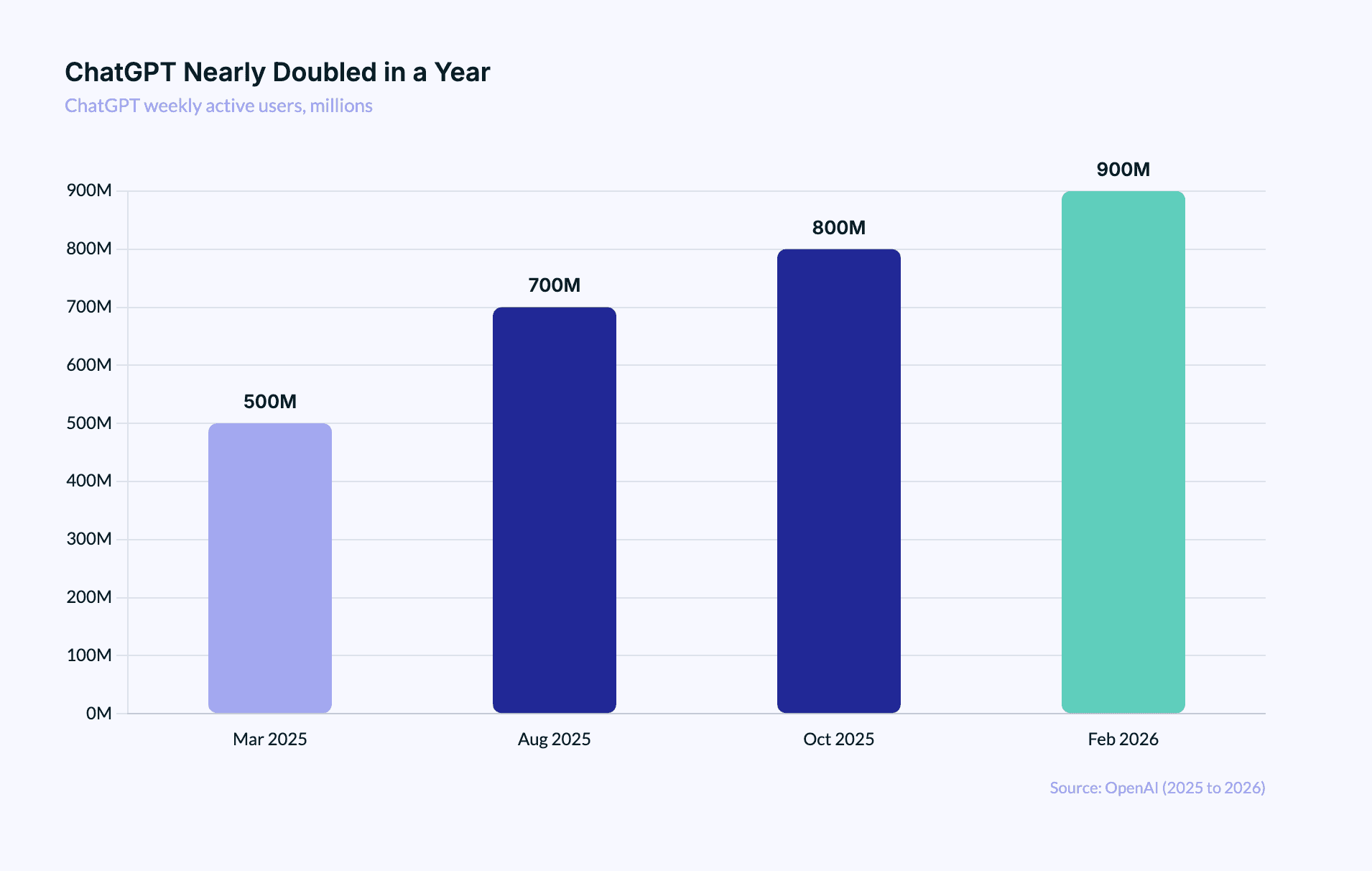
Adoption curves like this usually take a decade. This one took about thirty months, and it is steepest among the youngest buyers, the audiences brands already pay the most to reach.
Nearly 9 in 10 internet users aged 16 to 24 (89.4%) used an AI tool in the past month, the highest rate of any age group².
64% of U.S. teens use AI chatbots, and 57% use them to search for information⁴.
Weekly use of generative AI nearly doubled in a year, from 18% to 34% of online adults across six countries⁶.
Half of U.S. adults using chatbots is the reassuring headline. The number that matters for marketing is who those users are. Nearly 90% of 16-to-24-year-olds used an AI tool last month, 64% of U.S. teens already reach for chatbots to look things up, and the youngest cohort reaches for an AI by default. Adoption is not spreading evenly. It is concentrating in exactly the audiences brands pay the most to reach.
And 60% of U.S. adults now say they read the AI summaries sitting at the top of their search results, which is where this shift reaches the widest audience of all: inside Google.
AI Overviews Quietly Took Over the Top of Google
AI search did not arrive as a separate destination people chose to visit. It arrived inside the search box they already used, pinned to the top, above everything they came for.
About 18% of U.S. Google searches produced an AI Overview in Pew's March 2025 browsing study⁷.
Google's AI Overviews passed 2 billion monthly users and were driving more than 10% additional queries in the categories where they appear⁸.
Google AI Mode, the fully conversational version, surpassed 100 million monthly active users in the U.S. and India within months of launch⁸.
By late 2025, daily AI Mode queries per user in the U.S. had doubled, and AI Mode questions run about three times longer than a typical search⁹.
The scale is only half of it. The other half is which searches get an Overview at all, and that turns out to be highly predictable.
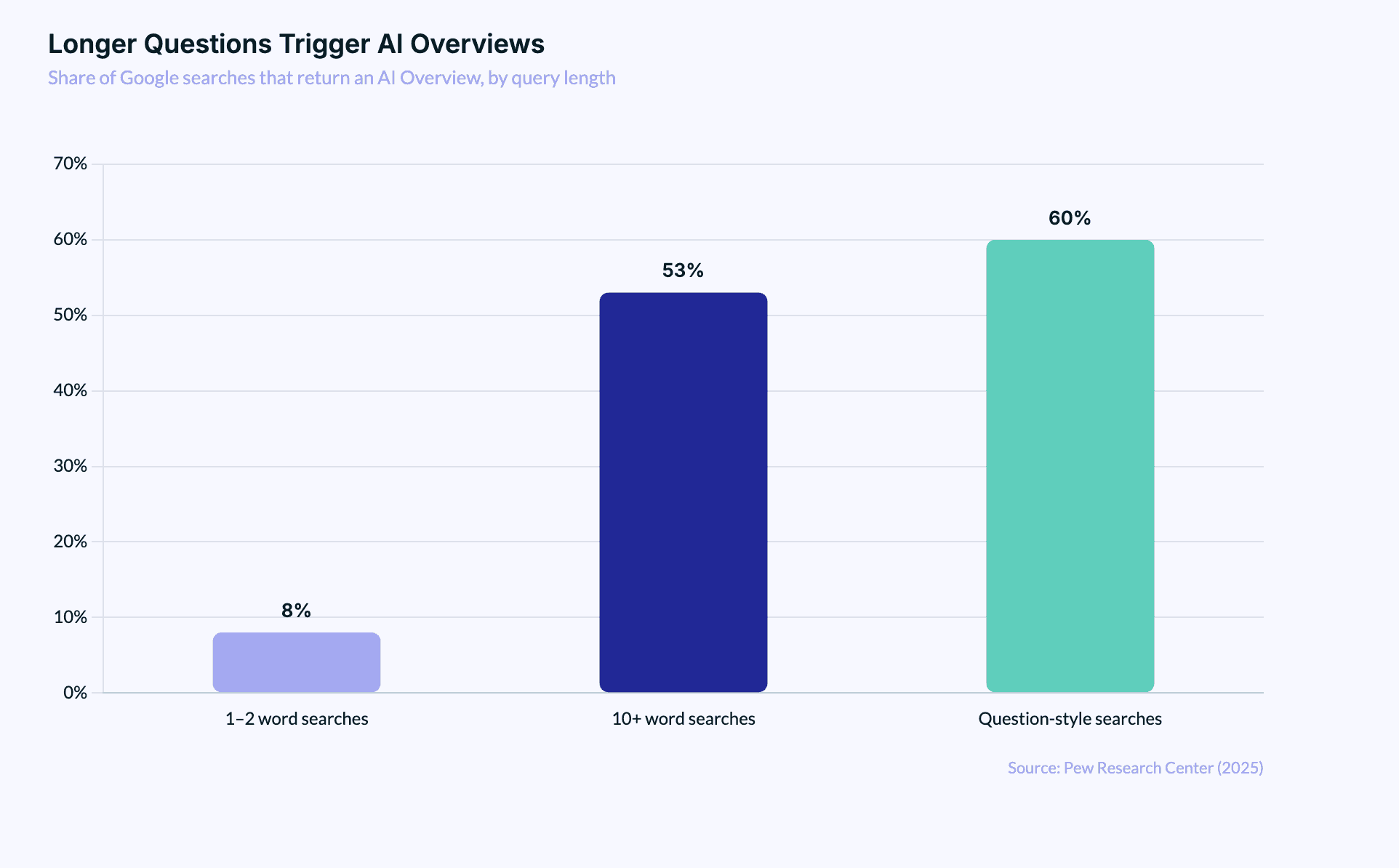
Overviews are query-driven: only 8% of one-to-two-word searches produced one, versus 53% of searches with 10 or more words, and around 60% of question-style queries⁷.
The typical AI Overview is just 67 words long (median)⁷.
A 2026 study of 55,393 queries found AI Overviews on 13.7% of trending searches overall but 64.7% of question-form ones¹⁰.
It is tempting to file 18% under “still a minority, business as usual.” That misreads where the 18% lands. AI Overviews concentrate on the long, specific, question-shaped queries that were always the most valuable to rank for, the part of the funnel where intent lives. And once an Overview sits at the top of those results, click-through to the links underneath it drops sharply.
When the AI Answers, the Clicks Stop
The click data is where this starts showing up on the P&L.
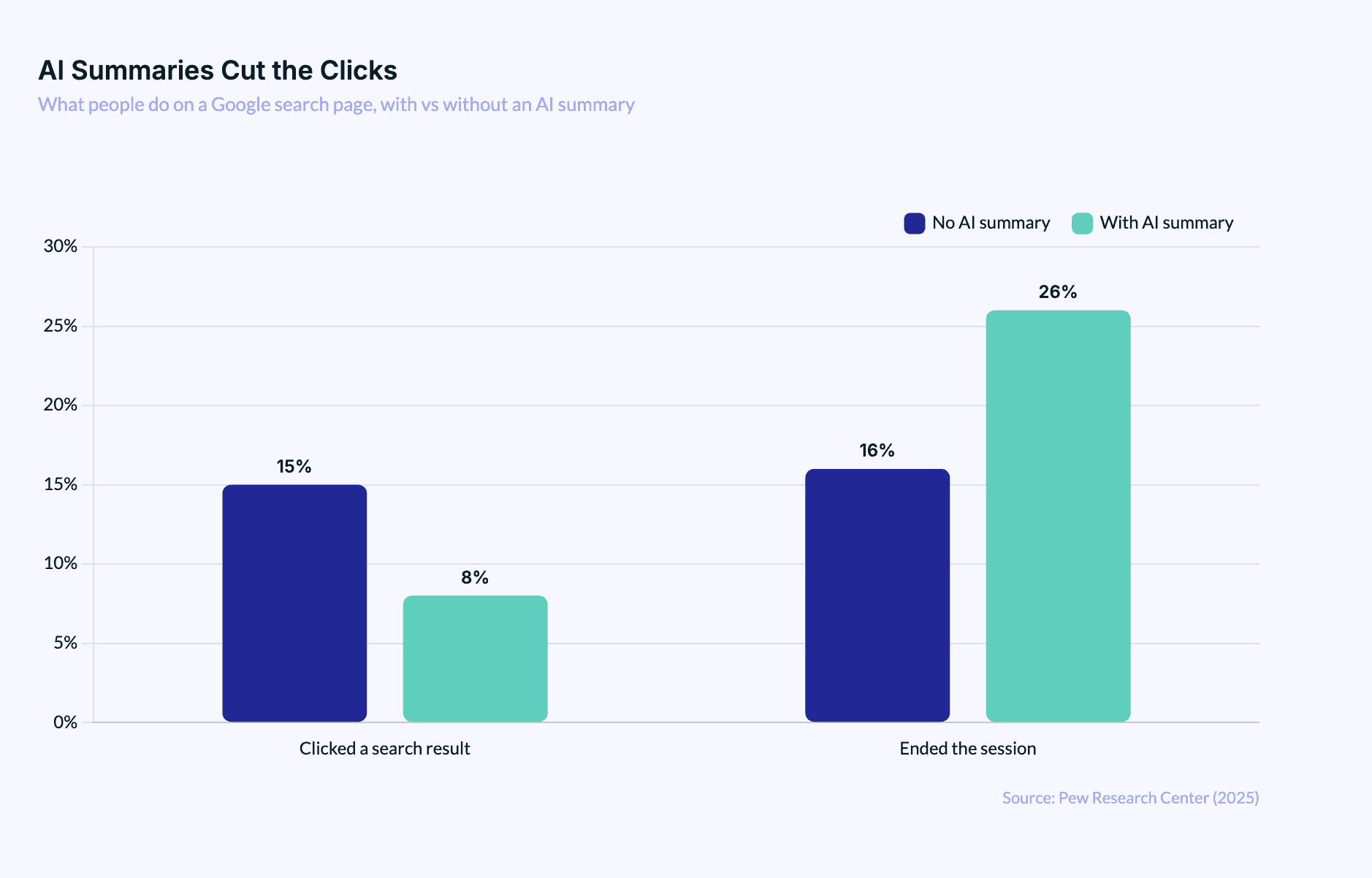
When a Google search returns an AI summary, users click a traditional result link in only 8% of visits, versus 15% when no summary appears, nearly half the click-through⁷.
They click a link inside the AI summary itself just 1% of the time, which is roughly the rate at which anyone clicks a link in the terms and conditions⁷.
On a search page with an AI summary, 26% of sessions end right there, versus 16% without one⁷.
68% of all Google searches now end without any click, up from around 45% a decade ago¹¹.
When an AI Overview is present, the zero-click rate averages 83%¹².
Those missing clicks show up as missing traffic, and the measured declines are steep:
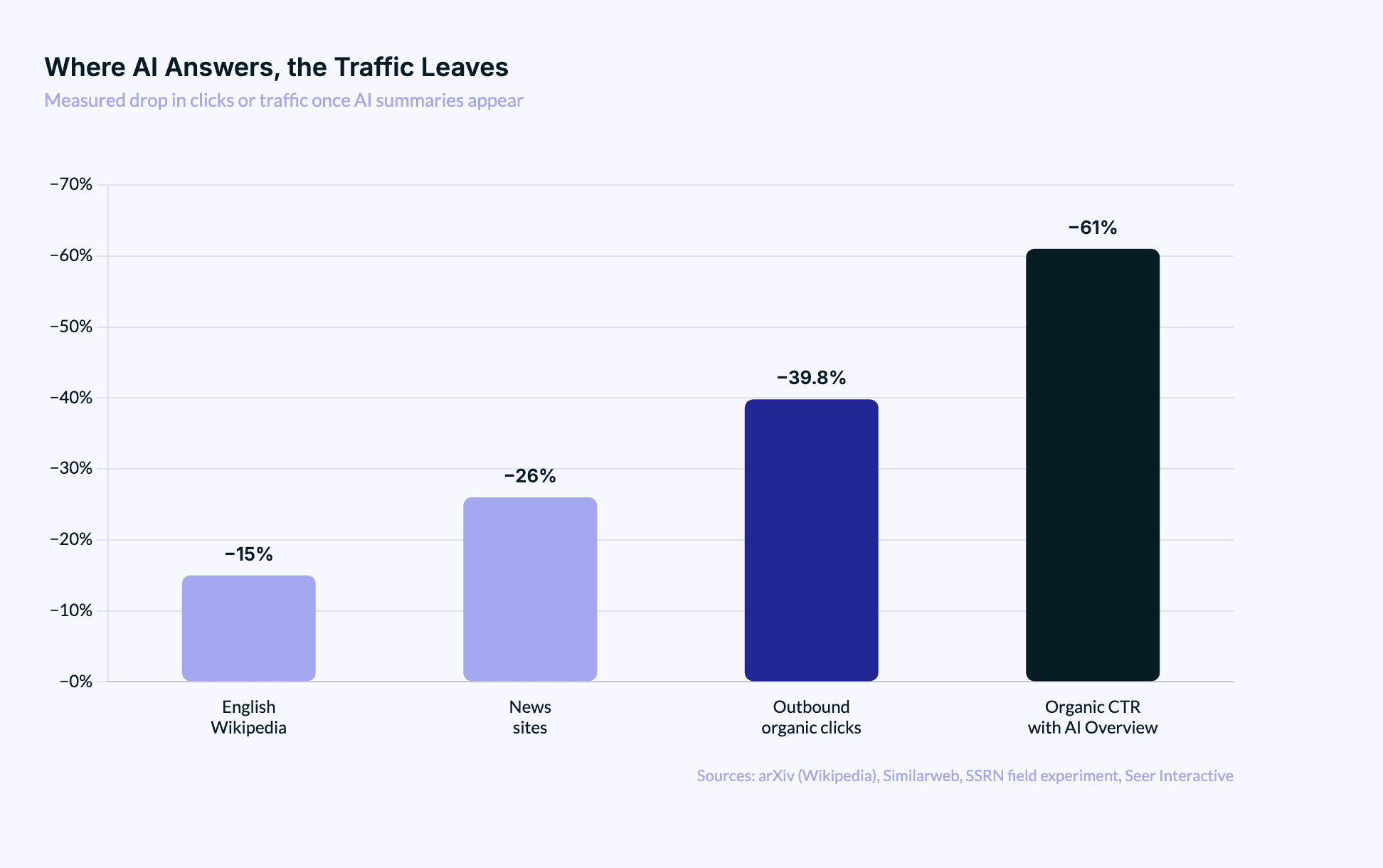
Organic click-through rate on queries with an AI Overview fell 61%, from 1.76% to 0.61% over fifteen months¹³.
A randomized field experiment found AI Overviews cut outbound organic clicks by 39.8%¹⁴.
A causal study measured a roughly 15% drop in traffic to English Wikipedia from AI summaries¹⁵.
AI crawlers now take tens of thousands of pages for every visitor they send back: one major crawler ran a ratio of about 70,900 to 1¹⁶.
Organic traffic to news sites dropped 26% since Google launched AI Overviews¹⁷.
AI answers borrow your content the way search always did, but increasingly send nothing back for it.
You could argue a lot of this was low-value informational traffic that never converted anyway, and there is some truth in that. The randomized field experiment is the part that should worry you, because it controls for exactly that and still finds a 40% click drop. This is not measurement noise or a few thin pages slipping. It is the unit economics of the open web getting rewritten while everyone watches. The traffic that still arrives, though, behaves nothing like the traffic that left.
The Visits That Get Through Are Worth More
If the story ended at “clicks down,” AI search would just be a tax everyone pays. It does not end there. The visits that survive the AI layer are a different animal, and the difference is the whole opportunity.
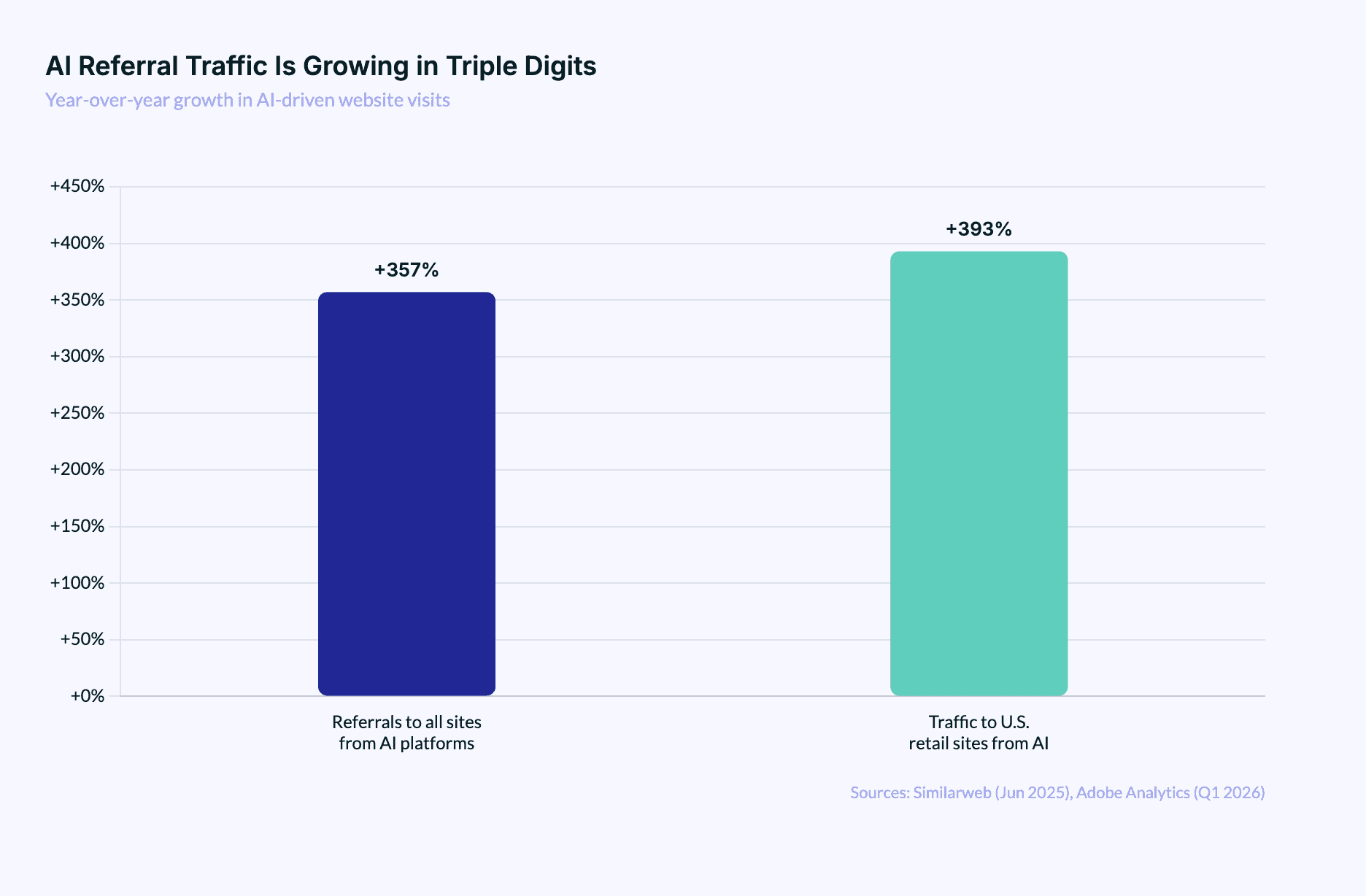
ChatGPT referral traffic converts at 7.1%, second only to paid search at 7.8% and ahead of organic, direct, social, and email¹⁸.
AI platforms sent more than 1.1 billion referral visits to websites and apps in June 2025, up 357% year over year¹⁹.
Shoppers reaching U.S. retail sites from AI sources viewed 12% more pages and bounced 23% less than other visitors²⁰.
AI traffic to U.S. retail sites grew 393% year over year in early 2026 and converted 42% better than non-AI traffic²¹.
The advantage is not only in how these visitors behave once they arrive. It shows up in whether they arrive at all:
Being recommended in an AI answer makes someone 2.5x more likely to visit that brand's site within seven days²².
When a brand is cited inside an AI Overview, it earns 35% more organic clicks (and 91% more paid) than when it is not¹³.
After ChatGPT added clickable brand links inside its answers, total referral traffic jumped 157.7% in a single week¹⁸.
Someone who clicks through after an AI recommended your brand has already had the pitch made for them by something they tend to trust. They land much further down the funnel than a cold organic visitor.
Next to Google, AI referrals are still tiny, a rounding error you could ignore today, but the growth rate is the reason not to. It already converts second-best of any channel you run and is growing in triple digits, and the visitor arrives pre-sold. Whether an AI ever names you has little to do with your Google rank. It comes down to whether you sit in the handful of sources it reads.
What AI Engines Cite
An AI answer is only as good as the handful of sources it pulled to write it, and which sources it trusts is the entire ballgame for visibility. That list looks almost nothing like a page of Google results.
In Google AI summaries, the three most-cited sources are Wikipedia, YouTube, and Reddit, together about 15% of all sources listed⁷.
AI Overviews link to government sites three times as often as standard results, 6% versus 2%⁷.
Across leading AI search engines, government sites drew 33% of the citations among the top 25 most-cited domains²³.
A study of 24,000 queries found AI search re-centralizes the web: it links to the top 1,000 sites far more than traditional search, and to the long tail far less²⁴.
88% of AI Overviews cite three or more sources, and only 1% rely on a single one⁷.
This matches what we see in our own citation data. Reddit is the #3 most-cited domain in AI search and accounts for close to 59% of all user-generated-content citations. When we compared AI citations against Google's organic top 10, the overlap was just 13.9%, meaning the large majority of what AI engines cite never appears in Google's top results at all. And listicles are the single most-cited content type, at 45.8% of all classifiable citations.
A first-place Google ranking and an AI citation are largely independent. They usually live on different websites entirely.
Put the external research and our own numbers side by side and they agree on the uncomfortable part. The page that wins an AI citation is usually not your homepage. It is a Reddit thread, a Wikipedia entry, a third-party listicle, or a forum you do not own and cannot edit (which is either a problem or a relief, depending on how your homepage is doing). The source list does skew toward a smaller set of large sites, but that is about which pages get cited, not which brands win the answer. At the brand level the engine still rewards fit over authority, which is why a focused brand can out-surface far bigger competitors on its own queries. None of which means AI search is reliable. It is still wrong a lot.
AI Search Still Gets a Lot Wrong
It would be easy to read the click-loss data as “AI search won, time to surrender.” The numbers do not support surrender. They support caution, because the thing eating your clicks is still unreliable in ways that should worry anyone treating it as a source of truth.
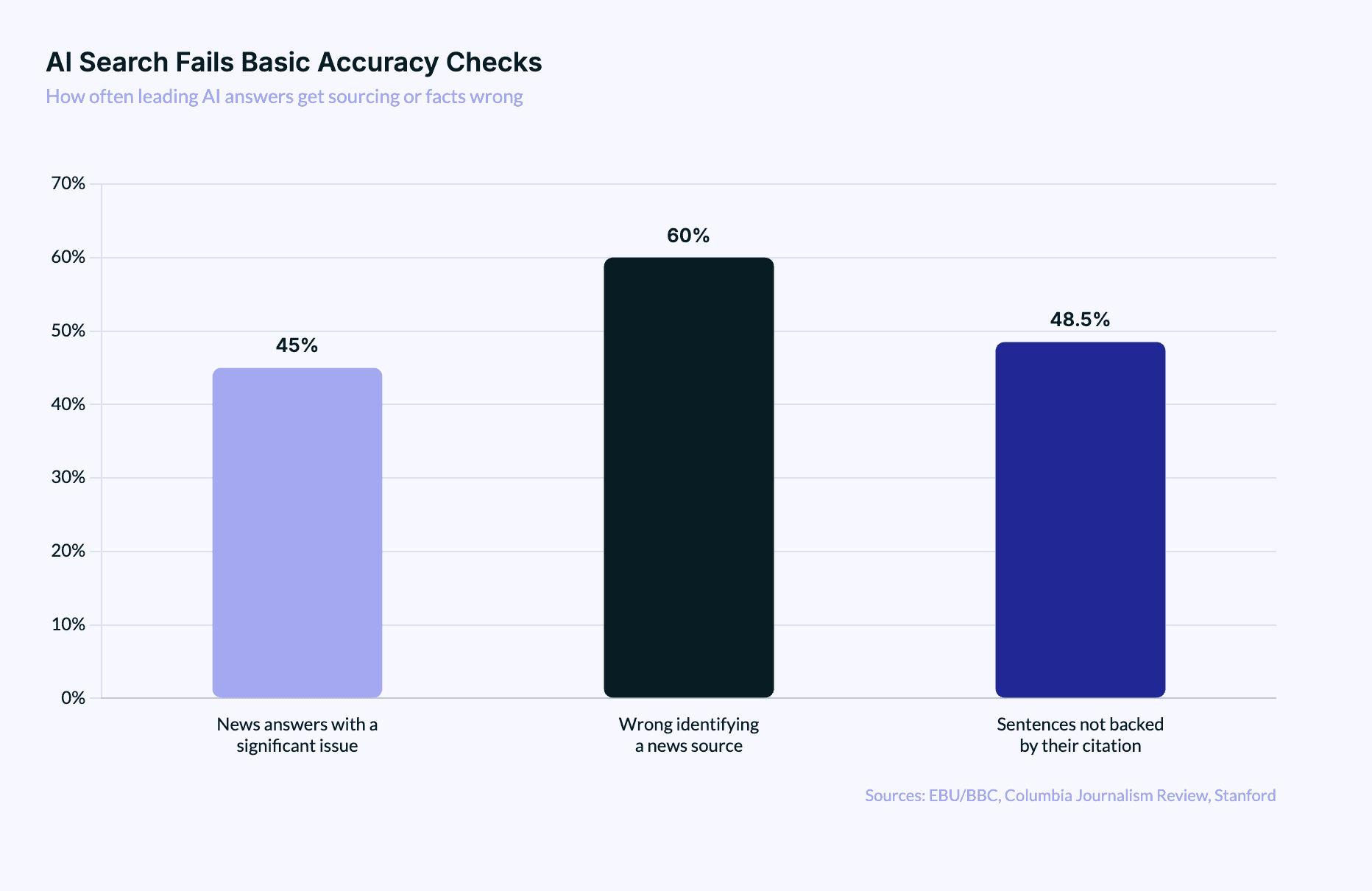
The largest cross-language audit to date found 31% of AI assistants' answers about the news had serious sourcing problems, and 45% had at least one significant issue²⁵.
Asked to identify where a news excerpt came from, leading AI search tools were wrong more than 60% of the time, and the worst performer was wrong 94% of the time²⁶.
A peer-reviewed Stanford evaluation found only 51.5% of generated sentences were fully supported by their own citations (as of 2023)²⁷.
Roughly 16% of the sources AI engines cited were themselves AI-generated content rather than original reporting²³.
Among people who have seen AI search summaries, only 20% find them very or extremely useful, and just 6% trust the information “a lot”, which has not stopped anyone from using them²⁸.
Because the engine is confidently wrong a third of the time, your brand had better be one of the sources it pulls from, so the version it repeats is yours.
The easy conclusion is that AI search is half-baked, so wait it out. The trouble with waiting is that the rest of the numbers in this piece, the 900 million users and the 68% zero-click rate, are not waiting with you. People act on these answers whether or not the answers are good. Low trust and high usage at the same time is a genuinely unstable mix, and it resolves in favor of whoever the engine decides to cite. Which is exactly why the budgets are already moving.
The Budgets Are Already Moving
Analysts and CMOs are not waiting for AI search to be perfect. They are reallocating around it now, on the assumption that the traffic shift is permanent rather than a phase.
Gartner predicted traditional search volume would drop 25% by 2026 as users move to AI³⁰, and that brands' organic search traffic will fall 50% or more by 2028³¹.
McKinsey projects $750 billion in U.S. consumer spend will flow through AI-powered search by 2028, with 20% to 50% of traditional search traffic at risk³².
Bain found 80% of consumers already rely on AI-written results for at least 40% of their searches³³.
Read those forecasts together rather than one at a time. Gartner's 25% drop by 2026, its 50% drop by 2028, and McKinsey's 20-to-50% at risk measure related but different things, query volume, brands' organic traffic, and traffic at risk, and they all point the same way, which is a firmer read than any single projection. The demand driving that direction is already here:
94% of B2B buyers now use generative AI somewhere in their purchase process, which makes this a pipeline decision rather than a brand experiment³⁶.
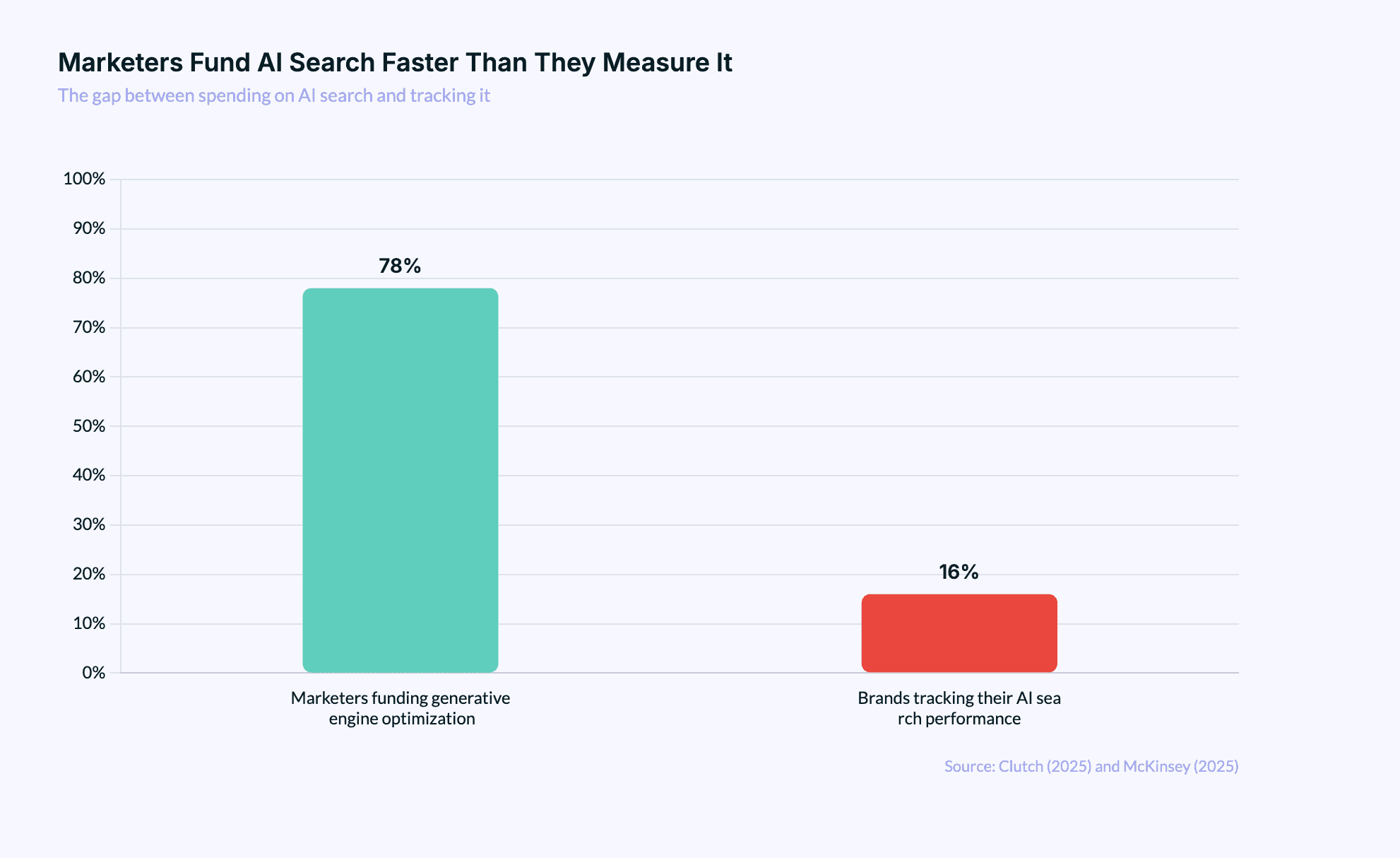
78% of marketers now fund generative engine optimization, edging out the 77.5% who fund traditional SEO and PPC³⁴.
CMOs allocate 15.3% of their marketing budgets to AI³⁵.
And yet only 16% of consumer brands systematically track how they perform in AI search³².
The budget is moving faster than the measurement. Most brands are already spending to influence AI answers they have never looked at.
Two numbers, side by side, tell the story. 78% of marketers fund generative engine optimization. 16% of brands measure whether it is working. That gap is not a rounding error. It is most of the market spending on a channel half-blind, optimizing toward an answer box they have never audited.
How to See Your AI Search Visibility
This is the problem Qvery solves. Qvery tracks how your brand shows up across ChatGPT and Google AI Mode, generates the queries your customers ask, and shows you which sources the engines cite when your category comes up. You enter your brand and see where you stand in a few minutes instead of guessing.
None of this means search is dead. It grew a layer on top that answers the question before anyone reaches your site, and the lever you still control is being one of the sources that answer pulls from. Which of those sources you are missing is the part most brands have not started measuring yet.
Frequently Asked Questions
What is AI search?
AI search is when a generative engine like ChatGPT or Google AI Mode answers a query directly, in its own words, instead of returning a list of links. It reads multiple sources, synthesizes them into a short answer, and usually cites a few of them. Around 18% of U.S. Google searches returned one of these AI summaries as of 2025⁷.
How many people use AI search?
ChatGPT alone reached more than 900 million weekly active users by early 2026¹, and an estimated 2.42 billion active generative-AI users exist overall, close to 29% of the global population².
What percentage of Google searches show an AI Overview?
About 18% of U.S. Google searches produced an AI Overview in Pew's March 2025 browsing study⁷. The rate is far higher for longer, question-style queries: 53% of searches with 10 or more words triggered one⁷.
Does AI search reduce website traffic?
Yes. When a Google search returns an AI summary, users click a traditional result in only 8% of visits, versus 15% without one⁷. A randomized field experiment measured a 39.8% drop in outbound organic clicks when an AI Overview appears¹⁴.
What is zero-click search?
A zero-click search is one where the user gets their answer without clicking through to any website. About 68% of all Google searches now end without a click¹¹, and that rate rises to an average of 83% when an AI Overview is present¹².
How much will AI search cut organic traffic?
Gartner predicts brands' organic search traffic will fall 50% or more by 2028³¹. McKinsey estimates 20% to 50% of traditional search traffic is at risk as spend shifts to AI-powered search³².
Is AI search traffic worth anything if it sends fewer clicks?
The clicks it does send convert unusually well. ChatGPT referral traffic converts at 7.1%, second only to paid search and ahead of organic, direct, and social¹⁸. AI traffic to retail sites converted 42% better than non-AI traffic in March 2026²¹.
Does being recommended by AI drive visits?
Yes. Being recommended in an AI answer makes a user 2.5x more likely to visit that brand's site within seven days²², and brands cited inside a Google AI Overview earn 35% more organic clicks than when they are absent¹³.
What sources do AI engines cite most?
In Google AI summaries, Wikipedia, YouTube, and Reddit are the three most-cited sources, together about 15% of all sources⁷. Our own data shows Reddit is the #3 most-cited domain across AI search overall.
Do AI citations match Google's top rankings?
Mostly not. Our analysis found just 13.9% overlap between AI citations and Google's organic top 10. Ranking first in Google and being cited by AI are largely separate outcomes.
How many sources does an AI answer use?
Most AI Overviews are multi-source: 88% cite three or more sources, and only 1% rely on a single one⁷. The typical Overview is just 67 words long⁷.
How accurate is AI search?
Not as accurate as its confidence suggests. The largest cross-language audit found 31% of AI assistants' answers about the news had serious sourcing problems and 45% had at least one significant issue²⁵. A Stanford study found only 51.5% of generated sentences were fully supported by their citations²⁷.
Do people trust AI search results?
Trust is low even as usage is high. Among people who have seen AI search summaries, only 20% find them very or extremely useful, and just 6% trust the information “a lot”²⁸.
Who uses AI search the most?
Younger audiences. Nearly 9 in 10 internet users aged 16 to 24 used an AI tool in the past month², and 64% of U.S. teens use AI chatbots, with 57% using them to search for information⁴.
What is generative engine optimization (GEO)?
GEO is the practice of getting your brand recommended and cited inside AI-generated answers, the way SEO targeted rankings in traditional search. It centers on your website, third-party mentions, and user-generated content rather than backlinks and search rankings. You can read more in our breakdown of the three pillars of AI engine visibility.
Are marketers investing in AI search?
Yes. 78% of marketers now fund generative engine optimization, slightly ahead of the 77.5% who fund traditional SEO and PPC³⁴, and CMOs allocate 15.3% of their budgets to AI³⁵.
How big is the AI market overall?
Gartner forecasts worldwide AI spending will reach $2.52 trillion in 2026, a 44% year-over-year increase²⁹.
Is AI search a factor in B2B buying?
Heavily. 94% of B2B buyers now use generative AI somewhere in their purchase process³⁶, which makes AI visibility a pipeline issue, not just a brand one.
Which is bigger, ChatGPT or Google AI Mode?
ChatGPT is larger by raw users, with more than 900 million weekly active users¹. Google AI Mode passed 100 million monthly active users in the U.S. and India within months of launch⁸, and Google's AI Overviews reach over 2 billion monthly users inside Search⁸. Customers use both, so visibility work has to cover both.
Why do longer searches trigger AI Overviews more often?
Longer, question-shaped queries give the engine more to synthesize and are exactly the cases an AI summary is built to answer. As people move from two-word queries to full sentences in search, a rising share of queries gets answered in place, before any link is clicked.
Does AI search favor big sites or small ones?
At the source level it re-centralizes toward large sites: a study of 24,000 queries found AI search links to the top 1,000 websites more than traditional search does²⁴. But at the brand level it rewards fit over authority, which is why a focused brand can win specific queries against far bigger competitors.
How fast is AI referral traffic growing?
Very fast off a small base. AI platforms sent more than 1.1 billion referral visits in June 2025, up 357% year over year¹⁹, and AI traffic to U.S. retail sites grew 393% year over year into early 2026²¹.
How many brands track their AI search visibility?
Very few. Only 16% of consumer brands systematically track how they perform in AI search³², even though most are already funding GEO. The gap between spending and measurement is the single clearest opportunity in the data.
What should a brand do about all this?
Start by measuring where you stand: which queries surface your category, whether ChatGPT and Google AI Mode mention you, and which sources they cite when they do. From there the work is earning citations in the places AI trusts, your website, third-party mentions, and user-generated content. That is exactly what Qvery is built to measure and grow.
Sources
DataReportal: Digital 2026 Mid-Year Global Update Report (2026)
Pew Research Center: Americans and AI 2026: Chatbots, Smart Devices and Views on Impact (2026)
National Bureau of Economic Research (NBER): How People Use ChatGPT (Working Paper 34255) (2025)
Google / Alphabet: Q2 earnings call: CEO's remarks (Sundar Pichai) (2025)
Google / Alphabet: Q4 earnings call: Remarks from our CEO (Sundar Pichai) (2025)
Similarweb: Zero-Click Searches And How They Impact Traffic (2025)
Seer Interactive: AIO Impact on Google CTR: September 2025 Update (2025)
Similarweb: GenAI and How It's Impacting US Publishers (2025)
Similarweb: Generative AI Statistics for 2026: AI Visibility Trends, Data and Insights (2026)
Similarweb: AI Discovery Surges: Similarweb's 2025 Generative AI Report Says (2025)
Similarweb: Being Recommended in AI Makes Users 2.5x More Likely to Visit Your Site (2026)
MIT: The Rise of AI Search: Implications for Information Markets and Human Judgement at Scale (2025)
European Broadcasting Union (EBU), led by the BBC: News Integrity in AI Assistants Report (2025)
Stanford (Liu, Zhang and Liang): Evaluating Verifiability in Generative Search Engines (2023)
Pew Research Center: Americans have mixed feelings about AI summaries in search results (2025)
Gartner: Gartner Says Worldwide AI Spending Will Total $2.5 Trillion in 2026 (2026)
McKinsey and Company: New front door to the internet: Winning in the age of AI search (2025)
Bain and Company: Consumer reliance on AI search results signals new era of marketing (2025)
Clutch: Search Marketing Budgets 2025: GEO vs. SEO and PPC (2025)
Gartner: Gartner 2026 CMO Spend Survey Finds CMOs Allocate 15.3% of Marketing Budgets to AI (2026)
By February 2026, ChatGPT had more than 900 million weekly active users and over 50 million paying subscribers¹. That is search behavior on the scale of a continent, almost none of which existed three years ago.
We pulled together the most credible, independently verified statistics on AI search we could find: from Pew, Gartner, McKinsey, Bain, OpenAI, Google, academic labs, and the analytics firms that measure where traffic goes.
Every third-party statistic below is footnoted to its original source, and the few figures from our own dataset link to where we published them. Nothing here is an estimate from memory or a figure recycled from another roundup.
Read together, they tell one story. AI search crossed from novelty to default faster than almost anyone planned for, and as it did, it quietly broke the deal the web has run on for two decades: you publish content, search sends you a click. The clicks are drying up. What replaces them is smaller and stranger, but in one specific way far more valuable. Visibility now depends on whether the answer names your brand at all, because few people scroll past it to the links.
Key Takeaways
ChatGPT passed 900 million weekly active users in early 2026¹, and an estimated 2.42 billion active generative-AI users now exist, close to 29% of the planet².
About 18% of U.S. Google searches trigger an AI Overview, and when one appears, people click a traditional link in just 8% of visits, versus 15% without one⁷.
68% of Google searches now end without a click¹¹, and Gartner expects organic search traffic to fall 50% or more by 2028³¹.
ChatGPT referral traffic converts at 7.1%, second only to paid search and ahead of organic, direct, and social¹⁸.
Yet only 16% of consumer brands systematically track how they show up in AI search³².
AI Search Is Already Mainstream, Not Emerging
AI search adoption already happened, even though most coverage still treats it as something on its way. The open questions are how complete the switch is and who made it first.
An estimated 2.42 billion active generative-AI users now exist, equal to about 29.2% of the global population, though that counts user identities rather than guaranteed-unique people².
That base grew by roughly 1.4 billion users in a single year, a 141% jump between April 2025 and April 2026².
49% of U.S. adults now use AI chatbots like ChatGPT, up from 33% in 2024, and about one in four use them daily³.
60% of U.S. adults say they read the AI summaries that appear at the top of search results³.
By July 2025, ChatGPT was reaching around 10% of the world's adults, who together sent roughly 18 billion messages a week⁵.
Adoption curves like this usually take a decade. This one took about thirty months, and it is steepest among the youngest buyers, the audiences brands already pay the most to reach.
Nearly 9 in 10 internet users aged 16 to 24 (89.4%) used an AI tool in the past month, the highest rate of any age group².
64% of U.S. teens use AI chatbots, and 57% use them to search for information⁴.
Weekly use of generative AI nearly doubled in a year, from 18% to 34% of online adults across six countries⁶.
Half of U.S. adults using chatbots is the reassuring headline. The number that matters for marketing is who those users are. Nearly 90% of 16-to-24-year-olds used an AI tool last month, 64% of U.S. teens already reach for chatbots to look things up, and the youngest cohort reaches for an AI by default. Adoption is not spreading evenly. It is concentrating in exactly the audiences brands pay the most to reach.
And 60% of U.S. adults now say they read the AI summaries sitting at the top of their search results, which is where this shift reaches the widest audience of all: inside Google.
AI Overviews Quietly Took Over the Top of Google
AI search did not arrive as a separate destination people chose to visit. It arrived inside the search box they already used, pinned to the top, above everything they came for.
About 18% of U.S. Google searches produced an AI Overview in Pew's March 2025 browsing study⁷.
Google's AI Overviews passed 2 billion monthly users and were driving more than 10% additional queries in the categories where they appear⁸.
Google AI Mode, the fully conversational version, surpassed 100 million monthly active users in the U.S. and India within months of launch⁸.
By late 2025, daily AI Mode queries per user in the U.S. had doubled, and AI Mode questions run about three times longer than a typical search⁹.
The scale is only half of it. The other half is which searches get an Overview at all, and that turns out to be highly predictable.
Overviews are query-driven: only 8% of one-to-two-word searches produced one, versus 53% of searches with 10 or more words, and around 60% of question-style queries⁷.
The typical AI Overview is just 67 words long (median)⁷.
A 2026 study of 55,393 queries found AI Overviews on 13.7% of trending searches overall but 64.7% of question-form ones¹⁰.
It is tempting to file 18% under “still a minority, business as usual.” That misreads where the 18% lands. AI Overviews concentrate on the long, specific, question-shaped queries that were always the most valuable to rank for, the part of the funnel where intent lives. And once an Overview sits at the top of those results, click-through to the links underneath it drops sharply.
When the AI Answers, the Clicks Stop
The click data is where this starts showing up on the P&L.
When a Google search returns an AI summary, users click a traditional result link in only 8% of visits, versus 15% when no summary appears, nearly half the click-through⁷.
They click a link inside the AI summary itself just 1% of the time, which is roughly the rate at which anyone clicks a link in the terms and conditions⁷.
On a search page with an AI summary, 26% of sessions end right there, versus 16% without one⁷.
68% of all Google searches now end without any click, up from around 45% a decade ago¹¹.
When an AI Overview is present, the zero-click rate averages 83%¹².
Those missing clicks show up as missing traffic, and the measured declines are steep:
Organic click-through rate on queries with an AI Overview fell 61%, from 1.76% to 0.61% over fifteen months¹³.
A randomized field experiment found AI Overviews cut outbound organic clicks by 39.8%¹⁴.
A causal study measured a roughly 15% drop in traffic to English Wikipedia from AI summaries¹⁵.
AI crawlers now take tens of thousands of pages for every visitor they send back: one major crawler ran a ratio of about 70,900 to 1¹⁶.
Organic traffic to news sites dropped 26% since Google launched AI Overviews¹⁷.
AI answers borrow your content the way search always did, but increasingly send nothing back for it.
You could argue a lot of this was low-value informational traffic that never converted anyway, and there is some truth in that. The randomized field experiment is the part that should worry you, because it controls for exactly that and still finds a 40% click drop. This is not measurement noise or a few thin pages slipping. It is the unit economics of the open web getting rewritten while everyone watches. The traffic that still arrives, though, behaves nothing like the traffic that left.
The Visits That Get Through Are Worth More
If the story ended at “clicks down,” AI search would just be a tax everyone pays. It does not end there. The visits that survive the AI layer are a different animal, and the difference is the whole opportunity.
ChatGPT referral traffic converts at 7.1%, second only to paid search at 7.8% and ahead of organic, direct, social, and email¹⁸.
AI platforms sent more than 1.1 billion referral visits to websites and apps in June 2025, up 357% year over year¹⁹.
Shoppers reaching U.S. retail sites from AI sources viewed 12% more pages and bounced 23% less than other visitors²⁰.
AI traffic to U.S. retail sites grew 393% year over year in early 2026 and converted 42% better than non-AI traffic²¹.
The advantage is not only in how these visitors behave once they arrive. It shows up in whether they arrive at all:
Being recommended in an AI answer makes someone 2.5x more likely to visit that brand's site within seven days²².
When a brand is cited inside an AI Overview, it earns 35% more organic clicks (and 91% more paid) than when it is not¹³.
After ChatGPT added clickable brand links inside its answers, total referral traffic jumped 157.7% in a single week¹⁸.
Someone who clicks through after an AI recommended your brand has already had the pitch made for them by something they tend to trust. They land much further down the funnel than a cold organic visitor.
Next to Google, AI referrals are still tiny, a rounding error you could ignore today, but the growth rate is the reason not to. It already converts second-best of any channel you run and is growing in triple digits, and the visitor arrives pre-sold. Whether an AI ever names you has little to do with your Google rank. It comes down to whether you sit in the handful of sources it reads.
What AI Engines Cite
An AI answer is only as good as the handful of sources it pulled to write it, and which sources it trusts is the entire ballgame for visibility. That list looks almost nothing like a page of Google results.
In Google AI summaries, the three most-cited sources are Wikipedia, YouTube, and Reddit, together about 15% of all sources listed⁷.
AI Overviews link to government sites three times as often as standard results, 6% versus 2%⁷.
Across leading AI search engines, government sites drew 33% of the citations among the top 25 most-cited domains²³.
A study of 24,000 queries found AI search re-centralizes the web: it links to the top 1,000 sites far more than traditional search, and to the long tail far less²⁴.
88% of AI Overviews cite three or more sources, and only 1% rely on a single one⁷.
This matches what we see in our own citation data. Reddit is the #3 most-cited domain in AI search and accounts for close to 59% of all user-generated-content citations. When we compared AI citations against Google's organic top 10, the overlap was just 13.9%, meaning the large majority of what AI engines cite never appears in Google's top results at all. And listicles are the single most-cited content type, at 45.8% of all classifiable citations.
A first-place Google ranking and an AI citation are largely independent. They usually live on different websites entirely.
Put the external research and our own numbers side by side and they agree on the uncomfortable part. The page that wins an AI citation is usually not your homepage. It is a Reddit thread, a Wikipedia entry, a third-party listicle, or a forum you do not own and cannot edit (which is either a problem or a relief, depending on how your homepage is doing). The source list does skew toward a smaller set of large sites, but that is about which pages get cited, not which brands win the answer. At the brand level the engine still rewards fit over authority, which is why a focused brand can out-surface far bigger competitors on its own queries. None of which means AI search is reliable. It is still wrong a lot.
AI Search Still Gets a Lot Wrong
It would be easy to read the click-loss data as “AI search won, time to surrender.” The numbers do not support surrender. They support caution, because the thing eating your clicks is still unreliable in ways that should worry anyone treating it as a source of truth.
The largest cross-language audit to date found 31% of AI assistants' answers about the news had serious sourcing problems, and 45% had at least one significant issue²⁵.
Asked to identify where a news excerpt came from, leading AI search tools were wrong more than 60% of the time, and the worst performer was wrong 94% of the time²⁶.
A peer-reviewed Stanford evaluation found only 51.5% of generated sentences were fully supported by their own citations (as of 2023)²⁷.
Roughly 16% of the sources AI engines cited were themselves AI-generated content rather than original reporting²³.
Among people who have seen AI search summaries, only 20% find them very or extremely useful, and just 6% trust the information “a lot”, which has not stopped anyone from using them²⁸.
Because the engine is confidently wrong a third of the time, your brand had better be one of the sources it pulls from, so the version it repeats is yours.
The easy conclusion is that AI search is half-baked, so wait it out. The trouble with waiting is that the rest of the numbers in this piece, the 900 million users and the 68% zero-click rate, are not waiting with you. People act on these answers whether or not the answers are good. Low trust and high usage at the same time is a genuinely unstable mix, and it resolves in favor of whoever the engine decides to cite. Which is exactly why the budgets are already moving.
The Budgets Are Already Moving
Analysts and CMOs are not waiting for AI search to be perfect. They are reallocating around it now, on the assumption that the traffic shift is permanent rather than a phase.
Gartner predicted traditional search volume would drop 25% by 2026 as users move to AI³⁰, and that brands' organic search traffic will fall 50% or more by 2028³¹.
McKinsey projects $750 billion in U.S. consumer spend will flow through AI-powered search by 2028, with 20% to 50% of traditional search traffic at risk³².
Bain found 80% of consumers already rely on AI-written results for at least 40% of their searches³³.
Read those forecasts together rather than one at a time. Gartner's 25% drop by 2026, its 50% drop by 2028, and McKinsey's 20-to-50% at risk measure related but different things, query volume, brands' organic traffic, and traffic at risk, and they all point the same way, which is a firmer read than any single projection. The demand driving that direction is already here:
94% of B2B buyers now use generative AI somewhere in their purchase process, which makes this a pipeline decision rather than a brand experiment³⁶.
78% of marketers now fund generative engine optimization, edging out the 77.5% who fund traditional SEO and PPC³⁴.
CMOs allocate 15.3% of their marketing budgets to AI³⁵.
And yet only 16% of consumer brands systematically track how they perform in AI search³².
The budget is moving faster than the measurement. Most brands are already spending to influence AI answers they have never looked at.
Two numbers, side by side, tell the story. 78% of marketers fund generative engine optimization. 16% of brands measure whether it is working. That gap is not a rounding error. It is most of the market spending on a channel half-blind, optimizing toward an answer box they have never audited.
How to See Your AI Search Visibility
This is the problem Qvery solves. Qvery tracks how your brand shows up across ChatGPT and Google AI Mode, generates the queries your customers ask, and shows you which sources the engines cite when your category comes up. You enter your brand and see where you stand in a few minutes instead of guessing.
None of this means search is dead. It grew a layer on top that answers the question before anyone reaches your site, and the lever you still control is being one of the sources that answer pulls from. Which of those sources you are missing is the part most brands have not started measuring yet.
Frequently Asked Questions
What is AI search?
AI search is when a generative engine like ChatGPT or Google AI Mode answers a query directly, in its own words, instead of returning a list of links. It reads multiple sources, synthesizes them into a short answer, and usually cites a few of them. Around 18% of U.S. Google searches returned one of these AI summaries as of 2025⁷.
How many people use AI search?
ChatGPT alone reached more than 900 million weekly active users by early 2026¹, and an estimated 2.42 billion active generative-AI users exist overall, close to 29% of the global population².
What percentage of Google searches show an AI Overview?
About 18% of U.S. Google searches produced an AI Overview in Pew's March 2025 browsing study⁷. The rate is far higher for longer, question-style queries: 53% of searches with 10 or more words triggered one⁷.
Does AI search reduce website traffic?
Yes. When a Google search returns an AI summary, users click a traditional result in only 8% of visits, versus 15% without one⁷. A randomized field experiment measured a 39.8% drop in outbound organic clicks when an AI Overview appears¹⁴.
What is zero-click search?
A zero-click search is one where the user gets their answer without clicking through to any website. About 68% of all Google searches now end without a click¹¹, and that rate rises to an average of 83% when an AI Overview is present¹².
How much will AI search cut organic traffic?
Gartner predicts brands' organic search traffic will fall 50% or more by 2028³¹. McKinsey estimates 20% to 50% of traditional search traffic is at risk as spend shifts to AI-powered search³².
Is AI search traffic worth anything if it sends fewer clicks?
The clicks it does send convert unusually well. ChatGPT referral traffic converts at 7.1%, second only to paid search and ahead of organic, direct, and social¹⁸. AI traffic to retail sites converted 42% better than non-AI traffic in March 2026²¹.
Does being recommended by AI drive visits?
Yes. Being recommended in an AI answer makes a user 2.5x more likely to visit that brand's site within seven days²², and brands cited inside a Google AI Overview earn 35% more organic clicks than when they are absent¹³.
What sources do AI engines cite most?
In Google AI summaries, Wikipedia, YouTube, and Reddit are the three most-cited sources, together about 15% of all sources⁷. Our own data shows Reddit is the #3 most-cited domain across AI search overall.
Do AI citations match Google's top rankings?
Mostly not. Our analysis found just 13.9% overlap between AI citations and Google's organic top 10. Ranking first in Google and being cited by AI are largely separate outcomes.
How many sources does an AI answer use?
Most AI Overviews are multi-source: 88% cite three or more sources, and only 1% rely on a single one⁷. The typical Overview is just 67 words long⁷.
How accurate is AI search?
Not as accurate as its confidence suggests. The largest cross-language audit found 31% of AI assistants' answers about the news had serious sourcing problems and 45% had at least one significant issue²⁵. A Stanford study found only 51.5% of generated sentences were fully supported by their citations²⁷.
Do people trust AI search results?
Trust is low even as usage is high. Among people who have seen AI search summaries, only 20% find them very or extremely useful, and just 6% trust the information “a lot”²⁸.
Who uses AI search the most?
Younger audiences. Nearly 9 in 10 internet users aged 16 to 24 used an AI tool in the past month², and 64% of U.S. teens use AI chatbots, with 57% using them to search for information⁴.
What is generative engine optimization (GEO)?
GEO is the practice of getting your brand recommended and cited inside AI-generated answers, the way SEO targeted rankings in traditional search. It centers on your website, third-party mentions, and user-generated content rather than backlinks and search rankings. You can read more in our breakdown of the three pillars of AI engine visibility.
Are marketers investing in AI search?
Yes. 78% of marketers now fund generative engine optimization, slightly ahead of the 77.5% who fund traditional SEO and PPC³⁴, and CMOs allocate 15.3% of their budgets to AI³⁵.
How big is the AI market overall?
Gartner forecasts worldwide AI spending will reach $2.52 trillion in 2026, a 44% year-over-year increase²⁹.
Is AI search a factor in B2B buying?
Heavily. 94% of B2B buyers now use generative AI somewhere in their purchase process³⁶, which makes AI visibility a pipeline issue, not just a brand one.
Which is bigger, ChatGPT or Google AI Mode?
ChatGPT is larger by raw users, with more than 900 million weekly active users¹. Google AI Mode passed 100 million monthly active users in the U.S. and India within months of launch⁸, and Google's AI Overviews reach over 2 billion monthly users inside Search⁸. Customers use both, so visibility work has to cover both.
Why do longer searches trigger AI Overviews more often?
Longer, question-shaped queries give the engine more to synthesize and are exactly the cases an AI summary is built to answer. As people move from two-word queries to full sentences in search, a rising share of queries gets answered in place, before any link is clicked.
Does AI search favor big sites or small ones?
At the source level it re-centralizes toward large sites: a study of 24,000 queries found AI search links to the top 1,000 websites more than traditional search does²⁴. But at the brand level it rewards fit over authority, which is why a focused brand can win specific queries against far bigger competitors.
How fast is AI referral traffic growing?
Very fast off a small base. AI platforms sent more than 1.1 billion referral visits in June 2025, up 357% year over year¹⁹, and AI traffic to U.S. retail sites grew 393% year over year into early 2026²¹.
How many brands track their AI search visibility?
Very few. Only 16% of consumer brands systematically track how they perform in AI search³², even though most are already funding GEO. The gap between spending and measurement is the single clearest opportunity in the data.
What should a brand do about all this?
Start by measuring where you stand: which queries surface your category, whether ChatGPT and Google AI Mode mention you, and which sources they cite when they do. From there the work is earning citations in the places AI trusts, your website, third-party mentions, and user-generated content. That is exactly what Qvery is built to measure and grow.
Sources
DataReportal: Digital 2026 Mid-Year Global Update Report (2026)
Pew Research Center: Americans and AI 2026: Chatbots, Smart Devices and Views on Impact (2026)
National Bureau of Economic Research (NBER): How People Use ChatGPT (Working Paper 34255) (2025)
Google / Alphabet: Q2 earnings call: CEO's remarks (Sundar Pichai) (2025)
Google / Alphabet: Q4 earnings call: Remarks from our CEO (Sundar Pichai) (2025)
Similarweb: Zero-Click Searches And How They Impact Traffic (2025)
Seer Interactive: AIO Impact on Google CTR: September 2025 Update (2025)
Similarweb: GenAI and How It's Impacting US Publishers (2025)
Similarweb: Generative AI Statistics for 2026: AI Visibility Trends, Data and Insights (2026)
Similarweb: AI Discovery Surges: Similarweb's 2025 Generative AI Report Says (2025)
Similarweb: Being Recommended in AI Makes Users 2.5x More Likely to Visit Your Site (2026)
MIT: The Rise of AI Search: Implications for Information Markets and Human Judgement at Scale (2025)
European Broadcasting Union (EBU), led by the BBC: News Integrity in AI Assistants Report (2025)
Stanford (Liu, Zhang and Liang): Evaluating Verifiability in Generative Search Engines (2023)
Pew Research Center: Americans have mixed feelings about AI summaries in search results (2025)
Gartner: Gartner Says Worldwide AI Spending Will Total $2.5 Trillion in 2026 (2026)
McKinsey and Company: New front door to the internet: Winning in the age of AI search (2025)
Bain and Company: Consumer reliance on AI search results signals new era of marketing (2025)
Clutch: Search Marketing Budgets 2025: GEO vs. SEO and PPC (2025)
Gartner: Gartner 2026 CMO Spend Survey Finds CMOs Allocate 15.3% of Marketing Budgets to AI (2026)
By February 2026, ChatGPT had more than 900 million weekly active users and over 50 million paying subscribers¹. That is search behavior on the scale of a continent, almost none of which existed three years ago.
We pulled together the most credible, independently verified statistics on AI search we could find: from Pew, Gartner, McKinsey, Bain, OpenAI, Google, academic labs, and the analytics firms that measure where traffic goes.
Every third-party statistic below is footnoted to its original source, and the few figures from our own dataset link to where we published them. Nothing here is an estimate from memory or a figure recycled from another roundup.
Read together, they tell one story. AI search crossed from novelty to default faster than almost anyone planned for, and as it did, it quietly broke the deal the web has run on for two decades: you publish content, search sends you a click. The clicks are drying up. What replaces them is smaller and stranger, but in one specific way far more valuable. Visibility now depends on whether the answer names your brand at all, because few people scroll past it to the links.
Key Takeaways
ChatGPT passed 900 million weekly active users in early 2026¹, and an estimated 2.42 billion active generative-AI users now exist, close to 29% of the planet².
About 18% of U.S. Google searches trigger an AI Overview, and when one appears, people click a traditional link in just 8% of visits, versus 15% without one⁷.
68% of Google searches now end without a click¹¹, and Gartner expects organic search traffic to fall 50% or more by 2028³¹.
ChatGPT referral traffic converts at 7.1%, second only to paid search and ahead of organic, direct, and social¹⁸.
Yet only 16% of consumer brands systematically track how they show up in AI search³².
AI Search Is Already Mainstream, Not Emerging
AI search adoption already happened, even though most coverage still treats it as something on its way. The open questions are how complete the switch is and who made it first.
An estimated 2.42 billion active generative-AI users now exist, equal to about 29.2% of the global population, though that counts user identities rather than guaranteed-unique people².
That base grew by roughly 1.4 billion users in a single year, a 141% jump between April 2025 and April 2026².
49% of U.S. adults now use AI chatbots like ChatGPT, up from 33% in 2024, and about one in four use them daily³.
60% of U.S. adults say they read the AI summaries that appear at the top of search results³.
By July 2025, ChatGPT was reaching around 10% of the world's adults, who together sent roughly 18 billion messages a week⁵.
Adoption curves like this usually take a decade. This one took about thirty months, and it is steepest among the youngest buyers, the audiences brands already pay the most to reach.
Nearly 9 in 10 internet users aged 16 to 24 (89.4%) used an AI tool in the past month, the highest rate of any age group².
64% of U.S. teens use AI chatbots, and 57% use them to search for information⁴.
Weekly use of generative AI nearly doubled in a year, from 18% to 34% of online adults across six countries⁶.
Half of U.S. adults using chatbots is the reassuring headline. The number that matters for marketing is who those users are. Nearly 90% of 16-to-24-year-olds used an AI tool last month, 64% of U.S. teens already reach for chatbots to look things up, and the youngest cohort reaches for an AI by default. Adoption is not spreading evenly. It is concentrating in exactly the audiences brands pay the most to reach.
And 60% of U.S. adults now say they read the AI summaries sitting at the top of their search results, which is where this shift reaches the widest audience of all: inside Google.
AI Overviews Quietly Took Over the Top of Google
AI search did not arrive as a separate destination people chose to visit. It arrived inside the search box they already used, pinned to the top, above everything they came for.
About 18% of U.S. Google searches produced an AI Overview in Pew's March 2025 browsing study⁷.
Google's AI Overviews passed 2 billion monthly users and were driving more than 10% additional queries in the categories where they appear⁸.
Google AI Mode, the fully conversational version, surpassed 100 million monthly active users in the U.S. and India within months of launch⁸.
By late 2025, daily AI Mode queries per user in the U.S. had doubled, and AI Mode questions run about three times longer than a typical search⁹.
The scale is only half of it. The other half is which searches get an Overview at all, and that turns out to be highly predictable.
Overviews are query-driven: only 8% of one-to-two-word searches produced one, versus 53% of searches with 10 or more words, and around 60% of question-style queries⁷.
The typical AI Overview is just 67 words long (median)⁷.
A 2026 study of 55,393 queries found AI Overviews on 13.7% of trending searches overall but 64.7% of question-form ones¹⁰.
It is tempting to file 18% under “still a minority, business as usual.” That misreads where the 18% lands. AI Overviews concentrate on the long, specific, question-shaped queries that were always the most valuable to rank for, the part of the funnel where intent lives. And once an Overview sits at the top of those results, click-through to the links underneath it drops sharply.
When the AI Answers, the Clicks Stop
The click data is where this starts showing up on the P&L.
When a Google search returns an AI summary, users click a traditional result link in only 8% of visits, versus 15% when no summary appears, nearly half the click-through⁷.
They click a link inside the AI summary itself just 1% of the time, which is roughly the rate at which anyone clicks a link in the terms and conditions⁷.
On a search page with an AI summary, 26% of sessions end right there, versus 16% without one⁷.
68% of all Google searches now end without any click, up from around 45% a decade ago¹¹.
When an AI Overview is present, the zero-click rate averages 83%¹².
Those missing clicks show up as missing traffic, and the measured declines are steep:
Organic click-through rate on queries with an AI Overview fell 61%, from 1.76% to 0.61% over fifteen months¹³.
A randomized field experiment found AI Overviews cut outbound organic clicks by 39.8%¹⁴.
A causal study measured a roughly 15% drop in traffic to English Wikipedia from AI summaries¹⁵.
AI crawlers now take tens of thousands of pages for every visitor they send back: one major crawler ran a ratio of about 70,900 to 1¹⁶.
Organic traffic to news sites dropped 26% since Google launched AI Overviews¹⁷.
AI answers borrow your content the way search always did, but increasingly send nothing back for it.
You could argue a lot of this was low-value informational traffic that never converted anyway, and there is some truth in that. The randomized field experiment is the part that should worry you, because it controls for exactly that and still finds a 40% click drop. This is not measurement noise or a few thin pages slipping. It is the unit economics of the open web getting rewritten while everyone watches. The traffic that still arrives, though, behaves nothing like the traffic that left.
The Visits That Get Through Are Worth More
If the story ended at “clicks down,” AI search would just be a tax everyone pays. It does not end there. The visits that survive the AI layer are a different animal, and the difference is the whole opportunity.
ChatGPT referral traffic converts at 7.1%, second only to paid search at 7.8% and ahead of organic, direct, social, and email¹⁸.
AI platforms sent more than 1.1 billion referral visits to websites and apps in June 2025, up 357% year over year¹⁹.
Shoppers reaching U.S. retail sites from AI sources viewed 12% more pages and bounced 23% less than other visitors²⁰.
AI traffic to U.S. retail sites grew 393% year over year in early 2026 and converted 42% better than non-AI traffic²¹.
The advantage is not only in how these visitors behave once they arrive. It shows up in whether they arrive at all:
Being recommended in an AI answer makes someone 2.5x more likely to visit that brand's site within seven days²².
When a brand is cited inside an AI Overview, it earns 35% more organic clicks (and 91% more paid) than when it is not¹³.
After ChatGPT added clickable brand links inside its answers, total referral traffic jumped 157.7% in a single week¹⁸.
Someone who clicks through after an AI recommended your brand has already had the pitch made for them by something they tend to trust. They land much further down the funnel than a cold organic visitor.
Next to Google, AI referrals are still tiny, a rounding error you could ignore today, but the growth rate is the reason not to. It already converts second-best of any channel you run and is growing in triple digits, and the visitor arrives pre-sold. Whether an AI ever names you has little to do with your Google rank. It comes down to whether you sit in the handful of sources it reads.
What AI Engines Cite
An AI answer is only as good as the handful of sources it pulled to write it, and which sources it trusts is the entire ballgame for visibility. That list looks almost nothing like a page of Google results.
In Google AI summaries, the three most-cited sources are Wikipedia, YouTube, and Reddit, together about 15% of all sources listed⁷.
AI Overviews link to government sites three times as often as standard results, 6% versus 2%⁷.
Across leading AI search engines, government sites drew 33% of the citations among the top 25 most-cited domains²³.
A study of 24,000 queries found AI search re-centralizes the web: it links to the top 1,000 sites far more than traditional search, and to the long tail far less²⁴.
88% of AI Overviews cite three or more sources, and only 1% rely on a single one⁷.
This matches what we see in our own citation data. Reddit is the #3 most-cited domain in AI search and accounts for close to 59% of all user-generated-content citations. When we compared AI citations against Google's organic top 10, the overlap was just 13.9%, meaning the large majority of what AI engines cite never appears in Google's top results at all. And listicles are the single most-cited content type, at 45.8% of all classifiable citations.
A first-place Google ranking and an AI citation are largely independent. They usually live on different websites entirely.
Put the external research and our own numbers side by side and they agree on the uncomfortable part. The page that wins an AI citation is usually not your homepage. It is a Reddit thread, a Wikipedia entry, a third-party listicle, or a forum you do not own and cannot edit (which is either a problem or a relief, depending on how your homepage is doing). The source list does skew toward a smaller set of large sites, but that is about which pages get cited, not which brands win the answer. At the brand level the engine still rewards fit over authority, which is why a focused brand can out-surface far bigger competitors on its own queries. None of which means AI search is reliable. It is still wrong a lot.
AI Search Still Gets a Lot Wrong
It would be easy to read the click-loss data as “AI search won, time to surrender.” The numbers do not support surrender. They support caution, because the thing eating your clicks is still unreliable in ways that should worry anyone treating it as a source of truth.
The largest cross-language audit to date found 31% of AI assistants' answers about the news had serious sourcing problems, and 45% had at least one significant issue²⁵.
Asked to identify where a news excerpt came from, leading AI search tools were wrong more than 60% of the time, and the worst performer was wrong 94% of the time²⁶.
A peer-reviewed Stanford evaluation found only 51.5% of generated sentences were fully supported by their own citations (as of 2023)²⁷.
Roughly 16% of the sources AI engines cited were themselves AI-generated content rather than original reporting²³.
Among people who have seen AI search summaries, only 20% find them very or extremely useful, and just 6% trust the information “a lot”, which has not stopped anyone from using them²⁸.
Because the engine is confidently wrong a third of the time, your brand had better be one of the sources it pulls from, so the version it repeats is yours.
The easy conclusion is that AI search is half-baked, so wait it out. The trouble with waiting is that the rest of the numbers in this piece, the 900 million users and the 68% zero-click rate, are not waiting with you. People act on these answers whether or not the answers are good. Low trust and high usage at the same time is a genuinely unstable mix, and it resolves in favor of whoever the engine decides to cite. Which is exactly why the budgets are already moving.
The Budgets Are Already Moving
Analysts and CMOs are not waiting for AI search to be perfect. They are reallocating around it now, on the assumption that the traffic shift is permanent rather than a phase.
Gartner predicted traditional search volume would drop 25% by 2026 as users move to AI³⁰, and that brands' organic search traffic will fall 50% or more by 2028³¹.
McKinsey projects $750 billion in U.S. consumer spend will flow through AI-powered search by 2028, with 20% to 50% of traditional search traffic at risk³².
Bain found 80% of consumers already rely on AI-written results for at least 40% of their searches³³.
Read those forecasts together rather than one at a time. Gartner's 25% drop by 2026, its 50% drop by 2028, and McKinsey's 20-to-50% at risk measure related but different things, query volume, brands' organic traffic, and traffic at risk, and they all point the same way, which is a firmer read than any single projection. The demand driving that direction is already here:
94% of B2B buyers now use generative AI somewhere in their purchase process, which makes this a pipeline decision rather than a brand experiment³⁶.
78% of marketers now fund generative engine optimization, edging out the 77.5% who fund traditional SEO and PPC³⁴.
CMOs allocate 15.3% of their marketing budgets to AI³⁵.
And yet only 16% of consumer brands systematically track how they perform in AI search³².
The budget is moving faster than the measurement. Most brands are already spending to influence AI answers they have never looked at.
Two numbers, side by side, tell the story. 78% of marketers fund generative engine optimization. 16% of brands measure whether it is working. That gap is not a rounding error. It is most of the market spending on a channel half-blind, optimizing toward an answer box they have never audited.
How to See Your AI Search Visibility
This is the problem Qvery solves. Qvery tracks how your brand shows up across ChatGPT and Google AI Mode, generates the queries your customers ask, and shows you which sources the engines cite when your category comes up. You enter your brand and see where you stand in a few minutes instead of guessing.
None of this means search is dead. It grew a layer on top that answers the question before anyone reaches your site, and the lever you still control is being one of the sources that answer pulls from. Which of those sources you are missing is the part most brands have not started measuring yet.
Frequently Asked Questions
What is AI search?
AI search is when a generative engine like ChatGPT or Google AI Mode answers a query directly, in its own words, instead of returning a list of links. It reads multiple sources, synthesizes them into a short answer, and usually cites a few of them. Around 18% of U.S. Google searches returned one of these AI summaries as of 2025⁷.
How many people use AI search?
ChatGPT alone reached more than 900 million weekly active users by early 2026¹, and an estimated 2.42 billion active generative-AI users exist overall, close to 29% of the global population².
What percentage of Google searches show an AI Overview?
About 18% of U.S. Google searches produced an AI Overview in Pew's March 2025 browsing study⁷. The rate is far higher for longer, question-style queries: 53% of searches with 10 or more words triggered one⁷.
Does AI search reduce website traffic?
Yes. When a Google search returns an AI summary, users click a traditional result in only 8% of visits, versus 15% without one⁷. A randomized field experiment measured a 39.8% drop in outbound organic clicks when an AI Overview appears¹⁴.
What is zero-click search?
A zero-click search is one where the user gets their answer without clicking through to any website. About 68% of all Google searches now end without a click¹¹, and that rate rises to an average of 83% when an AI Overview is present¹².
How much will AI search cut organic traffic?
Gartner predicts brands' organic search traffic will fall 50% or more by 2028³¹. McKinsey estimates 20% to 50% of traditional search traffic is at risk as spend shifts to AI-powered search³².
Is AI search traffic worth anything if it sends fewer clicks?
The clicks it does send convert unusually well. ChatGPT referral traffic converts at 7.1%, second only to paid search and ahead of organic, direct, and social¹⁸. AI traffic to retail sites converted 42% better than non-AI traffic in March 2026²¹.
Does being recommended by AI drive visits?
Yes. Being recommended in an AI answer makes a user 2.5x more likely to visit that brand's site within seven days²², and brands cited inside a Google AI Overview earn 35% more organic clicks than when they are absent¹³.
What sources do AI engines cite most?
In Google AI summaries, Wikipedia, YouTube, and Reddit are the three most-cited sources, together about 15% of all sources⁷. Our own data shows Reddit is the #3 most-cited domain across AI search overall.
Do AI citations match Google's top rankings?
Mostly not. Our analysis found just 13.9% overlap between AI citations and Google's organic top 10. Ranking first in Google and being cited by AI are largely separate outcomes.
How many sources does an AI answer use?
Most AI Overviews are multi-source: 88% cite three or more sources, and only 1% rely on a single one⁷. The typical Overview is just 67 words long⁷.
How accurate is AI search?
Not as accurate as its confidence suggests. The largest cross-language audit found 31% of AI assistants' answers about the news had serious sourcing problems and 45% had at least one significant issue²⁵. A Stanford study found only 51.5% of generated sentences were fully supported by their citations²⁷.
Do people trust AI search results?
Trust is low even as usage is high. Among people who have seen AI search summaries, only 20% find them very or extremely useful, and just 6% trust the information “a lot”²⁸.
Who uses AI search the most?
Younger audiences. Nearly 9 in 10 internet users aged 16 to 24 used an AI tool in the past month², and 64% of U.S. teens use AI chatbots, with 57% using them to search for information⁴.
What is generative engine optimization (GEO)?
GEO is the practice of getting your brand recommended and cited inside AI-generated answers, the way SEO targeted rankings in traditional search. It centers on your website, third-party mentions, and user-generated content rather than backlinks and search rankings. You can read more in our breakdown of the three pillars of AI engine visibility.
Are marketers investing in AI search?
Yes. 78% of marketers now fund generative engine optimization, slightly ahead of the 77.5% who fund traditional SEO and PPC³⁴, and CMOs allocate 15.3% of their budgets to AI³⁵.
How big is the AI market overall?
Gartner forecasts worldwide AI spending will reach $2.52 trillion in 2026, a 44% year-over-year increase²⁹.
Is AI search a factor in B2B buying?
Heavily. 94% of B2B buyers now use generative AI somewhere in their purchase process³⁶, which makes AI visibility a pipeline issue, not just a brand one.
Which is bigger, ChatGPT or Google AI Mode?
ChatGPT is larger by raw users, with more than 900 million weekly active users¹. Google AI Mode passed 100 million monthly active users in the U.S. and India within months of launch⁸, and Google's AI Overviews reach over 2 billion monthly users inside Search⁸. Customers use both, so visibility work has to cover both.
Why do longer searches trigger AI Overviews more often?
Longer, question-shaped queries give the engine more to synthesize and are exactly the cases an AI summary is built to answer. As people move from two-word queries to full sentences in search, a rising share of queries gets answered in place, before any link is clicked.
Does AI search favor big sites or small ones?
At the source level it re-centralizes toward large sites: a study of 24,000 queries found AI search links to the top 1,000 websites more than traditional search does²⁴. But at the brand level it rewards fit over authority, which is why a focused brand can win specific queries against far bigger competitors.
How fast is AI referral traffic growing?
Very fast off a small base. AI platforms sent more than 1.1 billion referral visits in June 2025, up 357% year over year¹⁹, and AI traffic to U.S. retail sites grew 393% year over year into early 2026²¹.
How many brands track their AI search visibility?
Very few. Only 16% of consumer brands systematically track how they perform in AI search³², even though most are already funding GEO. The gap between spending and measurement is the single clearest opportunity in the data.
What should a brand do about all this?
Start by measuring where you stand: which queries surface your category, whether ChatGPT and Google AI Mode mention you, and which sources they cite when they do. From there the work is earning citations in the places AI trusts, your website, third-party mentions, and user-generated content. That is exactly what Qvery is built to measure and grow.
Sources
DataReportal: Digital 2026 Mid-Year Global Update Report (2026)
Pew Research Center: Americans and AI 2026: Chatbots, Smart Devices and Views on Impact (2026)
National Bureau of Economic Research (NBER): How People Use ChatGPT (Working Paper 34255) (2025)
Google / Alphabet: Q2 earnings call: CEO's remarks (Sundar Pichai) (2025)
Google / Alphabet: Q4 earnings call: Remarks from our CEO (Sundar Pichai) (2025)
Similarweb: Zero-Click Searches And How They Impact Traffic (2025)
Seer Interactive: AIO Impact on Google CTR: September 2025 Update (2025)
Similarweb: GenAI and How It's Impacting US Publishers (2025)
Similarweb: Generative AI Statistics for 2026: AI Visibility Trends, Data and Insights (2026)
Similarweb: AI Discovery Surges: Similarweb's 2025 Generative AI Report Says (2025)
Similarweb: Being Recommended in AI Makes Users 2.5x More Likely to Visit Your Site (2026)
MIT: The Rise of AI Search: Implications for Information Markets and Human Judgement at Scale (2025)
European Broadcasting Union (EBU), led by the BBC: News Integrity in AI Assistants Report (2025)
Stanford (Liu, Zhang and Liang): Evaluating Verifiability in Generative Search Engines (2023)
Pew Research Center: Americans have mixed feelings about AI summaries in search results (2025)
Gartner: Gartner Says Worldwide AI Spending Will Total $2.5 Trillion in 2026 (2026)
McKinsey and Company: New front door to the internet: Winning in the age of AI search (2025)
Bain and Company: Consumer reliance on AI search results signals new era of marketing (2025)
Clutch: Search Marketing Budgets 2025: GEO vs. SEO and PPC (2025)
Gartner: Gartner 2026 CMO Spend Survey Finds CMOs Allocate 15.3% of Marketing Budgets to AI (2026)
By February 2026, ChatGPT had more than 900 million weekly active users and over 50 million paying subscribers¹. That is search behavior on the scale of a continent, almost none of which existed three years ago.
We pulled together the most credible, independently verified statistics on AI search we could find: from Pew, Gartner, McKinsey, Bain, OpenAI, Google, academic labs, and the analytics firms that measure where traffic goes.
Every third-party statistic below is footnoted to its original source, and the few figures from our own dataset link to where we published them. Nothing here is an estimate from memory or a figure recycled from another roundup.
Read together, they tell one story. AI search crossed from novelty to default faster than almost anyone planned for, and as it did, it quietly broke the deal the web has run on for two decades: you publish content, search sends you a click. The clicks are drying up. What replaces them is smaller and stranger, but in one specific way far more valuable. Visibility now depends on whether the answer names your brand at all, because few people scroll past it to the links.
Key Takeaways
ChatGPT passed 900 million weekly active users in early 2026¹, and an estimated 2.42 billion active generative-AI users now exist, close to 29% of the planet².
About 18% of U.S. Google searches trigger an AI Overview, and when one appears, people click a traditional link in just 8% of visits, versus 15% without one⁷.
68% of Google searches now end without a click¹¹, and Gartner expects organic search traffic to fall 50% or more by 2028³¹.
ChatGPT referral traffic converts at 7.1%, second only to paid search and ahead of organic, direct, and social¹⁸.
Yet only 16% of consumer brands systematically track how they show up in AI search³².
AI Search Is Already Mainstream, Not Emerging
AI search adoption already happened, even though most coverage still treats it as something on its way. The open questions are how complete the switch is and who made it first.
An estimated 2.42 billion active generative-AI users now exist, equal to about 29.2% of the global population, though that counts user identities rather than guaranteed-unique people².
That base grew by roughly 1.4 billion users in a single year, a 141% jump between April 2025 and April 2026².
49% of U.S. adults now use AI chatbots like ChatGPT, up from 33% in 2024, and about one in four use them daily³.
60% of U.S. adults say they read the AI summaries that appear at the top of search results³.
By July 2025, ChatGPT was reaching around 10% of the world's adults, who together sent roughly 18 billion messages a week⁵.
Adoption curves like this usually take a decade. This one took about thirty months, and it is steepest among the youngest buyers, the audiences brands already pay the most to reach.
Nearly 9 in 10 internet users aged 16 to 24 (89.4%) used an AI tool in the past month, the highest rate of any age group².
64% of U.S. teens use AI chatbots, and 57% use them to search for information⁴.
Weekly use of generative AI nearly doubled in a year, from 18% to 34% of online adults across six countries⁶.
Half of U.S. adults using chatbots is the reassuring headline. The number that matters for marketing is who those users are. Nearly 90% of 16-to-24-year-olds used an AI tool last month, 64% of U.S. teens already reach for chatbots to look things up, and the youngest cohort reaches for an AI by default. Adoption is not spreading evenly. It is concentrating in exactly the audiences brands pay the most to reach.
And 60% of U.S. adults now say they read the AI summaries sitting at the top of their search results, which is where this shift reaches the widest audience of all: inside Google.
AI Overviews Quietly Took Over the Top of Google
AI search did not arrive as a separate destination people chose to visit. It arrived inside the search box they already used, pinned to the top, above everything they came for.
About 18% of U.S. Google searches produced an AI Overview in Pew's March 2025 browsing study⁷.
Google's AI Overviews passed 2 billion monthly users and were driving more than 10% additional queries in the categories where they appear⁸.
Google AI Mode, the fully conversational version, surpassed 100 million monthly active users in the U.S. and India within months of launch⁸.
By late 2025, daily AI Mode queries per user in the U.S. had doubled, and AI Mode questions run about three times longer than a typical search⁹.
The scale is only half of it. The other half is which searches get an Overview at all, and that turns out to be highly predictable.
Overviews are query-driven: only 8% of one-to-two-word searches produced one, versus 53% of searches with 10 or more words, and around 60% of question-style queries⁷.
The typical AI Overview is just 67 words long (median)⁷.
A 2026 study of 55,393 queries found AI Overviews on 13.7% of trending searches overall but 64.7% of question-form ones¹⁰.
It is tempting to file 18% under “still a minority, business as usual.” That misreads where the 18% lands. AI Overviews concentrate on the long, specific, question-shaped queries that were always the most valuable to rank for, the part of the funnel where intent lives. And once an Overview sits at the top of those results, click-through to the links underneath it drops sharply.
When the AI Answers, the Clicks Stop
The click data is where this starts showing up on the P&L.
When a Google search returns an AI summary, users click a traditional result link in only 8% of visits, versus 15% when no summary appears, nearly half the click-through⁷.
They click a link inside the AI summary itself just 1% of the time, which is roughly the rate at which anyone clicks a link in the terms and conditions⁷.
On a search page with an AI summary, 26% of sessions end right there, versus 16% without one⁷.
68% of all Google searches now end without any click, up from around 45% a decade ago¹¹.
When an AI Overview is present, the zero-click rate averages 83%¹².
Those missing clicks show up as missing traffic, and the measured declines are steep:
Organic click-through rate on queries with an AI Overview fell 61%, from 1.76% to 0.61% over fifteen months¹³.
A randomized field experiment found AI Overviews cut outbound organic clicks by 39.8%¹⁴.
A causal study measured a roughly 15% drop in traffic to English Wikipedia from AI summaries¹⁵.
AI crawlers now take tens of thousands of pages for every visitor they send back: one major crawler ran a ratio of about 70,900 to 1¹⁶.
Organic traffic to news sites dropped 26% since Google launched AI Overviews¹⁷.
AI answers borrow your content the way search always did, but increasingly send nothing back for it.
You could argue a lot of this was low-value informational traffic that never converted anyway, and there is some truth in that. The randomized field experiment is the part that should worry you, because it controls for exactly that and still finds a 40% click drop. This is not measurement noise or a few thin pages slipping. It is the unit economics of the open web getting rewritten while everyone watches. The traffic that still arrives, though, behaves nothing like the traffic that left.
The Visits That Get Through Are Worth More
If the story ended at “clicks down,” AI search would just be a tax everyone pays. It does not end there. The visits that survive the AI layer are a different animal, and the difference is the whole opportunity.
ChatGPT referral traffic converts at 7.1%, second only to paid search at 7.8% and ahead of organic, direct, social, and email¹⁸.
AI platforms sent more than 1.1 billion referral visits to websites and apps in June 2025, up 357% year over year¹⁹.
Shoppers reaching U.S. retail sites from AI sources viewed 12% more pages and bounced 23% less than other visitors²⁰.
AI traffic to U.S. retail sites grew 393% year over year in early 2026 and converted 42% better than non-AI traffic²¹.
The advantage is not only in how these visitors behave once they arrive. It shows up in whether they arrive at all:
Being recommended in an AI answer makes someone 2.5x more likely to visit that brand's site within seven days²².
When a brand is cited inside an AI Overview, it earns 35% more organic clicks (and 91% more paid) than when it is not¹³.
After ChatGPT added clickable brand links inside its answers, total referral traffic jumped 157.7% in a single week¹⁸.
Someone who clicks through after an AI recommended your brand has already had the pitch made for them by something they tend to trust. They land much further down the funnel than a cold organic visitor.
Next to Google, AI referrals are still tiny, a rounding error you could ignore today, but the growth rate is the reason not to. It already converts second-best of any channel you run and is growing in triple digits, and the visitor arrives pre-sold. Whether an AI ever names you has little to do with your Google rank. It comes down to whether you sit in the handful of sources it reads.
What AI Engines Cite
An AI answer is only as good as the handful of sources it pulled to write it, and which sources it trusts is the entire ballgame for visibility. That list looks almost nothing like a page of Google results.
In Google AI summaries, the three most-cited sources are Wikipedia, YouTube, and Reddit, together about 15% of all sources listed⁷.
AI Overviews link to government sites three times as often as standard results, 6% versus 2%⁷.
Across leading AI search engines, government sites drew 33% of the citations among the top 25 most-cited domains²³.
A study of 24,000 queries found AI search re-centralizes the web: it links to the top 1,000 sites far more than traditional search, and to the long tail far less²⁴.
88% of AI Overviews cite three or more sources, and only 1% rely on a single one⁷.
This matches what we see in our own citation data. Reddit is the #3 most-cited domain in AI search and accounts for close to 59% of all user-generated-content citations. When we compared AI citations against Google's organic top 10, the overlap was just 13.9%, meaning the large majority of what AI engines cite never appears in Google's top results at all. And listicles are the single most-cited content type, at 45.8% of all classifiable citations.
A first-place Google ranking and an AI citation are largely independent. They usually live on different websites entirely.
Put the external research and our own numbers side by side and they agree on the uncomfortable part. The page that wins an AI citation is usually not your homepage. It is a Reddit thread, a Wikipedia entry, a third-party listicle, or a forum you do not own and cannot edit (which is either a problem or a relief, depending on how your homepage is doing). The source list does skew toward a smaller set of large sites, but that is about which pages get cited, not which brands win the answer. At the brand level the engine still rewards fit over authority, which is why a focused brand can out-surface far bigger competitors on its own queries. None of which means AI search is reliable. It is still wrong a lot.
AI Search Still Gets a Lot Wrong
It would be easy to read the click-loss data as “AI search won, time to surrender.” The numbers do not support surrender. They support caution, because the thing eating your clicks is still unreliable in ways that should worry anyone treating it as a source of truth.
The largest cross-language audit to date found 31% of AI assistants' answers about the news had serious sourcing problems, and 45% had at least one significant issue²⁵.
Asked to identify where a news excerpt came from, leading AI search tools were wrong more than 60% of the time, and the worst performer was wrong 94% of the time²⁶.
A peer-reviewed Stanford evaluation found only 51.5% of generated sentences were fully supported by their own citations (as of 2023)²⁷.
Roughly 16% of the sources AI engines cited were themselves AI-generated content rather than original reporting²³.
Among people who have seen AI search summaries, only 20% find them very or extremely useful, and just 6% trust the information “a lot”, which has not stopped anyone from using them²⁸.
Because the engine is confidently wrong a third of the time, your brand had better be one of the sources it pulls from, so the version it repeats is yours.
The easy conclusion is that AI search is half-baked, so wait it out. The trouble with waiting is that the rest of the numbers in this piece, the 900 million users and the 68% zero-click rate, are not waiting with you. People act on these answers whether or not the answers are good. Low trust and high usage at the same time is a genuinely unstable mix, and it resolves in favor of whoever the engine decides to cite. Which is exactly why the budgets are already moving.
The Budgets Are Already Moving
Analysts and CMOs are not waiting for AI search to be perfect. They are reallocating around it now, on the assumption that the traffic shift is permanent rather than a phase.
Gartner predicted traditional search volume would drop 25% by 2026 as users move to AI³⁰, and that brands' organic search traffic will fall 50% or more by 2028³¹.
McKinsey projects $750 billion in U.S. consumer spend will flow through AI-powered search by 2028, with 20% to 50% of traditional search traffic at risk³².
Bain found 80% of consumers already rely on AI-written results for at least 40% of their searches³³.
Read those forecasts together rather than one at a time. Gartner's 25% drop by 2026, its 50% drop by 2028, and McKinsey's 20-to-50% at risk measure related but different things, query volume, brands' organic traffic, and traffic at risk, and they all point the same way, which is a firmer read than any single projection. The demand driving that direction is already here:
94% of B2B buyers now use generative AI somewhere in their purchase process, which makes this a pipeline decision rather than a brand experiment³⁶.
78% of marketers now fund generative engine optimization, edging out the 77.5% who fund traditional SEO and PPC³⁴.
CMOs allocate 15.3% of their marketing budgets to AI³⁵.
And yet only 16% of consumer brands systematically track how they perform in AI search³².
The budget is moving faster than the measurement. Most brands are already spending to influence AI answers they have never looked at.
Two numbers, side by side, tell the story. 78% of marketers fund generative engine optimization. 16% of brands measure whether it is working. That gap is not a rounding error. It is most of the market spending on a channel half-blind, optimizing toward an answer box they have never audited.
How to See Your AI Search Visibility
This is the problem Qvery solves. Qvery tracks how your brand shows up across ChatGPT and Google AI Mode, generates the queries your customers ask, and shows you which sources the engines cite when your category comes up. You enter your brand and see where you stand in a few minutes instead of guessing.
None of this means search is dead. It grew a layer on top that answers the question before anyone reaches your site, and the lever you still control is being one of the sources that answer pulls from. Which of those sources you are missing is the part most brands have not started measuring yet.
Frequently Asked Questions
What is AI search?
AI search is when a generative engine like ChatGPT or Google AI Mode answers a query directly, in its own words, instead of returning a list of links. It reads multiple sources, synthesizes them into a short answer, and usually cites a few of them. Around 18% of U.S. Google searches returned one of these AI summaries as of 2025⁷.
How many people use AI search?
ChatGPT alone reached more than 900 million weekly active users by early 2026¹, and an estimated 2.42 billion active generative-AI users exist overall, close to 29% of the global population².
What percentage of Google searches show an AI Overview?
About 18% of U.S. Google searches produced an AI Overview in Pew's March 2025 browsing study⁷. The rate is far higher for longer, question-style queries: 53% of searches with 10 or more words triggered one⁷.
Does AI search reduce website traffic?
Yes. When a Google search returns an AI summary, users click a traditional result in only 8% of visits, versus 15% without one⁷. A randomized field experiment measured a 39.8% drop in outbound organic clicks when an AI Overview appears¹⁴.
What is zero-click search?
A zero-click search is one where the user gets their answer without clicking through to any website. About 68% of all Google searches now end without a click¹¹, and that rate rises to an average of 83% when an AI Overview is present¹².
How much will AI search cut organic traffic?
Gartner predicts brands' organic search traffic will fall 50% or more by 2028³¹. McKinsey estimates 20% to 50% of traditional search traffic is at risk as spend shifts to AI-powered search³².
Is AI search traffic worth anything if it sends fewer clicks?
The clicks it does send convert unusually well. ChatGPT referral traffic converts at 7.1%, second only to paid search and ahead of organic, direct, and social¹⁸. AI traffic to retail sites converted 42% better than non-AI traffic in March 2026²¹.
Does being recommended by AI drive visits?
Yes. Being recommended in an AI answer makes a user 2.5x more likely to visit that brand's site within seven days²², and brands cited inside a Google AI Overview earn 35% more organic clicks than when they are absent¹³.
What sources do AI engines cite most?
In Google AI summaries, Wikipedia, YouTube, and Reddit are the three most-cited sources, together about 15% of all sources⁷. Our own data shows Reddit is the #3 most-cited domain across AI search overall.
Do AI citations match Google's top rankings?
Mostly not. Our analysis found just 13.9% overlap between AI citations and Google's organic top 10. Ranking first in Google and being cited by AI are largely separate outcomes.
How many sources does an AI answer use?
Most AI Overviews are multi-source: 88% cite three or more sources, and only 1% rely on a single one⁷. The typical Overview is just 67 words long⁷.
How accurate is AI search?
Not as accurate as its confidence suggests. The largest cross-language audit found 31% of AI assistants' answers about the news had serious sourcing problems and 45% had at least one significant issue²⁵. A Stanford study found only 51.5% of generated sentences were fully supported by their citations²⁷.
Do people trust AI search results?
Trust is low even as usage is high. Among people who have seen AI search summaries, only 20% find them very or extremely useful, and just 6% trust the information “a lot”²⁸.
Who uses AI search the most?
Younger audiences. Nearly 9 in 10 internet users aged 16 to 24 used an AI tool in the past month², and 64% of U.S. teens use AI chatbots, with 57% using them to search for information⁴.
What is generative engine optimization (GEO)?
GEO is the practice of getting your brand recommended and cited inside AI-generated answers, the way SEO targeted rankings in traditional search. It centers on your website, third-party mentions, and user-generated content rather than backlinks and search rankings. You can read more in our breakdown of the three pillars of AI engine visibility.
Are marketers investing in AI search?
Yes. 78% of marketers now fund generative engine optimization, slightly ahead of the 77.5% who fund traditional SEO and PPC³⁴, and CMOs allocate 15.3% of their budgets to AI³⁵.
How big is the AI market overall?
Gartner forecasts worldwide AI spending will reach $2.52 trillion in 2026, a 44% year-over-year increase²⁹.
Is AI search a factor in B2B buying?
Heavily. 94% of B2B buyers now use generative AI somewhere in their purchase process³⁶, which makes AI visibility a pipeline issue, not just a brand one.
Which is bigger, ChatGPT or Google AI Mode?
ChatGPT is larger by raw users, with more than 900 million weekly active users¹. Google AI Mode passed 100 million monthly active users in the U.S. and India within months of launch⁸, and Google's AI Overviews reach over 2 billion monthly users inside Search⁸. Customers use both, so visibility work has to cover both.
Why do longer searches trigger AI Overviews more often?
Longer, question-shaped queries give the engine more to synthesize and are exactly the cases an AI summary is built to answer. As people move from two-word queries to full sentences in search, a rising share of queries gets answered in place, before any link is clicked.
Does AI search favor big sites or small ones?
At the source level it re-centralizes toward large sites: a study of 24,000 queries found AI search links to the top 1,000 websites more than traditional search does²⁴. But at the brand level it rewards fit over authority, which is why a focused brand can win specific queries against far bigger competitors.
How fast is AI referral traffic growing?
Very fast off a small base. AI platforms sent more than 1.1 billion referral visits in June 2025, up 357% year over year¹⁹, and AI traffic to U.S. retail sites grew 393% year over year into early 2026²¹.
How many brands track their AI search visibility?
Very few. Only 16% of consumer brands systematically track how they perform in AI search³², even though most are already funding GEO. The gap between spending and measurement is the single clearest opportunity in the data.
What should a brand do about all this?
Start by measuring where you stand: which queries surface your category, whether ChatGPT and Google AI Mode mention you, and which sources they cite when they do. From there the work is earning citations in the places AI trusts, your website, third-party mentions, and user-generated content. That is exactly what Qvery is built to measure and grow.
Sources
DataReportal: Digital 2026 Mid-Year Global Update Report (2026)
Pew Research Center: Americans and AI 2026: Chatbots, Smart Devices and Views on Impact (2026)
National Bureau of Economic Research (NBER): How People Use ChatGPT (Working Paper 34255) (2025)
Google / Alphabet: Q2 earnings call: CEO's remarks (Sundar Pichai) (2025)
Google / Alphabet: Q4 earnings call: Remarks from our CEO (Sundar Pichai) (2025)
Similarweb: Zero-Click Searches And How They Impact Traffic (2025)
Seer Interactive: AIO Impact on Google CTR: September 2025 Update (2025)
Similarweb: GenAI and How It's Impacting US Publishers (2025)
Similarweb: Generative AI Statistics for 2026: AI Visibility Trends, Data and Insights (2026)
Similarweb: AI Discovery Surges: Similarweb's 2025 Generative AI Report Says (2025)
Similarweb: Being Recommended in AI Makes Users 2.5x More Likely to Visit Your Site (2026)
MIT: The Rise of AI Search: Implications for Information Markets and Human Judgement at Scale (2025)
European Broadcasting Union (EBU), led by the BBC: News Integrity in AI Assistants Report (2025)
Stanford (Liu, Zhang and Liang): Evaluating Verifiability in Generative Search Engines (2023)
Pew Research Center: Americans have mixed feelings about AI summaries in search results (2025)
Gartner: Gartner Says Worldwide AI Spending Will Total $2.5 Trillion in 2026 (2026)
McKinsey and Company: New front door to the internet: Winning in the age of AI search (2025)
Bain and Company: Consumer reliance on AI search results signals new era of marketing (2025)
Clutch: Search Marketing Budgets 2025: GEO vs. SEO and PPC (2025)
Gartner: Gartner 2026 CMO Spend Survey Finds CMOs Allocate 15.3% of Marketing Budgets to AI (2026)

© 2026 Qvery AI OÜ