
On this page
- A Touchless Rate Counts Only the Invoices Nobody Touched
- Sort Last Month's Exceptions by What Would Close Them
- Your Tolerance Decides How Many Invoices Skip a Person
- Releasing Payment and Changing Bank Details Stay With a Person
- How Qvery Builds the Agent That Works Your Payables Exceptions
- Count Three Numbers Every Friday
- Frequently asked questions
The invoices that hold up a payables team are usually not wrong, only unproven: the warehouse hasn't posted the receipt, the supplier left off the PO number, or the price comes from a contract nobody attached to the order.
Each one sits on hold while the supplier calls to ask where the money is, and the ones nobody has time to question get paid as billed.
Ask a vendor how much of that AI can handle and you get a touchless rate, which counts only the invoices nobody had to touch.
The real answer is a setting you make in three places: the tolerance that decides which invoices skip a person, the exceptions whose answer already sits in your own systems, and the few steps a person keeps at any setting.
Here is how to set each one, and how Qvery builds the agent that works your exceptions on autopilot.
The worked month below runs on assumptions; your own month replaces them.
A Touchless Rate Counts Only the Invoices Nobody Touched
A touchless invoice, also called straight-through, goes from the inbox to the payment run without anyone editing, matching or chasing it.
In Ardent Partners' 2026 benchmarks, a survey of nearly 200 AP and finance leaders, the best fifth of teams by cost and speed process 55.2% of invoices with no manual touch. Everyone else manages 31.4%. So even the best teams send 44.8% of their invoices past a person.
Sorting last month's invoices into four piles tells you your own share. The rest of the work sits in the invoices that needed someone, and they aren't one kind of problem.
Sort Last Month's Exceptions by What Would Close Them
Take every invoice that needed someone last month and write down what finally let it be paid.
Missing evidence. The answer was already somewhere in your company: a receipt in the warehouse system not yet posted, a PO the supplier didn't quote, a contract amendment nobody loaded into the order.
A judgment. Someone had to decide: a disputed delivery, a price rise nobody agreed, a bill with no budget owner.
A control. A person acts whatever the documents say: changed bank details, a new supplier's first invoice, the payment run itself.
| Exception | What closes it | Kind |
|---|---|---|
| Receipt not posted | The warehouse posts it or confirms the delivery | Evidence |
| PO number missing or wrong | The PO found by supplier, amount and item | Evidence |
| Price above the PO | A newer price on file, or someone agreeing to the rise | Evidence or judgment |
| Billed in full, delivered in part | The receipt, and paying what arrived | Evidence |
| The same invoice already paid | The payment history | Evidence |
| No PO (utilities, subscriptions, services) | The contract rate or the owner's standing approval | Evidence or judgment |
| Goods damaged or disputed | The buyer and the supplier agreeing a credit | Judgment |
| New bank details or a new supplier | A call to a number on file, and a second person's approval | Control |
An invoice with no PO clears against a reference you keep: the contract rate, the subscription price, the budget owner's standing approval. Matching last month's amount isn't proof it's right.
A dispute stays a judgment, but its paperwork needn't: the short-pay note or credit request can be drafted from the receipt and the order, for a person to send.
Now put hours on it. Say 1,200 invoices a month and an exception rate near Ardent's 2026 average of 19.9%: about 240 exceptions. Assume 170 are missing evidence at 15 minutes of chasing each, 60 are judgments at 30 minutes, and 10 are controls at 20 minutes.
That's about 43 hours of chasing, 30 of deciding and 3 of control work. In that month, most of the exception hours go to finding documents, not to making decisions.
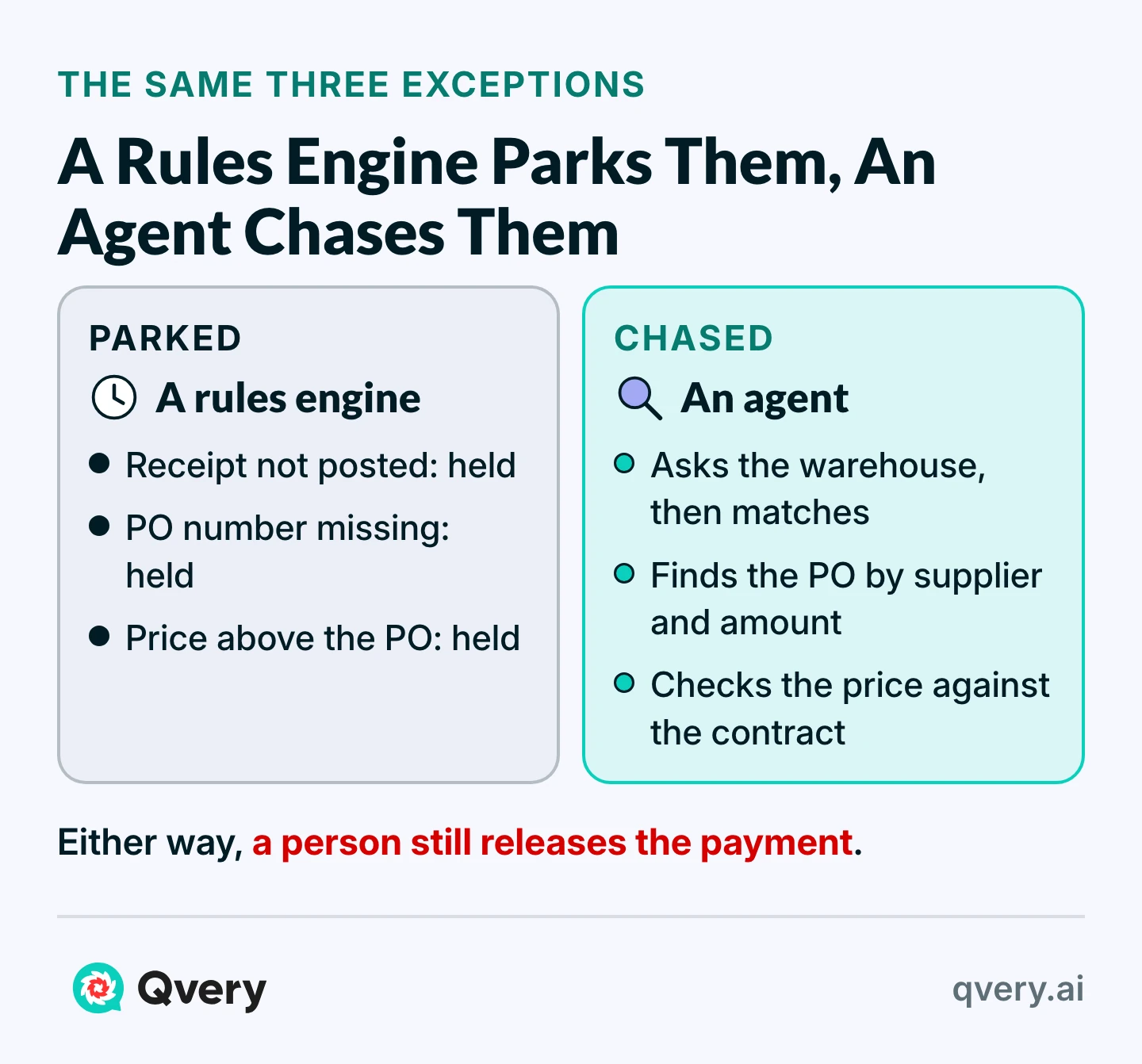
A rules engine parks all 170 of those invoices and waits; an agent can go and get the missing document.
Your Tolerance Decides How Many Invoices Skip a Person
An invoice skips a person only when it matches its PO and receipt, isn't a duplicate, and meets its approval rule. The tolerance is the part you set as a number: how far an invoice may differ before someone looks.
Set it two ways at once where your system allows. In Microsoft's Dynamics 365 Finance, for one, a line can carry a percentage and an amount, and exceeding either one stops it. Use both: on a $500 invoice, 2% is ten dollars of rounding, and on a $40,000 one it's $800 nobody checks.
Price the band both ways before you pick it. Say 60 of last month's exceptions were price differences between 1% and 3%. Widening the band from 1% to 3% clears all 60 and gives back the 15 hours they took.
It also means up to 3% of every matched invoice is paid without a look, every month.
 Vlad ShvetsPartner @ Qvery
I'd rather a team start with its tolerance too tight and loosen it from the data than the other way round. A tight band costs hours you can see in the queue every morning. A loose one costs money you never see: a supplier who bills a little over the agreed price, inside the band, gets a clean match on every invoice, and nobody looks until someone compares a year of them.
So set it by what you buy, not one number for everything:
- Near zero on a fixed-price contract, where any difference is a billing error.
- Freight and tax as their own lines, with their own small band.
- Tight, or none, on a new supplier's first invoices, until you know what normal looks like.
Then write the rule in one sentence an auditor could check: "Pay any line within 2% or $250 of the PO price, whichever is lower, for suppliers with six months of history; hold everything else."
Run it on last quarter's invoices before switching it on, and count both columns: the invoices it would have cleared, and the money it would have waved through.
Releasing Payment and Changing Bank Details Stay With a Person
In a team of two or three, the steps that move money are often one person's job, and payables fraud counts on that.
In the Association for Financial Professionals' 2026 survey of 465 treasury practitioners, business email compromise hit 74% of organizations in 2025, mostly fraudsters posing as suppliers or executives and asking to change payment instructions. The FBI's 2025 crime report puts reported losses to it at $3,046,598,558.
So the agent holds no right to approve, release a payment or edit a supplier record.
A new bank account, a new remit-to address or a second record for the same supplier gets flagged, confirmed by a call to a number already on file (never one from the email), and approved by a second person before the next run.
Every invoice is also checked for a duplicate under a new number, and for one bill split into pieces that each fall under an approval limit. Whoever releases the run sees what the agent cleared since the last one and every supplier record that changed.
Microsoft draws the same line for its own payables agent in Business Central: it prepares draft invoices from the AP inbox and doesn't post them, and a supplier it creates stays blocked until a person unblocks it.
Tips from Reddit
How AP people handle a supplier's new bank details
Anytime someone wants to change bank info, you just call and confirm. Imo, companies don't change banks too often.
Treat any banking change as a separate event from the invoice. Verify it through a known contact and require a second person to approve the change before anyone can release payment.
One person enters the bills and different person pay them. No approval chain necessary. Vendor information changes get escalated and require approval from management.
Start the agent where it only proposes: your team works as before, with a note beside each invoice saying what the agent would have done, and it acts on its own once those notes have proved right.
How Qvery Builds the Agent That Works Your Payables Exceptions
The agent we build lives on your AP inbox and your accounting system, and it runs on your company's rules rather than a vendor's defaults. It matches each invoice to its PO and receipt and lets through what passes your written tolerance.
For the rest it does the legwork your team does by email today: it asks the warehouse whether the delivery came, finds the PO the supplier didn't quote, checks a higher price against the contract on file, and holds a bill with no PO against its contract rate.
A judgment reaches its owner as one file: the invoice, the documents and what doesn't match. Payments and supplier records stay with people.
It works on autopilot beside your AP team, inside NetSuite, Sage Intacct, Business Central or QuickBooks, the shared inbox and the payment run they already use.
We begin with how your team closes each kind of exception now, and turn that into the tolerance sentence and the approval lines above. A first working version runs on your real exceptions within two weeks, and we train your AP team and approvers to work with it.
Then every week we report two numbers: hours saved on the exception queue and errors avoided, such as a duplicate stopped, a price above the order held, or a bank change caught before the run.
Count Three Numbers Every Friday
Three numbers tell you whether it's working: the share of invoices that went through untouched, by kind of invoice; the age of the oldest open exception; and what the checks stopped before payment.
A touchless rate that climbs while credits and supplier disputes climb with it is a looser tolerance, not progress. The same count names which receipts arrive late, and from which site, which is the list that gets receiving fixed.
On Monday, pull last month's exceptions and write beside each one what finally closed it. The rows that say "found the document" are how much of your payables an agent can take.
Frequently asked questions
How much of accounts payable can AI handle?
The invoices that match within your tolerance, plus the exceptions whose answer is a document already in your systems. In Ardent Partners' 2026 benchmarks the best fifth of teams process 55.2% of invoices with no manual touch; an agent can also take the exceptions caused by a missing receipt, PO or price. Payment release and supplier changes stay with people.
What is straight-through processing in accounts payable?
An invoice that goes from receipt to the payment run with no one editing, matching or approving it by hand. It's also called touchless processing. It counts only invoices nobody touched, so it says nothing about how fast the exceptions are cleared.
What match tolerance should we set?
There's no single right number. Start tight, near zero on fixed-price contracts, with freight and tax as their own lines and a tight band for new suppliers. Run the rule on last quarter's invoices first and look at both the invoices it clears and the money it lets through unchecked.
Should a tolerance be a percentage or a fixed amount?
Both, with the lower one winning. A percentage alone lets large invoices carry large differences; an amount alone stops trivial ones on big orders. Systems like Microsoft's Dynamics 365 Finance flag a line when either limit is exceeded.
Can AI do three-way matching?
Yes. Matching an invoice to its purchase order and its goods receipt is rules work accounting systems already do. What AI adds is reading invoices in any layout, finding a PO the supplier didn't quote, and chasing a receipt that hasn't been posted, which is where three-way matching usually stalls.
What happens to invoices AI cannot match?
They go to a person, and the question is what they arrive with. An agent can attach the PO, the receipt, the contract price and the reason for the mismatch, so the owner decides from one file instead of starting a search.
How does AI handle invoices without a purchase order?
It checks them against a reference you keep: the contract rate, the subscription price, or a budget owner's standing approval. A change from last month's amount is worth flagging, but a matching amount isn't proof the bill is right.
Can an AI agent resolve invoice exceptions on its own?
The ones caused by missing evidence, often. It can ask the warehouse to confirm a delivery, find the right PO, or match a higher price to a newer contract. Exceptions that need a decision, like a disputed delivery or an unagreed price rise, go to a person with the file prepared.
Should an AI agent be allowed to release payments?
No. Releasing the payment run, approving a new supplier and changing bank details are controls a person keeps. The agent can prepare all three; it holds no right to complete them.
Can AI catch a changed supplier bank account?
It can flag every change and hold the payment until a person confirms it with a call to a number already on file. That matters because business email compromise, mostly fraudsters posing as suppliers or executives, hit 74% of organizations in the AFP's 2026 survey.
Can AI catch duplicate invoices?
Yes, including the ones a basic duplicate check misses: the same invoice under a new number, the same amount from a second supplier record, a resent copy after a late payment. It checks every invoice against payment history before it reaches the run.
What changes for the AP team when an agent takes the exceptions?
Less chasing and more deciding. The team stops emailing the warehouse for receipts and spends that time on disputes, supplier problems and the controls. Somebody still owns the tolerance, the approval lines and the payment run.
How long does it take to set up an AP agent?
With Qvery, a first working version runs on your real exceptions within two weeks. It starts by proposing only, and takes on more as its proposals prove right on your invoices.
Which accounting systems can an AP agent work with?
The ones you already run, for example NetSuite, Sage Intacct, Business Central or QuickBooks, plus the shared AP inbox. The agent works inside your current systems rather than asking you to move to new ones.
What should we measure after automating accounts payable?
The share of invoices that go through untouched by kind, the age of the oldest open exception, what the checks stopped before payment, and which receipts arrive late. A rising touchless rate with rising credits or disputes means the tolerance got looser, not better.