By
Vlad Shvets
AI Answers Cite Zillow for Home Values, Almost Never for Mortgages
How often ChatGPT and Google AI Mode cite zillow.com in real-estate answers, which question types carry those citations, and why the five-portal set is the better thing to track.
How often ChatGPT and Google AI Mode cite zillow.com in real-estate answers, which question types carry those citations, and why the five-portal set is the better thing to track.
How often ChatGPT and Google AI Mode cite zillow.com in real-estate answers, which question types carry those citations, and why the five-portal set is the better thing to track.
Nearly every real estate marketing plan I have read has a Zillow paragraph in it. It usually says the portal owns the results, so the plan works around it. That paragraph was written for a page of blue links, and a growing share of your buyers are asking a chat window instead.
In September we ran a real-estate query set through ChatGPT and Google AI Mode and logged every source the answers cited. zillow.com appears in 12.57% of recommendation answers, out of 716 valid answers, and in 5.56% of informational answers, out of 288. Both engines, runs pooled.
That footprint is real, and it is lopsided.
Zillow shows up in more than four of every ten answers about home values and listing search, and in about one answer in a hundred about selling a house for cash. The question your buyer asks decides whether Zillow is in the room at all.
Zillow's citation footprint is narrow and uneven: heavy in home value and listing search questions, lighter in rental and agent questions, close to nothing in mortgage and cash-sale questions. Four other portals turn up in answers where Zillow does not, which is the case for tracking the set instead of the brand.
Zillow is a home-value fixture. It is cited in 45 of 106 home value and listing search answers (42.45%), against 2 of 120 mortgage answers (1.67%) and 1 of 112 cash-sale answers (0.89%).
Both engines cite it at close rates. On recommendation answers, ChatGPT 13.33% of 540 valid answers and Google AI Mode 10.23% of 176. No engine-difference verdict was registered for zillow.com, so the two figures stand as they are.
The five-portal set is bigger than Zillow alone. Zillow, Realtor.com, Redfin, Trulia, and Homes.com together appear in 15.08% of recommendation answers and 11.46% of informational ones.
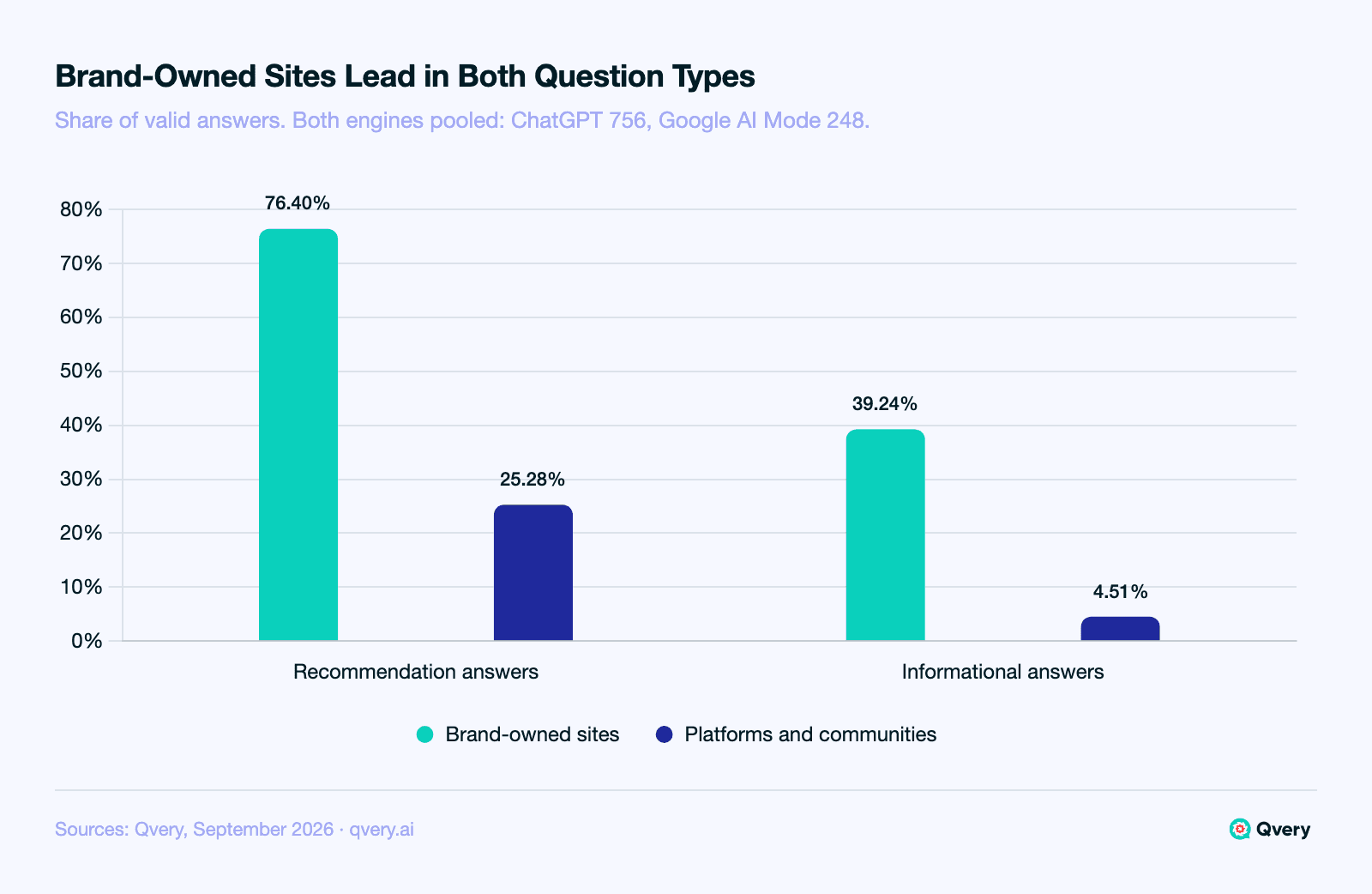
Brand-owned sites lead both question types. They appear in 76.40% of recommendation answers (547 of 716) and 39.24% of informational answers (113 of 288). Platforms and communities: 25.28% and 4.51%.
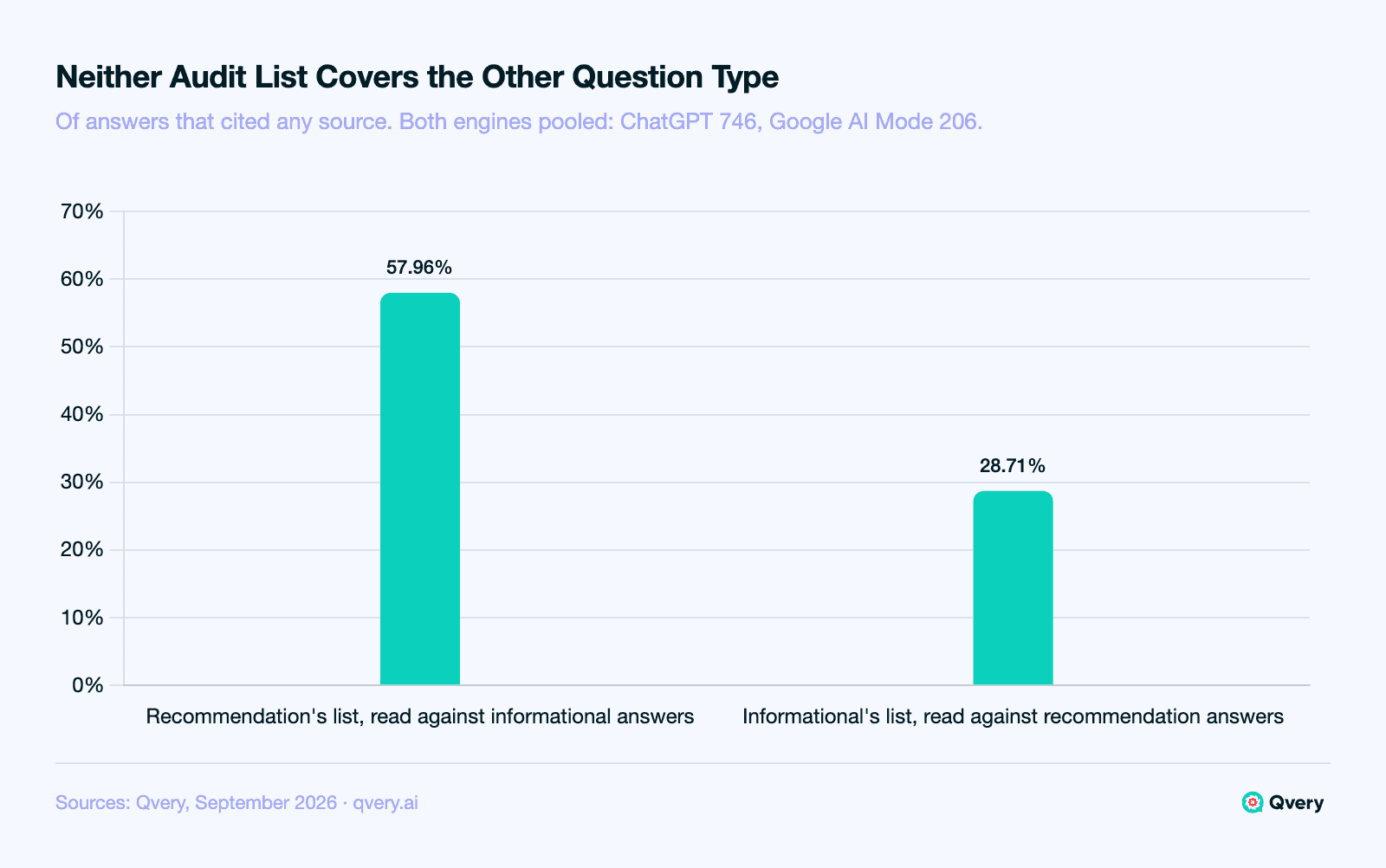
One audit list will not serve both. The recommendation list covers 57.96% of informational answers that cited any source, and the informational list covers 28.71% of recommendation answers that cited any source.
The corpus is September's fresh real-estate query set, frozen before the runs, and every percentage here is a share of all valid answers in the cut named beside it. Both engines, runs pooled: 756 valid ChatGPT answers and 248 from Google AI Mode, with the recommendation cut skewed 3.07 to one (540 to 176).
June is not a comparison. The two periods stored their sources differently, so no change over time ships here. The survey figures further down come from a reviewed ledger, in which 48 statistics survived from 70 candidates across 14 source pages.
We have read the portal layer from the other end before. In city-anchored questions about hiring an agent, agent-matching directories carried the answer and portals sat well behind them. That was a different cut from this one, and nothing here confirms or contradicts it.
Which Questions Cite Zillow
The query set is grouped by subtopic, which lets us ask where Zillow's citations sit rather than only how many of them there are. Every subtopic below cleared 100 valid and 100 cited answers. All shares are of valid answers, both engines with runs pooled, with ChatGPT contributing 540 and Google AI Mode 176 across the whole recommendation cut.
Home value estimates and listing search for buyers and sellers: 45 of 106 valid answers, 42.45%, with 105 of those answers citing at least one source.
Apartment and rental search: 24 of 123 valid answers, 19.51%, 122 cited.
Real estate agents and brokerages: 18 of 123 valid answers, 14.63%, 117 cited.
Mortgage lenders and home loans: 2 of 120 valid answers, 1.67%, 120 cited.
Cash home buyers and fast home-selling services: 1 of 112 valid answers, 0.89%, 112 cited.
Two more subtopics ran too small to carry a percentage: property management services (80 valid answers, 79 cited) and first-time homebuyer help and down payment assistance (52 valid, 52 cited). No answer in either one cited zillow.com. At those bases that is a quiet result, not a finding that Zillow is missing from those questions.
The 106 answers that cite Zillow anywhere in the corpus draw on 90 distinct Zillow URLs. A path rule sorts them into 43 other, 20 research or guide pages, 14 rentals, 9 agent directory, and 4 home values.
It matched no URL to a listing detail page or a mortgage page. With the largest bucket sitting in "other", that says the rule needs work rather than saying anything about which Zillow pages the engines prefer.
How Often AI Answers Cite Zillow, and What the Portal Set Adds
Pooled across engines, zillow.com is cited in 12.57% of recommendation answers (716 valid, 707 of them citing at least one source) and 5.56% of informational answers (288 valid, 245 cited). Recommendation questions are the ones that sound like a buyer talking. Informational questions are the ones that sound like a buyer reading.
Split by engine on recommendation answers, ChatGPT cites zillow.com in 13.33% (540 valid, 534 cited) and Google AI Mode in 10.23% (176 valid, 173 cited). No engine-difference test was registered for zillow.com alone, so those two numbers describe the cut and settle nothing between the engines.
On informational answers Google AI Mode ran 72 valid answers and 33 cited ones, which is below the floor.
No percentage ships for that slice.
Now put the other four portals back in.
The hand-audited set of zillow.com, realtor.com, redfin.com, trulia.com, and homes.com is cited in 15.08% of recommendation answers and 11.46% of informational answers, on the same bases. On recommendation answers the set reaches 16.48% of ChatGPT answers and 10.80% of Google AI Mode answers. These are descriptive figures: no intent verdict and no engine verdict is attached to them.
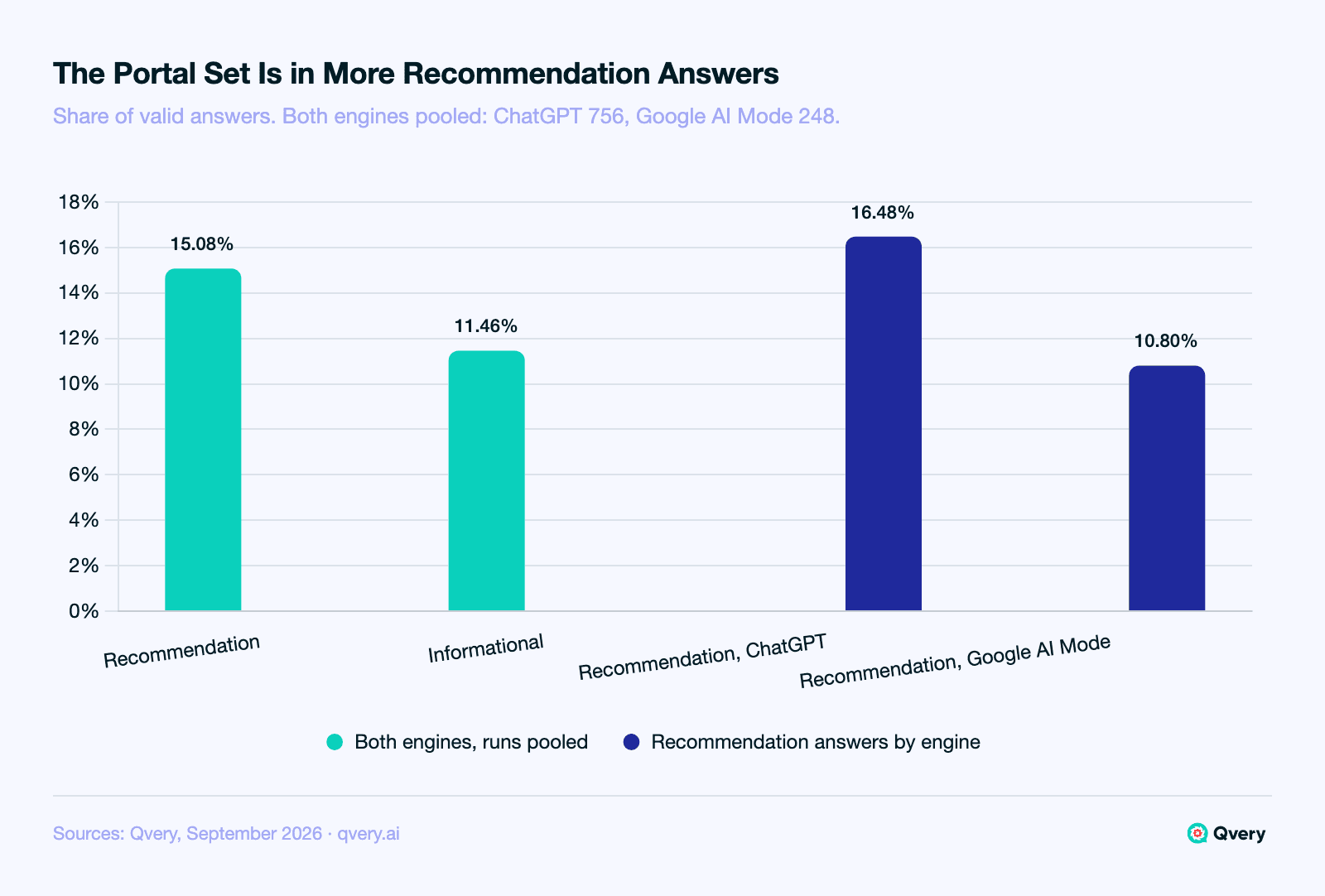
The set is present in more recommendation answers than Zillow is on its own, which means there are answers where a portal is cited and Zillow is not one of them.
Watching Zillow alone is watching one lane and calling it traffic.
The portal set is the unit worth tracking. Zillow is the loudest member of it, and it is not a stand-in for the other four.
This study does not rank the five against each other. The numerators for trulia.com and homes.com were never settled, so no individual share or rank ships for the other four.
Brand-Owned Sites Appear in More Answers Than Platforms and Communities
Underneath the portal question is a bigger one: what kind of source answers a real-estate question at all. We labelled every cited domain into two validated layers, brand-owned sites and platforms and communities, and measured how many answers contained at least one of each.
In recommendation answers, brand-owned sites appear in 76.40% (547 of 716) and platforms and communities in 25.28% (181 of 716), a ratio of 3.02. In informational answers the gap widens: brand-owned 39.24% (113 of 288) against 4.51% (13 of 288), a ratio of 8.69.
An answer can sit in both layers, so the shares do not sum to 100.
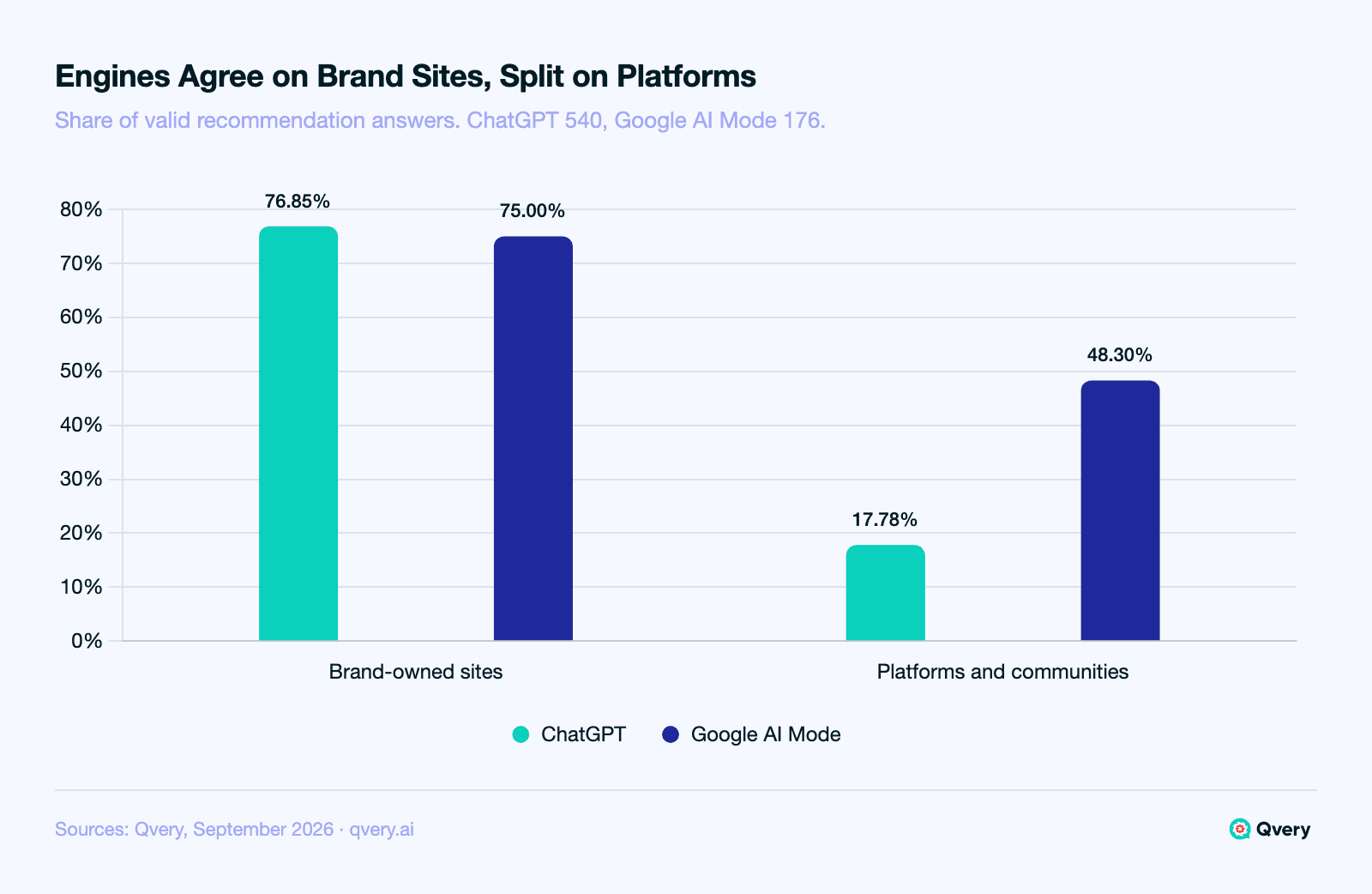
By engine, on recommendation answers, the brand-owned layer is the same story twice: ChatGPT 76.85% (415 of 540) and Google AI Mode 75.00% (132 of 176), a ratio of 1.02. The platform and community layer is where they part: ChatGPT 17.78% (96 of 540) against Google AI Mode 48.30% (85 of 176), a ratio of 0.37.
In real estate, the answer is mostly built out of somebody's own website. Platforms and communities are the second layer in both question types, and on Google AI Mode they sit in almost half of the recommendation answers.
In real-estate recommendation answers, Google AI Mode reaches for forums and platforms nearly three times as often as ChatGPT does. If you're deciding where to spend effort, your own pages are in the answer for both question types, and community threads are more of a Google AI Mode story than a ChatGPT one.
Practitioners have been saying the first half of this for a while.
One real-estate visibility page puts it as "Each platform draws from different sources: ChatGPT cites LinkedIn heavily, Google AI Overview cites Reddit, and others weight industry publications differently."
Our cut is narrower, and it only partly agrees. The platform and community layer did differ by engine and the brand-owned layer did not. We measured ChatGPT and Google AI Mode, and Google AI Mode is a different product from the Google AI Overview that quote names.
Two more claims in circulation need a line each. "The agent whose content gets cited becomes the agent AI recommends" is a leap this study cannot support. We measured which sources answers cited, not which brands answers named or recommended, and no naming extraction was registered.
Another page reads the same layer result as a trust signal, saying "the answer comes from sources LLMs already trust, and most real estate brands are not among them." Layer presence is a count of answers, and it carries no reading of how the engine chose the source.
Then there is the audit list.
Working from the domains each question type cited, the recommendation half needs 8 domains to cover half its cited answers and 25 to cover four fifths. The informational half needs 4 and 15. zillow.com sits on both 80% lists, inside recommendation's 50% head and outside informational's.
Recommendation's 80% list (25 domains): zillow.com, bankrate.com, opendoor.com, openrent.co.uk, apple.com, gov.uk, consumerfinance.gov, reddit.com, expertise.com, multihousingnews.com, zumper.com, listwithclever.com, hud.gov, yahoo.com, homelight.com, realestate.com.au, google.com, cnbc.com, lets-canada.com, buildium.com, houzeo.com, realtor.com, nerdwallet.com, selectra.co.uk, homego.com.
Informational's 80% list (15 domains): consumerfinance.gov, realtor.com, nar.realtor, gc.ca, irs.gov, moneyhelper.org.uk, rocketmortgage.com, ftc.gov, zillow.com, nsw.gov.au, huduser.gov, ca.gov, reddit.com, fanniemae.com, on.ca.
Read each list against the other half of the corpus and the overlap thins out. Recommendation's list covers 57.96% of informational answers that cited any source (142 of 245). Informational's list covers 28.71% of recommendation answers that cited any source (203 of 707).
The smaller of the two decides it, and at 0.2871 it sits well under the 0.60 bar we set before running.
In this corpus, each question type needs its own list.
A third practitioner claim lands here: "Monitor when and how AI systems recommend your properties or services to homebuyers." The recommendation half of this corpus did carry higher portal presence and its own source list, so monitoring it separately is sound. What we measured is still citation, and a citation is not a recommendation.
For the audit-list decision on a different cut, generic against city-named questions, our real-estate audit post carries its own two lists, measured separately and neither confirming nor contradicting this one.
How Much of Home Search and Agent Choice Starts Online, and How Soon Is the Agent Chosen?
The citation data says which sources answer a question. It says nothing about how many buyers are asking, so here is the demand side, from Zillow Group's own reporting. Zillow Group says 94% of buyers use online tools to search for homes, and 64% prefer to schedule tours online.
Agent choice starts in the same place.
Zillow Group reports that 36% of sellers now find their agent through online channels, more than double the 15% share in 2018, and that 33% of buyers say online research played a key role in how they chose their agent.
Then it ends quickly.
47% of buyers hired the first agent they spoke with, and 59% of sellers did the same, per the same Zillow Group report.
Put those together and the monitoring order is straightforward. Home search happens online, agent choice increasingly starts there, and the agent decision closes fast once contact is made. Those are also the question types where the portals are already in the answer, so that is where a real estate brand should be watching first.
Put the Portal Set on Your Own Query List in Qvery
Everything above is one corpus and one query set. Yours is a different set of questions, and it's the one your buyers are typing. In Qvery you write those questions down, and the engines get asked them daily.
Qvery tracks visibility, share of voice, and average rank across ChatGPT and Google AI Mode, in 200+ countries. Every citation is captured daily and tied to the query and the engine that produced it, so you can open a question like "best way to estimate my home value in Austin" and see whether it cited zillow.com, one of the other four portals, or you.
Qvery Assistant sits in the app and answers questions about your own data in plain language, so building the portal view is a sentence rather than a dashboard exercise. Ask it which of your queries cite zillow.com, add the questions this post says to watch first, and trigger a run.
Start your free trial: 7 days free, and no credit card required. What Qvery will not settle for you is why an engine cited a source. The citation is observable and the reasoning behind it is not, in Qvery or anywhere else.
What This Study Does Not Say
The four other portals get no individual share and no rank here, because the cut-level numerators for trulia.com and homes.com were never settled. Answer-level percentages by Zillow URL family do not ship either, so the page types above are counts of distinct URLs and nothing more. Two subtopics sat below the eligibility floor, and Google AI Mode's informational slice was too small to carry a percentage.
No engine-difference verdict ships for zillow.com, and no June-to-September comparison ships at all. Everything here is citation co-occurrence: which sources appeared in an answer, not why they appeared, whether the engine trusted them, whether a brand was named, or whether anything was recommended. We measured citations inside ChatGPT and Google AI Mode answers, which says nothing about apps built inside either product. One corpus, one frozen query set, September 2026.
What to Do With This
Keep two audit lists, one for the questions that ask for a recommendation and one for the questions that ask for an explanation, because in this corpus neither list covered the other. The same split is already the advice in our property management post, measured a different way.
Then set your Zillow benchmark where Zillow is cited. Benchmark against it in home value and listing search first, then apartment and rental search, then agents and brokerages. Leave it out of mortgage and cash-sale questions, where it turns up in roughly one answer in a hundred and the sources that matter belong to somebody else.
And track it inside the portal set rather than alone, because the answers you're missing are the ones where a different portal got the citation.
Nearly every real estate marketing plan I have read has a Zillow paragraph in it. It usually says the portal owns the results, so the plan works around it. That paragraph was written for a page of blue links, and a growing share of your buyers are asking a chat window instead.
In September we ran a real-estate query set through ChatGPT and Google AI Mode and logged every source the answers cited. zillow.com appears in 12.57% of recommendation answers, out of 716 valid answers, and in 5.56% of informational answers, out of 288. Both engines, runs pooled.
That footprint is real, and it is lopsided.
Zillow shows up in more than four of every ten answers about home values and listing search, and in about one answer in a hundred about selling a house for cash. The question your buyer asks decides whether Zillow is in the room at all.
Zillow's citation footprint is narrow and uneven: heavy in home value and listing search questions, lighter in rental and agent questions, close to nothing in mortgage and cash-sale questions. Four other portals turn up in answers where Zillow does not, which is the case for tracking the set instead of the brand.
Zillow is a home-value fixture. It is cited in 45 of 106 home value and listing search answers (42.45%), against 2 of 120 mortgage answers (1.67%) and 1 of 112 cash-sale answers (0.89%).
Both engines cite it at close rates. On recommendation answers, ChatGPT 13.33% of 540 valid answers and Google AI Mode 10.23% of 176. No engine-difference verdict was registered for zillow.com, so the two figures stand as they are.
The five-portal set is bigger than Zillow alone. Zillow, Realtor.com, Redfin, Trulia, and Homes.com together appear in 15.08% of recommendation answers and 11.46% of informational ones.
Brand-owned sites lead both question types. They appear in 76.40% of recommendation answers (547 of 716) and 39.24% of informational answers (113 of 288). Platforms and communities: 25.28% and 4.51%.
One audit list will not serve both. The recommendation list covers 57.96% of informational answers that cited any source, and the informational list covers 28.71% of recommendation answers that cited any source.
The corpus is September's fresh real-estate query set, frozen before the runs, and every percentage here is a share of all valid answers in the cut named beside it. Both engines, runs pooled: 756 valid ChatGPT answers and 248 from Google AI Mode, with the recommendation cut skewed 3.07 to one (540 to 176).
June is not a comparison. The two periods stored their sources differently, so no change over time ships here. The survey figures further down come from a reviewed ledger, in which 48 statistics survived from 70 candidates across 14 source pages.
We have read the portal layer from the other end before. In city-anchored questions about hiring an agent, agent-matching directories carried the answer and portals sat well behind them. That was a different cut from this one, and nothing here confirms or contradicts it.
Which Questions Cite Zillow
The query set is grouped by subtopic, which lets us ask where Zillow's citations sit rather than only how many of them there are. Every subtopic below cleared 100 valid and 100 cited answers. All shares are of valid answers, both engines with runs pooled, with ChatGPT contributing 540 and Google AI Mode 176 across the whole recommendation cut.
Home value estimates and listing search for buyers and sellers: 45 of 106 valid answers, 42.45%, with 105 of those answers citing at least one source.
Apartment and rental search: 24 of 123 valid answers, 19.51%, 122 cited.
Real estate agents and brokerages: 18 of 123 valid answers, 14.63%, 117 cited.
Mortgage lenders and home loans: 2 of 120 valid answers, 1.67%, 120 cited.
Cash home buyers and fast home-selling services: 1 of 112 valid answers, 0.89%, 112 cited.
Two more subtopics ran too small to carry a percentage: property management services (80 valid answers, 79 cited) and first-time homebuyer help and down payment assistance (52 valid, 52 cited). No answer in either one cited zillow.com. At those bases that is a quiet result, not a finding that Zillow is missing from those questions.
The 106 answers that cite Zillow anywhere in the corpus draw on 90 distinct Zillow URLs. A path rule sorts them into 43 other, 20 research or guide pages, 14 rentals, 9 agent directory, and 4 home values.
It matched no URL to a listing detail page or a mortgage page. With the largest bucket sitting in "other", that says the rule needs work rather than saying anything about which Zillow pages the engines prefer.
How Often AI Answers Cite Zillow, and What the Portal Set Adds
Pooled across engines, zillow.com is cited in 12.57% of recommendation answers (716 valid, 707 of them citing at least one source) and 5.56% of informational answers (288 valid, 245 cited). Recommendation questions are the ones that sound like a buyer talking. Informational questions are the ones that sound like a buyer reading.
Split by engine on recommendation answers, ChatGPT cites zillow.com in 13.33% (540 valid, 534 cited) and Google AI Mode in 10.23% (176 valid, 173 cited). No engine-difference test was registered for zillow.com alone, so those two numbers describe the cut and settle nothing between the engines.
On informational answers Google AI Mode ran 72 valid answers and 33 cited ones, which is below the floor.
No percentage ships for that slice.
Now put the other four portals back in.
The hand-audited set of zillow.com, realtor.com, redfin.com, trulia.com, and homes.com is cited in 15.08% of recommendation answers and 11.46% of informational answers, on the same bases. On recommendation answers the set reaches 16.48% of ChatGPT answers and 10.80% of Google AI Mode answers. These are descriptive figures: no intent verdict and no engine verdict is attached to them.
The set is present in more recommendation answers than Zillow is on its own, which means there are answers where a portal is cited and Zillow is not one of them.
Watching Zillow alone is watching one lane and calling it traffic.
The portal set is the unit worth tracking. Zillow is the loudest member of it, and it is not a stand-in for the other four.
This study does not rank the five against each other. The numerators for trulia.com and homes.com were never settled, so no individual share or rank ships for the other four.
Brand-Owned Sites Appear in More Answers Than Platforms and Communities
Underneath the portal question is a bigger one: what kind of source answers a real-estate question at all. We labelled every cited domain into two validated layers, brand-owned sites and platforms and communities, and measured how many answers contained at least one of each.
In recommendation answers, brand-owned sites appear in 76.40% (547 of 716) and platforms and communities in 25.28% (181 of 716), a ratio of 3.02. In informational answers the gap widens: brand-owned 39.24% (113 of 288) against 4.51% (13 of 288), a ratio of 8.69.
An answer can sit in both layers, so the shares do not sum to 100.
By engine, on recommendation answers, the brand-owned layer is the same story twice: ChatGPT 76.85% (415 of 540) and Google AI Mode 75.00% (132 of 176), a ratio of 1.02. The platform and community layer is where they part: ChatGPT 17.78% (96 of 540) against Google AI Mode 48.30% (85 of 176), a ratio of 0.37.
In real estate, the answer is mostly built out of somebody's own website. Platforms and communities are the second layer in both question types, and on Google AI Mode they sit in almost half of the recommendation answers.
In real-estate recommendation answers, Google AI Mode reaches for forums and platforms nearly three times as often as ChatGPT does. If you're deciding where to spend effort, your own pages are in the answer for both question types, and community threads are more of a Google AI Mode story than a ChatGPT one.
Practitioners have been saying the first half of this for a while.
One real-estate visibility page puts it as "Each platform draws from different sources: ChatGPT cites LinkedIn heavily, Google AI Overview cites Reddit, and others weight industry publications differently."
Our cut is narrower, and it only partly agrees. The platform and community layer did differ by engine and the brand-owned layer did not. We measured ChatGPT and Google AI Mode, and Google AI Mode is a different product from the Google AI Overview that quote names.
Two more claims in circulation need a line each. "The agent whose content gets cited becomes the agent AI recommends" is a leap this study cannot support. We measured which sources answers cited, not which brands answers named or recommended, and no naming extraction was registered.
Another page reads the same layer result as a trust signal, saying "the answer comes from sources LLMs already trust, and most real estate brands are not among them." Layer presence is a count of answers, and it carries no reading of how the engine chose the source.
Then there is the audit list.
Working from the domains each question type cited, the recommendation half needs 8 domains to cover half its cited answers and 25 to cover four fifths. The informational half needs 4 and 15. zillow.com sits on both 80% lists, inside recommendation's 50% head and outside informational's.
Recommendation's 80% list (25 domains): zillow.com, bankrate.com, opendoor.com, openrent.co.uk, apple.com, gov.uk, consumerfinance.gov, reddit.com, expertise.com, multihousingnews.com, zumper.com, listwithclever.com, hud.gov, yahoo.com, homelight.com, realestate.com.au, google.com, cnbc.com, lets-canada.com, buildium.com, houzeo.com, realtor.com, nerdwallet.com, selectra.co.uk, homego.com.
Informational's 80% list (15 domains): consumerfinance.gov, realtor.com, nar.realtor, gc.ca, irs.gov, moneyhelper.org.uk, rocketmortgage.com, ftc.gov, zillow.com, nsw.gov.au, huduser.gov, ca.gov, reddit.com, fanniemae.com, on.ca.
Read each list against the other half of the corpus and the overlap thins out. Recommendation's list covers 57.96% of informational answers that cited any source (142 of 245). Informational's list covers 28.71% of recommendation answers that cited any source (203 of 707).
The smaller of the two decides it, and at 0.2871 it sits well under the 0.60 bar we set before running.
In this corpus, each question type needs its own list.
A third practitioner claim lands here: "Monitor when and how AI systems recommend your properties or services to homebuyers." The recommendation half of this corpus did carry higher portal presence and its own source list, so monitoring it separately is sound. What we measured is still citation, and a citation is not a recommendation.
For the audit-list decision on a different cut, generic against city-named questions, our real-estate audit post carries its own two lists, measured separately and neither confirming nor contradicting this one.
How Much of Home Search and Agent Choice Starts Online, and How Soon Is the Agent Chosen?
The citation data says which sources answer a question. It says nothing about how many buyers are asking, so here is the demand side, from Zillow Group's own reporting. Zillow Group says 94% of buyers use online tools to search for homes, and 64% prefer to schedule tours online.
Agent choice starts in the same place.
Zillow Group reports that 36% of sellers now find their agent through online channels, more than double the 15% share in 2018, and that 33% of buyers say online research played a key role in how they chose their agent.
Then it ends quickly.
47% of buyers hired the first agent they spoke with, and 59% of sellers did the same, per the same Zillow Group report.
Put those together and the monitoring order is straightforward. Home search happens online, agent choice increasingly starts there, and the agent decision closes fast once contact is made. Those are also the question types where the portals are already in the answer, so that is where a real estate brand should be watching first.
Put the Portal Set on Your Own Query List in Qvery
Everything above is one corpus and one query set. Yours is a different set of questions, and it's the one your buyers are typing. In Qvery you write those questions down, and the engines get asked them daily.
Qvery tracks visibility, share of voice, and average rank across ChatGPT and Google AI Mode, in 200+ countries. Every citation is captured daily and tied to the query and the engine that produced it, so you can open a question like "best way to estimate my home value in Austin" and see whether it cited zillow.com, one of the other four portals, or you.
Qvery Assistant sits in the app and answers questions about your own data in plain language, so building the portal view is a sentence rather than a dashboard exercise. Ask it which of your queries cite zillow.com, add the questions this post says to watch first, and trigger a run.
Start your free trial: 7 days free, and no credit card required. What Qvery will not settle for you is why an engine cited a source. The citation is observable and the reasoning behind it is not, in Qvery or anywhere else.
What This Study Does Not Say
The four other portals get no individual share and no rank here, because the cut-level numerators for trulia.com and homes.com were never settled. Answer-level percentages by Zillow URL family do not ship either, so the page types above are counts of distinct URLs and nothing more. Two subtopics sat below the eligibility floor, and Google AI Mode's informational slice was too small to carry a percentage.
No engine-difference verdict ships for zillow.com, and no June-to-September comparison ships at all. Everything here is citation co-occurrence: which sources appeared in an answer, not why they appeared, whether the engine trusted them, whether a brand was named, or whether anything was recommended. We measured citations inside ChatGPT and Google AI Mode answers, which says nothing about apps built inside either product. One corpus, one frozen query set, September 2026.
What to Do With This
Keep two audit lists, one for the questions that ask for a recommendation and one for the questions that ask for an explanation, because in this corpus neither list covered the other. The same split is already the advice in our property management post, measured a different way.
Then set your Zillow benchmark where Zillow is cited. Benchmark against it in home value and listing search first, then apartment and rental search, then agents and brokerages. Leave it out of mortgage and cash-sale questions, where it turns up in roughly one answer in a hundred and the sources that matter belong to somebody else.
And track it inside the portal set rather than alone, because the answers you're missing are the ones where a different portal got the citation.
Nearly every real estate marketing plan I have read has a Zillow paragraph in it. It usually says the portal owns the results, so the plan works around it. That paragraph was written for a page of blue links, and a growing share of your buyers are asking a chat window instead.
In September we ran a real-estate query set through ChatGPT and Google AI Mode and logged every source the answers cited. zillow.com appears in 12.57% of recommendation answers, out of 716 valid answers, and in 5.56% of informational answers, out of 288. Both engines, runs pooled.
That footprint is real, and it is lopsided.
Zillow shows up in more than four of every ten answers about home values and listing search, and in about one answer in a hundred about selling a house for cash. The question your buyer asks decides whether Zillow is in the room at all.
Zillow's citation footprint is narrow and uneven: heavy in home value and listing search questions, lighter in rental and agent questions, close to nothing in mortgage and cash-sale questions. Four other portals turn up in answers where Zillow does not, which is the case for tracking the set instead of the brand.
Zillow is a home-value fixture. It is cited in 45 of 106 home value and listing search answers (42.45%), against 2 of 120 mortgage answers (1.67%) and 1 of 112 cash-sale answers (0.89%).
Both engines cite it at close rates. On recommendation answers, ChatGPT 13.33% of 540 valid answers and Google AI Mode 10.23% of 176. No engine-difference verdict was registered for zillow.com, so the two figures stand as they are.
The five-portal set is bigger than Zillow alone. Zillow, Realtor.com, Redfin, Trulia, and Homes.com together appear in 15.08% of recommendation answers and 11.46% of informational ones.
Brand-owned sites lead both question types. They appear in 76.40% of recommendation answers (547 of 716) and 39.24% of informational answers (113 of 288). Platforms and communities: 25.28% and 4.51%.
One audit list will not serve both. The recommendation list covers 57.96% of informational answers that cited any source, and the informational list covers 28.71% of recommendation answers that cited any source.
The corpus is September's fresh real-estate query set, frozen before the runs, and every percentage here is a share of all valid answers in the cut named beside it. Both engines, runs pooled: 756 valid ChatGPT answers and 248 from Google AI Mode, with the recommendation cut skewed 3.07 to one (540 to 176).
June is not a comparison. The two periods stored their sources differently, so no change over time ships here. The survey figures further down come from a reviewed ledger, in which 48 statistics survived from 70 candidates across 14 source pages.
We have read the portal layer from the other end before. In city-anchored questions about hiring an agent, agent-matching directories carried the answer and portals sat well behind them. That was a different cut from this one, and nothing here confirms or contradicts it.
Which Questions Cite Zillow
The query set is grouped by subtopic, which lets us ask where Zillow's citations sit rather than only how many of them there are. Every subtopic below cleared 100 valid and 100 cited answers. All shares are of valid answers, both engines with runs pooled, with ChatGPT contributing 540 and Google AI Mode 176 across the whole recommendation cut.
Home value estimates and listing search for buyers and sellers: 45 of 106 valid answers, 42.45%, with 105 of those answers citing at least one source.
Apartment and rental search: 24 of 123 valid answers, 19.51%, 122 cited.
Real estate agents and brokerages: 18 of 123 valid answers, 14.63%, 117 cited.
Mortgage lenders and home loans: 2 of 120 valid answers, 1.67%, 120 cited.
Cash home buyers and fast home-selling services: 1 of 112 valid answers, 0.89%, 112 cited.
Two more subtopics ran too small to carry a percentage: property management services (80 valid answers, 79 cited) and first-time homebuyer help and down payment assistance (52 valid, 52 cited). No answer in either one cited zillow.com. At those bases that is a quiet result, not a finding that Zillow is missing from those questions.
The 106 answers that cite Zillow anywhere in the corpus draw on 90 distinct Zillow URLs. A path rule sorts them into 43 other, 20 research or guide pages, 14 rentals, 9 agent directory, and 4 home values.
It matched no URL to a listing detail page or a mortgage page. With the largest bucket sitting in "other", that says the rule needs work rather than saying anything about which Zillow pages the engines prefer.
How Often AI Answers Cite Zillow, and What the Portal Set Adds
Pooled across engines, zillow.com is cited in 12.57% of recommendation answers (716 valid, 707 of them citing at least one source) and 5.56% of informational answers (288 valid, 245 cited). Recommendation questions are the ones that sound like a buyer talking. Informational questions are the ones that sound like a buyer reading.
Split by engine on recommendation answers, ChatGPT cites zillow.com in 13.33% (540 valid, 534 cited) and Google AI Mode in 10.23% (176 valid, 173 cited). No engine-difference test was registered for zillow.com alone, so those two numbers describe the cut and settle nothing between the engines.
On informational answers Google AI Mode ran 72 valid answers and 33 cited ones, which is below the floor.
No percentage ships for that slice.
Now put the other four portals back in.
The hand-audited set of zillow.com, realtor.com, redfin.com, trulia.com, and homes.com is cited in 15.08% of recommendation answers and 11.46% of informational answers, on the same bases. On recommendation answers the set reaches 16.48% of ChatGPT answers and 10.80% of Google AI Mode answers. These are descriptive figures: no intent verdict and no engine verdict is attached to them.
The set is present in more recommendation answers than Zillow is on its own, which means there are answers where a portal is cited and Zillow is not one of them.
Watching Zillow alone is watching one lane and calling it traffic.
The portal set is the unit worth tracking. Zillow is the loudest member of it, and it is not a stand-in for the other four.
This study does not rank the five against each other. The numerators for trulia.com and homes.com were never settled, so no individual share or rank ships for the other four.
Brand-Owned Sites Appear in More Answers Than Platforms and Communities
Underneath the portal question is a bigger one: what kind of source answers a real-estate question at all. We labelled every cited domain into two validated layers, brand-owned sites and platforms and communities, and measured how many answers contained at least one of each.
In recommendation answers, brand-owned sites appear in 76.40% (547 of 716) and platforms and communities in 25.28% (181 of 716), a ratio of 3.02. In informational answers the gap widens: brand-owned 39.24% (113 of 288) against 4.51% (13 of 288), a ratio of 8.69.
An answer can sit in both layers, so the shares do not sum to 100.
By engine, on recommendation answers, the brand-owned layer is the same story twice: ChatGPT 76.85% (415 of 540) and Google AI Mode 75.00% (132 of 176), a ratio of 1.02. The platform and community layer is where they part: ChatGPT 17.78% (96 of 540) against Google AI Mode 48.30% (85 of 176), a ratio of 0.37.
In real estate, the answer is mostly built out of somebody's own website. Platforms and communities are the second layer in both question types, and on Google AI Mode they sit in almost half of the recommendation answers.
In real-estate recommendation answers, Google AI Mode reaches for forums and platforms nearly three times as often as ChatGPT does. If you're deciding where to spend effort, your own pages are in the answer for both question types, and community threads are more of a Google AI Mode story than a ChatGPT one.
Practitioners have been saying the first half of this for a while.
One real-estate visibility page puts it as "Each platform draws from different sources: ChatGPT cites LinkedIn heavily, Google AI Overview cites Reddit, and others weight industry publications differently."
Our cut is narrower, and it only partly agrees. The platform and community layer did differ by engine and the brand-owned layer did not. We measured ChatGPT and Google AI Mode, and Google AI Mode is a different product from the Google AI Overview that quote names.
Two more claims in circulation need a line each. "The agent whose content gets cited becomes the agent AI recommends" is a leap this study cannot support. We measured which sources answers cited, not which brands answers named or recommended, and no naming extraction was registered.
Another page reads the same layer result as a trust signal, saying "the answer comes from sources LLMs already trust, and most real estate brands are not among them." Layer presence is a count of answers, and it carries no reading of how the engine chose the source.
Then there is the audit list.
Working from the domains each question type cited, the recommendation half needs 8 domains to cover half its cited answers and 25 to cover four fifths. The informational half needs 4 and 15. zillow.com sits on both 80% lists, inside recommendation's 50% head and outside informational's.
Recommendation's 80% list (25 domains): zillow.com, bankrate.com, opendoor.com, openrent.co.uk, apple.com, gov.uk, consumerfinance.gov, reddit.com, expertise.com, multihousingnews.com, zumper.com, listwithclever.com, hud.gov, yahoo.com, homelight.com, realestate.com.au, google.com, cnbc.com, lets-canada.com, buildium.com, houzeo.com, realtor.com, nerdwallet.com, selectra.co.uk, homego.com.
Informational's 80% list (15 domains): consumerfinance.gov, realtor.com, nar.realtor, gc.ca, irs.gov, moneyhelper.org.uk, rocketmortgage.com, ftc.gov, zillow.com, nsw.gov.au, huduser.gov, ca.gov, reddit.com, fanniemae.com, on.ca.
Read each list against the other half of the corpus and the overlap thins out. Recommendation's list covers 57.96% of informational answers that cited any source (142 of 245). Informational's list covers 28.71% of recommendation answers that cited any source (203 of 707).
The smaller of the two decides it, and at 0.2871 it sits well under the 0.60 bar we set before running.
In this corpus, each question type needs its own list.
A third practitioner claim lands here: "Monitor when and how AI systems recommend your properties or services to homebuyers." The recommendation half of this corpus did carry higher portal presence and its own source list, so monitoring it separately is sound. What we measured is still citation, and a citation is not a recommendation.
For the audit-list decision on a different cut, generic against city-named questions, our real-estate audit post carries its own two lists, measured separately and neither confirming nor contradicting this one.
How Much of Home Search and Agent Choice Starts Online, and How Soon Is the Agent Chosen?
The citation data says which sources answer a question. It says nothing about how many buyers are asking, so here is the demand side, from Zillow Group's own reporting. Zillow Group says 94% of buyers use online tools to search for homes, and 64% prefer to schedule tours online.
Agent choice starts in the same place.
Zillow Group reports that 36% of sellers now find their agent through online channels, more than double the 15% share in 2018, and that 33% of buyers say online research played a key role in how they chose their agent.
Then it ends quickly.
47% of buyers hired the first agent they spoke with, and 59% of sellers did the same, per the same Zillow Group report.
Put those together and the monitoring order is straightforward. Home search happens online, agent choice increasingly starts there, and the agent decision closes fast once contact is made. Those are also the question types where the portals are already in the answer, so that is where a real estate brand should be watching first.
Put the Portal Set on Your Own Query List in Qvery
Everything above is one corpus and one query set. Yours is a different set of questions, and it's the one your buyers are typing. In Qvery you write those questions down, and the engines get asked them daily.
Qvery tracks visibility, share of voice, and average rank across ChatGPT and Google AI Mode, in 200+ countries. Every citation is captured daily and tied to the query and the engine that produced it, so you can open a question like "best way to estimate my home value in Austin" and see whether it cited zillow.com, one of the other four portals, or you.
Qvery Assistant sits in the app and answers questions about your own data in plain language, so building the portal view is a sentence rather than a dashboard exercise. Ask it which of your queries cite zillow.com, add the questions this post says to watch first, and trigger a run.
Start your free trial: 7 days free, and no credit card required. What Qvery will not settle for you is why an engine cited a source. The citation is observable and the reasoning behind it is not, in Qvery or anywhere else.
What This Study Does Not Say
The four other portals get no individual share and no rank here, because the cut-level numerators for trulia.com and homes.com were never settled. Answer-level percentages by Zillow URL family do not ship either, so the page types above are counts of distinct URLs and nothing more. Two subtopics sat below the eligibility floor, and Google AI Mode's informational slice was too small to carry a percentage.
No engine-difference verdict ships for zillow.com, and no June-to-September comparison ships at all. Everything here is citation co-occurrence: which sources appeared in an answer, not why they appeared, whether the engine trusted them, whether a brand was named, or whether anything was recommended. We measured citations inside ChatGPT and Google AI Mode answers, which says nothing about apps built inside either product. One corpus, one frozen query set, September 2026.
What to Do With This
Keep two audit lists, one for the questions that ask for a recommendation and one for the questions that ask for an explanation, because in this corpus neither list covered the other. The same split is already the advice in our property management post, measured a different way.
Then set your Zillow benchmark where Zillow is cited. Benchmark against it in home value and listing search first, then apartment and rental search, then agents and brokerages. Leave it out of mortgage and cash-sale questions, where it turns up in roughly one answer in a hundred and the sources that matter belong to somebody else.
And track it inside the portal set rather than alone, because the answers you're missing are the ones where a different portal got the citation.
Nearly every real estate marketing plan I have read has a Zillow paragraph in it. It usually says the portal owns the results, so the plan works around it. That paragraph was written for a page of blue links, and a growing share of your buyers are asking a chat window instead.
In September we ran a real-estate query set through ChatGPT and Google AI Mode and logged every source the answers cited. zillow.com appears in 12.57% of recommendation answers, out of 716 valid answers, and in 5.56% of informational answers, out of 288. Both engines, runs pooled.
That footprint is real, and it is lopsided.
Zillow shows up in more than four of every ten answers about home values and listing search, and in about one answer in a hundred about selling a house for cash. The question your buyer asks decides whether Zillow is in the room at all.
Zillow's citation footprint is narrow and uneven: heavy in home value and listing search questions, lighter in rental and agent questions, close to nothing in mortgage and cash-sale questions. Four other portals turn up in answers where Zillow does not, which is the case for tracking the set instead of the brand.
Zillow is a home-value fixture. It is cited in 45 of 106 home value and listing search answers (42.45%), against 2 of 120 mortgage answers (1.67%) and 1 of 112 cash-sale answers (0.89%).
Both engines cite it at close rates. On recommendation answers, ChatGPT 13.33% of 540 valid answers and Google AI Mode 10.23% of 176. No engine-difference verdict was registered for zillow.com, so the two figures stand as they are.
The five-portal set is bigger than Zillow alone. Zillow, Realtor.com, Redfin, Trulia, and Homes.com together appear in 15.08% of recommendation answers and 11.46% of informational ones.
Brand-owned sites lead both question types. They appear in 76.40% of recommendation answers (547 of 716) and 39.24% of informational answers (113 of 288). Platforms and communities: 25.28% and 4.51%.
One audit list will not serve both. The recommendation list covers 57.96% of informational answers that cited any source, and the informational list covers 28.71% of recommendation answers that cited any source.
The corpus is September's fresh real-estate query set, frozen before the runs, and every percentage here is a share of all valid answers in the cut named beside it. Both engines, runs pooled: 756 valid ChatGPT answers and 248 from Google AI Mode, with the recommendation cut skewed 3.07 to one (540 to 176).
June is not a comparison. The two periods stored their sources differently, so no change over time ships here. The survey figures further down come from a reviewed ledger, in which 48 statistics survived from 70 candidates across 14 source pages.
We have read the portal layer from the other end before. In city-anchored questions about hiring an agent, agent-matching directories carried the answer and portals sat well behind them. That was a different cut from this one, and nothing here confirms or contradicts it.
Which Questions Cite Zillow
The query set is grouped by subtopic, which lets us ask where Zillow's citations sit rather than only how many of them there are. Every subtopic below cleared 100 valid and 100 cited answers. All shares are of valid answers, both engines with runs pooled, with ChatGPT contributing 540 and Google AI Mode 176 across the whole recommendation cut.
Home value estimates and listing search for buyers and sellers: 45 of 106 valid answers, 42.45%, with 105 of those answers citing at least one source.
Apartment and rental search: 24 of 123 valid answers, 19.51%, 122 cited.
Real estate agents and brokerages: 18 of 123 valid answers, 14.63%, 117 cited.
Mortgage lenders and home loans: 2 of 120 valid answers, 1.67%, 120 cited.
Cash home buyers and fast home-selling services: 1 of 112 valid answers, 0.89%, 112 cited.
Two more subtopics ran too small to carry a percentage: property management services (80 valid answers, 79 cited) and first-time homebuyer help and down payment assistance (52 valid, 52 cited). No answer in either one cited zillow.com. At those bases that is a quiet result, not a finding that Zillow is missing from those questions.
The 106 answers that cite Zillow anywhere in the corpus draw on 90 distinct Zillow URLs. A path rule sorts them into 43 other, 20 research or guide pages, 14 rentals, 9 agent directory, and 4 home values.
It matched no URL to a listing detail page or a mortgage page. With the largest bucket sitting in "other", that says the rule needs work rather than saying anything about which Zillow pages the engines prefer.
How Often AI Answers Cite Zillow, and What the Portal Set Adds
Pooled across engines, zillow.com is cited in 12.57% of recommendation answers (716 valid, 707 of them citing at least one source) and 5.56% of informational answers (288 valid, 245 cited). Recommendation questions are the ones that sound like a buyer talking. Informational questions are the ones that sound like a buyer reading.
Split by engine on recommendation answers, ChatGPT cites zillow.com in 13.33% (540 valid, 534 cited) and Google AI Mode in 10.23% (176 valid, 173 cited). No engine-difference test was registered for zillow.com alone, so those two numbers describe the cut and settle nothing between the engines.
On informational answers Google AI Mode ran 72 valid answers and 33 cited ones, which is below the floor.
No percentage ships for that slice.
Now put the other four portals back in.
The hand-audited set of zillow.com, realtor.com, redfin.com, trulia.com, and homes.com is cited in 15.08% of recommendation answers and 11.46% of informational answers, on the same bases. On recommendation answers the set reaches 16.48% of ChatGPT answers and 10.80% of Google AI Mode answers. These are descriptive figures: no intent verdict and no engine verdict is attached to them.
The set is present in more recommendation answers than Zillow is on its own, which means there are answers where a portal is cited and Zillow is not one of them.
Watching Zillow alone is watching one lane and calling it traffic.
The portal set is the unit worth tracking. Zillow is the loudest member of it, and it is not a stand-in for the other four.
This study does not rank the five against each other. The numerators for trulia.com and homes.com were never settled, so no individual share or rank ships for the other four.
Brand-Owned Sites Appear in More Answers Than Platforms and Communities
Underneath the portal question is a bigger one: what kind of source answers a real-estate question at all. We labelled every cited domain into two validated layers, brand-owned sites and platforms and communities, and measured how many answers contained at least one of each.
In recommendation answers, brand-owned sites appear in 76.40% (547 of 716) and platforms and communities in 25.28% (181 of 716), a ratio of 3.02. In informational answers the gap widens: brand-owned 39.24% (113 of 288) against 4.51% (13 of 288), a ratio of 8.69.
An answer can sit in both layers, so the shares do not sum to 100.
By engine, on recommendation answers, the brand-owned layer is the same story twice: ChatGPT 76.85% (415 of 540) and Google AI Mode 75.00% (132 of 176), a ratio of 1.02. The platform and community layer is where they part: ChatGPT 17.78% (96 of 540) against Google AI Mode 48.30% (85 of 176), a ratio of 0.37.
In real estate, the answer is mostly built out of somebody's own website. Platforms and communities are the second layer in both question types, and on Google AI Mode they sit in almost half of the recommendation answers.
In real-estate recommendation answers, Google AI Mode reaches for forums and platforms nearly three times as often as ChatGPT does. If you're deciding where to spend effort, your own pages are in the answer for both question types, and community threads are more of a Google AI Mode story than a ChatGPT one.
Practitioners have been saying the first half of this for a while.
One real-estate visibility page puts it as "Each platform draws from different sources: ChatGPT cites LinkedIn heavily, Google AI Overview cites Reddit, and others weight industry publications differently."
Our cut is narrower, and it only partly agrees. The platform and community layer did differ by engine and the brand-owned layer did not. We measured ChatGPT and Google AI Mode, and Google AI Mode is a different product from the Google AI Overview that quote names.
Two more claims in circulation need a line each. "The agent whose content gets cited becomes the agent AI recommends" is a leap this study cannot support. We measured which sources answers cited, not which brands answers named or recommended, and no naming extraction was registered.
Another page reads the same layer result as a trust signal, saying "the answer comes from sources LLMs already trust, and most real estate brands are not among them." Layer presence is a count of answers, and it carries no reading of how the engine chose the source.
Then there is the audit list.
Working from the domains each question type cited, the recommendation half needs 8 domains to cover half its cited answers and 25 to cover four fifths. The informational half needs 4 and 15. zillow.com sits on both 80% lists, inside recommendation's 50% head and outside informational's.
Recommendation's 80% list (25 domains): zillow.com, bankrate.com, opendoor.com, openrent.co.uk, apple.com, gov.uk, consumerfinance.gov, reddit.com, expertise.com, multihousingnews.com, zumper.com, listwithclever.com, hud.gov, yahoo.com, homelight.com, realestate.com.au, google.com, cnbc.com, lets-canada.com, buildium.com, houzeo.com, realtor.com, nerdwallet.com, selectra.co.uk, homego.com.
Informational's 80% list (15 domains): consumerfinance.gov, realtor.com, nar.realtor, gc.ca, irs.gov, moneyhelper.org.uk, rocketmortgage.com, ftc.gov, zillow.com, nsw.gov.au, huduser.gov, ca.gov, reddit.com, fanniemae.com, on.ca.
Read each list against the other half of the corpus and the overlap thins out. Recommendation's list covers 57.96% of informational answers that cited any source (142 of 245). Informational's list covers 28.71% of recommendation answers that cited any source (203 of 707).
The smaller of the two decides it, and at 0.2871 it sits well under the 0.60 bar we set before running.
In this corpus, each question type needs its own list.
A third practitioner claim lands here: "Monitor when and how AI systems recommend your properties or services to homebuyers." The recommendation half of this corpus did carry higher portal presence and its own source list, so monitoring it separately is sound. What we measured is still citation, and a citation is not a recommendation.
For the audit-list decision on a different cut, generic against city-named questions, our real-estate audit post carries its own two lists, measured separately and neither confirming nor contradicting this one.
How Much of Home Search and Agent Choice Starts Online, and How Soon Is the Agent Chosen?
The citation data says which sources answer a question. It says nothing about how many buyers are asking, so here is the demand side, from Zillow Group's own reporting. Zillow Group says 94% of buyers use online tools to search for homes, and 64% prefer to schedule tours online.
Agent choice starts in the same place.
Zillow Group reports that 36% of sellers now find their agent through online channels, more than double the 15% share in 2018, and that 33% of buyers say online research played a key role in how they chose their agent.
Then it ends quickly.
47% of buyers hired the first agent they spoke with, and 59% of sellers did the same, per the same Zillow Group report.
Put those together and the monitoring order is straightforward. Home search happens online, agent choice increasingly starts there, and the agent decision closes fast once contact is made. Those are also the question types where the portals are already in the answer, so that is where a real estate brand should be watching first.
Put the Portal Set on Your Own Query List in Qvery
Everything above is one corpus and one query set. Yours is a different set of questions, and it's the one your buyers are typing. In Qvery you write those questions down, and the engines get asked them daily.
Qvery tracks visibility, share of voice, and average rank across ChatGPT and Google AI Mode, in 200+ countries. Every citation is captured daily and tied to the query and the engine that produced it, so you can open a question like "best way to estimate my home value in Austin" and see whether it cited zillow.com, one of the other four portals, or you.
Qvery Assistant sits in the app and answers questions about your own data in plain language, so building the portal view is a sentence rather than a dashboard exercise. Ask it which of your queries cite zillow.com, add the questions this post says to watch first, and trigger a run.
Start your free trial: 7 days free, and no credit card required. What Qvery will not settle for you is why an engine cited a source. The citation is observable and the reasoning behind it is not, in Qvery or anywhere else.
What This Study Does Not Say
The four other portals get no individual share and no rank here, because the cut-level numerators for trulia.com and homes.com were never settled. Answer-level percentages by Zillow URL family do not ship either, so the page types above are counts of distinct URLs and nothing more. Two subtopics sat below the eligibility floor, and Google AI Mode's informational slice was too small to carry a percentage.
No engine-difference verdict ships for zillow.com, and no June-to-September comparison ships at all. Everything here is citation co-occurrence: which sources appeared in an answer, not why they appeared, whether the engine trusted them, whether a brand was named, or whether anything was recommended. We measured citations inside ChatGPT and Google AI Mode answers, which says nothing about apps built inside either product. One corpus, one frozen query set, September 2026.
What to Do With This
Keep two audit lists, one for the questions that ask for a recommendation and one for the questions that ask for an explanation, because in this corpus neither list covered the other. The same split is already the advice in our property management post, measured a different way.
Then set your Zillow benchmark where Zillow is cited. Benchmark against it in home value and listing search first, then apartment and rental search, then agents and brokerages. Leave it out of mortgage and cash-sale questions, where it turns up in roughly one answer in a hundred and the sources that matter belong to somebody else.
And track it inside the portal set rather than alone, because the answers you're missing are the ones where a different portal got the citation.

© 2026 Qvery AI OÜ