By
Vlad Shvets
What City-Anchored AI Answers Name in Property Management
Property management is a referral business that has spent two decades moving onto review sites. AI search inherited that, and then did something to it that...
Property management is a referral business that has spent two decades moving onto review sites. AI search inherited that, and then did something to it that...
Property management is a referral business that has spent two decades moving onto review sites. AI search inherited that, and then did something to it that...
Property management is a referral business that has spent two decades moving onto review sites. AI search inherited that, and then did something to it that is worth knowing before you spend another quarter on your website.
We ran a targeted collection across property management queries, split by the size of the metro, the type of property, and whether the person was hiring or researching.
Two of those three splits moved the results substantially. The third moved them least.
One boundary before any number. This measures which sources appear alongside the answers. It does not measure whether appearing on a source causes a company to be recommended, and nothing here was designed to test that.
Hiring Questions And Research Questions Are Different Surfaces
Across a targeted set of property management queries spanning three metro sizes and three property types, run on ChatGPT and Google AI Mode, August 2026, the biggest single difference is the question being asked.
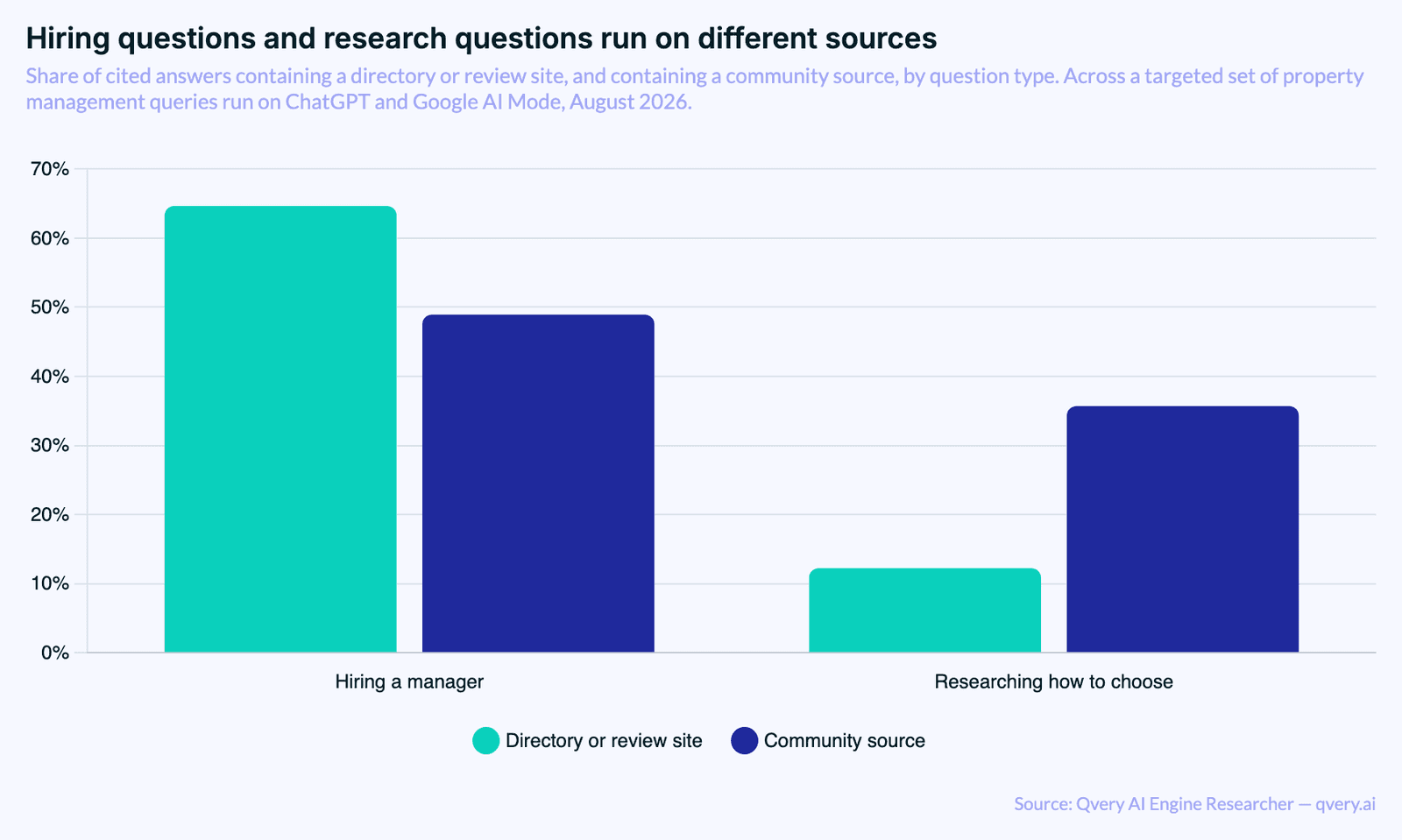
Ask which company to hire and a directory or review site appears in 64.66% of cited answers. Ask how to choose a property manager at all and that collapses to 12.24%.
Community sources move the other way, from 48.95% on hiring questions to 35.71% on research ones, which is a much gentler decline.
So the directory layer is specifically a hiring-moment phenomenon. When someone is still working out what to look for, it is largely absent from the answer.
Directories carry 64.66% of the hiring answers and 12.24% of the research ones. Community sources move far less, 48.95% against 35.71%.
We saw the same shape in a separate legal collection, where the directory layer ran at 81.40% on find-me-a-firm questions and 22.00% on questions checking whether a specific firm was any good. Two unrelated service categories, the same split.
Smaller Metros Face More Of It
The second split is about where the property sits.
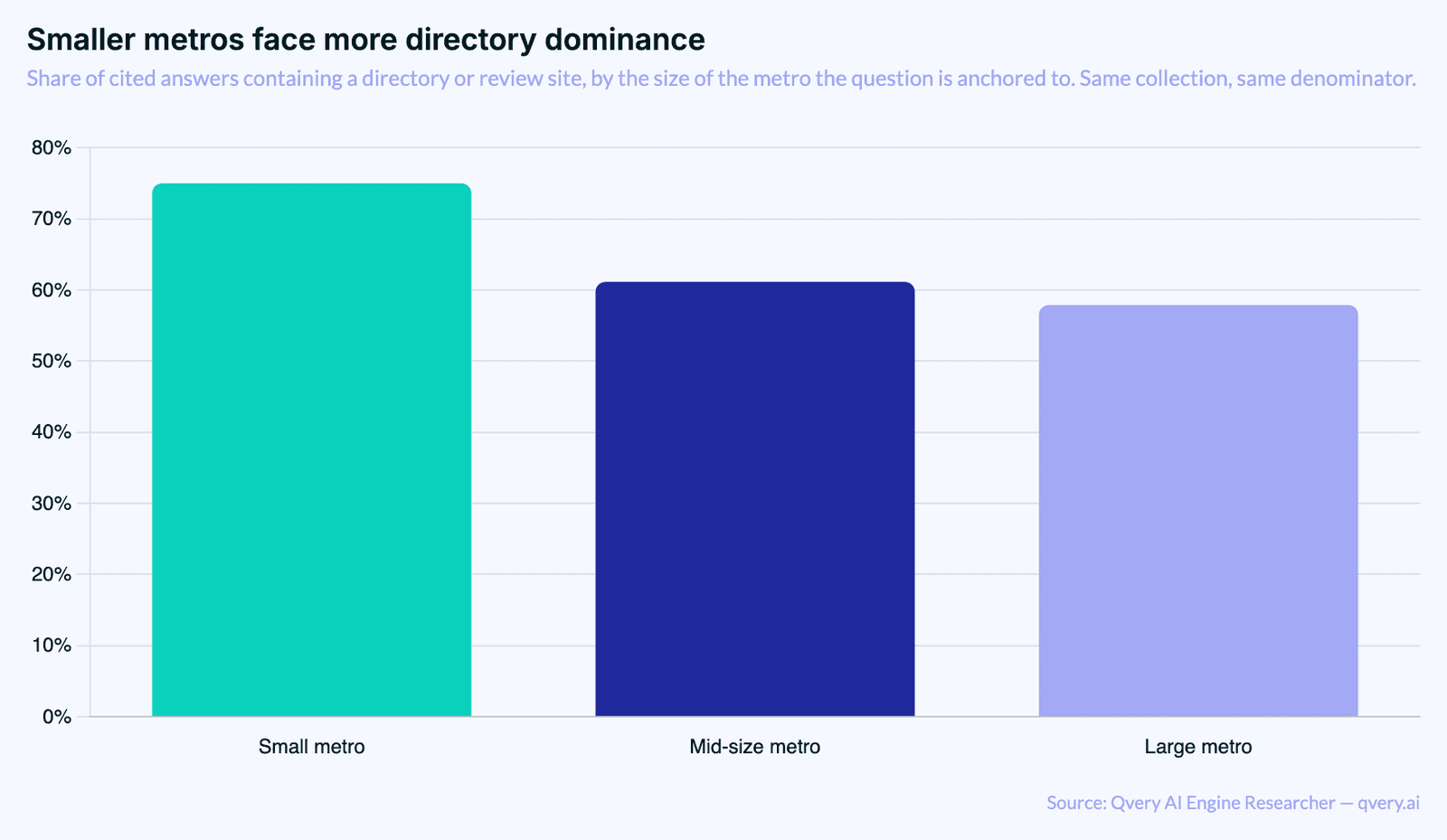
Questions anchored to small metros: directories in 75.00% of cited answers. Large metros: 57.89%. A 17.11-point spread.
This one has a companion result we did not expect. In the legal collection, directory presence ran from 89.26% in small metros to 72.13% in major ones, a spread of 17.13 points. Two unrelated service categories, the same dimension, and the spreads land two hundredths of a point apart.
We are not going to over-read a coincidence of that precision from two collections. The direction, though, is consistent: the smaller the metro, the more completely third-party listings occupy the answers about it.
Our reading, which neither collection can test: smaller metros attract less independent local coverage, so the listing profile is a larger share of what exists to cite. Treat it as a hypothesis.
Property Type Matters Less, With One Exception
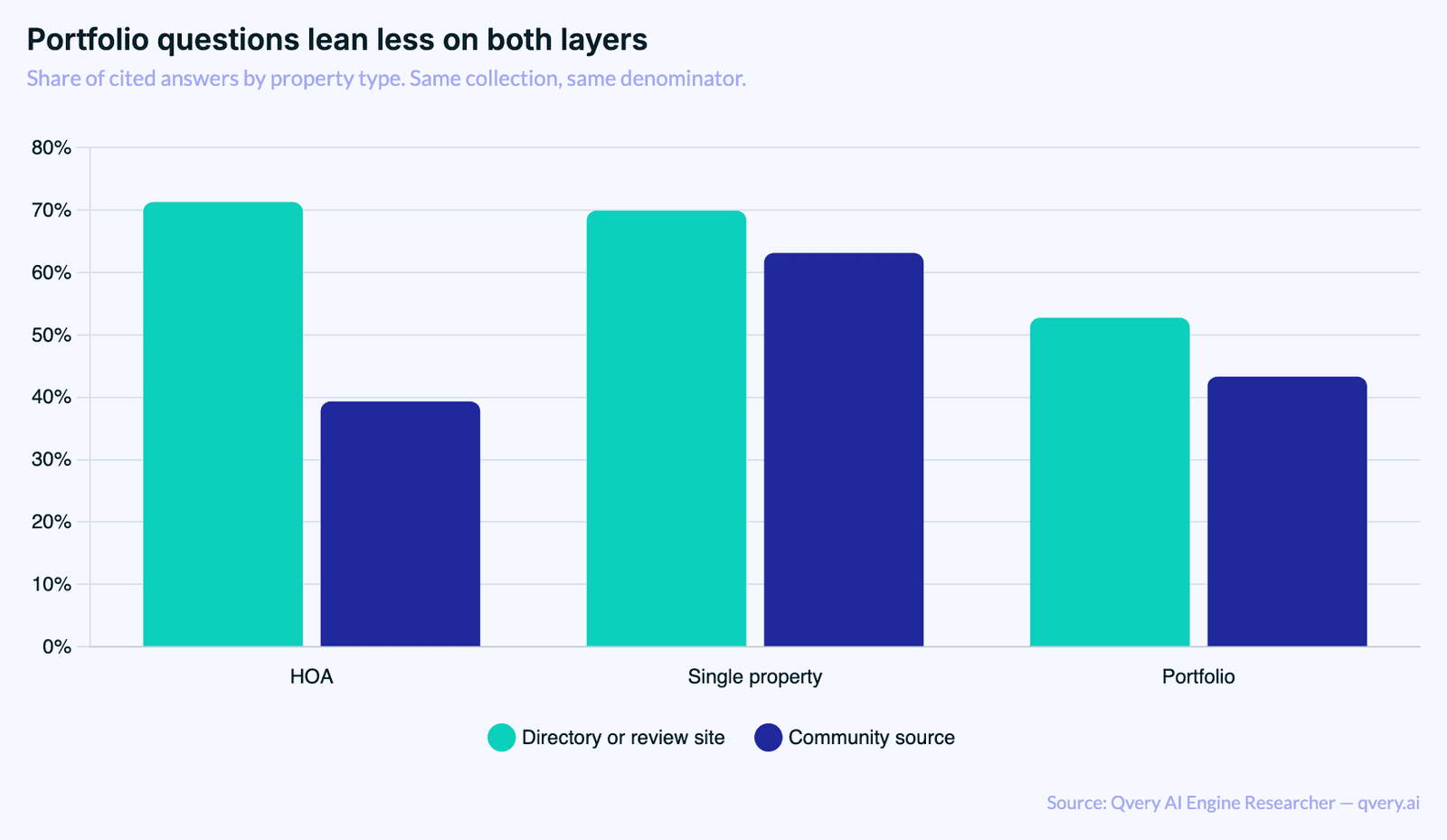
HOA questions at 71.31% directory presence and single-property questions at 69.92% sit close together. Portfolio questions drop to 52.76%.
The more interesting line is the community one. Single-property questions pull community sources at 63.16%, well above HOA questions at 39.34%. Individual landlords are talking to each other in places the engines then cite. HOA boards, apparently, less so.
If you serve individual landlords, roughly six in ten of the answers about that work already contain a community source. That is a surface, and it is not one you can buy your way onto.
Building The Audit
Everything above is one collection at one moment. Four things follow.
Split hiring queries from research queries before measuring anything. A 52.42-point difference in directory presence sits between them. Pooled, you get a number describing neither.
Audit the named directories first if you operate in a smaller metro. Three quarters of the answers anchored to small metros contain one, against under six in ten for large metros.
Track community sources as their own line, especially for single-property work. At 63.16% of those cited answers they are not a side channel.
Log it over time. A single snapshot cannot separate a source that structurally anchors your market from one that appeared once.
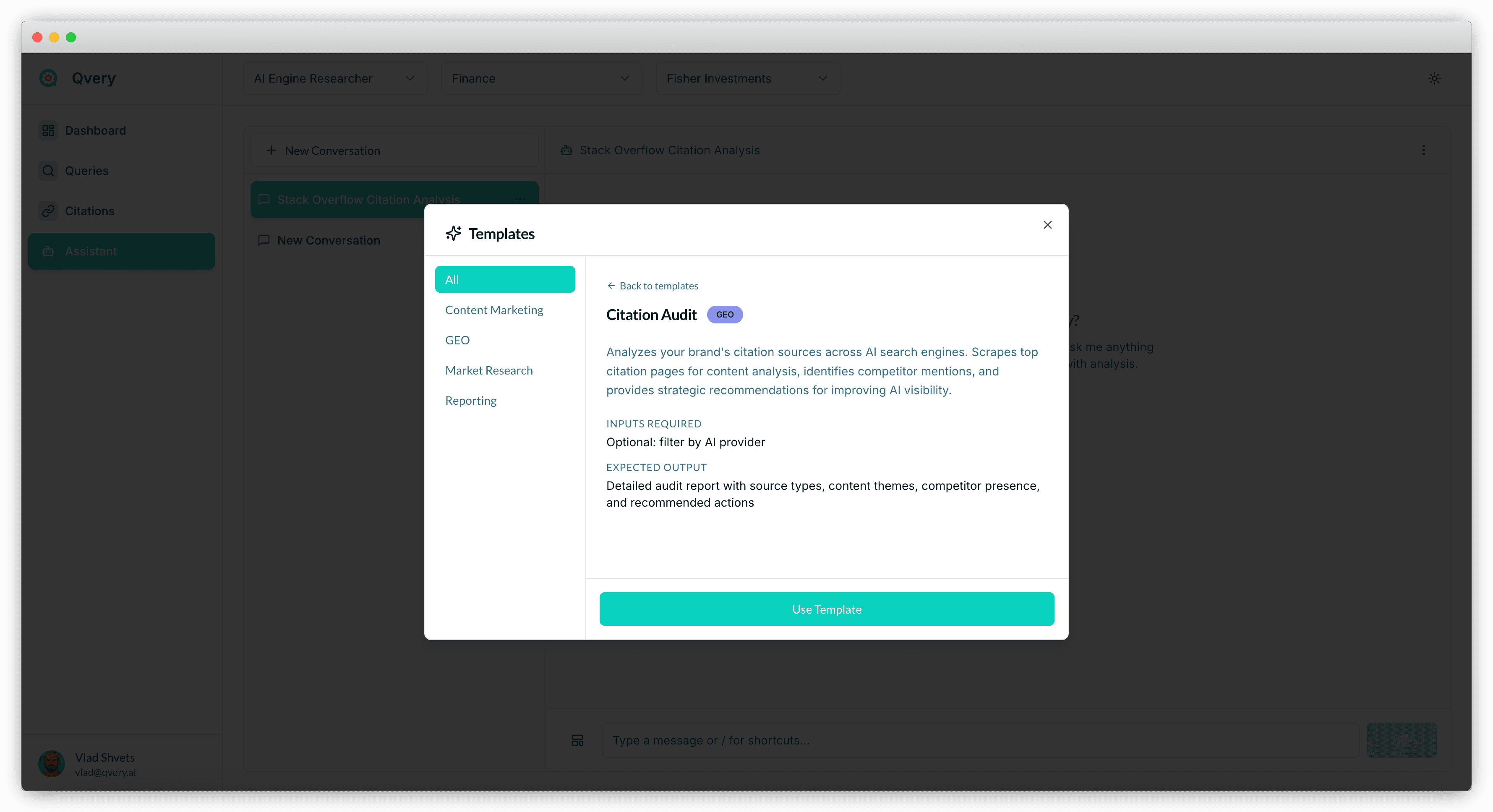
Qvery supplies the tracking underneath that. It tracks visibility, share of voice, and average rank across ChatGPT and Google AI Mode daily, in over 200 countries, and captures every citation tied to the query and engine that produced it. In Qvery Assistant you can ask about your own visibility, share of voice, citation, topic, and query data, add queries, trigger a run, or export a report.
The directory and community classification stays yours to maintain alongside those records. Ours are hand-checked named lists rather than classifier output.
Start your free trial and split your first month of citations by question type.
Writer's Judgment, Not A Finding
Flagging this clearly, because the rest of the article stays inside what was measured.
Given the metro gradient, our judgment is that a company operating in smaller metros should weight listing profiles above its own website, and that a large-metro operator has more room for owned content to matter. That is a view about where effort is likely to pay, and the pattern does not establish it.
Given the intent split, our judgment is that research-stage visibility is a separate workstream from hiring-stage visibility, with different sources and probably a different owner. Most operators we see run one plan for both.
Neither is established by the collection, and nothing here shows that improving a listing will get a company named.
What the collection did establish is narrower and firmer. Directories appear in 64.66% of cited hiring answers against 12.24% of research ones, in 75.00% of answers anchored to small metros against 57.89% for large metros, and community sources reach 63.16% in single-property questions. Those are the bounds. What you do inside them is a decision, not a finding.
Property management is a referral business that has spent two decades moving onto review sites. AI search inherited that, and then did something to it that is worth knowing before you spend another quarter on your website.
We ran a targeted collection across property management queries, split by the size of the metro, the type of property, and whether the person was hiring or researching.
Two of those three splits moved the results substantially. The third moved them least.
One boundary before any number. This measures which sources appear alongside the answers. It does not measure whether appearing on a source causes a company to be recommended, and nothing here was designed to test that.
Hiring Questions And Research Questions Are Different Surfaces
Across a targeted set of property management queries spanning three metro sizes and three property types, run on ChatGPT and Google AI Mode, August 2026, the biggest single difference is the question being asked.
Ask which company to hire and a directory or review site appears in 64.66% of cited answers. Ask how to choose a property manager at all and that collapses to 12.24%.
Community sources move the other way, from 48.95% on hiring questions to 35.71% on research ones, which is a much gentler decline.
So the directory layer is specifically a hiring-moment phenomenon. When someone is still working out what to look for, it is largely absent from the answer.
Directories carry 64.66% of the hiring answers and 12.24% of the research ones. Community sources move far less, 48.95% against 35.71%.
We saw the same shape in a separate legal collection, where the directory layer ran at 81.40% on find-me-a-firm questions and 22.00% on questions checking whether a specific firm was any good. Two unrelated service categories, the same split.
Smaller Metros Face More Of It
The second split is about where the property sits.
Questions anchored to small metros: directories in 75.00% of cited answers. Large metros: 57.89%. A 17.11-point spread.
This one has a companion result we did not expect. In the legal collection, directory presence ran from 89.26% in small metros to 72.13% in major ones, a spread of 17.13 points. Two unrelated service categories, the same dimension, and the spreads land two hundredths of a point apart.
We are not going to over-read a coincidence of that precision from two collections. The direction, though, is consistent: the smaller the metro, the more completely third-party listings occupy the answers about it.
Our reading, which neither collection can test: smaller metros attract less independent local coverage, so the listing profile is a larger share of what exists to cite. Treat it as a hypothesis.
Property Type Matters Less, With One Exception
HOA questions at 71.31% directory presence and single-property questions at 69.92% sit close together. Portfolio questions drop to 52.76%.
The more interesting line is the community one. Single-property questions pull community sources at 63.16%, well above HOA questions at 39.34%. Individual landlords are talking to each other in places the engines then cite. HOA boards, apparently, less so.
If you serve individual landlords, roughly six in ten of the answers about that work already contain a community source. That is a surface, and it is not one you can buy your way onto.
Building The Audit
Everything above is one collection at one moment. Four things follow.
Split hiring queries from research queries before measuring anything. A 52.42-point difference in directory presence sits between them. Pooled, you get a number describing neither.
Audit the named directories first if you operate in a smaller metro. Three quarters of the answers anchored to small metros contain one, against under six in ten for large metros.
Track community sources as their own line, especially for single-property work. At 63.16% of those cited answers they are not a side channel.
Log it over time. A single snapshot cannot separate a source that structurally anchors your market from one that appeared once.
Qvery supplies the tracking underneath that. It tracks visibility, share of voice, and average rank across ChatGPT and Google AI Mode daily, in over 200 countries, and captures every citation tied to the query and engine that produced it. In Qvery Assistant you can ask about your own visibility, share of voice, citation, topic, and query data, add queries, trigger a run, or export a report.
The directory and community classification stays yours to maintain alongside those records. Ours are hand-checked named lists rather than classifier output.
Start your free trial and split your first month of citations by question type.
Writer's Judgment, Not A Finding
Flagging this clearly, because the rest of the article stays inside what was measured.
Given the metro gradient, our judgment is that a company operating in smaller metros should weight listing profiles above its own website, and that a large-metro operator has more room for owned content to matter. That is a view about where effort is likely to pay, and the pattern does not establish it.
Given the intent split, our judgment is that research-stage visibility is a separate workstream from hiring-stage visibility, with different sources and probably a different owner. Most operators we see run one plan for both.
Neither is established by the collection, and nothing here shows that improving a listing will get a company named.
What the collection did establish is narrower and firmer. Directories appear in 64.66% of cited hiring answers against 12.24% of research ones, in 75.00% of answers anchored to small metros against 57.89% for large metros, and community sources reach 63.16% in single-property questions. Those are the bounds. What you do inside them is a decision, not a finding.
Property management is a referral business that has spent two decades moving onto review sites. AI search inherited that, and then did something to it that is worth knowing before you spend another quarter on your website.
We ran a targeted collection across property management queries, split by the size of the metro, the type of property, and whether the person was hiring or researching.
Two of those three splits moved the results substantially. The third moved them least.
One boundary before any number. This measures which sources appear alongside the answers. It does not measure whether appearing on a source causes a company to be recommended, and nothing here was designed to test that.
Hiring Questions And Research Questions Are Different Surfaces
Across a targeted set of property management queries spanning three metro sizes and three property types, run on ChatGPT and Google AI Mode, August 2026, the biggest single difference is the question being asked.
Ask which company to hire and a directory or review site appears in 64.66% of cited answers. Ask how to choose a property manager at all and that collapses to 12.24%.
Community sources move the other way, from 48.95% on hiring questions to 35.71% on research ones, which is a much gentler decline.
So the directory layer is specifically a hiring-moment phenomenon. When someone is still working out what to look for, it is largely absent from the answer.
Directories carry 64.66% of the hiring answers and 12.24% of the research ones. Community sources move far less, 48.95% against 35.71%.
We saw the same shape in a separate legal collection, where the directory layer ran at 81.40% on find-me-a-firm questions and 22.00% on questions checking whether a specific firm was any good. Two unrelated service categories, the same split.
Smaller Metros Face More Of It
The second split is about where the property sits.
Questions anchored to small metros: directories in 75.00% of cited answers. Large metros: 57.89%. A 17.11-point spread.
This one has a companion result we did not expect. In the legal collection, directory presence ran from 89.26% in small metros to 72.13% in major ones, a spread of 17.13 points. Two unrelated service categories, the same dimension, and the spreads land two hundredths of a point apart.
We are not going to over-read a coincidence of that precision from two collections. The direction, though, is consistent: the smaller the metro, the more completely third-party listings occupy the answers about it.
Our reading, which neither collection can test: smaller metros attract less independent local coverage, so the listing profile is a larger share of what exists to cite. Treat it as a hypothesis.
Property Type Matters Less, With One Exception
HOA questions at 71.31% directory presence and single-property questions at 69.92% sit close together. Portfolio questions drop to 52.76%.
The more interesting line is the community one. Single-property questions pull community sources at 63.16%, well above HOA questions at 39.34%. Individual landlords are talking to each other in places the engines then cite. HOA boards, apparently, less so.
If you serve individual landlords, roughly six in ten of the answers about that work already contain a community source. That is a surface, and it is not one you can buy your way onto.
Building The Audit
Everything above is one collection at one moment. Four things follow.
Split hiring queries from research queries before measuring anything. A 52.42-point difference in directory presence sits between them. Pooled, you get a number describing neither.
Audit the named directories first if you operate in a smaller metro. Three quarters of the answers anchored to small metros contain one, against under six in ten for large metros.
Track community sources as their own line, especially for single-property work. At 63.16% of those cited answers they are not a side channel.
Log it over time. A single snapshot cannot separate a source that structurally anchors your market from one that appeared once.
Qvery supplies the tracking underneath that. It tracks visibility, share of voice, and average rank across ChatGPT and Google AI Mode daily, in over 200 countries, and captures every citation tied to the query and engine that produced it. In Qvery Assistant you can ask about your own visibility, share of voice, citation, topic, and query data, add queries, trigger a run, or export a report.
The directory and community classification stays yours to maintain alongside those records. Ours are hand-checked named lists rather than classifier output.
Start your free trial and split your first month of citations by question type.
Writer's Judgment, Not A Finding
Flagging this clearly, because the rest of the article stays inside what was measured.
Given the metro gradient, our judgment is that a company operating in smaller metros should weight listing profiles above its own website, and that a large-metro operator has more room for owned content to matter. That is a view about where effort is likely to pay, and the pattern does not establish it.
Given the intent split, our judgment is that research-stage visibility is a separate workstream from hiring-stage visibility, with different sources and probably a different owner. Most operators we see run one plan for both.
Neither is established by the collection, and nothing here shows that improving a listing will get a company named.
What the collection did establish is narrower and firmer. Directories appear in 64.66% of cited hiring answers against 12.24% of research ones, in 75.00% of answers anchored to small metros against 57.89% for large metros, and community sources reach 63.16% in single-property questions. Those are the bounds. What you do inside them is a decision, not a finding.
Property management is a referral business that has spent two decades moving onto review sites. AI search inherited that, and then did something to it that is worth knowing before you spend another quarter on your website.
We ran a targeted collection across property management queries, split by the size of the metro, the type of property, and whether the person was hiring or researching.
Two of those three splits moved the results substantially. The third moved them least.
One boundary before any number. This measures which sources appear alongside the answers. It does not measure whether appearing on a source causes a company to be recommended, and nothing here was designed to test that.
Hiring Questions And Research Questions Are Different Surfaces
Across a targeted set of property management queries spanning three metro sizes and three property types, run on ChatGPT and Google AI Mode, August 2026, the biggest single difference is the question being asked.
Ask which company to hire and a directory or review site appears in 64.66% of cited answers. Ask how to choose a property manager at all and that collapses to 12.24%.
Community sources move the other way, from 48.95% on hiring questions to 35.71% on research ones, which is a much gentler decline.
So the directory layer is specifically a hiring-moment phenomenon. When someone is still working out what to look for, it is largely absent from the answer.
Directories carry 64.66% of the hiring answers and 12.24% of the research ones. Community sources move far less, 48.95% against 35.71%.
We saw the same shape in a separate legal collection, where the directory layer ran at 81.40% on find-me-a-firm questions and 22.00% on questions checking whether a specific firm was any good. Two unrelated service categories, the same split.
Smaller Metros Face More Of It
The second split is about where the property sits.
Questions anchored to small metros: directories in 75.00% of cited answers. Large metros: 57.89%. A 17.11-point spread.
This one has a companion result we did not expect. In the legal collection, directory presence ran from 89.26% in small metros to 72.13% in major ones, a spread of 17.13 points. Two unrelated service categories, the same dimension, and the spreads land two hundredths of a point apart.
We are not going to over-read a coincidence of that precision from two collections. The direction, though, is consistent: the smaller the metro, the more completely third-party listings occupy the answers about it.
Our reading, which neither collection can test: smaller metros attract less independent local coverage, so the listing profile is a larger share of what exists to cite. Treat it as a hypothesis.
Property Type Matters Less, With One Exception
HOA questions at 71.31% directory presence and single-property questions at 69.92% sit close together. Portfolio questions drop to 52.76%.
The more interesting line is the community one. Single-property questions pull community sources at 63.16%, well above HOA questions at 39.34%. Individual landlords are talking to each other in places the engines then cite. HOA boards, apparently, less so.
If you serve individual landlords, roughly six in ten of the answers about that work already contain a community source. That is a surface, and it is not one you can buy your way onto.
Building The Audit
Everything above is one collection at one moment. Four things follow.
Split hiring queries from research queries before measuring anything. A 52.42-point difference in directory presence sits between them. Pooled, you get a number describing neither.
Audit the named directories first if you operate in a smaller metro. Three quarters of the answers anchored to small metros contain one, against under six in ten for large metros.
Track community sources as their own line, especially for single-property work. At 63.16% of those cited answers they are not a side channel.
Log it over time. A single snapshot cannot separate a source that structurally anchors your market from one that appeared once.
Qvery supplies the tracking underneath that. It tracks visibility, share of voice, and average rank across ChatGPT and Google AI Mode daily, in over 200 countries, and captures every citation tied to the query and engine that produced it. In Qvery Assistant you can ask about your own visibility, share of voice, citation, topic, and query data, add queries, trigger a run, or export a report.
The directory and community classification stays yours to maintain alongside those records. Ours are hand-checked named lists rather than classifier output.
Start your free trial and split your first month of citations by question type.
Writer's Judgment, Not A Finding
Flagging this clearly, because the rest of the article stays inside what was measured.
Given the metro gradient, our judgment is that a company operating in smaller metros should weight listing profiles above its own website, and that a large-metro operator has more room for owned content to matter. That is a view about where effort is likely to pay, and the pattern does not establish it.
Given the intent split, our judgment is that research-stage visibility is a separate workstream from hiring-stage visibility, with different sources and probably a different owner. Most operators we see run one plan for both.
Neither is established by the collection, and nothing here shows that improving a listing will get a company named.
What the collection did establish is narrower and firmer. Directories appear in 64.66% of cited hiring answers against 12.24% of research ones, in 75.00% of answers anchored to small metros against 57.89% for large metros, and community sources reach 63.16% in single-property questions. Those are the bounds. What you do inside them is a decision, not a finding.

© 2026 Qvery AI OÜ