By
Vlad Shvets
Why Your Law Firm Is Invisible in AI Search
Plain lawyer searches were answered by the directories. Add the constraints a real client brings and the directories drop out, and firms' own websites take their place.
Plain lawyer searches were answered by the directories. Add the constraints a real client brings and the directories drop out, and firms' own websites take their place.
Plain lawyer searches were answered by the directories. Add the constraints a real client brings and the directories drop out, and firms' own websites take their place.
Every firm marketing a legal practice has been given the same instruction for twenty years: own your website.
Fill it with practice-area pages, gather reviews, keep the blog moving, and the clients arrive. It is the one asset a firm controls outright, and it is where the budget tends to go.
That instruction was written for a search box that returned ten links. A growing share of the people looking for a lawyer now type the whole problem into a chat window and read one answer. That answer names firms, and whether yours is among them has little to do with how good your website is.
Open ten firm websites in your city and you will find the same three words on every one: experienced, aggressive, trusted. When every site makes the identical claim, an engine has no reason to single any of them out.
So we ran the questions people use to find a lawyer, on ChatGPT and Google AI Mode, and logged what the answers were built from.
The short version: the plain question is answered by the sites that list lawyers, the constrained question is answered by the sites lawyers built, and the two barely overlap.
One boundary before any number. This records which sources appear alongside an answer. It does not establish that being on one of them causes a firm to be named, and nothing here was built to test that.
The Plain Question Is Answered By The People Who List You
Start with the question in its shortest form. Best divorce lawyers in Chicago. A practice area, a city, and nothing else, which is what most firms picture when they picture someone searching for them.
Ask that question and its equivalents on ChatGPT and Google AI Mode in August 2026, and the answer is assembled out of the directory layer:
Expertise: 11.20% of answers that cited any source, the most common one.
Super Lawyers and Avvo: 10.40% each, tied with Best Lawyers at the same rate.
Justia: 8.00%, and Best Law Firms 7.20%.
ReviewSolicitors: 5.60%, the one British property in an otherwise American list.
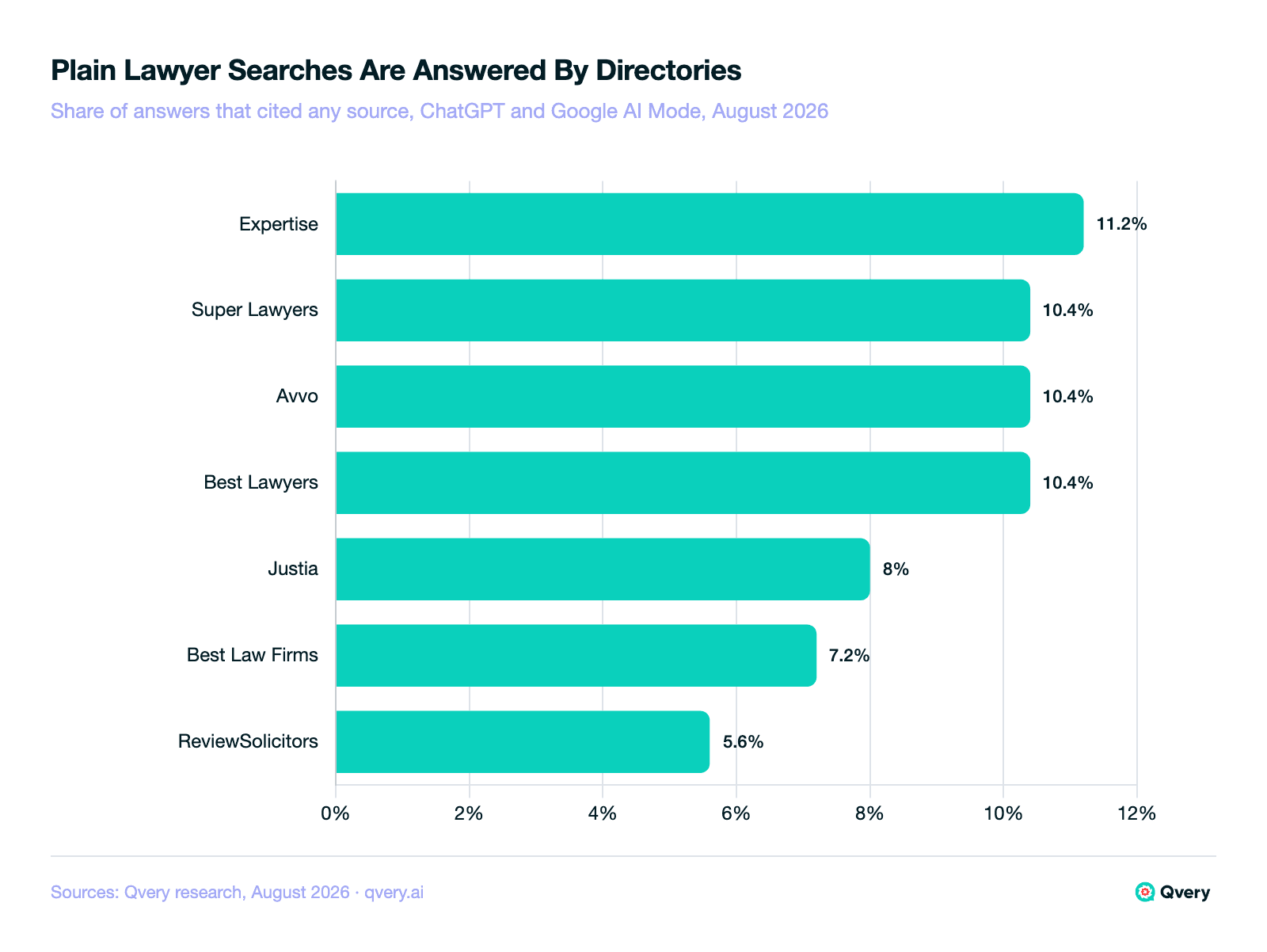
Every one of those is a page that lists lawyers.
On this shape of question, a firm reaches the answer through a profile somebody else owns and somebody else formats.
A plain request carries a practice area and a place. A directory row is built out of those same two variables, one entry per lawyer per city per specialty, and on this shape of question the rows are what showed up.
It is the same structural job third-party directories do in software, in a category where the directories are older and denser.
That matches what we published earlier this month, where a named legal directory appeared in 71.57% of answers that cited any source across a city-anchored set of legal questions. These plain questions land in the same world.
One row is missing from the chart on purpose. Google AI Mode returns its citations as Google's own wrapper links rather than as publisher URLs, so google.com sits near the top of both lists here as engine plumbing. We left it out of the roster and changed nothing else.
Every share above is still measured against every answer that cited anything, which makes these figures floors rather than exact levels.
If your organic rankings look healthy and none of this matches your experience, the two things are less connected than they used to be: across verticals, only about 13.9% of AI-cited sources overlap with Google's organic top ten.
Read the list as the shape of the layer, not as a league table for your market.
These are August 2026 numbers from a targeted set of questions, direction rather than census.
The questions were weighted toward the United States, with the United Kingdom, Canada, and Australia behind it. That is how a British property ends up in a list otherwise made of American ones.
The first thing worth doing with that list is dull.
Open your profile on each of those directories and write down which ones have your practice area, your city, or your credentials wrong.
Those are the pages carrying you on this question.
Add One Real Constraint And The Directory Layer Goes Missing
Now ask for the same kinds of lawyer, in the same places, with constraints attached: works on contingency, speaks Mandarin, sees people after six, handles one specific circumstance.
Two of the questions we ran, word for word:
"Personal injury firms in Toronto working on contingency, serving Spanish-speaking construction workers, after a job-site injury."
"Divorce firms in Leeds with legal aid eligibility checks for parents preparing for a first hearing."
That is longer than anything a search box invited a decade ago, and a chat window will hold all of it.
Every clause is a filter the person applies before they will call anybody.
A directory row cannot hold that. It has fields for practice area, city, firm name, and a rating, and every row carries the same ones. When a question arrives with payment terms, a language, and an hour of the day, the only text matching all of it is a page somebody wrote about that circumstance.
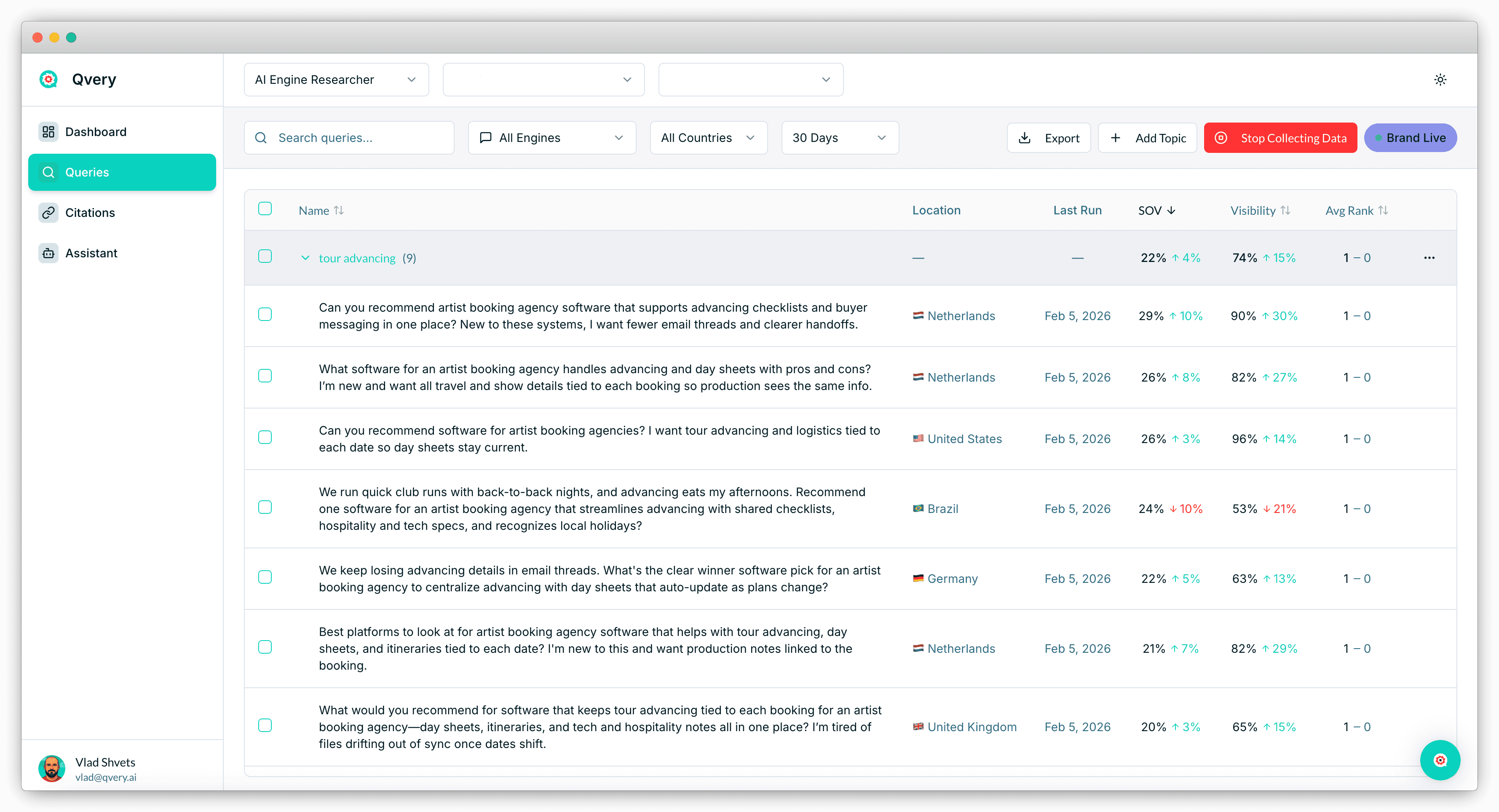
A tracked query is that whole string, kept still, which is how you watch one question move over time.
None of the directory names above appears at the top of those answers. The only source that appears often enough to carry a number is gov.uk, at 4.03% of answers that cited any source.
gov.uk is public guidance, not a firm and not a directory. It shows up because a constrained question often has a procedural answer waiting in front of the commercial one: what your rights are, what the time limit is, whether legal aid covers any of it.
Everything else is individual law firms. taegelaw.com, vclawyers.ca, wanlawyers.com.au and sunlaws.com.au are firms' own websites, cited in answers to the same kinds of question the directory layer had just handled.
Compare the two top tens and exactly one domain sits on both. It is Google's wrapper link, so the two rosters of real sources overlap at nothing.
Every firm domain in the constrained half appears at the same low rate. That rate sits below the level where a share in a set this size stops being a percentage and becomes an event count wearing a percent sign.
So those firms get named and ranked here, never measured.
What that leaves is a claim about composition: the answer changes completely, and it changes toward sites the firms themselves own.
Write down the five constraints your last ten intake calls carried, which is a different list from your practice areas: payment terms, languages, hours, the circumstance the client kept explaining. Run those as queries this week and read what comes back.
Nobody Owns The Layer That Replaces Them
The firms in the constrained answers have something in common beyond being firms. Each appears about as often as every other one, and none of them repeats enough to pull ahead.
That is what a fragmented layer looks like from the inside.
Five directory names carry most of the plain question. The constrained question is carried by a long tail where no single firm has established itself.
We tried to measure how concentrated that layer is and could not. At these rates there is not enough separation between one firm and the next, which is itself an answer to the question.
So the two shapes of question differ in more than which sites appear. They differ in whether those sites are already occupied.
Justia and Avvo are occupied by definition, because every firm in the category is on them, while the constrained layer has no incumbent.
A layer with no incumbent is also a layer nobody has managed to own, and these numbers cannot tell you which of those it is.
None of that shows that publishing a constraint-specific page gets a firm cited. What it shows is that the constrained answers were assembled out of firm-owned pages, and that no firm we saw had accumulated enough of those appearances to look established.
Which layer is answering for you is a read off the citation list, ranked by weight rather than by which names you recognize.
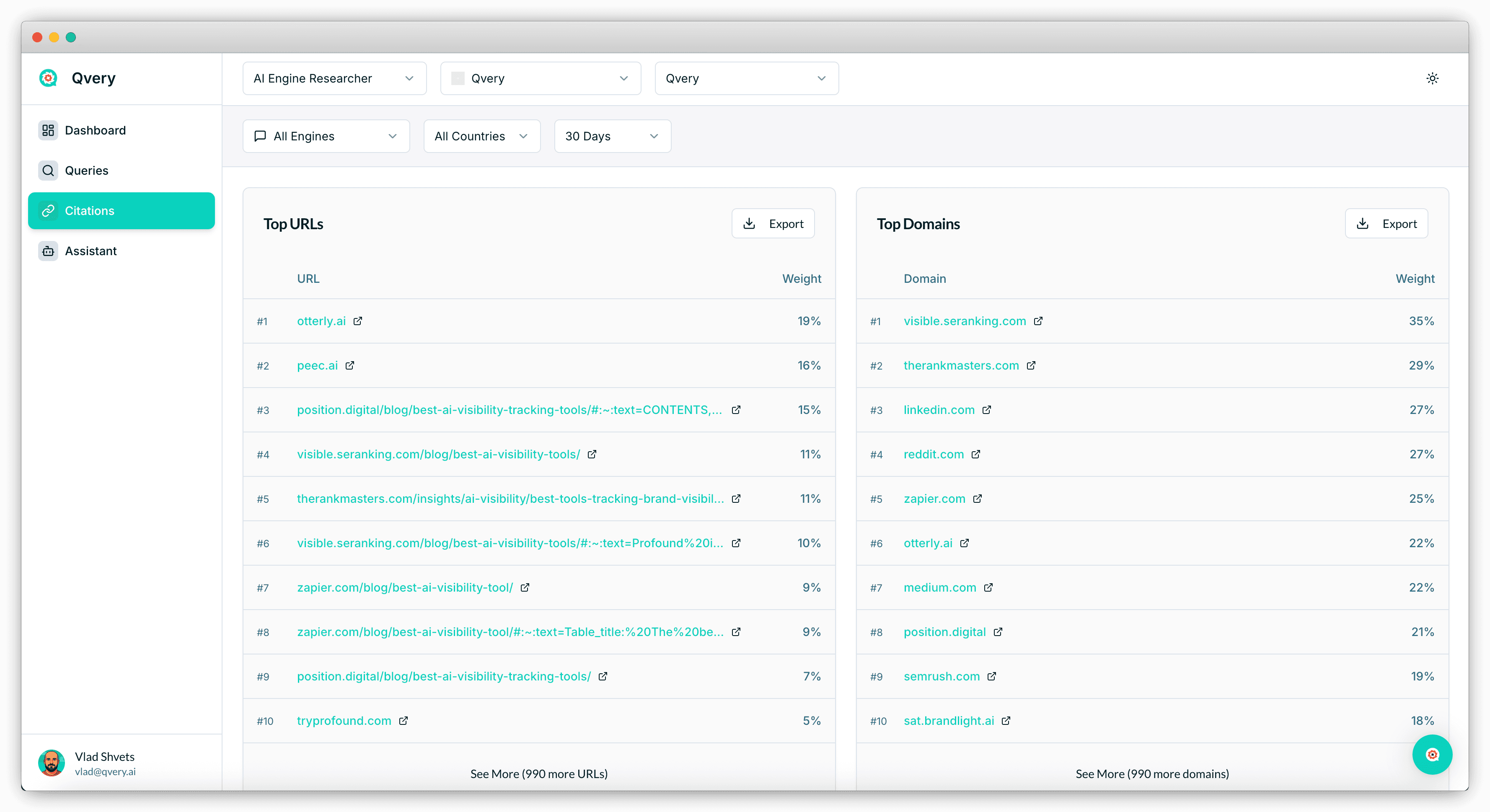
The account in that view is not a law firm, and the ranked-weight read is the part that transfers.
Pick the two constraints you answer better than anyone else in your city. Give each one its own page, in plain sentences a person would say out loud, rather than a bullet buried in a services grid.
We Expected The Two Layers To Sit Together
We had it backwards before any of this ran.
The expectation was co-presence: firm sites riding alongside the directories, with constraints adding firm names without taking anything away.
The two layers behave closer to a switch. Where one is doing the answering the other is largely absent, and they barely appear together.
Both shapes were asked on the same engines, in the same countries, in the same month. Whatever the wrapper links cost in resolution, they cost equally on both sides.
The consequence for anyone reading a visibility report, including one we produce, is direct.
A source breakdown built from plain and constrained questions together is an average of two populations that share almost nothing.
One further boundary, worth stating rather than leaving for a reader to trip over. Every question here asks an engine to recommend somebody.
Nothing here describes what happens when a client already has your name and is checking whether you are any good, which our earlier work found runs on a third layer again.
Go back to your own report and check which questions produced it. If the list is all practice area plus city, you have measured one half of your visibility and none of the other.
Two Shapes, Two Budgets
Everything from here is judgment on what the pattern suggests.
The numbers show what appears alongside these answers. They do not show that changing any of it changes what gets cited.
Given that, the two shapes look like two jobs with two budgets.
The plain question is a profile-hygiene job: your entry on the sites that list lawyers, accurate and complete, because that is the layer doing the answering. It is cheap and it has a ceiling, because a profile is a fixed set of fields and every competitor fills the same ones.
The constrained question looks like a writing job. The information a client screens on does not fit in a directory field. It fits on a page:
Contingency terms: the percentage, and what happens if the case is lost.
Languages spoken: which ones, by whom, and whether that covers a hearing or only the intake call.
Evening and weekend availability: the actual hours somebody can turn up.
The specific situations you take: written as the circumstance a client describes, not as a practice-area label.
Our read is that most firms have spent years on the first job and treat the second as marketing copy. The measured pattern is at least consistent with the reverse being available, and it is the half where no competitor has claimed the ground.
If you sell legal software rather than legal representation, none of this is your fight, and the source roster you are being judged on is a different one entirely.
Split your tracked query list in two before you spend anything. Plain questions in one report, constrained questions in the other, scored separately from the first week.
Score The Plain And Constrained Lists Separately In Qvery
Building the two lists is twenty minutes of work, and they stay in separate reports:
The plain list: your practice areas against the cities you serve, and nothing else on the line.
The constrained list: the same practice areas with the real filters hung off them, meaning fees, languages, hours, and the circumstance the client keeps describing on the phone.
Set them up as two topics, not one, and let them run. Qvery asks them daily across ChatGPT and Google AI Mode, in over 200 countries, and captures every citation tied to the query and the engine that produced it, which is the record the two lists above came from.
That setup takes one sitting. A two-person marketing team can run it without anyone who specializes in dashboards.
Then read the two rows against each other:
Visibility per topic: whether you are named at all on each shape. A firm present on one and absent on the other is the pattern this whole article describes.
The citation list per topic: directories on one, firm sites on the other, which tells you which job you are being scored on.
Average rank: where you sit once you do appear, which matters more on the constrained side where nobody is established.
The delta: whether the constrained row moves after you ship the pages.
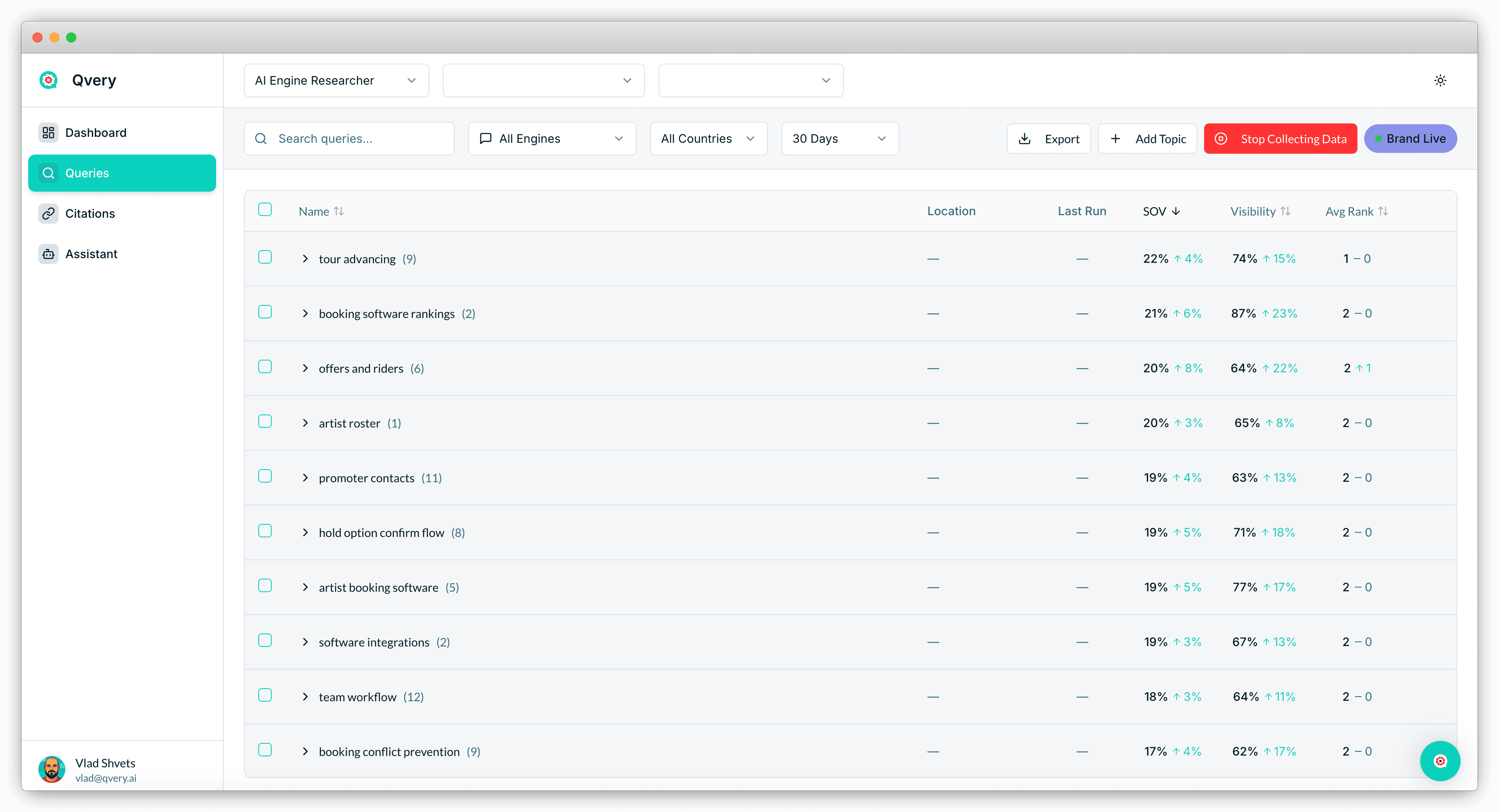
In Qvery Assistant you ask about your own data in plain language, add or edit queries, trigger a run, or export a report. The shortcut worth knowing for this article is the one that returns the queries where you appear nowhere at all.
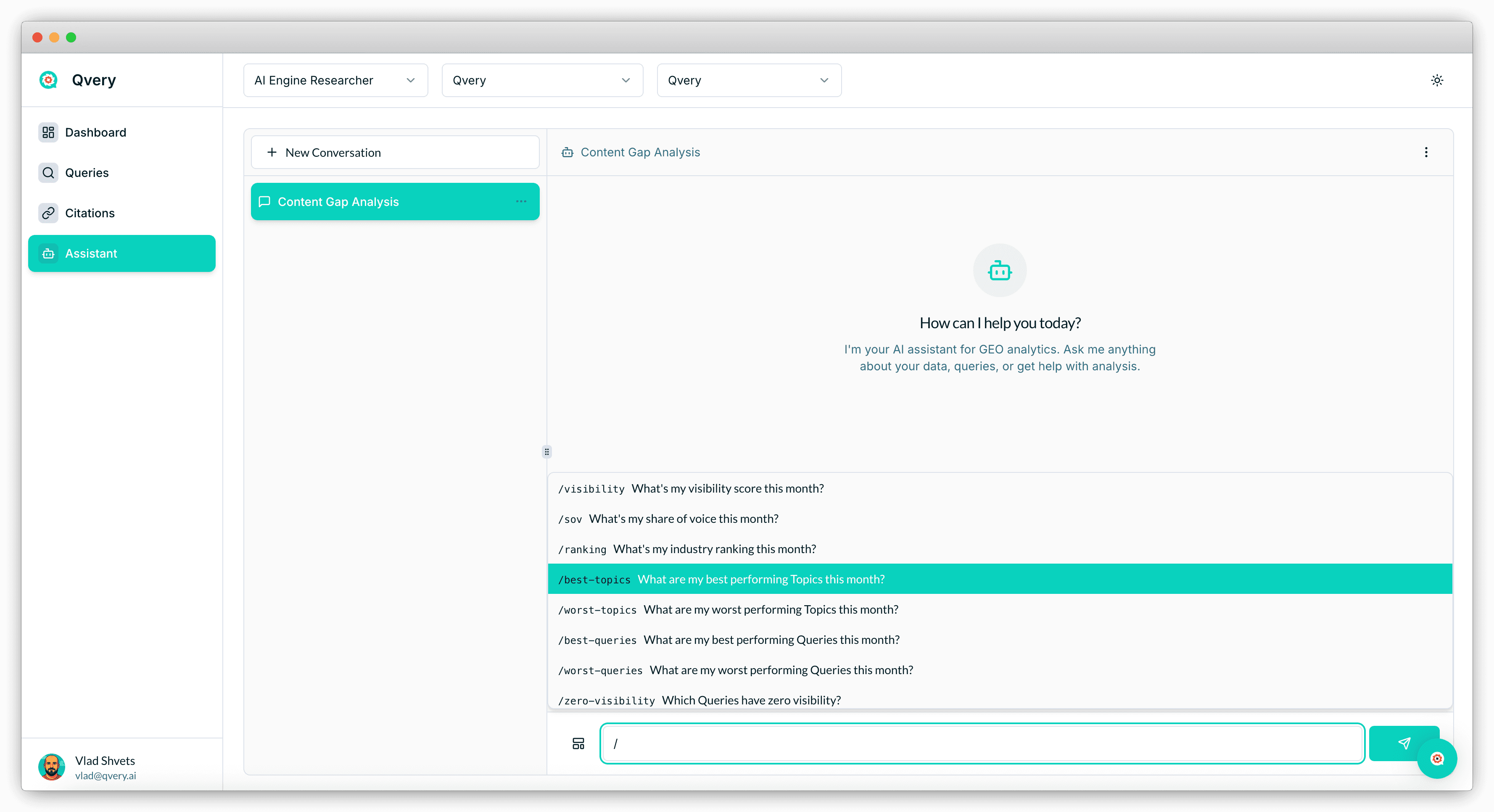
Two things stay yours. Deciding whether a cited domain is a directory, a government page, or a firm's own website is a judgment call on a list of URLs, and Qvery captures the list rather than sorting it.
And a blended average across both shapes is still available to you if you build it that way. Nothing stops you pooling the two topics, and it is the number this whole article argues against.
Start your free trial, split your queries into plain and constrained, and read the two source lists separately.
Run your own two shapes this week. If the plain one returns directories and the constrained one returns nothing at all, you have found the gap, and it sits on a layer nobody has taken yet.
Every firm marketing a legal practice has been given the same instruction for twenty years: own your website.
Fill it with practice-area pages, gather reviews, keep the blog moving, and the clients arrive. It is the one asset a firm controls outright, and it is where the budget tends to go.
That instruction was written for a search box that returned ten links. A growing share of the people looking for a lawyer now type the whole problem into a chat window and read one answer. That answer names firms, and whether yours is among them has little to do with how good your website is.
Open ten firm websites in your city and you will find the same three words on every one: experienced, aggressive, trusted. When every site makes the identical claim, an engine has no reason to single any of them out.
So we ran the questions people use to find a lawyer, on ChatGPT and Google AI Mode, and logged what the answers were built from.
The short version: the plain question is answered by the sites that list lawyers, the constrained question is answered by the sites lawyers built, and the two barely overlap.
One boundary before any number. This records which sources appear alongside an answer. It does not establish that being on one of them causes a firm to be named, and nothing here was built to test that.
The Plain Question Is Answered By The People Who List You
Start with the question in its shortest form. Best divorce lawyers in Chicago. A practice area, a city, and nothing else, which is what most firms picture when they picture someone searching for them.
Ask that question and its equivalents on ChatGPT and Google AI Mode in August 2026, and the answer is assembled out of the directory layer:
Expertise: 11.20% of answers that cited any source, the most common one.
Super Lawyers and Avvo: 10.40% each, tied with Best Lawyers at the same rate.
Justia: 8.00%, and Best Law Firms 7.20%.
ReviewSolicitors: 5.60%, the one British property in an otherwise American list.
Every one of those is a page that lists lawyers.
On this shape of question, a firm reaches the answer through a profile somebody else owns and somebody else formats.
A plain request carries a practice area and a place. A directory row is built out of those same two variables, one entry per lawyer per city per specialty, and on this shape of question the rows are what showed up.
It is the same structural job third-party directories do in software, in a category where the directories are older and denser.
That matches what we published earlier this month, where a named legal directory appeared in 71.57% of answers that cited any source across a city-anchored set of legal questions. These plain questions land in the same world.
One row is missing from the chart on purpose. Google AI Mode returns its citations as Google's own wrapper links rather than as publisher URLs, so google.com sits near the top of both lists here as engine plumbing. We left it out of the roster and changed nothing else.
Every share above is still measured against every answer that cited anything, which makes these figures floors rather than exact levels.
If your organic rankings look healthy and none of this matches your experience, the two things are less connected than they used to be: across verticals, only about 13.9% of AI-cited sources overlap with Google's organic top ten.
Read the list as the shape of the layer, not as a league table for your market.
These are August 2026 numbers from a targeted set of questions, direction rather than census.
The questions were weighted toward the United States, with the United Kingdom, Canada, and Australia behind it. That is how a British property ends up in a list otherwise made of American ones.
The first thing worth doing with that list is dull.
Open your profile on each of those directories and write down which ones have your practice area, your city, or your credentials wrong.
Those are the pages carrying you on this question.
Add One Real Constraint And The Directory Layer Goes Missing
Now ask for the same kinds of lawyer, in the same places, with constraints attached: works on contingency, speaks Mandarin, sees people after six, handles one specific circumstance.
Two of the questions we ran, word for word:
"Personal injury firms in Toronto working on contingency, serving Spanish-speaking construction workers, after a job-site injury."
"Divorce firms in Leeds with legal aid eligibility checks for parents preparing for a first hearing."
That is longer than anything a search box invited a decade ago, and a chat window will hold all of it.
Every clause is a filter the person applies before they will call anybody.
A directory row cannot hold that. It has fields for practice area, city, firm name, and a rating, and every row carries the same ones. When a question arrives with payment terms, a language, and an hour of the day, the only text matching all of it is a page somebody wrote about that circumstance.
A tracked query is that whole string, kept still, which is how you watch one question move over time.
None of the directory names above appears at the top of those answers. The only source that appears often enough to carry a number is gov.uk, at 4.03% of answers that cited any source.
gov.uk is public guidance, not a firm and not a directory. It shows up because a constrained question often has a procedural answer waiting in front of the commercial one: what your rights are, what the time limit is, whether legal aid covers any of it.
Everything else is individual law firms. taegelaw.com, vclawyers.ca, wanlawyers.com.au and sunlaws.com.au are firms' own websites, cited in answers to the same kinds of question the directory layer had just handled.
Compare the two top tens and exactly one domain sits on both. It is Google's wrapper link, so the two rosters of real sources overlap at nothing.
Every firm domain in the constrained half appears at the same low rate. That rate sits below the level where a share in a set this size stops being a percentage and becomes an event count wearing a percent sign.
So those firms get named and ranked here, never measured.
What that leaves is a claim about composition: the answer changes completely, and it changes toward sites the firms themselves own.
Write down the five constraints your last ten intake calls carried, which is a different list from your practice areas: payment terms, languages, hours, the circumstance the client kept explaining. Run those as queries this week and read what comes back.
Nobody Owns The Layer That Replaces Them
The firms in the constrained answers have something in common beyond being firms. Each appears about as often as every other one, and none of them repeats enough to pull ahead.
That is what a fragmented layer looks like from the inside.
Five directory names carry most of the plain question. The constrained question is carried by a long tail where no single firm has established itself.
We tried to measure how concentrated that layer is and could not. At these rates there is not enough separation between one firm and the next, which is itself an answer to the question.
So the two shapes of question differ in more than which sites appear. They differ in whether those sites are already occupied.
Justia and Avvo are occupied by definition, because every firm in the category is on them, while the constrained layer has no incumbent.
A layer with no incumbent is also a layer nobody has managed to own, and these numbers cannot tell you which of those it is.
None of that shows that publishing a constraint-specific page gets a firm cited. What it shows is that the constrained answers were assembled out of firm-owned pages, and that no firm we saw had accumulated enough of those appearances to look established.
Which layer is answering for you is a read off the citation list, ranked by weight rather than by which names you recognize.
The account in that view is not a law firm, and the ranked-weight read is the part that transfers.
Pick the two constraints you answer better than anyone else in your city. Give each one its own page, in plain sentences a person would say out loud, rather than a bullet buried in a services grid.
We Expected The Two Layers To Sit Together
We had it backwards before any of this ran.
The expectation was co-presence: firm sites riding alongside the directories, with constraints adding firm names without taking anything away.
The two layers behave closer to a switch. Where one is doing the answering the other is largely absent, and they barely appear together.
Both shapes were asked on the same engines, in the same countries, in the same month. Whatever the wrapper links cost in resolution, they cost equally on both sides.
The consequence for anyone reading a visibility report, including one we produce, is direct.
A source breakdown built from plain and constrained questions together is an average of two populations that share almost nothing.
One further boundary, worth stating rather than leaving for a reader to trip over. Every question here asks an engine to recommend somebody.
Nothing here describes what happens when a client already has your name and is checking whether you are any good, which our earlier work found runs on a third layer again.
Go back to your own report and check which questions produced it. If the list is all practice area plus city, you have measured one half of your visibility and none of the other.
Two Shapes, Two Budgets
Everything from here is judgment on what the pattern suggests.
The numbers show what appears alongside these answers. They do not show that changing any of it changes what gets cited.
Given that, the two shapes look like two jobs with two budgets.
The plain question is a profile-hygiene job: your entry on the sites that list lawyers, accurate and complete, because that is the layer doing the answering. It is cheap and it has a ceiling, because a profile is a fixed set of fields and every competitor fills the same ones.
The constrained question looks like a writing job. The information a client screens on does not fit in a directory field. It fits on a page:
Contingency terms: the percentage, and what happens if the case is lost.
Languages spoken: which ones, by whom, and whether that covers a hearing or only the intake call.
Evening and weekend availability: the actual hours somebody can turn up.
The specific situations you take: written as the circumstance a client describes, not as a practice-area label.
Our read is that most firms have spent years on the first job and treat the second as marketing copy. The measured pattern is at least consistent with the reverse being available, and it is the half where no competitor has claimed the ground.
If you sell legal software rather than legal representation, none of this is your fight, and the source roster you are being judged on is a different one entirely.
Split your tracked query list in two before you spend anything. Plain questions in one report, constrained questions in the other, scored separately from the first week.
Score The Plain And Constrained Lists Separately In Qvery
Building the two lists is twenty minutes of work, and they stay in separate reports:
The plain list: your practice areas against the cities you serve, and nothing else on the line.
The constrained list: the same practice areas with the real filters hung off them, meaning fees, languages, hours, and the circumstance the client keeps describing on the phone.
Set them up as two topics, not one, and let them run. Qvery asks them daily across ChatGPT and Google AI Mode, in over 200 countries, and captures every citation tied to the query and the engine that produced it, which is the record the two lists above came from.
That setup takes one sitting. A two-person marketing team can run it without anyone who specializes in dashboards.
Then read the two rows against each other:
Visibility per topic: whether you are named at all on each shape. A firm present on one and absent on the other is the pattern this whole article describes.
The citation list per topic: directories on one, firm sites on the other, which tells you which job you are being scored on.
Average rank: where you sit once you do appear, which matters more on the constrained side where nobody is established.
The delta: whether the constrained row moves after you ship the pages.
In Qvery Assistant you ask about your own data in plain language, add or edit queries, trigger a run, or export a report. The shortcut worth knowing for this article is the one that returns the queries where you appear nowhere at all.
Two things stay yours. Deciding whether a cited domain is a directory, a government page, or a firm's own website is a judgment call on a list of URLs, and Qvery captures the list rather than sorting it.
And a blended average across both shapes is still available to you if you build it that way. Nothing stops you pooling the two topics, and it is the number this whole article argues against.
Start your free trial, split your queries into plain and constrained, and read the two source lists separately.
Run your own two shapes this week. If the plain one returns directories and the constrained one returns nothing at all, you have found the gap, and it sits on a layer nobody has taken yet.
Every firm marketing a legal practice has been given the same instruction for twenty years: own your website.
Fill it with practice-area pages, gather reviews, keep the blog moving, and the clients arrive. It is the one asset a firm controls outright, and it is where the budget tends to go.
That instruction was written for a search box that returned ten links. A growing share of the people looking for a lawyer now type the whole problem into a chat window and read one answer. That answer names firms, and whether yours is among them has little to do with how good your website is.
Open ten firm websites in your city and you will find the same three words on every one: experienced, aggressive, trusted. When every site makes the identical claim, an engine has no reason to single any of them out.
So we ran the questions people use to find a lawyer, on ChatGPT and Google AI Mode, and logged what the answers were built from.
The short version: the plain question is answered by the sites that list lawyers, the constrained question is answered by the sites lawyers built, and the two barely overlap.
One boundary before any number. This records which sources appear alongside an answer. It does not establish that being on one of them causes a firm to be named, and nothing here was built to test that.
The Plain Question Is Answered By The People Who List You
Start with the question in its shortest form. Best divorce lawyers in Chicago. A practice area, a city, and nothing else, which is what most firms picture when they picture someone searching for them.
Ask that question and its equivalents on ChatGPT and Google AI Mode in August 2026, and the answer is assembled out of the directory layer:
Expertise: 11.20% of answers that cited any source, the most common one.
Super Lawyers and Avvo: 10.40% each, tied with Best Lawyers at the same rate.
Justia: 8.00%, and Best Law Firms 7.20%.
ReviewSolicitors: 5.60%, the one British property in an otherwise American list.
Every one of those is a page that lists lawyers.
On this shape of question, a firm reaches the answer through a profile somebody else owns and somebody else formats.
A plain request carries a practice area and a place. A directory row is built out of those same two variables, one entry per lawyer per city per specialty, and on this shape of question the rows are what showed up.
It is the same structural job third-party directories do in software, in a category where the directories are older and denser.
That matches what we published earlier this month, where a named legal directory appeared in 71.57% of answers that cited any source across a city-anchored set of legal questions. These plain questions land in the same world.
One row is missing from the chart on purpose. Google AI Mode returns its citations as Google's own wrapper links rather than as publisher URLs, so google.com sits near the top of both lists here as engine plumbing. We left it out of the roster and changed nothing else.
Every share above is still measured against every answer that cited anything, which makes these figures floors rather than exact levels.
If your organic rankings look healthy and none of this matches your experience, the two things are less connected than they used to be: across verticals, only about 13.9% of AI-cited sources overlap with Google's organic top ten.
Read the list as the shape of the layer, not as a league table for your market.
These are August 2026 numbers from a targeted set of questions, direction rather than census.
The questions were weighted toward the United States, with the United Kingdom, Canada, and Australia behind it. That is how a British property ends up in a list otherwise made of American ones.
The first thing worth doing with that list is dull.
Open your profile on each of those directories and write down which ones have your practice area, your city, or your credentials wrong.
Those are the pages carrying you on this question.
Add One Real Constraint And The Directory Layer Goes Missing
Now ask for the same kinds of lawyer, in the same places, with constraints attached: works on contingency, speaks Mandarin, sees people after six, handles one specific circumstance.
Two of the questions we ran, word for word:
"Personal injury firms in Toronto working on contingency, serving Spanish-speaking construction workers, after a job-site injury."
"Divorce firms in Leeds with legal aid eligibility checks for parents preparing for a first hearing."
That is longer than anything a search box invited a decade ago, and a chat window will hold all of it.
Every clause is a filter the person applies before they will call anybody.
A directory row cannot hold that. It has fields for practice area, city, firm name, and a rating, and every row carries the same ones. When a question arrives with payment terms, a language, and an hour of the day, the only text matching all of it is a page somebody wrote about that circumstance.
A tracked query is that whole string, kept still, which is how you watch one question move over time.
None of the directory names above appears at the top of those answers. The only source that appears often enough to carry a number is gov.uk, at 4.03% of answers that cited any source.
gov.uk is public guidance, not a firm and not a directory. It shows up because a constrained question often has a procedural answer waiting in front of the commercial one: what your rights are, what the time limit is, whether legal aid covers any of it.
Everything else is individual law firms. taegelaw.com, vclawyers.ca, wanlawyers.com.au and sunlaws.com.au are firms' own websites, cited in answers to the same kinds of question the directory layer had just handled.
Compare the two top tens and exactly one domain sits on both. It is Google's wrapper link, so the two rosters of real sources overlap at nothing.
Every firm domain in the constrained half appears at the same low rate. That rate sits below the level where a share in a set this size stops being a percentage and becomes an event count wearing a percent sign.
So those firms get named and ranked here, never measured.
What that leaves is a claim about composition: the answer changes completely, and it changes toward sites the firms themselves own.
Write down the five constraints your last ten intake calls carried, which is a different list from your practice areas: payment terms, languages, hours, the circumstance the client kept explaining. Run those as queries this week and read what comes back.
Nobody Owns The Layer That Replaces Them
The firms in the constrained answers have something in common beyond being firms. Each appears about as often as every other one, and none of them repeats enough to pull ahead.
That is what a fragmented layer looks like from the inside.
Five directory names carry most of the plain question. The constrained question is carried by a long tail where no single firm has established itself.
We tried to measure how concentrated that layer is and could not. At these rates there is not enough separation between one firm and the next, which is itself an answer to the question.
So the two shapes of question differ in more than which sites appear. They differ in whether those sites are already occupied.
Justia and Avvo are occupied by definition, because every firm in the category is on them, while the constrained layer has no incumbent.
A layer with no incumbent is also a layer nobody has managed to own, and these numbers cannot tell you which of those it is.
None of that shows that publishing a constraint-specific page gets a firm cited. What it shows is that the constrained answers were assembled out of firm-owned pages, and that no firm we saw had accumulated enough of those appearances to look established.
Which layer is answering for you is a read off the citation list, ranked by weight rather than by which names you recognize.
The account in that view is not a law firm, and the ranked-weight read is the part that transfers.
Pick the two constraints you answer better than anyone else in your city. Give each one its own page, in plain sentences a person would say out loud, rather than a bullet buried in a services grid.
We Expected The Two Layers To Sit Together
We had it backwards before any of this ran.
The expectation was co-presence: firm sites riding alongside the directories, with constraints adding firm names without taking anything away.
The two layers behave closer to a switch. Where one is doing the answering the other is largely absent, and they barely appear together.
Both shapes were asked on the same engines, in the same countries, in the same month. Whatever the wrapper links cost in resolution, they cost equally on both sides.
The consequence for anyone reading a visibility report, including one we produce, is direct.
A source breakdown built from plain and constrained questions together is an average of two populations that share almost nothing.
One further boundary, worth stating rather than leaving for a reader to trip over. Every question here asks an engine to recommend somebody.
Nothing here describes what happens when a client already has your name and is checking whether you are any good, which our earlier work found runs on a third layer again.
Go back to your own report and check which questions produced it. If the list is all practice area plus city, you have measured one half of your visibility and none of the other.
Two Shapes, Two Budgets
Everything from here is judgment on what the pattern suggests.
The numbers show what appears alongside these answers. They do not show that changing any of it changes what gets cited.
Given that, the two shapes look like two jobs with two budgets.
The plain question is a profile-hygiene job: your entry on the sites that list lawyers, accurate and complete, because that is the layer doing the answering. It is cheap and it has a ceiling, because a profile is a fixed set of fields and every competitor fills the same ones.
The constrained question looks like a writing job. The information a client screens on does not fit in a directory field. It fits on a page:
Contingency terms: the percentage, and what happens if the case is lost.
Languages spoken: which ones, by whom, and whether that covers a hearing or only the intake call.
Evening and weekend availability: the actual hours somebody can turn up.
The specific situations you take: written as the circumstance a client describes, not as a practice-area label.
Our read is that most firms have spent years on the first job and treat the second as marketing copy. The measured pattern is at least consistent with the reverse being available, and it is the half where no competitor has claimed the ground.
If you sell legal software rather than legal representation, none of this is your fight, and the source roster you are being judged on is a different one entirely.
Split your tracked query list in two before you spend anything. Plain questions in one report, constrained questions in the other, scored separately from the first week.
Score The Plain And Constrained Lists Separately In Qvery
Building the two lists is twenty minutes of work, and they stay in separate reports:
The plain list: your practice areas against the cities you serve, and nothing else on the line.
The constrained list: the same practice areas with the real filters hung off them, meaning fees, languages, hours, and the circumstance the client keeps describing on the phone.
Set them up as two topics, not one, and let them run. Qvery asks them daily across ChatGPT and Google AI Mode, in over 200 countries, and captures every citation tied to the query and the engine that produced it, which is the record the two lists above came from.
That setup takes one sitting. A two-person marketing team can run it without anyone who specializes in dashboards.
Then read the two rows against each other:
Visibility per topic: whether you are named at all on each shape. A firm present on one and absent on the other is the pattern this whole article describes.
The citation list per topic: directories on one, firm sites on the other, which tells you which job you are being scored on.
Average rank: where you sit once you do appear, which matters more on the constrained side where nobody is established.
The delta: whether the constrained row moves after you ship the pages.
In Qvery Assistant you ask about your own data in plain language, add or edit queries, trigger a run, or export a report. The shortcut worth knowing for this article is the one that returns the queries where you appear nowhere at all.
Two things stay yours. Deciding whether a cited domain is a directory, a government page, or a firm's own website is a judgment call on a list of URLs, and Qvery captures the list rather than sorting it.
And a blended average across both shapes is still available to you if you build it that way. Nothing stops you pooling the two topics, and it is the number this whole article argues against.
Start your free trial, split your queries into plain and constrained, and read the two source lists separately.
Run your own two shapes this week. If the plain one returns directories and the constrained one returns nothing at all, you have found the gap, and it sits on a layer nobody has taken yet.
Every firm marketing a legal practice has been given the same instruction for twenty years: own your website.
Fill it with practice-area pages, gather reviews, keep the blog moving, and the clients arrive. It is the one asset a firm controls outright, and it is where the budget tends to go.
That instruction was written for a search box that returned ten links. A growing share of the people looking for a lawyer now type the whole problem into a chat window and read one answer. That answer names firms, and whether yours is among them has little to do with how good your website is.
Open ten firm websites in your city and you will find the same three words on every one: experienced, aggressive, trusted. When every site makes the identical claim, an engine has no reason to single any of them out.
So we ran the questions people use to find a lawyer, on ChatGPT and Google AI Mode, and logged what the answers were built from.
The short version: the plain question is answered by the sites that list lawyers, the constrained question is answered by the sites lawyers built, and the two barely overlap.
One boundary before any number. This records which sources appear alongside an answer. It does not establish that being on one of them causes a firm to be named, and nothing here was built to test that.
The Plain Question Is Answered By The People Who List You
Start with the question in its shortest form. Best divorce lawyers in Chicago. A practice area, a city, and nothing else, which is what most firms picture when they picture someone searching for them.
Ask that question and its equivalents on ChatGPT and Google AI Mode in August 2026, and the answer is assembled out of the directory layer:
Expertise: 11.20% of answers that cited any source, the most common one.
Super Lawyers and Avvo: 10.40% each, tied with Best Lawyers at the same rate.
Justia: 8.00%, and Best Law Firms 7.20%.
ReviewSolicitors: 5.60%, the one British property in an otherwise American list.
Every one of those is a page that lists lawyers.
On this shape of question, a firm reaches the answer through a profile somebody else owns and somebody else formats.
A plain request carries a practice area and a place. A directory row is built out of those same two variables, one entry per lawyer per city per specialty, and on this shape of question the rows are what showed up.
It is the same structural job third-party directories do in software, in a category where the directories are older and denser.
That matches what we published earlier this month, where a named legal directory appeared in 71.57% of answers that cited any source across a city-anchored set of legal questions. These plain questions land in the same world.
One row is missing from the chart on purpose. Google AI Mode returns its citations as Google's own wrapper links rather than as publisher URLs, so google.com sits near the top of both lists here as engine plumbing. We left it out of the roster and changed nothing else.
Every share above is still measured against every answer that cited anything, which makes these figures floors rather than exact levels.
If your organic rankings look healthy and none of this matches your experience, the two things are less connected than they used to be: across verticals, only about 13.9% of AI-cited sources overlap with Google's organic top ten.
Read the list as the shape of the layer, not as a league table for your market.
These are August 2026 numbers from a targeted set of questions, direction rather than census.
The questions were weighted toward the United States, with the United Kingdom, Canada, and Australia behind it. That is how a British property ends up in a list otherwise made of American ones.
The first thing worth doing with that list is dull.
Open your profile on each of those directories and write down which ones have your practice area, your city, or your credentials wrong.
Those are the pages carrying you on this question.
Add One Real Constraint And The Directory Layer Goes Missing
Now ask for the same kinds of lawyer, in the same places, with constraints attached: works on contingency, speaks Mandarin, sees people after six, handles one specific circumstance.
Two of the questions we ran, word for word:
"Personal injury firms in Toronto working on contingency, serving Spanish-speaking construction workers, after a job-site injury."
"Divorce firms in Leeds with legal aid eligibility checks for parents preparing for a first hearing."
That is longer than anything a search box invited a decade ago, and a chat window will hold all of it.
Every clause is a filter the person applies before they will call anybody.
A directory row cannot hold that. It has fields for practice area, city, firm name, and a rating, and every row carries the same ones. When a question arrives with payment terms, a language, and an hour of the day, the only text matching all of it is a page somebody wrote about that circumstance.
A tracked query is that whole string, kept still, which is how you watch one question move over time.
None of the directory names above appears at the top of those answers. The only source that appears often enough to carry a number is gov.uk, at 4.03% of answers that cited any source.
gov.uk is public guidance, not a firm and not a directory. It shows up because a constrained question often has a procedural answer waiting in front of the commercial one: what your rights are, what the time limit is, whether legal aid covers any of it.
Everything else is individual law firms. taegelaw.com, vclawyers.ca, wanlawyers.com.au and sunlaws.com.au are firms' own websites, cited in answers to the same kinds of question the directory layer had just handled.
Compare the two top tens and exactly one domain sits on both. It is Google's wrapper link, so the two rosters of real sources overlap at nothing.
Every firm domain in the constrained half appears at the same low rate. That rate sits below the level where a share in a set this size stops being a percentage and becomes an event count wearing a percent sign.
So those firms get named and ranked here, never measured.
What that leaves is a claim about composition: the answer changes completely, and it changes toward sites the firms themselves own.
Write down the five constraints your last ten intake calls carried, which is a different list from your practice areas: payment terms, languages, hours, the circumstance the client kept explaining. Run those as queries this week and read what comes back.
Nobody Owns The Layer That Replaces Them
The firms in the constrained answers have something in common beyond being firms. Each appears about as often as every other one, and none of them repeats enough to pull ahead.
That is what a fragmented layer looks like from the inside.
Five directory names carry most of the plain question. The constrained question is carried by a long tail where no single firm has established itself.
We tried to measure how concentrated that layer is and could not. At these rates there is not enough separation between one firm and the next, which is itself an answer to the question.
So the two shapes of question differ in more than which sites appear. They differ in whether those sites are already occupied.
Justia and Avvo are occupied by definition, because every firm in the category is on them, while the constrained layer has no incumbent.
A layer with no incumbent is also a layer nobody has managed to own, and these numbers cannot tell you which of those it is.
None of that shows that publishing a constraint-specific page gets a firm cited. What it shows is that the constrained answers were assembled out of firm-owned pages, and that no firm we saw had accumulated enough of those appearances to look established.
Which layer is answering for you is a read off the citation list, ranked by weight rather than by which names you recognize.
The account in that view is not a law firm, and the ranked-weight read is the part that transfers.
Pick the two constraints you answer better than anyone else in your city. Give each one its own page, in plain sentences a person would say out loud, rather than a bullet buried in a services grid.
We Expected The Two Layers To Sit Together
We had it backwards before any of this ran.
The expectation was co-presence: firm sites riding alongside the directories, with constraints adding firm names without taking anything away.
The two layers behave closer to a switch. Where one is doing the answering the other is largely absent, and they barely appear together.
Both shapes were asked on the same engines, in the same countries, in the same month. Whatever the wrapper links cost in resolution, they cost equally on both sides.
The consequence for anyone reading a visibility report, including one we produce, is direct.
A source breakdown built from plain and constrained questions together is an average of two populations that share almost nothing.
One further boundary, worth stating rather than leaving for a reader to trip over. Every question here asks an engine to recommend somebody.
Nothing here describes what happens when a client already has your name and is checking whether you are any good, which our earlier work found runs on a third layer again.
Go back to your own report and check which questions produced it. If the list is all practice area plus city, you have measured one half of your visibility and none of the other.
Two Shapes, Two Budgets
Everything from here is judgment on what the pattern suggests.
The numbers show what appears alongside these answers. They do not show that changing any of it changes what gets cited.
Given that, the two shapes look like two jobs with two budgets.
The plain question is a profile-hygiene job: your entry on the sites that list lawyers, accurate and complete, because that is the layer doing the answering. It is cheap and it has a ceiling, because a profile is a fixed set of fields and every competitor fills the same ones.
The constrained question looks like a writing job. The information a client screens on does not fit in a directory field. It fits on a page:
Contingency terms: the percentage, and what happens if the case is lost.
Languages spoken: which ones, by whom, and whether that covers a hearing or only the intake call.
Evening and weekend availability: the actual hours somebody can turn up.
The specific situations you take: written as the circumstance a client describes, not as a practice-area label.
Our read is that most firms have spent years on the first job and treat the second as marketing copy. The measured pattern is at least consistent with the reverse being available, and it is the half where no competitor has claimed the ground.
If you sell legal software rather than legal representation, none of this is your fight, and the source roster you are being judged on is a different one entirely.
Split your tracked query list in two before you spend anything. Plain questions in one report, constrained questions in the other, scored separately from the first week.
Score The Plain And Constrained Lists Separately In Qvery
Building the two lists is twenty minutes of work, and they stay in separate reports:
The plain list: your practice areas against the cities you serve, and nothing else on the line.
The constrained list: the same practice areas with the real filters hung off them, meaning fees, languages, hours, and the circumstance the client keeps describing on the phone.
Set them up as two topics, not one, and let them run. Qvery asks them daily across ChatGPT and Google AI Mode, in over 200 countries, and captures every citation tied to the query and the engine that produced it, which is the record the two lists above came from.
That setup takes one sitting. A two-person marketing team can run it without anyone who specializes in dashboards.
Then read the two rows against each other:
Visibility per topic: whether you are named at all on each shape. A firm present on one and absent on the other is the pattern this whole article describes.
The citation list per topic: directories on one, firm sites on the other, which tells you which job you are being scored on.
Average rank: where you sit once you do appear, which matters more on the constrained side where nobody is established.
The delta: whether the constrained row moves after you ship the pages.
In Qvery Assistant you ask about your own data in plain language, add or edit queries, trigger a run, or export a report. The shortcut worth knowing for this article is the one that returns the queries where you appear nowhere at all.
Two things stay yours. Deciding whether a cited domain is a directory, a government page, or a firm's own website is a judgment call on a list of URLs, and Qvery captures the list rather than sorting it.
And a blended average across both shapes is still available to you if you build it that way. Nothing stops you pooling the two topics, and it is the number this whole article argues against.
Start your free trial, split your queries into plain and constrained, and read the two source lists separately.
Run your own two shapes this week. If the plain one returns directories and the constrained one returns nothing at all, you have found the gap, and it sits on a layer nobody has taken yet.

© 2026 Qvery AI OÜ