By
Vlad Shvets
SEO Statistics 2026: 45+ Numbers on the Discipline Quietly Becoming AEO
SEO isn't dead, but the CTR curve that made ranking valuable is collapsing under AI answers, and the smart money is already moving to AEO. Here are 45+ verified statistics on the shift.
SEO isn't dead, but the CTR curve that made ranking valuable is collapsing under AI answers, and the smart money is already moving to AEO. Here are 45+ verified statistics on the shift.
SEO isn't dead, but the CTR curve that made ranking valuable is collapsing under AI answers, and the smart money is already moving to AEO. Here are 45+ verified statistics on the shift.
SEO has been declared dead so often it should qualify for a frequent-flyer program with the afterlife. It is also, at last count, roughly a $85 billion software market growing double digits⁸, which is a strange thing for a corpse. The truth is less dramatic and more interesting: SEO isn't dying, the machine it optimized for is changing underneath it.
For twenty years the entire discipline rested on one curve. The number-one organic result on Google earns a 39.8% click-through rate, and the top three take more than two-thirds of all clicks¹. That is why ranking was worth a fortune.
Then Google put an AI answer on top of the page, and the presence of an AI Overview now cuts the click-through rate of that number-one result by 58%². The clicks didn't redistribute down the page; they went to the AI answer on top.
We pulled the most credible, independently verified statistics on SEO and its shift to AI search we could find, from Ahrefs, Semrush, Pew, Bain, Conductor, HubSpot, and the analytics firms that measure the search click.
A few figures come from our own AI-citation data at Qvery. Everything else is footnoted to its original source, and some of the classic benchmarks are older data, labeled where they are. Read together, they tell one story: the skills of SEO still matter, but the target they were aimed at, a ranked link that earns a click, is being replaced by a cited source inside an answer.
Highlights
The top three organic results take 68.7% of all Google clicks¹, which is why ranking was worth so much.
An AI Overview cuts the number-one result's click-through rate by 58%², up from 34.5% eight months earlier².
Only 1.53% of Google results now have no SERP features³; the plain ten blue links are effectively extinct.
56% of enterprise marketing leaders made a significant or high AEO investment in 2025, and 94% plan to increase it in 2026⁴.
The average AI-search visitor is worth 4.4 times a traditional organic visitor on conversion⁵.
96.55% of all pages get zero traffic from Google⁶; ranking was always brutal.
The global SEO services market crosses $108 billion in 2026¹⁵, even as organic clicks fall.
In our own data, only 13.9% of the domains AI engines cite also rank in Google's organic top 10⁷.
The Curve That Made SEO Worth Doing
To see what is changing, you have to see what SEO was built on. On a clean Google results page, the click distribution is savagely top-heavy: the number-one result earns a 39.8% click-through rate, number two earns 18.7%¹, and the number-one result alone gets more clicks than results three through ten combined¹.
Across four million results, the number-one organic result averaged a 27.6% CTR (2019 data)⁹.
Moving from position two to position one increased clicks by 74.5%⁹.
Only 0.63% of searchers clicked anything on page two⁹, which remains the safest place on earth to hide something.
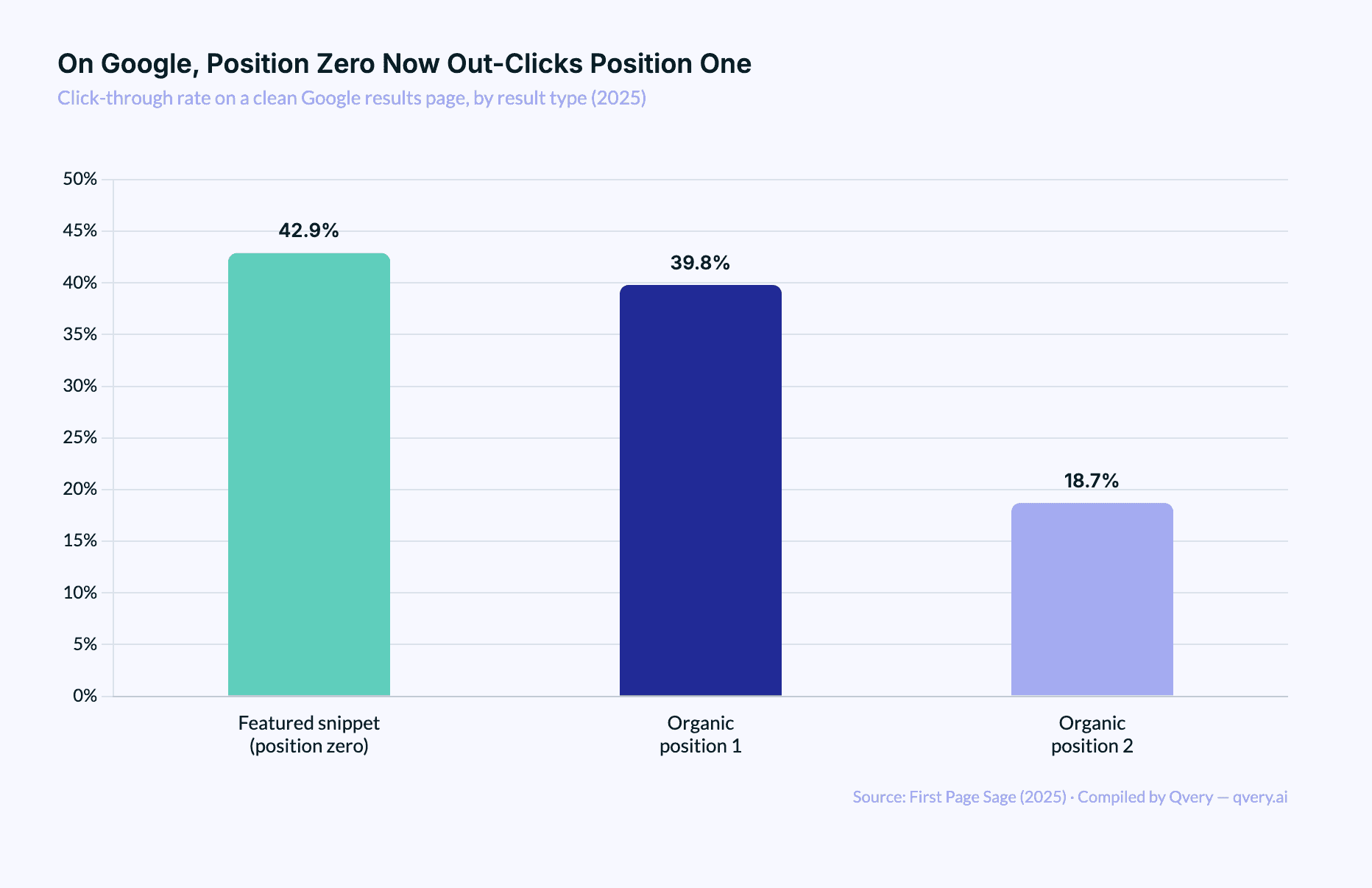
This curve is the whole reason ranking mattered. Two-thirds of the clicks live in three slots, so an entire industry organized itself around winning them. The curve didn't just shift; Google started answering the question before anyone reaches it at all.
The Curve Is Collapsing
The ten blue links are already a museum piece. Only 1.53% of Google results now appear with no SERP features at all³, and Google added eight new SERP features in 2024, pushing the total past thirty¹⁰. The most consequential of them sits above everything else: AI Overviews.
AI Overviews appear on 20.5% of all Google searches, analyzed across 146 million results¹².
They hit informational intent hardest, showing on 57.9% of question queries and 46.4% of queries with seven or more words¹².
When one appears, the number-one organic CTR drops 58%², and for informational queries organic CTR is down 61% over fifteen months¹³.
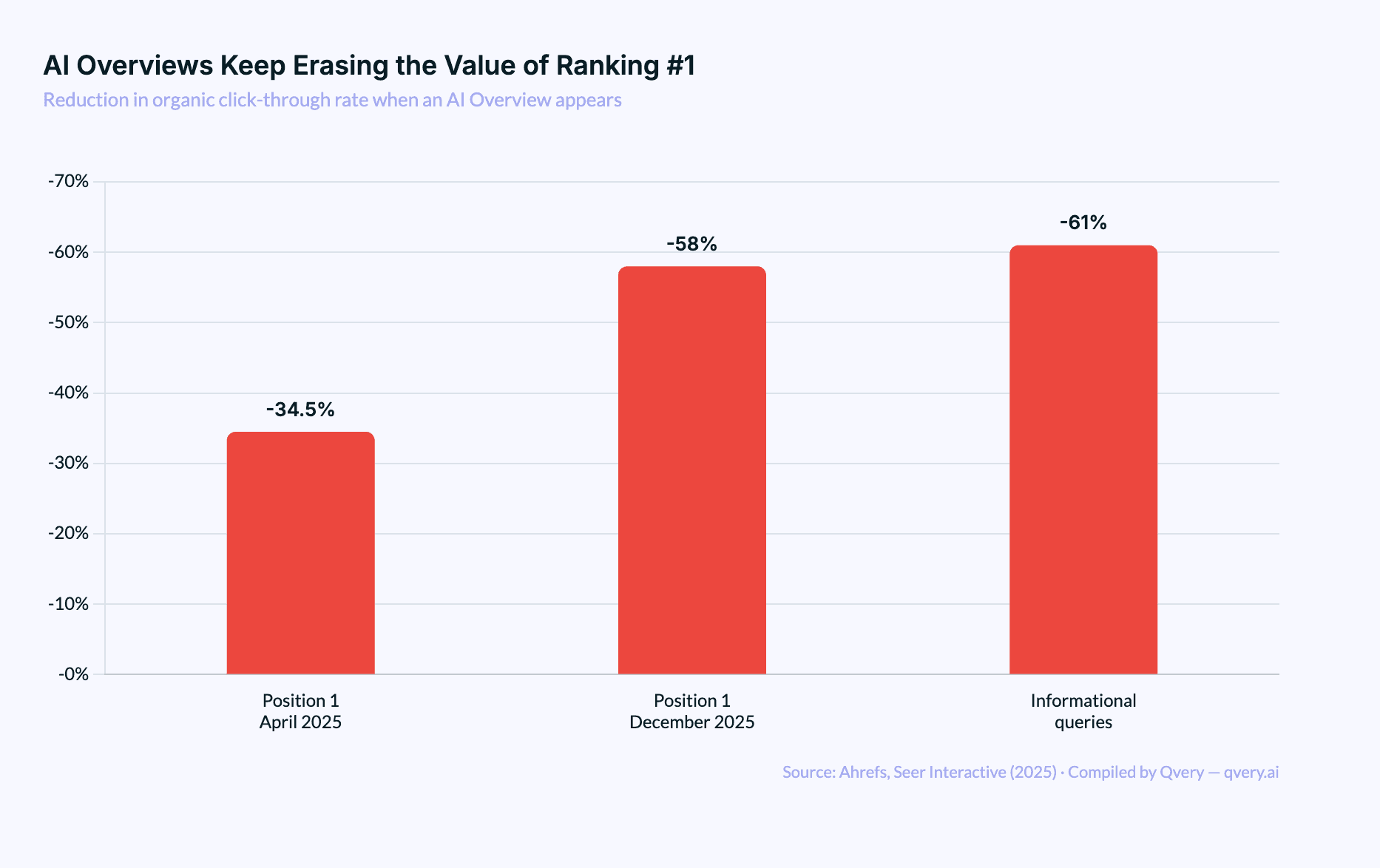
Google spent years teaching everyone to fight for the number-one spot, then quietly added a number-zero spot and an answer box that needs no spot at all. The featured snippet already out-clicks the number-one result, at 42.9%¹. Neutral data confirms the drain: in real browsing, people click a result 8% of the time when an AI summary appears, versus 15% without¹⁴. The click-through rate is falling across every position, not just reshuffling¹⁰. The curve that justified the whole discipline is sinking, and ranking higher on a sinking curve is a smaller and smaller prize.
Yet the Money Keeps Pouring In
The paradox reframes everything else. Organic clicks are falling, and spending on organic visibility is rising. The global SEO software market was $84.94 billion in 2025 and is forecast to reach $295 billion by 2035⁸, and the separate SEO services market runs even larger.
SEO services will grow from $92.74 billion in 2025 to $108.28 billion in 2026¹⁵.
That market is projected to reach $203.83 billion by 2030¹⁵.
The US SEO software market alone was $23.49 billion in 2025⁸.
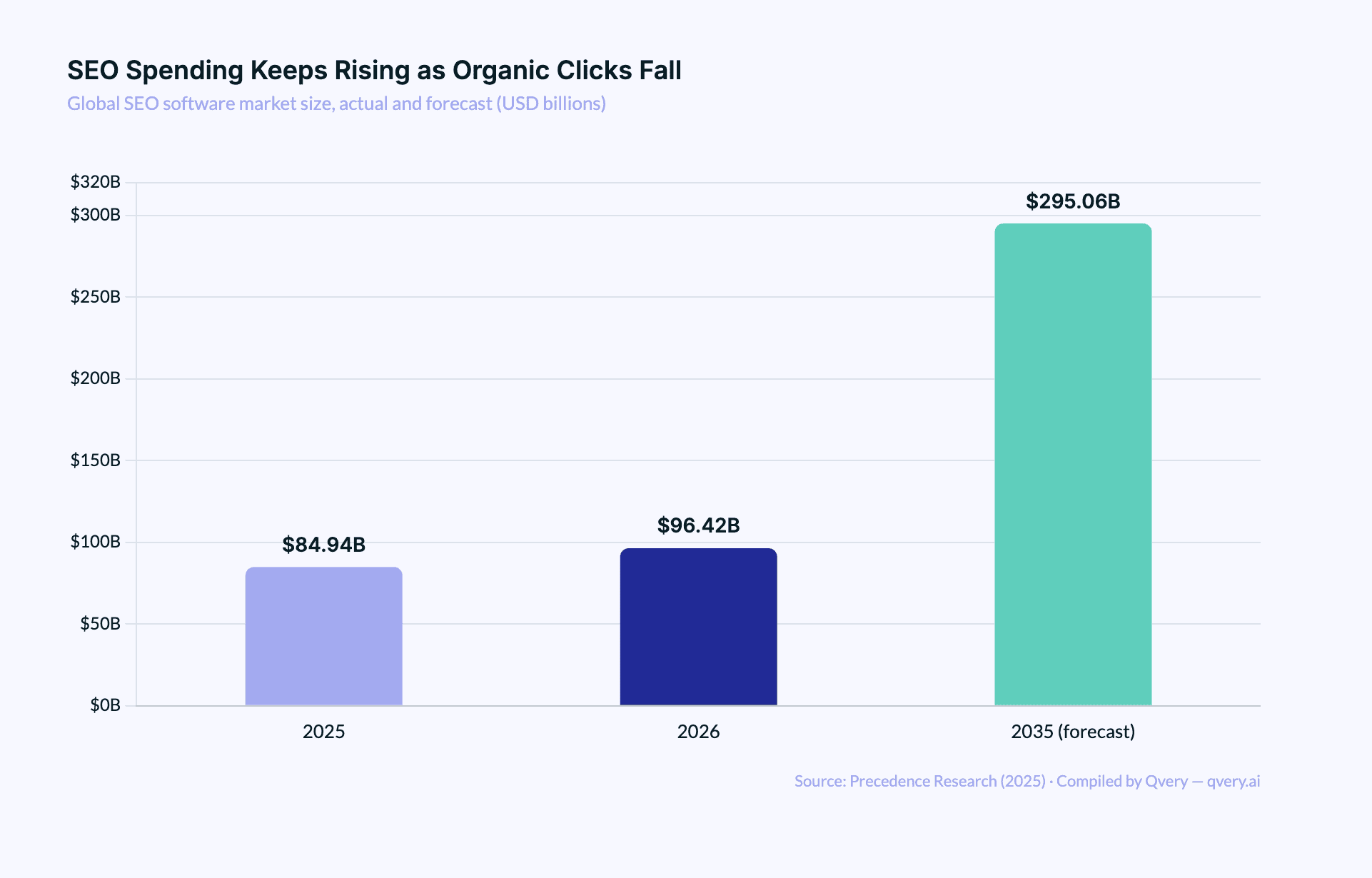
Spending on visibility going up while the clicks it buys go down is the tell. The money has stopped chasing clicks and started chasing presence: the goal is shifting from being the ranked link to being the cited source. An industry does not double its budget for a channel it believes is dying; it doubles down because the job changed and still matters.
Ranking Was Always Brutal Anyway
It helps to remember that organic search was never the easy channel nostalgia makes it out to be. 96.55% of all pages get zero traffic from Google, across a 14-billion-page study⁶, which means the median piece of content performs about as well as a diary locked in a drawer. The reasons are structural and getting worse.
About 95% of all pages have zero backlinks, and the number-one result has 3.8 times more backlinks than positions two through ten (2020 data)¹⁶.
Only 1.74% of new pages rank in the top 10 within a year, down from 5.7% in 2017¹⁷.
The average number-one page is now 5 years old, up from 2 years in 2017, and 72.9% of top-10 pages are over three years old¹⁷.
The incumbency moat hardened at exactly the wrong moment. Just as AI answers were cutting what a top ranking pays out, the odds of earning that ranking with new content fell by two-thirds. SEO is facing a squeeze from both ends: harder to win, worth less when you do. That is the real argument for spreading visibility across more than one surface, rather than pouring everything into a game that got steeper and cheaper at once.
The Pivot Already Happened in the Budgets
While practitioners argue about whether AI search matters, the budget holders already voted. In a survey of enterprise marketing leaders, 56% made a significant or high investment in AEO in 2025, and an overwhelming 94% plan to increase that investment in 2026⁴.
Enterprises already allocate an average of 12% of their digital budgets to AEO⁴.
97% reported AEO had a positive impact on their marketing funnel⁴, and 51% already run a dedicated AEO measurement platform⁴.
Over 92% of marketers use or plan to use SEO for both traditional and AI-powered search¹⁸, treating it as one discipline, not two.
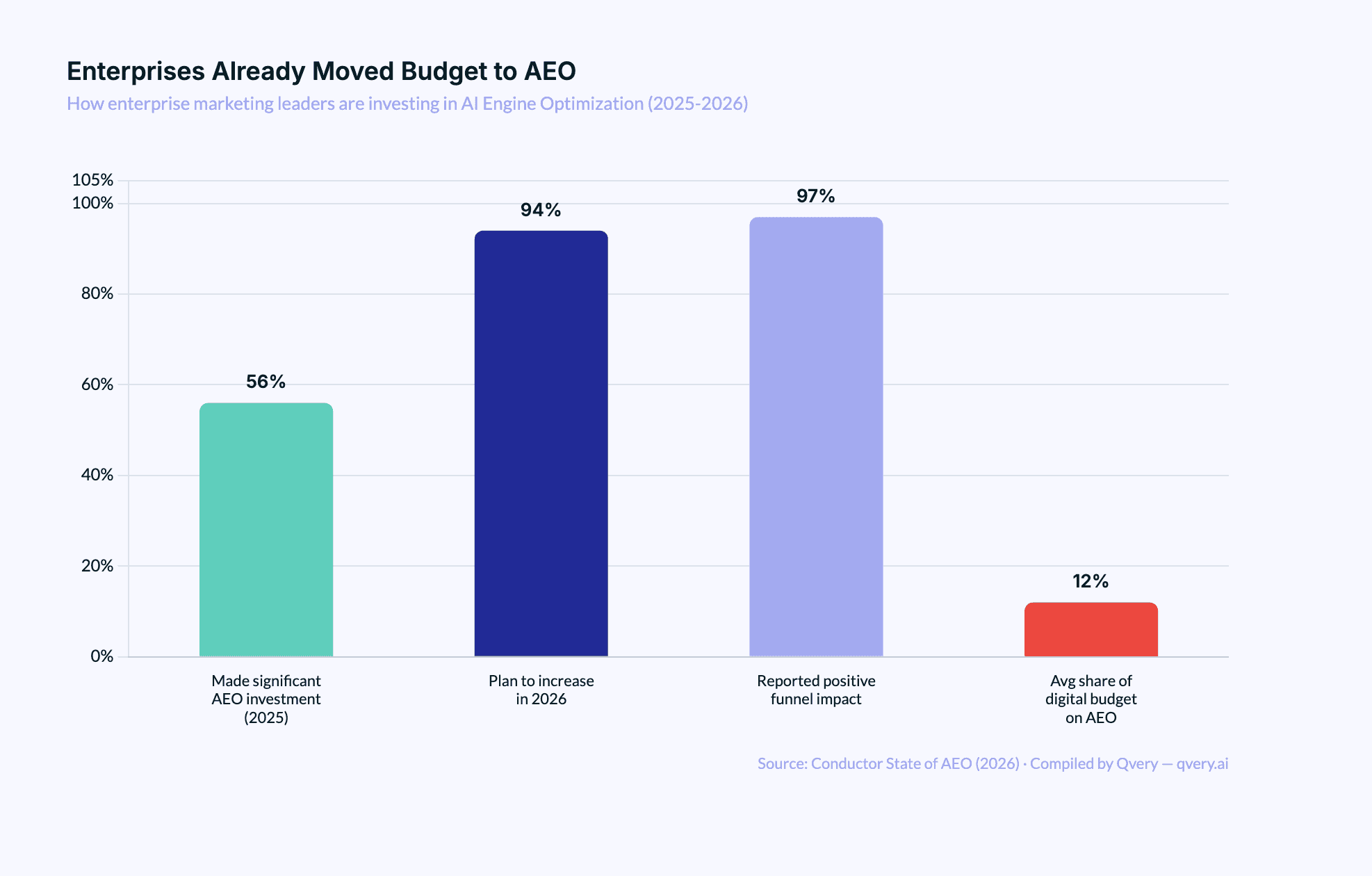
This is a purchase order, not a forecast. A budget line at one-eighth of digital spend is a real commitment, and at the companies with the most to lose, the debate about investing in AI search is already settled. What most of them still lack is the measurement.
Why the Move Pays
The reason the budget moved is that the traffic on the other side converts. Across three separate research firms, AI-referred visitors outperform classic organic by a wide margin.
The average AI-search visitor is worth 4.4 times a traditional organic visitor on conversion⁵.
Visitors from AI answers convert at twice the rate in a third of the sessions⁴.
One vendor measured 3 times better conversion from AI-sourced leads¹⁸.
Owned content is what wins those visits, so the SEO instinct to build strong content still pays; it just has a second audience now. 50% of the links ChatGPT includes point to business and service sites⁵, and on the same Google page, being cited in an AI Overview earns 35% more organic clicks and 91% more paid clicks¹³. Semrush projects AI search could drive more visits than traditional search by early 2028⁵, against a backdrop where Bain estimates zero-click behavior is cutting organic web traffic 15% to 25%¹⁹.
A Number-One Ranking Is Now a Coin Flip for an AI Citation
This last number should reorganize a marketer's week. Winning Google no longer wins the AI answer sitting on top of it. Across the queries we track, only 13.9% of the domains AI engines cite also rank in Google's organic top 10⁷, and just 27.7% of Google's top-10 organic results get cited by AI at all⁷.

Even a number-one Google ranking is only a 48.8% chance of being cited by an AI engine⁷, which is to say your hard-won top spot has roughly the odds of a coin flip, and the coin is cheaper to win than the ranking. The flip side is the opportunity: 86.1% of AI citations go to pages that do not rank in Google's top 10⁷, and the content that wins is winnable.
Listicles alone are 45.8% of all classifiable AI citations²⁰, and 87.75% of citations go to brand sites, niche publications, and specialist pages²¹, not the platform giants. The SEO skill set transfers. The target moved from the ranked link to the cited source, and most brands have not started aiming at the new one.
How to See Whether AI Search Cites You
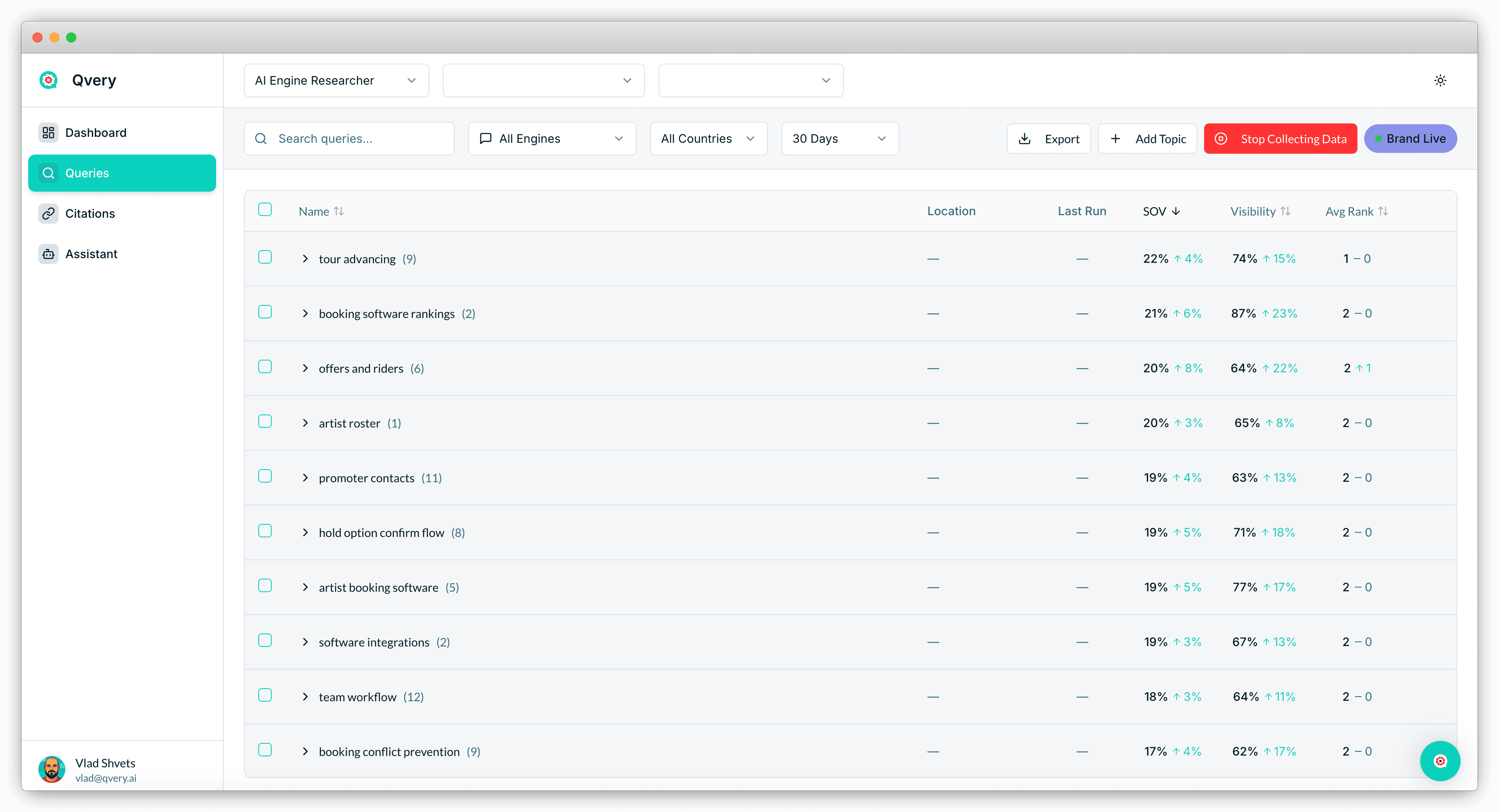
This is the problem Qvery solves. Qvery tracks how your brand shows up across ChatGPT and Google AI Mode, generates the queries your customers ask, and shows you which sources each engine cites when your category comes up. You enter your brand and see where you stand in a few minutes, instead of assuming your Google rankings carry over.
None of this makes SEO a waste. The craft of earning authority, structuring content, and being genuinely useful is exactly what wins AI citations too. What changed is the scoreboard. Ranking is now one of two things worth measuring, and the second one, whether the answer names you, is the part almost nobody is watching yet. That is the gap, and it is finally measurable.
Frequently Asked Questions
What is the click-through rate for the number-one result on Google?
On a clean results page, the number-one organic result earns about a 39.8% CTR¹, and the top three results take 68.7% of all clicks¹.
How much do AI Overviews reduce SEO clicks?
An AI Overview cuts the number-one result's click-through rate by 58%², up from 34.5% eight months earlier², and informational-query CTR is down 61%¹³.
How common are AI Overviews on Google?
They appear on 20.5% of all searches and 57.9% of question queries¹². Only 1.53% of results have no SERP features at all³.
Is SEO dead?
No. The SEO software market was $84.94 billion in 2025⁸ and SEO services cross $108 billion in 2026¹⁵. The discipline is shifting toward AEO, not disappearing.
How big is the SEO industry?
SEO software is a $84.94 billion market forecast to reach $295 billion by 2035⁸; SEO services are projected to reach $203.83 billion by 2030¹⁵.
Do most pages get traffic from Google?
No. 96.55% of all pages get zero traffic from Google⁶, largely because about 95% have zero backlinks¹⁶.
How long does it take to rank on Google?
Only 1.74% of new pages rank in the top 10 within a year¹⁷, down from 5.7% in 2017, and the average number-one page is now 5 years old¹⁷.
What is AEO?
AEO is AI Engine Optimization, the practice of earning visibility in AI answers. 56% of enterprise marketing leaders invested significantly in AEO in 2025, and 94% plan to increase it in 2026⁴.
How much are companies spending on AEO?
Enterprises already allocate an average of 12% of digital budgets to AEO⁴, and 92% of marketers use or plan to use SEO for both traditional and AI search¹⁸.
Does AI search traffic convert better than SEO traffic?
Yes, by a wide margin. AI-search visitors are worth 4.4 times a traditional organic visitor⁵, and AI-sourced leads convert up to 3 times better¹⁸.
Does getting cited in an AI Overview help?
Yes. Being cited in an AI Overview earns 35% more organic clicks and 91% more paid clicks than not being cited¹³.
Does ranking on Google get you cited by AI?
Often not. Only 13.9% of AI-cited domains rank in Google's top 10⁷, and even a number-one ranking has just a 48.8% chance of being cited⁷.
What content gets cited most by AI engines?
Listicles, by a wide margin, at 45.8% of all classifiable AI citations²⁰. And 87.75% of citations go to brand and niche sites, not platform giants²¹.
How much organic traffic is AI search costing?
Bain estimates zero-click behavior is cutting organic web traffic 15% to 25%¹⁹, with about 60% of searches ending without a click¹⁹.
Do featured snippets get clicks?
Yes, more than the top link. The featured snippet has the highest CTR of any result at 42.9%¹, above the number-one organic result.
Is click-through rate declining across the board?
Yes. Independent studies find organic CTR falling across all ranking positions¹⁰, with first-position desktop CTR down nearly a full point in a single quarter¹¹.
When will AI search overtake traditional search for traffic?
Semrush projects that for marketing topics, AI search may drive more visits than traditional search by early 2028⁵.
Should I stop doing SEO and switch to AEO?
No. The two share a craft, and 92% of marketers already run or plan to run both¹⁸. The move is to keep earning authority and measure both scoreboards: your rankings and whether AI answers cite you.
What should a brand do first?
Measure where you stand in AI answers, since 86.1% of AI citations go to pages outside Google's top 10⁷. Tracking your visibility across ChatGPT and Google AI Mode is what Qvery is built to do.
Sources
First Page Sage: Google Click-Through Rates by Ranking Position (2025)
Conductor: The State of AEO / GEO in 2026, CMO Investment Report (2026)
Semrush: We Studied the Impact of AI Search on SEO Traffic (2025)
Ahrefs: 96.55% of Content Gets No Traffic From Google (2023)
Qvery: AI Engine Citations vs Google Organic SERPs, Only 13.9% Overlap (2026)
Precedence Research: SEO Software Market Size and Trends (2025)
Backlinko (Semrush): We Analyzed 4 Million Google Search Results, Organic CTR (2019)
Advanced Web Ranking: Google CTR Changes Report, Q3 2025 (2025)
Ahrefs: What Triggers AI Overviews, 146 Million SERPs Analyzed (2025)
Seer Interactive: AI Overview Impact on Google CTR, September 2025 Update (2025)
Pew Research Center: Google Users Are Less Likely to Click When an AI Summary Appears (2025)
The Business Research Company: SEO Services Global Market Report (2025)
Backlinko (Semrush): We Analyzed 11.8 Million Google Search Results (2020)
Qvery: Listicles Are the Most Cited Content Type in AI Search (2026)
SEO has been declared dead so often it should qualify for a frequent-flyer program with the afterlife. It is also, at last count, roughly a $85 billion software market growing double digits⁸, which is a strange thing for a corpse. The truth is less dramatic and more interesting: SEO isn't dying, the machine it optimized for is changing underneath it.
For twenty years the entire discipline rested on one curve. The number-one organic result on Google earns a 39.8% click-through rate, and the top three take more than two-thirds of all clicks¹. That is why ranking was worth a fortune.
Then Google put an AI answer on top of the page, and the presence of an AI Overview now cuts the click-through rate of that number-one result by 58%². The clicks didn't redistribute down the page; they went to the AI answer on top.
We pulled the most credible, independently verified statistics on SEO and its shift to AI search we could find, from Ahrefs, Semrush, Pew, Bain, Conductor, HubSpot, and the analytics firms that measure the search click.
A few figures come from our own AI-citation data at Qvery. Everything else is footnoted to its original source, and some of the classic benchmarks are older data, labeled where they are. Read together, they tell one story: the skills of SEO still matter, but the target they were aimed at, a ranked link that earns a click, is being replaced by a cited source inside an answer.
Highlights
The top three organic results take 68.7% of all Google clicks¹, which is why ranking was worth so much.
An AI Overview cuts the number-one result's click-through rate by 58%², up from 34.5% eight months earlier².
Only 1.53% of Google results now have no SERP features³; the plain ten blue links are effectively extinct.
56% of enterprise marketing leaders made a significant or high AEO investment in 2025, and 94% plan to increase it in 2026⁴.
The average AI-search visitor is worth 4.4 times a traditional organic visitor on conversion⁵.
96.55% of all pages get zero traffic from Google⁶; ranking was always brutal.
The global SEO services market crosses $108 billion in 2026¹⁵, even as organic clicks fall.
In our own data, only 13.9% of the domains AI engines cite also rank in Google's organic top 10⁷.
The Curve That Made SEO Worth Doing
To see what is changing, you have to see what SEO was built on. On a clean Google results page, the click distribution is savagely top-heavy: the number-one result earns a 39.8% click-through rate, number two earns 18.7%¹, and the number-one result alone gets more clicks than results three through ten combined¹.
Across four million results, the number-one organic result averaged a 27.6% CTR (2019 data)⁹.
Moving from position two to position one increased clicks by 74.5%⁹.
Only 0.63% of searchers clicked anything on page two⁹, which remains the safest place on earth to hide something.
This curve is the whole reason ranking mattered. Two-thirds of the clicks live in three slots, so an entire industry organized itself around winning them. The curve didn't just shift; Google started answering the question before anyone reaches it at all.
The Curve Is Collapsing
The ten blue links are already a museum piece. Only 1.53% of Google results now appear with no SERP features at all³, and Google added eight new SERP features in 2024, pushing the total past thirty¹⁰. The most consequential of them sits above everything else: AI Overviews.
AI Overviews appear on 20.5% of all Google searches, analyzed across 146 million results¹².
They hit informational intent hardest, showing on 57.9% of question queries and 46.4% of queries with seven or more words¹².
When one appears, the number-one organic CTR drops 58%², and for informational queries organic CTR is down 61% over fifteen months¹³.
Google spent years teaching everyone to fight for the number-one spot, then quietly added a number-zero spot and an answer box that needs no spot at all. The featured snippet already out-clicks the number-one result, at 42.9%¹. Neutral data confirms the drain: in real browsing, people click a result 8% of the time when an AI summary appears, versus 15% without¹⁴. The click-through rate is falling across every position, not just reshuffling¹⁰. The curve that justified the whole discipline is sinking, and ranking higher on a sinking curve is a smaller and smaller prize.
Yet the Money Keeps Pouring In
The paradox reframes everything else. Organic clicks are falling, and spending on organic visibility is rising. The global SEO software market was $84.94 billion in 2025 and is forecast to reach $295 billion by 2035⁸, and the separate SEO services market runs even larger.
SEO services will grow from $92.74 billion in 2025 to $108.28 billion in 2026¹⁵.
That market is projected to reach $203.83 billion by 2030¹⁵.
The US SEO software market alone was $23.49 billion in 2025⁸.
Spending on visibility going up while the clicks it buys go down is the tell. The money has stopped chasing clicks and started chasing presence: the goal is shifting from being the ranked link to being the cited source. An industry does not double its budget for a channel it believes is dying; it doubles down because the job changed and still matters.
Ranking Was Always Brutal Anyway
It helps to remember that organic search was never the easy channel nostalgia makes it out to be. 96.55% of all pages get zero traffic from Google, across a 14-billion-page study⁶, which means the median piece of content performs about as well as a diary locked in a drawer. The reasons are structural and getting worse.
About 95% of all pages have zero backlinks, and the number-one result has 3.8 times more backlinks than positions two through ten (2020 data)¹⁶.
Only 1.74% of new pages rank in the top 10 within a year, down from 5.7% in 2017¹⁷.
The average number-one page is now 5 years old, up from 2 years in 2017, and 72.9% of top-10 pages are over three years old¹⁷.
The incumbency moat hardened at exactly the wrong moment. Just as AI answers were cutting what a top ranking pays out, the odds of earning that ranking with new content fell by two-thirds. SEO is facing a squeeze from both ends: harder to win, worth less when you do. That is the real argument for spreading visibility across more than one surface, rather than pouring everything into a game that got steeper and cheaper at once.
The Pivot Already Happened in the Budgets
While practitioners argue about whether AI search matters, the budget holders already voted. In a survey of enterprise marketing leaders, 56% made a significant or high investment in AEO in 2025, and an overwhelming 94% plan to increase that investment in 2026⁴.
Enterprises already allocate an average of 12% of their digital budgets to AEO⁴.
97% reported AEO had a positive impact on their marketing funnel⁴, and 51% already run a dedicated AEO measurement platform⁴.
Over 92% of marketers use or plan to use SEO for both traditional and AI-powered search¹⁸, treating it as one discipline, not two.
This is a purchase order, not a forecast. A budget line at one-eighth of digital spend is a real commitment, and at the companies with the most to lose, the debate about investing in AI search is already settled. What most of them still lack is the measurement.
Why the Move Pays
The reason the budget moved is that the traffic on the other side converts. Across three separate research firms, AI-referred visitors outperform classic organic by a wide margin.
The average AI-search visitor is worth 4.4 times a traditional organic visitor on conversion⁵.
Visitors from AI answers convert at twice the rate in a third of the sessions⁴.
One vendor measured 3 times better conversion from AI-sourced leads¹⁸.
Owned content is what wins those visits, so the SEO instinct to build strong content still pays; it just has a second audience now. 50% of the links ChatGPT includes point to business and service sites⁵, and on the same Google page, being cited in an AI Overview earns 35% more organic clicks and 91% more paid clicks¹³. Semrush projects AI search could drive more visits than traditional search by early 2028⁵, against a backdrop where Bain estimates zero-click behavior is cutting organic web traffic 15% to 25%¹⁹.
A Number-One Ranking Is Now a Coin Flip for an AI Citation
This last number should reorganize a marketer's week. Winning Google no longer wins the AI answer sitting on top of it. Across the queries we track, only 13.9% of the domains AI engines cite also rank in Google's organic top 10⁷, and just 27.7% of Google's top-10 organic results get cited by AI at all⁷.
Even a number-one Google ranking is only a 48.8% chance of being cited by an AI engine⁷, which is to say your hard-won top spot has roughly the odds of a coin flip, and the coin is cheaper to win than the ranking. The flip side is the opportunity: 86.1% of AI citations go to pages that do not rank in Google's top 10⁷, and the content that wins is winnable.
Listicles alone are 45.8% of all classifiable AI citations²⁰, and 87.75% of citations go to brand sites, niche publications, and specialist pages²¹, not the platform giants. The SEO skill set transfers. The target moved from the ranked link to the cited source, and most brands have not started aiming at the new one.
How to See Whether AI Search Cites You
This is the problem Qvery solves. Qvery tracks how your brand shows up across ChatGPT and Google AI Mode, generates the queries your customers ask, and shows you which sources each engine cites when your category comes up. You enter your brand and see where you stand in a few minutes, instead of assuming your Google rankings carry over.
None of this makes SEO a waste. The craft of earning authority, structuring content, and being genuinely useful is exactly what wins AI citations too. What changed is the scoreboard. Ranking is now one of two things worth measuring, and the second one, whether the answer names you, is the part almost nobody is watching yet. That is the gap, and it is finally measurable.
Frequently Asked Questions
What is the click-through rate for the number-one result on Google?
On a clean results page, the number-one organic result earns about a 39.8% CTR¹, and the top three results take 68.7% of all clicks¹.
How much do AI Overviews reduce SEO clicks?
An AI Overview cuts the number-one result's click-through rate by 58%², up from 34.5% eight months earlier², and informational-query CTR is down 61%¹³.
How common are AI Overviews on Google?
They appear on 20.5% of all searches and 57.9% of question queries¹². Only 1.53% of results have no SERP features at all³.
Is SEO dead?
No. The SEO software market was $84.94 billion in 2025⁸ and SEO services cross $108 billion in 2026¹⁵. The discipline is shifting toward AEO, not disappearing.
How big is the SEO industry?
SEO software is a $84.94 billion market forecast to reach $295 billion by 2035⁸; SEO services are projected to reach $203.83 billion by 2030¹⁵.
Do most pages get traffic from Google?
No. 96.55% of all pages get zero traffic from Google⁶, largely because about 95% have zero backlinks¹⁶.
How long does it take to rank on Google?
Only 1.74% of new pages rank in the top 10 within a year¹⁷, down from 5.7% in 2017, and the average number-one page is now 5 years old¹⁷.
What is AEO?
AEO is AI Engine Optimization, the practice of earning visibility in AI answers. 56% of enterprise marketing leaders invested significantly in AEO in 2025, and 94% plan to increase it in 2026⁴.
How much are companies spending on AEO?
Enterprises already allocate an average of 12% of digital budgets to AEO⁴, and 92% of marketers use or plan to use SEO for both traditional and AI search¹⁸.
Does AI search traffic convert better than SEO traffic?
Yes, by a wide margin. AI-search visitors are worth 4.4 times a traditional organic visitor⁵, and AI-sourced leads convert up to 3 times better¹⁸.
Does getting cited in an AI Overview help?
Yes. Being cited in an AI Overview earns 35% more organic clicks and 91% more paid clicks than not being cited¹³.
Does ranking on Google get you cited by AI?
Often not. Only 13.9% of AI-cited domains rank in Google's top 10⁷, and even a number-one ranking has just a 48.8% chance of being cited⁷.
What content gets cited most by AI engines?
Listicles, by a wide margin, at 45.8% of all classifiable AI citations²⁰. And 87.75% of citations go to brand and niche sites, not platform giants²¹.
How much organic traffic is AI search costing?
Bain estimates zero-click behavior is cutting organic web traffic 15% to 25%¹⁹, with about 60% of searches ending without a click¹⁹.
Do featured snippets get clicks?
Yes, more than the top link. The featured snippet has the highest CTR of any result at 42.9%¹, above the number-one organic result.
Is click-through rate declining across the board?
Yes. Independent studies find organic CTR falling across all ranking positions¹⁰, with first-position desktop CTR down nearly a full point in a single quarter¹¹.
When will AI search overtake traditional search for traffic?
Semrush projects that for marketing topics, AI search may drive more visits than traditional search by early 2028⁵.
Should I stop doing SEO and switch to AEO?
No. The two share a craft, and 92% of marketers already run or plan to run both¹⁸. The move is to keep earning authority and measure both scoreboards: your rankings and whether AI answers cite you.
What should a brand do first?
Measure where you stand in AI answers, since 86.1% of AI citations go to pages outside Google's top 10⁷. Tracking your visibility across ChatGPT and Google AI Mode is what Qvery is built to do.
Sources
First Page Sage: Google Click-Through Rates by Ranking Position (2025)
Conductor: The State of AEO / GEO in 2026, CMO Investment Report (2026)
Semrush: We Studied the Impact of AI Search on SEO Traffic (2025)
Ahrefs: 96.55% of Content Gets No Traffic From Google (2023)
Qvery: AI Engine Citations vs Google Organic SERPs, Only 13.9% Overlap (2026)
Precedence Research: SEO Software Market Size and Trends (2025)
Backlinko (Semrush): We Analyzed 4 Million Google Search Results, Organic CTR (2019)
Advanced Web Ranking: Google CTR Changes Report, Q3 2025 (2025)
Ahrefs: What Triggers AI Overviews, 146 Million SERPs Analyzed (2025)
Seer Interactive: AI Overview Impact on Google CTR, September 2025 Update (2025)
Pew Research Center: Google Users Are Less Likely to Click When an AI Summary Appears (2025)
The Business Research Company: SEO Services Global Market Report (2025)
Backlinko (Semrush): We Analyzed 11.8 Million Google Search Results (2020)
Qvery: Listicles Are the Most Cited Content Type in AI Search (2026)
SEO has been declared dead so often it should qualify for a frequent-flyer program with the afterlife. It is also, at last count, roughly a $85 billion software market growing double digits⁸, which is a strange thing for a corpse. The truth is less dramatic and more interesting: SEO isn't dying, the machine it optimized for is changing underneath it.
For twenty years the entire discipline rested on one curve. The number-one organic result on Google earns a 39.8% click-through rate, and the top three take more than two-thirds of all clicks¹. That is why ranking was worth a fortune.
Then Google put an AI answer on top of the page, and the presence of an AI Overview now cuts the click-through rate of that number-one result by 58%². The clicks didn't redistribute down the page; they went to the AI answer on top.
We pulled the most credible, independently verified statistics on SEO and its shift to AI search we could find, from Ahrefs, Semrush, Pew, Bain, Conductor, HubSpot, and the analytics firms that measure the search click.
A few figures come from our own AI-citation data at Qvery. Everything else is footnoted to its original source, and some of the classic benchmarks are older data, labeled where they are. Read together, they tell one story: the skills of SEO still matter, but the target they were aimed at, a ranked link that earns a click, is being replaced by a cited source inside an answer.
Highlights
The top three organic results take 68.7% of all Google clicks¹, which is why ranking was worth so much.
An AI Overview cuts the number-one result's click-through rate by 58%², up from 34.5% eight months earlier².
Only 1.53% of Google results now have no SERP features³; the plain ten blue links are effectively extinct.
56% of enterprise marketing leaders made a significant or high AEO investment in 2025, and 94% plan to increase it in 2026⁴.
The average AI-search visitor is worth 4.4 times a traditional organic visitor on conversion⁵.
96.55% of all pages get zero traffic from Google⁶; ranking was always brutal.
The global SEO services market crosses $108 billion in 2026¹⁵, even as organic clicks fall.
In our own data, only 13.9% of the domains AI engines cite also rank in Google's organic top 10⁷.
The Curve That Made SEO Worth Doing
To see what is changing, you have to see what SEO was built on. On a clean Google results page, the click distribution is savagely top-heavy: the number-one result earns a 39.8% click-through rate, number two earns 18.7%¹, and the number-one result alone gets more clicks than results three through ten combined¹.
Across four million results, the number-one organic result averaged a 27.6% CTR (2019 data)⁹.
Moving from position two to position one increased clicks by 74.5%⁹.
Only 0.63% of searchers clicked anything on page two⁹, which remains the safest place on earth to hide something.
This curve is the whole reason ranking mattered. Two-thirds of the clicks live in three slots, so an entire industry organized itself around winning them. The curve didn't just shift; Google started answering the question before anyone reaches it at all.
The Curve Is Collapsing
The ten blue links are already a museum piece. Only 1.53% of Google results now appear with no SERP features at all³, and Google added eight new SERP features in 2024, pushing the total past thirty¹⁰. The most consequential of them sits above everything else: AI Overviews.
AI Overviews appear on 20.5% of all Google searches, analyzed across 146 million results¹².
They hit informational intent hardest, showing on 57.9% of question queries and 46.4% of queries with seven or more words¹².
When one appears, the number-one organic CTR drops 58%², and for informational queries organic CTR is down 61% over fifteen months¹³.
Google spent years teaching everyone to fight for the number-one spot, then quietly added a number-zero spot and an answer box that needs no spot at all. The featured snippet already out-clicks the number-one result, at 42.9%¹. Neutral data confirms the drain: in real browsing, people click a result 8% of the time when an AI summary appears, versus 15% without¹⁴. The click-through rate is falling across every position, not just reshuffling¹⁰. The curve that justified the whole discipline is sinking, and ranking higher on a sinking curve is a smaller and smaller prize.
Yet the Money Keeps Pouring In
The paradox reframes everything else. Organic clicks are falling, and spending on organic visibility is rising. The global SEO software market was $84.94 billion in 2025 and is forecast to reach $295 billion by 2035⁸, and the separate SEO services market runs even larger.
SEO services will grow from $92.74 billion in 2025 to $108.28 billion in 2026¹⁵.
That market is projected to reach $203.83 billion by 2030¹⁵.
The US SEO software market alone was $23.49 billion in 2025⁸.
Spending on visibility going up while the clicks it buys go down is the tell. The money has stopped chasing clicks and started chasing presence: the goal is shifting from being the ranked link to being the cited source. An industry does not double its budget for a channel it believes is dying; it doubles down because the job changed and still matters.
Ranking Was Always Brutal Anyway
It helps to remember that organic search was never the easy channel nostalgia makes it out to be. 96.55% of all pages get zero traffic from Google, across a 14-billion-page study⁶, which means the median piece of content performs about as well as a diary locked in a drawer. The reasons are structural and getting worse.
About 95% of all pages have zero backlinks, and the number-one result has 3.8 times more backlinks than positions two through ten (2020 data)¹⁶.
Only 1.74% of new pages rank in the top 10 within a year, down from 5.7% in 2017¹⁷.
The average number-one page is now 5 years old, up from 2 years in 2017, and 72.9% of top-10 pages are over three years old¹⁷.
The incumbency moat hardened at exactly the wrong moment. Just as AI answers were cutting what a top ranking pays out, the odds of earning that ranking with new content fell by two-thirds. SEO is facing a squeeze from both ends: harder to win, worth less when you do. That is the real argument for spreading visibility across more than one surface, rather than pouring everything into a game that got steeper and cheaper at once.
The Pivot Already Happened in the Budgets
While practitioners argue about whether AI search matters, the budget holders already voted. In a survey of enterprise marketing leaders, 56% made a significant or high investment in AEO in 2025, and an overwhelming 94% plan to increase that investment in 2026⁴.
Enterprises already allocate an average of 12% of their digital budgets to AEO⁴.
97% reported AEO had a positive impact on their marketing funnel⁴, and 51% already run a dedicated AEO measurement platform⁴.
Over 92% of marketers use or plan to use SEO for both traditional and AI-powered search¹⁸, treating it as one discipline, not two.
This is a purchase order, not a forecast. A budget line at one-eighth of digital spend is a real commitment, and at the companies with the most to lose, the debate about investing in AI search is already settled. What most of them still lack is the measurement.
Why the Move Pays
The reason the budget moved is that the traffic on the other side converts. Across three separate research firms, AI-referred visitors outperform classic organic by a wide margin.
The average AI-search visitor is worth 4.4 times a traditional organic visitor on conversion⁵.
Visitors from AI answers convert at twice the rate in a third of the sessions⁴.
One vendor measured 3 times better conversion from AI-sourced leads¹⁸.
Owned content is what wins those visits, so the SEO instinct to build strong content still pays; it just has a second audience now. 50% of the links ChatGPT includes point to business and service sites⁵, and on the same Google page, being cited in an AI Overview earns 35% more organic clicks and 91% more paid clicks¹³. Semrush projects AI search could drive more visits than traditional search by early 2028⁵, against a backdrop where Bain estimates zero-click behavior is cutting organic web traffic 15% to 25%¹⁹.
A Number-One Ranking Is Now a Coin Flip for an AI Citation
This last number should reorganize a marketer's week. Winning Google no longer wins the AI answer sitting on top of it. Across the queries we track, only 13.9% of the domains AI engines cite also rank in Google's organic top 10⁷, and just 27.7% of Google's top-10 organic results get cited by AI at all⁷.
Even a number-one Google ranking is only a 48.8% chance of being cited by an AI engine⁷, which is to say your hard-won top spot has roughly the odds of a coin flip, and the coin is cheaper to win than the ranking. The flip side is the opportunity: 86.1% of AI citations go to pages that do not rank in Google's top 10⁷, and the content that wins is winnable.
Listicles alone are 45.8% of all classifiable AI citations²⁰, and 87.75% of citations go to brand sites, niche publications, and specialist pages²¹, not the platform giants. The SEO skill set transfers. The target moved from the ranked link to the cited source, and most brands have not started aiming at the new one.
How to See Whether AI Search Cites You
This is the problem Qvery solves. Qvery tracks how your brand shows up across ChatGPT and Google AI Mode, generates the queries your customers ask, and shows you which sources each engine cites when your category comes up. You enter your brand and see where you stand in a few minutes, instead of assuming your Google rankings carry over.
None of this makes SEO a waste. The craft of earning authority, structuring content, and being genuinely useful is exactly what wins AI citations too. What changed is the scoreboard. Ranking is now one of two things worth measuring, and the second one, whether the answer names you, is the part almost nobody is watching yet. That is the gap, and it is finally measurable.
Frequently Asked Questions
What is the click-through rate for the number-one result on Google?
On a clean results page, the number-one organic result earns about a 39.8% CTR¹, and the top three results take 68.7% of all clicks¹.
How much do AI Overviews reduce SEO clicks?
An AI Overview cuts the number-one result's click-through rate by 58%², up from 34.5% eight months earlier², and informational-query CTR is down 61%¹³.
How common are AI Overviews on Google?
They appear on 20.5% of all searches and 57.9% of question queries¹². Only 1.53% of results have no SERP features at all³.
Is SEO dead?
No. The SEO software market was $84.94 billion in 2025⁸ and SEO services cross $108 billion in 2026¹⁵. The discipline is shifting toward AEO, not disappearing.
How big is the SEO industry?
SEO software is a $84.94 billion market forecast to reach $295 billion by 2035⁸; SEO services are projected to reach $203.83 billion by 2030¹⁵.
Do most pages get traffic from Google?
No. 96.55% of all pages get zero traffic from Google⁶, largely because about 95% have zero backlinks¹⁶.
How long does it take to rank on Google?
Only 1.74% of new pages rank in the top 10 within a year¹⁷, down from 5.7% in 2017, and the average number-one page is now 5 years old¹⁷.
What is AEO?
AEO is AI Engine Optimization, the practice of earning visibility in AI answers. 56% of enterprise marketing leaders invested significantly in AEO in 2025, and 94% plan to increase it in 2026⁴.
How much are companies spending on AEO?
Enterprises already allocate an average of 12% of digital budgets to AEO⁴, and 92% of marketers use or plan to use SEO for both traditional and AI search¹⁸.
Does AI search traffic convert better than SEO traffic?
Yes, by a wide margin. AI-search visitors are worth 4.4 times a traditional organic visitor⁵, and AI-sourced leads convert up to 3 times better¹⁸.
Does getting cited in an AI Overview help?
Yes. Being cited in an AI Overview earns 35% more organic clicks and 91% more paid clicks than not being cited¹³.
Does ranking on Google get you cited by AI?
Often not. Only 13.9% of AI-cited domains rank in Google's top 10⁷, and even a number-one ranking has just a 48.8% chance of being cited⁷.
What content gets cited most by AI engines?
Listicles, by a wide margin, at 45.8% of all classifiable AI citations²⁰. And 87.75% of citations go to brand and niche sites, not platform giants²¹.
How much organic traffic is AI search costing?
Bain estimates zero-click behavior is cutting organic web traffic 15% to 25%¹⁹, with about 60% of searches ending without a click¹⁹.
Do featured snippets get clicks?
Yes, more than the top link. The featured snippet has the highest CTR of any result at 42.9%¹, above the number-one organic result.
Is click-through rate declining across the board?
Yes. Independent studies find organic CTR falling across all ranking positions¹⁰, with first-position desktop CTR down nearly a full point in a single quarter¹¹.
When will AI search overtake traditional search for traffic?
Semrush projects that for marketing topics, AI search may drive more visits than traditional search by early 2028⁵.
Should I stop doing SEO and switch to AEO?
No. The two share a craft, and 92% of marketers already run or plan to run both¹⁸. The move is to keep earning authority and measure both scoreboards: your rankings and whether AI answers cite you.
What should a brand do first?
Measure where you stand in AI answers, since 86.1% of AI citations go to pages outside Google's top 10⁷. Tracking your visibility across ChatGPT and Google AI Mode is what Qvery is built to do.
Sources
First Page Sage: Google Click-Through Rates by Ranking Position (2025)
Conductor: The State of AEO / GEO in 2026, CMO Investment Report (2026)
Semrush: We Studied the Impact of AI Search on SEO Traffic (2025)
Ahrefs: 96.55% of Content Gets No Traffic From Google (2023)
Qvery: AI Engine Citations vs Google Organic SERPs, Only 13.9% Overlap (2026)
Precedence Research: SEO Software Market Size and Trends (2025)
Backlinko (Semrush): We Analyzed 4 Million Google Search Results, Organic CTR (2019)
Advanced Web Ranking: Google CTR Changes Report, Q3 2025 (2025)
Ahrefs: What Triggers AI Overviews, 146 Million SERPs Analyzed (2025)
Seer Interactive: AI Overview Impact on Google CTR, September 2025 Update (2025)
Pew Research Center: Google Users Are Less Likely to Click When an AI Summary Appears (2025)
The Business Research Company: SEO Services Global Market Report (2025)
Backlinko (Semrush): We Analyzed 11.8 Million Google Search Results (2020)
Qvery: Listicles Are the Most Cited Content Type in AI Search (2026)
SEO has been declared dead so often it should qualify for a frequent-flyer program with the afterlife. It is also, at last count, roughly a $85 billion software market growing double digits⁸, which is a strange thing for a corpse. The truth is less dramatic and more interesting: SEO isn't dying, the machine it optimized for is changing underneath it.
For twenty years the entire discipline rested on one curve. The number-one organic result on Google earns a 39.8% click-through rate, and the top three take more than two-thirds of all clicks¹. That is why ranking was worth a fortune.
Then Google put an AI answer on top of the page, and the presence of an AI Overview now cuts the click-through rate of that number-one result by 58%². The clicks didn't redistribute down the page; they went to the AI answer on top.
We pulled the most credible, independently verified statistics on SEO and its shift to AI search we could find, from Ahrefs, Semrush, Pew, Bain, Conductor, HubSpot, and the analytics firms that measure the search click.
A few figures come from our own AI-citation data at Qvery. Everything else is footnoted to its original source, and some of the classic benchmarks are older data, labeled where they are. Read together, they tell one story: the skills of SEO still matter, but the target they were aimed at, a ranked link that earns a click, is being replaced by a cited source inside an answer.
Highlights
The top three organic results take 68.7% of all Google clicks¹, which is why ranking was worth so much.
An AI Overview cuts the number-one result's click-through rate by 58%², up from 34.5% eight months earlier².
Only 1.53% of Google results now have no SERP features³; the plain ten blue links are effectively extinct.
56% of enterprise marketing leaders made a significant or high AEO investment in 2025, and 94% plan to increase it in 2026⁴.
The average AI-search visitor is worth 4.4 times a traditional organic visitor on conversion⁵.
96.55% of all pages get zero traffic from Google⁶; ranking was always brutal.
The global SEO services market crosses $108 billion in 2026¹⁵, even as organic clicks fall.
In our own data, only 13.9% of the domains AI engines cite also rank in Google's organic top 10⁷.
The Curve That Made SEO Worth Doing
To see what is changing, you have to see what SEO was built on. On a clean Google results page, the click distribution is savagely top-heavy: the number-one result earns a 39.8% click-through rate, number two earns 18.7%¹, and the number-one result alone gets more clicks than results three through ten combined¹.
Across four million results, the number-one organic result averaged a 27.6% CTR (2019 data)⁹.
Moving from position two to position one increased clicks by 74.5%⁹.
Only 0.63% of searchers clicked anything on page two⁹, which remains the safest place on earth to hide something.
This curve is the whole reason ranking mattered. Two-thirds of the clicks live in three slots, so an entire industry organized itself around winning them. The curve didn't just shift; Google started answering the question before anyone reaches it at all.
The Curve Is Collapsing
The ten blue links are already a museum piece. Only 1.53% of Google results now appear with no SERP features at all³, and Google added eight new SERP features in 2024, pushing the total past thirty¹⁰. The most consequential of them sits above everything else: AI Overviews.
AI Overviews appear on 20.5% of all Google searches, analyzed across 146 million results¹².
They hit informational intent hardest, showing on 57.9% of question queries and 46.4% of queries with seven or more words¹².
When one appears, the number-one organic CTR drops 58%², and for informational queries organic CTR is down 61% over fifteen months¹³.
Google spent years teaching everyone to fight for the number-one spot, then quietly added a number-zero spot and an answer box that needs no spot at all. The featured snippet already out-clicks the number-one result, at 42.9%¹. Neutral data confirms the drain: in real browsing, people click a result 8% of the time when an AI summary appears, versus 15% without¹⁴. The click-through rate is falling across every position, not just reshuffling¹⁰. The curve that justified the whole discipline is sinking, and ranking higher on a sinking curve is a smaller and smaller prize.
Yet the Money Keeps Pouring In
The paradox reframes everything else. Organic clicks are falling, and spending on organic visibility is rising. The global SEO software market was $84.94 billion in 2025 and is forecast to reach $295 billion by 2035⁸, and the separate SEO services market runs even larger.
SEO services will grow from $92.74 billion in 2025 to $108.28 billion in 2026¹⁵.
That market is projected to reach $203.83 billion by 2030¹⁵.
The US SEO software market alone was $23.49 billion in 2025⁸.
Spending on visibility going up while the clicks it buys go down is the tell. The money has stopped chasing clicks and started chasing presence: the goal is shifting from being the ranked link to being the cited source. An industry does not double its budget for a channel it believes is dying; it doubles down because the job changed and still matters.
Ranking Was Always Brutal Anyway
It helps to remember that organic search was never the easy channel nostalgia makes it out to be. 96.55% of all pages get zero traffic from Google, across a 14-billion-page study⁶, which means the median piece of content performs about as well as a diary locked in a drawer. The reasons are structural and getting worse.
About 95% of all pages have zero backlinks, and the number-one result has 3.8 times more backlinks than positions two through ten (2020 data)¹⁶.
Only 1.74% of new pages rank in the top 10 within a year, down from 5.7% in 2017¹⁷.
The average number-one page is now 5 years old, up from 2 years in 2017, and 72.9% of top-10 pages are over three years old¹⁷.
The incumbency moat hardened at exactly the wrong moment. Just as AI answers were cutting what a top ranking pays out, the odds of earning that ranking with new content fell by two-thirds. SEO is facing a squeeze from both ends: harder to win, worth less when you do. That is the real argument for spreading visibility across more than one surface, rather than pouring everything into a game that got steeper and cheaper at once.
The Pivot Already Happened in the Budgets
While practitioners argue about whether AI search matters, the budget holders already voted. In a survey of enterprise marketing leaders, 56% made a significant or high investment in AEO in 2025, and an overwhelming 94% plan to increase that investment in 2026⁴.
Enterprises already allocate an average of 12% of their digital budgets to AEO⁴.
97% reported AEO had a positive impact on their marketing funnel⁴, and 51% already run a dedicated AEO measurement platform⁴.
Over 92% of marketers use or plan to use SEO for both traditional and AI-powered search¹⁸, treating it as one discipline, not two.
This is a purchase order, not a forecast. A budget line at one-eighth of digital spend is a real commitment, and at the companies with the most to lose, the debate about investing in AI search is already settled. What most of them still lack is the measurement.
Why the Move Pays
The reason the budget moved is that the traffic on the other side converts. Across three separate research firms, AI-referred visitors outperform classic organic by a wide margin.
The average AI-search visitor is worth 4.4 times a traditional organic visitor on conversion⁵.
Visitors from AI answers convert at twice the rate in a third of the sessions⁴.
One vendor measured 3 times better conversion from AI-sourced leads¹⁸.
Owned content is what wins those visits, so the SEO instinct to build strong content still pays; it just has a second audience now. 50% of the links ChatGPT includes point to business and service sites⁵, and on the same Google page, being cited in an AI Overview earns 35% more organic clicks and 91% more paid clicks¹³. Semrush projects AI search could drive more visits than traditional search by early 2028⁵, against a backdrop where Bain estimates zero-click behavior is cutting organic web traffic 15% to 25%¹⁹.
A Number-One Ranking Is Now a Coin Flip for an AI Citation
This last number should reorganize a marketer's week. Winning Google no longer wins the AI answer sitting on top of it. Across the queries we track, only 13.9% of the domains AI engines cite also rank in Google's organic top 10⁷, and just 27.7% of Google's top-10 organic results get cited by AI at all⁷.
Even a number-one Google ranking is only a 48.8% chance of being cited by an AI engine⁷, which is to say your hard-won top spot has roughly the odds of a coin flip, and the coin is cheaper to win than the ranking. The flip side is the opportunity: 86.1% of AI citations go to pages that do not rank in Google's top 10⁷, and the content that wins is winnable.
Listicles alone are 45.8% of all classifiable AI citations²⁰, and 87.75% of citations go to brand sites, niche publications, and specialist pages²¹, not the platform giants. The SEO skill set transfers. The target moved from the ranked link to the cited source, and most brands have not started aiming at the new one.
How to See Whether AI Search Cites You
This is the problem Qvery solves. Qvery tracks how your brand shows up across ChatGPT and Google AI Mode, generates the queries your customers ask, and shows you which sources each engine cites when your category comes up. You enter your brand and see where you stand in a few minutes, instead of assuming your Google rankings carry over.
None of this makes SEO a waste. The craft of earning authority, structuring content, and being genuinely useful is exactly what wins AI citations too. What changed is the scoreboard. Ranking is now one of two things worth measuring, and the second one, whether the answer names you, is the part almost nobody is watching yet. That is the gap, and it is finally measurable.
Frequently Asked Questions
What is the click-through rate for the number-one result on Google?
On a clean results page, the number-one organic result earns about a 39.8% CTR¹, and the top three results take 68.7% of all clicks¹.
How much do AI Overviews reduce SEO clicks?
An AI Overview cuts the number-one result's click-through rate by 58%², up from 34.5% eight months earlier², and informational-query CTR is down 61%¹³.
How common are AI Overviews on Google?
They appear on 20.5% of all searches and 57.9% of question queries¹². Only 1.53% of results have no SERP features at all³.
Is SEO dead?
No. The SEO software market was $84.94 billion in 2025⁸ and SEO services cross $108 billion in 2026¹⁵. The discipline is shifting toward AEO, not disappearing.
How big is the SEO industry?
SEO software is a $84.94 billion market forecast to reach $295 billion by 2035⁸; SEO services are projected to reach $203.83 billion by 2030¹⁵.
Do most pages get traffic from Google?
No. 96.55% of all pages get zero traffic from Google⁶, largely because about 95% have zero backlinks¹⁶.
How long does it take to rank on Google?
Only 1.74% of new pages rank in the top 10 within a year¹⁷, down from 5.7% in 2017, and the average number-one page is now 5 years old¹⁷.
What is AEO?
AEO is AI Engine Optimization, the practice of earning visibility in AI answers. 56% of enterprise marketing leaders invested significantly in AEO in 2025, and 94% plan to increase it in 2026⁴.
How much are companies spending on AEO?
Enterprises already allocate an average of 12% of digital budgets to AEO⁴, and 92% of marketers use or plan to use SEO for both traditional and AI search¹⁸.
Does AI search traffic convert better than SEO traffic?
Yes, by a wide margin. AI-search visitors are worth 4.4 times a traditional organic visitor⁵, and AI-sourced leads convert up to 3 times better¹⁸.
Does getting cited in an AI Overview help?
Yes. Being cited in an AI Overview earns 35% more organic clicks and 91% more paid clicks than not being cited¹³.
Does ranking on Google get you cited by AI?
Often not. Only 13.9% of AI-cited domains rank in Google's top 10⁷, and even a number-one ranking has just a 48.8% chance of being cited⁷.
What content gets cited most by AI engines?
Listicles, by a wide margin, at 45.8% of all classifiable AI citations²⁰. And 87.75% of citations go to brand and niche sites, not platform giants²¹.
How much organic traffic is AI search costing?
Bain estimates zero-click behavior is cutting organic web traffic 15% to 25%¹⁹, with about 60% of searches ending without a click¹⁹.
Do featured snippets get clicks?
Yes, more than the top link. The featured snippet has the highest CTR of any result at 42.9%¹, above the number-one organic result.
Is click-through rate declining across the board?
Yes. Independent studies find organic CTR falling across all ranking positions¹⁰, with first-position desktop CTR down nearly a full point in a single quarter¹¹.
When will AI search overtake traditional search for traffic?
Semrush projects that for marketing topics, AI search may drive more visits than traditional search by early 2028⁵.
Should I stop doing SEO and switch to AEO?
No. The two share a craft, and 92% of marketers already run or plan to run both¹⁸. The move is to keep earning authority and measure both scoreboards: your rankings and whether AI answers cite you.
What should a brand do first?
Measure where you stand in AI answers, since 86.1% of AI citations go to pages outside Google's top 10⁷. Tracking your visibility across ChatGPT and Google AI Mode is what Qvery is built to do.
Sources
First Page Sage: Google Click-Through Rates by Ranking Position (2025)
Conductor: The State of AEO / GEO in 2026, CMO Investment Report (2026)
Semrush: We Studied the Impact of AI Search on SEO Traffic (2025)
Ahrefs: 96.55% of Content Gets No Traffic From Google (2023)
Qvery: AI Engine Citations vs Google Organic SERPs, Only 13.9% Overlap (2026)
Precedence Research: SEO Software Market Size and Trends (2025)
Backlinko (Semrush): We Analyzed 4 Million Google Search Results, Organic CTR (2019)
Advanced Web Ranking: Google CTR Changes Report, Q3 2025 (2025)
Ahrefs: What Triggers AI Overviews, 146 Million SERPs Analyzed (2025)
Seer Interactive: AI Overview Impact on Google CTR, September 2025 Update (2025)
Pew Research Center: Google Users Are Less Likely to Click When an AI Summary Appears (2025)
The Business Research Company: SEO Services Global Market Report (2025)
Backlinko (Semrush): We Analyzed 11.8 Million Google Search Results (2020)
Qvery: Listicles Are the Most Cited Content Type in AI Search (2026)

© 2026 Qvery AI OÜ