By
Vlad Shvets
The Best Salesperson For Your Ecommerce Product Is A Stranger On Reddit
When someone asks ChatGPT what to buy, it trusts a stranger on Reddit over your product page. Here's how ecommerce brands earn those citations, starting with the support inbox.
When someone asks ChatGPT what to buy, it trusts a stranger on Reddit over your product page. Here's how ecommerce brands earn those citations, starting with the support inbox.
When someone asks ChatGPT what to buy, it trusts a stranger on Reddit over your product page. Here's how ecommerce brands earn those citations, starting with the support inbox.
When someone asks ChatGPT for the best pair of headphones under $200, your product page does not get a vote. The AI engine reads your page, sees that you describe your own product as life-changing, and weighs that exactly as much as you would weigh a restaurant calling itself the best in town: which is to say, not at all. Then it goes and reads a Reddit thread where 11 strangers argue about durability for 40 comments, and that is what shapes the recommendation.
That is the part of ecommerce nobody warns you about, especially if you just spent three months polishing a Shopify store: the most persuasive sentence about your product is one you did not write, posted by someone you have never met, in a thread you will never fully control.
For purchase-intent queries, AI engines lean far harder on user-generated recommendations than on brand-owned product pages.
A heads up on the numbers first: we do not yet have a clean ecommerce-specific citation slice, so everything I cite here is cross-vertical, tracked daily across ChatGPT and Google AI Mode since January 2026. I will tell you every time a number is cross-vertical rather than ecommerce-only, because pretending otherwise would be exactly the kind of thing this post argues against.
AI Engines Trust Strangers Over Your Product Page
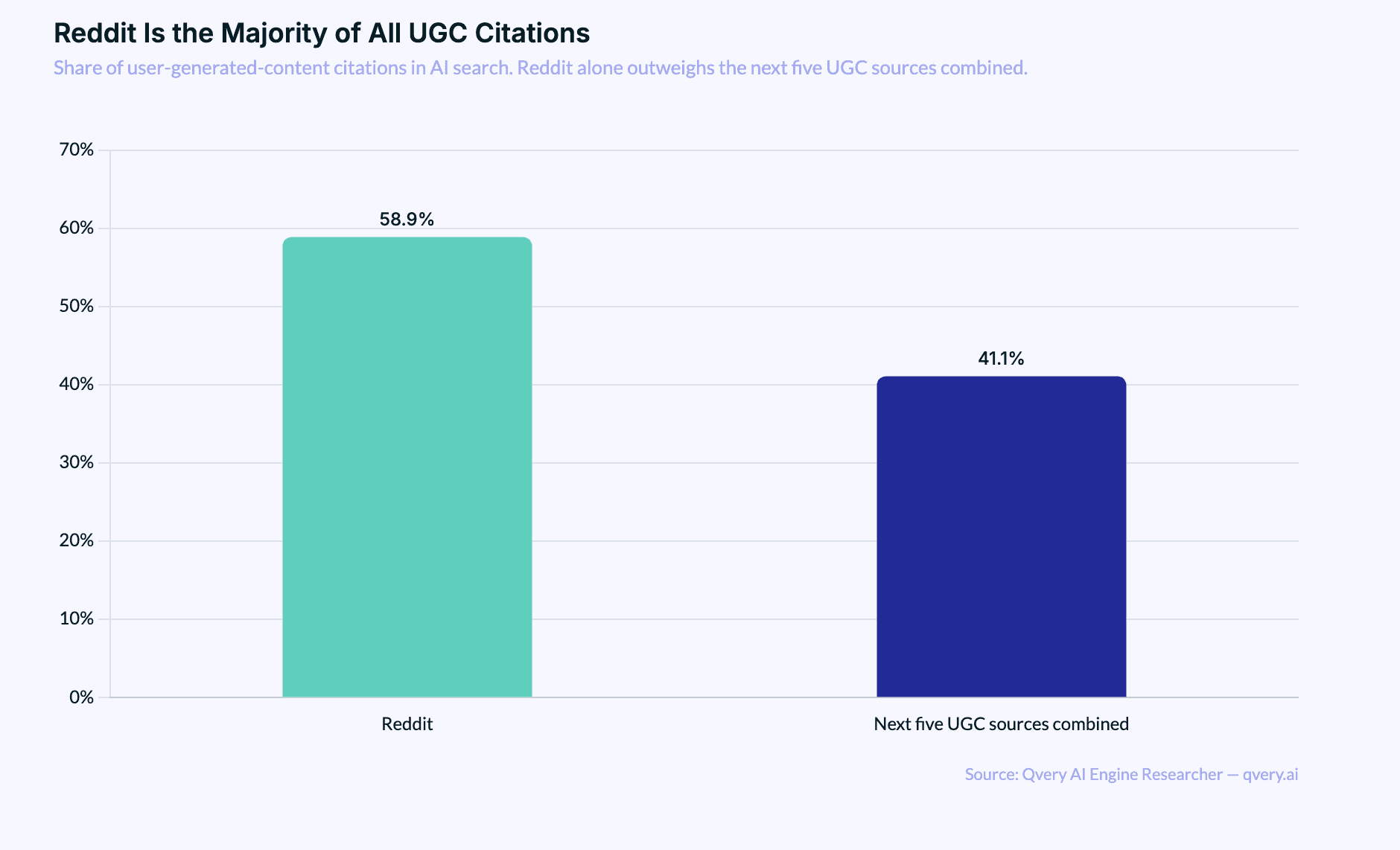
Start with where the citations go. Across everything we track, Reddit is the third most-cited domain overall and roughly 58.9% of all user-generated-content citations, more than the next five UGC sources combined. Three of every five times an AI engine reaches for a real human opinion, it reaches for Reddit. Wikipedia and google.com are the only two domains ahead of it, and neither of those is going to tell a shopper whether your blender survives a year of smoothies.
Your own product page, weighed against every competitor's equally polished page, mostly gets ignored. The Reddit thread is the opposite: the engine reads it as a verdict rather than a sales pitch, which is the one thing your page can never be.
The category math stings here. User-generated content is about 1.90% of all citations, with social just behind at about 1.74%. Those are small slices, but they are the slices that carry purchase intent. When an AI engine answers "is this worth the money," it is not quoting a brand's About page. It is quoting the people who already bought the thing and lived with it.
There is a documented reason Reddit feeds these engines so heavily: OpenAI and Google both ingest Reddit data through Reddit's API partnerships. That is public context, not a Qvery data point, but it explains the plumbing. The opinions are right there, structured, dated, and arguing with each other, which is exactly the texture these engines pull from when they answer a recommendation question.
Why The Long Tail Quietly Favors Small Stores
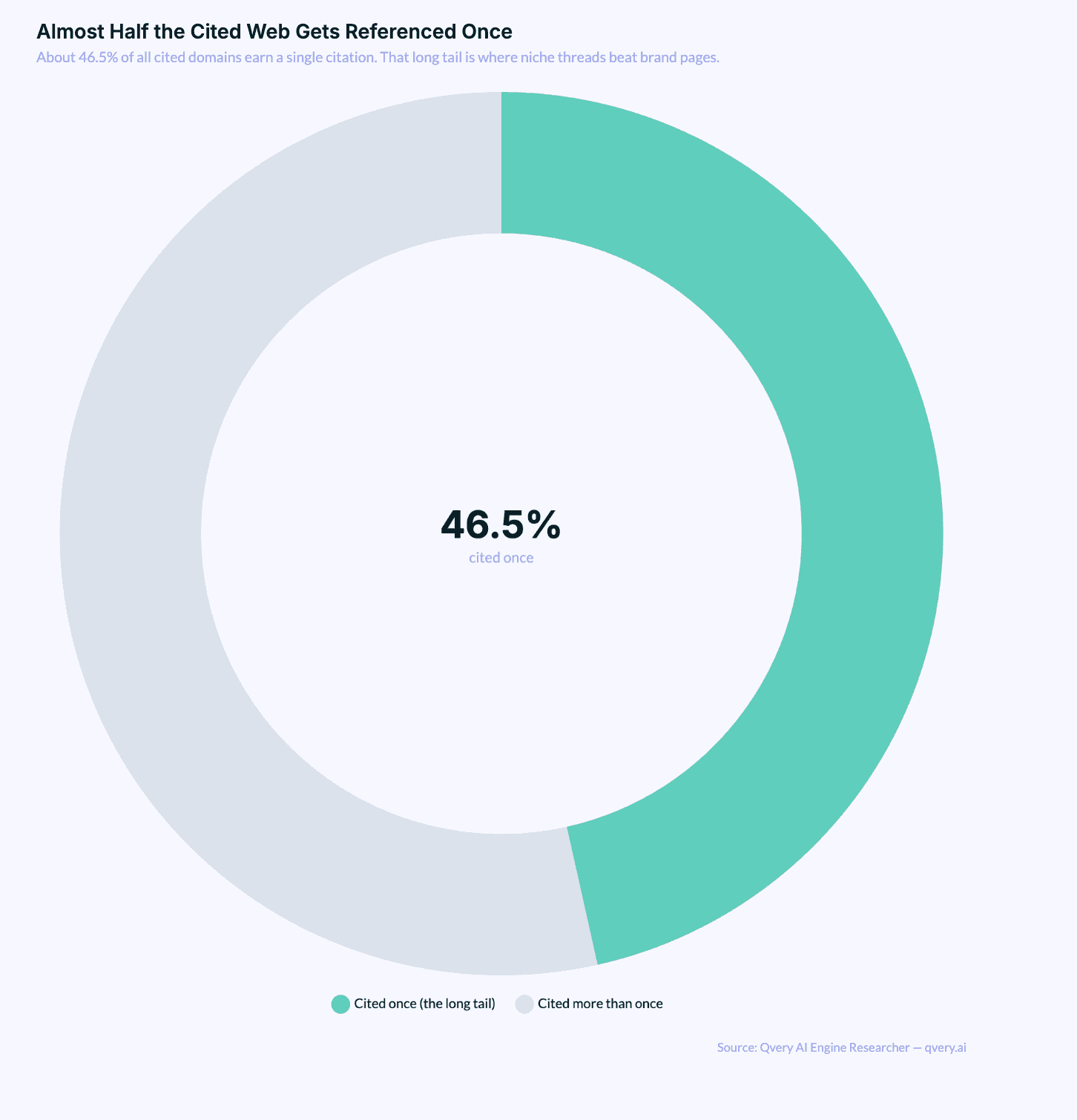
About 46.5% of all cited domains have only a single citation, cross-vertical. If you run a small store, that number is your whole opening: almost half the cited web gets referenced once and never again. That single-use long tail is how AI engines handle "what should I buy for this very particular situation."
Your product page cannot live in that long tail. A single page can only say one thing, in your voice, ranked against every rival's page that says the same flattering thing. A Reddit thread about "best waterproof boots for someone who works outside in the rain" is a different artifact entirely: hyper-specific, written by people with actual wet feet, and it earns a citation your product page can never replicate.
The narrower the question, the smaller your competition for the answer, and the better a single honest thread performs.
This is the same dynamic I wrote about in why AI search rewards fit over raw authority. Big retailers have decades of accumulated mentions, but AI engines weigh whether a source fits the query, so a niche store that is genuinely the right answer for a narrow question can get cited for it even when the giants do not.
Review Sites Lost The Trust, Reddit Took It
Over the past year, the sources AI engines trust quietly reshuffled. In SaaS, the one vertical where we can see it cleanly, traditional review sites lost roughly 78% of their citation share from January to March 2026 while Reddit held steady. I am flagging that as a SaaS slice, not an ecommerce one, because that is the honest read of the data. But the direction is the thing worth borrowing.
AI engines have quietly stopped trusting the trust signals a brand can nudge. The trust they used to carry is moving to the threads that read as least gamed.
Losing trust: star ratings, sponsored "top 10" listicles, review widgets, the signals a brand can nudge.
Gaining it: r/BuyItForLife arguments about what lasts, r/deals threads pressure-testing whether a price is real, the product-specific subreddits where regulars already have opinions about your category.
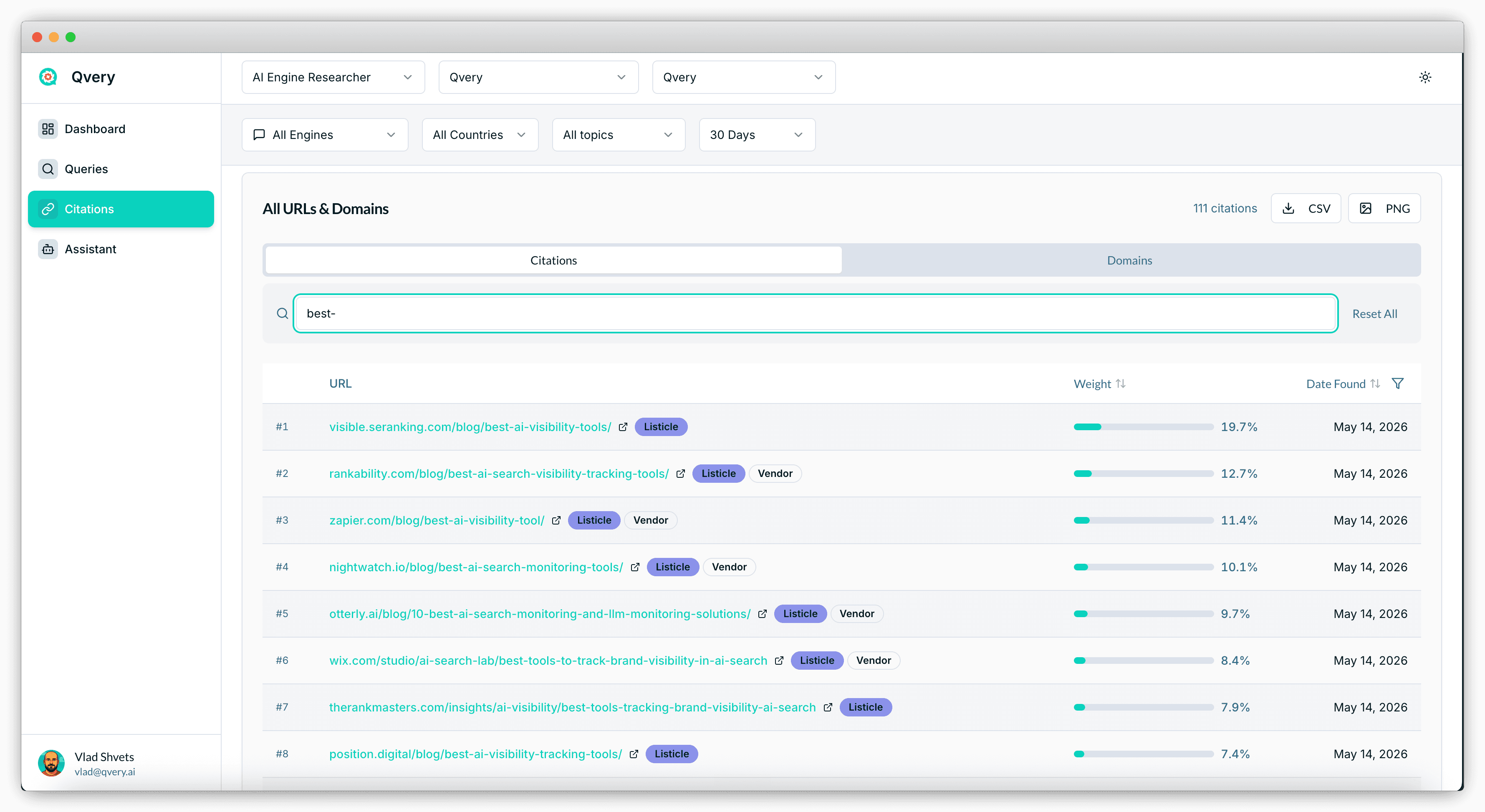
None of that means listicles are dead. "Best X" articles are still the single most-cited classifiable content type, about 45.8% of classifiable citations, cross-vertical. The shift is that the listicles getting cited increasingly read like they were assembled from real community consensus rather than from an affiliate spreadsheet. Land inside one of those roundups and you ride its citation every time a shopper asks the question it answers.
The Best Reddit Strategy Is Not A Reddit Strategy
Most ecommerce brands manage their Reddit risk in exactly the wrong order. They worry about being absent. The real risk is the complaint thread that quietly becomes a cited thread. A furious customer writes three paragraphs about your shipping, 20 people pile on, and eight months later that thread is what an AI engine surfaces when someone asks if your brand is legit.
So the real Reddit strategy starts nowhere near Reddit. It starts in your support inbox and your returns policy. Deliver an experience good enough that customers do not march off to Reddit furious in the first place, then give the ones who are annoyed a faster, better place to vent: responsive support on your own channels, where the complaint gets resolved before it ever becomes a public, citable thread. Staying close to your customers is what keeps the complaint off Reddit in the first place.
The cheapest GEO win in ecommerce is a support ticket closed before the customer opens Reddit.
When you are on Reddit, respond fast and like a human, not a brand account reading from a card; a quick, real reply can turn the thread that hurts you into the thread that helps you. And participate where your customers already gather, before you need anything from them.
r/BuyItForLife: show up where durability is the whole point, and let the product earn the mention.
r/deals: be honest when a price is good and quiet when it is not; the regulars can smell a plant.
Product-specific subreddits: answer real questions in your category with no link attached most of the time.
"What should I buy" threads: contribute a genuinely useful comparison, including when a competitor is the better fit for that person.
The first time you recommend a competitor in a "what should I buy" thread it feels self-defeating, but a comment that sends someone to the better fit reads as honest, and honest is the texture these engines keep surfacing. The ecommerce brands we help with Reddit that win are the ones that answer a question without dropping a link, then get cited anyway three weeks later.
How Qvery Turns This Into A Workflow You Can Run
The hard part of all this is that Reddit is enormous and you cannot eyeball which threads are shaping AI answers about your category. This is the problem we built for at Qvery. Here is what the work looks like.
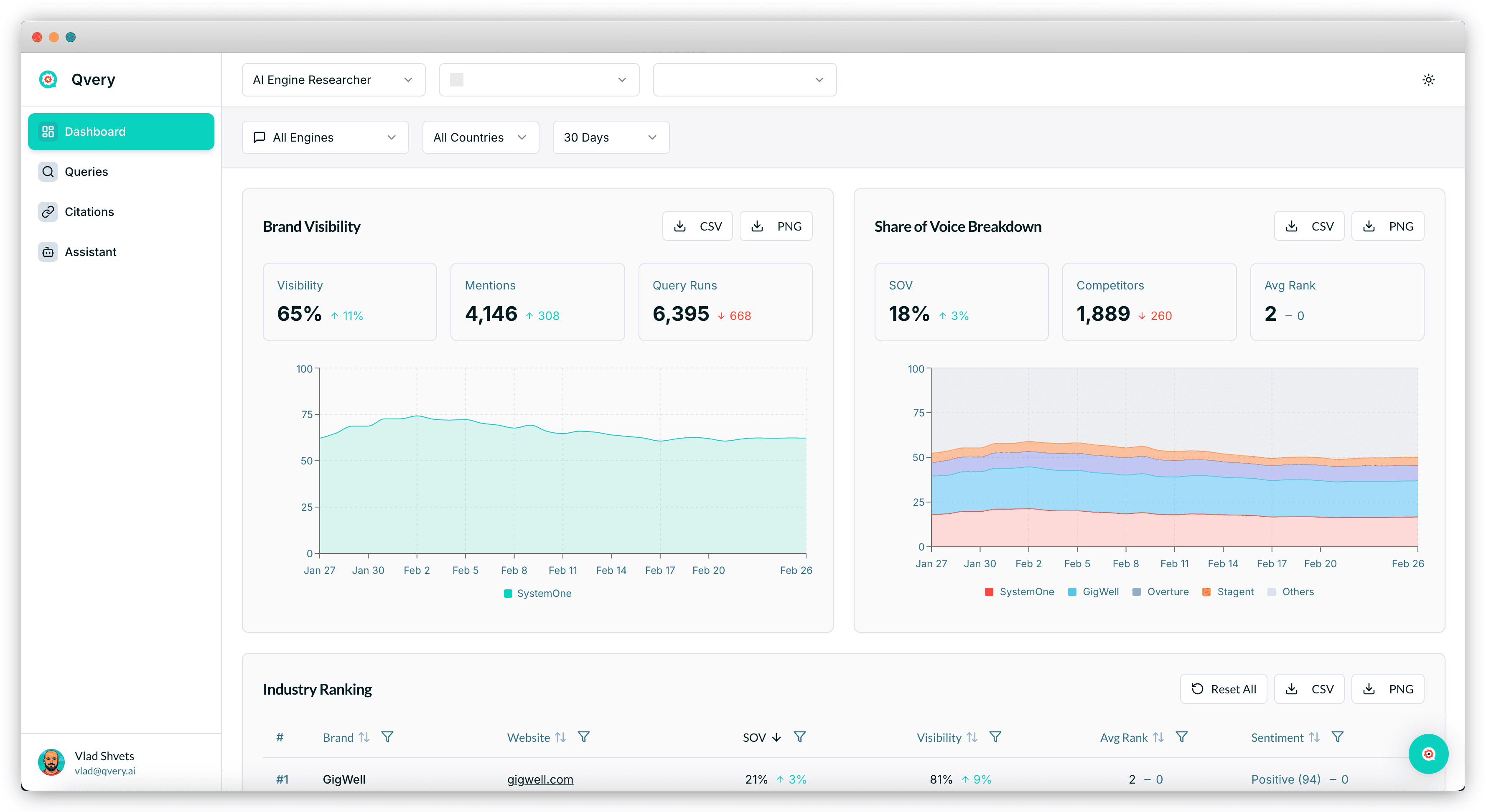
Step 1: See what's cited. You start in AI Engine Researcher. You enter your brand, and it auto-generates the purchase-intent queries that matter for your category, then runs them daily across ChatGPT and Google AI Mode and captures every citation. Instead of guessing, you see exactly which Reddit threads and which "best X" listicles are already being cited when a shopper asks for a recommendation in your space, and where competitors show up that you do not.
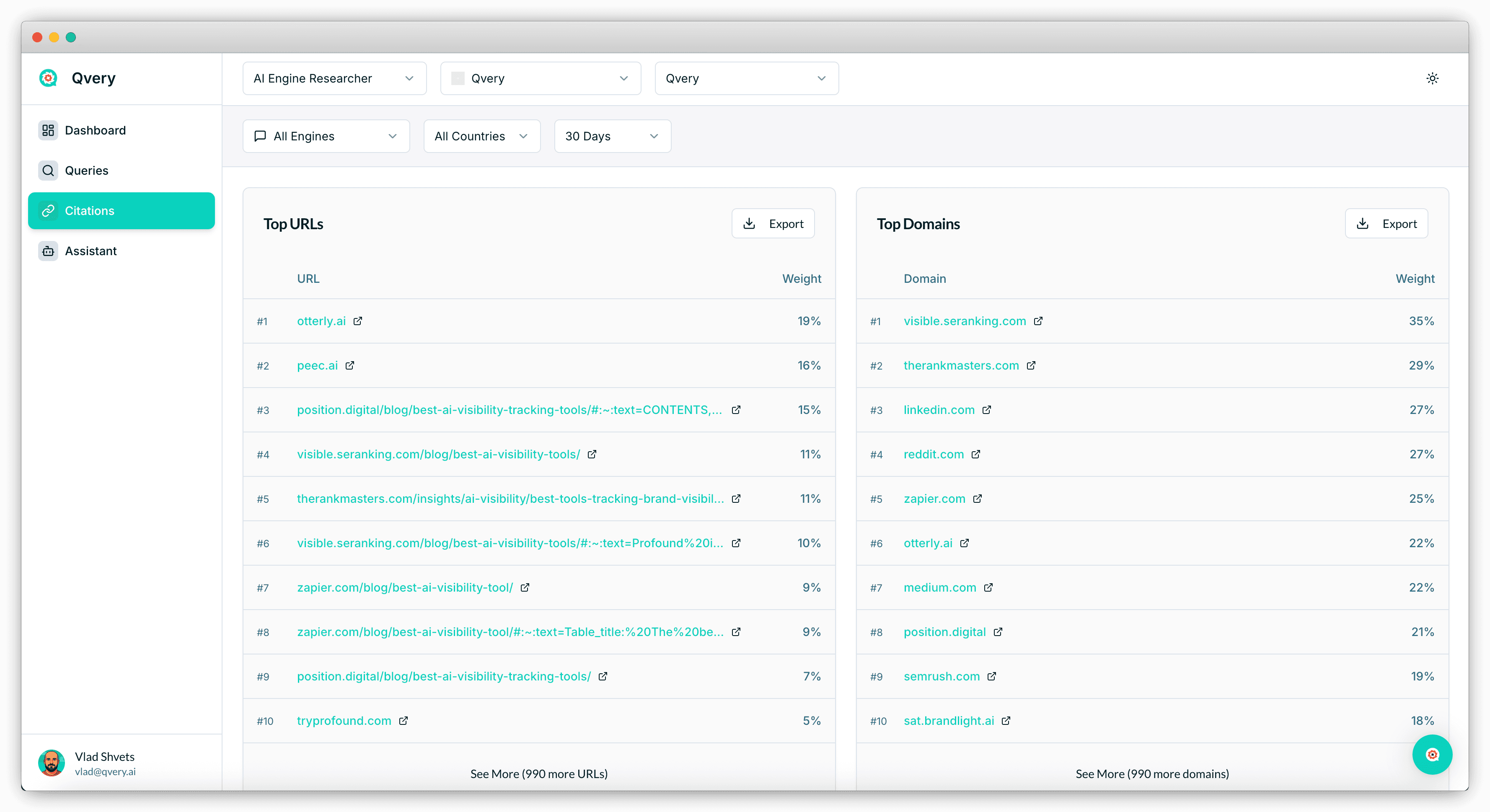
Step 2: Decide where to act. From there the UGC Agent takes over the second half. It surfaces the high-impact Reddit threads and forum discussions for your category and ranks them by the influence they have on AI answers. For the ones worth joining, it delivers ready-to-post content. Qvery analyzes AI search citations to identify the subreddits, TripAdvisor topics, and specialist forums that feed ChatGPT and Google AI Mode, so you are spending your effort on the threads that move recommendations rather than the loudest ones.
Then you watch whether your share of voice moves. Sign up, see data in 15 minutes.
Useful People Win The Recommendation
I am not going to pretend we have ecommerce figured out to the decimal. We have a clear cross-vertical picture and a thinner ecommerce-specific one, and I would rather tell you that than dress up a SaaS number in ecommerce clothing. What I am confident about is the direction, because it shows up in every vertical we can see.
AI engines reward the page that sounds like someone who already bought the thing, and ignore the one that sounds like the brand that sold it. Reddit's UGC dominance and the single-citation long tail both point the same way: the recommendation goes to whoever is genuinely useful at the exact moment of the question. For an ecommerce brand, the fastest path there runs through your support inbox first and the right threads second.
The fastest path is unglamorous: fix the support experience that sends people to Reddit angry, then show up in the threads where your category already argues with itself. The recommendation you cannot write yourself follows from being the most useful person in that thread.
Qvery's AI Engine Researcher shows you which of those threads are already shaping the answers. Sign up, see data in 15 minutes.
When someone asks ChatGPT for the best pair of headphones under $200, your product page does not get a vote. The AI engine reads your page, sees that you describe your own product as life-changing, and weighs that exactly as much as you would weigh a restaurant calling itself the best in town: which is to say, not at all. Then it goes and reads a Reddit thread where 11 strangers argue about durability for 40 comments, and that is what shapes the recommendation.
That is the part of ecommerce nobody warns you about, especially if you just spent three months polishing a Shopify store: the most persuasive sentence about your product is one you did not write, posted by someone you have never met, in a thread you will never fully control.
For purchase-intent queries, AI engines lean far harder on user-generated recommendations than on brand-owned product pages.
A heads up on the numbers first: we do not yet have a clean ecommerce-specific citation slice, so everything I cite here is cross-vertical, tracked daily across ChatGPT and Google AI Mode since January 2026. I will tell you every time a number is cross-vertical rather than ecommerce-only, because pretending otherwise would be exactly the kind of thing this post argues against.
AI Engines Trust Strangers Over Your Product Page
Start with where the citations go. Across everything we track, Reddit is the third most-cited domain overall and roughly 58.9% of all user-generated-content citations, more than the next five UGC sources combined. Three of every five times an AI engine reaches for a real human opinion, it reaches for Reddit. Wikipedia and google.com are the only two domains ahead of it, and neither of those is going to tell a shopper whether your blender survives a year of smoothies.
Your own product page, weighed against every competitor's equally polished page, mostly gets ignored. The Reddit thread is the opposite: the engine reads it as a verdict rather than a sales pitch, which is the one thing your page can never be.
The category math stings here. User-generated content is about 1.90% of all citations, with social just behind at about 1.74%. Those are small slices, but they are the slices that carry purchase intent. When an AI engine answers "is this worth the money," it is not quoting a brand's About page. It is quoting the people who already bought the thing and lived with it.
There is a documented reason Reddit feeds these engines so heavily: OpenAI and Google both ingest Reddit data through Reddit's API partnerships. That is public context, not a Qvery data point, but it explains the plumbing. The opinions are right there, structured, dated, and arguing with each other, which is exactly the texture these engines pull from when they answer a recommendation question.
Why The Long Tail Quietly Favors Small Stores
About 46.5% of all cited domains have only a single citation, cross-vertical. If you run a small store, that number is your whole opening: almost half the cited web gets referenced once and never again. That single-use long tail is how AI engines handle "what should I buy for this very particular situation."
Your product page cannot live in that long tail. A single page can only say one thing, in your voice, ranked against every rival's page that says the same flattering thing. A Reddit thread about "best waterproof boots for someone who works outside in the rain" is a different artifact entirely: hyper-specific, written by people with actual wet feet, and it earns a citation your product page can never replicate.
The narrower the question, the smaller your competition for the answer, and the better a single honest thread performs.
This is the same dynamic I wrote about in why AI search rewards fit over raw authority. Big retailers have decades of accumulated mentions, but AI engines weigh whether a source fits the query, so a niche store that is genuinely the right answer for a narrow question can get cited for it even when the giants do not.
Review Sites Lost The Trust, Reddit Took It
Over the past year, the sources AI engines trust quietly reshuffled. In SaaS, the one vertical where we can see it cleanly, traditional review sites lost roughly 78% of their citation share from January to March 2026 while Reddit held steady. I am flagging that as a SaaS slice, not an ecommerce one, because that is the honest read of the data. But the direction is the thing worth borrowing.
AI engines have quietly stopped trusting the trust signals a brand can nudge. The trust they used to carry is moving to the threads that read as least gamed.
Losing trust: star ratings, sponsored "top 10" listicles, review widgets, the signals a brand can nudge.
Gaining it: r/BuyItForLife arguments about what lasts, r/deals threads pressure-testing whether a price is real, the product-specific subreddits where regulars already have opinions about your category.
None of that means listicles are dead. "Best X" articles are still the single most-cited classifiable content type, about 45.8% of classifiable citations, cross-vertical. The shift is that the listicles getting cited increasingly read like they were assembled from real community consensus rather than from an affiliate spreadsheet. Land inside one of those roundups and you ride its citation every time a shopper asks the question it answers.
The Best Reddit Strategy Is Not A Reddit Strategy
Most ecommerce brands manage their Reddit risk in exactly the wrong order. They worry about being absent. The real risk is the complaint thread that quietly becomes a cited thread. A furious customer writes three paragraphs about your shipping, 20 people pile on, and eight months later that thread is what an AI engine surfaces when someone asks if your brand is legit.
So the real Reddit strategy starts nowhere near Reddit. It starts in your support inbox and your returns policy. Deliver an experience good enough that customers do not march off to Reddit furious in the first place, then give the ones who are annoyed a faster, better place to vent: responsive support on your own channels, where the complaint gets resolved before it ever becomes a public, citable thread. Staying close to your customers is what keeps the complaint off Reddit in the first place.
The cheapest GEO win in ecommerce is a support ticket closed before the customer opens Reddit.
When you are on Reddit, respond fast and like a human, not a brand account reading from a card; a quick, real reply can turn the thread that hurts you into the thread that helps you. And participate where your customers already gather, before you need anything from them.
r/BuyItForLife: show up where durability is the whole point, and let the product earn the mention.
r/deals: be honest when a price is good and quiet when it is not; the regulars can smell a plant.
Product-specific subreddits: answer real questions in your category with no link attached most of the time.
"What should I buy" threads: contribute a genuinely useful comparison, including when a competitor is the better fit for that person.
The first time you recommend a competitor in a "what should I buy" thread it feels self-defeating, but a comment that sends someone to the better fit reads as honest, and honest is the texture these engines keep surfacing. The ecommerce brands we help with Reddit that win are the ones that answer a question without dropping a link, then get cited anyway three weeks later.
How Qvery Turns This Into A Workflow You Can Run
The hard part of all this is that Reddit is enormous and you cannot eyeball which threads are shaping AI answers about your category. This is the problem we built for at Qvery. Here is what the work looks like.
Step 1: See what's cited. You start in AI Engine Researcher. You enter your brand, and it auto-generates the purchase-intent queries that matter for your category, then runs them daily across ChatGPT and Google AI Mode and captures every citation. Instead of guessing, you see exactly which Reddit threads and which "best X" listicles are already being cited when a shopper asks for a recommendation in your space, and where competitors show up that you do not.
Step 2: Decide where to act. From there the UGC Agent takes over the second half. It surfaces the high-impact Reddit threads and forum discussions for your category and ranks them by the influence they have on AI answers. For the ones worth joining, it delivers ready-to-post content. Qvery analyzes AI search citations to identify the subreddits, TripAdvisor topics, and specialist forums that feed ChatGPT and Google AI Mode, so you are spending your effort on the threads that move recommendations rather than the loudest ones.
Then you watch whether your share of voice moves. Sign up, see data in 15 minutes.
Useful People Win The Recommendation
I am not going to pretend we have ecommerce figured out to the decimal. We have a clear cross-vertical picture and a thinner ecommerce-specific one, and I would rather tell you that than dress up a SaaS number in ecommerce clothing. What I am confident about is the direction, because it shows up in every vertical we can see.
AI engines reward the page that sounds like someone who already bought the thing, and ignore the one that sounds like the brand that sold it. Reddit's UGC dominance and the single-citation long tail both point the same way: the recommendation goes to whoever is genuinely useful at the exact moment of the question. For an ecommerce brand, the fastest path there runs through your support inbox first and the right threads second.
The fastest path is unglamorous: fix the support experience that sends people to Reddit angry, then show up in the threads where your category already argues with itself. The recommendation you cannot write yourself follows from being the most useful person in that thread.
Qvery's AI Engine Researcher shows you which of those threads are already shaping the answers. Sign up, see data in 15 minutes.
When someone asks ChatGPT for the best pair of headphones under $200, your product page does not get a vote. The AI engine reads your page, sees that you describe your own product as life-changing, and weighs that exactly as much as you would weigh a restaurant calling itself the best in town: which is to say, not at all. Then it goes and reads a Reddit thread where 11 strangers argue about durability for 40 comments, and that is what shapes the recommendation.
That is the part of ecommerce nobody warns you about, especially if you just spent three months polishing a Shopify store: the most persuasive sentence about your product is one you did not write, posted by someone you have never met, in a thread you will never fully control.
For purchase-intent queries, AI engines lean far harder on user-generated recommendations than on brand-owned product pages.
A heads up on the numbers first: we do not yet have a clean ecommerce-specific citation slice, so everything I cite here is cross-vertical, tracked daily across ChatGPT and Google AI Mode since January 2026. I will tell you every time a number is cross-vertical rather than ecommerce-only, because pretending otherwise would be exactly the kind of thing this post argues against.
AI Engines Trust Strangers Over Your Product Page
Start with where the citations go. Across everything we track, Reddit is the third most-cited domain overall and roughly 58.9% of all user-generated-content citations, more than the next five UGC sources combined. Three of every five times an AI engine reaches for a real human opinion, it reaches for Reddit. Wikipedia and google.com are the only two domains ahead of it, and neither of those is going to tell a shopper whether your blender survives a year of smoothies.
Your own product page, weighed against every competitor's equally polished page, mostly gets ignored. The Reddit thread is the opposite: the engine reads it as a verdict rather than a sales pitch, which is the one thing your page can never be.
The category math stings here. User-generated content is about 1.90% of all citations, with social just behind at about 1.74%. Those are small slices, but they are the slices that carry purchase intent. When an AI engine answers "is this worth the money," it is not quoting a brand's About page. It is quoting the people who already bought the thing and lived with it.
There is a documented reason Reddit feeds these engines so heavily: OpenAI and Google both ingest Reddit data through Reddit's API partnerships. That is public context, not a Qvery data point, but it explains the plumbing. The opinions are right there, structured, dated, and arguing with each other, which is exactly the texture these engines pull from when they answer a recommendation question.
Why The Long Tail Quietly Favors Small Stores
About 46.5% of all cited domains have only a single citation, cross-vertical. If you run a small store, that number is your whole opening: almost half the cited web gets referenced once and never again. That single-use long tail is how AI engines handle "what should I buy for this very particular situation."
Your product page cannot live in that long tail. A single page can only say one thing, in your voice, ranked against every rival's page that says the same flattering thing. A Reddit thread about "best waterproof boots for someone who works outside in the rain" is a different artifact entirely: hyper-specific, written by people with actual wet feet, and it earns a citation your product page can never replicate.
The narrower the question, the smaller your competition for the answer, and the better a single honest thread performs.
This is the same dynamic I wrote about in why AI search rewards fit over raw authority. Big retailers have decades of accumulated mentions, but AI engines weigh whether a source fits the query, so a niche store that is genuinely the right answer for a narrow question can get cited for it even when the giants do not.
Review Sites Lost The Trust, Reddit Took It
Over the past year, the sources AI engines trust quietly reshuffled. In SaaS, the one vertical where we can see it cleanly, traditional review sites lost roughly 78% of their citation share from January to March 2026 while Reddit held steady. I am flagging that as a SaaS slice, not an ecommerce one, because that is the honest read of the data. But the direction is the thing worth borrowing.
AI engines have quietly stopped trusting the trust signals a brand can nudge. The trust they used to carry is moving to the threads that read as least gamed.
Losing trust: star ratings, sponsored "top 10" listicles, review widgets, the signals a brand can nudge.
Gaining it: r/BuyItForLife arguments about what lasts, r/deals threads pressure-testing whether a price is real, the product-specific subreddits where regulars already have opinions about your category.
None of that means listicles are dead. "Best X" articles are still the single most-cited classifiable content type, about 45.8% of classifiable citations, cross-vertical. The shift is that the listicles getting cited increasingly read like they were assembled from real community consensus rather than from an affiliate spreadsheet. Land inside one of those roundups and you ride its citation every time a shopper asks the question it answers.
The Best Reddit Strategy Is Not A Reddit Strategy
Most ecommerce brands manage their Reddit risk in exactly the wrong order. They worry about being absent. The real risk is the complaint thread that quietly becomes a cited thread. A furious customer writes three paragraphs about your shipping, 20 people pile on, and eight months later that thread is what an AI engine surfaces when someone asks if your brand is legit.
So the real Reddit strategy starts nowhere near Reddit. It starts in your support inbox and your returns policy. Deliver an experience good enough that customers do not march off to Reddit furious in the first place, then give the ones who are annoyed a faster, better place to vent: responsive support on your own channels, where the complaint gets resolved before it ever becomes a public, citable thread. Staying close to your customers is what keeps the complaint off Reddit in the first place.
The cheapest GEO win in ecommerce is a support ticket closed before the customer opens Reddit.
When you are on Reddit, respond fast and like a human, not a brand account reading from a card; a quick, real reply can turn the thread that hurts you into the thread that helps you. And participate where your customers already gather, before you need anything from them.
r/BuyItForLife: show up where durability is the whole point, and let the product earn the mention.
r/deals: be honest when a price is good and quiet when it is not; the regulars can smell a plant.
Product-specific subreddits: answer real questions in your category with no link attached most of the time.
"What should I buy" threads: contribute a genuinely useful comparison, including when a competitor is the better fit for that person.
The first time you recommend a competitor in a "what should I buy" thread it feels self-defeating, but a comment that sends someone to the better fit reads as honest, and honest is the texture these engines keep surfacing. The ecommerce brands we help with Reddit that win are the ones that answer a question without dropping a link, then get cited anyway three weeks later.
How Qvery Turns This Into A Workflow You Can Run
The hard part of all this is that Reddit is enormous and you cannot eyeball which threads are shaping AI answers about your category. This is the problem we built for at Qvery. Here is what the work looks like.
Step 1: See what's cited. You start in AI Engine Researcher. You enter your brand, and it auto-generates the purchase-intent queries that matter for your category, then runs them daily across ChatGPT and Google AI Mode and captures every citation. Instead of guessing, you see exactly which Reddit threads and which "best X" listicles are already being cited when a shopper asks for a recommendation in your space, and where competitors show up that you do not.
Step 2: Decide where to act. From there the UGC Agent takes over the second half. It surfaces the high-impact Reddit threads and forum discussions for your category and ranks them by the influence they have on AI answers. For the ones worth joining, it delivers ready-to-post content. Qvery analyzes AI search citations to identify the subreddits, TripAdvisor topics, and specialist forums that feed ChatGPT and Google AI Mode, so you are spending your effort on the threads that move recommendations rather than the loudest ones.
Then you watch whether your share of voice moves. Sign up, see data in 15 minutes.
Useful People Win The Recommendation
I am not going to pretend we have ecommerce figured out to the decimal. We have a clear cross-vertical picture and a thinner ecommerce-specific one, and I would rather tell you that than dress up a SaaS number in ecommerce clothing. What I am confident about is the direction, because it shows up in every vertical we can see.
AI engines reward the page that sounds like someone who already bought the thing, and ignore the one that sounds like the brand that sold it. Reddit's UGC dominance and the single-citation long tail both point the same way: the recommendation goes to whoever is genuinely useful at the exact moment of the question. For an ecommerce brand, the fastest path there runs through your support inbox first and the right threads second.
The fastest path is unglamorous: fix the support experience that sends people to Reddit angry, then show up in the threads where your category already argues with itself. The recommendation you cannot write yourself follows from being the most useful person in that thread.
Qvery's AI Engine Researcher shows you which of those threads are already shaping the answers. Sign up, see data in 15 minutes.
When someone asks ChatGPT for the best pair of headphones under $200, your product page does not get a vote. The AI engine reads your page, sees that you describe your own product as life-changing, and weighs that exactly as much as you would weigh a restaurant calling itself the best in town: which is to say, not at all. Then it goes and reads a Reddit thread where 11 strangers argue about durability for 40 comments, and that is what shapes the recommendation.
That is the part of ecommerce nobody warns you about, especially if you just spent three months polishing a Shopify store: the most persuasive sentence about your product is one you did not write, posted by someone you have never met, in a thread you will never fully control.
For purchase-intent queries, AI engines lean far harder on user-generated recommendations than on brand-owned product pages.
A heads up on the numbers first: we do not yet have a clean ecommerce-specific citation slice, so everything I cite here is cross-vertical, tracked daily across ChatGPT and Google AI Mode since January 2026. I will tell you every time a number is cross-vertical rather than ecommerce-only, because pretending otherwise would be exactly the kind of thing this post argues against.
AI Engines Trust Strangers Over Your Product Page
Start with where the citations go. Across everything we track, Reddit is the third most-cited domain overall and roughly 58.9% of all user-generated-content citations, more than the next five UGC sources combined. Three of every five times an AI engine reaches for a real human opinion, it reaches for Reddit. Wikipedia and google.com are the only two domains ahead of it, and neither of those is going to tell a shopper whether your blender survives a year of smoothies.
Your own product page, weighed against every competitor's equally polished page, mostly gets ignored. The Reddit thread is the opposite: the engine reads it as a verdict rather than a sales pitch, which is the one thing your page can never be.
The category math stings here. User-generated content is about 1.90% of all citations, with social just behind at about 1.74%. Those are small slices, but they are the slices that carry purchase intent. When an AI engine answers "is this worth the money," it is not quoting a brand's About page. It is quoting the people who already bought the thing and lived with it.
There is a documented reason Reddit feeds these engines so heavily: OpenAI and Google both ingest Reddit data through Reddit's API partnerships. That is public context, not a Qvery data point, but it explains the plumbing. The opinions are right there, structured, dated, and arguing with each other, which is exactly the texture these engines pull from when they answer a recommendation question.
Why The Long Tail Quietly Favors Small Stores
About 46.5% of all cited domains have only a single citation, cross-vertical. If you run a small store, that number is your whole opening: almost half the cited web gets referenced once and never again. That single-use long tail is how AI engines handle "what should I buy for this very particular situation."
Your product page cannot live in that long tail. A single page can only say one thing, in your voice, ranked against every rival's page that says the same flattering thing. A Reddit thread about "best waterproof boots for someone who works outside in the rain" is a different artifact entirely: hyper-specific, written by people with actual wet feet, and it earns a citation your product page can never replicate.
The narrower the question, the smaller your competition for the answer, and the better a single honest thread performs.
This is the same dynamic I wrote about in why AI search rewards fit over raw authority. Big retailers have decades of accumulated mentions, but AI engines weigh whether a source fits the query, so a niche store that is genuinely the right answer for a narrow question can get cited for it even when the giants do not.
Review Sites Lost The Trust, Reddit Took It
Over the past year, the sources AI engines trust quietly reshuffled. In SaaS, the one vertical where we can see it cleanly, traditional review sites lost roughly 78% of their citation share from January to March 2026 while Reddit held steady. I am flagging that as a SaaS slice, not an ecommerce one, because that is the honest read of the data. But the direction is the thing worth borrowing.
AI engines have quietly stopped trusting the trust signals a brand can nudge. The trust they used to carry is moving to the threads that read as least gamed.
Losing trust: star ratings, sponsored "top 10" listicles, review widgets, the signals a brand can nudge.
Gaining it: r/BuyItForLife arguments about what lasts, r/deals threads pressure-testing whether a price is real, the product-specific subreddits where regulars already have opinions about your category.
None of that means listicles are dead. "Best X" articles are still the single most-cited classifiable content type, about 45.8% of classifiable citations, cross-vertical. The shift is that the listicles getting cited increasingly read like they were assembled from real community consensus rather than from an affiliate spreadsheet. Land inside one of those roundups and you ride its citation every time a shopper asks the question it answers.
The Best Reddit Strategy Is Not A Reddit Strategy
Most ecommerce brands manage their Reddit risk in exactly the wrong order. They worry about being absent. The real risk is the complaint thread that quietly becomes a cited thread. A furious customer writes three paragraphs about your shipping, 20 people pile on, and eight months later that thread is what an AI engine surfaces when someone asks if your brand is legit.
So the real Reddit strategy starts nowhere near Reddit. It starts in your support inbox and your returns policy. Deliver an experience good enough that customers do not march off to Reddit furious in the first place, then give the ones who are annoyed a faster, better place to vent: responsive support on your own channels, where the complaint gets resolved before it ever becomes a public, citable thread. Staying close to your customers is what keeps the complaint off Reddit in the first place.
The cheapest GEO win in ecommerce is a support ticket closed before the customer opens Reddit.
When you are on Reddit, respond fast and like a human, not a brand account reading from a card; a quick, real reply can turn the thread that hurts you into the thread that helps you. And participate where your customers already gather, before you need anything from them.
r/BuyItForLife: show up where durability is the whole point, and let the product earn the mention.
r/deals: be honest when a price is good and quiet when it is not; the regulars can smell a plant.
Product-specific subreddits: answer real questions in your category with no link attached most of the time.
"What should I buy" threads: contribute a genuinely useful comparison, including when a competitor is the better fit for that person.
The first time you recommend a competitor in a "what should I buy" thread it feels self-defeating, but a comment that sends someone to the better fit reads as honest, and honest is the texture these engines keep surfacing. The ecommerce brands we help with Reddit that win are the ones that answer a question without dropping a link, then get cited anyway three weeks later.
How Qvery Turns This Into A Workflow You Can Run
The hard part of all this is that Reddit is enormous and you cannot eyeball which threads are shaping AI answers about your category. This is the problem we built for at Qvery. Here is what the work looks like.
Step 1: See what's cited. You start in AI Engine Researcher. You enter your brand, and it auto-generates the purchase-intent queries that matter for your category, then runs them daily across ChatGPT and Google AI Mode and captures every citation. Instead of guessing, you see exactly which Reddit threads and which "best X" listicles are already being cited when a shopper asks for a recommendation in your space, and where competitors show up that you do not.
Step 2: Decide where to act. From there the UGC Agent takes over the second half. It surfaces the high-impact Reddit threads and forum discussions for your category and ranks them by the influence they have on AI answers. For the ones worth joining, it delivers ready-to-post content. Qvery analyzes AI search citations to identify the subreddits, TripAdvisor topics, and specialist forums that feed ChatGPT and Google AI Mode, so you are spending your effort on the threads that move recommendations rather than the loudest ones.
Then you watch whether your share of voice moves. Sign up, see data in 15 minutes.
Useful People Win The Recommendation
I am not going to pretend we have ecommerce figured out to the decimal. We have a clear cross-vertical picture and a thinner ecommerce-specific one, and I would rather tell you that than dress up a SaaS number in ecommerce clothing. What I am confident about is the direction, because it shows up in every vertical we can see.
AI engines reward the page that sounds like someone who already bought the thing, and ignore the one that sounds like the brand that sold it. Reddit's UGC dominance and the single-citation long tail both point the same way: the recommendation goes to whoever is genuinely useful at the exact moment of the question. For an ecommerce brand, the fastest path there runs through your support inbox first and the right threads second.
The fastest path is unglamorous: fix the support experience that sends people to Reddit angry, then show up in the threads where your category already argues with itself. The recommendation you cannot write yourself follows from being the most useful person in that thread.
Qvery's AI Engine Researcher shows you which of those threads are already shaping the answers. Sign up, see data in 15 minutes.

© 2026 Qvery AI OÜ