By
Vlad Shvets
AI Engine Visibility for Institutional Crypto: Custody, Compliance, and Staking Brands
Plain and procurement-constrained institutional crypto questions share an audit core in ChatGPT and Google AI Mode answers, with a separate tail for each.
Plain and procurement-constrained institutional crypto questions share an audit core in ChatGPT and Google AI Mode answers, with a separate tail for each.
Plain and procurement-constrained institutional crypto questions share an audit core in ChatGPT and Google AI Mode answers, with a separate tail for each.
If you sell custody, compliance or staking infrastructure, your buyers rarely ask an AI engine a bare question. They ask for a custodian that works under a specific regulator, a staking provider with a particular licence, a qualified custody setup for a fund in their jurisdiction.
Sometimes they ask without the constraint, too. The practical question for your team is whether those two kinds of question draw on the same sources, or whether each needs its own citation audit.
So we asked ChatGPT and Google AI Mode paired institutional buying questions in September 2026, each need once plainly and once with a procurement constraint, and recorded the domains the answers cited and the vendors they named.
Three answers were possible: one audit list serves both, a shared core with a separate tail for each, or two separate lists. The short version: a shared core with distinct tails.
The unconstrained list covered 62.81% of the constrained answers that cited any source, and the constrained list covered 67.17% of the unconstrained answers that cited any source.
That audit advice is our judgment from what appeared together. Throughout, a vendor counts as named when the answer names it, which is not the same as recommending it, and nothing here says why a domain or a name appears.
One Audit Core, Two Tails
For each kind of question we built a list of domains, adding at each step the domain that covered the most answers not yet covered, until the list reached 80% of the answers that cited any source.
Unconstrained questions, 17 domains: coinbase.com, sec.gov, bitgo.com, fireblocks.com, chainalysis.com, bitcoinfoundation.org, occ.gov, blockdaemon.com, lowenstein.com, talos.com, ethereum.org, interactivebrokers.com.au, nasdaq.com, aminagroup.com, docs.sumsub.com, kraken.com, safe.global.
Procurement-constrained questions, 19 domains: fireblocks.com, sec.gov, coinbase.com, chainalysis.com, occ.gov, ethereum.org, falconx.io, finra.org, lowenstein.com, acsa.com.au, esma.europa.eu, fca.org.uk, nexusmutual.io, securities-administrators.ca, bitgo.com, delcode.delaware.gov, everstake.com, ledgible.io, niceactimize.com.
Eight domains sit on both lists, and they are your shared core: bitgo.com, chainalysis.com, coinbase.com, ethereum.org, fireblocks.com, lowenstein.com, occ.gov and sec.gov.
The rest are the two tails, in each list's order:
Unconstrained only: bitcoinfoundation.org, blockdaemon.com, talos.com, interactivebrokers.com.au, nasdaq.com, aminagroup.com, docs.sumsub.com, kraken.com, safe.global.
Constrained only: falconx.io, finra.org, acsa.com.au, esma.europa.eu, fca.org.uk, nexusmutual.io, securities-administrators.ca, delcode.delaware.gov, everstake.com, ledgible.io, niceactimize.com.
Then we swapped the lists. The unconstrained list covered 62.81% of the constrained answers that cited any source, and the constrained list covered 67.17% of the unconstrained answers that cited any source.
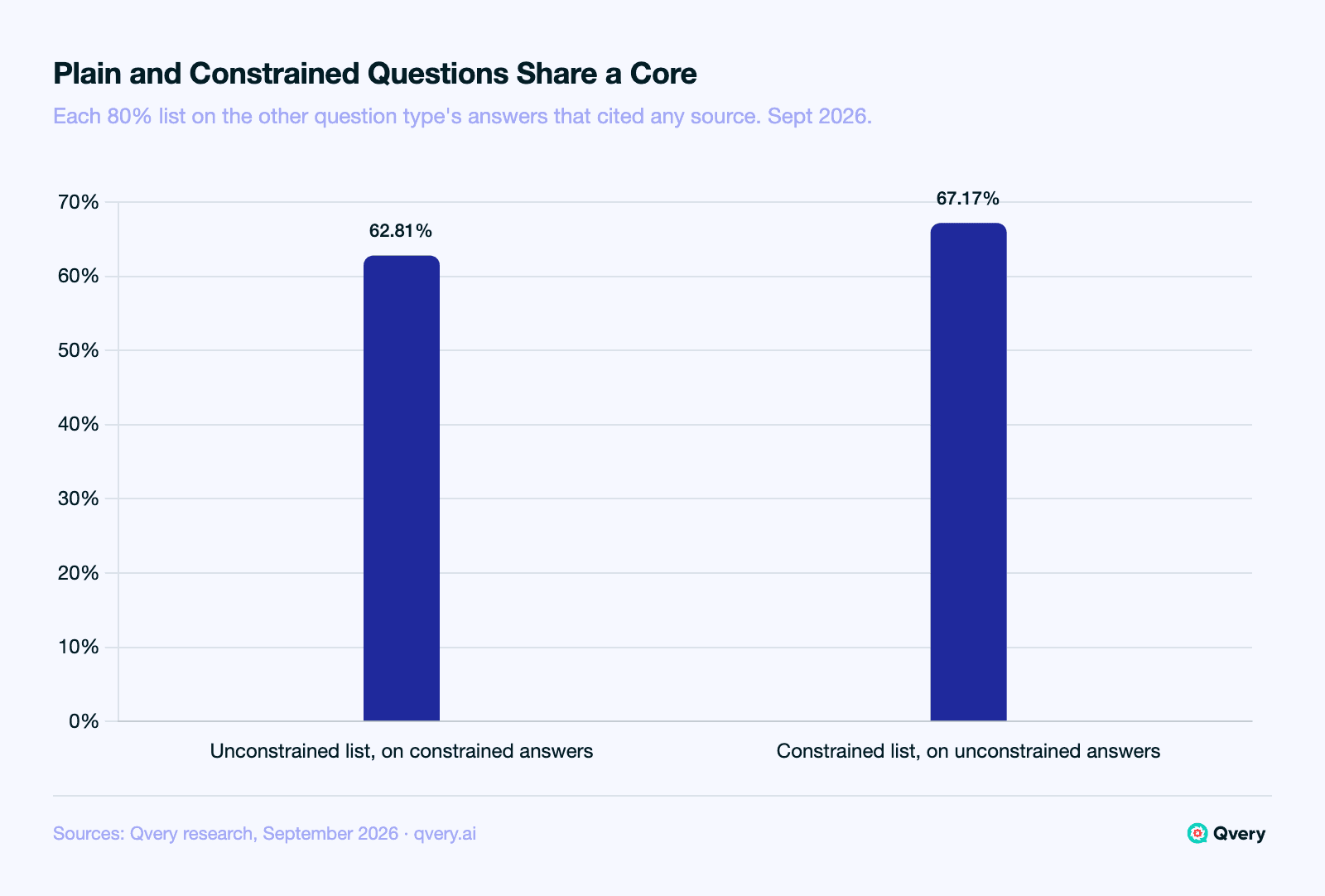
The lower figure, 0.6281, clears our 0.60 bar for a shared core and misses the 0.80 bar for one list. So audit the core once, and keep a tail for each kind of question, checking each tail domain on the questions it belongs to.
The eight shared domains describe the overlap; they do not decide it. And the two kinds of question do not cite the same domains, so one list does not cover 80% of both.
For how to turn lists like these into a working audit, see the crypto marketer's audit.
Whether a Constraint Changes Which Vendors Get Named Is Not Settled
Before collecting, we fixed a set of four institutional vendors and hand-checked it: Anchorage, BitGo, Chainalysis and Fireblocks.
At least one of them was named in 60.00% of unconstrained answers and 41.00% of constrained answers, each a share of all the valid answers of that type, both engines pooled, with nothing unresolved. The ratio is 1.46, which sits in the band we set in advance as indeterminate.
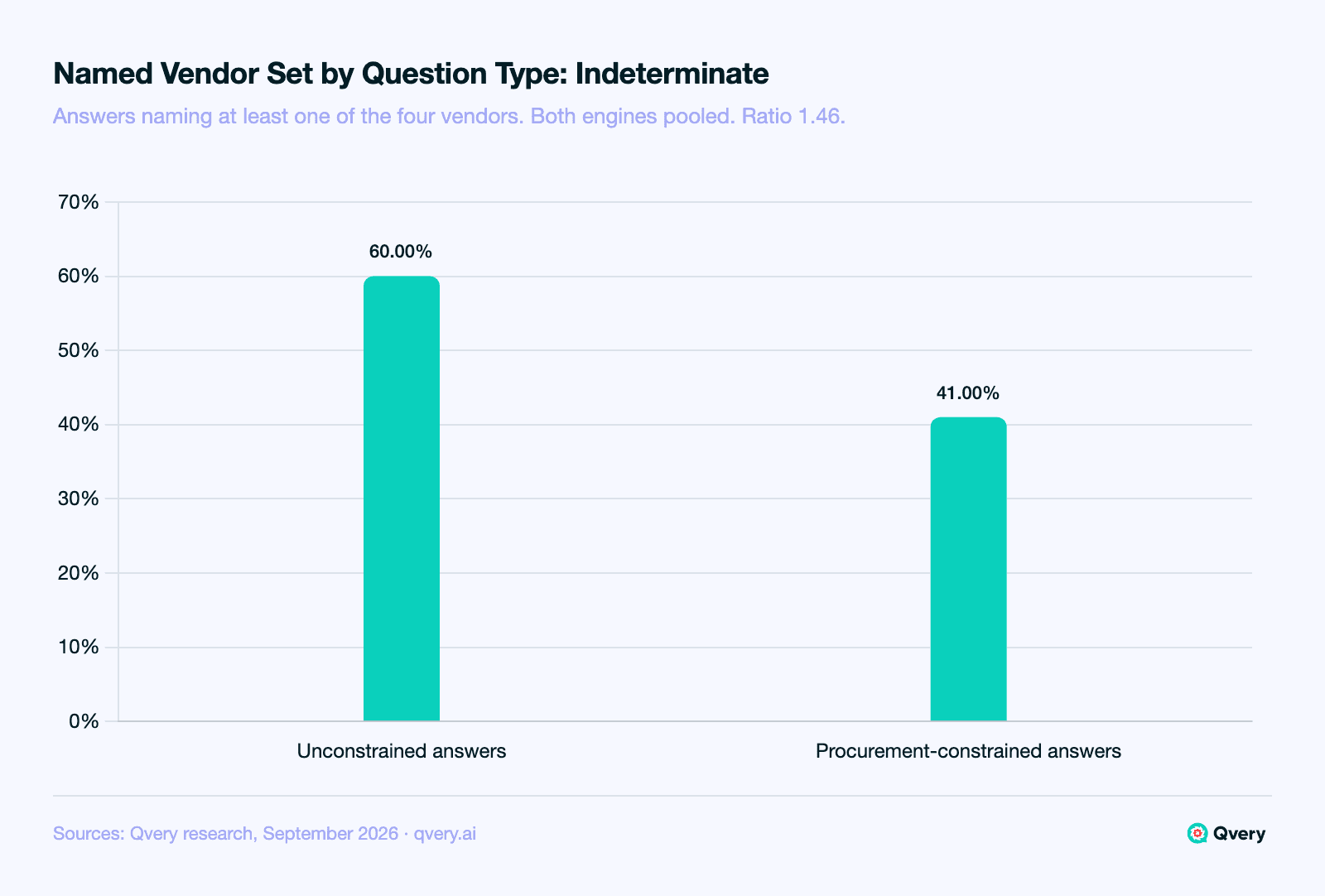
So this supports neither the direction we predicted, that a constraint would bring these names up more, nor the opposite. The name extraction behind these figures passed its reliability check: a blind hand-coded sample scored 0.865 against a 0.85 bar.
For your planning, that means tracking the four names on both kinds of question, rather than planning around a constraint changing how often they appear.
Brand Sites Are Cited Alike on Both Kinds of Question
A domain labelled brand-owned, a vendor's own site, was cited in 92.00% of unconstrained answers and 88.00% of constrained answers, each a share of all the valid answers of that type, both engines pooled. One answer in each could not be resolved for this question.
The ratio is 1.05. Counting that unresolved answer each way keeps it between 1.04 and 1.05, inside the band we call equivalent, so the two halves are answered alike on this rate.
Equal rates are not equal rosters. The tails above still stand, so do not merge them because this rate came out alike.
That brand sites carry most crypto answers is covered elsewhere: see how the answer is built from company pages and the crypto marketer's audit, which also covers how the two engines differ.
Track Each Buying Question Twice in Qvery
Building your roster of buying questions and tracking it daily is covered in measuring a crypto brand's AI visibility. What this post adds is the pairing.
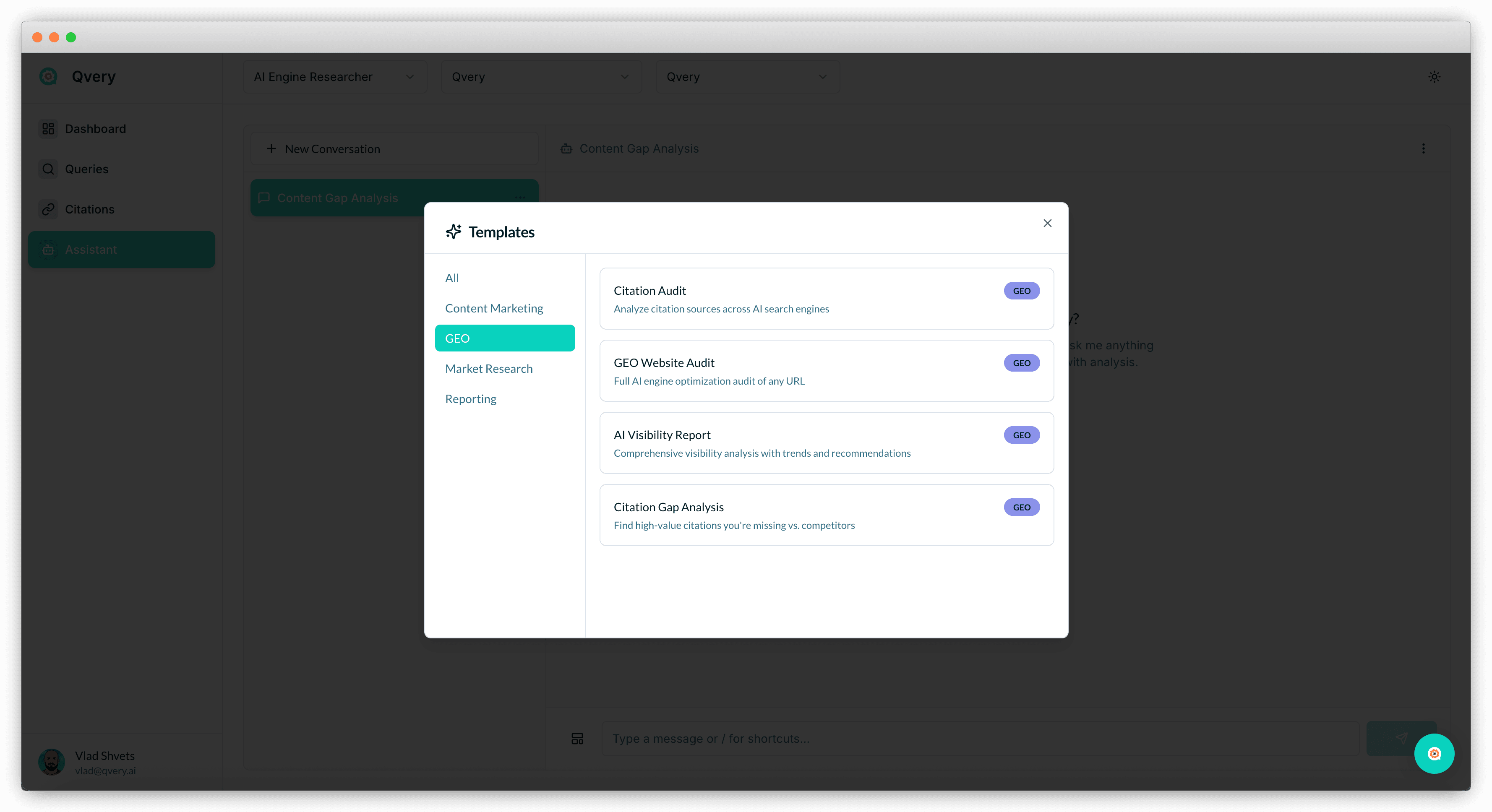
Enter each buying question twice: once plain, and once with the constraint your buyers use. You add and edit those queries through Qvery Assistant.
Qvery tracks visibility, share of voice and average rank on both versions daily across ChatGPT and Google AI Mode, in 200+ countries.
Every citation is tied to the query and engine that produced it, so you can see which core and tail domains your own questions cite, and where your brand appears.
To ask instead of filter, open Qvery Assistant in the app and ask about your own visibility, share of voice or citations in plain language.
The audit shows which domains are cited and where your brand appears, not why.
Start a free 7-day trial of Qvery, no credit card required, and enter your first paired buying questions today.
What This Data Cannot Settle
One paired set of questions. Institutional buying questions on ChatGPT and Google AI Mode in September 2026, nothing wider.
Co-occurrence and names only. No recommendation status, no vendor ranking, and no cause.
No engine claim. No engine comparison is made, and no Google AI Mode figure for a single question type prints, because each rests on too few answers; Google AI Mode's answers still count inside every pooled figure.
ChatGPT-weighted. Pooled figures carry three ChatGPT answers for every two from Google AI Mode.
A little unlabelled residue. A few cited domains carry no brand-owned label, which leaves one answer per question type unresolved for the brand-site rate; it cannot move that verdict.
No earlier figures are pooled or compared.
Keep One Core and a Tail for Each Kind of Question
Keep one shared audit core and a tail for each kind of buying question. Do not merge the tails because the brand-site rate came out alike, and do not plan on a procurement constraint changing whether the four registered names appear.
If you sell custody, compliance or staking infrastructure, your buyers rarely ask an AI engine a bare question. They ask for a custodian that works under a specific regulator, a staking provider with a particular licence, a qualified custody setup for a fund in their jurisdiction.
Sometimes they ask without the constraint, too. The practical question for your team is whether those two kinds of question draw on the same sources, or whether each needs its own citation audit.
So we asked ChatGPT and Google AI Mode paired institutional buying questions in September 2026, each need once plainly and once with a procurement constraint, and recorded the domains the answers cited and the vendors they named.
Three answers were possible: one audit list serves both, a shared core with a separate tail for each, or two separate lists. The short version: a shared core with distinct tails.
The unconstrained list covered 62.81% of the constrained answers that cited any source, and the constrained list covered 67.17% of the unconstrained answers that cited any source.
That audit advice is our judgment from what appeared together. Throughout, a vendor counts as named when the answer names it, which is not the same as recommending it, and nothing here says why a domain or a name appears.
One Audit Core, Two Tails
For each kind of question we built a list of domains, adding at each step the domain that covered the most answers not yet covered, until the list reached 80% of the answers that cited any source.
Unconstrained questions, 17 domains: coinbase.com, sec.gov, bitgo.com, fireblocks.com, chainalysis.com, bitcoinfoundation.org, occ.gov, blockdaemon.com, lowenstein.com, talos.com, ethereum.org, interactivebrokers.com.au, nasdaq.com, aminagroup.com, docs.sumsub.com, kraken.com, safe.global.
Procurement-constrained questions, 19 domains: fireblocks.com, sec.gov, coinbase.com, chainalysis.com, occ.gov, ethereum.org, falconx.io, finra.org, lowenstein.com, acsa.com.au, esma.europa.eu, fca.org.uk, nexusmutual.io, securities-administrators.ca, bitgo.com, delcode.delaware.gov, everstake.com, ledgible.io, niceactimize.com.
Eight domains sit on both lists, and they are your shared core: bitgo.com, chainalysis.com, coinbase.com, ethereum.org, fireblocks.com, lowenstein.com, occ.gov and sec.gov.
The rest are the two tails, in each list's order:
Unconstrained only: bitcoinfoundation.org, blockdaemon.com, talos.com, interactivebrokers.com.au, nasdaq.com, aminagroup.com, docs.sumsub.com, kraken.com, safe.global.
Constrained only: falconx.io, finra.org, acsa.com.au, esma.europa.eu, fca.org.uk, nexusmutual.io, securities-administrators.ca, delcode.delaware.gov, everstake.com, ledgible.io, niceactimize.com.
Then we swapped the lists. The unconstrained list covered 62.81% of the constrained answers that cited any source, and the constrained list covered 67.17% of the unconstrained answers that cited any source.
The lower figure, 0.6281, clears our 0.60 bar for a shared core and misses the 0.80 bar for one list. So audit the core once, and keep a tail for each kind of question, checking each tail domain on the questions it belongs to.
The eight shared domains describe the overlap; they do not decide it. And the two kinds of question do not cite the same domains, so one list does not cover 80% of both.
For how to turn lists like these into a working audit, see the crypto marketer's audit.
Whether a Constraint Changes Which Vendors Get Named Is Not Settled
Before collecting, we fixed a set of four institutional vendors and hand-checked it: Anchorage, BitGo, Chainalysis and Fireblocks.
At least one of them was named in 60.00% of unconstrained answers and 41.00% of constrained answers, each a share of all the valid answers of that type, both engines pooled, with nothing unresolved. The ratio is 1.46, which sits in the band we set in advance as indeterminate.
So this supports neither the direction we predicted, that a constraint would bring these names up more, nor the opposite. The name extraction behind these figures passed its reliability check: a blind hand-coded sample scored 0.865 against a 0.85 bar.
For your planning, that means tracking the four names on both kinds of question, rather than planning around a constraint changing how often they appear.
Brand Sites Are Cited Alike on Both Kinds of Question
A domain labelled brand-owned, a vendor's own site, was cited in 92.00% of unconstrained answers and 88.00% of constrained answers, each a share of all the valid answers of that type, both engines pooled. One answer in each could not be resolved for this question.
The ratio is 1.05. Counting that unresolved answer each way keeps it between 1.04 and 1.05, inside the band we call equivalent, so the two halves are answered alike on this rate.
Equal rates are not equal rosters. The tails above still stand, so do not merge them because this rate came out alike.
That brand sites carry most crypto answers is covered elsewhere: see how the answer is built from company pages and the crypto marketer's audit, which also covers how the two engines differ.
Track Each Buying Question Twice in Qvery
Building your roster of buying questions and tracking it daily is covered in measuring a crypto brand's AI visibility. What this post adds is the pairing.
Enter each buying question twice: once plain, and once with the constraint your buyers use. You add and edit those queries through Qvery Assistant.
Qvery tracks visibility, share of voice and average rank on both versions daily across ChatGPT and Google AI Mode, in 200+ countries.
Every citation is tied to the query and engine that produced it, so you can see which core and tail domains your own questions cite, and where your brand appears.
To ask instead of filter, open Qvery Assistant in the app and ask about your own visibility, share of voice or citations in plain language.
The audit shows which domains are cited and where your brand appears, not why.
Start a free 7-day trial of Qvery, no credit card required, and enter your first paired buying questions today.
What This Data Cannot Settle
One paired set of questions. Institutional buying questions on ChatGPT and Google AI Mode in September 2026, nothing wider.
Co-occurrence and names only. No recommendation status, no vendor ranking, and no cause.
No engine claim. No engine comparison is made, and no Google AI Mode figure for a single question type prints, because each rests on too few answers; Google AI Mode's answers still count inside every pooled figure.
ChatGPT-weighted. Pooled figures carry three ChatGPT answers for every two from Google AI Mode.
A little unlabelled residue. A few cited domains carry no brand-owned label, which leaves one answer per question type unresolved for the brand-site rate; it cannot move that verdict.
No earlier figures are pooled or compared.
Keep One Core and a Tail for Each Kind of Question
Keep one shared audit core and a tail for each kind of buying question. Do not merge the tails because the brand-site rate came out alike, and do not plan on a procurement constraint changing whether the four registered names appear.
If you sell custody, compliance or staking infrastructure, your buyers rarely ask an AI engine a bare question. They ask for a custodian that works under a specific regulator, a staking provider with a particular licence, a qualified custody setup for a fund in their jurisdiction.
Sometimes they ask without the constraint, too. The practical question for your team is whether those two kinds of question draw on the same sources, or whether each needs its own citation audit.
So we asked ChatGPT and Google AI Mode paired institutional buying questions in September 2026, each need once plainly and once with a procurement constraint, and recorded the domains the answers cited and the vendors they named.
Three answers were possible: one audit list serves both, a shared core with a separate tail for each, or two separate lists. The short version: a shared core with distinct tails.
The unconstrained list covered 62.81% of the constrained answers that cited any source, and the constrained list covered 67.17% of the unconstrained answers that cited any source.
That audit advice is our judgment from what appeared together. Throughout, a vendor counts as named when the answer names it, which is not the same as recommending it, and nothing here says why a domain or a name appears.
One Audit Core, Two Tails
For each kind of question we built a list of domains, adding at each step the domain that covered the most answers not yet covered, until the list reached 80% of the answers that cited any source.
Unconstrained questions, 17 domains: coinbase.com, sec.gov, bitgo.com, fireblocks.com, chainalysis.com, bitcoinfoundation.org, occ.gov, blockdaemon.com, lowenstein.com, talos.com, ethereum.org, interactivebrokers.com.au, nasdaq.com, aminagroup.com, docs.sumsub.com, kraken.com, safe.global.
Procurement-constrained questions, 19 domains: fireblocks.com, sec.gov, coinbase.com, chainalysis.com, occ.gov, ethereum.org, falconx.io, finra.org, lowenstein.com, acsa.com.au, esma.europa.eu, fca.org.uk, nexusmutual.io, securities-administrators.ca, bitgo.com, delcode.delaware.gov, everstake.com, ledgible.io, niceactimize.com.
Eight domains sit on both lists, and they are your shared core: bitgo.com, chainalysis.com, coinbase.com, ethereum.org, fireblocks.com, lowenstein.com, occ.gov and sec.gov.
The rest are the two tails, in each list's order:
Unconstrained only: bitcoinfoundation.org, blockdaemon.com, talos.com, interactivebrokers.com.au, nasdaq.com, aminagroup.com, docs.sumsub.com, kraken.com, safe.global.
Constrained only: falconx.io, finra.org, acsa.com.au, esma.europa.eu, fca.org.uk, nexusmutual.io, securities-administrators.ca, delcode.delaware.gov, everstake.com, ledgible.io, niceactimize.com.
Then we swapped the lists. The unconstrained list covered 62.81% of the constrained answers that cited any source, and the constrained list covered 67.17% of the unconstrained answers that cited any source.
The lower figure, 0.6281, clears our 0.60 bar for a shared core and misses the 0.80 bar for one list. So audit the core once, and keep a tail for each kind of question, checking each tail domain on the questions it belongs to.
The eight shared domains describe the overlap; they do not decide it. And the two kinds of question do not cite the same domains, so one list does not cover 80% of both.
For how to turn lists like these into a working audit, see the crypto marketer's audit.
Whether a Constraint Changes Which Vendors Get Named Is Not Settled
Before collecting, we fixed a set of four institutional vendors and hand-checked it: Anchorage, BitGo, Chainalysis and Fireblocks.
At least one of them was named in 60.00% of unconstrained answers and 41.00% of constrained answers, each a share of all the valid answers of that type, both engines pooled, with nothing unresolved. The ratio is 1.46, which sits in the band we set in advance as indeterminate.
So this supports neither the direction we predicted, that a constraint would bring these names up more, nor the opposite. The name extraction behind these figures passed its reliability check: a blind hand-coded sample scored 0.865 against a 0.85 bar.
For your planning, that means tracking the four names on both kinds of question, rather than planning around a constraint changing how often they appear.
Brand Sites Are Cited Alike on Both Kinds of Question
A domain labelled brand-owned, a vendor's own site, was cited in 92.00% of unconstrained answers and 88.00% of constrained answers, each a share of all the valid answers of that type, both engines pooled. One answer in each could not be resolved for this question.
The ratio is 1.05. Counting that unresolved answer each way keeps it between 1.04 and 1.05, inside the band we call equivalent, so the two halves are answered alike on this rate.
Equal rates are not equal rosters. The tails above still stand, so do not merge them because this rate came out alike.
That brand sites carry most crypto answers is covered elsewhere: see how the answer is built from company pages and the crypto marketer's audit, which also covers how the two engines differ.
Track Each Buying Question Twice in Qvery
Building your roster of buying questions and tracking it daily is covered in measuring a crypto brand's AI visibility. What this post adds is the pairing.
Enter each buying question twice: once plain, and once with the constraint your buyers use. You add and edit those queries through Qvery Assistant.
Qvery tracks visibility, share of voice and average rank on both versions daily across ChatGPT and Google AI Mode, in 200+ countries.
Every citation is tied to the query and engine that produced it, so you can see which core and tail domains your own questions cite, and where your brand appears.
To ask instead of filter, open Qvery Assistant in the app and ask about your own visibility, share of voice or citations in plain language.
The audit shows which domains are cited and where your brand appears, not why.
Start a free 7-day trial of Qvery, no credit card required, and enter your first paired buying questions today.
What This Data Cannot Settle
One paired set of questions. Institutional buying questions on ChatGPT and Google AI Mode in September 2026, nothing wider.
Co-occurrence and names only. No recommendation status, no vendor ranking, and no cause.
No engine claim. No engine comparison is made, and no Google AI Mode figure for a single question type prints, because each rests on too few answers; Google AI Mode's answers still count inside every pooled figure.
ChatGPT-weighted. Pooled figures carry three ChatGPT answers for every two from Google AI Mode.
A little unlabelled residue. A few cited domains carry no brand-owned label, which leaves one answer per question type unresolved for the brand-site rate; it cannot move that verdict.
No earlier figures are pooled or compared.
Keep One Core and a Tail for Each Kind of Question
Keep one shared audit core and a tail for each kind of buying question. Do not merge the tails because the brand-site rate came out alike, and do not plan on a procurement constraint changing whether the four registered names appear.
If you sell custody, compliance or staking infrastructure, your buyers rarely ask an AI engine a bare question. They ask for a custodian that works under a specific regulator, a staking provider with a particular licence, a qualified custody setup for a fund in their jurisdiction.
Sometimes they ask without the constraint, too. The practical question for your team is whether those two kinds of question draw on the same sources, or whether each needs its own citation audit.
So we asked ChatGPT and Google AI Mode paired institutional buying questions in September 2026, each need once plainly and once with a procurement constraint, and recorded the domains the answers cited and the vendors they named.
Three answers were possible: one audit list serves both, a shared core with a separate tail for each, or two separate lists. The short version: a shared core with distinct tails.
The unconstrained list covered 62.81% of the constrained answers that cited any source, and the constrained list covered 67.17% of the unconstrained answers that cited any source.
That audit advice is our judgment from what appeared together. Throughout, a vendor counts as named when the answer names it, which is not the same as recommending it, and nothing here says why a domain or a name appears.
One Audit Core, Two Tails
For each kind of question we built a list of domains, adding at each step the domain that covered the most answers not yet covered, until the list reached 80% of the answers that cited any source.
Unconstrained questions, 17 domains: coinbase.com, sec.gov, bitgo.com, fireblocks.com, chainalysis.com, bitcoinfoundation.org, occ.gov, blockdaemon.com, lowenstein.com, talos.com, ethereum.org, interactivebrokers.com.au, nasdaq.com, aminagroup.com, docs.sumsub.com, kraken.com, safe.global.
Procurement-constrained questions, 19 domains: fireblocks.com, sec.gov, coinbase.com, chainalysis.com, occ.gov, ethereum.org, falconx.io, finra.org, lowenstein.com, acsa.com.au, esma.europa.eu, fca.org.uk, nexusmutual.io, securities-administrators.ca, bitgo.com, delcode.delaware.gov, everstake.com, ledgible.io, niceactimize.com.
Eight domains sit on both lists, and they are your shared core: bitgo.com, chainalysis.com, coinbase.com, ethereum.org, fireblocks.com, lowenstein.com, occ.gov and sec.gov.
The rest are the two tails, in each list's order:
Unconstrained only: bitcoinfoundation.org, blockdaemon.com, talos.com, interactivebrokers.com.au, nasdaq.com, aminagroup.com, docs.sumsub.com, kraken.com, safe.global.
Constrained only: falconx.io, finra.org, acsa.com.au, esma.europa.eu, fca.org.uk, nexusmutual.io, securities-administrators.ca, delcode.delaware.gov, everstake.com, ledgible.io, niceactimize.com.
Then we swapped the lists. The unconstrained list covered 62.81% of the constrained answers that cited any source, and the constrained list covered 67.17% of the unconstrained answers that cited any source.
The lower figure, 0.6281, clears our 0.60 bar for a shared core and misses the 0.80 bar for one list. So audit the core once, and keep a tail for each kind of question, checking each tail domain on the questions it belongs to.
The eight shared domains describe the overlap; they do not decide it. And the two kinds of question do not cite the same domains, so one list does not cover 80% of both.
For how to turn lists like these into a working audit, see the crypto marketer's audit.
Whether a Constraint Changes Which Vendors Get Named Is Not Settled
Before collecting, we fixed a set of four institutional vendors and hand-checked it: Anchorage, BitGo, Chainalysis and Fireblocks.
At least one of them was named in 60.00% of unconstrained answers and 41.00% of constrained answers, each a share of all the valid answers of that type, both engines pooled, with nothing unresolved. The ratio is 1.46, which sits in the band we set in advance as indeterminate.
So this supports neither the direction we predicted, that a constraint would bring these names up more, nor the opposite. The name extraction behind these figures passed its reliability check: a blind hand-coded sample scored 0.865 against a 0.85 bar.
For your planning, that means tracking the four names on both kinds of question, rather than planning around a constraint changing how often they appear.
Brand Sites Are Cited Alike on Both Kinds of Question
A domain labelled brand-owned, a vendor's own site, was cited in 92.00% of unconstrained answers and 88.00% of constrained answers, each a share of all the valid answers of that type, both engines pooled. One answer in each could not be resolved for this question.
The ratio is 1.05. Counting that unresolved answer each way keeps it between 1.04 and 1.05, inside the band we call equivalent, so the two halves are answered alike on this rate.
Equal rates are not equal rosters. The tails above still stand, so do not merge them because this rate came out alike.
That brand sites carry most crypto answers is covered elsewhere: see how the answer is built from company pages and the crypto marketer's audit, which also covers how the two engines differ.
Track Each Buying Question Twice in Qvery
Building your roster of buying questions and tracking it daily is covered in measuring a crypto brand's AI visibility. What this post adds is the pairing.
Enter each buying question twice: once plain, and once with the constraint your buyers use. You add and edit those queries through Qvery Assistant.
Qvery tracks visibility, share of voice and average rank on both versions daily across ChatGPT and Google AI Mode, in 200+ countries.
Every citation is tied to the query and engine that produced it, so you can see which core and tail domains your own questions cite, and where your brand appears.
To ask instead of filter, open Qvery Assistant in the app and ask about your own visibility, share of voice or citations in plain language.
The audit shows which domains are cited and where your brand appears, not why.
Start a free 7-day trial of Qvery, no credit card required, and enter your first paired buying questions today.
What This Data Cannot Settle
One paired set of questions. Institutional buying questions on ChatGPT and Google AI Mode in September 2026, nothing wider.
Co-occurrence and names only. No recommendation status, no vendor ranking, and no cause.
No engine claim. No engine comparison is made, and no Google AI Mode figure for a single question type prints, because each rests on too few answers; Google AI Mode's answers still count inside every pooled figure.
ChatGPT-weighted. Pooled figures carry three ChatGPT answers for every two from Google AI Mode.
A little unlabelled residue. A few cited domains carry no brand-owned label, which leaves one answer per question type unresolved for the brand-site rate; it cannot move that verdict.
No earlier figures are pooled or compared.
Keep One Core and a Tail for Each Kind of Question
Keep one shared audit core and a tail for each kind of buying question. Do not merge the tails because the brand-site rate came out alike, and do not plan on a procurement constraint changing whether the four registered names appear.

© 2026 Qvery AI OÜ