By
Vlad Shvets
How to Choose GEO Software
There is a lot of chatter that GEO software is all the same. It is not. Here is how to choose, from engines and monitoring method to whether the tool acts and who is behind it.
There is a lot of chatter that GEO software is all the same. It is not. Here is how to choose, from engines and monitoring method to whether the tool acts and who is behind it.
There is a lot of chatter that GEO software is all the same. It is not. Here is how to choose, from engines and monitoring method to whether the tool acts and who is behind it.
Sit through three GEO software demos in a week and you will hear three versions of the same sentence: we track your brand across AI engines.
The dashboards look identical, the pitches blur together, and you walk away assuming this is a commodity where you just pick the cheapest logo.
That assumption is wrong, and it is an expensive thing to be wrong about. Choosing GEO software by feature checklist is like choosing a surgeon by who has the shiniest waiting room.
The tools in this category differ in ways that decide whether you grow your share of voice or just watch a number every Monday. Some of those differences are technical. One of them is human. Here is how to tell them apart before you sign anything.
GEO Software Is Not a Commodity
Most listicles rank these tools as if they were interchangeable, like five brands of the same bottled water. They are not. They differ on what they measure, how they measure it, and whether they do anything with what they find. Treating them as identical is how teams end up paying for a dashboard nobody opens.
Start from why this is even a separate category. AI search is not a skin on top of Google. Across 922 queries on ChatGPT and Google AI Mode, the overlap between AI citations and Google's organic top 10 was just 13.9%.
Even ranking number one in Google gives you only a 48.8% chance of being cited by an AI engine for the same query. A coin flip.
So a tool that bolts AI tracking onto a Google-era model is solving a different problem than the one you have. The question is not "which tool has the most features." It is "which tool is built for how AI search works, and what will it do about my gaps." Five criteria sort the field.
Start With the Engines That Matter
Every vendor advertises a count of engines, and the numbers keep climbing. Counting engines on a pricing page is like judging a buffet by the number of trays. The question is whether anything on them is worth eating.
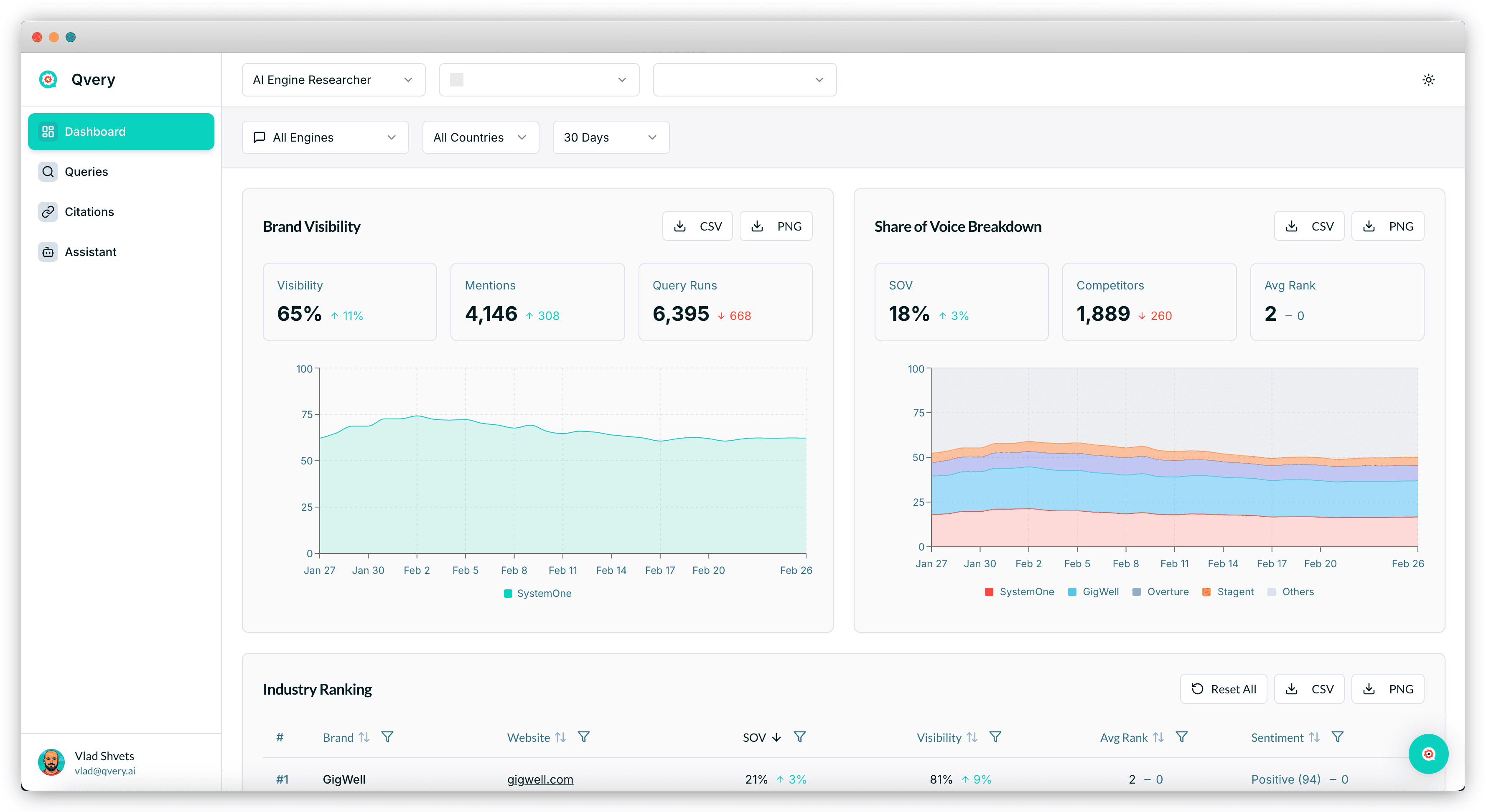
Your buyers are using ChatGPT and Google AI Mode, and your visibility is a weighted average across both. A tool that covers 10 engines shallowly is worth less than one that covers the two that matter deeply, every day, in the countries you sell in. Depth means the tool runs enough queries to be statistically honest rather than sampling a handful of prompts and calling it a trend.
When you evaluate coverage, ask three things:
Are both ChatGPT and Google AI Mode tracked.
How often does the data refresh
How many countries does it run in.
If it refreshes daily and runs in the countries you sell in, that is the bar. Weekly snapshots from a single market will quietly mislead you about a channel that shifts week to week, and if you sell in 30 markets, a single-country number is close to useless.
Ask How the Tool Checks
Here is a question almost no buyer asks and every vendor should answer: how does the tool query the engines? Some run real browser sessions, the way a person would. Others call the model through an API. The two approaches return different answers to the same prompt, because an API response and a logged-in browser response are not the same surface.
The gap is not academic. Ask the same question through a logged-in browser and through the API and you can get different brands named, different sources cited, even a different count of citations.
A tool measuring one way and a competitor measuring the other can hand you two different realities for the same query. (If a salesperson cannot tell you which method their tool uses, that is its own kind of answer.)
Neither method is automatically right, but the difference is real and it shapes every number you will report upward. Know which one you are buying before you compare scores across vendors, or you will be comparing apples to a slightly different apple.
Decide If You Want a Tracker or an Agent
This is the criterion that splits the category in half. Most GEO software tracks. It shows you a number, a chart, a list of citations, and then it hands the work back to you. That is genuinely useful, and for some teams it is enough. But measurement is not the goal; growth is.
I have watched this wall hit every team that buys one of these tools. The data is fine, the dashboard is pretty, and then turning any of it into next week's plan is still entirely on you. The honest version of the value shows up only when the tool helps you do something about what it found.
A dashboard tells you that you are losing. An agent helps you stop losing, for the same price.
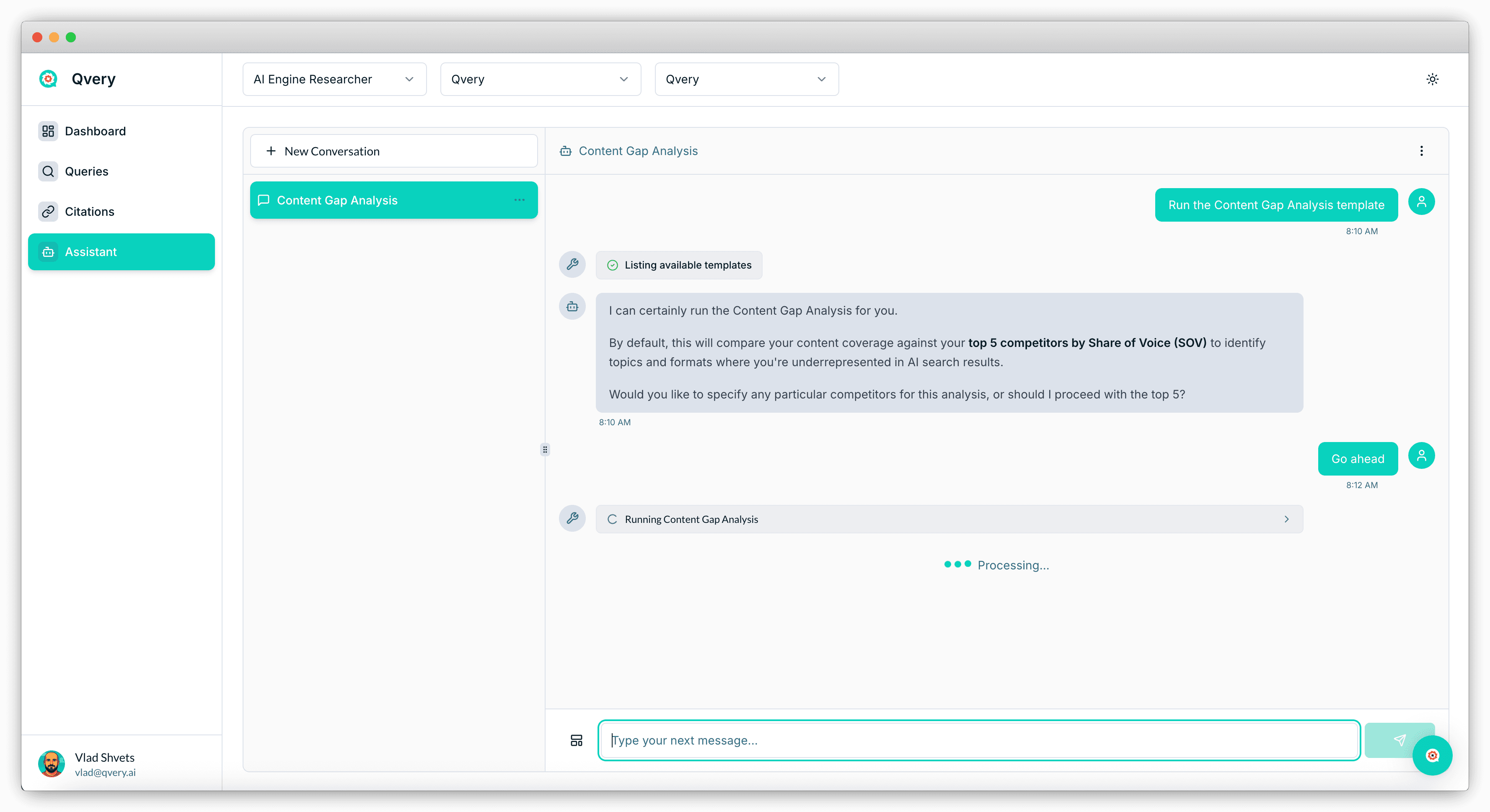
That is the line between a tracker and an agent. A tracker reports the gap. An agent helps close it: it finds the third-party sources feeding your competitors' mentions, drafts the outreach, finds the Reddit and forum threads where your brand belongs, and rewrites the passages that keep getting skipped.
The difference shows up the moment you act. A tracker tells you a competitor owns a high-intent query, and that the answer it wins cites three industry roundups you are missing from. That is useful, but now you have a research project on your hands: find the roundups, find the editors, write the pitches, track the replies. An agent takes the same finding and hands back the target list, a drafted pitch for each roundup, and the forum threads already debating the topic, so you can start sending the same week. The measurement and the work live in one place, which is how teams close the loop.
When you are choosing, ask one thing: what happens after the tool finds a problem. Some of the people using Qvery describe the shift:
"Having this type of data changes your content writing a lot and it becomes easier to rank" (r/copywriting)
"I used Qvery to get data and to track AI mentions across relevant queries and I made it show what sources it was drawing from. I saw that I was at about 10% mention rate, which is too low against my competitors" (r/StartupsHelpStartups)
Look at Who Is Behind the Software
This criterion gets ignored, and it might be the one that matters most. GEO is new. Nobody has a decade of best practices, the engines change every few weeks, and the difference between a vendor who has done this work and one who read about it shows up fast once you are a customer.
So ask who built the tool. Are they practitioners who have run AI engine optimization on real projects, or did they ship a dashboard because the category was hot? When something breaks or the engines shift, will a real person answer you, or will you file a ticket into a queue of thousands and become a row in a churn report?
This is where being a smaller company helps you. Qvery was founded by AI engine optimization practitioners who do this work on real projects. We are a small team, and that is deliberate. We are not a venture-funded vendor managing tens of thousands of logos, where your account is a line item someone reviews once a quarter.
That size changes the relationship. We take real pride in the brands we work with, which means we are more responsive, easier to reach, and genuinely there with you through the messy, fast-moving reality of growing in AI search. When the engines change next month, and they will, you want the people who built your tool to be the ones picking up the phone.
Match the Price to Your Stage
Pricing in this category runs from $29 a month to enterprise contracts in the tens of thousands, and the right number depends entirely on where you are. A solo founder taking a first honest look does not need a 500-prompt enterprise plan. And if you are a global brand running AEO across regions, the opposite problem bites: you will blow past a starter tier in a month.
So map the tier to the work. The cheapest plan that covers the engines, the query volume, and the markets you sell in is the right one. Everything above that is you subsidizing features for someone else's use case. Look at the real levers: how many queries you can track, how many brands or markets, whether daily runs are included, and whether support is a shared inbox or a real channel.
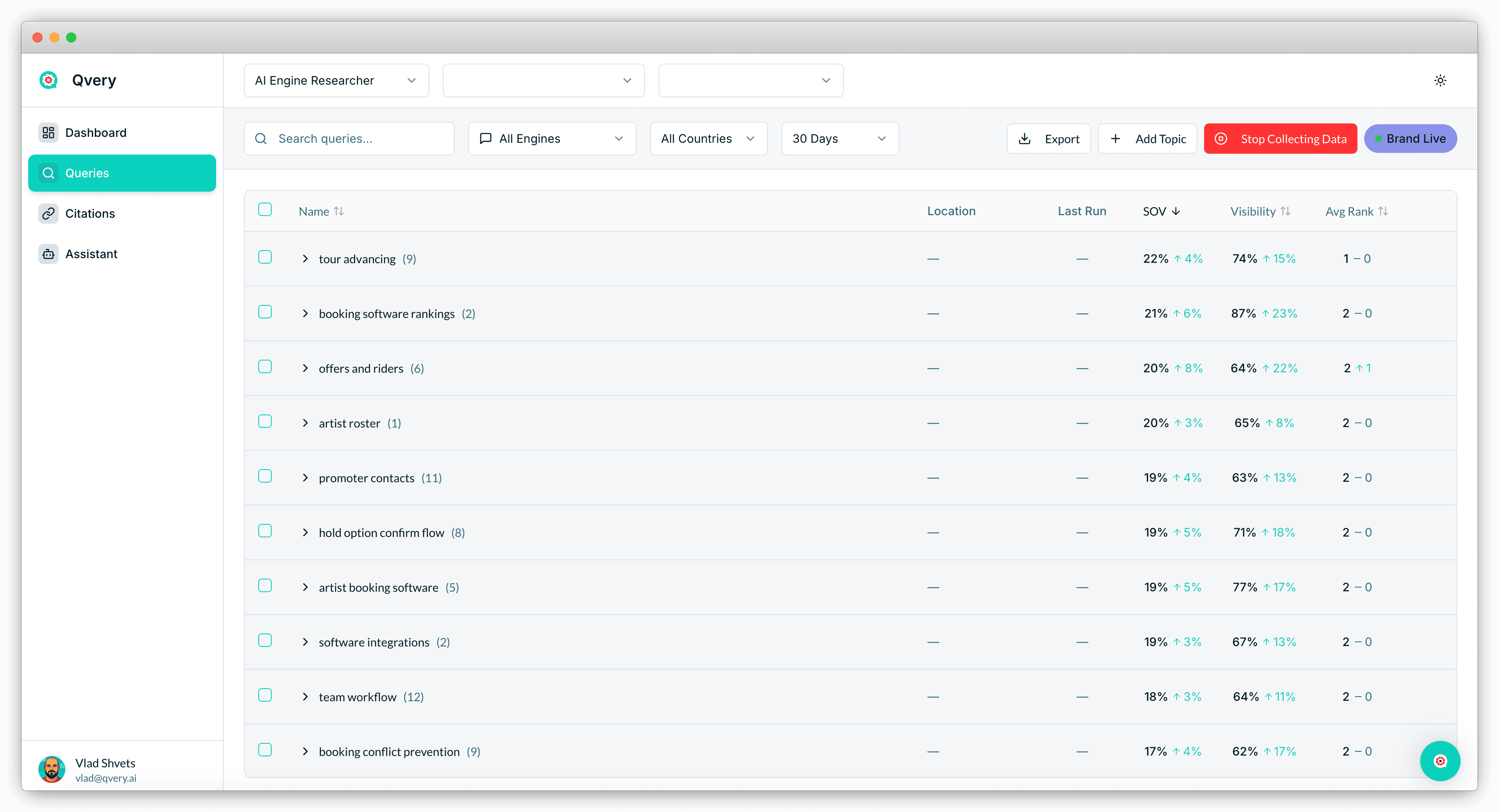
As a rough guide, a solo founder or early team is well served by an entry plan in the $29 to $99 range, a growing brand usually lands in the low hundreds per month, and only teams running AEO across many markets and product lines need the enterprise tier. Paying for engines and seats you will never touch is the most common way teams overspend here, so buy for the stage you are in now and upgrade when you outgrow it.
Where Qvery Fits
Qvery was built to answer all five of these questions in one place. The AI Engine Researcher runs daily across ChatGPT and Google AI Mode in 200+ countries, so coverage and freshness are handled by default. You sign up and see your first data in about 15 minutes, without a sales call.
From there, the work happens through agents instead of landing on your desk. Open the Qvery Assistant and ask for what you need in plain language. Want a content gap analysis? One prompt. Need an llms.txt file for your site? One prompt.
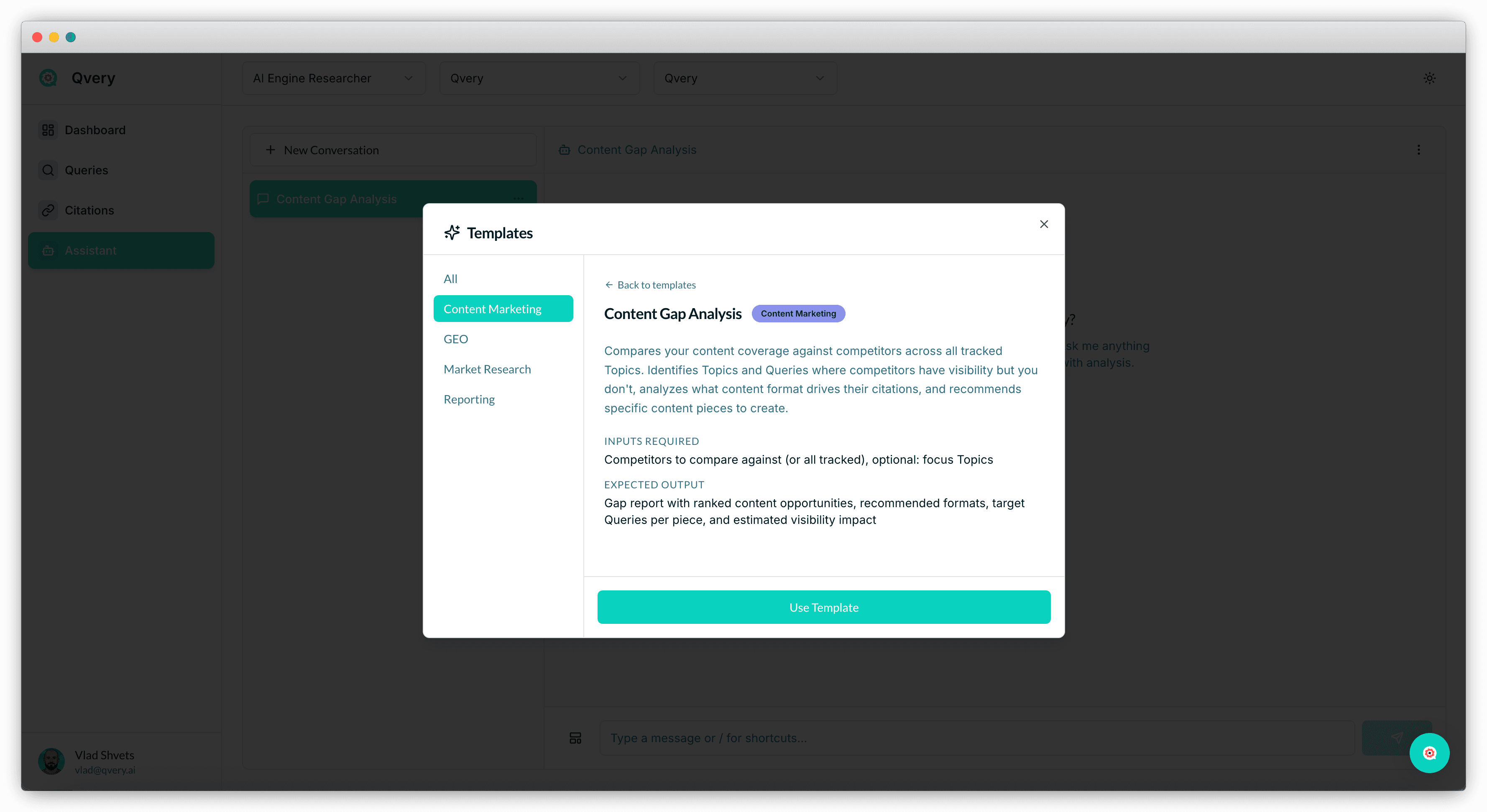
That structure works for two kinds of people at once. A non-technical marketer gets answers without learning a query language. An experienced practitioner gets templates, shortcuts, and multi-step workflows that replace an afternoon of manual work. Same product, different depth depending on who is driving.
Choosing GEO software is really choosing who you want next to you while a brand-new channel takes shape. Pick the engines that matter, ask how the tool checks and whether it acts, and look hard at who is on the other end.
If you want to see how the major tools stack up first, start with our review of the best GEO software tools, then come back and pick the one you would go on this journey with.
Sit through three GEO software demos in a week and you will hear three versions of the same sentence: we track your brand across AI engines.
The dashboards look identical, the pitches blur together, and you walk away assuming this is a commodity where you just pick the cheapest logo.
That assumption is wrong, and it is an expensive thing to be wrong about. Choosing GEO software by feature checklist is like choosing a surgeon by who has the shiniest waiting room.
The tools in this category differ in ways that decide whether you grow your share of voice or just watch a number every Monday. Some of those differences are technical. One of them is human. Here is how to tell them apart before you sign anything.
GEO Software Is Not a Commodity
Most listicles rank these tools as if they were interchangeable, like five brands of the same bottled water. They are not. They differ on what they measure, how they measure it, and whether they do anything with what they find. Treating them as identical is how teams end up paying for a dashboard nobody opens.
Start from why this is even a separate category. AI search is not a skin on top of Google. Across 922 queries on ChatGPT and Google AI Mode, the overlap between AI citations and Google's organic top 10 was just 13.9%.
Even ranking number one in Google gives you only a 48.8% chance of being cited by an AI engine for the same query. A coin flip.
So a tool that bolts AI tracking onto a Google-era model is solving a different problem than the one you have. The question is not "which tool has the most features." It is "which tool is built for how AI search works, and what will it do about my gaps." Five criteria sort the field.
Start With the Engines That Matter
Every vendor advertises a count of engines, and the numbers keep climbing. Counting engines on a pricing page is like judging a buffet by the number of trays. The question is whether anything on them is worth eating.
Your buyers are using ChatGPT and Google AI Mode, and your visibility is a weighted average across both. A tool that covers 10 engines shallowly is worth less than one that covers the two that matter deeply, every day, in the countries you sell in. Depth means the tool runs enough queries to be statistically honest rather than sampling a handful of prompts and calling it a trend.
When you evaluate coverage, ask three things:
Are both ChatGPT and Google AI Mode tracked.
How often does the data refresh
How many countries does it run in.
If it refreshes daily and runs in the countries you sell in, that is the bar. Weekly snapshots from a single market will quietly mislead you about a channel that shifts week to week, and if you sell in 30 markets, a single-country number is close to useless.
Ask How the Tool Checks
Here is a question almost no buyer asks and every vendor should answer: how does the tool query the engines? Some run real browser sessions, the way a person would. Others call the model through an API. The two approaches return different answers to the same prompt, because an API response and a logged-in browser response are not the same surface.
The gap is not academic. Ask the same question through a logged-in browser and through the API and you can get different brands named, different sources cited, even a different count of citations.
A tool measuring one way and a competitor measuring the other can hand you two different realities for the same query. (If a salesperson cannot tell you which method their tool uses, that is its own kind of answer.)
Neither method is automatically right, but the difference is real and it shapes every number you will report upward. Know which one you are buying before you compare scores across vendors, or you will be comparing apples to a slightly different apple.
Decide If You Want a Tracker or an Agent
This is the criterion that splits the category in half. Most GEO software tracks. It shows you a number, a chart, a list of citations, and then it hands the work back to you. That is genuinely useful, and for some teams it is enough. But measurement is not the goal; growth is.
I have watched this wall hit every team that buys one of these tools. The data is fine, the dashboard is pretty, and then turning any of it into next week's plan is still entirely on you. The honest version of the value shows up only when the tool helps you do something about what it found.
A dashboard tells you that you are losing. An agent helps you stop losing, for the same price.
That is the line between a tracker and an agent. A tracker reports the gap. An agent helps close it: it finds the third-party sources feeding your competitors' mentions, drafts the outreach, finds the Reddit and forum threads where your brand belongs, and rewrites the passages that keep getting skipped.
The difference shows up the moment you act. A tracker tells you a competitor owns a high-intent query, and that the answer it wins cites three industry roundups you are missing from. That is useful, but now you have a research project on your hands: find the roundups, find the editors, write the pitches, track the replies. An agent takes the same finding and hands back the target list, a drafted pitch for each roundup, and the forum threads already debating the topic, so you can start sending the same week. The measurement and the work live in one place, which is how teams close the loop.
When you are choosing, ask one thing: what happens after the tool finds a problem. Some of the people using Qvery describe the shift:
"Having this type of data changes your content writing a lot and it becomes easier to rank" (r/copywriting)
"I used Qvery to get data and to track AI mentions across relevant queries and I made it show what sources it was drawing from. I saw that I was at about 10% mention rate, which is too low against my competitors" (r/StartupsHelpStartups)
Look at Who Is Behind the Software
This criterion gets ignored, and it might be the one that matters most. GEO is new. Nobody has a decade of best practices, the engines change every few weeks, and the difference between a vendor who has done this work and one who read about it shows up fast once you are a customer.
So ask who built the tool. Are they practitioners who have run AI engine optimization on real projects, or did they ship a dashboard because the category was hot? When something breaks or the engines shift, will a real person answer you, or will you file a ticket into a queue of thousands and become a row in a churn report?
This is where being a smaller company helps you. Qvery was founded by AI engine optimization practitioners who do this work on real projects. We are a small team, and that is deliberate. We are not a venture-funded vendor managing tens of thousands of logos, where your account is a line item someone reviews once a quarter.
That size changes the relationship. We take real pride in the brands we work with, which means we are more responsive, easier to reach, and genuinely there with you through the messy, fast-moving reality of growing in AI search. When the engines change next month, and they will, you want the people who built your tool to be the ones picking up the phone.
Match the Price to Your Stage
Pricing in this category runs from $29 a month to enterprise contracts in the tens of thousands, and the right number depends entirely on where you are. A solo founder taking a first honest look does not need a 500-prompt enterprise plan. And if you are a global brand running AEO across regions, the opposite problem bites: you will blow past a starter tier in a month.
So map the tier to the work. The cheapest plan that covers the engines, the query volume, and the markets you sell in is the right one. Everything above that is you subsidizing features for someone else's use case. Look at the real levers: how many queries you can track, how many brands or markets, whether daily runs are included, and whether support is a shared inbox or a real channel.
As a rough guide, a solo founder or early team is well served by an entry plan in the $29 to $99 range, a growing brand usually lands in the low hundreds per month, and only teams running AEO across many markets and product lines need the enterprise tier. Paying for engines and seats you will never touch is the most common way teams overspend here, so buy for the stage you are in now and upgrade when you outgrow it.
Where Qvery Fits
Qvery was built to answer all five of these questions in one place. The AI Engine Researcher runs daily across ChatGPT and Google AI Mode in 200+ countries, so coverage and freshness are handled by default. You sign up and see your first data in about 15 minutes, without a sales call.
From there, the work happens through agents instead of landing on your desk. Open the Qvery Assistant and ask for what you need in plain language. Want a content gap analysis? One prompt. Need an llms.txt file for your site? One prompt.
That structure works for two kinds of people at once. A non-technical marketer gets answers without learning a query language. An experienced practitioner gets templates, shortcuts, and multi-step workflows that replace an afternoon of manual work. Same product, different depth depending on who is driving.
Choosing GEO software is really choosing who you want next to you while a brand-new channel takes shape. Pick the engines that matter, ask how the tool checks and whether it acts, and look hard at who is on the other end.
If you want to see how the major tools stack up first, start with our review of the best GEO software tools, then come back and pick the one you would go on this journey with.
Sit through three GEO software demos in a week and you will hear three versions of the same sentence: we track your brand across AI engines.
The dashboards look identical, the pitches blur together, and you walk away assuming this is a commodity where you just pick the cheapest logo.
That assumption is wrong, and it is an expensive thing to be wrong about. Choosing GEO software by feature checklist is like choosing a surgeon by who has the shiniest waiting room.
The tools in this category differ in ways that decide whether you grow your share of voice or just watch a number every Monday. Some of those differences are technical. One of them is human. Here is how to tell them apart before you sign anything.
GEO Software Is Not a Commodity
Most listicles rank these tools as if they were interchangeable, like five brands of the same bottled water. They are not. They differ on what they measure, how they measure it, and whether they do anything with what they find. Treating them as identical is how teams end up paying for a dashboard nobody opens.
Start from why this is even a separate category. AI search is not a skin on top of Google. Across 922 queries on ChatGPT and Google AI Mode, the overlap between AI citations and Google's organic top 10 was just 13.9%.
Even ranking number one in Google gives you only a 48.8% chance of being cited by an AI engine for the same query. A coin flip.
So a tool that bolts AI tracking onto a Google-era model is solving a different problem than the one you have. The question is not "which tool has the most features." It is "which tool is built for how AI search works, and what will it do about my gaps." Five criteria sort the field.
Start With the Engines That Matter
Every vendor advertises a count of engines, and the numbers keep climbing. Counting engines on a pricing page is like judging a buffet by the number of trays. The question is whether anything on them is worth eating.
Your buyers are using ChatGPT and Google AI Mode, and your visibility is a weighted average across both. A tool that covers 10 engines shallowly is worth less than one that covers the two that matter deeply, every day, in the countries you sell in. Depth means the tool runs enough queries to be statistically honest rather than sampling a handful of prompts and calling it a trend.
When you evaluate coverage, ask three things:
Are both ChatGPT and Google AI Mode tracked.
How often does the data refresh
How many countries does it run in.
If it refreshes daily and runs in the countries you sell in, that is the bar. Weekly snapshots from a single market will quietly mislead you about a channel that shifts week to week, and if you sell in 30 markets, a single-country number is close to useless.
Ask How the Tool Checks
Here is a question almost no buyer asks and every vendor should answer: how does the tool query the engines? Some run real browser sessions, the way a person would. Others call the model through an API. The two approaches return different answers to the same prompt, because an API response and a logged-in browser response are not the same surface.
The gap is not academic. Ask the same question through a logged-in browser and through the API and you can get different brands named, different sources cited, even a different count of citations.
A tool measuring one way and a competitor measuring the other can hand you two different realities for the same query. (If a salesperson cannot tell you which method their tool uses, that is its own kind of answer.)
Neither method is automatically right, but the difference is real and it shapes every number you will report upward. Know which one you are buying before you compare scores across vendors, or you will be comparing apples to a slightly different apple.
Decide If You Want a Tracker or an Agent
This is the criterion that splits the category in half. Most GEO software tracks. It shows you a number, a chart, a list of citations, and then it hands the work back to you. That is genuinely useful, and for some teams it is enough. But measurement is not the goal; growth is.
I have watched this wall hit every team that buys one of these tools. The data is fine, the dashboard is pretty, and then turning any of it into next week's plan is still entirely on you. The honest version of the value shows up only when the tool helps you do something about what it found.
A dashboard tells you that you are losing. An agent helps you stop losing, for the same price.
That is the line between a tracker and an agent. A tracker reports the gap. An agent helps close it: it finds the third-party sources feeding your competitors' mentions, drafts the outreach, finds the Reddit and forum threads where your brand belongs, and rewrites the passages that keep getting skipped.
The difference shows up the moment you act. A tracker tells you a competitor owns a high-intent query, and that the answer it wins cites three industry roundups you are missing from. That is useful, but now you have a research project on your hands: find the roundups, find the editors, write the pitches, track the replies. An agent takes the same finding and hands back the target list, a drafted pitch for each roundup, and the forum threads already debating the topic, so you can start sending the same week. The measurement and the work live in one place, which is how teams close the loop.
When you are choosing, ask one thing: what happens after the tool finds a problem. Some of the people using Qvery describe the shift:
"Having this type of data changes your content writing a lot and it becomes easier to rank" (r/copywriting)
"I used Qvery to get data and to track AI mentions across relevant queries and I made it show what sources it was drawing from. I saw that I was at about 10% mention rate, which is too low against my competitors" (r/StartupsHelpStartups)
Look at Who Is Behind the Software
This criterion gets ignored, and it might be the one that matters most. GEO is new. Nobody has a decade of best practices, the engines change every few weeks, and the difference between a vendor who has done this work and one who read about it shows up fast once you are a customer.
So ask who built the tool. Are they practitioners who have run AI engine optimization on real projects, or did they ship a dashboard because the category was hot? When something breaks or the engines shift, will a real person answer you, or will you file a ticket into a queue of thousands and become a row in a churn report?
This is where being a smaller company helps you. Qvery was founded by AI engine optimization practitioners who do this work on real projects. We are a small team, and that is deliberate. We are not a venture-funded vendor managing tens of thousands of logos, where your account is a line item someone reviews once a quarter.
That size changes the relationship. We take real pride in the brands we work with, which means we are more responsive, easier to reach, and genuinely there with you through the messy, fast-moving reality of growing in AI search. When the engines change next month, and they will, you want the people who built your tool to be the ones picking up the phone.
Match the Price to Your Stage
Pricing in this category runs from $29 a month to enterprise contracts in the tens of thousands, and the right number depends entirely on where you are. A solo founder taking a first honest look does not need a 500-prompt enterprise plan. And if you are a global brand running AEO across regions, the opposite problem bites: you will blow past a starter tier in a month.
So map the tier to the work. The cheapest plan that covers the engines, the query volume, and the markets you sell in is the right one. Everything above that is you subsidizing features for someone else's use case. Look at the real levers: how many queries you can track, how many brands or markets, whether daily runs are included, and whether support is a shared inbox or a real channel.
As a rough guide, a solo founder or early team is well served by an entry plan in the $29 to $99 range, a growing brand usually lands in the low hundreds per month, and only teams running AEO across many markets and product lines need the enterprise tier. Paying for engines and seats you will never touch is the most common way teams overspend here, so buy for the stage you are in now and upgrade when you outgrow it.
Where Qvery Fits
Qvery was built to answer all five of these questions in one place. The AI Engine Researcher runs daily across ChatGPT and Google AI Mode in 200+ countries, so coverage and freshness are handled by default. You sign up and see your first data in about 15 minutes, without a sales call.
From there, the work happens through agents instead of landing on your desk. Open the Qvery Assistant and ask for what you need in plain language. Want a content gap analysis? One prompt. Need an llms.txt file for your site? One prompt.
That structure works for two kinds of people at once. A non-technical marketer gets answers without learning a query language. An experienced practitioner gets templates, shortcuts, and multi-step workflows that replace an afternoon of manual work. Same product, different depth depending on who is driving.
Choosing GEO software is really choosing who you want next to you while a brand-new channel takes shape. Pick the engines that matter, ask how the tool checks and whether it acts, and look hard at who is on the other end.
If you want to see how the major tools stack up first, start with our review of the best GEO software tools, then come back and pick the one you would go on this journey with.
Sit through three GEO software demos in a week and you will hear three versions of the same sentence: we track your brand across AI engines.
The dashboards look identical, the pitches blur together, and you walk away assuming this is a commodity where you just pick the cheapest logo.
That assumption is wrong, and it is an expensive thing to be wrong about. Choosing GEO software by feature checklist is like choosing a surgeon by who has the shiniest waiting room.
The tools in this category differ in ways that decide whether you grow your share of voice or just watch a number every Monday. Some of those differences are technical. One of them is human. Here is how to tell them apart before you sign anything.
GEO Software Is Not a Commodity
Most listicles rank these tools as if they were interchangeable, like five brands of the same bottled water. They are not. They differ on what they measure, how they measure it, and whether they do anything with what they find. Treating them as identical is how teams end up paying for a dashboard nobody opens.
Start from why this is even a separate category. AI search is not a skin on top of Google. Across 922 queries on ChatGPT and Google AI Mode, the overlap between AI citations and Google's organic top 10 was just 13.9%.
Even ranking number one in Google gives you only a 48.8% chance of being cited by an AI engine for the same query. A coin flip.
So a tool that bolts AI tracking onto a Google-era model is solving a different problem than the one you have. The question is not "which tool has the most features." It is "which tool is built for how AI search works, and what will it do about my gaps." Five criteria sort the field.
Start With the Engines That Matter
Every vendor advertises a count of engines, and the numbers keep climbing. Counting engines on a pricing page is like judging a buffet by the number of trays. The question is whether anything on them is worth eating.
Your buyers are using ChatGPT and Google AI Mode, and your visibility is a weighted average across both. A tool that covers 10 engines shallowly is worth less than one that covers the two that matter deeply, every day, in the countries you sell in. Depth means the tool runs enough queries to be statistically honest rather than sampling a handful of prompts and calling it a trend.
When you evaluate coverage, ask three things:
Are both ChatGPT and Google AI Mode tracked.
How often does the data refresh
How many countries does it run in.
If it refreshes daily and runs in the countries you sell in, that is the bar. Weekly snapshots from a single market will quietly mislead you about a channel that shifts week to week, and if you sell in 30 markets, a single-country number is close to useless.
Ask How the Tool Checks
Here is a question almost no buyer asks and every vendor should answer: how does the tool query the engines? Some run real browser sessions, the way a person would. Others call the model through an API. The two approaches return different answers to the same prompt, because an API response and a logged-in browser response are not the same surface.
The gap is not academic. Ask the same question through a logged-in browser and through the API and you can get different brands named, different sources cited, even a different count of citations.
A tool measuring one way and a competitor measuring the other can hand you two different realities for the same query. (If a salesperson cannot tell you which method their tool uses, that is its own kind of answer.)
Neither method is automatically right, but the difference is real and it shapes every number you will report upward. Know which one you are buying before you compare scores across vendors, or you will be comparing apples to a slightly different apple.
Decide If You Want a Tracker or an Agent
This is the criterion that splits the category in half. Most GEO software tracks. It shows you a number, a chart, a list of citations, and then it hands the work back to you. That is genuinely useful, and for some teams it is enough. But measurement is not the goal; growth is.
I have watched this wall hit every team that buys one of these tools. The data is fine, the dashboard is pretty, and then turning any of it into next week's plan is still entirely on you. The honest version of the value shows up only when the tool helps you do something about what it found.
A dashboard tells you that you are losing. An agent helps you stop losing, for the same price.
That is the line between a tracker and an agent. A tracker reports the gap. An agent helps close it: it finds the third-party sources feeding your competitors' mentions, drafts the outreach, finds the Reddit and forum threads where your brand belongs, and rewrites the passages that keep getting skipped.
The difference shows up the moment you act. A tracker tells you a competitor owns a high-intent query, and that the answer it wins cites three industry roundups you are missing from. That is useful, but now you have a research project on your hands: find the roundups, find the editors, write the pitches, track the replies. An agent takes the same finding and hands back the target list, a drafted pitch for each roundup, and the forum threads already debating the topic, so you can start sending the same week. The measurement and the work live in one place, which is how teams close the loop.
When you are choosing, ask one thing: what happens after the tool finds a problem. Some of the people using Qvery describe the shift:
"Having this type of data changes your content writing a lot and it becomes easier to rank" (r/copywriting)
"I used Qvery to get data and to track AI mentions across relevant queries and I made it show what sources it was drawing from. I saw that I was at about 10% mention rate, which is too low against my competitors" (r/StartupsHelpStartups)
Look at Who Is Behind the Software
This criterion gets ignored, and it might be the one that matters most. GEO is new. Nobody has a decade of best practices, the engines change every few weeks, and the difference between a vendor who has done this work and one who read about it shows up fast once you are a customer.
So ask who built the tool. Are they practitioners who have run AI engine optimization on real projects, or did they ship a dashboard because the category was hot? When something breaks or the engines shift, will a real person answer you, or will you file a ticket into a queue of thousands and become a row in a churn report?
This is where being a smaller company helps you. Qvery was founded by AI engine optimization practitioners who do this work on real projects. We are a small team, and that is deliberate. We are not a venture-funded vendor managing tens of thousands of logos, where your account is a line item someone reviews once a quarter.
That size changes the relationship. We take real pride in the brands we work with, which means we are more responsive, easier to reach, and genuinely there with you through the messy, fast-moving reality of growing in AI search. When the engines change next month, and they will, you want the people who built your tool to be the ones picking up the phone.
Match the Price to Your Stage
Pricing in this category runs from $29 a month to enterprise contracts in the tens of thousands, and the right number depends entirely on where you are. A solo founder taking a first honest look does not need a 500-prompt enterprise plan. And if you are a global brand running AEO across regions, the opposite problem bites: you will blow past a starter tier in a month.
So map the tier to the work. The cheapest plan that covers the engines, the query volume, and the markets you sell in is the right one. Everything above that is you subsidizing features for someone else's use case. Look at the real levers: how many queries you can track, how many brands or markets, whether daily runs are included, and whether support is a shared inbox or a real channel.
As a rough guide, a solo founder or early team is well served by an entry plan in the $29 to $99 range, a growing brand usually lands in the low hundreds per month, and only teams running AEO across many markets and product lines need the enterprise tier. Paying for engines and seats you will never touch is the most common way teams overspend here, so buy for the stage you are in now and upgrade when you outgrow it.
Where Qvery Fits
Qvery was built to answer all five of these questions in one place. The AI Engine Researcher runs daily across ChatGPT and Google AI Mode in 200+ countries, so coverage and freshness are handled by default. You sign up and see your first data in about 15 minutes, without a sales call.
From there, the work happens through agents instead of landing on your desk. Open the Qvery Assistant and ask for what you need in plain language. Want a content gap analysis? One prompt. Need an llms.txt file for your site? One prompt.
That structure works for two kinds of people at once. A non-technical marketer gets answers without learning a query language. An experienced practitioner gets templates, shortcuts, and multi-step workflows that replace an afternoon of manual work. Same product, different depth depending on who is driving.
Choosing GEO software is really choosing who you want next to you while a brand-new channel takes shape. Pick the engines that matter, ask how the tool checks and whether it acts, and look hard at who is on the other end.
If you want to see how the major tools stack up first, start with our review of the best GEO software tools, then come back and pick the one you would go on this journey with.

© 2026 Qvery AI OÜ