By
Vlad Shvets
Google AI Overviews Statistics 2026: 45+ Numbers on the Box That Ate the Click
AI Overviews sit on top of one in five Google searches and answer before anyone clicks. Here are 45+ verified statistics on what changed, from Pew to Google to our own citation data.
AI Overviews sit on top of one in five Google searches and answer before anyone clicks. Here are 45+ verified statistics on what changed, from Pew to Google to our own citation data.
AI Overviews sit on top of one in five Google searches and answer before anyone clicks. Here are 45+ verified statistics on what changed, from Pew to Google to our own citation data.
By mid-2025, Google's AI Overviews had more than 2 billion monthly users across 200-plus countries and 40 languages¹. Two billion is not a rounding error on search behavior. It's the largest generative-AI surface on the planet, bolted to the top of the box most of the web still leans on for traffic.
And it changed the one thing publishers were counting on. When an AI Overview appears, people read the answer and stay put. Google users clicked a normal search result in just 8% of visits with an AI Overview, versus 15% without one². The box doesn't resent publishers. It just makes the click optional, which from a publisher's chair feels like roughly the same thing.
We pulled the most credible, independently verified statistics on Google AI Overviews we could find, from Pew, Google's own earnings, an academic field experiment, Gartner, Bain, and the analytics firms that measure where clicks go.
A few figures below come from our own AI-citation data at Qvery. Everything else is footnoted to its original source, and nothing here is an estimate typed from memory. Read together, they point one way: AI Overviews moved from experiment to the default front page of search, and in doing so quietly rewired who gets the click and who gets cited. Ranking on page one no longer settles either question.
Highlights
About 18% of all Google searches produced an AI Overview in March 2025, rising to 53% for queries of 10 words or more².
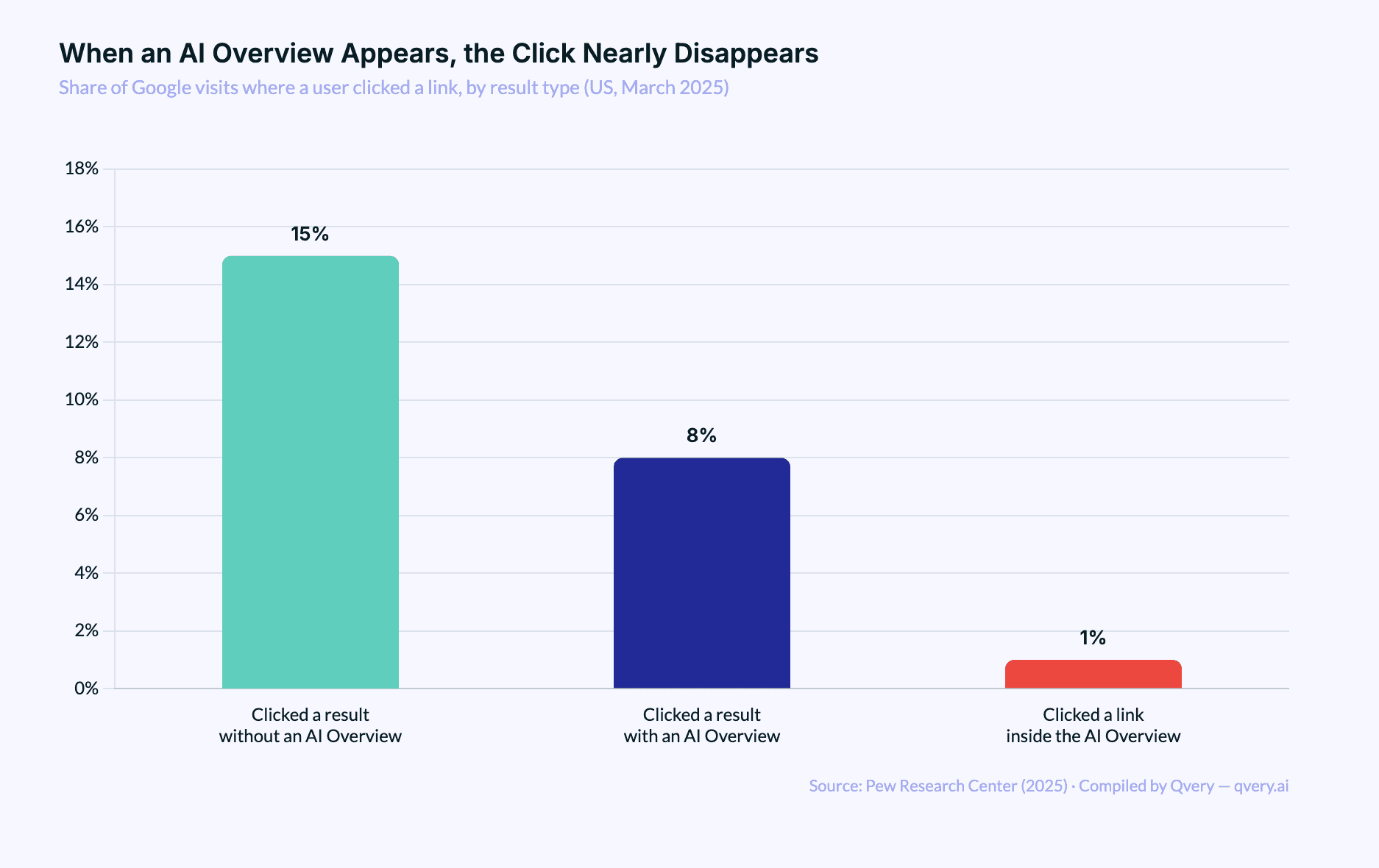
With an AI Overview present, users clicked a traditional result in 8% of visits versus 15% without, and clicked a link inside the summary itself just 1% of the time².
68.01% of US Google searches ended without any click in the first four months of 2026¹³.
AI Overviews cut the position-one organic click-through rate by 58% by December 2025⁵, and a randomized field experiment measured a 39.8% drop in outbound clicks when they appear⁶.
Only 37.9% of AI Overview citations also rank in Google's organic top 10, down from roughly 76% in mid-2025⁸.
AI Overviews reached 2 billion monthly users by mid-2025¹; Google's AI Mode passed 75 million daily active users by October⁴.
Only 39% of AI Overviews were both correct and fully supported by the sources they cited²⁰.
In our own data, just 13.9% of the domains AI engines cite also rank in Google's organic top 10¹⁶.
How Often You Are Looking at an AI Overview
Start with frequency, because the whole argument depends on it. If AI Overviews were rare, none of the click data would matter. They're not rare. In a metered study of real US browsing, 18% of all Google searches produced an AI Overview, and 58% of people ran at least one in a single month². By a nationally representative survey that autumn, 65% of US adults said they at least sometimes see them, including 45% who see them often³.
The more useful finding is where they show up. AI Overviews are not sprinkled evenly across search. They concentrate on exactly the question-shaped, informational queries that used to send the open web its best traffic.
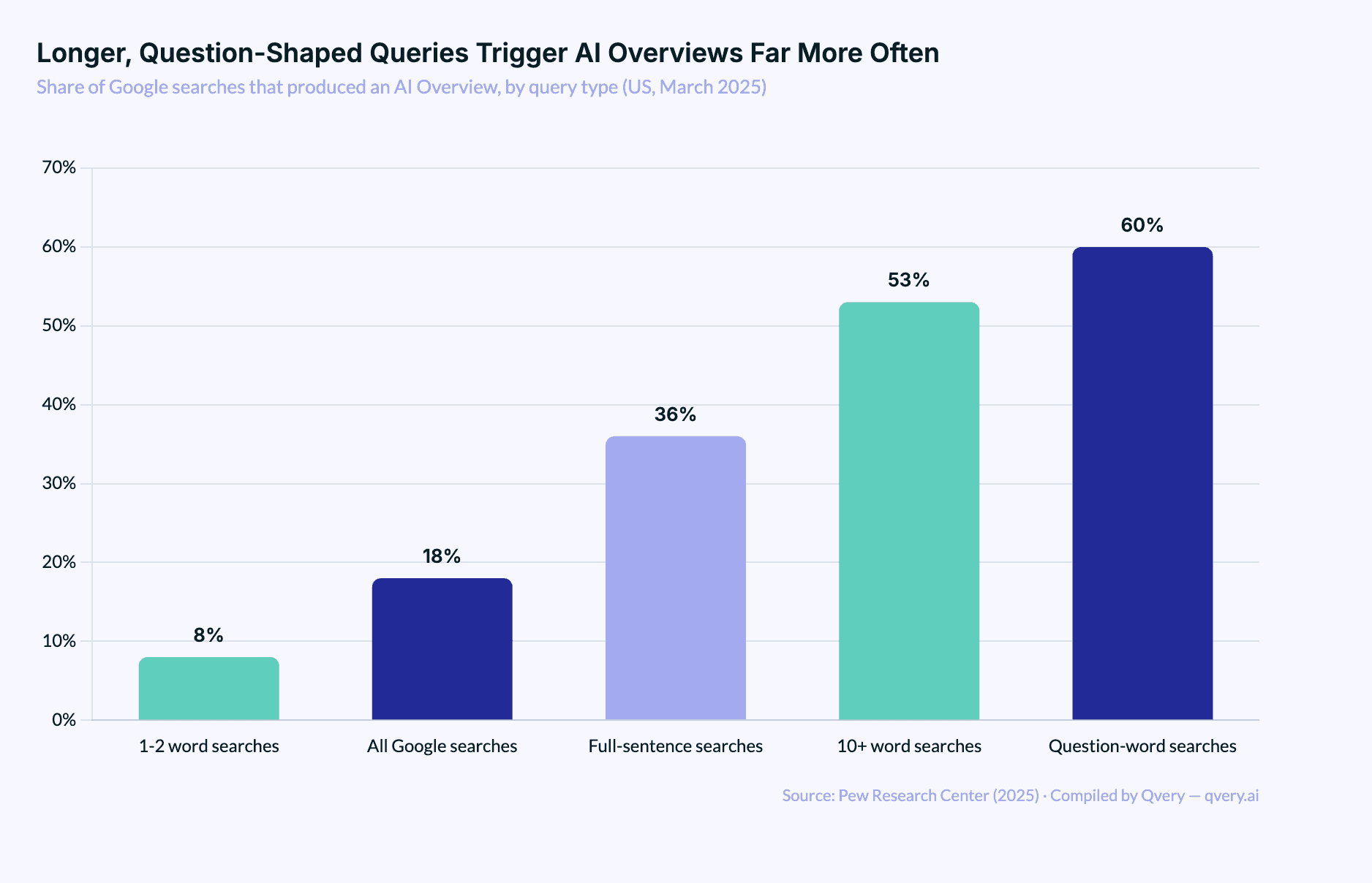
8% of one or two-word searches triggered an AI Overview, versus 53% of searches with 10 words or more².
60% of queries beginning with a question word (who, what, when, why) returned one².
36% of full-sentence searches (a noun plus a verb) generated one, more than double the base rate².
Coverage over 2025 looked less like a steady climb and more like Google feeling out the boundaries in public. Across a 10-million-query panel, AI Overview presence went from 6.49% of queries in January to a peak of 24.61% in July, then settled back to 15.69% by November⁹. Read that as a company testing how much AI it can bolt onto its cash cow before the complaints (and the lawsuits) outrun the benefits, then easing off the throttle.
The part that should worry marketers is the drift down-funnel. AI Overviews started as an answer to research questions and are steadily moving into money queries.
Informational intent fell from 91.3% of AI Overview queries in January to 57.1% by October⁹, while commercial-intent coverage roughly doubled to 18.57% and transactional coverage climbed from 1.98% to 13.94%⁹. The box started at the top of the funnel and is walking toward the checkout.
Google, for its part, insists this is all upside. It says AI Overviews are driving over 10% more queries for the query types that show them¹, and it has kept expanding the more aggressive AI Mode: 1.5 billion monthly AI Overview users in May 2025¹⁰, over 2 billion by July¹, and an AI Mode that went from 100 million monthly users¹ to 75 million daily active users in a quarter⁴.
One reading is that AI answers grow the search pie. The other is that Google is measuring engagement with its own box while the sites feeding that box measure something very different. Both can be true, and which one you believe depends on whether you own the box.
The Click Collapse: What Happens When the Answer Is Right There
Here is the finding the whole industry has been arguing about, from the one source with no product to sell. Using real clickstream data, Pew found that a Google search with an AI Overview sent a click to a traditional result 8% of the time, against 15% for searches without one². Nearly half the clicks disappear, on exactly the queries most likely to show a summary.
Two smaller numbers do more damage than the headline. Users clicked a link inside the AI Overview itself 1% of the time², which is roughly the rate at which anyone reads the full terms before clicking agree. And people ended their browsing session entirely on 26% of pages with an AI Overview, versus 16% without². That last one is the real behavior change. People get the answer and close the tab.
The AI Overview does not compete with the ten blue links for your attention. It answers the question above them, so most people never form the intent to scroll.
Zoom out and this is a decade-long trend that AI Overviews poured accelerant on. Zero-click searches, the ones that end with no onward click at all, hit 58.5% in the US in 2024¹⁴ and 68.01% in the first four months of 2026¹³.
Put differently, in 2024 only 360 of every 1,000 US Google searches sent a click to an independent, non-Google property¹⁴. Barely a third of search still rewards the open web, and the line is moving the wrong way.
The forecasters saw this coming and, unusually, agreed with each other. Gartner projected traditional search volume would fall 25% by 2026 as chatbots and AI answers take share¹¹. Bain estimated zero-click behavior is cutting organic web traffic by 15% to 25%, with about 80% of consumers already relying on zero-click results for at least 40% of searches¹². When Gartner and Bain independently land on the same range, it is usually not a fluke.
The Traffic Damage, Measured Every Way Anyone Has Tried
Correlation studies are easy to wave away, so it is worth stacking them next to the one experiment that is not correlational. The pattern holds across every method anyone has tried.
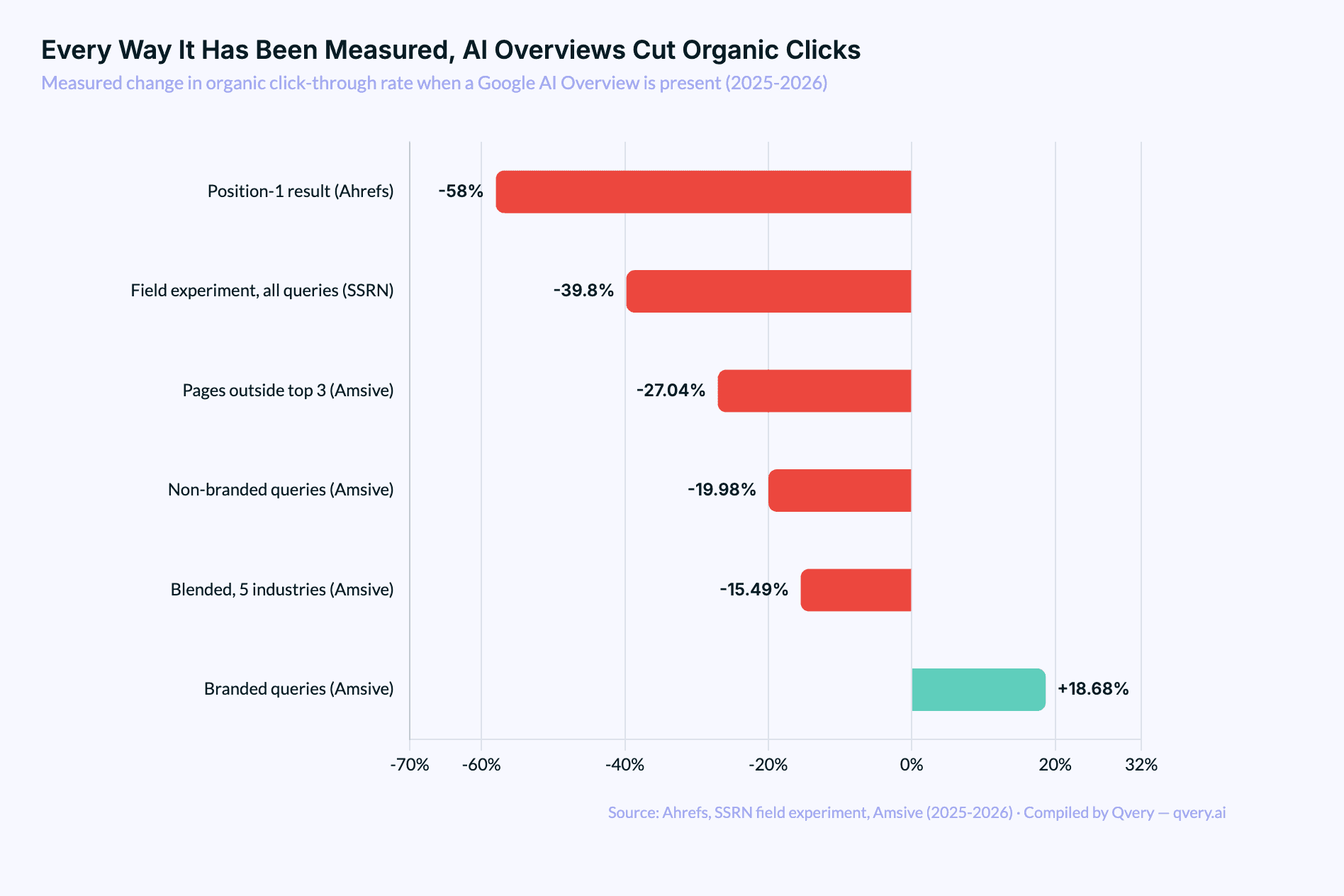
The presence of an AI Overview correlated with a 58% lower click-through rate for the position-one result by December 2025, nearly double the same study's 34.5% figure from April⁵.
A randomized field experiment, running a real browser extension, found AI Overviews cut outbound organic clicks by 39.8% and lifted zero-click searches by 34.5%, with no measurable improvement in how useful people found the results⁶.
Across 700,000 queries in five industries, AI Overview queries saw an average 15.49% CTR decline, worsening to 19.98% for non-branded terms and 27.04% for pages ranking outside the top three⁷.
The experiment is the one that matters most, and not because the number is biggest. It is the only study that changes one variable and watches what happens, rather than comparing pages that already differ. When academic economists randomize who sees an AI Overview and measure a 39.8% click drop with no gain in perceived quality⁶, the "AI Overviews grow the pie" argument gets much harder to make with a straight face.
One number cuts the other way, and it is the most instructive in the set. Branded queries that triggered an AI Overview saw click-through rise 18.68%, and only 4.79% of branded queries triggered a summary at all⁷.
So the damage concentrates almost entirely on non-branded, top-of-funnel discovery, the exact traffic content marketing was built to capture.
If people already know your name, the box helps you. If they are still deciding, it stands between you and them. The strategic read writes itself: brand is the hedge against the click collapse, and it always quietly was.
What Google's AI Cites
If the click is disappearing, the next question is what earns a mention inside the box instead. AI Overviews are not featured snippets that lift one page. They are synthesis: 88% cited three or more sources, and only 1% leaned on a single source². So the game is being one of several trusted inputs, not the one true answer.
The sources skew in two directions at once: user-generated content and institutional authority. Wikipedia, YouTube, and Reddit were the three most-cited sources, together about 15% of all AI Overview links².
Government domains punched well above their weight, at 6% of AI Overview links versus 2% of standard results². And video keeps climbing: by early 2026 YouTube was the single most-cited domain, up 34% in six months and 5.6% of all AI Overview citations⁸, often for queries where it does not even rank organically.
AI Overviews trust two kinds of source above all others: places where real people argue in public, and places with an official seal. Marketing content sits awkwardly between them.
There is a quiet efficiency drive in here too. The average AI Overview cited about three URLs from the top 20 organic results as of October 2025, down from five in May¹⁵. Google is citing fewer high-ranking pages per answer, not more. If you were hoping the path to visibility was simply "publish more and get quoted more," the box is tightening, not widening.
Ranking on Page One Stopped Guaranteeing a Citation
Two credible datasets here look like they flatly contradict each other. They do not, and the reconciliation is the useful part.
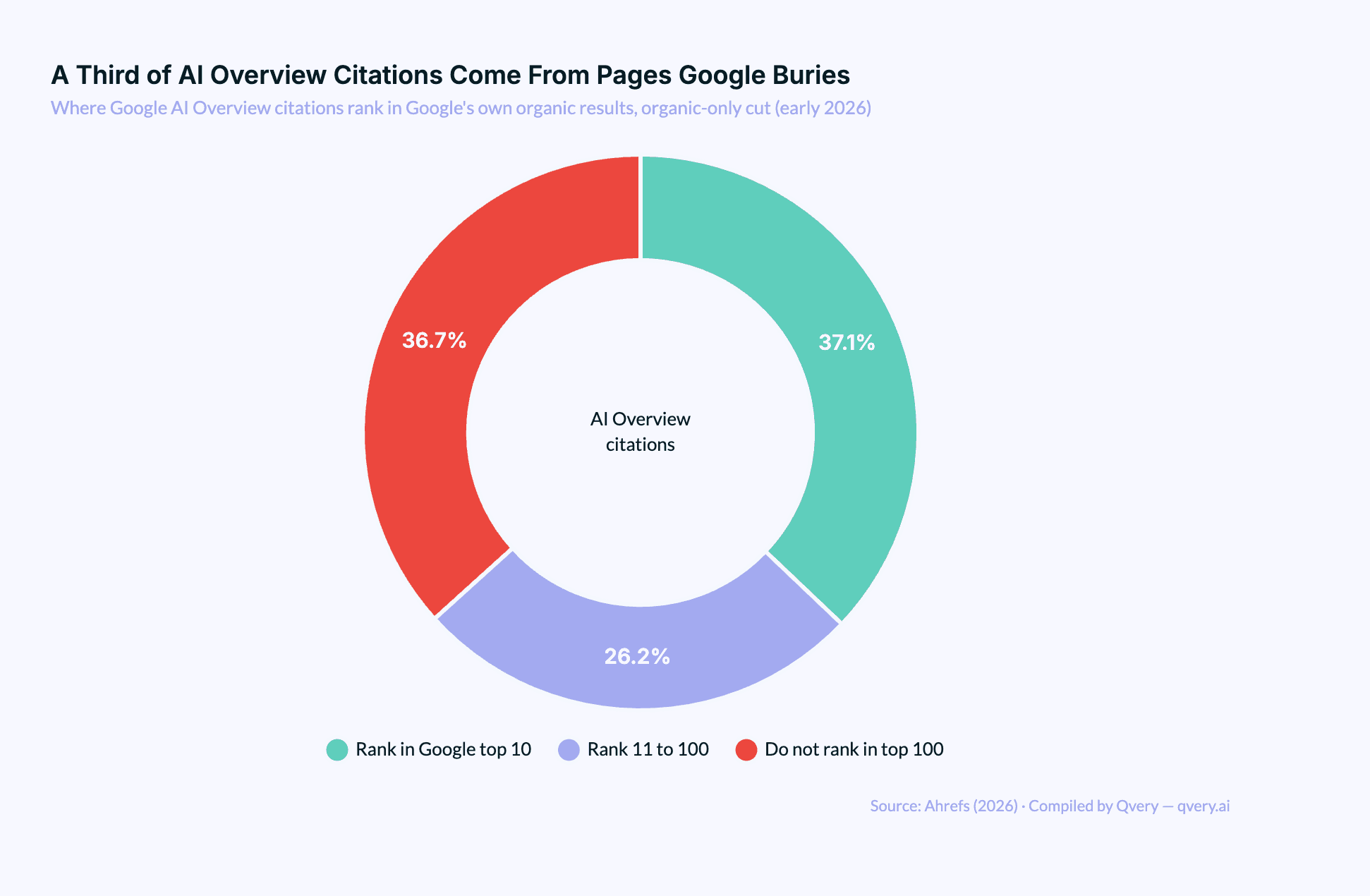
The overlap between AI Overview citations and organic rankings collapsed in a year. Only 37.9% of AI Overview citations also ranked in Google's top 10, down from about 76% in mid-2025⁸. In the organic-only cut, the split was stark: 37.1% of citations ranked top 10, 26.2% ranked 11 to 100, and 36.7% did not rank in Google's top 100 at all⁸.
More than a third of what Google's AI cites comes from pages Google's own algorithm buries. A good chunk of that gap is video: 18.2% of citations from outside the top 100 were YouTube⁸.
Now the apparent contradiction. A separate 362,000-query study found that 94% of AI Overviews included at least one citation from the top 20, and 90% from the top 10¹⁵. So which is it, rankings matter or they do not? Both, at different levels.
Almost every AI Overview anchors on at least one high-ranking page, but across the full list of citations, 44% come from beyond the top 20¹⁵. One top-ranker gets you in the room. The other slots go to pages ranking has nothing to do with. And rank still tilts the odds hard: a position-one URL was cited 43% of the time, falling to 7% at position 20¹⁵.
Our own data says the same thing from the AI-engine side, and more bluntly. Across queries we track on ChatGPT and Google AI Mode, only 13.9% of cited domains also rank in Google's organic top 10, which means 86.1% of AI citations go to pages Google's organic algorithm does not surface¹⁶.
Rank still helps: a domain at position one has a 48.8% chance of being cited, versus 17.3% at position 10¹⁶. And the two engines behave differently, so a single strategy is wrong on arrival: Google AI Mode's overlap with organic (16.7%) runs 53% higher than ChatGPT's (10.9%), because AI Mode leans on Google's own index¹⁶. Ranking is table stakes now, not the prize.
The Sources That Win Both
So if page-one rank is not the lever, what is? Format and source, more than most marketers want to hear. The content types AI engines cite are not evenly distributed, and the gap is embarrassing.
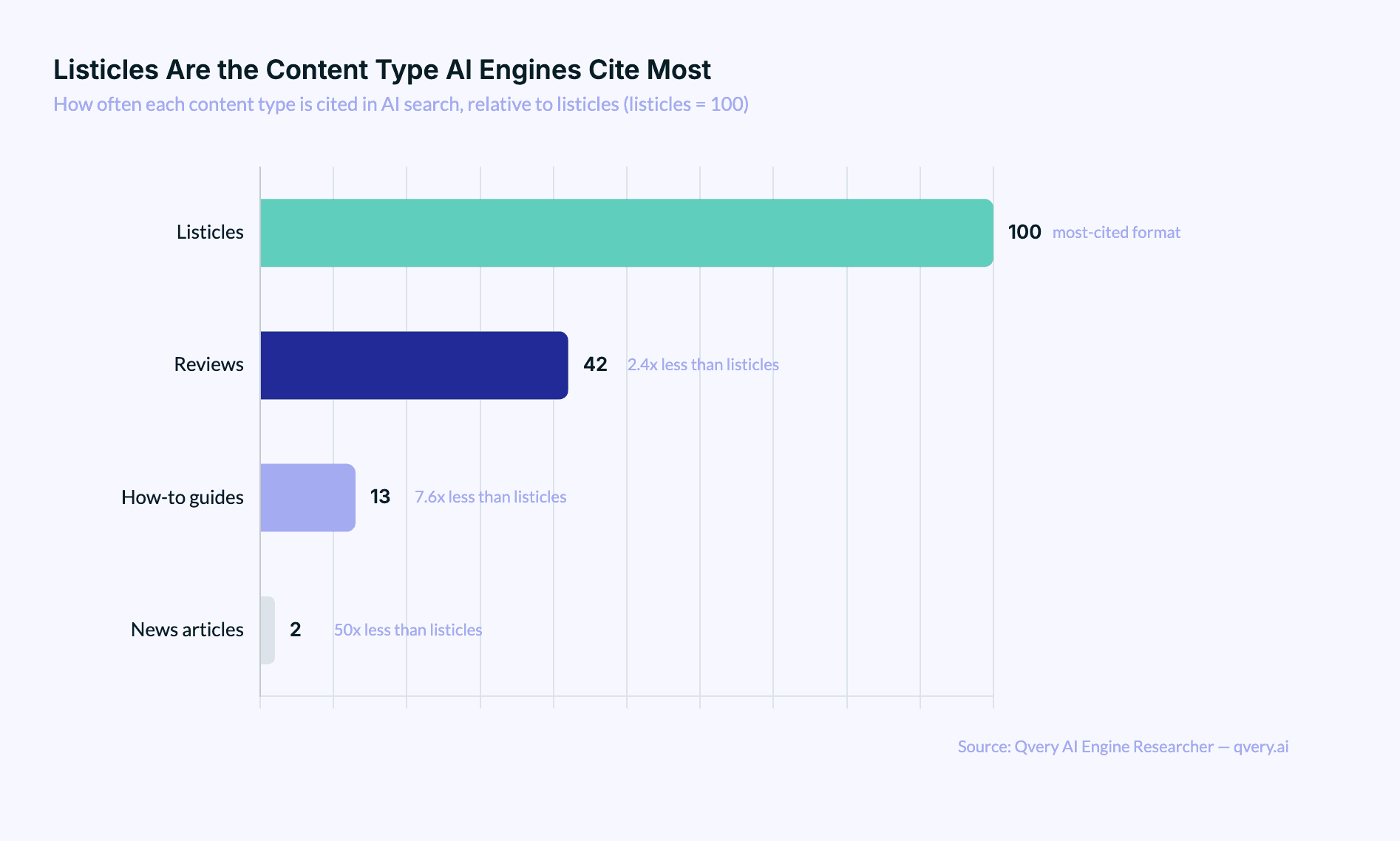
Listicles are 45.8% of all classifiable AI engine citations, the single most-cited format¹⁷.
That format beats reviews by 2.4x, how-to guides by 7.6x, and news articles by 50x¹⁷.
Reddit is the #3 most-cited well-known domain and 58.9% of all user-generated-content citations, more than the next five UGC sources combined¹⁸.
The Reddit number connects the two worlds better than anything else. When an AI engine cites Reddit, there is a 78.5% chance Reddit also ranks in Google's organic top 10 for that query¹⁸. Against a 13.9% baseline overlap, that is astonishing. User-generated content is the rare thing that wins the AI answer and the blue link at the same time, which is exactly why "get mentioned on Reddit" stopped being a growth-hack and became infrastructure.
Then there is the engine-specific trap. Wikipedia is ChatGPT's favorite source, cited in 2.49% of responses, versus 0.02% for Google AI Mode, a 124x gap that sends 98.8% of Wikipedia's AI citations through ChatGPT alone¹⁹. When Wikipedia does get cited it lands in the top five sources 52.4% of the time, the best average prominence of any major domain¹⁹.
Google AI Mode, the AI-Overview-adjacent engine, mostly ignores external reference content and trusts its own knowledge graph.
Optimize for "AI search" as one thing and you will pour effort into a source one engine loves and the other cannot see.
How Accurate Is the Thing Replacing the Link?
There is one more number that ought to sit next to all the traffic panic, because it complicates the story in a useful way. The box winning the click is not always right. In an automated audit of thousands of queries, AI Overviews were accurate only about 9 times out of 10, and roughly half contained facts not supported by the sources they cited²⁰. At the claim level, only 67% of statements were supported, meaning about a third were effectively hallucinated²⁰. Fully 39% were both correct and fully supported, the combination that deserves trust²⁰.
A 9% error rate sounds small until you multiply it by Google's volume, at which point the box is confidently wrong millions of times an hour. And people can feel it.
Despite near-universal exposure, only 20% of people who see them find AI summaries very useful, and while 53% have some trust in them, just 6% trust them a lot³. That gap, shown to almost everyone and deeply trusted by almost no one, is the whole opportunity. The engines want sources they can stand behind. Become a source the engine can stand behind and you get cited more, and quoted correctly more. That is the entire lever, and almost nobody is pulling it yet.
How to See Whether AI Overviews Name You
This is the problem Qvery solves. Qvery tracks how your brand shows up across ChatGPT and Google AI Mode, generates the queries your customers ask, and shows you which sources the engine pulls from when your category comes up. You enter your brand and see where you stand in a few minutes, instead of guessing whether the answer names you.
None of this means search is over. It grew a box on top that answers the question before anyone reaches your site, and the lever you still control is being one of the sources that box trusts. Whether Google's AI names you, links you, or skips you entirely is the part most brands have never measured. It's measurable now, and that's the first move.
Frequently Asked Questions
What are Google AI Overviews?
AI Overviews are the AI-generated summaries Google places at the top of many search results, answering the query directly and citing a handful of sources. They reached over 2 billion monthly users by mid-2025¹.
How often do AI Overviews appear in Google search?
About 18% of all Google searches produced an AI Overview in a March 2025 metered study, and 58% of users saw at least one in that month².
What kinds of queries trigger an AI Overview?
Longer, question-shaped queries. Just 8% of one or two-word searches triggered one, versus 53% for searches of 10 words or more and 60% of question-word queries².
Do AI Overviews reduce clicks to websites?
Yes. Users clicked a traditional result in 8% of visits with an AI Overview versus 15% without², and a randomized field experiment measured a 39.8% drop in outbound clicks⁶.
How much do AI Overviews cut click-through rate?
By December 2025 an AI Overview correlated with a 58% lower click-through rate for the position-one result⁵. Blended across industries, one study found a 15.49% average decline⁷.
How often do people click a link inside the AI Overview?
Rarely. Google users clicked a link inside the summary in just 1% of visits to pages that had one².
What is the zero-click search rate in 2026?
68.01% of US Google searches ended without a click in the first four months of 2026¹³, up from 58.5% in 2024¹⁴.
Do AI Overviews make people stop browsing?
They do. Users ended their session on 26% of pages with an AI Overview, versus 16% without one².
What sources do AI Overviews cite most?
Wikipedia, YouTube, and Reddit are the top three, together about 15% of all AI Overview links². By early 2026, YouTube was the single most-cited domain⁸.
How many sources does an AI Overview cite?
Most cite several: 88% of AI Overviews cited three or more sources, and only 1% relied on a single source².
Do AI Overviews favor government sites?
Yes, relatively. 6% of AI Overview links pointed to .gov sites, versus 2% of standard results².
Does ranking on page one guarantee an AI Overview citation?
No. Only 37.9% of AI Overview citations also rank in Google's top 10, down from about 76% in mid-2025⁸, and 36.7% do not rank in the top 100 at all⁸.
Do rankings still matter for AI Overview citations?
They help but do not decide. A position-one URL was cited 43% of the time, falling to 7% at position 20¹⁵, and 90% of AI Overviews included at least one top-10 citation¹⁵.
How much do AI engine citations overlap with Google organic rankings?
Only 13.9% of domains cited by ChatGPT and Google AI Mode also rank in Google's organic top 10, so 86.1% do not¹⁶.
What content types get cited most in AI search?
Listicles, by a wide margin: 45.8% of classifiable AI engine citations, beating how-to guides by 7.6x and news by 50x¹⁷.
Why does Reddit matter for AI search visibility?
Reddit is the #3 most-cited well-known domain and 58.9% of all UGC citations¹⁸, and when it is cited there is a 78.5% chance it also ranks in Google's top 10¹⁸.
Do ChatGPT and Google AI Mode cite the same sources?
No. Wikipedia is cited by ChatGPT 124x more often than by Google AI Mode¹⁹, and AI Mode's overlap with Google organic runs 53% higher than ChatGPT's¹⁶.
How accurate are AI Overviews?
An automated audit found them accurate about 9 times out of 10, with roughly half containing unsupported facts and only 39% both correct and fully supported²⁰.
Do people trust AI Overviews?
Not deeply. 53% have some trust in AI summaries, but only 6% trust them a lot, and just 20% find them very useful³.
Is AI Mode different from AI Overviews?
Yes. AI Mode is Google's fuller end-to-end AI search experience; it reached 75 million daily active users by October 2025⁴, separate from AI Overviews' 2 billion monthly users¹.
Are AI Overviews spreading into commercial searches?
Yes. Commercial-intent coverage roughly doubled to 18.57% and transactional coverage climbed to 13.94% over 2025⁹.
What will happen to search traffic because of AI?
Gartner projects traditional search volume down 25% by 2026¹¹, and Bain estimates zero-click behavior is cutting organic web traffic 15% to 25%¹².
Are branded searches affected by AI Overviews?
Less, and sometimes positively. Branded queries that triggered an AI Overview saw click-through rise 18.68%, and only 4.79% of branded queries triggered one at all⁷.
How many industries are heavily affected by AI Overviews?
Coverage is uneven. In November 2025 the most-saturated verticals were Science at 25.96%, Computers and Electronics at 17.92%, and People and Society at 17.29%⁹.
What should a brand do about AI Overviews?
Measure whether AI engines cite you, then earn placement in the sources they trust (UGC, listicles, authoritative references). Start by tracking your visibility across ChatGPT and Google AI Mode, which is exactly what Qvery is built to measure.
Sources
Pew Research Center: Americans Have Mixed Feelings About AI Summaries in Search Results (2025)
Ahrefs: 38% of AI Overview Citations Pull From the Top 10 (2026)
Bain and Company: Goodbye Clicks, Hello AI, Zero-Click Search Redefines Marketing (2024)
SparkToro (data by Datos): 2024 Zero-Click Search Study (2024)
seoClarity: The Overlap Between AI Overviews and Organic Rankings (2025)
Qvery: AI Engine Citations vs Google Organic SERPs, Only 13.9% Overlap (2026)
Qvery: Listicles Are the Most Cited Content Type in AI Search (2026)
Qvery: Reddit Is the Most Important Website for AI Search Visibility (2026)
Qvery: Wikipedia AI Citations, ChatGPT's Favorite Source That Google AI Ignores (2026)
By mid-2025, Google's AI Overviews had more than 2 billion monthly users across 200-plus countries and 40 languages¹. Two billion is not a rounding error on search behavior. It's the largest generative-AI surface on the planet, bolted to the top of the box most of the web still leans on for traffic.
And it changed the one thing publishers were counting on. When an AI Overview appears, people read the answer and stay put. Google users clicked a normal search result in just 8% of visits with an AI Overview, versus 15% without one². The box doesn't resent publishers. It just makes the click optional, which from a publisher's chair feels like roughly the same thing.
We pulled the most credible, independently verified statistics on Google AI Overviews we could find, from Pew, Google's own earnings, an academic field experiment, Gartner, Bain, and the analytics firms that measure where clicks go.
A few figures below come from our own AI-citation data at Qvery. Everything else is footnoted to its original source, and nothing here is an estimate typed from memory. Read together, they point one way: AI Overviews moved from experiment to the default front page of search, and in doing so quietly rewired who gets the click and who gets cited. Ranking on page one no longer settles either question.
Highlights
About 18% of all Google searches produced an AI Overview in March 2025, rising to 53% for queries of 10 words or more².
With an AI Overview present, users clicked a traditional result in 8% of visits versus 15% without, and clicked a link inside the summary itself just 1% of the time².
68.01% of US Google searches ended without any click in the first four months of 2026¹³.
AI Overviews cut the position-one organic click-through rate by 58% by December 2025⁵, and a randomized field experiment measured a 39.8% drop in outbound clicks when they appear⁶.
Only 37.9% of AI Overview citations also rank in Google's organic top 10, down from roughly 76% in mid-2025⁸.
AI Overviews reached 2 billion monthly users by mid-2025¹; Google's AI Mode passed 75 million daily active users by October⁴.
Only 39% of AI Overviews were both correct and fully supported by the sources they cited²⁰.
In our own data, just 13.9% of the domains AI engines cite also rank in Google's organic top 10¹⁶.
How Often You Are Looking at an AI Overview
Start with frequency, because the whole argument depends on it. If AI Overviews were rare, none of the click data would matter. They're not rare. In a metered study of real US browsing, 18% of all Google searches produced an AI Overview, and 58% of people ran at least one in a single month². By a nationally representative survey that autumn, 65% of US adults said they at least sometimes see them, including 45% who see them often³.
The more useful finding is where they show up. AI Overviews are not sprinkled evenly across search. They concentrate on exactly the question-shaped, informational queries that used to send the open web its best traffic.
8% of one or two-word searches triggered an AI Overview, versus 53% of searches with 10 words or more².
60% of queries beginning with a question word (who, what, when, why) returned one².
36% of full-sentence searches (a noun plus a verb) generated one, more than double the base rate².
Coverage over 2025 looked less like a steady climb and more like Google feeling out the boundaries in public. Across a 10-million-query panel, AI Overview presence went from 6.49% of queries in January to a peak of 24.61% in July, then settled back to 15.69% by November⁹. Read that as a company testing how much AI it can bolt onto its cash cow before the complaints (and the lawsuits) outrun the benefits, then easing off the throttle.
The part that should worry marketers is the drift down-funnel. AI Overviews started as an answer to research questions and are steadily moving into money queries.
Informational intent fell from 91.3% of AI Overview queries in January to 57.1% by October⁹, while commercial-intent coverage roughly doubled to 18.57% and transactional coverage climbed from 1.98% to 13.94%⁹. The box started at the top of the funnel and is walking toward the checkout.
Google, for its part, insists this is all upside. It says AI Overviews are driving over 10% more queries for the query types that show them¹, and it has kept expanding the more aggressive AI Mode: 1.5 billion monthly AI Overview users in May 2025¹⁰, over 2 billion by July¹, and an AI Mode that went from 100 million monthly users¹ to 75 million daily active users in a quarter⁴.
One reading is that AI answers grow the search pie. The other is that Google is measuring engagement with its own box while the sites feeding that box measure something very different. Both can be true, and which one you believe depends on whether you own the box.
The Click Collapse: What Happens When the Answer Is Right There
Here is the finding the whole industry has been arguing about, from the one source with no product to sell. Using real clickstream data, Pew found that a Google search with an AI Overview sent a click to a traditional result 8% of the time, against 15% for searches without one². Nearly half the clicks disappear, on exactly the queries most likely to show a summary.
Two smaller numbers do more damage than the headline. Users clicked a link inside the AI Overview itself 1% of the time², which is roughly the rate at which anyone reads the full terms before clicking agree. And people ended their browsing session entirely on 26% of pages with an AI Overview, versus 16% without². That last one is the real behavior change. People get the answer and close the tab.
The AI Overview does not compete with the ten blue links for your attention. It answers the question above them, so most people never form the intent to scroll.
Zoom out and this is a decade-long trend that AI Overviews poured accelerant on. Zero-click searches, the ones that end with no onward click at all, hit 58.5% in the US in 2024¹⁴ and 68.01% in the first four months of 2026¹³.
Put differently, in 2024 only 360 of every 1,000 US Google searches sent a click to an independent, non-Google property¹⁴. Barely a third of search still rewards the open web, and the line is moving the wrong way.
The forecasters saw this coming and, unusually, agreed with each other. Gartner projected traditional search volume would fall 25% by 2026 as chatbots and AI answers take share¹¹. Bain estimated zero-click behavior is cutting organic web traffic by 15% to 25%, with about 80% of consumers already relying on zero-click results for at least 40% of searches¹². When Gartner and Bain independently land on the same range, it is usually not a fluke.
The Traffic Damage, Measured Every Way Anyone Has Tried
Correlation studies are easy to wave away, so it is worth stacking them next to the one experiment that is not correlational. The pattern holds across every method anyone has tried.
The presence of an AI Overview correlated with a 58% lower click-through rate for the position-one result by December 2025, nearly double the same study's 34.5% figure from April⁵.
A randomized field experiment, running a real browser extension, found AI Overviews cut outbound organic clicks by 39.8% and lifted zero-click searches by 34.5%, with no measurable improvement in how useful people found the results⁶.
Across 700,000 queries in five industries, AI Overview queries saw an average 15.49% CTR decline, worsening to 19.98% for non-branded terms and 27.04% for pages ranking outside the top three⁷.
The experiment is the one that matters most, and not because the number is biggest. It is the only study that changes one variable and watches what happens, rather than comparing pages that already differ. When academic economists randomize who sees an AI Overview and measure a 39.8% click drop with no gain in perceived quality⁶, the "AI Overviews grow the pie" argument gets much harder to make with a straight face.
One number cuts the other way, and it is the most instructive in the set. Branded queries that triggered an AI Overview saw click-through rise 18.68%, and only 4.79% of branded queries triggered a summary at all⁷.
So the damage concentrates almost entirely on non-branded, top-of-funnel discovery, the exact traffic content marketing was built to capture.
If people already know your name, the box helps you. If they are still deciding, it stands between you and them. The strategic read writes itself: brand is the hedge against the click collapse, and it always quietly was.
What Google's AI Cites
If the click is disappearing, the next question is what earns a mention inside the box instead. AI Overviews are not featured snippets that lift one page. They are synthesis: 88% cited three or more sources, and only 1% leaned on a single source². So the game is being one of several trusted inputs, not the one true answer.
The sources skew in two directions at once: user-generated content and institutional authority. Wikipedia, YouTube, and Reddit were the three most-cited sources, together about 15% of all AI Overview links².
Government domains punched well above their weight, at 6% of AI Overview links versus 2% of standard results². And video keeps climbing: by early 2026 YouTube was the single most-cited domain, up 34% in six months and 5.6% of all AI Overview citations⁸, often for queries where it does not even rank organically.
AI Overviews trust two kinds of source above all others: places where real people argue in public, and places with an official seal. Marketing content sits awkwardly between them.
There is a quiet efficiency drive in here too. The average AI Overview cited about three URLs from the top 20 organic results as of October 2025, down from five in May¹⁵. Google is citing fewer high-ranking pages per answer, not more. If you were hoping the path to visibility was simply "publish more and get quoted more," the box is tightening, not widening.
Ranking on Page One Stopped Guaranteeing a Citation
Two credible datasets here look like they flatly contradict each other. They do not, and the reconciliation is the useful part.
The overlap between AI Overview citations and organic rankings collapsed in a year. Only 37.9% of AI Overview citations also ranked in Google's top 10, down from about 76% in mid-2025⁸. In the organic-only cut, the split was stark: 37.1% of citations ranked top 10, 26.2% ranked 11 to 100, and 36.7% did not rank in Google's top 100 at all⁸.
More than a third of what Google's AI cites comes from pages Google's own algorithm buries. A good chunk of that gap is video: 18.2% of citations from outside the top 100 were YouTube⁸.
Now the apparent contradiction. A separate 362,000-query study found that 94% of AI Overviews included at least one citation from the top 20, and 90% from the top 10¹⁵. So which is it, rankings matter or they do not? Both, at different levels.
Almost every AI Overview anchors on at least one high-ranking page, but across the full list of citations, 44% come from beyond the top 20¹⁵. One top-ranker gets you in the room. The other slots go to pages ranking has nothing to do with. And rank still tilts the odds hard: a position-one URL was cited 43% of the time, falling to 7% at position 20¹⁵.
Our own data says the same thing from the AI-engine side, and more bluntly. Across queries we track on ChatGPT and Google AI Mode, only 13.9% of cited domains also rank in Google's organic top 10, which means 86.1% of AI citations go to pages Google's organic algorithm does not surface¹⁶.
Rank still helps: a domain at position one has a 48.8% chance of being cited, versus 17.3% at position 10¹⁶. And the two engines behave differently, so a single strategy is wrong on arrival: Google AI Mode's overlap with organic (16.7%) runs 53% higher than ChatGPT's (10.9%), because AI Mode leans on Google's own index¹⁶. Ranking is table stakes now, not the prize.
The Sources That Win Both
So if page-one rank is not the lever, what is? Format and source, more than most marketers want to hear. The content types AI engines cite are not evenly distributed, and the gap is embarrassing.
Listicles are 45.8% of all classifiable AI engine citations, the single most-cited format¹⁷.
That format beats reviews by 2.4x, how-to guides by 7.6x, and news articles by 50x¹⁷.
Reddit is the #3 most-cited well-known domain and 58.9% of all user-generated-content citations, more than the next five UGC sources combined¹⁸.
The Reddit number connects the two worlds better than anything else. When an AI engine cites Reddit, there is a 78.5% chance Reddit also ranks in Google's organic top 10 for that query¹⁸. Against a 13.9% baseline overlap, that is astonishing. User-generated content is the rare thing that wins the AI answer and the blue link at the same time, which is exactly why "get mentioned on Reddit" stopped being a growth-hack and became infrastructure.
Then there is the engine-specific trap. Wikipedia is ChatGPT's favorite source, cited in 2.49% of responses, versus 0.02% for Google AI Mode, a 124x gap that sends 98.8% of Wikipedia's AI citations through ChatGPT alone¹⁹. When Wikipedia does get cited it lands in the top five sources 52.4% of the time, the best average prominence of any major domain¹⁹.
Google AI Mode, the AI-Overview-adjacent engine, mostly ignores external reference content and trusts its own knowledge graph.
Optimize for "AI search" as one thing and you will pour effort into a source one engine loves and the other cannot see.
How Accurate Is the Thing Replacing the Link?
There is one more number that ought to sit next to all the traffic panic, because it complicates the story in a useful way. The box winning the click is not always right. In an automated audit of thousands of queries, AI Overviews were accurate only about 9 times out of 10, and roughly half contained facts not supported by the sources they cited²⁰. At the claim level, only 67% of statements were supported, meaning about a third were effectively hallucinated²⁰. Fully 39% were both correct and fully supported, the combination that deserves trust²⁰.
A 9% error rate sounds small until you multiply it by Google's volume, at which point the box is confidently wrong millions of times an hour. And people can feel it.
Despite near-universal exposure, only 20% of people who see them find AI summaries very useful, and while 53% have some trust in them, just 6% trust them a lot³. That gap, shown to almost everyone and deeply trusted by almost no one, is the whole opportunity. The engines want sources they can stand behind. Become a source the engine can stand behind and you get cited more, and quoted correctly more. That is the entire lever, and almost nobody is pulling it yet.
How to See Whether AI Overviews Name You
This is the problem Qvery solves. Qvery tracks how your brand shows up across ChatGPT and Google AI Mode, generates the queries your customers ask, and shows you which sources the engine pulls from when your category comes up. You enter your brand and see where you stand in a few minutes, instead of guessing whether the answer names you.
None of this means search is over. It grew a box on top that answers the question before anyone reaches your site, and the lever you still control is being one of the sources that box trusts. Whether Google's AI names you, links you, or skips you entirely is the part most brands have never measured. It's measurable now, and that's the first move.
Frequently Asked Questions
What are Google AI Overviews?
AI Overviews are the AI-generated summaries Google places at the top of many search results, answering the query directly and citing a handful of sources. They reached over 2 billion monthly users by mid-2025¹.
How often do AI Overviews appear in Google search?
About 18% of all Google searches produced an AI Overview in a March 2025 metered study, and 58% of users saw at least one in that month².
What kinds of queries trigger an AI Overview?
Longer, question-shaped queries. Just 8% of one or two-word searches triggered one, versus 53% for searches of 10 words or more and 60% of question-word queries².
Do AI Overviews reduce clicks to websites?
Yes. Users clicked a traditional result in 8% of visits with an AI Overview versus 15% without², and a randomized field experiment measured a 39.8% drop in outbound clicks⁶.
How much do AI Overviews cut click-through rate?
By December 2025 an AI Overview correlated with a 58% lower click-through rate for the position-one result⁵. Blended across industries, one study found a 15.49% average decline⁷.
How often do people click a link inside the AI Overview?
Rarely. Google users clicked a link inside the summary in just 1% of visits to pages that had one².
What is the zero-click search rate in 2026?
68.01% of US Google searches ended without a click in the first four months of 2026¹³, up from 58.5% in 2024¹⁴.
Do AI Overviews make people stop browsing?
They do. Users ended their session on 26% of pages with an AI Overview, versus 16% without one².
What sources do AI Overviews cite most?
Wikipedia, YouTube, and Reddit are the top three, together about 15% of all AI Overview links². By early 2026, YouTube was the single most-cited domain⁸.
How many sources does an AI Overview cite?
Most cite several: 88% of AI Overviews cited three or more sources, and only 1% relied on a single source².
Do AI Overviews favor government sites?
Yes, relatively. 6% of AI Overview links pointed to .gov sites, versus 2% of standard results².
Does ranking on page one guarantee an AI Overview citation?
No. Only 37.9% of AI Overview citations also rank in Google's top 10, down from about 76% in mid-2025⁸, and 36.7% do not rank in the top 100 at all⁸.
Do rankings still matter for AI Overview citations?
They help but do not decide. A position-one URL was cited 43% of the time, falling to 7% at position 20¹⁵, and 90% of AI Overviews included at least one top-10 citation¹⁵.
How much do AI engine citations overlap with Google organic rankings?
Only 13.9% of domains cited by ChatGPT and Google AI Mode also rank in Google's organic top 10, so 86.1% do not¹⁶.
What content types get cited most in AI search?
Listicles, by a wide margin: 45.8% of classifiable AI engine citations, beating how-to guides by 7.6x and news by 50x¹⁷.
Why does Reddit matter for AI search visibility?
Reddit is the #3 most-cited well-known domain and 58.9% of all UGC citations¹⁸, and when it is cited there is a 78.5% chance it also ranks in Google's top 10¹⁸.
Do ChatGPT and Google AI Mode cite the same sources?
No. Wikipedia is cited by ChatGPT 124x more often than by Google AI Mode¹⁹, and AI Mode's overlap with Google organic runs 53% higher than ChatGPT's¹⁶.
How accurate are AI Overviews?
An automated audit found them accurate about 9 times out of 10, with roughly half containing unsupported facts and only 39% both correct and fully supported²⁰.
Do people trust AI Overviews?
Not deeply. 53% have some trust in AI summaries, but only 6% trust them a lot, and just 20% find them very useful³.
Is AI Mode different from AI Overviews?
Yes. AI Mode is Google's fuller end-to-end AI search experience; it reached 75 million daily active users by October 2025⁴, separate from AI Overviews' 2 billion monthly users¹.
Are AI Overviews spreading into commercial searches?
Yes. Commercial-intent coverage roughly doubled to 18.57% and transactional coverage climbed to 13.94% over 2025⁹.
What will happen to search traffic because of AI?
Gartner projects traditional search volume down 25% by 2026¹¹, and Bain estimates zero-click behavior is cutting organic web traffic 15% to 25%¹².
Are branded searches affected by AI Overviews?
Less, and sometimes positively. Branded queries that triggered an AI Overview saw click-through rise 18.68%, and only 4.79% of branded queries triggered one at all⁷.
How many industries are heavily affected by AI Overviews?
Coverage is uneven. In November 2025 the most-saturated verticals were Science at 25.96%, Computers and Electronics at 17.92%, and People and Society at 17.29%⁹.
What should a brand do about AI Overviews?
Measure whether AI engines cite you, then earn placement in the sources they trust (UGC, listicles, authoritative references). Start by tracking your visibility across ChatGPT and Google AI Mode, which is exactly what Qvery is built to measure.
Sources
Pew Research Center: Americans Have Mixed Feelings About AI Summaries in Search Results (2025)
Ahrefs: 38% of AI Overview Citations Pull From the Top 10 (2026)
Bain and Company: Goodbye Clicks, Hello AI, Zero-Click Search Redefines Marketing (2024)
SparkToro (data by Datos): 2024 Zero-Click Search Study (2024)
seoClarity: The Overlap Between AI Overviews and Organic Rankings (2025)
Qvery: AI Engine Citations vs Google Organic SERPs, Only 13.9% Overlap (2026)
Qvery: Listicles Are the Most Cited Content Type in AI Search (2026)
Qvery: Reddit Is the Most Important Website for AI Search Visibility (2026)
Qvery: Wikipedia AI Citations, ChatGPT's Favorite Source That Google AI Ignores (2026)
By mid-2025, Google's AI Overviews had more than 2 billion monthly users across 200-plus countries and 40 languages¹. Two billion is not a rounding error on search behavior. It's the largest generative-AI surface on the planet, bolted to the top of the box most of the web still leans on for traffic.
And it changed the one thing publishers were counting on. When an AI Overview appears, people read the answer and stay put. Google users clicked a normal search result in just 8% of visits with an AI Overview, versus 15% without one². The box doesn't resent publishers. It just makes the click optional, which from a publisher's chair feels like roughly the same thing.
We pulled the most credible, independently verified statistics on Google AI Overviews we could find, from Pew, Google's own earnings, an academic field experiment, Gartner, Bain, and the analytics firms that measure where clicks go.
A few figures below come from our own AI-citation data at Qvery. Everything else is footnoted to its original source, and nothing here is an estimate typed from memory. Read together, they point one way: AI Overviews moved from experiment to the default front page of search, and in doing so quietly rewired who gets the click and who gets cited. Ranking on page one no longer settles either question.
Highlights
About 18% of all Google searches produced an AI Overview in March 2025, rising to 53% for queries of 10 words or more².
With an AI Overview present, users clicked a traditional result in 8% of visits versus 15% without, and clicked a link inside the summary itself just 1% of the time².
68.01% of US Google searches ended without any click in the first four months of 2026¹³.
AI Overviews cut the position-one organic click-through rate by 58% by December 2025⁵, and a randomized field experiment measured a 39.8% drop in outbound clicks when they appear⁶.
Only 37.9% of AI Overview citations also rank in Google's organic top 10, down from roughly 76% in mid-2025⁸.
AI Overviews reached 2 billion monthly users by mid-2025¹; Google's AI Mode passed 75 million daily active users by October⁴.
Only 39% of AI Overviews were both correct and fully supported by the sources they cited²⁰.
In our own data, just 13.9% of the domains AI engines cite also rank in Google's organic top 10¹⁶.
How Often You Are Looking at an AI Overview
Start with frequency, because the whole argument depends on it. If AI Overviews were rare, none of the click data would matter. They're not rare. In a metered study of real US browsing, 18% of all Google searches produced an AI Overview, and 58% of people ran at least one in a single month². By a nationally representative survey that autumn, 65% of US adults said they at least sometimes see them, including 45% who see them often³.
The more useful finding is where they show up. AI Overviews are not sprinkled evenly across search. They concentrate on exactly the question-shaped, informational queries that used to send the open web its best traffic.
8% of one or two-word searches triggered an AI Overview, versus 53% of searches with 10 words or more².
60% of queries beginning with a question word (who, what, when, why) returned one².
36% of full-sentence searches (a noun plus a verb) generated one, more than double the base rate².
Coverage over 2025 looked less like a steady climb and more like Google feeling out the boundaries in public. Across a 10-million-query panel, AI Overview presence went from 6.49% of queries in January to a peak of 24.61% in July, then settled back to 15.69% by November⁹. Read that as a company testing how much AI it can bolt onto its cash cow before the complaints (and the lawsuits) outrun the benefits, then easing off the throttle.
The part that should worry marketers is the drift down-funnel. AI Overviews started as an answer to research questions and are steadily moving into money queries.
Informational intent fell from 91.3% of AI Overview queries in January to 57.1% by October⁹, while commercial-intent coverage roughly doubled to 18.57% and transactional coverage climbed from 1.98% to 13.94%⁹. The box started at the top of the funnel and is walking toward the checkout.
Google, for its part, insists this is all upside. It says AI Overviews are driving over 10% more queries for the query types that show them¹, and it has kept expanding the more aggressive AI Mode: 1.5 billion monthly AI Overview users in May 2025¹⁰, over 2 billion by July¹, and an AI Mode that went from 100 million monthly users¹ to 75 million daily active users in a quarter⁴.
One reading is that AI answers grow the search pie. The other is that Google is measuring engagement with its own box while the sites feeding that box measure something very different. Both can be true, and which one you believe depends on whether you own the box.
The Click Collapse: What Happens When the Answer Is Right There
Here is the finding the whole industry has been arguing about, from the one source with no product to sell. Using real clickstream data, Pew found that a Google search with an AI Overview sent a click to a traditional result 8% of the time, against 15% for searches without one². Nearly half the clicks disappear, on exactly the queries most likely to show a summary.
Two smaller numbers do more damage than the headline. Users clicked a link inside the AI Overview itself 1% of the time², which is roughly the rate at which anyone reads the full terms before clicking agree. And people ended their browsing session entirely on 26% of pages with an AI Overview, versus 16% without². That last one is the real behavior change. People get the answer and close the tab.
The AI Overview does not compete with the ten blue links for your attention. It answers the question above them, so most people never form the intent to scroll.
Zoom out and this is a decade-long trend that AI Overviews poured accelerant on. Zero-click searches, the ones that end with no onward click at all, hit 58.5% in the US in 2024¹⁴ and 68.01% in the first four months of 2026¹³.
Put differently, in 2024 only 360 of every 1,000 US Google searches sent a click to an independent, non-Google property¹⁴. Barely a third of search still rewards the open web, and the line is moving the wrong way.
The forecasters saw this coming and, unusually, agreed with each other. Gartner projected traditional search volume would fall 25% by 2026 as chatbots and AI answers take share¹¹. Bain estimated zero-click behavior is cutting organic web traffic by 15% to 25%, with about 80% of consumers already relying on zero-click results for at least 40% of searches¹². When Gartner and Bain independently land on the same range, it is usually not a fluke.
The Traffic Damage, Measured Every Way Anyone Has Tried
Correlation studies are easy to wave away, so it is worth stacking them next to the one experiment that is not correlational. The pattern holds across every method anyone has tried.
The presence of an AI Overview correlated with a 58% lower click-through rate for the position-one result by December 2025, nearly double the same study's 34.5% figure from April⁵.
A randomized field experiment, running a real browser extension, found AI Overviews cut outbound organic clicks by 39.8% and lifted zero-click searches by 34.5%, with no measurable improvement in how useful people found the results⁶.
Across 700,000 queries in five industries, AI Overview queries saw an average 15.49% CTR decline, worsening to 19.98% for non-branded terms and 27.04% for pages ranking outside the top three⁷.
The experiment is the one that matters most, and not because the number is biggest. It is the only study that changes one variable and watches what happens, rather than comparing pages that already differ. When academic economists randomize who sees an AI Overview and measure a 39.8% click drop with no gain in perceived quality⁶, the "AI Overviews grow the pie" argument gets much harder to make with a straight face.
One number cuts the other way, and it is the most instructive in the set. Branded queries that triggered an AI Overview saw click-through rise 18.68%, and only 4.79% of branded queries triggered a summary at all⁷.
So the damage concentrates almost entirely on non-branded, top-of-funnel discovery, the exact traffic content marketing was built to capture.
If people already know your name, the box helps you. If they are still deciding, it stands between you and them. The strategic read writes itself: brand is the hedge against the click collapse, and it always quietly was.
What Google's AI Cites
If the click is disappearing, the next question is what earns a mention inside the box instead. AI Overviews are not featured snippets that lift one page. They are synthesis: 88% cited three or more sources, and only 1% leaned on a single source². So the game is being one of several trusted inputs, not the one true answer.
The sources skew in two directions at once: user-generated content and institutional authority. Wikipedia, YouTube, and Reddit were the three most-cited sources, together about 15% of all AI Overview links².
Government domains punched well above their weight, at 6% of AI Overview links versus 2% of standard results². And video keeps climbing: by early 2026 YouTube was the single most-cited domain, up 34% in six months and 5.6% of all AI Overview citations⁸, often for queries where it does not even rank organically.
AI Overviews trust two kinds of source above all others: places where real people argue in public, and places with an official seal. Marketing content sits awkwardly between them.
There is a quiet efficiency drive in here too. The average AI Overview cited about three URLs from the top 20 organic results as of October 2025, down from five in May¹⁵. Google is citing fewer high-ranking pages per answer, not more. If you were hoping the path to visibility was simply "publish more and get quoted more," the box is tightening, not widening.
Ranking on Page One Stopped Guaranteeing a Citation
Two credible datasets here look like they flatly contradict each other. They do not, and the reconciliation is the useful part.
The overlap between AI Overview citations and organic rankings collapsed in a year. Only 37.9% of AI Overview citations also ranked in Google's top 10, down from about 76% in mid-2025⁸. In the organic-only cut, the split was stark: 37.1% of citations ranked top 10, 26.2% ranked 11 to 100, and 36.7% did not rank in Google's top 100 at all⁸.
More than a third of what Google's AI cites comes from pages Google's own algorithm buries. A good chunk of that gap is video: 18.2% of citations from outside the top 100 were YouTube⁸.
Now the apparent contradiction. A separate 362,000-query study found that 94% of AI Overviews included at least one citation from the top 20, and 90% from the top 10¹⁵. So which is it, rankings matter or they do not? Both, at different levels.
Almost every AI Overview anchors on at least one high-ranking page, but across the full list of citations, 44% come from beyond the top 20¹⁵. One top-ranker gets you in the room. The other slots go to pages ranking has nothing to do with. And rank still tilts the odds hard: a position-one URL was cited 43% of the time, falling to 7% at position 20¹⁵.
Our own data says the same thing from the AI-engine side, and more bluntly. Across queries we track on ChatGPT and Google AI Mode, only 13.9% of cited domains also rank in Google's organic top 10, which means 86.1% of AI citations go to pages Google's organic algorithm does not surface¹⁶.
Rank still helps: a domain at position one has a 48.8% chance of being cited, versus 17.3% at position 10¹⁶. And the two engines behave differently, so a single strategy is wrong on arrival: Google AI Mode's overlap with organic (16.7%) runs 53% higher than ChatGPT's (10.9%), because AI Mode leans on Google's own index¹⁶. Ranking is table stakes now, not the prize.
The Sources That Win Both
So if page-one rank is not the lever, what is? Format and source, more than most marketers want to hear. The content types AI engines cite are not evenly distributed, and the gap is embarrassing.
Listicles are 45.8% of all classifiable AI engine citations, the single most-cited format¹⁷.
That format beats reviews by 2.4x, how-to guides by 7.6x, and news articles by 50x¹⁷.
Reddit is the #3 most-cited well-known domain and 58.9% of all user-generated-content citations, more than the next five UGC sources combined¹⁸.
The Reddit number connects the two worlds better than anything else. When an AI engine cites Reddit, there is a 78.5% chance Reddit also ranks in Google's organic top 10 for that query¹⁸. Against a 13.9% baseline overlap, that is astonishing. User-generated content is the rare thing that wins the AI answer and the blue link at the same time, which is exactly why "get mentioned on Reddit" stopped being a growth-hack and became infrastructure.
Then there is the engine-specific trap. Wikipedia is ChatGPT's favorite source, cited in 2.49% of responses, versus 0.02% for Google AI Mode, a 124x gap that sends 98.8% of Wikipedia's AI citations through ChatGPT alone¹⁹. When Wikipedia does get cited it lands in the top five sources 52.4% of the time, the best average prominence of any major domain¹⁹.
Google AI Mode, the AI-Overview-adjacent engine, mostly ignores external reference content and trusts its own knowledge graph.
Optimize for "AI search" as one thing and you will pour effort into a source one engine loves and the other cannot see.
How Accurate Is the Thing Replacing the Link?
There is one more number that ought to sit next to all the traffic panic, because it complicates the story in a useful way. The box winning the click is not always right. In an automated audit of thousands of queries, AI Overviews were accurate only about 9 times out of 10, and roughly half contained facts not supported by the sources they cited²⁰. At the claim level, only 67% of statements were supported, meaning about a third were effectively hallucinated²⁰. Fully 39% were both correct and fully supported, the combination that deserves trust²⁰.
A 9% error rate sounds small until you multiply it by Google's volume, at which point the box is confidently wrong millions of times an hour. And people can feel it.
Despite near-universal exposure, only 20% of people who see them find AI summaries very useful, and while 53% have some trust in them, just 6% trust them a lot³. That gap, shown to almost everyone and deeply trusted by almost no one, is the whole opportunity. The engines want sources they can stand behind. Become a source the engine can stand behind and you get cited more, and quoted correctly more. That is the entire lever, and almost nobody is pulling it yet.
How to See Whether AI Overviews Name You
This is the problem Qvery solves. Qvery tracks how your brand shows up across ChatGPT and Google AI Mode, generates the queries your customers ask, and shows you which sources the engine pulls from when your category comes up. You enter your brand and see where you stand in a few minutes, instead of guessing whether the answer names you.
None of this means search is over. It grew a box on top that answers the question before anyone reaches your site, and the lever you still control is being one of the sources that box trusts. Whether Google's AI names you, links you, or skips you entirely is the part most brands have never measured. It's measurable now, and that's the first move.
Frequently Asked Questions
What are Google AI Overviews?
AI Overviews are the AI-generated summaries Google places at the top of many search results, answering the query directly and citing a handful of sources. They reached over 2 billion monthly users by mid-2025¹.
How often do AI Overviews appear in Google search?
About 18% of all Google searches produced an AI Overview in a March 2025 metered study, and 58% of users saw at least one in that month².
What kinds of queries trigger an AI Overview?
Longer, question-shaped queries. Just 8% of one or two-word searches triggered one, versus 53% for searches of 10 words or more and 60% of question-word queries².
Do AI Overviews reduce clicks to websites?
Yes. Users clicked a traditional result in 8% of visits with an AI Overview versus 15% without², and a randomized field experiment measured a 39.8% drop in outbound clicks⁶.
How much do AI Overviews cut click-through rate?
By December 2025 an AI Overview correlated with a 58% lower click-through rate for the position-one result⁵. Blended across industries, one study found a 15.49% average decline⁷.
How often do people click a link inside the AI Overview?
Rarely. Google users clicked a link inside the summary in just 1% of visits to pages that had one².
What is the zero-click search rate in 2026?
68.01% of US Google searches ended without a click in the first four months of 2026¹³, up from 58.5% in 2024¹⁴.
Do AI Overviews make people stop browsing?
They do. Users ended their session on 26% of pages with an AI Overview, versus 16% without one².
What sources do AI Overviews cite most?
Wikipedia, YouTube, and Reddit are the top three, together about 15% of all AI Overview links². By early 2026, YouTube was the single most-cited domain⁸.
How many sources does an AI Overview cite?
Most cite several: 88% of AI Overviews cited three or more sources, and only 1% relied on a single source².
Do AI Overviews favor government sites?
Yes, relatively. 6% of AI Overview links pointed to .gov sites, versus 2% of standard results².
Does ranking on page one guarantee an AI Overview citation?
No. Only 37.9% of AI Overview citations also rank in Google's top 10, down from about 76% in mid-2025⁸, and 36.7% do not rank in the top 100 at all⁸.
Do rankings still matter for AI Overview citations?
They help but do not decide. A position-one URL was cited 43% of the time, falling to 7% at position 20¹⁵, and 90% of AI Overviews included at least one top-10 citation¹⁵.
How much do AI engine citations overlap with Google organic rankings?
Only 13.9% of domains cited by ChatGPT and Google AI Mode also rank in Google's organic top 10, so 86.1% do not¹⁶.
What content types get cited most in AI search?
Listicles, by a wide margin: 45.8% of classifiable AI engine citations, beating how-to guides by 7.6x and news by 50x¹⁷.
Why does Reddit matter for AI search visibility?
Reddit is the #3 most-cited well-known domain and 58.9% of all UGC citations¹⁸, and when it is cited there is a 78.5% chance it also ranks in Google's top 10¹⁸.
Do ChatGPT and Google AI Mode cite the same sources?
No. Wikipedia is cited by ChatGPT 124x more often than by Google AI Mode¹⁹, and AI Mode's overlap with Google organic runs 53% higher than ChatGPT's¹⁶.
How accurate are AI Overviews?
An automated audit found them accurate about 9 times out of 10, with roughly half containing unsupported facts and only 39% both correct and fully supported²⁰.
Do people trust AI Overviews?
Not deeply. 53% have some trust in AI summaries, but only 6% trust them a lot, and just 20% find them very useful³.
Is AI Mode different from AI Overviews?
Yes. AI Mode is Google's fuller end-to-end AI search experience; it reached 75 million daily active users by October 2025⁴, separate from AI Overviews' 2 billion monthly users¹.
Are AI Overviews spreading into commercial searches?
Yes. Commercial-intent coverage roughly doubled to 18.57% and transactional coverage climbed to 13.94% over 2025⁹.
What will happen to search traffic because of AI?
Gartner projects traditional search volume down 25% by 2026¹¹, and Bain estimates zero-click behavior is cutting organic web traffic 15% to 25%¹².
Are branded searches affected by AI Overviews?
Less, and sometimes positively. Branded queries that triggered an AI Overview saw click-through rise 18.68%, and only 4.79% of branded queries triggered one at all⁷.
How many industries are heavily affected by AI Overviews?
Coverage is uneven. In November 2025 the most-saturated verticals were Science at 25.96%, Computers and Electronics at 17.92%, and People and Society at 17.29%⁹.
What should a brand do about AI Overviews?
Measure whether AI engines cite you, then earn placement in the sources they trust (UGC, listicles, authoritative references). Start by tracking your visibility across ChatGPT and Google AI Mode, which is exactly what Qvery is built to measure.
Sources
Pew Research Center: Americans Have Mixed Feelings About AI Summaries in Search Results (2025)
Ahrefs: 38% of AI Overview Citations Pull From the Top 10 (2026)
Bain and Company: Goodbye Clicks, Hello AI, Zero-Click Search Redefines Marketing (2024)
SparkToro (data by Datos): 2024 Zero-Click Search Study (2024)
seoClarity: The Overlap Between AI Overviews and Organic Rankings (2025)
Qvery: AI Engine Citations vs Google Organic SERPs, Only 13.9% Overlap (2026)
Qvery: Listicles Are the Most Cited Content Type in AI Search (2026)
Qvery: Reddit Is the Most Important Website for AI Search Visibility (2026)
Qvery: Wikipedia AI Citations, ChatGPT's Favorite Source That Google AI Ignores (2026)
By mid-2025, Google's AI Overviews had more than 2 billion monthly users across 200-plus countries and 40 languages¹. Two billion is not a rounding error on search behavior. It's the largest generative-AI surface on the planet, bolted to the top of the box most of the web still leans on for traffic.
And it changed the one thing publishers were counting on. When an AI Overview appears, people read the answer and stay put. Google users clicked a normal search result in just 8% of visits with an AI Overview, versus 15% without one². The box doesn't resent publishers. It just makes the click optional, which from a publisher's chair feels like roughly the same thing.
We pulled the most credible, independently verified statistics on Google AI Overviews we could find, from Pew, Google's own earnings, an academic field experiment, Gartner, Bain, and the analytics firms that measure where clicks go.
A few figures below come from our own AI-citation data at Qvery. Everything else is footnoted to its original source, and nothing here is an estimate typed from memory. Read together, they point one way: AI Overviews moved from experiment to the default front page of search, and in doing so quietly rewired who gets the click and who gets cited. Ranking on page one no longer settles either question.
Highlights
About 18% of all Google searches produced an AI Overview in March 2025, rising to 53% for queries of 10 words or more².
With an AI Overview present, users clicked a traditional result in 8% of visits versus 15% without, and clicked a link inside the summary itself just 1% of the time².
68.01% of US Google searches ended without any click in the first four months of 2026¹³.
AI Overviews cut the position-one organic click-through rate by 58% by December 2025⁵, and a randomized field experiment measured a 39.8% drop in outbound clicks when they appear⁶.
Only 37.9% of AI Overview citations also rank in Google's organic top 10, down from roughly 76% in mid-2025⁸.
AI Overviews reached 2 billion monthly users by mid-2025¹; Google's AI Mode passed 75 million daily active users by October⁴.
Only 39% of AI Overviews were both correct and fully supported by the sources they cited²⁰.
In our own data, just 13.9% of the domains AI engines cite also rank in Google's organic top 10¹⁶.
How Often You Are Looking at an AI Overview
Start with frequency, because the whole argument depends on it. If AI Overviews were rare, none of the click data would matter. They're not rare. In a metered study of real US browsing, 18% of all Google searches produced an AI Overview, and 58% of people ran at least one in a single month². By a nationally representative survey that autumn, 65% of US adults said they at least sometimes see them, including 45% who see them often³.
The more useful finding is where they show up. AI Overviews are not sprinkled evenly across search. They concentrate on exactly the question-shaped, informational queries that used to send the open web its best traffic.
8% of one or two-word searches triggered an AI Overview, versus 53% of searches with 10 words or more².
60% of queries beginning with a question word (who, what, when, why) returned one².
36% of full-sentence searches (a noun plus a verb) generated one, more than double the base rate².
Coverage over 2025 looked less like a steady climb and more like Google feeling out the boundaries in public. Across a 10-million-query panel, AI Overview presence went from 6.49% of queries in January to a peak of 24.61% in July, then settled back to 15.69% by November⁹. Read that as a company testing how much AI it can bolt onto its cash cow before the complaints (and the lawsuits) outrun the benefits, then easing off the throttle.
The part that should worry marketers is the drift down-funnel. AI Overviews started as an answer to research questions and are steadily moving into money queries.
Informational intent fell from 91.3% of AI Overview queries in January to 57.1% by October⁹, while commercial-intent coverage roughly doubled to 18.57% and transactional coverage climbed from 1.98% to 13.94%⁹. The box started at the top of the funnel and is walking toward the checkout.
Google, for its part, insists this is all upside. It says AI Overviews are driving over 10% more queries for the query types that show them¹, and it has kept expanding the more aggressive AI Mode: 1.5 billion monthly AI Overview users in May 2025¹⁰, over 2 billion by July¹, and an AI Mode that went from 100 million monthly users¹ to 75 million daily active users in a quarter⁴.
One reading is that AI answers grow the search pie. The other is that Google is measuring engagement with its own box while the sites feeding that box measure something very different. Both can be true, and which one you believe depends on whether you own the box.
The Click Collapse: What Happens When the Answer Is Right There
Here is the finding the whole industry has been arguing about, from the one source with no product to sell. Using real clickstream data, Pew found that a Google search with an AI Overview sent a click to a traditional result 8% of the time, against 15% for searches without one². Nearly half the clicks disappear, on exactly the queries most likely to show a summary.
Two smaller numbers do more damage than the headline. Users clicked a link inside the AI Overview itself 1% of the time², which is roughly the rate at which anyone reads the full terms before clicking agree. And people ended their browsing session entirely on 26% of pages with an AI Overview, versus 16% without². That last one is the real behavior change. People get the answer and close the tab.
The AI Overview does not compete with the ten blue links for your attention. It answers the question above them, so most people never form the intent to scroll.
Zoom out and this is a decade-long trend that AI Overviews poured accelerant on. Zero-click searches, the ones that end with no onward click at all, hit 58.5% in the US in 2024¹⁴ and 68.01% in the first four months of 2026¹³.
Put differently, in 2024 only 360 of every 1,000 US Google searches sent a click to an independent, non-Google property¹⁴. Barely a third of search still rewards the open web, and the line is moving the wrong way.
The forecasters saw this coming and, unusually, agreed with each other. Gartner projected traditional search volume would fall 25% by 2026 as chatbots and AI answers take share¹¹. Bain estimated zero-click behavior is cutting organic web traffic by 15% to 25%, with about 80% of consumers already relying on zero-click results for at least 40% of searches¹². When Gartner and Bain independently land on the same range, it is usually not a fluke.
The Traffic Damage, Measured Every Way Anyone Has Tried
Correlation studies are easy to wave away, so it is worth stacking them next to the one experiment that is not correlational. The pattern holds across every method anyone has tried.
The presence of an AI Overview correlated with a 58% lower click-through rate for the position-one result by December 2025, nearly double the same study's 34.5% figure from April⁵.
A randomized field experiment, running a real browser extension, found AI Overviews cut outbound organic clicks by 39.8% and lifted zero-click searches by 34.5%, with no measurable improvement in how useful people found the results⁶.
Across 700,000 queries in five industries, AI Overview queries saw an average 15.49% CTR decline, worsening to 19.98% for non-branded terms and 27.04% for pages ranking outside the top three⁷.
The experiment is the one that matters most, and not because the number is biggest. It is the only study that changes one variable and watches what happens, rather than comparing pages that already differ. When academic economists randomize who sees an AI Overview and measure a 39.8% click drop with no gain in perceived quality⁶, the "AI Overviews grow the pie" argument gets much harder to make with a straight face.
One number cuts the other way, and it is the most instructive in the set. Branded queries that triggered an AI Overview saw click-through rise 18.68%, and only 4.79% of branded queries triggered a summary at all⁷.
So the damage concentrates almost entirely on non-branded, top-of-funnel discovery, the exact traffic content marketing was built to capture.
If people already know your name, the box helps you. If they are still deciding, it stands between you and them. The strategic read writes itself: brand is the hedge against the click collapse, and it always quietly was.
What Google's AI Cites
If the click is disappearing, the next question is what earns a mention inside the box instead. AI Overviews are not featured snippets that lift one page. They are synthesis: 88% cited three or more sources, and only 1% leaned on a single source². So the game is being one of several trusted inputs, not the one true answer.
The sources skew in two directions at once: user-generated content and institutional authority. Wikipedia, YouTube, and Reddit were the three most-cited sources, together about 15% of all AI Overview links².
Government domains punched well above their weight, at 6% of AI Overview links versus 2% of standard results². And video keeps climbing: by early 2026 YouTube was the single most-cited domain, up 34% in six months and 5.6% of all AI Overview citations⁸, often for queries where it does not even rank organically.
AI Overviews trust two kinds of source above all others: places where real people argue in public, and places with an official seal. Marketing content sits awkwardly between them.
There is a quiet efficiency drive in here too. The average AI Overview cited about three URLs from the top 20 organic results as of October 2025, down from five in May¹⁵. Google is citing fewer high-ranking pages per answer, not more. If you were hoping the path to visibility was simply "publish more and get quoted more," the box is tightening, not widening.
Ranking on Page One Stopped Guaranteeing a Citation
Two credible datasets here look like they flatly contradict each other. They do not, and the reconciliation is the useful part.
The overlap between AI Overview citations and organic rankings collapsed in a year. Only 37.9% of AI Overview citations also ranked in Google's top 10, down from about 76% in mid-2025⁸. In the organic-only cut, the split was stark: 37.1% of citations ranked top 10, 26.2% ranked 11 to 100, and 36.7% did not rank in Google's top 100 at all⁸.
More than a third of what Google's AI cites comes from pages Google's own algorithm buries. A good chunk of that gap is video: 18.2% of citations from outside the top 100 were YouTube⁸.
Now the apparent contradiction. A separate 362,000-query study found that 94% of AI Overviews included at least one citation from the top 20, and 90% from the top 10¹⁵. So which is it, rankings matter or they do not? Both, at different levels.
Almost every AI Overview anchors on at least one high-ranking page, but across the full list of citations, 44% come from beyond the top 20¹⁵. One top-ranker gets you in the room. The other slots go to pages ranking has nothing to do with. And rank still tilts the odds hard: a position-one URL was cited 43% of the time, falling to 7% at position 20¹⁵.
Our own data says the same thing from the AI-engine side, and more bluntly. Across queries we track on ChatGPT and Google AI Mode, only 13.9% of cited domains also rank in Google's organic top 10, which means 86.1% of AI citations go to pages Google's organic algorithm does not surface¹⁶.
Rank still helps: a domain at position one has a 48.8% chance of being cited, versus 17.3% at position 10¹⁶. And the two engines behave differently, so a single strategy is wrong on arrival: Google AI Mode's overlap with organic (16.7%) runs 53% higher than ChatGPT's (10.9%), because AI Mode leans on Google's own index¹⁶. Ranking is table stakes now, not the prize.
The Sources That Win Both
So if page-one rank is not the lever, what is? Format and source, more than most marketers want to hear. The content types AI engines cite are not evenly distributed, and the gap is embarrassing.
Listicles are 45.8% of all classifiable AI engine citations, the single most-cited format¹⁷.
That format beats reviews by 2.4x, how-to guides by 7.6x, and news articles by 50x¹⁷.
Reddit is the #3 most-cited well-known domain and 58.9% of all user-generated-content citations, more than the next five UGC sources combined¹⁸.
The Reddit number connects the two worlds better than anything else. When an AI engine cites Reddit, there is a 78.5% chance Reddit also ranks in Google's organic top 10 for that query¹⁸. Against a 13.9% baseline overlap, that is astonishing. User-generated content is the rare thing that wins the AI answer and the blue link at the same time, which is exactly why "get mentioned on Reddit" stopped being a growth-hack and became infrastructure.
Then there is the engine-specific trap. Wikipedia is ChatGPT's favorite source, cited in 2.49% of responses, versus 0.02% for Google AI Mode, a 124x gap that sends 98.8% of Wikipedia's AI citations through ChatGPT alone¹⁹. When Wikipedia does get cited it lands in the top five sources 52.4% of the time, the best average prominence of any major domain¹⁹.
Google AI Mode, the AI-Overview-adjacent engine, mostly ignores external reference content and trusts its own knowledge graph.
Optimize for "AI search" as one thing and you will pour effort into a source one engine loves and the other cannot see.
How Accurate Is the Thing Replacing the Link?
There is one more number that ought to sit next to all the traffic panic, because it complicates the story in a useful way. The box winning the click is not always right. In an automated audit of thousands of queries, AI Overviews were accurate only about 9 times out of 10, and roughly half contained facts not supported by the sources they cited²⁰. At the claim level, only 67% of statements were supported, meaning about a third were effectively hallucinated²⁰. Fully 39% were both correct and fully supported, the combination that deserves trust²⁰.
A 9% error rate sounds small until you multiply it by Google's volume, at which point the box is confidently wrong millions of times an hour. And people can feel it.
Despite near-universal exposure, only 20% of people who see them find AI summaries very useful, and while 53% have some trust in them, just 6% trust them a lot³. That gap, shown to almost everyone and deeply trusted by almost no one, is the whole opportunity. The engines want sources they can stand behind. Become a source the engine can stand behind and you get cited more, and quoted correctly more. That is the entire lever, and almost nobody is pulling it yet.
How to See Whether AI Overviews Name You
This is the problem Qvery solves. Qvery tracks how your brand shows up across ChatGPT and Google AI Mode, generates the queries your customers ask, and shows you which sources the engine pulls from when your category comes up. You enter your brand and see where you stand in a few minutes, instead of guessing whether the answer names you.
None of this means search is over. It grew a box on top that answers the question before anyone reaches your site, and the lever you still control is being one of the sources that box trusts. Whether Google's AI names you, links you, or skips you entirely is the part most brands have never measured. It's measurable now, and that's the first move.
Frequently Asked Questions
What are Google AI Overviews?
AI Overviews are the AI-generated summaries Google places at the top of many search results, answering the query directly and citing a handful of sources. They reached over 2 billion monthly users by mid-2025¹.
How often do AI Overviews appear in Google search?
About 18% of all Google searches produced an AI Overview in a March 2025 metered study, and 58% of users saw at least one in that month².
What kinds of queries trigger an AI Overview?
Longer, question-shaped queries. Just 8% of one or two-word searches triggered one, versus 53% for searches of 10 words or more and 60% of question-word queries².
Do AI Overviews reduce clicks to websites?
Yes. Users clicked a traditional result in 8% of visits with an AI Overview versus 15% without², and a randomized field experiment measured a 39.8% drop in outbound clicks⁶.
How much do AI Overviews cut click-through rate?
By December 2025 an AI Overview correlated with a 58% lower click-through rate for the position-one result⁵. Blended across industries, one study found a 15.49% average decline⁷.
How often do people click a link inside the AI Overview?
Rarely. Google users clicked a link inside the summary in just 1% of visits to pages that had one².
What is the zero-click search rate in 2026?
68.01% of US Google searches ended without a click in the first four months of 2026¹³, up from 58.5% in 2024¹⁴.
Do AI Overviews make people stop browsing?
They do. Users ended their session on 26% of pages with an AI Overview, versus 16% without one².
What sources do AI Overviews cite most?
Wikipedia, YouTube, and Reddit are the top three, together about 15% of all AI Overview links². By early 2026, YouTube was the single most-cited domain⁸.
How many sources does an AI Overview cite?
Most cite several: 88% of AI Overviews cited three or more sources, and only 1% relied on a single source².
Do AI Overviews favor government sites?
Yes, relatively. 6% of AI Overview links pointed to .gov sites, versus 2% of standard results².
Does ranking on page one guarantee an AI Overview citation?
No. Only 37.9% of AI Overview citations also rank in Google's top 10, down from about 76% in mid-2025⁸, and 36.7% do not rank in the top 100 at all⁸.
Do rankings still matter for AI Overview citations?
They help but do not decide. A position-one URL was cited 43% of the time, falling to 7% at position 20¹⁵, and 90% of AI Overviews included at least one top-10 citation¹⁵.
How much do AI engine citations overlap with Google organic rankings?
Only 13.9% of domains cited by ChatGPT and Google AI Mode also rank in Google's organic top 10, so 86.1% do not¹⁶.
What content types get cited most in AI search?
Listicles, by a wide margin: 45.8% of classifiable AI engine citations, beating how-to guides by 7.6x and news by 50x¹⁷.
Why does Reddit matter for AI search visibility?
Reddit is the #3 most-cited well-known domain and 58.9% of all UGC citations¹⁸, and when it is cited there is a 78.5% chance it also ranks in Google's top 10¹⁸.
Do ChatGPT and Google AI Mode cite the same sources?
No. Wikipedia is cited by ChatGPT 124x more often than by Google AI Mode¹⁹, and AI Mode's overlap with Google organic runs 53% higher than ChatGPT's¹⁶.
How accurate are AI Overviews?
An automated audit found them accurate about 9 times out of 10, with roughly half containing unsupported facts and only 39% both correct and fully supported²⁰.
Do people trust AI Overviews?
Not deeply. 53% have some trust in AI summaries, but only 6% trust them a lot, and just 20% find them very useful³.
Is AI Mode different from AI Overviews?
Yes. AI Mode is Google's fuller end-to-end AI search experience; it reached 75 million daily active users by October 2025⁴, separate from AI Overviews' 2 billion monthly users¹.
Are AI Overviews spreading into commercial searches?
Yes. Commercial-intent coverage roughly doubled to 18.57% and transactional coverage climbed to 13.94% over 2025⁹.
What will happen to search traffic because of AI?
Gartner projects traditional search volume down 25% by 2026¹¹, and Bain estimates zero-click behavior is cutting organic web traffic 15% to 25%¹².
Are branded searches affected by AI Overviews?
Less, and sometimes positively. Branded queries that triggered an AI Overview saw click-through rise 18.68%, and only 4.79% of branded queries triggered one at all⁷.
How many industries are heavily affected by AI Overviews?
Coverage is uneven. In November 2025 the most-saturated verticals were Science at 25.96%, Computers and Electronics at 17.92%, and People and Society at 17.29%⁹.
What should a brand do about AI Overviews?
Measure whether AI engines cite you, then earn placement in the sources they trust (UGC, listicles, authoritative references). Start by tracking your visibility across ChatGPT and Google AI Mode, which is exactly what Qvery is built to measure.
Sources
Pew Research Center: Americans Have Mixed Feelings About AI Summaries in Search Results (2025)
Ahrefs: 38% of AI Overview Citations Pull From the Top 10 (2026)
Bain and Company: Goodbye Clicks, Hello AI, Zero-Click Search Redefines Marketing (2024)
SparkToro (data by Datos): 2024 Zero-Click Search Study (2024)
seoClarity: The Overlap Between AI Overviews and Organic Rankings (2025)
Qvery: AI Engine Citations vs Google Organic SERPs, Only 13.9% Overlap (2026)
Qvery: Listicles Are the Most Cited Content Type in AI Search (2026)
Qvery: Reddit Is the Most Important Website for AI Search Visibility (2026)
Qvery: Wikipedia AI Citations, ChatGPT's Favorite Source That Google AI Ignores (2026)

© 2026 Qvery AI OÜ