By
Vlad Shvets
The Expert Quote Pipeline for Health Brands: What AI Answers Cite and Who They Name
How often the health pages ChatGPT and Google AI Mode cite quote a credentialed clinician, whether the answers name them, and how to judge an expert-quote placement.
How often the health pages ChatGPT and Google AI Mode cite quote a credentialed clinician, whether the answers name them, and how to judge an expert-quote placement.
How often the health pages ChatGPT and Google AI Mode cite quote a credentialed clinician, whether the answers name them, and how to judge an expert-quote placement.
If you market a health brand, you've probably been pitched an expert-quote pipeline: get your physicians, dietitians, and physical therapists quoted on respected health sites, and AI answers will follow. It's a sensible plan, and an expensive one to run blind.
Before you fund it, it's worth knowing how often the health pages AI answers already cite carry a quote from a credentialed clinician at all, and whether the answer ever names that clinician.
So we asked ChatGPT and Google AI Mode the same health needs two ways in September 2026, once as a clinical-care recommendation question and once as a wellness one, read the health pages the answers cited, and checked the answers for the quoted clinicians' names.
Among the pages we could settle, 9.26% of clinical-care pages and 8.61% of wellness pages quoted a named clinician with a stated credential. So many pages couldn't be settled that the two surfaces can't be compared. And of the answers citing such a page, exactly one named the quoted clinician.
The practical read: judge a quote placement by whether AI answers cite the page, tracked separately on each kind of question, not by whether the answer names your clinician. This measures what was present, not what earns a citation.
What Counts as a Credentialed Quote on a Cited Page
The audit is worth copying, so here is how it worked.
We wrote each health need twice: once as a clinical-care recommendation question and once as a wellness question, across nutrition, sleep, physical activity, prevention, symptom navigation, care access, recovery, and healthy aging. How the cited sources themselves differ between clinical and wellness claims is covered in health product citations by claim type.
A page counted as carrying a credentialed quote only if it did both of these:
Attributed specific words to a named person, in quotation marks, with "says" or "recommends", or as a labelled expert answer.
Stated that person's clinical credential or role, on the page or in a linked bio.
A byline, an author box, or a "medically reviewed by" credit alone didn't count. A named "Dr." with no stated credential stayed unresolved.
The pages in scope were health-information, publisher, provider, hospital, public-health, and clinical-practice pages. Homepages, directory listings, app-store pages, social profiles, video, shops, insurers, and community threads were left out; Reddit's role in health answers is covered in Reddit and healthcare AI visibility.
Every page was read in full, long pages in parts, and a page counted as having no quote only when every part read had none. An unresolved page never counted as no quote.
These Results Don't Settle Which Surface to Start On
Among the cited clinical-care pages we could settle, 9.26% carried a credentialed quote.
Among the cited wellness pages we could settle, 8.61% did.
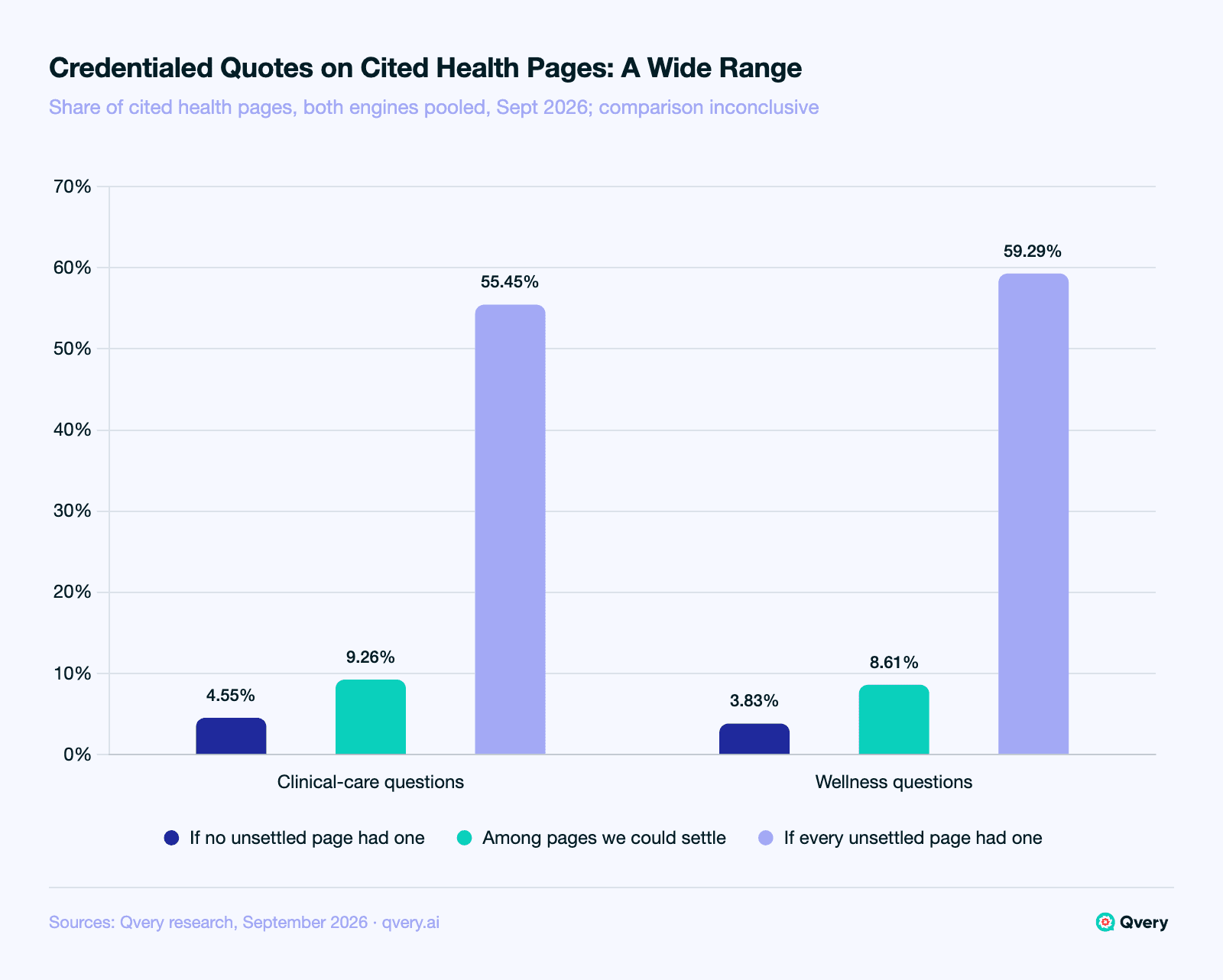
The pages we couldn't settle change that.
There were enough of them that the true share could sit anywhere from 4.55% to 55.45% on the clinical-care side and from 3.83% to 59.29% on the wellness side. So the comparison between the two surfaces is inconclusive, and these results don't tell you which one to start on.
What a documented quote looked like is clearer. On pages cited for clinical-care questions:
Health systems quoting their own clinicians: an HSS physical therapist on exercises after knee replacement, a Johns Hopkins Medicine bone center director on osteoporosis, and a University of Utah Health maternal-fetal medicine specialist on recovery after a C-section.
Care companies quoting their own clinicians: Hinge Health and Oshi Health.
A specialist publisher quoting an outside physician: Migraine Again.
A public-sector page quoting a named clinician: GOV.UK.
On pages cited for wellness questions:
Health systems quoting their own physicians: Stanford Medicine, Geisinger, and HSS.
Publishers quoting a dietitian: Healthline and AARP.
A patient-community publisher quoting an outside physician: CreakyJoints.
A public-sector page quoting a named clinician: the NHS.
Healthcare Success describes how AI systems "scan huge parts of the web, pick a short list of trustworthy sources and then synthesize an answer," often with no click to your site.
This data doesn't measure how sources are picked or whether anyone clicks. It shows that most of the settled pages on both surfaces carried no credentialed quote, so a quote isn't what those cited pages have in common.
The Answer Cites the Page; It Named the Clinician Once
The second half of the pipeline is the name: when an answer cites a page quoting your clinician, does it say who they are?
One answer did, on the clinical-care side. It listed the physician among provider options and cited his profile page at a university health system, which makes it a provider listing more than a quote paying off.
On the wellness side, no carriage was documented, with three answers that couldn't be resolved; that's not the same as none.
Eight clinical-care answers couldn't be resolved either, because the name couldn't be confirmed on the cited page. The comparison between the surfaces is inconclusive.
A placement pays off at the page. The answer carried the quoted clinician's name once in this whole set, so the page is the thing to measure.
Inizio Evoke argues that "Conversational content, structured data, and expert-reviewed pages will be critical in maintaining a presence within AI responses." This audit didn't count a review credit as a quote, so it says nothing about review credits, and it tests no link between either one and being cited.
Do Not Assume One Quote-Positive Publisher List Serves Both Surfaces
The obvious next step is a single outreach list of publishers that quote clinicians. This data can't give you one, and it can't tell you whether one list would serve both surfaces.
The publishers with documented quotes fell well short of the audit list the test needs on either surface, and the unsettled pages could add more. So one list, a shared core, or two lists are all still open.
Run the test on your own audit:
List the publishers whose cited pages quote your clinicians, separately for clinical-care and wellness questions.
Check each list against the other surface's answers before treating them as one.
For building the general healthcare audit list, see measuring healthcare AI engine visibility.
Halcy writes that "health AI Overviews tend to cite authoritative sources: government health sites, major medical centers, and established health information sites."
This data reads ChatGPT and Google AI Mode answers, and it doesn't rank which kinds of sources get cited. The quote-positive pages above include government, charity, health-system, publisher, and patient-community pages, and that's membership, not a ranking.
Monitor Paired Questions in Qvery and Adjudicate Cited Pages Separately
Add your category's health needs to Qvery as paired queries, one clinical-care question and one wellness question for each. Qvery tracks them daily on ChatGPT and Google AI Mode, in any of 200+ countries, and reports your visibility, share of voice, and average rank.
Every citation is tied to the query and the engine that produced it, so you can see which pages the answers cite on each surface, including any page carrying your clinicians' quotes. Ask Qvery Assistant which pages your clinical-care questions cited this week and it answers from your own data.
Reading each cited page for a credentialed quote, and reading the answer for your clinician's name, happens outside Qvery. Start a free 7-day trial, no credit card required, and set up your first ten pairs.
Where These Numbers Stop
This is one set of unbranded clinical-care and wellness recommendation questions, on ChatGPT and Google AI Mode, pooled. It covers no informational questions and no other engine.
It measures presence, not effect: nothing says a quote earned a citation, a mention, a click, or a recommendation, and no brand naming or recommendation status was measured. Review credits are outside the audit.
Many pages stayed unsettled: a named person quoted with no stated credential, a long page with a part that couldn't be settled, pages behind a bot check or login, and some pages that couldn't be fetched. None of them counted as no quote.
The page labels are model judgments, cross-scored and checked, with the list of eligible pages hand-checked before any fetch. Clinician names were matched in the answers by code, with a sample checked by hand. There's no engine comparison, and nothing is compared with an earlier period.
Judge the Placement by the Page
From these results, judge a clinician-quote placement by whether AI answers cite the page that carries it, tracked separately on clinical-care and wellness questions, and not by whether the answer names your clinician. Let your own paired audit, not this data, pick the surface and the publisher list.
If you market a health brand, you've probably been pitched an expert-quote pipeline: get your physicians, dietitians, and physical therapists quoted on respected health sites, and AI answers will follow. It's a sensible plan, and an expensive one to run blind.
Before you fund it, it's worth knowing how often the health pages AI answers already cite carry a quote from a credentialed clinician at all, and whether the answer ever names that clinician.
So we asked ChatGPT and Google AI Mode the same health needs two ways in September 2026, once as a clinical-care recommendation question and once as a wellness one, read the health pages the answers cited, and checked the answers for the quoted clinicians' names.
Among the pages we could settle, 9.26% of clinical-care pages and 8.61% of wellness pages quoted a named clinician with a stated credential. So many pages couldn't be settled that the two surfaces can't be compared. And of the answers citing such a page, exactly one named the quoted clinician.
The practical read: judge a quote placement by whether AI answers cite the page, tracked separately on each kind of question, not by whether the answer names your clinician. This measures what was present, not what earns a citation.
What Counts as a Credentialed Quote on a Cited Page
The audit is worth copying, so here is how it worked.
We wrote each health need twice: once as a clinical-care recommendation question and once as a wellness question, across nutrition, sleep, physical activity, prevention, symptom navigation, care access, recovery, and healthy aging. How the cited sources themselves differ between clinical and wellness claims is covered in health product citations by claim type.
A page counted as carrying a credentialed quote only if it did both of these:
Attributed specific words to a named person, in quotation marks, with "says" or "recommends", or as a labelled expert answer.
Stated that person's clinical credential or role, on the page or in a linked bio.
A byline, an author box, or a "medically reviewed by" credit alone didn't count. A named "Dr." with no stated credential stayed unresolved.
The pages in scope were health-information, publisher, provider, hospital, public-health, and clinical-practice pages. Homepages, directory listings, app-store pages, social profiles, video, shops, insurers, and community threads were left out; Reddit's role in health answers is covered in Reddit and healthcare AI visibility.
Every page was read in full, long pages in parts, and a page counted as having no quote only when every part read had none. An unresolved page never counted as no quote.
These Results Don't Settle Which Surface to Start On
Among the cited clinical-care pages we could settle, 9.26% carried a credentialed quote.
Among the cited wellness pages we could settle, 8.61% did.
The pages we couldn't settle change that.
There were enough of them that the true share could sit anywhere from 4.55% to 55.45% on the clinical-care side and from 3.83% to 59.29% on the wellness side. So the comparison between the two surfaces is inconclusive, and these results don't tell you which one to start on.
What a documented quote looked like is clearer. On pages cited for clinical-care questions:
Health systems quoting their own clinicians: an HSS physical therapist on exercises after knee replacement, a Johns Hopkins Medicine bone center director on osteoporosis, and a University of Utah Health maternal-fetal medicine specialist on recovery after a C-section.
Care companies quoting their own clinicians: Hinge Health and Oshi Health.
A specialist publisher quoting an outside physician: Migraine Again.
A public-sector page quoting a named clinician: GOV.UK.
On pages cited for wellness questions:
Health systems quoting their own physicians: Stanford Medicine, Geisinger, and HSS.
Publishers quoting a dietitian: Healthline and AARP.
A patient-community publisher quoting an outside physician: CreakyJoints.
A public-sector page quoting a named clinician: the NHS.
Healthcare Success describes how AI systems "scan huge parts of the web, pick a short list of trustworthy sources and then synthesize an answer," often with no click to your site.
This data doesn't measure how sources are picked or whether anyone clicks. It shows that most of the settled pages on both surfaces carried no credentialed quote, so a quote isn't what those cited pages have in common.
The Answer Cites the Page; It Named the Clinician Once
The second half of the pipeline is the name: when an answer cites a page quoting your clinician, does it say who they are?
One answer did, on the clinical-care side. It listed the physician among provider options and cited his profile page at a university health system, which makes it a provider listing more than a quote paying off.
On the wellness side, no carriage was documented, with three answers that couldn't be resolved; that's not the same as none.
Eight clinical-care answers couldn't be resolved either, because the name couldn't be confirmed on the cited page. The comparison between the surfaces is inconclusive.
A placement pays off at the page. The answer carried the quoted clinician's name once in this whole set, so the page is the thing to measure.
Inizio Evoke argues that "Conversational content, structured data, and expert-reviewed pages will be critical in maintaining a presence within AI responses." This audit didn't count a review credit as a quote, so it says nothing about review credits, and it tests no link between either one and being cited.
Do Not Assume One Quote-Positive Publisher List Serves Both Surfaces
The obvious next step is a single outreach list of publishers that quote clinicians. This data can't give you one, and it can't tell you whether one list would serve both surfaces.
The publishers with documented quotes fell well short of the audit list the test needs on either surface, and the unsettled pages could add more. So one list, a shared core, or two lists are all still open.
Run the test on your own audit:
List the publishers whose cited pages quote your clinicians, separately for clinical-care and wellness questions.
Check each list against the other surface's answers before treating them as one.
For building the general healthcare audit list, see measuring healthcare AI engine visibility.
Halcy writes that "health AI Overviews tend to cite authoritative sources: government health sites, major medical centers, and established health information sites."
This data reads ChatGPT and Google AI Mode answers, and it doesn't rank which kinds of sources get cited. The quote-positive pages above include government, charity, health-system, publisher, and patient-community pages, and that's membership, not a ranking.
Monitor Paired Questions in Qvery and Adjudicate Cited Pages Separately
Add your category's health needs to Qvery as paired queries, one clinical-care question and one wellness question for each. Qvery tracks them daily on ChatGPT and Google AI Mode, in any of 200+ countries, and reports your visibility, share of voice, and average rank.
Every citation is tied to the query and the engine that produced it, so you can see which pages the answers cite on each surface, including any page carrying your clinicians' quotes. Ask Qvery Assistant which pages your clinical-care questions cited this week and it answers from your own data.
Reading each cited page for a credentialed quote, and reading the answer for your clinician's name, happens outside Qvery. Start a free 7-day trial, no credit card required, and set up your first ten pairs.
Where These Numbers Stop
This is one set of unbranded clinical-care and wellness recommendation questions, on ChatGPT and Google AI Mode, pooled. It covers no informational questions and no other engine.
It measures presence, not effect: nothing says a quote earned a citation, a mention, a click, or a recommendation, and no brand naming or recommendation status was measured. Review credits are outside the audit.
Many pages stayed unsettled: a named person quoted with no stated credential, a long page with a part that couldn't be settled, pages behind a bot check or login, and some pages that couldn't be fetched. None of them counted as no quote.
The page labels are model judgments, cross-scored and checked, with the list of eligible pages hand-checked before any fetch. Clinician names were matched in the answers by code, with a sample checked by hand. There's no engine comparison, and nothing is compared with an earlier period.
Judge the Placement by the Page
From these results, judge a clinician-quote placement by whether AI answers cite the page that carries it, tracked separately on clinical-care and wellness questions, and not by whether the answer names your clinician. Let your own paired audit, not this data, pick the surface and the publisher list.
If you market a health brand, you've probably been pitched an expert-quote pipeline: get your physicians, dietitians, and physical therapists quoted on respected health sites, and AI answers will follow. It's a sensible plan, and an expensive one to run blind.
Before you fund it, it's worth knowing how often the health pages AI answers already cite carry a quote from a credentialed clinician at all, and whether the answer ever names that clinician.
So we asked ChatGPT and Google AI Mode the same health needs two ways in September 2026, once as a clinical-care recommendation question and once as a wellness one, read the health pages the answers cited, and checked the answers for the quoted clinicians' names.
Among the pages we could settle, 9.26% of clinical-care pages and 8.61% of wellness pages quoted a named clinician with a stated credential. So many pages couldn't be settled that the two surfaces can't be compared. And of the answers citing such a page, exactly one named the quoted clinician.
The practical read: judge a quote placement by whether AI answers cite the page, tracked separately on each kind of question, not by whether the answer names your clinician. This measures what was present, not what earns a citation.
What Counts as a Credentialed Quote on a Cited Page
The audit is worth copying, so here is how it worked.
We wrote each health need twice: once as a clinical-care recommendation question and once as a wellness question, across nutrition, sleep, physical activity, prevention, symptom navigation, care access, recovery, and healthy aging. How the cited sources themselves differ between clinical and wellness claims is covered in health product citations by claim type.
A page counted as carrying a credentialed quote only if it did both of these:
Attributed specific words to a named person, in quotation marks, with "says" or "recommends", or as a labelled expert answer.
Stated that person's clinical credential or role, on the page or in a linked bio.
A byline, an author box, or a "medically reviewed by" credit alone didn't count. A named "Dr." with no stated credential stayed unresolved.
The pages in scope were health-information, publisher, provider, hospital, public-health, and clinical-practice pages. Homepages, directory listings, app-store pages, social profiles, video, shops, insurers, and community threads were left out; Reddit's role in health answers is covered in Reddit and healthcare AI visibility.
Every page was read in full, long pages in parts, and a page counted as having no quote only when every part read had none. An unresolved page never counted as no quote.
These Results Don't Settle Which Surface to Start On
Among the cited clinical-care pages we could settle, 9.26% carried a credentialed quote.
Among the cited wellness pages we could settle, 8.61% did.
The pages we couldn't settle change that.
There were enough of them that the true share could sit anywhere from 4.55% to 55.45% on the clinical-care side and from 3.83% to 59.29% on the wellness side. So the comparison between the two surfaces is inconclusive, and these results don't tell you which one to start on.
What a documented quote looked like is clearer. On pages cited for clinical-care questions:
Health systems quoting their own clinicians: an HSS physical therapist on exercises after knee replacement, a Johns Hopkins Medicine bone center director on osteoporosis, and a University of Utah Health maternal-fetal medicine specialist on recovery after a C-section.
Care companies quoting their own clinicians: Hinge Health and Oshi Health.
A specialist publisher quoting an outside physician: Migraine Again.
A public-sector page quoting a named clinician: GOV.UK.
On pages cited for wellness questions:
Health systems quoting their own physicians: Stanford Medicine, Geisinger, and HSS.
Publishers quoting a dietitian: Healthline and AARP.
A patient-community publisher quoting an outside physician: CreakyJoints.
A public-sector page quoting a named clinician: the NHS.
Healthcare Success describes how AI systems "scan huge parts of the web, pick a short list of trustworthy sources and then synthesize an answer," often with no click to your site.
This data doesn't measure how sources are picked or whether anyone clicks. It shows that most of the settled pages on both surfaces carried no credentialed quote, so a quote isn't what those cited pages have in common.
The Answer Cites the Page; It Named the Clinician Once
The second half of the pipeline is the name: when an answer cites a page quoting your clinician, does it say who they are?
One answer did, on the clinical-care side. It listed the physician among provider options and cited his profile page at a university health system, which makes it a provider listing more than a quote paying off.
On the wellness side, no carriage was documented, with three answers that couldn't be resolved; that's not the same as none.
Eight clinical-care answers couldn't be resolved either, because the name couldn't be confirmed on the cited page. The comparison between the surfaces is inconclusive.
A placement pays off at the page. The answer carried the quoted clinician's name once in this whole set, so the page is the thing to measure.
Inizio Evoke argues that "Conversational content, structured data, and expert-reviewed pages will be critical in maintaining a presence within AI responses." This audit didn't count a review credit as a quote, so it says nothing about review credits, and it tests no link between either one and being cited.
Do Not Assume One Quote-Positive Publisher List Serves Both Surfaces
The obvious next step is a single outreach list of publishers that quote clinicians. This data can't give you one, and it can't tell you whether one list would serve both surfaces.
The publishers with documented quotes fell well short of the audit list the test needs on either surface, and the unsettled pages could add more. So one list, a shared core, or two lists are all still open.
Run the test on your own audit:
List the publishers whose cited pages quote your clinicians, separately for clinical-care and wellness questions.
Check each list against the other surface's answers before treating them as one.
For building the general healthcare audit list, see measuring healthcare AI engine visibility.
Halcy writes that "health AI Overviews tend to cite authoritative sources: government health sites, major medical centers, and established health information sites."
This data reads ChatGPT and Google AI Mode answers, and it doesn't rank which kinds of sources get cited. The quote-positive pages above include government, charity, health-system, publisher, and patient-community pages, and that's membership, not a ranking.
Monitor Paired Questions in Qvery and Adjudicate Cited Pages Separately
Add your category's health needs to Qvery as paired queries, one clinical-care question and one wellness question for each. Qvery tracks them daily on ChatGPT and Google AI Mode, in any of 200+ countries, and reports your visibility, share of voice, and average rank.
Every citation is tied to the query and the engine that produced it, so you can see which pages the answers cite on each surface, including any page carrying your clinicians' quotes. Ask Qvery Assistant which pages your clinical-care questions cited this week and it answers from your own data.
Reading each cited page for a credentialed quote, and reading the answer for your clinician's name, happens outside Qvery. Start a free 7-day trial, no credit card required, and set up your first ten pairs.
Where These Numbers Stop
This is one set of unbranded clinical-care and wellness recommendation questions, on ChatGPT and Google AI Mode, pooled. It covers no informational questions and no other engine.
It measures presence, not effect: nothing says a quote earned a citation, a mention, a click, or a recommendation, and no brand naming or recommendation status was measured. Review credits are outside the audit.
Many pages stayed unsettled: a named person quoted with no stated credential, a long page with a part that couldn't be settled, pages behind a bot check or login, and some pages that couldn't be fetched. None of them counted as no quote.
The page labels are model judgments, cross-scored and checked, with the list of eligible pages hand-checked before any fetch. Clinician names were matched in the answers by code, with a sample checked by hand. There's no engine comparison, and nothing is compared with an earlier period.
Judge the Placement by the Page
From these results, judge a clinician-quote placement by whether AI answers cite the page that carries it, tracked separately on clinical-care and wellness questions, and not by whether the answer names your clinician. Let your own paired audit, not this data, pick the surface and the publisher list.
If you market a health brand, you've probably been pitched an expert-quote pipeline: get your physicians, dietitians, and physical therapists quoted on respected health sites, and AI answers will follow. It's a sensible plan, and an expensive one to run blind.
Before you fund it, it's worth knowing how often the health pages AI answers already cite carry a quote from a credentialed clinician at all, and whether the answer ever names that clinician.
So we asked ChatGPT and Google AI Mode the same health needs two ways in September 2026, once as a clinical-care recommendation question and once as a wellness one, read the health pages the answers cited, and checked the answers for the quoted clinicians' names.
Among the pages we could settle, 9.26% of clinical-care pages and 8.61% of wellness pages quoted a named clinician with a stated credential. So many pages couldn't be settled that the two surfaces can't be compared. And of the answers citing such a page, exactly one named the quoted clinician.
The practical read: judge a quote placement by whether AI answers cite the page, tracked separately on each kind of question, not by whether the answer names your clinician. This measures what was present, not what earns a citation.
What Counts as a Credentialed Quote on a Cited Page
The audit is worth copying, so here is how it worked.
We wrote each health need twice: once as a clinical-care recommendation question and once as a wellness question, across nutrition, sleep, physical activity, prevention, symptom navigation, care access, recovery, and healthy aging. How the cited sources themselves differ between clinical and wellness claims is covered in health product citations by claim type.
A page counted as carrying a credentialed quote only if it did both of these:
Attributed specific words to a named person, in quotation marks, with "says" or "recommends", or as a labelled expert answer.
Stated that person's clinical credential or role, on the page or in a linked bio.
A byline, an author box, or a "medically reviewed by" credit alone didn't count. A named "Dr." with no stated credential stayed unresolved.
The pages in scope were health-information, publisher, provider, hospital, public-health, and clinical-practice pages. Homepages, directory listings, app-store pages, social profiles, video, shops, insurers, and community threads were left out; Reddit's role in health answers is covered in Reddit and healthcare AI visibility.
Every page was read in full, long pages in parts, and a page counted as having no quote only when every part read had none. An unresolved page never counted as no quote.
These Results Don't Settle Which Surface to Start On
Among the cited clinical-care pages we could settle, 9.26% carried a credentialed quote.
Among the cited wellness pages we could settle, 8.61% did.
The pages we couldn't settle change that.
There were enough of them that the true share could sit anywhere from 4.55% to 55.45% on the clinical-care side and from 3.83% to 59.29% on the wellness side. So the comparison between the two surfaces is inconclusive, and these results don't tell you which one to start on.
What a documented quote looked like is clearer. On pages cited for clinical-care questions:
Health systems quoting their own clinicians: an HSS physical therapist on exercises after knee replacement, a Johns Hopkins Medicine bone center director on osteoporosis, and a University of Utah Health maternal-fetal medicine specialist on recovery after a C-section.
Care companies quoting their own clinicians: Hinge Health and Oshi Health.
A specialist publisher quoting an outside physician: Migraine Again.
A public-sector page quoting a named clinician: GOV.UK.
On pages cited for wellness questions:
Health systems quoting their own physicians: Stanford Medicine, Geisinger, and HSS.
Publishers quoting a dietitian: Healthline and AARP.
A patient-community publisher quoting an outside physician: CreakyJoints.
A public-sector page quoting a named clinician: the NHS.
Healthcare Success describes how AI systems "scan huge parts of the web, pick a short list of trustworthy sources and then synthesize an answer," often with no click to your site.
This data doesn't measure how sources are picked or whether anyone clicks. It shows that most of the settled pages on both surfaces carried no credentialed quote, so a quote isn't what those cited pages have in common.
The Answer Cites the Page; It Named the Clinician Once
The second half of the pipeline is the name: when an answer cites a page quoting your clinician, does it say who they are?
One answer did, on the clinical-care side. It listed the physician among provider options and cited his profile page at a university health system, which makes it a provider listing more than a quote paying off.
On the wellness side, no carriage was documented, with three answers that couldn't be resolved; that's not the same as none.
Eight clinical-care answers couldn't be resolved either, because the name couldn't be confirmed on the cited page. The comparison between the surfaces is inconclusive.
A placement pays off at the page. The answer carried the quoted clinician's name once in this whole set, so the page is the thing to measure.
Inizio Evoke argues that "Conversational content, structured data, and expert-reviewed pages will be critical in maintaining a presence within AI responses." This audit didn't count a review credit as a quote, so it says nothing about review credits, and it tests no link between either one and being cited.
Do Not Assume One Quote-Positive Publisher List Serves Both Surfaces
The obvious next step is a single outreach list of publishers that quote clinicians. This data can't give you one, and it can't tell you whether one list would serve both surfaces.
The publishers with documented quotes fell well short of the audit list the test needs on either surface, and the unsettled pages could add more. So one list, a shared core, or two lists are all still open.
Run the test on your own audit:
List the publishers whose cited pages quote your clinicians, separately for clinical-care and wellness questions.
Check each list against the other surface's answers before treating them as one.
For building the general healthcare audit list, see measuring healthcare AI engine visibility.
Halcy writes that "health AI Overviews tend to cite authoritative sources: government health sites, major medical centers, and established health information sites."
This data reads ChatGPT and Google AI Mode answers, and it doesn't rank which kinds of sources get cited. The quote-positive pages above include government, charity, health-system, publisher, and patient-community pages, and that's membership, not a ranking.
Monitor Paired Questions in Qvery and Adjudicate Cited Pages Separately
Add your category's health needs to Qvery as paired queries, one clinical-care question and one wellness question for each. Qvery tracks them daily on ChatGPT and Google AI Mode, in any of 200+ countries, and reports your visibility, share of voice, and average rank.
Every citation is tied to the query and the engine that produced it, so you can see which pages the answers cite on each surface, including any page carrying your clinicians' quotes. Ask Qvery Assistant which pages your clinical-care questions cited this week and it answers from your own data.
Reading each cited page for a credentialed quote, and reading the answer for your clinician's name, happens outside Qvery. Start a free 7-day trial, no credit card required, and set up your first ten pairs.
Where These Numbers Stop
This is one set of unbranded clinical-care and wellness recommendation questions, on ChatGPT and Google AI Mode, pooled. It covers no informational questions and no other engine.
It measures presence, not effect: nothing says a quote earned a citation, a mention, a click, or a recommendation, and no brand naming or recommendation status was measured. Review credits are outside the audit.
Many pages stayed unsettled: a named person quoted with no stated credential, a long page with a part that couldn't be settled, pages behind a bot check or login, and some pages that couldn't be fetched. None of them counted as no quote.
The page labels are model judgments, cross-scored and checked, with the list of eligible pages hand-checked before any fetch. Clinician names were matched in the answers by code, with a sample checked by hand. There's no engine comparison, and nothing is compared with an earlier period.
Judge the Placement by the Page
From these results, judge a clinician-quote placement by whether AI answers cite the page that carries it, tracked separately on clinical-care and wellness questions, and not by whether the answer names your clinician. Let your own paired audit, not this data, pick the surface and the publisher list.
© 2026 Qvery AI OÜ