By
Vlad Shvets
Content Marketing Statistics 2026: 50+ Numbers on the Function AI Is Rewiring
Content still drives the buying decision, buyers self-educate long before sales. But the distribution it relied on is fracturing as AI intercepts the funnel. Here are 45+ verified statistics on the shift.
Content still drives the buying decision, buyers self-educate long before sales. But the distribution it relied on is fracturing as AI intercepts the funnel. Here are 45+ verified statistics on the shift.
Content still drives the buying decision, buyers self-educate long before sales. But the distribution it relied on is fracturing as AI intercepts the funnel. Here are 45+ verified statistics on the shift.
By the time a B2B buyer talks to your sales team, the decision is mostly made. 84% of buyers say the first vendor they contacted won the business¹, and they only reach out when they are already 70% through the buying journey, roughly eight months into a deal¹. Sales didn't win that deal. The content did, months earlier, while no one was watching.
That has always been content marketing's quiet superpower and its measurement nightmare. What is new in 2026 is the intermediary. Buyers now do that self-education through AI: 94% of business buyers used AI in their buying process, and more of them named generative AI their single most meaningful information source than named vendor websites, experts, or sales². The content still does the work. It just reaches the buyer through an answer engine that may or may not name you.
We pulled the most credible, independently verified statistics on content marketing we could find, from the Content Marketing Institute, HubSpot, Gartner, Forrester, Edelman, and the firms that measure where content gets consumed.
A few figures come from our own AI-citation data at Qvery. Everything else is footnoted to its original source. Read together, they describe a function that still drives the buying decision, whose free distribution channels are collapsing at once, and whose new job is to be the content an AI answer cites.
Highlights
84% of B2B buyers say the first vendor they contacted won¹, and they engage sales only 70% through the journey¹.
94% of business buyers used AI in their buying process, now their most meaningful information source².
Website, blog, and SEO is the #1 ROI-driving channel, cited by 27% of marketers³.
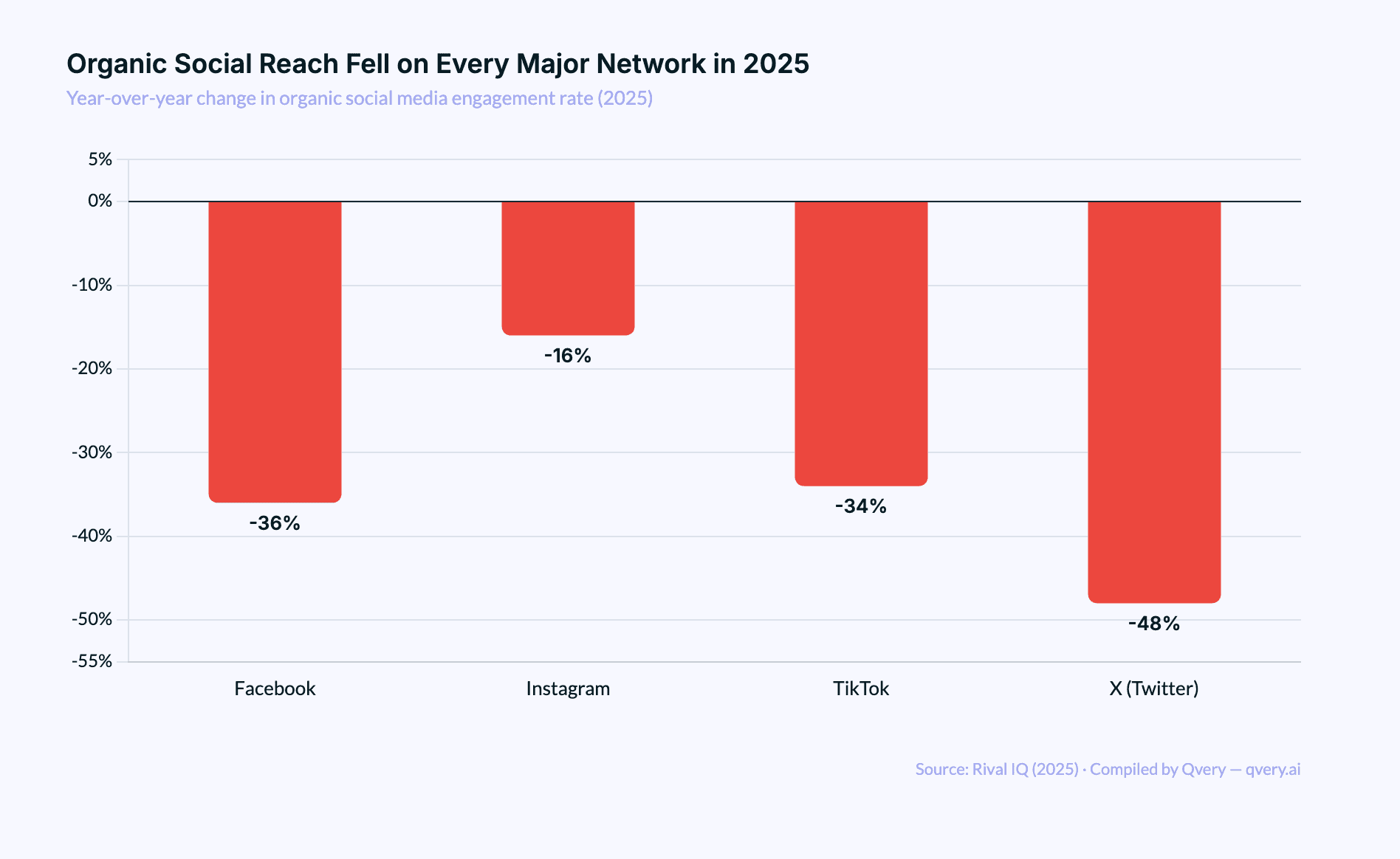
Organic social engagement fell on every major social network in 2025, including Facebook down 36% and X down 48%⁴.
96.55% of all pages get zero traffic from Google⁵, and 10 million new pages worth indexing appear each day⁵.
Listicles are 45.8% of all classifiable AI citations, the single most-cited content type⁶.
87.75% of AI citations go to brand and niche sites, not the internet giants⁷.
Only 13.9% of the domains AI engines cite also rank in Google's organic top 10¹⁶.
Content Still Decides the Buying Decision
The case for content marketing was never really about traffic. It was about being the trusted answer while a buyer quietly makes up their mind. The data on how B2B buying works makes that vivid.
67% of B2B buyers prefer a rep-free buying experience, doing their research through digital channels⁸.
Content marketing is now a staffed function: 76% of B2B organizations have a dedicated content team or person⁹.
More than a third of buyers sought out third-party content in 2024, up from under a quarter the year before¹⁰.
The thought-leadership research puts numbers on the influence. 73% of decision-makers say thought-leadership content is a more trustworthy basis for judging a vendor than its marketing materials¹¹, 75% say a piece of it led them to research a product they weren't considering¹¹, and 70% of C-suite leaders say it made them question an existing supplier¹¹. Content creates demand as much as it captures it, and quietly pulls it away from incumbents. That's the job, and it's worth doing well precisely because the buyer is doing it alone.
The Formats That Work
What buyers consume and what marketers make do not always match, and the gap is where the opportunity sits. In B2B, short articles are the most-used format at 92%, followed by video at 76% and case studies at 75%⁹, but marketers rate video the most effective (58%), then case studies (53%)⁹.
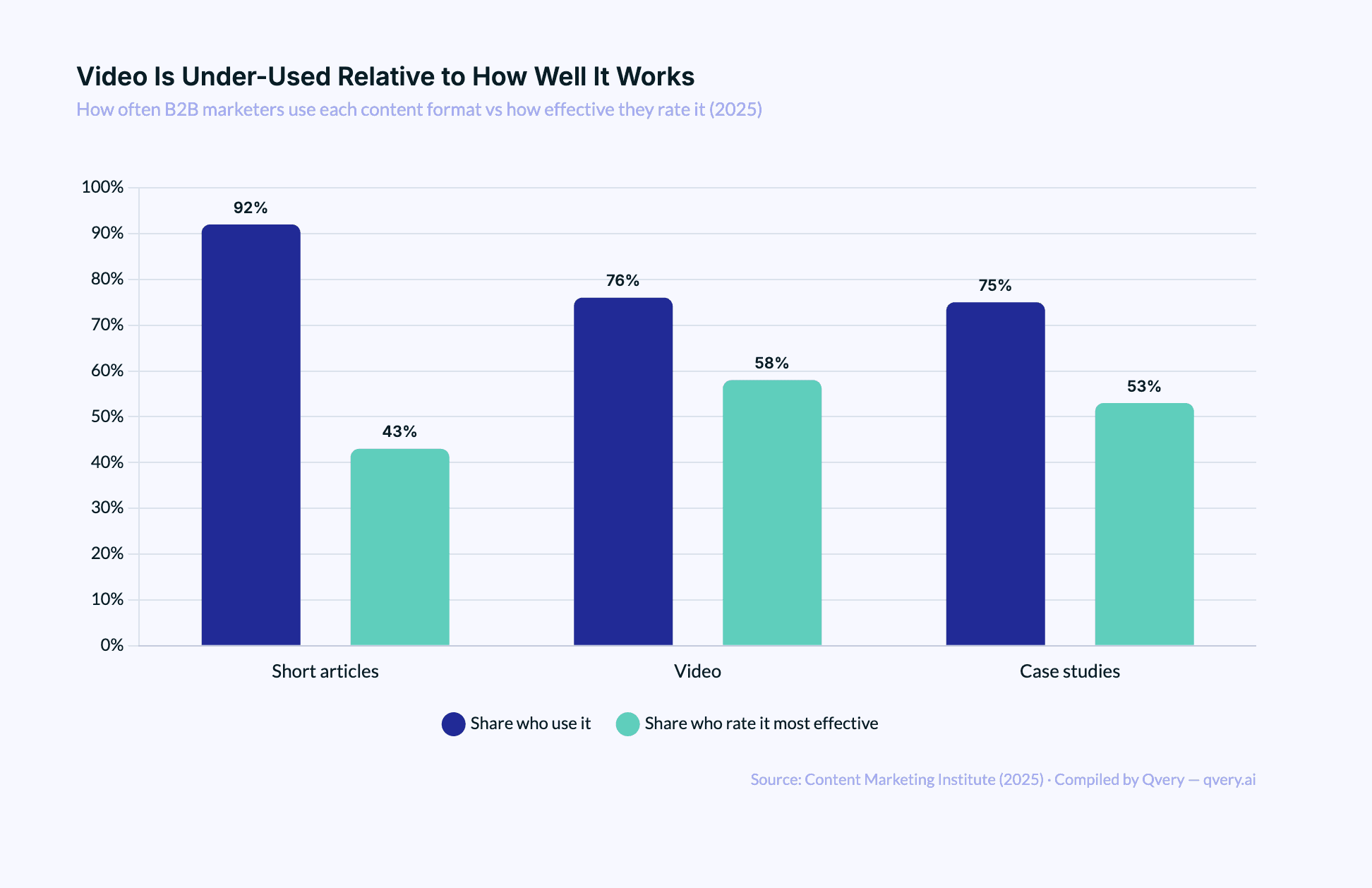
Video dominates human attention. 91% of businesses use video, 82% say it delivers good ROI, and people say they would rather learn about a product from a short video than a text article by 63% to 12%¹². AI engines, though, can't watch a video to save their lives; they read the text.
So the content that persuades a human and the content that gets cited by a machine are drifting apart, and the smart content teams are producing both. The blog isn't dead, either. It moved up to the third most-used format at 38%³, and text is exactly what answer engines quote.
The Measurement Problem Just Got Worse
Content marketing has always struggled to prove itself, and the numbers are blunt about it. Only 29% of B2B marketers call their content strategy extremely or very effective⁹, only 12% rate their marketing highly effective over the past year¹³, and a third name measuring content effectiveness a top-three challenge¹³. A third of content marketers admit they can't measure whether their content works, which is a bold thing to build a hundred-person function on.
The measurement crisis is about to get worse, because the proxy everyone leaned on is disappearing. 42% of producers still measure success by looking for more website and social traffic¹¹, which is exactly the number AI answers are cutting.
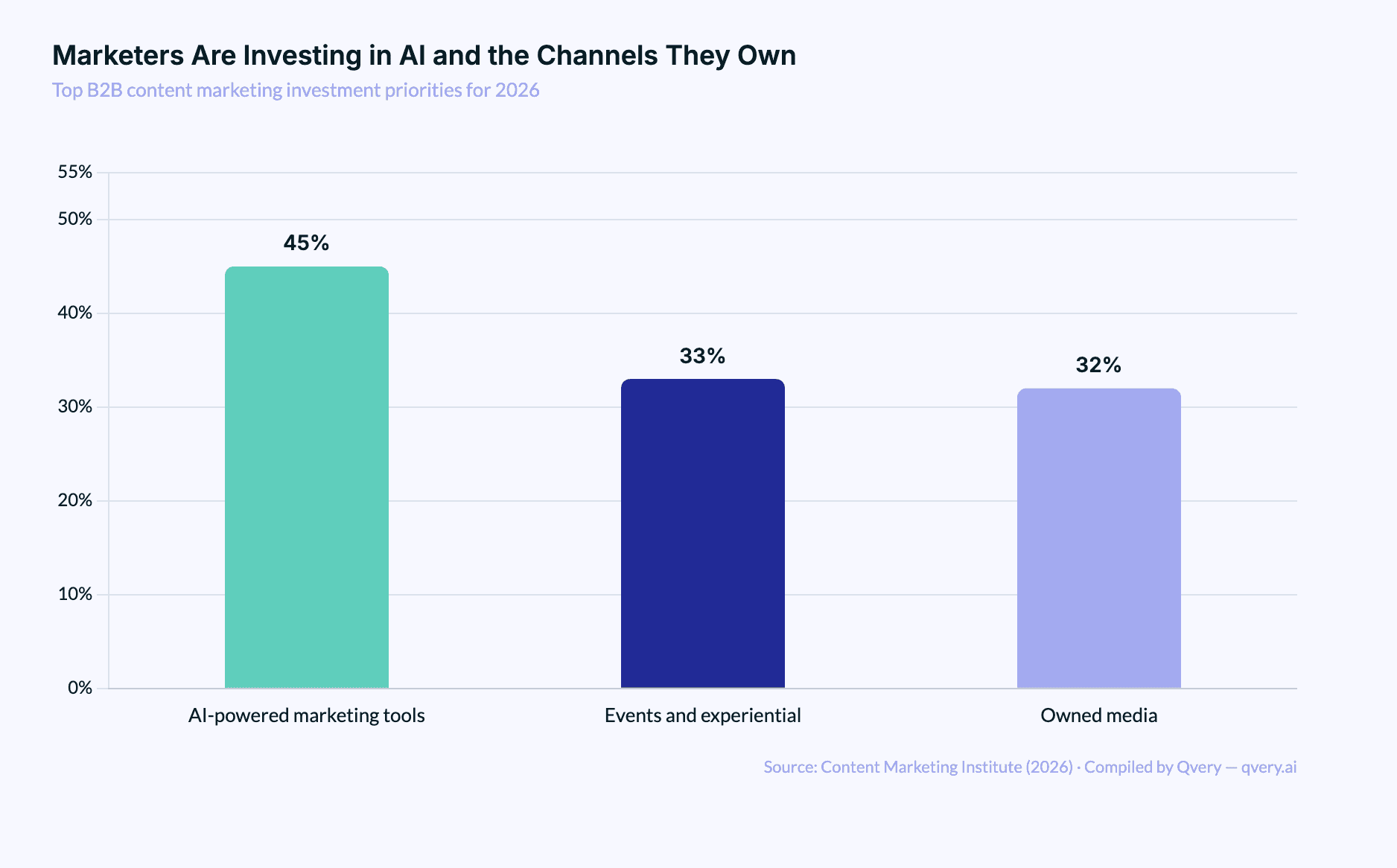
The good news in the 2026 budgets is that marketers are shifting toward channels they control: AI tools lead investment at 45%, but owned media sits right behind at 32%¹³. The instinct is right. Own the content and the audience, because the borrowed distribution is collapsing.
The Distribution It Relied On Is Fracturing
Every free channel content marketing was built to ride is closing at the same time. Start with social, which was supposed to be the great equalizer. In 2025, organic engagement fell on every major social network.
Organic search is no gentler. 96.55% of all pages get zero traffic from Google⁵, and the reason is partly sheer volume: Ahrefs finds 10 million new pages worth indexing every single day⁵. Your blog post isn't entering a library. It's entering a stampede.
The old content-marketing promise, publish something useful and the audience will find it, quietly stopped being true, and it stopped being true before AI arrived to finish the job. Publishing was never the same thing as distribution, and that gap is now a chasm.
AI Is Intercepting the Top of the Funnel
Into that fractured distribution steps the answer engine, and it sits directly between your content and the buyer. Gartner projects traditional search volume will drop 25% by 2026 as AI chatbots absorb queries¹⁴, and the click behavior is already measurable.
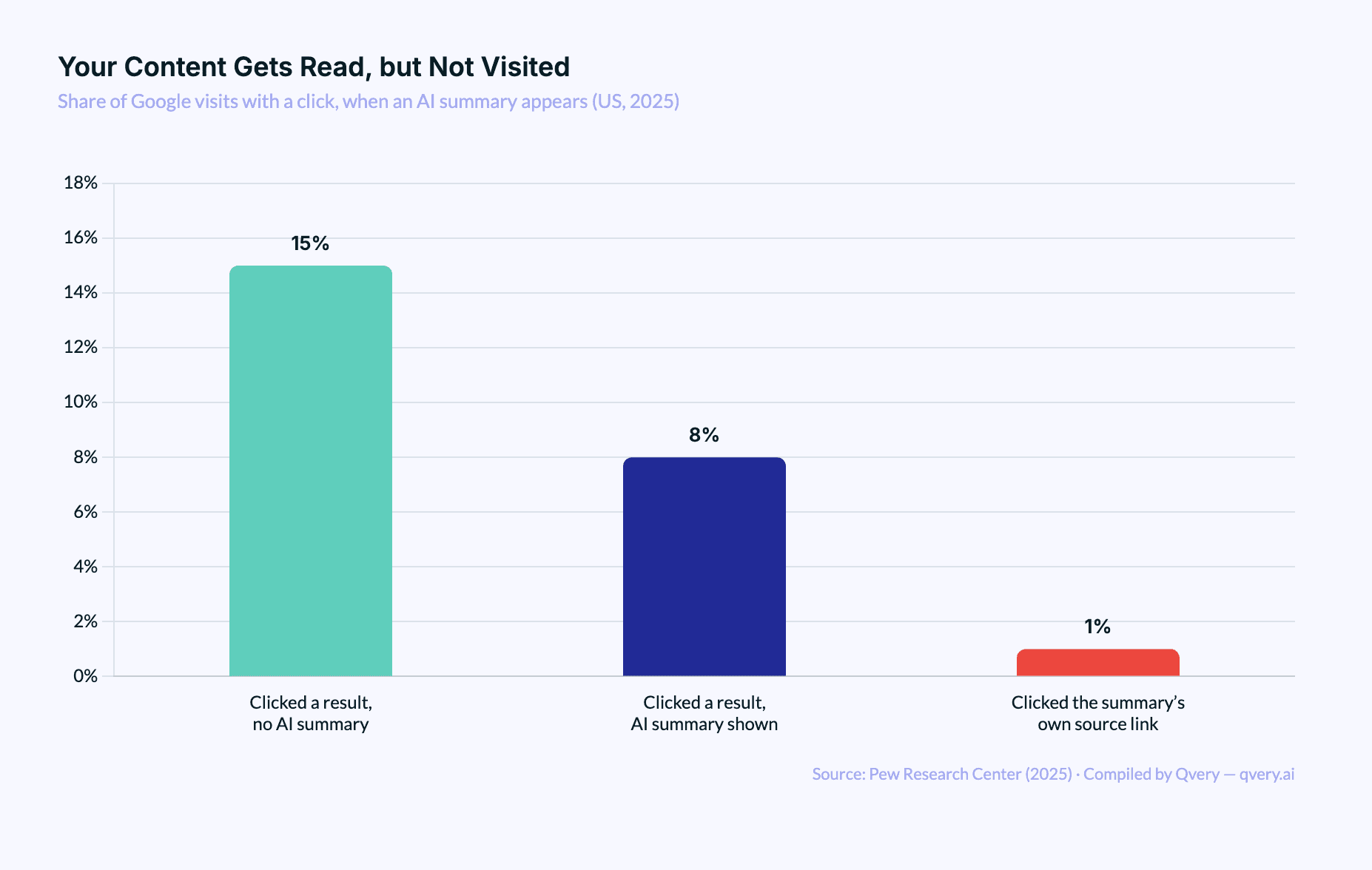
When an AI summary appears, people click a result in 8% of visits versus 15% without one, and they click the summary's own cited source just 1% of the time¹⁵. Your content can be read, synthesized, and used to answer the question without anyone ever landing on your page. On the buyer side, 45% of B2B buyers used AI during a recent purchase⁸, and for a growing share it is their primary research surface. The content still does the persuading. It just does it inside an answer you didn't write and can't see, which is exactly why being named in that answer is the new distribution.
Where Content Still Wins
None of this means the content function is losing. It means the payoff moved. Genuine expertise still commands attention from the exact people who sign the contracts: 52% of decision-makers and 54% of the C-suite spend an hour or more a week reading thought leadership¹¹. And it converts into pipeline in a way marketers routinely underestimate.
86% of decision-makers say they will invite a company that consistently produces strong thought leadership to the RFP, yet only 38% of producers expect that payoff¹¹.
Even now, 95% of business buyers are not actively in-market at any given moment¹¹, so the content that reaches them early decides who they consider later.
Owned content remains the top-reported ROI channel, and in AI answers 87.75% of citations go to brand sites, niche publications, and specialist pages⁷.
The through-line is that the same content that earns human trust, specific, expert, genuinely useful, is the content answer engines pull from. Same craft, new scoreboard. Building authority is still the work; being cited for it is the new measure of whether the work reached anyone.
The New Content KPI Is Getting Cited
If traffic is the metric AI is erasing, citation is the one replacing it, and our data shows the new game has different rules. Listicles are 45.8% of all classifiable AI citations, the single most-referenced content type⁶. The listicle, the format every serious marketer was told to be embarrassed about, is exactly what AI engines reach for most, and somewhere a thought-leadership consultant just felt a chill.

The engines also reward format very differently: ChatGPT cites listicles at 8.62% of its citations versus Google AI Mode's 2.50%, a 3.4x gap⁶. That kills the single-channel content mindset on its own. And the new scoreboard barely overlaps with the old one: only 13.9% of AI-cited domains rank in Google's organic top 10¹⁶, and even a number-one Google ranking is only a 48.8% chance of being cited by an AI engine¹⁶. Content marketing's job grew a second target, the AI answer, and most teams are still only aiming at the first.
How to See Whether AI Answers Cite Your Content
This is the problem Qvery solves. Qvery tracks how your brand and content show up across ChatGPT and Google AI Mode, generates the queries your buyers ask, and shows you which sources each engine cites when your category comes up. You enter your brand and see where you stand in a few minutes, instead of guessing whether the answer names you.
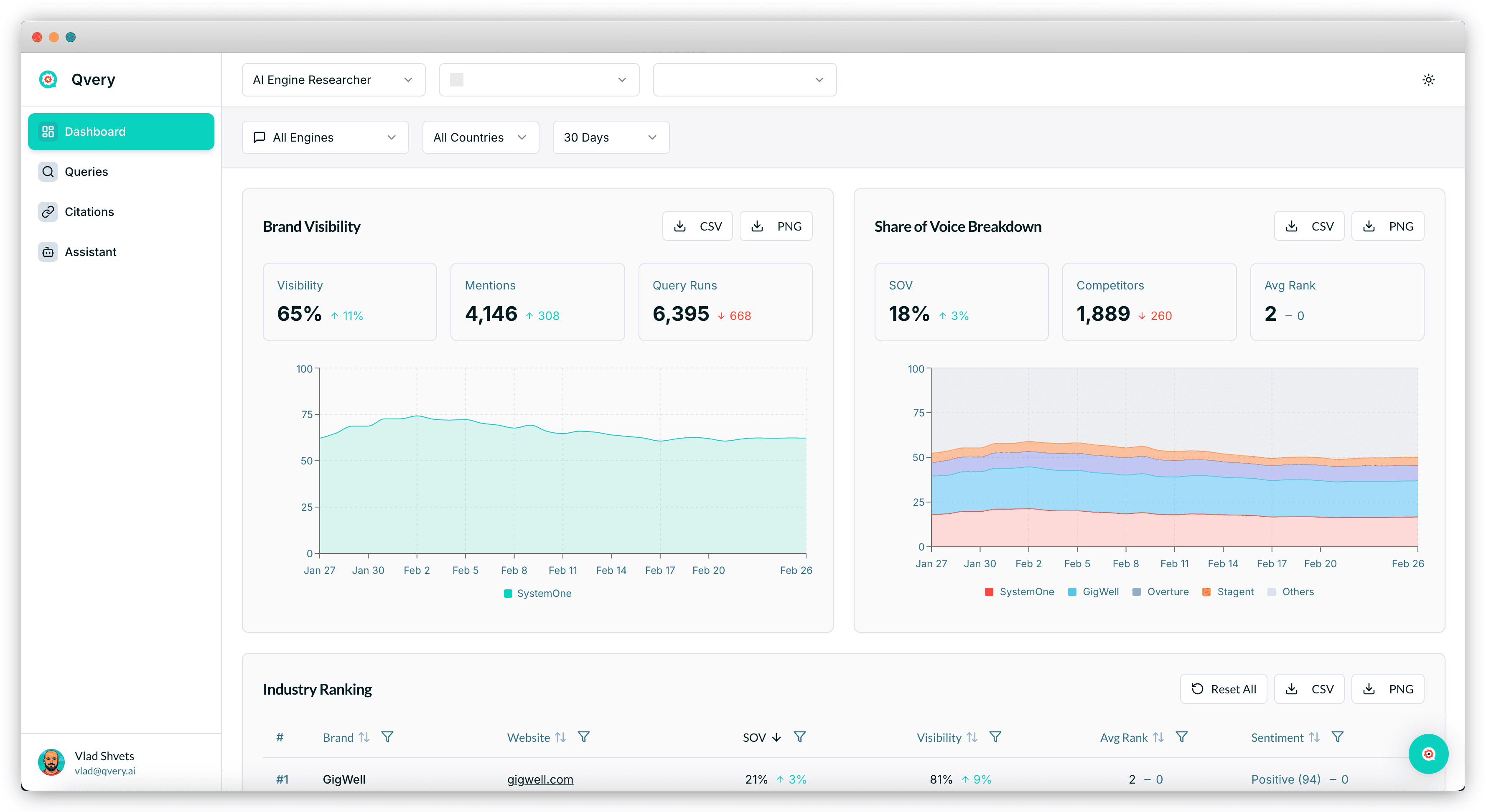
Content marketing still works the way it always did: earn trust, create demand, be genuinely useful. What changed is where the buyer meets your content, and whether an answer engine passes your name along or leaves it out. Traffic used to tell you if the work landed. It can't anymore, because the buyer never arrives. Whether AI answers cite you is the metric that replaces it, and it is finally something you can measure.
Frequently Asked Questions
When do B2B buyers contact sales?
Late. Buyers reach out only when they are about 70% through the buying journey¹, and 84% say the first vendor they contacted won¹.
Do B2B buyers use AI in their research?
Overwhelmingly. 94% of business buyers used AI in their buying process, now their most meaningful information source², and 45% used it in a recent purchase⁸.
Do buyers prefer to avoid salespeople?
Yes. 67% of B2B buyers prefer a rep-free buying experience, doing their research through digital channels⁸.
Is content marketing a staffed function?
Mostly. 76% of B2B organizations have a dedicated content team or person⁹, and 46% expected a bigger content budget⁹.
What is the highest-ROI marketing channel?
Owned content. Website, blog, and SEO is the #1 ROI-driving channel at 27%³, ahead of email at 22%³.
What content formats work best?
Video for engagement (rated most effective by 58% of marketers⁹), but short written articles are the most-used at 92%⁹, and text is what AI engines quote.
How do buyers prefer to learn about products?
By video, by a wide margin: 63% prefer a short video versus 12% for text articles¹². AI engines, though, read text, not video.
Is the blog dead?
No. Blog posts moved up to the third most-used content format at 38%³, and blogs are prime material for AI citations.
Can content marketers measure their results?
Often not. A third name measuring effectiveness a top challenge¹³, and only 29% call their strategy very effective⁹.
Why is content measurement getting harder?
Because 42% of producers still measure by website and social traffic¹¹, the exact metric AI answers are cutting as they intercept the click.
Is organic social reach declining?
Sharply. In 2025 engagement fell on every major social network, including Facebook down 36% and X down 48%⁴.
How saturated is content?
Extremely. 96.55% of pages get zero Google traffic⁵, and about 10 million new indexable pages appear a day⁵.
How much is AI reducing search traffic?
Gartner projects traditional search volume down 25% by 2026¹⁴, and when an AI summary appears, clicks to results fall from 15% to 8%¹⁵.
Does content still influence buyers?
Yes. 73% of decision-makers trust thought leadership over marketing materials¹¹, and 75% researched a new product because of it¹¹.
Does content marketing generate pipeline?
Yes. 86% of decision-makers will invite strong thought-leadership producers to the RFP¹¹, and 85% of video marketers say video generated leads¹².
What content types get cited most by AI engines?
Listicles, by far, at 45.8% of all classifiable AI citations⁶, followed by owned brand and niche content, which is 87.75% of citations⁷.
Do ChatGPT and Google AI Mode cite content the same way?
No. ChatGPT cites listicles at 8.62% of its citations versus Google AI Mode's 2.50%⁶, so format strategy has to be engine-specific.
Does ranking on Google get my content cited by AI?
Often not. Only 13.9% of AI-cited domains rank in Google's top 10¹⁶, and even a #1 ranking has just a 48.8% chance of being cited¹⁶.
What should a content team do about AI search?
Measure whether AI answers cite your content, then create the formats and earn the mentions that get cited. Tracking your visibility across ChatGPT and Google AI Mode is what Qvery is built to do.
Sources
6sense: 84% of B2B Deals Are Decided Before Marketers Know About Them (2023)
Forrester: B2B Buyers Make Zero-Click Buying Number One (2026)
Rival IQ: 2025 Social Media Industry Benchmark Report (2025)
Ahrefs: 96.55% of Content Gets No Traffic From Google (2023)
Qvery: Listicles Are the Most Cited Content Type in AI Search (2026)
Gartner: 67% of B2B Buyers Prefer a Rep-Free Experience (2026)
Content Marketing Institute: B2B Content Marketing Benchmarks, Outlook for 2025 (2025)
Demand Gen Report: 2024 Content Preferences Benchmark Survey (2024)
Edelman and LinkedIn: 2024 B2B Thought Leadership Impact Report (2024)
Content Marketing Institute: 2026 B2B Content and Marketing Trends Report (2026)
Pew Research Center: Google Users Are Less Likely to Click When an AI Summary Appears (2025)
Qvery: AI Engine Citations vs Google Organic SERPs, Only 13.9% Overlap (2026)
By the time a B2B buyer talks to your sales team, the decision is mostly made. 84% of buyers say the first vendor they contacted won the business¹, and they only reach out when they are already 70% through the buying journey, roughly eight months into a deal¹. Sales didn't win that deal. The content did, months earlier, while no one was watching.
That has always been content marketing's quiet superpower and its measurement nightmare. What is new in 2026 is the intermediary. Buyers now do that self-education through AI: 94% of business buyers used AI in their buying process, and more of them named generative AI their single most meaningful information source than named vendor websites, experts, or sales². The content still does the work. It just reaches the buyer through an answer engine that may or may not name you.
We pulled the most credible, independently verified statistics on content marketing we could find, from the Content Marketing Institute, HubSpot, Gartner, Forrester, Edelman, and the firms that measure where content gets consumed.
A few figures come from our own AI-citation data at Qvery. Everything else is footnoted to its original source. Read together, they describe a function that still drives the buying decision, whose free distribution channels are collapsing at once, and whose new job is to be the content an AI answer cites.
Highlights
84% of B2B buyers say the first vendor they contacted won¹, and they engage sales only 70% through the journey¹.
94% of business buyers used AI in their buying process, now their most meaningful information source².
Website, blog, and SEO is the #1 ROI-driving channel, cited by 27% of marketers³.
Organic social engagement fell on every major social network in 2025, including Facebook down 36% and X down 48%⁴.
96.55% of all pages get zero traffic from Google⁵, and 10 million new pages worth indexing appear each day⁵.
Listicles are 45.8% of all classifiable AI citations, the single most-cited content type⁶.
87.75% of AI citations go to brand and niche sites, not the internet giants⁷.
Only 13.9% of the domains AI engines cite also rank in Google's organic top 10¹⁶.
Content Still Decides the Buying Decision
The case for content marketing was never really about traffic. It was about being the trusted answer while a buyer quietly makes up their mind. The data on how B2B buying works makes that vivid.
67% of B2B buyers prefer a rep-free buying experience, doing their research through digital channels⁸.
Content marketing is now a staffed function: 76% of B2B organizations have a dedicated content team or person⁹.
More than a third of buyers sought out third-party content in 2024, up from under a quarter the year before¹⁰.
The thought-leadership research puts numbers on the influence. 73% of decision-makers say thought-leadership content is a more trustworthy basis for judging a vendor than its marketing materials¹¹, 75% say a piece of it led them to research a product they weren't considering¹¹, and 70% of C-suite leaders say it made them question an existing supplier¹¹. Content creates demand as much as it captures it, and quietly pulls it away from incumbents. That's the job, and it's worth doing well precisely because the buyer is doing it alone.
The Formats That Work
What buyers consume and what marketers make do not always match, and the gap is where the opportunity sits. In B2B, short articles are the most-used format at 92%, followed by video at 76% and case studies at 75%⁹, but marketers rate video the most effective (58%), then case studies (53%)⁹.
Video dominates human attention. 91% of businesses use video, 82% say it delivers good ROI, and people say they would rather learn about a product from a short video than a text article by 63% to 12%¹². AI engines, though, can't watch a video to save their lives; they read the text.
So the content that persuades a human and the content that gets cited by a machine are drifting apart, and the smart content teams are producing both. The blog isn't dead, either. It moved up to the third most-used format at 38%³, and text is exactly what answer engines quote.
The Measurement Problem Just Got Worse
Content marketing has always struggled to prove itself, and the numbers are blunt about it. Only 29% of B2B marketers call their content strategy extremely or very effective⁹, only 12% rate their marketing highly effective over the past year¹³, and a third name measuring content effectiveness a top-three challenge¹³. A third of content marketers admit they can't measure whether their content works, which is a bold thing to build a hundred-person function on.
The measurement crisis is about to get worse, because the proxy everyone leaned on is disappearing. 42% of producers still measure success by looking for more website and social traffic¹¹, which is exactly the number AI answers are cutting.
The good news in the 2026 budgets is that marketers are shifting toward channels they control: AI tools lead investment at 45%, but owned media sits right behind at 32%¹³. The instinct is right. Own the content and the audience, because the borrowed distribution is collapsing.
The Distribution It Relied On Is Fracturing
Every free channel content marketing was built to ride is closing at the same time. Start with social, which was supposed to be the great equalizer. In 2025, organic engagement fell on every major social network.
Organic search is no gentler. 96.55% of all pages get zero traffic from Google⁵, and the reason is partly sheer volume: Ahrefs finds 10 million new pages worth indexing every single day⁵. Your blog post isn't entering a library. It's entering a stampede.
The old content-marketing promise, publish something useful and the audience will find it, quietly stopped being true, and it stopped being true before AI arrived to finish the job. Publishing was never the same thing as distribution, and that gap is now a chasm.
AI Is Intercepting the Top of the Funnel
Into that fractured distribution steps the answer engine, and it sits directly between your content and the buyer. Gartner projects traditional search volume will drop 25% by 2026 as AI chatbots absorb queries¹⁴, and the click behavior is already measurable.
When an AI summary appears, people click a result in 8% of visits versus 15% without one, and they click the summary's own cited source just 1% of the time¹⁵. Your content can be read, synthesized, and used to answer the question without anyone ever landing on your page. On the buyer side, 45% of B2B buyers used AI during a recent purchase⁸, and for a growing share it is their primary research surface. The content still does the persuading. It just does it inside an answer you didn't write and can't see, which is exactly why being named in that answer is the new distribution.
Where Content Still Wins
None of this means the content function is losing. It means the payoff moved. Genuine expertise still commands attention from the exact people who sign the contracts: 52% of decision-makers and 54% of the C-suite spend an hour or more a week reading thought leadership¹¹. And it converts into pipeline in a way marketers routinely underestimate.
86% of decision-makers say they will invite a company that consistently produces strong thought leadership to the RFP, yet only 38% of producers expect that payoff¹¹.
Even now, 95% of business buyers are not actively in-market at any given moment¹¹, so the content that reaches them early decides who they consider later.
Owned content remains the top-reported ROI channel, and in AI answers 87.75% of citations go to brand sites, niche publications, and specialist pages⁷.
The through-line is that the same content that earns human trust, specific, expert, genuinely useful, is the content answer engines pull from. Same craft, new scoreboard. Building authority is still the work; being cited for it is the new measure of whether the work reached anyone.
The New Content KPI Is Getting Cited
If traffic is the metric AI is erasing, citation is the one replacing it, and our data shows the new game has different rules. Listicles are 45.8% of all classifiable AI citations, the single most-referenced content type⁶. The listicle, the format every serious marketer was told to be embarrassed about, is exactly what AI engines reach for most, and somewhere a thought-leadership consultant just felt a chill.
The engines also reward format very differently: ChatGPT cites listicles at 8.62% of its citations versus Google AI Mode's 2.50%, a 3.4x gap⁶. That kills the single-channel content mindset on its own. And the new scoreboard barely overlaps with the old one: only 13.9% of AI-cited domains rank in Google's organic top 10¹⁶, and even a number-one Google ranking is only a 48.8% chance of being cited by an AI engine¹⁶. Content marketing's job grew a second target, the AI answer, and most teams are still only aiming at the first.
How to See Whether AI Answers Cite Your Content
This is the problem Qvery solves. Qvery tracks how your brand and content show up across ChatGPT and Google AI Mode, generates the queries your buyers ask, and shows you which sources each engine cites when your category comes up. You enter your brand and see where you stand in a few minutes, instead of guessing whether the answer names you.
Content marketing still works the way it always did: earn trust, create demand, be genuinely useful. What changed is where the buyer meets your content, and whether an answer engine passes your name along or leaves it out. Traffic used to tell you if the work landed. It can't anymore, because the buyer never arrives. Whether AI answers cite you is the metric that replaces it, and it is finally something you can measure.
Frequently Asked Questions
When do B2B buyers contact sales?
Late. Buyers reach out only when they are about 70% through the buying journey¹, and 84% say the first vendor they contacted won¹.
Do B2B buyers use AI in their research?
Overwhelmingly. 94% of business buyers used AI in their buying process, now their most meaningful information source², and 45% used it in a recent purchase⁸.
Do buyers prefer to avoid salespeople?
Yes. 67% of B2B buyers prefer a rep-free buying experience, doing their research through digital channels⁸.
Is content marketing a staffed function?
Mostly. 76% of B2B organizations have a dedicated content team or person⁹, and 46% expected a bigger content budget⁹.
What is the highest-ROI marketing channel?
Owned content. Website, blog, and SEO is the #1 ROI-driving channel at 27%³, ahead of email at 22%³.
What content formats work best?
Video for engagement (rated most effective by 58% of marketers⁹), but short written articles are the most-used at 92%⁹, and text is what AI engines quote.
How do buyers prefer to learn about products?
By video, by a wide margin: 63% prefer a short video versus 12% for text articles¹². AI engines, though, read text, not video.
Is the blog dead?
No. Blog posts moved up to the third most-used content format at 38%³, and blogs are prime material for AI citations.
Can content marketers measure their results?
Often not. A third name measuring effectiveness a top challenge¹³, and only 29% call their strategy very effective⁹.
Why is content measurement getting harder?
Because 42% of producers still measure by website and social traffic¹¹, the exact metric AI answers are cutting as they intercept the click.
Is organic social reach declining?
Sharply. In 2025 engagement fell on every major social network, including Facebook down 36% and X down 48%⁴.
How saturated is content?
Extremely. 96.55% of pages get zero Google traffic⁵, and about 10 million new indexable pages appear a day⁵.
How much is AI reducing search traffic?
Gartner projects traditional search volume down 25% by 2026¹⁴, and when an AI summary appears, clicks to results fall from 15% to 8%¹⁵.
Does content still influence buyers?
Yes. 73% of decision-makers trust thought leadership over marketing materials¹¹, and 75% researched a new product because of it¹¹.
Does content marketing generate pipeline?
Yes. 86% of decision-makers will invite strong thought-leadership producers to the RFP¹¹, and 85% of video marketers say video generated leads¹².
What content types get cited most by AI engines?
Listicles, by far, at 45.8% of all classifiable AI citations⁶, followed by owned brand and niche content, which is 87.75% of citations⁷.
Do ChatGPT and Google AI Mode cite content the same way?
No. ChatGPT cites listicles at 8.62% of its citations versus Google AI Mode's 2.50%⁶, so format strategy has to be engine-specific.
Does ranking on Google get my content cited by AI?
Often not. Only 13.9% of AI-cited domains rank in Google's top 10¹⁶, and even a #1 ranking has just a 48.8% chance of being cited¹⁶.
What should a content team do about AI search?
Measure whether AI answers cite your content, then create the formats and earn the mentions that get cited. Tracking your visibility across ChatGPT and Google AI Mode is what Qvery is built to do.
Sources
6sense: 84% of B2B Deals Are Decided Before Marketers Know About Them (2023)
Forrester: B2B Buyers Make Zero-Click Buying Number One (2026)
Rival IQ: 2025 Social Media Industry Benchmark Report (2025)
Ahrefs: 96.55% of Content Gets No Traffic From Google (2023)
Qvery: Listicles Are the Most Cited Content Type in AI Search (2026)
Gartner: 67% of B2B Buyers Prefer a Rep-Free Experience (2026)
Content Marketing Institute: B2B Content Marketing Benchmarks, Outlook for 2025 (2025)
Demand Gen Report: 2024 Content Preferences Benchmark Survey (2024)
Edelman and LinkedIn: 2024 B2B Thought Leadership Impact Report (2024)
Content Marketing Institute: 2026 B2B Content and Marketing Trends Report (2026)
Pew Research Center: Google Users Are Less Likely to Click When an AI Summary Appears (2025)
Qvery: AI Engine Citations vs Google Organic SERPs, Only 13.9% Overlap (2026)
By the time a B2B buyer talks to your sales team, the decision is mostly made. 84% of buyers say the first vendor they contacted won the business¹, and they only reach out when they are already 70% through the buying journey, roughly eight months into a deal¹. Sales didn't win that deal. The content did, months earlier, while no one was watching.
That has always been content marketing's quiet superpower and its measurement nightmare. What is new in 2026 is the intermediary. Buyers now do that self-education through AI: 94% of business buyers used AI in their buying process, and more of them named generative AI their single most meaningful information source than named vendor websites, experts, or sales². The content still does the work. It just reaches the buyer through an answer engine that may or may not name you.
We pulled the most credible, independently verified statistics on content marketing we could find, from the Content Marketing Institute, HubSpot, Gartner, Forrester, Edelman, and the firms that measure where content gets consumed.
A few figures come from our own AI-citation data at Qvery. Everything else is footnoted to its original source. Read together, they describe a function that still drives the buying decision, whose free distribution channels are collapsing at once, and whose new job is to be the content an AI answer cites.
Highlights
84% of B2B buyers say the first vendor they contacted won¹, and they engage sales only 70% through the journey¹.
94% of business buyers used AI in their buying process, now their most meaningful information source².
Website, blog, and SEO is the #1 ROI-driving channel, cited by 27% of marketers³.
Organic social engagement fell on every major social network in 2025, including Facebook down 36% and X down 48%⁴.
96.55% of all pages get zero traffic from Google⁵, and 10 million new pages worth indexing appear each day⁵.
Listicles are 45.8% of all classifiable AI citations, the single most-cited content type⁶.
87.75% of AI citations go to brand and niche sites, not the internet giants⁷.
Only 13.9% of the domains AI engines cite also rank in Google's organic top 10¹⁶.
Content Still Decides the Buying Decision
The case for content marketing was never really about traffic. It was about being the trusted answer while a buyer quietly makes up their mind. The data on how B2B buying works makes that vivid.
67% of B2B buyers prefer a rep-free buying experience, doing their research through digital channels⁸.
Content marketing is now a staffed function: 76% of B2B organizations have a dedicated content team or person⁹.
More than a third of buyers sought out third-party content in 2024, up from under a quarter the year before¹⁰.
The thought-leadership research puts numbers on the influence. 73% of decision-makers say thought-leadership content is a more trustworthy basis for judging a vendor than its marketing materials¹¹, 75% say a piece of it led them to research a product they weren't considering¹¹, and 70% of C-suite leaders say it made them question an existing supplier¹¹. Content creates demand as much as it captures it, and quietly pulls it away from incumbents. That's the job, and it's worth doing well precisely because the buyer is doing it alone.
The Formats That Work
What buyers consume and what marketers make do not always match, and the gap is where the opportunity sits. In B2B, short articles are the most-used format at 92%, followed by video at 76% and case studies at 75%⁹, but marketers rate video the most effective (58%), then case studies (53%)⁹.
Video dominates human attention. 91% of businesses use video, 82% say it delivers good ROI, and people say they would rather learn about a product from a short video than a text article by 63% to 12%¹². AI engines, though, can't watch a video to save their lives; they read the text.
So the content that persuades a human and the content that gets cited by a machine are drifting apart, and the smart content teams are producing both. The blog isn't dead, either. It moved up to the third most-used format at 38%³, and text is exactly what answer engines quote.
The Measurement Problem Just Got Worse
Content marketing has always struggled to prove itself, and the numbers are blunt about it. Only 29% of B2B marketers call their content strategy extremely or very effective⁹, only 12% rate their marketing highly effective over the past year¹³, and a third name measuring content effectiveness a top-three challenge¹³. A third of content marketers admit they can't measure whether their content works, which is a bold thing to build a hundred-person function on.
The measurement crisis is about to get worse, because the proxy everyone leaned on is disappearing. 42% of producers still measure success by looking for more website and social traffic¹¹, which is exactly the number AI answers are cutting.
The good news in the 2026 budgets is that marketers are shifting toward channels they control: AI tools lead investment at 45%, but owned media sits right behind at 32%¹³. The instinct is right. Own the content and the audience, because the borrowed distribution is collapsing.
The Distribution It Relied On Is Fracturing
Every free channel content marketing was built to ride is closing at the same time. Start with social, which was supposed to be the great equalizer. In 2025, organic engagement fell on every major social network.
Organic search is no gentler. 96.55% of all pages get zero traffic from Google⁵, and the reason is partly sheer volume: Ahrefs finds 10 million new pages worth indexing every single day⁵. Your blog post isn't entering a library. It's entering a stampede.
The old content-marketing promise, publish something useful and the audience will find it, quietly stopped being true, and it stopped being true before AI arrived to finish the job. Publishing was never the same thing as distribution, and that gap is now a chasm.
AI Is Intercepting the Top of the Funnel
Into that fractured distribution steps the answer engine, and it sits directly between your content and the buyer. Gartner projects traditional search volume will drop 25% by 2026 as AI chatbots absorb queries¹⁴, and the click behavior is already measurable.
When an AI summary appears, people click a result in 8% of visits versus 15% without one, and they click the summary's own cited source just 1% of the time¹⁵. Your content can be read, synthesized, and used to answer the question without anyone ever landing on your page. On the buyer side, 45% of B2B buyers used AI during a recent purchase⁸, and for a growing share it is their primary research surface. The content still does the persuading. It just does it inside an answer you didn't write and can't see, which is exactly why being named in that answer is the new distribution.
Where Content Still Wins
None of this means the content function is losing. It means the payoff moved. Genuine expertise still commands attention from the exact people who sign the contracts: 52% of decision-makers and 54% of the C-suite spend an hour or more a week reading thought leadership¹¹. And it converts into pipeline in a way marketers routinely underestimate.
86% of decision-makers say they will invite a company that consistently produces strong thought leadership to the RFP, yet only 38% of producers expect that payoff¹¹.
Even now, 95% of business buyers are not actively in-market at any given moment¹¹, so the content that reaches them early decides who they consider later.
Owned content remains the top-reported ROI channel, and in AI answers 87.75% of citations go to brand sites, niche publications, and specialist pages⁷.
The through-line is that the same content that earns human trust, specific, expert, genuinely useful, is the content answer engines pull from. Same craft, new scoreboard. Building authority is still the work; being cited for it is the new measure of whether the work reached anyone.
The New Content KPI Is Getting Cited
If traffic is the metric AI is erasing, citation is the one replacing it, and our data shows the new game has different rules. Listicles are 45.8% of all classifiable AI citations, the single most-referenced content type⁶. The listicle, the format every serious marketer was told to be embarrassed about, is exactly what AI engines reach for most, and somewhere a thought-leadership consultant just felt a chill.
The engines also reward format very differently: ChatGPT cites listicles at 8.62% of its citations versus Google AI Mode's 2.50%, a 3.4x gap⁶. That kills the single-channel content mindset on its own. And the new scoreboard barely overlaps with the old one: only 13.9% of AI-cited domains rank in Google's organic top 10¹⁶, and even a number-one Google ranking is only a 48.8% chance of being cited by an AI engine¹⁶. Content marketing's job grew a second target, the AI answer, and most teams are still only aiming at the first.
How to See Whether AI Answers Cite Your Content
This is the problem Qvery solves. Qvery tracks how your brand and content show up across ChatGPT and Google AI Mode, generates the queries your buyers ask, and shows you which sources each engine cites when your category comes up. You enter your brand and see where you stand in a few minutes, instead of guessing whether the answer names you.
Content marketing still works the way it always did: earn trust, create demand, be genuinely useful. What changed is where the buyer meets your content, and whether an answer engine passes your name along or leaves it out. Traffic used to tell you if the work landed. It can't anymore, because the buyer never arrives. Whether AI answers cite you is the metric that replaces it, and it is finally something you can measure.
Frequently Asked Questions
When do B2B buyers contact sales?
Late. Buyers reach out only when they are about 70% through the buying journey¹, and 84% say the first vendor they contacted won¹.
Do B2B buyers use AI in their research?
Overwhelmingly. 94% of business buyers used AI in their buying process, now their most meaningful information source², and 45% used it in a recent purchase⁸.
Do buyers prefer to avoid salespeople?
Yes. 67% of B2B buyers prefer a rep-free buying experience, doing their research through digital channels⁸.
Is content marketing a staffed function?
Mostly. 76% of B2B organizations have a dedicated content team or person⁹, and 46% expected a bigger content budget⁹.
What is the highest-ROI marketing channel?
Owned content. Website, blog, and SEO is the #1 ROI-driving channel at 27%³, ahead of email at 22%³.
What content formats work best?
Video for engagement (rated most effective by 58% of marketers⁹), but short written articles are the most-used at 92%⁹, and text is what AI engines quote.
How do buyers prefer to learn about products?
By video, by a wide margin: 63% prefer a short video versus 12% for text articles¹². AI engines, though, read text, not video.
Is the blog dead?
No. Blog posts moved up to the third most-used content format at 38%³, and blogs are prime material for AI citations.
Can content marketers measure their results?
Often not. A third name measuring effectiveness a top challenge¹³, and only 29% call their strategy very effective⁹.
Why is content measurement getting harder?
Because 42% of producers still measure by website and social traffic¹¹, the exact metric AI answers are cutting as they intercept the click.
Is organic social reach declining?
Sharply. In 2025 engagement fell on every major social network, including Facebook down 36% and X down 48%⁴.
How saturated is content?
Extremely. 96.55% of pages get zero Google traffic⁵, and about 10 million new indexable pages appear a day⁵.
How much is AI reducing search traffic?
Gartner projects traditional search volume down 25% by 2026¹⁴, and when an AI summary appears, clicks to results fall from 15% to 8%¹⁵.
Does content still influence buyers?
Yes. 73% of decision-makers trust thought leadership over marketing materials¹¹, and 75% researched a new product because of it¹¹.
Does content marketing generate pipeline?
Yes. 86% of decision-makers will invite strong thought-leadership producers to the RFP¹¹, and 85% of video marketers say video generated leads¹².
What content types get cited most by AI engines?
Listicles, by far, at 45.8% of all classifiable AI citations⁶, followed by owned brand and niche content, which is 87.75% of citations⁷.
Do ChatGPT and Google AI Mode cite content the same way?
No. ChatGPT cites listicles at 8.62% of its citations versus Google AI Mode's 2.50%⁶, so format strategy has to be engine-specific.
Does ranking on Google get my content cited by AI?
Often not. Only 13.9% of AI-cited domains rank in Google's top 10¹⁶, and even a #1 ranking has just a 48.8% chance of being cited¹⁶.
What should a content team do about AI search?
Measure whether AI answers cite your content, then create the formats and earn the mentions that get cited. Tracking your visibility across ChatGPT and Google AI Mode is what Qvery is built to do.
Sources
6sense: 84% of B2B Deals Are Decided Before Marketers Know About Them (2023)
Forrester: B2B Buyers Make Zero-Click Buying Number One (2026)
Rival IQ: 2025 Social Media Industry Benchmark Report (2025)
Ahrefs: 96.55% of Content Gets No Traffic From Google (2023)
Qvery: Listicles Are the Most Cited Content Type in AI Search (2026)
Gartner: 67% of B2B Buyers Prefer a Rep-Free Experience (2026)
Content Marketing Institute: B2B Content Marketing Benchmarks, Outlook for 2025 (2025)
Demand Gen Report: 2024 Content Preferences Benchmark Survey (2024)
Edelman and LinkedIn: 2024 B2B Thought Leadership Impact Report (2024)
Content Marketing Institute: 2026 B2B Content and Marketing Trends Report (2026)
Pew Research Center: Google Users Are Less Likely to Click When an AI Summary Appears (2025)
Qvery: AI Engine Citations vs Google Organic SERPs, Only 13.9% Overlap (2026)
By the time a B2B buyer talks to your sales team, the decision is mostly made. 84% of buyers say the first vendor they contacted won the business¹, and they only reach out when they are already 70% through the buying journey, roughly eight months into a deal¹. Sales didn't win that deal. The content did, months earlier, while no one was watching.
That has always been content marketing's quiet superpower and its measurement nightmare. What is new in 2026 is the intermediary. Buyers now do that self-education through AI: 94% of business buyers used AI in their buying process, and more of them named generative AI their single most meaningful information source than named vendor websites, experts, or sales². The content still does the work. It just reaches the buyer through an answer engine that may or may not name you.
We pulled the most credible, independently verified statistics on content marketing we could find, from the Content Marketing Institute, HubSpot, Gartner, Forrester, Edelman, and the firms that measure where content gets consumed.
A few figures come from our own AI-citation data at Qvery. Everything else is footnoted to its original source. Read together, they describe a function that still drives the buying decision, whose free distribution channels are collapsing at once, and whose new job is to be the content an AI answer cites.
Highlights
84% of B2B buyers say the first vendor they contacted won¹, and they engage sales only 70% through the journey¹.
94% of business buyers used AI in their buying process, now their most meaningful information source².
Website, blog, and SEO is the #1 ROI-driving channel, cited by 27% of marketers³.
Organic social engagement fell on every major social network in 2025, including Facebook down 36% and X down 48%⁴.
96.55% of all pages get zero traffic from Google⁵, and 10 million new pages worth indexing appear each day⁵.
Listicles are 45.8% of all classifiable AI citations, the single most-cited content type⁶.
87.75% of AI citations go to brand and niche sites, not the internet giants⁷.
Only 13.9% of the domains AI engines cite also rank in Google's organic top 10¹⁶.
Content Still Decides the Buying Decision
The case for content marketing was never really about traffic. It was about being the trusted answer while a buyer quietly makes up their mind. The data on how B2B buying works makes that vivid.
67% of B2B buyers prefer a rep-free buying experience, doing their research through digital channels⁸.
Content marketing is now a staffed function: 76% of B2B organizations have a dedicated content team or person⁹.
More than a third of buyers sought out third-party content in 2024, up from under a quarter the year before¹⁰.
The thought-leadership research puts numbers on the influence. 73% of decision-makers say thought-leadership content is a more trustworthy basis for judging a vendor than its marketing materials¹¹, 75% say a piece of it led them to research a product they weren't considering¹¹, and 70% of C-suite leaders say it made them question an existing supplier¹¹. Content creates demand as much as it captures it, and quietly pulls it away from incumbents. That's the job, and it's worth doing well precisely because the buyer is doing it alone.
The Formats That Work
What buyers consume and what marketers make do not always match, and the gap is where the opportunity sits. In B2B, short articles are the most-used format at 92%, followed by video at 76% and case studies at 75%⁹, but marketers rate video the most effective (58%), then case studies (53%)⁹.
Video dominates human attention. 91% of businesses use video, 82% say it delivers good ROI, and people say they would rather learn about a product from a short video than a text article by 63% to 12%¹². AI engines, though, can't watch a video to save their lives; they read the text.
So the content that persuades a human and the content that gets cited by a machine are drifting apart, and the smart content teams are producing both. The blog isn't dead, either. It moved up to the third most-used format at 38%³, and text is exactly what answer engines quote.
The Measurement Problem Just Got Worse
Content marketing has always struggled to prove itself, and the numbers are blunt about it. Only 29% of B2B marketers call their content strategy extremely or very effective⁹, only 12% rate their marketing highly effective over the past year¹³, and a third name measuring content effectiveness a top-three challenge¹³. A third of content marketers admit they can't measure whether their content works, which is a bold thing to build a hundred-person function on.
The measurement crisis is about to get worse, because the proxy everyone leaned on is disappearing. 42% of producers still measure success by looking for more website and social traffic¹¹, which is exactly the number AI answers are cutting.
The good news in the 2026 budgets is that marketers are shifting toward channels they control: AI tools lead investment at 45%, but owned media sits right behind at 32%¹³. The instinct is right. Own the content and the audience, because the borrowed distribution is collapsing.
The Distribution It Relied On Is Fracturing
Every free channel content marketing was built to ride is closing at the same time. Start with social, which was supposed to be the great equalizer. In 2025, organic engagement fell on every major social network.
Organic search is no gentler. 96.55% of all pages get zero traffic from Google⁵, and the reason is partly sheer volume: Ahrefs finds 10 million new pages worth indexing every single day⁵. Your blog post isn't entering a library. It's entering a stampede.
The old content-marketing promise, publish something useful and the audience will find it, quietly stopped being true, and it stopped being true before AI arrived to finish the job. Publishing was never the same thing as distribution, and that gap is now a chasm.
AI Is Intercepting the Top of the Funnel
Into that fractured distribution steps the answer engine, and it sits directly between your content and the buyer. Gartner projects traditional search volume will drop 25% by 2026 as AI chatbots absorb queries¹⁴, and the click behavior is already measurable.
When an AI summary appears, people click a result in 8% of visits versus 15% without one, and they click the summary's own cited source just 1% of the time¹⁵. Your content can be read, synthesized, and used to answer the question without anyone ever landing on your page. On the buyer side, 45% of B2B buyers used AI during a recent purchase⁸, and for a growing share it is their primary research surface. The content still does the persuading. It just does it inside an answer you didn't write and can't see, which is exactly why being named in that answer is the new distribution.
Where Content Still Wins
None of this means the content function is losing. It means the payoff moved. Genuine expertise still commands attention from the exact people who sign the contracts: 52% of decision-makers and 54% of the C-suite spend an hour or more a week reading thought leadership¹¹. And it converts into pipeline in a way marketers routinely underestimate.
86% of decision-makers say they will invite a company that consistently produces strong thought leadership to the RFP, yet only 38% of producers expect that payoff¹¹.
Even now, 95% of business buyers are not actively in-market at any given moment¹¹, so the content that reaches them early decides who they consider later.
Owned content remains the top-reported ROI channel, and in AI answers 87.75% of citations go to brand sites, niche publications, and specialist pages⁷.
The through-line is that the same content that earns human trust, specific, expert, genuinely useful, is the content answer engines pull from. Same craft, new scoreboard. Building authority is still the work; being cited for it is the new measure of whether the work reached anyone.
The New Content KPI Is Getting Cited
If traffic is the metric AI is erasing, citation is the one replacing it, and our data shows the new game has different rules. Listicles are 45.8% of all classifiable AI citations, the single most-referenced content type⁶. The listicle, the format every serious marketer was told to be embarrassed about, is exactly what AI engines reach for most, and somewhere a thought-leadership consultant just felt a chill.
The engines also reward format very differently: ChatGPT cites listicles at 8.62% of its citations versus Google AI Mode's 2.50%, a 3.4x gap⁶. That kills the single-channel content mindset on its own. And the new scoreboard barely overlaps with the old one: only 13.9% of AI-cited domains rank in Google's organic top 10¹⁶, and even a number-one Google ranking is only a 48.8% chance of being cited by an AI engine¹⁶. Content marketing's job grew a second target, the AI answer, and most teams are still only aiming at the first.
How to See Whether AI Answers Cite Your Content
This is the problem Qvery solves. Qvery tracks how your brand and content show up across ChatGPT and Google AI Mode, generates the queries your buyers ask, and shows you which sources each engine cites when your category comes up. You enter your brand and see where you stand in a few minutes, instead of guessing whether the answer names you.
Content marketing still works the way it always did: earn trust, create demand, be genuinely useful. What changed is where the buyer meets your content, and whether an answer engine passes your name along or leaves it out. Traffic used to tell you if the work landed. It can't anymore, because the buyer never arrives. Whether AI answers cite you is the metric that replaces it, and it is finally something you can measure.
Frequently Asked Questions
When do B2B buyers contact sales?
Late. Buyers reach out only when they are about 70% through the buying journey¹, and 84% say the first vendor they contacted won¹.
Do B2B buyers use AI in their research?
Overwhelmingly. 94% of business buyers used AI in their buying process, now their most meaningful information source², and 45% used it in a recent purchase⁸.
Do buyers prefer to avoid salespeople?
Yes. 67% of B2B buyers prefer a rep-free buying experience, doing their research through digital channels⁸.
Is content marketing a staffed function?
Mostly. 76% of B2B organizations have a dedicated content team or person⁹, and 46% expected a bigger content budget⁹.
What is the highest-ROI marketing channel?
Owned content. Website, blog, and SEO is the #1 ROI-driving channel at 27%³, ahead of email at 22%³.
What content formats work best?
Video for engagement (rated most effective by 58% of marketers⁹), but short written articles are the most-used at 92%⁹, and text is what AI engines quote.
How do buyers prefer to learn about products?
By video, by a wide margin: 63% prefer a short video versus 12% for text articles¹². AI engines, though, read text, not video.
Is the blog dead?
No. Blog posts moved up to the third most-used content format at 38%³, and blogs are prime material for AI citations.
Can content marketers measure their results?
Often not. A third name measuring effectiveness a top challenge¹³, and only 29% call their strategy very effective⁹.
Why is content measurement getting harder?
Because 42% of producers still measure by website and social traffic¹¹, the exact metric AI answers are cutting as they intercept the click.
Is organic social reach declining?
Sharply. In 2025 engagement fell on every major social network, including Facebook down 36% and X down 48%⁴.
How saturated is content?
Extremely. 96.55% of pages get zero Google traffic⁵, and about 10 million new indexable pages appear a day⁵.
How much is AI reducing search traffic?
Gartner projects traditional search volume down 25% by 2026¹⁴, and when an AI summary appears, clicks to results fall from 15% to 8%¹⁵.
Does content still influence buyers?
Yes. 73% of decision-makers trust thought leadership over marketing materials¹¹, and 75% researched a new product because of it¹¹.
Does content marketing generate pipeline?
Yes. 86% of decision-makers will invite strong thought-leadership producers to the RFP¹¹, and 85% of video marketers say video generated leads¹².
What content types get cited most by AI engines?
Listicles, by far, at 45.8% of all classifiable AI citations⁶, followed by owned brand and niche content, which is 87.75% of citations⁷.
Do ChatGPT and Google AI Mode cite content the same way?
No. ChatGPT cites listicles at 8.62% of its citations versus Google AI Mode's 2.50%⁶, so format strategy has to be engine-specific.
Does ranking on Google get my content cited by AI?
Often not. Only 13.9% of AI-cited domains rank in Google's top 10¹⁶, and even a #1 ranking has just a 48.8% chance of being cited¹⁶.
What should a content team do about AI search?
Measure whether AI answers cite your content, then create the formats and earn the mentions that get cited. Tracking your visibility across ChatGPT and Google AI Mode is what Qvery is built to do.
Sources
6sense: 84% of B2B Deals Are Decided Before Marketers Know About Them (2023)
Forrester: B2B Buyers Make Zero-Click Buying Number One (2026)
Rival IQ: 2025 Social Media Industry Benchmark Report (2025)
Ahrefs: 96.55% of Content Gets No Traffic From Google (2023)
Qvery: Listicles Are the Most Cited Content Type in AI Search (2026)
Gartner: 67% of B2B Buyers Prefer a Rep-Free Experience (2026)
Content Marketing Institute: B2B Content Marketing Benchmarks, Outlook for 2025 (2025)
Demand Gen Report: 2024 Content Preferences Benchmark Survey (2024)
Edelman and LinkedIn: 2024 B2B Thought Leadership Impact Report (2024)
Content Marketing Institute: 2026 B2B Content and Marketing Trends Report (2026)
Pew Research Center: Google Users Are Less Likely to Click When an AI Summary Appears (2025)
Qvery: AI Engine Citations vs Google Organic SERPs, Only 13.9% Overlap (2026)

© 2026 Qvery AI OÜ