By
Vlad Shvets
Class Central and AI Visibility: Audit It Separately for Broad and Decision Course Questions
Class Central was cited in 14.00% of AI answers to broad course questions and 6.50% once a decision constraint was added. Why course providers should check it per question type.
Class Central was cited in 14.00% of AI answers to broad course questions and 6.50% once a decision constraint was added. Why course providers should check it per question type.
Class Central was cited in 14.00% of AI answers to broad course questions and 6.50% once a decision constraint was added. Why course providers should check it per question type.
If you market online courses, you've heard that AI engines lean on aggregators when a learner asks what to study, and Class Central is the obvious one to check. The usual advice is to get listed and move on.
The part the advice skips is that learners don't ask one kind of question. Some ask for the best course in a subject. Others ask the same thing with a condition attached: under $100, for beginners, with a certificate, done in six weeks.
So we put both kinds of question to ChatGPT and Google AI Mode in September 2026, the same needs asked broadly and then with one decision constraint, and recorded which answers cited classcentral.com.
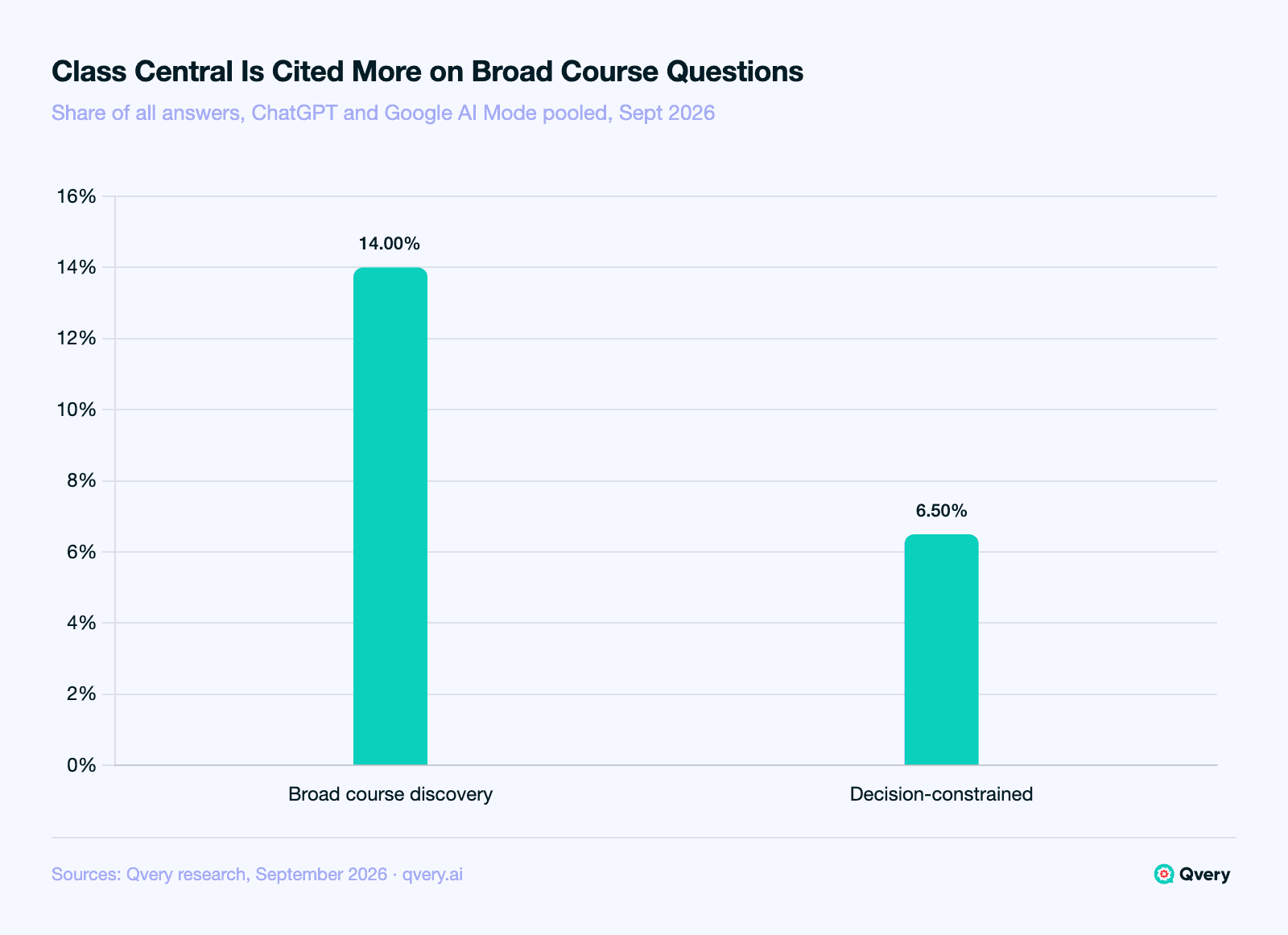
Class Central was cited in 14.00% of the broad course-discovery answers and 6.50% of the decision-constrained ones. The big course hosts held steady across both. So check Class Central separately for each kind of question; had the two rates matched, one check would have covered both.
This measures which domains the answers cited, not which courses the engines recommended.
Class Central Shows Up More Than Twice as Often on Broad Course Questions
Across both engines, classcentral.com appeared in 14.00% of broad course-discovery answers and 6.50% of decision-constrained answers, each a share of all answers to that kind of question. Broad discovery runs 2.15 times the decision-constrained rate. Across every answer in both sets, it appeared in 10.25%.
We registered a different expectation before collecting: that one added constraint would leave Class Central's share about where it was. That prediction failed.
For your audit, this means Class Central is a question-type check, not a one-time box. A listing that turns up when a learner asks for the best data science course can be cited far less often once the same learner adds a budget or a credential.
EAB makes the general point: "AI models and results change constantly, and visibility varies by prompt, platform, version, and timing." This data bears out the prompt half, narrowly: Class Central's presence differed between two kinds of course question. Platforms, versions, and timing weren't measured here.
ZandaX goes further: "But if it rarely appears in respected education lists, third-party comparisons, directories, or subject-specific rankings, AI tools may not treat it as an obvious recommendation." This data counts how often Class Central is cited in each kind of answer.
It doesn't test recommendation at all, so it neither supports nor refutes that.
UPCEA puts the weight on your own page: "an AI answer is assembled from whichever source presents that information most clearly and credibly, ideally the program page." Nothing here compares a provider's own course page with Class Central or with anything else, so that stays open too.
The Big Course Hosts Held Steady Across Both Question Types
The Class Central gap is not a general rule about course sites. We tracked the big hosts as one set: Coursera, edX, Udemy, FutureLearn, Udacity, Skillshare, Khan Academy, and LinkedIn Learning paths.
That set appeared in 44.50% of broad course-discovery answers and 52.00% of decision-constrained answers, a difference that falls in the band we registered as equivalent. The two kinds of question were answered alike on this measure.
One LinkedIn record couldn't be resolved to a page.
Counting it either way leaves the verdict where it is.
A course host that shows up about equally on both kinds of question belongs in every audit you run, whichever question type you start with.
So the question-type split in the last section belongs to Class Central. It isn't evidence that every course domain behaves that way, and the two sets aren't compared with each other here.
Build One Audit List With Two Tails
The next question for your audit is which domains to watch at all. For each kind of question, we took the smallest set of domains that together appeared in 80% of the answers that cited any source, and checked how well each list covers the other kind of question.
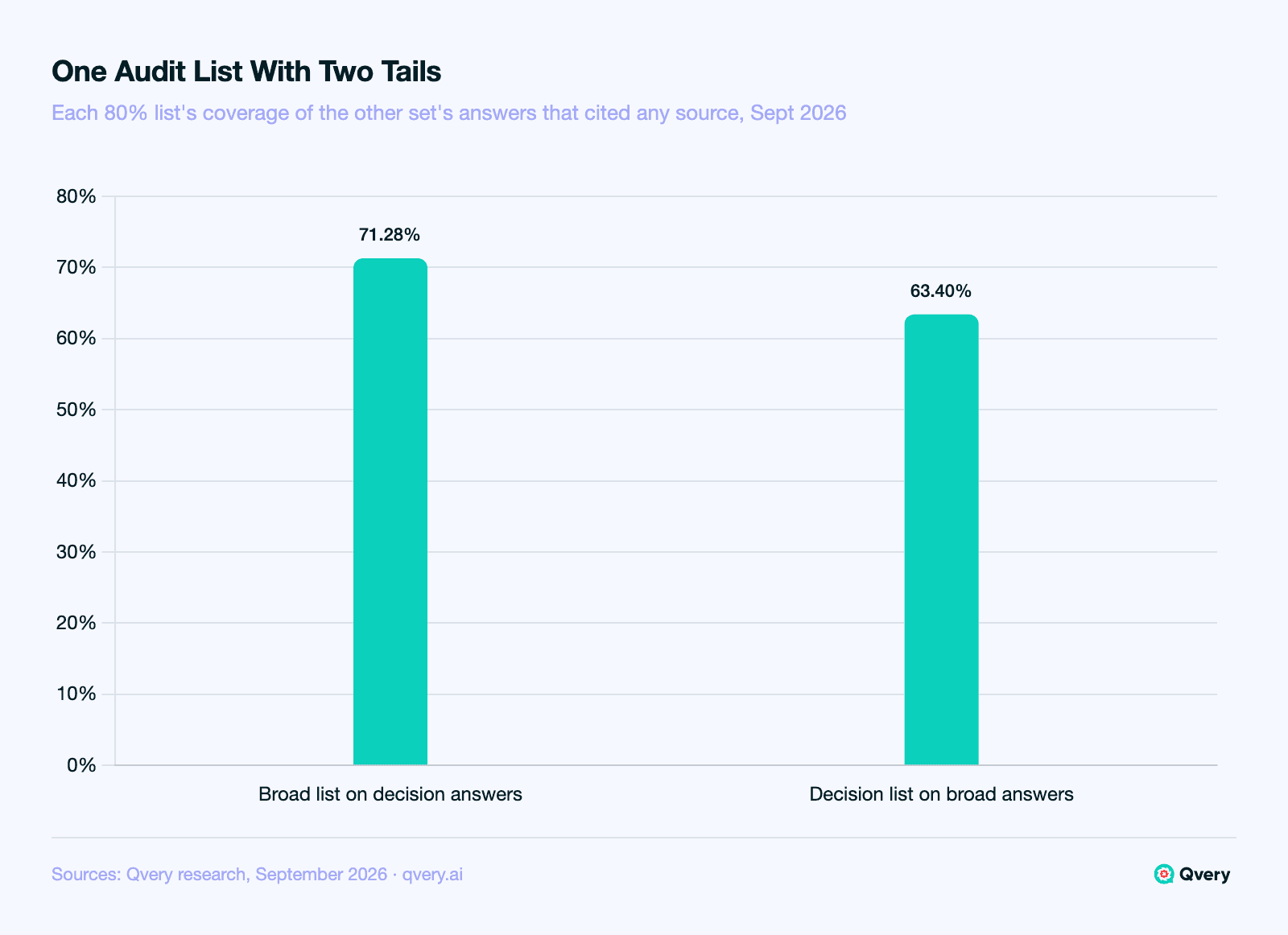
The broad-discovery list covered 71.28% of the decision-constrained answers that cited any source. The decision-constrained list covered 63.40% of the broad-discovery answers that cited any source.
That lands between the two extremes: a shared core with a distinct tail for each kind of question. The broad list holds 16 domains and the decision-constrained list 14, and five sit on both: coursera.org, faa.gov, learn.microsoft.com, open.edu, and youtube.com.
In practice, keep one audit list with the shared core at the top and a separate tail for each question type.
The education AI visibility guide already covers how to size that audit list for education brands. For the wider source picture across course questions, see the online education AI search statistics, and for the full sequence of moves, the education brand AEO checklist.
Which Class Central Pages to Work On Is Still Open
If Class Central matters for your broad questions, the next thing you'd want is which of its pages the answers cite. We read every cited Class Central page and labelled what it was.
Broad course-discovery answers: mostly ranked guides (14 pages), plus two course records. Three more answers cited the Class Central homepage, so we couldn't tell which page was meant.
Decision-constrained answers: six ranked guides, four course records, and one page that fit no label.
No review page turned up in either set. Every identifiable page was read and both coders agreed on every label, but there were fewer pages than a page-type rate needs, so nothing here says which page type is cited more often, or on which kind of question.
The practical step is to collect the cited URLs from Class Central on your own questions before deciding whether your listing, a ranked guide, or a course record is the thing to work on.
Run the Class Central Check on Both Question Types in Qvery
Add your course questions to Qvery as pairs: the broad version, and the same need with one decision constraint. Qvery tracks them daily on ChatGPT and Google AI Mode, in any of 200+ countries, and reports your visibility, share of voice, and average rank.
Every citation is tied to the query and the engine that produced it, so you can see on which of your questions classcentral.com is among the cited sources, and on which it isn't. To get that without building a view, ask Qvery Assistant which of your broad questions cited Class Central this week.
It shows where Class Central is cited on your questions, not why. Start a free 7-day trial, no credit card required, and set up your first ten broad and decision-constrained pairs.
What These Numbers Can't Settle
This is cited-domain co-occurrence in one September 2026 set of course questions. It doesn't say why Class Central appears more on broad questions, which Class Central surface matters, or whether any course was named or recommended.
The page audit fell short of the volume a rate needs. The pooled rates count every answer once, and ChatGPT answered more of the questions than Google AI Mode, so they lean toward ChatGPT; no per-engine figure for each question type is printed. Nothing is compared with an earlier period.
Two Class Central Checks, Not One
Run the Class Central check on broad course-discovery questions and on decision-constrained questions as two separate audits. Keep the shared domain core in both lists and maintain each tail on its own. Collect the Class Central URLs your answers cite before choosing which page type to work on.
If you market online courses, you've heard that AI engines lean on aggregators when a learner asks what to study, and Class Central is the obvious one to check. The usual advice is to get listed and move on.
The part the advice skips is that learners don't ask one kind of question. Some ask for the best course in a subject. Others ask the same thing with a condition attached: under $100, for beginners, with a certificate, done in six weeks.
So we put both kinds of question to ChatGPT and Google AI Mode in September 2026, the same needs asked broadly and then with one decision constraint, and recorded which answers cited classcentral.com.
Class Central was cited in 14.00% of the broad course-discovery answers and 6.50% of the decision-constrained ones. The big course hosts held steady across both. So check Class Central separately for each kind of question; had the two rates matched, one check would have covered both.
This measures which domains the answers cited, not which courses the engines recommended.
Class Central Shows Up More Than Twice as Often on Broad Course Questions
Across both engines, classcentral.com appeared in 14.00% of broad course-discovery answers and 6.50% of decision-constrained answers, each a share of all answers to that kind of question. Broad discovery runs 2.15 times the decision-constrained rate. Across every answer in both sets, it appeared in 10.25%.
We registered a different expectation before collecting: that one added constraint would leave Class Central's share about where it was. That prediction failed.
For your audit, this means Class Central is a question-type check, not a one-time box. A listing that turns up when a learner asks for the best data science course can be cited far less often once the same learner adds a budget or a credential.
EAB makes the general point: "AI models and results change constantly, and visibility varies by prompt, platform, version, and timing." This data bears out the prompt half, narrowly: Class Central's presence differed between two kinds of course question. Platforms, versions, and timing weren't measured here.
ZandaX goes further: "But if it rarely appears in respected education lists, third-party comparisons, directories, or subject-specific rankings, AI tools may not treat it as an obvious recommendation." This data counts how often Class Central is cited in each kind of answer.
It doesn't test recommendation at all, so it neither supports nor refutes that.
UPCEA puts the weight on your own page: "an AI answer is assembled from whichever source presents that information most clearly and credibly, ideally the program page." Nothing here compares a provider's own course page with Class Central or with anything else, so that stays open too.
The Big Course Hosts Held Steady Across Both Question Types
The Class Central gap is not a general rule about course sites. We tracked the big hosts as one set: Coursera, edX, Udemy, FutureLearn, Udacity, Skillshare, Khan Academy, and LinkedIn Learning paths.
That set appeared in 44.50% of broad course-discovery answers and 52.00% of decision-constrained answers, a difference that falls in the band we registered as equivalent. The two kinds of question were answered alike on this measure.
One LinkedIn record couldn't be resolved to a page.
Counting it either way leaves the verdict where it is.
A course host that shows up about equally on both kinds of question belongs in every audit you run, whichever question type you start with.
So the question-type split in the last section belongs to Class Central. It isn't evidence that every course domain behaves that way, and the two sets aren't compared with each other here.
Build One Audit List With Two Tails
The next question for your audit is which domains to watch at all. For each kind of question, we took the smallest set of domains that together appeared in 80% of the answers that cited any source, and checked how well each list covers the other kind of question.
The broad-discovery list covered 71.28% of the decision-constrained answers that cited any source. The decision-constrained list covered 63.40% of the broad-discovery answers that cited any source.
That lands between the two extremes: a shared core with a distinct tail for each kind of question. The broad list holds 16 domains and the decision-constrained list 14, and five sit on both: coursera.org, faa.gov, learn.microsoft.com, open.edu, and youtube.com.
In practice, keep one audit list with the shared core at the top and a separate tail for each question type.
The education AI visibility guide already covers how to size that audit list for education brands. For the wider source picture across course questions, see the online education AI search statistics, and for the full sequence of moves, the education brand AEO checklist.
Which Class Central Pages to Work On Is Still Open
If Class Central matters for your broad questions, the next thing you'd want is which of its pages the answers cite. We read every cited Class Central page and labelled what it was.
Broad course-discovery answers: mostly ranked guides (14 pages), plus two course records. Three more answers cited the Class Central homepage, so we couldn't tell which page was meant.
Decision-constrained answers: six ranked guides, four course records, and one page that fit no label.
No review page turned up in either set. Every identifiable page was read and both coders agreed on every label, but there were fewer pages than a page-type rate needs, so nothing here says which page type is cited more often, or on which kind of question.
The practical step is to collect the cited URLs from Class Central on your own questions before deciding whether your listing, a ranked guide, or a course record is the thing to work on.
Run the Class Central Check on Both Question Types in Qvery
Add your course questions to Qvery as pairs: the broad version, and the same need with one decision constraint. Qvery tracks them daily on ChatGPT and Google AI Mode, in any of 200+ countries, and reports your visibility, share of voice, and average rank.
Every citation is tied to the query and the engine that produced it, so you can see on which of your questions classcentral.com is among the cited sources, and on which it isn't. To get that without building a view, ask Qvery Assistant which of your broad questions cited Class Central this week.
It shows where Class Central is cited on your questions, not why. Start a free 7-day trial, no credit card required, and set up your first ten broad and decision-constrained pairs.
What These Numbers Can't Settle
This is cited-domain co-occurrence in one September 2026 set of course questions. It doesn't say why Class Central appears more on broad questions, which Class Central surface matters, or whether any course was named or recommended.
The page audit fell short of the volume a rate needs. The pooled rates count every answer once, and ChatGPT answered more of the questions than Google AI Mode, so they lean toward ChatGPT; no per-engine figure for each question type is printed. Nothing is compared with an earlier period.
Two Class Central Checks, Not One
Run the Class Central check on broad course-discovery questions and on decision-constrained questions as two separate audits. Keep the shared domain core in both lists and maintain each tail on its own. Collect the Class Central URLs your answers cite before choosing which page type to work on.
If you market online courses, you've heard that AI engines lean on aggregators when a learner asks what to study, and Class Central is the obvious one to check. The usual advice is to get listed and move on.
The part the advice skips is that learners don't ask one kind of question. Some ask for the best course in a subject. Others ask the same thing with a condition attached: under $100, for beginners, with a certificate, done in six weeks.
So we put both kinds of question to ChatGPT and Google AI Mode in September 2026, the same needs asked broadly and then with one decision constraint, and recorded which answers cited classcentral.com.
Class Central was cited in 14.00% of the broad course-discovery answers and 6.50% of the decision-constrained ones. The big course hosts held steady across both. So check Class Central separately for each kind of question; had the two rates matched, one check would have covered both.
This measures which domains the answers cited, not which courses the engines recommended.
Class Central Shows Up More Than Twice as Often on Broad Course Questions
Across both engines, classcentral.com appeared in 14.00% of broad course-discovery answers and 6.50% of decision-constrained answers, each a share of all answers to that kind of question. Broad discovery runs 2.15 times the decision-constrained rate. Across every answer in both sets, it appeared in 10.25%.
We registered a different expectation before collecting: that one added constraint would leave Class Central's share about where it was. That prediction failed.
For your audit, this means Class Central is a question-type check, not a one-time box. A listing that turns up when a learner asks for the best data science course can be cited far less often once the same learner adds a budget or a credential.
EAB makes the general point: "AI models and results change constantly, and visibility varies by prompt, platform, version, and timing." This data bears out the prompt half, narrowly: Class Central's presence differed between two kinds of course question. Platforms, versions, and timing weren't measured here.
ZandaX goes further: "But if it rarely appears in respected education lists, third-party comparisons, directories, or subject-specific rankings, AI tools may not treat it as an obvious recommendation." This data counts how often Class Central is cited in each kind of answer.
It doesn't test recommendation at all, so it neither supports nor refutes that.
UPCEA puts the weight on your own page: "an AI answer is assembled from whichever source presents that information most clearly and credibly, ideally the program page." Nothing here compares a provider's own course page with Class Central or with anything else, so that stays open too.
The Big Course Hosts Held Steady Across Both Question Types
The Class Central gap is not a general rule about course sites. We tracked the big hosts as one set: Coursera, edX, Udemy, FutureLearn, Udacity, Skillshare, Khan Academy, and LinkedIn Learning paths.
That set appeared in 44.50% of broad course-discovery answers and 52.00% of decision-constrained answers, a difference that falls in the band we registered as equivalent. The two kinds of question were answered alike on this measure.
One LinkedIn record couldn't be resolved to a page.
Counting it either way leaves the verdict where it is.
A course host that shows up about equally on both kinds of question belongs in every audit you run, whichever question type you start with.
So the question-type split in the last section belongs to Class Central. It isn't evidence that every course domain behaves that way, and the two sets aren't compared with each other here.
Build One Audit List With Two Tails
The next question for your audit is which domains to watch at all. For each kind of question, we took the smallest set of domains that together appeared in 80% of the answers that cited any source, and checked how well each list covers the other kind of question.
The broad-discovery list covered 71.28% of the decision-constrained answers that cited any source. The decision-constrained list covered 63.40% of the broad-discovery answers that cited any source.
That lands between the two extremes: a shared core with a distinct tail for each kind of question. The broad list holds 16 domains and the decision-constrained list 14, and five sit on both: coursera.org, faa.gov, learn.microsoft.com, open.edu, and youtube.com.
In practice, keep one audit list with the shared core at the top and a separate tail for each question type.
The education AI visibility guide already covers how to size that audit list for education brands. For the wider source picture across course questions, see the online education AI search statistics, and for the full sequence of moves, the education brand AEO checklist.
Which Class Central Pages to Work On Is Still Open
If Class Central matters for your broad questions, the next thing you'd want is which of its pages the answers cite. We read every cited Class Central page and labelled what it was.
Broad course-discovery answers: mostly ranked guides (14 pages), plus two course records. Three more answers cited the Class Central homepage, so we couldn't tell which page was meant.
Decision-constrained answers: six ranked guides, four course records, and one page that fit no label.
No review page turned up in either set. Every identifiable page was read and both coders agreed on every label, but there were fewer pages than a page-type rate needs, so nothing here says which page type is cited more often, or on which kind of question.
The practical step is to collect the cited URLs from Class Central on your own questions before deciding whether your listing, a ranked guide, or a course record is the thing to work on.
Run the Class Central Check on Both Question Types in Qvery
Add your course questions to Qvery as pairs: the broad version, and the same need with one decision constraint. Qvery tracks them daily on ChatGPT and Google AI Mode, in any of 200+ countries, and reports your visibility, share of voice, and average rank.
Every citation is tied to the query and the engine that produced it, so you can see on which of your questions classcentral.com is among the cited sources, and on which it isn't. To get that without building a view, ask Qvery Assistant which of your broad questions cited Class Central this week.
It shows where Class Central is cited on your questions, not why. Start a free 7-day trial, no credit card required, and set up your first ten broad and decision-constrained pairs.
What These Numbers Can't Settle
This is cited-domain co-occurrence in one September 2026 set of course questions. It doesn't say why Class Central appears more on broad questions, which Class Central surface matters, or whether any course was named or recommended.
The page audit fell short of the volume a rate needs. The pooled rates count every answer once, and ChatGPT answered more of the questions than Google AI Mode, so they lean toward ChatGPT; no per-engine figure for each question type is printed. Nothing is compared with an earlier period.
Two Class Central Checks, Not One
Run the Class Central check on broad course-discovery questions and on decision-constrained questions as two separate audits. Keep the shared domain core in both lists and maintain each tail on its own. Collect the Class Central URLs your answers cite before choosing which page type to work on.
If you market online courses, you've heard that AI engines lean on aggregators when a learner asks what to study, and Class Central is the obvious one to check. The usual advice is to get listed and move on.
The part the advice skips is that learners don't ask one kind of question. Some ask for the best course in a subject. Others ask the same thing with a condition attached: under $100, for beginners, with a certificate, done in six weeks.
So we put both kinds of question to ChatGPT and Google AI Mode in September 2026, the same needs asked broadly and then with one decision constraint, and recorded which answers cited classcentral.com.
Class Central was cited in 14.00% of the broad course-discovery answers and 6.50% of the decision-constrained ones. The big course hosts held steady across both. So check Class Central separately for each kind of question; had the two rates matched, one check would have covered both.
This measures which domains the answers cited, not which courses the engines recommended.
Class Central Shows Up More Than Twice as Often on Broad Course Questions
Across both engines, classcentral.com appeared in 14.00% of broad course-discovery answers and 6.50% of decision-constrained answers, each a share of all answers to that kind of question. Broad discovery runs 2.15 times the decision-constrained rate. Across every answer in both sets, it appeared in 10.25%.
We registered a different expectation before collecting: that one added constraint would leave Class Central's share about where it was. That prediction failed.
For your audit, this means Class Central is a question-type check, not a one-time box. A listing that turns up when a learner asks for the best data science course can be cited far less often once the same learner adds a budget or a credential.
EAB makes the general point: "AI models and results change constantly, and visibility varies by prompt, platform, version, and timing." This data bears out the prompt half, narrowly: Class Central's presence differed between two kinds of course question. Platforms, versions, and timing weren't measured here.
ZandaX goes further: "But if it rarely appears in respected education lists, third-party comparisons, directories, or subject-specific rankings, AI tools may not treat it as an obvious recommendation." This data counts how often Class Central is cited in each kind of answer.
It doesn't test recommendation at all, so it neither supports nor refutes that.
UPCEA puts the weight on your own page: "an AI answer is assembled from whichever source presents that information most clearly and credibly, ideally the program page." Nothing here compares a provider's own course page with Class Central or with anything else, so that stays open too.
The Big Course Hosts Held Steady Across Both Question Types
The Class Central gap is not a general rule about course sites. We tracked the big hosts as one set: Coursera, edX, Udemy, FutureLearn, Udacity, Skillshare, Khan Academy, and LinkedIn Learning paths.
That set appeared in 44.50% of broad course-discovery answers and 52.00% of decision-constrained answers, a difference that falls in the band we registered as equivalent. The two kinds of question were answered alike on this measure.
One LinkedIn record couldn't be resolved to a page.
Counting it either way leaves the verdict where it is.
A course host that shows up about equally on both kinds of question belongs in every audit you run, whichever question type you start with.
So the question-type split in the last section belongs to Class Central. It isn't evidence that every course domain behaves that way, and the two sets aren't compared with each other here.
Build One Audit List With Two Tails
The next question for your audit is which domains to watch at all. For each kind of question, we took the smallest set of domains that together appeared in 80% of the answers that cited any source, and checked how well each list covers the other kind of question.
The broad-discovery list covered 71.28% of the decision-constrained answers that cited any source. The decision-constrained list covered 63.40% of the broad-discovery answers that cited any source.
That lands between the two extremes: a shared core with a distinct tail for each kind of question. The broad list holds 16 domains and the decision-constrained list 14, and five sit on both: coursera.org, faa.gov, learn.microsoft.com, open.edu, and youtube.com.
In practice, keep one audit list with the shared core at the top and a separate tail for each question type.
The education AI visibility guide already covers how to size that audit list for education brands. For the wider source picture across course questions, see the online education AI search statistics, and for the full sequence of moves, the education brand AEO checklist.
Which Class Central Pages to Work On Is Still Open
If Class Central matters for your broad questions, the next thing you'd want is which of its pages the answers cite. We read every cited Class Central page and labelled what it was.
Broad course-discovery answers: mostly ranked guides (14 pages), plus two course records. Three more answers cited the Class Central homepage, so we couldn't tell which page was meant.
Decision-constrained answers: six ranked guides, four course records, and one page that fit no label.
No review page turned up in either set. Every identifiable page was read and both coders agreed on every label, but there were fewer pages than a page-type rate needs, so nothing here says which page type is cited more often, or on which kind of question.
The practical step is to collect the cited URLs from Class Central on your own questions before deciding whether your listing, a ranked guide, or a course record is the thing to work on.
Run the Class Central Check on Both Question Types in Qvery
Add your course questions to Qvery as pairs: the broad version, and the same need with one decision constraint. Qvery tracks them daily on ChatGPT and Google AI Mode, in any of 200+ countries, and reports your visibility, share of voice, and average rank.
Every citation is tied to the query and the engine that produced it, so you can see on which of your questions classcentral.com is among the cited sources, and on which it isn't. To get that without building a view, ask Qvery Assistant which of your broad questions cited Class Central this week.
It shows where Class Central is cited on your questions, not why. Start a free 7-day trial, no credit card required, and set up your first ten broad and decision-constrained pairs.
What These Numbers Can't Settle
This is cited-domain co-occurrence in one September 2026 set of course questions. It doesn't say why Class Central appears more on broad questions, which Class Central surface matters, or whether any course was named or recommended.
The page audit fell short of the volume a rate needs. The pooled rates count every answer once, and ChatGPT answered more of the questions than Google AI Mode, so they lean toward ChatGPT; no per-engine figure for each question type is printed. Nothing is compared with an earlier period.
Two Class Central Checks, Not One
Run the Class Central check on broad course-discovery questions and on decision-constrained questions as two separate audits. Keep the shared domain core in both lists and maintain each tail on its own. Collect the Class Central URLs your answers cite before choosing which page type to work on.

© 2026 Qvery AI OÜ