By
Vlad Shvets
Car Insurance AI Visibility: Which Sources Decide Which Insurers Get Recommended
Geico and Progressive are cited on their own domains in about a fifth of generic car insurance answers, and fall out of the leading group once the question names a driver.
Geico and Progressive are cited on their own domains in about a fifth of generic car insurance answers, and fall out of the leading group once the question names a driver.
Geico and Progressive are cited on their own domains in about a fifth of generic car insurance answers, and fall out of the leading group once the question names a driver.
Anyone marketing car insurance has heard the same advice about AI search: the engines quote third parties, so your own website is not the asset it used to be. Go and earn placement on the comparison sites, and stop polishing pages nobody quotes.
In this category that advice is half wrong, and the half it gets wrong is the expensive one.
Ask an AI engine for the best car insurance companies and Geico and Progressive are in the answer, cited on their own domains, alongside NerdWallet and the comparison sites.
Ask it for the best insurance for a 23-year-old Michigan driver and both carriers fall out of the leading group entirely. The comparison properties stay, in different proportions, and two specialists move up to take the space.
One detail separates those two questions, and it is the one every buyer supplies.
The short version: an insurer's own domain earns its place on the category question and loses it when the buyer describes themselves.
The boundary on all of this, stated once. We recorded which sources appeared next to these answers. Nothing here shows that a source caused a carrier to be named, and nothing was built to test that.
Generic Insurance Questions Cite The Carriers Themselves
Across a targeted set of car insurance queries we ran on ChatGPT and Google AI Mode, August 2026, here is what the unqualified half was assembled from.
The ChatGPT side is its search-triggered subset, since an answer written without a live search cites nothing.
NerdWallet and carinsurance.com each appear in 25.41% of answers that cited any source. Insurance.com follows at 22.13%, Geico at 21.31%, Progressive at 19.67%, and J.D. Power at 18.85%.

Two of those six are insurers, cited on their own websites, in answers about which insurer to choose. That is worth pausing on, because most categories we measure do not work that way.
Our own automotive work found that manufacturer channels are largely absent from their own category. Car brands do not get cited when someone asks about cars. Car insurers do, when someone asks about car insurance, at least on this shape of question.
The questions in this half were plain.
"Best car insurance companies." "Which auto insurers have easy online quoting." A category, sometimes a feature, and no person attached to it.
This cuts against the standard advice that your own website does not matter in AI search. In this category, on this shape of question, it plainly does, and the carrier domains were cited at rates comparable to the comparison properties sitting above them.
One row is left out of that chart deliberately. Google AI Mode returns its citations as Google's own wrapper links instead of publisher URLs, so google.com sits near the top of both lists as engine plumbing, not a source.
Dropping it changes no other figure, and both halves carry the same mix of engines, so the two remain comparable against each other.
Run your own generic set first and check whether your carrier domain comes back. If it does, find the specific page it is pulling and put that page on the maintained list, because it is doing visibility work nobody on your team has been credited for.
Name A Driver And The Carriers Fall Out
The second half asked the same category question with a driver attached. "Best insurance for 23-year-old Michigan drivers." "Looking for insurance after an at-fault claim in Georgia." "Best UK cover for low-mileage graduates."
Age, state, record, mileage: the variables that price a policy.
NerdWallet leads at 18.18% of answers that cited any source, carinsurance.com follows at 14.88%, then MoneyGeek at 13.22%, insure.com at 12.40%, Forbes at 7.44%, and insurance.com at 6.61%.
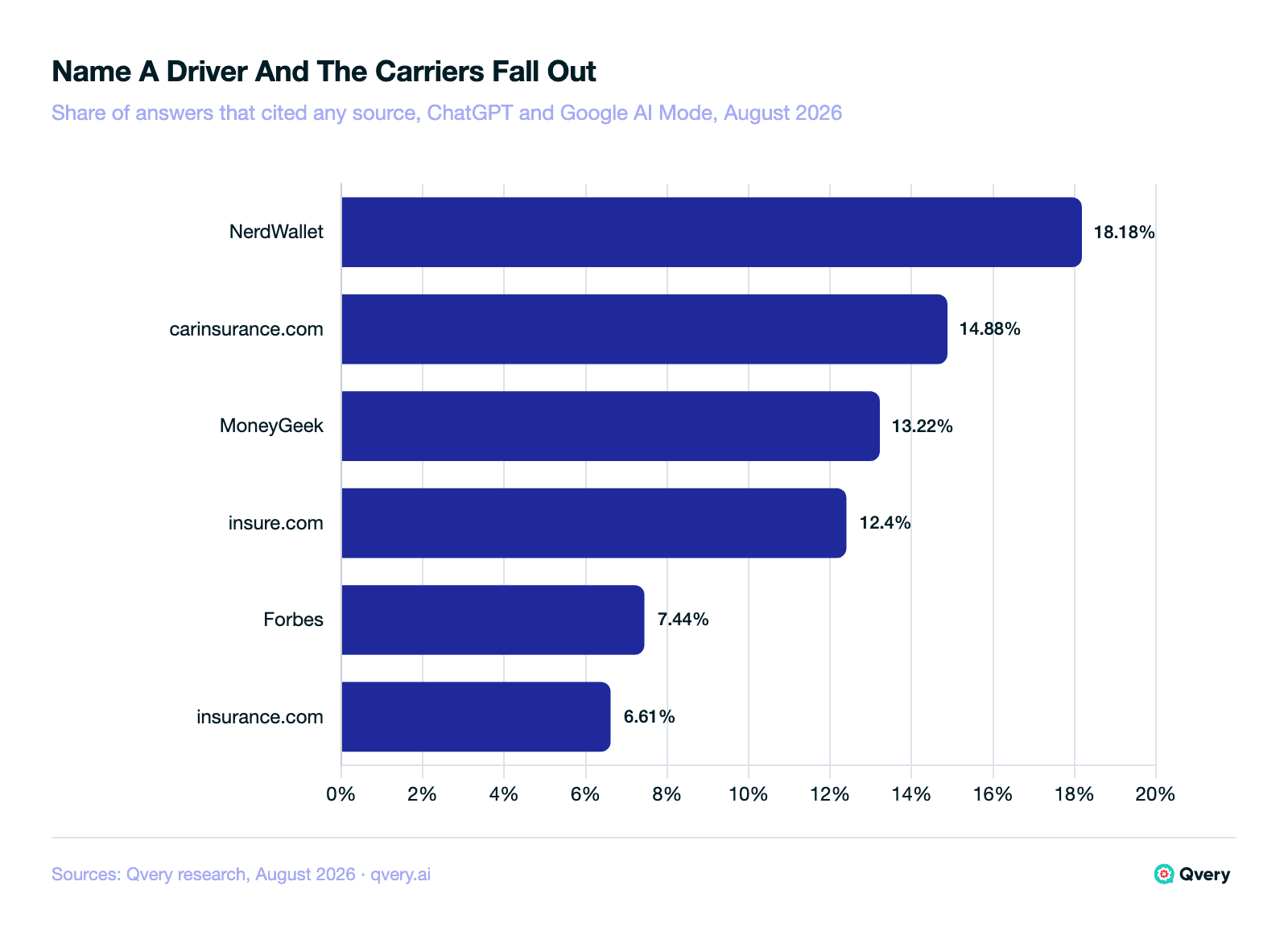
Geico, Progressive, and J.D. Power are all out of the leading group. They were in roughly a fifth of the generic answers each, and once the question names a driver they no longer make the list.
The reading that fits is unglamorous, and it is about what a website can hold.
A carrier's own site is a credible answer to who sells car insurance. It is a poor answer to who should insure a 23-year-old in Michigan, because that question wants a rate comparison across carriers and no carrier publishes one.
Look at what the qualified questions ask for. A price, for a specific person, in a specific state, with a specific record. That makes it a comparison question by construction.
A carrier site can publish an average, a range, or a marketing claim about savings. What it cannot publish is a competitor's price beside its own, and that is the shape these answers wanted.
We are not putting a percentage on Geico or Progressive in the qualified half. Where they land below the leading group, the figures sit at or under the level where a share in a set this size becomes an event count wearing a percent sign, so they ship as an absence and a rank.
If your tracked list is all category terms, rebuild it around the variables that change the price:
Age band: the under-25 and over-65 questions behave differently from everything in between.
State or country: rates are regulated locally, so the answer moves with the jurisdiction named.
Claims history: an at-fault claim in the question pulls a different set of properties than a clean record.
Annual mileage: low-mileage and commuter framings sit in different parts of the comparison tables.
Vehicle type: the car named in the question narrows which specialist gets cited.
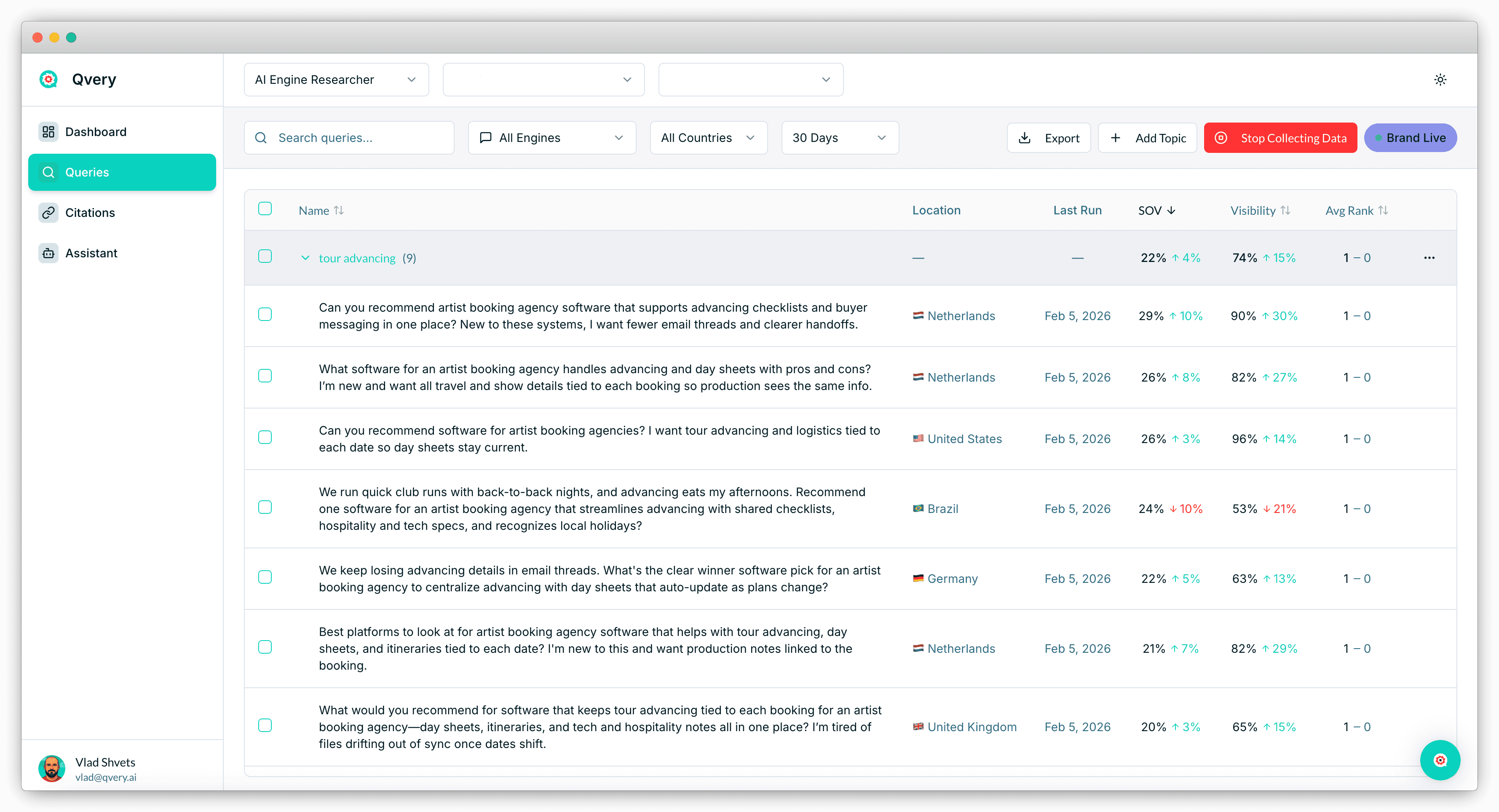
A tracked query is the whole question, not a category term, and it carries its own country, its own last-run date, and its own share of voice.
The account in the view below is not an insurer, and the columns are the part to read.
Run the qualified list as its own report rather than folding it into the generic one. You are measuring two different markets, and your own website only helps you in one of them.
The Comparison Layer Thins As Well
Two things moved when the question got specific, and only one of them was the thing we went in expecting.
We expected naming a driver to thin out the comparison sites. It does. NerdWallet goes from 25.41% to 18.18%, carinsurance.com from 25.41% to 14.88%, and insurance.com from 22.13% down to 6.61%.
So the comparison layer does not simply survive the qualifier. It thins, and the space is taken by more specialized properties: MoneyGeek at 13.22% and insure.com at 12.40% both climb into the leading group.
J.D. Power deserves its own note. It is a ratings body rather than a comparison site, and it sits in the generic leading group at 18.85% and outside the qualified one. A satisfaction ranking answers which insurer is well regarded, and says nothing about what one driver would pay.
Five domains sit in both leading groups.
That is far tighter coupling than the legal and health categories we measured this month showed. The roster does not swap out here. It reorders and reweights, and that is how both movements stay visible at once.
Those two patterns cost different things. When a roster swaps out, you have to win a new set of properties. When it reorders, you are already on the list and the question is your weight inside it, which is a cheaper problem to have.
A single insurance visibility number moves when either half of the market moves, and it never says which half.
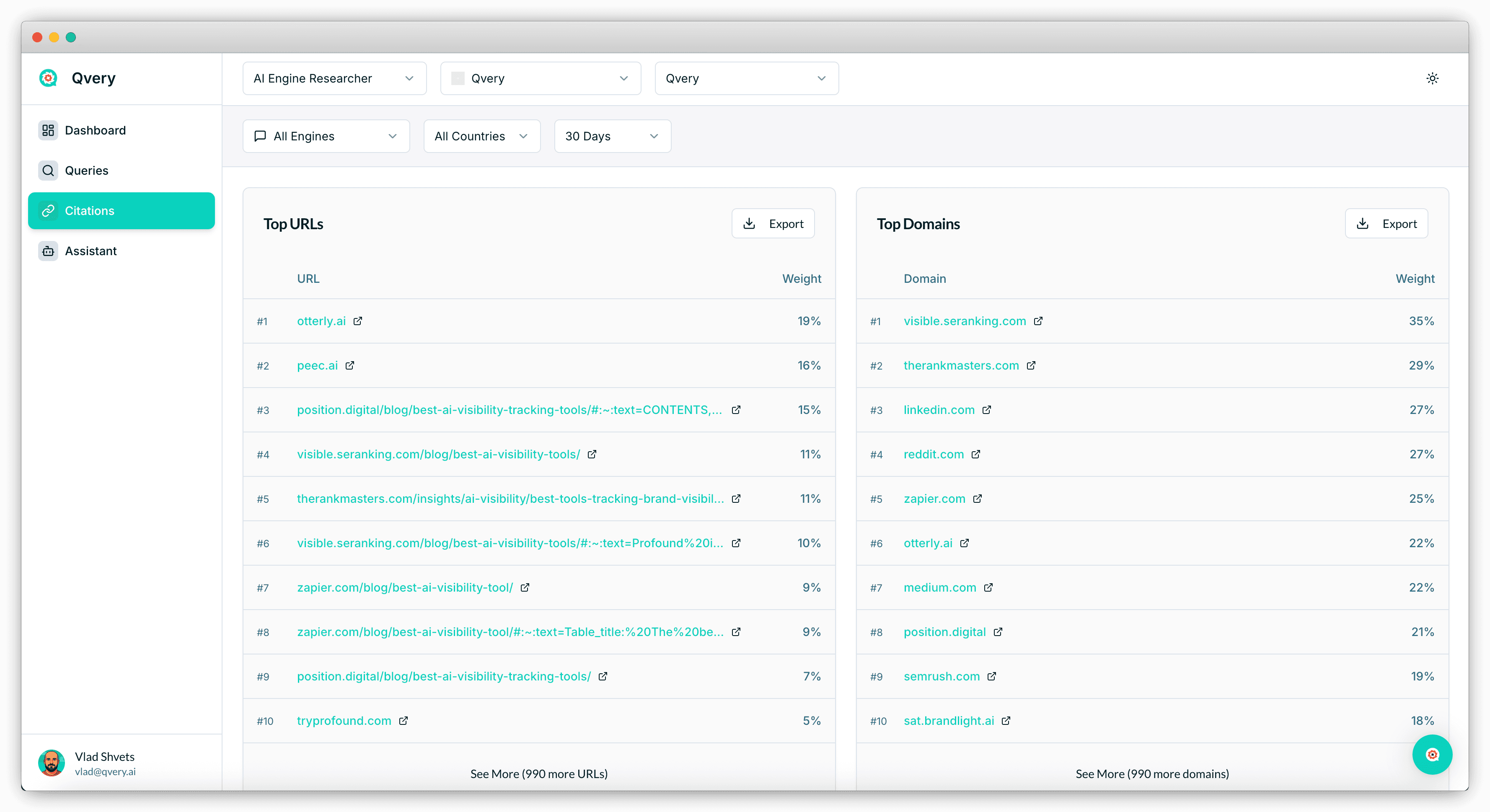
Two rows instead of one is what stops that averaging. Underneath either of them sits the same object: a ranked list of the properties that answered, with a weight against each name.
Neither specialist that rose is where you would look if you were reading a search results page. What AI engines cite and what Google ranks are mostly different pages, so the comparison layer has to be checked on its own.
Open the two specialists and look for your own rates in their tables, for the driver profiles you want to write. That is a data-supply question rather than a PR one, and it usually belongs to a different team than the one reading this.
The Engine Split We Did Not Make
We went in expecting the two engines to differ here, and that carriers' own domains would show up on one of them noticeably more than the other.
We are not reporting a result for it.
Taking all the questions together, there is enough behind the engine difference to say something. The version anyone would want, the difference inside each half, is not carried by enough Google AI Mode answers to support a number.
We could have published the combined figure and let readers assume it applied to both halves. That is the kind of shortcut that makes a report look more useful and makes it wrong.
It is also the kind of shortcut a reader has no way to see.
Nobody can tell from a percentage how little sat underneath it. That is the reason to set the minimum before the data arrives rather than after, when the number is already on the screen and you want it.
The same discipline removes a country breakdown. Insurance is regulated state by state and country by country, the questions were weighted toward the United States with British, Canadian, and Australian drivers behind them, and the non-US rows are not comparable to the US ones.
Most vendor reports do not carry a section listing what their data could not support. We think every one of them should, because the missing section is where the overclaiming hides.
When a report hands you an engine split or a country split, ask how much sat underneath it. The answer is usually available, and when nobody can produce it, that is its own answer.
The Two Places A Carrier Can Push
Everything from here is judgment on what the pattern suggests. The numbers show what appeared alongside these answers. It does not show that changing any of it changes what gets cited.
Given that, the room to act looks like it sits in two places, and neither one is a press release.
The first is your rate data inside the comparison properties. Those sites are answering the qualified question, and their tables are built from carrier data. Getting your rates present, current, and segmented the way buyers ask is a slow operational job with a clear owner.
The second is the profile-shaped pages on your own site. A carrier's own domain already gets cited on the generic question, so the domain is legible. What it lacks in this data is anything to say about a 23-year-old in Michigan.
That is an unusually good position to start from. Most brands in most categories have to earn their way onto a third-party property before an engine will read them at all. A carrier is already being read, and the gap is in what the pages say.
A carrier's website answers who sells insurance. Nothing on it answers who should insure this particular driver, which is the question buyers bring.
What we would spend less on, given this pattern, is more category-level content. The generic question is the half where carrier domains already appear, so another best-car-insurance page competes against NerdWallet on the question you are already in.
Pick the three driver profiles you price most competitively and write one page each that answers that profile's question in plain text, with the numbers you are willing to stand behind.
Score The Generic And Qualified Lists Separately In Qvery
Build the two lists as two topics, not one. That is the whole setup, and it takes an afternoon.
Write the generic topic the way your category page is titled. Write the qualified topic the way a customer describes themselves on the phone: their age, their state, and what happened to them last year.
Both are editable from Qvery Assistant in plain language.
Then open the Queries view at topic level and read the two rows against each other:
Visibility: whether you are named at all, per topic. A gap between the two rows is this article's gap, on your own brand.
Share of voice: how much of the named-brand space you hold once you do appear.
Average rank: where you sit inside the answer when the specialists are named too.
The delta on each: whether the qualified row moves after you ship the profile pages.
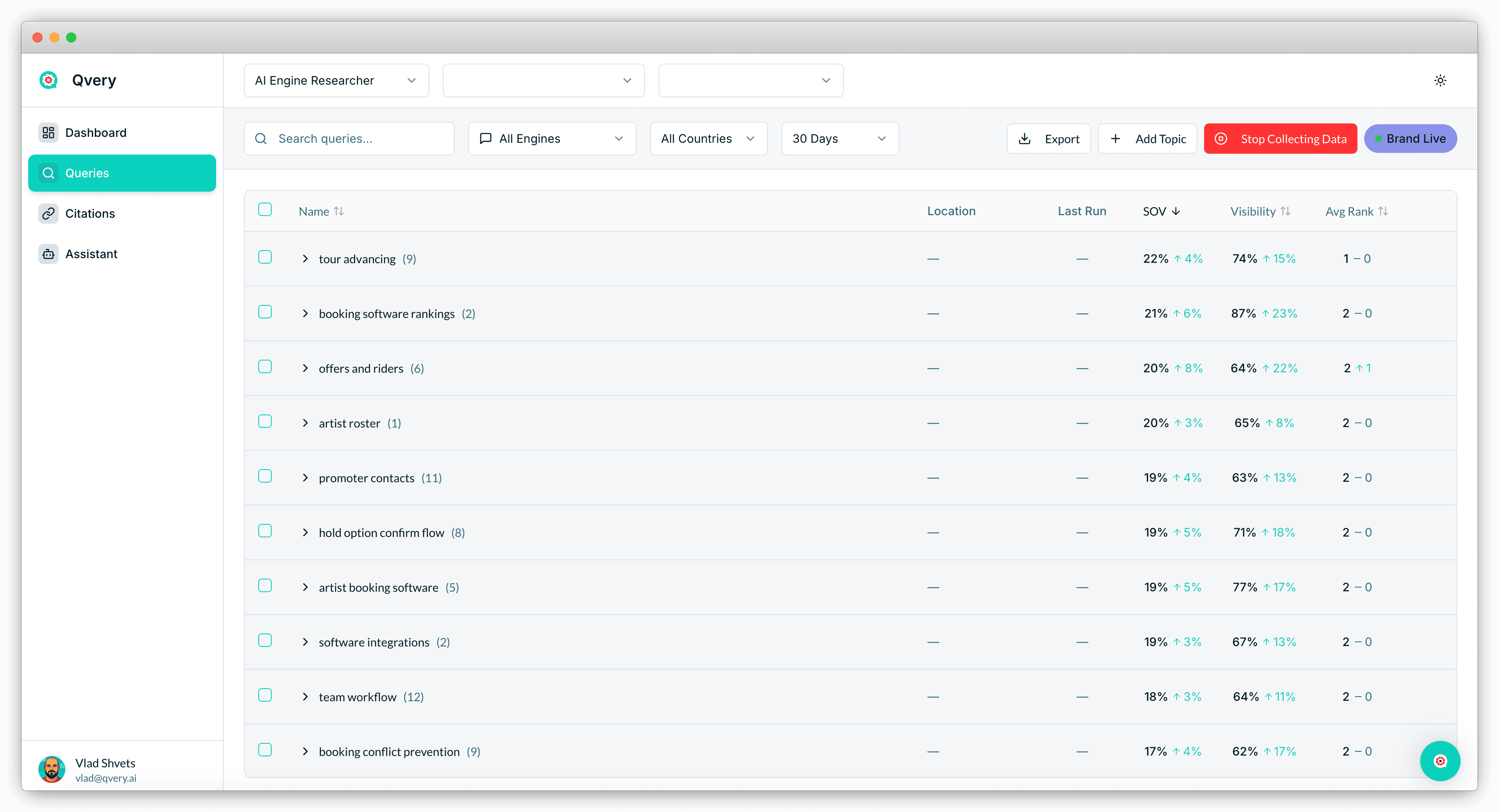
Qvery runs both topics daily against ChatGPT and Google AI Mode, in over 200 countries, and captures every citation tied to the query and the engine that produced it. That citation list is what tells you which properties are answering your qualified topic while your own domain is not.
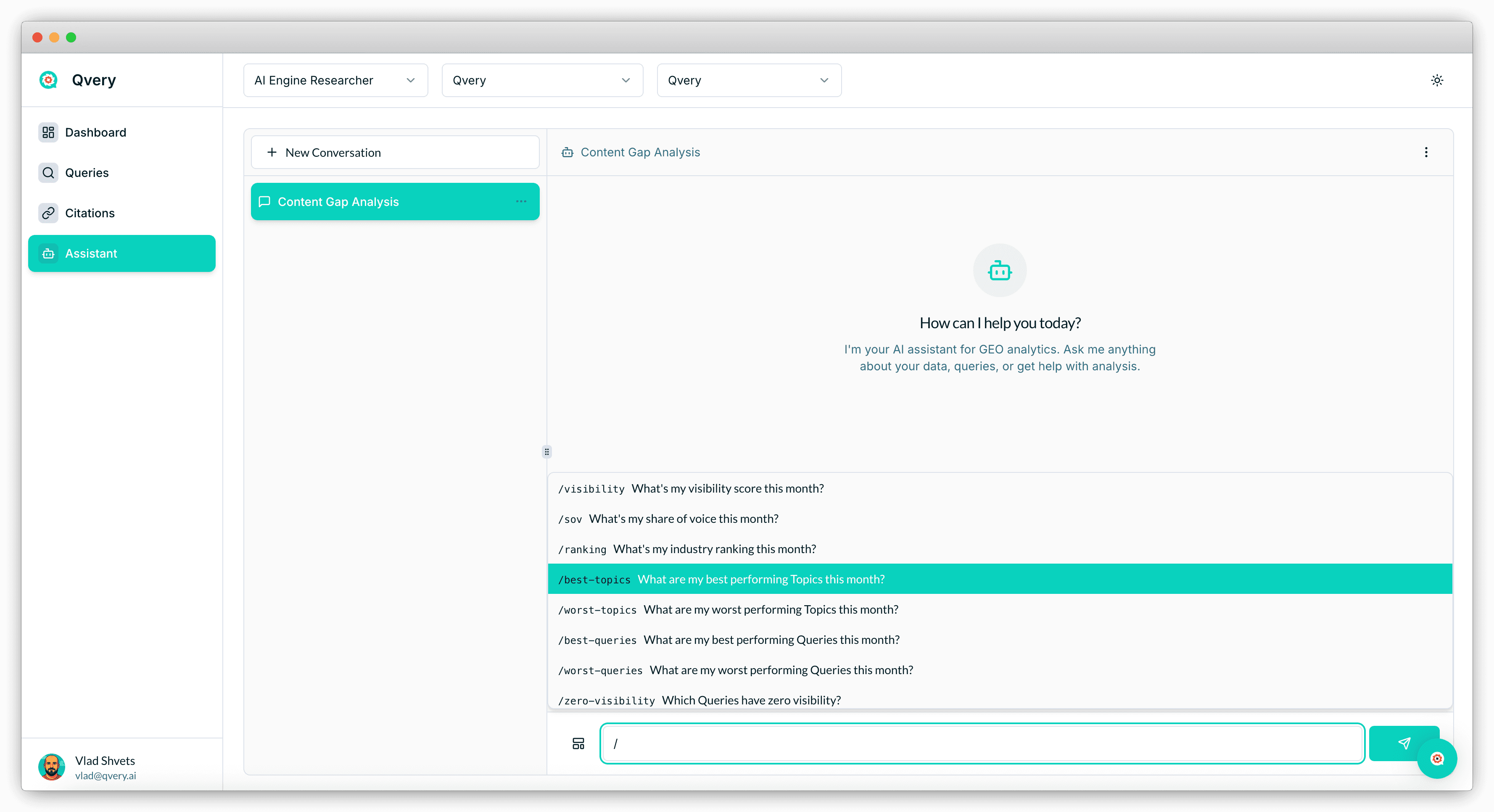
The question this article ends on has its own shortcut. In Qvery Assistant, /zero-visibility returns the queries you do not appear in at all, and pointed at the qualified topic it is a list of driver profiles the engines answer without you.
Qvery reports ChatGPT and Google AI Mode, so an answer written by an engine we do not track is not in your number.
The other thing it will not do is the sorting. Deciding whether a cited domain is a comparison property, a ratings body, or a carrier's own estate is your read on a list of URLs, and it is the read this whole article is built on.
Start your free trial and split your first month of insurance citations by whether the question named a driver.
If the generic topic shows your domain and the qualified one does not, you have found the same gap we did, and the fix is on pages you already own.
Anyone marketing car insurance has heard the same advice about AI search: the engines quote third parties, so your own website is not the asset it used to be. Go and earn placement on the comparison sites, and stop polishing pages nobody quotes.
In this category that advice is half wrong, and the half it gets wrong is the expensive one.
Ask an AI engine for the best car insurance companies and Geico and Progressive are in the answer, cited on their own domains, alongside NerdWallet and the comparison sites.
Ask it for the best insurance for a 23-year-old Michigan driver and both carriers fall out of the leading group entirely. The comparison properties stay, in different proportions, and two specialists move up to take the space.
One detail separates those two questions, and it is the one every buyer supplies.
The short version: an insurer's own domain earns its place on the category question and loses it when the buyer describes themselves.
The boundary on all of this, stated once. We recorded which sources appeared next to these answers. Nothing here shows that a source caused a carrier to be named, and nothing was built to test that.
Generic Insurance Questions Cite The Carriers Themselves
Across a targeted set of car insurance queries we ran on ChatGPT and Google AI Mode, August 2026, here is what the unqualified half was assembled from.
The ChatGPT side is its search-triggered subset, since an answer written without a live search cites nothing.
NerdWallet and carinsurance.com each appear in 25.41% of answers that cited any source. Insurance.com follows at 22.13%, Geico at 21.31%, Progressive at 19.67%, and J.D. Power at 18.85%.
Two of those six are insurers, cited on their own websites, in answers about which insurer to choose. That is worth pausing on, because most categories we measure do not work that way.
Our own automotive work found that manufacturer channels are largely absent from their own category. Car brands do not get cited when someone asks about cars. Car insurers do, when someone asks about car insurance, at least on this shape of question.
The questions in this half were plain.
"Best car insurance companies." "Which auto insurers have easy online quoting." A category, sometimes a feature, and no person attached to it.
This cuts against the standard advice that your own website does not matter in AI search. In this category, on this shape of question, it plainly does, and the carrier domains were cited at rates comparable to the comparison properties sitting above them.
One row is left out of that chart deliberately. Google AI Mode returns its citations as Google's own wrapper links instead of publisher URLs, so google.com sits near the top of both lists as engine plumbing, not a source.
Dropping it changes no other figure, and both halves carry the same mix of engines, so the two remain comparable against each other.
Run your own generic set first and check whether your carrier domain comes back. If it does, find the specific page it is pulling and put that page on the maintained list, because it is doing visibility work nobody on your team has been credited for.
Name A Driver And The Carriers Fall Out
The second half asked the same category question with a driver attached. "Best insurance for 23-year-old Michigan drivers." "Looking for insurance after an at-fault claim in Georgia." "Best UK cover for low-mileage graduates."
Age, state, record, mileage: the variables that price a policy.
NerdWallet leads at 18.18% of answers that cited any source, carinsurance.com follows at 14.88%, then MoneyGeek at 13.22%, insure.com at 12.40%, Forbes at 7.44%, and insurance.com at 6.61%.
Geico, Progressive, and J.D. Power are all out of the leading group. They were in roughly a fifth of the generic answers each, and once the question names a driver they no longer make the list.
The reading that fits is unglamorous, and it is about what a website can hold.
A carrier's own site is a credible answer to who sells car insurance. It is a poor answer to who should insure a 23-year-old in Michigan, because that question wants a rate comparison across carriers and no carrier publishes one.
Look at what the qualified questions ask for. A price, for a specific person, in a specific state, with a specific record. That makes it a comparison question by construction.
A carrier site can publish an average, a range, or a marketing claim about savings. What it cannot publish is a competitor's price beside its own, and that is the shape these answers wanted.
We are not putting a percentage on Geico or Progressive in the qualified half. Where they land below the leading group, the figures sit at or under the level where a share in a set this size becomes an event count wearing a percent sign, so they ship as an absence and a rank.
If your tracked list is all category terms, rebuild it around the variables that change the price:
Age band: the under-25 and over-65 questions behave differently from everything in between.
State or country: rates are regulated locally, so the answer moves with the jurisdiction named.
Claims history: an at-fault claim in the question pulls a different set of properties than a clean record.
Annual mileage: low-mileage and commuter framings sit in different parts of the comparison tables.
Vehicle type: the car named in the question narrows which specialist gets cited.
A tracked query is the whole question, not a category term, and it carries its own country, its own last-run date, and its own share of voice.
The account in the view below is not an insurer, and the columns are the part to read.
Run the qualified list as its own report rather than folding it into the generic one. You are measuring two different markets, and your own website only helps you in one of them.
The Comparison Layer Thins As Well
Two things moved when the question got specific, and only one of them was the thing we went in expecting.
We expected naming a driver to thin out the comparison sites. It does. NerdWallet goes from 25.41% to 18.18%, carinsurance.com from 25.41% to 14.88%, and insurance.com from 22.13% down to 6.61%.
So the comparison layer does not simply survive the qualifier. It thins, and the space is taken by more specialized properties: MoneyGeek at 13.22% and insure.com at 12.40% both climb into the leading group.
J.D. Power deserves its own note. It is a ratings body rather than a comparison site, and it sits in the generic leading group at 18.85% and outside the qualified one. A satisfaction ranking answers which insurer is well regarded, and says nothing about what one driver would pay.
Five domains sit in both leading groups.
That is far tighter coupling than the legal and health categories we measured this month showed. The roster does not swap out here. It reorders and reweights, and that is how both movements stay visible at once.
Those two patterns cost different things. When a roster swaps out, you have to win a new set of properties. When it reorders, you are already on the list and the question is your weight inside it, which is a cheaper problem to have.
A single insurance visibility number moves when either half of the market moves, and it never says which half.
Two rows instead of one is what stops that averaging. Underneath either of them sits the same object: a ranked list of the properties that answered, with a weight against each name.
Neither specialist that rose is where you would look if you were reading a search results page. What AI engines cite and what Google ranks are mostly different pages, so the comparison layer has to be checked on its own.
Open the two specialists and look for your own rates in their tables, for the driver profiles you want to write. That is a data-supply question rather than a PR one, and it usually belongs to a different team than the one reading this.
The Engine Split We Did Not Make
We went in expecting the two engines to differ here, and that carriers' own domains would show up on one of them noticeably more than the other.
We are not reporting a result for it.
Taking all the questions together, there is enough behind the engine difference to say something. The version anyone would want, the difference inside each half, is not carried by enough Google AI Mode answers to support a number.
We could have published the combined figure and let readers assume it applied to both halves. That is the kind of shortcut that makes a report look more useful and makes it wrong.
It is also the kind of shortcut a reader has no way to see.
Nobody can tell from a percentage how little sat underneath it. That is the reason to set the minimum before the data arrives rather than after, when the number is already on the screen and you want it.
The same discipline removes a country breakdown. Insurance is regulated state by state and country by country, the questions were weighted toward the United States with British, Canadian, and Australian drivers behind them, and the non-US rows are not comparable to the US ones.
Most vendor reports do not carry a section listing what their data could not support. We think every one of them should, because the missing section is where the overclaiming hides.
When a report hands you an engine split or a country split, ask how much sat underneath it. The answer is usually available, and when nobody can produce it, that is its own answer.
The Two Places A Carrier Can Push
Everything from here is judgment on what the pattern suggests. The numbers show what appeared alongside these answers. It does not show that changing any of it changes what gets cited.
Given that, the room to act looks like it sits in two places, and neither one is a press release.
The first is your rate data inside the comparison properties. Those sites are answering the qualified question, and their tables are built from carrier data. Getting your rates present, current, and segmented the way buyers ask is a slow operational job with a clear owner.
The second is the profile-shaped pages on your own site. A carrier's own domain already gets cited on the generic question, so the domain is legible. What it lacks in this data is anything to say about a 23-year-old in Michigan.
That is an unusually good position to start from. Most brands in most categories have to earn their way onto a third-party property before an engine will read them at all. A carrier is already being read, and the gap is in what the pages say.
A carrier's website answers who sells insurance. Nothing on it answers who should insure this particular driver, which is the question buyers bring.
What we would spend less on, given this pattern, is more category-level content. The generic question is the half where carrier domains already appear, so another best-car-insurance page competes against NerdWallet on the question you are already in.
Pick the three driver profiles you price most competitively and write one page each that answers that profile's question in plain text, with the numbers you are willing to stand behind.
Score The Generic And Qualified Lists Separately In Qvery
Build the two lists as two topics, not one. That is the whole setup, and it takes an afternoon.
Write the generic topic the way your category page is titled. Write the qualified topic the way a customer describes themselves on the phone: their age, their state, and what happened to them last year.
Both are editable from Qvery Assistant in plain language.
Then open the Queries view at topic level and read the two rows against each other:
Visibility: whether you are named at all, per topic. A gap between the two rows is this article's gap, on your own brand.
Share of voice: how much of the named-brand space you hold once you do appear.
Average rank: where you sit inside the answer when the specialists are named too.
The delta on each: whether the qualified row moves after you ship the profile pages.
Qvery runs both topics daily against ChatGPT and Google AI Mode, in over 200 countries, and captures every citation tied to the query and the engine that produced it. That citation list is what tells you which properties are answering your qualified topic while your own domain is not.
The question this article ends on has its own shortcut. In Qvery Assistant, /zero-visibility returns the queries you do not appear in at all, and pointed at the qualified topic it is a list of driver profiles the engines answer without you.
Qvery reports ChatGPT and Google AI Mode, so an answer written by an engine we do not track is not in your number.
The other thing it will not do is the sorting. Deciding whether a cited domain is a comparison property, a ratings body, or a carrier's own estate is your read on a list of URLs, and it is the read this whole article is built on.
Start your free trial and split your first month of insurance citations by whether the question named a driver.
If the generic topic shows your domain and the qualified one does not, you have found the same gap we did, and the fix is on pages you already own.
Anyone marketing car insurance has heard the same advice about AI search: the engines quote third parties, so your own website is not the asset it used to be. Go and earn placement on the comparison sites, and stop polishing pages nobody quotes.
In this category that advice is half wrong, and the half it gets wrong is the expensive one.
Ask an AI engine for the best car insurance companies and Geico and Progressive are in the answer, cited on their own domains, alongside NerdWallet and the comparison sites.
Ask it for the best insurance for a 23-year-old Michigan driver and both carriers fall out of the leading group entirely. The comparison properties stay, in different proportions, and two specialists move up to take the space.
One detail separates those two questions, and it is the one every buyer supplies.
The short version: an insurer's own domain earns its place on the category question and loses it when the buyer describes themselves.
The boundary on all of this, stated once. We recorded which sources appeared next to these answers. Nothing here shows that a source caused a carrier to be named, and nothing was built to test that.
Generic Insurance Questions Cite The Carriers Themselves
Across a targeted set of car insurance queries we ran on ChatGPT and Google AI Mode, August 2026, here is what the unqualified half was assembled from.
The ChatGPT side is its search-triggered subset, since an answer written without a live search cites nothing.
NerdWallet and carinsurance.com each appear in 25.41% of answers that cited any source. Insurance.com follows at 22.13%, Geico at 21.31%, Progressive at 19.67%, and J.D. Power at 18.85%.
Two of those six are insurers, cited on their own websites, in answers about which insurer to choose. That is worth pausing on, because most categories we measure do not work that way.
Our own automotive work found that manufacturer channels are largely absent from their own category. Car brands do not get cited when someone asks about cars. Car insurers do, when someone asks about car insurance, at least on this shape of question.
The questions in this half were plain.
"Best car insurance companies." "Which auto insurers have easy online quoting." A category, sometimes a feature, and no person attached to it.
This cuts against the standard advice that your own website does not matter in AI search. In this category, on this shape of question, it plainly does, and the carrier domains were cited at rates comparable to the comparison properties sitting above them.
One row is left out of that chart deliberately. Google AI Mode returns its citations as Google's own wrapper links instead of publisher URLs, so google.com sits near the top of both lists as engine plumbing, not a source.
Dropping it changes no other figure, and both halves carry the same mix of engines, so the two remain comparable against each other.
Run your own generic set first and check whether your carrier domain comes back. If it does, find the specific page it is pulling and put that page on the maintained list, because it is doing visibility work nobody on your team has been credited for.
Name A Driver And The Carriers Fall Out
The second half asked the same category question with a driver attached. "Best insurance for 23-year-old Michigan drivers." "Looking for insurance after an at-fault claim in Georgia." "Best UK cover for low-mileage graduates."
Age, state, record, mileage: the variables that price a policy.
NerdWallet leads at 18.18% of answers that cited any source, carinsurance.com follows at 14.88%, then MoneyGeek at 13.22%, insure.com at 12.40%, Forbes at 7.44%, and insurance.com at 6.61%.
Geico, Progressive, and J.D. Power are all out of the leading group. They were in roughly a fifth of the generic answers each, and once the question names a driver they no longer make the list.
The reading that fits is unglamorous, and it is about what a website can hold.
A carrier's own site is a credible answer to who sells car insurance. It is a poor answer to who should insure a 23-year-old in Michigan, because that question wants a rate comparison across carriers and no carrier publishes one.
Look at what the qualified questions ask for. A price, for a specific person, in a specific state, with a specific record. That makes it a comparison question by construction.
A carrier site can publish an average, a range, or a marketing claim about savings. What it cannot publish is a competitor's price beside its own, and that is the shape these answers wanted.
We are not putting a percentage on Geico or Progressive in the qualified half. Where they land below the leading group, the figures sit at or under the level where a share in a set this size becomes an event count wearing a percent sign, so they ship as an absence and a rank.
If your tracked list is all category terms, rebuild it around the variables that change the price:
Age band: the under-25 and over-65 questions behave differently from everything in between.
State or country: rates are regulated locally, so the answer moves with the jurisdiction named.
Claims history: an at-fault claim in the question pulls a different set of properties than a clean record.
Annual mileage: low-mileage and commuter framings sit in different parts of the comparison tables.
Vehicle type: the car named in the question narrows which specialist gets cited.
A tracked query is the whole question, not a category term, and it carries its own country, its own last-run date, and its own share of voice.
The account in the view below is not an insurer, and the columns are the part to read.
Run the qualified list as its own report rather than folding it into the generic one. You are measuring two different markets, and your own website only helps you in one of them.
The Comparison Layer Thins As Well
Two things moved when the question got specific, and only one of them was the thing we went in expecting.
We expected naming a driver to thin out the comparison sites. It does. NerdWallet goes from 25.41% to 18.18%, carinsurance.com from 25.41% to 14.88%, and insurance.com from 22.13% down to 6.61%.
So the comparison layer does not simply survive the qualifier. It thins, and the space is taken by more specialized properties: MoneyGeek at 13.22% and insure.com at 12.40% both climb into the leading group.
J.D. Power deserves its own note. It is a ratings body rather than a comparison site, and it sits in the generic leading group at 18.85% and outside the qualified one. A satisfaction ranking answers which insurer is well regarded, and says nothing about what one driver would pay.
Five domains sit in both leading groups.
That is far tighter coupling than the legal and health categories we measured this month showed. The roster does not swap out here. It reorders and reweights, and that is how both movements stay visible at once.
Those two patterns cost different things. When a roster swaps out, you have to win a new set of properties. When it reorders, you are already on the list and the question is your weight inside it, which is a cheaper problem to have.
A single insurance visibility number moves when either half of the market moves, and it never says which half.
Two rows instead of one is what stops that averaging. Underneath either of them sits the same object: a ranked list of the properties that answered, with a weight against each name.
Neither specialist that rose is where you would look if you were reading a search results page. What AI engines cite and what Google ranks are mostly different pages, so the comparison layer has to be checked on its own.
Open the two specialists and look for your own rates in their tables, for the driver profiles you want to write. That is a data-supply question rather than a PR one, and it usually belongs to a different team than the one reading this.
The Engine Split We Did Not Make
We went in expecting the two engines to differ here, and that carriers' own domains would show up on one of them noticeably more than the other.
We are not reporting a result for it.
Taking all the questions together, there is enough behind the engine difference to say something. The version anyone would want, the difference inside each half, is not carried by enough Google AI Mode answers to support a number.
We could have published the combined figure and let readers assume it applied to both halves. That is the kind of shortcut that makes a report look more useful and makes it wrong.
It is also the kind of shortcut a reader has no way to see.
Nobody can tell from a percentage how little sat underneath it. That is the reason to set the minimum before the data arrives rather than after, when the number is already on the screen and you want it.
The same discipline removes a country breakdown. Insurance is regulated state by state and country by country, the questions were weighted toward the United States with British, Canadian, and Australian drivers behind them, and the non-US rows are not comparable to the US ones.
Most vendor reports do not carry a section listing what their data could not support. We think every one of them should, because the missing section is where the overclaiming hides.
When a report hands you an engine split or a country split, ask how much sat underneath it. The answer is usually available, and when nobody can produce it, that is its own answer.
The Two Places A Carrier Can Push
Everything from here is judgment on what the pattern suggests. The numbers show what appeared alongside these answers. It does not show that changing any of it changes what gets cited.
Given that, the room to act looks like it sits in two places, and neither one is a press release.
The first is your rate data inside the comparison properties. Those sites are answering the qualified question, and their tables are built from carrier data. Getting your rates present, current, and segmented the way buyers ask is a slow operational job with a clear owner.
The second is the profile-shaped pages on your own site. A carrier's own domain already gets cited on the generic question, so the domain is legible. What it lacks in this data is anything to say about a 23-year-old in Michigan.
That is an unusually good position to start from. Most brands in most categories have to earn their way onto a third-party property before an engine will read them at all. A carrier is already being read, and the gap is in what the pages say.
A carrier's website answers who sells insurance. Nothing on it answers who should insure this particular driver, which is the question buyers bring.
What we would spend less on, given this pattern, is more category-level content. The generic question is the half where carrier domains already appear, so another best-car-insurance page competes against NerdWallet on the question you are already in.
Pick the three driver profiles you price most competitively and write one page each that answers that profile's question in plain text, with the numbers you are willing to stand behind.
Score The Generic And Qualified Lists Separately In Qvery
Build the two lists as two topics, not one. That is the whole setup, and it takes an afternoon.
Write the generic topic the way your category page is titled. Write the qualified topic the way a customer describes themselves on the phone: their age, their state, and what happened to them last year.
Both are editable from Qvery Assistant in plain language.
Then open the Queries view at topic level and read the two rows against each other:
Visibility: whether you are named at all, per topic. A gap between the two rows is this article's gap, on your own brand.
Share of voice: how much of the named-brand space you hold once you do appear.
Average rank: where you sit inside the answer when the specialists are named too.
The delta on each: whether the qualified row moves after you ship the profile pages.
Qvery runs both topics daily against ChatGPT and Google AI Mode, in over 200 countries, and captures every citation tied to the query and the engine that produced it. That citation list is what tells you which properties are answering your qualified topic while your own domain is not.
The question this article ends on has its own shortcut. In Qvery Assistant, /zero-visibility returns the queries you do not appear in at all, and pointed at the qualified topic it is a list of driver profiles the engines answer without you.
Qvery reports ChatGPT and Google AI Mode, so an answer written by an engine we do not track is not in your number.
The other thing it will not do is the sorting. Deciding whether a cited domain is a comparison property, a ratings body, or a carrier's own estate is your read on a list of URLs, and it is the read this whole article is built on.
Start your free trial and split your first month of insurance citations by whether the question named a driver.
If the generic topic shows your domain and the qualified one does not, you have found the same gap we did, and the fix is on pages you already own.
Anyone marketing car insurance has heard the same advice about AI search: the engines quote third parties, so your own website is not the asset it used to be. Go and earn placement on the comparison sites, and stop polishing pages nobody quotes.
In this category that advice is half wrong, and the half it gets wrong is the expensive one.
Ask an AI engine for the best car insurance companies and Geico and Progressive are in the answer, cited on their own domains, alongside NerdWallet and the comparison sites.
Ask it for the best insurance for a 23-year-old Michigan driver and both carriers fall out of the leading group entirely. The comparison properties stay, in different proportions, and two specialists move up to take the space.
One detail separates those two questions, and it is the one every buyer supplies.
The short version: an insurer's own domain earns its place on the category question and loses it when the buyer describes themselves.
The boundary on all of this, stated once. We recorded which sources appeared next to these answers. Nothing here shows that a source caused a carrier to be named, and nothing was built to test that.
Generic Insurance Questions Cite The Carriers Themselves
Across a targeted set of car insurance queries we ran on ChatGPT and Google AI Mode, August 2026, here is what the unqualified half was assembled from.
The ChatGPT side is its search-triggered subset, since an answer written without a live search cites nothing.
NerdWallet and carinsurance.com each appear in 25.41% of answers that cited any source. Insurance.com follows at 22.13%, Geico at 21.31%, Progressive at 19.67%, and J.D. Power at 18.85%.
Two of those six are insurers, cited on their own websites, in answers about which insurer to choose. That is worth pausing on, because most categories we measure do not work that way.
Our own automotive work found that manufacturer channels are largely absent from their own category. Car brands do not get cited when someone asks about cars. Car insurers do, when someone asks about car insurance, at least on this shape of question.
The questions in this half were plain.
"Best car insurance companies." "Which auto insurers have easy online quoting." A category, sometimes a feature, and no person attached to it.
This cuts against the standard advice that your own website does not matter in AI search. In this category, on this shape of question, it plainly does, and the carrier domains were cited at rates comparable to the comparison properties sitting above them.
One row is left out of that chart deliberately. Google AI Mode returns its citations as Google's own wrapper links instead of publisher URLs, so google.com sits near the top of both lists as engine plumbing, not a source.
Dropping it changes no other figure, and both halves carry the same mix of engines, so the two remain comparable against each other.
Run your own generic set first and check whether your carrier domain comes back. If it does, find the specific page it is pulling and put that page on the maintained list, because it is doing visibility work nobody on your team has been credited for.
Name A Driver And The Carriers Fall Out
The second half asked the same category question with a driver attached. "Best insurance for 23-year-old Michigan drivers." "Looking for insurance after an at-fault claim in Georgia." "Best UK cover for low-mileage graduates."
Age, state, record, mileage: the variables that price a policy.
NerdWallet leads at 18.18% of answers that cited any source, carinsurance.com follows at 14.88%, then MoneyGeek at 13.22%, insure.com at 12.40%, Forbes at 7.44%, and insurance.com at 6.61%.
Geico, Progressive, and J.D. Power are all out of the leading group. They were in roughly a fifth of the generic answers each, and once the question names a driver they no longer make the list.
The reading that fits is unglamorous, and it is about what a website can hold.
A carrier's own site is a credible answer to who sells car insurance. It is a poor answer to who should insure a 23-year-old in Michigan, because that question wants a rate comparison across carriers and no carrier publishes one.
Look at what the qualified questions ask for. A price, for a specific person, in a specific state, with a specific record. That makes it a comparison question by construction.
A carrier site can publish an average, a range, or a marketing claim about savings. What it cannot publish is a competitor's price beside its own, and that is the shape these answers wanted.
We are not putting a percentage on Geico or Progressive in the qualified half. Where they land below the leading group, the figures sit at or under the level where a share in a set this size becomes an event count wearing a percent sign, so they ship as an absence and a rank.
If your tracked list is all category terms, rebuild it around the variables that change the price:
Age band: the under-25 and over-65 questions behave differently from everything in between.
State or country: rates are regulated locally, so the answer moves with the jurisdiction named.
Claims history: an at-fault claim in the question pulls a different set of properties than a clean record.
Annual mileage: low-mileage and commuter framings sit in different parts of the comparison tables.
Vehicle type: the car named in the question narrows which specialist gets cited.
A tracked query is the whole question, not a category term, and it carries its own country, its own last-run date, and its own share of voice.
The account in the view below is not an insurer, and the columns are the part to read.
Run the qualified list as its own report rather than folding it into the generic one. You are measuring two different markets, and your own website only helps you in one of them.
The Comparison Layer Thins As Well
Two things moved when the question got specific, and only one of them was the thing we went in expecting.
We expected naming a driver to thin out the comparison sites. It does. NerdWallet goes from 25.41% to 18.18%, carinsurance.com from 25.41% to 14.88%, and insurance.com from 22.13% down to 6.61%.
So the comparison layer does not simply survive the qualifier. It thins, and the space is taken by more specialized properties: MoneyGeek at 13.22% and insure.com at 12.40% both climb into the leading group.
J.D. Power deserves its own note. It is a ratings body rather than a comparison site, and it sits in the generic leading group at 18.85% and outside the qualified one. A satisfaction ranking answers which insurer is well regarded, and says nothing about what one driver would pay.
Five domains sit in both leading groups.
That is far tighter coupling than the legal and health categories we measured this month showed. The roster does not swap out here. It reorders and reweights, and that is how both movements stay visible at once.
Those two patterns cost different things. When a roster swaps out, you have to win a new set of properties. When it reorders, you are already on the list and the question is your weight inside it, which is a cheaper problem to have.
A single insurance visibility number moves when either half of the market moves, and it never says which half.
Two rows instead of one is what stops that averaging. Underneath either of them sits the same object: a ranked list of the properties that answered, with a weight against each name.
Neither specialist that rose is where you would look if you were reading a search results page. What AI engines cite and what Google ranks are mostly different pages, so the comparison layer has to be checked on its own.
Open the two specialists and look for your own rates in their tables, for the driver profiles you want to write. That is a data-supply question rather than a PR one, and it usually belongs to a different team than the one reading this.
The Engine Split We Did Not Make
We went in expecting the two engines to differ here, and that carriers' own domains would show up on one of them noticeably more than the other.
We are not reporting a result for it.
Taking all the questions together, there is enough behind the engine difference to say something. The version anyone would want, the difference inside each half, is not carried by enough Google AI Mode answers to support a number.
We could have published the combined figure and let readers assume it applied to both halves. That is the kind of shortcut that makes a report look more useful and makes it wrong.
It is also the kind of shortcut a reader has no way to see.
Nobody can tell from a percentage how little sat underneath it. That is the reason to set the minimum before the data arrives rather than after, when the number is already on the screen and you want it.
The same discipline removes a country breakdown. Insurance is regulated state by state and country by country, the questions were weighted toward the United States with British, Canadian, and Australian drivers behind them, and the non-US rows are not comparable to the US ones.
Most vendor reports do not carry a section listing what their data could not support. We think every one of them should, because the missing section is where the overclaiming hides.
When a report hands you an engine split or a country split, ask how much sat underneath it. The answer is usually available, and when nobody can produce it, that is its own answer.
The Two Places A Carrier Can Push
Everything from here is judgment on what the pattern suggests. The numbers show what appeared alongside these answers. It does not show that changing any of it changes what gets cited.
Given that, the room to act looks like it sits in two places, and neither one is a press release.
The first is your rate data inside the comparison properties. Those sites are answering the qualified question, and their tables are built from carrier data. Getting your rates present, current, and segmented the way buyers ask is a slow operational job with a clear owner.
The second is the profile-shaped pages on your own site. A carrier's own domain already gets cited on the generic question, so the domain is legible. What it lacks in this data is anything to say about a 23-year-old in Michigan.
That is an unusually good position to start from. Most brands in most categories have to earn their way onto a third-party property before an engine will read them at all. A carrier is already being read, and the gap is in what the pages say.
A carrier's website answers who sells insurance. Nothing on it answers who should insure this particular driver, which is the question buyers bring.
What we would spend less on, given this pattern, is more category-level content. The generic question is the half where carrier domains already appear, so another best-car-insurance page competes against NerdWallet on the question you are already in.
Pick the three driver profiles you price most competitively and write one page each that answers that profile's question in plain text, with the numbers you are willing to stand behind.
Score The Generic And Qualified Lists Separately In Qvery
Build the two lists as two topics, not one. That is the whole setup, and it takes an afternoon.
Write the generic topic the way your category page is titled. Write the qualified topic the way a customer describes themselves on the phone: their age, their state, and what happened to them last year.
Both are editable from Qvery Assistant in plain language.
Then open the Queries view at topic level and read the two rows against each other:
Visibility: whether you are named at all, per topic. A gap between the two rows is this article's gap, on your own brand.
Share of voice: how much of the named-brand space you hold once you do appear.
Average rank: where you sit inside the answer when the specialists are named too.
The delta on each: whether the qualified row moves after you ship the profile pages.
Qvery runs both topics daily against ChatGPT and Google AI Mode, in over 200 countries, and captures every citation tied to the query and the engine that produced it. That citation list is what tells you which properties are answering your qualified topic while your own domain is not.
The question this article ends on has its own shortcut. In Qvery Assistant, /zero-visibility returns the queries you do not appear in at all, and pointed at the qualified topic it is a list of driver profiles the engines answer without you.
Qvery reports ChatGPT and Google AI Mode, so an answer written by an engine we do not track is not in your number.
The other thing it will not do is the sorting. Deciding whether a cited domain is a comparison property, a ratings body, or a carrier's own estate is your read on a list of URLs, and it is the read this whole article is built on.
Start your free trial and split your first month of insurance citations by whether the question named a driver.
If the generic topic shows your domain and the qualified one does not, you have found the same gap we did, and the fix is on pages you already own.

© 2026 Qvery AI OÜ