By
Vlad Shvets
8 Best AI Visibility Tools for Travel Brands (Compared)
Eight AI visibility tools for hotel groups, tour operators, and travel brands, read against five travel requirements, from per-country tracking to destination questions per market.
Eight AI visibility tools for hotel groups, tour operators, and travel brands, read against five travel requirements, from per-country tracking to destination questions per market.
Eight AI visibility tools for hotel groups, tour operators, and travel brands, read against five travel requirements, from per-country tracking to destination questions per market.
This September, 73.02% of the answers ChatGPT and Google AI Mode gave to travel recommendation questions cited at least one travel brand's own website. Travel demand is local, so ask whether yours gets cited in each market. One global score is a weather report for the planet: accurate on average, useless for packing.
Every product here documents both engines on its own pages and has a public pricing page. What they most often leave undocumented is what travel needs most: your own destination questions per market. Each entry splits the documented from the demo questions, as of September 22, 2026.
What a Travel Brand Needs a Tracker to Prove, Market by Market
Travel sells destination by destination, and that splits one visibility number into five separate questions:
Per-country tracking. The same question run in each market you sell in, since travel demand is local.
Cited pages. Which pages and domains an answer cited, so you can see whether it leaned on an OTA, a review site, a forum thread, or your own site. In hotel answers, the OTA pages that get cited are mostly city hubs rather than listings, which you only learn at page level.
Several brands in one account. Groups, chains, and portfolios need each property or brand tracked on its own, under one login.
Named in the answer. Whether the brand itself appears in what the engine says, which is a different measurement from its pages turning up among the sources.
Destination prompts per market. For example, “boutique hotels in Porto” tracked in Portugal and in the UK, or “family ski trips” in each market you sell to.
Every entry marks each requirement as documented (the vendor's own page says so), documented as not offered (the page says it isn't), or not documented (the page is silent). A silent page turns the requirement into a question for the demo.
Of the seven competitors, five document four of the five (Scrunch two of them only on Enterprise), and none documents the fifth. Qvery's documentation covers all five, and it's our product, so check that claim in the free trial like any other.
1. Qvery: Ask It Which Destination Questions You're Missing
Key Features:
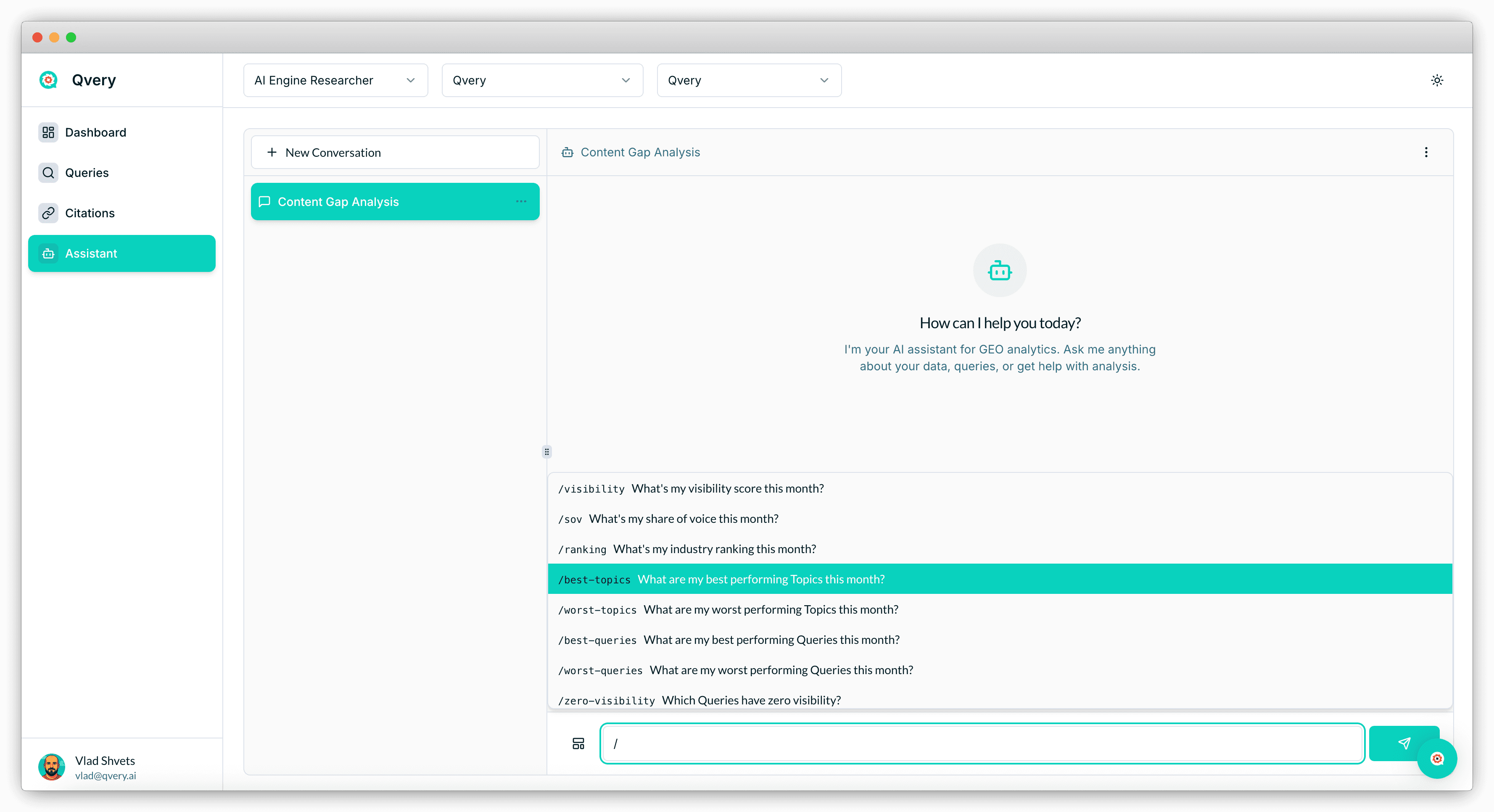
Qvery Assistant, where you ask about your own visibility, share of voice, citations, topics, and queries in plain language, and have it add queries, trigger a data run, or export a report.
Daily tracking in 200+ countries, across ChatGPT and Google AI Mode, with visibility, share of voice, and average rank for your brand against the competitors in the same answers.
Every citation, captured daily and tied to the query and engine that produced it, so you can see which OTA, review site, or page an answer leaned on.
Your own destination queries, trip-type ones included, added and edited per market, alongside the topics and queries Qvery generates from your brand at onboarding.
Unlimited brands on Business, for groups that run several properties from one account.
Pricing:
Starter: €49/month for 1 brand and 25 tracked queries.
Growth: €99/month for 1 brand and 50 tracked queries.
Business: €199 for unlimited brands and 100 tracked queries (the pricing page shows no billing period for this tier).
Every tier includes ChatGPT and Google AI Mode, daily query runs, unlimited countries, and unlimited seats, and the paid plans start with a free 7-day trial, no credit card required.
Reddit Score: 85.0% Positive. What redditors say:
“tracking mentions in local publications and external sites is key for AI visibility, like Qvery AI does.” (r/smallbusiness)
Qvery is our product, so read this entry as the vendor's case and hold it to the same five questions as the other seven. It leads for travel because of the Qvery Assistant.
A marketer can ask which destination queries had zero visibility this month, then which sources the engines cited instead, and get both answers from their own tracked data without building a report.
Against the five requirements, Qvery documents per-country tracking, the cited pages, several brands (on Business), whether your brand is named (as visibility, share of voice, and average rank), and your own destination questions in any of the 200+ countries.
What it doesn't document is the answer text itself, so a team that needs to read what each engine said word for word should look at Ahrefs, seventh on this list.
Qvery is built for small travel marketing teams and independent operators who want answers rather than another dashboard. A hotel group buying through procurement, with single sign-on and security reviews on the checklist, will be better served by the enterprise tiers further down.
To see where you stand, start a free 7-day trial with no credit card, add your five most important destination questions in two markets, and the next daily run shows where you're named and which pages answered instead.
2. OtterlyAI: Market-by-Market Reports, With Google AI Mode as an Add-On
Key Features:
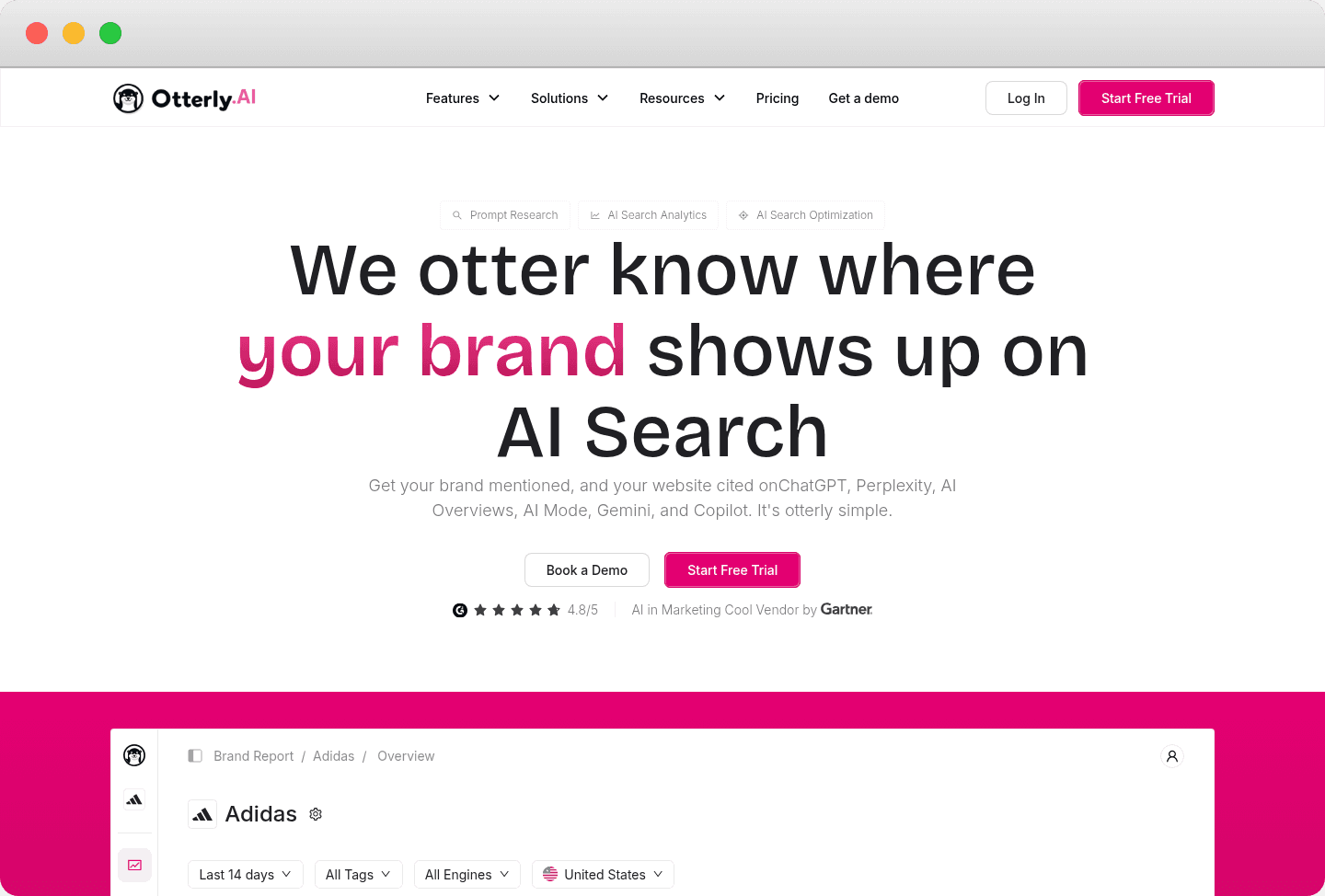
Market-by-market reporting, so your visibility shows up per market instead of as one global number.
Cited domains and URLs from every AI answer, checked daily, with link-position changes over time.
Workspaces for several brands and clients inside one subscription.
Mention tracking that shows when you're named, when you're not, and how you compare with competitors.
A public API for brand reports, prompts, citations, and workspace data.
Pricing:
Lite: $29/month, or $25/month billed annually, for 15 search prompts across four engines, with Google AI Mode as an add-on at $9/month.
Standard: $189/month, or $160/month billed annually, for 100 search prompts and API access, with the Google AI Mode add-on at $59/month.
Premium: $489/month, or $422/month billed annually, for 400 search prompts, with the Google AI Mode add-on at $149/month.
Enterprise: custom, starting from 1,000 search prompts.
Reddit Score: 69.2% Positive. What redditors say:
A practitioner's roundup of tracking tools puts it with Peec AI as good at surfacing citations (r/SaaS).
“Otterly was confusing.” (r/SaaS)
OtterlyAI documents four of the five travel requirements: market-by-market reporting, every cited domain and URL, several brands in one workspace, and whether you're named. For a travel group, that's most of the lens covered on the vendor's own pages, and the cited-URL history with link positions is the detail that makes an OTA-heavy answer readable.
The trade-off for a team that wants both engines sits on the pricing page. Google AI Mode is an add-on on every plan, priced by tier, so the cheapest way to watch both engines is Lite plus the add-on at $38 a month.
Destination questions per market aren't documented, so that's the demo question: have them set up one destination query in two markets and show you both results.
3. Peec AI: Citations and Countries, With Three Model Picks per Plan
Key Features:
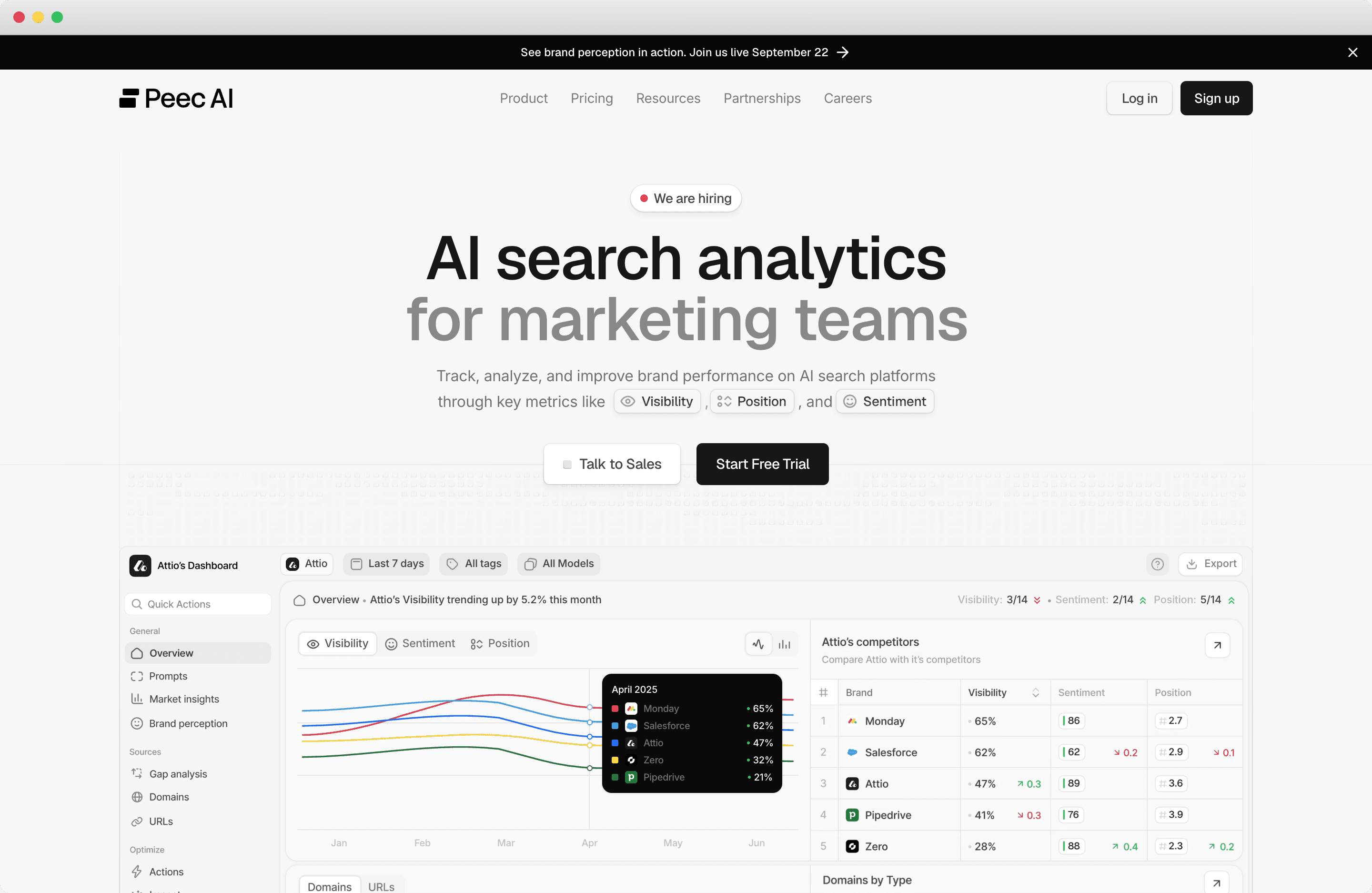
Sources and citations, meaning the URLs and domains an engine drew on for its answer, Google AI Mode citations included.
Tracking across all countries, at no extra cost per the pricing FAQ, with Multi country also listed as a plan feature on Advanced.
Multi-brand tracking that monitors visibility, sentiment, and citations separately for each client from one dashboard.
Visibility and share of voice, measured as the share of AI responses where your brand appears and your share of mentions against the brands you track.
Unlimited users and daily tracking on Starter, Pro, and Advanced.
Pricing:
Starter: $95/mo for 50 prompts and 1 project.
Pro: $245/mo for 150 prompts and 2 projects.
Advanced: $495/mo for 350 prompts, 5 projects, and Multi country.
Enterprise: custom, billed annually, with API access and single sign-on.
Starter, Pro, and Advanced each say “Choose 3 models”, so ChatGPT and Google AI Mode take two of the three.
Reddit Score: 68.6% Positive. What redditors say:
“Peec blends SERP and generative results so you can see when AI answers start pulling from different sources” (r/SEO)
“I think for the money, Peec AI probably offers the best value if you want to track AI search performance alone.” (r/SaaS)
Peec AI documents four of the five: countries, the cited URLs and domains, several brands, and whether you appear. Its citation view goes down to which URLs an answer drew on, and unlimited users mean a revenue team and a content team can both log in without a seat conversation.
The pricing FAQ says any supported country or language costs nothing extra, yet Multi country appears as a plan row only on Advanced, so ask which applies to the plan you'd buy.
Then decide which third model you'd add once both engines take their slots. Destination questions per market aren't documented, which makes them the other question for the demo.
4. AthenaHQ: Brands, Markets, and Models in One Operation
Key Features:
Brands, markets, and models in one operation, with centralized tracking of share of voice and citation rate across multiple brands and business units.
Source Intelligence, which shows the sources shaping AI answers.
Brand mention frequency tracking and competitor share of voice comparisons.
An API for pulling visibility data into your own dashboards, and data export to CSV on Starter.
Pricing:
Essential: free, with $25 of credit, covering ChatGPT and four other engines but not Google AI Mode.
Starter: $295/month for ChatGPT and Google AI Mode, with API access and extra credits as paid add-ons.
Enterprise: custom, with multi-region and multi-language support.
Reddit Score: 57.1% Positive. What redditors say:
“we use athenahq to show clients exactly where they appear vs don't across llms.” (r/DigitalMarketing)
AthenaHQ documents four of the five, with one nuance on cited pages. Source Intelligence covers the sources behind an answer; ask whether it goes down to the individual page cited, because an OTA's city page and your own listing on that OTA tell you different things.
Google AI Mode first appears on Starter, so the free Essential plan can't show you one of the two engines. For a travel brand selling into several markets and languages, Enterprise is where multi-region and multi-language support is listed, and destination questions per market remain undocumented on every tier.
5. Omnia: Both Engines From €79 a Month
Key Features:
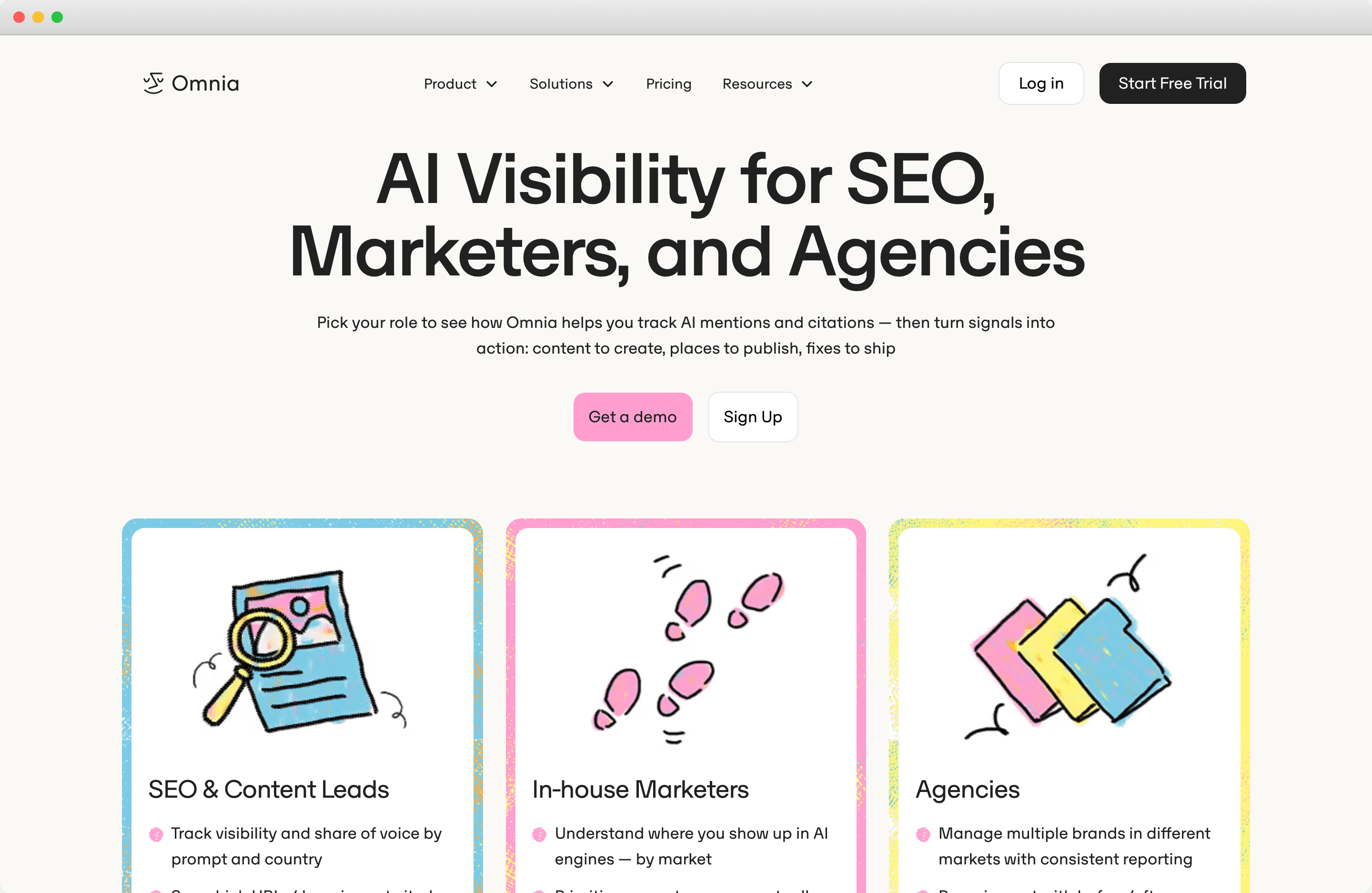
Geo-level monitoring and comparison, built on the premise that visibility varies by country.
Multiple brands in different markets, with consistent reporting across them.
Cited URLs and domains, and why they get cited.
Prompts tracked every 24 hours, with mention tracking, competitor benchmarking, and API docs for embedding citation data.
Pricing:
Growth: €79/month, or €63/month billed yearly, for up to 25 prompts across four default engines that include ChatGPT and Google AI Mode.
Pro: €279/month, or €223/month billed yearly, for up to 100 prompts.
Enterprise: from €499/month, or from €399/month billed yearly, for 200+ prompts.
Reddit Score: too few mentions to score. The Reddit sample behind these scores holds no mentions of Omnia, so there's no percentage and nothing to quote.
Omnia documents four of the five and pairs them with one of the lowest entry prices here that include both engines. Its solutions page reads like a travel brief: visibility by prompt and country, where you show up by market, and several brands in different markets with consistent reporting.
The trade-off is volume. Twenty-five prompts is a small sample once your destination questions are multiplied by your markets, so price the tier you'd need, not the one on the banner. Destination questions per market aren't documented, and that's the question to bring.
6. Profound: Agency Mode and Citation Analysis, Priced on a Call
Key Features:
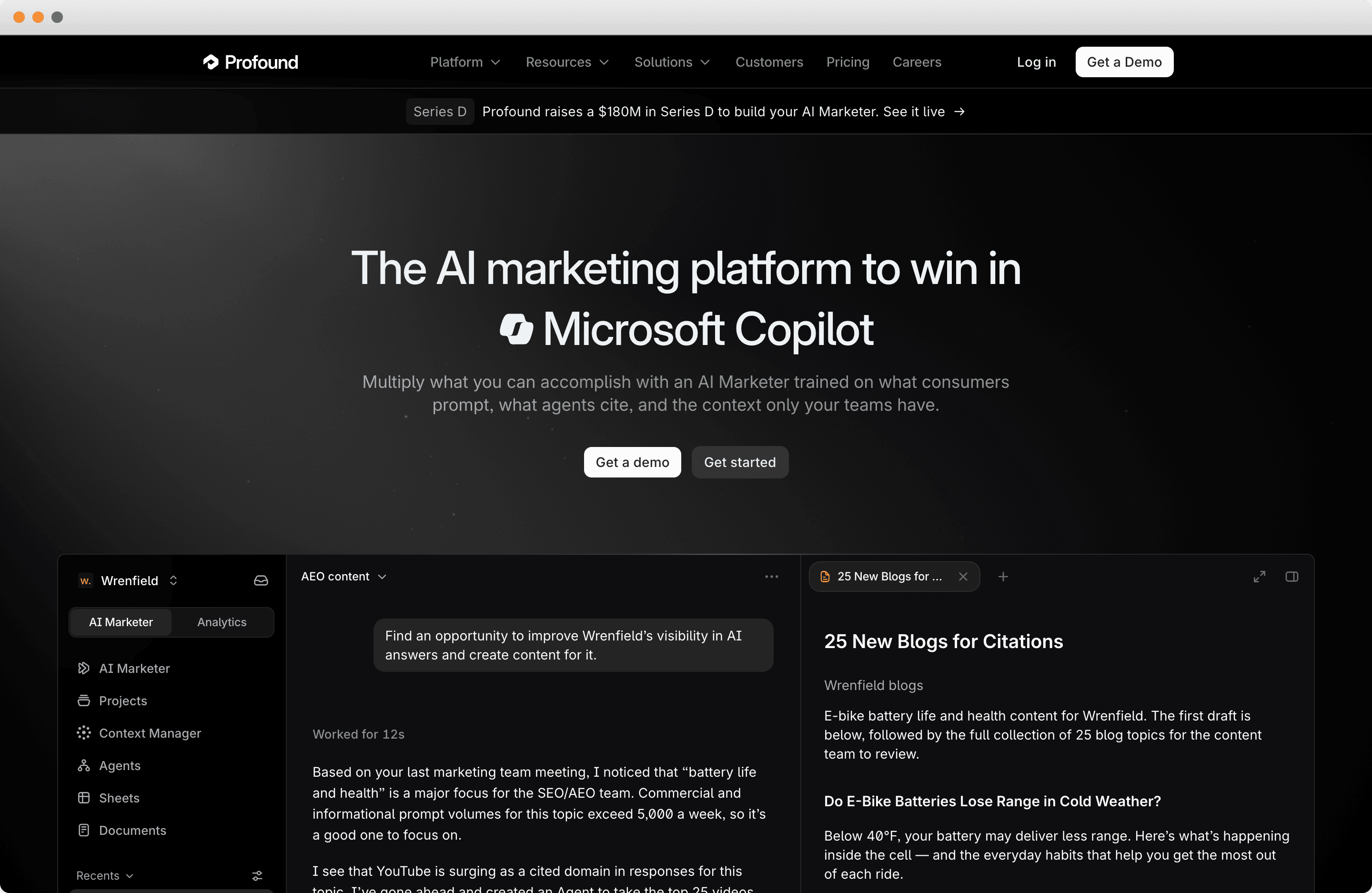
Answer Engine Insights, which track how answer engines mention, rank, and describe a brand.
Citation Analysis, showing which websites influence AI answers about your brand and the themes and narratives AI associates with you.
Agency Mode, which creates and manages multiple brand environments within one platform.
Up to nine engines on Enterprise, with unlimited seats.
Pricing:
Trial: free for 7 days, with 50 prompts run daily across ChatGPT, Gemini, and Google AI Overviews, a recommended prompt set you can't customize, and limited AI Marketer credits.
Enterprise: custom, with a tailored prompt tracking plan.
Reddit Score: too few mentions to score. The sample holds one mention about Profound, a practitioner describing it as their citation feed for “Which URLs showed up in answers for the prompts we track” (r/GrowthHacking). One mention isn't a score.
Profound documents three of the five: citations, several brand environments, and whether you're named. Its Citation Analysis goes past the URL to the themes and narratives attached to your brand, which is useful when a property is being described in a way you'd rather it wasn't.
Per-country tracking and destination questions per market aren't documented, and those are the two requirements most specific to travel. Pricing past the trial goes through sales. The seven-day trial runs a recommended prompt set without Google AI Mode, so a travel team can't test its own destination questions there, and everything else is Enterprise, custom.
7. Ahrefs: The Only Entry That Documents the Answer Text
Key Features:
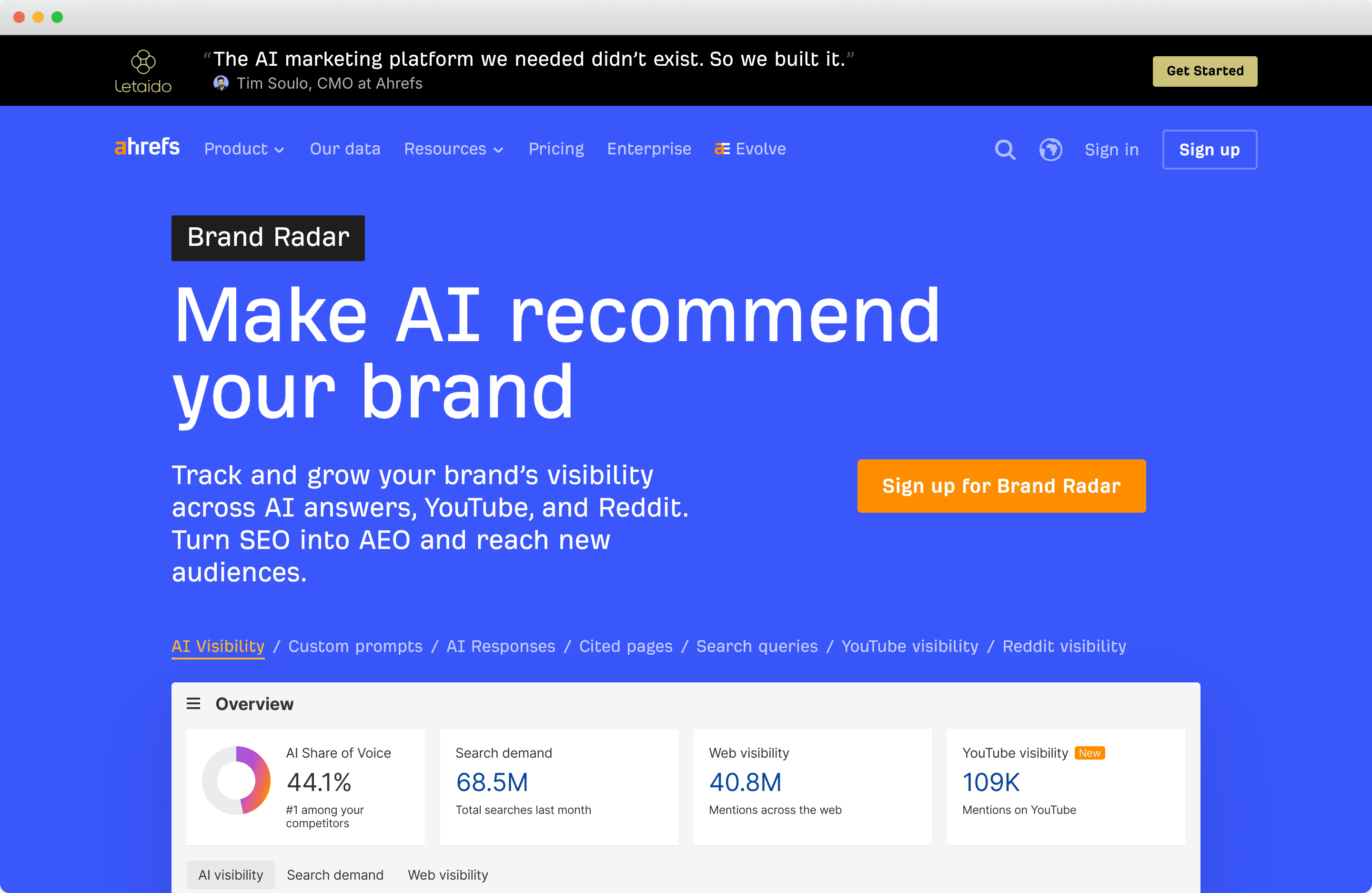
Stored raw responses you can search for brand mentions and for citations as linked URLs.
The top cited pages, the specific URLs cited most often alongside your brand.
Share of voice in Google AI Mode against any competitor you choose.
Daily monitoring of mentions and citations, with charts and exports.
Pricing:
Brand Radar AI: from $199/mo, sold as a standalone product that comes with an Ahrefs Free account.
Lite: $129/mo, with 5 tracked AI prompts.
Standard: $249/mo, with 10 tracked AI prompts.
Advanced: $449/mo, with 20 tracked AI prompts.
Enterprise: $1,499/mo, with an annual commitment required.
Reddit Score: 48.3% Positive. What redditors say:
“Ahrefs was just closer to what our own internal data was saying so we trusted what it was saying about our competitors.” (r/SEO)
“I also stopped my Ahrefs subscription from last few months because of its pricing.” (r/SEO)
Ahrefs documents two of the five, the cited pages and whether you're named, plus the one capability no other entry here documents, stored and searchable raw answers. If you want to read how an engine described your property, word for word, that's the feature.
Per-country tracking and several brands in one account aren't documented on the pages we read. The custom prompt packages count one check per prompt, platform, and location, so ask in the demo how those locations map to the countries you sell in.
8. Scrunch: Citations on Core, Countries and Google AI Mode on Enterprise
Key Features:
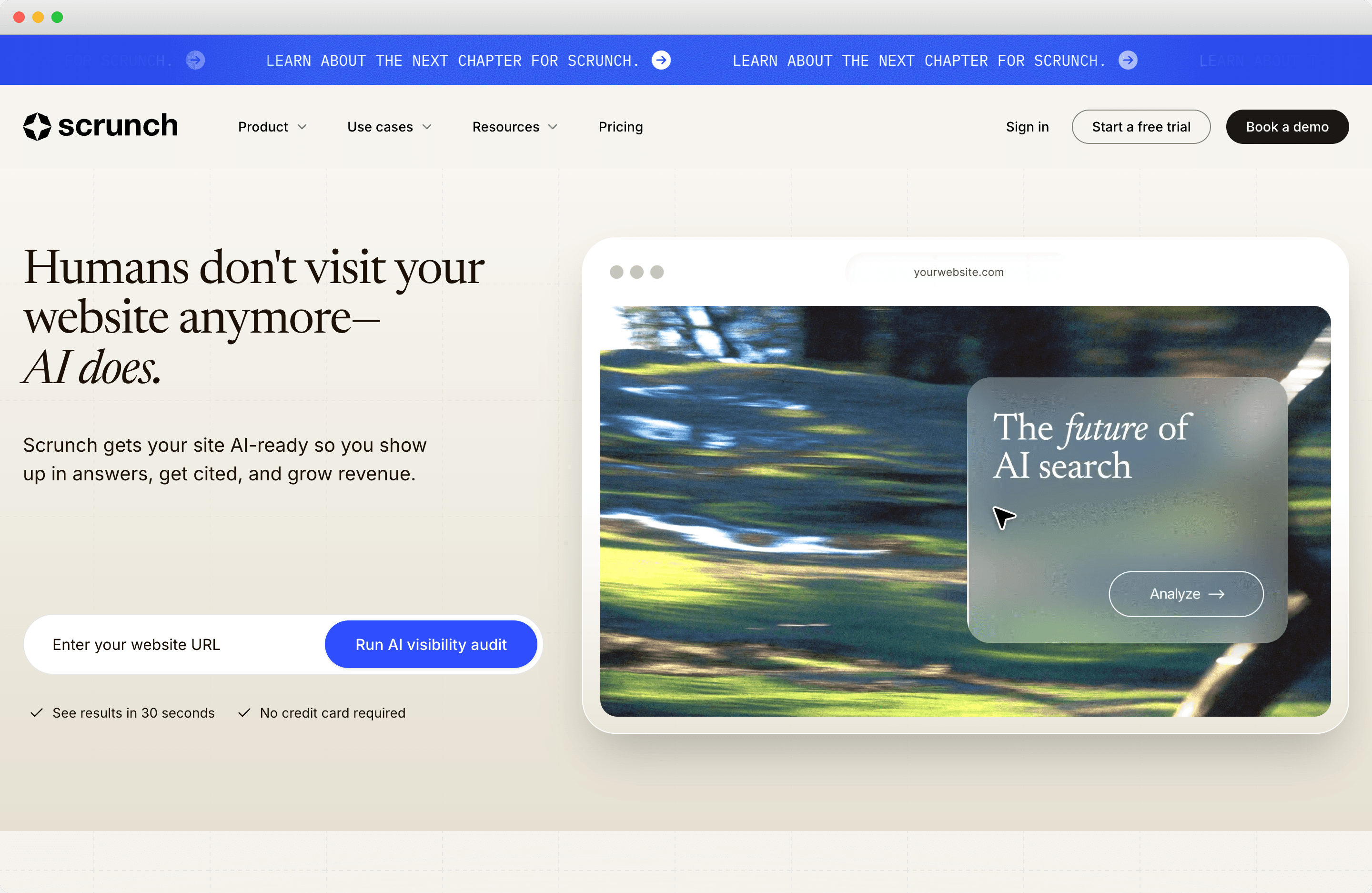
Citations and sources as a Core plan feature.
Unlimited countries on Enterprise, against one country on Core.
Competitor tracking, with five competitors on Core and a custom number on Enterprise.
Comparisons across AI platforms of brand presence, competitive presence, position, sentiment, and citations.
Enterprise customization of prompts, brand workspaces, and user licenses, with API access and integrations.
Pricing:
Core: $250/mo for 125 unique prompts, 1 brand workspace, and 1 country, on a platform list that doesn't include Google AI Mode.
Enterprise: custom, with unlimited countries, a custom number of brand workspaces, and Google AI Mode among the listed platforms.
Reddit Score: 50.0% Positive. One team that tested several tools grouped Scrunch with two others as “decent for generating text, but not enough depth for a serious content + visibility motion” (r/SaaS).
Scrunch documents four of the five, two of them only on Enterprise: cited sources and whether you're named on both plans, then unlimited countries and a custom number of brand workspaces on Enterprise.
Core covers one country, one workspace, and a platform list without Google AI Mode, so for a travel team, both engines and more than one market each mean Enterprise.
Destination questions per market aren't documented on either plan, which makes them the question for the demo.
Where This Comparison Stops
This is a read of each vendor's own pages and live pricing on September 22, 2026. None of the products was run against real travel questions, nothing here measures how well any of them works, and a requirement a vendor leaves undocumented may still be something the product does.
The Reddit scores come from public threads, are printed only where a tool has at least five mentions in the sample, and describe how people talk about a tool, not whether it fits travel or measures correctly.
Pick by the Travel Business You Run
Multi-country hotel groups. You need per-country tracking and several brands in one account, and OtterlyAI, Peec AI, AthenaHQ, and Omnia document both, as does Scrunch on Enterprise. Qvery documents both as well, on Business.
Single-destination tour operators selling into a few markets. The lowest published entry prices with both engines are OtterlyAI's Lite with the Google AI Mode add-on at $38 a month, Qvery's Starter at €49, Omnia's Growth at €79, and Peec AI's Starter at $95.
Teams that read the answers. Ahrefs is the one entry that documents stored, searchable answers.
Procurement-led buyers. Profound, AthenaHQ, and Scrunch each keep something a travel brand needs on a custom Enterprise tier: Profound's wider engine coverage, AthenaHQ's multi-region and multi-language support, and Scrunch's Google AI Mode and unlimited countries.
Whichever you shortlist, give every vendor the same test: five of your destination questions, in two of your markets, during the trial. Anything the vendor can't show you in writing becomes a question for the demo. The steps for setting those questions up market by market are the next thing to read.
This September, 73.02% of the answers ChatGPT and Google AI Mode gave to travel recommendation questions cited at least one travel brand's own website. Travel demand is local, so ask whether yours gets cited in each market. One global score is a weather report for the planet: accurate on average, useless for packing.
Every product here documents both engines on its own pages and has a public pricing page. What they most often leave undocumented is what travel needs most: your own destination questions per market. Each entry splits the documented from the demo questions, as of September 22, 2026.
What a Travel Brand Needs a Tracker to Prove, Market by Market
Travel sells destination by destination, and that splits one visibility number into five separate questions:
Per-country tracking. The same question run in each market you sell in, since travel demand is local.
Cited pages. Which pages and domains an answer cited, so you can see whether it leaned on an OTA, a review site, a forum thread, or your own site. In hotel answers, the OTA pages that get cited are mostly city hubs rather than listings, which you only learn at page level.
Several brands in one account. Groups, chains, and portfolios need each property or brand tracked on its own, under one login.
Named in the answer. Whether the brand itself appears in what the engine says, which is a different measurement from its pages turning up among the sources.
Destination prompts per market. For example, “boutique hotels in Porto” tracked in Portugal and in the UK, or “family ski trips” in each market you sell to.
Every entry marks each requirement as documented (the vendor's own page says so), documented as not offered (the page says it isn't), or not documented (the page is silent). A silent page turns the requirement into a question for the demo.
Of the seven competitors, five document four of the five (Scrunch two of them only on Enterprise), and none documents the fifth. Qvery's documentation covers all five, and it's our product, so check that claim in the free trial like any other.
1. Qvery: Ask It Which Destination Questions You're Missing
Key Features:
Qvery Assistant, where you ask about your own visibility, share of voice, citations, topics, and queries in plain language, and have it add queries, trigger a data run, or export a report.
Daily tracking in 200+ countries, across ChatGPT and Google AI Mode, with visibility, share of voice, and average rank for your brand against the competitors in the same answers.
Every citation, captured daily and tied to the query and engine that produced it, so you can see which OTA, review site, or page an answer leaned on.
Your own destination queries, trip-type ones included, added and edited per market, alongside the topics and queries Qvery generates from your brand at onboarding.
Unlimited brands on Business, for groups that run several properties from one account.
Pricing:
Starter: €49/month for 1 brand and 25 tracked queries.
Growth: €99/month for 1 brand and 50 tracked queries.
Business: €199 for unlimited brands and 100 tracked queries (the pricing page shows no billing period for this tier).
Every tier includes ChatGPT and Google AI Mode, daily query runs, unlimited countries, and unlimited seats, and the paid plans start with a free 7-day trial, no credit card required.
Reddit Score: 85.0% Positive. What redditors say:
“tracking mentions in local publications and external sites is key for AI visibility, like Qvery AI does.” (r/smallbusiness)
Qvery is our product, so read this entry as the vendor's case and hold it to the same five questions as the other seven. It leads for travel because of the Qvery Assistant.
A marketer can ask which destination queries had zero visibility this month, then which sources the engines cited instead, and get both answers from their own tracked data without building a report.
Against the five requirements, Qvery documents per-country tracking, the cited pages, several brands (on Business), whether your brand is named (as visibility, share of voice, and average rank), and your own destination questions in any of the 200+ countries.
What it doesn't document is the answer text itself, so a team that needs to read what each engine said word for word should look at Ahrefs, seventh on this list.
Qvery is built for small travel marketing teams and independent operators who want answers rather than another dashboard. A hotel group buying through procurement, with single sign-on and security reviews on the checklist, will be better served by the enterprise tiers further down.
To see where you stand, start a free 7-day trial with no credit card, add your five most important destination questions in two markets, and the next daily run shows where you're named and which pages answered instead.
2. OtterlyAI: Market-by-Market Reports, With Google AI Mode as an Add-On
Key Features:
Market-by-market reporting, so your visibility shows up per market instead of as one global number.
Cited domains and URLs from every AI answer, checked daily, with link-position changes over time.
Workspaces for several brands and clients inside one subscription.
Mention tracking that shows when you're named, when you're not, and how you compare with competitors.
A public API for brand reports, prompts, citations, and workspace data.
Pricing:
Lite: $29/month, or $25/month billed annually, for 15 search prompts across four engines, with Google AI Mode as an add-on at $9/month.
Standard: $189/month, or $160/month billed annually, for 100 search prompts and API access, with the Google AI Mode add-on at $59/month.
Premium: $489/month, or $422/month billed annually, for 400 search prompts, with the Google AI Mode add-on at $149/month.
Enterprise: custom, starting from 1,000 search prompts.
Reddit Score: 69.2% Positive. What redditors say:
A practitioner's roundup of tracking tools puts it with Peec AI as good at surfacing citations (r/SaaS).
“Otterly was confusing.” (r/SaaS)
OtterlyAI documents four of the five travel requirements: market-by-market reporting, every cited domain and URL, several brands in one workspace, and whether you're named. For a travel group, that's most of the lens covered on the vendor's own pages, and the cited-URL history with link positions is the detail that makes an OTA-heavy answer readable.
The trade-off for a team that wants both engines sits on the pricing page. Google AI Mode is an add-on on every plan, priced by tier, so the cheapest way to watch both engines is Lite plus the add-on at $38 a month.
Destination questions per market aren't documented, so that's the demo question: have them set up one destination query in two markets and show you both results.
3. Peec AI: Citations and Countries, With Three Model Picks per Plan
Key Features:
Sources and citations, meaning the URLs and domains an engine drew on for its answer, Google AI Mode citations included.
Tracking across all countries, at no extra cost per the pricing FAQ, with Multi country also listed as a plan feature on Advanced.
Multi-brand tracking that monitors visibility, sentiment, and citations separately for each client from one dashboard.
Visibility and share of voice, measured as the share of AI responses where your brand appears and your share of mentions against the brands you track.
Unlimited users and daily tracking on Starter, Pro, and Advanced.
Pricing:
Starter: $95/mo for 50 prompts and 1 project.
Pro: $245/mo for 150 prompts and 2 projects.
Advanced: $495/mo for 350 prompts, 5 projects, and Multi country.
Enterprise: custom, billed annually, with API access and single sign-on.
Starter, Pro, and Advanced each say “Choose 3 models”, so ChatGPT and Google AI Mode take two of the three.
Reddit Score: 68.6% Positive. What redditors say:
“Peec blends SERP and generative results so you can see when AI answers start pulling from different sources” (r/SEO)
“I think for the money, Peec AI probably offers the best value if you want to track AI search performance alone.” (r/SaaS)
Peec AI documents four of the five: countries, the cited URLs and domains, several brands, and whether you appear. Its citation view goes down to which URLs an answer drew on, and unlimited users mean a revenue team and a content team can both log in without a seat conversation.
The pricing FAQ says any supported country or language costs nothing extra, yet Multi country appears as a plan row only on Advanced, so ask which applies to the plan you'd buy.
Then decide which third model you'd add once both engines take their slots. Destination questions per market aren't documented, which makes them the other question for the demo.
4. AthenaHQ: Brands, Markets, and Models in One Operation
Key Features:
Brands, markets, and models in one operation, with centralized tracking of share of voice and citation rate across multiple brands and business units.
Source Intelligence, which shows the sources shaping AI answers.
Brand mention frequency tracking and competitor share of voice comparisons.
An API for pulling visibility data into your own dashboards, and data export to CSV on Starter.
Pricing:
Essential: free, with $25 of credit, covering ChatGPT and four other engines but not Google AI Mode.
Starter: $295/month for ChatGPT and Google AI Mode, with API access and extra credits as paid add-ons.
Enterprise: custom, with multi-region and multi-language support.
Reddit Score: 57.1% Positive. What redditors say:
“we use athenahq to show clients exactly where they appear vs don't across llms.” (r/DigitalMarketing)
AthenaHQ documents four of the five, with one nuance on cited pages. Source Intelligence covers the sources behind an answer; ask whether it goes down to the individual page cited, because an OTA's city page and your own listing on that OTA tell you different things.
Google AI Mode first appears on Starter, so the free Essential plan can't show you one of the two engines. For a travel brand selling into several markets and languages, Enterprise is where multi-region and multi-language support is listed, and destination questions per market remain undocumented on every tier.
5. Omnia: Both Engines From €79 a Month
Key Features:
Geo-level monitoring and comparison, built on the premise that visibility varies by country.
Multiple brands in different markets, with consistent reporting across them.
Cited URLs and domains, and why they get cited.
Prompts tracked every 24 hours, with mention tracking, competitor benchmarking, and API docs for embedding citation data.
Pricing:
Growth: €79/month, or €63/month billed yearly, for up to 25 prompts across four default engines that include ChatGPT and Google AI Mode.
Pro: €279/month, or €223/month billed yearly, for up to 100 prompts.
Enterprise: from €499/month, or from €399/month billed yearly, for 200+ prompts.
Reddit Score: too few mentions to score. The Reddit sample behind these scores holds no mentions of Omnia, so there's no percentage and nothing to quote.
Omnia documents four of the five and pairs them with one of the lowest entry prices here that include both engines. Its solutions page reads like a travel brief: visibility by prompt and country, where you show up by market, and several brands in different markets with consistent reporting.
The trade-off is volume. Twenty-five prompts is a small sample once your destination questions are multiplied by your markets, so price the tier you'd need, not the one on the banner. Destination questions per market aren't documented, and that's the question to bring.
6. Profound: Agency Mode and Citation Analysis, Priced on a Call
Key Features:
Answer Engine Insights, which track how answer engines mention, rank, and describe a brand.
Citation Analysis, showing which websites influence AI answers about your brand and the themes and narratives AI associates with you.
Agency Mode, which creates and manages multiple brand environments within one platform.
Up to nine engines on Enterprise, with unlimited seats.
Pricing:
Trial: free for 7 days, with 50 prompts run daily across ChatGPT, Gemini, and Google AI Overviews, a recommended prompt set you can't customize, and limited AI Marketer credits.
Enterprise: custom, with a tailored prompt tracking plan.
Reddit Score: too few mentions to score. The sample holds one mention about Profound, a practitioner describing it as their citation feed for “Which URLs showed up in answers for the prompts we track” (r/GrowthHacking). One mention isn't a score.
Profound documents three of the five: citations, several brand environments, and whether you're named. Its Citation Analysis goes past the URL to the themes and narratives attached to your brand, which is useful when a property is being described in a way you'd rather it wasn't.
Per-country tracking and destination questions per market aren't documented, and those are the two requirements most specific to travel. Pricing past the trial goes through sales. The seven-day trial runs a recommended prompt set without Google AI Mode, so a travel team can't test its own destination questions there, and everything else is Enterprise, custom.
7. Ahrefs: The Only Entry That Documents the Answer Text
Key Features:
Stored raw responses you can search for brand mentions and for citations as linked URLs.
The top cited pages, the specific URLs cited most often alongside your brand.
Share of voice in Google AI Mode against any competitor you choose.
Daily monitoring of mentions and citations, with charts and exports.
Pricing:
Brand Radar AI: from $199/mo, sold as a standalone product that comes with an Ahrefs Free account.
Lite: $129/mo, with 5 tracked AI prompts.
Standard: $249/mo, with 10 tracked AI prompts.
Advanced: $449/mo, with 20 tracked AI prompts.
Enterprise: $1,499/mo, with an annual commitment required.
Reddit Score: 48.3% Positive. What redditors say:
“Ahrefs was just closer to what our own internal data was saying so we trusted what it was saying about our competitors.” (r/SEO)
“I also stopped my Ahrefs subscription from last few months because of its pricing.” (r/SEO)
Ahrefs documents two of the five, the cited pages and whether you're named, plus the one capability no other entry here documents, stored and searchable raw answers. If you want to read how an engine described your property, word for word, that's the feature.
Per-country tracking and several brands in one account aren't documented on the pages we read. The custom prompt packages count one check per prompt, platform, and location, so ask in the demo how those locations map to the countries you sell in.
8. Scrunch: Citations on Core, Countries and Google AI Mode on Enterprise
Key Features:
Citations and sources as a Core plan feature.
Unlimited countries on Enterprise, against one country on Core.
Competitor tracking, with five competitors on Core and a custom number on Enterprise.
Comparisons across AI platforms of brand presence, competitive presence, position, sentiment, and citations.
Enterprise customization of prompts, brand workspaces, and user licenses, with API access and integrations.
Pricing:
Core: $250/mo for 125 unique prompts, 1 brand workspace, and 1 country, on a platform list that doesn't include Google AI Mode.
Enterprise: custom, with unlimited countries, a custom number of brand workspaces, and Google AI Mode among the listed platforms.
Reddit Score: 50.0% Positive. One team that tested several tools grouped Scrunch with two others as “decent for generating text, but not enough depth for a serious content + visibility motion” (r/SaaS).
Scrunch documents four of the five, two of them only on Enterprise: cited sources and whether you're named on both plans, then unlimited countries and a custom number of brand workspaces on Enterprise.
Core covers one country, one workspace, and a platform list without Google AI Mode, so for a travel team, both engines and more than one market each mean Enterprise.
Destination questions per market aren't documented on either plan, which makes them the question for the demo.
Where This Comparison Stops
This is a read of each vendor's own pages and live pricing on September 22, 2026. None of the products was run against real travel questions, nothing here measures how well any of them works, and a requirement a vendor leaves undocumented may still be something the product does.
The Reddit scores come from public threads, are printed only where a tool has at least five mentions in the sample, and describe how people talk about a tool, not whether it fits travel or measures correctly.
Pick by the Travel Business You Run
Multi-country hotel groups. You need per-country tracking and several brands in one account, and OtterlyAI, Peec AI, AthenaHQ, and Omnia document both, as does Scrunch on Enterprise. Qvery documents both as well, on Business.
Single-destination tour operators selling into a few markets. The lowest published entry prices with both engines are OtterlyAI's Lite with the Google AI Mode add-on at $38 a month, Qvery's Starter at €49, Omnia's Growth at €79, and Peec AI's Starter at $95.
Teams that read the answers. Ahrefs is the one entry that documents stored, searchable answers.
Procurement-led buyers. Profound, AthenaHQ, and Scrunch each keep something a travel brand needs on a custom Enterprise tier: Profound's wider engine coverage, AthenaHQ's multi-region and multi-language support, and Scrunch's Google AI Mode and unlimited countries.
Whichever you shortlist, give every vendor the same test: five of your destination questions, in two of your markets, during the trial. Anything the vendor can't show you in writing becomes a question for the demo. The steps for setting those questions up market by market are the next thing to read.
This September, 73.02% of the answers ChatGPT and Google AI Mode gave to travel recommendation questions cited at least one travel brand's own website. Travel demand is local, so ask whether yours gets cited in each market. One global score is a weather report for the planet: accurate on average, useless for packing.
Every product here documents both engines on its own pages and has a public pricing page. What they most often leave undocumented is what travel needs most: your own destination questions per market. Each entry splits the documented from the demo questions, as of September 22, 2026.
What a Travel Brand Needs a Tracker to Prove, Market by Market
Travel sells destination by destination, and that splits one visibility number into five separate questions:
Per-country tracking. The same question run in each market you sell in, since travel demand is local.
Cited pages. Which pages and domains an answer cited, so you can see whether it leaned on an OTA, a review site, a forum thread, or your own site. In hotel answers, the OTA pages that get cited are mostly city hubs rather than listings, which you only learn at page level.
Several brands in one account. Groups, chains, and portfolios need each property or brand tracked on its own, under one login.
Named in the answer. Whether the brand itself appears in what the engine says, which is a different measurement from its pages turning up among the sources.
Destination prompts per market. For example, “boutique hotels in Porto” tracked in Portugal and in the UK, or “family ski trips” in each market you sell to.
Every entry marks each requirement as documented (the vendor's own page says so), documented as not offered (the page says it isn't), or not documented (the page is silent). A silent page turns the requirement into a question for the demo.
Of the seven competitors, five document four of the five (Scrunch two of them only on Enterprise), and none documents the fifth. Qvery's documentation covers all five, and it's our product, so check that claim in the free trial like any other.
1. Qvery: Ask It Which Destination Questions You're Missing
Key Features:
Qvery Assistant, where you ask about your own visibility, share of voice, citations, topics, and queries in plain language, and have it add queries, trigger a data run, or export a report.
Daily tracking in 200+ countries, across ChatGPT and Google AI Mode, with visibility, share of voice, and average rank for your brand against the competitors in the same answers.
Every citation, captured daily and tied to the query and engine that produced it, so you can see which OTA, review site, or page an answer leaned on.
Your own destination queries, trip-type ones included, added and edited per market, alongside the topics and queries Qvery generates from your brand at onboarding.
Unlimited brands on Business, for groups that run several properties from one account.
Pricing:
Starter: €49/month for 1 brand and 25 tracked queries.
Growth: €99/month for 1 brand and 50 tracked queries.
Business: €199 for unlimited brands and 100 tracked queries (the pricing page shows no billing period for this tier).
Every tier includes ChatGPT and Google AI Mode, daily query runs, unlimited countries, and unlimited seats, and the paid plans start with a free 7-day trial, no credit card required.
Reddit Score: 85.0% Positive. What redditors say:
“tracking mentions in local publications and external sites is key for AI visibility, like Qvery AI does.” (r/smallbusiness)
Qvery is our product, so read this entry as the vendor's case and hold it to the same five questions as the other seven. It leads for travel because of the Qvery Assistant.
A marketer can ask which destination queries had zero visibility this month, then which sources the engines cited instead, and get both answers from their own tracked data without building a report.
Against the five requirements, Qvery documents per-country tracking, the cited pages, several brands (on Business), whether your brand is named (as visibility, share of voice, and average rank), and your own destination questions in any of the 200+ countries.
What it doesn't document is the answer text itself, so a team that needs to read what each engine said word for word should look at Ahrefs, seventh on this list.
Qvery is built for small travel marketing teams and independent operators who want answers rather than another dashboard. A hotel group buying through procurement, with single sign-on and security reviews on the checklist, will be better served by the enterprise tiers further down.
To see where you stand, start a free 7-day trial with no credit card, add your five most important destination questions in two markets, and the next daily run shows where you're named and which pages answered instead.
2. OtterlyAI: Market-by-Market Reports, With Google AI Mode as an Add-On
Key Features:
Market-by-market reporting, so your visibility shows up per market instead of as one global number.
Cited domains and URLs from every AI answer, checked daily, with link-position changes over time.
Workspaces for several brands and clients inside one subscription.
Mention tracking that shows when you're named, when you're not, and how you compare with competitors.
A public API for brand reports, prompts, citations, and workspace data.
Pricing:
Lite: $29/month, or $25/month billed annually, for 15 search prompts across four engines, with Google AI Mode as an add-on at $9/month.
Standard: $189/month, or $160/month billed annually, for 100 search prompts and API access, with the Google AI Mode add-on at $59/month.
Premium: $489/month, or $422/month billed annually, for 400 search prompts, with the Google AI Mode add-on at $149/month.
Enterprise: custom, starting from 1,000 search prompts.
Reddit Score: 69.2% Positive. What redditors say:
A practitioner's roundup of tracking tools puts it with Peec AI as good at surfacing citations (r/SaaS).
“Otterly was confusing.” (r/SaaS)
OtterlyAI documents four of the five travel requirements: market-by-market reporting, every cited domain and URL, several brands in one workspace, and whether you're named. For a travel group, that's most of the lens covered on the vendor's own pages, and the cited-URL history with link positions is the detail that makes an OTA-heavy answer readable.
The trade-off for a team that wants both engines sits on the pricing page. Google AI Mode is an add-on on every plan, priced by tier, so the cheapest way to watch both engines is Lite plus the add-on at $38 a month.
Destination questions per market aren't documented, so that's the demo question: have them set up one destination query in two markets and show you both results.
3. Peec AI: Citations and Countries, With Three Model Picks per Plan
Key Features:
Sources and citations, meaning the URLs and domains an engine drew on for its answer, Google AI Mode citations included.
Tracking across all countries, at no extra cost per the pricing FAQ, with Multi country also listed as a plan feature on Advanced.
Multi-brand tracking that monitors visibility, sentiment, and citations separately for each client from one dashboard.
Visibility and share of voice, measured as the share of AI responses where your brand appears and your share of mentions against the brands you track.
Unlimited users and daily tracking on Starter, Pro, and Advanced.
Pricing:
Starter: $95/mo for 50 prompts and 1 project.
Pro: $245/mo for 150 prompts and 2 projects.
Advanced: $495/mo for 350 prompts, 5 projects, and Multi country.
Enterprise: custom, billed annually, with API access and single sign-on.
Starter, Pro, and Advanced each say “Choose 3 models”, so ChatGPT and Google AI Mode take two of the three.
Reddit Score: 68.6% Positive. What redditors say:
“Peec blends SERP and generative results so you can see when AI answers start pulling from different sources” (r/SEO)
“I think for the money, Peec AI probably offers the best value if you want to track AI search performance alone.” (r/SaaS)
Peec AI documents four of the five: countries, the cited URLs and domains, several brands, and whether you appear. Its citation view goes down to which URLs an answer drew on, and unlimited users mean a revenue team and a content team can both log in without a seat conversation.
The pricing FAQ says any supported country or language costs nothing extra, yet Multi country appears as a plan row only on Advanced, so ask which applies to the plan you'd buy.
Then decide which third model you'd add once both engines take their slots. Destination questions per market aren't documented, which makes them the other question for the demo.
4. AthenaHQ: Brands, Markets, and Models in One Operation
Key Features:
Brands, markets, and models in one operation, with centralized tracking of share of voice and citation rate across multiple brands and business units.
Source Intelligence, which shows the sources shaping AI answers.
Brand mention frequency tracking and competitor share of voice comparisons.
An API for pulling visibility data into your own dashboards, and data export to CSV on Starter.
Pricing:
Essential: free, with $25 of credit, covering ChatGPT and four other engines but not Google AI Mode.
Starter: $295/month for ChatGPT and Google AI Mode, with API access and extra credits as paid add-ons.
Enterprise: custom, with multi-region and multi-language support.
Reddit Score: 57.1% Positive. What redditors say:
“we use athenahq to show clients exactly where they appear vs don't across llms.” (r/DigitalMarketing)
AthenaHQ documents four of the five, with one nuance on cited pages. Source Intelligence covers the sources behind an answer; ask whether it goes down to the individual page cited, because an OTA's city page and your own listing on that OTA tell you different things.
Google AI Mode first appears on Starter, so the free Essential plan can't show you one of the two engines. For a travel brand selling into several markets and languages, Enterprise is where multi-region and multi-language support is listed, and destination questions per market remain undocumented on every tier.
5. Omnia: Both Engines From €79 a Month
Key Features:
Geo-level monitoring and comparison, built on the premise that visibility varies by country.
Multiple brands in different markets, with consistent reporting across them.
Cited URLs and domains, and why they get cited.
Prompts tracked every 24 hours, with mention tracking, competitor benchmarking, and API docs for embedding citation data.
Pricing:
Growth: €79/month, or €63/month billed yearly, for up to 25 prompts across four default engines that include ChatGPT and Google AI Mode.
Pro: €279/month, or €223/month billed yearly, for up to 100 prompts.
Enterprise: from €499/month, or from €399/month billed yearly, for 200+ prompts.
Reddit Score: too few mentions to score. The Reddit sample behind these scores holds no mentions of Omnia, so there's no percentage and nothing to quote.
Omnia documents four of the five and pairs them with one of the lowest entry prices here that include both engines. Its solutions page reads like a travel brief: visibility by prompt and country, where you show up by market, and several brands in different markets with consistent reporting.
The trade-off is volume. Twenty-five prompts is a small sample once your destination questions are multiplied by your markets, so price the tier you'd need, not the one on the banner. Destination questions per market aren't documented, and that's the question to bring.
6. Profound: Agency Mode and Citation Analysis, Priced on a Call
Key Features:
Answer Engine Insights, which track how answer engines mention, rank, and describe a brand.
Citation Analysis, showing which websites influence AI answers about your brand and the themes and narratives AI associates with you.
Agency Mode, which creates and manages multiple brand environments within one platform.
Up to nine engines on Enterprise, with unlimited seats.
Pricing:
Trial: free for 7 days, with 50 prompts run daily across ChatGPT, Gemini, and Google AI Overviews, a recommended prompt set you can't customize, and limited AI Marketer credits.
Enterprise: custom, with a tailored prompt tracking plan.
Reddit Score: too few mentions to score. The sample holds one mention about Profound, a practitioner describing it as their citation feed for “Which URLs showed up in answers for the prompts we track” (r/GrowthHacking). One mention isn't a score.
Profound documents three of the five: citations, several brand environments, and whether you're named. Its Citation Analysis goes past the URL to the themes and narratives attached to your brand, which is useful when a property is being described in a way you'd rather it wasn't.
Per-country tracking and destination questions per market aren't documented, and those are the two requirements most specific to travel. Pricing past the trial goes through sales. The seven-day trial runs a recommended prompt set without Google AI Mode, so a travel team can't test its own destination questions there, and everything else is Enterprise, custom.
7. Ahrefs: The Only Entry That Documents the Answer Text
Key Features:
Stored raw responses you can search for brand mentions and for citations as linked URLs.
The top cited pages, the specific URLs cited most often alongside your brand.
Share of voice in Google AI Mode against any competitor you choose.
Daily monitoring of mentions and citations, with charts and exports.
Pricing:
Brand Radar AI: from $199/mo, sold as a standalone product that comes with an Ahrefs Free account.
Lite: $129/mo, with 5 tracked AI prompts.
Standard: $249/mo, with 10 tracked AI prompts.
Advanced: $449/mo, with 20 tracked AI prompts.
Enterprise: $1,499/mo, with an annual commitment required.
Reddit Score: 48.3% Positive. What redditors say:
“Ahrefs was just closer to what our own internal data was saying so we trusted what it was saying about our competitors.” (r/SEO)
“I also stopped my Ahrefs subscription from last few months because of its pricing.” (r/SEO)
Ahrefs documents two of the five, the cited pages and whether you're named, plus the one capability no other entry here documents, stored and searchable raw answers. If you want to read how an engine described your property, word for word, that's the feature.
Per-country tracking and several brands in one account aren't documented on the pages we read. The custom prompt packages count one check per prompt, platform, and location, so ask in the demo how those locations map to the countries you sell in.
8. Scrunch: Citations on Core, Countries and Google AI Mode on Enterprise
Key Features:
Citations and sources as a Core plan feature.
Unlimited countries on Enterprise, against one country on Core.
Competitor tracking, with five competitors on Core and a custom number on Enterprise.
Comparisons across AI platforms of brand presence, competitive presence, position, sentiment, and citations.
Enterprise customization of prompts, brand workspaces, and user licenses, with API access and integrations.
Pricing:
Core: $250/mo for 125 unique prompts, 1 brand workspace, and 1 country, on a platform list that doesn't include Google AI Mode.
Enterprise: custom, with unlimited countries, a custom number of brand workspaces, and Google AI Mode among the listed platforms.
Reddit Score: 50.0% Positive. One team that tested several tools grouped Scrunch with two others as “decent for generating text, but not enough depth for a serious content + visibility motion” (r/SaaS).
Scrunch documents four of the five, two of them only on Enterprise: cited sources and whether you're named on both plans, then unlimited countries and a custom number of brand workspaces on Enterprise.
Core covers one country, one workspace, and a platform list without Google AI Mode, so for a travel team, both engines and more than one market each mean Enterprise.
Destination questions per market aren't documented on either plan, which makes them the question for the demo.
Where This Comparison Stops
This is a read of each vendor's own pages and live pricing on September 22, 2026. None of the products was run against real travel questions, nothing here measures how well any of them works, and a requirement a vendor leaves undocumented may still be something the product does.
The Reddit scores come from public threads, are printed only where a tool has at least five mentions in the sample, and describe how people talk about a tool, not whether it fits travel or measures correctly.
Pick by the Travel Business You Run
Multi-country hotel groups. You need per-country tracking and several brands in one account, and OtterlyAI, Peec AI, AthenaHQ, and Omnia document both, as does Scrunch on Enterprise. Qvery documents both as well, on Business.
Single-destination tour operators selling into a few markets. The lowest published entry prices with both engines are OtterlyAI's Lite with the Google AI Mode add-on at $38 a month, Qvery's Starter at €49, Omnia's Growth at €79, and Peec AI's Starter at $95.
Teams that read the answers. Ahrefs is the one entry that documents stored, searchable answers.
Procurement-led buyers. Profound, AthenaHQ, and Scrunch each keep something a travel brand needs on a custom Enterprise tier: Profound's wider engine coverage, AthenaHQ's multi-region and multi-language support, and Scrunch's Google AI Mode and unlimited countries.
Whichever you shortlist, give every vendor the same test: five of your destination questions, in two of your markets, during the trial. Anything the vendor can't show you in writing becomes a question for the demo. The steps for setting those questions up market by market are the next thing to read.
This September, 73.02% of the answers ChatGPT and Google AI Mode gave to travel recommendation questions cited at least one travel brand's own website. Travel demand is local, so ask whether yours gets cited in each market. One global score is a weather report for the planet: accurate on average, useless for packing.
Every product here documents both engines on its own pages and has a public pricing page. What they most often leave undocumented is what travel needs most: your own destination questions per market. Each entry splits the documented from the demo questions, as of September 22, 2026.
What a Travel Brand Needs a Tracker to Prove, Market by Market
Travel sells destination by destination, and that splits one visibility number into five separate questions:
Per-country tracking. The same question run in each market you sell in, since travel demand is local.
Cited pages. Which pages and domains an answer cited, so you can see whether it leaned on an OTA, a review site, a forum thread, or your own site. In hotel answers, the OTA pages that get cited are mostly city hubs rather than listings, which you only learn at page level.
Several brands in one account. Groups, chains, and portfolios need each property or brand tracked on its own, under one login.
Named in the answer. Whether the brand itself appears in what the engine says, which is a different measurement from its pages turning up among the sources.
Destination prompts per market. For example, “boutique hotels in Porto” tracked in Portugal and in the UK, or “family ski trips” in each market you sell to.
Every entry marks each requirement as documented (the vendor's own page says so), documented as not offered (the page says it isn't), or not documented (the page is silent). A silent page turns the requirement into a question for the demo.
Of the seven competitors, five document four of the five (Scrunch two of them only on Enterprise), and none documents the fifth. Qvery's documentation covers all five, and it's our product, so check that claim in the free trial like any other.
1. Qvery: Ask It Which Destination Questions You're Missing
Key Features:
Qvery Assistant, where you ask about your own visibility, share of voice, citations, topics, and queries in plain language, and have it add queries, trigger a data run, or export a report.
Daily tracking in 200+ countries, across ChatGPT and Google AI Mode, with visibility, share of voice, and average rank for your brand against the competitors in the same answers.
Every citation, captured daily and tied to the query and engine that produced it, so you can see which OTA, review site, or page an answer leaned on.
Your own destination queries, trip-type ones included, added and edited per market, alongside the topics and queries Qvery generates from your brand at onboarding.
Unlimited brands on Business, for groups that run several properties from one account.
Pricing:
Starter: €49/month for 1 brand and 25 tracked queries.
Growth: €99/month for 1 brand and 50 tracked queries.
Business: €199 for unlimited brands and 100 tracked queries (the pricing page shows no billing period for this tier).
Every tier includes ChatGPT and Google AI Mode, daily query runs, unlimited countries, and unlimited seats, and the paid plans start with a free 7-day trial, no credit card required.
Reddit Score: 85.0% Positive. What redditors say:
“tracking mentions in local publications and external sites is key for AI visibility, like Qvery AI does.” (r/smallbusiness)
Qvery is our product, so read this entry as the vendor's case and hold it to the same five questions as the other seven. It leads for travel because of the Qvery Assistant.
A marketer can ask which destination queries had zero visibility this month, then which sources the engines cited instead, and get both answers from their own tracked data without building a report.
Against the five requirements, Qvery documents per-country tracking, the cited pages, several brands (on Business), whether your brand is named (as visibility, share of voice, and average rank), and your own destination questions in any of the 200+ countries.
What it doesn't document is the answer text itself, so a team that needs to read what each engine said word for word should look at Ahrefs, seventh on this list.
Qvery is built for small travel marketing teams and independent operators who want answers rather than another dashboard. A hotel group buying through procurement, with single sign-on and security reviews on the checklist, will be better served by the enterprise tiers further down.
To see where you stand, start a free 7-day trial with no credit card, add your five most important destination questions in two markets, and the next daily run shows where you're named and which pages answered instead.
2. OtterlyAI: Market-by-Market Reports, With Google AI Mode as an Add-On
Key Features:
Market-by-market reporting, so your visibility shows up per market instead of as one global number.
Cited domains and URLs from every AI answer, checked daily, with link-position changes over time.
Workspaces for several brands and clients inside one subscription.
Mention tracking that shows when you're named, when you're not, and how you compare with competitors.
A public API for brand reports, prompts, citations, and workspace data.
Pricing:
Lite: $29/month, or $25/month billed annually, for 15 search prompts across four engines, with Google AI Mode as an add-on at $9/month.
Standard: $189/month, or $160/month billed annually, for 100 search prompts and API access, with the Google AI Mode add-on at $59/month.
Premium: $489/month, or $422/month billed annually, for 400 search prompts, with the Google AI Mode add-on at $149/month.
Enterprise: custom, starting from 1,000 search prompts.
Reddit Score: 69.2% Positive. What redditors say:
A practitioner's roundup of tracking tools puts it with Peec AI as good at surfacing citations (r/SaaS).
“Otterly was confusing.” (r/SaaS)
OtterlyAI documents four of the five travel requirements: market-by-market reporting, every cited domain and URL, several brands in one workspace, and whether you're named. For a travel group, that's most of the lens covered on the vendor's own pages, and the cited-URL history with link positions is the detail that makes an OTA-heavy answer readable.
The trade-off for a team that wants both engines sits on the pricing page. Google AI Mode is an add-on on every plan, priced by tier, so the cheapest way to watch both engines is Lite plus the add-on at $38 a month.
Destination questions per market aren't documented, so that's the demo question: have them set up one destination query in two markets and show you both results.
3. Peec AI: Citations and Countries, With Three Model Picks per Plan
Key Features:
Sources and citations, meaning the URLs and domains an engine drew on for its answer, Google AI Mode citations included.
Tracking across all countries, at no extra cost per the pricing FAQ, with Multi country also listed as a plan feature on Advanced.
Multi-brand tracking that monitors visibility, sentiment, and citations separately for each client from one dashboard.
Visibility and share of voice, measured as the share of AI responses where your brand appears and your share of mentions against the brands you track.
Unlimited users and daily tracking on Starter, Pro, and Advanced.
Pricing:
Starter: $95/mo for 50 prompts and 1 project.
Pro: $245/mo for 150 prompts and 2 projects.
Advanced: $495/mo for 350 prompts, 5 projects, and Multi country.
Enterprise: custom, billed annually, with API access and single sign-on.
Starter, Pro, and Advanced each say “Choose 3 models”, so ChatGPT and Google AI Mode take two of the three.
Reddit Score: 68.6% Positive. What redditors say:
“Peec blends SERP and generative results so you can see when AI answers start pulling from different sources” (r/SEO)
“I think for the money, Peec AI probably offers the best value if you want to track AI search performance alone.” (r/SaaS)
Peec AI documents four of the five: countries, the cited URLs and domains, several brands, and whether you appear. Its citation view goes down to which URLs an answer drew on, and unlimited users mean a revenue team and a content team can both log in without a seat conversation.
The pricing FAQ says any supported country or language costs nothing extra, yet Multi country appears as a plan row only on Advanced, so ask which applies to the plan you'd buy.
Then decide which third model you'd add once both engines take their slots. Destination questions per market aren't documented, which makes them the other question for the demo.
4. AthenaHQ: Brands, Markets, and Models in One Operation
Key Features:
Brands, markets, and models in one operation, with centralized tracking of share of voice and citation rate across multiple brands and business units.
Source Intelligence, which shows the sources shaping AI answers.
Brand mention frequency tracking and competitor share of voice comparisons.
An API for pulling visibility data into your own dashboards, and data export to CSV on Starter.
Pricing:
Essential: free, with $25 of credit, covering ChatGPT and four other engines but not Google AI Mode.
Starter: $295/month for ChatGPT and Google AI Mode, with API access and extra credits as paid add-ons.
Enterprise: custom, with multi-region and multi-language support.
Reddit Score: 57.1% Positive. What redditors say:
“we use athenahq to show clients exactly where they appear vs don't across llms.” (r/DigitalMarketing)
AthenaHQ documents four of the five, with one nuance on cited pages. Source Intelligence covers the sources behind an answer; ask whether it goes down to the individual page cited, because an OTA's city page and your own listing on that OTA tell you different things.
Google AI Mode first appears on Starter, so the free Essential plan can't show you one of the two engines. For a travel brand selling into several markets and languages, Enterprise is where multi-region and multi-language support is listed, and destination questions per market remain undocumented on every tier.
5. Omnia: Both Engines From €79 a Month
Key Features:
Geo-level monitoring and comparison, built on the premise that visibility varies by country.
Multiple brands in different markets, with consistent reporting across them.
Cited URLs and domains, and why they get cited.
Prompts tracked every 24 hours, with mention tracking, competitor benchmarking, and API docs for embedding citation data.
Pricing:
Growth: €79/month, or €63/month billed yearly, for up to 25 prompts across four default engines that include ChatGPT and Google AI Mode.
Pro: €279/month, or €223/month billed yearly, for up to 100 prompts.
Enterprise: from €499/month, or from €399/month billed yearly, for 200+ prompts.
Reddit Score: too few mentions to score. The Reddit sample behind these scores holds no mentions of Omnia, so there's no percentage and nothing to quote.
Omnia documents four of the five and pairs them with one of the lowest entry prices here that include both engines. Its solutions page reads like a travel brief: visibility by prompt and country, where you show up by market, and several brands in different markets with consistent reporting.
The trade-off is volume. Twenty-five prompts is a small sample once your destination questions are multiplied by your markets, so price the tier you'd need, not the one on the banner. Destination questions per market aren't documented, and that's the question to bring.
6. Profound: Agency Mode and Citation Analysis, Priced on a Call
Key Features:
Answer Engine Insights, which track how answer engines mention, rank, and describe a brand.
Citation Analysis, showing which websites influence AI answers about your brand and the themes and narratives AI associates with you.
Agency Mode, which creates and manages multiple brand environments within one platform.
Up to nine engines on Enterprise, with unlimited seats.
Pricing:
Trial: free for 7 days, with 50 prompts run daily across ChatGPT, Gemini, and Google AI Overviews, a recommended prompt set you can't customize, and limited AI Marketer credits.
Enterprise: custom, with a tailored prompt tracking plan.
Reddit Score: too few mentions to score. The sample holds one mention about Profound, a practitioner describing it as their citation feed for “Which URLs showed up in answers for the prompts we track” (r/GrowthHacking). One mention isn't a score.
Profound documents three of the five: citations, several brand environments, and whether you're named. Its Citation Analysis goes past the URL to the themes and narratives attached to your brand, which is useful when a property is being described in a way you'd rather it wasn't.
Per-country tracking and destination questions per market aren't documented, and those are the two requirements most specific to travel. Pricing past the trial goes through sales. The seven-day trial runs a recommended prompt set without Google AI Mode, so a travel team can't test its own destination questions there, and everything else is Enterprise, custom.
7. Ahrefs: The Only Entry That Documents the Answer Text
Key Features:
Stored raw responses you can search for brand mentions and for citations as linked URLs.
The top cited pages, the specific URLs cited most often alongside your brand.
Share of voice in Google AI Mode against any competitor you choose.
Daily monitoring of mentions and citations, with charts and exports.
Pricing:
Brand Radar AI: from $199/mo, sold as a standalone product that comes with an Ahrefs Free account.
Lite: $129/mo, with 5 tracked AI prompts.
Standard: $249/mo, with 10 tracked AI prompts.
Advanced: $449/mo, with 20 tracked AI prompts.
Enterprise: $1,499/mo, with an annual commitment required.
Reddit Score: 48.3% Positive. What redditors say:
“Ahrefs was just closer to what our own internal data was saying so we trusted what it was saying about our competitors.” (r/SEO)
“I also stopped my Ahrefs subscription from last few months because of its pricing.” (r/SEO)
Ahrefs documents two of the five, the cited pages and whether you're named, plus the one capability no other entry here documents, stored and searchable raw answers. If you want to read how an engine described your property, word for word, that's the feature.
Per-country tracking and several brands in one account aren't documented on the pages we read. The custom prompt packages count one check per prompt, platform, and location, so ask in the demo how those locations map to the countries you sell in.
8. Scrunch: Citations on Core, Countries and Google AI Mode on Enterprise
Key Features:
Citations and sources as a Core plan feature.
Unlimited countries on Enterprise, against one country on Core.
Competitor tracking, with five competitors on Core and a custom number on Enterprise.
Comparisons across AI platforms of brand presence, competitive presence, position, sentiment, and citations.
Enterprise customization of prompts, brand workspaces, and user licenses, with API access and integrations.
Pricing:
Core: $250/mo for 125 unique prompts, 1 brand workspace, and 1 country, on a platform list that doesn't include Google AI Mode.
Enterprise: custom, with unlimited countries, a custom number of brand workspaces, and Google AI Mode among the listed platforms.
Reddit Score: 50.0% Positive. One team that tested several tools grouped Scrunch with two others as “decent for generating text, but not enough depth for a serious content + visibility motion” (r/SaaS).
Scrunch documents four of the five, two of them only on Enterprise: cited sources and whether you're named on both plans, then unlimited countries and a custom number of brand workspaces on Enterprise.
Core covers one country, one workspace, and a platform list without Google AI Mode, so for a travel team, both engines and more than one market each mean Enterprise.
Destination questions per market aren't documented on either plan, which makes them the question for the demo.
Where This Comparison Stops
This is a read of each vendor's own pages and live pricing on September 22, 2026. None of the products was run against real travel questions, nothing here measures how well any of them works, and a requirement a vendor leaves undocumented may still be something the product does.
The Reddit scores come from public threads, are printed only where a tool has at least five mentions in the sample, and describe how people talk about a tool, not whether it fits travel or measures correctly.
Pick by the Travel Business You Run
Multi-country hotel groups. You need per-country tracking and several brands in one account, and OtterlyAI, Peec AI, AthenaHQ, and Omnia document both, as does Scrunch on Enterprise. Qvery documents both as well, on Business.
Single-destination tour operators selling into a few markets. The lowest published entry prices with both engines are OtterlyAI's Lite with the Google AI Mode add-on at $38 a month, Qvery's Starter at €49, Omnia's Growth at €79, and Peec AI's Starter at $95.
Teams that read the answers. Ahrefs is the one entry that documents stored, searchable answers.
Procurement-led buyers. Profound, AthenaHQ, and Scrunch each keep something a travel brand needs on a custom Enterprise tier: Profound's wider engine coverage, AthenaHQ's multi-region and multi-language support, and Scrunch's Google AI Mode and unlimited countries.
Whichever you shortlist, give every vendor the same test: five of your destination questions, in two of your markets, during the trial. Anything the vendor can't show you in writing becomes a question for the demo. The steps for setting those questions up market by market are the next thing to read.

© 2026 Qvery AI OÜ