By
Vlad Shvets
The Travel AI Visibility Measurement Playbook
Pre-trip and in-destination are answered by two different industries. One audit list runs to eighteen rows, the other to thirty-four, and they share two.
Pre-trip and in-destination are answered by two different industries. One audit list runs to eighteen rows, the other to thirty-four, and they share two.
Pre-trip and in-destination are answered by two different industries. One audit list runs to eighteen rows, the other to thirty-four, and they share two.
The AI search studies your commercial director has read are about hotels. They do not sell hotels. They sell insurance, or rail passes, or walking tours, or car hire, and they want to know whether the engines put the company in front of a traveller who has not typed a brand name yet.
The hotel numbers will not tell them. Neither will one number for travel.
A trip has two halves, and the websites that answer them are two different industries. Which half you sell into decides how long your working list is, who you are competing with on it, and whether one tracking setup covers your line or two do.
Nothing here ranks anybody. This is the setup that comes before any of that.
Split The Trip Before You Split The Budget
Pre-trip is everything a traveller buys while still at home. Flights, rail passes, car hire, travel insurance, packages, an eSIM.
In-destination is everything they buy once they have landed. Tours, tickets, activities, local transport, city passes.
Most travel companies sell into one half. Some straddle. A tour operator with an airport transfer product has a foot on each side, and tracking those two as one thing is what produces a number neither half recognises.
Sort your product lines into the two halves. Then write the questions a traveller types for each, in their words, before they know your name. That list is the input to everything below.
Count The Working List For Each Half
Start with the size of the job. Take one half, find the smallest set of domains that covers half the answers that cited any source, then the set that covers four fifths. Repeat for the other half.
Across a targeted set of traveller questions we ran on ChatGPT and Google AI Mode in September 2026, the two halves came out very differently. Directional, not a census.
Pre-trip: six domains cover half the answers that cited any source. Eighteen cover four fifths.
In-destination: eight cover half. Thirty-four cover four fifths.
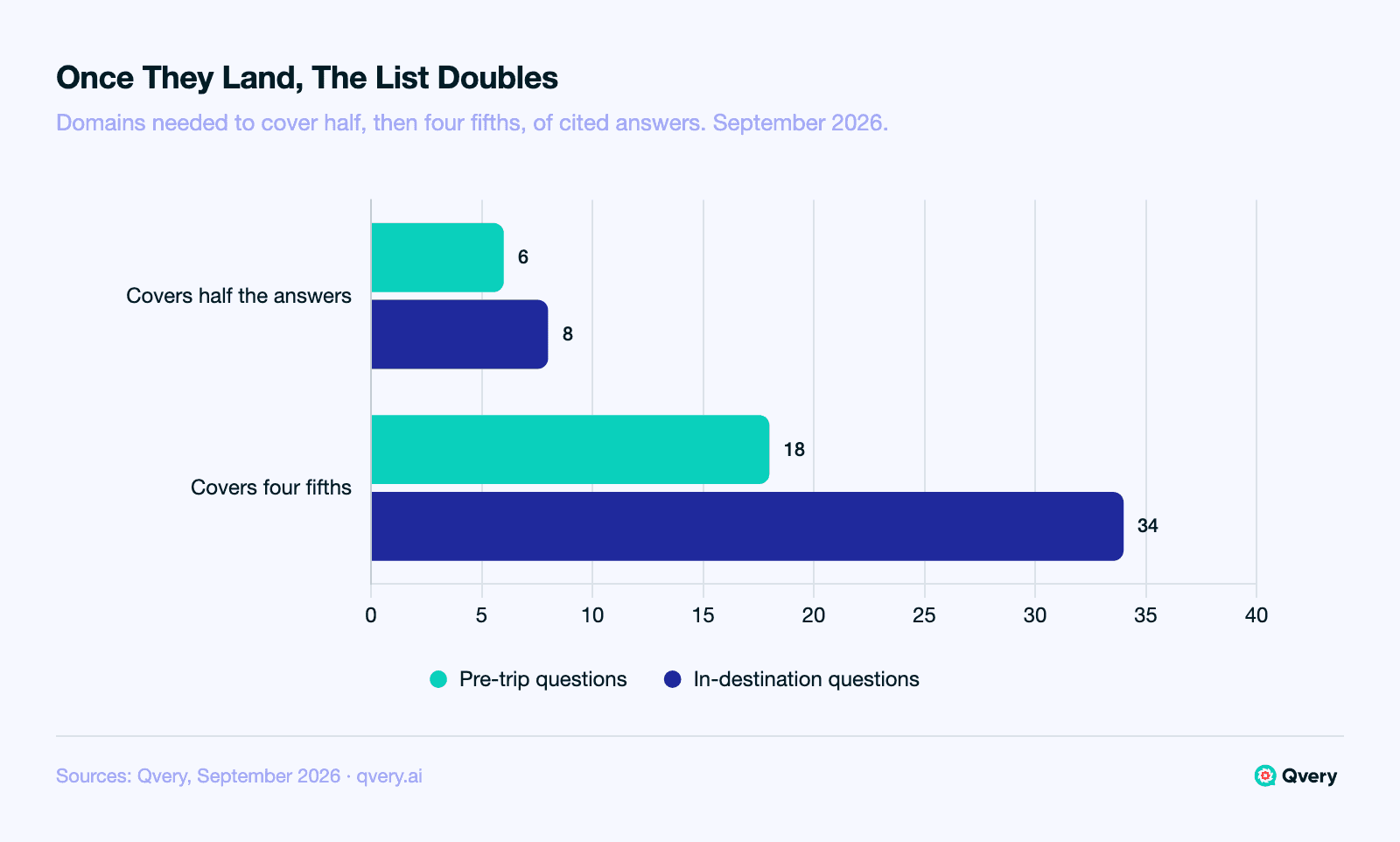
Eighteen rows against thirty-four. Same category, same month, roughly twice the surface area once the traveller has arrived.
The two lists share two rows: Google and Reddit. Two out of the smaller list's eighteen, a shared fraction of 0.11. Everything else diverges.
Here is the pre-trip list in full, in the order the coverage was reached:
Google, Forbes, Eurail, Enterprise, Expedia, Uber
Trafalgar, CoverMe, Club Med, Skyscanner, Sixt, Reddit
Snowcard, UNiDAYS, Going, True Traveller, Yell, Enterprise Canada
And the in-destination list:
Viator, CityPass, Intrepid Travel, Google, ToursByLocals, Tripadvisor, Visit London, TourScoop
GetYourGuide, NSW National Parks, Bruneck, Reddit, Travel and Leisure, a Danish public transport site
Contiki, Mayo Civic Center, TCCruise, Explore Elk Grove, Daily Clarion, Downtown Stockton, Daytrip
Visit Billings, Rendezvous Weymouth, TravelStride, Visit Finger Lakes, CityPass media, Indulge Boise
Change Inspector, Visit Philly, Travel South USA, Visit Toledo, a county library site, Visit Florida, Welcome Anchorage
The pre-trip list is recognisable from a mile away. The in-destination list turns into city and regional tourism boards, one per place, about halfway down.
That tail is the second half's defining feature. In the questions we ran, no single national in-destination source stood in for the cities. Philadelphia questions came back with Philadelphia sources.
If you sell in-destination, your working list is partly a list of cities. Budget for that, or pick the cities you sell in and stop pretending the rest are covered.
Who Answers Before The Trip, And Who Answers After
Classify each cited domain and the two lists stop looking like an accident.
Comparison and price-search sites were present in 49.18% of answers that cited any source on the pre-trip side and 7.02% on the in-destination side. Activity marketplaces run the opposite way, 47.37% and 17.21% of answers that cited any source.
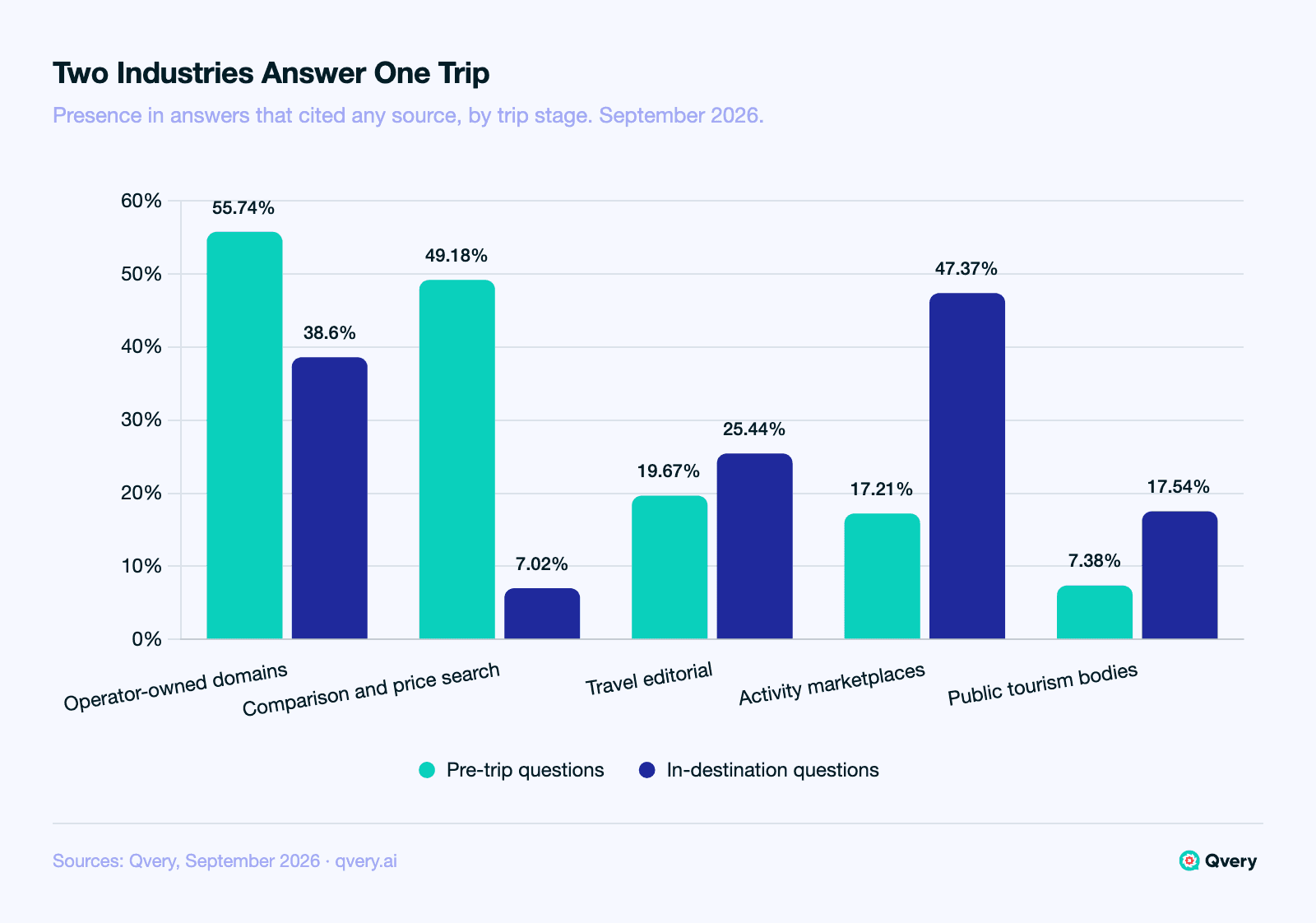
Two layers that matter for planning. Public tourism bodies were present in 17.54% of answers that cited any source on the in-destination side and 7.38% on the pre-trip side, mostly national park services and city tourism boards. Travel editorial was present in 25.44% of answers that cited any source on the in-destination side and 19.67% on the pre-trip side, roughly even across the trip.
Then the one that shapes where your own effort goes. Operator-owned domains were present in 55.74% of answers that cited any source on the pre-trip side and 38.6% on the in-destination side.
Those figures cover every operator's estate in the set, not yours. If you sell pre-trip, the layer is present in more than half of the answers that cited any source, which makes checking your own domain the first thing to do and a page you already control the cheapest thing to fix.
If you sell in-destination, your own site appears alongside marketplaces that sell your product, and that is a distribution question as much as a content one.
Pre-trip is a market you can name. In-destination is a market you have to enumerate, city by city.
Careful with all of this. We counted which sources answers cited. We did not read what the answers said, did not measure why one marketplace was cited over another, and cannot tell you whether being cited moved a booking.
The Number Your Commercial Director Is Asking For
Judgment now, not findings. Three numbers get confused in travel meetings more than in any other vertical I work in, because seasonality makes everything look like movement.
Do we appear at all is the question for a new product line or a new market. Visibility, per topic, per country.
How much of the conversation is ours is the question when you already appear and want to know whether you are the answer or a footnote. Share of voice against a competitor set you wrote down.
Where do we land when we appear is the question when the first two are fine and bookings are not. Average position.
Each needs a window you decide in advance, and travel needs it more than most. A short read taken across a season change tells you about the season. For what separates the three numbers, we wrote that up in AI visibility versus share of voice.
Set Up Both Halves Of The Trip In Qvery
Create one topic per product line and label it with the trip stage it belongs to. Put the traveller questions under each as queries. Qvery generates a starting set at onboarding and you edit it in plain language from there.
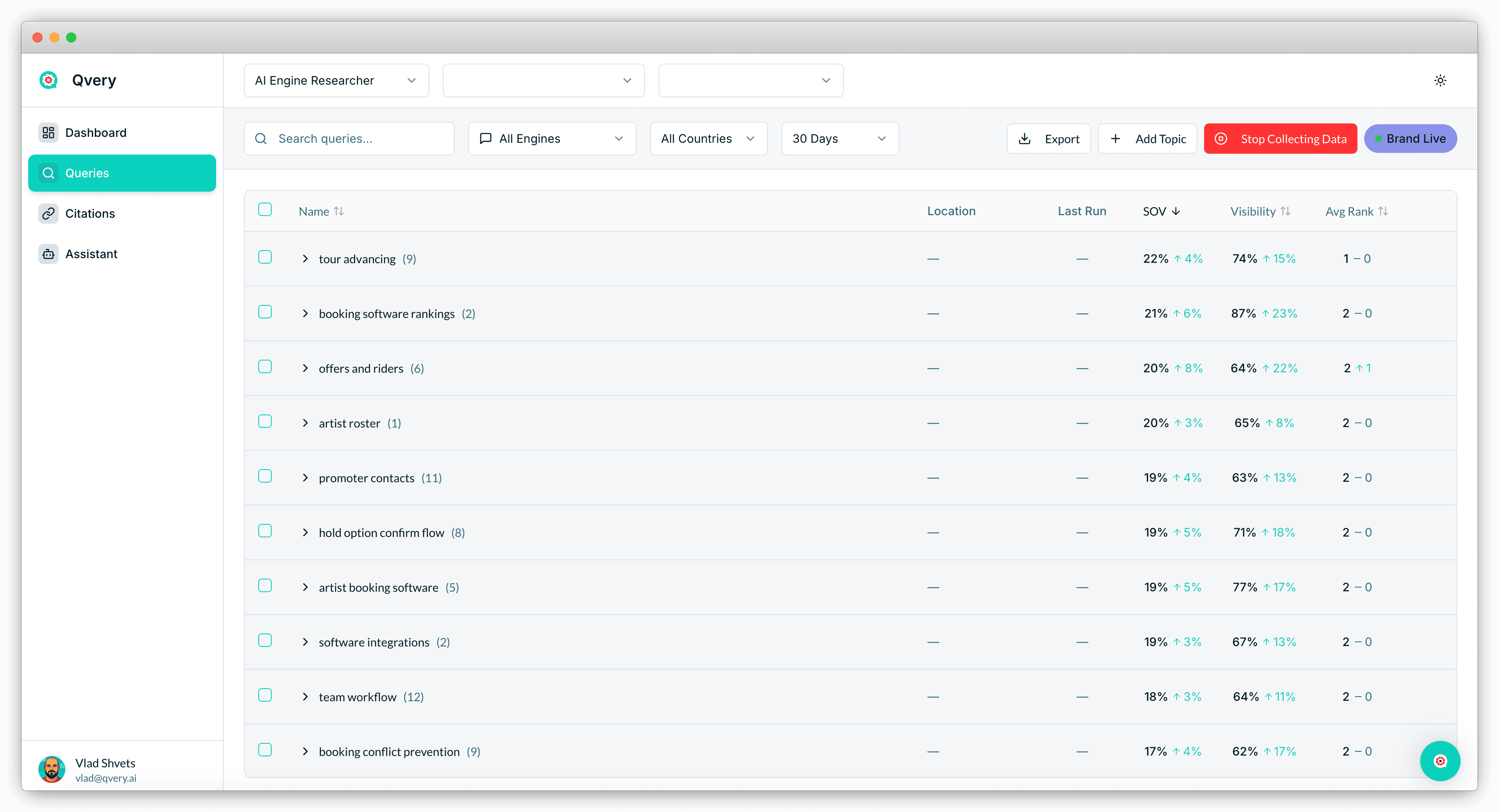
Country is not a detail in travel, it is a dimension. The same question about rail passes answers differently in Germany and Australia, and a pooled number averages your strongest market with a market you do not serve.
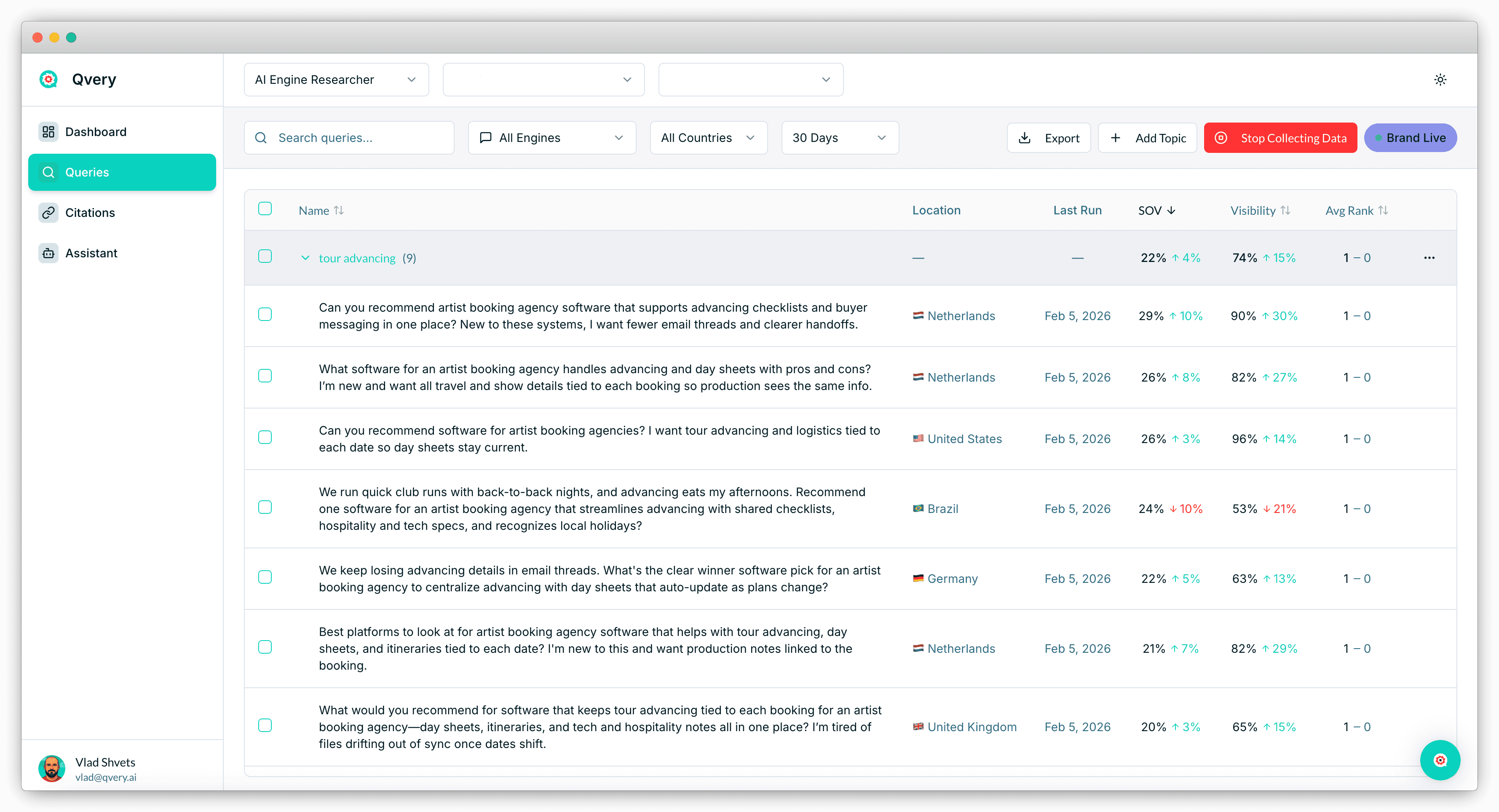
Every answer keeps the sources cited in it, tied to the query and the engine that produced it. The Citations view ranks the URLs and domains behind those answers, each with a weight, filterable by engine and country, and the ranking exports. That is where your own version of this list comes from:
Open the Citations view for one trip stage's topics and read the Top Domains ranking.
Take rows from the top until another row stops changing what you would do. That is your working list.
Do the same for the other stage.
Go down both lists and mark every row present, absent or stale for your brand, then mark the rows that sit on both.
A note on method. Our counts used a stricter definition than a top-ranked cut.
We took the smallest set of domains that together cover four fifths of the answers that cited any source, choosing them one at a time by how many still-uncovered answers each one adds. A ranked list read from the top is a close and usable version of the same thing.
Then ask the Assistant for the queries where your visibility is zero. Read that list stage by stage: it is the only output of this exercise that arrives with its own to-do attached.
One limit worth knowing. The Citations view records and ranks the sources cited; it does not sort them into marketplaces, operators and tourism boards for you, and it does not report which brands the answer named. That read is yours, done once, when you build the list.
Start a Qvery trial and put both halves of your trip in as separate topics. Seven days free, no credit card, which is time to get both stages configured and the first days of data in.
Do it before the next budget cycle. If the two halves of your trip cite two different industries, they were never one line item.
The AI search studies your commercial director has read are about hotels. They do not sell hotels. They sell insurance, or rail passes, or walking tours, or car hire, and they want to know whether the engines put the company in front of a traveller who has not typed a brand name yet.
The hotel numbers will not tell them. Neither will one number for travel.
A trip has two halves, and the websites that answer them are two different industries. Which half you sell into decides how long your working list is, who you are competing with on it, and whether one tracking setup covers your line or two do.
Nothing here ranks anybody. This is the setup that comes before any of that.
Split The Trip Before You Split The Budget
Pre-trip is everything a traveller buys while still at home. Flights, rail passes, car hire, travel insurance, packages, an eSIM.
In-destination is everything they buy once they have landed. Tours, tickets, activities, local transport, city passes.
Most travel companies sell into one half. Some straddle. A tour operator with an airport transfer product has a foot on each side, and tracking those two as one thing is what produces a number neither half recognises.
Sort your product lines into the two halves. Then write the questions a traveller types for each, in their words, before they know your name. That list is the input to everything below.
Count The Working List For Each Half
Start with the size of the job. Take one half, find the smallest set of domains that covers half the answers that cited any source, then the set that covers four fifths. Repeat for the other half.
Across a targeted set of traveller questions we ran on ChatGPT and Google AI Mode in September 2026, the two halves came out very differently. Directional, not a census.
Pre-trip: six domains cover half the answers that cited any source. Eighteen cover four fifths.
In-destination: eight cover half. Thirty-four cover four fifths.
Eighteen rows against thirty-four. Same category, same month, roughly twice the surface area once the traveller has arrived.
The two lists share two rows: Google and Reddit. Two out of the smaller list's eighteen, a shared fraction of 0.11. Everything else diverges.
Here is the pre-trip list in full, in the order the coverage was reached:
Google, Forbes, Eurail, Enterprise, Expedia, Uber
Trafalgar, CoverMe, Club Med, Skyscanner, Sixt, Reddit
Snowcard, UNiDAYS, Going, True Traveller, Yell, Enterprise Canada
And the in-destination list:
Viator, CityPass, Intrepid Travel, Google, ToursByLocals, Tripadvisor, Visit London, TourScoop
GetYourGuide, NSW National Parks, Bruneck, Reddit, Travel and Leisure, a Danish public transport site
Contiki, Mayo Civic Center, TCCruise, Explore Elk Grove, Daily Clarion, Downtown Stockton, Daytrip
Visit Billings, Rendezvous Weymouth, TravelStride, Visit Finger Lakes, CityPass media, Indulge Boise
Change Inspector, Visit Philly, Travel South USA, Visit Toledo, a county library site, Visit Florida, Welcome Anchorage
The pre-trip list is recognisable from a mile away. The in-destination list turns into city and regional tourism boards, one per place, about halfway down.
That tail is the second half's defining feature. In the questions we ran, no single national in-destination source stood in for the cities. Philadelphia questions came back with Philadelphia sources.
If you sell in-destination, your working list is partly a list of cities. Budget for that, or pick the cities you sell in and stop pretending the rest are covered.
Who Answers Before The Trip, And Who Answers After
Classify each cited domain and the two lists stop looking like an accident.
Comparison and price-search sites were present in 49.18% of answers that cited any source on the pre-trip side and 7.02% on the in-destination side. Activity marketplaces run the opposite way, 47.37% and 17.21% of answers that cited any source.
Two layers that matter for planning. Public tourism bodies were present in 17.54% of answers that cited any source on the in-destination side and 7.38% on the pre-trip side, mostly national park services and city tourism boards. Travel editorial was present in 25.44% of answers that cited any source on the in-destination side and 19.67% on the pre-trip side, roughly even across the trip.
Then the one that shapes where your own effort goes. Operator-owned domains were present in 55.74% of answers that cited any source on the pre-trip side and 38.6% on the in-destination side.
Those figures cover every operator's estate in the set, not yours. If you sell pre-trip, the layer is present in more than half of the answers that cited any source, which makes checking your own domain the first thing to do and a page you already control the cheapest thing to fix.
If you sell in-destination, your own site appears alongside marketplaces that sell your product, and that is a distribution question as much as a content one.
Pre-trip is a market you can name. In-destination is a market you have to enumerate, city by city.
Careful with all of this. We counted which sources answers cited. We did not read what the answers said, did not measure why one marketplace was cited over another, and cannot tell you whether being cited moved a booking.
The Number Your Commercial Director Is Asking For
Judgment now, not findings. Three numbers get confused in travel meetings more than in any other vertical I work in, because seasonality makes everything look like movement.
Do we appear at all is the question for a new product line or a new market. Visibility, per topic, per country.
How much of the conversation is ours is the question when you already appear and want to know whether you are the answer or a footnote. Share of voice against a competitor set you wrote down.
Where do we land when we appear is the question when the first two are fine and bookings are not. Average position.
Each needs a window you decide in advance, and travel needs it more than most. A short read taken across a season change tells you about the season. For what separates the three numbers, we wrote that up in AI visibility versus share of voice.
Set Up Both Halves Of The Trip In Qvery
Create one topic per product line and label it with the trip stage it belongs to. Put the traveller questions under each as queries. Qvery generates a starting set at onboarding and you edit it in plain language from there.
Country is not a detail in travel, it is a dimension. The same question about rail passes answers differently in Germany and Australia, and a pooled number averages your strongest market with a market you do not serve.
Every answer keeps the sources cited in it, tied to the query and the engine that produced it. The Citations view ranks the URLs and domains behind those answers, each with a weight, filterable by engine and country, and the ranking exports. That is where your own version of this list comes from:
Open the Citations view for one trip stage's topics and read the Top Domains ranking.
Take rows from the top until another row stops changing what you would do. That is your working list.
Do the same for the other stage.
Go down both lists and mark every row present, absent or stale for your brand, then mark the rows that sit on both.
A note on method. Our counts used a stricter definition than a top-ranked cut.
We took the smallest set of domains that together cover four fifths of the answers that cited any source, choosing them one at a time by how many still-uncovered answers each one adds. A ranked list read from the top is a close and usable version of the same thing.
Then ask the Assistant for the queries where your visibility is zero. Read that list stage by stage: it is the only output of this exercise that arrives with its own to-do attached.
One limit worth knowing. The Citations view records and ranks the sources cited; it does not sort them into marketplaces, operators and tourism boards for you, and it does not report which brands the answer named. That read is yours, done once, when you build the list.
Start a Qvery trial and put both halves of your trip in as separate topics. Seven days free, no credit card, which is time to get both stages configured and the first days of data in.
Do it before the next budget cycle. If the two halves of your trip cite two different industries, they were never one line item.
The AI search studies your commercial director has read are about hotels. They do not sell hotels. They sell insurance, or rail passes, or walking tours, or car hire, and they want to know whether the engines put the company in front of a traveller who has not typed a brand name yet.
The hotel numbers will not tell them. Neither will one number for travel.
A trip has two halves, and the websites that answer them are two different industries. Which half you sell into decides how long your working list is, who you are competing with on it, and whether one tracking setup covers your line or two do.
Nothing here ranks anybody. This is the setup that comes before any of that.
Split The Trip Before You Split The Budget
Pre-trip is everything a traveller buys while still at home. Flights, rail passes, car hire, travel insurance, packages, an eSIM.
In-destination is everything they buy once they have landed. Tours, tickets, activities, local transport, city passes.
Most travel companies sell into one half. Some straddle. A tour operator with an airport transfer product has a foot on each side, and tracking those two as one thing is what produces a number neither half recognises.
Sort your product lines into the two halves. Then write the questions a traveller types for each, in their words, before they know your name. That list is the input to everything below.
Count The Working List For Each Half
Start with the size of the job. Take one half, find the smallest set of domains that covers half the answers that cited any source, then the set that covers four fifths. Repeat for the other half.
Across a targeted set of traveller questions we ran on ChatGPT and Google AI Mode in September 2026, the two halves came out very differently. Directional, not a census.
Pre-trip: six domains cover half the answers that cited any source. Eighteen cover four fifths.
In-destination: eight cover half. Thirty-four cover four fifths.
Eighteen rows against thirty-four. Same category, same month, roughly twice the surface area once the traveller has arrived.
The two lists share two rows: Google and Reddit. Two out of the smaller list's eighteen, a shared fraction of 0.11. Everything else diverges.
Here is the pre-trip list in full, in the order the coverage was reached:
Google, Forbes, Eurail, Enterprise, Expedia, Uber
Trafalgar, CoverMe, Club Med, Skyscanner, Sixt, Reddit
Snowcard, UNiDAYS, Going, True Traveller, Yell, Enterprise Canada
And the in-destination list:
Viator, CityPass, Intrepid Travel, Google, ToursByLocals, Tripadvisor, Visit London, TourScoop
GetYourGuide, NSW National Parks, Bruneck, Reddit, Travel and Leisure, a Danish public transport site
Contiki, Mayo Civic Center, TCCruise, Explore Elk Grove, Daily Clarion, Downtown Stockton, Daytrip
Visit Billings, Rendezvous Weymouth, TravelStride, Visit Finger Lakes, CityPass media, Indulge Boise
Change Inspector, Visit Philly, Travel South USA, Visit Toledo, a county library site, Visit Florida, Welcome Anchorage
The pre-trip list is recognisable from a mile away. The in-destination list turns into city and regional tourism boards, one per place, about halfway down.
That tail is the second half's defining feature. In the questions we ran, no single national in-destination source stood in for the cities. Philadelphia questions came back with Philadelphia sources.
If you sell in-destination, your working list is partly a list of cities. Budget for that, or pick the cities you sell in and stop pretending the rest are covered.
Who Answers Before The Trip, And Who Answers After
Classify each cited domain and the two lists stop looking like an accident.
Comparison and price-search sites were present in 49.18% of answers that cited any source on the pre-trip side and 7.02% on the in-destination side. Activity marketplaces run the opposite way, 47.37% and 17.21% of answers that cited any source.
Two layers that matter for planning. Public tourism bodies were present in 17.54% of answers that cited any source on the in-destination side and 7.38% on the pre-trip side, mostly national park services and city tourism boards. Travel editorial was present in 25.44% of answers that cited any source on the in-destination side and 19.67% on the pre-trip side, roughly even across the trip.
Then the one that shapes where your own effort goes. Operator-owned domains were present in 55.74% of answers that cited any source on the pre-trip side and 38.6% on the in-destination side.
Those figures cover every operator's estate in the set, not yours. If you sell pre-trip, the layer is present in more than half of the answers that cited any source, which makes checking your own domain the first thing to do and a page you already control the cheapest thing to fix.
If you sell in-destination, your own site appears alongside marketplaces that sell your product, and that is a distribution question as much as a content one.
Pre-trip is a market you can name. In-destination is a market you have to enumerate, city by city.
Careful with all of this. We counted which sources answers cited. We did not read what the answers said, did not measure why one marketplace was cited over another, and cannot tell you whether being cited moved a booking.
The Number Your Commercial Director Is Asking For
Judgment now, not findings. Three numbers get confused in travel meetings more than in any other vertical I work in, because seasonality makes everything look like movement.
Do we appear at all is the question for a new product line or a new market. Visibility, per topic, per country.
How much of the conversation is ours is the question when you already appear and want to know whether you are the answer or a footnote. Share of voice against a competitor set you wrote down.
Where do we land when we appear is the question when the first two are fine and bookings are not. Average position.
Each needs a window you decide in advance, and travel needs it more than most. A short read taken across a season change tells you about the season. For what separates the three numbers, we wrote that up in AI visibility versus share of voice.
Set Up Both Halves Of The Trip In Qvery
Create one topic per product line and label it with the trip stage it belongs to. Put the traveller questions under each as queries. Qvery generates a starting set at onboarding and you edit it in plain language from there.
Country is not a detail in travel, it is a dimension. The same question about rail passes answers differently in Germany and Australia, and a pooled number averages your strongest market with a market you do not serve.
Every answer keeps the sources cited in it, tied to the query and the engine that produced it. The Citations view ranks the URLs and domains behind those answers, each with a weight, filterable by engine and country, and the ranking exports. That is where your own version of this list comes from:
Open the Citations view for one trip stage's topics and read the Top Domains ranking.
Take rows from the top until another row stops changing what you would do. That is your working list.
Do the same for the other stage.
Go down both lists and mark every row present, absent or stale for your brand, then mark the rows that sit on both.
A note on method. Our counts used a stricter definition than a top-ranked cut.
We took the smallest set of domains that together cover four fifths of the answers that cited any source, choosing them one at a time by how many still-uncovered answers each one adds. A ranked list read from the top is a close and usable version of the same thing.
Then ask the Assistant for the queries where your visibility is zero. Read that list stage by stage: it is the only output of this exercise that arrives with its own to-do attached.
One limit worth knowing. The Citations view records and ranks the sources cited; it does not sort them into marketplaces, operators and tourism boards for you, and it does not report which brands the answer named. That read is yours, done once, when you build the list.
Start a Qvery trial and put both halves of your trip in as separate topics. Seven days free, no credit card, which is time to get both stages configured and the first days of data in.
Do it before the next budget cycle. If the two halves of your trip cite two different industries, they were never one line item.
The AI search studies your commercial director has read are about hotels. They do not sell hotels. They sell insurance, or rail passes, or walking tours, or car hire, and they want to know whether the engines put the company in front of a traveller who has not typed a brand name yet.
The hotel numbers will not tell them. Neither will one number for travel.
A trip has two halves, and the websites that answer them are two different industries. Which half you sell into decides how long your working list is, who you are competing with on it, and whether one tracking setup covers your line or two do.
Nothing here ranks anybody. This is the setup that comes before any of that.
Split The Trip Before You Split The Budget
Pre-trip is everything a traveller buys while still at home. Flights, rail passes, car hire, travel insurance, packages, an eSIM.
In-destination is everything they buy once they have landed. Tours, tickets, activities, local transport, city passes.
Most travel companies sell into one half. Some straddle. A tour operator with an airport transfer product has a foot on each side, and tracking those two as one thing is what produces a number neither half recognises.
Sort your product lines into the two halves. Then write the questions a traveller types for each, in their words, before they know your name. That list is the input to everything below.
Count The Working List For Each Half
Start with the size of the job. Take one half, find the smallest set of domains that covers half the answers that cited any source, then the set that covers four fifths. Repeat for the other half.
Across a targeted set of traveller questions we ran on ChatGPT and Google AI Mode in September 2026, the two halves came out very differently. Directional, not a census.
Pre-trip: six domains cover half the answers that cited any source. Eighteen cover four fifths.
In-destination: eight cover half. Thirty-four cover four fifths.
Eighteen rows against thirty-four. Same category, same month, roughly twice the surface area once the traveller has arrived.
The two lists share two rows: Google and Reddit. Two out of the smaller list's eighteen, a shared fraction of 0.11. Everything else diverges.
Here is the pre-trip list in full, in the order the coverage was reached:
Google, Forbes, Eurail, Enterprise, Expedia, Uber
Trafalgar, CoverMe, Club Med, Skyscanner, Sixt, Reddit
Snowcard, UNiDAYS, Going, True Traveller, Yell, Enterprise Canada
And the in-destination list:
Viator, CityPass, Intrepid Travel, Google, ToursByLocals, Tripadvisor, Visit London, TourScoop
GetYourGuide, NSW National Parks, Bruneck, Reddit, Travel and Leisure, a Danish public transport site
Contiki, Mayo Civic Center, TCCruise, Explore Elk Grove, Daily Clarion, Downtown Stockton, Daytrip
Visit Billings, Rendezvous Weymouth, TravelStride, Visit Finger Lakes, CityPass media, Indulge Boise
Change Inspector, Visit Philly, Travel South USA, Visit Toledo, a county library site, Visit Florida, Welcome Anchorage
The pre-trip list is recognisable from a mile away. The in-destination list turns into city and regional tourism boards, one per place, about halfway down.
That tail is the second half's defining feature. In the questions we ran, no single national in-destination source stood in for the cities. Philadelphia questions came back with Philadelphia sources.
If you sell in-destination, your working list is partly a list of cities. Budget for that, or pick the cities you sell in and stop pretending the rest are covered.
Who Answers Before The Trip, And Who Answers After
Classify each cited domain and the two lists stop looking like an accident.
Comparison and price-search sites were present in 49.18% of answers that cited any source on the pre-trip side and 7.02% on the in-destination side. Activity marketplaces run the opposite way, 47.37% and 17.21% of answers that cited any source.
Two layers that matter for planning. Public tourism bodies were present in 17.54% of answers that cited any source on the in-destination side and 7.38% on the pre-trip side, mostly national park services and city tourism boards. Travel editorial was present in 25.44% of answers that cited any source on the in-destination side and 19.67% on the pre-trip side, roughly even across the trip.
Then the one that shapes where your own effort goes. Operator-owned domains were present in 55.74% of answers that cited any source on the pre-trip side and 38.6% on the in-destination side.
Those figures cover every operator's estate in the set, not yours. If you sell pre-trip, the layer is present in more than half of the answers that cited any source, which makes checking your own domain the first thing to do and a page you already control the cheapest thing to fix.
If you sell in-destination, your own site appears alongside marketplaces that sell your product, and that is a distribution question as much as a content one.
Pre-trip is a market you can name. In-destination is a market you have to enumerate, city by city.
Careful with all of this. We counted which sources answers cited. We did not read what the answers said, did not measure why one marketplace was cited over another, and cannot tell you whether being cited moved a booking.
The Number Your Commercial Director Is Asking For
Judgment now, not findings. Three numbers get confused in travel meetings more than in any other vertical I work in, because seasonality makes everything look like movement.
Do we appear at all is the question for a new product line or a new market. Visibility, per topic, per country.
How much of the conversation is ours is the question when you already appear and want to know whether you are the answer or a footnote. Share of voice against a competitor set you wrote down.
Where do we land when we appear is the question when the first two are fine and bookings are not. Average position.
Each needs a window you decide in advance, and travel needs it more than most. A short read taken across a season change tells you about the season. For what separates the three numbers, we wrote that up in AI visibility versus share of voice.
Set Up Both Halves Of The Trip In Qvery
Create one topic per product line and label it with the trip stage it belongs to. Put the traveller questions under each as queries. Qvery generates a starting set at onboarding and you edit it in plain language from there.
Country is not a detail in travel, it is a dimension. The same question about rail passes answers differently in Germany and Australia, and a pooled number averages your strongest market with a market you do not serve.
Every answer keeps the sources cited in it, tied to the query and the engine that produced it. The Citations view ranks the URLs and domains behind those answers, each with a weight, filterable by engine and country, and the ranking exports. That is where your own version of this list comes from:
Open the Citations view for one trip stage's topics and read the Top Domains ranking.
Take rows from the top until another row stops changing what you would do. That is your working list.
Do the same for the other stage.
Go down both lists and mark every row present, absent or stale for your brand, then mark the rows that sit on both.
A note on method. Our counts used a stricter definition than a top-ranked cut.
We took the smallest set of domains that together cover four fifths of the answers that cited any source, choosing them one at a time by how many still-uncovered answers each one adds. A ranked list read from the top is a close and usable version of the same thing.
Then ask the Assistant for the queries where your visibility is zero. Read that list stage by stage: it is the only output of this exercise that arrives with its own to-do attached.
One limit worth knowing. The Citations view records and ranks the sources cited; it does not sort them into marketplaces, operators and tourism boards for you, and it does not report which brands the answer named. That read is yours, done once, when you build the list.
Start a Qvery trial and put both halves of your trip in as separate topics. Seven days free, no credit card, which is time to get both stages configured and the first days of data in.
Do it before the next budget cycle. If the two halves of your trip cite two different industries, they were never one line item.

© 2026 Qvery AI OÜ