By
Vlad Shvets
8 Best AI Visibility Tools for Law Firms (2026)
Eight AI visibility tools read against what a law firm has to measure: answer text, markets, cited sources, brands, and practice area by city.
Eight AI visibility tools read against what a law firm has to measure: answer text, markets, cited sources, brands, and practice area by city.
Eight AI visibility tools read against what a law firm has to measure: answer text, markets, cited sources, brands, and practice area by city.
Start with the bad news. Not one of these eight tools documents what a firm most wants watched: a question built from a practice area and a city, with the firm tracked apart from its attorneys. It matters, because in our law firm AI search study, brand-owned sites were cited in 73.95% of recommendation answers, counting every valid answer in that slice on ChatGPT and Google AI Mode.
So this is a documentation review, not a ranking. Qvery is ours and goes first, which you should discount accordingly. The other seven are the five highest-ranked tools on our competitor leaderboard that document both engines and publish a price, plus the two qualifying tools documenting the most criteria, ordered by that count.
Five Things a Firm Has to See Documented, and the Fifth Is Missing Everywhere
A law firm's visibility question is really a grid: every practice area you sell, in every city you sell it in, asked by people who do not know your name yet. That grid turns into five things a tool has to show you.
The answer text itself. A visibility score says you appeared somewhere; only the words say whether the engine recommended you, listed you fifth among nine, or named you beside a caveat about your practice area. Two tools here document it.
Per-country tracking. Law is practised inside jurisdictions, so the answer that counts is the one served in your market. Country coverage is not city coverage, which is criterion five's problem.
Cited-source monitoring. Which pages and domains the answer drew on: your practice pages, the directories, the bar listings, the local press. Since brand-owned sites are in most recommendation answers, seeing whose pages were cited is how you find out if any of them were yours.
More than one brand in one account. Useful when a firm answers to more than one name, or an agency runs several firms. It is not the same as tracking each office or each attorney separately, and no page here claims it is.
Practice area and city in one prompt, firm kept apart from attorney. Nobody documents this. It is the criterion the demo has to settle, and it is the reason this post names no winner.
Two things had to be true before a tool made the list: its own pages say it tracks ChatGPT and Google AI Mode, and it publishes a price or says plainly that pricing is quoted.
Past that bar, each criterion sits in one of three states. A criterion is documented when a line on the vendor's own page says so, and that line is quoted here. It is documented as not offered when the vendor says no, which happens to none of the five for any tool on this list.
Everything else is not documented, which means the pages are silent, never that the feature is absent. Read it as a question to ask in the demo, not as a mark against the tool. Every entry below ends with that question.
Carry one number into every pricing block. Practice areas times cities is the number of questions you need tracked: five practice areas across six cities is thirty before anyone asks about fees or reviews. Several vendors count the same question separately on each engine and in each market, so read each plan's cap twice.
Hold that figure against each plan's prompt cap. For building the measurement rather than buying it, measuring a law firm's AI visibility covers the method, and how to choose GEO software covers the general case.
1. Qvery: Both Engines Daily, No Practice-Area Reporting
Key Features:
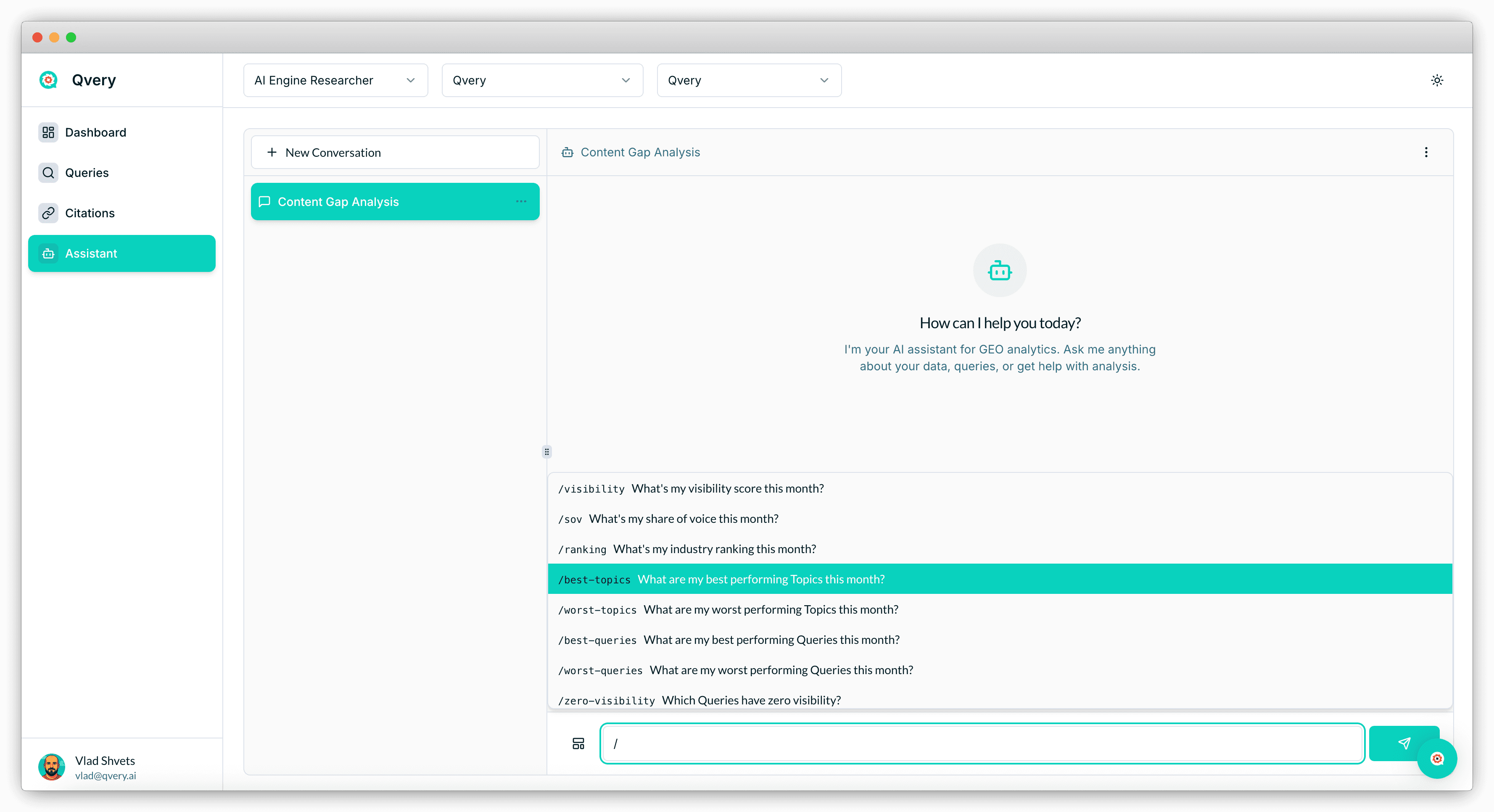
Daily tracking of visibility, share of voice, and average rank across ChatGPT and Google AI Mode, in 200+ countries.
Every citation captured daily, tied to the query and the engine that produced it.
Queries you add and edit, so a question naming a practice area and a city can sit in your tracked set.
Share of voice against the other names the engines put in the same answers.
Qvery Assistant in the app: ask about your own visibility, share of voice, citation, topic, and query data in plain language, and have it add queries, trigger a run, or export a report.
Pricing:
Starter: €49/month, 1 brand, 25 tracked queries.
Growth: €99/month, 1 brand, 50 tracked queries.
Business: €199 for unlimited brands and 100 tracked queries (the pricing page prints no billing period on this tier).
Every tier includes ChatGPT and Google AI Mode, daily query runs, unlimited countries, and unlimited seats. The paid plans open with a free 7-day trial and no credit card.
Reddit Score: 85.0% Positive, across 20 mentions. What redditors say:
"I looked into our firm's AI visibility using Qvery and we were also invisible across most platforms. The firms coming up more often had more mentions in legal trade publications, local business press, and third-party attorney ranking sites." (r/LawFirm)
Eighteen of those 20 mentions come from accounts on our own Reddit board. Two do not, which is too thin to score on its own, so treat the percentage as ours rather than the market's.
We wrote the five criteria, so it would be strange to then grade ourselves generously on them. Here is the same interrogation we would run on a vendor, answered about our own product.
Does it show the answer text? No, and the pages do not claim it. You get visibility, share of voice, average rank, and the citations.
Does it track per country? Yes, on every tier, unlimited countries. Does it show cited sources? Yes, every citation, tied to the query and engine it came from.
More than one brand in one account? Only on Business, where the pricing page reads unlimited brands; Starter and Growth are one brand each.
Practice area and city, firm apart from attorney? Not documented. A query can name a practice area and a city, and the reporting comes back by query, not by city or by attorney.
That makes three of five, and the missing two are the ones a large firm will push hardest on. Our demo question is the same as everyone else's: run your own practice-area-and-city questions on both engines, and see whether the result separates the firm from your partners' personal pages.
Start a free 7-day trial if you would rather test it than take our word for it. Checkout is self-serve and no credit card is required.
2. Dageno AI: The Answer Text and the Cited URLs
Key Features:
Original AI answers, cited domains, and URLs in one trace: "Trace insights back to cited domains, URLs, and original AI answers to see where you need stronger official content, third-party reviews, or channel coverage."
Region view with per-market rank and visibility, listing markets such as US, FR and GB.
Brand comparison inside the same market, model, region, and time range, with brand and project limits set per tier.
Nine AI models on every paid tier, Google AI Mode among them.
Monitoring of citation performance for published content.
Pricing:
Starter: $49/month (the page notes it was $89), 1 brand, 50 custom tracked prompts, 2 market segments.
Growth: $199/month, 2 brands, 250 prompts, 5 market segments, alerts and recurring reports.
Scale: $410/month, 5 brands, 600 prompts, 12 market segments, plus API, batch configuration, and exports.
Custom: custom pricing, limits on request. Annual billing saves about 15%, and Starter opens with a 7-day free trial.
Reddit Score: Not scored. Two mentions of Dageno turned up in the threads we read, which is not a base for a percentage, and neither said anything a firm could use.
Dageno documents four of the five criteria, more than any other tool here, and it is the only one besides Ahrefs whose pages say you can read the answer itself. For a firm, that is the difference between knowing you appeared in an answer about the best employment lawyer in Austin and knowing the engine described you as handling only executive-side cases.
The tier ladder is where a legal grid gets expensive. Thirty questions looks like a comfortable fit inside Starter's fifty prompts, until you read the pricing FAQ: monitoring the same prompt across different models and regions counts separately. On two engines those thirty questions are already sixty of the fifty.
Ask the demo to price your real grid before you pick a tier, and ask whether the firm and two named partners can be three tracked brands on the plan you would buy. On Starter, the answer is one.
3. OtterlyAI: Market-by-Market Citations, With AI Mode on the Add-On Line
Key Features:
Every domain and URL cited in AI answers, checked daily, "with link-position changes over time."
Market-by-market reporting: "See how your brand performs market by market, not as one global number that hides where you're invisible."
Workspaces, which "lets you manage multiple brands and clients inside one OtterlyAI subscription."
Daily tracking frequency on every self-serve tier.
A public API for brand reports, prompts, citations, and workspace data.
Pricing:
Lite: $29/month, 15 search prompts, 1 workspace.
Standard: $189/month, 100 search prompts, API access.
Premium: $489/month, 400 search prompts.
Enterprise: custom, from 1,000 search prompts. Annual billing brings the three self-serve tiers to $25, $160 and $422 per month.
Google AI Mode is an add-on on every self-serve tier, not part of the sticker price: $9/month on Lite, $59 on Standard, $149 on Premium, or $93, $610 and $1,540 per year.
Reddit Score: 69.2% Positive, across 13 mentions about OtterlyAI. What redditors say:
"Otterly I signed up for and the onboarding was unnecessarily long. Once I finally got started, it was very confusing and I couldn't figure it out on the first day." (r/SaaS)
OtterlyAI documents three of five: markets, cited URLs, and several brands in one subscription. Market-by-market is the useful one for a firm with offices in more than one country, and the citation view is at URL level, which is where a directory listing and your own practice page stop looking alike.
The arithmetic is the thing to watch. The tracked engines named on every tier are ChatGPT, Google AI Overviews, Perplexity and Microsoft Copilot, with Google AI Mode sold separately, so the price of watching both engines you care about is the tier plus the add-on. On Lite that is $38 a month, which is still the cheapest way onto this list; on Premium it is $638.
The demo question is whether the add-on's data arrives in the same reports as the base engines, and what a market is: a country, or something smaller.
4. Peec AI: Three Models Per Plan, Chosen by You
Key Features:
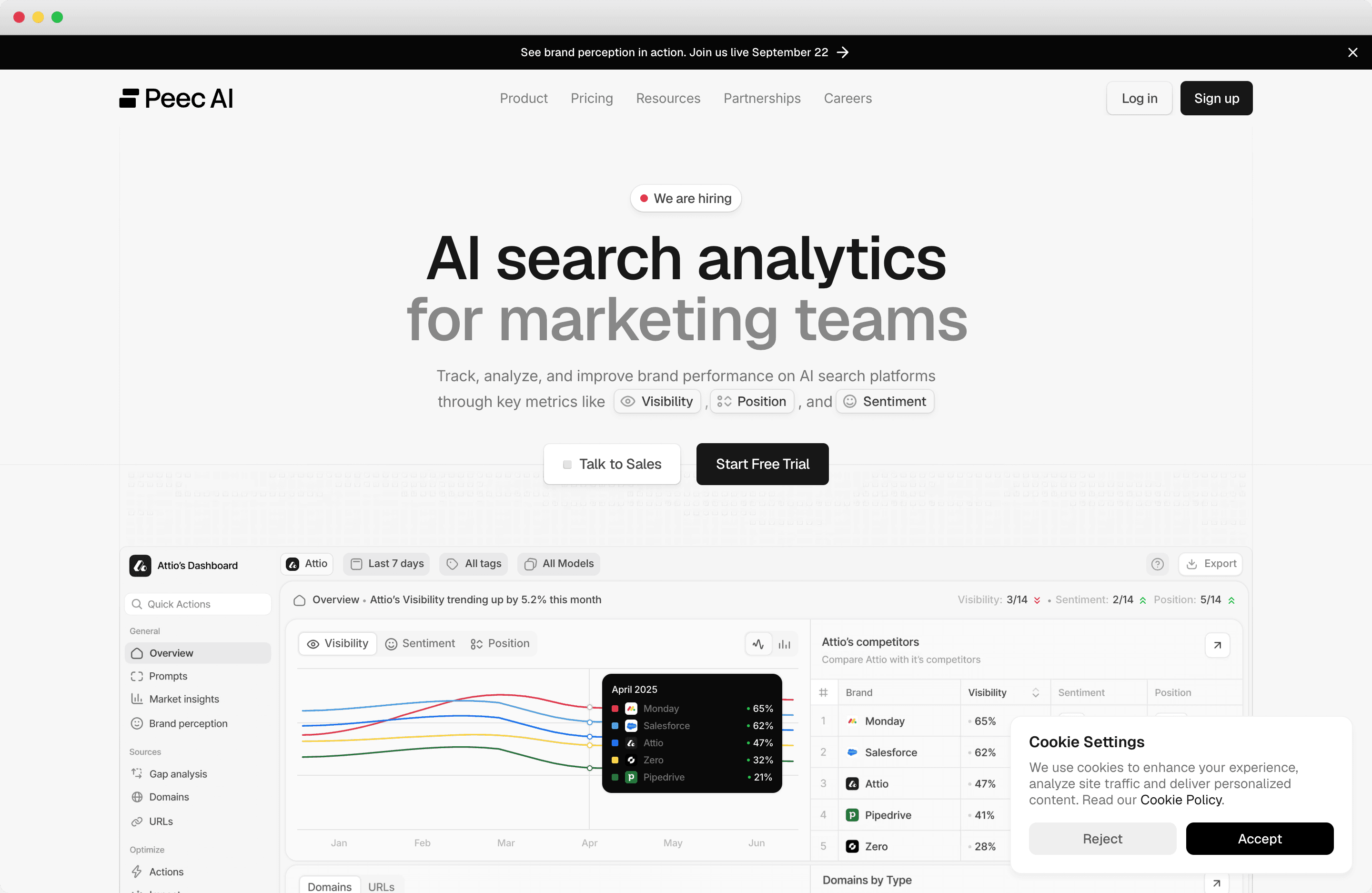
Sources and citations: "which URLs and domains the engine drew on to generate its answer (ChatGPT sources, Google AI Mode citations, Gemini grounding sources)".
All-country tracking, listed on the pricing page as a feature of the Advanced tier.
Multi-brand tracking that monitors "AI Mode visibility, sentiment, and citations separately for each client from one dashboard".
Visibility as appearance rate: "Percentage of AI responses where your brand appears."
Continuous tracking, daily on every tier.
Pricing:
Starter: $95/month, 50 prompts, 1 project, choose 3 models.
Pro: $245/month, 150 prompts, 2 projects, choose 3 models.
Advanced: $495/month, 350 prompts, 5 projects, multi-country, Looker Studio integration.
Enterprise: custom, billed annually, choose from all models with up to 13 tracked, plus API access and SSO.
Extra models are priced per plan on annual billing: $30, $70 and $140 per month.
Reddit Score: 68.6% Positive, across 51 mentions about Peec AI. What redditors say:
"Tools like Profound, Peec AI and LLM Scout give you a baseline of how often your brand and competitors appear across AI models" (r/TechSEO)
"I use GeoGen, been using also Peec and TryProfound all good options." (r/digital_marketing)
Peec has the largest Reddit footprint of the challengers here and documents three of five. Its citation line is the most specific on this list about what it reads per engine, naming ChatGPT sources and Google AI Mode citations separately, which is exactly the distinction a firm needs when one engine leans on directories and the other on your own pages.
Two lines on Peec's own pages sit oddly together. The instructions page says ChatGPT, Google AI Mode, Perplexity, Gemini and Microsoft Copilot are included by default in every plan; each self-serve tier says "Choose 3 models".
Whichever way that resolves, the demo is where a firm finds out which three models it ends up with, and what a fourth costs. Multi-country appears on Advanced only, so a firm with offices abroad is looking at $495 a month rather than $95.
5. AthenaHQ: Answers Metered by the Credit
Key Features:
Source Intelligence, its page for cited-source monitoring.
Global scale: "Operate across brands, markets, and models."
Centralized tracking of share of voice, citation rate, and evaluation coverage "across multiple brands and business units."
Brand mention frequency tracking and competitor share-of-voice comparison.
An API for putting visibility data into your own dashboards.
Pricing:
Essential: free, with $25 of credit and 300 credits. The engines listed are ChatGPT, Perplexity, AI Overviews, Gemini and Copilot. Google AI Mode is not among them.
Starter: $295/month, 3,600 credits, where one credit is one AI response, and the tier where AI Mode first appears.
Enterprise: custom, with multi-region and multi-language support.
Reddit Score: 57.1% Positive, across 7 mentions about AthenaHQ. What redditors say:
"we use athenahq to show clients exactly where they appear vs don't across llms. makes it click faster" (r/DigitalMarketing)
Seven mentions is a thin base, and one of them is a single agency's experience, so read 57.1% as a direction rather than a verdict.
AthenaHQ documents three of five, and prices the whole thing in credits instead of prompts. For a firm, that turns budgeting into multiplication: practice areas, times cities, times engines, times how often you want each one asked, against 3,600 answers a month on Starter.
The free tier is worth naming for what it cannot do here. It runs on five engines, and Google AI Mode is not one of them, so a firm cannot use it to test half the question this post exists to answer. That test starts at $295.
The demo question is whether "Prompt and response analysis", the Essential tier's own line, means someone at the firm can read the answer text or only a summary of it. The pages do not say, so nobody should assume either way.
6. Profound: Citation Analysis Behind a Sales Call
Key Features:
Citation Analysis: "See which websites influence AI answers about your brand".
Answer Engine Insights: "Tracks how AI answer engines mention, rank, and describe a brand."
Agency Mode, which lets agencies "create and manage multiple brand environments within one platform."
Up to nine answer engines tracked on Enterprise, ChatGPT and Google AI Mode among them.
Pricing:
Trial: free, 50 prompts run daily for 7 days, on ChatGPT, Gemini and Google AI Overviews.
Enterprise: custom, with a tailored prompt tracking plan, SSO and SOC 2.
Reddit Score: Not scored. One mention of Profound turned up in the threads we read, which is no base at all for a percentage.
Profound's description of what it measures goes further than most: how an engine mentions, ranks, and describes a brand. That last verb is the one closest to a firm's real worry, which is whether the answer said you handle this kind of case in this city. Its pages document two of five.
What is not on the pages is a price, and the free trial runs on three engines that do not include Google AI Mode, so the half of the question that belongs to Google cannot be tested before the sales call. Per-country tracking and answer-text reading are not documented either.
With no published price and no Google AI Mode in the trial, the demo carries the whole evaluation. Ask for the Enterprise price against your real prompt count, ask to see Google AI Mode data inside the account rather than on a slide, and ask what happens to the firm's tracking when a partner leaves.
7. Ahrefs: Stored Responses and Cited Pages

Key Features:
Stored raw responses: "We store the raw responses so you can search them for brand mentions (string matches) and citations (linked URLs)."
Top 5 cited pages: "The specific URLs most frequently cited alongside your brand."
Daily monitoring of mentions and citations in AI Mode, "not just a one-off snapshot."
Share-of-voice comparison against a competitor you choose.
Charts and exports, plus API and MCP access on the core plans.
Pricing:
Brand Radar AI: from $199/month, and the pricing FAQ says it can be bought on its own: "Yes, Brand Radar is available as a standalone tool. When you purchase it, you’ll also receive an Ahrefs Free account."
Core plans, which track 5, 10 and 20 AI prompts: Lite $129/month, Standard $249/month, Advanced $449/month.
Enterprise: $1,499/month, with uncapped API access and an annual commitment.
Reddit Score: 48.3% Positive, across 378 mentions about Ahrefs. What redditors say:
"If you are using Ahrefs (which I recommend) then KD of 19 is too much and you won't be able to rank it." (r/SEO)
"Same experience with Ahrefs. Their data is completely off." (r/SEO)
Ahrefs is the most discussed tool on this list by a distance, and the only one whose score comes from a base big enough to argue with. Most of those 378 mentions are about the SEO suite rather than the AI tracker, which is worth remembering before reading the percentage as a verdict on Brand Radar.
On the five criteria it documents two, and one of them is the rare one: the raw responses are stored and searchable, so a firm can read what the engine said. Cited pages come with it.
What is not documented is per-country tracking or more than one brand in one account, which is the part a multi-office firm should press on.
The prompt counts are the trap. Five tracked AI prompts on Lite, ten on Standard, twenty on Advanced, against a grid of thirty before you have finished listing your cities. Ask what a custom prompt package costs for your real number, and what "location" means on a check.
8. Scrunch: Google AI Mode Only on Enterprise
Key Features:
Citations and sources on both plans, listed as a plan row on the pricing page.
Competitor tracking, five competitors on Core and a custom number on Enterprise.
Platform comparison: users can "compare brand presence, competitive presence, position, sentiment, or citations across different AI platforms."
Nine LLMs on Enterprise, including Google AI Mode; four on Core, which does not include it.
Pricing:
Core: $250/month, 125 unique prompts, 1 brand workspace, 1 country, 5 user licenses, with a 7-day free trial.
Enterprise: custom, with a custom number of prompts and workspaces, unlimited countries, API access, and expanded model coverage.
Reddit Score: 50.0% Positive, across 5 mentions about Scrunch. Four of the five are posts comparing several tools at once, and the only comment came from someone who works for a competing vendor and said so, so there is no customer review here to quote.
Scrunch is on this list because it ranks sixth on our competitor leaderboard among the tools that cleared both bars, and its pricing rows document one of the five criteria: citations and sources on both plans. The pages carry plan limits beyond that, and the entry reports them as limits rather than as documented capabilities.
The rest of the legal grid is unresolved, and the coverage question is the one to settle first. Core's four supported models are ChatGPT, Perplexity, Google AI Overviews and Copilot. Google AI Mode appears on the Enterprise list only, so a firm that needs both engines is not buying the $250 plan, it is starting a procurement conversation. Core also tracks one country and one brand workspace.
What This Review Cannot Tell You
This is a reading of vendor documentation, not a test. We ran no trials, measured no outcomes, and put no legal question set through any of these tools.
Every quoted capability is a line on the vendor's own page, and every price was checked live on September 22, 2026, which means the good ones will be wrong eventually, probably on the day you click through.
Not documented is doing a lot of work here, and it means one thing: the pages are silent. Half these tools may well separate a firm from its attorneys beautifully; none says so in writing, and a documentation review cannot promote a guess.
A Reddit score carries the same kind of limit. It tells you how a tool is talked about, mostly by marketers rather than by law firms, and nothing about whether it measures correctly.
Pick the One Thing You Cannot Leave Unmeasured
Nobody documents the full grid, so the choice comes down to one question: which of the five would you refuse to buy without?
If it is reading what the engine said, the list is Dageno AI and Ahrefs. If it is markets, it is most of the rest. If it is several brands in one account, check which tier carries it.
Then make every shortlisted vendor prove the rest in the demo, with your questions rather than theirs: your practice areas and your cities, run in ChatGPT and in Google AI Mode separately, with the answer text on screen and the cited pages listed.
Ask each one to show whether the firm was recommended or merely mentioned. If they cannot, you have learned what the pages already implied. For the measurement itself, measuring a law firm's AI visibility and how to get ChatGPT to recommend your law firm cover what to do with the answers once you can see them.
Start with the bad news. Not one of these eight tools documents what a firm most wants watched: a question built from a practice area and a city, with the firm tracked apart from its attorneys. It matters, because in our law firm AI search study, brand-owned sites were cited in 73.95% of recommendation answers, counting every valid answer in that slice on ChatGPT and Google AI Mode.
So this is a documentation review, not a ranking. Qvery is ours and goes first, which you should discount accordingly. The other seven are the five highest-ranked tools on our competitor leaderboard that document both engines and publish a price, plus the two qualifying tools documenting the most criteria, ordered by that count.
Five Things a Firm Has to See Documented, and the Fifth Is Missing Everywhere
A law firm's visibility question is really a grid: every practice area you sell, in every city you sell it in, asked by people who do not know your name yet. That grid turns into five things a tool has to show you.
The answer text itself. A visibility score says you appeared somewhere; only the words say whether the engine recommended you, listed you fifth among nine, or named you beside a caveat about your practice area. Two tools here document it.
Per-country tracking. Law is practised inside jurisdictions, so the answer that counts is the one served in your market. Country coverage is not city coverage, which is criterion five's problem.
Cited-source monitoring. Which pages and domains the answer drew on: your practice pages, the directories, the bar listings, the local press. Since brand-owned sites are in most recommendation answers, seeing whose pages were cited is how you find out if any of them were yours.
More than one brand in one account. Useful when a firm answers to more than one name, or an agency runs several firms. It is not the same as tracking each office or each attorney separately, and no page here claims it is.
Practice area and city in one prompt, firm kept apart from attorney. Nobody documents this. It is the criterion the demo has to settle, and it is the reason this post names no winner.
Two things had to be true before a tool made the list: its own pages say it tracks ChatGPT and Google AI Mode, and it publishes a price or says plainly that pricing is quoted.
Past that bar, each criterion sits in one of three states. A criterion is documented when a line on the vendor's own page says so, and that line is quoted here. It is documented as not offered when the vendor says no, which happens to none of the five for any tool on this list.
Everything else is not documented, which means the pages are silent, never that the feature is absent. Read it as a question to ask in the demo, not as a mark against the tool. Every entry below ends with that question.
Carry one number into every pricing block. Practice areas times cities is the number of questions you need tracked: five practice areas across six cities is thirty before anyone asks about fees or reviews. Several vendors count the same question separately on each engine and in each market, so read each plan's cap twice.
Hold that figure against each plan's prompt cap. For building the measurement rather than buying it, measuring a law firm's AI visibility covers the method, and how to choose GEO software covers the general case.
1. Qvery: Both Engines Daily, No Practice-Area Reporting
Key Features:
Daily tracking of visibility, share of voice, and average rank across ChatGPT and Google AI Mode, in 200+ countries.
Every citation captured daily, tied to the query and the engine that produced it.
Queries you add and edit, so a question naming a practice area and a city can sit in your tracked set.
Share of voice against the other names the engines put in the same answers.
Qvery Assistant in the app: ask about your own visibility, share of voice, citation, topic, and query data in plain language, and have it add queries, trigger a run, or export a report.
Pricing:
Starter: €49/month, 1 brand, 25 tracked queries.
Growth: €99/month, 1 brand, 50 tracked queries.
Business: €199 for unlimited brands and 100 tracked queries (the pricing page prints no billing period on this tier).
Every tier includes ChatGPT and Google AI Mode, daily query runs, unlimited countries, and unlimited seats. The paid plans open with a free 7-day trial and no credit card.
Reddit Score: 85.0% Positive, across 20 mentions. What redditors say:
"I looked into our firm's AI visibility using Qvery and we were also invisible across most platforms. The firms coming up more often had more mentions in legal trade publications, local business press, and third-party attorney ranking sites." (r/LawFirm)
Eighteen of those 20 mentions come from accounts on our own Reddit board. Two do not, which is too thin to score on its own, so treat the percentage as ours rather than the market's.
We wrote the five criteria, so it would be strange to then grade ourselves generously on them. Here is the same interrogation we would run on a vendor, answered about our own product.
Does it show the answer text? No, and the pages do not claim it. You get visibility, share of voice, average rank, and the citations.
Does it track per country? Yes, on every tier, unlimited countries. Does it show cited sources? Yes, every citation, tied to the query and engine it came from.
More than one brand in one account? Only on Business, where the pricing page reads unlimited brands; Starter and Growth are one brand each.
Practice area and city, firm apart from attorney? Not documented. A query can name a practice area and a city, and the reporting comes back by query, not by city or by attorney.
That makes three of five, and the missing two are the ones a large firm will push hardest on. Our demo question is the same as everyone else's: run your own practice-area-and-city questions on both engines, and see whether the result separates the firm from your partners' personal pages.
Start a free 7-day trial if you would rather test it than take our word for it. Checkout is self-serve and no credit card is required.
2. Dageno AI: The Answer Text and the Cited URLs
Key Features:
Original AI answers, cited domains, and URLs in one trace: "Trace insights back to cited domains, URLs, and original AI answers to see where you need stronger official content, third-party reviews, or channel coverage."
Region view with per-market rank and visibility, listing markets such as US, FR and GB.
Brand comparison inside the same market, model, region, and time range, with brand and project limits set per tier.
Nine AI models on every paid tier, Google AI Mode among them.
Monitoring of citation performance for published content.
Pricing:
Starter: $49/month (the page notes it was $89), 1 brand, 50 custom tracked prompts, 2 market segments.
Growth: $199/month, 2 brands, 250 prompts, 5 market segments, alerts and recurring reports.
Scale: $410/month, 5 brands, 600 prompts, 12 market segments, plus API, batch configuration, and exports.
Custom: custom pricing, limits on request. Annual billing saves about 15%, and Starter opens with a 7-day free trial.
Reddit Score: Not scored. Two mentions of Dageno turned up in the threads we read, which is not a base for a percentage, and neither said anything a firm could use.
Dageno documents four of the five criteria, more than any other tool here, and it is the only one besides Ahrefs whose pages say you can read the answer itself. For a firm, that is the difference between knowing you appeared in an answer about the best employment lawyer in Austin and knowing the engine described you as handling only executive-side cases.
The tier ladder is where a legal grid gets expensive. Thirty questions looks like a comfortable fit inside Starter's fifty prompts, until you read the pricing FAQ: monitoring the same prompt across different models and regions counts separately. On two engines those thirty questions are already sixty of the fifty.
Ask the demo to price your real grid before you pick a tier, and ask whether the firm and two named partners can be three tracked brands on the plan you would buy. On Starter, the answer is one.
3. OtterlyAI: Market-by-Market Citations, With AI Mode on the Add-On Line
Key Features:
Every domain and URL cited in AI answers, checked daily, "with link-position changes over time."
Market-by-market reporting: "See how your brand performs market by market, not as one global number that hides where you're invisible."
Workspaces, which "lets you manage multiple brands and clients inside one OtterlyAI subscription."
Daily tracking frequency on every self-serve tier.
A public API for brand reports, prompts, citations, and workspace data.
Pricing:
Lite: $29/month, 15 search prompts, 1 workspace.
Standard: $189/month, 100 search prompts, API access.
Premium: $489/month, 400 search prompts.
Enterprise: custom, from 1,000 search prompts. Annual billing brings the three self-serve tiers to $25, $160 and $422 per month.
Google AI Mode is an add-on on every self-serve tier, not part of the sticker price: $9/month on Lite, $59 on Standard, $149 on Premium, or $93, $610 and $1,540 per year.
Reddit Score: 69.2% Positive, across 13 mentions about OtterlyAI. What redditors say:
"Otterly I signed up for and the onboarding was unnecessarily long. Once I finally got started, it was very confusing and I couldn't figure it out on the first day." (r/SaaS)
OtterlyAI documents three of five: markets, cited URLs, and several brands in one subscription. Market-by-market is the useful one for a firm with offices in more than one country, and the citation view is at URL level, which is where a directory listing and your own practice page stop looking alike.
The arithmetic is the thing to watch. The tracked engines named on every tier are ChatGPT, Google AI Overviews, Perplexity and Microsoft Copilot, with Google AI Mode sold separately, so the price of watching both engines you care about is the tier plus the add-on. On Lite that is $38 a month, which is still the cheapest way onto this list; on Premium it is $638.
The demo question is whether the add-on's data arrives in the same reports as the base engines, and what a market is: a country, or something smaller.
4. Peec AI: Three Models Per Plan, Chosen by You
Key Features:
Sources and citations: "which URLs and domains the engine drew on to generate its answer (ChatGPT sources, Google AI Mode citations, Gemini grounding sources)".
All-country tracking, listed on the pricing page as a feature of the Advanced tier.
Multi-brand tracking that monitors "AI Mode visibility, sentiment, and citations separately for each client from one dashboard".
Visibility as appearance rate: "Percentage of AI responses where your brand appears."
Continuous tracking, daily on every tier.
Pricing:
Starter: $95/month, 50 prompts, 1 project, choose 3 models.
Pro: $245/month, 150 prompts, 2 projects, choose 3 models.
Advanced: $495/month, 350 prompts, 5 projects, multi-country, Looker Studio integration.
Enterprise: custom, billed annually, choose from all models with up to 13 tracked, plus API access and SSO.
Extra models are priced per plan on annual billing: $30, $70 and $140 per month.
Reddit Score: 68.6% Positive, across 51 mentions about Peec AI. What redditors say:
"Tools like Profound, Peec AI and LLM Scout give you a baseline of how often your brand and competitors appear across AI models" (r/TechSEO)
"I use GeoGen, been using also Peec and TryProfound all good options." (r/digital_marketing)
Peec has the largest Reddit footprint of the challengers here and documents three of five. Its citation line is the most specific on this list about what it reads per engine, naming ChatGPT sources and Google AI Mode citations separately, which is exactly the distinction a firm needs when one engine leans on directories and the other on your own pages.
Two lines on Peec's own pages sit oddly together. The instructions page says ChatGPT, Google AI Mode, Perplexity, Gemini and Microsoft Copilot are included by default in every plan; each self-serve tier says "Choose 3 models".
Whichever way that resolves, the demo is where a firm finds out which three models it ends up with, and what a fourth costs. Multi-country appears on Advanced only, so a firm with offices abroad is looking at $495 a month rather than $95.
5. AthenaHQ: Answers Metered by the Credit
Key Features:
Source Intelligence, its page for cited-source monitoring.
Global scale: "Operate across brands, markets, and models."
Centralized tracking of share of voice, citation rate, and evaluation coverage "across multiple brands and business units."
Brand mention frequency tracking and competitor share-of-voice comparison.
An API for putting visibility data into your own dashboards.
Pricing:
Essential: free, with $25 of credit and 300 credits. The engines listed are ChatGPT, Perplexity, AI Overviews, Gemini and Copilot. Google AI Mode is not among them.
Starter: $295/month, 3,600 credits, where one credit is one AI response, and the tier where AI Mode first appears.
Enterprise: custom, with multi-region and multi-language support.
Reddit Score: 57.1% Positive, across 7 mentions about AthenaHQ. What redditors say:
"we use athenahq to show clients exactly where they appear vs don't across llms. makes it click faster" (r/DigitalMarketing)
Seven mentions is a thin base, and one of them is a single agency's experience, so read 57.1% as a direction rather than a verdict.
AthenaHQ documents three of five, and prices the whole thing in credits instead of prompts. For a firm, that turns budgeting into multiplication: practice areas, times cities, times engines, times how often you want each one asked, against 3,600 answers a month on Starter.
The free tier is worth naming for what it cannot do here. It runs on five engines, and Google AI Mode is not one of them, so a firm cannot use it to test half the question this post exists to answer. That test starts at $295.
The demo question is whether "Prompt and response analysis", the Essential tier's own line, means someone at the firm can read the answer text or only a summary of it. The pages do not say, so nobody should assume either way.
6. Profound: Citation Analysis Behind a Sales Call
Key Features:
Citation Analysis: "See which websites influence AI answers about your brand".
Answer Engine Insights: "Tracks how AI answer engines mention, rank, and describe a brand."
Agency Mode, which lets agencies "create and manage multiple brand environments within one platform."
Up to nine answer engines tracked on Enterprise, ChatGPT and Google AI Mode among them.
Pricing:
Trial: free, 50 prompts run daily for 7 days, on ChatGPT, Gemini and Google AI Overviews.
Enterprise: custom, with a tailored prompt tracking plan, SSO and SOC 2.
Reddit Score: Not scored. One mention of Profound turned up in the threads we read, which is no base at all for a percentage.
Profound's description of what it measures goes further than most: how an engine mentions, ranks, and describes a brand. That last verb is the one closest to a firm's real worry, which is whether the answer said you handle this kind of case in this city. Its pages document two of five.
What is not on the pages is a price, and the free trial runs on three engines that do not include Google AI Mode, so the half of the question that belongs to Google cannot be tested before the sales call. Per-country tracking and answer-text reading are not documented either.
With no published price and no Google AI Mode in the trial, the demo carries the whole evaluation. Ask for the Enterprise price against your real prompt count, ask to see Google AI Mode data inside the account rather than on a slide, and ask what happens to the firm's tracking when a partner leaves.
7. Ahrefs: Stored Responses and Cited Pages
Key Features:
Stored raw responses: "We store the raw responses so you can search them for brand mentions (string matches) and citations (linked URLs)."
Top 5 cited pages: "The specific URLs most frequently cited alongside your brand."
Daily monitoring of mentions and citations in AI Mode, "not just a one-off snapshot."
Share-of-voice comparison against a competitor you choose.
Charts and exports, plus API and MCP access on the core plans.
Pricing:
Brand Radar AI: from $199/month, and the pricing FAQ says it can be bought on its own: "Yes, Brand Radar is available as a standalone tool. When you purchase it, you’ll also receive an Ahrefs Free account."
Core plans, which track 5, 10 and 20 AI prompts: Lite $129/month, Standard $249/month, Advanced $449/month.
Enterprise: $1,499/month, with uncapped API access and an annual commitment.
Reddit Score: 48.3% Positive, across 378 mentions about Ahrefs. What redditors say:
"If you are using Ahrefs (which I recommend) then KD of 19 is too much and you won't be able to rank it." (r/SEO)
"Same experience with Ahrefs. Their data is completely off." (r/SEO)
Ahrefs is the most discussed tool on this list by a distance, and the only one whose score comes from a base big enough to argue with. Most of those 378 mentions are about the SEO suite rather than the AI tracker, which is worth remembering before reading the percentage as a verdict on Brand Radar.
On the five criteria it documents two, and one of them is the rare one: the raw responses are stored and searchable, so a firm can read what the engine said. Cited pages come with it.
What is not documented is per-country tracking or more than one brand in one account, which is the part a multi-office firm should press on.
The prompt counts are the trap. Five tracked AI prompts on Lite, ten on Standard, twenty on Advanced, against a grid of thirty before you have finished listing your cities. Ask what a custom prompt package costs for your real number, and what "location" means on a check.
8. Scrunch: Google AI Mode Only on Enterprise
Key Features:
Citations and sources on both plans, listed as a plan row on the pricing page.
Competitor tracking, five competitors on Core and a custom number on Enterprise.
Platform comparison: users can "compare brand presence, competitive presence, position, sentiment, or citations across different AI platforms."
Nine LLMs on Enterprise, including Google AI Mode; four on Core, which does not include it.
Pricing:
Core: $250/month, 125 unique prompts, 1 brand workspace, 1 country, 5 user licenses, with a 7-day free trial.
Enterprise: custom, with a custom number of prompts and workspaces, unlimited countries, API access, and expanded model coverage.
Reddit Score: 50.0% Positive, across 5 mentions about Scrunch. Four of the five are posts comparing several tools at once, and the only comment came from someone who works for a competing vendor and said so, so there is no customer review here to quote.
Scrunch is on this list because it ranks sixth on our competitor leaderboard among the tools that cleared both bars, and its pricing rows document one of the five criteria: citations and sources on both plans. The pages carry plan limits beyond that, and the entry reports them as limits rather than as documented capabilities.
The rest of the legal grid is unresolved, and the coverage question is the one to settle first. Core's four supported models are ChatGPT, Perplexity, Google AI Overviews and Copilot. Google AI Mode appears on the Enterprise list only, so a firm that needs both engines is not buying the $250 plan, it is starting a procurement conversation. Core also tracks one country and one brand workspace.
What This Review Cannot Tell You
This is a reading of vendor documentation, not a test. We ran no trials, measured no outcomes, and put no legal question set through any of these tools.
Every quoted capability is a line on the vendor's own page, and every price was checked live on September 22, 2026, which means the good ones will be wrong eventually, probably on the day you click through.
Not documented is doing a lot of work here, and it means one thing: the pages are silent. Half these tools may well separate a firm from its attorneys beautifully; none says so in writing, and a documentation review cannot promote a guess.
A Reddit score carries the same kind of limit. It tells you how a tool is talked about, mostly by marketers rather than by law firms, and nothing about whether it measures correctly.
Pick the One Thing You Cannot Leave Unmeasured
Nobody documents the full grid, so the choice comes down to one question: which of the five would you refuse to buy without?
If it is reading what the engine said, the list is Dageno AI and Ahrefs. If it is markets, it is most of the rest. If it is several brands in one account, check which tier carries it.
Then make every shortlisted vendor prove the rest in the demo, with your questions rather than theirs: your practice areas and your cities, run in ChatGPT and in Google AI Mode separately, with the answer text on screen and the cited pages listed.
Ask each one to show whether the firm was recommended or merely mentioned. If they cannot, you have learned what the pages already implied. For the measurement itself, measuring a law firm's AI visibility and how to get ChatGPT to recommend your law firm cover what to do with the answers once you can see them.
Start with the bad news. Not one of these eight tools documents what a firm most wants watched: a question built from a practice area and a city, with the firm tracked apart from its attorneys. It matters, because in our law firm AI search study, brand-owned sites were cited in 73.95% of recommendation answers, counting every valid answer in that slice on ChatGPT and Google AI Mode.
So this is a documentation review, not a ranking. Qvery is ours and goes first, which you should discount accordingly. The other seven are the five highest-ranked tools on our competitor leaderboard that document both engines and publish a price, plus the two qualifying tools documenting the most criteria, ordered by that count.
Five Things a Firm Has to See Documented, and the Fifth Is Missing Everywhere
A law firm's visibility question is really a grid: every practice area you sell, in every city you sell it in, asked by people who do not know your name yet. That grid turns into five things a tool has to show you.
The answer text itself. A visibility score says you appeared somewhere; only the words say whether the engine recommended you, listed you fifth among nine, or named you beside a caveat about your practice area. Two tools here document it.
Per-country tracking. Law is practised inside jurisdictions, so the answer that counts is the one served in your market. Country coverage is not city coverage, which is criterion five's problem.
Cited-source monitoring. Which pages and domains the answer drew on: your practice pages, the directories, the bar listings, the local press. Since brand-owned sites are in most recommendation answers, seeing whose pages were cited is how you find out if any of them were yours.
More than one brand in one account. Useful when a firm answers to more than one name, or an agency runs several firms. It is not the same as tracking each office or each attorney separately, and no page here claims it is.
Practice area and city in one prompt, firm kept apart from attorney. Nobody documents this. It is the criterion the demo has to settle, and it is the reason this post names no winner.
Two things had to be true before a tool made the list: its own pages say it tracks ChatGPT and Google AI Mode, and it publishes a price or says plainly that pricing is quoted.
Past that bar, each criterion sits in one of three states. A criterion is documented when a line on the vendor's own page says so, and that line is quoted here. It is documented as not offered when the vendor says no, which happens to none of the five for any tool on this list.
Everything else is not documented, which means the pages are silent, never that the feature is absent. Read it as a question to ask in the demo, not as a mark against the tool. Every entry below ends with that question.
Carry one number into every pricing block. Practice areas times cities is the number of questions you need tracked: five practice areas across six cities is thirty before anyone asks about fees or reviews. Several vendors count the same question separately on each engine and in each market, so read each plan's cap twice.
Hold that figure against each plan's prompt cap. For building the measurement rather than buying it, measuring a law firm's AI visibility covers the method, and how to choose GEO software covers the general case.
1. Qvery: Both Engines Daily, No Practice-Area Reporting
Key Features:
Daily tracking of visibility, share of voice, and average rank across ChatGPT and Google AI Mode, in 200+ countries.
Every citation captured daily, tied to the query and the engine that produced it.
Queries you add and edit, so a question naming a practice area and a city can sit in your tracked set.
Share of voice against the other names the engines put in the same answers.
Qvery Assistant in the app: ask about your own visibility, share of voice, citation, topic, and query data in plain language, and have it add queries, trigger a run, or export a report.
Pricing:
Starter: €49/month, 1 brand, 25 tracked queries.
Growth: €99/month, 1 brand, 50 tracked queries.
Business: €199 for unlimited brands and 100 tracked queries (the pricing page prints no billing period on this tier).
Every tier includes ChatGPT and Google AI Mode, daily query runs, unlimited countries, and unlimited seats. The paid plans open with a free 7-day trial and no credit card.
Reddit Score: 85.0% Positive, across 20 mentions. What redditors say:
"I looked into our firm's AI visibility using Qvery and we were also invisible across most platforms. The firms coming up more often had more mentions in legal trade publications, local business press, and third-party attorney ranking sites." (r/LawFirm)
Eighteen of those 20 mentions come from accounts on our own Reddit board. Two do not, which is too thin to score on its own, so treat the percentage as ours rather than the market's.
We wrote the five criteria, so it would be strange to then grade ourselves generously on them. Here is the same interrogation we would run on a vendor, answered about our own product.
Does it show the answer text? No, and the pages do not claim it. You get visibility, share of voice, average rank, and the citations.
Does it track per country? Yes, on every tier, unlimited countries. Does it show cited sources? Yes, every citation, tied to the query and engine it came from.
More than one brand in one account? Only on Business, where the pricing page reads unlimited brands; Starter and Growth are one brand each.
Practice area and city, firm apart from attorney? Not documented. A query can name a practice area and a city, and the reporting comes back by query, not by city or by attorney.
That makes three of five, and the missing two are the ones a large firm will push hardest on. Our demo question is the same as everyone else's: run your own practice-area-and-city questions on both engines, and see whether the result separates the firm from your partners' personal pages.
Start a free 7-day trial if you would rather test it than take our word for it. Checkout is self-serve and no credit card is required.
2. Dageno AI: The Answer Text and the Cited URLs
Key Features:
Original AI answers, cited domains, and URLs in one trace: "Trace insights back to cited domains, URLs, and original AI answers to see where you need stronger official content, third-party reviews, or channel coverage."
Region view with per-market rank and visibility, listing markets such as US, FR and GB.
Brand comparison inside the same market, model, region, and time range, with brand and project limits set per tier.
Nine AI models on every paid tier, Google AI Mode among them.
Monitoring of citation performance for published content.
Pricing:
Starter: $49/month (the page notes it was $89), 1 brand, 50 custom tracked prompts, 2 market segments.
Growth: $199/month, 2 brands, 250 prompts, 5 market segments, alerts and recurring reports.
Scale: $410/month, 5 brands, 600 prompts, 12 market segments, plus API, batch configuration, and exports.
Custom: custom pricing, limits on request. Annual billing saves about 15%, and Starter opens with a 7-day free trial.
Reddit Score: Not scored. Two mentions of Dageno turned up in the threads we read, which is not a base for a percentage, and neither said anything a firm could use.
Dageno documents four of the five criteria, more than any other tool here, and it is the only one besides Ahrefs whose pages say you can read the answer itself. For a firm, that is the difference between knowing you appeared in an answer about the best employment lawyer in Austin and knowing the engine described you as handling only executive-side cases.
The tier ladder is where a legal grid gets expensive. Thirty questions looks like a comfortable fit inside Starter's fifty prompts, until you read the pricing FAQ: monitoring the same prompt across different models and regions counts separately. On two engines those thirty questions are already sixty of the fifty.
Ask the demo to price your real grid before you pick a tier, and ask whether the firm and two named partners can be three tracked brands on the plan you would buy. On Starter, the answer is one.
3. OtterlyAI: Market-by-Market Citations, With AI Mode on the Add-On Line
Key Features:
Every domain and URL cited in AI answers, checked daily, "with link-position changes over time."
Market-by-market reporting: "See how your brand performs market by market, not as one global number that hides where you're invisible."
Workspaces, which "lets you manage multiple brands and clients inside one OtterlyAI subscription."
Daily tracking frequency on every self-serve tier.
A public API for brand reports, prompts, citations, and workspace data.
Pricing:
Lite: $29/month, 15 search prompts, 1 workspace.
Standard: $189/month, 100 search prompts, API access.
Premium: $489/month, 400 search prompts.
Enterprise: custom, from 1,000 search prompts. Annual billing brings the three self-serve tiers to $25, $160 and $422 per month.
Google AI Mode is an add-on on every self-serve tier, not part of the sticker price: $9/month on Lite, $59 on Standard, $149 on Premium, or $93, $610 and $1,540 per year.
Reddit Score: 69.2% Positive, across 13 mentions about OtterlyAI. What redditors say:
"Otterly I signed up for and the onboarding was unnecessarily long. Once I finally got started, it was very confusing and I couldn't figure it out on the first day." (r/SaaS)
OtterlyAI documents three of five: markets, cited URLs, and several brands in one subscription. Market-by-market is the useful one for a firm with offices in more than one country, and the citation view is at URL level, which is where a directory listing and your own practice page stop looking alike.
The arithmetic is the thing to watch. The tracked engines named on every tier are ChatGPT, Google AI Overviews, Perplexity and Microsoft Copilot, with Google AI Mode sold separately, so the price of watching both engines you care about is the tier plus the add-on. On Lite that is $38 a month, which is still the cheapest way onto this list; on Premium it is $638.
The demo question is whether the add-on's data arrives in the same reports as the base engines, and what a market is: a country, or something smaller.
4. Peec AI: Three Models Per Plan, Chosen by You
Key Features:
Sources and citations: "which URLs and domains the engine drew on to generate its answer (ChatGPT sources, Google AI Mode citations, Gemini grounding sources)".
All-country tracking, listed on the pricing page as a feature of the Advanced tier.
Multi-brand tracking that monitors "AI Mode visibility, sentiment, and citations separately for each client from one dashboard".
Visibility as appearance rate: "Percentage of AI responses where your brand appears."
Continuous tracking, daily on every tier.
Pricing:
Starter: $95/month, 50 prompts, 1 project, choose 3 models.
Pro: $245/month, 150 prompts, 2 projects, choose 3 models.
Advanced: $495/month, 350 prompts, 5 projects, multi-country, Looker Studio integration.
Enterprise: custom, billed annually, choose from all models with up to 13 tracked, plus API access and SSO.
Extra models are priced per plan on annual billing: $30, $70 and $140 per month.
Reddit Score: 68.6% Positive, across 51 mentions about Peec AI. What redditors say:
"Tools like Profound, Peec AI and LLM Scout give you a baseline of how often your brand and competitors appear across AI models" (r/TechSEO)
"I use GeoGen, been using also Peec and TryProfound all good options." (r/digital_marketing)
Peec has the largest Reddit footprint of the challengers here and documents three of five. Its citation line is the most specific on this list about what it reads per engine, naming ChatGPT sources and Google AI Mode citations separately, which is exactly the distinction a firm needs when one engine leans on directories and the other on your own pages.
Two lines on Peec's own pages sit oddly together. The instructions page says ChatGPT, Google AI Mode, Perplexity, Gemini and Microsoft Copilot are included by default in every plan; each self-serve tier says "Choose 3 models".
Whichever way that resolves, the demo is where a firm finds out which three models it ends up with, and what a fourth costs. Multi-country appears on Advanced only, so a firm with offices abroad is looking at $495 a month rather than $95.
5. AthenaHQ: Answers Metered by the Credit
Key Features:
Source Intelligence, its page for cited-source monitoring.
Global scale: "Operate across brands, markets, and models."
Centralized tracking of share of voice, citation rate, and evaluation coverage "across multiple brands and business units."
Brand mention frequency tracking and competitor share-of-voice comparison.
An API for putting visibility data into your own dashboards.
Pricing:
Essential: free, with $25 of credit and 300 credits. The engines listed are ChatGPT, Perplexity, AI Overviews, Gemini and Copilot. Google AI Mode is not among them.
Starter: $295/month, 3,600 credits, where one credit is one AI response, and the tier where AI Mode first appears.
Enterprise: custom, with multi-region and multi-language support.
Reddit Score: 57.1% Positive, across 7 mentions about AthenaHQ. What redditors say:
"we use athenahq to show clients exactly where they appear vs don't across llms. makes it click faster" (r/DigitalMarketing)
Seven mentions is a thin base, and one of them is a single agency's experience, so read 57.1% as a direction rather than a verdict.
AthenaHQ documents three of five, and prices the whole thing in credits instead of prompts. For a firm, that turns budgeting into multiplication: practice areas, times cities, times engines, times how often you want each one asked, against 3,600 answers a month on Starter.
The free tier is worth naming for what it cannot do here. It runs on five engines, and Google AI Mode is not one of them, so a firm cannot use it to test half the question this post exists to answer. That test starts at $295.
The demo question is whether "Prompt and response analysis", the Essential tier's own line, means someone at the firm can read the answer text or only a summary of it. The pages do not say, so nobody should assume either way.
6. Profound: Citation Analysis Behind a Sales Call
Key Features:
Citation Analysis: "See which websites influence AI answers about your brand".
Answer Engine Insights: "Tracks how AI answer engines mention, rank, and describe a brand."
Agency Mode, which lets agencies "create and manage multiple brand environments within one platform."
Up to nine answer engines tracked on Enterprise, ChatGPT and Google AI Mode among them.
Pricing:
Trial: free, 50 prompts run daily for 7 days, on ChatGPT, Gemini and Google AI Overviews.
Enterprise: custom, with a tailored prompt tracking plan, SSO and SOC 2.
Reddit Score: Not scored. One mention of Profound turned up in the threads we read, which is no base at all for a percentage.
Profound's description of what it measures goes further than most: how an engine mentions, ranks, and describes a brand. That last verb is the one closest to a firm's real worry, which is whether the answer said you handle this kind of case in this city. Its pages document two of five.
What is not on the pages is a price, and the free trial runs on three engines that do not include Google AI Mode, so the half of the question that belongs to Google cannot be tested before the sales call. Per-country tracking and answer-text reading are not documented either.
With no published price and no Google AI Mode in the trial, the demo carries the whole evaluation. Ask for the Enterprise price against your real prompt count, ask to see Google AI Mode data inside the account rather than on a slide, and ask what happens to the firm's tracking when a partner leaves.
7. Ahrefs: Stored Responses and Cited Pages
Key Features:
Stored raw responses: "We store the raw responses so you can search them for brand mentions (string matches) and citations (linked URLs)."
Top 5 cited pages: "The specific URLs most frequently cited alongside your brand."
Daily monitoring of mentions and citations in AI Mode, "not just a one-off snapshot."
Share-of-voice comparison against a competitor you choose.
Charts and exports, plus API and MCP access on the core plans.
Pricing:
Brand Radar AI: from $199/month, and the pricing FAQ says it can be bought on its own: "Yes, Brand Radar is available as a standalone tool. When you purchase it, you’ll also receive an Ahrefs Free account."
Core plans, which track 5, 10 and 20 AI prompts: Lite $129/month, Standard $249/month, Advanced $449/month.
Enterprise: $1,499/month, with uncapped API access and an annual commitment.
Reddit Score: 48.3% Positive, across 378 mentions about Ahrefs. What redditors say:
"If you are using Ahrefs (which I recommend) then KD of 19 is too much and you won't be able to rank it." (r/SEO)
"Same experience with Ahrefs. Their data is completely off." (r/SEO)
Ahrefs is the most discussed tool on this list by a distance, and the only one whose score comes from a base big enough to argue with. Most of those 378 mentions are about the SEO suite rather than the AI tracker, which is worth remembering before reading the percentage as a verdict on Brand Radar.
On the five criteria it documents two, and one of them is the rare one: the raw responses are stored and searchable, so a firm can read what the engine said. Cited pages come with it.
What is not documented is per-country tracking or more than one brand in one account, which is the part a multi-office firm should press on.
The prompt counts are the trap. Five tracked AI prompts on Lite, ten on Standard, twenty on Advanced, against a grid of thirty before you have finished listing your cities. Ask what a custom prompt package costs for your real number, and what "location" means on a check.
8. Scrunch: Google AI Mode Only on Enterprise
Key Features:
Citations and sources on both plans, listed as a plan row on the pricing page.
Competitor tracking, five competitors on Core and a custom number on Enterprise.
Platform comparison: users can "compare brand presence, competitive presence, position, sentiment, or citations across different AI platforms."
Nine LLMs on Enterprise, including Google AI Mode; four on Core, which does not include it.
Pricing:
Core: $250/month, 125 unique prompts, 1 brand workspace, 1 country, 5 user licenses, with a 7-day free trial.
Enterprise: custom, with a custom number of prompts and workspaces, unlimited countries, API access, and expanded model coverage.
Reddit Score: 50.0% Positive, across 5 mentions about Scrunch. Four of the five are posts comparing several tools at once, and the only comment came from someone who works for a competing vendor and said so, so there is no customer review here to quote.
Scrunch is on this list because it ranks sixth on our competitor leaderboard among the tools that cleared both bars, and its pricing rows document one of the five criteria: citations and sources on both plans. The pages carry plan limits beyond that, and the entry reports them as limits rather than as documented capabilities.
The rest of the legal grid is unresolved, and the coverage question is the one to settle first. Core's four supported models are ChatGPT, Perplexity, Google AI Overviews and Copilot. Google AI Mode appears on the Enterprise list only, so a firm that needs both engines is not buying the $250 plan, it is starting a procurement conversation. Core also tracks one country and one brand workspace.
What This Review Cannot Tell You
This is a reading of vendor documentation, not a test. We ran no trials, measured no outcomes, and put no legal question set through any of these tools.
Every quoted capability is a line on the vendor's own page, and every price was checked live on September 22, 2026, which means the good ones will be wrong eventually, probably on the day you click through.
Not documented is doing a lot of work here, and it means one thing: the pages are silent. Half these tools may well separate a firm from its attorneys beautifully; none says so in writing, and a documentation review cannot promote a guess.
A Reddit score carries the same kind of limit. It tells you how a tool is talked about, mostly by marketers rather than by law firms, and nothing about whether it measures correctly.
Pick the One Thing You Cannot Leave Unmeasured
Nobody documents the full grid, so the choice comes down to one question: which of the five would you refuse to buy without?
If it is reading what the engine said, the list is Dageno AI and Ahrefs. If it is markets, it is most of the rest. If it is several brands in one account, check which tier carries it.
Then make every shortlisted vendor prove the rest in the demo, with your questions rather than theirs: your practice areas and your cities, run in ChatGPT and in Google AI Mode separately, with the answer text on screen and the cited pages listed.
Ask each one to show whether the firm was recommended or merely mentioned. If they cannot, you have learned what the pages already implied. For the measurement itself, measuring a law firm's AI visibility and how to get ChatGPT to recommend your law firm cover what to do with the answers once you can see them.
Start with the bad news. Not one of these eight tools documents what a firm most wants watched: a question built from a practice area and a city, with the firm tracked apart from its attorneys. It matters, because in our law firm AI search study, brand-owned sites were cited in 73.95% of recommendation answers, counting every valid answer in that slice on ChatGPT and Google AI Mode.
So this is a documentation review, not a ranking. Qvery is ours and goes first, which you should discount accordingly. The other seven are the five highest-ranked tools on our competitor leaderboard that document both engines and publish a price, plus the two qualifying tools documenting the most criteria, ordered by that count.
Five Things a Firm Has to See Documented, and the Fifth Is Missing Everywhere
A law firm's visibility question is really a grid: every practice area you sell, in every city you sell it in, asked by people who do not know your name yet. That grid turns into five things a tool has to show you.
The answer text itself. A visibility score says you appeared somewhere; only the words say whether the engine recommended you, listed you fifth among nine, or named you beside a caveat about your practice area. Two tools here document it.
Per-country tracking. Law is practised inside jurisdictions, so the answer that counts is the one served in your market. Country coverage is not city coverage, which is criterion five's problem.
Cited-source monitoring. Which pages and domains the answer drew on: your practice pages, the directories, the bar listings, the local press. Since brand-owned sites are in most recommendation answers, seeing whose pages were cited is how you find out if any of them were yours.
More than one brand in one account. Useful when a firm answers to more than one name, or an agency runs several firms. It is not the same as tracking each office or each attorney separately, and no page here claims it is.
Practice area and city in one prompt, firm kept apart from attorney. Nobody documents this. It is the criterion the demo has to settle, and it is the reason this post names no winner.
Two things had to be true before a tool made the list: its own pages say it tracks ChatGPT and Google AI Mode, and it publishes a price or says plainly that pricing is quoted.
Past that bar, each criterion sits in one of three states. A criterion is documented when a line on the vendor's own page says so, and that line is quoted here. It is documented as not offered when the vendor says no, which happens to none of the five for any tool on this list.
Everything else is not documented, which means the pages are silent, never that the feature is absent. Read it as a question to ask in the demo, not as a mark against the tool. Every entry below ends with that question.
Carry one number into every pricing block. Practice areas times cities is the number of questions you need tracked: five practice areas across six cities is thirty before anyone asks about fees or reviews. Several vendors count the same question separately on each engine and in each market, so read each plan's cap twice.
Hold that figure against each plan's prompt cap. For building the measurement rather than buying it, measuring a law firm's AI visibility covers the method, and how to choose GEO software covers the general case.
1. Qvery: Both Engines Daily, No Practice-Area Reporting
Key Features:
Daily tracking of visibility, share of voice, and average rank across ChatGPT and Google AI Mode, in 200+ countries.
Every citation captured daily, tied to the query and the engine that produced it.
Queries you add and edit, so a question naming a practice area and a city can sit in your tracked set.
Share of voice against the other names the engines put in the same answers.
Qvery Assistant in the app: ask about your own visibility, share of voice, citation, topic, and query data in plain language, and have it add queries, trigger a run, or export a report.
Pricing:
Starter: €49/month, 1 brand, 25 tracked queries.
Growth: €99/month, 1 brand, 50 tracked queries.
Business: €199 for unlimited brands and 100 tracked queries (the pricing page prints no billing period on this tier).
Every tier includes ChatGPT and Google AI Mode, daily query runs, unlimited countries, and unlimited seats. The paid plans open with a free 7-day trial and no credit card.
Reddit Score: 85.0% Positive, across 20 mentions. What redditors say:
"I looked into our firm's AI visibility using Qvery and we were also invisible across most platforms. The firms coming up more often had more mentions in legal trade publications, local business press, and third-party attorney ranking sites." (r/LawFirm)
Eighteen of those 20 mentions come from accounts on our own Reddit board. Two do not, which is too thin to score on its own, so treat the percentage as ours rather than the market's.
We wrote the five criteria, so it would be strange to then grade ourselves generously on them. Here is the same interrogation we would run on a vendor, answered about our own product.
Does it show the answer text? No, and the pages do not claim it. You get visibility, share of voice, average rank, and the citations.
Does it track per country? Yes, on every tier, unlimited countries. Does it show cited sources? Yes, every citation, tied to the query and engine it came from.
More than one brand in one account? Only on Business, where the pricing page reads unlimited brands; Starter and Growth are one brand each.
Practice area and city, firm apart from attorney? Not documented. A query can name a practice area and a city, and the reporting comes back by query, not by city or by attorney.
That makes three of five, and the missing two are the ones a large firm will push hardest on. Our demo question is the same as everyone else's: run your own practice-area-and-city questions on both engines, and see whether the result separates the firm from your partners' personal pages.
Start a free 7-day trial if you would rather test it than take our word for it. Checkout is self-serve and no credit card is required.
2. Dageno AI: The Answer Text and the Cited URLs
Key Features:
Original AI answers, cited domains, and URLs in one trace: "Trace insights back to cited domains, URLs, and original AI answers to see where you need stronger official content, third-party reviews, or channel coverage."
Region view with per-market rank and visibility, listing markets such as US, FR and GB.
Brand comparison inside the same market, model, region, and time range, with brand and project limits set per tier.
Nine AI models on every paid tier, Google AI Mode among them.
Monitoring of citation performance for published content.
Pricing:
Starter: $49/month (the page notes it was $89), 1 brand, 50 custom tracked prompts, 2 market segments.
Growth: $199/month, 2 brands, 250 prompts, 5 market segments, alerts and recurring reports.
Scale: $410/month, 5 brands, 600 prompts, 12 market segments, plus API, batch configuration, and exports.
Custom: custom pricing, limits on request. Annual billing saves about 15%, and Starter opens with a 7-day free trial.
Reddit Score: Not scored. Two mentions of Dageno turned up in the threads we read, which is not a base for a percentage, and neither said anything a firm could use.
Dageno documents four of the five criteria, more than any other tool here, and it is the only one besides Ahrefs whose pages say you can read the answer itself. For a firm, that is the difference between knowing you appeared in an answer about the best employment lawyer in Austin and knowing the engine described you as handling only executive-side cases.
The tier ladder is where a legal grid gets expensive. Thirty questions looks like a comfortable fit inside Starter's fifty prompts, until you read the pricing FAQ: monitoring the same prompt across different models and regions counts separately. On two engines those thirty questions are already sixty of the fifty.
Ask the demo to price your real grid before you pick a tier, and ask whether the firm and two named partners can be three tracked brands on the plan you would buy. On Starter, the answer is one.
3. OtterlyAI: Market-by-Market Citations, With AI Mode on the Add-On Line
Key Features:
Every domain and URL cited in AI answers, checked daily, "with link-position changes over time."
Market-by-market reporting: "See how your brand performs market by market, not as one global number that hides where you're invisible."
Workspaces, which "lets you manage multiple brands and clients inside one OtterlyAI subscription."
Daily tracking frequency on every self-serve tier.
A public API for brand reports, prompts, citations, and workspace data.
Pricing:
Lite: $29/month, 15 search prompts, 1 workspace.
Standard: $189/month, 100 search prompts, API access.
Premium: $489/month, 400 search prompts.
Enterprise: custom, from 1,000 search prompts. Annual billing brings the three self-serve tiers to $25, $160 and $422 per month.
Google AI Mode is an add-on on every self-serve tier, not part of the sticker price: $9/month on Lite, $59 on Standard, $149 on Premium, or $93, $610 and $1,540 per year.
Reddit Score: 69.2% Positive, across 13 mentions about OtterlyAI. What redditors say:
"Otterly I signed up for and the onboarding was unnecessarily long. Once I finally got started, it was very confusing and I couldn't figure it out on the first day." (r/SaaS)
OtterlyAI documents three of five: markets, cited URLs, and several brands in one subscription. Market-by-market is the useful one for a firm with offices in more than one country, and the citation view is at URL level, which is where a directory listing and your own practice page stop looking alike.
The arithmetic is the thing to watch. The tracked engines named on every tier are ChatGPT, Google AI Overviews, Perplexity and Microsoft Copilot, with Google AI Mode sold separately, so the price of watching both engines you care about is the tier plus the add-on. On Lite that is $38 a month, which is still the cheapest way onto this list; on Premium it is $638.
The demo question is whether the add-on's data arrives in the same reports as the base engines, and what a market is: a country, or something smaller.
4. Peec AI: Three Models Per Plan, Chosen by You
Key Features:
Sources and citations: "which URLs and domains the engine drew on to generate its answer (ChatGPT sources, Google AI Mode citations, Gemini grounding sources)".
All-country tracking, listed on the pricing page as a feature of the Advanced tier.
Multi-brand tracking that monitors "AI Mode visibility, sentiment, and citations separately for each client from one dashboard".
Visibility as appearance rate: "Percentage of AI responses where your brand appears."
Continuous tracking, daily on every tier.
Pricing:
Starter: $95/month, 50 prompts, 1 project, choose 3 models.
Pro: $245/month, 150 prompts, 2 projects, choose 3 models.
Advanced: $495/month, 350 prompts, 5 projects, multi-country, Looker Studio integration.
Enterprise: custom, billed annually, choose from all models with up to 13 tracked, plus API access and SSO.
Extra models are priced per plan on annual billing: $30, $70 and $140 per month.
Reddit Score: 68.6% Positive, across 51 mentions about Peec AI. What redditors say:
"Tools like Profound, Peec AI and LLM Scout give you a baseline of how often your brand and competitors appear across AI models" (r/TechSEO)
"I use GeoGen, been using also Peec and TryProfound all good options." (r/digital_marketing)
Peec has the largest Reddit footprint of the challengers here and documents three of five. Its citation line is the most specific on this list about what it reads per engine, naming ChatGPT sources and Google AI Mode citations separately, which is exactly the distinction a firm needs when one engine leans on directories and the other on your own pages.
Two lines on Peec's own pages sit oddly together. The instructions page says ChatGPT, Google AI Mode, Perplexity, Gemini and Microsoft Copilot are included by default in every plan; each self-serve tier says "Choose 3 models".
Whichever way that resolves, the demo is where a firm finds out which three models it ends up with, and what a fourth costs. Multi-country appears on Advanced only, so a firm with offices abroad is looking at $495 a month rather than $95.
5. AthenaHQ: Answers Metered by the Credit
Key Features:
Source Intelligence, its page for cited-source monitoring.
Global scale: "Operate across brands, markets, and models."
Centralized tracking of share of voice, citation rate, and evaluation coverage "across multiple brands and business units."
Brand mention frequency tracking and competitor share-of-voice comparison.
An API for putting visibility data into your own dashboards.
Pricing:
Essential: free, with $25 of credit and 300 credits. The engines listed are ChatGPT, Perplexity, AI Overviews, Gemini and Copilot. Google AI Mode is not among them.
Starter: $295/month, 3,600 credits, where one credit is one AI response, and the tier where AI Mode first appears.
Enterprise: custom, with multi-region and multi-language support.
Reddit Score: 57.1% Positive, across 7 mentions about AthenaHQ. What redditors say:
"we use athenahq to show clients exactly where they appear vs don't across llms. makes it click faster" (r/DigitalMarketing)
Seven mentions is a thin base, and one of them is a single agency's experience, so read 57.1% as a direction rather than a verdict.
AthenaHQ documents three of five, and prices the whole thing in credits instead of prompts. For a firm, that turns budgeting into multiplication: practice areas, times cities, times engines, times how often you want each one asked, against 3,600 answers a month on Starter.
The free tier is worth naming for what it cannot do here. It runs on five engines, and Google AI Mode is not one of them, so a firm cannot use it to test half the question this post exists to answer. That test starts at $295.
The demo question is whether "Prompt and response analysis", the Essential tier's own line, means someone at the firm can read the answer text or only a summary of it. The pages do not say, so nobody should assume either way.
6. Profound: Citation Analysis Behind a Sales Call
Key Features:
Citation Analysis: "See which websites influence AI answers about your brand".
Answer Engine Insights: "Tracks how AI answer engines mention, rank, and describe a brand."
Agency Mode, which lets agencies "create and manage multiple brand environments within one platform."
Up to nine answer engines tracked on Enterprise, ChatGPT and Google AI Mode among them.
Pricing:
Trial: free, 50 prompts run daily for 7 days, on ChatGPT, Gemini and Google AI Overviews.
Enterprise: custom, with a tailored prompt tracking plan, SSO and SOC 2.
Reddit Score: Not scored. One mention of Profound turned up in the threads we read, which is no base at all for a percentage.
Profound's description of what it measures goes further than most: how an engine mentions, ranks, and describes a brand. That last verb is the one closest to a firm's real worry, which is whether the answer said you handle this kind of case in this city. Its pages document two of five.
What is not on the pages is a price, and the free trial runs on three engines that do not include Google AI Mode, so the half of the question that belongs to Google cannot be tested before the sales call. Per-country tracking and answer-text reading are not documented either.
With no published price and no Google AI Mode in the trial, the demo carries the whole evaluation. Ask for the Enterprise price against your real prompt count, ask to see Google AI Mode data inside the account rather than on a slide, and ask what happens to the firm's tracking when a partner leaves.
7. Ahrefs: Stored Responses and Cited Pages
Key Features:
Stored raw responses: "We store the raw responses so you can search them for brand mentions (string matches) and citations (linked URLs)."
Top 5 cited pages: "The specific URLs most frequently cited alongside your brand."
Daily monitoring of mentions and citations in AI Mode, "not just a one-off snapshot."
Share-of-voice comparison against a competitor you choose.
Charts and exports, plus API and MCP access on the core plans.
Pricing:
Brand Radar AI: from $199/month, and the pricing FAQ says it can be bought on its own: "Yes, Brand Radar is available as a standalone tool. When you purchase it, you’ll also receive an Ahrefs Free account."
Core plans, which track 5, 10 and 20 AI prompts: Lite $129/month, Standard $249/month, Advanced $449/month.
Enterprise: $1,499/month, with uncapped API access and an annual commitment.
Reddit Score: 48.3% Positive, across 378 mentions about Ahrefs. What redditors say:
"If you are using Ahrefs (which I recommend) then KD of 19 is too much and you won't be able to rank it." (r/SEO)
"Same experience with Ahrefs. Their data is completely off." (r/SEO)
Ahrefs is the most discussed tool on this list by a distance, and the only one whose score comes from a base big enough to argue with. Most of those 378 mentions are about the SEO suite rather than the AI tracker, which is worth remembering before reading the percentage as a verdict on Brand Radar.
On the five criteria it documents two, and one of them is the rare one: the raw responses are stored and searchable, so a firm can read what the engine said. Cited pages come with it.
What is not documented is per-country tracking or more than one brand in one account, which is the part a multi-office firm should press on.
The prompt counts are the trap. Five tracked AI prompts on Lite, ten on Standard, twenty on Advanced, against a grid of thirty before you have finished listing your cities. Ask what a custom prompt package costs for your real number, and what "location" means on a check.
8. Scrunch: Google AI Mode Only on Enterprise
Key Features:
Citations and sources on both plans, listed as a plan row on the pricing page.
Competitor tracking, five competitors on Core and a custom number on Enterprise.
Platform comparison: users can "compare brand presence, competitive presence, position, sentiment, or citations across different AI platforms."
Nine LLMs on Enterprise, including Google AI Mode; four on Core, which does not include it.
Pricing:
Core: $250/month, 125 unique prompts, 1 brand workspace, 1 country, 5 user licenses, with a 7-day free trial.
Enterprise: custom, with a custom number of prompts and workspaces, unlimited countries, API access, and expanded model coverage.
Reddit Score: 50.0% Positive, across 5 mentions about Scrunch. Four of the five are posts comparing several tools at once, and the only comment came from someone who works for a competing vendor and said so, so there is no customer review here to quote.
Scrunch is on this list because it ranks sixth on our competitor leaderboard among the tools that cleared both bars, and its pricing rows document one of the five criteria: citations and sources on both plans. The pages carry plan limits beyond that, and the entry reports them as limits rather than as documented capabilities.
The rest of the legal grid is unresolved, and the coverage question is the one to settle first. Core's four supported models are ChatGPT, Perplexity, Google AI Overviews and Copilot. Google AI Mode appears on the Enterprise list only, so a firm that needs both engines is not buying the $250 plan, it is starting a procurement conversation. Core also tracks one country and one brand workspace.
What This Review Cannot Tell You
This is a reading of vendor documentation, not a test. We ran no trials, measured no outcomes, and put no legal question set through any of these tools.
Every quoted capability is a line on the vendor's own page, and every price was checked live on September 22, 2026, which means the good ones will be wrong eventually, probably on the day you click through.
Not documented is doing a lot of work here, and it means one thing: the pages are silent. Half these tools may well separate a firm from its attorneys beautifully; none says so in writing, and a documentation review cannot promote a guess.
A Reddit score carries the same kind of limit. It tells you how a tool is talked about, mostly by marketers rather than by law firms, and nothing about whether it measures correctly.
Pick the One Thing You Cannot Leave Unmeasured
Nobody documents the full grid, so the choice comes down to one question: which of the five would you refuse to buy without?
If it is reading what the engine said, the list is Dageno AI and Ahrefs. If it is markets, it is most of the rest. If it is several brands in one account, check which tier carries it.
Then make every shortlisted vendor prove the rest in the demo, with your questions rather than theirs: your practice areas and your cities, run in ChatGPT and in Google AI Mode separately, with the answer text on screen and the cited pages listed.
Ask each one to show whether the firm was recommended or merely mentioned. If they cannot, you have learned what the pages already implied. For the measurement itself, measuring a law firm's AI visibility and how to get ChatGPT to recommend your law firm cover what to do with the answers once you can see them.

© 2026 Qvery AI OÜ