By
Vlad Shvets
Law Firm AI Search Statistics 2026: How People Look for Lawyers and What AI Answers Cite
How people look for lawyers with AI and search, and what ChatGPT and Google AI Mode cite when they answer legal questions, by question family and by engine.
How people look for lawyers with AI and search, and what ChatGPT and Google AI Mode cite when they answer legal questions, by question family and by engine.
How people look for lawyers with AI and search, and what ChatGPT and Google AI Mode cite when they answer legal questions, by question family and by engine.
It is tempting to treat AI search as one channel with one scoreboard. The legal questions people type split into two very different families, though: questions that ask for a lawyer, a legal service or a piece of legal software, and questions that ask what the law says. ChatGPT and Google AI Mode answer the two families from different kinds of sources.
In September we ran a frozen set of legal questions through both engines, in four countries, and labelled every domain the answers cited. Brand-owned domains appear alongside 73.95% of recommendation answers (528 of 714) and 22.00% of informational answers (66 of 300), both engines, runs pooled.
Inside the recommendation family the engines part ways.
Google AI Mode cites a platform domain in 25.00% of its recommendation answers (44 of 176), and ChatGPT in 2.97% of its own (16 of 538).
Brand-owned domains: alongside 73.95% of recommendation answers (528 of 714) and 22.00% of informational answers (66 of 300), share of all valid answers.
Platforms and communities, by engine: in recommendation answers, Google AI Mode 25.00% (44 of 176) and ChatGPT 2.97% (16 of 538), share of all valid recommendation answers for each engine.
Platforms and communities, pooled: alongside 8.40% of recommendation answers (60 of 714) and 3.00% of informational answers (9 of 300).
One informational answer is unresolved. Counted either way, it leaves both informational rates in the same verdict band.
The bases: 714 recommendation answers (ChatGPT 538, Google AI Mode 176) and 300 informational answers (ChatGPT 225, Google AI Mode 75).
Context, not corpus: 28% of consumers who asked AI a legal question were told to contact a lawyer, and 97% of respondents who researched their contacted attorney online used Google.
Where Do People Turn First With a Legal Problem?
Before anyone hires a lawyer, a lot of the legal question has already been asked somewhere else. Clio found that 28% of consumers who used AI for a legal question were directed by it to contact a lawyer.
The same report counts the other direction in cases rather than people: in 12% of cases, consumers were convinced by an AI that their legal problem was not worth pursuing. That is a potential client lost before a firm's website loads.
Search still carries the research.
FindLaw's 2024 consumer survey found that 97% of respondents who searched online for information about the attorney they contacted used search engines, specifically Google, and that 73% of adults who searched for DIY legal products did so via the internet.
Those two groups are the reason the informational family matters. People ask what the law says long before they ask who should handle it.
What Do People Weigh When They Choose a Lawyer?
Reviews shape the hire in every study cited here.
In Clio's 2022 research on what makes a lawyer hireable, client reviews carried an impact score of 52 out of 100, the most influential factor, while office location tied with responsiveness for second at a score of 16.
FindLaw's survey lands in the same place. 82% of respondents who contacted an attorney after learning about them online used online reviews in their decision. Scorpion's 2025 report puts it more bluntly: nearly 60% of consumers say online reviews now carry more weight than word of mouth.
That is why the sources inside AI answers deserve a look before the brand names do. A marketer who knows reviews decide the hire will want to see which domains the engines lean on when somebody asks who to choose.
How Many People Use the Two Engines Measured Here?
Both are large.
OpenAI's own study of consumer use describes ChatGPT at 700 million weekly active users. Google said in May 2026 that AI Mode had surpassed a billion monthly active users globally.
The two figures use different units.
One is weekly and the other monthly, so together they say both engines reach a big audience and nothing about which reaches more. The case for reading the engines separately comes from the citation data below, not from these counts.
What Was Measured
The corpus is a frozen legal query set from September 2026, answered by ChatGPT and Google AI Mode for people in the United States, the United Kingdom, Canada and Australia. Each question carries the query set's own intent label: recommendation or informational.
The recommendation family is broader than finding a lawyer. It covers six use cases: finding a lawyer by practice area, online legal services and DIY platforms, document and contract drafting tools, contract review and e-signature, affordable and free legal help, and AI legal research tools. Most of it is services and software, which matters for reading the brand-owned rate.
Every percentage below uses one of two denominators. The first three findings are shares of all valid answers in the stated slice; the audit-list table is of answers that cited any source. Pooled figures count each run as one answer, so ChatGPT's three runs per question weigh against Google AI Mode's one.
The two source layers are validated domain labels: brand-owned domains, and platform or community domains such as reddit.com, youtube.com, quora.com, linkedin.com, medium.com and facebook.com. A June collection used a different instrument, so no change over time is reported here.
Brand-Owned Domains Appear Far More Often in Recommendation Answers
Brand-owned domains appear alongside 73.95% of recommendation answers (528 of 714) and 22.00% of informational answers (66 of 300), share of all valid answers, both engines, runs pooled. The recommendation rate is 3.36 times the informational one. One informational answer is unresolved, and counting it present or absent leaves that ratio in the same band.
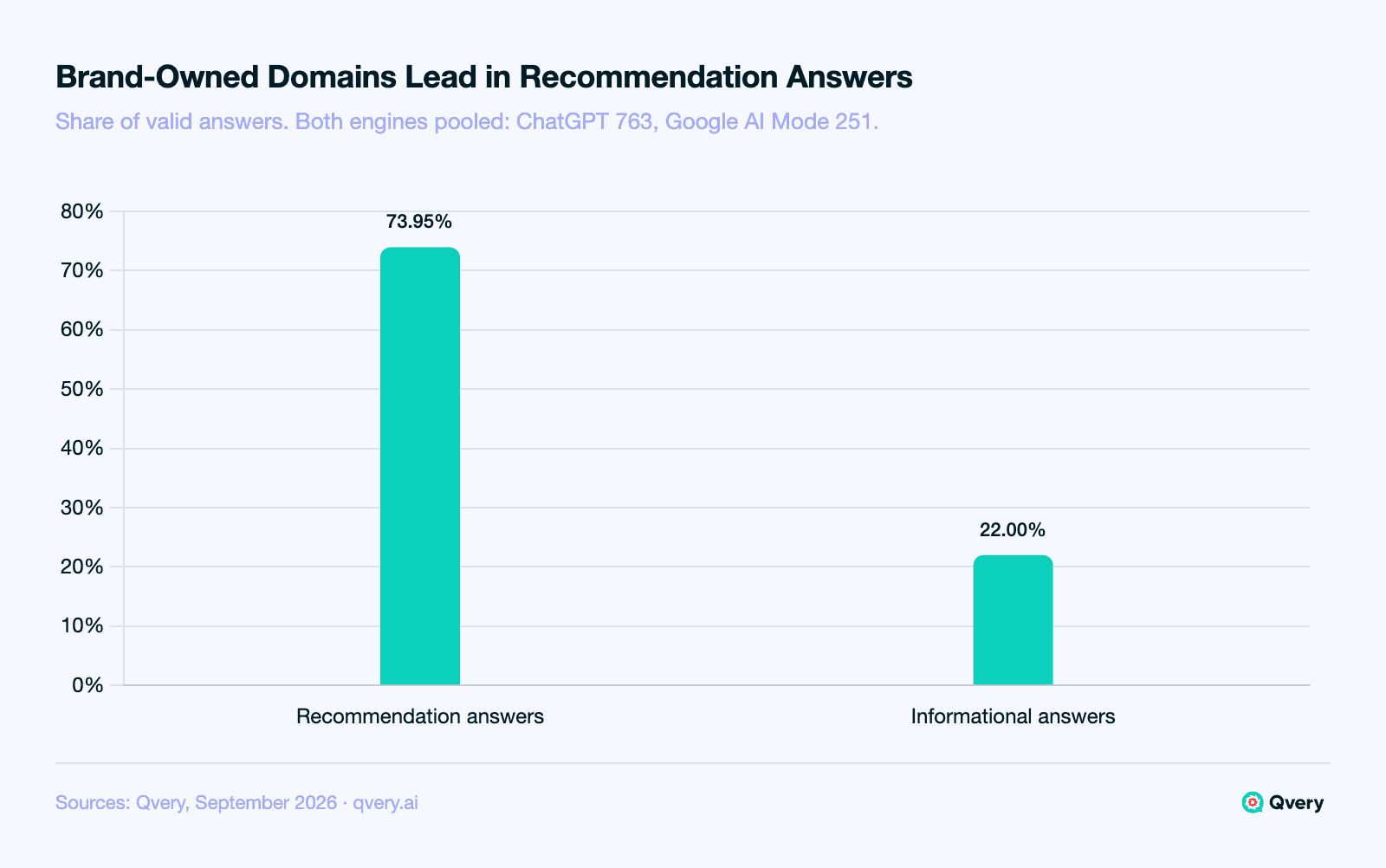
A brand-owned presence check run across a mixed legal query set averages two very different numbers. Set one baseline for questions that ask who to hire or what to buy, and another for questions that ask what the law says.
The same brand can look dominant in one family and nearly absent in the other, and a pooled number will report neither.
Brand-owned does not mean a law firm's own website. The label covers legal-software and legal-services vendors too, and the recommendation family is mostly services and software, so this finding says nothing about firm websites in particular.
The same limit applies to a popular claim about law firm websites. A legal-marketing guide argues that "Of all the specific practices the May 15 guide validates, entity mapping for individual attorneys is the one most consistently underdeveloped on law firm websites". Nothing here measures entity mapping or local citation, so this finding neither supports nor complicates it.
Platform Domains Also Lean Toward Recommendation Answers
Platform and community domains appear alongside 8.40% of recommendation answers (60 of 714) and 3.00% of informational answers (9 of 300), share of all valid answers, both engines, runs pooled. The ratio is 2.80, and the same unresolved informational answer leaves it in its band.

The platform check belongs with the recommendation family. The pooled 8.40% is a blend of two engines that behave very differently, which is the next finding, so read it as an average of two lanes rather than a speed limit.
Legal directories are not in this number.
They carry neither the brand-owned label nor the platform label, so nothing in this section is a directory result.
In Recommendation Answers, Google AI Mode Cites Platforms Far More Often Than ChatGPT
Within recommendation answers, Google AI Mode cites a platform domain in 25.00% of its answers (44 of 176), and ChatGPT in 2.97% (16 of 538), share of all valid recommendation answers for each engine. Neither engine has an unresolved answer here, and the engines are never pooled in this comparison.
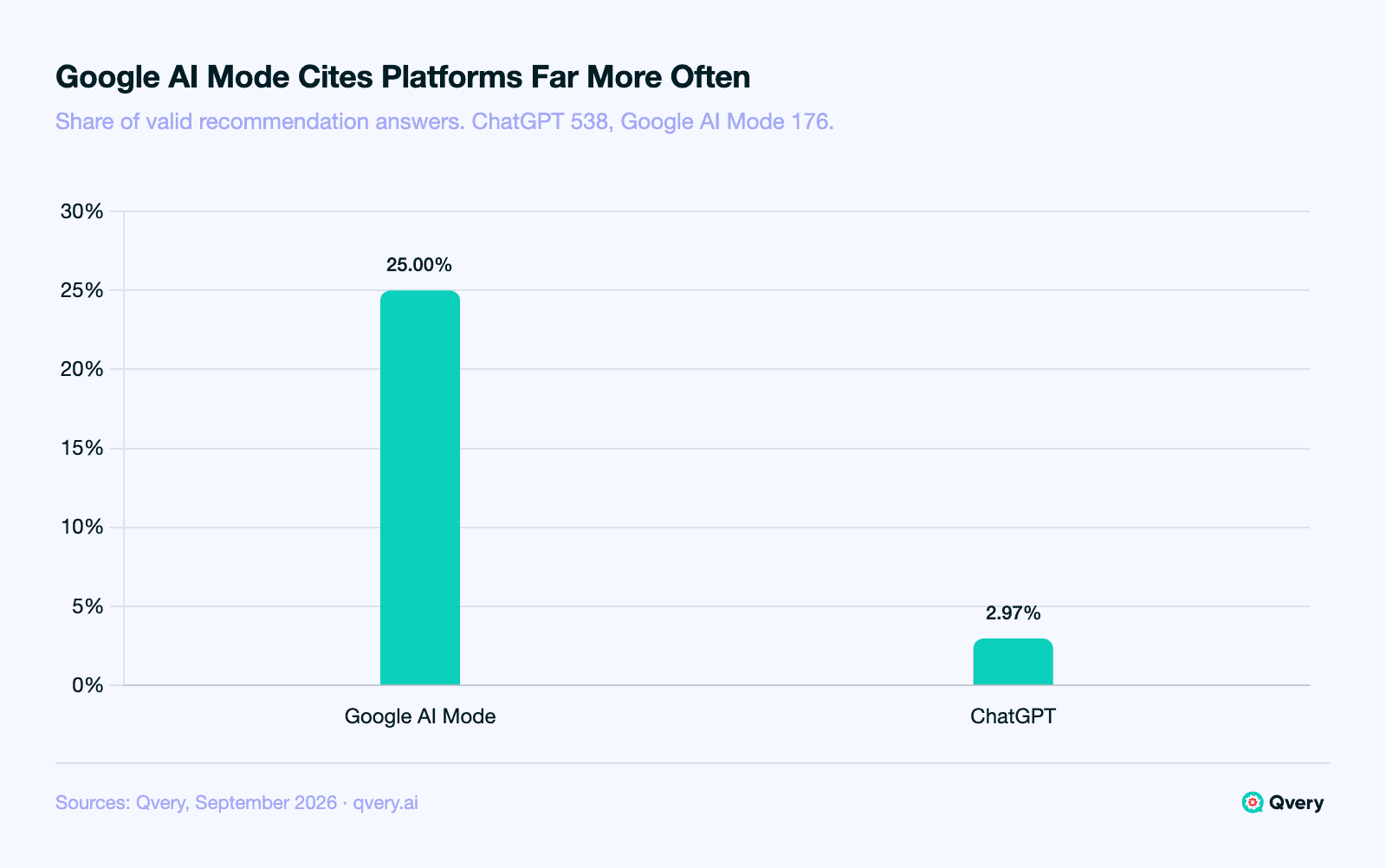
We registered the opposite prediction before the runs: that ChatGPT would carry the higher platform rate. It did not, and the ChatGPT to Google AI Mode ratio of 0.12 points firmly the other way.
A platform plan tuned on ChatGPT would find almost nothing to tune. The same plan on Google AI Mode shows up in one recommendation answer in four.
For a marketer tracking recommendation questions, one engine's platform layer does not describe the other's. Read them separately.
Why the engines differ is not something this data can say.
FindLaw's white paper on legal-services questions reports a related result for directories: "From a previous study of the search visibility impact of legal directories inclusion that found an increasing performance visibility in Google local and organic search with the increase of being present in the number of legal directories, we see the same impact within ChatGPT visibility."
This finding counts platform domains, not directories or the effect of being listed, so it neither supports nor complicates that claim. For a separate look at how ChatGPT treats firms, our guide to auditing AI engine recommendations for your law firm is the related read.
Which Domains Head Each Family's Citations
The two families also cite different domains. Working from the answers that cited any source (707 recommendation answers and 277 informational ones), 10 domains carry 50% of recommendation-answer coverage and 8 carry 50% of informational-answer coverage, of answers that cited any source.
Recommendation 50% head (10 domains): rocketlawyer.com, docusign.com, superlawyers.com, clio.com, americanbar.org, ironcladapp.com, justia.com, nerdwallet.com, thomsonreuters.com, gartner.com.
Recommendation 80% audit list (42 domains): the ten above, then gov.uk, bindlegal.com, ca.gov, legalzoom.com, lsc.gov, avvo.com, chambers.com, youtube.com, bestlawyers.com, redbricklabs.io, reuters.com, texaslawhelp.org, pandadoc.com, spellbook.com, google.com, texasbar.com, expertise.com, freelegalanswers.org, gavel.io, juro.com, mass.gov, ncoa.org, sprintlaw.com, usa.gov, caesar.co.uk, citizensadvice.org.uk, contractscounsel.com, disneyplus.com, floridabar.org, general.legal, helium42.com, klaro.legal.
Informational 50% head (8 domains): cornell.edu, uscourts.gov, eeoc.gov, gov.uk, justia.com, americanbar.org, ca.gov, nsw.gov.au.
Informational 80% audit list (30 domains): the eight above, then vic.gov.au, consumerfinance.gov, nolo.com, ontario.ca, gc.ca, qld.gov.au, texas.gov, mo.gov, usa.gov, flcourts.gov, illinoislegalaid.org, nccourts.gov, youtube.com, albertacourts.ca, dol.gov, fl.us, house.gov, legalclarity.org, legalinfo.org, mb.ca, medlineplus.gov, michigan.gov.
The lists count registrable domains, so a government entry such as ca.gov, gc.ca or mb.ca is a namespace holding several publishers. In these runs ca.gov covers both the California courts' self-help pages and the State Bar, so none of those entries is a single site.
Read each list against the other family and the overlap is thin.
The recommendation 80% list covers 34.30% of informational answers that cited any source, and the informational 80% list covers 23.90% of recommendation answers that cited any source.
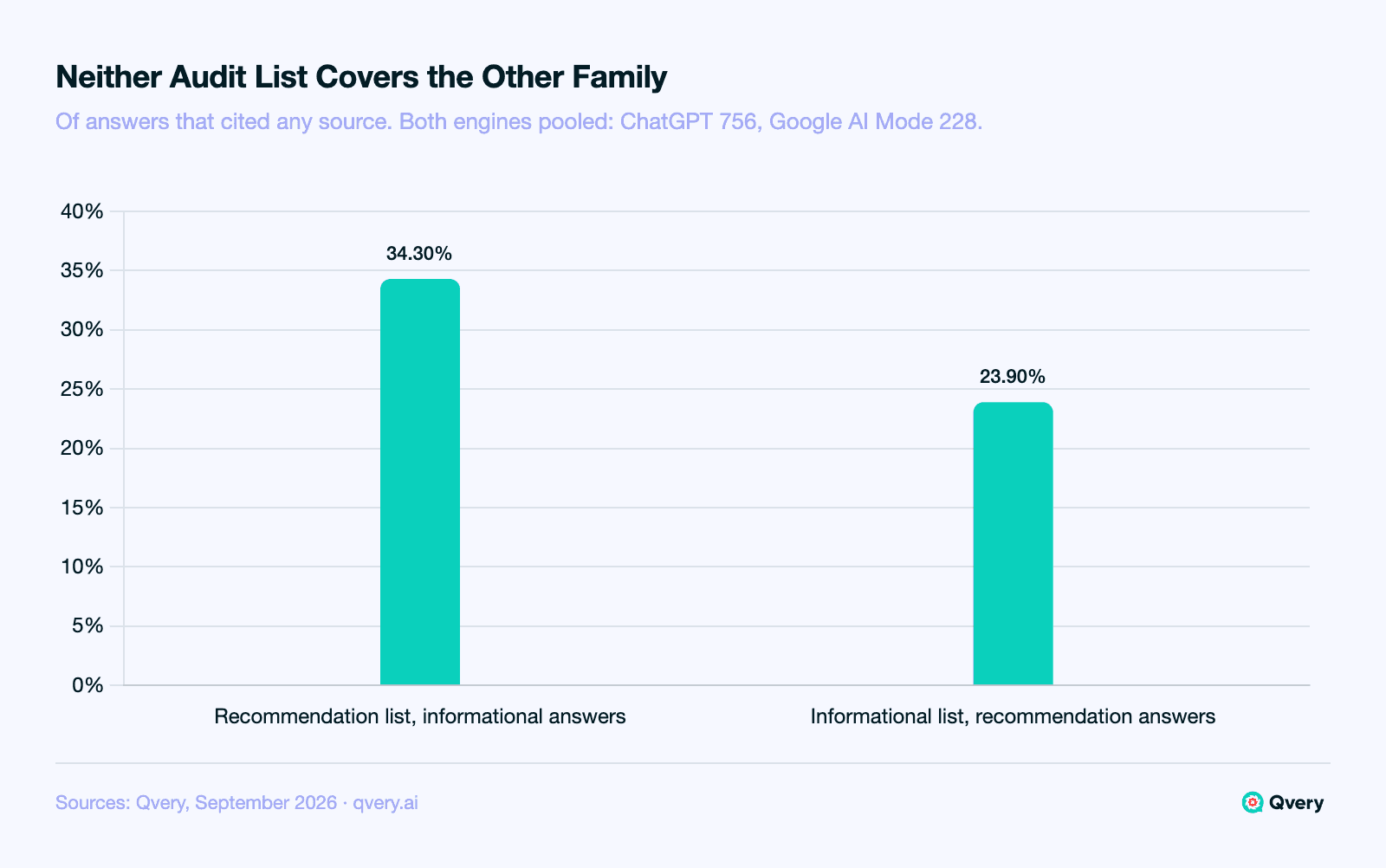
The smaller of the two, 0.239 unrounded, sits well under the 0.60 bar set before the runs, so each family needs its own list. Six domains sit on both lists (americanbar.org, justia.com, gov.uk, ca.gov, youtube.com and usa.gov), and those shared names do not change the verdict.
Our law firm measurement guide made its own separate-sources call on two practice areas. This table compares recommendation with informational questions instead, so the two are different cuts of the same habit.
Track Both Families, Engine by Engine, in Qvery
Everything above is one frozen query set. The questions your prospective clients type are a different set, and in Qvery you write them in, as separate topics for recommendation questions and informational ones, and edit them whenever your practice changes.
Qvery tracks visibility, share of voice and average rank across ChatGPT and Google AI Mode daily, and captures every citation tied to the query and the engine that produced it. That lets you see, engine by engine, which domains the answers to your own questions cite.
Qvery Assistant sits in the app and answers plain-language questions about your own data, such as which of your informational questions stopped citing you this month. What Qvery will not do is apply this post's layer labels or explain why an engine chose a source.
Start your free trial: 7 days free on the paid plans, and no credit card required.
What These Numbers Do Not Say
These are co-occurrence results: which domains appeared in an answer, never why. Brand-owned domains are not law-firm websites, and the platform label is not a directory label. A cited domain is not a named or recommended brand, and no naming or recommendation rate was measured. Recommendation answers are not lawyer-selection answers.
June and September are not compared, because the collection instrument changed, and no June figure appears. Pooled rates lean on ChatGPT's three runs per question.
One Google AI Mode informational answer is unresolved; F1 and F2 keep their bands either way, and it cannot move the domain lists. The layer labels are a validated classification with known single-domain errors, and none of the known ones moves a result. Everything covers one frozen September query set, not every legal question, practice area or country.
What to Do With This
Track recommendation and informational legal questions as separate sets, each with its own brand-owned and platform baseline: brand-owned domains sit alongside 73.95% of recommendation answers and 22.00% of informational ones.
Then read the recommendation set engine by engine. Google AI Mode cites at least one platform domain in 44 of 176 recommendation answers (25.00%) and ChatGPT in 16 of 538 (2.97%), share of all valid recommendation answers for each engine, so one engine's picture will not stand in for the other's.
It is tempting to treat AI search as one channel with one scoreboard. The legal questions people type split into two very different families, though: questions that ask for a lawyer, a legal service or a piece of legal software, and questions that ask what the law says. ChatGPT and Google AI Mode answer the two families from different kinds of sources.
In September we ran a frozen set of legal questions through both engines, in four countries, and labelled every domain the answers cited. Brand-owned domains appear alongside 73.95% of recommendation answers (528 of 714) and 22.00% of informational answers (66 of 300), both engines, runs pooled.
Inside the recommendation family the engines part ways.
Google AI Mode cites a platform domain in 25.00% of its recommendation answers (44 of 176), and ChatGPT in 2.97% of its own (16 of 538).
Brand-owned domains: alongside 73.95% of recommendation answers (528 of 714) and 22.00% of informational answers (66 of 300), share of all valid answers.
Platforms and communities, by engine: in recommendation answers, Google AI Mode 25.00% (44 of 176) and ChatGPT 2.97% (16 of 538), share of all valid recommendation answers for each engine.
Platforms and communities, pooled: alongside 8.40% of recommendation answers (60 of 714) and 3.00% of informational answers (9 of 300).
One informational answer is unresolved. Counted either way, it leaves both informational rates in the same verdict band.
The bases: 714 recommendation answers (ChatGPT 538, Google AI Mode 176) and 300 informational answers (ChatGPT 225, Google AI Mode 75).
Context, not corpus: 28% of consumers who asked AI a legal question were told to contact a lawyer, and 97% of respondents who researched their contacted attorney online used Google.
Where Do People Turn First With a Legal Problem?
Before anyone hires a lawyer, a lot of the legal question has already been asked somewhere else. Clio found that 28% of consumers who used AI for a legal question were directed by it to contact a lawyer.
The same report counts the other direction in cases rather than people: in 12% of cases, consumers were convinced by an AI that their legal problem was not worth pursuing. That is a potential client lost before a firm's website loads.
Search still carries the research.
FindLaw's 2024 consumer survey found that 97% of respondents who searched online for information about the attorney they contacted used search engines, specifically Google, and that 73% of adults who searched for DIY legal products did so via the internet.
Those two groups are the reason the informational family matters. People ask what the law says long before they ask who should handle it.
What Do People Weigh When They Choose a Lawyer?
Reviews shape the hire in every study cited here.
In Clio's 2022 research on what makes a lawyer hireable, client reviews carried an impact score of 52 out of 100, the most influential factor, while office location tied with responsiveness for second at a score of 16.
FindLaw's survey lands in the same place. 82% of respondents who contacted an attorney after learning about them online used online reviews in their decision. Scorpion's 2025 report puts it more bluntly: nearly 60% of consumers say online reviews now carry more weight than word of mouth.
That is why the sources inside AI answers deserve a look before the brand names do. A marketer who knows reviews decide the hire will want to see which domains the engines lean on when somebody asks who to choose.
How Many People Use the Two Engines Measured Here?
Both are large.
OpenAI's own study of consumer use describes ChatGPT at 700 million weekly active users. Google said in May 2026 that AI Mode had surpassed a billion monthly active users globally.
The two figures use different units.
One is weekly and the other monthly, so together they say both engines reach a big audience and nothing about which reaches more. The case for reading the engines separately comes from the citation data below, not from these counts.
What Was Measured
The corpus is a frozen legal query set from September 2026, answered by ChatGPT and Google AI Mode for people in the United States, the United Kingdom, Canada and Australia. Each question carries the query set's own intent label: recommendation or informational.
The recommendation family is broader than finding a lawyer. It covers six use cases: finding a lawyer by practice area, online legal services and DIY platforms, document and contract drafting tools, contract review and e-signature, affordable and free legal help, and AI legal research tools. Most of it is services and software, which matters for reading the brand-owned rate.
Every percentage below uses one of two denominators. The first three findings are shares of all valid answers in the stated slice; the audit-list table is of answers that cited any source. Pooled figures count each run as one answer, so ChatGPT's three runs per question weigh against Google AI Mode's one.
The two source layers are validated domain labels: brand-owned domains, and platform or community domains such as reddit.com, youtube.com, quora.com, linkedin.com, medium.com and facebook.com. A June collection used a different instrument, so no change over time is reported here.
Brand-Owned Domains Appear Far More Often in Recommendation Answers
Brand-owned domains appear alongside 73.95% of recommendation answers (528 of 714) and 22.00% of informational answers (66 of 300), share of all valid answers, both engines, runs pooled. The recommendation rate is 3.36 times the informational one. One informational answer is unresolved, and counting it present or absent leaves that ratio in the same band.
A brand-owned presence check run across a mixed legal query set averages two very different numbers. Set one baseline for questions that ask who to hire or what to buy, and another for questions that ask what the law says.
The same brand can look dominant in one family and nearly absent in the other, and a pooled number will report neither.
Brand-owned does not mean a law firm's own website. The label covers legal-software and legal-services vendors too, and the recommendation family is mostly services and software, so this finding says nothing about firm websites in particular.
The same limit applies to a popular claim about law firm websites. A legal-marketing guide argues that "Of all the specific practices the May 15 guide validates, entity mapping for individual attorneys is the one most consistently underdeveloped on law firm websites". Nothing here measures entity mapping or local citation, so this finding neither supports nor complicates it.
Platform Domains Also Lean Toward Recommendation Answers
Platform and community domains appear alongside 8.40% of recommendation answers (60 of 714) and 3.00% of informational answers (9 of 300), share of all valid answers, both engines, runs pooled. The ratio is 2.80, and the same unresolved informational answer leaves it in its band.
The platform check belongs with the recommendation family. The pooled 8.40% is a blend of two engines that behave very differently, which is the next finding, so read it as an average of two lanes rather than a speed limit.
Legal directories are not in this number.
They carry neither the brand-owned label nor the platform label, so nothing in this section is a directory result.
In Recommendation Answers, Google AI Mode Cites Platforms Far More Often Than ChatGPT
Within recommendation answers, Google AI Mode cites a platform domain in 25.00% of its answers (44 of 176), and ChatGPT in 2.97% (16 of 538), share of all valid recommendation answers for each engine. Neither engine has an unresolved answer here, and the engines are never pooled in this comparison.
We registered the opposite prediction before the runs: that ChatGPT would carry the higher platform rate. It did not, and the ChatGPT to Google AI Mode ratio of 0.12 points firmly the other way.
A platform plan tuned on ChatGPT would find almost nothing to tune. The same plan on Google AI Mode shows up in one recommendation answer in four.
For a marketer tracking recommendation questions, one engine's platform layer does not describe the other's. Read them separately.
Why the engines differ is not something this data can say.
FindLaw's white paper on legal-services questions reports a related result for directories: "From a previous study of the search visibility impact of legal directories inclusion that found an increasing performance visibility in Google local and organic search with the increase of being present in the number of legal directories, we see the same impact within ChatGPT visibility."
This finding counts platform domains, not directories or the effect of being listed, so it neither supports nor complicates that claim. For a separate look at how ChatGPT treats firms, our guide to auditing AI engine recommendations for your law firm is the related read.
Which Domains Head Each Family's Citations
The two families also cite different domains. Working from the answers that cited any source (707 recommendation answers and 277 informational ones), 10 domains carry 50% of recommendation-answer coverage and 8 carry 50% of informational-answer coverage, of answers that cited any source.
Recommendation 50% head (10 domains): rocketlawyer.com, docusign.com, superlawyers.com, clio.com, americanbar.org, ironcladapp.com, justia.com, nerdwallet.com, thomsonreuters.com, gartner.com.
Recommendation 80% audit list (42 domains): the ten above, then gov.uk, bindlegal.com, ca.gov, legalzoom.com, lsc.gov, avvo.com, chambers.com, youtube.com, bestlawyers.com, redbricklabs.io, reuters.com, texaslawhelp.org, pandadoc.com, spellbook.com, google.com, texasbar.com, expertise.com, freelegalanswers.org, gavel.io, juro.com, mass.gov, ncoa.org, sprintlaw.com, usa.gov, caesar.co.uk, citizensadvice.org.uk, contractscounsel.com, disneyplus.com, floridabar.org, general.legal, helium42.com, klaro.legal.
Informational 50% head (8 domains): cornell.edu, uscourts.gov, eeoc.gov, gov.uk, justia.com, americanbar.org, ca.gov, nsw.gov.au.
Informational 80% audit list (30 domains): the eight above, then vic.gov.au, consumerfinance.gov, nolo.com, ontario.ca, gc.ca, qld.gov.au, texas.gov, mo.gov, usa.gov, flcourts.gov, illinoislegalaid.org, nccourts.gov, youtube.com, albertacourts.ca, dol.gov, fl.us, house.gov, legalclarity.org, legalinfo.org, mb.ca, medlineplus.gov, michigan.gov.
The lists count registrable domains, so a government entry such as ca.gov, gc.ca or mb.ca is a namespace holding several publishers. In these runs ca.gov covers both the California courts' self-help pages and the State Bar, so none of those entries is a single site.
Read each list against the other family and the overlap is thin.
The recommendation 80% list covers 34.30% of informational answers that cited any source, and the informational 80% list covers 23.90% of recommendation answers that cited any source.
The smaller of the two, 0.239 unrounded, sits well under the 0.60 bar set before the runs, so each family needs its own list. Six domains sit on both lists (americanbar.org, justia.com, gov.uk, ca.gov, youtube.com and usa.gov), and those shared names do not change the verdict.
Our law firm measurement guide made its own separate-sources call on two practice areas. This table compares recommendation with informational questions instead, so the two are different cuts of the same habit.
Track Both Families, Engine by Engine, in Qvery
Everything above is one frozen query set. The questions your prospective clients type are a different set, and in Qvery you write them in, as separate topics for recommendation questions and informational ones, and edit them whenever your practice changes.
Qvery tracks visibility, share of voice and average rank across ChatGPT and Google AI Mode daily, and captures every citation tied to the query and the engine that produced it. That lets you see, engine by engine, which domains the answers to your own questions cite.
Qvery Assistant sits in the app and answers plain-language questions about your own data, such as which of your informational questions stopped citing you this month. What Qvery will not do is apply this post's layer labels or explain why an engine chose a source.
Start your free trial: 7 days free on the paid plans, and no credit card required.
What These Numbers Do Not Say
These are co-occurrence results: which domains appeared in an answer, never why. Brand-owned domains are not law-firm websites, and the platform label is not a directory label. A cited domain is not a named or recommended brand, and no naming or recommendation rate was measured. Recommendation answers are not lawyer-selection answers.
June and September are not compared, because the collection instrument changed, and no June figure appears. Pooled rates lean on ChatGPT's three runs per question.
One Google AI Mode informational answer is unresolved; F1 and F2 keep their bands either way, and it cannot move the domain lists. The layer labels are a validated classification with known single-domain errors, and none of the known ones moves a result. Everything covers one frozen September query set, not every legal question, practice area or country.
What to Do With This
Track recommendation and informational legal questions as separate sets, each with its own brand-owned and platform baseline: brand-owned domains sit alongside 73.95% of recommendation answers and 22.00% of informational ones.
Then read the recommendation set engine by engine. Google AI Mode cites at least one platform domain in 44 of 176 recommendation answers (25.00%) and ChatGPT in 16 of 538 (2.97%), share of all valid recommendation answers for each engine, so one engine's picture will not stand in for the other's.
It is tempting to treat AI search as one channel with one scoreboard. The legal questions people type split into two very different families, though: questions that ask for a lawyer, a legal service or a piece of legal software, and questions that ask what the law says. ChatGPT and Google AI Mode answer the two families from different kinds of sources.
In September we ran a frozen set of legal questions through both engines, in four countries, and labelled every domain the answers cited. Brand-owned domains appear alongside 73.95% of recommendation answers (528 of 714) and 22.00% of informational answers (66 of 300), both engines, runs pooled.
Inside the recommendation family the engines part ways.
Google AI Mode cites a platform domain in 25.00% of its recommendation answers (44 of 176), and ChatGPT in 2.97% of its own (16 of 538).
Brand-owned domains: alongside 73.95% of recommendation answers (528 of 714) and 22.00% of informational answers (66 of 300), share of all valid answers.
Platforms and communities, by engine: in recommendation answers, Google AI Mode 25.00% (44 of 176) and ChatGPT 2.97% (16 of 538), share of all valid recommendation answers for each engine.
Platforms and communities, pooled: alongside 8.40% of recommendation answers (60 of 714) and 3.00% of informational answers (9 of 300).
One informational answer is unresolved. Counted either way, it leaves both informational rates in the same verdict band.
The bases: 714 recommendation answers (ChatGPT 538, Google AI Mode 176) and 300 informational answers (ChatGPT 225, Google AI Mode 75).
Context, not corpus: 28% of consumers who asked AI a legal question were told to contact a lawyer, and 97% of respondents who researched their contacted attorney online used Google.
Where Do People Turn First With a Legal Problem?
Before anyone hires a lawyer, a lot of the legal question has already been asked somewhere else. Clio found that 28% of consumers who used AI for a legal question were directed by it to contact a lawyer.
The same report counts the other direction in cases rather than people: in 12% of cases, consumers were convinced by an AI that their legal problem was not worth pursuing. That is a potential client lost before a firm's website loads.
Search still carries the research.
FindLaw's 2024 consumer survey found that 97% of respondents who searched online for information about the attorney they contacted used search engines, specifically Google, and that 73% of adults who searched for DIY legal products did so via the internet.
Those two groups are the reason the informational family matters. People ask what the law says long before they ask who should handle it.
What Do People Weigh When They Choose a Lawyer?
Reviews shape the hire in every study cited here.
In Clio's 2022 research on what makes a lawyer hireable, client reviews carried an impact score of 52 out of 100, the most influential factor, while office location tied with responsiveness for second at a score of 16.
FindLaw's survey lands in the same place. 82% of respondents who contacted an attorney after learning about them online used online reviews in their decision. Scorpion's 2025 report puts it more bluntly: nearly 60% of consumers say online reviews now carry more weight than word of mouth.
That is why the sources inside AI answers deserve a look before the brand names do. A marketer who knows reviews decide the hire will want to see which domains the engines lean on when somebody asks who to choose.
How Many People Use the Two Engines Measured Here?
Both are large.
OpenAI's own study of consumer use describes ChatGPT at 700 million weekly active users. Google said in May 2026 that AI Mode had surpassed a billion monthly active users globally.
The two figures use different units.
One is weekly and the other monthly, so together they say both engines reach a big audience and nothing about which reaches more. The case for reading the engines separately comes from the citation data below, not from these counts.
What Was Measured
The corpus is a frozen legal query set from September 2026, answered by ChatGPT and Google AI Mode for people in the United States, the United Kingdom, Canada and Australia. Each question carries the query set's own intent label: recommendation or informational.
The recommendation family is broader than finding a lawyer. It covers six use cases: finding a lawyer by practice area, online legal services and DIY platforms, document and contract drafting tools, contract review and e-signature, affordable and free legal help, and AI legal research tools. Most of it is services and software, which matters for reading the brand-owned rate.
Every percentage below uses one of two denominators. The first three findings are shares of all valid answers in the stated slice; the audit-list table is of answers that cited any source. Pooled figures count each run as one answer, so ChatGPT's three runs per question weigh against Google AI Mode's one.
The two source layers are validated domain labels: brand-owned domains, and platform or community domains such as reddit.com, youtube.com, quora.com, linkedin.com, medium.com and facebook.com. A June collection used a different instrument, so no change over time is reported here.
Brand-Owned Domains Appear Far More Often in Recommendation Answers
Brand-owned domains appear alongside 73.95% of recommendation answers (528 of 714) and 22.00% of informational answers (66 of 300), share of all valid answers, both engines, runs pooled. The recommendation rate is 3.36 times the informational one. One informational answer is unresolved, and counting it present or absent leaves that ratio in the same band.
A brand-owned presence check run across a mixed legal query set averages two very different numbers. Set one baseline for questions that ask who to hire or what to buy, and another for questions that ask what the law says.
The same brand can look dominant in one family and nearly absent in the other, and a pooled number will report neither.
Brand-owned does not mean a law firm's own website. The label covers legal-software and legal-services vendors too, and the recommendation family is mostly services and software, so this finding says nothing about firm websites in particular.
The same limit applies to a popular claim about law firm websites. A legal-marketing guide argues that "Of all the specific practices the May 15 guide validates, entity mapping for individual attorneys is the one most consistently underdeveloped on law firm websites". Nothing here measures entity mapping or local citation, so this finding neither supports nor complicates it.
Platform Domains Also Lean Toward Recommendation Answers
Platform and community domains appear alongside 8.40% of recommendation answers (60 of 714) and 3.00% of informational answers (9 of 300), share of all valid answers, both engines, runs pooled. The ratio is 2.80, and the same unresolved informational answer leaves it in its band.
The platform check belongs with the recommendation family. The pooled 8.40% is a blend of two engines that behave very differently, which is the next finding, so read it as an average of two lanes rather than a speed limit.
Legal directories are not in this number.
They carry neither the brand-owned label nor the platform label, so nothing in this section is a directory result.
In Recommendation Answers, Google AI Mode Cites Platforms Far More Often Than ChatGPT
Within recommendation answers, Google AI Mode cites a platform domain in 25.00% of its answers (44 of 176), and ChatGPT in 2.97% (16 of 538), share of all valid recommendation answers for each engine. Neither engine has an unresolved answer here, and the engines are never pooled in this comparison.
We registered the opposite prediction before the runs: that ChatGPT would carry the higher platform rate. It did not, and the ChatGPT to Google AI Mode ratio of 0.12 points firmly the other way.
A platform plan tuned on ChatGPT would find almost nothing to tune. The same plan on Google AI Mode shows up in one recommendation answer in four.
For a marketer tracking recommendation questions, one engine's platform layer does not describe the other's. Read them separately.
Why the engines differ is not something this data can say.
FindLaw's white paper on legal-services questions reports a related result for directories: "From a previous study of the search visibility impact of legal directories inclusion that found an increasing performance visibility in Google local and organic search with the increase of being present in the number of legal directories, we see the same impact within ChatGPT visibility."
This finding counts platform domains, not directories or the effect of being listed, so it neither supports nor complicates that claim. For a separate look at how ChatGPT treats firms, our guide to auditing AI engine recommendations for your law firm is the related read.
Which Domains Head Each Family's Citations
The two families also cite different domains. Working from the answers that cited any source (707 recommendation answers and 277 informational ones), 10 domains carry 50% of recommendation-answer coverage and 8 carry 50% of informational-answer coverage, of answers that cited any source.
Recommendation 50% head (10 domains): rocketlawyer.com, docusign.com, superlawyers.com, clio.com, americanbar.org, ironcladapp.com, justia.com, nerdwallet.com, thomsonreuters.com, gartner.com.
Recommendation 80% audit list (42 domains): the ten above, then gov.uk, bindlegal.com, ca.gov, legalzoom.com, lsc.gov, avvo.com, chambers.com, youtube.com, bestlawyers.com, redbricklabs.io, reuters.com, texaslawhelp.org, pandadoc.com, spellbook.com, google.com, texasbar.com, expertise.com, freelegalanswers.org, gavel.io, juro.com, mass.gov, ncoa.org, sprintlaw.com, usa.gov, caesar.co.uk, citizensadvice.org.uk, contractscounsel.com, disneyplus.com, floridabar.org, general.legal, helium42.com, klaro.legal.
Informational 50% head (8 domains): cornell.edu, uscourts.gov, eeoc.gov, gov.uk, justia.com, americanbar.org, ca.gov, nsw.gov.au.
Informational 80% audit list (30 domains): the eight above, then vic.gov.au, consumerfinance.gov, nolo.com, ontario.ca, gc.ca, qld.gov.au, texas.gov, mo.gov, usa.gov, flcourts.gov, illinoislegalaid.org, nccourts.gov, youtube.com, albertacourts.ca, dol.gov, fl.us, house.gov, legalclarity.org, legalinfo.org, mb.ca, medlineplus.gov, michigan.gov.
The lists count registrable domains, so a government entry such as ca.gov, gc.ca or mb.ca is a namespace holding several publishers. In these runs ca.gov covers both the California courts' self-help pages and the State Bar, so none of those entries is a single site.
Read each list against the other family and the overlap is thin.
The recommendation 80% list covers 34.30% of informational answers that cited any source, and the informational 80% list covers 23.90% of recommendation answers that cited any source.
The smaller of the two, 0.239 unrounded, sits well under the 0.60 bar set before the runs, so each family needs its own list. Six domains sit on both lists (americanbar.org, justia.com, gov.uk, ca.gov, youtube.com and usa.gov), and those shared names do not change the verdict.
Our law firm measurement guide made its own separate-sources call on two practice areas. This table compares recommendation with informational questions instead, so the two are different cuts of the same habit.
Track Both Families, Engine by Engine, in Qvery
Everything above is one frozen query set. The questions your prospective clients type are a different set, and in Qvery you write them in, as separate topics for recommendation questions and informational ones, and edit them whenever your practice changes.
Qvery tracks visibility, share of voice and average rank across ChatGPT and Google AI Mode daily, and captures every citation tied to the query and the engine that produced it. That lets you see, engine by engine, which domains the answers to your own questions cite.
Qvery Assistant sits in the app and answers plain-language questions about your own data, such as which of your informational questions stopped citing you this month. What Qvery will not do is apply this post's layer labels or explain why an engine chose a source.
Start your free trial: 7 days free on the paid plans, and no credit card required.
What These Numbers Do Not Say
These are co-occurrence results: which domains appeared in an answer, never why. Brand-owned domains are not law-firm websites, and the platform label is not a directory label. A cited domain is not a named or recommended brand, and no naming or recommendation rate was measured. Recommendation answers are not lawyer-selection answers.
June and September are not compared, because the collection instrument changed, and no June figure appears. Pooled rates lean on ChatGPT's three runs per question.
One Google AI Mode informational answer is unresolved; F1 and F2 keep their bands either way, and it cannot move the domain lists. The layer labels are a validated classification with known single-domain errors, and none of the known ones moves a result. Everything covers one frozen September query set, not every legal question, practice area or country.
What to Do With This
Track recommendation and informational legal questions as separate sets, each with its own brand-owned and platform baseline: brand-owned domains sit alongside 73.95% of recommendation answers and 22.00% of informational ones.
Then read the recommendation set engine by engine. Google AI Mode cites at least one platform domain in 44 of 176 recommendation answers (25.00%) and ChatGPT in 16 of 538 (2.97%), share of all valid recommendation answers for each engine, so one engine's picture will not stand in for the other's.
It is tempting to treat AI search as one channel with one scoreboard. The legal questions people type split into two very different families, though: questions that ask for a lawyer, a legal service or a piece of legal software, and questions that ask what the law says. ChatGPT and Google AI Mode answer the two families from different kinds of sources.
In September we ran a frozen set of legal questions through both engines, in four countries, and labelled every domain the answers cited. Brand-owned domains appear alongside 73.95% of recommendation answers (528 of 714) and 22.00% of informational answers (66 of 300), both engines, runs pooled.
Inside the recommendation family the engines part ways.
Google AI Mode cites a platform domain in 25.00% of its recommendation answers (44 of 176), and ChatGPT in 2.97% of its own (16 of 538).
Brand-owned domains: alongside 73.95% of recommendation answers (528 of 714) and 22.00% of informational answers (66 of 300), share of all valid answers.
Platforms and communities, by engine: in recommendation answers, Google AI Mode 25.00% (44 of 176) and ChatGPT 2.97% (16 of 538), share of all valid recommendation answers for each engine.
Platforms and communities, pooled: alongside 8.40% of recommendation answers (60 of 714) and 3.00% of informational answers (9 of 300).
One informational answer is unresolved. Counted either way, it leaves both informational rates in the same verdict band.
The bases: 714 recommendation answers (ChatGPT 538, Google AI Mode 176) and 300 informational answers (ChatGPT 225, Google AI Mode 75).
Context, not corpus: 28% of consumers who asked AI a legal question were told to contact a lawyer, and 97% of respondents who researched their contacted attorney online used Google.
Where Do People Turn First With a Legal Problem?
Before anyone hires a lawyer, a lot of the legal question has already been asked somewhere else. Clio found that 28% of consumers who used AI for a legal question were directed by it to contact a lawyer.
The same report counts the other direction in cases rather than people: in 12% of cases, consumers were convinced by an AI that their legal problem was not worth pursuing. That is a potential client lost before a firm's website loads.
Search still carries the research.
FindLaw's 2024 consumer survey found that 97% of respondents who searched online for information about the attorney they contacted used search engines, specifically Google, and that 73% of adults who searched for DIY legal products did so via the internet.
Those two groups are the reason the informational family matters. People ask what the law says long before they ask who should handle it.
What Do People Weigh When They Choose a Lawyer?
Reviews shape the hire in every study cited here.
In Clio's 2022 research on what makes a lawyer hireable, client reviews carried an impact score of 52 out of 100, the most influential factor, while office location tied with responsiveness for second at a score of 16.
FindLaw's survey lands in the same place. 82% of respondents who contacted an attorney after learning about them online used online reviews in their decision. Scorpion's 2025 report puts it more bluntly: nearly 60% of consumers say online reviews now carry more weight than word of mouth.
That is why the sources inside AI answers deserve a look before the brand names do. A marketer who knows reviews decide the hire will want to see which domains the engines lean on when somebody asks who to choose.
How Many People Use the Two Engines Measured Here?
Both are large.
OpenAI's own study of consumer use describes ChatGPT at 700 million weekly active users. Google said in May 2026 that AI Mode had surpassed a billion monthly active users globally.
The two figures use different units.
One is weekly and the other monthly, so together they say both engines reach a big audience and nothing about which reaches more. The case for reading the engines separately comes from the citation data below, not from these counts.
What Was Measured
The corpus is a frozen legal query set from September 2026, answered by ChatGPT and Google AI Mode for people in the United States, the United Kingdom, Canada and Australia. Each question carries the query set's own intent label: recommendation or informational.
The recommendation family is broader than finding a lawyer. It covers six use cases: finding a lawyer by practice area, online legal services and DIY platforms, document and contract drafting tools, contract review and e-signature, affordable and free legal help, and AI legal research tools. Most of it is services and software, which matters for reading the brand-owned rate.
Every percentage below uses one of two denominators. The first three findings are shares of all valid answers in the stated slice; the audit-list table is of answers that cited any source. Pooled figures count each run as one answer, so ChatGPT's three runs per question weigh against Google AI Mode's one.
The two source layers are validated domain labels: brand-owned domains, and platform or community domains such as reddit.com, youtube.com, quora.com, linkedin.com, medium.com and facebook.com. A June collection used a different instrument, so no change over time is reported here.
Brand-Owned Domains Appear Far More Often in Recommendation Answers
Brand-owned domains appear alongside 73.95% of recommendation answers (528 of 714) and 22.00% of informational answers (66 of 300), share of all valid answers, both engines, runs pooled. The recommendation rate is 3.36 times the informational one. One informational answer is unresolved, and counting it present or absent leaves that ratio in the same band.
A brand-owned presence check run across a mixed legal query set averages two very different numbers. Set one baseline for questions that ask who to hire or what to buy, and another for questions that ask what the law says.
The same brand can look dominant in one family and nearly absent in the other, and a pooled number will report neither.
Brand-owned does not mean a law firm's own website. The label covers legal-software and legal-services vendors too, and the recommendation family is mostly services and software, so this finding says nothing about firm websites in particular.
The same limit applies to a popular claim about law firm websites. A legal-marketing guide argues that "Of all the specific practices the May 15 guide validates, entity mapping for individual attorneys is the one most consistently underdeveloped on law firm websites". Nothing here measures entity mapping or local citation, so this finding neither supports nor complicates it.
Platform Domains Also Lean Toward Recommendation Answers
Platform and community domains appear alongside 8.40% of recommendation answers (60 of 714) and 3.00% of informational answers (9 of 300), share of all valid answers, both engines, runs pooled. The ratio is 2.80, and the same unresolved informational answer leaves it in its band.
The platform check belongs with the recommendation family. The pooled 8.40% is a blend of two engines that behave very differently, which is the next finding, so read it as an average of two lanes rather than a speed limit.
Legal directories are not in this number.
They carry neither the brand-owned label nor the platform label, so nothing in this section is a directory result.
In Recommendation Answers, Google AI Mode Cites Platforms Far More Often Than ChatGPT
Within recommendation answers, Google AI Mode cites a platform domain in 25.00% of its answers (44 of 176), and ChatGPT in 2.97% (16 of 538), share of all valid recommendation answers for each engine. Neither engine has an unresolved answer here, and the engines are never pooled in this comparison.
We registered the opposite prediction before the runs: that ChatGPT would carry the higher platform rate. It did not, and the ChatGPT to Google AI Mode ratio of 0.12 points firmly the other way.
A platform plan tuned on ChatGPT would find almost nothing to tune. The same plan on Google AI Mode shows up in one recommendation answer in four.
For a marketer tracking recommendation questions, one engine's platform layer does not describe the other's. Read them separately.
Why the engines differ is not something this data can say.
FindLaw's white paper on legal-services questions reports a related result for directories: "From a previous study of the search visibility impact of legal directories inclusion that found an increasing performance visibility in Google local and organic search with the increase of being present in the number of legal directories, we see the same impact within ChatGPT visibility."
This finding counts platform domains, not directories or the effect of being listed, so it neither supports nor complicates that claim. For a separate look at how ChatGPT treats firms, our guide to auditing AI engine recommendations for your law firm is the related read.
Which Domains Head Each Family's Citations
The two families also cite different domains. Working from the answers that cited any source (707 recommendation answers and 277 informational ones), 10 domains carry 50% of recommendation-answer coverage and 8 carry 50% of informational-answer coverage, of answers that cited any source.
Recommendation 50% head (10 domains): rocketlawyer.com, docusign.com, superlawyers.com, clio.com, americanbar.org, ironcladapp.com, justia.com, nerdwallet.com, thomsonreuters.com, gartner.com.
Recommendation 80% audit list (42 domains): the ten above, then gov.uk, bindlegal.com, ca.gov, legalzoom.com, lsc.gov, avvo.com, chambers.com, youtube.com, bestlawyers.com, redbricklabs.io, reuters.com, texaslawhelp.org, pandadoc.com, spellbook.com, google.com, texasbar.com, expertise.com, freelegalanswers.org, gavel.io, juro.com, mass.gov, ncoa.org, sprintlaw.com, usa.gov, caesar.co.uk, citizensadvice.org.uk, contractscounsel.com, disneyplus.com, floridabar.org, general.legal, helium42.com, klaro.legal.
Informational 50% head (8 domains): cornell.edu, uscourts.gov, eeoc.gov, gov.uk, justia.com, americanbar.org, ca.gov, nsw.gov.au.
Informational 80% audit list (30 domains): the eight above, then vic.gov.au, consumerfinance.gov, nolo.com, ontario.ca, gc.ca, qld.gov.au, texas.gov, mo.gov, usa.gov, flcourts.gov, illinoislegalaid.org, nccourts.gov, youtube.com, albertacourts.ca, dol.gov, fl.us, house.gov, legalclarity.org, legalinfo.org, mb.ca, medlineplus.gov, michigan.gov.
The lists count registrable domains, so a government entry such as ca.gov, gc.ca or mb.ca is a namespace holding several publishers. In these runs ca.gov covers both the California courts' self-help pages and the State Bar, so none of those entries is a single site.
Read each list against the other family and the overlap is thin.
The recommendation 80% list covers 34.30% of informational answers that cited any source, and the informational 80% list covers 23.90% of recommendation answers that cited any source.
The smaller of the two, 0.239 unrounded, sits well under the 0.60 bar set before the runs, so each family needs its own list. Six domains sit on both lists (americanbar.org, justia.com, gov.uk, ca.gov, youtube.com and usa.gov), and those shared names do not change the verdict.
Our law firm measurement guide made its own separate-sources call on two practice areas. This table compares recommendation with informational questions instead, so the two are different cuts of the same habit.
Track Both Families, Engine by Engine, in Qvery
Everything above is one frozen query set. The questions your prospective clients type are a different set, and in Qvery you write them in, as separate topics for recommendation questions and informational ones, and edit them whenever your practice changes.
Qvery tracks visibility, share of voice and average rank across ChatGPT and Google AI Mode daily, and captures every citation tied to the query and the engine that produced it. That lets you see, engine by engine, which domains the answers to your own questions cite.
Qvery Assistant sits in the app and answers plain-language questions about your own data, such as which of your informational questions stopped citing you this month. What Qvery will not do is apply this post's layer labels or explain why an engine chose a source.
Start your free trial: 7 days free on the paid plans, and no credit card required.
What These Numbers Do Not Say
These are co-occurrence results: which domains appeared in an answer, never why. Brand-owned domains are not law-firm websites, and the platform label is not a directory label. A cited domain is not a named or recommended brand, and no naming or recommendation rate was measured. Recommendation answers are not lawyer-selection answers.
June and September are not compared, because the collection instrument changed, and no June figure appears. Pooled rates lean on ChatGPT's three runs per question.
One Google AI Mode informational answer is unresolved; F1 and F2 keep their bands either way, and it cannot move the domain lists. The layer labels are a validated classification with known single-domain errors, and none of the known ones moves a result. Everything covers one frozen September query set, not every legal question, practice area or country.
What to Do With This
Track recommendation and informational legal questions as separate sets, each with its own brand-owned and platform baseline: brand-owned domains sit alongside 73.95% of recommendation answers and 22.00% of informational ones.
Then read the recommendation set engine by engine. Google AI Mode cites at least one platform domain in 44 of 176 recommendation answers (25.00%) and ChatGPT in 16 of 538 (2.97%), share of all valid recommendation answers for each engine, so one engine's picture will not stand in for the other's.

© 2026 Qvery AI OÜ