By
Vlad Shvets
8 Best AI Visibility Tools for Fintech Brands (Compared)
Eight AI visibility tools read against the five things a regulated fintech team has to be able to do: read the answer text, track per country, see the citations, export with dates, and track product prompts.
Eight AI visibility tools read against the five things a regulated fintech team has to be able to do: read the answer text, track per country, see the citations, export with dates, and track product prompts.
Eight AI visibility tools read against the five things a regulated fintech team has to be able to do: read the answer text, track per country, see the citations, export with dates, and track product prompts.
Nobody in a fintech marketing review asks for the visibility score. They ask what the assistant said about the card, and whether it mentioned the APR. That question needs the answer text, and most of these eight tools, read on their own pages this September, do not write down whether you can read it.
In fintech recommendation answers that cited any source, nerdwallet.com, schwab.com, and cnbc.com together cover half of the recommendation answers that cited any source, and 712 of 719 recommendation answers cited one. Informational questions get there with two government sites, consumerfinance.gov and investor.gov, where 246 of 300 answers cited a source.
What a Fintech Team Has to Be Able to Read
Each entry was read against five things a regulated marketing team has to be able to do, with prices taken from the live pricing pages the same week. No trials, no test prompts, and no outcome claims.
The five are the fintech lens, and the reason a generic feature count is useless here. A tracker that scores you but cannot show you the words is a smoke alarm that reports humidity.
Answer text. The words around your brand, caveats and risk wording included, so a reviewer reads what the engine said in full.
Per-country tracking. The same prompt run in every market you are licensed in, because the answer in Germany is not the answer in Texas.
Citation sources. Which pages the answer cited: the comparison sites, the regulator, your own product pages.
Export or API. The records leave the tool with dates on them, so review and audit work from a file.
Financial product-category prompts. Cards, loans, brokerage, and payments tracked as their own prompts, each with its own history. Every tool here documents that you choose the prompts; only one documents financial-category coverage as such.
Each entry codes every criterion one of three ways: documented (the vendor's own pages say so), documented as not offered (the vendor says it does not do it), or not documented.
That third state is the one to read carefully. It means nobody wrote it down, not that the product cannot do it, and the only way to settle it is to make the vendor show you. None of the eight documents all five.
For the general buying questions that apply to any vertical, our guide to choosing GEO software covers the ground this list does not.
1. Qvery: The Queries You Write, Run Daily, in Every Market
Key Features:
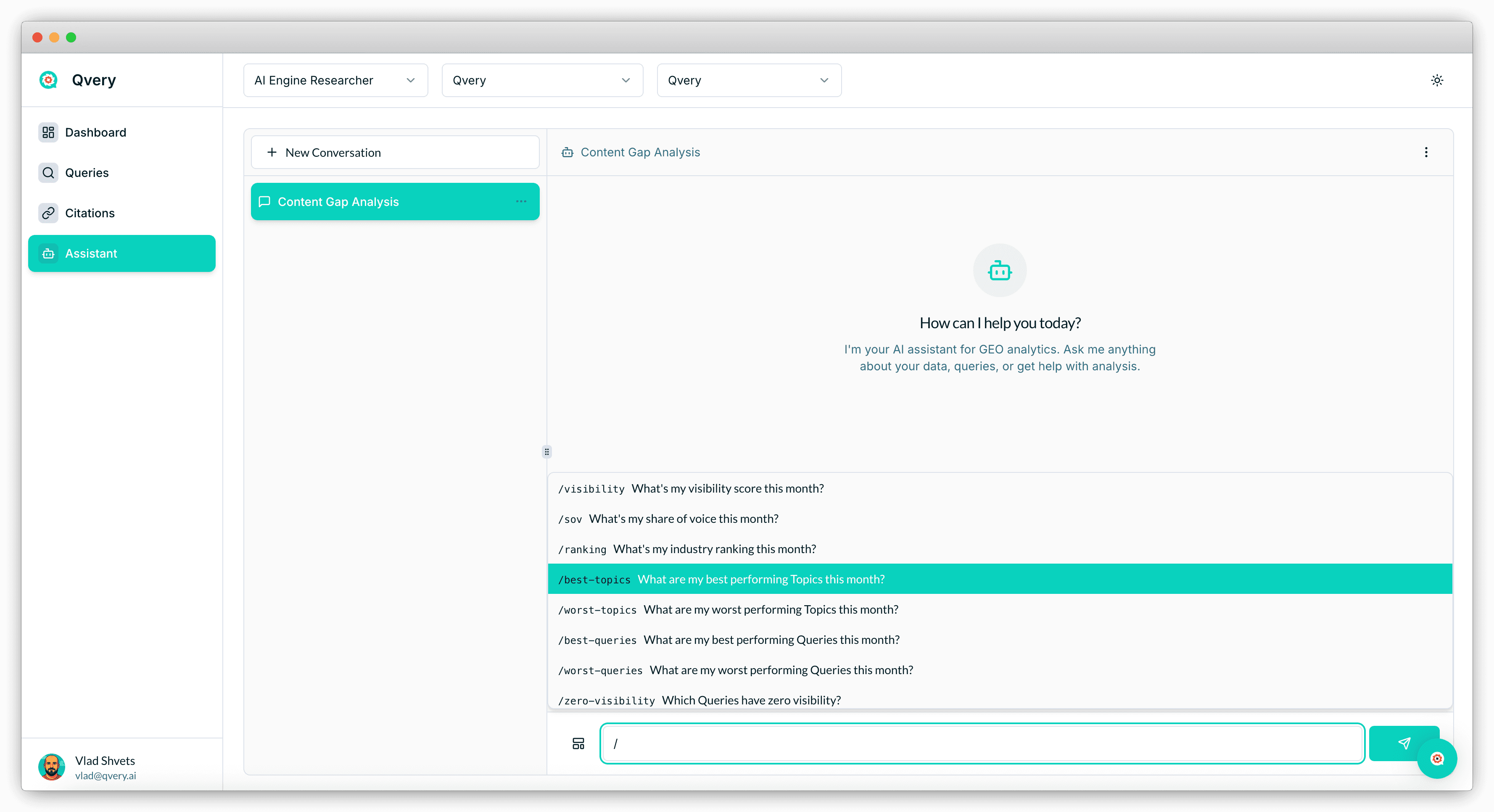
You write the queries. Add the questions a cards, loans, or brokerage buyer types, edit them whenever the product changes, and watch them run daily against ChatGPT and Google AI Mode.
Every citation captured daily, tied to the query and the engine that produced it, so the comparison sites and regulator pages behind an answer are on the record.
Visibility and share of voice across 200+ countries, with average rank, which covers the markets question without a per-country upgrade.
Qvery Assistant in the app: ask what changed this week in plain language, and export the report from the same chat.
Answer text is not documented, so if your reviewer needs the engine's exact wording, ask for it in the demo before you buy.
Pricing:
Starter: €49 per month for 1 brand, 25 tracked queries, unlimited countries, and unlimited seats.
Growth: €99 per month for 1 brand and 50 tracked queries.
Business: €199 for unlimited brands and 100 tracked queries (the page shows no billing period on this tier).
Every tier includes ChatGPT and Google AI Mode, daily query runs, and monthly optimization reports.
Reddit Score: 85.0% Positive. What redditors say:
"tracking mentions in local publications and external sites is key for AI visibility, like Qvery AI does." (r/smallbusiness)
It turns up in the threads where a business owner has just discovered the assistant recommends a competitor, which is how most fintech teams arrive here too.
Mostly positive across the mentions we counted, with no negative ones on record.
Qvery is our product, so treat this entry as the founder demo it is and hold it to the same five criteria as the rest.
Documented: the queries are yours to write per market, every citation is captured with its query and engine, report export runs through the Assistant, and the country coverage is on the pricing page.
Not documented: answer text. Qvery does not document it today, and a team whose compliance reviewer must read the engine's exact sentence should say so in the demo and weigh the answer.
Where Qvery fits a fintech team is the workflow. You write the product questions, they run every day, and you ask the Assistant what moved, which suits a small marketing team more than it suits a bank's procurement department.
Start your free trial: 7 days free, and no credit card required.
2. AthenaHQ: The Only Entry With Financial Prompts on the Record
Key Features:
Financial prompt coverage in writing. Its own page describes increasing "authoritative citations and recommendation coverage across comparison and compliance-driven prompts", which is the closest any entry comes to the product-category criterion.
Source Intelligence, which it describes as revealing the sources shaping AI answers.
Global Scale: operating "across brands, markets, and models", the documented form of per-country coverage.
AthenaHQ API for pushing visibility data into your own dashboards.
Brands and business units tracked together, including share of voice and citation rate.
Pricing:
Essential: free, with $25 of credit and 300 credits, covering ChatGPT, Perplexity, AI Overviews, Gemini, and Copilot. Google AI Mode is not on this tier.
Starter: $295 per month with 3,600 credits, where AI Mode first appears.
Enterprise: custom, adding multi-region and multi-language support and the citation engine.
Reddit Score: 57.1% Positive. What redditors say:
A 10-tool AEO roundup in r/DigitalMarketing tried it alongside Profound, Peec AI, Otterly, Scrunch, Rankscale, Semrush, and Ahrefs. (r/DigitalMarketing)
Its mentions run thin and mixed, which is what a 7-mention sample looks like.
Agency posters describe using it to show clients where they appear and where they do not.
That roundup's verdict on AthenaHQ was a commercial one: "AthenaHQ stood out more for ecommerce use cases." A fintech team reading that should hear the gap, since product discovery and product compliance are different jobs.
AthenaHQ is the only entry whose own pages describe financial prompt coverage, and that earns it second place. Markets, citation sources, and the API are documented as well.
Answer text is the exception, and separately inspectable reporting for each engine is undocumented too, so a team that needs the ChatGPT view apart from the Google AI Mode view arrives at the demo with two questions.
The free tier is a real way to start, with one catch worth pricing in. Google AI Mode only appears on the $295 Starter plan, so a fintech brand that needs both engines is choosing between a free tier that covers one of them and a plan that costs more than most of this list.
3. OtterlyAI: Every Cited URL, Market by Market
Key Features:
Every domain and URL cited in AI answers, checked daily, with link-position changes over time.
Market-by-market reporting rather than one global number, in its own words, "not as one global number that hides where you're invisible".
Public API for brand reports, prompts, citations, and workspace data.
Workspaces for running several brands or clients inside one subscription.
Daily tracking frequency listed as a plan feature on every tier.
Pricing:
Lite: $29 per month for 15 search prompts, or $25 per month on annual billing.
Standard: $189 per month for 100 prompts, or $160 per month on annual billing.
Premium: $489 per month for 400 prompts, or $422 per month on annual billing.
Enterprise: custom, from 1,000 prompts.
Google AI Mode is an add-on on every tier: $9 on Lite, $59 on Standard, $149 on Premium, per month.
Reddit Score: 69.2% Positive. What redditors say:
"Great roundup Otterly/SE Ranking combo wins for SaaS dashboards + Perplexity tracking." (r/SaaS)
A 2026 buyer's guide in r/SaaS calls it a good entry-level option covering prompt tracking, citations, links, and competitor visibility. (r/SaaS)
The highest competitor score on this list, mostly earned on ease of setup and price.
Citation sources are documented in the most literal form on this list, and so are market-by-market reporting and an export path through the Public API. Answer text is the open one, and the prompts are yours to set inside the plan's count.
The pricing needs reading twice for a fintech buyer. Lite is $29, and covering both engines means adding Google AI Mode at $9, so $38 a month. At 15 prompts, cards, loans, and payments will be competing for slots.
4. Ahrefs: The One That Stores the Answers
Key Features:
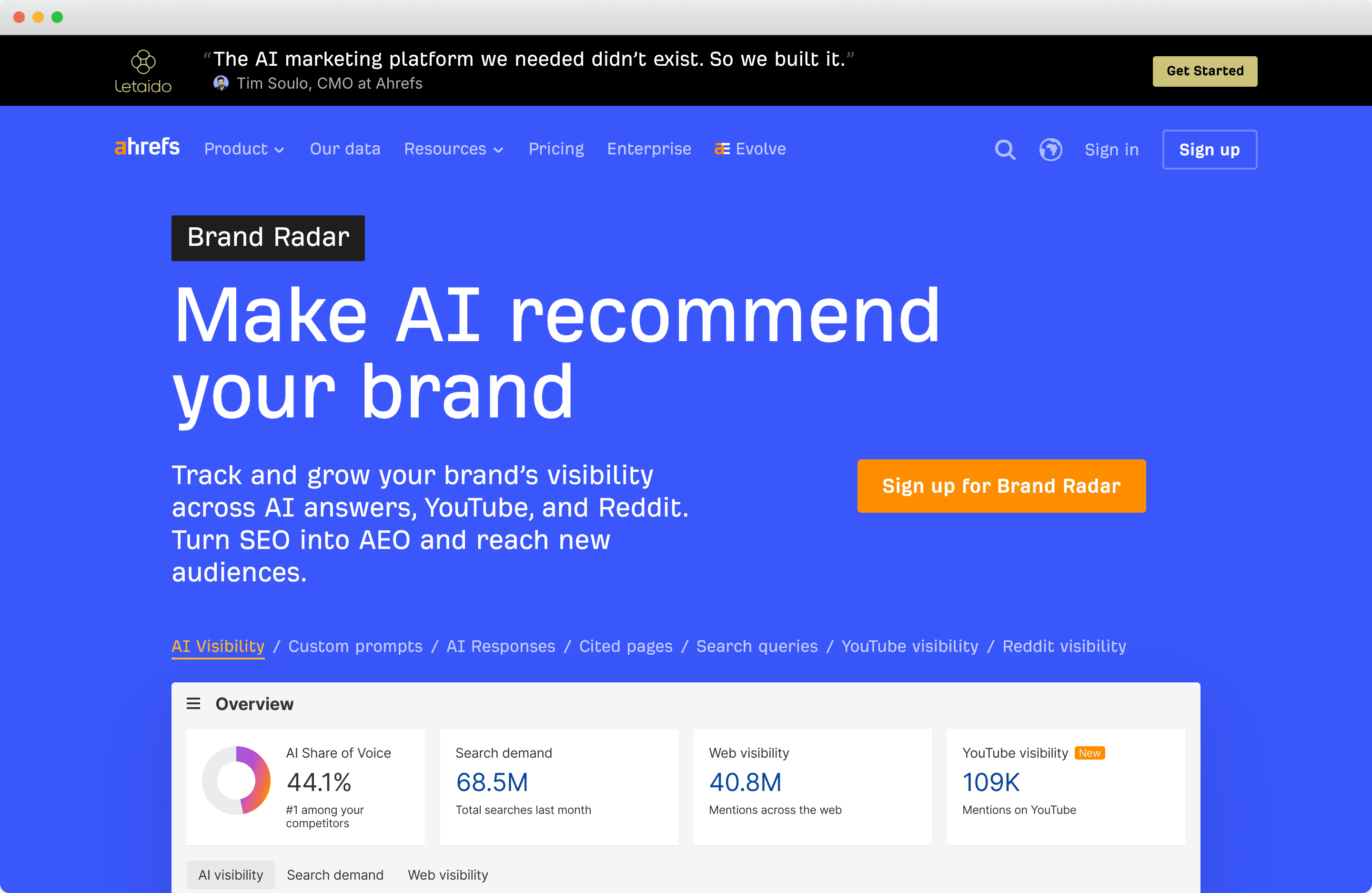
Raw responses stored and searchable, in its own words: "We store the raw responses so you can search them for brand mentions (string matches) and citations (linked URLs)." That is the answer-text criterion, and no other entry documents it.
Top 5 cited pages, the specific URLs cited alongside your brand.
Share of voice against any competitor you choose in AI Mode.
Daily monitoring of mentions and citations rather than a one-off snapshot.
Charts and exports for the reporting side.
Pricing:
Starter: $29 per month; Lite $129; Standard $249; Advanced $449.
Enterprise: $1,499 per month, with an annual commitment required.
Brand Radar AI: from $199 per month, sold standalone, and the tiered add-ons run Basic $50, Growth $100, Scale $250.
Reddit Score: 48.3% Positive. What redditors say:
"I use AHREFs and I recommend that to everyone." (r/SEO)
The score covers the whole product across 378 mentions, most of them about search work rather than AI visibility, and the negative ones are almost all about price.
Its AI features are newer than its reputation, which cuts both ways in a sample this size.
For a fintech team with a compliance reviewer, Ahrefs is the entry that answers the hardest criterion. Stored raw responses mean somebody can read the sentence the engine produced about your savings account, rather than inferring it from a visibility line going down.
The trade-off is geography. Per-country tracking is not documented, so a lender in six markets has an open question here, even though its own prompts are yours to track.
The roundup that tested ten tools put the suite question plainly: "If you're already deep into Ahrefs, being able to connect AI visibility with your existing SEO and brand research is useful and can save you from adding yet another tool."
Brand Radar AI is also sold standalone from $199 a month, and the AI Mode tracker page the stored-responses line comes from is a free tool, so the suite is a convenience rather than a gate.
5. Rankscale: Regions, Schedules, and a REST API

Key Features:
240+ regions and languages, listed as one figure on its own page.
8 monitoring schedules, so a check can run on the cadence a review cycle needs.
Citation visibility: where AI search engines cite your brand.
REST API access from the Growth tier up, for teams that keep records outside the tool.
Search terms: unlimited to create, with execution metered by credits, so the product prompts are yours to write.
Pricing:
Essentials: starting at $20 per month.
Pro: $99 per month, with 10 brand dashboards and all regions.
Growth: $385 per month, adding white-label options and the REST API.
Enterprise: $780 per month, with 100 brand dashboards and API access.
Reddit Score: 61.1% Positive. What redditors say:
"If you're only looking to analyze how AI grades your website, you could use the free audit from Rankscale.ai" (r/SEO)
The 10-tool roundup put it between traditional search work and AI visibility, and found the move from one to the other natural. (r/DigitalMarketing)
Nine mentions is a small sample, and it reads as early rather than settled.
Regions, citation sources, schedules, and the API are documented, and the regions line is the one a lender licensed in six markets will read first. Schedules matter more here than they look: a cadence you set is what turns a dashboard into a record somebody reviews on a date.
Answer text is open, and so is the overlap question that the same roundup raised: if your team already pays for a search suite, make Rankscale show you what it adds before the second subscription starts.
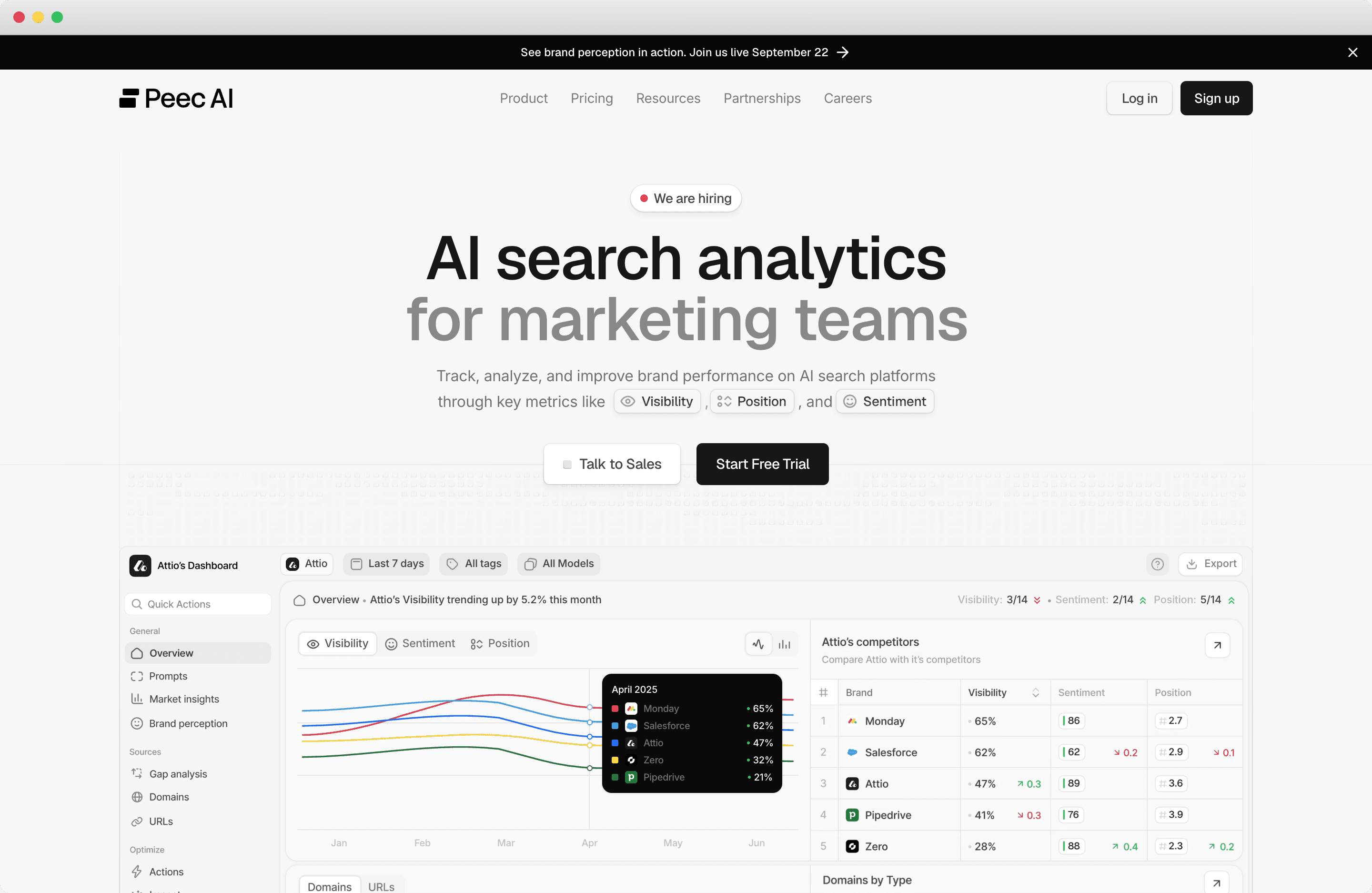
6. Peec AI: Countries at No Extra Cost, Citations by URL
Key Features:
Sources and citations by URL and domain, described as what the engine drew on to generate its answer.
Tracking across all countries, with the pricing FAQ stating that countries and languages cost nothing extra.
Visibility and share of voice as defined metrics: the percentage of AI responses where your brand appears, and your share against the other brands tracked.
Multi-brand tracking with separate reporting per brand.
Continuous tracking rather than manual checks.
Pricing:
Starter: $95 per month for 50 prompts.
Pro: $245 per month for 150 prompts.
Advanced: $495 per month for 350 prompts, with multi-country listed as a plan row.
Enterprise: custom, billed annually, adding custom prompt setup and API access.
Reddit Score: 68.6% Positive. What redditors say:
"I have good experience with Peec AI. The data seems to be solid and it doesn't cost an arm and a leg." (r/SaaS)
The 2026 buyer's guide calls it one of the nicest interfaces for tracking prompts, competitors, visibility, and citations. (r/SaaS)
With 51 mentions it has the deepest sample of the dedicated trackers here, and the complaints are about cost at scale.
Peec AI's country handling is the cleanest on this list: any supported country or language, priced on prompts rather than markets. For a lender licensed in nine states or six countries, that removes the arithmetic most of these tools make you do.
Export and API sit on Enterprise, and answer text is not documented, which puts the audit-trail question in the demo. The tier prices were not published when this research was done and are now on the page, so read them as of this week rather than as a settled number.
Country coverage splits this list in two. Qvery, Peec AI and Rankscale price markets at zero, OtterlyAI ships a 50-plus market list on every tier, and Scrunch counts countries as a plan row: one on Core, unlimited on Enterprise.
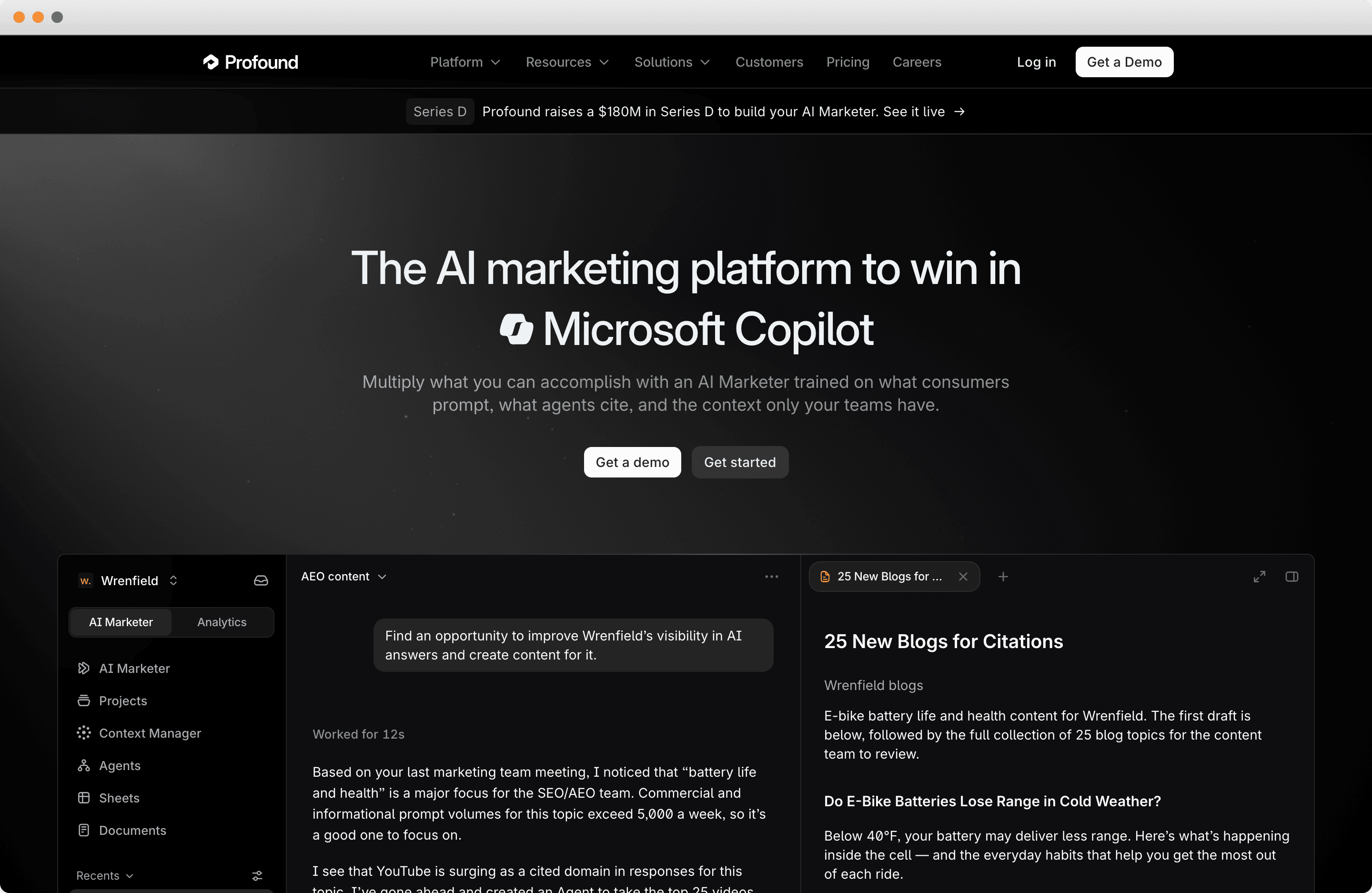
7. Profound: Citation Analysis on a Custom Quote
Key Features:
Citation Analysis: which websites influence AI answers about your brand, and the themes and narratives attached to it.
Answer Engine Insights, tracking how engines mention, rank, and describe a brand.
Both engines monitored, inside a list of up to nine answer engines on the paid tier.
Agency Mode and personas, for running several brand environments in one account.
Pricing:
Trial: free, with 50 prompts run daily for seven days across ChatGPT, Gemini, and Google AI Overviews.
Enterprise: custom, with tailored prompt tracking, up to nine answer engines, and unlimited seats.
Reddit Score: Too few mentions to score. One mention about Profound came up in the sample, below the five-mention floor, so there is no percentage here and the absence carries no verdict.
The 10-tool roundup that did try it called it "the most serious platform I tested from a pure AI visibility perspective" (r/DigitalMarketing).
Profound documents both engines and the citation side, and the description of how engines "describe" a brand is the closest thing to the answer-text criterion outside Ahrefs, without saying the text is readable.
Its pricing table carries the rest: Regions reads 1 on Trial and Custom on Enterprise, Exports go from None to CSV and JSON, and API goes from None to Yes. Those are documented capabilities with a plan attached, which for a fintech team means the audit trail starts at Enterprise.
Answer text is the criterion left open, and everything else arrives on a tier whose price you learn on a call.
The trial is worth taking for a first look with one limit worth knowing: its pages say Trial users get a recommended prompt set for their industry and cannot change it, and editing prompts starts on Enterprise. Google AI Mode is an Enterprise engine too.
8. Scrunch: The Plan Table Is the Documentation
Key Features:
Citations and sources listed as a plan feature on both tiers.
Countries: one on Core, unlimited on Enterprise, stated in the plan table rather than in a feature page.
Competitors: five on Core, custom on Enterprise.
Brand presence comparison across engines, including position, sentiment, and citations.
Brand workspaces: one on Core, a custom number on Enterprise.
Pricing:
Core: $250 per month for 125 unique prompts, one brand workspace, five user licenses, and four engines (ChatGPT, Perplexity, Google AI Overviews, Copilot).
Enterprise: custom, adding API access, SSO, expanded coverage, and nine engines including Google AI Mode.
Core starts from a seven-day free trial; Enterprise runs through a demo request.
Reddit Score: 50.0% Positive. What redditors say:
The 10-tool roundup found it leaning into the technical side of AI visibility. (r/DigitalMarketing)
The 2026 buyer's guide files it in enterprise territory next to Profound. (r/SaaS)
Five mentions is exactly the floor for a score, so read 50.0% as a signal rather than a verdict.
Scrunch is the entry whose documentation lives in its pricing table, which is worth knowing before you dismiss it. Countries, competitors, citations, and brand workspaces are all plan rows, so what looks undocumented on the feature pages is written down where the money is.
The line a fintech buyer has to see is the engine list. Google AI Mode appears on Enterprise and not on the $250 Core plan, so both-engine coverage here is a custom quote, not a credit card. Answer text is not documented on either tier.
The pattern across all eight: what a tracker counts is written down, and what a reviewer would read is the part left for the sales call.
What This Review Cannot Tell You
This is a documentation review. Everything above comes from the vendors' own pages and their live pricing pages, read in September 2026, with no trials, no financial-product test set, and no measured outcomes. Nothing here says a tool performs better than another.
Not one of the eight documents all five criteria, and that is a statement about documentation rather than about the products. "Not documented" means nobody wrote it down. Every entry above turns its open criteria into a question for the demo rather than a verdict.
Who Should Not Buy Which
If compliance reads every claim, do not buy on visibility scores alone. Ahrefs is the only entry documenting stored, searchable answer text, and everyone else owes you a demo of what a reviewer would read.
If you sell one market, do not pay for regions. Rankscale's 240+ regions and Peec AI's free country coverage are worth real money to a cross-border lender and nothing to a single-state credit union.
If audits read your records, do not buy a plan whose export sits one tier up. OtterlyAI documents a Public API, Rankscale puts REST API on Growth, AthenaHQ documents its API, and Peec AI and Scrunch keep it on Enterprise.
If a search suite exists, do not add a second subscription before the incumbent has been tested. Ahrefs and the suite-attached options exist for exactly this case.
If budget is the constraint, do not start at the top. Rankscale's Essentials starts at $20 a month, OtterlyAI's Lite with the Google AI Mode add-on runs $38, and Qvery's Starter is €49, all three covering both engines.
Whichever two you shortlist, give both the same audition: five of your own product questions, in the markets you are licensed in, with a dated export at the end of the week.
A vendor who shows all of that has answered the criteria in front of you. Whatever stays open after the demo is the question to press on before the contract. What share of voice measures, and what it does not, is worth reading before you sit in that demo.
Nobody in a fintech marketing review asks for the visibility score. They ask what the assistant said about the card, and whether it mentioned the APR. That question needs the answer text, and most of these eight tools, read on their own pages this September, do not write down whether you can read it.
In fintech recommendation answers that cited any source, nerdwallet.com, schwab.com, and cnbc.com together cover half of the recommendation answers that cited any source, and 712 of 719 recommendation answers cited one. Informational questions get there with two government sites, consumerfinance.gov and investor.gov, where 246 of 300 answers cited a source.
What a Fintech Team Has to Be Able to Read
Each entry was read against five things a regulated marketing team has to be able to do, with prices taken from the live pricing pages the same week. No trials, no test prompts, and no outcome claims.
The five are the fintech lens, and the reason a generic feature count is useless here. A tracker that scores you but cannot show you the words is a smoke alarm that reports humidity.
Answer text. The words around your brand, caveats and risk wording included, so a reviewer reads what the engine said in full.
Per-country tracking. The same prompt run in every market you are licensed in, because the answer in Germany is not the answer in Texas.
Citation sources. Which pages the answer cited: the comparison sites, the regulator, your own product pages.
Export or API. The records leave the tool with dates on them, so review and audit work from a file.
Financial product-category prompts. Cards, loans, brokerage, and payments tracked as their own prompts, each with its own history. Every tool here documents that you choose the prompts; only one documents financial-category coverage as such.
Each entry codes every criterion one of three ways: documented (the vendor's own pages say so), documented as not offered (the vendor says it does not do it), or not documented.
That third state is the one to read carefully. It means nobody wrote it down, not that the product cannot do it, and the only way to settle it is to make the vendor show you. None of the eight documents all five.
For the general buying questions that apply to any vertical, our guide to choosing GEO software covers the ground this list does not.
1. Qvery: The Queries You Write, Run Daily, in Every Market
Key Features:
You write the queries. Add the questions a cards, loans, or brokerage buyer types, edit them whenever the product changes, and watch them run daily against ChatGPT and Google AI Mode.
Every citation captured daily, tied to the query and the engine that produced it, so the comparison sites and regulator pages behind an answer are on the record.
Visibility and share of voice across 200+ countries, with average rank, which covers the markets question without a per-country upgrade.
Qvery Assistant in the app: ask what changed this week in plain language, and export the report from the same chat.
Answer text is not documented, so if your reviewer needs the engine's exact wording, ask for it in the demo before you buy.
Pricing:
Starter: €49 per month for 1 brand, 25 tracked queries, unlimited countries, and unlimited seats.
Growth: €99 per month for 1 brand and 50 tracked queries.
Business: €199 for unlimited brands and 100 tracked queries (the page shows no billing period on this tier).
Every tier includes ChatGPT and Google AI Mode, daily query runs, and monthly optimization reports.
Reddit Score: 85.0% Positive. What redditors say:
"tracking mentions in local publications and external sites is key for AI visibility, like Qvery AI does." (r/smallbusiness)
It turns up in the threads where a business owner has just discovered the assistant recommends a competitor, which is how most fintech teams arrive here too.
Mostly positive across the mentions we counted, with no negative ones on record.
Qvery is our product, so treat this entry as the founder demo it is and hold it to the same five criteria as the rest.
Documented: the queries are yours to write per market, every citation is captured with its query and engine, report export runs through the Assistant, and the country coverage is on the pricing page.
Not documented: answer text. Qvery does not document it today, and a team whose compliance reviewer must read the engine's exact sentence should say so in the demo and weigh the answer.
Where Qvery fits a fintech team is the workflow. You write the product questions, they run every day, and you ask the Assistant what moved, which suits a small marketing team more than it suits a bank's procurement department.
Start your free trial: 7 days free, and no credit card required.
2. AthenaHQ: The Only Entry With Financial Prompts on the Record
Key Features:
Financial prompt coverage in writing. Its own page describes increasing "authoritative citations and recommendation coverage across comparison and compliance-driven prompts", which is the closest any entry comes to the product-category criterion.
Source Intelligence, which it describes as revealing the sources shaping AI answers.
Global Scale: operating "across brands, markets, and models", the documented form of per-country coverage.
AthenaHQ API for pushing visibility data into your own dashboards.
Brands and business units tracked together, including share of voice and citation rate.
Pricing:
Essential: free, with $25 of credit and 300 credits, covering ChatGPT, Perplexity, AI Overviews, Gemini, and Copilot. Google AI Mode is not on this tier.
Starter: $295 per month with 3,600 credits, where AI Mode first appears.
Enterprise: custom, adding multi-region and multi-language support and the citation engine.
Reddit Score: 57.1% Positive. What redditors say:
A 10-tool AEO roundup in r/DigitalMarketing tried it alongside Profound, Peec AI, Otterly, Scrunch, Rankscale, Semrush, and Ahrefs. (r/DigitalMarketing)
Its mentions run thin and mixed, which is what a 7-mention sample looks like.
Agency posters describe using it to show clients where they appear and where they do not.
That roundup's verdict on AthenaHQ was a commercial one: "AthenaHQ stood out more for ecommerce use cases." A fintech team reading that should hear the gap, since product discovery and product compliance are different jobs.
AthenaHQ is the only entry whose own pages describe financial prompt coverage, and that earns it second place. Markets, citation sources, and the API are documented as well.
Answer text is the exception, and separately inspectable reporting for each engine is undocumented too, so a team that needs the ChatGPT view apart from the Google AI Mode view arrives at the demo with two questions.
The free tier is a real way to start, with one catch worth pricing in. Google AI Mode only appears on the $295 Starter plan, so a fintech brand that needs both engines is choosing between a free tier that covers one of them and a plan that costs more than most of this list.
3. OtterlyAI: Every Cited URL, Market by Market
Key Features:
Every domain and URL cited in AI answers, checked daily, with link-position changes over time.
Market-by-market reporting rather than one global number, in its own words, "not as one global number that hides where you're invisible".
Public API for brand reports, prompts, citations, and workspace data.
Workspaces for running several brands or clients inside one subscription.
Daily tracking frequency listed as a plan feature on every tier.
Pricing:
Lite: $29 per month for 15 search prompts, or $25 per month on annual billing.
Standard: $189 per month for 100 prompts, or $160 per month on annual billing.
Premium: $489 per month for 400 prompts, or $422 per month on annual billing.
Enterprise: custom, from 1,000 prompts.
Google AI Mode is an add-on on every tier: $9 on Lite, $59 on Standard, $149 on Premium, per month.
Reddit Score: 69.2% Positive. What redditors say:
"Great roundup Otterly/SE Ranking combo wins for SaaS dashboards + Perplexity tracking." (r/SaaS)
A 2026 buyer's guide in r/SaaS calls it a good entry-level option covering prompt tracking, citations, links, and competitor visibility. (r/SaaS)
The highest competitor score on this list, mostly earned on ease of setup and price.
Citation sources are documented in the most literal form on this list, and so are market-by-market reporting and an export path through the Public API. Answer text is the open one, and the prompts are yours to set inside the plan's count.
The pricing needs reading twice for a fintech buyer. Lite is $29, and covering both engines means adding Google AI Mode at $9, so $38 a month. At 15 prompts, cards, loans, and payments will be competing for slots.
4. Ahrefs: The One That Stores the Answers
Key Features:
Raw responses stored and searchable, in its own words: "We store the raw responses so you can search them for brand mentions (string matches) and citations (linked URLs)." That is the answer-text criterion, and no other entry documents it.
Top 5 cited pages, the specific URLs cited alongside your brand.
Share of voice against any competitor you choose in AI Mode.
Daily monitoring of mentions and citations rather than a one-off snapshot.
Charts and exports for the reporting side.
Pricing:
Starter: $29 per month; Lite $129; Standard $249; Advanced $449.
Enterprise: $1,499 per month, with an annual commitment required.
Brand Radar AI: from $199 per month, sold standalone, and the tiered add-ons run Basic $50, Growth $100, Scale $250.
Reddit Score: 48.3% Positive. What redditors say:
"I use AHREFs and I recommend that to everyone." (r/SEO)
The score covers the whole product across 378 mentions, most of them about search work rather than AI visibility, and the negative ones are almost all about price.
Its AI features are newer than its reputation, which cuts both ways in a sample this size.
For a fintech team with a compliance reviewer, Ahrefs is the entry that answers the hardest criterion. Stored raw responses mean somebody can read the sentence the engine produced about your savings account, rather than inferring it from a visibility line going down.
The trade-off is geography. Per-country tracking is not documented, so a lender in six markets has an open question here, even though its own prompts are yours to track.
The roundup that tested ten tools put the suite question plainly: "If you're already deep into Ahrefs, being able to connect AI visibility with your existing SEO and brand research is useful and can save you from adding yet another tool."
Brand Radar AI is also sold standalone from $199 a month, and the AI Mode tracker page the stored-responses line comes from is a free tool, so the suite is a convenience rather than a gate.
5. Rankscale: Regions, Schedules, and a REST API
Key Features:
240+ regions and languages, listed as one figure on its own page.
8 monitoring schedules, so a check can run on the cadence a review cycle needs.
Citation visibility: where AI search engines cite your brand.
REST API access from the Growth tier up, for teams that keep records outside the tool.
Search terms: unlimited to create, with execution metered by credits, so the product prompts are yours to write.
Pricing:
Essentials: starting at $20 per month.
Pro: $99 per month, with 10 brand dashboards and all regions.
Growth: $385 per month, adding white-label options and the REST API.
Enterprise: $780 per month, with 100 brand dashboards and API access.
Reddit Score: 61.1% Positive. What redditors say:
"If you're only looking to analyze how AI grades your website, you could use the free audit from Rankscale.ai" (r/SEO)
The 10-tool roundup put it between traditional search work and AI visibility, and found the move from one to the other natural. (r/DigitalMarketing)
Nine mentions is a small sample, and it reads as early rather than settled.
Regions, citation sources, schedules, and the API are documented, and the regions line is the one a lender licensed in six markets will read first. Schedules matter more here than they look: a cadence you set is what turns a dashboard into a record somebody reviews on a date.
Answer text is open, and so is the overlap question that the same roundup raised: if your team already pays for a search suite, make Rankscale show you what it adds before the second subscription starts.
6. Peec AI: Countries at No Extra Cost, Citations by URL
Key Features:
Sources and citations by URL and domain, described as what the engine drew on to generate its answer.
Tracking across all countries, with the pricing FAQ stating that countries and languages cost nothing extra.
Visibility and share of voice as defined metrics: the percentage of AI responses where your brand appears, and your share against the other brands tracked.
Multi-brand tracking with separate reporting per brand.
Continuous tracking rather than manual checks.
Pricing:
Starter: $95 per month for 50 prompts.
Pro: $245 per month for 150 prompts.
Advanced: $495 per month for 350 prompts, with multi-country listed as a plan row.
Enterprise: custom, billed annually, adding custom prompt setup and API access.
Reddit Score: 68.6% Positive. What redditors say:
"I have good experience with Peec AI. The data seems to be solid and it doesn't cost an arm and a leg." (r/SaaS)
The 2026 buyer's guide calls it one of the nicest interfaces for tracking prompts, competitors, visibility, and citations. (r/SaaS)
With 51 mentions it has the deepest sample of the dedicated trackers here, and the complaints are about cost at scale.
Peec AI's country handling is the cleanest on this list: any supported country or language, priced on prompts rather than markets. For a lender licensed in nine states or six countries, that removes the arithmetic most of these tools make you do.
Export and API sit on Enterprise, and answer text is not documented, which puts the audit-trail question in the demo. The tier prices were not published when this research was done and are now on the page, so read them as of this week rather than as a settled number.
Country coverage splits this list in two. Qvery, Peec AI and Rankscale price markets at zero, OtterlyAI ships a 50-plus market list on every tier, and Scrunch counts countries as a plan row: one on Core, unlimited on Enterprise.
7. Profound: Citation Analysis on a Custom Quote
Key Features:
Citation Analysis: which websites influence AI answers about your brand, and the themes and narratives attached to it.
Answer Engine Insights, tracking how engines mention, rank, and describe a brand.
Both engines monitored, inside a list of up to nine answer engines on the paid tier.
Agency Mode and personas, for running several brand environments in one account.
Pricing:
Trial: free, with 50 prompts run daily for seven days across ChatGPT, Gemini, and Google AI Overviews.
Enterprise: custom, with tailored prompt tracking, up to nine answer engines, and unlimited seats.
Reddit Score: Too few mentions to score. One mention about Profound came up in the sample, below the five-mention floor, so there is no percentage here and the absence carries no verdict.
The 10-tool roundup that did try it called it "the most serious platform I tested from a pure AI visibility perspective" (r/DigitalMarketing).
Profound documents both engines and the citation side, and the description of how engines "describe" a brand is the closest thing to the answer-text criterion outside Ahrefs, without saying the text is readable.
Its pricing table carries the rest: Regions reads 1 on Trial and Custom on Enterprise, Exports go from None to CSV and JSON, and API goes from None to Yes. Those are documented capabilities with a plan attached, which for a fintech team means the audit trail starts at Enterprise.
Answer text is the criterion left open, and everything else arrives on a tier whose price you learn on a call.
The trial is worth taking for a first look with one limit worth knowing: its pages say Trial users get a recommended prompt set for their industry and cannot change it, and editing prompts starts on Enterprise. Google AI Mode is an Enterprise engine too.
8. Scrunch: The Plan Table Is the Documentation
Key Features:
Citations and sources listed as a plan feature on both tiers.
Countries: one on Core, unlimited on Enterprise, stated in the plan table rather than in a feature page.
Competitors: five on Core, custom on Enterprise.
Brand presence comparison across engines, including position, sentiment, and citations.
Brand workspaces: one on Core, a custom number on Enterprise.
Pricing:
Core: $250 per month for 125 unique prompts, one brand workspace, five user licenses, and four engines (ChatGPT, Perplexity, Google AI Overviews, Copilot).
Enterprise: custom, adding API access, SSO, expanded coverage, and nine engines including Google AI Mode.
Core starts from a seven-day free trial; Enterprise runs through a demo request.
Reddit Score: 50.0% Positive. What redditors say:
The 10-tool roundup found it leaning into the technical side of AI visibility. (r/DigitalMarketing)
The 2026 buyer's guide files it in enterprise territory next to Profound. (r/SaaS)
Five mentions is exactly the floor for a score, so read 50.0% as a signal rather than a verdict.
Scrunch is the entry whose documentation lives in its pricing table, which is worth knowing before you dismiss it. Countries, competitors, citations, and brand workspaces are all plan rows, so what looks undocumented on the feature pages is written down where the money is.
The line a fintech buyer has to see is the engine list. Google AI Mode appears on Enterprise and not on the $250 Core plan, so both-engine coverage here is a custom quote, not a credit card. Answer text is not documented on either tier.
The pattern across all eight: what a tracker counts is written down, and what a reviewer would read is the part left for the sales call.
What This Review Cannot Tell You
This is a documentation review. Everything above comes from the vendors' own pages and their live pricing pages, read in September 2026, with no trials, no financial-product test set, and no measured outcomes. Nothing here says a tool performs better than another.
Not one of the eight documents all five criteria, and that is a statement about documentation rather than about the products. "Not documented" means nobody wrote it down. Every entry above turns its open criteria into a question for the demo rather than a verdict.
Who Should Not Buy Which
If compliance reads every claim, do not buy on visibility scores alone. Ahrefs is the only entry documenting stored, searchable answer text, and everyone else owes you a demo of what a reviewer would read.
If you sell one market, do not pay for regions. Rankscale's 240+ regions and Peec AI's free country coverage are worth real money to a cross-border lender and nothing to a single-state credit union.
If audits read your records, do not buy a plan whose export sits one tier up. OtterlyAI documents a Public API, Rankscale puts REST API on Growth, AthenaHQ documents its API, and Peec AI and Scrunch keep it on Enterprise.
If a search suite exists, do not add a second subscription before the incumbent has been tested. Ahrefs and the suite-attached options exist for exactly this case.
If budget is the constraint, do not start at the top. Rankscale's Essentials starts at $20 a month, OtterlyAI's Lite with the Google AI Mode add-on runs $38, and Qvery's Starter is €49, all three covering both engines.
Whichever two you shortlist, give both the same audition: five of your own product questions, in the markets you are licensed in, with a dated export at the end of the week.
A vendor who shows all of that has answered the criteria in front of you. Whatever stays open after the demo is the question to press on before the contract. What share of voice measures, and what it does not, is worth reading before you sit in that demo.
Nobody in a fintech marketing review asks for the visibility score. They ask what the assistant said about the card, and whether it mentioned the APR. That question needs the answer text, and most of these eight tools, read on their own pages this September, do not write down whether you can read it.
In fintech recommendation answers that cited any source, nerdwallet.com, schwab.com, and cnbc.com together cover half of the recommendation answers that cited any source, and 712 of 719 recommendation answers cited one. Informational questions get there with two government sites, consumerfinance.gov and investor.gov, where 246 of 300 answers cited a source.
What a Fintech Team Has to Be Able to Read
Each entry was read against five things a regulated marketing team has to be able to do, with prices taken from the live pricing pages the same week. No trials, no test prompts, and no outcome claims.
The five are the fintech lens, and the reason a generic feature count is useless here. A tracker that scores you but cannot show you the words is a smoke alarm that reports humidity.
Answer text. The words around your brand, caveats and risk wording included, so a reviewer reads what the engine said in full.
Per-country tracking. The same prompt run in every market you are licensed in, because the answer in Germany is not the answer in Texas.
Citation sources. Which pages the answer cited: the comparison sites, the regulator, your own product pages.
Export or API. The records leave the tool with dates on them, so review and audit work from a file.
Financial product-category prompts. Cards, loans, brokerage, and payments tracked as their own prompts, each with its own history. Every tool here documents that you choose the prompts; only one documents financial-category coverage as such.
Each entry codes every criterion one of three ways: documented (the vendor's own pages say so), documented as not offered (the vendor says it does not do it), or not documented.
That third state is the one to read carefully. It means nobody wrote it down, not that the product cannot do it, and the only way to settle it is to make the vendor show you. None of the eight documents all five.
For the general buying questions that apply to any vertical, our guide to choosing GEO software covers the ground this list does not.
1. Qvery: The Queries You Write, Run Daily, in Every Market
Key Features:
You write the queries. Add the questions a cards, loans, or brokerage buyer types, edit them whenever the product changes, and watch them run daily against ChatGPT and Google AI Mode.
Every citation captured daily, tied to the query and the engine that produced it, so the comparison sites and regulator pages behind an answer are on the record.
Visibility and share of voice across 200+ countries, with average rank, which covers the markets question without a per-country upgrade.
Qvery Assistant in the app: ask what changed this week in plain language, and export the report from the same chat.
Answer text is not documented, so if your reviewer needs the engine's exact wording, ask for it in the demo before you buy.
Pricing:
Starter: €49 per month for 1 brand, 25 tracked queries, unlimited countries, and unlimited seats.
Growth: €99 per month for 1 brand and 50 tracked queries.
Business: €199 for unlimited brands and 100 tracked queries (the page shows no billing period on this tier).
Every tier includes ChatGPT and Google AI Mode, daily query runs, and monthly optimization reports.
Reddit Score: 85.0% Positive. What redditors say:
"tracking mentions in local publications and external sites is key for AI visibility, like Qvery AI does." (r/smallbusiness)
It turns up in the threads where a business owner has just discovered the assistant recommends a competitor, which is how most fintech teams arrive here too.
Mostly positive across the mentions we counted, with no negative ones on record.
Qvery is our product, so treat this entry as the founder demo it is and hold it to the same five criteria as the rest.
Documented: the queries are yours to write per market, every citation is captured with its query and engine, report export runs through the Assistant, and the country coverage is on the pricing page.
Not documented: answer text. Qvery does not document it today, and a team whose compliance reviewer must read the engine's exact sentence should say so in the demo and weigh the answer.
Where Qvery fits a fintech team is the workflow. You write the product questions, they run every day, and you ask the Assistant what moved, which suits a small marketing team more than it suits a bank's procurement department.
Start your free trial: 7 days free, and no credit card required.
2. AthenaHQ: The Only Entry With Financial Prompts on the Record
Key Features:
Financial prompt coverage in writing. Its own page describes increasing "authoritative citations and recommendation coverage across comparison and compliance-driven prompts", which is the closest any entry comes to the product-category criterion.
Source Intelligence, which it describes as revealing the sources shaping AI answers.
Global Scale: operating "across brands, markets, and models", the documented form of per-country coverage.
AthenaHQ API for pushing visibility data into your own dashboards.
Brands and business units tracked together, including share of voice and citation rate.
Pricing:
Essential: free, with $25 of credit and 300 credits, covering ChatGPT, Perplexity, AI Overviews, Gemini, and Copilot. Google AI Mode is not on this tier.
Starter: $295 per month with 3,600 credits, where AI Mode first appears.
Enterprise: custom, adding multi-region and multi-language support and the citation engine.
Reddit Score: 57.1% Positive. What redditors say:
A 10-tool AEO roundup in r/DigitalMarketing tried it alongside Profound, Peec AI, Otterly, Scrunch, Rankscale, Semrush, and Ahrefs. (r/DigitalMarketing)
Its mentions run thin and mixed, which is what a 7-mention sample looks like.
Agency posters describe using it to show clients where they appear and where they do not.
That roundup's verdict on AthenaHQ was a commercial one: "AthenaHQ stood out more for ecommerce use cases." A fintech team reading that should hear the gap, since product discovery and product compliance are different jobs.
AthenaHQ is the only entry whose own pages describe financial prompt coverage, and that earns it second place. Markets, citation sources, and the API are documented as well.
Answer text is the exception, and separately inspectable reporting for each engine is undocumented too, so a team that needs the ChatGPT view apart from the Google AI Mode view arrives at the demo with two questions.
The free tier is a real way to start, with one catch worth pricing in. Google AI Mode only appears on the $295 Starter plan, so a fintech brand that needs both engines is choosing between a free tier that covers one of them and a plan that costs more than most of this list.
3. OtterlyAI: Every Cited URL, Market by Market
Key Features:
Every domain and URL cited in AI answers, checked daily, with link-position changes over time.
Market-by-market reporting rather than one global number, in its own words, "not as one global number that hides where you're invisible".
Public API for brand reports, prompts, citations, and workspace data.
Workspaces for running several brands or clients inside one subscription.
Daily tracking frequency listed as a plan feature on every tier.
Pricing:
Lite: $29 per month for 15 search prompts, or $25 per month on annual billing.
Standard: $189 per month for 100 prompts, or $160 per month on annual billing.
Premium: $489 per month for 400 prompts, or $422 per month on annual billing.
Enterprise: custom, from 1,000 prompts.
Google AI Mode is an add-on on every tier: $9 on Lite, $59 on Standard, $149 on Premium, per month.
Reddit Score: 69.2% Positive. What redditors say:
"Great roundup Otterly/SE Ranking combo wins for SaaS dashboards + Perplexity tracking." (r/SaaS)
A 2026 buyer's guide in r/SaaS calls it a good entry-level option covering prompt tracking, citations, links, and competitor visibility. (r/SaaS)
The highest competitor score on this list, mostly earned on ease of setup and price.
Citation sources are documented in the most literal form on this list, and so are market-by-market reporting and an export path through the Public API. Answer text is the open one, and the prompts are yours to set inside the plan's count.
The pricing needs reading twice for a fintech buyer. Lite is $29, and covering both engines means adding Google AI Mode at $9, so $38 a month. At 15 prompts, cards, loans, and payments will be competing for slots.
4. Ahrefs: The One That Stores the Answers
Key Features:
Raw responses stored and searchable, in its own words: "We store the raw responses so you can search them for brand mentions (string matches) and citations (linked URLs)." That is the answer-text criterion, and no other entry documents it.
Top 5 cited pages, the specific URLs cited alongside your brand.
Share of voice against any competitor you choose in AI Mode.
Daily monitoring of mentions and citations rather than a one-off snapshot.
Charts and exports for the reporting side.
Pricing:
Starter: $29 per month; Lite $129; Standard $249; Advanced $449.
Enterprise: $1,499 per month, with an annual commitment required.
Brand Radar AI: from $199 per month, sold standalone, and the tiered add-ons run Basic $50, Growth $100, Scale $250.
Reddit Score: 48.3% Positive. What redditors say:
"I use AHREFs and I recommend that to everyone." (r/SEO)
The score covers the whole product across 378 mentions, most of them about search work rather than AI visibility, and the negative ones are almost all about price.
Its AI features are newer than its reputation, which cuts both ways in a sample this size.
For a fintech team with a compliance reviewer, Ahrefs is the entry that answers the hardest criterion. Stored raw responses mean somebody can read the sentence the engine produced about your savings account, rather than inferring it from a visibility line going down.
The trade-off is geography. Per-country tracking is not documented, so a lender in six markets has an open question here, even though its own prompts are yours to track.
The roundup that tested ten tools put the suite question plainly: "If you're already deep into Ahrefs, being able to connect AI visibility with your existing SEO and brand research is useful and can save you from adding yet another tool."
Brand Radar AI is also sold standalone from $199 a month, and the AI Mode tracker page the stored-responses line comes from is a free tool, so the suite is a convenience rather than a gate.
5. Rankscale: Regions, Schedules, and a REST API
Key Features:
240+ regions and languages, listed as one figure on its own page.
8 monitoring schedules, so a check can run on the cadence a review cycle needs.
Citation visibility: where AI search engines cite your brand.
REST API access from the Growth tier up, for teams that keep records outside the tool.
Search terms: unlimited to create, with execution metered by credits, so the product prompts are yours to write.
Pricing:
Essentials: starting at $20 per month.
Pro: $99 per month, with 10 brand dashboards and all regions.
Growth: $385 per month, adding white-label options and the REST API.
Enterprise: $780 per month, with 100 brand dashboards and API access.
Reddit Score: 61.1% Positive. What redditors say:
"If you're only looking to analyze how AI grades your website, you could use the free audit from Rankscale.ai" (r/SEO)
The 10-tool roundup put it between traditional search work and AI visibility, and found the move from one to the other natural. (r/DigitalMarketing)
Nine mentions is a small sample, and it reads as early rather than settled.
Regions, citation sources, schedules, and the API are documented, and the regions line is the one a lender licensed in six markets will read first. Schedules matter more here than they look: a cadence you set is what turns a dashboard into a record somebody reviews on a date.
Answer text is open, and so is the overlap question that the same roundup raised: if your team already pays for a search suite, make Rankscale show you what it adds before the second subscription starts.
6. Peec AI: Countries at No Extra Cost, Citations by URL
Key Features:
Sources and citations by URL and domain, described as what the engine drew on to generate its answer.
Tracking across all countries, with the pricing FAQ stating that countries and languages cost nothing extra.
Visibility and share of voice as defined metrics: the percentage of AI responses where your brand appears, and your share against the other brands tracked.
Multi-brand tracking with separate reporting per brand.
Continuous tracking rather than manual checks.
Pricing:
Starter: $95 per month for 50 prompts.
Pro: $245 per month for 150 prompts.
Advanced: $495 per month for 350 prompts, with multi-country listed as a plan row.
Enterprise: custom, billed annually, adding custom prompt setup and API access.
Reddit Score: 68.6% Positive. What redditors say:
"I have good experience with Peec AI. The data seems to be solid and it doesn't cost an arm and a leg." (r/SaaS)
The 2026 buyer's guide calls it one of the nicest interfaces for tracking prompts, competitors, visibility, and citations. (r/SaaS)
With 51 mentions it has the deepest sample of the dedicated trackers here, and the complaints are about cost at scale.
Peec AI's country handling is the cleanest on this list: any supported country or language, priced on prompts rather than markets. For a lender licensed in nine states or six countries, that removes the arithmetic most of these tools make you do.
Export and API sit on Enterprise, and answer text is not documented, which puts the audit-trail question in the demo. The tier prices were not published when this research was done and are now on the page, so read them as of this week rather than as a settled number.
Country coverage splits this list in two. Qvery, Peec AI and Rankscale price markets at zero, OtterlyAI ships a 50-plus market list on every tier, and Scrunch counts countries as a plan row: one on Core, unlimited on Enterprise.
7. Profound: Citation Analysis on a Custom Quote
Key Features:
Citation Analysis: which websites influence AI answers about your brand, and the themes and narratives attached to it.
Answer Engine Insights, tracking how engines mention, rank, and describe a brand.
Both engines monitored, inside a list of up to nine answer engines on the paid tier.
Agency Mode and personas, for running several brand environments in one account.
Pricing:
Trial: free, with 50 prompts run daily for seven days across ChatGPT, Gemini, and Google AI Overviews.
Enterprise: custom, with tailored prompt tracking, up to nine answer engines, and unlimited seats.
Reddit Score: Too few mentions to score. One mention about Profound came up in the sample, below the five-mention floor, so there is no percentage here and the absence carries no verdict.
The 10-tool roundup that did try it called it "the most serious platform I tested from a pure AI visibility perspective" (r/DigitalMarketing).
Profound documents both engines and the citation side, and the description of how engines "describe" a brand is the closest thing to the answer-text criterion outside Ahrefs, without saying the text is readable.
Its pricing table carries the rest: Regions reads 1 on Trial and Custom on Enterprise, Exports go from None to CSV and JSON, and API goes from None to Yes. Those are documented capabilities with a plan attached, which for a fintech team means the audit trail starts at Enterprise.
Answer text is the criterion left open, and everything else arrives on a tier whose price you learn on a call.
The trial is worth taking for a first look with one limit worth knowing: its pages say Trial users get a recommended prompt set for their industry and cannot change it, and editing prompts starts on Enterprise. Google AI Mode is an Enterprise engine too.
8. Scrunch: The Plan Table Is the Documentation
Key Features:
Citations and sources listed as a plan feature on both tiers.
Countries: one on Core, unlimited on Enterprise, stated in the plan table rather than in a feature page.
Competitors: five on Core, custom on Enterprise.
Brand presence comparison across engines, including position, sentiment, and citations.
Brand workspaces: one on Core, a custom number on Enterprise.
Pricing:
Core: $250 per month for 125 unique prompts, one brand workspace, five user licenses, and four engines (ChatGPT, Perplexity, Google AI Overviews, Copilot).
Enterprise: custom, adding API access, SSO, expanded coverage, and nine engines including Google AI Mode.
Core starts from a seven-day free trial; Enterprise runs through a demo request.
Reddit Score: 50.0% Positive. What redditors say:
The 10-tool roundup found it leaning into the technical side of AI visibility. (r/DigitalMarketing)
The 2026 buyer's guide files it in enterprise territory next to Profound. (r/SaaS)
Five mentions is exactly the floor for a score, so read 50.0% as a signal rather than a verdict.
Scrunch is the entry whose documentation lives in its pricing table, which is worth knowing before you dismiss it. Countries, competitors, citations, and brand workspaces are all plan rows, so what looks undocumented on the feature pages is written down where the money is.
The line a fintech buyer has to see is the engine list. Google AI Mode appears on Enterprise and not on the $250 Core plan, so both-engine coverage here is a custom quote, not a credit card. Answer text is not documented on either tier.
The pattern across all eight: what a tracker counts is written down, and what a reviewer would read is the part left for the sales call.
What This Review Cannot Tell You
This is a documentation review. Everything above comes from the vendors' own pages and their live pricing pages, read in September 2026, with no trials, no financial-product test set, and no measured outcomes. Nothing here says a tool performs better than another.
Not one of the eight documents all five criteria, and that is a statement about documentation rather than about the products. "Not documented" means nobody wrote it down. Every entry above turns its open criteria into a question for the demo rather than a verdict.
Who Should Not Buy Which
If compliance reads every claim, do not buy on visibility scores alone. Ahrefs is the only entry documenting stored, searchable answer text, and everyone else owes you a demo of what a reviewer would read.
If you sell one market, do not pay for regions. Rankscale's 240+ regions and Peec AI's free country coverage are worth real money to a cross-border lender and nothing to a single-state credit union.
If audits read your records, do not buy a plan whose export sits one tier up. OtterlyAI documents a Public API, Rankscale puts REST API on Growth, AthenaHQ documents its API, and Peec AI and Scrunch keep it on Enterprise.
If a search suite exists, do not add a second subscription before the incumbent has been tested. Ahrefs and the suite-attached options exist for exactly this case.
If budget is the constraint, do not start at the top. Rankscale's Essentials starts at $20 a month, OtterlyAI's Lite with the Google AI Mode add-on runs $38, and Qvery's Starter is €49, all three covering both engines.
Whichever two you shortlist, give both the same audition: five of your own product questions, in the markets you are licensed in, with a dated export at the end of the week.
A vendor who shows all of that has answered the criteria in front of you. Whatever stays open after the demo is the question to press on before the contract. What share of voice measures, and what it does not, is worth reading before you sit in that demo.
Nobody in a fintech marketing review asks for the visibility score. They ask what the assistant said about the card, and whether it mentioned the APR. That question needs the answer text, and most of these eight tools, read on their own pages this September, do not write down whether you can read it.
In fintech recommendation answers that cited any source, nerdwallet.com, schwab.com, and cnbc.com together cover half of the recommendation answers that cited any source, and 712 of 719 recommendation answers cited one. Informational questions get there with two government sites, consumerfinance.gov and investor.gov, where 246 of 300 answers cited a source.
What a Fintech Team Has to Be Able to Read
Each entry was read against five things a regulated marketing team has to be able to do, with prices taken from the live pricing pages the same week. No trials, no test prompts, and no outcome claims.
The five are the fintech lens, and the reason a generic feature count is useless here. A tracker that scores you but cannot show you the words is a smoke alarm that reports humidity.
Answer text. The words around your brand, caveats and risk wording included, so a reviewer reads what the engine said in full.
Per-country tracking. The same prompt run in every market you are licensed in, because the answer in Germany is not the answer in Texas.
Citation sources. Which pages the answer cited: the comparison sites, the regulator, your own product pages.
Export or API. The records leave the tool with dates on them, so review and audit work from a file.
Financial product-category prompts. Cards, loans, brokerage, and payments tracked as their own prompts, each with its own history. Every tool here documents that you choose the prompts; only one documents financial-category coverage as such.
Each entry codes every criterion one of three ways: documented (the vendor's own pages say so), documented as not offered (the vendor says it does not do it), or not documented.
That third state is the one to read carefully. It means nobody wrote it down, not that the product cannot do it, and the only way to settle it is to make the vendor show you. None of the eight documents all five.
For the general buying questions that apply to any vertical, our guide to choosing GEO software covers the ground this list does not.
1. Qvery: The Queries You Write, Run Daily, in Every Market
Key Features:
You write the queries. Add the questions a cards, loans, or brokerage buyer types, edit them whenever the product changes, and watch them run daily against ChatGPT and Google AI Mode.
Every citation captured daily, tied to the query and the engine that produced it, so the comparison sites and regulator pages behind an answer are on the record.
Visibility and share of voice across 200+ countries, with average rank, which covers the markets question without a per-country upgrade.
Qvery Assistant in the app: ask what changed this week in plain language, and export the report from the same chat.
Answer text is not documented, so if your reviewer needs the engine's exact wording, ask for it in the demo before you buy.
Pricing:
Starter: €49 per month for 1 brand, 25 tracked queries, unlimited countries, and unlimited seats.
Growth: €99 per month for 1 brand and 50 tracked queries.
Business: €199 for unlimited brands and 100 tracked queries (the page shows no billing period on this tier).
Every tier includes ChatGPT and Google AI Mode, daily query runs, and monthly optimization reports.
Reddit Score: 85.0% Positive. What redditors say:
"tracking mentions in local publications and external sites is key for AI visibility, like Qvery AI does." (r/smallbusiness)
It turns up in the threads where a business owner has just discovered the assistant recommends a competitor, which is how most fintech teams arrive here too.
Mostly positive across the mentions we counted, with no negative ones on record.
Qvery is our product, so treat this entry as the founder demo it is and hold it to the same five criteria as the rest.
Documented: the queries are yours to write per market, every citation is captured with its query and engine, report export runs through the Assistant, and the country coverage is on the pricing page.
Not documented: answer text. Qvery does not document it today, and a team whose compliance reviewer must read the engine's exact sentence should say so in the demo and weigh the answer.
Where Qvery fits a fintech team is the workflow. You write the product questions, they run every day, and you ask the Assistant what moved, which suits a small marketing team more than it suits a bank's procurement department.
Start your free trial: 7 days free, and no credit card required.
2. AthenaHQ: The Only Entry With Financial Prompts on the Record
Key Features:
Financial prompt coverage in writing. Its own page describes increasing "authoritative citations and recommendation coverage across comparison and compliance-driven prompts", which is the closest any entry comes to the product-category criterion.
Source Intelligence, which it describes as revealing the sources shaping AI answers.
Global Scale: operating "across brands, markets, and models", the documented form of per-country coverage.
AthenaHQ API for pushing visibility data into your own dashboards.
Brands and business units tracked together, including share of voice and citation rate.
Pricing:
Essential: free, with $25 of credit and 300 credits, covering ChatGPT, Perplexity, AI Overviews, Gemini, and Copilot. Google AI Mode is not on this tier.
Starter: $295 per month with 3,600 credits, where AI Mode first appears.
Enterprise: custom, adding multi-region and multi-language support and the citation engine.
Reddit Score: 57.1% Positive. What redditors say:
A 10-tool AEO roundup in r/DigitalMarketing tried it alongside Profound, Peec AI, Otterly, Scrunch, Rankscale, Semrush, and Ahrefs. (r/DigitalMarketing)
Its mentions run thin and mixed, which is what a 7-mention sample looks like.
Agency posters describe using it to show clients where they appear and where they do not.
That roundup's verdict on AthenaHQ was a commercial one: "AthenaHQ stood out more for ecommerce use cases." A fintech team reading that should hear the gap, since product discovery and product compliance are different jobs.
AthenaHQ is the only entry whose own pages describe financial prompt coverage, and that earns it second place. Markets, citation sources, and the API are documented as well.
Answer text is the exception, and separately inspectable reporting for each engine is undocumented too, so a team that needs the ChatGPT view apart from the Google AI Mode view arrives at the demo with two questions.
The free tier is a real way to start, with one catch worth pricing in. Google AI Mode only appears on the $295 Starter plan, so a fintech brand that needs both engines is choosing between a free tier that covers one of them and a plan that costs more than most of this list.
3. OtterlyAI: Every Cited URL, Market by Market
Key Features:
Every domain and URL cited in AI answers, checked daily, with link-position changes over time.
Market-by-market reporting rather than one global number, in its own words, "not as one global number that hides where you're invisible".
Public API for brand reports, prompts, citations, and workspace data.
Workspaces for running several brands or clients inside one subscription.
Daily tracking frequency listed as a plan feature on every tier.
Pricing:
Lite: $29 per month for 15 search prompts, or $25 per month on annual billing.
Standard: $189 per month for 100 prompts, or $160 per month on annual billing.
Premium: $489 per month for 400 prompts, or $422 per month on annual billing.
Enterprise: custom, from 1,000 prompts.
Google AI Mode is an add-on on every tier: $9 on Lite, $59 on Standard, $149 on Premium, per month.
Reddit Score: 69.2% Positive. What redditors say:
"Great roundup Otterly/SE Ranking combo wins for SaaS dashboards + Perplexity tracking." (r/SaaS)
A 2026 buyer's guide in r/SaaS calls it a good entry-level option covering prompt tracking, citations, links, and competitor visibility. (r/SaaS)
The highest competitor score on this list, mostly earned on ease of setup and price.
Citation sources are documented in the most literal form on this list, and so are market-by-market reporting and an export path through the Public API. Answer text is the open one, and the prompts are yours to set inside the plan's count.
The pricing needs reading twice for a fintech buyer. Lite is $29, and covering both engines means adding Google AI Mode at $9, so $38 a month. At 15 prompts, cards, loans, and payments will be competing for slots.
4. Ahrefs: The One That Stores the Answers
Key Features:
Raw responses stored and searchable, in its own words: "We store the raw responses so you can search them for brand mentions (string matches) and citations (linked URLs)." That is the answer-text criterion, and no other entry documents it.
Top 5 cited pages, the specific URLs cited alongside your brand.
Share of voice against any competitor you choose in AI Mode.
Daily monitoring of mentions and citations rather than a one-off snapshot.
Charts and exports for the reporting side.
Pricing:
Starter: $29 per month; Lite $129; Standard $249; Advanced $449.
Enterprise: $1,499 per month, with an annual commitment required.
Brand Radar AI: from $199 per month, sold standalone, and the tiered add-ons run Basic $50, Growth $100, Scale $250.
Reddit Score: 48.3% Positive. What redditors say:
"I use AHREFs and I recommend that to everyone." (r/SEO)
The score covers the whole product across 378 mentions, most of them about search work rather than AI visibility, and the negative ones are almost all about price.
Its AI features are newer than its reputation, which cuts both ways in a sample this size.
For a fintech team with a compliance reviewer, Ahrefs is the entry that answers the hardest criterion. Stored raw responses mean somebody can read the sentence the engine produced about your savings account, rather than inferring it from a visibility line going down.
The trade-off is geography. Per-country tracking is not documented, so a lender in six markets has an open question here, even though its own prompts are yours to track.
The roundup that tested ten tools put the suite question plainly: "If you're already deep into Ahrefs, being able to connect AI visibility with your existing SEO and brand research is useful and can save you from adding yet another tool."
Brand Radar AI is also sold standalone from $199 a month, and the AI Mode tracker page the stored-responses line comes from is a free tool, so the suite is a convenience rather than a gate.
5. Rankscale: Regions, Schedules, and a REST API
Key Features:
240+ regions and languages, listed as one figure on its own page.
8 monitoring schedules, so a check can run on the cadence a review cycle needs.
Citation visibility: where AI search engines cite your brand.
REST API access from the Growth tier up, for teams that keep records outside the tool.
Search terms: unlimited to create, with execution metered by credits, so the product prompts are yours to write.
Pricing:
Essentials: starting at $20 per month.
Pro: $99 per month, with 10 brand dashboards and all regions.
Growth: $385 per month, adding white-label options and the REST API.
Enterprise: $780 per month, with 100 brand dashboards and API access.
Reddit Score: 61.1% Positive. What redditors say:
"If you're only looking to analyze how AI grades your website, you could use the free audit from Rankscale.ai" (r/SEO)
The 10-tool roundup put it between traditional search work and AI visibility, and found the move from one to the other natural. (r/DigitalMarketing)
Nine mentions is a small sample, and it reads as early rather than settled.
Regions, citation sources, schedules, and the API are documented, and the regions line is the one a lender licensed in six markets will read first. Schedules matter more here than they look: a cadence you set is what turns a dashboard into a record somebody reviews on a date.
Answer text is open, and so is the overlap question that the same roundup raised: if your team already pays for a search suite, make Rankscale show you what it adds before the second subscription starts.
6. Peec AI: Countries at No Extra Cost, Citations by URL
Key Features:
Sources and citations by URL and domain, described as what the engine drew on to generate its answer.
Tracking across all countries, with the pricing FAQ stating that countries and languages cost nothing extra.
Visibility and share of voice as defined metrics: the percentage of AI responses where your brand appears, and your share against the other brands tracked.
Multi-brand tracking with separate reporting per brand.
Continuous tracking rather than manual checks.
Pricing:
Starter: $95 per month for 50 prompts.
Pro: $245 per month for 150 prompts.
Advanced: $495 per month for 350 prompts, with multi-country listed as a plan row.
Enterprise: custom, billed annually, adding custom prompt setup and API access.
Reddit Score: 68.6% Positive. What redditors say:
"I have good experience with Peec AI. The data seems to be solid and it doesn't cost an arm and a leg." (r/SaaS)
The 2026 buyer's guide calls it one of the nicest interfaces for tracking prompts, competitors, visibility, and citations. (r/SaaS)
With 51 mentions it has the deepest sample of the dedicated trackers here, and the complaints are about cost at scale.
Peec AI's country handling is the cleanest on this list: any supported country or language, priced on prompts rather than markets. For a lender licensed in nine states or six countries, that removes the arithmetic most of these tools make you do.
Export and API sit on Enterprise, and answer text is not documented, which puts the audit-trail question in the demo. The tier prices were not published when this research was done and are now on the page, so read them as of this week rather than as a settled number.
Country coverage splits this list in two. Qvery, Peec AI and Rankscale price markets at zero, OtterlyAI ships a 50-plus market list on every tier, and Scrunch counts countries as a plan row: one on Core, unlimited on Enterprise.
7. Profound: Citation Analysis on a Custom Quote
Key Features:
Citation Analysis: which websites influence AI answers about your brand, and the themes and narratives attached to it.
Answer Engine Insights, tracking how engines mention, rank, and describe a brand.
Both engines monitored, inside a list of up to nine answer engines on the paid tier.
Agency Mode and personas, for running several brand environments in one account.
Pricing:
Trial: free, with 50 prompts run daily for seven days across ChatGPT, Gemini, and Google AI Overviews.
Enterprise: custom, with tailored prompt tracking, up to nine answer engines, and unlimited seats.
Reddit Score: Too few mentions to score. One mention about Profound came up in the sample, below the five-mention floor, so there is no percentage here and the absence carries no verdict.
The 10-tool roundup that did try it called it "the most serious platform I tested from a pure AI visibility perspective" (r/DigitalMarketing).
Profound documents both engines and the citation side, and the description of how engines "describe" a brand is the closest thing to the answer-text criterion outside Ahrefs, without saying the text is readable.
Its pricing table carries the rest: Regions reads 1 on Trial and Custom on Enterprise, Exports go from None to CSV and JSON, and API goes from None to Yes. Those are documented capabilities with a plan attached, which for a fintech team means the audit trail starts at Enterprise.
Answer text is the criterion left open, and everything else arrives on a tier whose price you learn on a call.
The trial is worth taking for a first look with one limit worth knowing: its pages say Trial users get a recommended prompt set for their industry and cannot change it, and editing prompts starts on Enterprise. Google AI Mode is an Enterprise engine too.
8. Scrunch: The Plan Table Is the Documentation
Key Features:
Citations and sources listed as a plan feature on both tiers.
Countries: one on Core, unlimited on Enterprise, stated in the plan table rather than in a feature page.
Competitors: five on Core, custom on Enterprise.
Brand presence comparison across engines, including position, sentiment, and citations.
Brand workspaces: one on Core, a custom number on Enterprise.
Pricing:
Core: $250 per month for 125 unique prompts, one brand workspace, five user licenses, and four engines (ChatGPT, Perplexity, Google AI Overviews, Copilot).
Enterprise: custom, adding API access, SSO, expanded coverage, and nine engines including Google AI Mode.
Core starts from a seven-day free trial; Enterprise runs through a demo request.
Reddit Score: 50.0% Positive. What redditors say:
The 10-tool roundup found it leaning into the technical side of AI visibility. (r/DigitalMarketing)
The 2026 buyer's guide files it in enterprise territory next to Profound. (r/SaaS)
Five mentions is exactly the floor for a score, so read 50.0% as a signal rather than a verdict.
Scrunch is the entry whose documentation lives in its pricing table, which is worth knowing before you dismiss it. Countries, competitors, citations, and brand workspaces are all plan rows, so what looks undocumented on the feature pages is written down where the money is.
The line a fintech buyer has to see is the engine list. Google AI Mode appears on Enterprise and not on the $250 Core plan, so both-engine coverage here is a custom quote, not a credit card. Answer text is not documented on either tier.
The pattern across all eight: what a tracker counts is written down, and what a reviewer would read is the part left for the sales call.
What This Review Cannot Tell You
This is a documentation review. Everything above comes from the vendors' own pages and their live pricing pages, read in September 2026, with no trials, no financial-product test set, and no measured outcomes. Nothing here says a tool performs better than another.
Not one of the eight documents all five criteria, and that is a statement about documentation rather than about the products. "Not documented" means nobody wrote it down. Every entry above turns its open criteria into a question for the demo rather than a verdict.
Who Should Not Buy Which
If compliance reads every claim, do not buy on visibility scores alone. Ahrefs is the only entry documenting stored, searchable answer text, and everyone else owes you a demo of what a reviewer would read.
If you sell one market, do not pay for regions. Rankscale's 240+ regions and Peec AI's free country coverage are worth real money to a cross-border lender and nothing to a single-state credit union.
If audits read your records, do not buy a plan whose export sits one tier up. OtterlyAI documents a Public API, Rankscale puts REST API on Growth, AthenaHQ documents its API, and Peec AI and Scrunch keep it on Enterprise.
If a search suite exists, do not add a second subscription before the incumbent has been tested. Ahrefs and the suite-attached options exist for exactly this case.
If budget is the constraint, do not start at the top. Rankscale's Essentials starts at $20 a month, OtterlyAI's Lite with the Google AI Mode add-on runs $38, and Qvery's Starter is €49, all three covering both engines.
Whichever two you shortlist, give both the same audition: five of your own product questions, in the markets you are licensed in, with a dated export at the end of the week.
A vendor who shows all of that has answered the criteria in front of you. Whatever stays open after the demo is the question to press on before the contract. What share of voice measures, and what it does not, is worth reading before you sit in that demo.

© 2026 Qvery AI OÜ