By
Vlad Shvets
Which Finance Comparison Sites Get Cited in AI Answers? Mostly Household Names
We tested whether little-known affiliate sites out-cite big brands in AI finance answers. Most of the comparison publishers cited are household names.
We tested whether little-known affiliate sites out-cite big brands in AI finance answers. Most of the comparison publishers cited are household names.
We tested whether little-known affiliate sites out-cite big brands in AI finance answers. Most of the comparison publishers cited are household names.
The worry in fintech marketing goes like this: while banks and card issuers polish their product pages, a crop of thin affiliate sites, the content farms, gets quoted by ChatGPT instead. We tested that premise on the money questions people ask ChatGPT and Google AI Mode in September 2026, with a fixed rule for what counts as an affiliate comparison publisher.
The premise mostly does not hold. Of the eleven affiliate comparison publishers cited in these answers, eight are household names, CNBC, the Wall Street Journal, The Motley Fool, WalletHub, Finder, LendingTree, Which? and TechRadar. Three are little-known. The list is publishable; a share of answers for the class is not yet, for the reason in the next section.
Key Takeaways
Eight of the eleven affiliate comparison publishers cited in AI finance answers are large, well-known publishers; three are little-known.
The class publishes as a named list, not a share of answers: our coders did not agree often enough on which pages carry affiliate markers to support a percentage.
Recommendation and information questions lean on different sources: three domains cover half of recommendation answers that cited any source, and two cover half of information answers that cited any source.
The information list covers only 11.24% of recommendation answers that cited any source, so each kind of finance question needs its own source list.
How the Test Worked
A domain counted as an affiliate comparison publisher when it passed three questions on its own pages: does it compare financial products, does it carry affiliate markers, and are its authors credentialed. "Little-known" had a plain definition too: organic search traffic below the median of all the candidate domains we checked.
The protocol classified the cited finance domains. Eleven qualified, and a larger group of candidates could not be classified at all, so the list below is a floor, not a census.
The reliability test decided what could be printed. On a hand-coded sample, coders agreed well on whether a page compares products and on whether its authors are credentialed, but not well enough on affiliate markers to clear the bar we set before collecting. When the membership of a class is that uncertain, a share of answers built on it would look precise and mean little, so we publish the names and hold the number.
The Affiliate Publishers Cited Are Mostly Big Names
The eight large affiliate comparison publishers: cnbc.com, finder.com, wsj.com, which.co.uk, techradar.com, lendingtree.com, wallethub.com, and fool.com.
The three little-known ones, by the traffic rule above: northvilletech.com, bestmoney.com, and dollarscout.net.
So most of the affiliate comparison publishers cited in AI finance answers are the comparison desks of major publishers, with a few small sites beside them; how often each group is cited is the number this study cannot yet print. Nothing here says either group is cited more than banks, because no share of answers ships for the class.
For a fintech brand, that changes the pitch list. The publishers worth approaching for inclusion in comparison content are mostly the ones with editorial desks and review processes, which are also the ones a compliance team is more comfortable being listed on. Our reading of which fintech roundups AI engines cite covers that outreach decision in more depth.
Recommendation and Information Questions Use Different Sources
This part of the study is measurable at full reliability, because it counts domains rather than classifying them. The shares below are of answers that cited any source, within each kind of question.
Recommendation questions, the three domains covering half of cited answers: nerdwallet.com, schwab.com, cnbc.com.
Recommendation questions, the list covering 80%: those three plus moneysavingexpert.com, irs.gov, wise.com, capitalone.com, consumerfinance.gov, reddit.com, gov.uk, quicken.com, and finder.com.
Information questions, the two domains covering half of cited answers: consumerfinance.gov and investor.gov.
Information questions, the list covering 80%: those two plus experian.com, moneysmart.gov.au, and canada.ca.
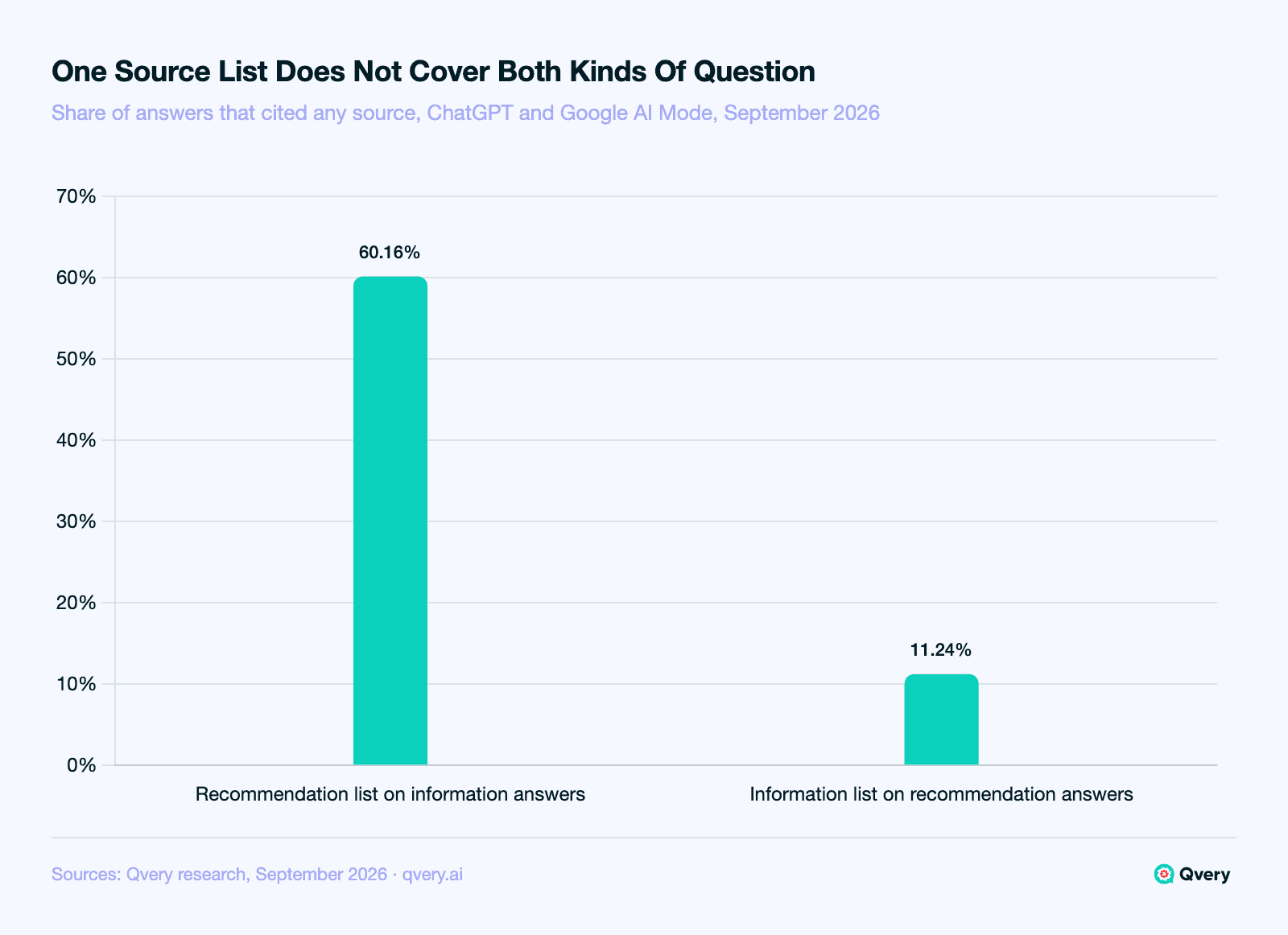
The recommendation list covers 60.16% of information answers that cited any source; the information list covers only 11.24% of recommendation answers that cited any source. The smaller figure sits well below the 60% bar we set before collecting, so each kind of question needs its own list. For how to build and keep one, see how to measure fintech AI visibility.
Do Finance Customers Trust What AI Tells Them?
Four outside figures frame why a fintech team should care which sites the answers cite. Each counts its own population, and none of them measures what the engines cite.
46% of surveyed US banking customers trust the accuracy of banking recommendations from generative AI tools, Deloitte found.
In the same survey, 49% trust generative AI tools for banking-product research, against 67% for traditional search engines.
20% of US adults say they would be interested in getting financial advice from AI, in FINRA Foundation's national study.
About four in ten US adults use chatbots to search for information, Pew Research Center reported in June 2026.
Trust sits around half, which is why the source behind an answer matters: a customer weighing an AI recommendation is weighing whoever it was built from.
What Qvery Measures Live
In Qvery you add and edit the queries you track, so your recommendation questions and your information questions can sit in separate groups, and you read visibility, share of voice, and average rank across ChatGPT and Google AI Mode every day, in 200+ countries, with every citation tied to the query and engine that produced it. Qvery Assistant answers plain-language questions about your own data in the app, such as which comparison sites were cited on the queries where you did not appear.
What Qvery will not do is classify those sites as affiliate publishers for you, or build the source lists. Start a free 7-day trial to see your own citations; checkout is self-serve and no credit card is required.
The Limits of These Numbers
The affiliate-publisher result is membership only: eleven named domains, a larger unclassified remainder, and no share of answers. The source lists are co-occurrence, never a cause, and nothing here measures whether a brand was named or recommended. The question sets are frozen September 2026 fintech questions, pooled across ChatGPT and Google AI Mode. An earlier collection used a different source format, so no comparison over time appears, and engine-by-engine splits are context in our other fintech posts, not here.
Pitch the Publishers Your Own Questions Cite
Build two source lists from your own tracked questions, one for recommendation questions and one for information questions, and check which of the eleven affiliate publishers named here appear in each before you spend a pitch on any of them. The big comparison desks are the likely targets; your own citations say which.
The worry in fintech marketing goes like this: while banks and card issuers polish their product pages, a crop of thin affiliate sites, the content farms, gets quoted by ChatGPT instead. We tested that premise on the money questions people ask ChatGPT and Google AI Mode in September 2026, with a fixed rule for what counts as an affiliate comparison publisher.
The premise mostly does not hold. Of the eleven affiliate comparison publishers cited in these answers, eight are household names, CNBC, the Wall Street Journal, The Motley Fool, WalletHub, Finder, LendingTree, Which? and TechRadar. Three are little-known. The list is publishable; a share of answers for the class is not yet, for the reason in the next section.
Key Takeaways
Eight of the eleven affiliate comparison publishers cited in AI finance answers are large, well-known publishers; three are little-known.
The class publishes as a named list, not a share of answers: our coders did not agree often enough on which pages carry affiliate markers to support a percentage.
Recommendation and information questions lean on different sources: three domains cover half of recommendation answers that cited any source, and two cover half of information answers that cited any source.
The information list covers only 11.24% of recommendation answers that cited any source, so each kind of finance question needs its own source list.
How the Test Worked
A domain counted as an affiliate comparison publisher when it passed three questions on its own pages: does it compare financial products, does it carry affiliate markers, and are its authors credentialed. "Little-known" had a plain definition too: organic search traffic below the median of all the candidate domains we checked.
The protocol classified the cited finance domains. Eleven qualified, and a larger group of candidates could not be classified at all, so the list below is a floor, not a census.
The reliability test decided what could be printed. On a hand-coded sample, coders agreed well on whether a page compares products and on whether its authors are credentialed, but not well enough on affiliate markers to clear the bar we set before collecting. When the membership of a class is that uncertain, a share of answers built on it would look precise and mean little, so we publish the names and hold the number.
The Affiliate Publishers Cited Are Mostly Big Names
The eight large affiliate comparison publishers: cnbc.com, finder.com, wsj.com, which.co.uk, techradar.com, lendingtree.com, wallethub.com, and fool.com.
The three little-known ones, by the traffic rule above: northvilletech.com, bestmoney.com, and dollarscout.net.
So most of the affiliate comparison publishers cited in AI finance answers are the comparison desks of major publishers, with a few small sites beside them; how often each group is cited is the number this study cannot yet print. Nothing here says either group is cited more than banks, because no share of answers ships for the class.
For a fintech brand, that changes the pitch list. The publishers worth approaching for inclusion in comparison content are mostly the ones with editorial desks and review processes, which are also the ones a compliance team is more comfortable being listed on. Our reading of which fintech roundups AI engines cite covers that outreach decision in more depth.
Recommendation and Information Questions Use Different Sources
This part of the study is measurable at full reliability, because it counts domains rather than classifying them. The shares below are of answers that cited any source, within each kind of question.
Recommendation questions, the three domains covering half of cited answers: nerdwallet.com, schwab.com, cnbc.com.
Recommendation questions, the list covering 80%: those three plus moneysavingexpert.com, irs.gov, wise.com, capitalone.com, consumerfinance.gov, reddit.com, gov.uk, quicken.com, and finder.com.
Information questions, the two domains covering half of cited answers: consumerfinance.gov and investor.gov.
Information questions, the list covering 80%: those two plus experian.com, moneysmart.gov.au, and canada.ca.
The recommendation list covers 60.16% of information answers that cited any source; the information list covers only 11.24% of recommendation answers that cited any source. The smaller figure sits well below the 60% bar we set before collecting, so each kind of question needs its own list. For how to build and keep one, see how to measure fintech AI visibility.
Do Finance Customers Trust What AI Tells Them?
Four outside figures frame why a fintech team should care which sites the answers cite. Each counts its own population, and none of them measures what the engines cite.
46% of surveyed US banking customers trust the accuracy of banking recommendations from generative AI tools, Deloitte found.
In the same survey, 49% trust generative AI tools for banking-product research, against 67% for traditional search engines.
20% of US adults say they would be interested in getting financial advice from AI, in FINRA Foundation's national study.
About four in ten US adults use chatbots to search for information, Pew Research Center reported in June 2026.
Trust sits around half, which is why the source behind an answer matters: a customer weighing an AI recommendation is weighing whoever it was built from.
What Qvery Measures Live
In Qvery you add and edit the queries you track, so your recommendation questions and your information questions can sit in separate groups, and you read visibility, share of voice, and average rank across ChatGPT and Google AI Mode every day, in 200+ countries, with every citation tied to the query and engine that produced it. Qvery Assistant answers plain-language questions about your own data in the app, such as which comparison sites were cited on the queries where you did not appear.
What Qvery will not do is classify those sites as affiliate publishers for you, or build the source lists. Start a free 7-day trial to see your own citations; checkout is self-serve and no credit card is required.
The Limits of These Numbers
The affiliate-publisher result is membership only: eleven named domains, a larger unclassified remainder, and no share of answers. The source lists are co-occurrence, never a cause, and nothing here measures whether a brand was named or recommended. The question sets are frozen September 2026 fintech questions, pooled across ChatGPT and Google AI Mode. An earlier collection used a different source format, so no comparison over time appears, and engine-by-engine splits are context in our other fintech posts, not here.
Pitch the Publishers Your Own Questions Cite
Build two source lists from your own tracked questions, one for recommendation questions and one for information questions, and check which of the eleven affiliate publishers named here appear in each before you spend a pitch on any of them. The big comparison desks are the likely targets; your own citations say which.
The worry in fintech marketing goes like this: while banks and card issuers polish their product pages, a crop of thin affiliate sites, the content farms, gets quoted by ChatGPT instead. We tested that premise on the money questions people ask ChatGPT and Google AI Mode in September 2026, with a fixed rule for what counts as an affiliate comparison publisher.
The premise mostly does not hold. Of the eleven affiliate comparison publishers cited in these answers, eight are household names, CNBC, the Wall Street Journal, The Motley Fool, WalletHub, Finder, LendingTree, Which? and TechRadar. Three are little-known. The list is publishable; a share of answers for the class is not yet, for the reason in the next section.
Key Takeaways
Eight of the eleven affiliate comparison publishers cited in AI finance answers are large, well-known publishers; three are little-known.
The class publishes as a named list, not a share of answers: our coders did not agree often enough on which pages carry affiliate markers to support a percentage.
Recommendation and information questions lean on different sources: three domains cover half of recommendation answers that cited any source, and two cover half of information answers that cited any source.
The information list covers only 11.24% of recommendation answers that cited any source, so each kind of finance question needs its own source list.
How the Test Worked
A domain counted as an affiliate comparison publisher when it passed three questions on its own pages: does it compare financial products, does it carry affiliate markers, and are its authors credentialed. "Little-known" had a plain definition too: organic search traffic below the median of all the candidate domains we checked.
The protocol classified the cited finance domains. Eleven qualified, and a larger group of candidates could not be classified at all, so the list below is a floor, not a census.
The reliability test decided what could be printed. On a hand-coded sample, coders agreed well on whether a page compares products and on whether its authors are credentialed, but not well enough on affiliate markers to clear the bar we set before collecting. When the membership of a class is that uncertain, a share of answers built on it would look precise and mean little, so we publish the names and hold the number.
The Affiliate Publishers Cited Are Mostly Big Names
The eight large affiliate comparison publishers: cnbc.com, finder.com, wsj.com, which.co.uk, techradar.com, lendingtree.com, wallethub.com, and fool.com.
The three little-known ones, by the traffic rule above: northvilletech.com, bestmoney.com, and dollarscout.net.
So most of the affiliate comparison publishers cited in AI finance answers are the comparison desks of major publishers, with a few small sites beside them; how often each group is cited is the number this study cannot yet print. Nothing here says either group is cited more than banks, because no share of answers ships for the class.
For a fintech brand, that changes the pitch list. The publishers worth approaching for inclusion in comparison content are mostly the ones with editorial desks and review processes, which are also the ones a compliance team is more comfortable being listed on. Our reading of which fintech roundups AI engines cite covers that outreach decision in more depth.
Recommendation and Information Questions Use Different Sources
This part of the study is measurable at full reliability, because it counts domains rather than classifying them. The shares below are of answers that cited any source, within each kind of question.
Recommendation questions, the three domains covering half of cited answers: nerdwallet.com, schwab.com, cnbc.com.
Recommendation questions, the list covering 80%: those three plus moneysavingexpert.com, irs.gov, wise.com, capitalone.com, consumerfinance.gov, reddit.com, gov.uk, quicken.com, and finder.com.
Information questions, the two domains covering half of cited answers: consumerfinance.gov and investor.gov.
Information questions, the list covering 80%: those two plus experian.com, moneysmart.gov.au, and canada.ca.
The recommendation list covers 60.16% of information answers that cited any source; the information list covers only 11.24% of recommendation answers that cited any source. The smaller figure sits well below the 60% bar we set before collecting, so each kind of question needs its own list. For how to build and keep one, see how to measure fintech AI visibility.
Do Finance Customers Trust What AI Tells Them?
Four outside figures frame why a fintech team should care which sites the answers cite. Each counts its own population, and none of them measures what the engines cite.
46% of surveyed US banking customers trust the accuracy of banking recommendations from generative AI tools, Deloitte found.
In the same survey, 49% trust generative AI tools for banking-product research, against 67% for traditional search engines.
20% of US adults say they would be interested in getting financial advice from AI, in FINRA Foundation's national study.
About four in ten US adults use chatbots to search for information, Pew Research Center reported in June 2026.
Trust sits around half, which is why the source behind an answer matters: a customer weighing an AI recommendation is weighing whoever it was built from.
What Qvery Measures Live
In Qvery you add and edit the queries you track, so your recommendation questions and your information questions can sit in separate groups, and you read visibility, share of voice, and average rank across ChatGPT and Google AI Mode every day, in 200+ countries, with every citation tied to the query and engine that produced it. Qvery Assistant answers plain-language questions about your own data in the app, such as which comparison sites were cited on the queries where you did not appear.
What Qvery will not do is classify those sites as affiliate publishers for you, or build the source lists. Start a free 7-day trial to see your own citations; checkout is self-serve and no credit card is required.
The Limits of These Numbers
The affiliate-publisher result is membership only: eleven named domains, a larger unclassified remainder, and no share of answers. The source lists are co-occurrence, never a cause, and nothing here measures whether a brand was named or recommended. The question sets are frozen September 2026 fintech questions, pooled across ChatGPT and Google AI Mode. An earlier collection used a different source format, so no comparison over time appears, and engine-by-engine splits are context in our other fintech posts, not here.
Pitch the Publishers Your Own Questions Cite
Build two source lists from your own tracked questions, one for recommendation questions and one for information questions, and check which of the eleven affiliate publishers named here appear in each before you spend a pitch on any of them. The big comparison desks are the likely targets; your own citations say which.
The worry in fintech marketing goes like this: while banks and card issuers polish their product pages, a crop of thin affiliate sites, the content farms, gets quoted by ChatGPT instead. We tested that premise on the money questions people ask ChatGPT and Google AI Mode in September 2026, with a fixed rule for what counts as an affiliate comparison publisher.
The premise mostly does not hold. Of the eleven affiliate comparison publishers cited in these answers, eight are household names, CNBC, the Wall Street Journal, The Motley Fool, WalletHub, Finder, LendingTree, Which? and TechRadar. Three are little-known. The list is publishable; a share of answers for the class is not yet, for the reason in the next section.
Key Takeaways
Eight of the eleven affiliate comparison publishers cited in AI finance answers are large, well-known publishers; three are little-known.
The class publishes as a named list, not a share of answers: our coders did not agree often enough on which pages carry affiliate markers to support a percentage.
Recommendation and information questions lean on different sources: three domains cover half of recommendation answers that cited any source, and two cover half of information answers that cited any source.
The information list covers only 11.24% of recommendation answers that cited any source, so each kind of finance question needs its own source list.
How the Test Worked
A domain counted as an affiliate comparison publisher when it passed three questions on its own pages: does it compare financial products, does it carry affiliate markers, and are its authors credentialed. "Little-known" had a plain definition too: organic search traffic below the median of all the candidate domains we checked.
The protocol classified the cited finance domains. Eleven qualified, and a larger group of candidates could not be classified at all, so the list below is a floor, not a census.
The reliability test decided what could be printed. On a hand-coded sample, coders agreed well on whether a page compares products and on whether its authors are credentialed, but not well enough on affiliate markers to clear the bar we set before collecting. When the membership of a class is that uncertain, a share of answers built on it would look precise and mean little, so we publish the names and hold the number.
The Affiliate Publishers Cited Are Mostly Big Names
The eight large affiliate comparison publishers: cnbc.com, finder.com, wsj.com, which.co.uk, techradar.com, lendingtree.com, wallethub.com, and fool.com.
The three little-known ones, by the traffic rule above: northvilletech.com, bestmoney.com, and dollarscout.net.
So most of the affiliate comparison publishers cited in AI finance answers are the comparison desks of major publishers, with a few small sites beside them; how often each group is cited is the number this study cannot yet print. Nothing here says either group is cited more than banks, because no share of answers ships for the class.
For a fintech brand, that changes the pitch list. The publishers worth approaching for inclusion in comparison content are mostly the ones with editorial desks and review processes, which are also the ones a compliance team is more comfortable being listed on. Our reading of which fintech roundups AI engines cite covers that outreach decision in more depth.
Recommendation and Information Questions Use Different Sources
This part of the study is measurable at full reliability, because it counts domains rather than classifying them. The shares below are of answers that cited any source, within each kind of question.
Recommendation questions, the three domains covering half of cited answers: nerdwallet.com, schwab.com, cnbc.com.
Recommendation questions, the list covering 80%: those three plus moneysavingexpert.com, irs.gov, wise.com, capitalone.com, consumerfinance.gov, reddit.com, gov.uk, quicken.com, and finder.com.
Information questions, the two domains covering half of cited answers: consumerfinance.gov and investor.gov.
Information questions, the list covering 80%: those two plus experian.com, moneysmart.gov.au, and canada.ca.
The recommendation list covers 60.16% of information answers that cited any source; the information list covers only 11.24% of recommendation answers that cited any source. The smaller figure sits well below the 60% bar we set before collecting, so each kind of question needs its own list. For how to build and keep one, see how to measure fintech AI visibility.
Do Finance Customers Trust What AI Tells Them?
Four outside figures frame why a fintech team should care which sites the answers cite. Each counts its own population, and none of them measures what the engines cite.
46% of surveyed US banking customers trust the accuracy of banking recommendations from generative AI tools, Deloitte found.
In the same survey, 49% trust generative AI tools for banking-product research, against 67% for traditional search engines.
20% of US adults say they would be interested in getting financial advice from AI, in FINRA Foundation's national study.
About four in ten US adults use chatbots to search for information, Pew Research Center reported in June 2026.
Trust sits around half, which is why the source behind an answer matters: a customer weighing an AI recommendation is weighing whoever it was built from.
What Qvery Measures Live
In Qvery you add and edit the queries you track, so your recommendation questions and your information questions can sit in separate groups, and you read visibility, share of voice, and average rank across ChatGPT and Google AI Mode every day, in 200+ countries, with every citation tied to the query and engine that produced it. Qvery Assistant answers plain-language questions about your own data in the app, such as which comparison sites were cited on the queries where you did not appear.
What Qvery will not do is classify those sites as affiliate publishers for you, or build the source lists. Start a free 7-day trial to see your own citations; checkout is self-serve and no credit card is required.
The Limits of These Numbers
The affiliate-publisher result is membership only: eleven named domains, a larger unclassified remainder, and no share of answers. The source lists are co-occurrence, never a cause, and nothing here measures whether a brand was named or recommended. The question sets are frozen September 2026 fintech questions, pooled across ChatGPT and Google AI Mode. An earlier collection used a different source format, so no comparison over time appears, and engine-by-engine splits are context in our other fintech posts, not here.
Pitch the Publishers Your Own Questions Cite
Build two source lists from your own tracked questions, one for recommendation questions and one for information questions, and check which of the eleven affiliate publishers named here appear in each before you spend a pitch on any of them. The big comparison desks are the likely targets; your own citations say which.

© 2026 Qvery AI OÜ