By
Vlad Shvets
8 Best AI Visibility Tools for Education Brands (2026)
Eight AI visibility tools read against what a school needs: programs tracked apart, recruiting markets, cited sources, and the real price of both engines.
Eight AI visibility tools read against what a school needs: programs tracked apart, recruiting markets, cited sources, and the real price of both engines.
Eight AI visibility tools read against what a school needs: programs tracked apart, recruiting markets, cited sources, and the real price of both engines.
A prospective student asks ChatGPT which data science certificate is worth the money, and the answer names three programs before it names a school. That answer now sits inside every school's enrollment funnel, program by program and market by market. In our education AI search study, a brand's own site was cited in 74.31% of the answers where ChatGPT and Google AI Mode recommended education programs.
We read the product and pricing pages of every tool on our competitor leaderboard that tracks both engines and has a public pricing page, then kept eight. None of them documents the whole education setup, so each entry says what the vendor's own pages prove, what they leave open, and what to ask in the demo.
Five Things a School Needs a Tool to Show
A school sells dozens of programs to students in several countries, and that turns a single visibility score into five separate questions:
Recommended, not just mentioned. Whether the engine recommends your school or a program, rather than naming it in passing. No tool on this list documents it as a separate measurement.
Programs as separate entities. Your brand, and each named degree, course, or certificate, tracked on its own. No tool here documents it.
The markets you recruit in. The same questions, asked in each country your students come from.
The pages behind the answer. Which domains and URLs the engine cited when it named a competitor instead of you.
Several brands in one account. For universities with separate schools or faculties, and for groups running more than one course brand.
Every tool below already cleared two bars: its own pages say it tracks both ChatGPT and Google AI Mode, and its pricing can be read without a sales call or is stated as a quote. Past that, each criterion lands in one of three states, and each state allows a different move:
Documented: a line on the vendor's own page says it. Shortlist on it, then confirm it sits on the tier you would buy.
Documented as not offered: the vendor says it doesn't do it. That rules the tool out on that criterion. No tool on this list is in this state for any of the five.
Not documented: the pages don't say either way. That is a demo question, never a no.
A features page describes the product; the pricing row describes what you are buying. On this list, recruiting markets, several brands, and even Google AI Mode itself sit on a higher tier or an add-on somewhere, Qvery's brands included.
Higher Education Marketing argues that schools “should not evaluate it in isolation” and should read AI search visibility next to enrollment context. That is why the test above is built around programs and markets instead of one brand score.
If you haven't set up the measurement yet, measuring an education brand's AI visibility covers the setup and how institutions show up in AI answers covers the segmentation.
Qvery leads the list because we make it. After it come the five highest-ranked tools on our competitor leaderboard that cleared both bars, then the two tools whose own pages document the most of the five criteria (a mention-tracking line counts toward that), with ties broken by leaderboard rank.
1. Qvery: Daily ChatGPT and Google AI Mode Tracking in 200+ Countries
Key Features:
Daily tracking of visibility, share of voice, and average rank across ChatGPT and Google AI Mode, in 200+ countries.
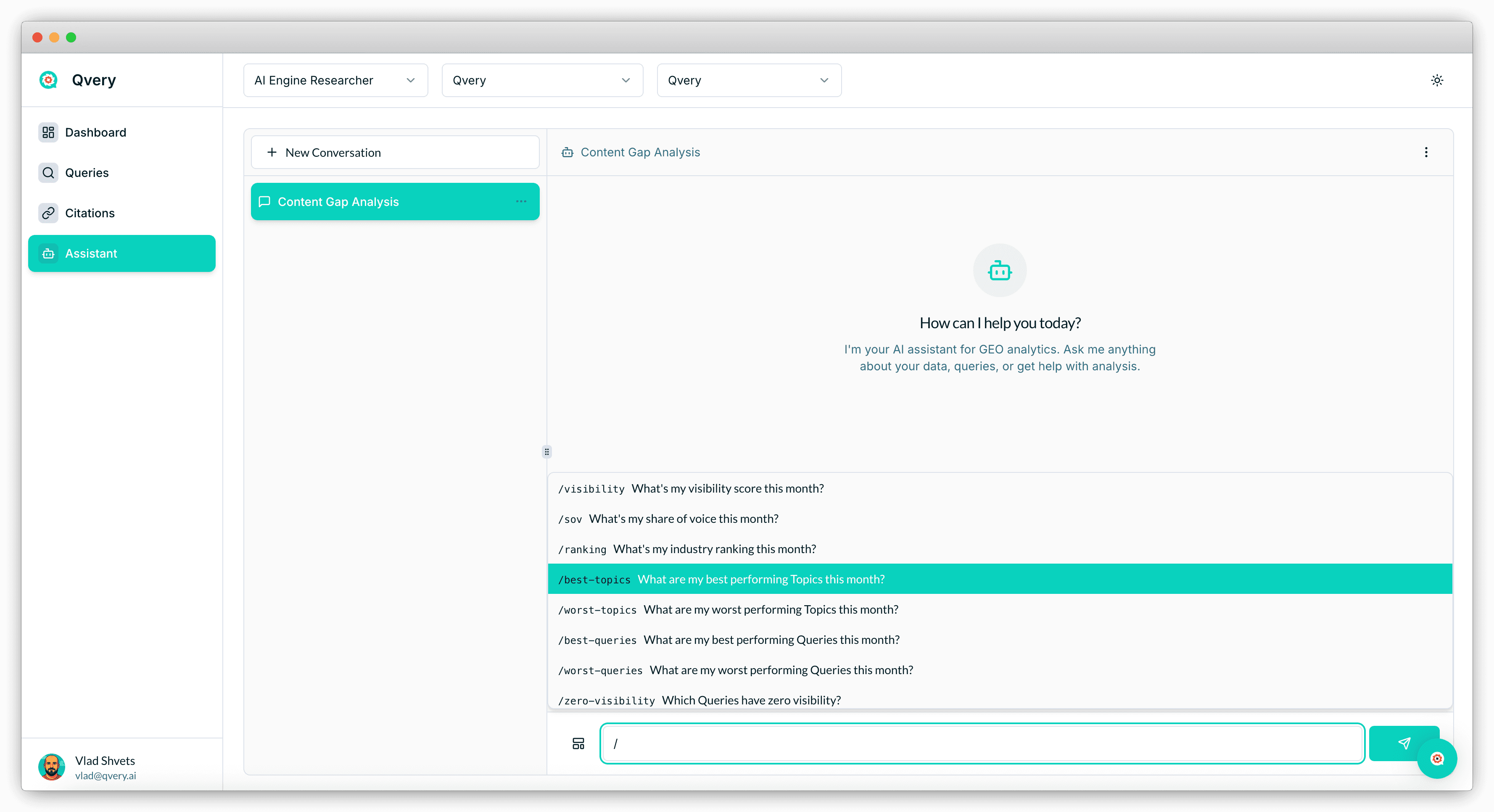
Qvery Assistant in the app: ask plain-language questions about your own visibility, share of voice, citation, topic, and query data, and have it add queries, trigger a data run, or export a report.
Every citation captured, tied to the query and the engine that produced it.
Queries you add and edit, in any of those countries.
Unlimited brands on the Business plan, per the live pricing page.
Pricing:
Starter: €49/month for 1 brand and 25 tracked queries.
Growth: €99/month for 1 brand and 50 tracked queries.
Business: €199 for unlimited brands and 100 tracked queries (the pricing page shows no billing period on this tier).
Every plan includes ChatGPT and Google AI Mode, daily query runs, unlimited countries, and unlimited seats. The paid plans start with a free 7-day trial, no credit card required.
Reddit Score: 85.0% Positive, across 20 mentions. What redditors say:
“tracking mentions in local publications and external sites is key for AI visibility, like Qvery AI does.” (r/smallbusiness)
Most of those 20 mentions sit in threads our own marketing team took part in. Only two come from people outside it, which is too few to score on their own, so weigh the percentage with that in mind.
Qvery is our product, so read this entry the way you'd read any vendor describing itself, and hold it to the same five questions.
Qvery documents daily brand appearance across both engines as visibility, share of voice, and average rank; it doesn't claim a separate status for being recommended versus being named. It documents the countries you track, the pages each answer cited, and several brands in one account on Business.
It documents nothing about tracking a school and each of its programs as separate entities, so that question goes on your demo list here too.
Where Qvery fits is a small marketing team at a school or course provider that would rather ask the Assistant which markets it is losing than read another dashboard. A university system that needs enterprise procurement, SSO, and security reviews is better served by the enterprise tiers further down this list.
To see your own programs across both engines, start a free 7-day trial; no credit card is required.
2. OtterlyAI: The Low Entry Price, Once You Add Google AI Mode
Key Features:
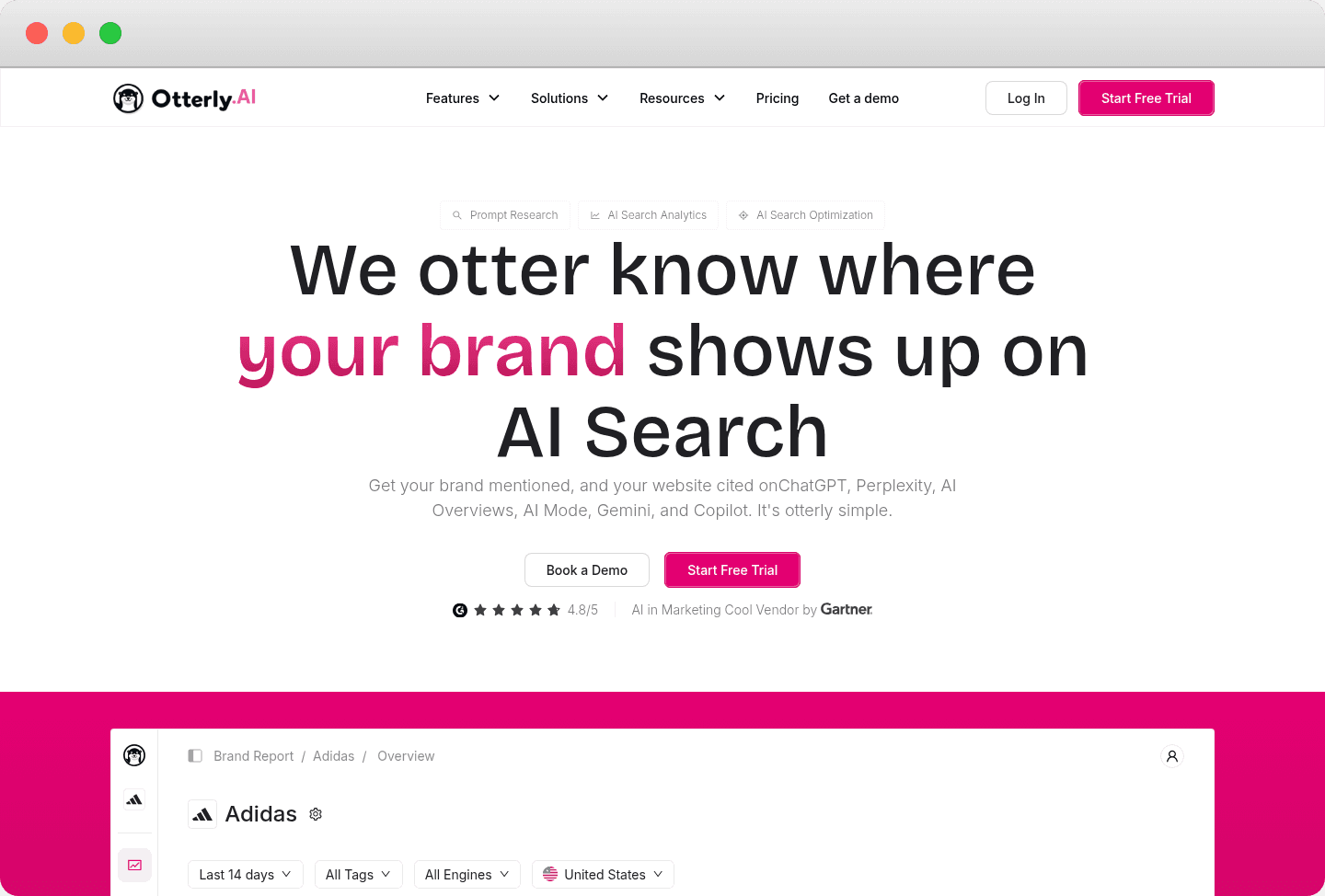
Seven engines, ChatGPT and Google AI Mode among them, named on its features page.
Mention tracking: “Know when you're mentioned, when you're not, and how you stack up against competitors.”
Every cited domain and URL, checked daily, with link-position changes over time.
Market-by-market performance, with multi-country support (50+) listed on every tier.
Several brands in Workspaces, one on Lite and unlimited on Standard and Premium, plus a public API.
Pricing:
Lite: $29/month, or $25/month billed annually, for 15 search prompts and 1 workspace.
Standard: $189/month, or $160/month billed annually, for 100 search prompts and unlimited workspaces.
Premium: $489/month, or $422/month billed annually, for 400 search prompts.
Enterprise: custom pricing.
The base tiers track four engines with ChatGPT among them. Google AI Mode is an add-on at $9, $59, or $149 a month on Lite, Standard, and Premium, so tracking both named engines starts at $38, $248, or $638 a month.
Reddit Score: 69.2% Positive, across 13 mentions about OtterlyAI. What redditors say:
OtterlyAI’s pages cover a good share of the school checklist: markets, cited pages, several brands in one account, and a daily schedule on the pricing page. The catch is arithmetic. Google AI Mode isn't in the base tiers, so the sticker price and the price of watching both engines are two different numbers.
Lite with the add-on comes to $38 a month for 15 prompts, which a school with more than a few programs will spend before lunch. The pages leave open whether a program can be tracked apart from the school, and whether a recommendation is scored apart from a mention.
3. Peec AI: Wide Coverage, With a Model Count to Confirm
Key Features:
Both engines by default: its AI-instructions page says ChatGPT and Google AI Mode are “Included by default in every plan”.
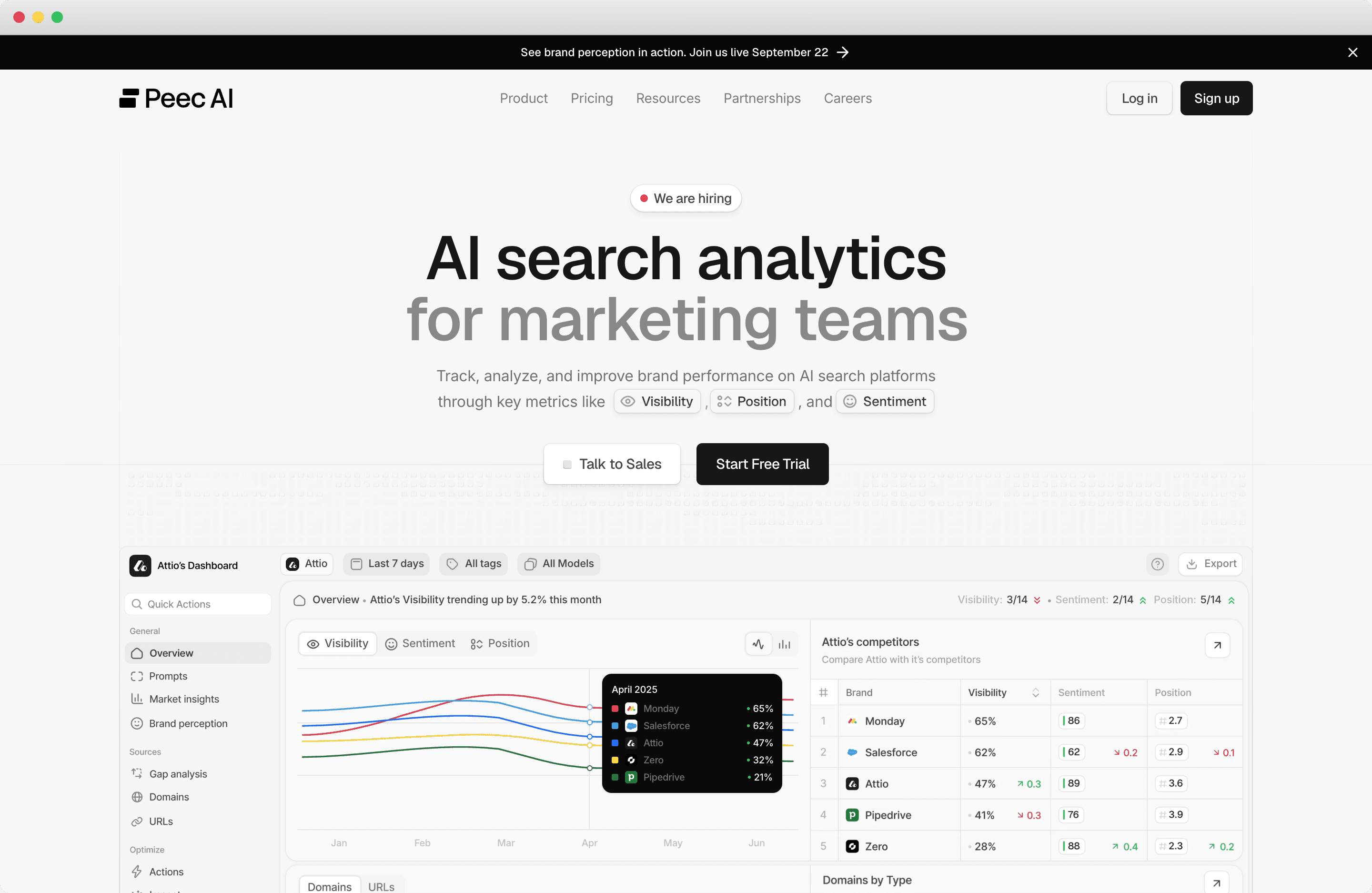
Visibility share: the “Percentage of AI responses where your brand appears”, plus competitor share of voice.
Sources and citations: the URLs and domains each answer drew on.
Tracking across all countries, and multi-brand tracking from one dashboard.
Daily tracking frequency and unlimited users on every priced tier.
Pricing:
Starter: $95/mo for 50 prompts, 3 models, and 1 project.
Pro: $245/mo for 150 prompts, 3 models, and 2 projects.
Advanced: $495/mo for 350 prompts, 3 models, 5 projects, and multi country.
Enterprise: custom, billed annually, with a choice from all models.
One extra model costs $30, $70, or $140 a month (annual pricing) on Starter, Pro, and Advanced.
Reddit Score: 68.6% Positive, across 51 mentions about Peec AI. What redditors say:
“We use Peec AI and it's pretty bad ass.” (r/DigitalMarketing)
“We discovered both athena and peec scrape API data and are not giving any insights at all” (r/SaaS)
Peec's pages say two things that don't obviously agree. The AI-instructions page lists ChatGPT and Google AI Mode as included by default in every plan, while each priced tier reads “Choose 3 models” instead. Both can be true, and the demo is where you learn which three a school ends up with.
“Multi country” appears only on the Advanced row, so a school recruiting in several markets should ask whether Starter and Pro follow it there, or price Advanced from the start. The rest of the list Peec documents well: sources, several brands, and a share-of-voice view a program director can read without a translator.
4. AthenaHQ: Priced in Credits, Scoped by Region
Key Features:
ChatGPT and Google AI Mode among the engines on its plans page, with both listed on Starter.
Brand mention frequency tracking and competitor share of voice comparison.
Source intelligence: “Reveal the sources shaping AI answers.”
Multi-brand tracking, centralized across brands and business units, plus an API.
Pricing:
Essential: free, with 300 credits; its engine list names ChatGPT.
Starter: $295/month for 3,600 credits (1 credit = 1 AI response), ChatGPT and AI Mode, and data export to CSV. API access and extra credits are paid add-ons.
Enterprise: custom credits, with multi-region and multi-language support.
Reddit Score: 57.1% Positive, across 7 mentions about AthenaHQ. What redditors say:
“we use athenahq to show clients exactly where they appear vs don't across llms. makes it click faster” (r/DigitalMarketing)
Seven mentions is a thin base, so read the percentage as a direction rather than a verdict.
AthenaHQ sells answers by the credit: 3,600 a month on Starter, one credit per AI response. For a school, that turns pricing into multiplication, with programs, questions, markets, and two engines as the factors, and the product decides how fast the credits go.
Its comparison table lists multi-language and multi-region support as “Single” on Starter and “Multiple” on Enterprise. A school recruiting internationally is therefore pricing Enterprise, and Enterprise is a quote. Multi-brand tracking and cited sources are documented; programs as separate entities are not.
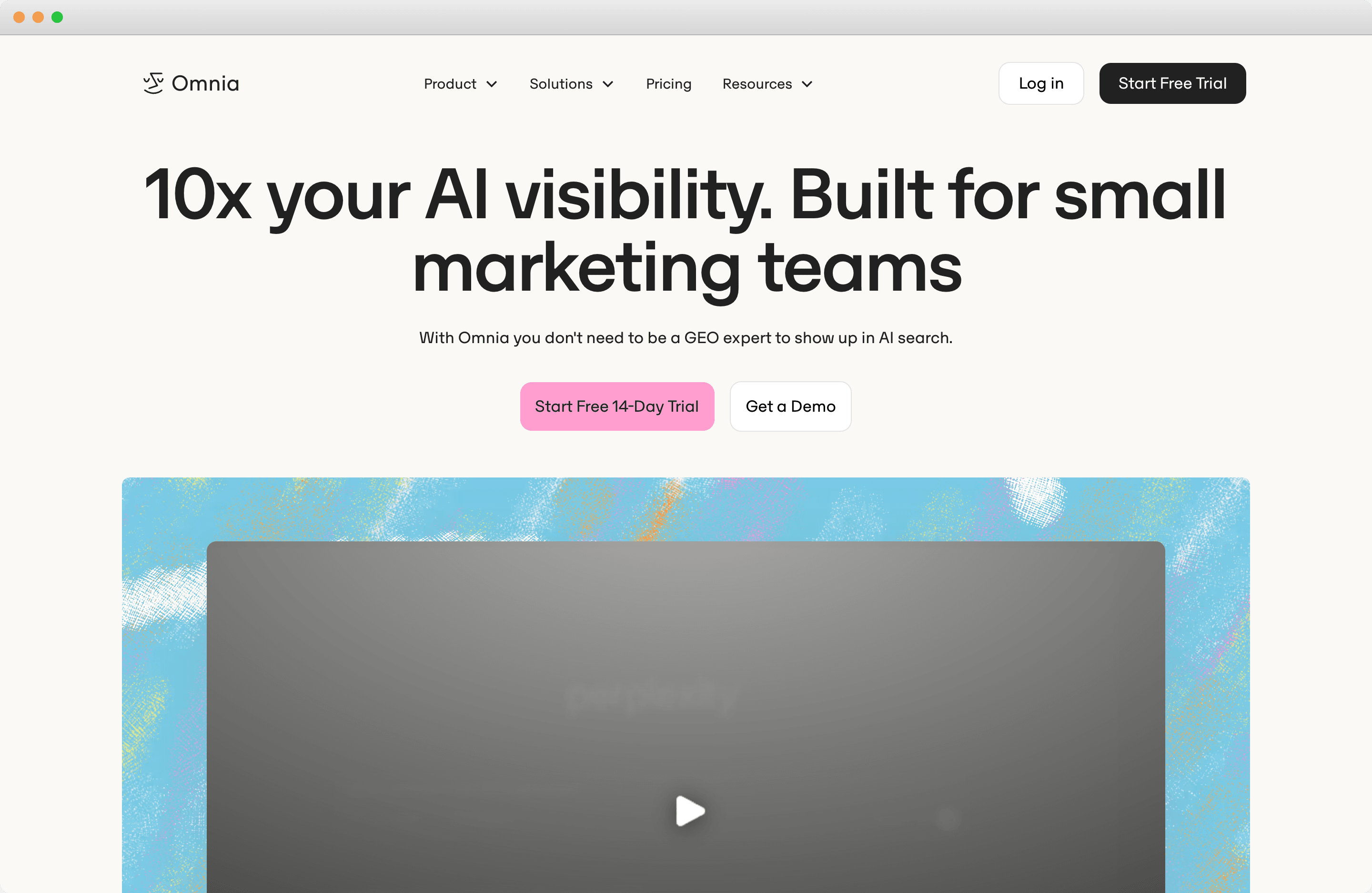
5. Omnia: A Published Price for Every Prompt Band
Key Features:
Both engines, every tier: ChatGPT and Google AI Mode among the four it monitors by default.
Brand mentions in AI answers, benchmarked against competitors.
Cited URLs and domains, listed per answer.
Geo-level monitoring and comparison, and several brands managed in different markets.
Prompts tracked every 24 hours, with API docs.
Pricing:
Growth: €79/month, or €63/month billed yearly, for up to 25 prompts.
Pro: €279/month, or €223/month billed yearly, for up to 100 prompts.
Enterprise: from €499/month, or from €399/month billed yearly, for 200+ prompts.
A 14-day free trial, no credit card required.
Reddit Score: Not scored. None of the Reddit threads we read mentioned Omnia, so there is nothing to average and nothing to quote.
Omnia answers the market question in writing. Its solutions page says visibility varies by country and that the product is designed for geo-level monitoring and comparison, and it pairs that with several brands in different markets. For a school recruiting in several countries, that is the documented half.
Its prices are published too: a number for each prompt band, with ChatGPT and Google AI Mode already included. The open half is the same as everyone else's: a program tracked apart from the school, and a recommendation scored apart from a mention.
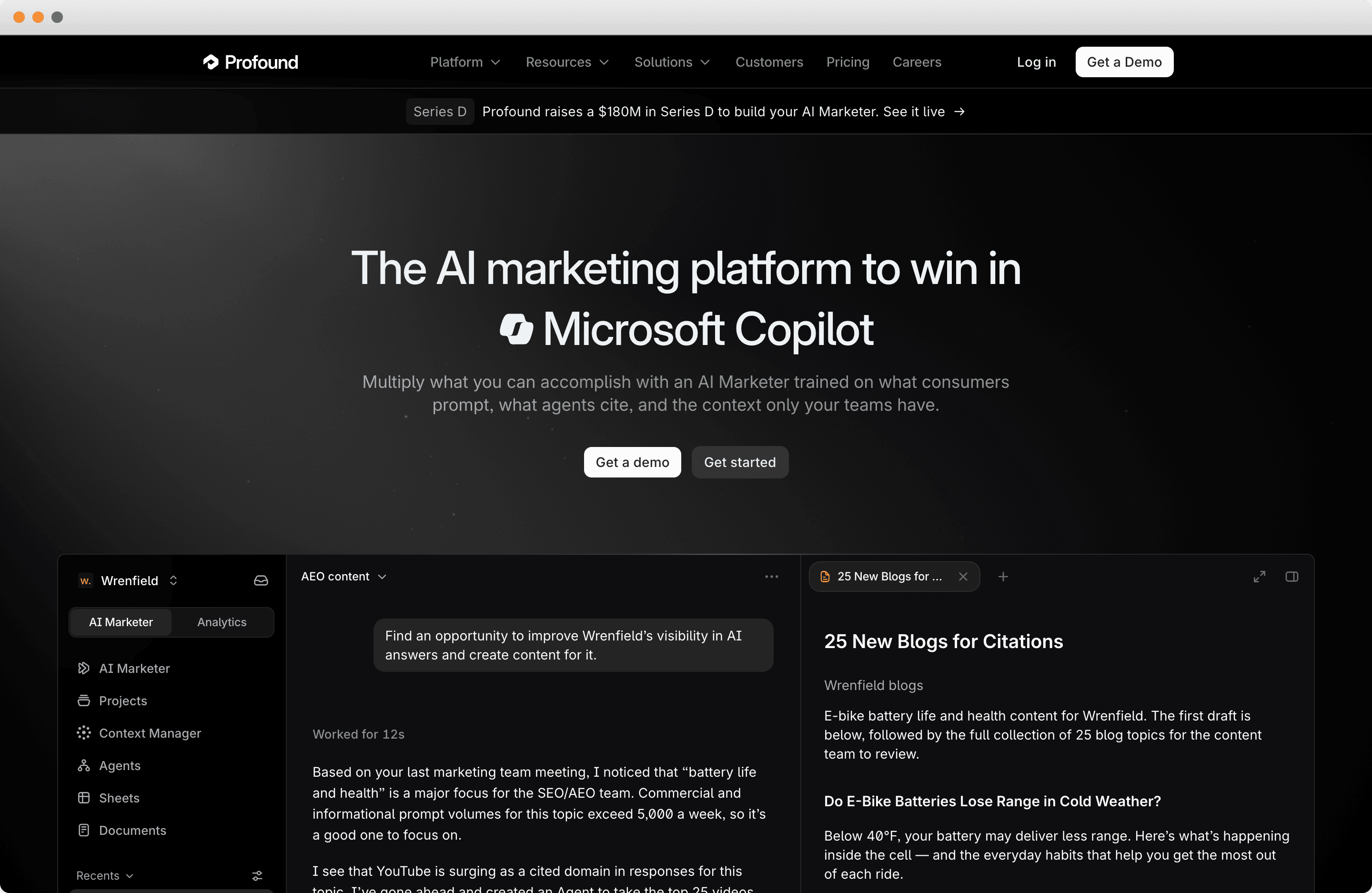
6. Profound: Enterprise Depth, Behind a Demo
Key Features:
ChatGPT and Google AI Mode among the answer engines on its AI-instructions page.
Answer Engine Insights, which “Tracks how AI answer engines mention, rank, and describe a brand.”
Citation analysis: which websites influence AI answers about your brand.
Agency Mode, for managing several brand environments in one account.
Pricing:
Trial: free, with limited credits and 50 prompts run daily for 7 days on three engines, none of them Google AI Mode, in one region.
Enterprise: custom, with a tailored prompt tracking plan, up to 9 answer engines, SSO/SAML, and SOC 2 compliance.
Reddit Score: Not scored. One mention about Profound turned up in the threads we read, which is not a base for a percentage.
Profound's description of what it measures goes a step past a mention count: how an engine mentions, ranks, and describes a brand. That is the closest line on this list to the recommendation question, and it still stops short of scoring a recommendation apart from a mention.
What it doesn't publish is a price, and its free trial runs on three engines that leave out Google AI Mode, so the Google half of the job can't be tested before the sales call. Country markets and program entities aren't documented.
For a university system with a procurement office and a security review, Enterprise is built for that conversation; for a single course brand, it is a lot of conversation.
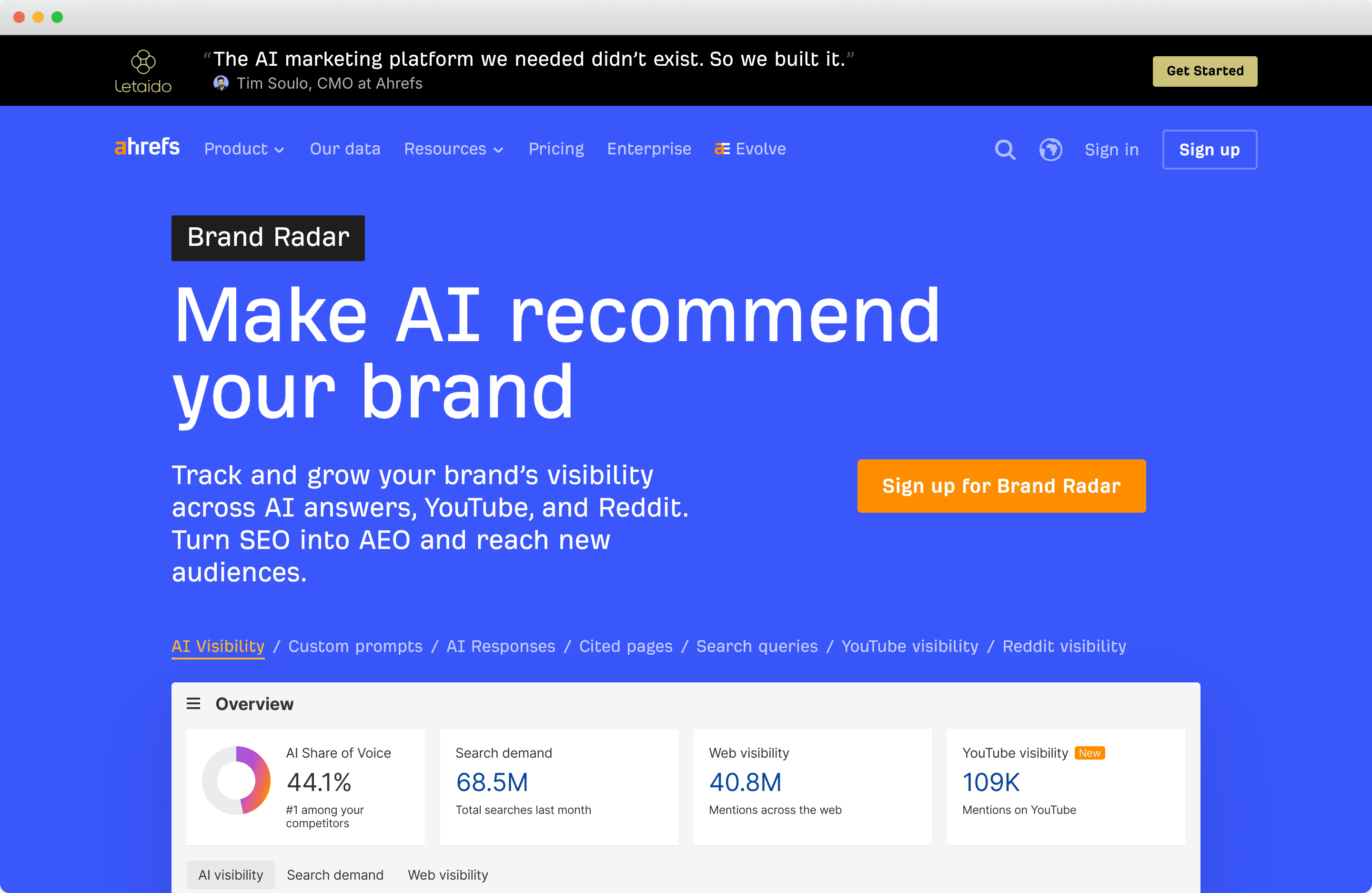
7. Ahrefs: The Only Entry That Keeps the Answer Text
Key Features:
An AI Mode tracker: how many AI Mode answers mention your brand across the prompts tested.
Raw responses stored, so you can search the answer text for brand mentions and linked citations.
The top cited pages alongside your brand, and AI Mode share of voice against any competitor you choose.
Daily monitoring of mentions and citations, with charts and exports.
ChatGPT coverage, named on the same page among the AI platforms it tracks mentions across.
Pricing:
Starter: $29/mo.
Lite: $129/mo with 5 tracked AI prompts.
Standard: $249/mo with 10 tracked AI prompts.
Advanced: $449/mo with 20 tracked AI prompts.
Enterprise: $1,499/mo, annual commitment required.
Brand Radar AI from $199/mo; custom prompt packages at $50/mo (e.g. 80 prompts daily on 1 platform), $100/mo (e.g. 100 prompts daily on 2 platforms), and $250/mo.
Reddit Score: 48.3% Positive, across 378 mentions about Ahrefs. What redditors say:
“While Ahrefs scale can be off, the trends are very accurate” (r/SEO)
“Ahrefs can be pricey starting out.” (r/SEO)
Ahrefs is the only tool here whose pages say it stores the raw answers. When an engine describes your nursing program's accreditation wrong, the answer text is the evidence you take to the program director, and a visibility score can't show it.
The work is in the assembly. The AI Mode tracker, Brand Radar AI, and the prompt packages are sized by prompts and by platform count, and the pricing page doesn't say which combination covers both engines, or what it adds up to.
Country markets and several brands aren't documented. If your team already runs its search work in Ahrefs, the demo question is simple to state: which bundle, at what total.
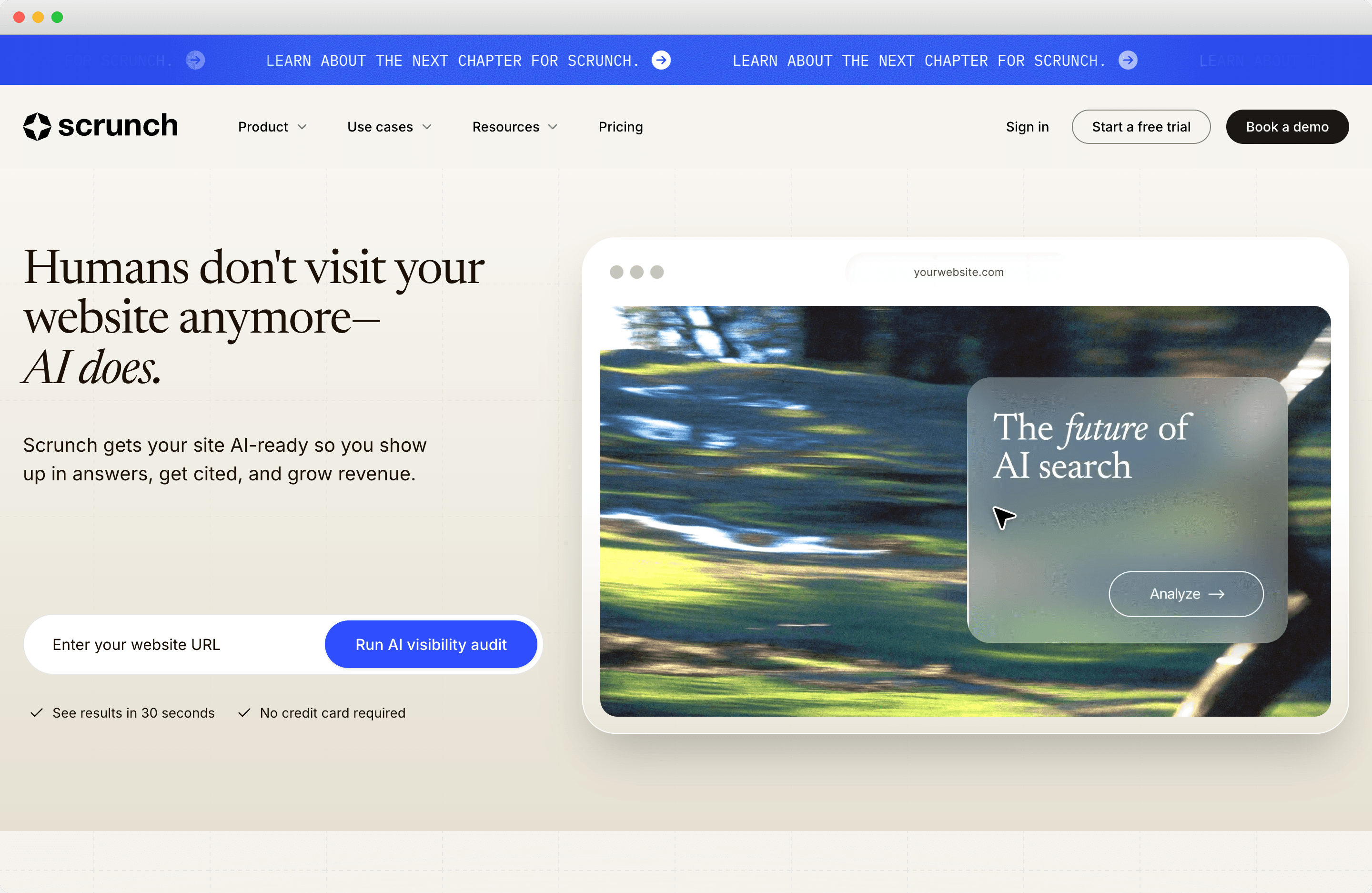
8. Scrunch: A Cross-Platform View, With Google AI Mode on Enterprise
Key Features:
Filtering by AI platform, with ChatGPT and Google AI Mode among the platforms its FAQ names.
A side-by-side comparison of “brand presence, competitive presence, position, sentiment, or citations” across platforms.
Citations and sources, and 5 tracked competitors on Core, per the pricing page.
Pricing:
Core: $250/mo for 125 unique prompts, 1 brand workspace, 1 country, 5 licenses, and four LLMs, with ChatGPT and Google AI Overviews among them and Google AI Mode not.
Enterprise: custom prompts, brand workspaces, and licenses, unlimited countries, and nine LLMs including Google AI Mode; no price is published.
A 7-day free trial on Core.
Reddit Score: 50.0% Positive, across 5 mentions about Scrunch. Four of the five are posts comparing several tools, and the fifth, the only comment, was written by an employee of a rival vendor, so there is no user review here to quote.
Scrunch's documentation is strongest on comparison: pick the platforms, then line up presence, position, sentiment, and citations across them. For a school, that view is useful exactly when both engines are in it, and the pricing table lists Google AI Mode on Enterprise, not on Core.
Core documents one brand workspace and one country, so a university with separate schools, or one recruiting abroad, is pricing Enterprise, which lists unlimited countries. Program entities aren't documented on either tier.
The Questions to Put to Every Vendor
Every open field above turns into one question. Ask all eight vendors the same six, in this order, and ask for the answers in writing:
Is the school or the program recommended, not only mentioned, and where in the report can we see the difference?
Can the institution and each named program be tracked as separate entities in one account, and on which tier?
Which of our recruiting markets does the tier we would buy include?
Does that tier include both ChatGPT and Google AI Mode, or is one of them an add-on?
For each answer, which cited pages will we see?
What is the total monthly cost for our institution, programs, and markets, with add-ons and credits included?
The Limits of Reading Vendor Pages
This is a reading of each vendor's own pages in September 2026, with prices re-checked on the live pricing pages on September 22, and with no product trials and no measured outcomes. That leaves these questions open:
Whether an undocumented feature exists. It may; it just isn't written down where a buyer can check it.
Whether any tool measures recommendations. Mention tracking is not recommendation measurement, and none of the eight claims to separate the two.
Whether a tool outside the eight documents more. After the leaderboard's top five, the two remaining places went to AthenaHQ and Omnia, which document the most of the five criteria when a mention-tracking line counts; without that line, Rankscale would have tied Omnia and taken its place on leaderboard rank.
Whether a tool fits education. A Reddit Score describes how people talk about a tool, not whether it fits a school or measures correctly.
What students did next. The 74.31% figure describes the answers the engines gave.
Shortlist on What Is Written Down
Shortlist a tool only on what its own pages document for the tier you would buy.
Then hold the purchase until the vendor puts the rest in writing: a recommendation measured apart from a mention, the institution and each named program as separate entities, your recruiting markets, both ChatGPT and Google AI Mode on that tier, and the total monthly cost with add-ons. A missing field is a question for the demo, not a no.
If you want the measurement running before you pick a tool, the education AI visibility setup guide walks through it.
A prospective student asks ChatGPT which data science certificate is worth the money, and the answer names three programs before it names a school. That answer now sits inside every school's enrollment funnel, program by program and market by market. In our education AI search study, a brand's own site was cited in 74.31% of the answers where ChatGPT and Google AI Mode recommended education programs.
We read the product and pricing pages of every tool on our competitor leaderboard that tracks both engines and has a public pricing page, then kept eight. None of them documents the whole education setup, so each entry says what the vendor's own pages prove, what they leave open, and what to ask in the demo.
Five Things a School Needs a Tool to Show
A school sells dozens of programs to students in several countries, and that turns a single visibility score into five separate questions:
Recommended, not just mentioned. Whether the engine recommends your school or a program, rather than naming it in passing. No tool on this list documents it as a separate measurement.
Programs as separate entities. Your brand, and each named degree, course, or certificate, tracked on its own. No tool here documents it.
The markets you recruit in. The same questions, asked in each country your students come from.
The pages behind the answer. Which domains and URLs the engine cited when it named a competitor instead of you.
Several brands in one account. For universities with separate schools or faculties, and for groups running more than one course brand.
Every tool below already cleared two bars: its own pages say it tracks both ChatGPT and Google AI Mode, and its pricing can be read without a sales call or is stated as a quote. Past that, each criterion lands in one of three states, and each state allows a different move:
Documented: a line on the vendor's own page says it. Shortlist on it, then confirm it sits on the tier you would buy.
Documented as not offered: the vendor says it doesn't do it. That rules the tool out on that criterion. No tool on this list is in this state for any of the five.
Not documented: the pages don't say either way. That is a demo question, never a no.
A features page describes the product; the pricing row describes what you are buying. On this list, recruiting markets, several brands, and even Google AI Mode itself sit on a higher tier or an add-on somewhere, Qvery's brands included.
Higher Education Marketing argues that schools “should not evaluate it in isolation” and should read AI search visibility next to enrollment context. That is why the test above is built around programs and markets instead of one brand score.
If you haven't set up the measurement yet, measuring an education brand's AI visibility covers the setup and how institutions show up in AI answers covers the segmentation.
Qvery leads the list because we make it. After it come the five highest-ranked tools on our competitor leaderboard that cleared both bars, then the two tools whose own pages document the most of the five criteria (a mention-tracking line counts toward that), with ties broken by leaderboard rank.
1. Qvery: Daily ChatGPT and Google AI Mode Tracking in 200+ Countries
Key Features:
Daily tracking of visibility, share of voice, and average rank across ChatGPT and Google AI Mode, in 200+ countries.
Qvery Assistant in the app: ask plain-language questions about your own visibility, share of voice, citation, topic, and query data, and have it add queries, trigger a data run, or export a report.
Every citation captured, tied to the query and the engine that produced it.
Queries you add and edit, in any of those countries.
Unlimited brands on the Business plan, per the live pricing page.
Pricing:
Starter: €49/month for 1 brand and 25 tracked queries.
Growth: €99/month for 1 brand and 50 tracked queries.
Business: €199 for unlimited brands and 100 tracked queries (the pricing page shows no billing period on this tier).
Every plan includes ChatGPT and Google AI Mode, daily query runs, unlimited countries, and unlimited seats. The paid plans start with a free 7-day trial, no credit card required.
Reddit Score: 85.0% Positive, across 20 mentions. What redditors say:
“tracking mentions in local publications and external sites is key for AI visibility, like Qvery AI does.” (r/smallbusiness)
Most of those 20 mentions sit in threads our own marketing team took part in. Only two come from people outside it, which is too few to score on their own, so weigh the percentage with that in mind.
Qvery is our product, so read this entry the way you'd read any vendor describing itself, and hold it to the same five questions.
Qvery documents daily brand appearance across both engines as visibility, share of voice, and average rank; it doesn't claim a separate status for being recommended versus being named. It documents the countries you track, the pages each answer cited, and several brands in one account on Business.
It documents nothing about tracking a school and each of its programs as separate entities, so that question goes on your demo list here too.
Where Qvery fits is a small marketing team at a school or course provider that would rather ask the Assistant which markets it is losing than read another dashboard. A university system that needs enterprise procurement, SSO, and security reviews is better served by the enterprise tiers further down this list.
To see your own programs across both engines, start a free 7-day trial; no credit card is required.
2. OtterlyAI: The Low Entry Price, Once You Add Google AI Mode
Key Features:
Seven engines, ChatGPT and Google AI Mode among them, named on its features page.
Mention tracking: “Know when you're mentioned, when you're not, and how you stack up against competitors.”
Every cited domain and URL, checked daily, with link-position changes over time.
Market-by-market performance, with multi-country support (50+) listed on every tier.
Several brands in Workspaces, one on Lite and unlimited on Standard and Premium, plus a public API.
Pricing:
Lite: $29/month, or $25/month billed annually, for 15 search prompts and 1 workspace.
Standard: $189/month, or $160/month billed annually, for 100 search prompts and unlimited workspaces.
Premium: $489/month, or $422/month billed annually, for 400 search prompts.
Enterprise: custom pricing.
The base tiers track four engines with ChatGPT among them. Google AI Mode is an add-on at $9, $59, or $149 a month on Lite, Standard, and Premium, so tracking both named engines starts at $38, $248, or $638 a month.
Reddit Score: 69.2% Positive, across 13 mentions about OtterlyAI. What redditors say:
OtterlyAI’s pages cover a good share of the school checklist: markets, cited pages, several brands in one account, and a daily schedule on the pricing page. The catch is arithmetic. Google AI Mode isn't in the base tiers, so the sticker price and the price of watching both engines are two different numbers.
Lite with the add-on comes to $38 a month for 15 prompts, which a school with more than a few programs will spend before lunch. The pages leave open whether a program can be tracked apart from the school, and whether a recommendation is scored apart from a mention.
3. Peec AI: Wide Coverage, With a Model Count to Confirm
Key Features:
Both engines by default: its AI-instructions page says ChatGPT and Google AI Mode are “Included by default in every plan”.
Visibility share: the “Percentage of AI responses where your brand appears”, plus competitor share of voice.
Sources and citations: the URLs and domains each answer drew on.
Tracking across all countries, and multi-brand tracking from one dashboard.
Daily tracking frequency and unlimited users on every priced tier.
Pricing:
Starter: $95/mo for 50 prompts, 3 models, and 1 project.
Pro: $245/mo for 150 prompts, 3 models, and 2 projects.
Advanced: $495/mo for 350 prompts, 3 models, 5 projects, and multi country.
Enterprise: custom, billed annually, with a choice from all models.
One extra model costs $30, $70, or $140 a month (annual pricing) on Starter, Pro, and Advanced.
Reddit Score: 68.6% Positive, across 51 mentions about Peec AI. What redditors say:
“We use Peec AI and it's pretty bad ass.” (r/DigitalMarketing)
“We discovered both athena and peec scrape API data and are not giving any insights at all” (r/SaaS)
Peec's pages say two things that don't obviously agree. The AI-instructions page lists ChatGPT and Google AI Mode as included by default in every plan, while each priced tier reads “Choose 3 models” instead. Both can be true, and the demo is where you learn which three a school ends up with.
“Multi country” appears only on the Advanced row, so a school recruiting in several markets should ask whether Starter and Pro follow it there, or price Advanced from the start. The rest of the list Peec documents well: sources, several brands, and a share-of-voice view a program director can read without a translator.
4. AthenaHQ: Priced in Credits, Scoped by Region
Key Features:
ChatGPT and Google AI Mode among the engines on its plans page, with both listed on Starter.
Brand mention frequency tracking and competitor share of voice comparison.
Source intelligence: “Reveal the sources shaping AI answers.”
Multi-brand tracking, centralized across brands and business units, plus an API.
Pricing:
Essential: free, with 300 credits; its engine list names ChatGPT.
Starter: $295/month for 3,600 credits (1 credit = 1 AI response), ChatGPT and AI Mode, and data export to CSV. API access and extra credits are paid add-ons.
Enterprise: custom credits, with multi-region and multi-language support.
Reddit Score: 57.1% Positive, across 7 mentions about AthenaHQ. What redditors say:
“we use athenahq to show clients exactly where they appear vs don't across llms. makes it click faster” (r/DigitalMarketing)
Seven mentions is a thin base, so read the percentage as a direction rather than a verdict.
AthenaHQ sells answers by the credit: 3,600 a month on Starter, one credit per AI response. For a school, that turns pricing into multiplication, with programs, questions, markets, and two engines as the factors, and the product decides how fast the credits go.
Its comparison table lists multi-language and multi-region support as “Single” on Starter and “Multiple” on Enterprise. A school recruiting internationally is therefore pricing Enterprise, and Enterprise is a quote. Multi-brand tracking and cited sources are documented; programs as separate entities are not.
5. Omnia: A Published Price for Every Prompt Band
Key Features:
Both engines, every tier: ChatGPT and Google AI Mode among the four it monitors by default.
Brand mentions in AI answers, benchmarked against competitors.
Cited URLs and domains, listed per answer.
Geo-level monitoring and comparison, and several brands managed in different markets.
Prompts tracked every 24 hours, with API docs.
Pricing:
Growth: €79/month, or €63/month billed yearly, for up to 25 prompts.
Pro: €279/month, or €223/month billed yearly, for up to 100 prompts.
Enterprise: from €499/month, or from €399/month billed yearly, for 200+ prompts.
A 14-day free trial, no credit card required.
Reddit Score: Not scored. None of the Reddit threads we read mentioned Omnia, so there is nothing to average and nothing to quote.
Omnia answers the market question in writing. Its solutions page says visibility varies by country and that the product is designed for geo-level monitoring and comparison, and it pairs that with several brands in different markets. For a school recruiting in several countries, that is the documented half.
Its prices are published too: a number for each prompt band, with ChatGPT and Google AI Mode already included. The open half is the same as everyone else's: a program tracked apart from the school, and a recommendation scored apart from a mention.
6. Profound: Enterprise Depth, Behind a Demo
Key Features:
ChatGPT and Google AI Mode among the answer engines on its AI-instructions page.
Answer Engine Insights, which “Tracks how AI answer engines mention, rank, and describe a brand.”
Citation analysis: which websites influence AI answers about your brand.
Agency Mode, for managing several brand environments in one account.
Pricing:
Trial: free, with limited credits and 50 prompts run daily for 7 days on three engines, none of them Google AI Mode, in one region.
Enterprise: custom, with a tailored prompt tracking plan, up to 9 answer engines, SSO/SAML, and SOC 2 compliance.
Reddit Score: Not scored. One mention about Profound turned up in the threads we read, which is not a base for a percentage.
Profound's description of what it measures goes a step past a mention count: how an engine mentions, ranks, and describes a brand. That is the closest line on this list to the recommendation question, and it still stops short of scoring a recommendation apart from a mention.
What it doesn't publish is a price, and its free trial runs on three engines that leave out Google AI Mode, so the Google half of the job can't be tested before the sales call. Country markets and program entities aren't documented.
For a university system with a procurement office and a security review, Enterprise is built for that conversation; for a single course brand, it is a lot of conversation.
7. Ahrefs: The Only Entry That Keeps the Answer Text
Key Features:
An AI Mode tracker: how many AI Mode answers mention your brand across the prompts tested.
Raw responses stored, so you can search the answer text for brand mentions and linked citations.
The top cited pages alongside your brand, and AI Mode share of voice against any competitor you choose.
Daily monitoring of mentions and citations, with charts and exports.
ChatGPT coverage, named on the same page among the AI platforms it tracks mentions across.
Pricing:
Starter: $29/mo.
Lite: $129/mo with 5 tracked AI prompts.
Standard: $249/mo with 10 tracked AI prompts.
Advanced: $449/mo with 20 tracked AI prompts.
Enterprise: $1,499/mo, annual commitment required.
Brand Radar AI from $199/mo; custom prompt packages at $50/mo (e.g. 80 prompts daily on 1 platform), $100/mo (e.g. 100 prompts daily on 2 platforms), and $250/mo.
Reddit Score: 48.3% Positive, across 378 mentions about Ahrefs. What redditors say:
“While Ahrefs scale can be off, the trends are very accurate” (r/SEO)
“Ahrefs can be pricey starting out.” (r/SEO)
Ahrefs is the only tool here whose pages say it stores the raw answers. When an engine describes your nursing program's accreditation wrong, the answer text is the evidence you take to the program director, and a visibility score can't show it.
The work is in the assembly. The AI Mode tracker, Brand Radar AI, and the prompt packages are sized by prompts and by platform count, and the pricing page doesn't say which combination covers both engines, or what it adds up to.
Country markets and several brands aren't documented. If your team already runs its search work in Ahrefs, the demo question is simple to state: which bundle, at what total.
8. Scrunch: A Cross-Platform View, With Google AI Mode on Enterprise
Key Features:
Filtering by AI platform, with ChatGPT and Google AI Mode among the platforms its FAQ names.
A side-by-side comparison of “brand presence, competitive presence, position, sentiment, or citations” across platforms.
Citations and sources, and 5 tracked competitors on Core, per the pricing page.
Pricing:
Core: $250/mo for 125 unique prompts, 1 brand workspace, 1 country, 5 licenses, and four LLMs, with ChatGPT and Google AI Overviews among them and Google AI Mode not.
Enterprise: custom prompts, brand workspaces, and licenses, unlimited countries, and nine LLMs including Google AI Mode; no price is published.
A 7-day free trial on Core.
Reddit Score: 50.0% Positive, across 5 mentions about Scrunch. Four of the five are posts comparing several tools, and the fifth, the only comment, was written by an employee of a rival vendor, so there is no user review here to quote.
Scrunch's documentation is strongest on comparison: pick the platforms, then line up presence, position, sentiment, and citations across them. For a school, that view is useful exactly when both engines are in it, and the pricing table lists Google AI Mode on Enterprise, not on Core.
Core documents one brand workspace and one country, so a university with separate schools, or one recruiting abroad, is pricing Enterprise, which lists unlimited countries. Program entities aren't documented on either tier.
The Questions to Put to Every Vendor
Every open field above turns into one question. Ask all eight vendors the same six, in this order, and ask for the answers in writing:
Is the school or the program recommended, not only mentioned, and where in the report can we see the difference?
Can the institution and each named program be tracked as separate entities in one account, and on which tier?
Which of our recruiting markets does the tier we would buy include?
Does that tier include both ChatGPT and Google AI Mode, or is one of them an add-on?
For each answer, which cited pages will we see?
What is the total monthly cost for our institution, programs, and markets, with add-ons and credits included?
The Limits of Reading Vendor Pages
This is a reading of each vendor's own pages in September 2026, with prices re-checked on the live pricing pages on September 22, and with no product trials and no measured outcomes. That leaves these questions open:
Whether an undocumented feature exists. It may; it just isn't written down where a buyer can check it.
Whether any tool measures recommendations. Mention tracking is not recommendation measurement, and none of the eight claims to separate the two.
Whether a tool outside the eight documents more. After the leaderboard's top five, the two remaining places went to AthenaHQ and Omnia, which document the most of the five criteria when a mention-tracking line counts; without that line, Rankscale would have tied Omnia and taken its place on leaderboard rank.
Whether a tool fits education. A Reddit Score describes how people talk about a tool, not whether it fits a school or measures correctly.
What students did next. The 74.31% figure describes the answers the engines gave.
Shortlist on What Is Written Down
Shortlist a tool only on what its own pages document for the tier you would buy.
Then hold the purchase until the vendor puts the rest in writing: a recommendation measured apart from a mention, the institution and each named program as separate entities, your recruiting markets, both ChatGPT and Google AI Mode on that tier, and the total monthly cost with add-ons. A missing field is a question for the demo, not a no.
If you want the measurement running before you pick a tool, the education AI visibility setup guide walks through it.
A prospective student asks ChatGPT which data science certificate is worth the money, and the answer names three programs before it names a school. That answer now sits inside every school's enrollment funnel, program by program and market by market. In our education AI search study, a brand's own site was cited in 74.31% of the answers where ChatGPT and Google AI Mode recommended education programs.
We read the product and pricing pages of every tool on our competitor leaderboard that tracks both engines and has a public pricing page, then kept eight. None of them documents the whole education setup, so each entry says what the vendor's own pages prove, what they leave open, and what to ask in the demo.
Five Things a School Needs a Tool to Show
A school sells dozens of programs to students in several countries, and that turns a single visibility score into five separate questions:
Recommended, not just mentioned. Whether the engine recommends your school or a program, rather than naming it in passing. No tool on this list documents it as a separate measurement.
Programs as separate entities. Your brand, and each named degree, course, or certificate, tracked on its own. No tool here documents it.
The markets you recruit in. The same questions, asked in each country your students come from.
The pages behind the answer. Which domains and URLs the engine cited when it named a competitor instead of you.
Several brands in one account. For universities with separate schools or faculties, and for groups running more than one course brand.
Every tool below already cleared two bars: its own pages say it tracks both ChatGPT and Google AI Mode, and its pricing can be read without a sales call or is stated as a quote. Past that, each criterion lands in one of three states, and each state allows a different move:
Documented: a line on the vendor's own page says it. Shortlist on it, then confirm it sits on the tier you would buy.
Documented as not offered: the vendor says it doesn't do it. That rules the tool out on that criterion. No tool on this list is in this state for any of the five.
Not documented: the pages don't say either way. That is a demo question, never a no.
A features page describes the product; the pricing row describes what you are buying. On this list, recruiting markets, several brands, and even Google AI Mode itself sit on a higher tier or an add-on somewhere, Qvery's brands included.
Higher Education Marketing argues that schools “should not evaluate it in isolation” and should read AI search visibility next to enrollment context. That is why the test above is built around programs and markets instead of one brand score.
If you haven't set up the measurement yet, measuring an education brand's AI visibility covers the setup and how institutions show up in AI answers covers the segmentation.
Qvery leads the list because we make it. After it come the five highest-ranked tools on our competitor leaderboard that cleared both bars, then the two tools whose own pages document the most of the five criteria (a mention-tracking line counts toward that), with ties broken by leaderboard rank.
1. Qvery: Daily ChatGPT and Google AI Mode Tracking in 200+ Countries
Key Features:
Daily tracking of visibility, share of voice, and average rank across ChatGPT and Google AI Mode, in 200+ countries.
Qvery Assistant in the app: ask plain-language questions about your own visibility, share of voice, citation, topic, and query data, and have it add queries, trigger a data run, or export a report.
Every citation captured, tied to the query and the engine that produced it.
Queries you add and edit, in any of those countries.
Unlimited brands on the Business plan, per the live pricing page.
Pricing:
Starter: €49/month for 1 brand and 25 tracked queries.
Growth: €99/month for 1 brand and 50 tracked queries.
Business: €199 for unlimited brands and 100 tracked queries (the pricing page shows no billing period on this tier).
Every plan includes ChatGPT and Google AI Mode, daily query runs, unlimited countries, and unlimited seats. The paid plans start with a free 7-day trial, no credit card required.
Reddit Score: 85.0% Positive, across 20 mentions. What redditors say:
“tracking mentions in local publications and external sites is key for AI visibility, like Qvery AI does.” (r/smallbusiness)
Most of those 20 mentions sit in threads our own marketing team took part in. Only two come from people outside it, which is too few to score on their own, so weigh the percentage with that in mind.
Qvery is our product, so read this entry the way you'd read any vendor describing itself, and hold it to the same five questions.
Qvery documents daily brand appearance across both engines as visibility, share of voice, and average rank; it doesn't claim a separate status for being recommended versus being named. It documents the countries you track, the pages each answer cited, and several brands in one account on Business.
It documents nothing about tracking a school and each of its programs as separate entities, so that question goes on your demo list here too.
Where Qvery fits is a small marketing team at a school or course provider that would rather ask the Assistant which markets it is losing than read another dashboard. A university system that needs enterprise procurement, SSO, and security reviews is better served by the enterprise tiers further down this list.
To see your own programs across both engines, start a free 7-day trial; no credit card is required.
2. OtterlyAI: The Low Entry Price, Once You Add Google AI Mode
Key Features:
Seven engines, ChatGPT and Google AI Mode among them, named on its features page.
Mention tracking: “Know when you're mentioned, when you're not, and how you stack up against competitors.”
Every cited domain and URL, checked daily, with link-position changes over time.
Market-by-market performance, with multi-country support (50+) listed on every tier.
Several brands in Workspaces, one on Lite and unlimited on Standard and Premium, plus a public API.
Pricing:
Lite: $29/month, or $25/month billed annually, for 15 search prompts and 1 workspace.
Standard: $189/month, or $160/month billed annually, for 100 search prompts and unlimited workspaces.
Premium: $489/month, or $422/month billed annually, for 400 search prompts.
Enterprise: custom pricing.
The base tiers track four engines with ChatGPT among them. Google AI Mode is an add-on at $9, $59, or $149 a month on Lite, Standard, and Premium, so tracking both named engines starts at $38, $248, or $638 a month.
Reddit Score: 69.2% Positive, across 13 mentions about OtterlyAI. What redditors say:
OtterlyAI’s pages cover a good share of the school checklist: markets, cited pages, several brands in one account, and a daily schedule on the pricing page. The catch is arithmetic. Google AI Mode isn't in the base tiers, so the sticker price and the price of watching both engines are two different numbers.
Lite with the add-on comes to $38 a month for 15 prompts, which a school with more than a few programs will spend before lunch. The pages leave open whether a program can be tracked apart from the school, and whether a recommendation is scored apart from a mention.
3. Peec AI: Wide Coverage, With a Model Count to Confirm
Key Features:
Both engines by default: its AI-instructions page says ChatGPT and Google AI Mode are “Included by default in every plan”.
Visibility share: the “Percentage of AI responses where your brand appears”, plus competitor share of voice.
Sources and citations: the URLs and domains each answer drew on.
Tracking across all countries, and multi-brand tracking from one dashboard.
Daily tracking frequency and unlimited users on every priced tier.
Pricing:
Starter: $95/mo for 50 prompts, 3 models, and 1 project.
Pro: $245/mo for 150 prompts, 3 models, and 2 projects.
Advanced: $495/mo for 350 prompts, 3 models, 5 projects, and multi country.
Enterprise: custom, billed annually, with a choice from all models.
One extra model costs $30, $70, or $140 a month (annual pricing) on Starter, Pro, and Advanced.
Reddit Score: 68.6% Positive, across 51 mentions about Peec AI. What redditors say:
“We use Peec AI and it's pretty bad ass.” (r/DigitalMarketing)
“We discovered both athena and peec scrape API data and are not giving any insights at all” (r/SaaS)
Peec's pages say two things that don't obviously agree. The AI-instructions page lists ChatGPT and Google AI Mode as included by default in every plan, while each priced tier reads “Choose 3 models” instead. Both can be true, and the demo is where you learn which three a school ends up with.
“Multi country” appears only on the Advanced row, so a school recruiting in several markets should ask whether Starter and Pro follow it there, or price Advanced from the start. The rest of the list Peec documents well: sources, several brands, and a share-of-voice view a program director can read without a translator.
4. AthenaHQ: Priced in Credits, Scoped by Region
Key Features:
ChatGPT and Google AI Mode among the engines on its plans page, with both listed on Starter.
Brand mention frequency tracking and competitor share of voice comparison.
Source intelligence: “Reveal the sources shaping AI answers.”
Multi-brand tracking, centralized across brands and business units, plus an API.
Pricing:
Essential: free, with 300 credits; its engine list names ChatGPT.
Starter: $295/month for 3,600 credits (1 credit = 1 AI response), ChatGPT and AI Mode, and data export to CSV. API access and extra credits are paid add-ons.
Enterprise: custom credits, with multi-region and multi-language support.
Reddit Score: 57.1% Positive, across 7 mentions about AthenaHQ. What redditors say:
“we use athenahq to show clients exactly where they appear vs don't across llms. makes it click faster” (r/DigitalMarketing)
Seven mentions is a thin base, so read the percentage as a direction rather than a verdict.
AthenaHQ sells answers by the credit: 3,600 a month on Starter, one credit per AI response. For a school, that turns pricing into multiplication, with programs, questions, markets, and two engines as the factors, and the product decides how fast the credits go.
Its comparison table lists multi-language and multi-region support as “Single” on Starter and “Multiple” on Enterprise. A school recruiting internationally is therefore pricing Enterprise, and Enterprise is a quote. Multi-brand tracking and cited sources are documented; programs as separate entities are not.
5. Omnia: A Published Price for Every Prompt Band
Key Features:
Both engines, every tier: ChatGPT and Google AI Mode among the four it monitors by default.
Brand mentions in AI answers, benchmarked against competitors.
Cited URLs and domains, listed per answer.
Geo-level monitoring and comparison, and several brands managed in different markets.
Prompts tracked every 24 hours, with API docs.
Pricing:
Growth: €79/month, or €63/month billed yearly, for up to 25 prompts.
Pro: €279/month, or €223/month billed yearly, for up to 100 prompts.
Enterprise: from €499/month, or from €399/month billed yearly, for 200+ prompts.
A 14-day free trial, no credit card required.
Reddit Score: Not scored. None of the Reddit threads we read mentioned Omnia, so there is nothing to average and nothing to quote.
Omnia answers the market question in writing. Its solutions page says visibility varies by country and that the product is designed for geo-level monitoring and comparison, and it pairs that with several brands in different markets. For a school recruiting in several countries, that is the documented half.
Its prices are published too: a number for each prompt band, with ChatGPT and Google AI Mode already included. The open half is the same as everyone else's: a program tracked apart from the school, and a recommendation scored apart from a mention.
6. Profound: Enterprise Depth, Behind a Demo
Key Features:
ChatGPT and Google AI Mode among the answer engines on its AI-instructions page.
Answer Engine Insights, which “Tracks how AI answer engines mention, rank, and describe a brand.”
Citation analysis: which websites influence AI answers about your brand.
Agency Mode, for managing several brand environments in one account.
Pricing:
Trial: free, with limited credits and 50 prompts run daily for 7 days on three engines, none of them Google AI Mode, in one region.
Enterprise: custom, with a tailored prompt tracking plan, up to 9 answer engines, SSO/SAML, and SOC 2 compliance.
Reddit Score: Not scored. One mention about Profound turned up in the threads we read, which is not a base for a percentage.
Profound's description of what it measures goes a step past a mention count: how an engine mentions, ranks, and describes a brand. That is the closest line on this list to the recommendation question, and it still stops short of scoring a recommendation apart from a mention.
What it doesn't publish is a price, and its free trial runs on three engines that leave out Google AI Mode, so the Google half of the job can't be tested before the sales call. Country markets and program entities aren't documented.
For a university system with a procurement office and a security review, Enterprise is built for that conversation; for a single course brand, it is a lot of conversation.
7. Ahrefs: The Only Entry That Keeps the Answer Text
Key Features:
An AI Mode tracker: how many AI Mode answers mention your brand across the prompts tested.
Raw responses stored, so you can search the answer text for brand mentions and linked citations.
The top cited pages alongside your brand, and AI Mode share of voice against any competitor you choose.
Daily monitoring of mentions and citations, with charts and exports.
ChatGPT coverage, named on the same page among the AI platforms it tracks mentions across.
Pricing:
Starter: $29/mo.
Lite: $129/mo with 5 tracked AI prompts.
Standard: $249/mo with 10 tracked AI prompts.
Advanced: $449/mo with 20 tracked AI prompts.
Enterprise: $1,499/mo, annual commitment required.
Brand Radar AI from $199/mo; custom prompt packages at $50/mo (e.g. 80 prompts daily on 1 platform), $100/mo (e.g. 100 prompts daily on 2 platforms), and $250/mo.
Reddit Score: 48.3% Positive, across 378 mentions about Ahrefs. What redditors say:
“While Ahrefs scale can be off, the trends are very accurate” (r/SEO)
“Ahrefs can be pricey starting out.” (r/SEO)
Ahrefs is the only tool here whose pages say it stores the raw answers. When an engine describes your nursing program's accreditation wrong, the answer text is the evidence you take to the program director, and a visibility score can't show it.
The work is in the assembly. The AI Mode tracker, Brand Radar AI, and the prompt packages are sized by prompts and by platform count, and the pricing page doesn't say which combination covers both engines, or what it adds up to.
Country markets and several brands aren't documented. If your team already runs its search work in Ahrefs, the demo question is simple to state: which bundle, at what total.
8. Scrunch: A Cross-Platform View, With Google AI Mode on Enterprise
Key Features:
Filtering by AI platform, with ChatGPT and Google AI Mode among the platforms its FAQ names.
A side-by-side comparison of “brand presence, competitive presence, position, sentiment, or citations” across platforms.
Citations and sources, and 5 tracked competitors on Core, per the pricing page.
Pricing:
Core: $250/mo for 125 unique prompts, 1 brand workspace, 1 country, 5 licenses, and four LLMs, with ChatGPT and Google AI Overviews among them and Google AI Mode not.
Enterprise: custom prompts, brand workspaces, and licenses, unlimited countries, and nine LLMs including Google AI Mode; no price is published.
A 7-day free trial on Core.
Reddit Score: 50.0% Positive, across 5 mentions about Scrunch. Four of the five are posts comparing several tools, and the fifth, the only comment, was written by an employee of a rival vendor, so there is no user review here to quote.
Scrunch's documentation is strongest on comparison: pick the platforms, then line up presence, position, sentiment, and citations across them. For a school, that view is useful exactly when both engines are in it, and the pricing table lists Google AI Mode on Enterprise, not on Core.
Core documents one brand workspace and one country, so a university with separate schools, or one recruiting abroad, is pricing Enterprise, which lists unlimited countries. Program entities aren't documented on either tier.
The Questions to Put to Every Vendor
Every open field above turns into one question. Ask all eight vendors the same six, in this order, and ask for the answers in writing:
Is the school or the program recommended, not only mentioned, and where in the report can we see the difference?
Can the institution and each named program be tracked as separate entities in one account, and on which tier?
Which of our recruiting markets does the tier we would buy include?
Does that tier include both ChatGPT and Google AI Mode, or is one of them an add-on?
For each answer, which cited pages will we see?
What is the total monthly cost for our institution, programs, and markets, with add-ons and credits included?
The Limits of Reading Vendor Pages
This is a reading of each vendor's own pages in September 2026, with prices re-checked on the live pricing pages on September 22, and with no product trials and no measured outcomes. That leaves these questions open:
Whether an undocumented feature exists. It may; it just isn't written down where a buyer can check it.
Whether any tool measures recommendations. Mention tracking is not recommendation measurement, and none of the eight claims to separate the two.
Whether a tool outside the eight documents more. After the leaderboard's top five, the two remaining places went to AthenaHQ and Omnia, which document the most of the five criteria when a mention-tracking line counts; without that line, Rankscale would have tied Omnia and taken its place on leaderboard rank.
Whether a tool fits education. A Reddit Score describes how people talk about a tool, not whether it fits a school or measures correctly.
What students did next. The 74.31% figure describes the answers the engines gave.
Shortlist on What Is Written Down
Shortlist a tool only on what its own pages document for the tier you would buy.
Then hold the purchase until the vendor puts the rest in writing: a recommendation measured apart from a mention, the institution and each named program as separate entities, your recruiting markets, both ChatGPT and Google AI Mode on that tier, and the total monthly cost with add-ons. A missing field is a question for the demo, not a no.
If you want the measurement running before you pick a tool, the education AI visibility setup guide walks through it.
A prospective student asks ChatGPT which data science certificate is worth the money, and the answer names three programs before it names a school. That answer now sits inside every school's enrollment funnel, program by program and market by market. In our education AI search study, a brand's own site was cited in 74.31% of the answers where ChatGPT and Google AI Mode recommended education programs.
We read the product and pricing pages of every tool on our competitor leaderboard that tracks both engines and has a public pricing page, then kept eight. None of them documents the whole education setup, so each entry says what the vendor's own pages prove, what they leave open, and what to ask in the demo.
Five Things a School Needs a Tool to Show
A school sells dozens of programs to students in several countries, and that turns a single visibility score into five separate questions:
Recommended, not just mentioned. Whether the engine recommends your school or a program, rather than naming it in passing. No tool on this list documents it as a separate measurement.
Programs as separate entities. Your brand, and each named degree, course, or certificate, tracked on its own. No tool here documents it.
The markets you recruit in. The same questions, asked in each country your students come from.
The pages behind the answer. Which domains and URLs the engine cited when it named a competitor instead of you.
Several brands in one account. For universities with separate schools or faculties, and for groups running more than one course brand.
Every tool below already cleared two bars: its own pages say it tracks both ChatGPT and Google AI Mode, and its pricing can be read without a sales call or is stated as a quote. Past that, each criterion lands in one of three states, and each state allows a different move:
Documented: a line on the vendor's own page says it. Shortlist on it, then confirm it sits on the tier you would buy.
Documented as not offered: the vendor says it doesn't do it. That rules the tool out on that criterion. No tool on this list is in this state for any of the five.
Not documented: the pages don't say either way. That is a demo question, never a no.
A features page describes the product; the pricing row describes what you are buying. On this list, recruiting markets, several brands, and even Google AI Mode itself sit on a higher tier or an add-on somewhere, Qvery's brands included.
Higher Education Marketing argues that schools “should not evaluate it in isolation” and should read AI search visibility next to enrollment context. That is why the test above is built around programs and markets instead of one brand score.
If you haven't set up the measurement yet, measuring an education brand's AI visibility covers the setup and how institutions show up in AI answers covers the segmentation.
Qvery leads the list because we make it. After it come the five highest-ranked tools on our competitor leaderboard that cleared both bars, then the two tools whose own pages document the most of the five criteria (a mention-tracking line counts toward that), with ties broken by leaderboard rank.
1. Qvery: Daily ChatGPT and Google AI Mode Tracking in 200+ Countries
Key Features:
Daily tracking of visibility, share of voice, and average rank across ChatGPT and Google AI Mode, in 200+ countries.
Qvery Assistant in the app: ask plain-language questions about your own visibility, share of voice, citation, topic, and query data, and have it add queries, trigger a data run, or export a report.
Every citation captured, tied to the query and the engine that produced it.
Queries you add and edit, in any of those countries.
Unlimited brands on the Business plan, per the live pricing page.
Pricing:
Starter: €49/month for 1 brand and 25 tracked queries.
Growth: €99/month for 1 brand and 50 tracked queries.
Business: €199 for unlimited brands and 100 tracked queries (the pricing page shows no billing period on this tier).
Every plan includes ChatGPT and Google AI Mode, daily query runs, unlimited countries, and unlimited seats. The paid plans start with a free 7-day trial, no credit card required.
Reddit Score: 85.0% Positive, across 20 mentions. What redditors say:
“tracking mentions in local publications and external sites is key for AI visibility, like Qvery AI does.” (r/smallbusiness)
Most of those 20 mentions sit in threads our own marketing team took part in. Only two come from people outside it, which is too few to score on their own, so weigh the percentage with that in mind.
Qvery is our product, so read this entry the way you'd read any vendor describing itself, and hold it to the same five questions.
Qvery documents daily brand appearance across both engines as visibility, share of voice, and average rank; it doesn't claim a separate status for being recommended versus being named. It documents the countries you track, the pages each answer cited, and several brands in one account on Business.
It documents nothing about tracking a school and each of its programs as separate entities, so that question goes on your demo list here too.
Where Qvery fits is a small marketing team at a school or course provider that would rather ask the Assistant which markets it is losing than read another dashboard. A university system that needs enterprise procurement, SSO, and security reviews is better served by the enterprise tiers further down this list.
To see your own programs across both engines, start a free 7-day trial; no credit card is required.
2. OtterlyAI: The Low Entry Price, Once You Add Google AI Mode
Key Features:
Seven engines, ChatGPT and Google AI Mode among them, named on its features page.
Mention tracking: “Know when you're mentioned, when you're not, and how you stack up against competitors.”
Every cited domain and URL, checked daily, with link-position changes over time.
Market-by-market performance, with multi-country support (50+) listed on every tier.
Several brands in Workspaces, one on Lite and unlimited on Standard and Premium, plus a public API.
Pricing:
Lite: $29/month, or $25/month billed annually, for 15 search prompts and 1 workspace.
Standard: $189/month, or $160/month billed annually, for 100 search prompts and unlimited workspaces.
Premium: $489/month, or $422/month billed annually, for 400 search prompts.
Enterprise: custom pricing.
The base tiers track four engines with ChatGPT among them. Google AI Mode is an add-on at $9, $59, or $149 a month on Lite, Standard, and Premium, so tracking both named engines starts at $38, $248, or $638 a month.
Reddit Score: 69.2% Positive, across 13 mentions about OtterlyAI. What redditors say:
OtterlyAI’s pages cover a good share of the school checklist: markets, cited pages, several brands in one account, and a daily schedule on the pricing page. The catch is arithmetic. Google AI Mode isn't in the base tiers, so the sticker price and the price of watching both engines are two different numbers.
Lite with the add-on comes to $38 a month for 15 prompts, which a school with more than a few programs will spend before lunch. The pages leave open whether a program can be tracked apart from the school, and whether a recommendation is scored apart from a mention.
3. Peec AI: Wide Coverage, With a Model Count to Confirm
Key Features:
Both engines by default: its AI-instructions page says ChatGPT and Google AI Mode are “Included by default in every plan”.
Visibility share: the “Percentage of AI responses where your brand appears”, plus competitor share of voice.
Sources and citations: the URLs and domains each answer drew on.
Tracking across all countries, and multi-brand tracking from one dashboard.
Daily tracking frequency and unlimited users on every priced tier.
Pricing:
Starter: $95/mo for 50 prompts, 3 models, and 1 project.
Pro: $245/mo for 150 prompts, 3 models, and 2 projects.
Advanced: $495/mo for 350 prompts, 3 models, 5 projects, and multi country.
Enterprise: custom, billed annually, with a choice from all models.
One extra model costs $30, $70, or $140 a month (annual pricing) on Starter, Pro, and Advanced.
Reddit Score: 68.6% Positive, across 51 mentions about Peec AI. What redditors say:
“We use Peec AI and it's pretty bad ass.” (r/DigitalMarketing)
“We discovered both athena and peec scrape API data and are not giving any insights at all” (r/SaaS)
Peec's pages say two things that don't obviously agree. The AI-instructions page lists ChatGPT and Google AI Mode as included by default in every plan, while each priced tier reads “Choose 3 models” instead. Both can be true, and the demo is where you learn which three a school ends up with.
“Multi country” appears only on the Advanced row, so a school recruiting in several markets should ask whether Starter and Pro follow it there, or price Advanced from the start. The rest of the list Peec documents well: sources, several brands, and a share-of-voice view a program director can read without a translator.
4. AthenaHQ: Priced in Credits, Scoped by Region
Key Features:
ChatGPT and Google AI Mode among the engines on its plans page, with both listed on Starter.
Brand mention frequency tracking and competitor share of voice comparison.
Source intelligence: “Reveal the sources shaping AI answers.”
Multi-brand tracking, centralized across brands and business units, plus an API.
Pricing:
Essential: free, with 300 credits; its engine list names ChatGPT.
Starter: $295/month for 3,600 credits (1 credit = 1 AI response), ChatGPT and AI Mode, and data export to CSV. API access and extra credits are paid add-ons.
Enterprise: custom credits, with multi-region and multi-language support.
Reddit Score: 57.1% Positive, across 7 mentions about AthenaHQ. What redditors say:
“we use athenahq to show clients exactly where they appear vs don't across llms. makes it click faster” (r/DigitalMarketing)
Seven mentions is a thin base, so read the percentage as a direction rather than a verdict.
AthenaHQ sells answers by the credit: 3,600 a month on Starter, one credit per AI response. For a school, that turns pricing into multiplication, with programs, questions, markets, and two engines as the factors, and the product decides how fast the credits go.
Its comparison table lists multi-language and multi-region support as “Single” on Starter and “Multiple” on Enterprise. A school recruiting internationally is therefore pricing Enterprise, and Enterprise is a quote. Multi-brand tracking and cited sources are documented; programs as separate entities are not.
5. Omnia: A Published Price for Every Prompt Band
Key Features:
Both engines, every tier: ChatGPT and Google AI Mode among the four it monitors by default.
Brand mentions in AI answers, benchmarked against competitors.
Cited URLs and domains, listed per answer.
Geo-level monitoring and comparison, and several brands managed in different markets.
Prompts tracked every 24 hours, with API docs.
Pricing:
Growth: €79/month, or €63/month billed yearly, for up to 25 prompts.
Pro: €279/month, or €223/month billed yearly, for up to 100 prompts.
Enterprise: from €499/month, or from €399/month billed yearly, for 200+ prompts.
A 14-day free trial, no credit card required.
Reddit Score: Not scored. None of the Reddit threads we read mentioned Omnia, so there is nothing to average and nothing to quote.
Omnia answers the market question in writing. Its solutions page says visibility varies by country and that the product is designed for geo-level monitoring and comparison, and it pairs that with several brands in different markets. For a school recruiting in several countries, that is the documented half.
Its prices are published too: a number for each prompt band, with ChatGPT and Google AI Mode already included. The open half is the same as everyone else's: a program tracked apart from the school, and a recommendation scored apart from a mention.
6. Profound: Enterprise Depth, Behind a Demo
Key Features:
ChatGPT and Google AI Mode among the answer engines on its AI-instructions page.
Answer Engine Insights, which “Tracks how AI answer engines mention, rank, and describe a brand.”
Citation analysis: which websites influence AI answers about your brand.
Agency Mode, for managing several brand environments in one account.
Pricing:
Trial: free, with limited credits and 50 prompts run daily for 7 days on three engines, none of them Google AI Mode, in one region.
Enterprise: custom, with a tailored prompt tracking plan, up to 9 answer engines, SSO/SAML, and SOC 2 compliance.
Reddit Score: Not scored. One mention about Profound turned up in the threads we read, which is not a base for a percentage.
Profound's description of what it measures goes a step past a mention count: how an engine mentions, ranks, and describes a brand. That is the closest line on this list to the recommendation question, and it still stops short of scoring a recommendation apart from a mention.
What it doesn't publish is a price, and its free trial runs on three engines that leave out Google AI Mode, so the Google half of the job can't be tested before the sales call. Country markets and program entities aren't documented.
For a university system with a procurement office and a security review, Enterprise is built for that conversation; for a single course brand, it is a lot of conversation.
7. Ahrefs: The Only Entry That Keeps the Answer Text
Key Features:
An AI Mode tracker: how many AI Mode answers mention your brand across the prompts tested.
Raw responses stored, so you can search the answer text for brand mentions and linked citations.
The top cited pages alongside your brand, and AI Mode share of voice against any competitor you choose.
Daily monitoring of mentions and citations, with charts and exports.
ChatGPT coverage, named on the same page among the AI platforms it tracks mentions across.
Pricing:
Starter: $29/mo.
Lite: $129/mo with 5 tracked AI prompts.
Standard: $249/mo with 10 tracked AI prompts.
Advanced: $449/mo with 20 tracked AI prompts.
Enterprise: $1,499/mo, annual commitment required.
Brand Radar AI from $199/mo; custom prompt packages at $50/mo (e.g. 80 prompts daily on 1 platform), $100/mo (e.g. 100 prompts daily on 2 platforms), and $250/mo.
Reddit Score: 48.3% Positive, across 378 mentions about Ahrefs. What redditors say:
“While Ahrefs scale can be off, the trends are very accurate” (r/SEO)
“Ahrefs can be pricey starting out.” (r/SEO)
Ahrefs is the only tool here whose pages say it stores the raw answers. When an engine describes your nursing program's accreditation wrong, the answer text is the evidence you take to the program director, and a visibility score can't show it.
The work is in the assembly. The AI Mode tracker, Brand Radar AI, and the prompt packages are sized by prompts and by platform count, and the pricing page doesn't say which combination covers both engines, or what it adds up to.
Country markets and several brands aren't documented. If your team already runs its search work in Ahrefs, the demo question is simple to state: which bundle, at what total.
8. Scrunch: A Cross-Platform View, With Google AI Mode on Enterprise
Key Features:
Filtering by AI platform, with ChatGPT and Google AI Mode among the platforms its FAQ names.
A side-by-side comparison of “brand presence, competitive presence, position, sentiment, or citations” across platforms.
Citations and sources, and 5 tracked competitors on Core, per the pricing page.
Pricing:
Core: $250/mo for 125 unique prompts, 1 brand workspace, 1 country, 5 licenses, and four LLMs, with ChatGPT and Google AI Overviews among them and Google AI Mode not.
Enterprise: custom prompts, brand workspaces, and licenses, unlimited countries, and nine LLMs including Google AI Mode; no price is published.
A 7-day free trial on Core.
Reddit Score: 50.0% Positive, across 5 mentions about Scrunch. Four of the five are posts comparing several tools, and the fifth, the only comment, was written by an employee of a rival vendor, so there is no user review here to quote.
Scrunch's documentation is strongest on comparison: pick the platforms, then line up presence, position, sentiment, and citations across them. For a school, that view is useful exactly when both engines are in it, and the pricing table lists Google AI Mode on Enterprise, not on Core.
Core documents one brand workspace and one country, so a university with separate schools, or one recruiting abroad, is pricing Enterprise, which lists unlimited countries. Program entities aren't documented on either tier.
The Questions to Put to Every Vendor
Every open field above turns into one question. Ask all eight vendors the same six, in this order, and ask for the answers in writing:
Is the school or the program recommended, not only mentioned, and where in the report can we see the difference?
Can the institution and each named program be tracked as separate entities in one account, and on which tier?
Which of our recruiting markets does the tier we would buy include?
Does that tier include both ChatGPT and Google AI Mode, or is one of them an add-on?
For each answer, which cited pages will we see?
What is the total monthly cost for our institution, programs, and markets, with add-ons and credits included?
The Limits of Reading Vendor Pages
This is a reading of each vendor's own pages in September 2026, with prices re-checked on the live pricing pages on September 22, and with no product trials and no measured outcomes. That leaves these questions open:
Whether an undocumented feature exists. It may; it just isn't written down where a buyer can check it.
Whether any tool measures recommendations. Mention tracking is not recommendation measurement, and none of the eight claims to separate the two.
Whether a tool outside the eight documents more. After the leaderboard's top five, the two remaining places went to AthenaHQ and Omnia, which document the most of the five criteria when a mention-tracking line counts; without that line, Rankscale would have tied Omnia and taken its place on leaderboard rank.
Whether a tool fits education. A Reddit Score describes how people talk about a tool, not whether it fits a school or measures correctly.
What students did next. The 74.31% figure describes the answers the engines gave.
Shortlist on What Is Written Down
Shortlist a tool only on what its own pages document for the tier you would buy.
Then hold the purchase until the vendor puts the rest in writing: a recommendation measured apart from a mention, the institution and each named program as separate entities, your recruiting markets, both ChatGPT and Google AI Mode on that tier, and the total monthly cost with add-ons. A missing field is a question for the demo, not a no.
If you want the measurement running before you pick a tool, the education AI visibility setup guide walks through it.

© 2026 Qvery AI OÜ