By
Vlad Shvets
8 Best AI Visibility Tools for Crypto Brands (2026)
Eight AI visibility tools read for exchanges, custodians and wallets: markets, cited sources, answer text, exports, and product prompts per regulated market.
Eight AI visibility tools read for exchanges, custodians and wallets: markets, cited sources, answer text, exports, and product prompts per regulated market.
Eight AI visibility tools read for exchanges, custodians and wallets: markets, cited sources, answer text, exports, and product prompts per regulated market.
A compliance lead opens a ChatGPT answer about the safest place to buy bitcoin in Germany and finds the exchange named third, one line above a warning about unlicensed platforms. Compliance files it for Monday's review. In our crypto AI search study, the sites covering most recommendation answers covered only 22.85% of information answers that cited any source, so each kind of question needs its own list.
Qvery is ours and goes first. The other seven are the five highest-ranked tools on our competitor leaderboard, ranked by how often ChatGPT and Google AI Mode named each tool in our own runs from May to July 2026, that document both engines and publish pricing tiers or a custom plan, plus the two qualifying tools documenting the most criteria.
Five Records a Crypto Team Needs a Tool to Keep
Crypto is marketed one regulator at a time, and the AI answer about your product is something a compliance reviewer may have to sign off on. That makes five capabilities worth checking on a vendor's own pages:
Per-country tracking. The same questions asked in each market you are licensed to serve. The answer that counts is the one given where you may legally operate. Country coverage is not the same as tracking a regulatory market, which is criterion five.
Cited sources. Which exchanges, review sites, news outlets and regulator pages the answer drew on. Given the study figure above, you want this per kind of question. Only three tools here quote individual URLs.
The answer text. What the engine wrote. A crypto answer can name you beside a risk warning or a licensing caveat, and no score shows that. Ahrefs is the only tool here whose pages document it.
Export or API. Dated records that leave the tool, for a compliance file or your own reporting.
Product prompts per regulated market. Questions about a product category, exchange, custody or wallet, tracked as their own prompts in each regulatory market. Country tracking alone does not document this.
Each criterion is in one of three states for every tool. Documented means a line on the vendor's own page says it, quoted in the entry. Documented as not offered means the vendor says it does not; no tool here says that of a criterion across all its plans, though some single plans exclude one, noted in the entry.
Not documented means the pages are silent, and it goes on your demo list rather than counting against the tool.
Three checks sit beside the five in every entry, because they decide whether the records are usable: whether the tool reports you recommended or only mentioned, whether it compares you with rivals, and whether you can see which engine cited what. For the wider buying guide, see how to choose GEO software; for setting up the measurement itself, measuring a crypto brand's AI visibility.
1. Qvery: Query-and-Engine-Linked Citation Visibility
Key Features:
Every citation captured daily, tied to the query and the engine that produced it.
Daily tracking of visibility, share of voice, and average rank across ChatGPT and Google AI Mode, in 200+ countries.
Queries you write and edit, so exchange, custody and wallet questions can run in every country you track.
Share of voice against the other names in the same answers.
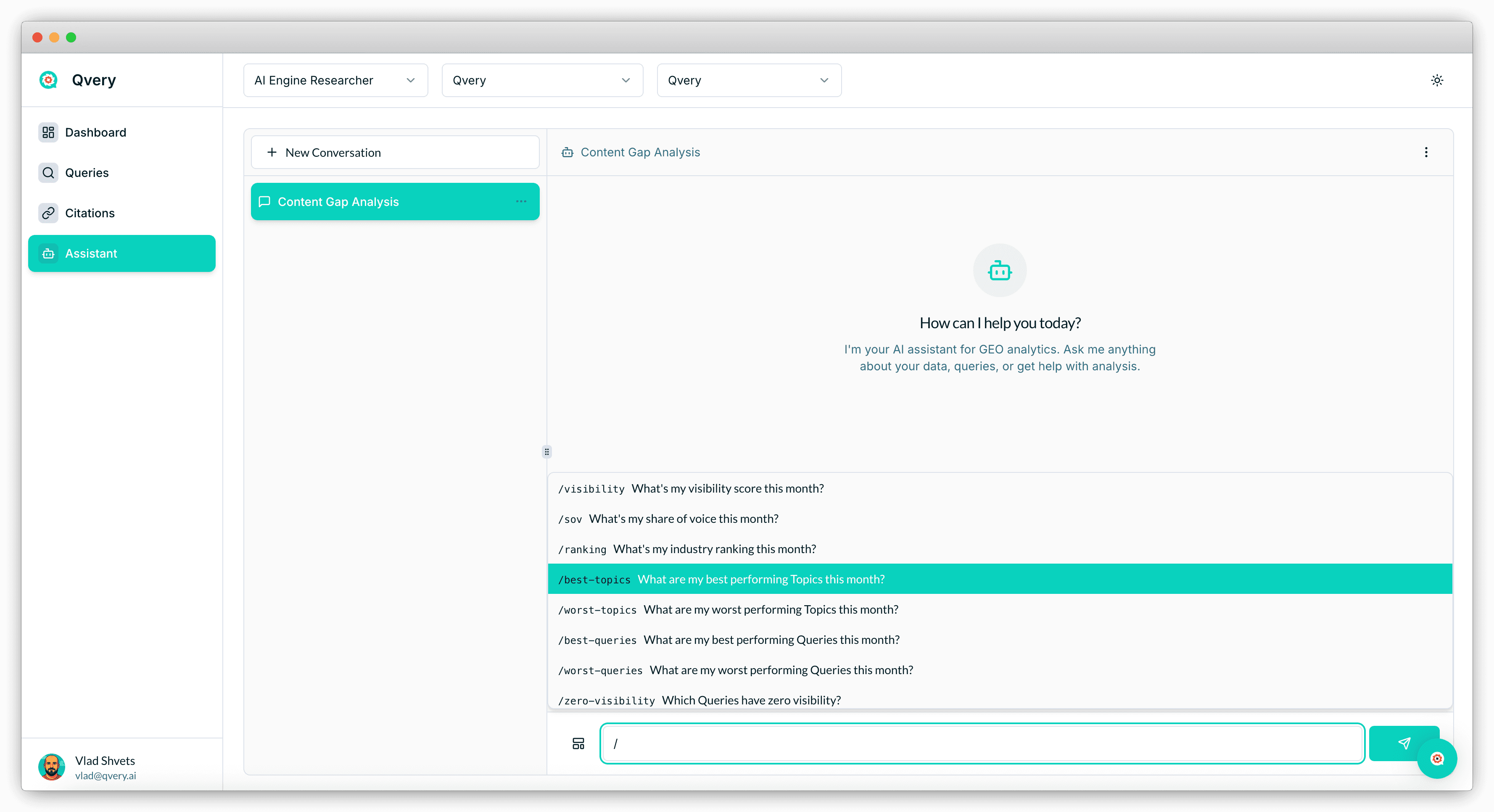
Qvery Assistant in the app: ask about your own visibility, share of voice, citation, topic, and query data in plain language, and have it add queries, trigger a run, or export a report.
Pricing:
Starter: €49/month for 1 brand and 25 tracked queries.
Growth: €99/month for 1 brand and 50 tracked queries.
Business: €199 for unlimited brands and 100 tracked queries; the pricing page shows no billing period on this tier.
All three include ChatGPT and Google AI Mode, daily query runs, unlimited countries, and unlimited seats, and the paid plans start with a free 7-day trial with no credit card.
Reddit Score: Too few independent mentions to score. Across all 20 mentions about Qvery the figure is 85.0% Positive, but 18 of those come from accounts on our own Reddit board. What one founder outside it wrote:
"I used Qvery to get data and to track AI mentions across relevant queries and I made it show what sources it was drawing from." (r/StartupsHelpStartups)
This is our product, so here is the workflow as it runs, and then what the pages don't claim.
You write the questions your customers ask, such as the best exchange for staking in Canada or whether a wallet is regulated in the UK, and they run every day on ChatGPT and Google AI Mode in each country you pick.
Each answer's citations arrive tied to the question and engine that produced them, so the regulator page cited on Google AI Mode in France is a separate line from the review site cited on ChatGPT in Canada. From there you ask Qvery Assistant in plain words which questions you are missing from, or have it export a report for the compliance file.
On the five criteria that is four: per-country, cited sources, an exported report, and product questions in each market you track. What the pages don't document is the answer text, so the risk-warning scene above is a thing you would have to open the engine to read. Visibility and share of voice tell you that you appeared, not whether you were recommended.
The demo question for us is the one for everyone: run your own exchange, custody or wallet questions in each market, then check whether appearing is enough for your reviewers. Start a free 7-day trial to run it; checkout is self-serve and needs no credit card.
2. OtterlyAI: Market-by-Market Visibility and Cited URLs
Key Features:
Cited URLs: "Every domain and URL cited in AI answers, checked daily, with link-position changes over time."
Markets: "See how your brand performs market by market, not as one global number that hides where you're invisible."
A public API that "lets you programmatically access brand reports, prompts, citations, and workspace data from the OtterlyAI platform."
Workspaces that let you "manage multiple brands and clients inside one OtterlyAI subscription."
Mention tracking: "Know when you're mentioned, when you're not, and how you stack up against competitors."
Pricing:
Lite: $29/month ($25/month billed annually), 15 search prompts.
Standard: $189/month ($160/month annually), 100 search prompts, API access.
Premium: $489/month ($422/month annually), 400 search prompts.
Enterprise: custom.
Google AI Mode is sold as an add-on on every self-serve tier: $9, $59 and $149 a month on Lite, Standard and Premium.
Reddit Score: 69.2% Positive, across 13 mentions about OtterlyAI. What redditors say:
"Otterly is fine as a third to compare against." A founder of a competing tool, who discloses it in the same comment. (r/SaaS)
OtterlyAI documents three of the five: markets, URL-level citations, and an API. For a crypto team that is a clean compliance trail, dated URLs by market, delivered to your own systems, as long as the tier you buy includes the API, which Lite does not.
What it does not document is the answer text, or product prompts per regulated market. Its mention tracking tells you when you were mentioned; nothing on the page separates a mention from a recommendation.
The pricing needs one line of arithmetic. Google AI Mode is an add-on, so the engine pair this list is about costs the tier plus $9, $59 or $149. Ask the demo whether the add-on's answers land in the same export as ChatGPT's.
3. Ahrefs: Raw-Response Inspection and AI Mode Rival Share of Voice

Key Features:
Stored responses: "We store the raw responses so you can search them for brand mentions (string matches) and citations (linked URLs)."
Top cited pages: "The specific URLs most frequently cited alongside your brand."
Rival comparison: "Compare your AI Mode share of voice against any competitor you choose."
Daily monitoring of AI Mode mentions and citations.
Charts and exports, with API and MCP access on the core plans.
Pricing:
Brand Radar AI: from $199/month. It can be bought on its own: "Yes, Brand Radar is available as a standalone tool. When you purchase it, you’ll also receive an Ahrefs Free account."
Core plans: Lite $129/month, Standard $249/month, Advanced $449/month, tracking 5, 10 and 20 AI prompts.
Enterprise: $1,499/month, annual commitment.
Reddit Score: 48.3% Positive, across 378 mentions about Ahrefs. What redditors say:
"You can use ahrefs if you want a better proxy." (r/Entrepreneur)
"we've had multiple prospects say this in the meetings as well that the numbers are wildly inaccurate." (r/SEO)
Ahrefs is the only tool on this list whose pages say you can read what the engine wrote, and for a crypto brand that answers the compliance question directly: search the stored responses for your name and read the sentence around it. It documents three of five, with cited URLs and exports alongside.
The catch is scope. Every quote above sits on the AI Mode tracker page, so whether ChatGPT answers get the same stored responses and share of voice is a demo question, as are per-country tracking and product prompts per market.
Most of those 378 mentions are about the SEO suite, which is worth remembering before reading 48.3% as a verdict on the AI tracker.
4. AthenaHQ: Cited-Source Monitoring Across Brands and Markets
Key Features:
Source Intelligence, which AthenaHQ describes as "Reveal the sources shaping AI answers."
Markets: "Operate across brands, markets, and models."
An API to "add visibility data to your own dashboards or build custom tools."
Competitor share of voice comparison and brand mention frequency tracking.
Multiple brands and business units tracked centrally.
Pricing:
Essential: free, with $25 of credit; ChatGPT, Perplexity, AI Overviews, Gemini and Copilot, and no Google AI Mode.
Starter: $295/month with 3,600 credits, one credit per AI response; Google AI Mode appears here.
Enterprise: custom, with multi-region and multi-language support.
Reddit Score: 57.1% Positive, across 7 mentions about AthenaHQ. What redditors say:
"AthenaHQ does this" (r/SaaS)
Seven mentions is a small base and most of them are one-liners, so the percentage is a direction, not a verdict.
AthenaHQ documents three of the five: markets, cited sources, and an API. Its competitor share-of-voice comparison matters when your compliance question is who gets named instead of you, and beside what.
The free tier is the thing to read carefully. It lists five engines and Google AI Mode is not one of them, so it cannot test half of what a crypto team needs; that starts at $295.
Ask whether Starter's API is included or a paid add-on (its row says "API access and extra credits available as paid add-ons"), and whether "Prompt and response analysis" means you can read the answer text.
5. Rankscale: Regional Monitoring and API Access
Key Features:
Both engines among many: "Track visibility in Google AI Overviews and AI Mode, plus ChatGPT, Perplexity, Gemini, Claude, Copilot, and DeepSeek, all 17+ engines in one platform."
Regions: 240+ regions and languages, listed on its homepage as global AI tracking.
Citations: "Discover where AI search engines cite your brand".
REST API: "Scale your search strategy with REST API access and a dedicated partner by your side."
Monitoring schedules from hourly to monthly, and multi-brand dashboards.
Pricing:
Essentials: from $20/month.
Pro: $99/month, 1,200 credits, up to 4,800 AI answers a month, 10 brand dashboards, with a 7-day free trial.
Growth: $385/month, up to 22,000 answers, 50 brand dashboards, REST API.
Enterprise: $780/month, up to 48,000 answers, 100 brand dashboards, REST API. Yearly billing saves 15%.
Reddit Score: 61.1% Positive, across 9 mentions about Rankscale. What redditors say:
"If you're only looking to analyze how AI grades your website, you could use the free audit from Rankscale.ai" (r/SEO)
Rankscale documents three of five: regions, citations and a REST API. Its region coverage is the widest stated number on this list, which suits a crypto brand checking many licensed markets, and its credit model means each engine per question costs a fraction of a credit, so both engines in many markets is a budget line you can calculate before signing.
It says citations, not URLs, so ask to see the page-level detail. Recommendation tracking, rival share of voice and which engine cited what are not documented, and the REST API starts on Growth, not Pro.
6. Peec AI: Engine-Labelled Citations and Continuous Tracking
Key Features:
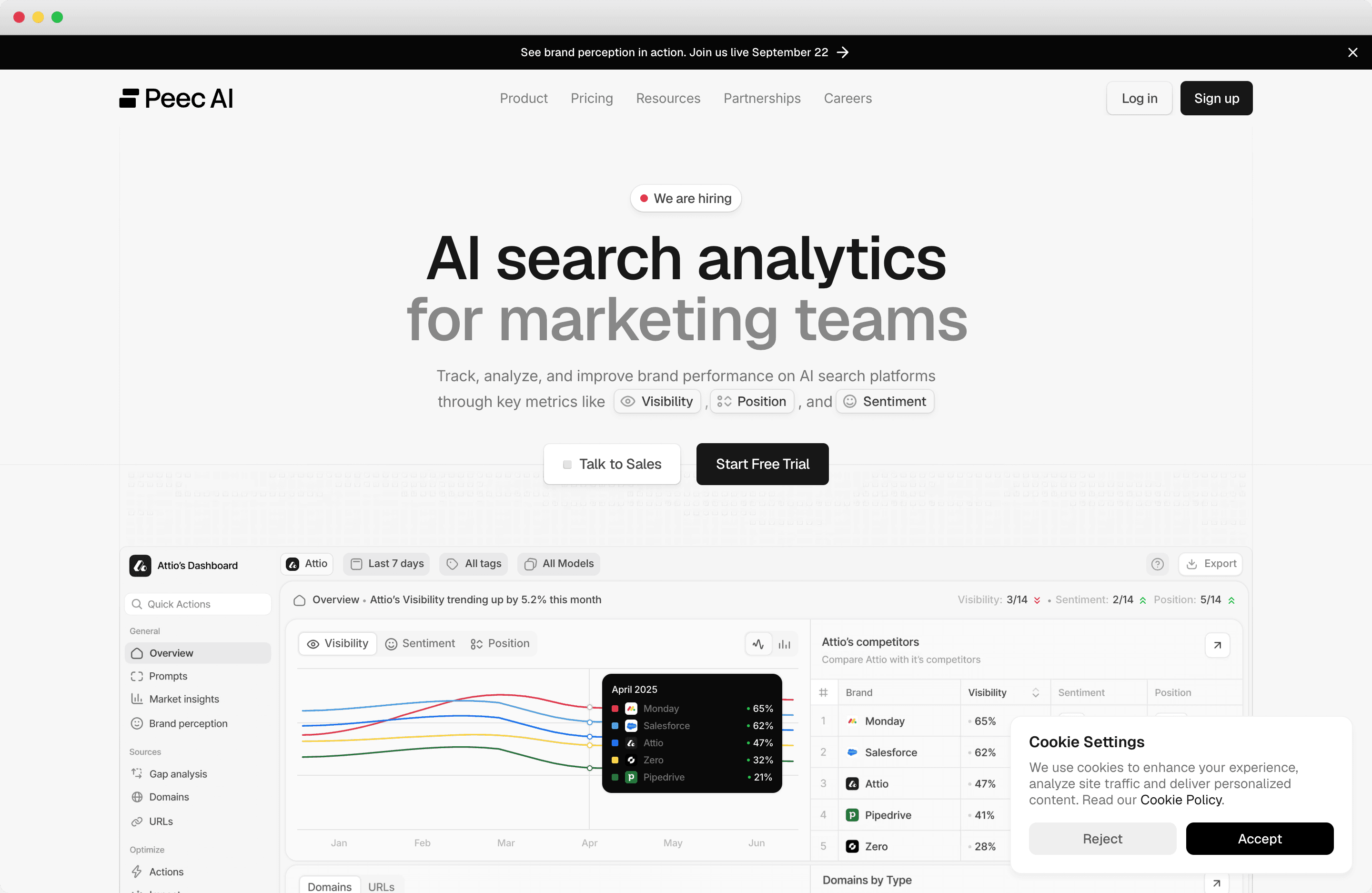
Engine-labelled sources: "which URLs and domains the engine drew on to generate its answer (ChatGPT sources, Google AI Mode citations, Gemini grounding sources)".
Countries: the homepage says "Track across all countries", and multi-country starts on the Advanced tier.
Share of voice: "Percentage of your brand mentions in AI responses compared to all tracked brands mentioned."
Appearance rate: "Percentage of AI responses where your brand appears."
Daily tracking on every self-serve tier.
Pricing:
Starter: $95/month, 50 prompts, choose 3 models, 1 project.
Pro: $245/month, 150 prompts, choose 3 models, 2 projects.
Advanced: $495/month, 350 prompts, 5 projects, multi-country.
Enterprise: custom, billed annually, with API access and up to 13 models tracked.
Reddit Score: 68.6% Positive, across 51 mentions about Peec AI. What redditors say:
"I've been using Peec, but it's nice to see how the other platforms compare since this space is changing so quickly." (r/SaaS)
"Have a look at promptwatch, peec, airefs (not ahrefs)" (r/GrowthHacking)
Peec is here as one of the leaderboard's top five, not for lens fit: it documents two of the five, markets and cited sources. Its citation line is the one that labels sources by engine, which answers the which-engine-cited-what check more directly than anything else on this list.
Answer text and product prompts per market are not documented, and API access appears only as an Enterprise tier row. Multi-country starts on Advanced, so a crypto team serving several markets starts at $495, and each self-serve tier reads "Choose 3 models", which is worth confirming includes both engines.
7. Profound: Answer-Engine Mention, Rank, and Description Records
Key Features:
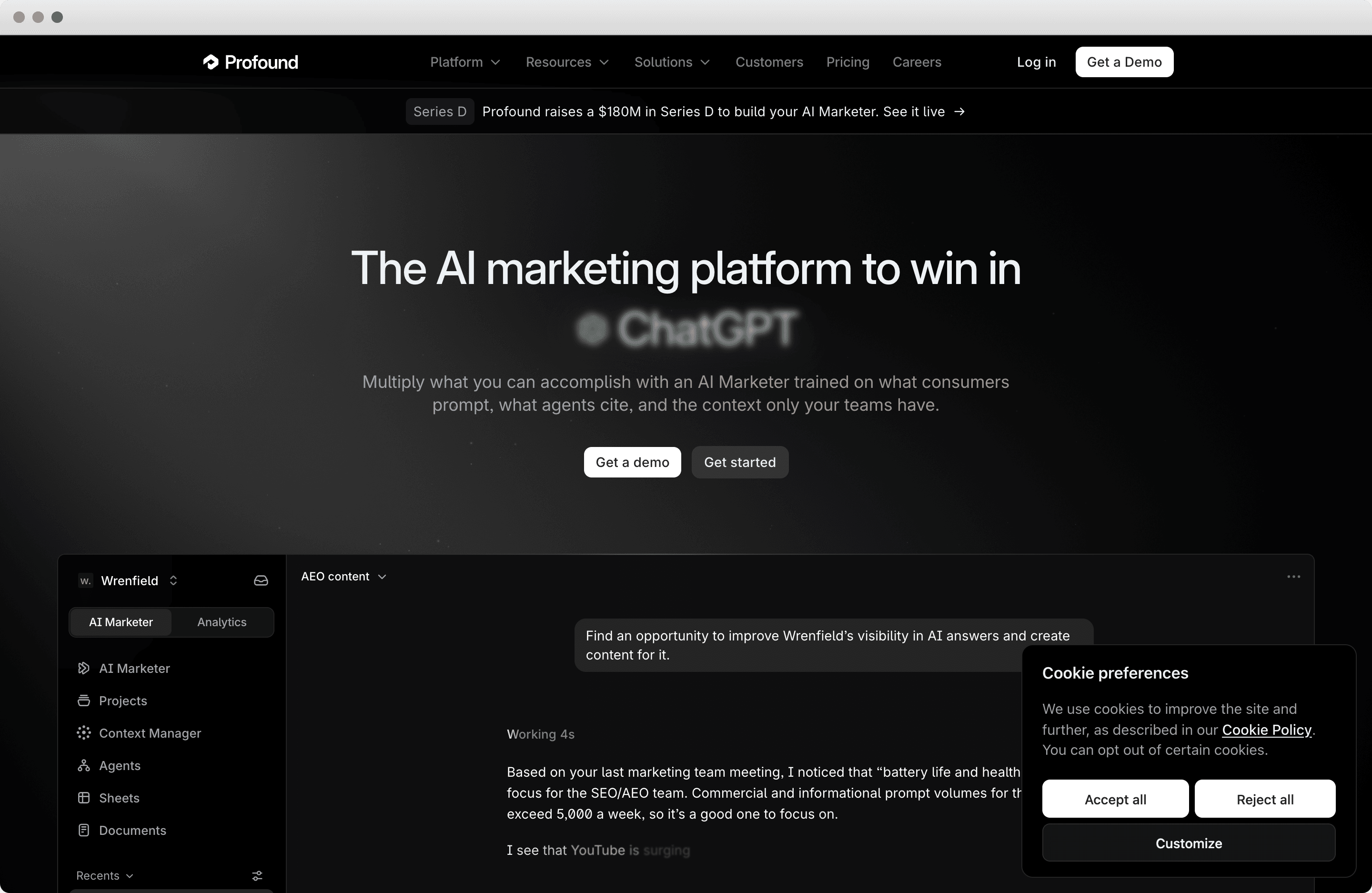
Citation Analysis, which Profound describes as "See which websites influence AI answers about your brand".
Answer Engine Insights: "Tracks how AI answer engines mention, rank, and describe a brand."
Agency Mode to "create and manage multiple brand environments within one platform."
Up to nine answer engines on Enterprise.
Pricing:
Trial: free, 50 prompts run daily for 7 days, on ChatGPT, Gemini and Google AI Overviews.
Enterprise: custom.
Reddit Score: Not available. One mention of Profound turned up in the threads we read, so there is no score, which is different from a low one.
Profound is in because it ranks second on our leaderboard, not for lens fit: it documents one of the five, cited sources. Its measurement line is the most interesting for a crypto brand, because "describe" is the closest any vendor here comes to the risk-warning question.
The trial runs on three engines that don't include Google AI Mode, its pricing rows list exports and API access on Enterprise only, and there is no published price, so both halves of the evaluation happen in the sales conversation: ask for Google AI Mode inside Enterprise, per-country tracking, the answer text, and an export.
8. Scrunch: Comparative Platform Views
Key Features:
Citations and sources on both plans, as a pricing-page row.
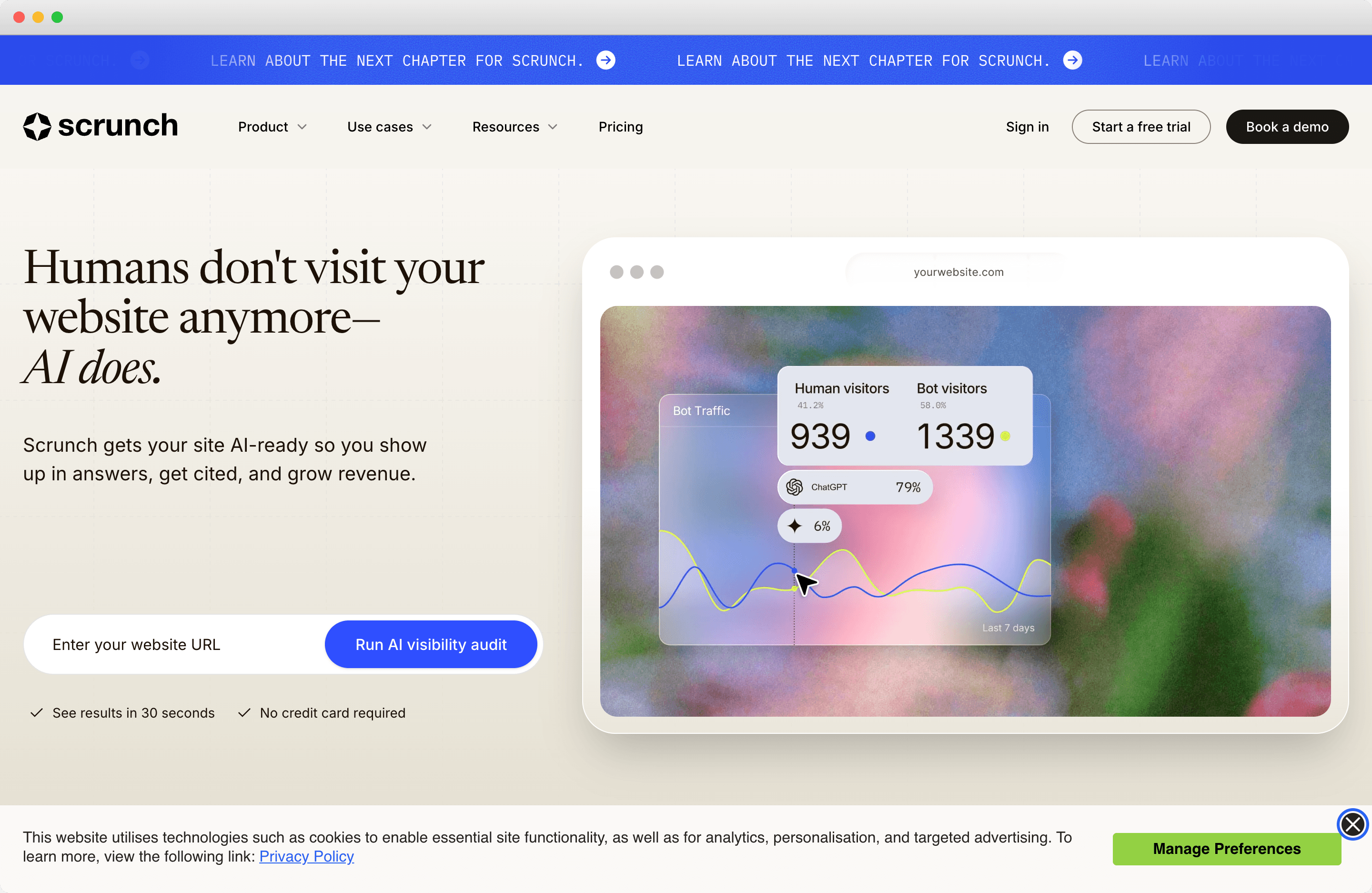
Platform comparison: "compare brand presence, competitive presence, position, sentiment, or citations across different AI platforms."
Competitors: five on Core, a custom number on Enterprise.
Nine models on Enterprise, Google AI Mode among them.
Pricing:
Core: $250/month, 125 unique prompts, 1 brand workspace, 1 country, four models that don't include Google AI Mode, and a 7-day free trial.
Enterprise: custom, with unlimited countries and API access.
Reddit Score: 50.0% Positive, across 5 mentions about Scrunch. The only comment among them came from an employee of a rival vendor, so there is no customer quote to show.
Scrunch is here as the sixth-ranked tool on our leaderboard, and its pricing rows document one of the five criteria, cited sources. Its comparison view filtered by AI platform is the closest it comes to showing which engine cited what.
Its pricing rows also list one country and no API on Core, with both on Enterprise. For a crypto team the first question is coverage: Core lists ChatGPT, Perplexity, Google AIO and Copilot, and Google AI Mode appears only on Enterprise, so both engines means a custom plan.
What This Review Cannot Tell You
This is a reading of vendor pages in September 2026. We trialled nothing, measured no outcomes, and ran no crypto question set through any tool, so nothing here says which tool is more accurate or how they compare in performance.
The roster is only as complete as its inputs: tools outside our leaderboard were not reviewed, and a tool excluded for not documenting both engines may still track them. No tool documents all five criteria. Ahrefs alone documents the answer text, no vendor page quotes product prompts tracked per regulatory market, and Qvery counts that criterion only because its questions are yours to write and run in any country.
A criterion marked not documented may still exist in the product; the pages just don't say so. A Reddit score reflects how people discuss a tool; fit for a crypto brand is a separate question the demo answers.
Choose by the Record You Cannot Leave Out
Start with the one record your compliance team will ask for first. If it is the exact words the engine used, Ahrefs is the only one that documents it. If it is dated, market-by-market citations delivered to your own systems, look at OtterlyAI, AthenaHQ and Rankscale, and check which tier carries the API.
If it is every citation tied to the question and engine that produced it, in any country, Qvery documents that.
Then make every shortlisted vendor run your own exchange, custody or wallet questions in each market you serve, in ChatGPT and in Google AI Mode separately, on the plan you would buy, and show you the answer text, the cited pages, a dated export, and whether you were recommended or only mentioned.
A compliance lead opens a ChatGPT answer about the safest place to buy bitcoin in Germany and finds the exchange named third, one line above a warning about unlicensed platforms. Compliance files it for Monday's review. In our crypto AI search study, the sites covering most recommendation answers covered only 22.85% of information answers that cited any source, so each kind of question needs its own list.
Qvery is ours and goes first. The other seven are the five highest-ranked tools on our competitor leaderboard, ranked by how often ChatGPT and Google AI Mode named each tool in our own runs from May to July 2026, that document both engines and publish pricing tiers or a custom plan, plus the two qualifying tools documenting the most criteria.
Five Records a Crypto Team Needs a Tool to Keep
Crypto is marketed one regulator at a time, and the AI answer about your product is something a compliance reviewer may have to sign off on. That makes five capabilities worth checking on a vendor's own pages:
Per-country tracking. The same questions asked in each market you are licensed to serve. The answer that counts is the one given where you may legally operate. Country coverage is not the same as tracking a regulatory market, which is criterion five.
Cited sources. Which exchanges, review sites, news outlets and regulator pages the answer drew on. Given the study figure above, you want this per kind of question. Only three tools here quote individual URLs.
The answer text. What the engine wrote. A crypto answer can name you beside a risk warning or a licensing caveat, and no score shows that. Ahrefs is the only tool here whose pages document it.
Export or API. Dated records that leave the tool, for a compliance file or your own reporting.
Product prompts per regulated market. Questions about a product category, exchange, custody or wallet, tracked as their own prompts in each regulatory market. Country tracking alone does not document this.
Each criterion is in one of three states for every tool. Documented means a line on the vendor's own page says it, quoted in the entry. Documented as not offered means the vendor says it does not; no tool here says that of a criterion across all its plans, though some single plans exclude one, noted in the entry.
Not documented means the pages are silent, and it goes on your demo list rather than counting against the tool.
Three checks sit beside the five in every entry, because they decide whether the records are usable: whether the tool reports you recommended or only mentioned, whether it compares you with rivals, and whether you can see which engine cited what. For the wider buying guide, see how to choose GEO software; for setting up the measurement itself, measuring a crypto brand's AI visibility.
1. Qvery: Query-and-Engine-Linked Citation Visibility
Key Features:
Every citation captured daily, tied to the query and the engine that produced it.
Daily tracking of visibility, share of voice, and average rank across ChatGPT and Google AI Mode, in 200+ countries.
Queries you write and edit, so exchange, custody and wallet questions can run in every country you track.
Share of voice against the other names in the same answers.
Qvery Assistant in the app: ask about your own visibility, share of voice, citation, topic, and query data in plain language, and have it add queries, trigger a run, or export a report.
Pricing:
Starter: €49/month for 1 brand and 25 tracked queries.
Growth: €99/month for 1 brand and 50 tracked queries.
Business: €199 for unlimited brands and 100 tracked queries; the pricing page shows no billing period on this tier.
All three include ChatGPT and Google AI Mode, daily query runs, unlimited countries, and unlimited seats, and the paid plans start with a free 7-day trial with no credit card.
Reddit Score: Too few independent mentions to score. Across all 20 mentions about Qvery the figure is 85.0% Positive, but 18 of those come from accounts on our own Reddit board. What one founder outside it wrote:
"I used Qvery to get data and to track AI mentions across relevant queries and I made it show what sources it was drawing from." (r/StartupsHelpStartups)
This is our product, so here is the workflow as it runs, and then what the pages don't claim.
You write the questions your customers ask, such as the best exchange for staking in Canada or whether a wallet is regulated in the UK, and they run every day on ChatGPT and Google AI Mode in each country you pick.
Each answer's citations arrive tied to the question and engine that produced them, so the regulator page cited on Google AI Mode in France is a separate line from the review site cited on ChatGPT in Canada. From there you ask Qvery Assistant in plain words which questions you are missing from, or have it export a report for the compliance file.
On the five criteria that is four: per-country, cited sources, an exported report, and product questions in each market you track. What the pages don't document is the answer text, so the risk-warning scene above is a thing you would have to open the engine to read. Visibility and share of voice tell you that you appeared, not whether you were recommended.
The demo question for us is the one for everyone: run your own exchange, custody or wallet questions in each market, then check whether appearing is enough for your reviewers. Start a free 7-day trial to run it; checkout is self-serve and needs no credit card.
2. OtterlyAI: Market-by-Market Visibility and Cited URLs
Key Features:
Cited URLs: "Every domain and URL cited in AI answers, checked daily, with link-position changes over time."
Markets: "See how your brand performs market by market, not as one global number that hides where you're invisible."
A public API that "lets you programmatically access brand reports, prompts, citations, and workspace data from the OtterlyAI platform."
Workspaces that let you "manage multiple brands and clients inside one OtterlyAI subscription."
Mention tracking: "Know when you're mentioned, when you're not, and how you stack up against competitors."
Pricing:
Lite: $29/month ($25/month billed annually), 15 search prompts.
Standard: $189/month ($160/month annually), 100 search prompts, API access.
Premium: $489/month ($422/month annually), 400 search prompts.
Enterprise: custom.
Google AI Mode is sold as an add-on on every self-serve tier: $9, $59 and $149 a month on Lite, Standard and Premium.
Reddit Score: 69.2% Positive, across 13 mentions about OtterlyAI. What redditors say:
"Otterly is fine as a third to compare against." A founder of a competing tool, who discloses it in the same comment. (r/SaaS)
OtterlyAI documents three of the five: markets, URL-level citations, and an API. For a crypto team that is a clean compliance trail, dated URLs by market, delivered to your own systems, as long as the tier you buy includes the API, which Lite does not.
What it does not document is the answer text, or product prompts per regulated market. Its mention tracking tells you when you were mentioned; nothing on the page separates a mention from a recommendation.
The pricing needs one line of arithmetic. Google AI Mode is an add-on, so the engine pair this list is about costs the tier plus $9, $59 or $149. Ask the demo whether the add-on's answers land in the same export as ChatGPT's.
3. Ahrefs: Raw-Response Inspection and AI Mode Rival Share of Voice
Key Features:
Stored responses: "We store the raw responses so you can search them for brand mentions (string matches) and citations (linked URLs)."
Top cited pages: "The specific URLs most frequently cited alongside your brand."
Rival comparison: "Compare your AI Mode share of voice against any competitor you choose."
Daily monitoring of AI Mode mentions and citations.
Charts and exports, with API and MCP access on the core plans.
Pricing:
Brand Radar AI: from $199/month. It can be bought on its own: "Yes, Brand Radar is available as a standalone tool. When you purchase it, you’ll also receive an Ahrefs Free account."
Core plans: Lite $129/month, Standard $249/month, Advanced $449/month, tracking 5, 10 and 20 AI prompts.
Enterprise: $1,499/month, annual commitment.
Reddit Score: 48.3% Positive, across 378 mentions about Ahrefs. What redditors say:
"You can use ahrefs if you want a better proxy." (r/Entrepreneur)
"we've had multiple prospects say this in the meetings as well that the numbers are wildly inaccurate." (r/SEO)
Ahrefs is the only tool on this list whose pages say you can read what the engine wrote, and for a crypto brand that answers the compliance question directly: search the stored responses for your name and read the sentence around it. It documents three of five, with cited URLs and exports alongside.
The catch is scope. Every quote above sits on the AI Mode tracker page, so whether ChatGPT answers get the same stored responses and share of voice is a demo question, as are per-country tracking and product prompts per market.
Most of those 378 mentions are about the SEO suite, which is worth remembering before reading 48.3% as a verdict on the AI tracker.
4. AthenaHQ: Cited-Source Monitoring Across Brands and Markets
Key Features:
Source Intelligence, which AthenaHQ describes as "Reveal the sources shaping AI answers."
Markets: "Operate across brands, markets, and models."
An API to "add visibility data to your own dashboards or build custom tools."
Competitor share of voice comparison and brand mention frequency tracking.
Multiple brands and business units tracked centrally.
Pricing:
Essential: free, with $25 of credit; ChatGPT, Perplexity, AI Overviews, Gemini and Copilot, and no Google AI Mode.
Starter: $295/month with 3,600 credits, one credit per AI response; Google AI Mode appears here.
Enterprise: custom, with multi-region and multi-language support.
Reddit Score: 57.1% Positive, across 7 mentions about AthenaHQ. What redditors say:
"AthenaHQ does this" (r/SaaS)
Seven mentions is a small base and most of them are one-liners, so the percentage is a direction, not a verdict.
AthenaHQ documents three of the five: markets, cited sources, and an API. Its competitor share-of-voice comparison matters when your compliance question is who gets named instead of you, and beside what.
The free tier is the thing to read carefully. It lists five engines and Google AI Mode is not one of them, so it cannot test half of what a crypto team needs; that starts at $295.
Ask whether Starter's API is included or a paid add-on (its row says "API access and extra credits available as paid add-ons"), and whether "Prompt and response analysis" means you can read the answer text.
5. Rankscale: Regional Monitoring and API Access
Key Features:
Both engines among many: "Track visibility in Google AI Overviews and AI Mode, plus ChatGPT, Perplexity, Gemini, Claude, Copilot, and DeepSeek, all 17+ engines in one platform."
Regions: 240+ regions and languages, listed on its homepage as global AI tracking.
Citations: "Discover where AI search engines cite your brand".
REST API: "Scale your search strategy with REST API access and a dedicated partner by your side."
Monitoring schedules from hourly to monthly, and multi-brand dashboards.
Pricing:
Essentials: from $20/month.
Pro: $99/month, 1,200 credits, up to 4,800 AI answers a month, 10 brand dashboards, with a 7-day free trial.
Growth: $385/month, up to 22,000 answers, 50 brand dashboards, REST API.
Enterprise: $780/month, up to 48,000 answers, 100 brand dashboards, REST API. Yearly billing saves 15%.
Reddit Score: 61.1% Positive, across 9 mentions about Rankscale. What redditors say:
"If you're only looking to analyze how AI grades your website, you could use the free audit from Rankscale.ai" (r/SEO)
Rankscale documents three of five: regions, citations and a REST API. Its region coverage is the widest stated number on this list, which suits a crypto brand checking many licensed markets, and its credit model means each engine per question costs a fraction of a credit, so both engines in many markets is a budget line you can calculate before signing.
It says citations, not URLs, so ask to see the page-level detail. Recommendation tracking, rival share of voice and which engine cited what are not documented, and the REST API starts on Growth, not Pro.
6. Peec AI: Engine-Labelled Citations and Continuous Tracking
Key Features:
Engine-labelled sources: "which URLs and domains the engine drew on to generate its answer (ChatGPT sources, Google AI Mode citations, Gemini grounding sources)".
Countries: the homepage says "Track across all countries", and multi-country starts on the Advanced tier.
Share of voice: "Percentage of your brand mentions in AI responses compared to all tracked brands mentioned."
Appearance rate: "Percentage of AI responses where your brand appears."
Daily tracking on every self-serve tier.
Pricing:
Starter: $95/month, 50 prompts, choose 3 models, 1 project.
Pro: $245/month, 150 prompts, choose 3 models, 2 projects.
Advanced: $495/month, 350 prompts, 5 projects, multi-country.
Enterprise: custom, billed annually, with API access and up to 13 models tracked.
Reddit Score: 68.6% Positive, across 51 mentions about Peec AI. What redditors say:
"I've been using Peec, but it's nice to see how the other platforms compare since this space is changing so quickly." (r/SaaS)
"Have a look at promptwatch, peec, airefs (not ahrefs)" (r/GrowthHacking)
Peec is here as one of the leaderboard's top five, not for lens fit: it documents two of the five, markets and cited sources. Its citation line is the one that labels sources by engine, which answers the which-engine-cited-what check more directly than anything else on this list.
Answer text and product prompts per market are not documented, and API access appears only as an Enterprise tier row. Multi-country starts on Advanced, so a crypto team serving several markets starts at $495, and each self-serve tier reads "Choose 3 models", which is worth confirming includes both engines.
7. Profound: Answer-Engine Mention, Rank, and Description Records
Key Features:
Citation Analysis, which Profound describes as "See which websites influence AI answers about your brand".
Answer Engine Insights: "Tracks how AI answer engines mention, rank, and describe a brand."
Agency Mode to "create and manage multiple brand environments within one platform."
Up to nine answer engines on Enterprise.
Pricing:
Trial: free, 50 prompts run daily for 7 days, on ChatGPT, Gemini and Google AI Overviews.
Enterprise: custom.
Reddit Score: Not available. One mention of Profound turned up in the threads we read, so there is no score, which is different from a low one.
Profound is in because it ranks second on our leaderboard, not for lens fit: it documents one of the five, cited sources. Its measurement line is the most interesting for a crypto brand, because "describe" is the closest any vendor here comes to the risk-warning question.
The trial runs on three engines that don't include Google AI Mode, its pricing rows list exports and API access on Enterprise only, and there is no published price, so both halves of the evaluation happen in the sales conversation: ask for Google AI Mode inside Enterprise, per-country tracking, the answer text, and an export.
8. Scrunch: Comparative Platform Views
Key Features:
Citations and sources on both plans, as a pricing-page row.
Platform comparison: "compare brand presence, competitive presence, position, sentiment, or citations across different AI platforms."
Competitors: five on Core, a custom number on Enterprise.
Nine models on Enterprise, Google AI Mode among them.
Pricing:
Core: $250/month, 125 unique prompts, 1 brand workspace, 1 country, four models that don't include Google AI Mode, and a 7-day free trial.
Enterprise: custom, with unlimited countries and API access.
Reddit Score: 50.0% Positive, across 5 mentions about Scrunch. The only comment among them came from an employee of a rival vendor, so there is no customer quote to show.
Scrunch is here as the sixth-ranked tool on our leaderboard, and its pricing rows document one of the five criteria, cited sources. Its comparison view filtered by AI platform is the closest it comes to showing which engine cited what.
Its pricing rows also list one country and no API on Core, with both on Enterprise. For a crypto team the first question is coverage: Core lists ChatGPT, Perplexity, Google AIO and Copilot, and Google AI Mode appears only on Enterprise, so both engines means a custom plan.
What This Review Cannot Tell You
This is a reading of vendor pages in September 2026. We trialled nothing, measured no outcomes, and ran no crypto question set through any tool, so nothing here says which tool is more accurate or how they compare in performance.
The roster is only as complete as its inputs: tools outside our leaderboard were not reviewed, and a tool excluded for not documenting both engines may still track them. No tool documents all five criteria. Ahrefs alone documents the answer text, no vendor page quotes product prompts tracked per regulatory market, and Qvery counts that criterion only because its questions are yours to write and run in any country.
A criterion marked not documented may still exist in the product; the pages just don't say so. A Reddit score reflects how people discuss a tool; fit for a crypto brand is a separate question the demo answers.
Choose by the Record You Cannot Leave Out
Start with the one record your compliance team will ask for first. If it is the exact words the engine used, Ahrefs is the only one that documents it. If it is dated, market-by-market citations delivered to your own systems, look at OtterlyAI, AthenaHQ and Rankscale, and check which tier carries the API.
If it is every citation tied to the question and engine that produced it, in any country, Qvery documents that.
Then make every shortlisted vendor run your own exchange, custody or wallet questions in each market you serve, in ChatGPT and in Google AI Mode separately, on the plan you would buy, and show you the answer text, the cited pages, a dated export, and whether you were recommended or only mentioned.
A compliance lead opens a ChatGPT answer about the safest place to buy bitcoin in Germany and finds the exchange named third, one line above a warning about unlicensed platforms. Compliance files it for Monday's review. In our crypto AI search study, the sites covering most recommendation answers covered only 22.85% of information answers that cited any source, so each kind of question needs its own list.
Qvery is ours and goes first. The other seven are the five highest-ranked tools on our competitor leaderboard, ranked by how often ChatGPT and Google AI Mode named each tool in our own runs from May to July 2026, that document both engines and publish pricing tiers or a custom plan, plus the two qualifying tools documenting the most criteria.
Five Records a Crypto Team Needs a Tool to Keep
Crypto is marketed one regulator at a time, and the AI answer about your product is something a compliance reviewer may have to sign off on. That makes five capabilities worth checking on a vendor's own pages:
Per-country tracking. The same questions asked in each market you are licensed to serve. The answer that counts is the one given where you may legally operate. Country coverage is not the same as tracking a regulatory market, which is criterion five.
Cited sources. Which exchanges, review sites, news outlets and regulator pages the answer drew on. Given the study figure above, you want this per kind of question. Only three tools here quote individual URLs.
The answer text. What the engine wrote. A crypto answer can name you beside a risk warning or a licensing caveat, and no score shows that. Ahrefs is the only tool here whose pages document it.
Export or API. Dated records that leave the tool, for a compliance file or your own reporting.
Product prompts per regulated market. Questions about a product category, exchange, custody or wallet, tracked as their own prompts in each regulatory market. Country tracking alone does not document this.
Each criterion is in one of three states for every tool. Documented means a line on the vendor's own page says it, quoted in the entry. Documented as not offered means the vendor says it does not; no tool here says that of a criterion across all its plans, though some single plans exclude one, noted in the entry.
Not documented means the pages are silent, and it goes on your demo list rather than counting against the tool.
Three checks sit beside the five in every entry, because they decide whether the records are usable: whether the tool reports you recommended or only mentioned, whether it compares you with rivals, and whether you can see which engine cited what. For the wider buying guide, see how to choose GEO software; for setting up the measurement itself, measuring a crypto brand's AI visibility.
1. Qvery: Query-and-Engine-Linked Citation Visibility
Key Features:
Every citation captured daily, tied to the query and the engine that produced it.
Daily tracking of visibility, share of voice, and average rank across ChatGPT and Google AI Mode, in 200+ countries.
Queries you write and edit, so exchange, custody and wallet questions can run in every country you track.
Share of voice against the other names in the same answers.
Qvery Assistant in the app: ask about your own visibility, share of voice, citation, topic, and query data in plain language, and have it add queries, trigger a run, or export a report.
Pricing:
Starter: €49/month for 1 brand and 25 tracked queries.
Growth: €99/month for 1 brand and 50 tracked queries.
Business: €199 for unlimited brands and 100 tracked queries; the pricing page shows no billing period on this tier.
All three include ChatGPT and Google AI Mode, daily query runs, unlimited countries, and unlimited seats, and the paid plans start with a free 7-day trial with no credit card.
Reddit Score: Too few independent mentions to score. Across all 20 mentions about Qvery the figure is 85.0% Positive, but 18 of those come from accounts on our own Reddit board. What one founder outside it wrote:
"I used Qvery to get data and to track AI mentions across relevant queries and I made it show what sources it was drawing from." (r/StartupsHelpStartups)
This is our product, so here is the workflow as it runs, and then what the pages don't claim.
You write the questions your customers ask, such as the best exchange for staking in Canada or whether a wallet is regulated in the UK, and they run every day on ChatGPT and Google AI Mode in each country you pick.
Each answer's citations arrive tied to the question and engine that produced them, so the regulator page cited on Google AI Mode in France is a separate line from the review site cited on ChatGPT in Canada. From there you ask Qvery Assistant in plain words which questions you are missing from, or have it export a report for the compliance file.
On the five criteria that is four: per-country, cited sources, an exported report, and product questions in each market you track. What the pages don't document is the answer text, so the risk-warning scene above is a thing you would have to open the engine to read. Visibility and share of voice tell you that you appeared, not whether you were recommended.
The demo question for us is the one for everyone: run your own exchange, custody or wallet questions in each market, then check whether appearing is enough for your reviewers. Start a free 7-day trial to run it; checkout is self-serve and needs no credit card.
2. OtterlyAI: Market-by-Market Visibility and Cited URLs
Key Features:
Cited URLs: "Every domain and URL cited in AI answers, checked daily, with link-position changes over time."
Markets: "See how your brand performs market by market, not as one global number that hides where you're invisible."
A public API that "lets you programmatically access brand reports, prompts, citations, and workspace data from the OtterlyAI platform."
Workspaces that let you "manage multiple brands and clients inside one OtterlyAI subscription."
Mention tracking: "Know when you're mentioned, when you're not, and how you stack up against competitors."
Pricing:
Lite: $29/month ($25/month billed annually), 15 search prompts.
Standard: $189/month ($160/month annually), 100 search prompts, API access.
Premium: $489/month ($422/month annually), 400 search prompts.
Enterprise: custom.
Google AI Mode is sold as an add-on on every self-serve tier: $9, $59 and $149 a month on Lite, Standard and Premium.
Reddit Score: 69.2% Positive, across 13 mentions about OtterlyAI. What redditors say:
"Otterly is fine as a third to compare against." A founder of a competing tool, who discloses it in the same comment. (r/SaaS)
OtterlyAI documents three of the five: markets, URL-level citations, and an API. For a crypto team that is a clean compliance trail, dated URLs by market, delivered to your own systems, as long as the tier you buy includes the API, which Lite does not.
What it does not document is the answer text, or product prompts per regulated market. Its mention tracking tells you when you were mentioned; nothing on the page separates a mention from a recommendation.
The pricing needs one line of arithmetic. Google AI Mode is an add-on, so the engine pair this list is about costs the tier plus $9, $59 or $149. Ask the demo whether the add-on's answers land in the same export as ChatGPT's.
3. Ahrefs: Raw-Response Inspection and AI Mode Rival Share of Voice
Key Features:
Stored responses: "We store the raw responses so you can search them for brand mentions (string matches) and citations (linked URLs)."
Top cited pages: "The specific URLs most frequently cited alongside your brand."
Rival comparison: "Compare your AI Mode share of voice against any competitor you choose."
Daily monitoring of AI Mode mentions and citations.
Charts and exports, with API and MCP access on the core plans.
Pricing:
Brand Radar AI: from $199/month. It can be bought on its own: "Yes, Brand Radar is available as a standalone tool. When you purchase it, you’ll also receive an Ahrefs Free account."
Core plans: Lite $129/month, Standard $249/month, Advanced $449/month, tracking 5, 10 and 20 AI prompts.
Enterprise: $1,499/month, annual commitment.
Reddit Score: 48.3% Positive, across 378 mentions about Ahrefs. What redditors say:
"You can use ahrefs if you want a better proxy." (r/Entrepreneur)
"we've had multiple prospects say this in the meetings as well that the numbers are wildly inaccurate." (r/SEO)
Ahrefs is the only tool on this list whose pages say you can read what the engine wrote, and for a crypto brand that answers the compliance question directly: search the stored responses for your name and read the sentence around it. It documents three of five, with cited URLs and exports alongside.
The catch is scope. Every quote above sits on the AI Mode tracker page, so whether ChatGPT answers get the same stored responses and share of voice is a demo question, as are per-country tracking and product prompts per market.
Most of those 378 mentions are about the SEO suite, which is worth remembering before reading 48.3% as a verdict on the AI tracker.
4. AthenaHQ: Cited-Source Monitoring Across Brands and Markets
Key Features:
Source Intelligence, which AthenaHQ describes as "Reveal the sources shaping AI answers."
Markets: "Operate across brands, markets, and models."
An API to "add visibility data to your own dashboards or build custom tools."
Competitor share of voice comparison and brand mention frequency tracking.
Multiple brands and business units tracked centrally.
Pricing:
Essential: free, with $25 of credit; ChatGPT, Perplexity, AI Overviews, Gemini and Copilot, and no Google AI Mode.
Starter: $295/month with 3,600 credits, one credit per AI response; Google AI Mode appears here.
Enterprise: custom, with multi-region and multi-language support.
Reddit Score: 57.1% Positive, across 7 mentions about AthenaHQ. What redditors say:
"AthenaHQ does this" (r/SaaS)
Seven mentions is a small base and most of them are one-liners, so the percentage is a direction, not a verdict.
AthenaHQ documents three of the five: markets, cited sources, and an API. Its competitor share-of-voice comparison matters when your compliance question is who gets named instead of you, and beside what.
The free tier is the thing to read carefully. It lists five engines and Google AI Mode is not one of them, so it cannot test half of what a crypto team needs; that starts at $295.
Ask whether Starter's API is included or a paid add-on (its row says "API access and extra credits available as paid add-ons"), and whether "Prompt and response analysis" means you can read the answer text.
5. Rankscale: Regional Monitoring and API Access
Key Features:
Both engines among many: "Track visibility in Google AI Overviews and AI Mode, plus ChatGPT, Perplexity, Gemini, Claude, Copilot, and DeepSeek, all 17+ engines in one platform."
Regions: 240+ regions and languages, listed on its homepage as global AI tracking.
Citations: "Discover where AI search engines cite your brand".
REST API: "Scale your search strategy with REST API access and a dedicated partner by your side."
Monitoring schedules from hourly to monthly, and multi-brand dashboards.
Pricing:
Essentials: from $20/month.
Pro: $99/month, 1,200 credits, up to 4,800 AI answers a month, 10 brand dashboards, with a 7-day free trial.
Growth: $385/month, up to 22,000 answers, 50 brand dashboards, REST API.
Enterprise: $780/month, up to 48,000 answers, 100 brand dashboards, REST API. Yearly billing saves 15%.
Reddit Score: 61.1% Positive, across 9 mentions about Rankscale. What redditors say:
"If you're only looking to analyze how AI grades your website, you could use the free audit from Rankscale.ai" (r/SEO)
Rankscale documents three of five: regions, citations and a REST API. Its region coverage is the widest stated number on this list, which suits a crypto brand checking many licensed markets, and its credit model means each engine per question costs a fraction of a credit, so both engines in many markets is a budget line you can calculate before signing.
It says citations, not URLs, so ask to see the page-level detail. Recommendation tracking, rival share of voice and which engine cited what are not documented, and the REST API starts on Growth, not Pro.
6. Peec AI: Engine-Labelled Citations and Continuous Tracking
Key Features:
Engine-labelled sources: "which URLs and domains the engine drew on to generate its answer (ChatGPT sources, Google AI Mode citations, Gemini grounding sources)".
Countries: the homepage says "Track across all countries", and multi-country starts on the Advanced tier.
Share of voice: "Percentage of your brand mentions in AI responses compared to all tracked brands mentioned."
Appearance rate: "Percentage of AI responses where your brand appears."
Daily tracking on every self-serve tier.
Pricing:
Starter: $95/month, 50 prompts, choose 3 models, 1 project.
Pro: $245/month, 150 prompts, choose 3 models, 2 projects.
Advanced: $495/month, 350 prompts, 5 projects, multi-country.
Enterprise: custom, billed annually, with API access and up to 13 models tracked.
Reddit Score: 68.6% Positive, across 51 mentions about Peec AI. What redditors say:
"I've been using Peec, but it's nice to see how the other platforms compare since this space is changing so quickly." (r/SaaS)
"Have a look at promptwatch, peec, airefs (not ahrefs)" (r/GrowthHacking)
Peec is here as one of the leaderboard's top five, not for lens fit: it documents two of the five, markets and cited sources. Its citation line is the one that labels sources by engine, which answers the which-engine-cited-what check more directly than anything else on this list.
Answer text and product prompts per market are not documented, and API access appears only as an Enterprise tier row. Multi-country starts on Advanced, so a crypto team serving several markets starts at $495, and each self-serve tier reads "Choose 3 models", which is worth confirming includes both engines.
7. Profound: Answer-Engine Mention, Rank, and Description Records
Key Features:
Citation Analysis, which Profound describes as "See which websites influence AI answers about your brand".
Answer Engine Insights: "Tracks how AI answer engines mention, rank, and describe a brand."
Agency Mode to "create and manage multiple brand environments within one platform."
Up to nine answer engines on Enterprise.
Pricing:
Trial: free, 50 prompts run daily for 7 days, on ChatGPT, Gemini and Google AI Overviews.
Enterprise: custom.
Reddit Score: Not available. One mention of Profound turned up in the threads we read, so there is no score, which is different from a low one.
Profound is in because it ranks second on our leaderboard, not for lens fit: it documents one of the five, cited sources. Its measurement line is the most interesting for a crypto brand, because "describe" is the closest any vendor here comes to the risk-warning question.
The trial runs on three engines that don't include Google AI Mode, its pricing rows list exports and API access on Enterprise only, and there is no published price, so both halves of the evaluation happen in the sales conversation: ask for Google AI Mode inside Enterprise, per-country tracking, the answer text, and an export.
8. Scrunch: Comparative Platform Views
Key Features:
Citations and sources on both plans, as a pricing-page row.
Platform comparison: "compare brand presence, competitive presence, position, sentiment, or citations across different AI platforms."
Competitors: five on Core, a custom number on Enterprise.
Nine models on Enterprise, Google AI Mode among them.
Pricing:
Core: $250/month, 125 unique prompts, 1 brand workspace, 1 country, four models that don't include Google AI Mode, and a 7-day free trial.
Enterprise: custom, with unlimited countries and API access.
Reddit Score: 50.0% Positive, across 5 mentions about Scrunch. The only comment among them came from an employee of a rival vendor, so there is no customer quote to show.
Scrunch is here as the sixth-ranked tool on our leaderboard, and its pricing rows document one of the five criteria, cited sources. Its comparison view filtered by AI platform is the closest it comes to showing which engine cited what.
Its pricing rows also list one country and no API on Core, with both on Enterprise. For a crypto team the first question is coverage: Core lists ChatGPT, Perplexity, Google AIO and Copilot, and Google AI Mode appears only on Enterprise, so both engines means a custom plan.
What This Review Cannot Tell You
This is a reading of vendor pages in September 2026. We trialled nothing, measured no outcomes, and ran no crypto question set through any tool, so nothing here says which tool is more accurate or how they compare in performance.
The roster is only as complete as its inputs: tools outside our leaderboard were not reviewed, and a tool excluded for not documenting both engines may still track them. No tool documents all five criteria. Ahrefs alone documents the answer text, no vendor page quotes product prompts tracked per regulatory market, and Qvery counts that criterion only because its questions are yours to write and run in any country.
A criterion marked not documented may still exist in the product; the pages just don't say so. A Reddit score reflects how people discuss a tool; fit for a crypto brand is a separate question the demo answers.
Choose by the Record You Cannot Leave Out
Start with the one record your compliance team will ask for first. If it is the exact words the engine used, Ahrefs is the only one that documents it. If it is dated, market-by-market citations delivered to your own systems, look at OtterlyAI, AthenaHQ and Rankscale, and check which tier carries the API.
If it is every citation tied to the question and engine that produced it, in any country, Qvery documents that.
Then make every shortlisted vendor run your own exchange, custody or wallet questions in each market you serve, in ChatGPT and in Google AI Mode separately, on the plan you would buy, and show you the answer text, the cited pages, a dated export, and whether you were recommended or only mentioned.
A compliance lead opens a ChatGPT answer about the safest place to buy bitcoin in Germany and finds the exchange named third, one line above a warning about unlicensed platforms. Compliance files it for Monday's review. In our crypto AI search study, the sites covering most recommendation answers covered only 22.85% of information answers that cited any source, so each kind of question needs its own list.
Qvery is ours and goes first. The other seven are the five highest-ranked tools on our competitor leaderboard, ranked by how often ChatGPT and Google AI Mode named each tool in our own runs from May to July 2026, that document both engines and publish pricing tiers or a custom plan, plus the two qualifying tools documenting the most criteria.
Five Records a Crypto Team Needs a Tool to Keep
Crypto is marketed one regulator at a time, and the AI answer about your product is something a compliance reviewer may have to sign off on. That makes five capabilities worth checking on a vendor's own pages:
Per-country tracking. The same questions asked in each market you are licensed to serve. The answer that counts is the one given where you may legally operate. Country coverage is not the same as tracking a regulatory market, which is criterion five.
Cited sources. Which exchanges, review sites, news outlets and regulator pages the answer drew on. Given the study figure above, you want this per kind of question. Only three tools here quote individual URLs.
The answer text. What the engine wrote. A crypto answer can name you beside a risk warning or a licensing caveat, and no score shows that. Ahrefs is the only tool here whose pages document it.
Export or API. Dated records that leave the tool, for a compliance file or your own reporting.
Product prompts per regulated market. Questions about a product category, exchange, custody or wallet, tracked as their own prompts in each regulatory market. Country tracking alone does not document this.
Each criterion is in one of three states for every tool. Documented means a line on the vendor's own page says it, quoted in the entry. Documented as not offered means the vendor says it does not; no tool here says that of a criterion across all its plans, though some single plans exclude one, noted in the entry.
Not documented means the pages are silent, and it goes on your demo list rather than counting against the tool.
Three checks sit beside the five in every entry, because they decide whether the records are usable: whether the tool reports you recommended or only mentioned, whether it compares you with rivals, and whether you can see which engine cited what. For the wider buying guide, see how to choose GEO software; for setting up the measurement itself, measuring a crypto brand's AI visibility.
1. Qvery: Query-and-Engine-Linked Citation Visibility
Key Features:
Every citation captured daily, tied to the query and the engine that produced it.
Daily tracking of visibility, share of voice, and average rank across ChatGPT and Google AI Mode, in 200+ countries.
Queries you write and edit, so exchange, custody and wallet questions can run in every country you track.
Share of voice against the other names in the same answers.
Qvery Assistant in the app: ask about your own visibility, share of voice, citation, topic, and query data in plain language, and have it add queries, trigger a run, or export a report.
Pricing:
Starter: €49/month for 1 brand and 25 tracked queries.
Growth: €99/month for 1 brand and 50 tracked queries.
Business: €199 for unlimited brands and 100 tracked queries; the pricing page shows no billing period on this tier.
All three include ChatGPT and Google AI Mode, daily query runs, unlimited countries, and unlimited seats, and the paid plans start with a free 7-day trial with no credit card.
Reddit Score: Too few independent mentions to score. Across all 20 mentions about Qvery the figure is 85.0% Positive, but 18 of those come from accounts on our own Reddit board. What one founder outside it wrote:
"I used Qvery to get data and to track AI mentions across relevant queries and I made it show what sources it was drawing from." (r/StartupsHelpStartups)
This is our product, so here is the workflow as it runs, and then what the pages don't claim.
You write the questions your customers ask, such as the best exchange for staking in Canada or whether a wallet is regulated in the UK, and they run every day on ChatGPT and Google AI Mode in each country you pick.
Each answer's citations arrive tied to the question and engine that produced them, so the regulator page cited on Google AI Mode in France is a separate line from the review site cited on ChatGPT in Canada. From there you ask Qvery Assistant in plain words which questions you are missing from, or have it export a report for the compliance file.
On the five criteria that is four: per-country, cited sources, an exported report, and product questions in each market you track. What the pages don't document is the answer text, so the risk-warning scene above is a thing you would have to open the engine to read. Visibility and share of voice tell you that you appeared, not whether you were recommended.
The demo question for us is the one for everyone: run your own exchange, custody or wallet questions in each market, then check whether appearing is enough for your reviewers. Start a free 7-day trial to run it; checkout is self-serve and needs no credit card.
2. OtterlyAI: Market-by-Market Visibility and Cited URLs
Key Features:
Cited URLs: "Every domain and URL cited in AI answers, checked daily, with link-position changes over time."
Markets: "See how your brand performs market by market, not as one global number that hides where you're invisible."
A public API that "lets you programmatically access brand reports, prompts, citations, and workspace data from the OtterlyAI platform."
Workspaces that let you "manage multiple brands and clients inside one OtterlyAI subscription."
Mention tracking: "Know when you're mentioned, when you're not, and how you stack up against competitors."
Pricing:
Lite: $29/month ($25/month billed annually), 15 search prompts.
Standard: $189/month ($160/month annually), 100 search prompts, API access.
Premium: $489/month ($422/month annually), 400 search prompts.
Enterprise: custom.
Google AI Mode is sold as an add-on on every self-serve tier: $9, $59 and $149 a month on Lite, Standard and Premium.
Reddit Score: 69.2% Positive, across 13 mentions about OtterlyAI. What redditors say:
"Otterly is fine as a third to compare against." A founder of a competing tool, who discloses it in the same comment. (r/SaaS)
OtterlyAI documents three of the five: markets, URL-level citations, and an API. For a crypto team that is a clean compliance trail, dated URLs by market, delivered to your own systems, as long as the tier you buy includes the API, which Lite does not.
What it does not document is the answer text, or product prompts per regulated market. Its mention tracking tells you when you were mentioned; nothing on the page separates a mention from a recommendation.
The pricing needs one line of arithmetic. Google AI Mode is an add-on, so the engine pair this list is about costs the tier plus $9, $59 or $149. Ask the demo whether the add-on's answers land in the same export as ChatGPT's.
3. Ahrefs: Raw-Response Inspection and AI Mode Rival Share of Voice
Key Features:
Stored responses: "We store the raw responses so you can search them for brand mentions (string matches) and citations (linked URLs)."
Top cited pages: "The specific URLs most frequently cited alongside your brand."
Rival comparison: "Compare your AI Mode share of voice against any competitor you choose."
Daily monitoring of AI Mode mentions and citations.
Charts and exports, with API and MCP access on the core plans.
Pricing:
Brand Radar AI: from $199/month. It can be bought on its own: "Yes, Brand Radar is available as a standalone tool. When you purchase it, you’ll also receive an Ahrefs Free account."
Core plans: Lite $129/month, Standard $249/month, Advanced $449/month, tracking 5, 10 and 20 AI prompts.
Enterprise: $1,499/month, annual commitment.
Reddit Score: 48.3% Positive, across 378 mentions about Ahrefs. What redditors say:
"You can use ahrefs if you want a better proxy." (r/Entrepreneur)
"we've had multiple prospects say this in the meetings as well that the numbers are wildly inaccurate." (r/SEO)
Ahrefs is the only tool on this list whose pages say you can read what the engine wrote, and for a crypto brand that answers the compliance question directly: search the stored responses for your name and read the sentence around it. It documents three of five, with cited URLs and exports alongside.
The catch is scope. Every quote above sits on the AI Mode tracker page, so whether ChatGPT answers get the same stored responses and share of voice is a demo question, as are per-country tracking and product prompts per market.
Most of those 378 mentions are about the SEO suite, which is worth remembering before reading 48.3% as a verdict on the AI tracker.
4. AthenaHQ: Cited-Source Monitoring Across Brands and Markets
Key Features:
Source Intelligence, which AthenaHQ describes as "Reveal the sources shaping AI answers."
Markets: "Operate across brands, markets, and models."
An API to "add visibility data to your own dashboards or build custom tools."
Competitor share of voice comparison and brand mention frequency tracking.
Multiple brands and business units tracked centrally.
Pricing:
Essential: free, with $25 of credit; ChatGPT, Perplexity, AI Overviews, Gemini and Copilot, and no Google AI Mode.
Starter: $295/month with 3,600 credits, one credit per AI response; Google AI Mode appears here.
Enterprise: custom, with multi-region and multi-language support.
Reddit Score: 57.1% Positive, across 7 mentions about AthenaHQ. What redditors say:
"AthenaHQ does this" (r/SaaS)
Seven mentions is a small base and most of them are one-liners, so the percentage is a direction, not a verdict.
AthenaHQ documents three of the five: markets, cited sources, and an API. Its competitor share-of-voice comparison matters when your compliance question is who gets named instead of you, and beside what.
The free tier is the thing to read carefully. It lists five engines and Google AI Mode is not one of them, so it cannot test half of what a crypto team needs; that starts at $295.
Ask whether Starter's API is included or a paid add-on (its row says "API access and extra credits available as paid add-ons"), and whether "Prompt and response analysis" means you can read the answer text.
5. Rankscale: Regional Monitoring and API Access
Key Features:
Both engines among many: "Track visibility in Google AI Overviews and AI Mode, plus ChatGPT, Perplexity, Gemini, Claude, Copilot, and DeepSeek, all 17+ engines in one platform."
Regions: 240+ regions and languages, listed on its homepage as global AI tracking.
Citations: "Discover where AI search engines cite your brand".
REST API: "Scale your search strategy with REST API access and a dedicated partner by your side."
Monitoring schedules from hourly to monthly, and multi-brand dashboards.
Pricing:
Essentials: from $20/month.
Pro: $99/month, 1,200 credits, up to 4,800 AI answers a month, 10 brand dashboards, with a 7-day free trial.
Growth: $385/month, up to 22,000 answers, 50 brand dashboards, REST API.
Enterprise: $780/month, up to 48,000 answers, 100 brand dashboards, REST API. Yearly billing saves 15%.
Reddit Score: 61.1% Positive, across 9 mentions about Rankscale. What redditors say:
"If you're only looking to analyze how AI grades your website, you could use the free audit from Rankscale.ai" (r/SEO)
Rankscale documents three of five: regions, citations and a REST API. Its region coverage is the widest stated number on this list, which suits a crypto brand checking many licensed markets, and its credit model means each engine per question costs a fraction of a credit, so both engines in many markets is a budget line you can calculate before signing.
It says citations, not URLs, so ask to see the page-level detail. Recommendation tracking, rival share of voice and which engine cited what are not documented, and the REST API starts on Growth, not Pro.
6. Peec AI: Engine-Labelled Citations and Continuous Tracking
Key Features:
Engine-labelled sources: "which URLs and domains the engine drew on to generate its answer (ChatGPT sources, Google AI Mode citations, Gemini grounding sources)".
Countries: the homepage says "Track across all countries", and multi-country starts on the Advanced tier.
Share of voice: "Percentage of your brand mentions in AI responses compared to all tracked brands mentioned."
Appearance rate: "Percentage of AI responses where your brand appears."
Daily tracking on every self-serve tier.
Pricing:
Starter: $95/month, 50 prompts, choose 3 models, 1 project.
Pro: $245/month, 150 prompts, choose 3 models, 2 projects.
Advanced: $495/month, 350 prompts, 5 projects, multi-country.
Enterprise: custom, billed annually, with API access and up to 13 models tracked.
Reddit Score: 68.6% Positive, across 51 mentions about Peec AI. What redditors say:
"I've been using Peec, but it's nice to see how the other platforms compare since this space is changing so quickly." (r/SaaS)
"Have a look at promptwatch, peec, airefs (not ahrefs)" (r/GrowthHacking)
Peec is here as one of the leaderboard's top five, not for lens fit: it documents two of the five, markets and cited sources. Its citation line is the one that labels sources by engine, which answers the which-engine-cited-what check more directly than anything else on this list.
Answer text and product prompts per market are not documented, and API access appears only as an Enterprise tier row. Multi-country starts on Advanced, so a crypto team serving several markets starts at $495, and each self-serve tier reads "Choose 3 models", which is worth confirming includes both engines.
7. Profound: Answer-Engine Mention, Rank, and Description Records
Key Features:
Citation Analysis, which Profound describes as "See which websites influence AI answers about your brand".
Answer Engine Insights: "Tracks how AI answer engines mention, rank, and describe a brand."
Agency Mode to "create and manage multiple brand environments within one platform."
Up to nine answer engines on Enterprise.
Pricing:
Trial: free, 50 prompts run daily for 7 days, on ChatGPT, Gemini and Google AI Overviews.
Enterprise: custom.
Reddit Score: Not available. One mention of Profound turned up in the threads we read, so there is no score, which is different from a low one.
Profound is in because it ranks second on our leaderboard, not for lens fit: it documents one of the five, cited sources. Its measurement line is the most interesting for a crypto brand, because "describe" is the closest any vendor here comes to the risk-warning question.
The trial runs on three engines that don't include Google AI Mode, its pricing rows list exports and API access on Enterprise only, and there is no published price, so both halves of the evaluation happen in the sales conversation: ask for Google AI Mode inside Enterprise, per-country tracking, the answer text, and an export.
8. Scrunch: Comparative Platform Views
Key Features:
Citations and sources on both plans, as a pricing-page row.
Platform comparison: "compare brand presence, competitive presence, position, sentiment, or citations across different AI platforms."
Competitors: five on Core, a custom number on Enterprise.
Nine models on Enterprise, Google AI Mode among them.
Pricing:
Core: $250/month, 125 unique prompts, 1 brand workspace, 1 country, four models that don't include Google AI Mode, and a 7-day free trial.
Enterprise: custom, with unlimited countries and API access.
Reddit Score: 50.0% Positive, across 5 mentions about Scrunch. The only comment among them came from an employee of a rival vendor, so there is no customer quote to show.
Scrunch is here as the sixth-ranked tool on our leaderboard, and its pricing rows document one of the five criteria, cited sources. Its comparison view filtered by AI platform is the closest it comes to showing which engine cited what.
Its pricing rows also list one country and no API on Core, with both on Enterprise. For a crypto team the first question is coverage: Core lists ChatGPT, Perplexity, Google AIO and Copilot, and Google AI Mode appears only on Enterprise, so both engines means a custom plan.
What This Review Cannot Tell You
This is a reading of vendor pages in September 2026. We trialled nothing, measured no outcomes, and ran no crypto question set through any tool, so nothing here says which tool is more accurate or how they compare in performance.
The roster is only as complete as its inputs: tools outside our leaderboard were not reviewed, and a tool excluded for not documenting both engines may still track them. No tool documents all five criteria. Ahrefs alone documents the answer text, no vendor page quotes product prompts tracked per regulatory market, and Qvery counts that criterion only because its questions are yours to write and run in any country.
A criterion marked not documented may still exist in the product; the pages just don't say so. A Reddit score reflects how people discuss a tool; fit for a crypto brand is a separate question the demo answers.
Choose by the Record You Cannot Leave Out
Start with the one record your compliance team will ask for first. If it is the exact words the engine used, Ahrefs is the only one that documents it. If it is dated, market-by-market citations delivered to your own systems, look at OtterlyAI, AthenaHQ and Rankscale, and check which tier carries the API.
If it is every citation tied to the question and engine that produced it, in any country, Qvery documents that.
Then make every shortlisted vendor run your own exchange, custody or wallet questions in each market you serve, in ChatGPT and in Google AI Mode separately, on the plan you would buy, and show you the answer text, the cited pages, a dated export, and whether you were recommended or only mentioned.

© 2026 Qvery AI OÜ