By
Vlad Shvets
Crypto AI Search Statistics: What ChatGPT and Google AI Mode Cite
What ChatGPT and Google AI Mode cite when they answer crypto questions: brand-owned sites and platforms by question type and by engine, with two ready-to-use audit lists.
What ChatGPT and Google AI Mode cite when they answer crypto questions: brand-owned sites and platforms by question type and by engine, with two ready-to-use audit lists.
What ChatGPT and Google AI Mode cite when they answer crypto questions: brand-owned sites and platforms by question type and by engine, with two ready-to-use audit lists.
Most crypto marketers checking AI answers start by asking whether their brand shows up. A more useful first question is which kinds of sites the answers lean on, because it changes with what the person asked. In September's crypto questions, brand-owned sites appear alongside 82.75% of recommendation answers (595 of 719) and 39.94% of informational answers (123 of 308).
Platforms and communities follow the same direction at a lower level: 22.95% of recommendation answers (165 of 719) against 6.49% of informational ones (20 of 308). All four are shares of all valid answers, ChatGPT and Google AI Mode with runs pooled, and they count what appeared alongside an answer, never why.
One decision follows from that.
Audit brand-owned and platform citations separately for questions that ask what to buy and questions that ask how something works, because the two question types lean on different layers at very different rates.
The corpus is a fresh set of crypto questions, answered by both engines in September 2026.
The audience asking them is not small: OpenAI's consumer-usage study, published in September 2025, put ChatGPT at 700 million weekly active users, and Google said in June 2026 that AI Mode had surpassed one billion monthly users. One count is weekly and the other monthly, so the two are never added or compared.
Where those people say they look is a separate question. In Kraken's survey of U.S. crypto holders, published in December 2024, 61% named social media and influencers as a source for new trading opportunities, 50% named news outlets, blogs and podcasts, 47% named sites like CoinMarketCap and CoinGecko, and 24% named friends and family. That is what holders report about themselves, not an explanation of what the engines cite.
What Was Measured
The June crypto query strings were run again, word for word, in September: three ChatGPT runs and one Google AI Mode run per question, pooled at that three-to-one mix. That gives 719 valid recommendation answers (540 ChatGPT, 179 Google AI Mode) and 308 valid informational answers (231 ChatGPT, 77 Google AI Mode).
Two denominators appear below, named once here. The layer rates are shares of all valid answers in the slice. The audit lists are of answers that cited any source: 709 recommendation and 267 informational answers.
The source layers are validated domain labels: brand-owned domains, and platform or community domains such as reddit.com and youtube.com. June's sources were stored differently, so no June figure appears and nothing here is a trend.
How Often Crypto Answers Cite Brand Sites and Communities
Brand-owned sites appear alongside 82.75% of recommendation answers (595 of 719) and 39.94% of informational answers (123 of 308), a ratio of 2.07. Platforms and communities appear alongside 22.95% (165 of 719) and 6.49% (20 of 308), a ratio of 3.53. Both layers lean toward recommendation answers, and no answer in either slice was left unresolved.
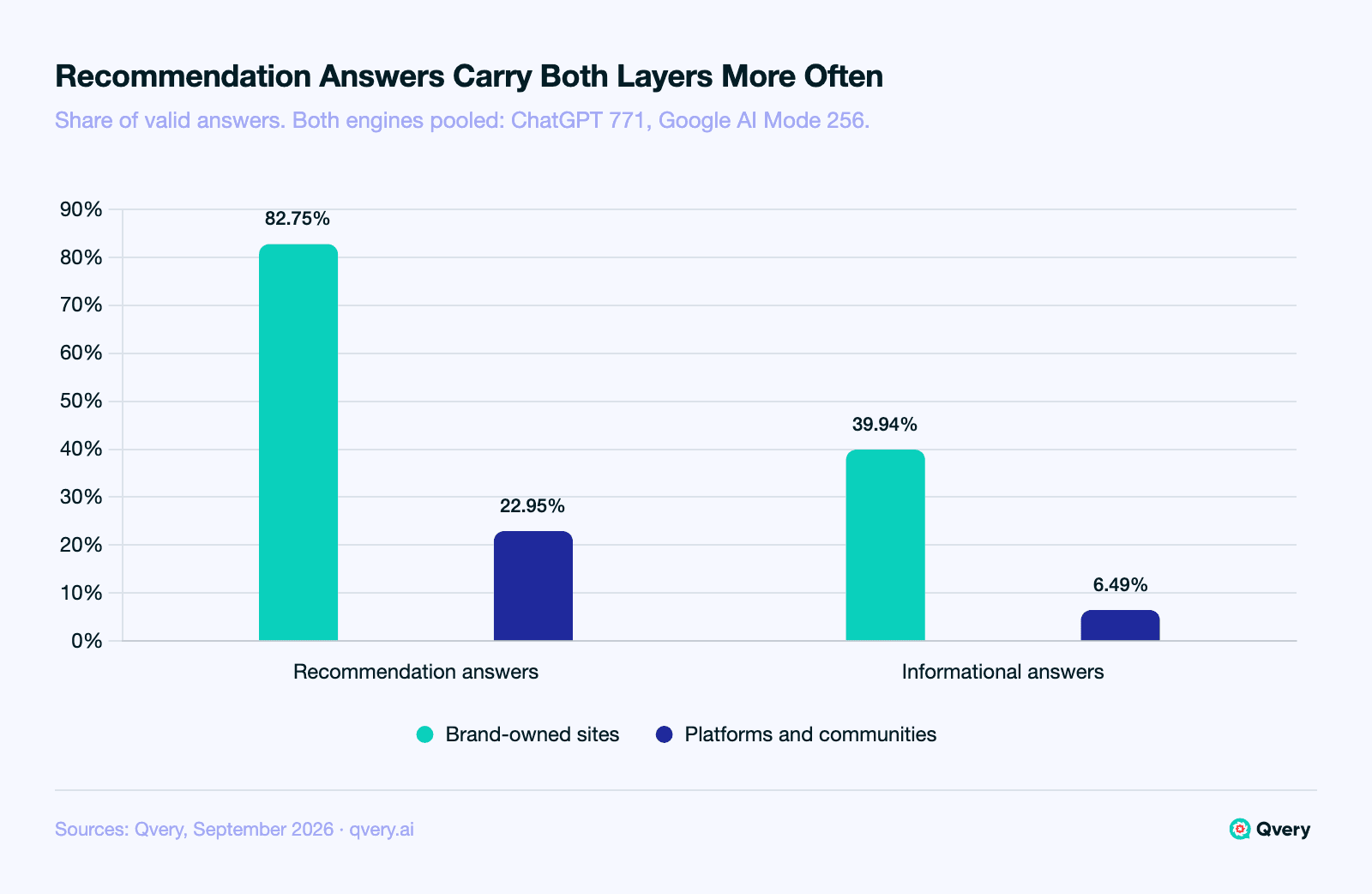
So a single brand-site check across a mixed crypto query set averages two very different rates. Set one baseline for the questions that ask which exchange, wallet or tracker to use, and a separate one for the questions that ask how staking, taxes or custody work.
Our guide to getting ChatGPT to recommend a crypto brand made its own cut on a different sample, B2B against retail questions. Its sections on the split that should change your plan and how often your own site appears are the related reading.
The brand-owned rate here counts any brand's domain, not only yours.
The brand-owned layer carries recommendation answers about twice as often as explanations, so one blended rate hides which kind of question it came from.
Inside recommendation answers, the engines split on one layer and not the other.
The same guide's look at what the engines do differently covers the wider engine picture; here are this corpus's two figures, shares of all valid recommendation answers for each engine:
Platforms and communities: Google AI Mode 55.87% (100 of 179) against ChatGPT 12.04% (65 of 540), a ChatGPT-to-Google ratio of 0.22, the Google AI Mode direction.
Brand-owned sites: ChatGPT 87.78% (474 of 540) against Google AI Mode 67.60% (121 of 179), a ratio of 1.30, which falls in the indeterminate band, so no direction is claimed.
Before the runs we predicted ChatGPT would carry the higher rate on both layers.
Neither delivered it: the platform layer went firmly the other way and the brand-owned layer did not clear the bar for any direction.
Which Sites the Engines Cite for Each Kind of Crypto Question
Of answers that cited any source, each question type needs four domains to cover half of its cited answers. The lists that reach 80% are short, and they are different.
Recommendation 80% list (covers 80% of recommendation answers that cited any source, 709 answers): coinbureau.com, coinbase.com, ledger.com, reddit.com, coinstats.app, opensea.io, koinly.io, aave.com, nerdwallet.com, bitcoinfoundation.org. The first four are the 50% head.
Informational 80% list (covers 80% of informational answers that cited any source, 267 answers): ethereum.org, irs.gov, coinbase.com, investor.gov, sec.gov, ftc.gov, ledger.com, bitcoin.org, uniswap.org, fincen.gov, imf.org. The first four are the 50% head.
Cross-coverage: the recommendation list covers 22.85% of informational answers that cited any source, and the informational list covers 34.84% of recommendation answers that cited any source. The smaller, 0.2285, sits well under the 0.60 bar, so each question type gets its own list.
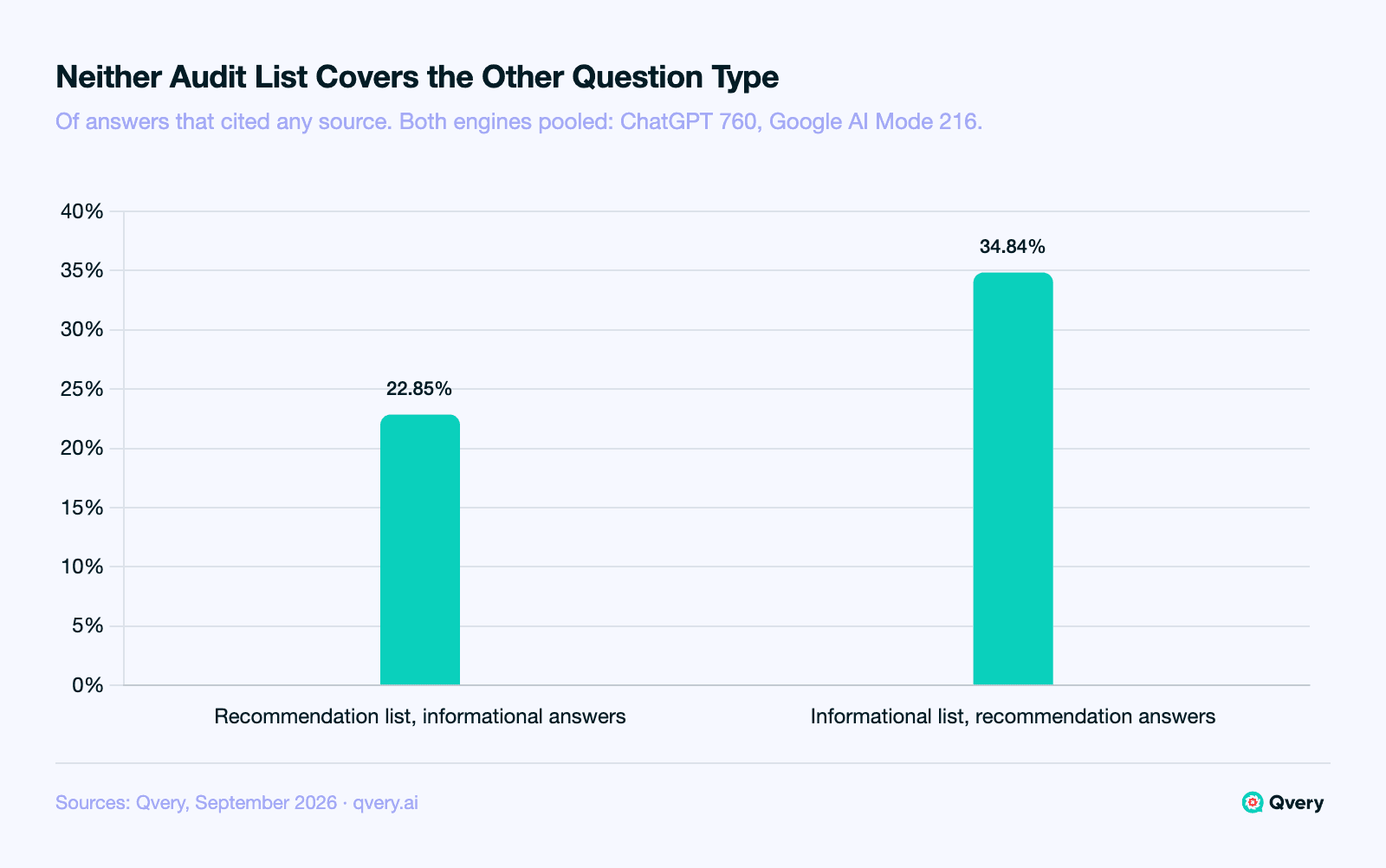
Two domains sit on both lists: coinbase.com and ledger.com.
For how to build and run a list like this, the same guide's section on building the audit is the method; its lists came from a different split, so compare the approach, not the domains.
Track Recommendation and Informational Questions Separately in Qvery
Everything above comes from one fresh set of questions. Yours will be different, and in Qvery you add and edit your own topics and queries, so the questions that ask what to buy and the ones that ask how it works can sit in two separate topics.
Qvery tracks visibility, share of voice and average rank across ChatGPT and Google AI Mode daily, in 200+ countries, and ties every citation to the query and engine that produced it. That is how you see which domains show up in the answers to your own questions, engine by engine.
Qvery Assistant sits in the app and answers plain-language questions about your own data. For a separate look at crypto buying questions, our crypto brand measurement guide ran its own sample.
Start your free trial: 7 days free on the paid plans, with self-serve checkout and no credit card required.
What These Numbers Do Not Say
The layer rates are shares of all valid answers in each slice: 719 recommendation and 308 informational answers pooled, and for the engine figures 540 ChatGPT and 179 Google AI Mode recommendation answers. The lists and cross-coverage are shares of answers that cited any source: 709 and 267.
Nothing here compares June with September, and nothing explains why a source appeared. No naming or recommendation rate was measured, so a cited domain is not a recommended brand. The engine figures are co-occurrence, not advice on which engine to prefer. The Kraken, OpenAI and Google figures describe their own populations, not this corpus.
What to Do With This
Audit brand-owned and platform citations separately for crypto questions that ask what to use and questions that ask how things work: brand-owned sites sit alongside 82.75% of the first and 39.94% of the second.
Then read your recommendation answers engine by engine for platforms and communities, which appear alongside 55.87% of Google AI Mode recommendation answers and 12.04% of ChatGPT's, as measured co-occurrence.
Most crypto marketers checking AI answers start by asking whether their brand shows up. A more useful first question is which kinds of sites the answers lean on, because it changes with what the person asked. In September's crypto questions, brand-owned sites appear alongside 82.75% of recommendation answers (595 of 719) and 39.94% of informational answers (123 of 308).
Platforms and communities follow the same direction at a lower level: 22.95% of recommendation answers (165 of 719) against 6.49% of informational ones (20 of 308). All four are shares of all valid answers, ChatGPT and Google AI Mode with runs pooled, and they count what appeared alongside an answer, never why.
One decision follows from that.
Audit brand-owned and platform citations separately for questions that ask what to buy and questions that ask how something works, because the two question types lean on different layers at very different rates.
The corpus is a fresh set of crypto questions, answered by both engines in September 2026.
The audience asking them is not small: OpenAI's consumer-usage study, published in September 2025, put ChatGPT at 700 million weekly active users, and Google said in June 2026 that AI Mode had surpassed one billion monthly users. One count is weekly and the other monthly, so the two are never added or compared.
Where those people say they look is a separate question. In Kraken's survey of U.S. crypto holders, published in December 2024, 61% named social media and influencers as a source for new trading opportunities, 50% named news outlets, blogs and podcasts, 47% named sites like CoinMarketCap and CoinGecko, and 24% named friends and family. That is what holders report about themselves, not an explanation of what the engines cite.
What Was Measured
The June crypto query strings were run again, word for word, in September: three ChatGPT runs and one Google AI Mode run per question, pooled at that three-to-one mix. That gives 719 valid recommendation answers (540 ChatGPT, 179 Google AI Mode) and 308 valid informational answers (231 ChatGPT, 77 Google AI Mode).
Two denominators appear below, named once here. The layer rates are shares of all valid answers in the slice. The audit lists are of answers that cited any source: 709 recommendation and 267 informational answers.
The source layers are validated domain labels: brand-owned domains, and platform or community domains such as reddit.com and youtube.com. June's sources were stored differently, so no June figure appears and nothing here is a trend.
How Often Crypto Answers Cite Brand Sites and Communities
Brand-owned sites appear alongside 82.75% of recommendation answers (595 of 719) and 39.94% of informational answers (123 of 308), a ratio of 2.07. Platforms and communities appear alongside 22.95% (165 of 719) and 6.49% (20 of 308), a ratio of 3.53. Both layers lean toward recommendation answers, and no answer in either slice was left unresolved.
So a single brand-site check across a mixed crypto query set averages two very different rates. Set one baseline for the questions that ask which exchange, wallet or tracker to use, and a separate one for the questions that ask how staking, taxes or custody work.
Our guide to getting ChatGPT to recommend a crypto brand made its own cut on a different sample, B2B against retail questions. Its sections on the split that should change your plan and how often your own site appears are the related reading.
The brand-owned rate here counts any brand's domain, not only yours.
The brand-owned layer carries recommendation answers about twice as often as explanations, so one blended rate hides which kind of question it came from.
Inside recommendation answers, the engines split on one layer and not the other.
The same guide's look at what the engines do differently covers the wider engine picture; here are this corpus's two figures, shares of all valid recommendation answers for each engine:
Platforms and communities: Google AI Mode 55.87% (100 of 179) against ChatGPT 12.04% (65 of 540), a ChatGPT-to-Google ratio of 0.22, the Google AI Mode direction.
Brand-owned sites: ChatGPT 87.78% (474 of 540) against Google AI Mode 67.60% (121 of 179), a ratio of 1.30, which falls in the indeterminate band, so no direction is claimed.
Before the runs we predicted ChatGPT would carry the higher rate on both layers.
Neither delivered it: the platform layer went firmly the other way and the brand-owned layer did not clear the bar for any direction.
Which Sites the Engines Cite for Each Kind of Crypto Question
Of answers that cited any source, each question type needs four domains to cover half of its cited answers. The lists that reach 80% are short, and they are different.
Recommendation 80% list (covers 80% of recommendation answers that cited any source, 709 answers): coinbureau.com, coinbase.com, ledger.com, reddit.com, coinstats.app, opensea.io, koinly.io, aave.com, nerdwallet.com, bitcoinfoundation.org. The first four are the 50% head.
Informational 80% list (covers 80% of informational answers that cited any source, 267 answers): ethereum.org, irs.gov, coinbase.com, investor.gov, sec.gov, ftc.gov, ledger.com, bitcoin.org, uniswap.org, fincen.gov, imf.org. The first four are the 50% head.
Cross-coverage: the recommendation list covers 22.85% of informational answers that cited any source, and the informational list covers 34.84% of recommendation answers that cited any source. The smaller, 0.2285, sits well under the 0.60 bar, so each question type gets its own list.
Two domains sit on both lists: coinbase.com and ledger.com.
For how to build and run a list like this, the same guide's section on building the audit is the method; its lists came from a different split, so compare the approach, not the domains.
Track Recommendation and Informational Questions Separately in Qvery
Everything above comes from one fresh set of questions. Yours will be different, and in Qvery you add and edit your own topics and queries, so the questions that ask what to buy and the ones that ask how it works can sit in two separate topics.
Qvery tracks visibility, share of voice and average rank across ChatGPT and Google AI Mode daily, in 200+ countries, and ties every citation to the query and engine that produced it. That is how you see which domains show up in the answers to your own questions, engine by engine.
Qvery Assistant sits in the app and answers plain-language questions about your own data. For a separate look at crypto buying questions, our crypto brand measurement guide ran its own sample.
Start your free trial: 7 days free on the paid plans, with self-serve checkout and no credit card required.
What These Numbers Do Not Say
The layer rates are shares of all valid answers in each slice: 719 recommendation and 308 informational answers pooled, and for the engine figures 540 ChatGPT and 179 Google AI Mode recommendation answers. The lists and cross-coverage are shares of answers that cited any source: 709 and 267.
Nothing here compares June with September, and nothing explains why a source appeared. No naming or recommendation rate was measured, so a cited domain is not a recommended brand. The engine figures are co-occurrence, not advice on which engine to prefer. The Kraken, OpenAI and Google figures describe their own populations, not this corpus.
What to Do With This
Audit brand-owned and platform citations separately for crypto questions that ask what to use and questions that ask how things work: brand-owned sites sit alongside 82.75% of the first and 39.94% of the second.
Then read your recommendation answers engine by engine for platforms and communities, which appear alongside 55.87% of Google AI Mode recommendation answers and 12.04% of ChatGPT's, as measured co-occurrence.
Most crypto marketers checking AI answers start by asking whether their brand shows up. A more useful first question is which kinds of sites the answers lean on, because it changes with what the person asked. In September's crypto questions, brand-owned sites appear alongside 82.75% of recommendation answers (595 of 719) and 39.94% of informational answers (123 of 308).
Platforms and communities follow the same direction at a lower level: 22.95% of recommendation answers (165 of 719) against 6.49% of informational ones (20 of 308). All four are shares of all valid answers, ChatGPT and Google AI Mode with runs pooled, and they count what appeared alongside an answer, never why.
One decision follows from that.
Audit brand-owned and platform citations separately for questions that ask what to buy and questions that ask how something works, because the two question types lean on different layers at very different rates.
The corpus is a fresh set of crypto questions, answered by both engines in September 2026.
The audience asking them is not small: OpenAI's consumer-usage study, published in September 2025, put ChatGPT at 700 million weekly active users, and Google said in June 2026 that AI Mode had surpassed one billion monthly users. One count is weekly and the other monthly, so the two are never added or compared.
Where those people say they look is a separate question. In Kraken's survey of U.S. crypto holders, published in December 2024, 61% named social media and influencers as a source for new trading opportunities, 50% named news outlets, blogs and podcasts, 47% named sites like CoinMarketCap and CoinGecko, and 24% named friends and family. That is what holders report about themselves, not an explanation of what the engines cite.
What Was Measured
The June crypto query strings were run again, word for word, in September: three ChatGPT runs and one Google AI Mode run per question, pooled at that three-to-one mix. That gives 719 valid recommendation answers (540 ChatGPT, 179 Google AI Mode) and 308 valid informational answers (231 ChatGPT, 77 Google AI Mode).
Two denominators appear below, named once here. The layer rates are shares of all valid answers in the slice. The audit lists are of answers that cited any source: 709 recommendation and 267 informational answers.
The source layers are validated domain labels: brand-owned domains, and platform or community domains such as reddit.com and youtube.com. June's sources were stored differently, so no June figure appears and nothing here is a trend.
How Often Crypto Answers Cite Brand Sites and Communities
Brand-owned sites appear alongside 82.75% of recommendation answers (595 of 719) and 39.94% of informational answers (123 of 308), a ratio of 2.07. Platforms and communities appear alongside 22.95% (165 of 719) and 6.49% (20 of 308), a ratio of 3.53. Both layers lean toward recommendation answers, and no answer in either slice was left unresolved.
So a single brand-site check across a mixed crypto query set averages two very different rates. Set one baseline for the questions that ask which exchange, wallet or tracker to use, and a separate one for the questions that ask how staking, taxes or custody work.
Our guide to getting ChatGPT to recommend a crypto brand made its own cut on a different sample, B2B against retail questions. Its sections on the split that should change your plan and how often your own site appears are the related reading.
The brand-owned rate here counts any brand's domain, not only yours.
The brand-owned layer carries recommendation answers about twice as often as explanations, so one blended rate hides which kind of question it came from.
Inside recommendation answers, the engines split on one layer and not the other.
The same guide's look at what the engines do differently covers the wider engine picture; here are this corpus's two figures, shares of all valid recommendation answers for each engine:
Platforms and communities: Google AI Mode 55.87% (100 of 179) against ChatGPT 12.04% (65 of 540), a ChatGPT-to-Google ratio of 0.22, the Google AI Mode direction.
Brand-owned sites: ChatGPT 87.78% (474 of 540) against Google AI Mode 67.60% (121 of 179), a ratio of 1.30, which falls in the indeterminate band, so no direction is claimed.
Before the runs we predicted ChatGPT would carry the higher rate on both layers.
Neither delivered it: the platform layer went firmly the other way and the brand-owned layer did not clear the bar for any direction.
Which Sites the Engines Cite for Each Kind of Crypto Question
Of answers that cited any source, each question type needs four domains to cover half of its cited answers. The lists that reach 80% are short, and they are different.
Recommendation 80% list (covers 80% of recommendation answers that cited any source, 709 answers): coinbureau.com, coinbase.com, ledger.com, reddit.com, coinstats.app, opensea.io, koinly.io, aave.com, nerdwallet.com, bitcoinfoundation.org. The first four are the 50% head.
Informational 80% list (covers 80% of informational answers that cited any source, 267 answers): ethereum.org, irs.gov, coinbase.com, investor.gov, sec.gov, ftc.gov, ledger.com, bitcoin.org, uniswap.org, fincen.gov, imf.org. The first four are the 50% head.
Cross-coverage: the recommendation list covers 22.85% of informational answers that cited any source, and the informational list covers 34.84% of recommendation answers that cited any source. The smaller, 0.2285, sits well under the 0.60 bar, so each question type gets its own list.
Two domains sit on both lists: coinbase.com and ledger.com.
For how to build and run a list like this, the same guide's section on building the audit is the method; its lists came from a different split, so compare the approach, not the domains.
Track Recommendation and Informational Questions Separately in Qvery
Everything above comes from one fresh set of questions. Yours will be different, and in Qvery you add and edit your own topics and queries, so the questions that ask what to buy and the ones that ask how it works can sit in two separate topics.
Qvery tracks visibility, share of voice and average rank across ChatGPT and Google AI Mode daily, in 200+ countries, and ties every citation to the query and engine that produced it. That is how you see which domains show up in the answers to your own questions, engine by engine.
Qvery Assistant sits in the app and answers plain-language questions about your own data. For a separate look at crypto buying questions, our crypto brand measurement guide ran its own sample.
Start your free trial: 7 days free on the paid plans, with self-serve checkout and no credit card required.
What These Numbers Do Not Say
The layer rates are shares of all valid answers in each slice: 719 recommendation and 308 informational answers pooled, and for the engine figures 540 ChatGPT and 179 Google AI Mode recommendation answers. The lists and cross-coverage are shares of answers that cited any source: 709 and 267.
Nothing here compares June with September, and nothing explains why a source appeared. No naming or recommendation rate was measured, so a cited domain is not a recommended brand. The engine figures are co-occurrence, not advice on which engine to prefer. The Kraken, OpenAI and Google figures describe their own populations, not this corpus.
What to Do With This
Audit brand-owned and platform citations separately for crypto questions that ask what to use and questions that ask how things work: brand-owned sites sit alongside 82.75% of the first and 39.94% of the second.
Then read your recommendation answers engine by engine for platforms and communities, which appear alongside 55.87% of Google AI Mode recommendation answers and 12.04% of ChatGPT's, as measured co-occurrence.
Most crypto marketers checking AI answers start by asking whether their brand shows up. A more useful first question is which kinds of sites the answers lean on, because it changes with what the person asked. In September's crypto questions, brand-owned sites appear alongside 82.75% of recommendation answers (595 of 719) and 39.94% of informational answers (123 of 308).
Platforms and communities follow the same direction at a lower level: 22.95% of recommendation answers (165 of 719) against 6.49% of informational ones (20 of 308). All four are shares of all valid answers, ChatGPT and Google AI Mode with runs pooled, and they count what appeared alongside an answer, never why.
One decision follows from that.
Audit brand-owned and platform citations separately for questions that ask what to buy and questions that ask how something works, because the two question types lean on different layers at very different rates.
The corpus is a fresh set of crypto questions, answered by both engines in September 2026.
The audience asking them is not small: OpenAI's consumer-usage study, published in September 2025, put ChatGPT at 700 million weekly active users, and Google said in June 2026 that AI Mode had surpassed one billion monthly users. One count is weekly and the other monthly, so the two are never added or compared.
Where those people say they look is a separate question. In Kraken's survey of U.S. crypto holders, published in December 2024, 61% named social media and influencers as a source for new trading opportunities, 50% named news outlets, blogs and podcasts, 47% named sites like CoinMarketCap and CoinGecko, and 24% named friends and family. That is what holders report about themselves, not an explanation of what the engines cite.
What Was Measured
The June crypto query strings were run again, word for word, in September: three ChatGPT runs and one Google AI Mode run per question, pooled at that three-to-one mix. That gives 719 valid recommendation answers (540 ChatGPT, 179 Google AI Mode) and 308 valid informational answers (231 ChatGPT, 77 Google AI Mode).
Two denominators appear below, named once here. The layer rates are shares of all valid answers in the slice. The audit lists are of answers that cited any source: 709 recommendation and 267 informational answers.
The source layers are validated domain labels: brand-owned domains, and platform or community domains such as reddit.com and youtube.com. June's sources were stored differently, so no June figure appears and nothing here is a trend.
How Often Crypto Answers Cite Brand Sites and Communities
Brand-owned sites appear alongside 82.75% of recommendation answers (595 of 719) and 39.94% of informational answers (123 of 308), a ratio of 2.07. Platforms and communities appear alongside 22.95% (165 of 719) and 6.49% (20 of 308), a ratio of 3.53. Both layers lean toward recommendation answers, and no answer in either slice was left unresolved.
So a single brand-site check across a mixed crypto query set averages two very different rates. Set one baseline for the questions that ask which exchange, wallet or tracker to use, and a separate one for the questions that ask how staking, taxes or custody work.
Our guide to getting ChatGPT to recommend a crypto brand made its own cut on a different sample, B2B against retail questions. Its sections on the split that should change your plan and how often your own site appears are the related reading.
The brand-owned rate here counts any brand's domain, not only yours.
The brand-owned layer carries recommendation answers about twice as often as explanations, so one blended rate hides which kind of question it came from.
Inside recommendation answers, the engines split on one layer and not the other.
The same guide's look at what the engines do differently covers the wider engine picture; here are this corpus's two figures, shares of all valid recommendation answers for each engine:
Platforms and communities: Google AI Mode 55.87% (100 of 179) against ChatGPT 12.04% (65 of 540), a ChatGPT-to-Google ratio of 0.22, the Google AI Mode direction.
Brand-owned sites: ChatGPT 87.78% (474 of 540) against Google AI Mode 67.60% (121 of 179), a ratio of 1.30, which falls in the indeterminate band, so no direction is claimed.
Before the runs we predicted ChatGPT would carry the higher rate on both layers.
Neither delivered it: the platform layer went firmly the other way and the brand-owned layer did not clear the bar for any direction.
Which Sites the Engines Cite for Each Kind of Crypto Question
Of answers that cited any source, each question type needs four domains to cover half of its cited answers. The lists that reach 80% are short, and they are different.
Recommendation 80% list (covers 80% of recommendation answers that cited any source, 709 answers): coinbureau.com, coinbase.com, ledger.com, reddit.com, coinstats.app, opensea.io, koinly.io, aave.com, nerdwallet.com, bitcoinfoundation.org. The first four are the 50% head.
Informational 80% list (covers 80% of informational answers that cited any source, 267 answers): ethereum.org, irs.gov, coinbase.com, investor.gov, sec.gov, ftc.gov, ledger.com, bitcoin.org, uniswap.org, fincen.gov, imf.org. The first four are the 50% head.
Cross-coverage: the recommendation list covers 22.85% of informational answers that cited any source, and the informational list covers 34.84% of recommendation answers that cited any source. The smaller, 0.2285, sits well under the 0.60 bar, so each question type gets its own list.
Two domains sit on both lists: coinbase.com and ledger.com.
For how to build and run a list like this, the same guide's section on building the audit is the method; its lists came from a different split, so compare the approach, not the domains.
Track Recommendation and Informational Questions Separately in Qvery
Everything above comes from one fresh set of questions. Yours will be different, and in Qvery you add and edit your own topics and queries, so the questions that ask what to buy and the ones that ask how it works can sit in two separate topics.
Qvery tracks visibility, share of voice and average rank across ChatGPT and Google AI Mode daily, in 200+ countries, and ties every citation to the query and engine that produced it. That is how you see which domains show up in the answers to your own questions, engine by engine.
Qvery Assistant sits in the app and answers plain-language questions about your own data. For a separate look at crypto buying questions, our crypto brand measurement guide ran its own sample.
Start your free trial: 7 days free on the paid plans, with self-serve checkout and no credit card required.
What These Numbers Do Not Say
The layer rates are shares of all valid answers in each slice: 719 recommendation and 308 informational answers pooled, and for the engine figures 540 ChatGPT and 179 Google AI Mode recommendation answers. The lists and cross-coverage are shares of answers that cited any source: 709 and 267.
Nothing here compares June with September, and nothing explains why a source appeared. No naming or recommendation rate was measured, so a cited domain is not a recommended brand. The engine figures are co-occurrence, not advice on which engine to prefer. The Kraken, OpenAI and Google figures describe their own populations, not this corpus.
What to Do With This
Audit brand-owned and platform citations separately for crypto questions that ask what to use and questions that ask how things work: brand-owned sites sit alongside 82.75% of the first and 39.94% of the second.
Then read your recommendation answers engine by engine for platforms and communities, which appear alongside 55.87% of Google AI Mode recommendation answers and 12.04% of ChatGPT's, as measured co-occurrence.

© 2026 Qvery AI OÜ