By
Vlad Shvets
Automotive AI Search Statistics 2026: Which Sites Get Cited When Buyers Ask About Cars
Car recommendation and information questions draw on different sites in ChatGPT and Google AI Mode: both source layers, Reddit's share, and the domain lists.
Car recommendation and information questions draw on different sites in ChatGPT and Google AI Mode: both source layers, Reddit's share, and the domain lists.
Car recommendation and information questions draw on different sites in ChatGPT and Google AI Mode: both source layers, Reddit's share, and the domain lists.
A buyer asking ChatGPT which midsize SUV to buy and a buyer asking how a lease buyout works are both filed as car questions in most tracking setups, and both land in the same visibility score. For a manufacturer, a dealer group, or a lender, that single score blends two different questions into one number. We put both kinds of question to ChatGPT and Google AI Mode in September 2026 and sorted each answer by the kinds of sites cited beside it.
The buying questions draw on more of both layers. Brand-owned sites turned up beside 61.81% of recommendation answers against 40.75% of information answers, and platform and community sites beside 11.81% against 6.85%. Read these as co-occurrence: they say which sites sat next to an answer, not why, and not whether any brand was put forward.
Key Takeaways
Brand-owned domains appeared in 61.81% of recommendation answers and 40.75% of information answers, each a share of all valid answers in its set, across ChatGPT and Google AI Mode.
Platform and community domains appeared in 11.81% of recommendation answers and 6.85% of information answers, a recommendation-to-information ratio of 1.72.
The brand-owned gap runs the other way as a ratio, 0.66 information to recommendation, and it contradicts the direction we registered before collecting.
The domains behind each kind of answer barely overlap: the information list covers only 28.15% of recommendation answers that cited any source, so each set needs its own watch list.
Reddit was cited in 3.06% of recommendation answers and 5.48% of information answers. That one is descriptive: no direction was registered for it, so no comparison ships.
Both Source Layers Are More Common on Recommendation Questions
When someone asks which car to buy, the answer carries more of both source layers. Brand-owned domains appeared in 61.81% of recommendation answers against 40.75% of information answers, and platform and community domains in 11.81% against 6.85%. Both figures are shares of all valid answers in their set, with ChatGPT and Google AI Mode counted together.
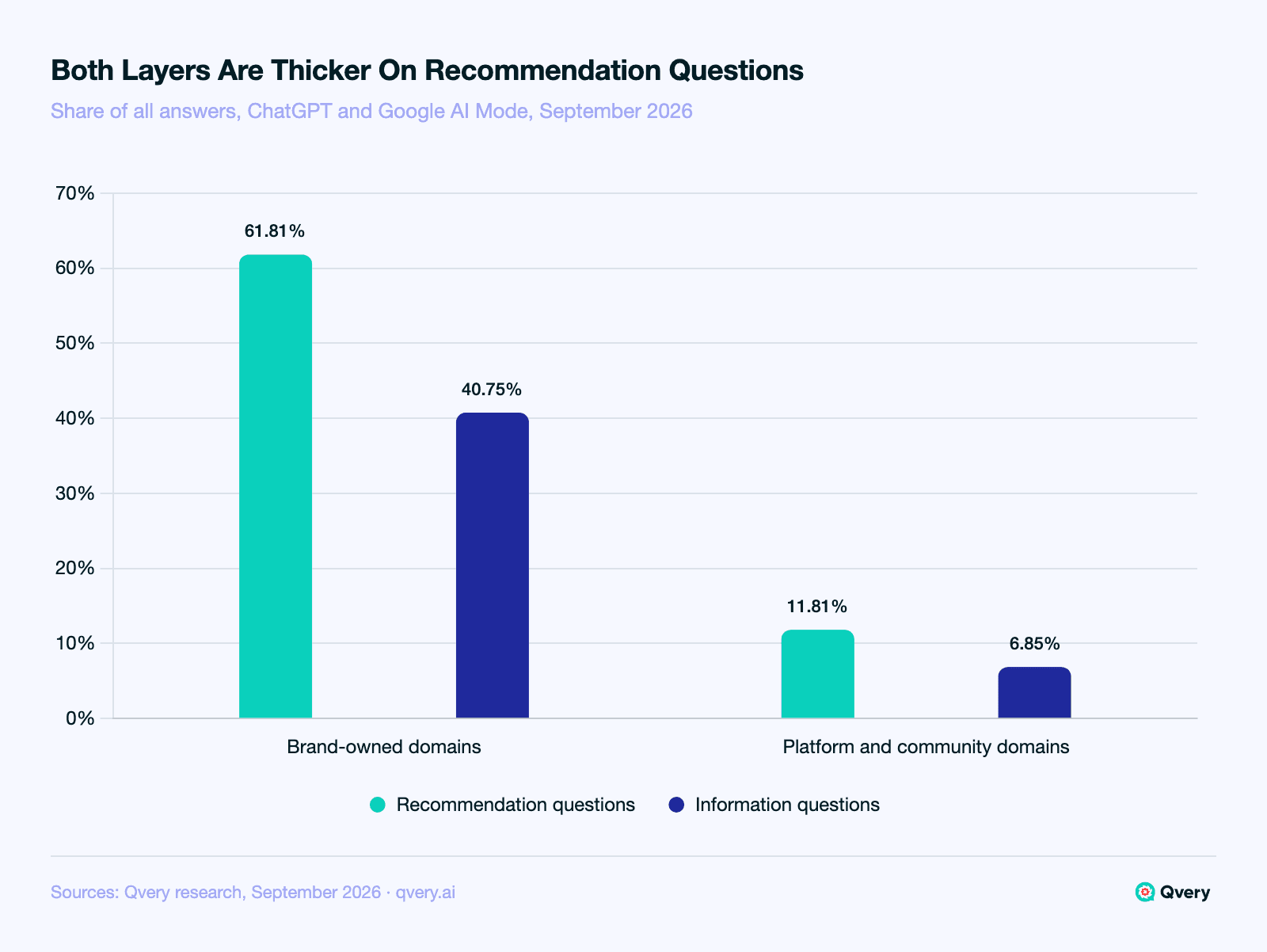
The platform gap is a ratio of 1.72, recommendation to information. The brand-owned gap read as a ratio the other way is 0.66, and that one is worth a sentence of its own: before collecting we registered the opposite direction, expecting manufacturer and dealer pages to carry more of the informational answers. They carry fewer.
For a car brand the practical consequence is the blended list. If your prompt set mixes both kinds of question, your owned-presence number lands somewhere between 61.81% and 40.75% and describes neither: it understates you on the questions where buyers choose, and overstates you on the questions where they only need facts.
Do Car Shoppers Use These Engines?
Four outside figures frame the question, and each counts a different population. None of them counts car shoppers using ChatGPT or Google AI Mode, which nobody has measured.
91% of consumers used digital sources while shopping for a vehicle, in Snap and Havas Media Network's study of recent and in-market buyers across five countries. Digital sources of any kind, not AI.
28% of buyers under 45 used AI tools during their last car purchase, McKinsey found, against 5% of buyers over 45. AI tools of any kind.
Google said AI Mode surpassed a billion monthly active users globally a year after its US launch.
OpenAI, writing in September 2025, put ChatGPT at 700 million weekly active users.
Each of those numbers keeps its own population, and none of them is evidence about what the engines cite. They are the reason to look at the citations at all.
How Often Reddit Is Cited in These Answers
Reddit is the one domain we measured by name, as its own hand-checked set. It was cited in 3.06% of recommendation answers and 5.48% of information answers, both shares of all valid answers in their set.
That pair is descriptive and stays that way. We registered no direction for it before collecting, so no ratio, no comparison between the two sets, and no claim that Reddit matters more to one kind of question than the other.
One piece of context sits under it. The recommendation figure is almost entirely Google AI Mode's, which cited Reddit in 11.67% of its recommendation answers against ChatGPT's 0.19%. Every information answer behind the pooled 5.48% came from Google AI Mode too, because ChatGPT cited Reddit in none of its information answers. What that means about either engine is a question this study does not answer.
Our Reddit citation study covers Reddit's position across verticals, and how automotive brands show up in AI search covers the per-engine reading for cars.
Which Domains Carry Each Kind of Answer
This is the reference table for anyone building a watch list. The shares below are of answers that cited any source, within each set.
Recommendation questions, the six domains covering half of cited answers: edmunds.com, nerdwallet.com, caranddriver.com, usnews.com, consumerreports.org, toyota.com.
Recommendation questions, the list covering 80%: those six plus rac.co.uk, ftc.gov, jdpower.com, cnbc.com, reddit.com, aaa.com, autotrader.co.uk, cars.com, allstate.com, canada.ca, youtube.com, capitalone.com, chevrolet.com, bookmygarage.com, kbb.com, gov.uk, which.co.uk, wsj.com, and google.com.
Information questions, the five domains covering half of cited answers: ftc.gov, consumerreports.org, aaa.com, kbb.com, consumerfinance.gov.
Information questions, the list covering 80%: those five plus energy.gov, nhtsa.gov, experian.com, reddit.com, epa.gov, canada.ca, gov.uk, ca.gov, rac.com.au, and chase.com.
Cross-coverage: the recommendation list covers 61.26% of information answers that cited any source; the information list covers 28.15% of recommendation answers that cited any source.
Verdict: the smaller of those two sits below the 60% bar we set before collecting, so each set needs its own list.
The two sets are frozen query sets, not buying and owning stages of a customer's life. For building and running a list like this, our automotive AI visibility audit walks through the method, stage by stage.
What Qvery Measures Live
You can run the same two-set split on your own questions. In Qvery you add and edit the queries you track, so car recommendation questions and car information questions can sit in separate groups, and you read visibility, share of voice, and average rank across ChatGPT and Google AI Mode every day, in 200+ countries, with every citation tied to the query and engine that produced it. Qvery Assistant answers plain-language questions about your own data in the app.
If those three metrics need untangling first, AI visibility versus share of voice defines them. What Qvery will not do is sort your citations into this study's brand-owned and platform labels, or build the domain lists for you.
To see your own two sets, start a free 7-day trial. Checkout is self-serve and no credit card is required.
The Limits of These Numbers
These are co-occurrence rates: which kinds of sites appear alongside an answer, never why an engine cites them, never whether a brand was named, and never whether one source mattered more than another inside the answer. The other boundaries:
A lean toward ChatGPT. The pooled rates count every answer once, and ChatGPT answered more of these questions than Google AI Mode did, so the pooled numbers lean that way. No per-engine layer figure ships.
One engine's information slice is unreported. Google AI Mode's information sample is too small to carry a share, and the pooled information platform figure rests on it alone: ChatGPT cited a platform or community domain in none of its information answers.
One question set. Frozen September 2026 automotive questions, not the whole category.
No trend. An earlier collection stored its sources differently, inside the answer text rather than as a separate citations list, so no figure from it is comparable and none appears here.
No engine verdict. Engine differences are context in this post, never a conclusion.
Track Car Questions as Two Sets
Split your tracked car questions into the ones that ask which vehicle to buy and the ones that ask how something works, and read brand-owned and platform presence separately in each. Both are more common on the recommendation side, which is the half a blended number quietly averages away.
A buyer asking ChatGPT which midsize SUV to buy and a buyer asking how a lease buyout works are both filed as car questions in most tracking setups, and both land in the same visibility score. For a manufacturer, a dealer group, or a lender, that single score blends two different questions into one number. We put both kinds of question to ChatGPT and Google AI Mode in September 2026 and sorted each answer by the kinds of sites cited beside it.
The buying questions draw on more of both layers. Brand-owned sites turned up beside 61.81% of recommendation answers against 40.75% of information answers, and platform and community sites beside 11.81% against 6.85%. Read these as co-occurrence: they say which sites sat next to an answer, not why, and not whether any brand was put forward.
Key Takeaways
Brand-owned domains appeared in 61.81% of recommendation answers and 40.75% of information answers, each a share of all valid answers in its set, across ChatGPT and Google AI Mode.
Platform and community domains appeared in 11.81% of recommendation answers and 6.85% of information answers, a recommendation-to-information ratio of 1.72.
The brand-owned gap runs the other way as a ratio, 0.66 information to recommendation, and it contradicts the direction we registered before collecting.
The domains behind each kind of answer barely overlap: the information list covers only 28.15% of recommendation answers that cited any source, so each set needs its own watch list.
Reddit was cited in 3.06% of recommendation answers and 5.48% of information answers. That one is descriptive: no direction was registered for it, so no comparison ships.
Both Source Layers Are More Common on Recommendation Questions
When someone asks which car to buy, the answer carries more of both source layers. Brand-owned domains appeared in 61.81% of recommendation answers against 40.75% of information answers, and platform and community domains in 11.81% against 6.85%. Both figures are shares of all valid answers in their set, with ChatGPT and Google AI Mode counted together.
The platform gap is a ratio of 1.72, recommendation to information. The brand-owned gap read as a ratio the other way is 0.66, and that one is worth a sentence of its own: before collecting we registered the opposite direction, expecting manufacturer and dealer pages to carry more of the informational answers. They carry fewer.
For a car brand the practical consequence is the blended list. If your prompt set mixes both kinds of question, your owned-presence number lands somewhere between 61.81% and 40.75% and describes neither: it understates you on the questions where buyers choose, and overstates you on the questions where they only need facts.
Do Car Shoppers Use These Engines?
Four outside figures frame the question, and each counts a different population. None of them counts car shoppers using ChatGPT or Google AI Mode, which nobody has measured.
91% of consumers used digital sources while shopping for a vehicle, in Snap and Havas Media Network's study of recent and in-market buyers across five countries. Digital sources of any kind, not AI.
28% of buyers under 45 used AI tools during their last car purchase, McKinsey found, against 5% of buyers over 45. AI tools of any kind.
Google said AI Mode surpassed a billion monthly active users globally a year after its US launch.
OpenAI, writing in September 2025, put ChatGPT at 700 million weekly active users.
Each of those numbers keeps its own population, and none of them is evidence about what the engines cite. They are the reason to look at the citations at all.
How Often Reddit Is Cited in These Answers
Reddit is the one domain we measured by name, as its own hand-checked set. It was cited in 3.06% of recommendation answers and 5.48% of information answers, both shares of all valid answers in their set.
That pair is descriptive and stays that way. We registered no direction for it before collecting, so no ratio, no comparison between the two sets, and no claim that Reddit matters more to one kind of question than the other.
One piece of context sits under it. The recommendation figure is almost entirely Google AI Mode's, which cited Reddit in 11.67% of its recommendation answers against ChatGPT's 0.19%. Every information answer behind the pooled 5.48% came from Google AI Mode too, because ChatGPT cited Reddit in none of its information answers. What that means about either engine is a question this study does not answer.
Our Reddit citation study covers Reddit's position across verticals, and how automotive brands show up in AI search covers the per-engine reading for cars.
Which Domains Carry Each Kind of Answer
This is the reference table for anyone building a watch list. The shares below are of answers that cited any source, within each set.
Recommendation questions, the six domains covering half of cited answers: edmunds.com, nerdwallet.com, caranddriver.com, usnews.com, consumerreports.org, toyota.com.
Recommendation questions, the list covering 80%: those six plus rac.co.uk, ftc.gov, jdpower.com, cnbc.com, reddit.com, aaa.com, autotrader.co.uk, cars.com, allstate.com, canada.ca, youtube.com, capitalone.com, chevrolet.com, bookmygarage.com, kbb.com, gov.uk, which.co.uk, wsj.com, and google.com.
Information questions, the five domains covering half of cited answers: ftc.gov, consumerreports.org, aaa.com, kbb.com, consumerfinance.gov.
Information questions, the list covering 80%: those five plus energy.gov, nhtsa.gov, experian.com, reddit.com, epa.gov, canada.ca, gov.uk, ca.gov, rac.com.au, and chase.com.
Cross-coverage: the recommendation list covers 61.26% of information answers that cited any source; the information list covers 28.15% of recommendation answers that cited any source.
Verdict: the smaller of those two sits below the 60% bar we set before collecting, so each set needs its own list.
The two sets are frozen query sets, not buying and owning stages of a customer's life. For building and running a list like this, our automotive AI visibility audit walks through the method, stage by stage.
What Qvery Measures Live
You can run the same two-set split on your own questions. In Qvery you add and edit the queries you track, so car recommendation questions and car information questions can sit in separate groups, and you read visibility, share of voice, and average rank across ChatGPT and Google AI Mode every day, in 200+ countries, with every citation tied to the query and engine that produced it. Qvery Assistant answers plain-language questions about your own data in the app.
If those three metrics need untangling first, AI visibility versus share of voice defines them. What Qvery will not do is sort your citations into this study's brand-owned and platform labels, or build the domain lists for you.
To see your own two sets, start a free 7-day trial. Checkout is self-serve and no credit card is required.
The Limits of These Numbers
These are co-occurrence rates: which kinds of sites appear alongside an answer, never why an engine cites them, never whether a brand was named, and never whether one source mattered more than another inside the answer. The other boundaries:
A lean toward ChatGPT. The pooled rates count every answer once, and ChatGPT answered more of these questions than Google AI Mode did, so the pooled numbers lean that way. No per-engine layer figure ships.
One engine's information slice is unreported. Google AI Mode's information sample is too small to carry a share, and the pooled information platform figure rests on it alone: ChatGPT cited a platform or community domain in none of its information answers.
One question set. Frozen September 2026 automotive questions, not the whole category.
No trend. An earlier collection stored its sources differently, inside the answer text rather than as a separate citations list, so no figure from it is comparable and none appears here.
No engine verdict. Engine differences are context in this post, never a conclusion.
Track Car Questions as Two Sets
Split your tracked car questions into the ones that ask which vehicle to buy and the ones that ask how something works, and read brand-owned and platform presence separately in each. Both are more common on the recommendation side, which is the half a blended number quietly averages away.
A buyer asking ChatGPT which midsize SUV to buy and a buyer asking how a lease buyout works are both filed as car questions in most tracking setups, and both land in the same visibility score. For a manufacturer, a dealer group, or a lender, that single score blends two different questions into one number. We put both kinds of question to ChatGPT and Google AI Mode in September 2026 and sorted each answer by the kinds of sites cited beside it.
The buying questions draw on more of both layers. Brand-owned sites turned up beside 61.81% of recommendation answers against 40.75% of information answers, and platform and community sites beside 11.81% against 6.85%. Read these as co-occurrence: they say which sites sat next to an answer, not why, and not whether any brand was put forward.
Key Takeaways
Brand-owned domains appeared in 61.81% of recommendation answers and 40.75% of information answers, each a share of all valid answers in its set, across ChatGPT and Google AI Mode.
Platform and community domains appeared in 11.81% of recommendation answers and 6.85% of information answers, a recommendation-to-information ratio of 1.72.
The brand-owned gap runs the other way as a ratio, 0.66 information to recommendation, and it contradicts the direction we registered before collecting.
The domains behind each kind of answer barely overlap: the information list covers only 28.15% of recommendation answers that cited any source, so each set needs its own watch list.
Reddit was cited in 3.06% of recommendation answers and 5.48% of information answers. That one is descriptive: no direction was registered for it, so no comparison ships.
Both Source Layers Are More Common on Recommendation Questions
When someone asks which car to buy, the answer carries more of both source layers. Brand-owned domains appeared in 61.81% of recommendation answers against 40.75% of information answers, and platform and community domains in 11.81% against 6.85%. Both figures are shares of all valid answers in their set, with ChatGPT and Google AI Mode counted together.
The platform gap is a ratio of 1.72, recommendation to information. The brand-owned gap read as a ratio the other way is 0.66, and that one is worth a sentence of its own: before collecting we registered the opposite direction, expecting manufacturer and dealer pages to carry more of the informational answers. They carry fewer.
For a car brand the practical consequence is the blended list. If your prompt set mixes both kinds of question, your owned-presence number lands somewhere between 61.81% and 40.75% and describes neither: it understates you on the questions where buyers choose, and overstates you on the questions where they only need facts.
Do Car Shoppers Use These Engines?
Four outside figures frame the question, and each counts a different population. None of them counts car shoppers using ChatGPT or Google AI Mode, which nobody has measured.
91% of consumers used digital sources while shopping for a vehicle, in Snap and Havas Media Network's study of recent and in-market buyers across five countries. Digital sources of any kind, not AI.
28% of buyers under 45 used AI tools during their last car purchase, McKinsey found, against 5% of buyers over 45. AI tools of any kind.
Google said AI Mode surpassed a billion monthly active users globally a year after its US launch.
OpenAI, writing in September 2025, put ChatGPT at 700 million weekly active users.
Each of those numbers keeps its own population, and none of them is evidence about what the engines cite. They are the reason to look at the citations at all.
How Often Reddit Is Cited in These Answers
Reddit is the one domain we measured by name, as its own hand-checked set. It was cited in 3.06% of recommendation answers and 5.48% of information answers, both shares of all valid answers in their set.
That pair is descriptive and stays that way. We registered no direction for it before collecting, so no ratio, no comparison between the two sets, and no claim that Reddit matters more to one kind of question than the other.
One piece of context sits under it. The recommendation figure is almost entirely Google AI Mode's, which cited Reddit in 11.67% of its recommendation answers against ChatGPT's 0.19%. Every information answer behind the pooled 5.48% came from Google AI Mode too, because ChatGPT cited Reddit in none of its information answers. What that means about either engine is a question this study does not answer.
Our Reddit citation study covers Reddit's position across verticals, and how automotive brands show up in AI search covers the per-engine reading for cars.
Which Domains Carry Each Kind of Answer
This is the reference table for anyone building a watch list. The shares below are of answers that cited any source, within each set.
Recommendation questions, the six domains covering half of cited answers: edmunds.com, nerdwallet.com, caranddriver.com, usnews.com, consumerreports.org, toyota.com.
Recommendation questions, the list covering 80%: those six plus rac.co.uk, ftc.gov, jdpower.com, cnbc.com, reddit.com, aaa.com, autotrader.co.uk, cars.com, allstate.com, canada.ca, youtube.com, capitalone.com, chevrolet.com, bookmygarage.com, kbb.com, gov.uk, which.co.uk, wsj.com, and google.com.
Information questions, the five domains covering half of cited answers: ftc.gov, consumerreports.org, aaa.com, kbb.com, consumerfinance.gov.
Information questions, the list covering 80%: those five plus energy.gov, nhtsa.gov, experian.com, reddit.com, epa.gov, canada.ca, gov.uk, ca.gov, rac.com.au, and chase.com.
Cross-coverage: the recommendation list covers 61.26% of information answers that cited any source; the information list covers 28.15% of recommendation answers that cited any source.
Verdict: the smaller of those two sits below the 60% bar we set before collecting, so each set needs its own list.
The two sets are frozen query sets, not buying and owning stages of a customer's life. For building and running a list like this, our automotive AI visibility audit walks through the method, stage by stage.
What Qvery Measures Live
You can run the same two-set split on your own questions. In Qvery you add and edit the queries you track, so car recommendation questions and car information questions can sit in separate groups, and you read visibility, share of voice, and average rank across ChatGPT and Google AI Mode every day, in 200+ countries, with every citation tied to the query and engine that produced it. Qvery Assistant answers plain-language questions about your own data in the app.
If those three metrics need untangling first, AI visibility versus share of voice defines them. What Qvery will not do is sort your citations into this study's brand-owned and platform labels, or build the domain lists for you.
To see your own two sets, start a free 7-day trial. Checkout is self-serve and no credit card is required.
The Limits of These Numbers
These are co-occurrence rates: which kinds of sites appear alongside an answer, never why an engine cites them, never whether a brand was named, and never whether one source mattered more than another inside the answer. The other boundaries:
A lean toward ChatGPT. The pooled rates count every answer once, and ChatGPT answered more of these questions than Google AI Mode did, so the pooled numbers lean that way. No per-engine layer figure ships.
One engine's information slice is unreported. Google AI Mode's information sample is too small to carry a share, and the pooled information platform figure rests on it alone: ChatGPT cited a platform or community domain in none of its information answers.
One question set. Frozen September 2026 automotive questions, not the whole category.
No trend. An earlier collection stored its sources differently, inside the answer text rather than as a separate citations list, so no figure from it is comparable and none appears here.
No engine verdict. Engine differences are context in this post, never a conclusion.
Track Car Questions as Two Sets
Split your tracked car questions into the ones that ask which vehicle to buy and the ones that ask how something works, and read brand-owned and platform presence separately in each. Both are more common on the recommendation side, which is the half a blended number quietly averages away.
A buyer asking ChatGPT which midsize SUV to buy and a buyer asking how a lease buyout works are both filed as car questions in most tracking setups, and both land in the same visibility score. For a manufacturer, a dealer group, or a lender, that single score blends two different questions into one number. We put both kinds of question to ChatGPT and Google AI Mode in September 2026 and sorted each answer by the kinds of sites cited beside it.
The buying questions draw on more of both layers. Brand-owned sites turned up beside 61.81% of recommendation answers against 40.75% of information answers, and platform and community sites beside 11.81% against 6.85%. Read these as co-occurrence: they say which sites sat next to an answer, not why, and not whether any brand was put forward.
Key Takeaways
Brand-owned domains appeared in 61.81% of recommendation answers and 40.75% of information answers, each a share of all valid answers in its set, across ChatGPT and Google AI Mode.
Platform and community domains appeared in 11.81% of recommendation answers and 6.85% of information answers, a recommendation-to-information ratio of 1.72.
The brand-owned gap runs the other way as a ratio, 0.66 information to recommendation, and it contradicts the direction we registered before collecting.
The domains behind each kind of answer barely overlap: the information list covers only 28.15% of recommendation answers that cited any source, so each set needs its own watch list.
Reddit was cited in 3.06% of recommendation answers and 5.48% of information answers. That one is descriptive: no direction was registered for it, so no comparison ships.
Both Source Layers Are More Common on Recommendation Questions
When someone asks which car to buy, the answer carries more of both source layers. Brand-owned domains appeared in 61.81% of recommendation answers against 40.75% of information answers, and platform and community domains in 11.81% against 6.85%. Both figures are shares of all valid answers in their set, with ChatGPT and Google AI Mode counted together.
The platform gap is a ratio of 1.72, recommendation to information. The brand-owned gap read as a ratio the other way is 0.66, and that one is worth a sentence of its own: before collecting we registered the opposite direction, expecting manufacturer and dealer pages to carry more of the informational answers. They carry fewer.
For a car brand the practical consequence is the blended list. If your prompt set mixes both kinds of question, your owned-presence number lands somewhere between 61.81% and 40.75% and describes neither: it understates you on the questions where buyers choose, and overstates you on the questions where they only need facts.
Do Car Shoppers Use These Engines?
Four outside figures frame the question, and each counts a different population. None of them counts car shoppers using ChatGPT or Google AI Mode, which nobody has measured.
91% of consumers used digital sources while shopping for a vehicle, in Snap and Havas Media Network's study of recent and in-market buyers across five countries. Digital sources of any kind, not AI.
28% of buyers under 45 used AI tools during their last car purchase, McKinsey found, against 5% of buyers over 45. AI tools of any kind.
Google said AI Mode surpassed a billion monthly active users globally a year after its US launch.
OpenAI, writing in September 2025, put ChatGPT at 700 million weekly active users.
Each of those numbers keeps its own population, and none of them is evidence about what the engines cite. They are the reason to look at the citations at all.
How Often Reddit Is Cited in These Answers
Reddit is the one domain we measured by name, as its own hand-checked set. It was cited in 3.06% of recommendation answers and 5.48% of information answers, both shares of all valid answers in their set.
That pair is descriptive and stays that way. We registered no direction for it before collecting, so no ratio, no comparison between the two sets, and no claim that Reddit matters more to one kind of question than the other.
One piece of context sits under it. The recommendation figure is almost entirely Google AI Mode's, which cited Reddit in 11.67% of its recommendation answers against ChatGPT's 0.19%. Every information answer behind the pooled 5.48% came from Google AI Mode too, because ChatGPT cited Reddit in none of its information answers. What that means about either engine is a question this study does not answer.
Our Reddit citation study covers Reddit's position across verticals, and how automotive brands show up in AI search covers the per-engine reading for cars.
Which Domains Carry Each Kind of Answer
This is the reference table for anyone building a watch list. The shares below are of answers that cited any source, within each set.
Recommendation questions, the six domains covering half of cited answers: edmunds.com, nerdwallet.com, caranddriver.com, usnews.com, consumerreports.org, toyota.com.
Recommendation questions, the list covering 80%: those six plus rac.co.uk, ftc.gov, jdpower.com, cnbc.com, reddit.com, aaa.com, autotrader.co.uk, cars.com, allstate.com, canada.ca, youtube.com, capitalone.com, chevrolet.com, bookmygarage.com, kbb.com, gov.uk, which.co.uk, wsj.com, and google.com.
Information questions, the five domains covering half of cited answers: ftc.gov, consumerreports.org, aaa.com, kbb.com, consumerfinance.gov.
Information questions, the list covering 80%: those five plus energy.gov, nhtsa.gov, experian.com, reddit.com, epa.gov, canada.ca, gov.uk, ca.gov, rac.com.au, and chase.com.
Cross-coverage: the recommendation list covers 61.26% of information answers that cited any source; the information list covers 28.15% of recommendation answers that cited any source.
Verdict: the smaller of those two sits below the 60% bar we set before collecting, so each set needs its own list.
The two sets are frozen query sets, not buying and owning stages of a customer's life. For building and running a list like this, our automotive AI visibility audit walks through the method, stage by stage.
What Qvery Measures Live
You can run the same two-set split on your own questions. In Qvery you add and edit the queries you track, so car recommendation questions and car information questions can sit in separate groups, and you read visibility, share of voice, and average rank across ChatGPT and Google AI Mode every day, in 200+ countries, with every citation tied to the query and engine that produced it. Qvery Assistant answers plain-language questions about your own data in the app.
If those three metrics need untangling first, AI visibility versus share of voice defines them. What Qvery will not do is sort your citations into this study's brand-owned and platform labels, or build the domain lists for you.
To see your own two sets, start a free 7-day trial. Checkout is self-serve and no credit card is required.
The Limits of These Numbers
These are co-occurrence rates: which kinds of sites appear alongside an answer, never why an engine cites them, never whether a brand was named, and never whether one source mattered more than another inside the answer. The other boundaries:
A lean toward ChatGPT. The pooled rates count every answer once, and ChatGPT answered more of these questions than Google AI Mode did, so the pooled numbers lean that way. No per-engine layer figure ships.
One engine's information slice is unreported. Google AI Mode's information sample is too small to carry a share, and the pooled information platform figure rests on it alone: ChatGPT cited a platform or community domain in none of its information answers.
One question set. Frozen September 2026 automotive questions, not the whole category.
No trend. An earlier collection stored its sources differently, inside the answer text rather than as a separate citations list, so no figure from it is comparable and none appears here.
No engine verdict. Engine differences are context in this post, never a conclusion.
Track Car Questions as Two Sets
Split your tracked car questions into the ones that ask which vehicle to buy and the ones that ask how something works, and read brand-owned and platform presence separately in each. Both are more common on the recommendation side, which is the half a blended number quietly averages away.

© 2026 Qvery AI OÜ