By
Vlad Shvets
AI Engine Visibility for Personal Injury Firms: One Audit List or Two?
Post-accident and firm-selection questions cite almost entirely different domains in ChatGPT and Google AI Mode, so personal injury firms need two audit lists.
Post-accident and firm-selection questions cite almost entirely different domains in ChatGPT and Google AI Mode, so personal injury firms need two audit lists.
Post-accident and firm-selection questions cite almost entirely different domains in ChatGPT and Google AI Mode, so personal injury firms need two audit lists.
A personal injury prospect usually asks an AI engine two different questions, days apart: what to do after the accident, and later, which lawyer to call.
If you market a PI firm, both questions feed your pipeline, and it is natural to assume the same sites answer both, so one citation audit list covers them.
So we asked ChatGPT and Google AI Mode both kinds of question in September 2026, post-accident guidance and firm selection, and recorded which domains the answers cited.
The short version: the two question types need separate audit lists.
The firm-selection list covered 1.70% of the post-accident answers that cited any source, and the post-accident list covered 7.65% of the firm-selection answers that cited any source. Had the lower figure reached 0.80, one list would have done; between 0.60 and 0.80, a shared core with separate tails. At 0.0170, it is two lists.
That audit advice is our judgment from what appeared together, not a measured effect. What follows is which domains were cited beside which questions, and nothing about why.
The Firm-Selection and Post-Accident Answers Barely Share a Source
For each question type we built a list of domains, adding at each step the domain that covered the most answers not yet covered, until the list reached 80% of the answers that cited any source. Here are both, in full and in order, because they are where the audit starts.
Firm selection, 30 domains: attorneys.superlawyers.com, avvo.com, google.com, forthepeople.com, thumbtack.com, bencrump.com, donatilaw.com, mcintyrelaw.com, rafilawgroup.com, cochranfirm.com, doctorspracticinglaw.com, domnitzlaw.com, hbinjury.com, horwitzlaw.com, mass.gov, nmwlawfirm.com, baggettlaw.com, bressmanlaw.com, caglefirm.com, cghlawfirm.com, clarkharmonsonattorney.com, coopers.law, dbbwc.com, floreslawmiami.com, freedmanlaw.com, helpmepaul.com, johnston-lawfirm.com, kansascitylawyers.com, ladendorf.com, leibolaw.com.
Post-accident guidance, 49 domains: cdc.gov, osha.gov, nhtsa.gov, youtube.com, law.justia.com, accessdata.fda.gov, ahrq.gov, healthychildren.org, reddit.com, help.lyft.com, orangelaw.us, tdi.texas.gov, 911.gov, arialaw.com, chglawyers.com, cms.gov, coateslawoffice.com, dfr.oregon.gov, dol.gov, extension.umd.edu, fasigbrooks.com, instagram.com, iowainjured.com, kytrialfirm.com, lawinfo.com, lawmd.com, redcross.org, rockylawfirm.com, weather.gov, 1800nowhurt.com, 303happenings.com, 511.idaho.gov, 911.utah.gov, aguiarinjurylawyers.com, akdlawyers.com, alabamamotorcyclelawyers.com, armstrong-lawoffice.com, attorneymcclure.com, barzakaylaw.com, bencrump.com, ca.gov, carlocklegal.com, cdph.ca.gov, codes.baltimorecity.gov, courts.ca.gov, daeryunlaw.com, dds.georgia.gov, dfs.ny.gov, digitalstudyroom.com.
Then we swapped them. The firm-selection list covered 1.70% of the post-accident answers that cited any source. The post-accident list covered 7.65% of the firm-selection answers that cited any source.
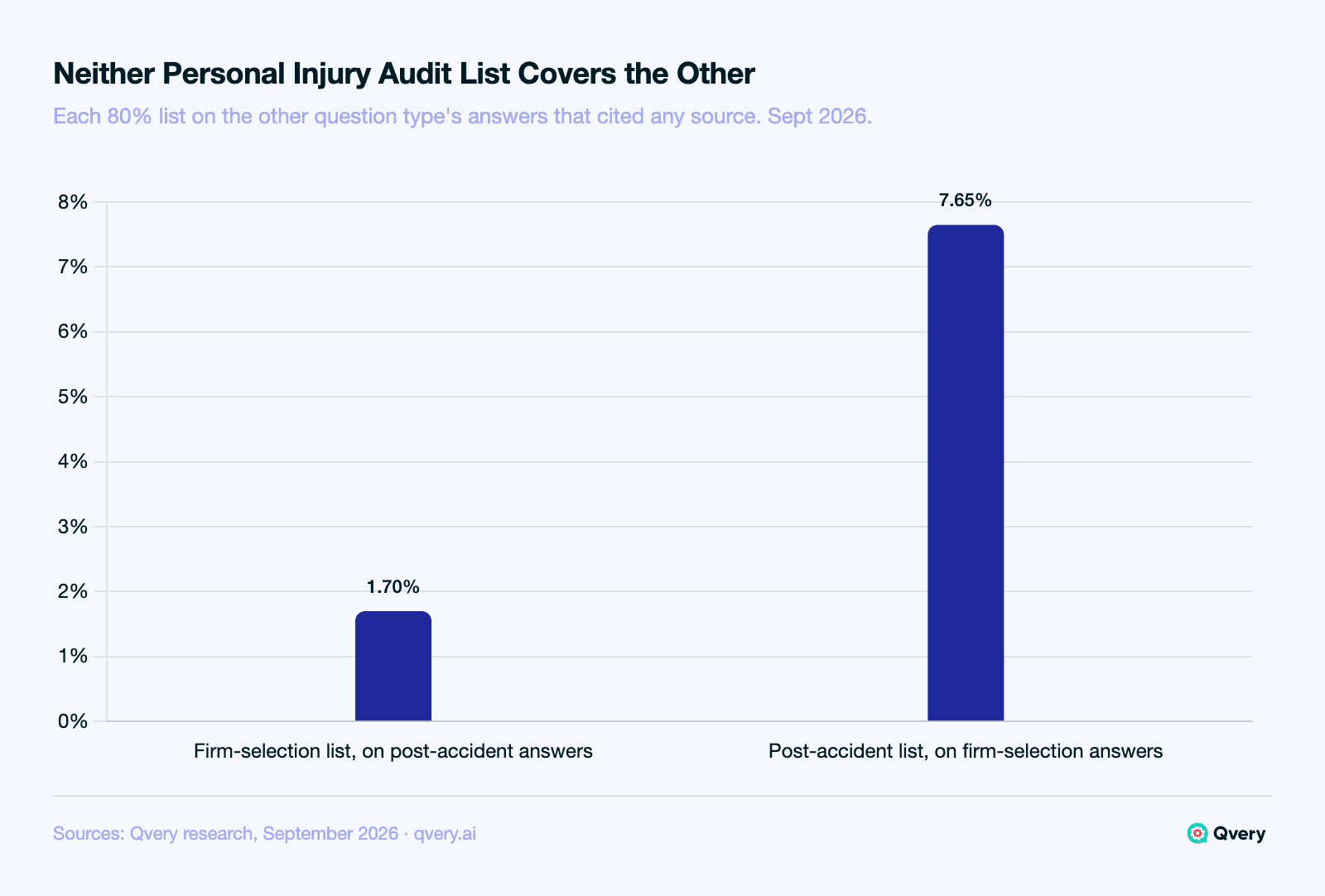
Both are nowhere near the 0.60 bar for a shared list. Read the lists and the split is visible: the post-accident list opens with government, health and safety sites, with firm pages further down, and the firm-selection list opens with legal directories and firm sites.
For the wider picture of how law firms show up in AI answers, see how to measure law firm AI visibility.
The Post-Accident List Is the Longer Audit
The post-accident list needs 49 domains to reach 80% of its answers that cited any source, and the firm-selection list needs 30. That is a ratio of 1.63.
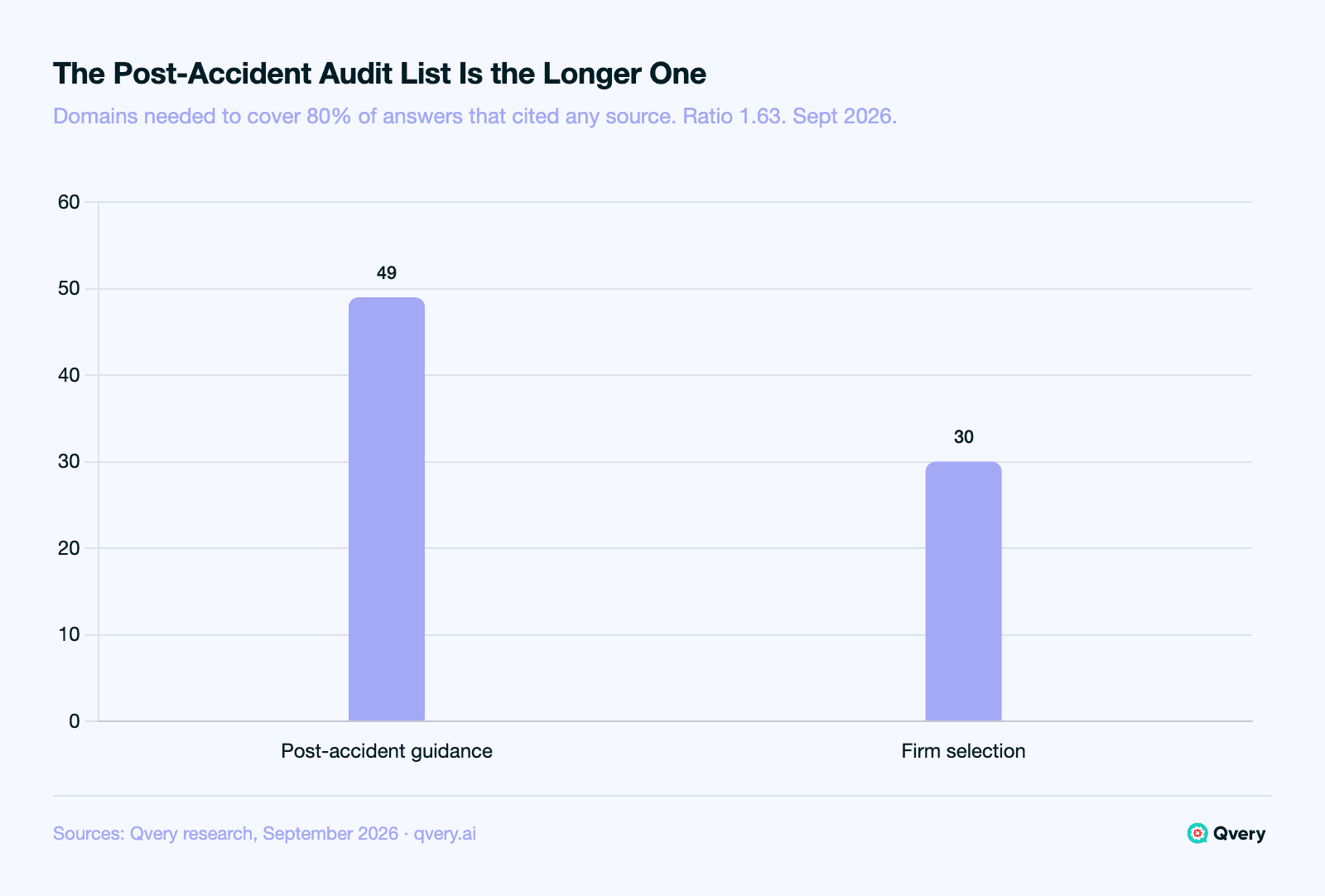
We predicted the opposite, that firm selection would need the longer list. It did not.
A list's size is the number of domains needed to cover 80% of that question type's answers that cited any source. It is not a measure of review workload, of how many pages a team must watch, or of visibility gained by watching them.
Our judgment from that: size the post-accident audit as the larger of the two when you plan the work.
Firm Sites Show Up Far More in Firm-Selection Answers
We also checked how often an answer cited at least one brand-owned domain, a firm's own site among them.
88.00% of firm-selection answers did, against 38.50% of post-accident answers, each a share of all the valid answers of that type, with no unresolved answers in either. The ratio is 0.44.
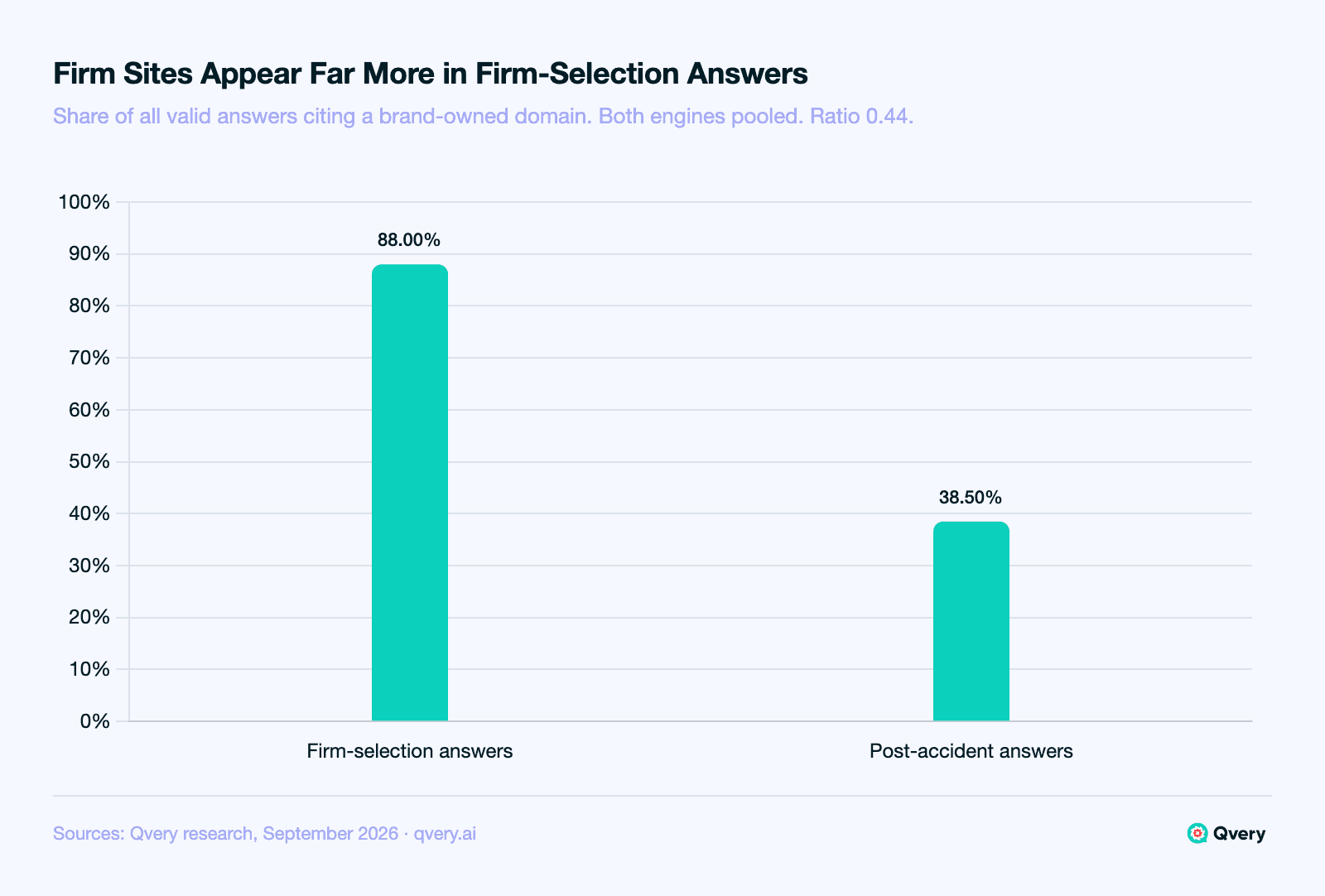
We had predicted post-accident answers would lead on this. They did not, and the gap runs the other way.
Read that as co-occurrence with a question type and nothing more. It does not say a cited firm is recommended, and it says nothing about trust, firm size or legal quality.
One PR firm's legal AI visibility index puts the emphasis on directories: "Across every query type tested, a small set of ranking directories dominates the legal AI citation layer." It adds that individual law firms "appear inside those directories but rarely as independent voices."
Our data measured which domains were cited beside which questions. It does not rank directories against firm sites, so it neither confirms nor disproves which sources dominate. What it does show is that firm-selection answers cited brand-owned domains in most cases, which is worth holding next to that claim.
Track Post-Accident and Firm-Selection Questions Separately in Qvery
The decision above is two lists, so set up your tracking the same way.
Add two groups of queries: the post-accident questions your prospects ask, and the firm-selection questions they ask later. Building tracking queries covers writing them, and you add and edit them through Qvery Assistant.
Qvery tracks visibility, share of voice and average rank for each group daily across ChatGPT and Google AI Mode, in 200+ countries.
Every citation is tied to the query and engine that produced it, so you can see which of your own questions cite which domains, and build each audit list from your own answers.
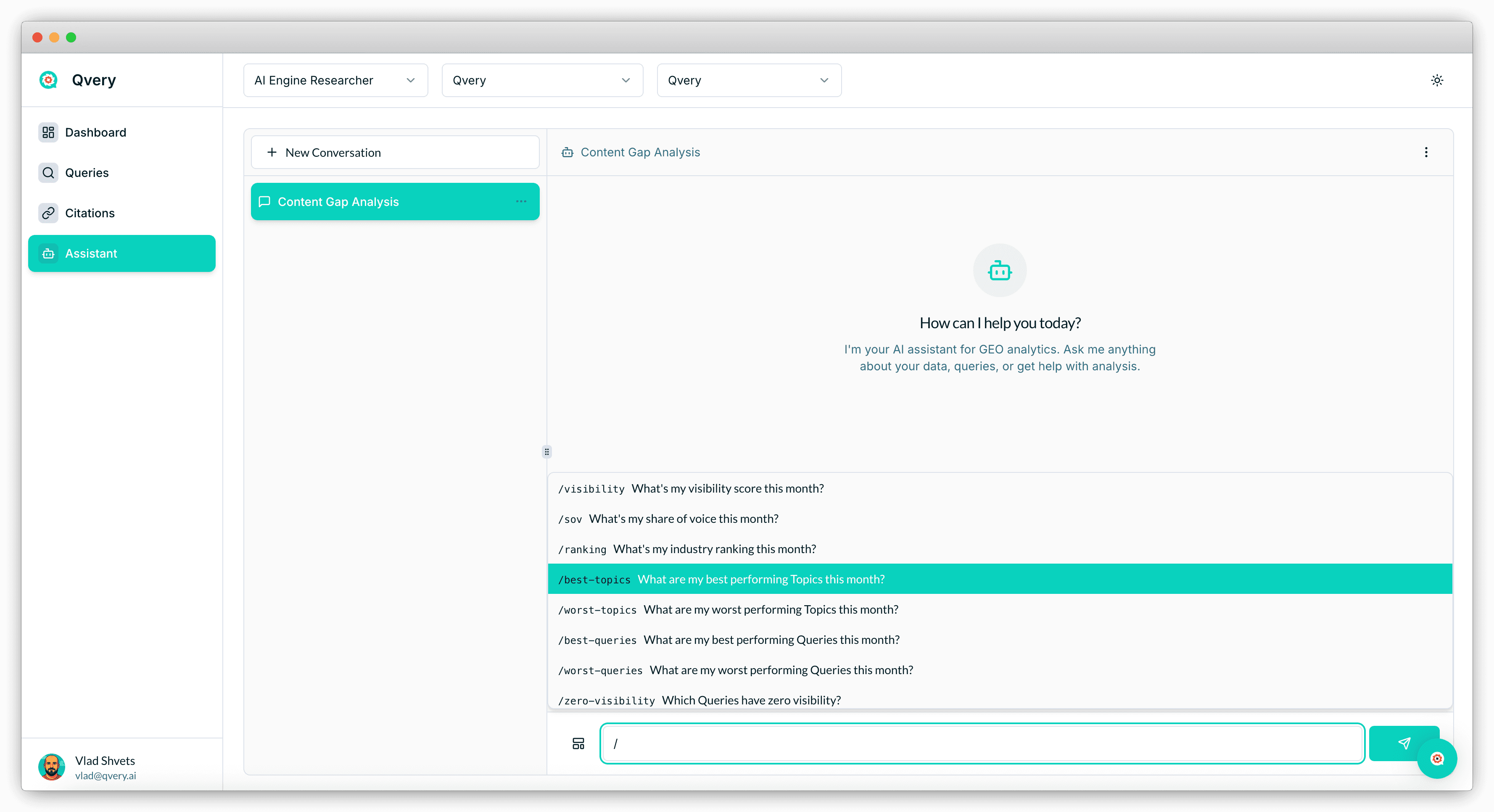
To ask instead of filter, open Qvery Assistant in the app and ask about your own visibility, share of voice or citations in plain language.
The tracking shows whether your firm appears in the answers, not whether it was recommended.
Start a free 7-day trial of Qvery, no credit card required, and set up both question groups this week.
What This Data Cannot Settle
US questions only. Paired post-accident and firm-selection questions in US settings; not other legal markets or question types.
Co-occurrence only. Which domains were cited beside which questions, with no explanation of why.
No recommendation, quality or outcome. Nothing here measures whether a firm was recommended, its legal quality, or any client outcome.
No engine claim. No Google AI Mode figure for a single question type prints, because each rests on too few answers.
ChatGPT-weighted. The pooled figures carry three ChatGPT answers for every two from Google AI Mode.
No page-level result. We tried to rank the cited pages themselves, but every registered page stayed unresolved, and the pages shared across the two question types were too few for any comparison, so no page rank, rate or status prints.
This month only. No earlier period is compared.
Run Two Audit Lists
Our judgment from what appeared together: run two audit lists, one for post-accident guidance and one for firm selection, and size the post-accident audit as the larger of the two.
Read your firm's presence in firm-selection answers as co-occurrence, not as a recommendation.
A personal injury prospect usually asks an AI engine two different questions, days apart: what to do after the accident, and later, which lawyer to call.
If you market a PI firm, both questions feed your pipeline, and it is natural to assume the same sites answer both, so one citation audit list covers them.
So we asked ChatGPT and Google AI Mode both kinds of question in September 2026, post-accident guidance and firm selection, and recorded which domains the answers cited.
The short version: the two question types need separate audit lists.
The firm-selection list covered 1.70% of the post-accident answers that cited any source, and the post-accident list covered 7.65% of the firm-selection answers that cited any source. Had the lower figure reached 0.80, one list would have done; between 0.60 and 0.80, a shared core with separate tails. At 0.0170, it is two lists.
That audit advice is our judgment from what appeared together, not a measured effect. What follows is which domains were cited beside which questions, and nothing about why.
The Firm-Selection and Post-Accident Answers Barely Share a Source
For each question type we built a list of domains, adding at each step the domain that covered the most answers not yet covered, until the list reached 80% of the answers that cited any source. Here are both, in full and in order, because they are where the audit starts.
Firm selection, 30 domains: attorneys.superlawyers.com, avvo.com, google.com, forthepeople.com, thumbtack.com, bencrump.com, donatilaw.com, mcintyrelaw.com, rafilawgroup.com, cochranfirm.com, doctorspracticinglaw.com, domnitzlaw.com, hbinjury.com, horwitzlaw.com, mass.gov, nmwlawfirm.com, baggettlaw.com, bressmanlaw.com, caglefirm.com, cghlawfirm.com, clarkharmonsonattorney.com, coopers.law, dbbwc.com, floreslawmiami.com, freedmanlaw.com, helpmepaul.com, johnston-lawfirm.com, kansascitylawyers.com, ladendorf.com, leibolaw.com.
Post-accident guidance, 49 domains: cdc.gov, osha.gov, nhtsa.gov, youtube.com, law.justia.com, accessdata.fda.gov, ahrq.gov, healthychildren.org, reddit.com, help.lyft.com, orangelaw.us, tdi.texas.gov, 911.gov, arialaw.com, chglawyers.com, cms.gov, coateslawoffice.com, dfr.oregon.gov, dol.gov, extension.umd.edu, fasigbrooks.com, instagram.com, iowainjured.com, kytrialfirm.com, lawinfo.com, lawmd.com, redcross.org, rockylawfirm.com, weather.gov, 1800nowhurt.com, 303happenings.com, 511.idaho.gov, 911.utah.gov, aguiarinjurylawyers.com, akdlawyers.com, alabamamotorcyclelawyers.com, armstrong-lawoffice.com, attorneymcclure.com, barzakaylaw.com, bencrump.com, ca.gov, carlocklegal.com, cdph.ca.gov, codes.baltimorecity.gov, courts.ca.gov, daeryunlaw.com, dds.georgia.gov, dfs.ny.gov, digitalstudyroom.com.
Then we swapped them. The firm-selection list covered 1.70% of the post-accident answers that cited any source. The post-accident list covered 7.65% of the firm-selection answers that cited any source.
Both are nowhere near the 0.60 bar for a shared list. Read the lists and the split is visible: the post-accident list opens with government, health and safety sites, with firm pages further down, and the firm-selection list opens with legal directories and firm sites.
For the wider picture of how law firms show up in AI answers, see how to measure law firm AI visibility.
The Post-Accident List Is the Longer Audit
The post-accident list needs 49 domains to reach 80% of its answers that cited any source, and the firm-selection list needs 30. That is a ratio of 1.63.
We predicted the opposite, that firm selection would need the longer list. It did not.
A list's size is the number of domains needed to cover 80% of that question type's answers that cited any source. It is not a measure of review workload, of how many pages a team must watch, or of visibility gained by watching them.
Our judgment from that: size the post-accident audit as the larger of the two when you plan the work.
Firm Sites Show Up Far More in Firm-Selection Answers
We also checked how often an answer cited at least one brand-owned domain, a firm's own site among them.
88.00% of firm-selection answers did, against 38.50% of post-accident answers, each a share of all the valid answers of that type, with no unresolved answers in either. The ratio is 0.44.
We had predicted post-accident answers would lead on this. They did not, and the gap runs the other way.
Read that as co-occurrence with a question type and nothing more. It does not say a cited firm is recommended, and it says nothing about trust, firm size or legal quality.
One PR firm's legal AI visibility index puts the emphasis on directories: "Across every query type tested, a small set of ranking directories dominates the legal AI citation layer." It adds that individual law firms "appear inside those directories but rarely as independent voices."
Our data measured which domains were cited beside which questions. It does not rank directories against firm sites, so it neither confirms nor disproves which sources dominate. What it does show is that firm-selection answers cited brand-owned domains in most cases, which is worth holding next to that claim.
Track Post-Accident and Firm-Selection Questions Separately in Qvery
The decision above is two lists, so set up your tracking the same way.
Add two groups of queries: the post-accident questions your prospects ask, and the firm-selection questions they ask later. Building tracking queries covers writing them, and you add and edit them through Qvery Assistant.
Qvery tracks visibility, share of voice and average rank for each group daily across ChatGPT and Google AI Mode, in 200+ countries.
Every citation is tied to the query and engine that produced it, so you can see which of your own questions cite which domains, and build each audit list from your own answers.
To ask instead of filter, open Qvery Assistant in the app and ask about your own visibility, share of voice or citations in plain language.
The tracking shows whether your firm appears in the answers, not whether it was recommended.
Start a free 7-day trial of Qvery, no credit card required, and set up both question groups this week.
What This Data Cannot Settle
US questions only. Paired post-accident and firm-selection questions in US settings; not other legal markets or question types.
Co-occurrence only. Which domains were cited beside which questions, with no explanation of why.
No recommendation, quality or outcome. Nothing here measures whether a firm was recommended, its legal quality, or any client outcome.
No engine claim. No Google AI Mode figure for a single question type prints, because each rests on too few answers.
ChatGPT-weighted. The pooled figures carry three ChatGPT answers for every two from Google AI Mode.
No page-level result. We tried to rank the cited pages themselves, but every registered page stayed unresolved, and the pages shared across the two question types were too few for any comparison, so no page rank, rate or status prints.
This month only. No earlier period is compared.
Run Two Audit Lists
Our judgment from what appeared together: run two audit lists, one for post-accident guidance and one for firm selection, and size the post-accident audit as the larger of the two.
Read your firm's presence in firm-selection answers as co-occurrence, not as a recommendation.
A personal injury prospect usually asks an AI engine two different questions, days apart: what to do after the accident, and later, which lawyer to call.
If you market a PI firm, both questions feed your pipeline, and it is natural to assume the same sites answer both, so one citation audit list covers them.
So we asked ChatGPT and Google AI Mode both kinds of question in September 2026, post-accident guidance and firm selection, and recorded which domains the answers cited.
The short version: the two question types need separate audit lists.
The firm-selection list covered 1.70% of the post-accident answers that cited any source, and the post-accident list covered 7.65% of the firm-selection answers that cited any source. Had the lower figure reached 0.80, one list would have done; between 0.60 and 0.80, a shared core with separate tails. At 0.0170, it is two lists.
That audit advice is our judgment from what appeared together, not a measured effect. What follows is which domains were cited beside which questions, and nothing about why.
The Firm-Selection and Post-Accident Answers Barely Share a Source
For each question type we built a list of domains, adding at each step the domain that covered the most answers not yet covered, until the list reached 80% of the answers that cited any source. Here are both, in full and in order, because they are where the audit starts.
Firm selection, 30 domains: attorneys.superlawyers.com, avvo.com, google.com, forthepeople.com, thumbtack.com, bencrump.com, donatilaw.com, mcintyrelaw.com, rafilawgroup.com, cochranfirm.com, doctorspracticinglaw.com, domnitzlaw.com, hbinjury.com, horwitzlaw.com, mass.gov, nmwlawfirm.com, baggettlaw.com, bressmanlaw.com, caglefirm.com, cghlawfirm.com, clarkharmonsonattorney.com, coopers.law, dbbwc.com, floreslawmiami.com, freedmanlaw.com, helpmepaul.com, johnston-lawfirm.com, kansascitylawyers.com, ladendorf.com, leibolaw.com.
Post-accident guidance, 49 domains: cdc.gov, osha.gov, nhtsa.gov, youtube.com, law.justia.com, accessdata.fda.gov, ahrq.gov, healthychildren.org, reddit.com, help.lyft.com, orangelaw.us, tdi.texas.gov, 911.gov, arialaw.com, chglawyers.com, cms.gov, coateslawoffice.com, dfr.oregon.gov, dol.gov, extension.umd.edu, fasigbrooks.com, instagram.com, iowainjured.com, kytrialfirm.com, lawinfo.com, lawmd.com, redcross.org, rockylawfirm.com, weather.gov, 1800nowhurt.com, 303happenings.com, 511.idaho.gov, 911.utah.gov, aguiarinjurylawyers.com, akdlawyers.com, alabamamotorcyclelawyers.com, armstrong-lawoffice.com, attorneymcclure.com, barzakaylaw.com, bencrump.com, ca.gov, carlocklegal.com, cdph.ca.gov, codes.baltimorecity.gov, courts.ca.gov, daeryunlaw.com, dds.georgia.gov, dfs.ny.gov, digitalstudyroom.com.
Then we swapped them. The firm-selection list covered 1.70% of the post-accident answers that cited any source. The post-accident list covered 7.65% of the firm-selection answers that cited any source.
Both are nowhere near the 0.60 bar for a shared list. Read the lists and the split is visible: the post-accident list opens with government, health and safety sites, with firm pages further down, and the firm-selection list opens with legal directories and firm sites.
For the wider picture of how law firms show up in AI answers, see how to measure law firm AI visibility.
The Post-Accident List Is the Longer Audit
The post-accident list needs 49 domains to reach 80% of its answers that cited any source, and the firm-selection list needs 30. That is a ratio of 1.63.
We predicted the opposite, that firm selection would need the longer list. It did not.
A list's size is the number of domains needed to cover 80% of that question type's answers that cited any source. It is not a measure of review workload, of how many pages a team must watch, or of visibility gained by watching them.
Our judgment from that: size the post-accident audit as the larger of the two when you plan the work.
Firm Sites Show Up Far More in Firm-Selection Answers
We also checked how often an answer cited at least one brand-owned domain, a firm's own site among them.
88.00% of firm-selection answers did, against 38.50% of post-accident answers, each a share of all the valid answers of that type, with no unresolved answers in either. The ratio is 0.44.
We had predicted post-accident answers would lead on this. They did not, and the gap runs the other way.
Read that as co-occurrence with a question type and nothing more. It does not say a cited firm is recommended, and it says nothing about trust, firm size or legal quality.
One PR firm's legal AI visibility index puts the emphasis on directories: "Across every query type tested, a small set of ranking directories dominates the legal AI citation layer." It adds that individual law firms "appear inside those directories but rarely as independent voices."
Our data measured which domains were cited beside which questions. It does not rank directories against firm sites, so it neither confirms nor disproves which sources dominate. What it does show is that firm-selection answers cited brand-owned domains in most cases, which is worth holding next to that claim.
Track Post-Accident and Firm-Selection Questions Separately in Qvery
The decision above is two lists, so set up your tracking the same way.
Add two groups of queries: the post-accident questions your prospects ask, and the firm-selection questions they ask later. Building tracking queries covers writing them, and you add and edit them through Qvery Assistant.
Qvery tracks visibility, share of voice and average rank for each group daily across ChatGPT and Google AI Mode, in 200+ countries.
Every citation is tied to the query and engine that produced it, so you can see which of your own questions cite which domains, and build each audit list from your own answers.
To ask instead of filter, open Qvery Assistant in the app and ask about your own visibility, share of voice or citations in plain language.
The tracking shows whether your firm appears in the answers, not whether it was recommended.
Start a free 7-day trial of Qvery, no credit card required, and set up both question groups this week.
What This Data Cannot Settle
US questions only. Paired post-accident and firm-selection questions in US settings; not other legal markets or question types.
Co-occurrence only. Which domains were cited beside which questions, with no explanation of why.
No recommendation, quality or outcome. Nothing here measures whether a firm was recommended, its legal quality, or any client outcome.
No engine claim. No Google AI Mode figure for a single question type prints, because each rests on too few answers.
ChatGPT-weighted. The pooled figures carry three ChatGPT answers for every two from Google AI Mode.
No page-level result. We tried to rank the cited pages themselves, but every registered page stayed unresolved, and the pages shared across the two question types were too few for any comparison, so no page rank, rate or status prints.
This month only. No earlier period is compared.
Run Two Audit Lists
Our judgment from what appeared together: run two audit lists, one for post-accident guidance and one for firm selection, and size the post-accident audit as the larger of the two.
Read your firm's presence in firm-selection answers as co-occurrence, not as a recommendation.
A personal injury prospect usually asks an AI engine two different questions, days apart: what to do after the accident, and later, which lawyer to call.
If you market a PI firm, both questions feed your pipeline, and it is natural to assume the same sites answer both, so one citation audit list covers them.
So we asked ChatGPT and Google AI Mode both kinds of question in September 2026, post-accident guidance and firm selection, and recorded which domains the answers cited.
The short version: the two question types need separate audit lists.
The firm-selection list covered 1.70% of the post-accident answers that cited any source, and the post-accident list covered 7.65% of the firm-selection answers that cited any source. Had the lower figure reached 0.80, one list would have done; between 0.60 and 0.80, a shared core with separate tails. At 0.0170, it is two lists.
That audit advice is our judgment from what appeared together, not a measured effect. What follows is which domains were cited beside which questions, and nothing about why.
The Firm-Selection and Post-Accident Answers Barely Share a Source
For each question type we built a list of domains, adding at each step the domain that covered the most answers not yet covered, until the list reached 80% of the answers that cited any source. Here are both, in full and in order, because they are where the audit starts.
Firm selection, 30 domains: attorneys.superlawyers.com, avvo.com, google.com, forthepeople.com, thumbtack.com, bencrump.com, donatilaw.com, mcintyrelaw.com, rafilawgroup.com, cochranfirm.com, doctorspracticinglaw.com, domnitzlaw.com, hbinjury.com, horwitzlaw.com, mass.gov, nmwlawfirm.com, baggettlaw.com, bressmanlaw.com, caglefirm.com, cghlawfirm.com, clarkharmonsonattorney.com, coopers.law, dbbwc.com, floreslawmiami.com, freedmanlaw.com, helpmepaul.com, johnston-lawfirm.com, kansascitylawyers.com, ladendorf.com, leibolaw.com.
Post-accident guidance, 49 domains: cdc.gov, osha.gov, nhtsa.gov, youtube.com, law.justia.com, accessdata.fda.gov, ahrq.gov, healthychildren.org, reddit.com, help.lyft.com, orangelaw.us, tdi.texas.gov, 911.gov, arialaw.com, chglawyers.com, cms.gov, coateslawoffice.com, dfr.oregon.gov, dol.gov, extension.umd.edu, fasigbrooks.com, instagram.com, iowainjured.com, kytrialfirm.com, lawinfo.com, lawmd.com, redcross.org, rockylawfirm.com, weather.gov, 1800nowhurt.com, 303happenings.com, 511.idaho.gov, 911.utah.gov, aguiarinjurylawyers.com, akdlawyers.com, alabamamotorcyclelawyers.com, armstrong-lawoffice.com, attorneymcclure.com, barzakaylaw.com, bencrump.com, ca.gov, carlocklegal.com, cdph.ca.gov, codes.baltimorecity.gov, courts.ca.gov, daeryunlaw.com, dds.georgia.gov, dfs.ny.gov, digitalstudyroom.com.
Then we swapped them. The firm-selection list covered 1.70% of the post-accident answers that cited any source. The post-accident list covered 7.65% of the firm-selection answers that cited any source.
Both are nowhere near the 0.60 bar for a shared list. Read the lists and the split is visible: the post-accident list opens with government, health and safety sites, with firm pages further down, and the firm-selection list opens with legal directories and firm sites.
For the wider picture of how law firms show up in AI answers, see how to measure law firm AI visibility.
The Post-Accident List Is the Longer Audit
The post-accident list needs 49 domains to reach 80% of its answers that cited any source, and the firm-selection list needs 30. That is a ratio of 1.63.
We predicted the opposite, that firm selection would need the longer list. It did not.
A list's size is the number of domains needed to cover 80% of that question type's answers that cited any source. It is not a measure of review workload, of how many pages a team must watch, or of visibility gained by watching them.
Our judgment from that: size the post-accident audit as the larger of the two when you plan the work.
Firm Sites Show Up Far More in Firm-Selection Answers
We also checked how often an answer cited at least one brand-owned domain, a firm's own site among them.
88.00% of firm-selection answers did, against 38.50% of post-accident answers, each a share of all the valid answers of that type, with no unresolved answers in either. The ratio is 0.44.
We had predicted post-accident answers would lead on this. They did not, and the gap runs the other way.
Read that as co-occurrence with a question type and nothing more. It does not say a cited firm is recommended, and it says nothing about trust, firm size or legal quality.
One PR firm's legal AI visibility index puts the emphasis on directories: "Across every query type tested, a small set of ranking directories dominates the legal AI citation layer." It adds that individual law firms "appear inside those directories but rarely as independent voices."
Our data measured which domains were cited beside which questions. It does not rank directories against firm sites, so it neither confirms nor disproves which sources dominate. What it does show is that firm-selection answers cited brand-owned domains in most cases, which is worth holding next to that claim.
Track Post-Accident and Firm-Selection Questions Separately in Qvery
The decision above is two lists, so set up your tracking the same way.
Add two groups of queries: the post-accident questions your prospects ask, and the firm-selection questions they ask later. Building tracking queries covers writing them, and you add and edit them through Qvery Assistant.
Qvery tracks visibility, share of voice and average rank for each group daily across ChatGPT and Google AI Mode, in 200+ countries.
Every citation is tied to the query and engine that produced it, so you can see which of your own questions cite which domains, and build each audit list from your own answers.
To ask instead of filter, open Qvery Assistant in the app and ask about your own visibility, share of voice or citations in plain language.
The tracking shows whether your firm appears in the answers, not whether it was recommended.
Start a free 7-day trial of Qvery, no credit card required, and set up both question groups this week.
What This Data Cannot Settle
US questions only. Paired post-accident and firm-selection questions in US settings; not other legal markets or question types.
Co-occurrence only. Which domains were cited beside which questions, with no explanation of why.
No recommendation, quality or outcome. Nothing here measures whether a firm was recommended, its legal quality, or any client outcome.
No engine claim. No Google AI Mode figure for a single question type prints, because each rests on too few answers.
ChatGPT-weighted. The pooled figures carry three ChatGPT answers for every two from Google AI Mode.
No page-level result. We tried to rank the cited pages themselves, but every registered page stayed unresolved, and the pages shared across the two question types were too few for any comparison, so no page rank, rate or status prints.
This month only. No earlier period is compared.
Run Two Audit Lists
Our judgment from what appeared together: run two audit lists, one for post-accident guidance and one for firm selection, and size the post-accident audit as the larger of the two.
Read your firm's presence in firm-selection answers as co-occurrence, not as a recommendation.

© 2026 Qvery AI OÜ