By
Vlad Shvets
AI Content Statistics 2026: 60+ Numbers on the Machine-Written Web
Almost every marketer uses AI to make content and half the new web is AI-written. But the flood doesn't win: humans still own the rankings and the citations. Here are 45+ verified statistics on the machine-written web.
Almost every marketer uses AI to make content and half the new web is AI-written. But the flood doesn't win: humans still own the rankings and the citations. Here are 45+ verified statistics on the machine-written web.
Almost every marketer uses AI to make content and half the new web is AI-written. But the flood doesn't win: humans still own the rankings and the citations. Here are 45+ verified statistics on the machine-written web.
Three-quarters of new web pages now contain AI-generated text. In a study of 900,000 pages, 74.2% carried AI content¹, and by another measure AI-written articles briefly passed human ones at 50.9% of everything published in late 2025². That sounds like the robots won, until you notice they mostly finished second. Only 14% of the articles that rank in Google are AI-generated³, and at the very top the number is smaller still.
That gap, half the web but a fraction of the winners, is the whole story of AI content in 2026. Marketers adopted it almost universally, the volume exploded, and then the quality bar reasserted itself. AI turned out to be a spectacular way to produce content and a mediocre way to produce good content, and the difference decides who gets read and cited.
We pulled the most credible, independently verified statistics on AI-generated content we could find, from Ahrefs, Semrush, Graphite, Originality.ai, HubSpot, Google's own documentation, and peer-reviewed research.
A few figures come from our own AI-citation data at Qvery. Everything else is footnoted to its original source. Read together, they say something more useful than either the hype or the panic: AI is now the default drafting tool, it doesn't by itself win rankings or citations, and the brands using it to type faster rather than think less are the ones still showing up in the answer.
Highlights
87% of content marketers use AI to create or help create content¹.
74.2% of new web pages contain AI content, but only 2.5% are fully automated¹.
AI-written articles reached 50.9% of everything published in late 2025, then settled near parity².
Yet only 14% of Google-ranking articles are AI-generated, and just 7% of #1 results³.
At position one, pages are 80.5% likely to be human-written versus 10% for AI⁴.
A leading model like GPT-4o still hallucinates in about 9.6% of grounded summaries⁵.
10.4% of the sources AI Overviews cite are themselves AI-generated, an early sign of the loop⁶.
In our data, listicles are 45.8% of all classifiable AI citations¹⁸, and 87.75% of citations go to brand and niche content⁸.
Almost Every Marketer Uses AI to Make Content Now
Adoption is close to universal, and it happened fast. 87% of content marketers use AI to create or help create content¹, content creation is the #1 AI use case, cited by 55%⁷, and 81% of B2B teams use generative AI, up from 72% a year earlier⁹. At the organizational level, 88% of companies now use AI in at least one function¹⁰.
The important caveat is how shallow that adoption still is. Only 19% of B2B marketers say AI is integrated into their daily workflows; most use it ad hoc⁹. And the use is concentrated in text: at least 65% use AI for research, editing, and optimization, but only 28% for visuals and 9% for video⁴.
AI is a tool almost everyone has picked up and almost no one has fully wired in, which is exactly the stage where the results are uneven and the winners are the teams with a real process, not just a subscription.
Half the New Web Is Now AI-Written
The volume story is genuine, and the trajectory is stark. After ChatGPT launched, AI-written articles hit 35.9% of everything published within twelve months², then crossed to 50.9% in late 2025 before settling around 49.9% in early 2026². The web reached roughly one-to-one, human to machine, and then plateaued rather than running away.
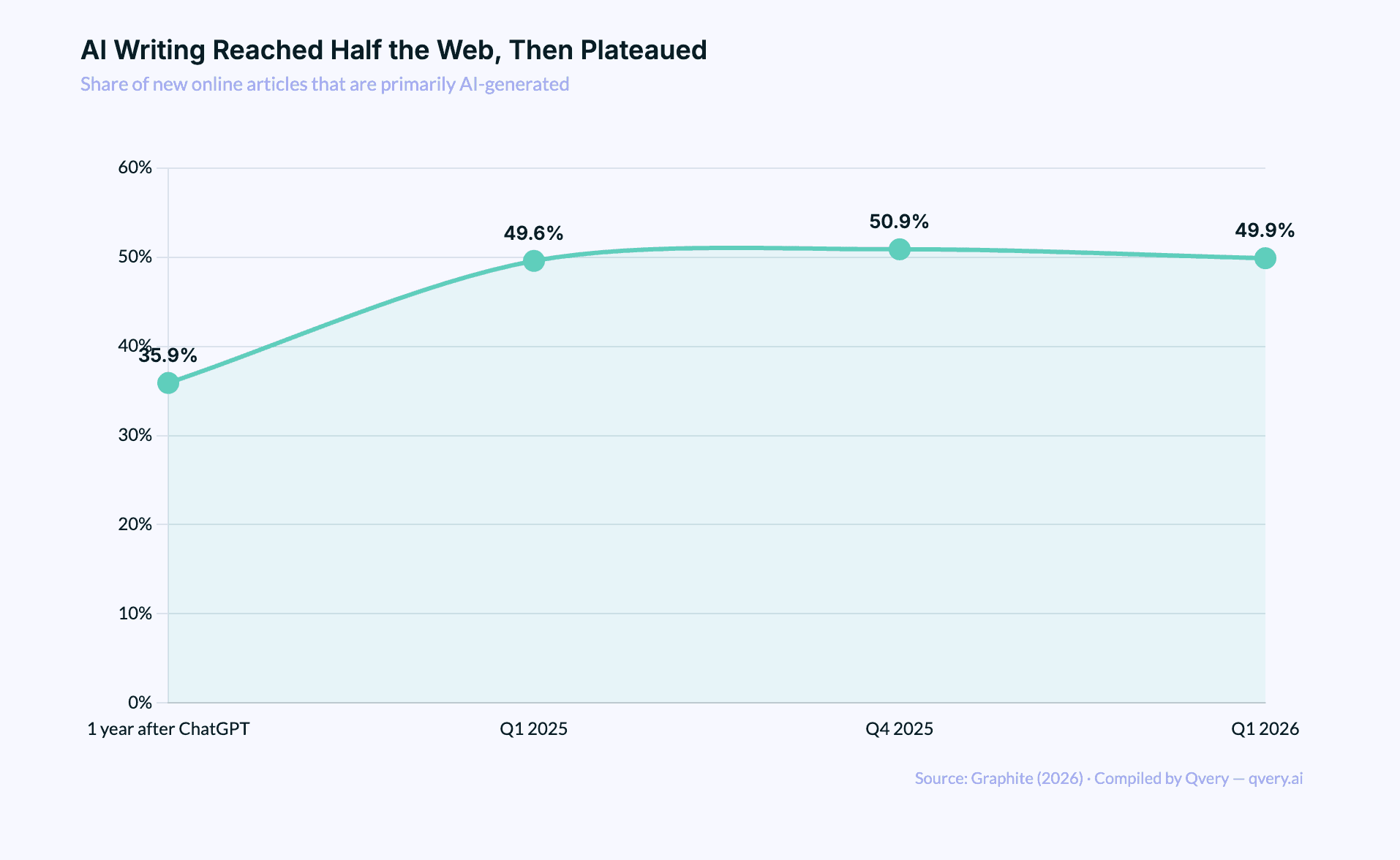
Most of that AI content is collaborative, not automated. Of those 900,000 new pages, only 2.5% were pure AI while 71.7% were a human-AI mix¹. And what surfaces in search is far lower than what gets published: AI content in Google's top 20 results climbed from 2.27% in 2019 to a July 2025 peak of 19.56%, then dipped to 17.31%¹¹. So the raw web is half AI, the visible results are a sixth AI, and the gap between those two numbers is Google doing its job.
The Flood Does Not Win the Rankings
The "AI ate content" narrative runs straight into the data and loses. Google's own position is refreshingly boring: it doesn't care whether a human or a model wrote your page, only whether the page is any good. In its documentation, Google says its focus is on "the quality of content, rather than how content is produced"¹², and that "using AI doesn't give content any special gains. It's just content"¹². The line it does enforce is scaled content abuse, mass-producing low-value pages to game rankings, which violates policy no matter how the pages are made¹³.
Only 14% of articles ranking in Google are AI-generated, and just 7% of number-one results, below AI's baseline share of the index³.
At position one, pages are 80.5% likely to be human-written versus 10% AI⁴.
Purely AI content holds the top spot only 9% of the time, versus 80% for human-written⁴.
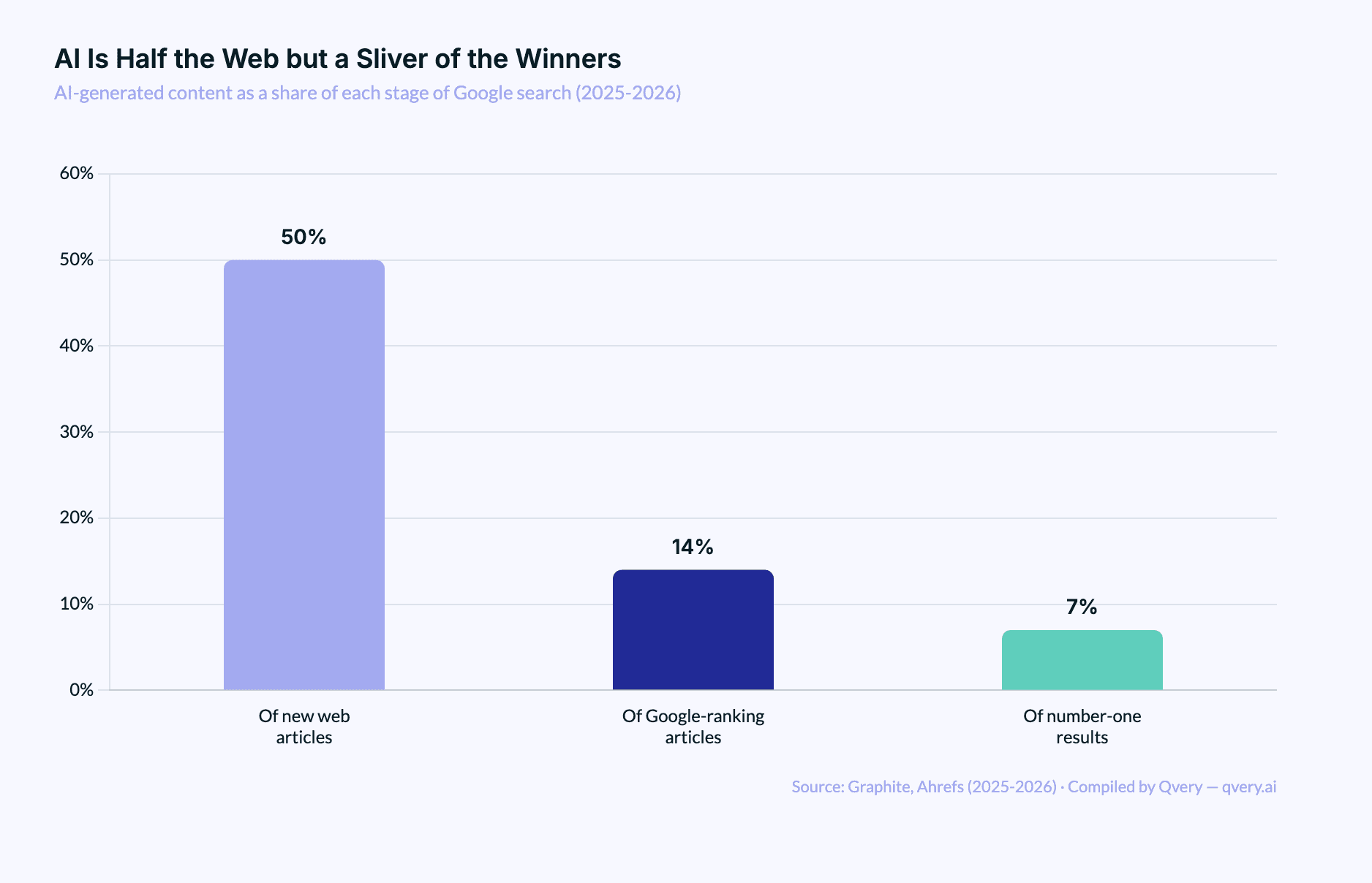
The pattern is consistent across measurers: AI content is abundant in the index and scarce at the top. Google isn't penalizing AI as a category, it's doing what it always did, sorting for quality, and quality is where mass-produced AI content is weakest. Publishing more of it doesn't move you up; it just adds to the pile you're competing against.
What AI Content Still Gets Wrong
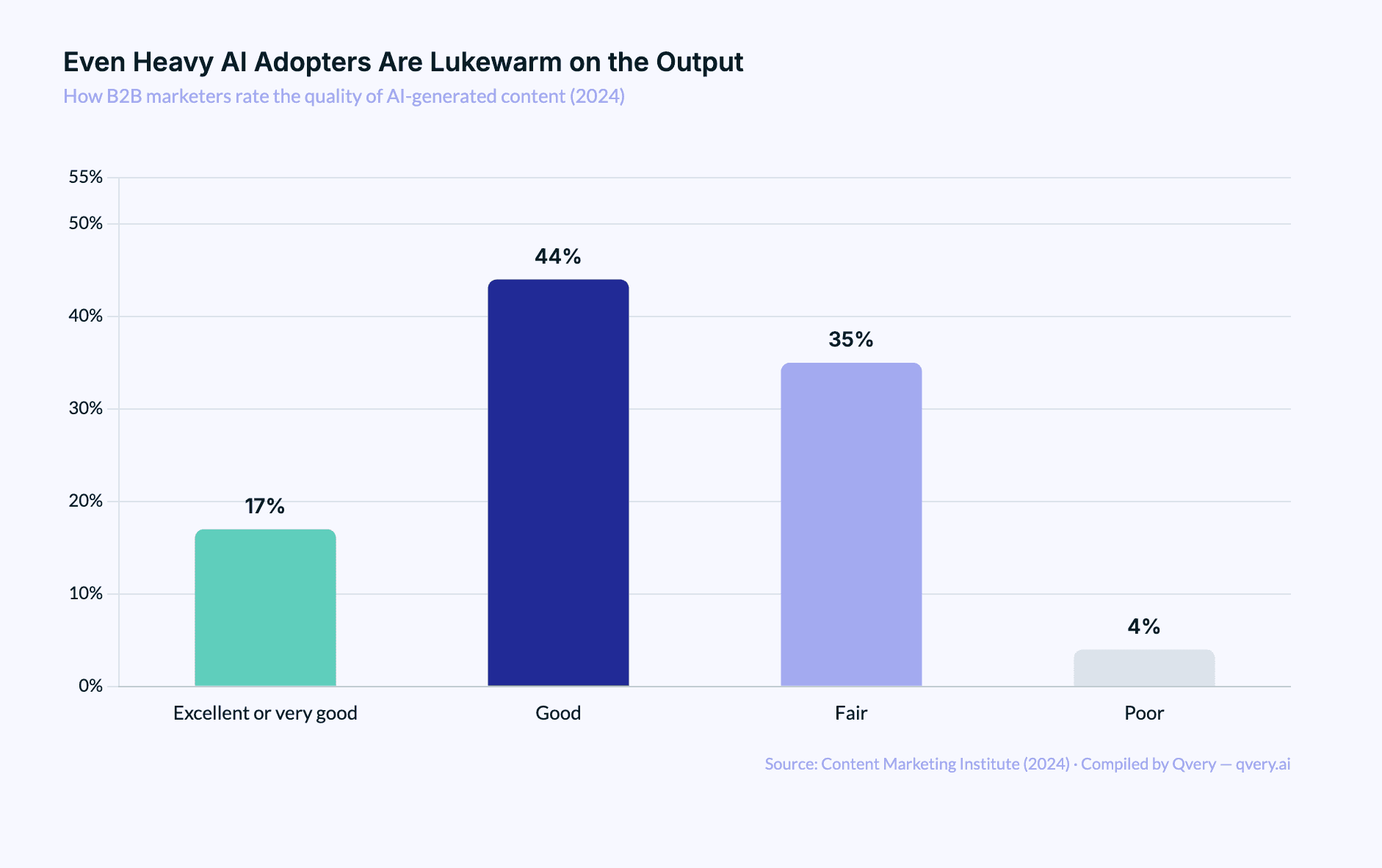
The quality gap isn't a vibe, it's measurable, and even the marketers using AI heavily are lukewarm about the output. Only 17% of B2B marketers rate AI content excellent or very good, and just 4% report high trust in it⁹. On the model side, a leading model like GPT-4o still hallucinates in about 9.6% of summaries even when grounded in a source document⁵, and 43% of marketers say inaccuracy is their top struggle with AI⁷.
Two findings kill the tidy solutions. First, detection does not work: AI-text detectors flagged 61% of essays by non-native English speakers as machine-written¹⁴, so the tools built to police AI content are worse at English than the students they are accusing.
Second, readers are of two minds: in a blind test 56% preferred the AI-written article, but 52% say they disengage the moment they suspect content is AI¹⁵. The lesson is not "avoid AI" or "just run a detector." It's that human judgment, the editing pass, is the part that can't be automated, which is why almost no one publishes raw AI (see the workflow data below).
The AI-Citing-AI Loop Is Starting
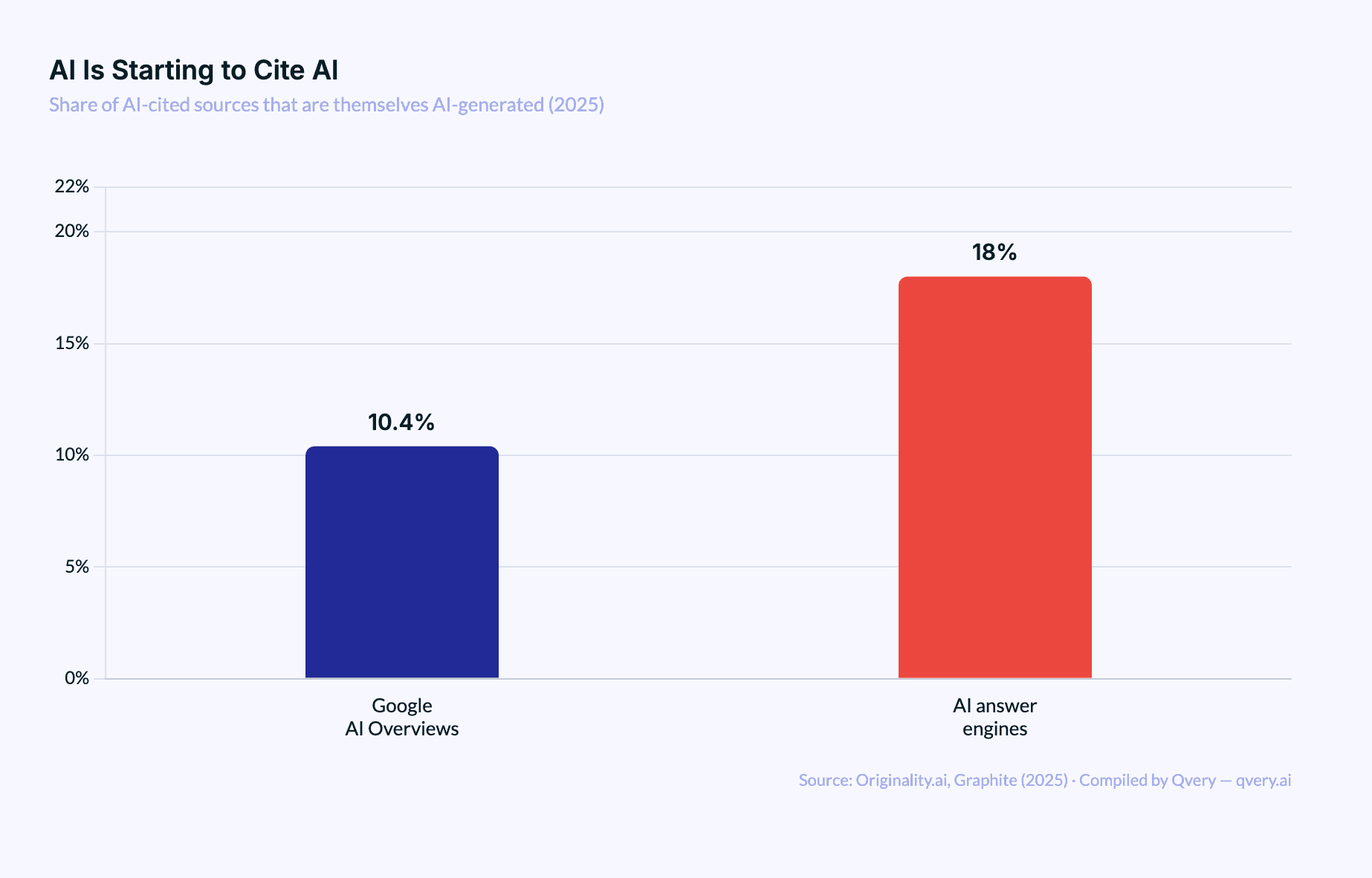
Now the systemic risk, which is more interesting than the usual slop complaint. AI answers are beginning to cite AI content, and AI content is beginning to train the next model, which is a loop that degrades if it tightens. The early numbers:
10.4% of the sources Google's AI Overviews cite are AI-generated, rising to 12.8% for sources outside the top 100⁶.
AI answer engines cite human-written articles 82% of the time, and AI-written ones 18%, slightly more than Google ranks them³.
When researchers let AI cite its own writing on a loop, the answers collapsed in 79.6% of simulations, and a single self-authored source could start the slide because models disproportionately cite their own content even after controlling for quality¹⁶.
Peer-reviewed work in Nature confirms the mechanism: training models on model output causes irreversible model collapse, where rare information disappears¹⁷. The web is learning to photocopy a photocopy. The counterintuitive takeaway for a marketer is that genuinely original, human-grounded content is becoming more valuable as the machine-made average regresses toward the mean.
Marketers Think It Ranks Fine; The Data Disagrees
This is the belief gap that gets teams in trouble. 72% of SEOs think AI content ranks at least as well as human content, up from 64% the year before⁴, while the same study's own page analysis shows the top spot is 8x more likely to be human-written⁴. Marketers are trusting the tool more precisely as the measured evidence points the other way.
The honest read on AI's value is narrower and more useful. 70% of teams say speed is AI's top benefit, and only 19% say it improves quality⁴. AI didn't make anyone a better writer, just a faster one, which isn't the same thing and occasionally the opposite.
The teams that win treat it accordingly: 87% keep content fully human-made or heavily human-led⁴, only 7% publish AI output unedited, and 56% significantly revise or rewrite it first⁷. Used that way, the productivity is real, nearly 80% report positive ROI on AI writing tasks⁷. The mistake is confusing "faster to publish" with "better to read."
What Gets Cited
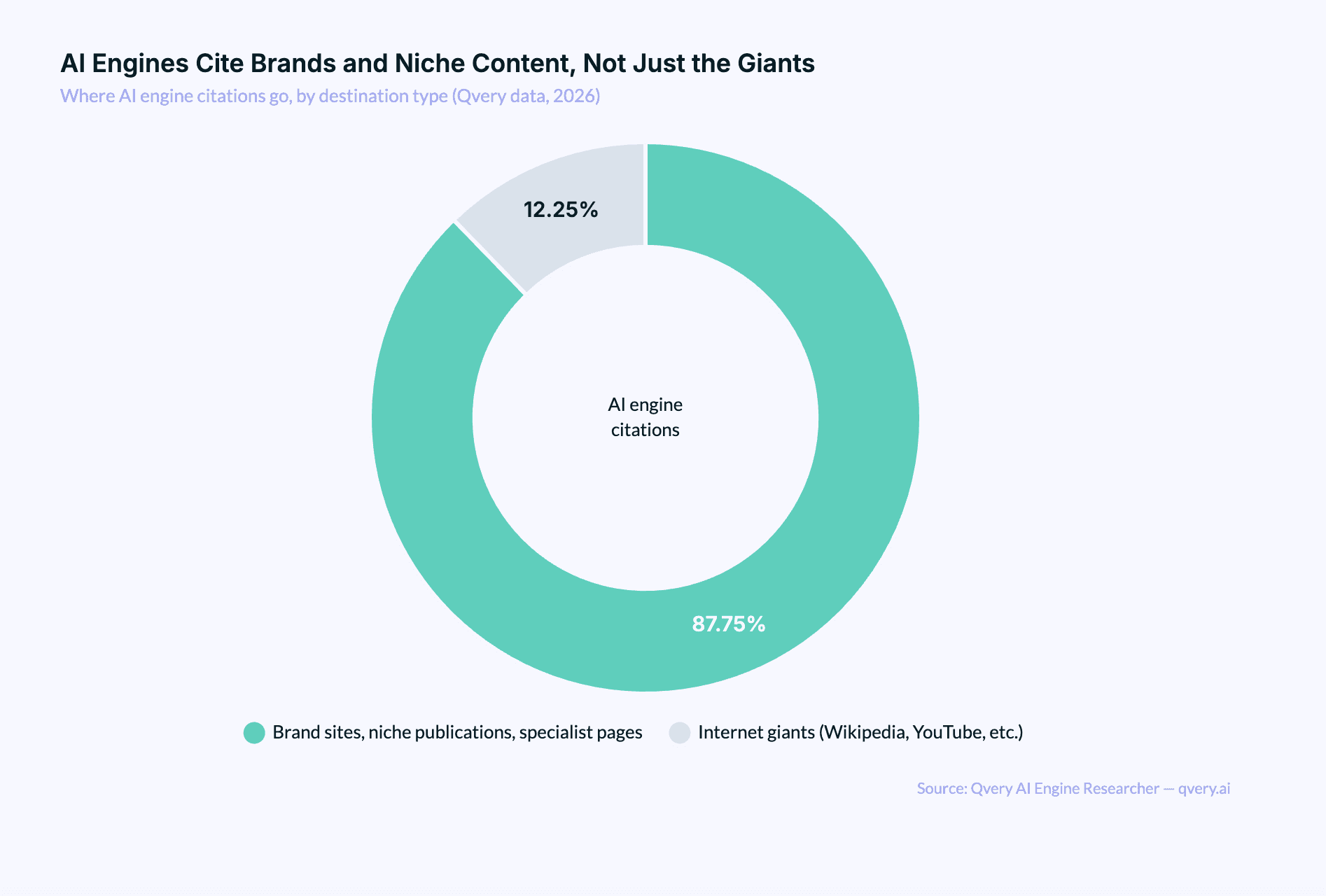
If neither volume nor speed wins the answer, what does? Substance in the right shape, and our data is specific about it. Listicles are 45.8% of all classifiable AI citations¹⁸, and 87.75% of citations go to brand sites, niche publications, and specialist pages, not the internet giants⁸.
The rest of our data reinforces that being cited is its own game. Only 13.9% of AI-cited domains rank in Google's organic top 10¹⁹, and even a number-one Google ranking is a 48.8% chance of an AI citation, a coin flip⁸. The through-line across every number in this piece is the same: AI floods the supply, but citations and rankings still reward the content worth citing. AI can help you make that content faster. It cannot decide, for you, whether the thing is worth citing at all.
How to See Whether AI Answers Cite Your Content
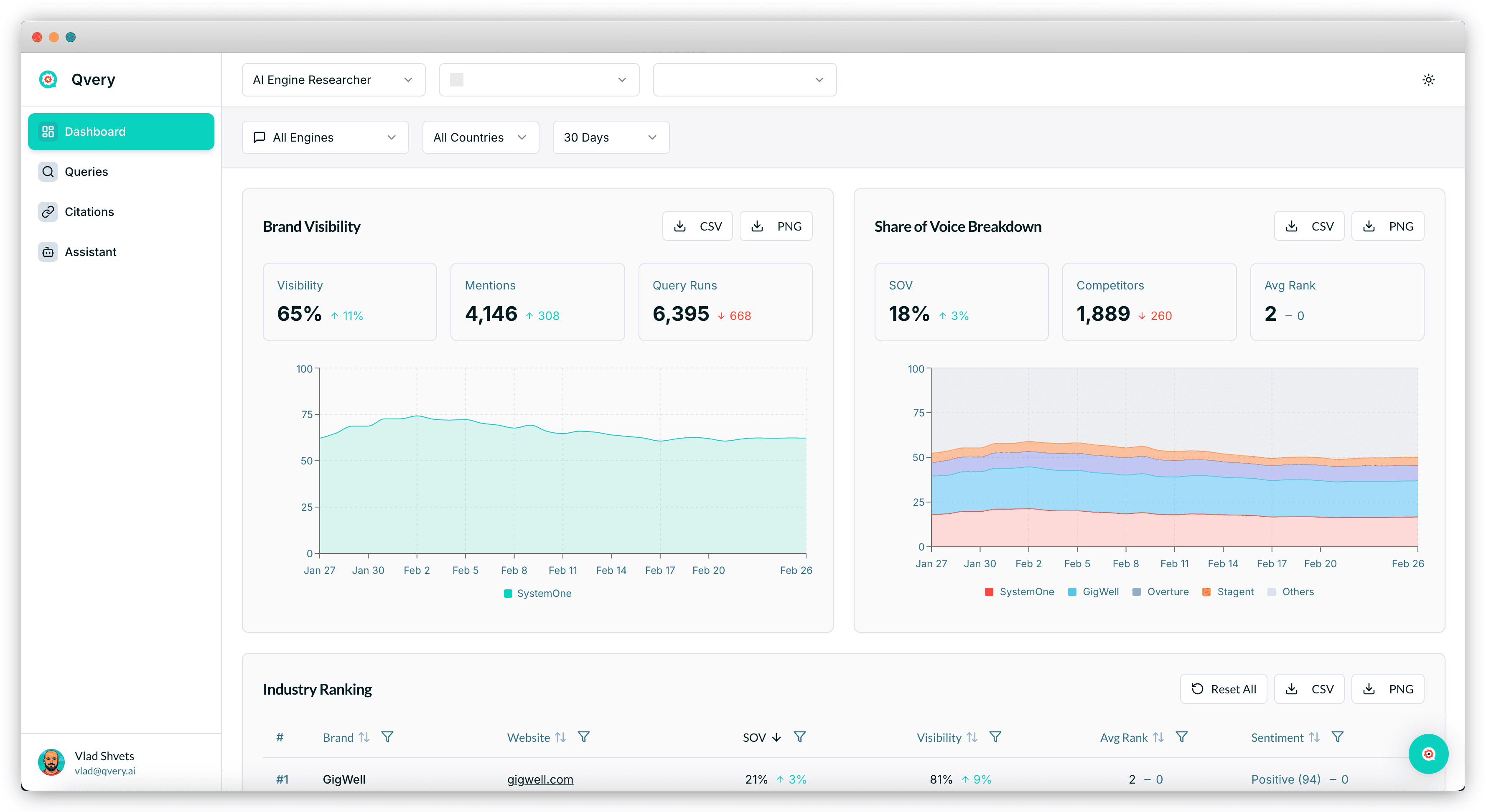
This is the problem Qvery solves. Qvery tracks how your content shows up across ChatGPT and Google AI Mode, generates the queries your customers ask, and shows you which sources each engine cites when your category comes up. You enter your brand and see where you stand in a few minutes, instead of guessing whether the answer pulls from your content or someone else's.
AI changed how content gets made, not what makes it worth citing. The web filled up with machine-written pages, and the rankings and citations quietly kept rewarding quality, originality, and usefulness, the things a model can accelerate but not supply on its own. Volume was never the metric that mattered. Whether the answer names you is, and that is now something you can measure.
Frequently Asked Questions
How many marketers use AI to create content?
Almost all of them. 87% of content marketers use AI to create or help create content¹, and content creation is the top AI use case at 55%⁷.
How much of the web is AI-generated?
About half of new articles. 74.2% of new pages contain AI content¹, and AI-written articles reached 50.9% of everything published in late 2025 before settling near parity².
Is most AI content fully automated?
No. Only 2.5% of new pages are pure AI; 71.7% are a human-AI mix¹, and 87% of teams keep content human-led⁴.
Does AI content rank on Google?
Rarely at the top. Only 14% of ranking articles are AI-generated and just 7% of number-one results³, and position one is 80.5% human versus 10% AI⁴.
Does Google penalize AI content?
Not for being AI. Google judges "quality, rather than how content is produced"¹², but scaled content abuse (mass-producing low-value pages) violates policy however it is made¹³.
How much AI content is in Google's search results?
17.31% of the top 20 results as of September 2025, down from a July peak of 19.56%¹¹, far below AI's ~50% share of the raw web.
Is AI-generated content accurate?
Not fully. A leading model like GPT-4o hallucinates in about 9.6% of grounded summaries⁵, and 43% of marketers say inaccuracy is their top struggle with AI⁷.
Do marketers trust AI content quality?
Barely. Only 17% rate AI content excellent or very good, and just 4% report high trust in it⁹.
Do AI-content detectors work?
Unreliably. Detectors flagged 61% of essays by non-native English speakers as AI-written¹⁴, making them risky to rely on.
Do readers care if content is AI-written?
Yes, once they suspect it. In a blind test 56% preferred the AI article, but 52% disengage when they suspect content is AI¹⁵.
Do AI engines cite AI-generated content?
Increasingly. 10.4% of AI Overview citations are AI-generated⁶, and about 18% of AI answer engine citations are³.
What is AI model collapse?
When AI is trained on or cites AI output in a loop, quality degrades. Simulations collapsed in 79.6% of runs¹⁶, and Nature research confirms irreversible model collapse¹⁷.
Does AI content perform as well as human content?
Marketers think so (72%), but the data disagrees: position one is 8x more likely to be human-written⁴.
What is AI good for in content?
Speed. 70% cite speed as AI's top benefit; only 19% say it improves quality⁴, and nearly 80% report positive ROI on writing tasks⁷.
How much AI content is published unedited?
Very little. Only 7% of marketers publish AI output without editing, and 56% significantly revise or rewrite it⁷.
Did AI content cause Google penalties?
Unedited mass AI did. In one study, 100% of sites hit with a manual action used AI content, half with 90-100% AI posts¹¹.
What content gets cited most by AI engines?
Listicles, at 45.8% of all classifiable AI citations¹⁸, and owned brand and niche content, which is 87.75% of citations⁸.
Does ranking on Google get my content cited by AI?
Not reliably. Only 13.9% of AI-cited domains rank in Google's top 10¹⁹, and a #1 ranking is a 48.8% chance of being cited⁸.
What should a brand do about AI content?
Use AI to draft faster, keep humans editing for quality, and measure whether AI answers cite you. Tracking your visibility across ChatGPT and Google AI Mode is what Qvery is built to do.
Sources
Ahrefs: 74% of New Webpages Include AI Content, Study of 900k Pages (2025)
Graphite: AI Now Writes as Many Online Articles as Humans Do (2026)
Semrush: Does AI Content Rank Well in Search, Survey and Data Study (2026)
Originality.ai: 10.4% of AI Overview Citations Are AI-Generated (2025)
HubSpot: AI in Content Marketing, How Creators and Marketers Use AI (2025)
Content Marketing Institute: B2B Content Marketing Benchmarks, Outlook for 2025 (2025)
Originality.ai: Amount of AI Content in Google Search Results, Ongoing Study (2025)
Google Search Central: Guidance About AI-Generated Content (2023)
Google Search Central: Guidance on Using Generative AI Content (2026)
Stanford HAI (Liang et al.): AI Detectors Biased Against Non-Native English Writers (2023)
Bynder: How Consumers Interact With AI-Generated vs Human-Made Content (2024)
Graphite: AI Search Collapse, AI Responses Collapse When AI Retrieves Its Own Generations (2026)
Nature (Shumailov et al.): AI Models Collapse When Trained on Recursively Generated Data (2024)
Qvery: Listicles Are the Most Cited Content Type in AI Search (2026)
Qvery: AI Engine Citations vs Google Organic SERPs, Only 13.9% Overlap (2026)
Three-quarters of new web pages now contain AI-generated text. In a study of 900,000 pages, 74.2% carried AI content¹, and by another measure AI-written articles briefly passed human ones at 50.9% of everything published in late 2025². That sounds like the robots won, until you notice they mostly finished second. Only 14% of the articles that rank in Google are AI-generated³, and at the very top the number is smaller still.
That gap, half the web but a fraction of the winners, is the whole story of AI content in 2026. Marketers adopted it almost universally, the volume exploded, and then the quality bar reasserted itself. AI turned out to be a spectacular way to produce content and a mediocre way to produce good content, and the difference decides who gets read and cited.
We pulled the most credible, independently verified statistics on AI-generated content we could find, from Ahrefs, Semrush, Graphite, Originality.ai, HubSpot, Google's own documentation, and peer-reviewed research.
A few figures come from our own AI-citation data at Qvery. Everything else is footnoted to its original source. Read together, they say something more useful than either the hype or the panic: AI is now the default drafting tool, it doesn't by itself win rankings or citations, and the brands using it to type faster rather than think less are the ones still showing up in the answer.
Highlights
87% of content marketers use AI to create or help create content¹.
74.2% of new web pages contain AI content, but only 2.5% are fully automated¹.
AI-written articles reached 50.9% of everything published in late 2025, then settled near parity².
Yet only 14% of Google-ranking articles are AI-generated, and just 7% of #1 results³.
At position one, pages are 80.5% likely to be human-written versus 10% for AI⁴.
A leading model like GPT-4o still hallucinates in about 9.6% of grounded summaries⁵.
10.4% of the sources AI Overviews cite are themselves AI-generated, an early sign of the loop⁶.
In our data, listicles are 45.8% of all classifiable AI citations¹⁸, and 87.75% of citations go to brand and niche content⁸.
Almost Every Marketer Uses AI to Make Content Now
Adoption is close to universal, and it happened fast. 87% of content marketers use AI to create or help create content¹, content creation is the #1 AI use case, cited by 55%⁷, and 81% of B2B teams use generative AI, up from 72% a year earlier⁹. At the organizational level, 88% of companies now use AI in at least one function¹⁰.
The important caveat is how shallow that adoption still is. Only 19% of B2B marketers say AI is integrated into their daily workflows; most use it ad hoc⁹. And the use is concentrated in text: at least 65% use AI for research, editing, and optimization, but only 28% for visuals and 9% for video⁴.
AI is a tool almost everyone has picked up and almost no one has fully wired in, which is exactly the stage where the results are uneven and the winners are the teams with a real process, not just a subscription.
Half the New Web Is Now AI-Written
The volume story is genuine, and the trajectory is stark. After ChatGPT launched, AI-written articles hit 35.9% of everything published within twelve months², then crossed to 50.9% in late 2025 before settling around 49.9% in early 2026². The web reached roughly one-to-one, human to machine, and then plateaued rather than running away.
Most of that AI content is collaborative, not automated. Of those 900,000 new pages, only 2.5% were pure AI while 71.7% were a human-AI mix¹. And what surfaces in search is far lower than what gets published: AI content in Google's top 20 results climbed from 2.27% in 2019 to a July 2025 peak of 19.56%, then dipped to 17.31%¹¹. So the raw web is half AI, the visible results are a sixth AI, and the gap between those two numbers is Google doing its job.
The Flood Does Not Win the Rankings
The "AI ate content" narrative runs straight into the data and loses. Google's own position is refreshingly boring: it doesn't care whether a human or a model wrote your page, only whether the page is any good. In its documentation, Google says its focus is on "the quality of content, rather than how content is produced"¹², and that "using AI doesn't give content any special gains. It's just content"¹². The line it does enforce is scaled content abuse, mass-producing low-value pages to game rankings, which violates policy no matter how the pages are made¹³.
Only 14% of articles ranking in Google are AI-generated, and just 7% of number-one results, below AI's baseline share of the index³.
At position one, pages are 80.5% likely to be human-written versus 10% AI⁴.
Purely AI content holds the top spot only 9% of the time, versus 80% for human-written⁴.
The pattern is consistent across measurers: AI content is abundant in the index and scarce at the top. Google isn't penalizing AI as a category, it's doing what it always did, sorting for quality, and quality is where mass-produced AI content is weakest. Publishing more of it doesn't move you up; it just adds to the pile you're competing against.
What AI Content Still Gets Wrong
The quality gap isn't a vibe, it's measurable, and even the marketers using AI heavily are lukewarm about the output. Only 17% of B2B marketers rate AI content excellent or very good, and just 4% report high trust in it⁹. On the model side, a leading model like GPT-4o still hallucinates in about 9.6% of summaries even when grounded in a source document⁵, and 43% of marketers say inaccuracy is their top struggle with AI⁷.
Two findings kill the tidy solutions. First, detection does not work: AI-text detectors flagged 61% of essays by non-native English speakers as machine-written¹⁴, so the tools built to police AI content are worse at English than the students they are accusing.
Second, readers are of two minds: in a blind test 56% preferred the AI-written article, but 52% say they disengage the moment they suspect content is AI¹⁵. The lesson is not "avoid AI" or "just run a detector." It's that human judgment, the editing pass, is the part that can't be automated, which is why almost no one publishes raw AI (see the workflow data below).
The AI-Citing-AI Loop Is Starting
Now the systemic risk, which is more interesting than the usual slop complaint. AI answers are beginning to cite AI content, and AI content is beginning to train the next model, which is a loop that degrades if it tightens. The early numbers:
10.4% of the sources Google's AI Overviews cite are AI-generated, rising to 12.8% for sources outside the top 100⁶.
AI answer engines cite human-written articles 82% of the time, and AI-written ones 18%, slightly more than Google ranks them³.
When researchers let AI cite its own writing on a loop, the answers collapsed in 79.6% of simulations, and a single self-authored source could start the slide because models disproportionately cite their own content even after controlling for quality¹⁶.
Peer-reviewed work in Nature confirms the mechanism: training models on model output causes irreversible model collapse, where rare information disappears¹⁷. The web is learning to photocopy a photocopy. The counterintuitive takeaway for a marketer is that genuinely original, human-grounded content is becoming more valuable as the machine-made average regresses toward the mean.
Marketers Think It Ranks Fine; The Data Disagrees
This is the belief gap that gets teams in trouble. 72% of SEOs think AI content ranks at least as well as human content, up from 64% the year before⁴, while the same study's own page analysis shows the top spot is 8x more likely to be human-written⁴. Marketers are trusting the tool more precisely as the measured evidence points the other way.
The honest read on AI's value is narrower and more useful. 70% of teams say speed is AI's top benefit, and only 19% say it improves quality⁴. AI didn't make anyone a better writer, just a faster one, which isn't the same thing and occasionally the opposite.
The teams that win treat it accordingly: 87% keep content fully human-made or heavily human-led⁴, only 7% publish AI output unedited, and 56% significantly revise or rewrite it first⁷. Used that way, the productivity is real, nearly 80% report positive ROI on AI writing tasks⁷. The mistake is confusing "faster to publish" with "better to read."
What Gets Cited
If neither volume nor speed wins the answer, what does? Substance in the right shape, and our data is specific about it. Listicles are 45.8% of all classifiable AI citations¹⁸, and 87.75% of citations go to brand sites, niche publications, and specialist pages, not the internet giants⁸.
The rest of our data reinforces that being cited is its own game. Only 13.9% of AI-cited domains rank in Google's organic top 10¹⁹, and even a number-one Google ranking is a 48.8% chance of an AI citation, a coin flip⁸. The through-line across every number in this piece is the same: AI floods the supply, but citations and rankings still reward the content worth citing. AI can help you make that content faster. It cannot decide, for you, whether the thing is worth citing at all.
How to See Whether AI Answers Cite Your Content
This is the problem Qvery solves. Qvery tracks how your content shows up across ChatGPT and Google AI Mode, generates the queries your customers ask, and shows you which sources each engine cites when your category comes up. You enter your brand and see where you stand in a few minutes, instead of guessing whether the answer pulls from your content or someone else's.
AI changed how content gets made, not what makes it worth citing. The web filled up with machine-written pages, and the rankings and citations quietly kept rewarding quality, originality, and usefulness, the things a model can accelerate but not supply on its own. Volume was never the metric that mattered. Whether the answer names you is, and that is now something you can measure.
Frequently Asked Questions
How many marketers use AI to create content?
Almost all of them. 87% of content marketers use AI to create or help create content¹, and content creation is the top AI use case at 55%⁷.
How much of the web is AI-generated?
About half of new articles. 74.2% of new pages contain AI content¹, and AI-written articles reached 50.9% of everything published in late 2025 before settling near parity².
Is most AI content fully automated?
No. Only 2.5% of new pages are pure AI; 71.7% are a human-AI mix¹, and 87% of teams keep content human-led⁴.
Does AI content rank on Google?
Rarely at the top. Only 14% of ranking articles are AI-generated and just 7% of number-one results³, and position one is 80.5% human versus 10% AI⁴.
Does Google penalize AI content?
Not for being AI. Google judges "quality, rather than how content is produced"¹², but scaled content abuse (mass-producing low-value pages) violates policy however it is made¹³.
How much AI content is in Google's search results?
17.31% of the top 20 results as of September 2025, down from a July peak of 19.56%¹¹, far below AI's ~50% share of the raw web.
Is AI-generated content accurate?
Not fully. A leading model like GPT-4o hallucinates in about 9.6% of grounded summaries⁵, and 43% of marketers say inaccuracy is their top struggle with AI⁷.
Do marketers trust AI content quality?
Barely. Only 17% rate AI content excellent or very good, and just 4% report high trust in it⁹.
Do AI-content detectors work?
Unreliably. Detectors flagged 61% of essays by non-native English speakers as AI-written¹⁴, making them risky to rely on.
Do readers care if content is AI-written?
Yes, once they suspect it. In a blind test 56% preferred the AI article, but 52% disengage when they suspect content is AI¹⁵.
Do AI engines cite AI-generated content?
Increasingly. 10.4% of AI Overview citations are AI-generated⁶, and about 18% of AI answer engine citations are³.
What is AI model collapse?
When AI is trained on or cites AI output in a loop, quality degrades. Simulations collapsed in 79.6% of runs¹⁶, and Nature research confirms irreversible model collapse¹⁷.
Does AI content perform as well as human content?
Marketers think so (72%), but the data disagrees: position one is 8x more likely to be human-written⁴.
What is AI good for in content?
Speed. 70% cite speed as AI's top benefit; only 19% say it improves quality⁴, and nearly 80% report positive ROI on writing tasks⁷.
How much AI content is published unedited?
Very little. Only 7% of marketers publish AI output without editing, and 56% significantly revise or rewrite it⁷.
Did AI content cause Google penalties?
Unedited mass AI did. In one study, 100% of sites hit with a manual action used AI content, half with 90-100% AI posts¹¹.
What content gets cited most by AI engines?
Listicles, at 45.8% of all classifiable AI citations¹⁸, and owned brand and niche content, which is 87.75% of citations⁸.
Does ranking on Google get my content cited by AI?
Not reliably. Only 13.9% of AI-cited domains rank in Google's top 10¹⁹, and a #1 ranking is a 48.8% chance of being cited⁸.
What should a brand do about AI content?
Use AI to draft faster, keep humans editing for quality, and measure whether AI answers cite you. Tracking your visibility across ChatGPT and Google AI Mode is what Qvery is built to do.
Sources
Ahrefs: 74% of New Webpages Include AI Content, Study of 900k Pages (2025)
Graphite: AI Now Writes as Many Online Articles as Humans Do (2026)
Semrush: Does AI Content Rank Well in Search, Survey and Data Study (2026)
Originality.ai: 10.4% of AI Overview Citations Are AI-Generated (2025)
HubSpot: AI in Content Marketing, How Creators and Marketers Use AI (2025)
Content Marketing Institute: B2B Content Marketing Benchmarks, Outlook for 2025 (2025)
Originality.ai: Amount of AI Content in Google Search Results, Ongoing Study (2025)
Google Search Central: Guidance About AI-Generated Content (2023)
Google Search Central: Guidance on Using Generative AI Content (2026)
Stanford HAI (Liang et al.): AI Detectors Biased Against Non-Native English Writers (2023)
Bynder: How Consumers Interact With AI-Generated vs Human-Made Content (2024)
Graphite: AI Search Collapse, AI Responses Collapse When AI Retrieves Its Own Generations (2026)
Nature (Shumailov et al.): AI Models Collapse When Trained on Recursively Generated Data (2024)
Qvery: Listicles Are the Most Cited Content Type in AI Search (2026)
Qvery: AI Engine Citations vs Google Organic SERPs, Only 13.9% Overlap (2026)
Three-quarters of new web pages now contain AI-generated text. In a study of 900,000 pages, 74.2% carried AI content¹, and by another measure AI-written articles briefly passed human ones at 50.9% of everything published in late 2025². That sounds like the robots won, until you notice they mostly finished second. Only 14% of the articles that rank in Google are AI-generated³, and at the very top the number is smaller still.
That gap, half the web but a fraction of the winners, is the whole story of AI content in 2026. Marketers adopted it almost universally, the volume exploded, and then the quality bar reasserted itself. AI turned out to be a spectacular way to produce content and a mediocre way to produce good content, and the difference decides who gets read and cited.
We pulled the most credible, independently verified statistics on AI-generated content we could find, from Ahrefs, Semrush, Graphite, Originality.ai, HubSpot, Google's own documentation, and peer-reviewed research.
A few figures come from our own AI-citation data at Qvery. Everything else is footnoted to its original source. Read together, they say something more useful than either the hype or the panic: AI is now the default drafting tool, it doesn't by itself win rankings or citations, and the brands using it to type faster rather than think less are the ones still showing up in the answer.
Highlights
87% of content marketers use AI to create or help create content¹.
74.2% of new web pages contain AI content, but only 2.5% are fully automated¹.
AI-written articles reached 50.9% of everything published in late 2025, then settled near parity².
Yet only 14% of Google-ranking articles are AI-generated, and just 7% of #1 results³.
At position one, pages are 80.5% likely to be human-written versus 10% for AI⁴.
A leading model like GPT-4o still hallucinates in about 9.6% of grounded summaries⁵.
10.4% of the sources AI Overviews cite are themselves AI-generated, an early sign of the loop⁶.
In our data, listicles are 45.8% of all classifiable AI citations¹⁸, and 87.75% of citations go to brand and niche content⁸.
Almost Every Marketer Uses AI to Make Content Now
Adoption is close to universal, and it happened fast. 87% of content marketers use AI to create or help create content¹, content creation is the #1 AI use case, cited by 55%⁷, and 81% of B2B teams use generative AI, up from 72% a year earlier⁹. At the organizational level, 88% of companies now use AI in at least one function¹⁰.
The important caveat is how shallow that adoption still is. Only 19% of B2B marketers say AI is integrated into their daily workflows; most use it ad hoc⁹. And the use is concentrated in text: at least 65% use AI for research, editing, and optimization, but only 28% for visuals and 9% for video⁴.
AI is a tool almost everyone has picked up and almost no one has fully wired in, which is exactly the stage where the results are uneven and the winners are the teams with a real process, not just a subscription.
Half the New Web Is Now AI-Written
The volume story is genuine, and the trajectory is stark. After ChatGPT launched, AI-written articles hit 35.9% of everything published within twelve months², then crossed to 50.9% in late 2025 before settling around 49.9% in early 2026². The web reached roughly one-to-one, human to machine, and then plateaued rather than running away.
Most of that AI content is collaborative, not automated. Of those 900,000 new pages, only 2.5% were pure AI while 71.7% were a human-AI mix¹. And what surfaces in search is far lower than what gets published: AI content in Google's top 20 results climbed from 2.27% in 2019 to a July 2025 peak of 19.56%, then dipped to 17.31%¹¹. So the raw web is half AI, the visible results are a sixth AI, and the gap between those two numbers is Google doing its job.
The Flood Does Not Win the Rankings
The "AI ate content" narrative runs straight into the data and loses. Google's own position is refreshingly boring: it doesn't care whether a human or a model wrote your page, only whether the page is any good. In its documentation, Google says its focus is on "the quality of content, rather than how content is produced"¹², and that "using AI doesn't give content any special gains. It's just content"¹². The line it does enforce is scaled content abuse, mass-producing low-value pages to game rankings, which violates policy no matter how the pages are made¹³.
Only 14% of articles ranking in Google are AI-generated, and just 7% of number-one results, below AI's baseline share of the index³.
At position one, pages are 80.5% likely to be human-written versus 10% AI⁴.
Purely AI content holds the top spot only 9% of the time, versus 80% for human-written⁴.
The pattern is consistent across measurers: AI content is abundant in the index and scarce at the top. Google isn't penalizing AI as a category, it's doing what it always did, sorting for quality, and quality is where mass-produced AI content is weakest. Publishing more of it doesn't move you up; it just adds to the pile you're competing against.
What AI Content Still Gets Wrong
The quality gap isn't a vibe, it's measurable, and even the marketers using AI heavily are lukewarm about the output. Only 17% of B2B marketers rate AI content excellent or very good, and just 4% report high trust in it⁹. On the model side, a leading model like GPT-4o still hallucinates in about 9.6% of summaries even when grounded in a source document⁵, and 43% of marketers say inaccuracy is their top struggle with AI⁷.
Two findings kill the tidy solutions. First, detection does not work: AI-text detectors flagged 61% of essays by non-native English speakers as machine-written¹⁴, so the tools built to police AI content are worse at English than the students they are accusing.
Second, readers are of two minds: in a blind test 56% preferred the AI-written article, but 52% say they disengage the moment they suspect content is AI¹⁵. The lesson is not "avoid AI" or "just run a detector." It's that human judgment, the editing pass, is the part that can't be automated, which is why almost no one publishes raw AI (see the workflow data below).
The AI-Citing-AI Loop Is Starting
Now the systemic risk, which is more interesting than the usual slop complaint. AI answers are beginning to cite AI content, and AI content is beginning to train the next model, which is a loop that degrades if it tightens. The early numbers:
10.4% of the sources Google's AI Overviews cite are AI-generated, rising to 12.8% for sources outside the top 100⁶.
AI answer engines cite human-written articles 82% of the time, and AI-written ones 18%, slightly more than Google ranks them³.
When researchers let AI cite its own writing on a loop, the answers collapsed in 79.6% of simulations, and a single self-authored source could start the slide because models disproportionately cite their own content even after controlling for quality¹⁶.
Peer-reviewed work in Nature confirms the mechanism: training models on model output causes irreversible model collapse, where rare information disappears¹⁷. The web is learning to photocopy a photocopy. The counterintuitive takeaway for a marketer is that genuinely original, human-grounded content is becoming more valuable as the machine-made average regresses toward the mean.
Marketers Think It Ranks Fine; The Data Disagrees
This is the belief gap that gets teams in trouble. 72% of SEOs think AI content ranks at least as well as human content, up from 64% the year before⁴, while the same study's own page analysis shows the top spot is 8x more likely to be human-written⁴. Marketers are trusting the tool more precisely as the measured evidence points the other way.
The honest read on AI's value is narrower and more useful. 70% of teams say speed is AI's top benefit, and only 19% say it improves quality⁴. AI didn't make anyone a better writer, just a faster one, which isn't the same thing and occasionally the opposite.
The teams that win treat it accordingly: 87% keep content fully human-made or heavily human-led⁴, only 7% publish AI output unedited, and 56% significantly revise or rewrite it first⁷. Used that way, the productivity is real, nearly 80% report positive ROI on AI writing tasks⁷. The mistake is confusing "faster to publish" with "better to read."
What Gets Cited
If neither volume nor speed wins the answer, what does? Substance in the right shape, and our data is specific about it. Listicles are 45.8% of all classifiable AI citations¹⁸, and 87.75% of citations go to brand sites, niche publications, and specialist pages, not the internet giants⁸.
The rest of our data reinforces that being cited is its own game. Only 13.9% of AI-cited domains rank in Google's organic top 10¹⁹, and even a number-one Google ranking is a 48.8% chance of an AI citation, a coin flip⁸. The through-line across every number in this piece is the same: AI floods the supply, but citations and rankings still reward the content worth citing. AI can help you make that content faster. It cannot decide, for you, whether the thing is worth citing at all.
How to See Whether AI Answers Cite Your Content
This is the problem Qvery solves. Qvery tracks how your content shows up across ChatGPT and Google AI Mode, generates the queries your customers ask, and shows you which sources each engine cites when your category comes up. You enter your brand and see where you stand in a few minutes, instead of guessing whether the answer pulls from your content or someone else's.
AI changed how content gets made, not what makes it worth citing. The web filled up with machine-written pages, and the rankings and citations quietly kept rewarding quality, originality, and usefulness, the things a model can accelerate but not supply on its own. Volume was never the metric that mattered. Whether the answer names you is, and that is now something you can measure.
Frequently Asked Questions
How many marketers use AI to create content?
Almost all of them. 87% of content marketers use AI to create or help create content¹, and content creation is the top AI use case at 55%⁷.
How much of the web is AI-generated?
About half of new articles. 74.2% of new pages contain AI content¹, and AI-written articles reached 50.9% of everything published in late 2025 before settling near parity².
Is most AI content fully automated?
No. Only 2.5% of new pages are pure AI; 71.7% are a human-AI mix¹, and 87% of teams keep content human-led⁴.
Does AI content rank on Google?
Rarely at the top. Only 14% of ranking articles are AI-generated and just 7% of number-one results³, and position one is 80.5% human versus 10% AI⁴.
Does Google penalize AI content?
Not for being AI. Google judges "quality, rather than how content is produced"¹², but scaled content abuse (mass-producing low-value pages) violates policy however it is made¹³.
How much AI content is in Google's search results?
17.31% of the top 20 results as of September 2025, down from a July peak of 19.56%¹¹, far below AI's ~50% share of the raw web.
Is AI-generated content accurate?
Not fully. A leading model like GPT-4o hallucinates in about 9.6% of grounded summaries⁵, and 43% of marketers say inaccuracy is their top struggle with AI⁷.
Do marketers trust AI content quality?
Barely. Only 17% rate AI content excellent or very good, and just 4% report high trust in it⁹.
Do AI-content detectors work?
Unreliably. Detectors flagged 61% of essays by non-native English speakers as AI-written¹⁴, making them risky to rely on.
Do readers care if content is AI-written?
Yes, once they suspect it. In a blind test 56% preferred the AI article, but 52% disengage when they suspect content is AI¹⁵.
Do AI engines cite AI-generated content?
Increasingly. 10.4% of AI Overview citations are AI-generated⁶, and about 18% of AI answer engine citations are³.
What is AI model collapse?
When AI is trained on or cites AI output in a loop, quality degrades. Simulations collapsed in 79.6% of runs¹⁶, and Nature research confirms irreversible model collapse¹⁷.
Does AI content perform as well as human content?
Marketers think so (72%), but the data disagrees: position one is 8x more likely to be human-written⁴.
What is AI good for in content?
Speed. 70% cite speed as AI's top benefit; only 19% say it improves quality⁴, and nearly 80% report positive ROI on writing tasks⁷.
How much AI content is published unedited?
Very little. Only 7% of marketers publish AI output without editing, and 56% significantly revise or rewrite it⁷.
Did AI content cause Google penalties?
Unedited mass AI did. In one study, 100% of sites hit with a manual action used AI content, half with 90-100% AI posts¹¹.
What content gets cited most by AI engines?
Listicles, at 45.8% of all classifiable AI citations¹⁸, and owned brand and niche content, which is 87.75% of citations⁸.
Does ranking on Google get my content cited by AI?
Not reliably. Only 13.9% of AI-cited domains rank in Google's top 10¹⁹, and a #1 ranking is a 48.8% chance of being cited⁸.
What should a brand do about AI content?
Use AI to draft faster, keep humans editing for quality, and measure whether AI answers cite you. Tracking your visibility across ChatGPT and Google AI Mode is what Qvery is built to do.
Sources
Ahrefs: 74% of New Webpages Include AI Content, Study of 900k Pages (2025)
Graphite: AI Now Writes as Many Online Articles as Humans Do (2026)
Semrush: Does AI Content Rank Well in Search, Survey and Data Study (2026)
Originality.ai: 10.4% of AI Overview Citations Are AI-Generated (2025)
HubSpot: AI in Content Marketing, How Creators and Marketers Use AI (2025)
Content Marketing Institute: B2B Content Marketing Benchmarks, Outlook for 2025 (2025)
Originality.ai: Amount of AI Content in Google Search Results, Ongoing Study (2025)
Google Search Central: Guidance About AI-Generated Content (2023)
Google Search Central: Guidance on Using Generative AI Content (2026)
Stanford HAI (Liang et al.): AI Detectors Biased Against Non-Native English Writers (2023)
Bynder: How Consumers Interact With AI-Generated vs Human-Made Content (2024)
Graphite: AI Search Collapse, AI Responses Collapse When AI Retrieves Its Own Generations (2026)
Nature (Shumailov et al.): AI Models Collapse When Trained on Recursively Generated Data (2024)
Qvery: Listicles Are the Most Cited Content Type in AI Search (2026)
Qvery: AI Engine Citations vs Google Organic SERPs, Only 13.9% Overlap (2026)
Three-quarters of new web pages now contain AI-generated text. In a study of 900,000 pages, 74.2% carried AI content¹, and by another measure AI-written articles briefly passed human ones at 50.9% of everything published in late 2025². That sounds like the robots won, until you notice they mostly finished second. Only 14% of the articles that rank in Google are AI-generated³, and at the very top the number is smaller still.
That gap, half the web but a fraction of the winners, is the whole story of AI content in 2026. Marketers adopted it almost universally, the volume exploded, and then the quality bar reasserted itself. AI turned out to be a spectacular way to produce content and a mediocre way to produce good content, and the difference decides who gets read and cited.
We pulled the most credible, independently verified statistics on AI-generated content we could find, from Ahrefs, Semrush, Graphite, Originality.ai, HubSpot, Google's own documentation, and peer-reviewed research.
A few figures come from our own AI-citation data at Qvery. Everything else is footnoted to its original source. Read together, they say something more useful than either the hype or the panic: AI is now the default drafting tool, it doesn't by itself win rankings or citations, and the brands using it to type faster rather than think less are the ones still showing up in the answer.
Highlights
87% of content marketers use AI to create or help create content¹.
74.2% of new web pages contain AI content, but only 2.5% are fully automated¹.
AI-written articles reached 50.9% of everything published in late 2025, then settled near parity².
Yet only 14% of Google-ranking articles are AI-generated, and just 7% of #1 results³.
At position one, pages are 80.5% likely to be human-written versus 10% for AI⁴.
A leading model like GPT-4o still hallucinates in about 9.6% of grounded summaries⁵.
10.4% of the sources AI Overviews cite are themselves AI-generated, an early sign of the loop⁶.
In our data, listicles are 45.8% of all classifiable AI citations¹⁸, and 87.75% of citations go to brand and niche content⁸.
Almost Every Marketer Uses AI to Make Content Now
Adoption is close to universal, and it happened fast. 87% of content marketers use AI to create or help create content¹, content creation is the #1 AI use case, cited by 55%⁷, and 81% of B2B teams use generative AI, up from 72% a year earlier⁹. At the organizational level, 88% of companies now use AI in at least one function¹⁰.
The important caveat is how shallow that adoption still is. Only 19% of B2B marketers say AI is integrated into their daily workflows; most use it ad hoc⁹. And the use is concentrated in text: at least 65% use AI for research, editing, and optimization, but only 28% for visuals and 9% for video⁴.
AI is a tool almost everyone has picked up and almost no one has fully wired in, which is exactly the stage where the results are uneven and the winners are the teams with a real process, not just a subscription.
Half the New Web Is Now AI-Written
The volume story is genuine, and the trajectory is stark. After ChatGPT launched, AI-written articles hit 35.9% of everything published within twelve months², then crossed to 50.9% in late 2025 before settling around 49.9% in early 2026². The web reached roughly one-to-one, human to machine, and then plateaued rather than running away.
Most of that AI content is collaborative, not automated. Of those 900,000 new pages, only 2.5% were pure AI while 71.7% were a human-AI mix¹. And what surfaces in search is far lower than what gets published: AI content in Google's top 20 results climbed from 2.27% in 2019 to a July 2025 peak of 19.56%, then dipped to 17.31%¹¹. So the raw web is half AI, the visible results are a sixth AI, and the gap between those two numbers is Google doing its job.
The Flood Does Not Win the Rankings
The "AI ate content" narrative runs straight into the data and loses. Google's own position is refreshingly boring: it doesn't care whether a human or a model wrote your page, only whether the page is any good. In its documentation, Google says its focus is on "the quality of content, rather than how content is produced"¹², and that "using AI doesn't give content any special gains. It's just content"¹². The line it does enforce is scaled content abuse, mass-producing low-value pages to game rankings, which violates policy no matter how the pages are made¹³.
Only 14% of articles ranking in Google are AI-generated, and just 7% of number-one results, below AI's baseline share of the index³.
At position one, pages are 80.5% likely to be human-written versus 10% AI⁴.
Purely AI content holds the top spot only 9% of the time, versus 80% for human-written⁴.
The pattern is consistent across measurers: AI content is abundant in the index and scarce at the top. Google isn't penalizing AI as a category, it's doing what it always did, sorting for quality, and quality is where mass-produced AI content is weakest. Publishing more of it doesn't move you up; it just adds to the pile you're competing against.
What AI Content Still Gets Wrong
The quality gap isn't a vibe, it's measurable, and even the marketers using AI heavily are lukewarm about the output. Only 17% of B2B marketers rate AI content excellent or very good, and just 4% report high trust in it⁹. On the model side, a leading model like GPT-4o still hallucinates in about 9.6% of summaries even when grounded in a source document⁵, and 43% of marketers say inaccuracy is their top struggle with AI⁷.
Two findings kill the tidy solutions. First, detection does not work: AI-text detectors flagged 61% of essays by non-native English speakers as machine-written¹⁴, so the tools built to police AI content are worse at English than the students they are accusing.
Second, readers are of two minds: in a blind test 56% preferred the AI-written article, but 52% say they disengage the moment they suspect content is AI¹⁵. The lesson is not "avoid AI" or "just run a detector." It's that human judgment, the editing pass, is the part that can't be automated, which is why almost no one publishes raw AI (see the workflow data below).
The AI-Citing-AI Loop Is Starting
Now the systemic risk, which is more interesting than the usual slop complaint. AI answers are beginning to cite AI content, and AI content is beginning to train the next model, which is a loop that degrades if it tightens. The early numbers:
10.4% of the sources Google's AI Overviews cite are AI-generated, rising to 12.8% for sources outside the top 100⁶.
AI answer engines cite human-written articles 82% of the time, and AI-written ones 18%, slightly more than Google ranks them³.
When researchers let AI cite its own writing on a loop, the answers collapsed in 79.6% of simulations, and a single self-authored source could start the slide because models disproportionately cite their own content even after controlling for quality¹⁶.
Peer-reviewed work in Nature confirms the mechanism: training models on model output causes irreversible model collapse, where rare information disappears¹⁷. The web is learning to photocopy a photocopy. The counterintuitive takeaway for a marketer is that genuinely original, human-grounded content is becoming more valuable as the machine-made average regresses toward the mean.
Marketers Think It Ranks Fine; The Data Disagrees
This is the belief gap that gets teams in trouble. 72% of SEOs think AI content ranks at least as well as human content, up from 64% the year before⁴, while the same study's own page analysis shows the top spot is 8x more likely to be human-written⁴. Marketers are trusting the tool more precisely as the measured evidence points the other way.
The honest read on AI's value is narrower and more useful. 70% of teams say speed is AI's top benefit, and only 19% say it improves quality⁴. AI didn't make anyone a better writer, just a faster one, which isn't the same thing and occasionally the opposite.
The teams that win treat it accordingly: 87% keep content fully human-made or heavily human-led⁴, only 7% publish AI output unedited, and 56% significantly revise or rewrite it first⁷. Used that way, the productivity is real, nearly 80% report positive ROI on AI writing tasks⁷. The mistake is confusing "faster to publish" with "better to read."
What Gets Cited
If neither volume nor speed wins the answer, what does? Substance in the right shape, and our data is specific about it. Listicles are 45.8% of all classifiable AI citations¹⁸, and 87.75% of citations go to brand sites, niche publications, and specialist pages, not the internet giants⁸.
The rest of our data reinforces that being cited is its own game. Only 13.9% of AI-cited domains rank in Google's organic top 10¹⁹, and even a number-one Google ranking is a 48.8% chance of an AI citation, a coin flip⁸. The through-line across every number in this piece is the same: AI floods the supply, but citations and rankings still reward the content worth citing. AI can help you make that content faster. It cannot decide, for you, whether the thing is worth citing at all.
How to See Whether AI Answers Cite Your Content
This is the problem Qvery solves. Qvery tracks how your content shows up across ChatGPT and Google AI Mode, generates the queries your customers ask, and shows you which sources each engine cites when your category comes up. You enter your brand and see where you stand in a few minutes, instead of guessing whether the answer pulls from your content or someone else's.
AI changed how content gets made, not what makes it worth citing. The web filled up with machine-written pages, and the rankings and citations quietly kept rewarding quality, originality, and usefulness, the things a model can accelerate but not supply on its own. Volume was never the metric that mattered. Whether the answer names you is, and that is now something you can measure.
Frequently Asked Questions
How many marketers use AI to create content?
Almost all of them. 87% of content marketers use AI to create or help create content¹, and content creation is the top AI use case at 55%⁷.
How much of the web is AI-generated?
About half of new articles. 74.2% of new pages contain AI content¹, and AI-written articles reached 50.9% of everything published in late 2025 before settling near parity².
Is most AI content fully automated?
No. Only 2.5% of new pages are pure AI; 71.7% are a human-AI mix¹, and 87% of teams keep content human-led⁴.
Does AI content rank on Google?
Rarely at the top. Only 14% of ranking articles are AI-generated and just 7% of number-one results³, and position one is 80.5% human versus 10% AI⁴.
Does Google penalize AI content?
Not for being AI. Google judges "quality, rather than how content is produced"¹², but scaled content abuse (mass-producing low-value pages) violates policy however it is made¹³.
How much AI content is in Google's search results?
17.31% of the top 20 results as of September 2025, down from a July peak of 19.56%¹¹, far below AI's ~50% share of the raw web.
Is AI-generated content accurate?
Not fully. A leading model like GPT-4o hallucinates in about 9.6% of grounded summaries⁵, and 43% of marketers say inaccuracy is their top struggle with AI⁷.
Do marketers trust AI content quality?
Barely. Only 17% rate AI content excellent or very good, and just 4% report high trust in it⁹.
Do AI-content detectors work?
Unreliably. Detectors flagged 61% of essays by non-native English speakers as AI-written¹⁴, making them risky to rely on.
Do readers care if content is AI-written?
Yes, once they suspect it. In a blind test 56% preferred the AI article, but 52% disengage when they suspect content is AI¹⁵.
Do AI engines cite AI-generated content?
Increasingly. 10.4% of AI Overview citations are AI-generated⁶, and about 18% of AI answer engine citations are³.
What is AI model collapse?
When AI is trained on or cites AI output in a loop, quality degrades. Simulations collapsed in 79.6% of runs¹⁶, and Nature research confirms irreversible model collapse¹⁷.
Does AI content perform as well as human content?
Marketers think so (72%), but the data disagrees: position one is 8x more likely to be human-written⁴.
What is AI good for in content?
Speed. 70% cite speed as AI's top benefit; only 19% say it improves quality⁴, and nearly 80% report positive ROI on writing tasks⁷.
How much AI content is published unedited?
Very little. Only 7% of marketers publish AI output without editing, and 56% significantly revise or rewrite it⁷.
Did AI content cause Google penalties?
Unedited mass AI did. In one study, 100% of sites hit with a manual action used AI content, half with 90-100% AI posts¹¹.
What content gets cited most by AI engines?
Listicles, at 45.8% of all classifiable AI citations¹⁸, and owned brand and niche content, which is 87.75% of citations⁸.
Does ranking on Google get my content cited by AI?
Not reliably. Only 13.9% of AI-cited domains rank in Google's top 10¹⁹, and a #1 ranking is a 48.8% chance of being cited⁸.
What should a brand do about AI content?
Use AI to draft faster, keep humans editing for quality, and measure whether AI answers cite you. Tracking your visibility across ChatGPT and Google AI Mode is what Qvery is built to do.
Sources
Ahrefs: 74% of New Webpages Include AI Content, Study of 900k Pages (2025)
Graphite: AI Now Writes as Many Online Articles as Humans Do (2026)
Semrush: Does AI Content Rank Well in Search, Survey and Data Study (2026)
Originality.ai: 10.4% of AI Overview Citations Are AI-Generated (2025)
HubSpot: AI in Content Marketing, How Creators and Marketers Use AI (2025)
Content Marketing Institute: B2B Content Marketing Benchmarks, Outlook for 2025 (2025)
Originality.ai: Amount of AI Content in Google Search Results, Ongoing Study (2025)
Google Search Central: Guidance About AI-Generated Content (2023)
Google Search Central: Guidance on Using Generative AI Content (2026)
Stanford HAI (Liang et al.): AI Detectors Biased Against Non-Native English Writers (2023)
Bynder: How Consumers Interact With AI-Generated vs Human-Made Content (2024)
Graphite: AI Search Collapse, AI Responses Collapse When AI Retrieves Its Own Generations (2026)
Nature (Shumailov et al.): AI Models Collapse When Trained on Recursively Generated Data (2024)
Qvery: Listicles Are the Most Cited Content Type in AI Search (2026)
Qvery: AI Engine Citations vs Google Organic SERPs, Only 13.9% Overlap (2026)

© 2026 Qvery AI OÜ