By
Vlad Shvets
The Agentic Web Statistics 2026: 50+ Numbers on the Web Agents Are Building
Bots already outnumber humans online, agents are learning to browse and buy, and agentic commerce could be $300-500 billion by 2030. Here are 50+ verified statistics on The Agentic Web, and why visibility to the machine is becoming the whole job.
Bots already outnumber humans online, agents are learning to browse and buy, and agentic commerce could be $300-500 billion by 2030. Here are 50+ verified statistics on The Agentic Web, and why visibility to the machine is becoming the whole job.
Bots already outnumber humans online, agents are learning to browse and buy, and agentic commerce could be $300-500 billion by 2030. Here are 50+ verified statistics on The Agentic Web, and why visibility to the machine is becoming the whole job.
Every marketing playbook ever written assumes the visitor is a person. Someone with eyes, a scroll habit, and a vague willingness to be persuaded. That assumption is quietly expiring. The web's largest and fastest-growing audience is now machines: crawlers that read for training, agents that fetch pages on your behalf, and, increasingly, shopping bots that compare options and click buy. If the internet held an election today, humans would be the minority party.
This is what people mean by The Agentic Web: an internet where a growing share of the browsing, evaluating, and buying is done by AI acting for a human, not the human directly.
The numbers below come from edge networks measuring real traffic, benchmark papers testing what agents can really do, the payment giants wiring up agent checkout, and our own citation data at Qvery. Read together they answer one question: what happens to visibility when your most important visitor doesn't have eyes? Here are 50+ verified statistics on the web agents are building, and why being seen by the machine is becoming the whole job.
Highlights
51% of web traffic is now automated. For the first time in a decade, bots outnumber humans online. The audience you optimize for is already mostly machines.
ChatGPT-User fetches grew 2,825% in a year. On-demand fetching, an agent pulling a page because a person asked, is the fastest-rising traffic signature on the web.
Agents finish only 30% of real office tasks on their own. Capable enough to matter, unreliable enough that betting your ops on unsupervised autonomy today is premature.
Agentic commerce could be $300-500 billion by 2030. Roughly 15-25% of US e-commerce, and independent forecasts from Bain, Morgan Stanley, and McKinsey all point the same way.
AI-referred shoppers now convert 42% better than everyone else. A full reversal from a year earlier, when the same AI traffic converted worse than everyone else.
Only 13.9% of AI-cited domains overlap with Google's organic top 10. Ranking on Google doesn't put you on the agent's shelf. That's a different shelf.
The Web's Majority Visitor Is Already a Machine
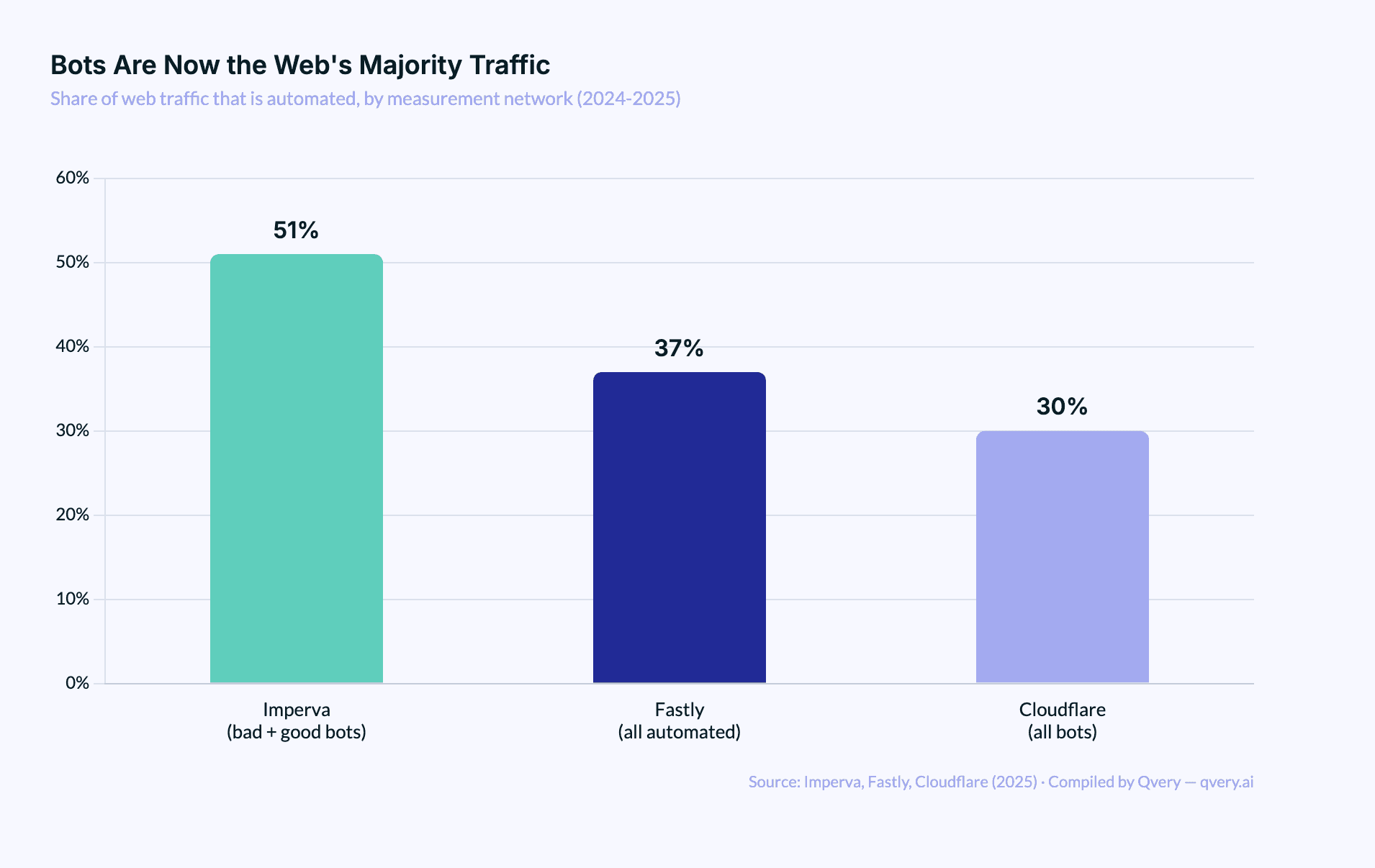
Start with the fact that reframes everything else. In 2024, automated bot traffic overtook humans for the first time in a decade, reaching 51% of all web traffic.¹
The audience marketers spend their lives courting is now, by headcount, a minority on the very network they court it on. Not all of that automation is friendly: bad bots alone make up 37% of internet traffic, up from 32% in 2023, and one security network blocked 13 trillion bad-bot requests in a single year.¹
Two other networks measuring the same thing land in the same zone. Cloudflare puts bots at roughly 30% of global web traffic, exceeding human traffic in some regions,² and Fastly clocks automated traffic at 37% of everything it sees.³ The exact percentage depends on whose pipes you measure. The direction doesn't. My read: "web traffic" and "human audience" have quietly become two different numbers, and most analytics dashboards still pretend they're the same one. If you're reporting sessions without asking how many had a pulse, you're measuring a room that's half empty of people.
From Crawling to Acting: The Shift That Names the Era
Bots are not new. What's new is what they're becoming. The old bot read your page to build an index. The new bot reads it to answer a question a person is asking right now, then, soon, to act on the answer. You can see the transition in the traffic mix.
AI and search crawling grew 18% in a year, and OpenAI's training crawler lifted its share of that traffic from 2.2% to 7.7%, a 305% jump in requests.² Meta's crawlers alone now generate 52% of AI crawler traffic, more than Google (23%) and OpenAI (20%) combined, and nearly 80% of all AI bot traffic is still crawling for training data.³
But the signature stat of The Agentic Web is a different one. ChatGPT-User, the fetcher that grabs a live page because someone asked ChatGPT a question, saw requests surge 2,825% in a year,² and OpenAI's bots now account for 98% of all real-time fetcher requests on one major network.³ That's an agent going to get something for a person, on demand. The gap between "crawls your site once a month" and "reads your page the instant a buyer asks about you" is the whole ballgame.
The enterprise forecasts point the same way. Gartner expects 33% of enterprise software to include agentic AI by 2028, up from less than 1% in 2024, and at least 15% of day-to-day work decisions to be made autonomously by agents, up from zero.⁴
Already, 62% of organizations say they're at least experimenting with AI agents,⁵ and Deloitte expects the share of generative-AI companies running agent pilots to double from 25% to 50% by 2027.⁶ The subjective read: the shift from bots that read to agents that act is not a someday. It's a budget line this year, and it changes who you're really writing for.
Can Agents Do the Job Yet?
Here's the honest counterweight, because the hype needs one. Agents that browse are real and improving fast, but they are not yet reliable colleagues. OpenAI's computer-using agent set a state of the art of 58.1% on WebArena and 87% on the simpler WebVoyager live-browsing benchmark, which is genuinely impressive for a machine clicking through real websites.⁷
Then the same agent scored 38.1% on the harder OSWorld full-computer-use test, against 72.4% for a human.⁷ On a benchmark of real professional tasks, the most competitive agent completed just 30% of them autonomously.⁸
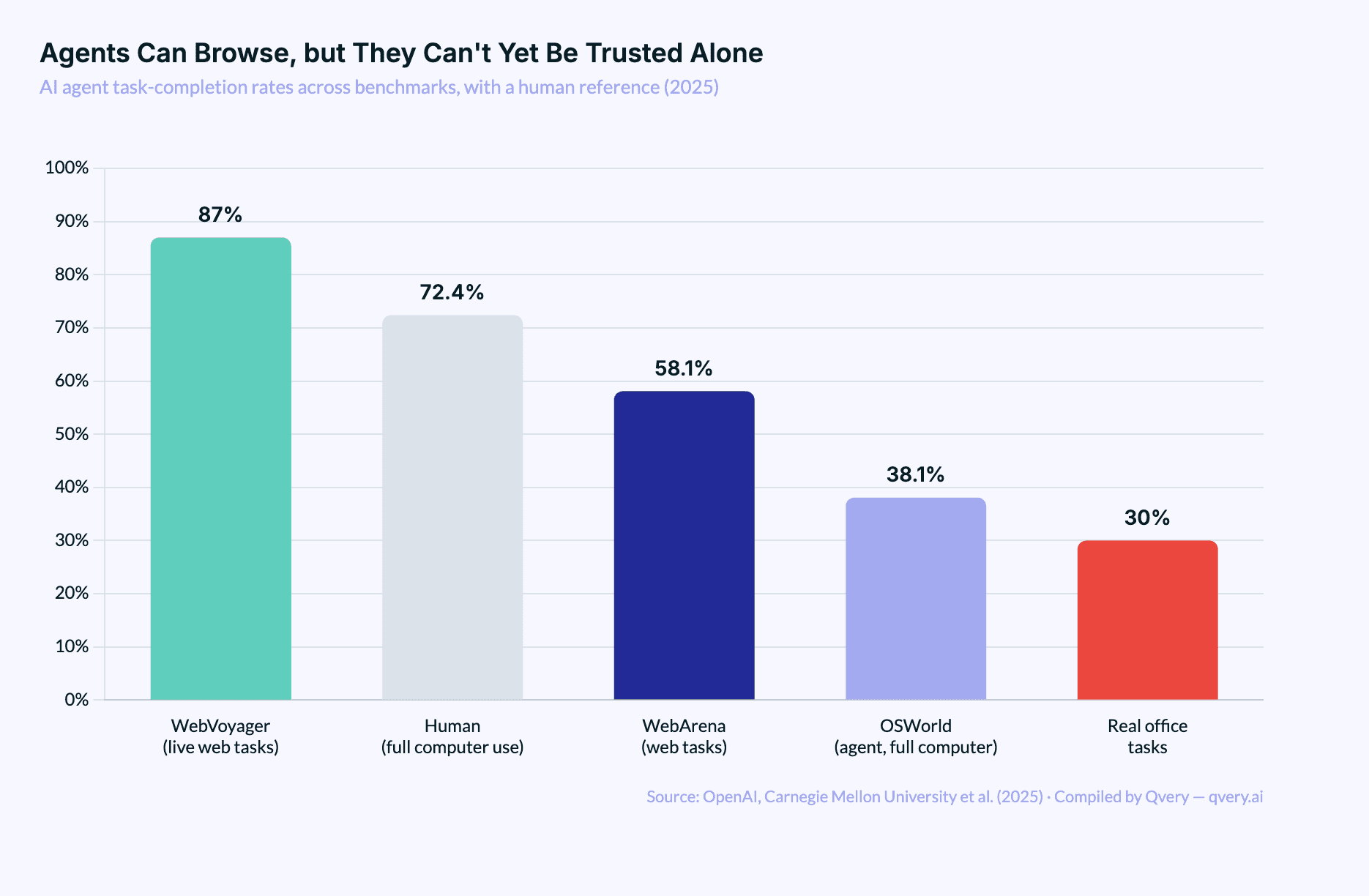
An agent that finishes three tasks in ten isn't coming for your job. It's coming for your patience. And the market knows it: Gartner expects over 40% of agentic AI projects to be scrapped by the end of 2027 on cost and weak controls, and reckons only about 130 of the thousands of self-described agentic vendors are the real thing, the rest being chatbots in a trench coat.⁴
My take: plan for both truths at once. Agents are good enough that buyers already use them to choose, and shaky enough that you should not yet hand them anything you can't supervise. The visibility implication is what matters here, and it doesn't wait for reliability to catch up: even a flawed agent that shortlists three brands has already excluded everyone else.
The Plumbing Is Being Laid Faster Than the Hype
Infrastructure is the least glamorous and most telling signal, because you don't build rails for something you don't expect to run. In roughly a year, Anthropic's Model Context Protocol, the standard that lets agents plug into tools and data, went from a launch announcement to a registry of nearly 2,000 servers, a 407% jump, backed by a community of more than 2,900 contributors with 100-plus new ones joining weekly.⁹
Its reference repository has passed 88,000 GitHub stars.¹⁰ A standard doesn't attract that kind of developer gravity unless people are betting their roadmaps on it.
The identity layer is arriving too. Cloudflare launched "signed agents," a cryptographic way for a website to verify that an agent knocking on its door is a legitimate, user-directed one and not an impostor, with a first cohort that includes OpenAI's ChatGPT agent and Block's Goose.¹¹ Think of it as a passport for bots. The read here is simple: when the industry starts standardizing how agents authenticate and how they connect to tools, it has stopped asking whether The Agentic Web happens and started deciding who gets let in. Brands that treat agent access as a security nuisance to block, rather than an audience to serve, are going to find themselves invisible to the one visitor that's growing.
The Money Is Already Forecast in the Trillions
None of this would matter to a marketer if there were no money behind it. There is, and the estimates are not shy. Bain projects US agentic commerce could reach $300 to $500 billion by 2030, roughly 15% to 25% of all e-commerce.¹² McKinsey goes bigger, sizing US B2C retail alone at up to $1 trillion in agent-orchestrated revenue by 2030, with global figures of $3 to $5 trillion.¹³ Morgan Stanley lands at $190 to $385 billion, or 10% to 20% of US e-commerce, by the same year.¹⁴
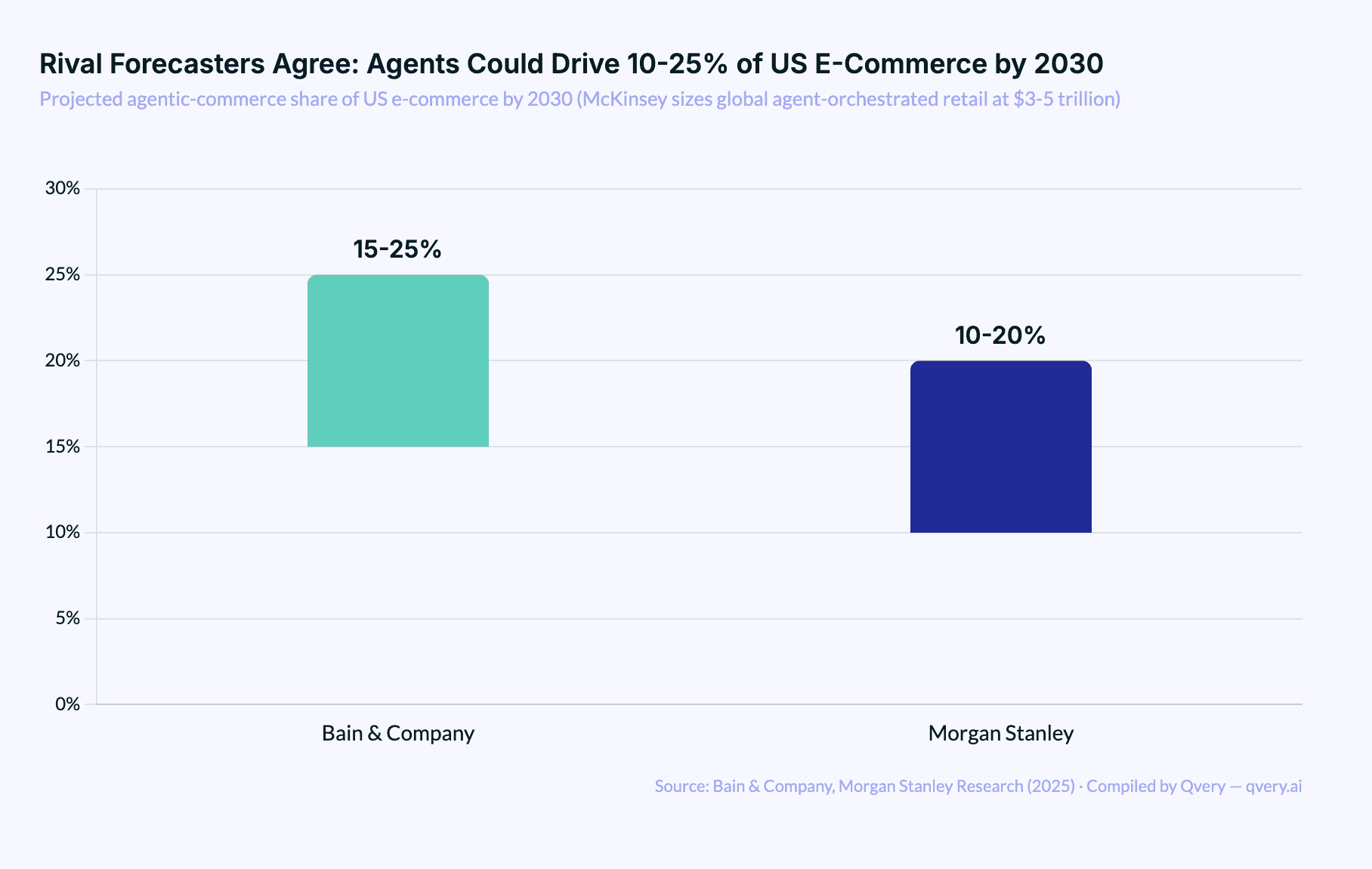
Two of those three, Bain and Morgan Stanley, land in the same 10-to-25%-of-e-commerce range using different methods, and McKinsey's larger, differently-measured figure points the same direction. Rivals converging like that is the closest thing forecasting has to a tell.
The executives are already moving on it: in one survey of 300 senior leaders, 88% said they plan to increase AI budgets in the next year specifically because of agentic AI.¹⁵ When roughly a fifth of the online economy is projected to route through agents, "is my brand visible to agents" stops being a novelty question and becomes a revenue question.
People Are Already Handing Over the Buy Button
The forecasts would be easy to dismiss if consumers weren't already doing this. They are. Roughly 23% of Americans bought something via AI in the past month,¹⁴ and 30% to 45% of US consumers already use generative AI for product research and comparison, which is the exact step where a brand shortlist gets decided.¹²
The traffic curve is vertical: retail traffic from generative AI sources jumped 1,200% in early 2025 versus the prior summer,¹⁶ rose 693.4% year over year during the 2025 holiday season,¹⁷ and was still growing 393% year over year in early 2026.¹⁸
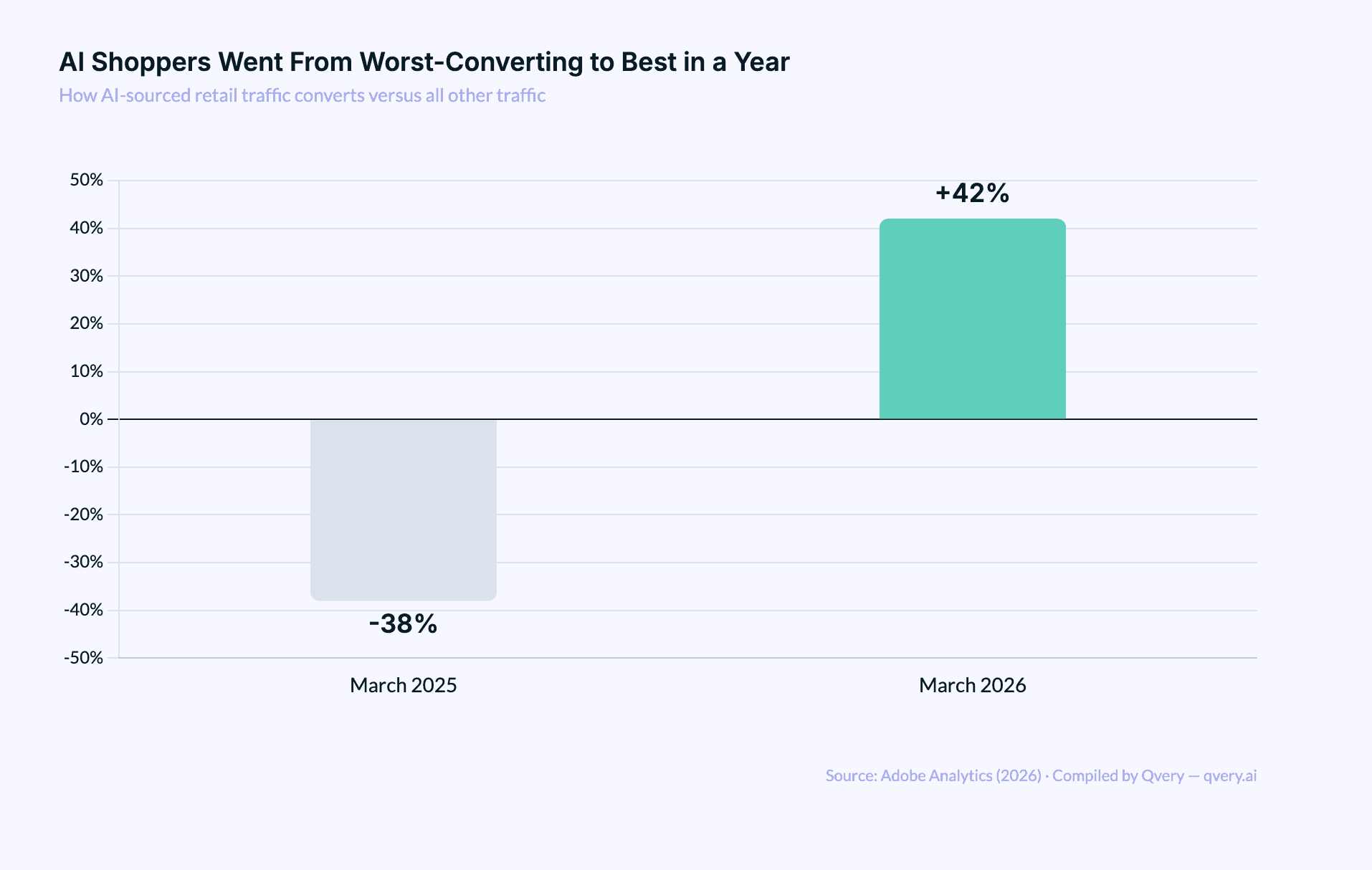
In March 2026, traffic arriving from AI sources converted 42% better than everyone else, a record high and a complete reversal from a year earlier, when the same AI traffic converted 38% worse.¹⁸
AI shoppers went from the worst-converting traffic source to the best in twelve months, which is the fastest glow-up in retail since free returns. They also browse 12% more pages and bounce 23% less, because the AI already narrowed the field before they arrived.¹⁶
The willingness runs deepest where the future spends. Among Gen Z, 54% already use AI for product discovery and 63% want an agent to purchase on their behalf.¹⁹ During 2025 Cyber Week, AI and agents drove $67 billion in sales and influenced 20% of all orders.²⁰
And the rails to close those purchases are shipping now: OpenAI's Instant Checkout lets its 700 million-plus weekly ChatGPT users buy in chat,²¹ on an open protocol built with Stripe that already reaches Etsy and, soon, over a million Shopify merchants.²² Mastercard launched Agent Pay,²³ and Visa opened its 300-billion-transaction network to verified agents.²⁴
My read: the buy button is migrating from the human's thumb to the agent's logic, and the brand the agent names is the brand that gets bought. There's no second-place link to click.
When the Visitor Is an Agent, Visibility Is the Whole Game
This is where it comes home for anyone doing marketing. If an agent shops on your customer's behalf, it doesn't browse your beautiful homepage or feel your brand. It reads what AI answer engines surface, builds a shortlist, and acts. So the only thing that matters is whether you're in that shortlist.
Being recommended in an AI answer already makes a user 2.5 times more likely to visit that brand's site within a week, even with no click to track,²⁵ and retail traffic from AI assistants grew 119% year over year in the first half of 2025.²⁶
Retailers running their own branded agents during Cyber Week grew sales 32% faster than those without.²⁰ Meanwhile the average US retail product page is only 66% machine-readable, so a quarter of the shelf is invisible to the very agents doing the shopping.¹⁸
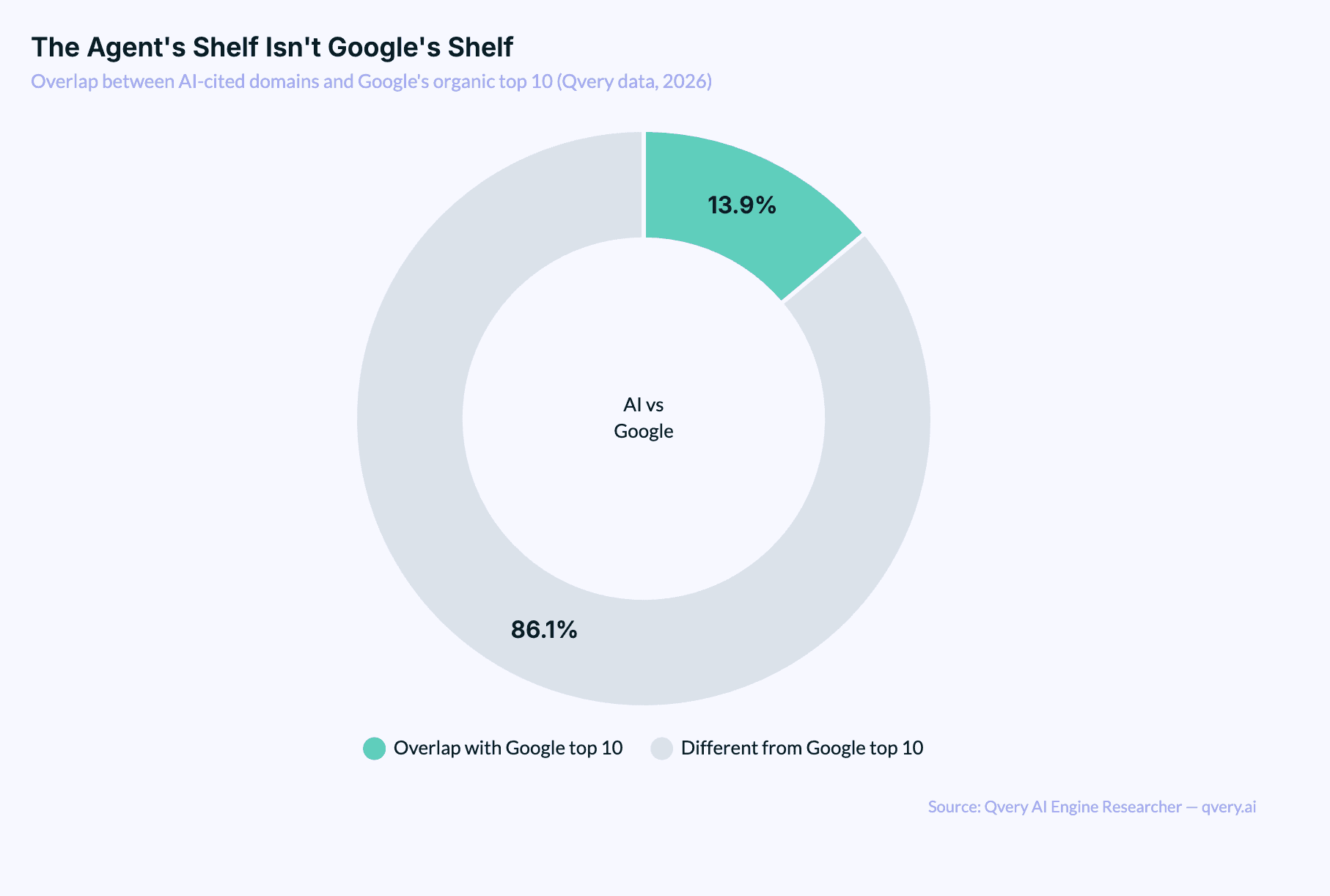
Here's the part most brands get wrong, and our own data at Qvery makes it concrete. The agent's shelf isn't Google's shelf. The overlap between AI-cited domains and Google's organic top 10 is just 13.9%, so a page-one ranking is no guarantee the agent ever sees you.²⁷
What the agent reads instead is third-party: Reddit is the third most-cited domain in AI search and owns 58.9% of all user-generated citations,²⁷ listicles are the single most-cited content type at 45.8% of classifiable citations,²⁸ and Wikipedia holds the best average citation rank at 5.65, meaning it lands in the first handful of sources an agent reads.²⁹ (The engine mechanics behind those citations are in our AI search statistics breakdown.)
The strategic conclusion the whole article has been driving at: in The Agentic Web, citation share is shelf space. You earn it off your own site, in the sources the agent trusts, and you can't earn it if you can't see it.
See What the Agents See About You
The uncomfortable truth in all of this is that most brands have no idea what an AI agent finds when it looks them up. Your analytics count human visits, and the visitor that's growing fastest and buying most decisively isn't human. You're optimizing a storefront for a shopper who has already left for the answer engine.
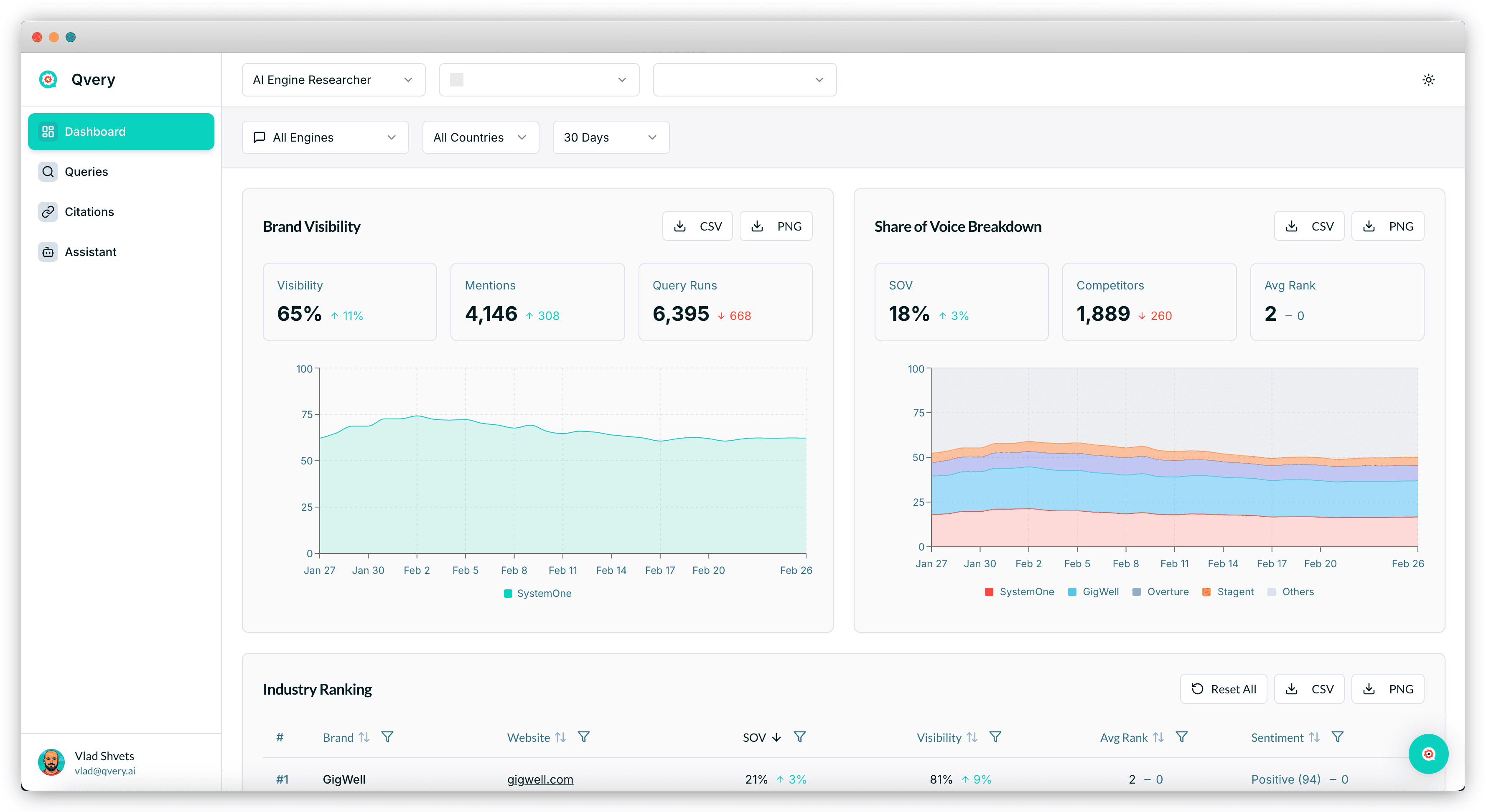
That's the gap Qvery closes. Our AI Engine Researcher tracks your brand's visibility and share of voice across ChatGPT and Google AI Mode, in 200-plus countries, and captures every citation an answer is built from, so you can see exactly which sources the agents read in your category and where you're missing. Inside the app, the Qvery Assistant answers questions about your own visibility, share of voice, citation, and query data, and runs first-party actions like adding or editing the queries you track, triggering a fresh data run, or exporting a report.
You start in minutes and see where you stand today. When your next customer sends an agent instead of showing up themselves, you should already know what it's going to find.
Frequently Asked Questions
What is The Agentic Web?
The Agentic Web is an internet where a growing share of browsing, evaluating, and buying is done by AI agents acting on a person's behalf, rather than by the person directly. Instead of a human visiting sites and comparing options, an agent reads what AI engines surface, builds a shortlist, and increasingly completes the action.
What percentage of web traffic is bots?
Automated bot traffic reached 51% of all web traffic in 2024, the first time bots outnumbered humans in a decade, per Imperva. Other networks measure it lower, around 30% (Cloudflare) to 37% (Fastly), but all agree automation is a large and growing share.
How fast is AI agent and crawler traffic growing?
AI and search crawler traffic grew 18% year over year to mid-2025. Within that, OpenAI's training crawler rose 305% in requests, and its on-demand ChatGPT-User fetcher surged 2,825%, the clearest signal of agents fetching pages in real time on a user's behalf.
How big will agentic commerce be?
Forecasts converge on 10-25% of US e-commerce by 2030. Bain estimates $300-500 billion (15-25%), Morgan Stanley $190-385 billion (10-20%), and McKinsey sizes global agent-orchestrated retail revenue at $3-5 trillion.
Are people shopping with AI yet?
Yes. Around 23% of Americans bought something via AI in the past month, and 30-45% use generative AI for product research. Retail traffic from AI sources grew triple digits year over year into 2026, and among Gen Z, 63% want an agent to buy on their behalf.
Do AI-referred shoppers convert well?
They now convert best. In March 2026, AI-sourced retail traffic converted 42% better than other traffic, a record high and a reversal from converting 38% worse a year earlier. AI-referred shoppers also browse 12% more pages and bounce 23% less, because the AI pre-qualified them.
Can AI agents complete real tasks reliably?
Not yet fully. The best browser agents score 58-87% on web-task benchmarks but only 38% on full computer-use tasks (versus 72% for humans), and the most competitive agent completes just 30% of real professional tasks autonomously. They are capable enough to shortlist brands, but not reliable enough for unsupervised work.
What is the Model Context Protocol (MCP)?
MCP is an open standard, introduced by Anthropic, that lets AI agents connect to tools, data, and services. Within about a year it grew to nearly 2,000 registered servers (up 407%) and 88,000-plus GitHub stars, making it the connective tissue of The Agentic Web.
How will AI agents pay for purchases?
Through new agentic-payment rails. OpenAI launched Instant Checkout in ChatGPT via the Stripe-built Agentic Commerce Protocol, Mastercard launched Agent Pay, and Visa opened its 300-billion-transaction network to verified AI agents, all in 2025.
Will ranking on Google keep me visible to AI agents?
Not reliably. Only 13.9% of AI-cited domains overlap with Google's organic top 10, so a page-one ranking does not guarantee an agent sees you. AI visibility is a separate discipline that depends on the third-party sources AI engines cite.
What sources do AI agents rely on to choose brands?
Mostly third-party content. Reddit is the third most-cited domain in AI search and holds 58.9% of user-generated citations, listicles are the most-cited content type at 45.8%, and Wikipedia has the best average citation rank at 5.65. Your own site is rarely the deciding source.
Why does machine-readability matter for The Agentic Web?
Because an agent can only recommend what it can parse. The average US retail product page is only 66% machine-readable, meaning a quarter or more of the product information is invisible to the AI doing the shopping. If the agent can't read it, the agent can't recommend it.
What is agentic commerce doing to product discovery?
Discovery is moving from search boxes to AI assistants. Retail traffic from AI assistants grew 119% year over year in the first half of 2025, and being recommended in an AI answer makes a user 2.5 times more likely to visit that brand within a week, even without a tracked click.
Is The Agentic Web hype or real?
Both, in different measures. Adoption, traffic, and investment are real and large, but reliability lags: Gartner expects over 40% of agentic AI projects to be canceled by the end of 2027. The safe reading is that agent-driven discovery is already reshaping visibility, while full autonomy is still maturing.
How should brands prepare for The Agentic Web?
Shift from optimizing for human eyeballs to earning citations in the sources AI engines trust, make your content genuinely machine-readable, get represented on high-citation surfaces like Reddit and quality listicles, and measure your share of voice inside AI answer engines rather than only counting human visits.
How can I measure my visibility to AI agents?
You need something built to watch the answer, not the visit. Qvery's AI Engine Researcher tracks your visibility, share of voice, and every citation across ChatGPT and Google AI Mode, so you can see whether agents find you and which sources they trust in your category.
Sources
Cloudflare: From Googlebot to GPTBot, Who's Crawling Your Site in 2025 (2025)
Fastly: AI Crawlers Make Up Almost 80% of AI Bot Traffic (2025)
Gartner: Over 40% of Agentic AI Projects Will Be Canceled by End of 2027 (2025)
Deloitte: Autonomous Generative AI Agents, Under Development (2025)
Cloudflare: The Age of Agents, Cryptographically Recognizing Agent Traffic (2025)
Bain and Company: 2030 Forecast, How Agentic AI Will Reshape US Retail (2025)
McKinsey and Company: The Agentic Commerce Opportunity (2025)
Adobe Analytics: Retail Traffic From Generative AI Sources Jumps 1,200% (2025)
Adobe Analytics: Holiday Shopping Season Drove a Record $257.8 Billion Online (2026)
Adobe: US Retailers See a Surge in AI Traffic, but Many Sites Aren't Machine-Readable (2026)
Salesforce: 75% of Retailers Say AI Agents Will Be Essential to Compete (2025)
Salesforce: AI and Agents Propel Cyber Week to a Record $336.6B (2025)
OpenAI: Buy It in ChatGPT, Instant Checkout and the Agentic Commerce Protocol (2025)
Stripe: Powering Instant Checkout in ChatGPT and the Agentic Commerce Protocol (2025)
Mastercard: Agent Pay, Pioneering Agentic Payments Technology (2025)
Visa: Intelligent Commerce, Enabling AI Agents to Buy Securely (2025)
Similarweb: Being Recommended in AI Makes Users 2.5x More Likely to Visit Your Site (2026)
Salesforce: AI Assistants Grow Retail Traffic Volumes by 119% (2025)
Qvery: Reddit Is the Most Important Website for AI Search Visibility (2026)
Qvery: Listicles Are the Most Cited Content Type in AI Search (2026)
Qvery: Wikipedia AI Citations, ChatGPT's Favorite Source That Google AI Ignores (2026)
Every marketing playbook ever written assumes the visitor is a person. Someone with eyes, a scroll habit, and a vague willingness to be persuaded. That assumption is quietly expiring. The web's largest and fastest-growing audience is now machines: crawlers that read for training, agents that fetch pages on your behalf, and, increasingly, shopping bots that compare options and click buy. If the internet held an election today, humans would be the minority party.
This is what people mean by The Agentic Web: an internet where a growing share of the browsing, evaluating, and buying is done by AI acting for a human, not the human directly.
The numbers below come from edge networks measuring real traffic, benchmark papers testing what agents can really do, the payment giants wiring up agent checkout, and our own citation data at Qvery. Read together they answer one question: what happens to visibility when your most important visitor doesn't have eyes? Here are 50+ verified statistics on the web agents are building, and why being seen by the machine is becoming the whole job.
Highlights
51% of web traffic is now automated. For the first time in a decade, bots outnumber humans online. The audience you optimize for is already mostly machines.
ChatGPT-User fetches grew 2,825% in a year. On-demand fetching, an agent pulling a page because a person asked, is the fastest-rising traffic signature on the web.
Agents finish only 30% of real office tasks on their own. Capable enough to matter, unreliable enough that betting your ops on unsupervised autonomy today is premature.
Agentic commerce could be $300-500 billion by 2030. Roughly 15-25% of US e-commerce, and independent forecasts from Bain, Morgan Stanley, and McKinsey all point the same way.
AI-referred shoppers now convert 42% better than everyone else. A full reversal from a year earlier, when the same AI traffic converted worse than everyone else.
Only 13.9% of AI-cited domains overlap with Google's organic top 10. Ranking on Google doesn't put you on the agent's shelf. That's a different shelf.
The Web's Majority Visitor Is Already a Machine
Start with the fact that reframes everything else. In 2024, automated bot traffic overtook humans for the first time in a decade, reaching 51% of all web traffic.¹
The audience marketers spend their lives courting is now, by headcount, a minority on the very network they court it on. Not all of that automation is friendly: bad bots alone make up 37% of internet traffic, up from 32% in 2023, and one security network blocked 13 trillion bad-bot requests in a single year.¹
Two other networks measuring the same thing land in the same zone. Cloudflare puts bots at roughly 30% of global web traffic, exceeding human traffic in some regions,² and Fastly clocks automated traffic at 37% of everything it sees.³ The exact percentage depends on whose pipes you measure. The direction doesn't. My read: "web traffic" and "human audience" have quietly become two different numbers, and most analytics dashboards still pretend they're the same one. If you're reporting sessions without asking how many had a pulse, you're measuring a room that's half empty of people.
From Crawling to Acting: The Shift That Names the Era
Bots are not new. What's new is what they're becoming. The old bot read your page to build an index. The new bot reads it to answer a question a person is asking right now, then, soon, to act on the answer. You can see the transition in the traffic mix.
AI and search crawling grew 18% in a year, and OpenAI's training crawler lifted its share of that traffic from 2.2% to 7.7%, a 305% jump in requests.² Meta's crawlers alone now generate 52% of AI crawler traffic, more than Google (23%) and OpenAI (20%) combined, and nearly 80% of all AI bot traffic is still crawling for training data.³
But the signature stat of The Agentic Web is a different one. ChatGPT-User, the fetcher that grabs a live page because someone asked ChatGPT a question, saw requests surge 2,825% in a year,² and OpenAI's bots now account for 98% of all real-time fetcher requests on one major network.³ That's an agent going to get something for a person, on demand. The gap between "crawls your site once a month" and "reads your page the instant a buyer asks about you" is the whole ballgame.
The enterprise forecasts point the same way. Gartner expects 33% of enterprise software to include agentic AI by 2028, up from less than 1% in 2024, and at least 15% of day-to-day work decisions to be made autonomously by agents, up from zero.⁴
Already, 62% of organizations say they're at least experimenting with AI agents,⁵ and Deloitte expects the share of generative-AI companies running agent pilots to double from 25% to 50% by 2027.⁶ The subjective read: the shift from bots that read to agents that act is not a someday. It's a budget line this year, and it changes who you're really writing for.
Can Agents Do the Job Yet?
Here's the honest counterweight, because the hype needs one. Agents that browse are real and improving fast, but they are not yet reliable colleagues. OpenAI's computer-using agent set a state of the art of 58.1% on WebArena and 87% on the simpler WebVoyager live-browsing benchmark, which is genuinely impressive for a machine clicking through real websites.⁷
Then the same agent scored 38.1% on the harder OSWorld full-computer-use test, against 72.4% for a human.⁷ On a benchmark of real professional tasks, the most competitive agent completed just 30% of them autonomously.⁸
An agent that finishes three tasks in ten isn't coming for your job. It's coming for your patience. And the market knows it: Gartner expects over 40% of agentic AI projects to be scrapped by the end of 2027 on cost and weak controls, and reckons only about 130 of the thousands of self-described agentic vendors are the real thing, the rest being chatbots in a trench coat.⁴
My take: plan for both truths at once. Agents are good enough that buyers already use them to choose, and shaky enough that you should not yet hand them anything you can't supervise. The visibility implication is what matters here, and it doesn't wait for reliability to catch up: even a flawed agent that shortlists three brands has already excluded everyone else.
The Plumbing Is Being Laid Faster Than the Hype
Infrastructure is the least glamorous and most telling signal, because you don't build rails for something you don't expect to run. In roughly a year, Anthropic's Model Context Protocol, the standard that lets agents plug into tools and data, went from a launch announcement to a registry of nearly 2,000 servers, a 407% jump, backed by a community of more than 2,900 contributors with 100-plus new ones joining weekly.⁹
Its reference repository has passed 88,000 GitHub stars.¹⁰ A standard doesn't attract that kind of developer gravity unless people are betting their roadmaps on it.
The identity layer is arriving too. Cloudflare launched "signed agents," a cryptographic way for a website to verify that an agent knocking on its door is a legitimate, user-directed one and not an impostor, with a first cohort that includes OpenAI's ChatGPT agent and Block's Goose.¹¹ Think of it as a passport for bots. The read here is simple: when the industry starts standardizing how agents authenticate and how they connect to tools, it has stopped asking whether The Agentic Web happens and started deciding who gets let in. Brands that treat agent access as a security nuisance to block, rather than an audience to serve, are going to find themselves invisible to the one visitor that's growing.
The Money Is Already Forecast in the Trillions
None of this would matter to a marketer if there were no money behind it. There is, and the estimates are not shy. Bain projects US agentic commerce could reach $300 to $500 billion by 2030, roughly 15% to 25% of all e-commerce.¹² McKinsey goes bigger, sizing US B2C retail alone at up to $1 trillion in agent-orchestrated revenue by 2030, with global figures of $3 to $5 trillion.¹³ Morgan Stanley lands at $190 to $385 billion, or 10% to 20% of US e-commerce, by the same year.¹⁴
Two of those three, Bain and Morgan Stanley, land in the same 10-to-25%-of-e-commerce range using different methods, and McKinsey's larger, differently-measured figure points the same direction. Rivals converging like that is the closest thing forecasting has to a tell.
The executives are already moving on it: in one survey of 300 senior leaders, 88% said they plan to increase AI budgets in the next year specifically because of agentic AI.¹⁵ When roughly a fifth of the online economy is projected to route through agents, "is my brand visible to agents" stops being a novelty question and becomes a revenue question.
People Are Already Handing Over the Buy Button
The forecasts would be easy to dismiss if consumers weren't already doing this. They are. Roughly 23% of Americans bought something via AI in the past month,¹⁴ and 30% to 45% of US consumers already use generative AI for product research and comparison, which is the exact step where a brand shortlist gets decided.¹²
The traffic curve is vertical: retail traffic from generative AI sources jumped 1,200% in early 2025 versus the prior summer,¹⁶ rose 693.4% year over year during the 2025 holiday season,¹⁷ and was still growing 393% year over year in early 2026.¹⁸
In March 2026, traffic arriving from AI sources converted 42% better than everyone else, a record high and a complete reversal from a year earlier, when the same AI traffic converted 38% worse.¹⁸
AI shoppers went from the worst-converting traffic source to the best in twelve months, which is the fastest glow-up in retail since free returns. They also browse 12% more pages and bounce 23% less, because the AI already narrowed the field before they arrived.¹⁶
The willingness runs deepest where the future spends. Among Gen Z, 54% already use AI for product discovery and 63% want an agent to purchase on their behalf.¹⁹ During 2025 Cyber Week, AI and agents drove $67 billion in sales and influenced 20% of all orders.²⁰
And the rails to close those purchases are shipping now: OpenAI's Instant Checkout lets its 700 million-plus weekly ChatGPT users buy in chat,²¹ on an open protocol built with Stripe that already reaches Etsy and, soon, over a million Shopify merchants.²² Mastercard launched Agent Pay,²³ and Visa opened its 300-billion-transaction network to verified agents.²⁴
My read: the buy button is migrating from the human's thumb to the agent's logic, and the brand the agent names is the brand that gets bought. There's no second-place link to click.
When the Visitor Is an Agent, Visibility Is the Whole Game
This is where it comes home for anyone doing marketing. If an agent shops on your customer's behalf, it doesn't browse your beautiful homepage or feel your brand. It reads what AI answer engines surface, builds a shortlist, and acts. So the only thing that matters is whether you're in that shortlist.
Being recommended in an AI answer already makes a user 2.5 times more likely to visit that brand's site within a week, even with no click to track,²⁵ and retail traffic from AI assistants grew 119% year over year in the first half of 2025.²⁶
Retailers running their own branded agents during Cyber Week grew sales 32% faster than those without.²⁰ Meanwhile the average US retail product page is only 66% machine-readable, so a quarter of the shelf is invisible to the very agents doing the shopping.¹⁸
Here's the part most brands get wrong, and our own data at Qvery makes it concrete. The agent's shelf isn't Google's shelf. The overlap between AI-cited domains and Google's organic top 10 is just 13.9%, so a page-one ranking is no guarantee the agent ever sees you.²⁷
What the agent reads instead is third-party: Reddit is the third most-cited domain in AI search and owns 58.9% of all user-generated citations,²⁷ listicles are the single most-cited content type at 45.8% of classifiable citations,²⁸ and Wikipedia holds the best average citation rank at 5.65, meaning it lands in the first handful of sources an agent reads.²⁹ (The engine mechanics behind those citations are in our AI search statistics breakdown.)
The strategic conclusion the whole article has been driving at: in The Agentic Web, citation share is shelf space. You earn it off your own site, in the sources the agent trusts, and you can't earn it if you can't see it.
See What the Agents See About You
The uncomfortable truth in all of this is that most brands have no idea what an AI agent finds when it looks them up. Your analytics count human visits, and the visitor that's growing fastest and buying most decisively isn't human. You're optimizing a storefront for a shopper who has already left for the answer engine.
That's the gap Qvery closes. Our AI Engine Researcher tracks your brand's visibility and share of voice across ChatGPT and Google AI Mode, in 200-plus countries, and captures every citation an answer is built from, so you can see exactly which sources the agents read in your category and where you're missing. Inside the app, the Qvery Assistant answers questions about your own visibility, share of voice, citation, and query data, and runs first-party actions like adding or editing the queries you track, triggering a fresh data run, or exporting a report.
You start in minutes and see where you stand today. When your next customer sends an agent instead of showing up themselves, you should already know what it's going to find.
Frequently Asked Questions
What is The Agentic Web?
The Agentic Web is an internet where a growing share of browsing, evaluating, and buying is done by AI agents acting on a person's behalf, rather than by the person directly. Instead of a human visiting sites and comparing options, an agent reads what AI engines surface, builds a shortlist, and increasingly completes the action.
What percentage of web traffic is bots?
Automated bot traffic reached 51% of all web traffic in 2024, the first time bots outnumbered humans in a decade, per Imperva. Other networks measure it lower, around 30% (Cloudflare) to 37% (Fastly), but all agree automation is a large and growing share.
How fast is AI agent and crawler traffic growing?
AI and search crawler traffic grew 18% year over year to mid-2025. Within that, OpenAI's training crawler rose 305% in requests, and its on-demand ChatGPT-User fetcher surged 2,825%, the clearest signal of agents fetching pages in real time on a user's behalf.
How big will agentic commerce be?
Forecasts converge on 10-25% of US e-commerce by 2030. Bain estimates $300-500 billion (15-25%), Morgan Stanley $190-385 billion (10-20%), and McKinsey sizes global agent-orchestrated retail revenue at $3-5 trillion.
Are people shopping with AI yet?
Yes. Around 23% of Americans bought something via AI in the past month, and 30-45% use generative AI for product research. Retail traffic from AI sources grew triple digits year over year into 2026, and among Gen Z, 63% want an agent to buy on their behalf.
Do AI-referred shoppers convert well?
They now convert best. In March 2026, AI-sourced retail traffic converted 42% better than other traffic, a record high and a reversal from converting 38% worse a year earlier. AI-referred shoppers also browse 12% more pages and bounce 23% less, because the AI pre-qualified them.
Can AI agents complete real tasks reliably?
Not yet fully. The best browser agents score 58-87% on web-task benchmarks but only 38% on full computer-use tasks (versus 72% for humans), and the most competitive agent completes just 30% of real professional tasks autonomously. They are capable enough to shortlist brands, but not reliable enough for unsupervised work.
What is the Model Context Protocol (MCP)?
MCP is an open standard, introduced by Anthropic, that lets AI agents connect to tools, data, and services. Within about a year it grew to nearly 2,000 registered servers (up 407%) and 88,000-plus GitHub stars, making it the connective tissue of The Agentic Web.
How will AI agents pay for purchases?
Through new agentic-payment rails. OpenAI launched Instant Checkout in ChatGPT via the Stripe-built Agentic Commerce Protocol, Mastercard launched Agent Pay, and Visa opened its 300-billion-transaction network to verified AI agents, all in 2025.
Will ranking on Google keep me visible to AI agents?
Not reliably. Only 13.9% of AI-cited domains overlap with Google's organic top 10, so a page-one ranking does not guarantee an agent sees you. AI visibility is a separate discipline that depends on the third-party sources AI engines cite.
What sources do AI agents rely on to choose brands?
Mostly third-party content. Reddit is the third most-cited domain in AI search and holds 58.9% of user-generated citations, listicles are the most-cited content type at 45.8%, and Wikipedia has the best average citation rank at 5.65. Your own site is rarely the deciding source.
Why does machine-readability matter for The Agentic Web?
Because an agent can only recommend what it can parse. The average US retail product page is only 66% machine-readable, meaning a quarter or more of the product information is invisible to the AI doing the shopping. If the agent can't read it, the agent can't recommend it.
What is agentic commerce doing to product discovery?
Discovery is moving from search boxes to AI assistants. Retail traffic from AI assistants grew 119% year over year in the first half of 2025, and being recommended in an AI answer makes a user 2.5 times more likely to visit that brand within a week, even without a tracked click.
Is The Agentic Web hype or real?
Both, in different measures. Adoption, traffic, and investment are real and large, but reliability lags: Gartner expects over 40% of agentic AI projects to be canceled by the end of 2027. The safe reading is that agent-driven discovery is already reshaping visibility, while full autonomy is still maturing.
How should brands prepare for The Agentic Web?
Shift from optimizing for human eyeballs to earning citations in the sources AI engines trust, make your content genuinely machine-readable, get represented on high-citation surfaces like Reddit and quality listicles, and measure your share of voice inside AI answer engines rather than only counting human visits.
How can I measure my visibility to AI agents?
You need something built to watch the answer, not the visit. Qvery's AI Engine Researcher tracks your visibility, share of voice, and every citation across ChatGPT and Google AI Mode, so you can see whether agents find you and which sources they trust in your category.
Sources
Cloudflare: From Googlebot to GPTBot, Who's Crawling Your Site in 2025 (2025)
Fastly: AI Crawlers Make Up Almost 80% of AI Bot Traffic (2025)
Gartner: Over 40% of Agentic AI Projects Will Be Canceled by End of 2027 (2025)
Deloitte: Autonomous Generative AI Agents, Under Development (2025)
Cloudflare: The Age of Agents, Cryptographically Recognizing Agent Traffic (2025)
Bain and Company: 2030 Forecast, How Agentic AI Will Reshape US Retail (2025)
McKinsey and Company: The Agentic Commerce Opportunity (2025)
Adobe Analytics: Retail Traffic From Generative AI Sources Jumps 1,200% (2025)
Adobe Analytics: Holiday Shopping Season Drove a Record $257.8 Billion Online (2026)
Adobe: US Retailers See a Surge in AI Traffic, but Many Sites Aren't Machine-Readable (2026)
Salesforce: 75% of Retailers Say AI Agents Will Be Essential to Compete (2025)
Salesforce: AI and Agents Propel Cyber Week to a Record $336.6B (2025)
OpenAI: Buy It in ChatGPT, Instant Checkout and the Agentic Commerce Protocol (2025)
Stripe: Powering Instant Checkout in ChatGPT and the Agentic Commerce Protocol (2025)
Mastercard: Agent Pay, Pioneering Agentic Payments Technology (2025)
Visa: Intelligent Commerce, Enabling AI Agents to Buy Securely (2025)
Similarweb: Being Recommended in AI Makes Users 2.5x More Likely to Visit Your Site (2026)
Salesforce: AI Assistants Grow Retail Traffic Volumes by 119% (2025)
Qvery: Reddit Is the Most Important Website for AI Search Visibility (2026)
Qvery: Listicles Are the Most Cited Content Type in AI Search (2026)
Qvery: Wikipedia AI Citations, ChatGPT's Favorite Source That Google AI Ignores (2026)
Every marketing playbook ever written assumes the visitor is a person. Someone with eyes, a scroll habit, and a vague willingness to be persuaded. That assumption is quietly expiring. The web's largest and fastest-growing audience is now machines: crawlers that read for training, agents that fetch pages on your behalf, and, increasingly, shopping bots that compare options and click buy. If the internet held an election today, humans would be the minority party.
This is what people mean by The Agentic Web: an internet where a growing share of the browsing, evaluating, and buying is done by AI acting for a human, not the human directly.
The numbers below come from edge networks measuring real traffic, benchmark papers testing what agents can really do, the payment giants wiring up agent checkout, and our own citation data at Qvery. Read together they answer one question: what happens to visibility when your most important visitor doesn't have eyes? Here are 50+ verified statistics on the web agents are building, and why being seen by the machine is becoming the whole job.
Highlights
51% of web traffic is now automated. For the first time in a decade, bots outnumber humans online. The audience you optimize for is already mostly machines.
ChatGPT-User fetches grew 2,825% in a year. On-demand fetching, an agent pulling a page because a person asked, is the fastest-rising traffic signature on the web.
Agents finish only 30% of real office tasks on their own. Capable enough to matter, unreliable enough that betting your ops on unsupervised autonomy today is premature.
Agentic commerce could be $300-500 billion by 2030. Roughly 15-25% of US e-commerce, and independent forecasts from Bain, Morgan Stanley, and McKinsey all point the same way.
AI-referred shoppers now convert 42% better than everyone else. A full reversal from a year earlier, when the same AI traffic converted worse than everyone else.
Only 13.9% of AI-cited domains overlap with Google's organic top 10. Ranking on Google doesn't put you on the agent's shelf. That's a different shelf.
The Web's Majority Visitor Is Already a Machine
Start with the fact that reframes everything else. In 2024, automated bot traffic overtook humans for the first time in a decade, reaching 51% of all web traffic.¹
The audience marketers spend their lives courting is now, by headcount, a minority on the very network they court it on. Not all of that automation is friendly: bad bots alone make up 37% of internet traffic, up from 32% in 2023, and one security network blocked 13 trillion bad-bot requests in a single year.¹
Two other networks measuring the same thing land in the same zone. Cloudflare puts bots at roughly 30% of global web traffic, exceeding human traffic in some regions,² and Fastly clocks automated traffic at 37% of everything it sees.³ The exact percentage depends on whose pipes you measure. The direction doesn't. My read: "web traffic" and "human audience" have quietly become two different numbers, and most analytics dashboards still pretend they're the same one. If you're reporting sessions without asking how many had a pulse, you're measuring a room that's half empty of people.
From Crawling to Acting: The Shift That Names the Era
Bots are not new. What's new is what they're becoming. The old bot read your page to build an index. The new bot reads it to answer a question a person is asking right now, then, soon, to act on the answer. You can see the transition in the traffic mix.
AI and search crawling grew 18% in a year, and OpenAI's training crawler lifted its share of that traffic from 2.2% to 7.7%, a 305% jump in requests.² Meta's crawlers alone now generate 52% of AI crawler traffic, more than Google (23%) and OpenAI (20%) combined, and nearly 80% of all AI bot traffic is still crawling for training data.³
But the signature stat of The Agentic Web is a different one. ChatGPT-User, the fetcher that grabs a live page because someone asked ChatGPT a question, saw requests surge 2,825% in a year,² and OpenAI's bots now account for 98% of all real-time fetcher requests on one major network.³ That's an agent going to get something for a person, on demand. The gap between "crawls your site once a month" and "reads your page the instant a buyer asks about you" is the whole ballgame.
The enterprise forecasts point the same way. Gartner expects 33% of enterprise software to include agentic AI by 2028, up from less than 1% in 2024, and at least 15% of day-to-day work decisions to be made autonomously by agents, up from zero.⁴
Already, 62% of organizations say they're at least experimenting with AI agents,⁵ and Deloitte expects the share of generative-AI companies running agent pilots to double from 25% to 50% by 2027.⁶ The subjective read: the shift from bots that read to agents that act is not a someday. It's a budget line this year, and it changes who you're really writing for.
Can Agents Do the Job Yet?
Here's the honest counterweight, because the hype needs one. Agents that browse are real and improving fast, but they are not yet reliable colleagues. OpenAI's computer-using agent set a state of the art of 58.1% on WebArena and 87% on the simpler WebVoyager live-browsing benchmark, which is genuinely impressive for a machine clicking through real websites.⁷
Then the same agent scored 38.1% on the harder OSWorld full-computer-use test, against 72.4% for a human.⁷ On a benchmark of real professional tasks, the most competitive agent completed just 30% of them autonomously.⁸
An agent that finishes three tasks in ten isn't coming for your job. It's coming for your patience. And the market knows it: Gartner expects over 40% of agentic AI projects to be scrapped by the end of 2027 on cost and weak controls, and reckons only about 130 of the thousands of self-described agentic vendors are the real thing, the rest being chatbots in a trench coat.⁴
My take: plan for both truths at once. Agents are good enough that buyers already use them to choose, and shaky enough that you should not yet hand them anything you can't supervise. The visibility implication is what matters here, and it doesn't wait for reliability to catch up: even a flawed agent that shortlists three brands has already excluded everyone else.
The Plumbing Is Being Laid Faster Than the Hype
Infrastructure is the least glamorous and most telling signal, because you don't build rails for something you don't expect to run. In roughly a year, Anthropic's Model Context Protocol, the standard that lets agents plug into tools and data, went from a launch announcement to a registry of nearly 2,000 servers, a 407% jump, backed by a community of more than 2,900 contributors with 100-plus new ones joining weekly.⁹
Its reference repository has passed 88,000 GitHub stars.¹⁰ A standard doesn't attract that kind of developer gravity unless people are betting their roadmaps on it.
The identity layer is arriving too. Cloudflare launched "signed agents," a cryptographic way for a website to verify that an agent knocking on its door is a legitimate, user-directed one and not an impostor, with a first cohort that includes OpenAI's ChatGPT agent and Block's Goose.¹¹ Think of it as a passport for bots. The read here is simple: when the industry starts standardizing how agents authenticate and how they connect to tools, it has stopped asking whether The Agentic Web happens and started deciding who gets let in. Brands that treat agent access as a security nuisance to block, rather than an audience to serve, are going to find themselves invisible to the one visitor that's growing.
The Money Is Already Forecast in the Trillions
None of this would matter to a marketer if there were no money behind it. There is, and the estimates are not shy. Bain projects US agentic commerce could reach $300 to $500 billion by 2030, roughly 15% to 25% of all e-commerce.¹² McKinsey goes bigger, sizing US B2C retail alone at up to $1 trillion in agent-orchestrated revenue by 2030, with global figures of $3 to $5 trillion.¹³ Morgan Stanley lands at $190 to $385 billion, or 10% to 20% of US e-commerce, by the same year.¹⁴
Two of those three, Bain and Morgan Stanley, land in the same 10-to-25%-of-e-commerce range using different methods, and McKinsey's larger, differently-measured figure points the same direction. Rivals converging like that is the closest thing forecasting has to a tell.
The executives are already moving on it: in one survey of 300 senior leaders, 88% said they plan to increase AI budgets in the next year specifically because of agentic AI.¹⁵ When roughly a fifth of the online economy is projected to route through agents, "is my brand visible to agents" stops being a novelty question and becomes a revenue question.
People Are Already Handing Over the Buy Button
The forecasts would be easy to dismiss if consumers weren't already doing this. They are. Roughly 23% of Americans bought something via AI in the past month,¹⁴ and 30% to 45% of US consumers already use generative AI for product research and comparison, which is the exact step where a brand shortlist gets decided.¹²
The traffic curve is vertical: retail traffic from generative AI sources jumped 1,200% in early 2025 versus the prior summer,¹⁶ rose 693.4% year over year during the 2025 holiday season,¹⁷ and was still growing 393% year over year in early 2026.¹⁸
In March 2026, traffic arriving from AI sources converted 42% better than everyone else, a record high and a complete reversal from a year earlier, when the same AI traffic converted 38% worse.¹⁸
AI shoppers went from the worst-converting traffic source to the best in twelve months, which is the fastest glow-up in retail since free returns. They also browse 12% more pages and bounce 23% less, because the AI already narrowed the field before they arrived.¹⁶
The willingness runs deepest where the future spends. Among Gen Z, 54% already use AI for product discovery and 63% want an agent to purchase on their behalf.¹⁹ During 2025 Cyber Week, AI and agents drove $67 billion in sales and influenced 20% of all orders.²⁰
And the rails to close those purchases are shipping now: OpenAI's Instant Checkout lets its 700 million-plus weekly ChatGPT users buy in chat,²¹ on an open protocol built with Stripe that already reaches Etsy and, soon, over a million Shopify merchants.²² Mastercard launched Agent Pay,²³ and Visa opened its 300-billion-transaction network to verified agents.²⁴
My read: the buy button is migrating from the human's thumb to the agent's logic, and the brand the agent names is the brand that gets bought. There's no second-place link to click.
When the Visitor Is an Agent, Visibility Is the Whole Game
This is where it comes home for anyone doing marketing. If an agent shops on your customer's behalf, it doesn't browse your beautiful homepage or feel your brand. It reads what AI answer engines surface, builds a shortlist, and acts. So the only thing that matters is whether you're in that shortlist.
Being recommended in an AI answer already makes a user 2.5 times more likely to visit that brand's site within a week, even with no click to track,²⁵ and retail traffic from AI assistants grew 119% year over year in the first half of 2025.²⁶
Retailers running their own branded agents during Cyber Week grew sales 32% faster than those without.²⁰ Meanwhile the average US retail product page is only 66% machine-readable, so a quarter of the shelf is invisible to the very agents doing the shopping.¹⁸
Here's the part most brands get wrong, and our own data at Qvery makes it concrete. The agent's shelf isn't Google's shelf. The overlap between AI-cited domains and Google's organic top 10 is just 13.9%, so a page-one ranking is no guarantee the agent ever sees you.²⁷
What the agent reads instead is third-party: Reddit is the third most-cited domain in AI search and owns 58.9% of all user-generated citations,²⁷ listicles are the single most-cited content type at 45.8% of classifiable citations,²⁸ and Wikipedia holds the best average citation rank at 5.65, meaning it lands in the first handful of sources an agent reads.²⁹ (The engine mechanics behind those citations are in our AI search statistics breakdown.)
The strategic conclusion the whole article has been driving at: in The Agentic Web, citation share is shelf space. You earn it off your own site, in the sources the agent trusts, and you can't earn it if you can't see it.
See What the Agents See About You
The uncomfortable truth in all of this is that most brands have no idea what an AI agent finds when it looks them up. Your analytics count human visits, and the visitor that's growing fastest and buying most decisively isn't human. You're optimizing a storefront for a shopper who has already left for the answer engine.
That's the gap Qvery closes. Our AI Engine Researcher tracks your brand's visibility and share of voice across ChatGPT and Google AI Mode, in 200-plus countries, and captures every citation an answer is built from, so you can see exactly which sources the agents read in your category and where you're missing. Inside the app, the Qvery Assistant answers questions about your own visibility, share of voice, citation, and query data, and runs first-party actions like adding or editing the queries you track, triggering a fresh data run, or exporting a report.
You start in minutes and see where you stand today. When your next customer sends an agent instead of showing up themselves, you should already know what it's going to find.
Frequently Asked Questions
What is The Agentic Web?
The Agentic Web is an internet where a growing share of browsing, evaluating, and buying is done by AI agents acting on a person's behalf, rather than by the person directly. Instead of a human visiting sites and comparing options, an agent reads what AI engines surface, builds a shortlist, and increasingly completes the action.
What percentage of web traffic is bots?
Automated bot traffic reached 51% of all web traffic in 2024, the first time bots outnumbered humans in a decade, per Imperva. Other networks measure it lower, around 30% (Cloudflare) to 37% (Fastly), but all agree automation is a large and growing share.
How fast is AI agent and crawler traffic growing?
AI and search crawler traffic grew 18% year over year to mid-2025. Within that, OpenAI's training crawler rose 305% in requests, and its on-demand ChatGPT-User fetcher surged 2,825%, the clearest signal of agents fetching pages in real time on a user's behalf.
How big will agentic commerce be?
Forecasts converge on 10-25% of US e-commerce by 2030. Bain estimates $300-500 billion (15-25%), Morgan Stanley $190-385 billion (10-20%), and McKinsey sizes global agent-orchestrated retail revenue at $3-5 trillion.
Are people shopping with AI yet?
Yes. Around 23% of Americans bought something via AI in the past month, and 30-45% use generative AI for product research. Retail traffic from AI sources grew triple digits year over year into 2026, and among Gen Z, 63% want an agent to buy on their behalf.
Do AI-referred shoppers convert well?
They now convert best. In March 2026, AI-sourced retail traffic converted 42% better than other traffic, a record high and a reversal from converting 38% worse a year earlier. AI-referred shoppers also browse 12% more pages and bounce 23% less, because the AI pre-qualified them.
Can AI agents complete real tasks reliably?
Not yet fully. The best browser agents score 58-87% on web-task benchmarks but only 38% on full computer-use tasks (versus 72% for humans), and the most competitive agent completes just 30% of real professional tasks autonomously. They are capable enough to shortlist brands, but not reliable enough for unsupervised work.
What is the Model Context Protocol (MCP)?
MCP is an open standard, introduced by Anthropic, that lets AI agents connect to tools, data, and services. Within about a year it grew to nearly 2,000 registered servers (up 407%) and 88,000-plus GitHub stars, making it the connective tissue of The Agentic Web.
How will AI agents pay for purchases?
Through new agentic-payment rails. OpenAI launched Instant Checkout in ChatGPT via the Stripe-built Agentic Commerce Protocol, Mastercard launched Agent Pay, and Visa opened its 300-billion-transaction network to verified AI agents, all in 2025.
Will ranking on Google keep me visible to AI agents?
Not reliably. Only 13.9% of AI-cited domains overlap with Google's organic top 10, so a page-one ranking does not guarantee an agent sees you. AI visibility is a separate discipline that depends on the third-party sources AI engines cite.
What sources do AI agents rely on to choose brands?
Mostly third-party content. Reddit is the third most-cited domain in AI search and holds 58.9% of user-generated citations, listicles are the most-cited content type at 45.8%, and Wikipedia has the best average citation rank at 5.65. Your own site is rarely the deciding source.
Why does machine-readability matter for The Agentic Web?
Because an agent can only recommend what it can parse. The average US retail product page is only 66% machine-readable, meaning a quarter or more of the product information is invisible to the AI doing the shopping. If the agent can't read it, the agent can't recommend it.
What is agentic commerce doing to product discovery?
Discovery is moving from search boxes to AI assistants. Retail traffic from AI assistants grew 119% year over year in the first half of 2025, and being recommended in an AI answer makes a user 2.5 times more likely to visit that brand within a week, even without a tracked click.
Is The Agentic Web hype or real?
Both, in different measures. Adoption, traffic, and investment are real and large, but reliability lags: Gartner expects over 40% of agentic AI projects to be canceled by the end of 2027. The safe reading is that agent-driven discovery is already reshaping visibility, while full autonomy is still maturing.
How should brands prepare for The Agentic Web?
Shift from optimizing for human eyeballs to earning citations in the sources AI engines trust, make your content genuinely machine-readable, get represented on high-citation surfaces like Reddit and quality listicles, and measure your share of voice inside AI answer engines rather than only counting human visits.
How can I measure my visibility to AI agents?
You need something built to watch the answer, not the visit. Qvery's AI Engine Researcher tracks your visibility, share of voice, and every citation across ChatGPT and Google AI Mode, so you can see whether agents find you and which sources they trust in your category.
Sources
Cloudflare: From Googlebot to GPTBot, Who's Crawling Your Site in 2025 (2025)
Fastly: AI Crawlers Make Up Almost 80% of AI Bot Traffic (2025)
Gartner: Over 40% of Agentic AI Projects Will Be Canceled by End of 2027 (2025)
Deloitte: Autonomous Generative AI Agents, Under Development (2025)
Cloudflare: The Age of Agents, Cryptographically Recognizing Agent Traffic (2025)
Bain and Company: 2030 Forecast, How Agentic AI Will Reshape US Retail (2025)
McKinsey and Company: The Agentic Commerce Opportunity (2025)
Adobe Analytics: Retail Traffic From Generative AI Sources Jumps 1,200% (2025)
Adobe Analytics: Holiday Shopping Season Drove a Record $257.8 Billion Online (2026)
Adobe: US Retailers See a Surge in AI Traffic, but Many Sites Aren't Machine-Readable (2026)
Salesforce: 75% of Retailers Say AI Agents Will Be Essential to Compete (2025)
Salesforce: AI and Agents Propel Cyber Week to a Record $336.6B (2025)
OpenAI: Buy It in ChatGPT, Instant Checkout and the Agentic Commerce Protocol (2025)
Stripe: Powering Instant Checkout in ChatGPT and the Agentic Commerce Protocol (2025)
Mastercard: Agent Pay, Pioneering Agentic Payments Technology (2025)
Visa: Intelligent Commerce, Enabling AI Agents to Buy Securely (2025)
Similarweb: Being Recommended in AI Makes Users 2.5x More Likely to Visit Your Site (2026)
Salesforce: AI Assistants Grow Retail Traffic Volumes by 119% (2025)
Qvery: Reddit Is the Most Important Website for AI Search Visibility (2026)
Qvery: Listicles Are the Most Cited Content Type in AI Search (2026)
Qvery: Wikipedia AI Citations, ChatGPT's Favorite Source That Google AI Ignores (2026)
Every marketing playbook ever written assumes the visitor is a person. Someone with eyes, a scroll habit, and a vague willingness to be persuaded. That assumption is quietly expiring. The web's largest and fastest-growing audience is now machines: crawlers that read for training, agents that fetch pages on your behalf, and, increasingly, shopping bots that compare options and click buy. If the internet held an election today, humans would be the minority party.
This is what people mean by The Agentic Web: an internet where a growing share of the browsing, evaluating, and buying is done by AI acting for a human, not the human directly.
The numbers below come from edge networks measuring real traffic, benchmark papers testing what agents can really do, the payment giants wiring up agent checkout, and our own citation data at Qvery. Read together they answer one question: what happens to visibility when your most important visitor doesn't have eyes? Here are 50+ verified statistics on the web agents are building, and why being seen by the machine is becoming the whole job.
Highlights
51% of web traffic is now automated. For the first time in a decade, bots outnumber humans online. The audience you optimize for is already mostly machines.
ChatGPT-User fetches grew 2,825% in a year. On-demand fetching, an agent pulling a page because a person asked, is the fastest-rising traffic signature on the web.
Agents finish only 30% of real office tasks on their own. Capable enough to matter, unreliable enough that betting your ops on unsupervised autonomy today is premature.
Agentic commerce could be $300-500 billion by 2030. Roughly 15-25% of US e-commerce, and independent forecasts from Bain, Morgan Stanley, and McKinsey all point the same way.
AI-referred shoppers now convert 42% better than everyone else. A full reversal from a year earlier, when the same AI traffic converted worse than everyone else.
Only 13.9% of AI-cited domains overlap with Google's organic top 10. Ranking on Google doesn't put you on the agent's shelf. That's a different shelf.
The Web's Majority Visitor Is Already a Machine
Start with the fact that reframes everything else. In 2024, automated bot traffic overtook humans for the first time in a decade, reaching 51% of all web traffic.¹
The audience marketers spend their lives courting is now, by headcount, a minority on the very network they court it on. Not all of that automation is friendly: bad bots alone make up 37% of internet traffic, up from 32% in 2023, and one security network blocked 13 trillion bad-bot requests in a single year.¹
Two other networks measuring the same thing land in the same zone. Cloudflare puts bots at roughly 30% of global web traffic, exceeding human traffic in some regions,² and Fastly clocks automated traffic at 37% of everything it sees.³ The exact percentage depends on whose pipes you measure. The direction doesn't. My read: "web traffic" and "human audience" have quietly become two different numbers, and most analytics dashboards still pretend they're the same one. If you're reporting sessions without asking how many had a pulse, you're measuring a room that's half empty of people.
From Crawling to Acting: The Shift That Names the Era
Bots are not new. What's new is what they're becoming. The old bot read your page to build an index. The new bot reads it to answer a question a person is asking right now, then, soon, to act on the answer. You can see the transition in the traffic mix.
AI and search crawling grew 18% in a year, and OpenAI's training crawler lifted its share of that traffic from 2.2% to 7.7%, a 305% jump in requests.² Meta's crawlers alone now generate 52% of AI crawler traffic, more than Google (23%) and OpenAI (20%) combined, and nearly 80% of all AI bot traffic is still crawling for training data.³
But the signature stat of The Agentic Web is a different one. ChatGPT-User, the fetcher that grabs a live page because someone asked ChatGPT a question, saw requests surge 2,825% in a year,² and OpenAI's bots now account for 98% of all real-time fetcher requests on one major network.³ That's an agent going to get something for a person, on demand. The gap between "crawls your site once a month" and "reads your page the instant a buyer asks about you" is the whole ballgame.
The enterprise forecasts point the same way. Gartner expects 33% of enterprise software to include agentic AI by 2028, up from less than 1% in 2024, and at least 15% of day-to-day work decisions to be made autonomously by agents, up from zero.⁴
Already, 62% of organizations say they're at least experimenting with AI agents,⁵ and Deloitte expects the share of generative-AI companies running agent pilots to double from 25% to 50% by 2027.⁶ The subjective read: the shift from bots that read to agents that act is not a someday. It's a budget line this year, and it changes who you're really writing for.
Can Agents Do the Job Yet?
Here's the honest counterweight, because the hype needs one. Agents that browse are real and improving fast, but they are not yet reliable colleagues. OpenAI's computer-using agent set a state of the art of 58.1% on WebArena and 87% on the simpler WebVoyager live-browsing benchmark, which is genuinely impressive for a machine clicking through real websites.⁷
Then the same agent scored 38.1% on the harder OSWorld full-computer-use test, against 72.4% for a human.⁷ On a benchmark of real professional tasks, the most competitive agent completed just 30% of them autonomously.⁸
An agent that finishes three tasks in ten isn't coming for your job. It's coming for your patience. And the market knows it: Gartner expects over 40% of agentic AI projects to be scrapped by the end of 2027 on cost and weak controls, and reckons only about 130 of the thousands of self-described agentic vendors are the real thing, the rest being chatbots in a trench coat.⁴
My take: plan for both truths at once. Agents are good enough that buyers already use them to choose, and shaky enough that you should not yet hand them anything you can't supervise. The visibility implication is what matters here, and it doesn't wait for reliability to catch up: even a flawed agent that shortlists three brands has already excluded everyone else.
The Plumbing Is Being Laid Faster Than the Hype
Infrastructure is the least glamorous and most telling signal, because you don't build rails for something you don't expect to run. In roughly a year, Anthropic's Model Context Protocol, the standard that lets agents plug into tools and data, went from a launch announcement to a registry of nearly 2,000 servers, a 407% jump, backed by a community of more than 2,900 contributors with 100-plus new ones joining weekly.⁹
Its reference repository has passed 88,000 GitHub stars.¹⁰ A standard doesn't attract that kind of developer gravity unless people are betting their roadmaps on it.
The identity layer is arriving too. Cloudflare launched "signed agents," a cryptographic way for a website to verify that an agent knocking on its door is a legitimate, user-directed one and not an impostor, with a first cohort that includes OpenAI's ChatGPT agent and Block's Goose.¹¹ Think of it as a passport for bots. The read here is simple: when the industry starts standardizing how agents authenticate and how they connect to tools, it has stopped asking whether The Agentic Web happens and started deciding who gets let in. Brands that treat agent access as a security nuisance to block, rather than an audience to serve, are going to find themselves invisible to the one visitor that's growing.
The Money Is Already Forecast in the Trillions
None of this would matter to a marketer if there were no money behind it. There is, and the estimates are not shy. Bain projects US agentic commerce could reach $300 to $500 billion by 2030, roughly 15% to 25% of all e-commerce.¹² McKinsey goes bigger, sizing US B2C retail alone at up to $1 trillion in agent-orchestrated revenue by 2030, with global figures of $3 to $5 trillion.¹³ Morgan Stanley lands at $190 to $385 billion, or 10% to 20% of US e-commerce, by the same year.¹⁴
Two of those three, Bain and Morgan Stanley, land in the same 10-to-25%-of-e-commerce range using different methods, and McKinsey's larger, differently-measured figure points the same direction. Rivals converging like that is the closest thing forecasting has to a tell.
The executives are already moving on it: in one survey of 300 senior leaders, 88% said they plan to increase AI budgets in the next year specifically because of agentic AI.¹⁵ When roughly a fifth of the online economy is projected to route through agents, "is my brand visible to agents" stops being a novelty question and becomes a revenue question.
People Are Already Handing Over the Buy Button
The forecasts would be easy to dismiss if consumers weren't already doing this. They are. Roughly 23% of Americans bought something via AI in the past month,¹⁴ and 30% to 45% of US consumers already use generative AI for product research and comparison, which is the exact step where a brand shortlist gets decided.¹²
The traffic curve is vertical: retail traffic from generative AI sources jumped 1,200% in early 2025 versus the prior summer,¹⁶ rose 693.4% year over year during the 2025 holiday season,¹⁷ and was still growing 393% year over year in early 2026.¹⁸
In March 2026, traffic arriving from AI sources converted 42% better than everyone else, a record high and a complete reversal from a year earlier, when the same AI traffic converted 38% worse.¹⁸
AI shoppers went from the worst-converting traffic source to the best in twelve months, which is the fastest glow-up in retail since free returns. They also browse 12% more pages and bounce 23% less, because the AI already narrowed the field before they arrived.¹⁶
The willingness runs deepest where the future spends. Among Gen Z, 54% already use AI for product discovery and 63% want an agent to purchase on their behalf.¹⁹ During 2025 Cyber Week, AI and agents drove $67 billion in sales and influenced 20% of all orders.²⁰
And the rails to close those purchases are shipping now: OpenAI's Instant Checkout lets its 700 million-plus weekly ChatGPT users buy in chat,²¹ on an open protocol built with Stripe that already reaches Etsy and, soon, over a million Shopify merchants.²² Mastercard launched Agent Pay,²³ and Visa opened its 300-billion-transaction network to verified agents.²⁴
My read: the buy button is migrating from the human's thumb to the agent's logic, and the brand the agent names is the brand that gets bought. There's no second-place link to click.
When the Visitor Is an Agent, Visibility Is the Whole Game
This is where it comes home for anyone doing marketing. If an agent shops on your customer's behalf, it doesn't browse your beautiful homepage or feel your brand. It reads what AI answer engines surface, builds a shortlist, and acts. So the only thing that matters is whether you're in that shortlist.
Being recommended in an AI answer already makes a user 2.5 times more likely to visit that brand's site within a week, even with no click to track,²⁵ and retail traffic from AI assistants grew 119% year over year in the first half of 2025.²⁶
Retailers running their own branded agents during Cyber Week grew sales 32% faster than those without.²⁰ Meanwhile the average US retail product page is only 66% machine-readable, so a quarter of the shelf is invisible to the very agents doing the shopping.¹⁸
Here's the part most brands get wrong, and our own data at Qvery makes it concrete. The agent's shelf isn't Google's shelf. The overlap between AI-cited domains and Google's organic top 10 is just 13.9%, so a page-one ranking is no guarantee the agent ever sees you.²⁷
What the agent reads instead is third-party: Reddit is the third most-cited domain in AI search and owns 58.9% of all user-generated citations,²⁷ listicles are the single most-cited content type at 45.8% of classifiable citations,²⁸ and Wikipedia holds the best average citation rank at 5.65, meaning it lands in the first handful of sources an agent reads.²⁹ (The engine mechanics behind those citations are in our AI search statistics breakdown.)
The strategic conclusion the whole article has been driving at: in The Agentic Web, citation share is shelf space. You earn it off your own site, in the sources the agent trusts, and you can't earn it if you can't see it.
See What the Agents See About You
The uncomfortable truth in all of this is that most brands have no idea what an AI agent finds when it looks them up. Your analytics count human visits, and the visitor that's growing fastest and buying most decisively isn't human. You're optimizing a storefront for a shopper who has already left for the answer engine.
That's the gap Qvery closes. Our AI Engine Researcher tracks your brand's visibility and share of voice across ChatGPT and Google AI Mode, in 200-plus countries, and captures every citation an answer is built from, so you can see exactly which sources the agents read in your category and where you're missing. Inside the app, the Qvery Assistant answers questions about your own visibility, share of voice, citation, and query data, and runs first-party actions like adding or editing the queries you track, triggering a fresh data run, or exporting a report.
You start in minutes and see where you stand today. When your next customer sends an agent instead of showing up themselves, you should already know what it's going to find.
Frequently Asked Questions
What is The Agentic Web?
The Agentic Web is an internet where a growing share of browsing, evaluating, and buying is done by AI agents acting on a person's behalf, rather than by the person directly. Instead of a human visiting sites and comparing options, an agent reads what AI engines surface, builds a shortlist, and increasingly completes the action.
What percentage of web traffic is bots?
Automated bot traffic reached 51% of all web traffic in 2024, the first time bots outnumbered humans in a decade, per Imperva. Other networks measure it lower, around 30% (Cloudflare) to 37% (Fastly), but all agree automation is a large and growing share.
How fast is AI agent and crawler traffic growing?
AI and search crawler traffic grew 18% year over year to mid-2025. Within that, OpenAI's training crawler rose 305% in requests, and its on-demand ChatGPT-User fetcher surged 2,825%, the clearest signal of agents fetching pages in real time on a user's behalf.
How big will agentic commerce be?
Forecasts converge on 10-25% of US e-commerce by 2030. Bain estimates $300-500 billion (15-25%), Morgan Stanley $190-385 billion (10-20%), and McKinsey sizes global agent-orchestrated retail revenue at $3-5 trillion.
Are people shopping with AI yet?
Yes. Around 23% of Americans bought something via AI in the past month, and 30-45% use generative AI for product research. Retail traffic from AI sources grew triple digits year over year into 2026, and among Gen Z, 63% want an agent to buy on their behalf.
Do AI-referred shoppers convert well?
They now convert best. In March 2026, AI-sourced retail traffic converted 42% better than other traffic, a record high and a reversal from converting 38% worse a year earlier. AI-referred shoppers also browse 12% more pages and bounce 23% less, because the AI pre-qualified them.
Can AI agents complete real tasks reliably?
Not yet fully. The best browser agents score 58-87% on web-task benchmarks but only 38% on full computer-use tasks (versus 72% for humans), and the most competitive agent completes just 30% of real professional tasks autonomously. They are capable enough to shortlist brands, but not reliable enough for unsupervised work.
What is the Model Context Protocol (MCP)?
MCP is an open standard, introduced by Anthropic, that lets AI agents connect to tools, data, and services. Within about a year it grew to nearly 2,000 registered servers (up 407%) and 88,000-plus GitHub stars, making it the connective tissue of The Agentic Web.
How will AI agents pay for purchases?
Through new agentic-payment rails. OpenAI launched Instant Checkout in ChatGPT via the Stripe-built Agentic Commerce Protocol, Mastercard launched Agent Pay, and Visa opened its 300-billion-transaction network to verified AI agents, all in 2025.
Will ranking on Google keep me visible to AI agents?
Not reliably. Only 13.9% of AI-cited domains overlap with Google's organic top 10, so a page-one ranking does not guarantee an agent sees you. AI visibility is a separate discipline that depends on the third-party sources AI engines cite.
What sources do AI agents rely on to choose brands?
Mostly third-party content. Reddit is the third most-cited domain in AI search and holds 58.9% of user-generated citations, listicles are the most-cited content type at 45.8%, and Wikipedia has the best average citation rank at 5.65. Your own site is rarely the deciding source.
Why does machine-readability matter for The Agentic Web?
Because an agent can only recommend what it can parse. The average US retail product page is only 66% machine-readable, meaning a quarter or more of the product information is invisible to the AI doing the shopping. If the agent can't read it, the agent can't recommend it.
What is agentic commerce doing to product discovery?
Discovery is moving from search boxes to AI assistants. Retail traffic from AI assistants grew 119% year over year in the first half of 2025, and being recommended in an AI answer makes a user 2.5 times more likely to visit that brand within a week, even without a tracked click.
Is The Agentic Web hype or real?
Both, in different measures. Adoption, traffic, and investment are real and large, but reliability lags: Gartner expects over 40% of agentic AI projects to be canceled by the end of 2027. The safe reading is that agent-driven discovery is already reshaping visibility, while full autonomy is still maturing.
How should brands prepare for The Agentic Web?
Shift from optimizing for human eyeballs to earning citations in the sources AI engines trust, make your content genuinely machine-readable, get represented on high-citation surfaces like Reddit and quality listicles, and measure your share of voice inside AI answer engines rather than only counting human visits.
How can I measure my visibility to AI agents?
You need something built to watch the answer, not the visit. Qvery's AI Engine Researcher tracks your visibility, share of voice, and every citation across ChatGPT and Google AI Mode, so you can see whether agents find you and which sources they trust in your category.
Sources
Cloudflare: From Googlebot to GPTBot, Who's Crawling Your Site in 2025 (2025)
Fastly: AI Crawlers Make Up Almost 80% of AI Bot Traffic (2025)
Gartner: Over 40% of Agentic AI Projects Will Be Canceled by End of 2027 (2025)
Deloitte: Autonomous Generative AI Agents, Under Development (2025)
Cloudflare: The Age of Agents, Cryptographically Recognizing Agent Traffic (2025)
Bain and Company: 2030 Forecast, How Agentic AI Will Reshape US Retail (2025)
McKinsey and Company: The Agentic Commerce Opportunity (2025)
Adobe Analytics: Retail Traffic From Generative AI Sources Jumps 1,200% (2025)
Adobe Analytics: Holiday Shopping Season Drove a Record $257.8 Billion Online (2026)
Adobe: US Retailers See a Surge in AI Traffic, but Many Sites Aren't Machine-Readable (2026)
Salesforce: 75% of Retailers Say AI Agents Will Be Essential to Compete (2025)
Salesforce: AI and Agents Propel Cyber Week to a Record $336.6B (2025)
OpenAI: Buy It in ChatGPT, Instant Checkout and the Agentic Commerce Protocol (2025)
Stripe: Powering Instant Checkout in ChatGPT and the Agentic Commerce Protocol (2025)
Mastercard: Agent Pay, Pioneering Agentic Payments Technology (2025)
Visa: Intelligent Commerce, Enabling AI Agents to Buy Securely (2025)
Similarweb: Being Recommended in AI Makes Users 2.5x More Likely to Visit Your Site (2026)
Salesforce: AI Assistants Grow Retail Traffic Volumes by 119% (2025)
Qvery: Reddit Is the Most Important Website for AI Search Visibility (2026)
Qvery: Listicles Are the Most Cited Content Type in AI Search (2026)
Qvery: Wikipedia AI Citations, ChatGPT's Favorite Source That Google AI Ignores (2026)

© 2026 Qvery AI OÜ