By
Vlad Shvets
How Automotive Marketers Can Audit YouTube Citations in Google AI Mode
If you market a car brand, a dealer group, or an automotive aftermarket product, you have probably been told that video matters in AI answers. That is true...
If you market a car brand, a dealer group, or an automotive aftermarket product, you have probably been told that video matters in AI answers. That is true...
If you market a car brand, a dealer group, or an automotive aftermarket product, you have probably been told that video matters in AI answers. That is true...
If you market a car brand, a dealer group, or an automotive aftermarket product, you have probably been told that video matters in AI answers. That is true as an aggregate observation and close to useless as an instruction.
It does not tell you which channels sit in the answers your customers see, whether those channels are ones you have heard of, or whether your own videos are anywhere in that layer.
So we went and looked at the videos themselves, rather than at the domain-level share, which is already published. We looked at the individual cited video URLs: who published each one, how often the same publisher comes back, and whether a single vehicle manufacturer's own channel appears anywhere in the set.
Two of the three analyses we planned did not survive their own quality checks. That was the most useful part of the exercise, and we will show you exactly where they broke, because the same failure is waiting for anyone who tries to audit this surface by eye.
What This Corpus Is, And What It Is Not
The already-published finding is that YouTube shows up far more often in Google AI Mode automotive answers than in ChatGPT ones. Our collection agrees, and agrees emphatically. That is not this article's subject, and we are not going to re-chart it. For the engine-level source mix, read our automotive AI search breakdown, which covers it properly.
What that aggregate cannot tell you is anything about the videos. A domain share says "youtube.com appeared." It does not say which channel published the video, whether that channel recurs, or whether it is one you have any relationship with. Those are the things an audit is for.
So the unit of analysis here is one cited video URL. We assembled every distinct YouTube URL cited across an automotive baseline collection and a targeted follow-up snapshot, then resolved each one to the channel that published it.
One scoping note that matters more than it sounds. In this collection, 0.00% of ChatGPT answers cited a YouTube video. In Google AI Mode, 58.62% of answers did.
Read that as scope, not as a recommendation to favour an engine or move budget. It means you should check where video appears in your answer set before spending anything on an audit. Scope one to the wrong engine and it will find nothing and tell you nothing.
The Check That Failed, And Why You Should Care
The plan was to sort every cited channel into publisher categories and report the composition. That composition was going to be the headline.
Before running it, we registered a rule: the classifier had to agree with an independent set of gold-standard labels at least 85% of the time, or the finding would not be published. A second labeler, working blind and with no sight of the first pass, adjudicated a stratified sample of channels.
Agreement came in at 60.0%.
The gate failed, so the composition appears in this article as no number at all, and neither does the chart it was meant to produce. We did not lower the threshold, collapse the categories into something coarser until the numbers agreed, or draw a new sample. The rule existed precisely so that it could produce this outcome.
The interesting part is where the two labelers disagreed. They agreed on Consumer Reports and Autotrader. They split on names like Off Track, Tool Demos, Car Influence, and Auto Educate: channels whose names carry no reliable signal about who runs them. Roughly half the time, in that middle band, two careful readers reached different verdicts.
Treat that as a finding about the work rather than a footnote about our process. If you are building a channel watchlist for your category, the tidy taxonomy you have in your head does not survive contact with the actual list.
You cannot sort this layer into publisher categories by reading names. Any audit that assumes you can is producing numbers with a coin-flip underneath them.
A second registered analysis died even earlier. We had planned to classify each cited video by format, reading the format from the video title. That pass resolved none of the corpus into a usable format label, because a title describes content and says nothing dependable about how the video was made. No format composition appears here either.
What follows uses only evidence that needs no classifier: which channel published a video, how often it recurs, and one narrow question we checked by hand.
There Is No Short List Of Channels To Court
Here is the first thing that survives without any classification, because it counts publishers rather than judging them.
Based on cited YouTube URLs from a 253-query automotive baseline collected June 2026 plus a targeted 117-query snapshot (50 model-review, 18 comparison, 49 financing-control queries), and that snapshot is US-weighted rather than all-US: 82 US queries, 18 GB, nine CA, and eight AU.
The most-cited channel in the entire corpus holds 3.12% of it. The top five together hold 11.53%. You have to reach the top twenty before clearing 28.66%.
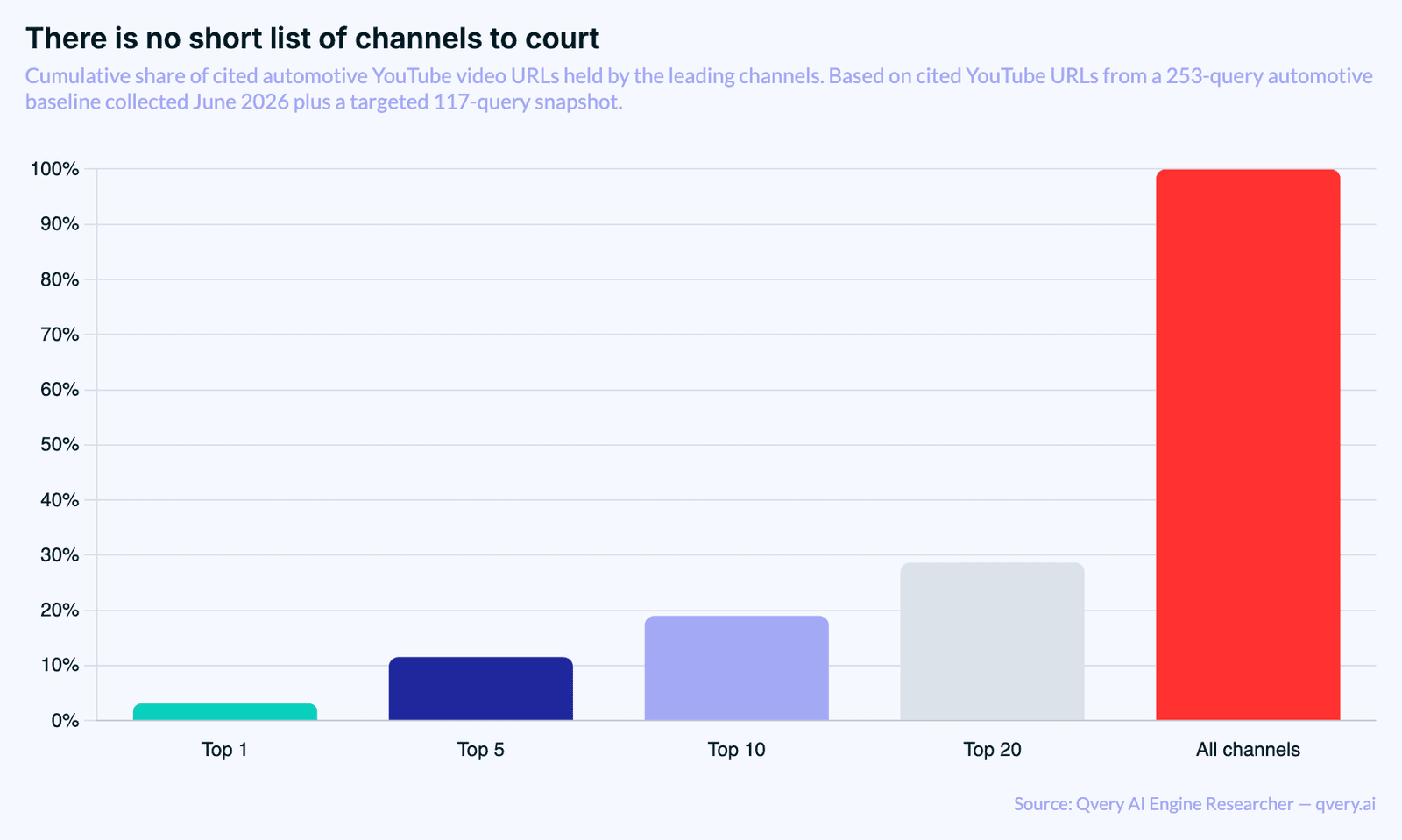
The tail is not a tail so much as the body of the thing. 80.44% of the channels in this corpus were cited exactly once, and those single-appearance channels together account for the majority of all cited videos.
If you were expecting a handful of channels to account for most of this surface, the distribution says otherwise. The realistic unit of work is a standing watchlist across a long tail, refreshed as it moves, and much of that tail will be channels appearing once and never returning.
That is a less satisfying picture than a short list, and it is the one the corpus supports.
The Channels That Do Repeat Are Not The Ones On Your Media Plan
Concentration is low. Some channels do come back, and their names are worth writing down.
Ranked by share of cited video URLs: Car Help Corner at #1 with 3.12%, Kevin Hunter The Homework Guy at #2 with 2.8%, then Everyman Driver, AutoPedia, Motor Future, and Chevy Dude tied at 1.87% each, CarEdge and Motormouth at 1.56%.
Consumer Reports ranks #9, at 1.25%.
Hold that against something from the same collection. At the domain level, consumerreports.org is the most-cited source in this entire automotive corpus, appearing in 37.9% of all answers. It is the most powerful automotive domain we measured, and in the video layer specifically it ranks behind eight channels, most of which do not appear on a typical automotive media plan.
Those two facts sit together fine. They describe different surfaces with different occupants. A brand with strong standing in the automotive press has not thereby earned standing in the cited video layer, because the same names do not run both.
Video citation also runs past review content, which is the other assumption worth killing. Our financing arm was designed as a control: questions about loans, credit, and dealer negotiation, deliberately away from vehicles. Video showed up there too.
We are putting no percentages on that split, because the comparison arm is too thin to carry one. What we can report is that the control arm was not empty. For the cross-vertical picture of how video sits in AI citations generally, see our YouTube citations breakdown.
One Regional Manufacturer Account, And Nothing Else
Since the publisher categories failed their check, we asked a narrower question that a channel name can answer: is this a vehicle manufacturer's own channel? That is close to a binary with a defined answer set, so we read every channel name in the corpus by hand rather than trusting anything automated.
That read surfaced one regional account, BMW Middle East. Beyond it, no Toyota, Ford, Honda, Hyundai, Chevrolet, Nissan, Volkswagen, Mercedes, or Audi channel appears anywhere in the corpus, in any region.
The same hand read surfaced named dealership channels: Subaru of Puyallup, Windsor Motor Group, Max The Van Dealer, and Motorpoint. Those are observations on name-evident cases from the hand audit, kept separate from the publisher categories that failed.
Now the necessary caution, meant literally rather than offered as a hedge. Absence in a corpus is no proof of exclusion. This establishes nothing about whether manufacturer video can be cited, whether anything filters it out, or whether publishing more video would change the picture.
What it does is bound a watchlist. It tells you what is currently there, which is the question an audit exists to answer.
Building The Audit You Can Run
Everything above is an observation about a corpus at a moment. Turning it into something operational means running the same measurement on your own category, on a schedule, and watching what moves.
The workable version has four parts.
Define the question set first, not the channel list. Write down the questions your customers ask across the full journey: model comparisons, reliability, financing, trade-in, servicing. Our financing control arm returned video citations, so the surface was not confined to review questions in this corpus.
Record the channel, not just the domain. Logging "a YouTube video was cited" gives you nothing to act on.
The channel that published it is the actionable unit, and it comes from the video's own publisher record rather than from its title. Our first attempt to read publishers from titles left 67.6% of the corpus unresolved. Titles describe content and say little about who made it.
Resist the taxonomy. Given what happened to our 85% gate, do not build tracking around percentage splits between publisher categories. Track named channels and how often each appears. In this corpus, channel identity came straight from the publisher record and needed no judgment call; the categories layered on top did not survive one.
Log it over time. A single snapshot cannot distinguish a channel that owns your category from one that appeared once and never returns. Given that 80.44% of our channels appeared exactly once, that distinction is most of the signal. Only a recurring log separates them.
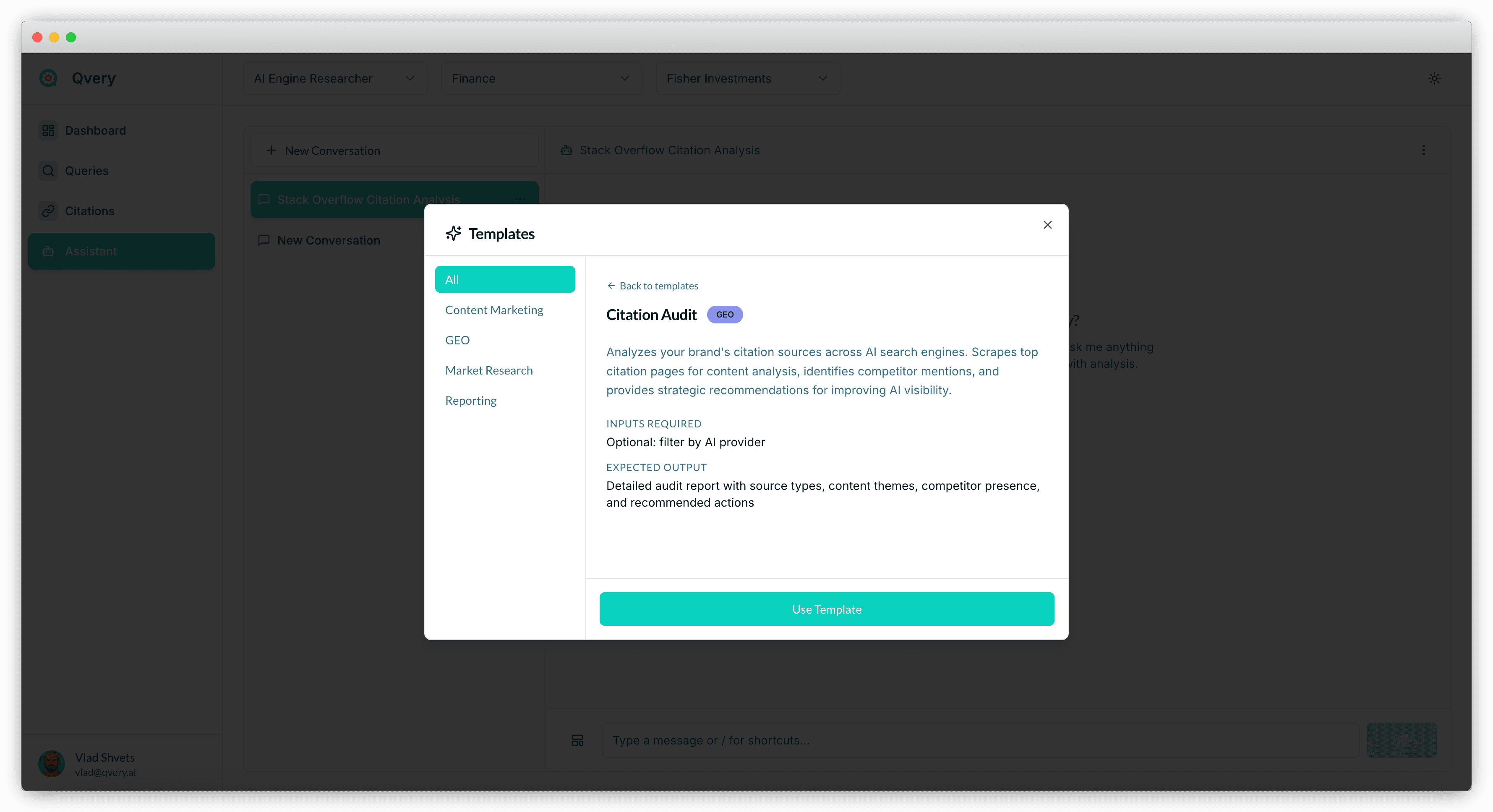
This is the part Qvery handles. It tracks visibility, share of voice, and average rank across ChatGPT and Google AI Mode daily, in over 200 countries, and captures every citation tied to the specific query and engine that produced it. The record accumulates instead of being rebuilt each time you wonder.
In Qvery Assistant you can ask about your own visibility, share of voice, citation, topic, and query data directly, add queries, trigger a run, or export a report. The channel-level annotations stay yours to maintain alongside that tracking, which given everything above is where that judgment belongs.
Start your free trial and get your first citation log running this week.
Writer's Judgment, Not A Finding
Marking this clearly, because it is opinion and the rest of the article is not.
If your category's eligible corpus keeps returning channels that appear nowhere on your map, the sensible next investigation is to audit those surfaces alongside your owned video rather than instead of it.
Given that manufacturer channels are effectively absent from what we measured, our judgment is that video budget aimed only at your own channel is aimed at a thin part of this surface.
A second judgment, from the financing control returning video citations: we would scope an audit past model reviews. Neither view is established by the data, and the directional control observation does not show that a broader audit changes anything about citations.
What the data did establish is narrower and firmer. This layer is a long tail where the most-cited channel holds 3.12% of it, 80.44% of channels appear exactly once, the best-known automotive publication ranks #9, manufacturers' own channels are effectively absent, and publisher categories applied by eye are unreliable enough that two careful readers disagree about half the time in the ambiguous middle.
None of that tells you why any particular video was cited. It tells you what is in the room. That is a better starting point than the aggregate you had before, which only told you that video was in the room somewhere.
If you market a car brand, a dealer group, or an automotive aftermarket product, you have probably been told that video matters in AI answers. That is true as an aggregate observation and close to useless as an instruction.
It does not tell you which channels sit in the answers your customers see, whether those channels are ones you have heard of, or whether your own videos are anywhere in that layer.
So we went and looked at the videos themselves, rather than at the domain-level share, which is already published. We looked at the individual cited video URLs: who published each one, how often the same publisher comes back, and whether a single vehicle manufacturer's own channel appears anywhere in the set.
Two of the three analyses we planned did not survive their own quality checks. That was the most useful part of the exercise, and we will show you exactly where they broke, because the same failure is waiting for anyone who tries to audit this surface by eye.
What This Corpus Is, And What It Is Not
The already-published finding is that YouTube shows up far more often in Google AI Mode automotive answers than in ChatGPT ones. Our collection agrees, and agrees emphatically. That is not this article's subject, and we are not going to re-chart it. For the engine-level source mix, read our automotive AI search breakdown, which covers it properly.
What that aggregate cannot tell you is anything about the videos. A domain share says "youtube.com appeared." It does not say which channel published the video, whether that channel recurs, or whether it is one you have any relationship with. Those are the things an audit is for.
So the unit of analysis here is one cited video URL. We assembled every distinct YouTube URL cited across an automotive baseline collection and a targeted follow-up snapshot, then resolved each one to the channel that published it.
One scoping note that matters more than it sounds. In this collection, 0.00% of ChatGPT answers cited a YouTube video. In Google AI Mode, 58.62% of answers did.
Read that as scope, not as a recommendation to favour an engine or move budget. It means you should check where video appears in your answer set before spending anything on an audit. Scope one to the wrong engine and it will find nothing and tell you nothing.
The Check That Failed, And Why You Should Care
The plan was to sort every cited channel into publisher categories and report the composition. That composition was going to be the headline.
Before running it, we registered a rule: the classifier had to agree with an independent set of gold-standard labels at least 85% of the time, or the finding would not be published. A second labeler, working blind and with no sight of the first pass, adjudicated a stratified sample of channels.
Agreement came in at 60.0%.
The gate failed, so the composition appears in this article as no number at all, and neither does the chart it was meant to produce. We did not lower the threshold, collapse the categories into something coarser until the numbers agreed, or draw a new sample. The rule existed precisely so that it could produce this outcome.
The interesting part is where the two labelers disagreed. They agreed on Consumer Reports and Autotrader. They split on names like Off Track, Tool Demos, Car Influence, and Auto Educate: channels whose names carry no reliable signal about who runs them. Roughly half the time, in that middle band, two careful readers reached different verdicts.
Treat that as a finding about the work rather than a footnote about our process. If you are building a channel watchlist for your category, the tidy taxonomy you have in your head does not survive contact with the actual list.
You cannot sort this layer into publisher categories by reading names. Any audit that assumes you can is producing numbers with a coin-flip underneath them.
A second registered analysis died even earlier. We had planned to classify each cited video by format, reading the format from the video title. That pass resolved none of the corpus into a usable format label, because a title describes content and says nothing dependable about how the video was made. No format composition appears here either.
What follows uses only evidence that needs no classifier: which channel published a video, how often it recurs, and one narrow question we checked by hand.
There Is No Short List Of Channels To Court
Here is the first thing that survives without any classification, because it counts publishers rather than judging them.
Based on cited YouTube URLs from a 253-query automotive baseline collected June 2026 plus a targeted 117-query snapshot (50 model-review, 18 comparison, 49 financing-control queries), and that snapshot is US-weighted rather than all-US: 82 US queries, 18 GB, nine CA, and eight AU.
The most-cited channel in the entire corpus holds 3.12% of it. The top five together hold 11.53%. You have to reach the top twenty before clearing 28.66%.
The tail is not a tail so much as the body of the thing. 80.44% of the channels in this corpus were cited exactly once, and those single-appearance channels together account for the majority of all cited videos.
If you were expecting a handful of channels to account for most of this surface, the distribution says otherwise. The realistic unit of work is a standing watchlist across a long tail, refreshed as it moves, and much of that tail will be channels appearing once and never returning.
That is a less satisfying picture than a short list, and it is the one the corpus supports.
The Channels That Do Repeat Are Not The Ones On Your Media Plan
Concentration is low. Some channels do come back, and their names are worth writing down.
Ranked by share of cited video URLs: Car Help Corner at #1 with 3.12%, Kevin Hunter The Homework Guy at #2 with 2.8%, then Everyman Driver, AutoPedia, Motor Future, and Chevy Dude tied at 1.87% each, CarEdge and Motormouth at 1.56%.
Consumer Reports ranks #9, at 1.25%.
Hold that against something from the same collection. At the domain level, consumerreports.org is the most-cited source in this entire automotive corpus, appearing in 37.9% of all answers. It is the most powerful automotive domain we measured, and in the video layer specifically it ranks behind eight channels, most of which do not appear on a typical automotive media plan.
Those two facts sit together fine. They describe different surfaces with different occupants. A brand with strong standing in the automotive press has not thereby earned standing in the cited video layer, because the same names do not run both.
Video citation also runs past review content, which is the other assumption worth killing. Our financing arm was designed as a control: questions about loans, credit, and dealer negotiation, deliberately away from vehicles. Video showed up there too.
We are putting no percentages on that split, because the comparison arm is too thin to carry one. What we can report is that the control arm was not empty. For the cross-vertical picture of how video sits in AI citations generally, see our YouTube citations breakdown.
One Regional Manufacturer Account, And Nothing Else
Since the publisher categories failed their check, we asked a narrower question that a channel name can answer: is this a vehicle manufacturer's own channel? That is close to a binary with a defined answer set, so we read every channel name in the corpus by hand rather than trusting anything automated.
That read surfaced one regional account, BMW Middle East. Beyond it, no Toyota, Ford, Honda, Hyundai, Chevrolet, Nissan, Volkswagen, Mercedes, or Audi channel appears anywhere in the corpus, in any region.
The same hand read surfaced named dealership channels: Subaru of Puyallup, Windsor Motor Group, Max The Van Dealer, and Motorpoint. Those are observations on name-evident cases from the hand audit, kept separate from the publisher categories that failed.
Now the necessary caution, meant literally rather than offered as a hedge. Absence in a corpus is no proof of exclusion. This establishes nothing about whether manufacturer video can be cited, whether anything filters it out, or whether publishing more video would change the picture.
What it does is bound a watchlist. It tells you what is currently there, which is the question an audit exists to answer.
Building The Audit You Can Run
Everything above is an observation about a corpus at a moment. Turning it into something operational means running the same measurement on your own category, on a schedule, and watching what moves.
The workable version has four parts.
Define the question set first, not the channel list. Write down the questions your customers ask across the full journey: model comparisons, reliability, financing, trade-in, servicing. Our financing control arm returned video citations, so the surface was not confined to review questions in this corpus.
Record the channel, not just the domain. Logging "a YouTube video was cited" gives you nothing to act on.
The channel that published it is the actionable unit, and it comes from the video's own publisher record rather than from its title. Our first attempt to read publishers from titles left 67.6% of the corpus unresolved. Titles describe content and say little about who made it.
Resist the taxonomy. Given what happened to our 85% gate, do not build tracking around percentage splits between publisher categories. Track named channels and how often each appears. In this corpus, channel identity came straight from the publisher record and needed no judgment call; the categories layered on top did not survive one.
Log it over time. A single snapshot cannot distinguish a channel that owns your category from one that appeared once and never returns. Given that 80.44% of our channels appeared exactly once, that distinction is most of the signal. Only a recurring log separates them.
This is the part Qvery handles. It tracks visibility, share of voice, and average rank across ChatGPT and Google AI Mode daily, in over 200 countries, and captures every citation tied to the specific query and engine that produced it. The record accumulates instead of being rebuilt each time you wonder.
In Qvery Assistant you can ask about your own visibility, share of voice, citation, topic, and query data directly, add queries, trigger a run, or export a report. The channel-level annotations stay yours to maintain alongside that tracking, which given everything above is where that judgment belongs.
Start your free trial and get your first citation log running this week.
Writer's Judgment, Not A Finding
Marking this clearly, because it is opinion and the rest of the article is not.
If your category's eligible corpus keeps returning channels that appear nowhere on your map, the sensible next investigation is to audit those surfaces alongside your owned video rather than instead of it.
Given that manufacturer channels are effectively absent from what we measured, our judgment is that video budget aimed only at your own channel is aimed at a thin part of this surface.
A second judgment, from the financing control returning video citations: we would scope an audit past model reviews. Neither view is established by the data, and the directional control observation does not show that a broader audit changes anything about citations.
What the data did establish is narrower and firmer. This layer is a long tail where the most-cited channel holds 3.12% of it, 80.44% of channels appear exactly once, the best-known automotive publication ranks #9, manufacturers' own channels are effectively absent, and publisher categories applied by eye are unreliable enough that two careful readers disagree about half the time in the ambiguous middle.
None of that tells you why any particular video was cited. It tells you what is in the room. That is a better starting point than the aggregate you had before, which only told you that video was in the room somewhere.
If you market a car brand, a dealer group, or an automotive aftermarket product, you have probably been told that video matters in AI answers. That is true as an aggregate observation and close to useless as an instruction.
It does not tell you which channels sit in the answers your customers see, whether those channels are ones you have heard of, or whether your own videos are anywhere in that layer.
So we went and looked at the videos themselves, rather than at the domain-level share, which is already published. We looked at the individual cited video URLs: who published each one, how often the same publisher comes back, and whether a single vehicle manufacturer's own channel appears anywhere in the set.
Two of the three analyses we planned did not survive their own quality checks. That was the most useful part of the exercise, and we will show you exactly where they broke, because the same failure is waiting for anyone who tries to audit this surface by eye.
What This Corpus Is, And What It Is Not
The already-published finding is that YouTube shows up far more often in Google AI Mode automotive answers than in ChatGPT ones. Our collection agrees, and agrees emphatically. That is not this article's subject, and we are not going to re-chart it. For the engine-level source mix, read our automotive AI search breakdown, which covers it properly.
What that aggregate cannot tell you is anything about the videos. A domain share says "youtube.com appeared." It does not say which channel published the video, whether that channel recurs, or whether it is one you have any relationship with. Those are the things an audit is for.
So the unit of analysis here is one cited video URL. We assembled every distinct YouTube URL cited across an automotive baseline collection and a targeted follow-up snapshot, then resolved each one to the channel that published it.
One scoping note that matters more than it sounds. In this collection, 0.00% of ChatGPT answers cited a YouTube video. In Google AI Mode, 58.62% of answers did.
Read that as scope, not as a recommendation to favour an engine or move budget. It means you should check where video appears in your answer set before spending anything on an audit. Scope one to the wrong engine and it will find nothing and tell you nothing.
The Check That Failed, And Why You Should Care
The plan was to sort every cited channel into publisher categories and report the composition. That composition was going to be the headline.
Before running it, we registered a rule: the classifier had to agree with an independent set of gold-standard labels at least 85% of the time, or the finding would not be published. A second labeler, working blind and with no sight of the first pass, adjudicated a stratified sample of channels.
Agreement came in at 60.0%.
The gate failed, so the composition appears in this article as no number at all, and neither does the chart it was meant to produce. We did not lower the threshold, collapse the categories into something coarser until the numbers agreed, or draw a new sample. The rule existed precisely so that it could produce this outcome.
The interesting part is where the two labelers disagreed. They agreed on Consumer Reports and Autotrader. They split on names like Off Track, Tool Demos, Car Influence, and Auto Educate: channels whose names carry no reliable signal about who runs them. Roughly half the time, in that middle band, two careful readers reached different verdicts.
Treat that as a finding about the work rather than a footnote about our process. If you are building a channel watchlist for your category, the tidy taxonomy you have in your head does not survive contact with the actual list.
You cannot sort this layer into publisher categories by reading names. Any audit that assumes you can is producing numbers with a coin-flip underneath them.
A second registered analysis died even earlier. We had planned to classify each cited video by format, reading the format from the video title. That pass resolved none of the corpus into a usable format label, because a title describes content and says nothing dependable about how the video was made. No format composition appears here either.
What follows uses only evidence that needs no classifier: which channel published a video, how often it recurs, and one narrow question we checked by hand.
There Is No Short List Of Channels To Court
Here is the first thing that survives without any classification, because it counts publishers rather than judging them.
Based on cited YouTube URLs from a 253-query automotive baseline collected June 2026 plus a targeted 117-query snapshot (50 model-review, 18 comparison, 49 financing-control queries), and that snapshot is US-weighted rather than all-US: 82 US queries, 18 GB, nine CA, and eight AU.
The most-cited channel in the entire corpus holds 3.12% of it. The top five together hold 11.53%. You have to reach the top twenty before clearing 28.66%.
The tail is not a tail so much as the body of the thing. 80.44% of the channels in this corpus were cited exactly once, and those single-appearance channels together account for the majority of all cited videos.
If you were expecting a handful of channels to account for most of this surface, the distribution says otherwise. The realistic unit of work is a standing watchlist across a long tail, refreshed as it moves, and much of that tail will be channels appearing once and never returning.
That is a less satisfying picture than a short list, and it is the one the corpus supports.
The Channels That Do Repeat Are Not The Ones On Your Media Plan
Concentration is low. Some channels do come back, and their names are worth writing down.
Ranked by share of cited video URLs: Car Help Corner at #1 with 3.12%, Kevin Hunter The Homework Guy at #2 with 2.8%, then Everyman Driver, AutoPedia, Motor Future, and Chevy Dude tied at 1.87% each, CarEdge and Motormouth at 1.56%.
Consumer Reports ranks #9, at 1.25%.
Hold that against something from the same collection. At the domain level, consumerreports.org is the most-cited source in this entire automotive corpus, appearing in 37.9% of all answers. It is the most powerful automotive domain we measured, and in the video layer specifically it ranks behind eight channels, most of which do not appear on a typical automotive media plan.
Those two facts sit together fine. They describe different surfaces with different occupants. A brand with strong standing in the automotive press has not thereby earned standing in the cited video layer, because the same names do not run both.
Video citation also runs past review content, which is the other assumption worth killing. Our financing arm was designed as a control: questions about loans, credit, and dealer negotiation, deliberately away from vehicles. Video showed up there too.
We are putting no percentages on that split, because the comparison arm is too thin to carry one. What we can report is that the control arm was not empty. For the cross-vertical picture of how video sits in AI citations generally, see our YouTube citations breakdown.
One Regional Manufacturer Account, And Nothing Else
Since the publisher categories failed their check, we asked a narrower question that a channel name can answer: is this a vehicle manufacturer's own channel? That is close to a binary with a defined answer set, so we read every channel name in the corpus by hand rather than trusting anything automated.
That read surfaced one regional account, BMW Middle East. Beyond it, no Toyota, Ford, Honda, Hyundai, Chevrolet, Nissan, Volkswagen, Mercedes, or Audi channel appears anywhere in the corpus, in any region.
The same hand read surfaced named dealership channels: Subaru of Puyallup, Windsor Motor Group, Max The Van Dealer, and Motorpoint. Those are observations on name-evident cases from the hand audit, kept separate from the publisher categories that failed.
Now the necessary caution, meant literally rather than offered as a hedge. Absence in a corpus is no proof of exclusion. This establishes nothing about whether manufacturer video can be cited, whether anything filters it out, or whether publishing more video would change the picture.
What it does is bound a watchlist. It tells you what is currently there, which is the question an audit exists to answer.
Building The Audit You Can Run
Everything above is an observation about a corpus at a moment. Turning it into something operational means running the same measurement on your own category, on a schedule, and watching what moves.
The workable version has four parts.
Define the question set first, not the channel list. Write down the questions your customers ask across the full journey: model comparisons, reliability, financing, trade-in, servicing. Our financing control arm returned video citations, so the surface was not confined to review questions in this corpus.
Record the channel, not just the domain. Logging "a YouTube video was cited" gives you nothing to act on.
The channel that published it is the actionable unit, and it comes from the video's own publisher record rather than from its title. Our first attempt to read publishers from titles left 67.6% of the corpus unresolved. Titles describe content and say little about who made it.
Resist the taxonomy. Given what happened to our 85% gate, do not build tracking around percentage splits between publisher categories. Track named channels and how often each appears. In this corpus, channel identity came straight from the publisher record and needed no judgment call; the categories layered on top did not survive one.
Log it over time. A single snapshot cannot distinguish a channel that owns your category from one that appeared once and never returns. Given that 80.44% of our channels appeared exactly once, that distinction is most of the signal. Only a recurring log separates them.
This is the part Qvery handles. It tracks visibility, share of voice, and average rank across ChatGPT and Google AI Mode daily, in over 200 countries, and captures every citation tied to the specific query and engine that produced it. The record accumulates instead of being rebuilt each time you wonder.
In Qvery Assistant you can ask about your own visibility, share of voice, citation, topic, and query data directly, add queries, trigger a run, or export a report. The channel-level annotations stay yours to maintain alongside that tracking, which given everything above is where that judgment belongs.
Start your free trial and get your first citation log running this week.
Writer's Judgment, Not A Finding
Marking this clearly, because it is opinion and the rest of the article is not.
If your category's eligible corpus keeps returning channels that appear nowhere on your map, the sensible next investigation is to audit those surfaces alongside your owned video rather than instead of it.
Given that manufacturer channels are effectively absent from what we measured, our judgment is that video budget aimed only at your own channel is aimed at a thin part of this surface.
A second judgment, from the financing control returning video citations: we would scope an audit past model reviews. Neither view is established by the data, and the directional control observation does not show that a broader audit changes anything about citations.
What the data did establish is narrower and firmer. This layer is a long tail where the most-cited channel holds 3.12% of it, 80.44% of channels appear exactly once, the best-known automotive publication ranks #9, manufacturers' own channels are effectively absent, and publisher categories applied by eye are unreliable enough that two careful readers disagree about half the time in the ambiguous middle.
None of that tells you why any particular video was cited. It tells you what is in the room. That is a better starting point than the aggregate you had before, which only told you that video was in the room somewhere.
If you market a car brand, a dealer group, or an automotive aftermarket product, you have probably been told that video matters in AI answers. That is true as an aggregate observation and close to useless as an instruction.
It does not tell you which channels sit in the answers your customers see, whether those channels are ones you have heard of, or whether your own videos are anywhere in that layer.
So we went and looked at the videos themselves, rather than at the domain-level share, which is already published. We looked at the individual cited video URLs: who published each one, how often the same publisher comes back, and whether a single vehicle manufacturer's own channel appears anywhere in the set.
Two of the three analyses we planned did not survive their own quality checks. That was the most useful part of the exercise, and we will show you exactly where they broke, because the same failure is waiting for anyone who tries to audit this surface by eye.
What This Corpus Is, And What It Is Not
The already-published finding is that YouTube shows up far more often in Google AI Mode automotive answers than in ChatGPT ones. Our collection agrees, and agrees emphatically. That is not this article's subject, and we are not going to re-chart it. For the engine-level source mix, read our automotive AI search breakdown, which covers it properly.
What that aggregate cannot tell you is anything about the videos. A domain share says "youtube.com appeared." It does not say which channel published the video, whether that channel recurs, or whether it is one you have any relationship with. Those are the things an audit is for.
So the unit of analysis here is one cited video URL. We assembled every distinct YouTube URL cited across an automotive baseline collection and a targeted follow-up snapshot, then resolved each one to the channel that published it.
One scoping note that matters more than it sounds. In this collection, 0.00% of ChatGPT answers cited a YouTube video. In Google AI Mode, 58.62% of answers did.
Read that as scope, not as a recommendation to favour an engine or move budget. It means you should check where video appears in your answer set before spending anything on an audit. Scope one to the wrong engine and it will find nothing and tell you nothing.
The Check That Failed, And Why You Should Care
The plan was to sort every cited channel into publisher categories and report the composition. That composition was going to be the headline.
Before running it, we registered a rule: the classifier had to agree with an independent set of gold-standard labels at least 85% of the time, or the finding would not be published. A second labeler, working blind and with no sight of the first pass, adjudicated a stratified sample of channels.
Agreement came in at 60.0%.
The gate failed, so the composition appears in this article as no number at all, and neither does the chart it was meant to produce. We did not lower the threshold, collapse the categories into something coarser until the numbers agreed, or draw a new sample. The rule existed precisely so that it could produce this outcome.
The interesting part is where the two labelers disagreed. They agreed on Consumer Reports and Autotrader. They split on names like Off Track, Tool Demos, Car Influence, and Auto Educate: channels whose names carry no reliable signal about who runs them. Roughly half the time, in that middle band, two careful readers reached different verdicts.
Treat that as a finding about the work rather than a footnote about our process. If you are building a channel watchlist for your category, the tidy taxonomy you have in your head does not survive contact with the actual list.
You cannot sort this layer into publisher categories by reading names. Any audit that assumes you can is producing numbers with a coin-flip underneath them.
A second registered analysis died even earlier. We had planned to classify each cited video by format, reading the format from the video title. That pass resolved none of the corpus into a usable format label, because a title describes content and says nothing dependable about how the video was made. No format composition appears here either.
What follows uses only evidence that needs no classifier: which channel published a video, how often it recurs, and one narrow question we checked by hand.
There Is No Short List Of Channels To Court
Here is the first thing that survives without any classification, because it counts publishers rather than judging them.
Based on cited YouTube URLs from a 253-query automotive baseline collected June 2026 plus a targeted 117-query snapshot (50 model-review, 18 comparison, 49 financing-control queries), and that snapshot is US-weighted rather than all-US: 82 US queries, 18 GB, nine CA, and eight AU.
The most-cited channel in the entire corpus holds 3.12% of it. The top five together hold 11.53%. You have to reach the top twenty before clearing 28.66%.
The tail is not a tail so much as the body of the thing. 80.44% of the channels in this corpus were cited exactly once, and those single-appearance channels together account for the majority of all cited videos.
If you were expecting a handful of channels to account for most of this surface, the distribution says otherwise. The realistic unit of work is a standing watchlist across a long tail, refreshed as it moves, and much of that tail will be channels appearing once and never returning.
That is a less satisfying picture than a short list, and it is the one the corpus supports.
The Channels That Do Repeat Are Not The Ones On Your Media Plan
Concentration is low. Some channels do come back, and their names are worth writing down.
Ranked by share of cited video URLs: Car Help Corner at #1 with 3.12%, Kevin Hunter The Homework Guy at #2 with 2.8%, then Everyman Driver, AutoPedia, Motor Future, and Chevy Dude tied at 1.87% each, CarEdge and Motormouth at 1.56%.
Consumer Reports ranks #9, at 1.25%.
Hold that against something from the same collection. At the domain level, consumerreports.org is the most-cited source in this entire automotive corpus, appearing in 37.9% of all answers. It is the most powerful automotive domain we measured, and in the video layer specifically it ranks behind eight channels, most of which do not appear on a typical automotive media plan.
Those two facts sit together fine. They describe different surfaces with different occupants. A brand with strong standing in the automotive press has not thereby earned standing in the cited video layer, because the same names do not run both.
Video citation also runs past review content, which is the other assumption worth killing. Our financing arm was designed as a control: questions about loans, credit, and dealer negotiation, deliberately away from vehicles. Video showed up there too.
We are putting no percentages on that split, because the comparison arm is too thin to carry one. What we can report is that the control arm was not empty. For the cross-vertical picture of how video sits in AI citations generally, see our YouTube citations breakdown.
One Regional Manufacturer Account, And Nothing Else
Since the publisher categories failed their check, we asked a narrower question that a channel name can answer: is this a vehicle manufacturer's own channel? That is close to a binary with a defined answer set, so we read every channel name in the corpus by hand rather than trusting anything automated.
That read surfaced one regional account, BMW Middle East. Beyond it, no Toyota, Ford, Honda, Hyundai, Chevrolet, Nissan, Volkswagen, Mercedes, or Audi channel appears anywhere in the corpus, in any region.
The same hand read surfaced named dealership channels: Subaru of Puyallup, Windsor Motor Group, Max The Van Dealer, and Motorpoint. Those are observations on name-evident cases from the hand audit, kept separate from the publisher categories that failed.
Now the necessary caution, meant literally rather than offered as a hedge. Absence in a corpus is no proof of exclusion. This establishes nothing about whether manufacturer video can be cited, whether anything filters it out, or whether publishing more video would change the picture.
What it does is bound a watchlist. It tells you what is currently there, which is the question an audit exists to answer.
Building The Audit You Can Run
Everything above is an observation about a corpus at a moment. Turning it into something operational means running the same measurement on your own category, on a schedule, and watching what moves.
The workable version has four parts.
Define the question set first, not the channel list. Write down the questions your customers ask across the full journey: model comparisons, reliability, financing, trade-in, servicing. Our financing control arm returned video citations, so the surface was not confined to review questions in this corpus.
Record the channel, not just the domain. Logging "a YouTube video was cited" gives you nothing to act on.
The channel that published it is the actionable unit, and it comes from the video's own publisher record rather than from its title. Our first attempt to read publishers from titles left 67.6% of the corpus unresolved. Titles describe content and say little about who made it.
Resist the taxonomy. Given what happened to our 85% gate, do not build tracking around percentage splits between publisher categories. Track named channels and how often each appears. In this corpus, channel identity came straight from the publisher record and needed no judgment call; the categories layered on top did not survive one.
Log it over time. A single snapshot cannot distinguish a channel that owns your category from one that appeared once and never returns. Given that 80.44% of our channels appeared exactly once, that distinction is most of the signal. Only a recurring log separates them.
This is the part Qvery handles. It tracks visibility, share of voice, and average rank across ChatGPT and Google AI Mode daily, in over 200 countries, and captures every citation tied to the specific query and engine that produced it. The record accumulates instead of being rebuilt each time you wonder.
In Qvery Assistant you can ask about your own visibility, share of voice, citation, topic, and query data directly, add queries, trigger a run, or export a report. The channel-level annotations stay yours to maintain alongside that tracking, which given everything above is where that judgment belongs.
Start your free trial and get your first citation log running this week.
Writer's Judgment, Not A Finding
Marking this clearly, because it is opinion and the rest of the article is not.
If your category's eligible corpus keeps returning channels that appear nowhere on your map, the sensible next investigation is to audit those surfaces alongside your owned video rather than instead of it.
Given that manufacturer channels are effectively absent from what we measured, our judgment is that video budget aimed only at your own channel is aimed at a thin part of this surface.
A second judgment, from the financing control returning video citations: we would scope an audit past model reviews. Neither view is established by the data, and the directional control observation does not show that a broader audit changes anything about citations.
What the data did establish is narrower and firmer. This layer is a long tail where the most-cited channel holds 3.12% of it, 80.44% of channels appear exactly once, the best-known automotive publication ranks #9, manufacturers' own channels are effectively absent, and publisher categories applied by eye are unreliable enough that two careful readers disagree about half the time in the ambiguous middle.
None of that tells you why any particular video was cited. It tells you what is in the room. That is a better starting point than the aggregate you had before, which only told you that video was in the room somewhere.

© 2026 Qvery AI OÜ