By
Vlad Shvets
PR for Travel Brands Is About Citations, Not Coverage
A celebrated press hit can vanish from AI search in three weeks. Here is why travel PR should chase evergreen citations, not coverage, with the Qvery data to prove it.
A celebrated press hit can vanish from AI search in three weeks. Here is why travel PR should chase evergreen citations, not coverage, with the Qvery data to prove it.
A celebrated press hit can vanish from AI search in three weeks. Here is why travel PR should chase evergreen citations, not coverage, with the Qvery data to prove it.
We ran the Citations view for a travel brand three weeks after they landed the kind of press hit most founders frame on the office wall. A glossy feature in a major outlet, a quote from the CEO, a launch announcement that bounced around the news cycle for about as long as a press embargo stays secret, then vanished.
When we asked ChatGPT and Google AI Mode the exact questions that brand wanted to own, the ones about where to stay and what to book, the celebrated placement was nowhere. The coverage existed, but the citation did not, and that is the gap nobody on the PR team had thought to check.
Travel PR has always been measured in coverage: the embargo lifted, the byline secured. None of that tells you whether ChatGPT recommends your hotel when a traveler asks where to stay in Patagonia without a car. The news cycle spikes and decays in days. AI engines pull from durable, evergreen pages, so a placement that only lived for a weekend leaves nothing behind for them to cite.
In Travel, the Shortlist Is the Whole Consideration Set
Travel is a trust purchase. Nobody books an expensive multi-day trip on a whim, and the moment a traveler asks ChatGPT or Google AI Mode "where to stay in Patagonia without a car," the shortlist it returns is the entire consideration set. Three hotels make the shortlist. Every other option is one the traveler never learns existed.
A press release counts who saw the coverage this week. The Citations view counts whether the engines still surface you months later, which is the number that decides whether you make the shortlist.
AI engines overwhelmingly cite brand websites and niche publications, which make up 87.75% of all citations across ChatGPT and Google AI Mode. They lean on evergreen editorial, traveler reviews, and the destination guides that get updated year after year. What they almost never cite is the thing PR teams are built to produce: time-sensitive news.
So the goal shifts. You are not chasing coverage that spikes and decays. You are earning editorial placements that compound as trust signals, the kind a competitor cannot simply buy back next quarter.
AI Engines Cite the Evergreen and Ignore the News Cycle
We classify the content type behind every citation across millions of AI citations on ChatGPT and Google AI Mode since January 2026. When you break down what Google AI Mode cites by content type, traditional PR barely registers. Listicles dominate at 47.0% of classified content, with discussion and forum posts close behind at 31.4%. Reviews account for another 15.1%. How-to and reference pages split the small remainder, and news sits dead last at just 0.3%.
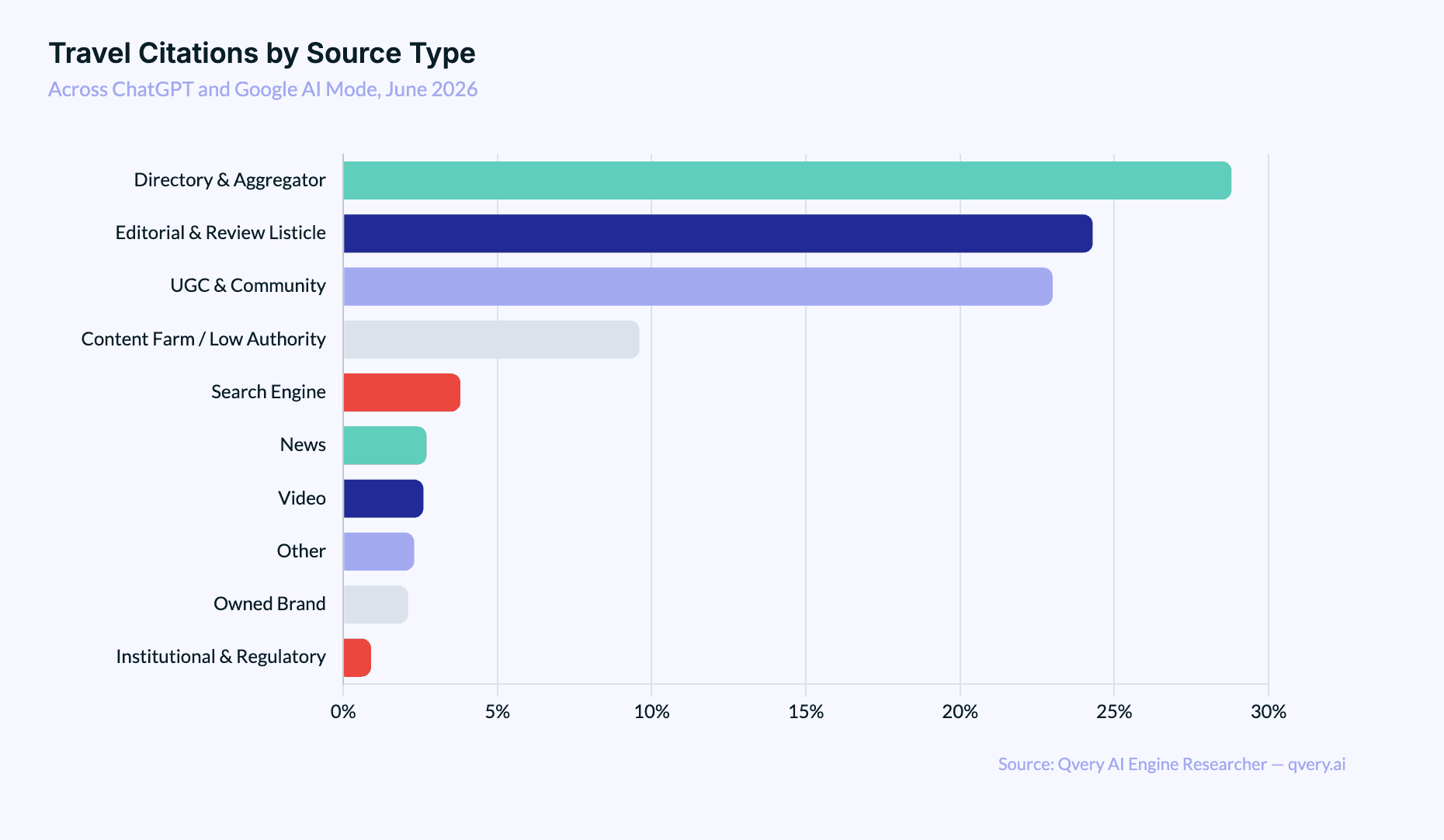
The format your PR agency optimizes for, the timely announcement, is the single least-cited content type AI engines pull from. They favor the destination guide that has been quietly updated for four years over the launch piece that trended for a weekend. An AI engine treats that guide like the friend who has been to the place, and the launch story like the friend who just saw an ad for it.
The citation web is also a long tail, which is why a single good placement matters. Across every cited domain we track, 46.5% are cited exactly once, and 75.4% are cited five times or fewer. One evergreen feature on the right travel publication can become a citation no rival holds, because the source pool is far more fragmented than the ten blue links ever were.
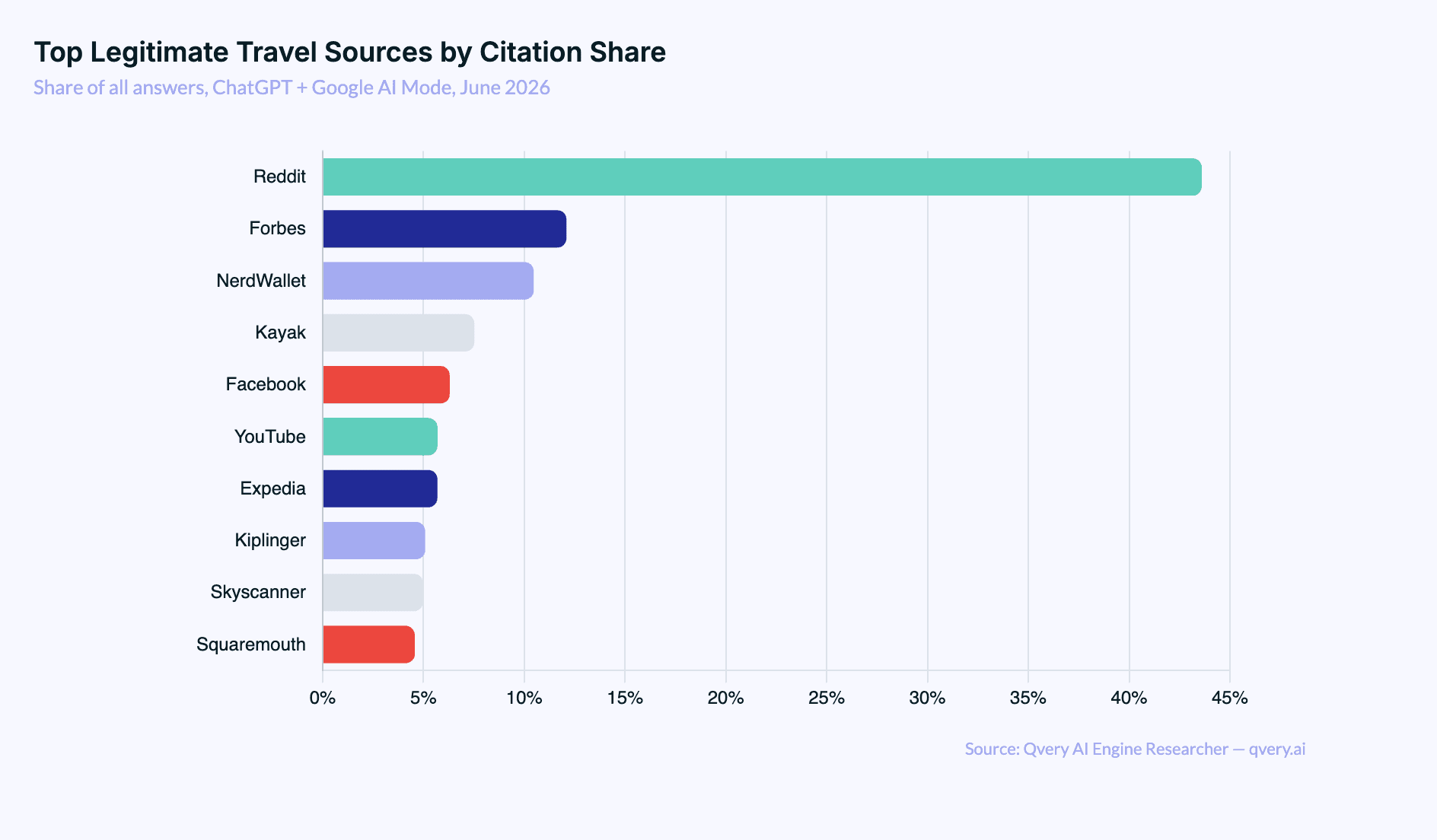
A clip dies on the news cycle's timeline. A citation lives on the buyer's, surfacing months after the journalist has moved on.
Travel Has Its Own Citation Physics
There is one source AI engines trust in travel more than almost anywhere else, and it tells you exactly where the trust signals live.
Within travel queries, TripAdvisor is the #4 most-cited domain (and #5 across the entire dataset). It accounts for 0.82% of all citations across categories, yet jumps to 3.5% of travel-query citations. That is a 4.3x over-index in your category, and 89% of those citations come from Google AI Mode specifically. TripAdvisor in travel is the one houseguest the engines never get tired of, while G2 and the directories are quietly being shown the door.
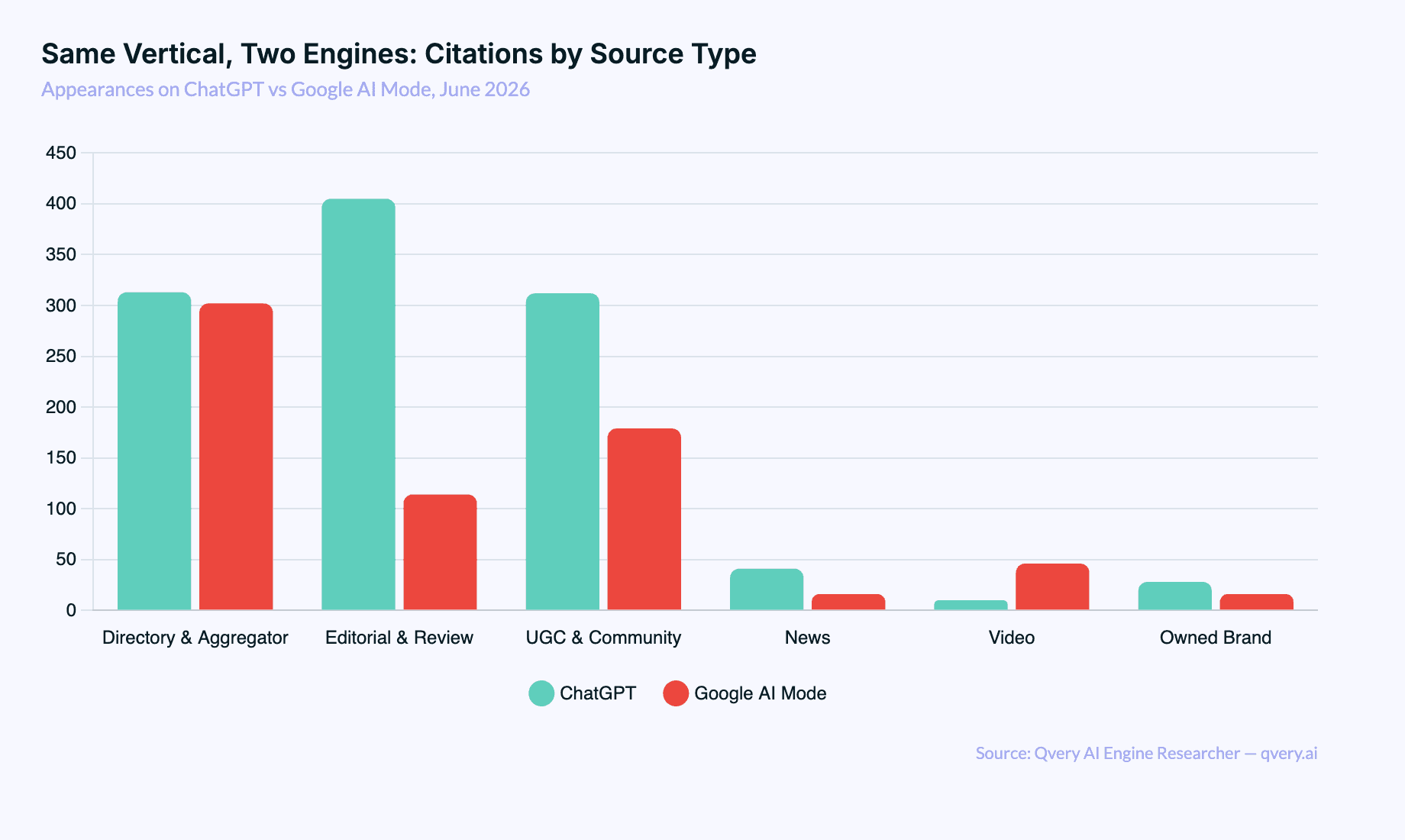
Meanwhile the directory and review-site real estate that brands used to lean on is shrinking. Software review and directory sites combined sit at just 1.19% of citations and are declining, with G2, the leading review site, down 78% from January to March.
That decline is the broader signal that review sites are losing citation share while AI engines reweight toward original editorial and lived experience. For travel brands, that gap is an opening. The shelf space directories are vacating gets filled by earned editorial and by the user-generated trust that traveler reviews represent.
UGC overall is 1.90% of all citations, and in travel the TripAdvisor profile is the closest thing to a permanent trust artifact you control. Which means your PR and reviews strategies are the same compounding signal, not separate departments arguing over budget.
What we still cannot predict is which travel features the engines keep citing six months out and which quietly fall off. The pattern so far is evergreen format plus a named brand, but the sample is young and we are watching it move.
The Travel PR Tactics That Earn Citations
Once you can see which travel publications the engines pull from, your pitch list rewrites itself. The destination roundup that gets refreshed every year is worth more than ten launch announcements, so spend your outreach budget there.
Pitch evergreen formats. Destination guides, "where to stay and eat" roundups, and expert lists are the formats AI engines reach for. A spot in a publication's "12 Best Surf Towns in South America" roundup matters because listicles are the most-cited classifiable content type on Google AI Mode, 47.0% of what it classifies, while the launch announcement competes for the 0.3% that goes to news. A precise destination guide signals fit, and in AI search fit beats authority, which is exactly what a generic press release cannot do.
Give journalists something citable. Editors and AI engines both reward what only you can provide. For a travel brand that is your booking data, average lead times by destination, which months a region empties out, the price a real guest paid versus the rack rate. A journalist who can anchor a piece on your numbers names you in it, and that named mention is the citation.
Target what AI already cites. Your competitor comparison just handed you the list. Spend your outreach budget where the engines already pull, not where the media-kit logos look impressive. Every outlet you earn is its own trust signal in the engines. One impressive media-kit logo does nothing if the engines never cite that outlet in your category.
Stack TripAdvisor onto editorial. When a feature links your destination page to its TripAdvisor reviews, you stack the strongest travel signal there is on top of an editorial one. A feature that points both signals at one brand is hard for a competitor to replicate.
Measure citation, not coverage. A clip report counts who saw the coverage. The Citations view shows whether the engines remember it, which is the only thing that affects whether you appear when a traveler asks.
The Citations View Turns PR From a Clip Report Into a Pitch List
You cannot run citation-first PR if you cannot see your citations. This is what the workflow looks like inside AI Engine Researcher, the live Qvery agent that tracks your brand across ChatGPT and Google AI Mode.
Open the Citations view. Every source that cited your brand appears with its domain, URL, citation weight, and which engine it came from. Scan the editorial sources and you immediately see which travel magazines, newspapers, and editorial sites are feeding the engines your recommendation, with the weight each carries and which engine surfaced it.
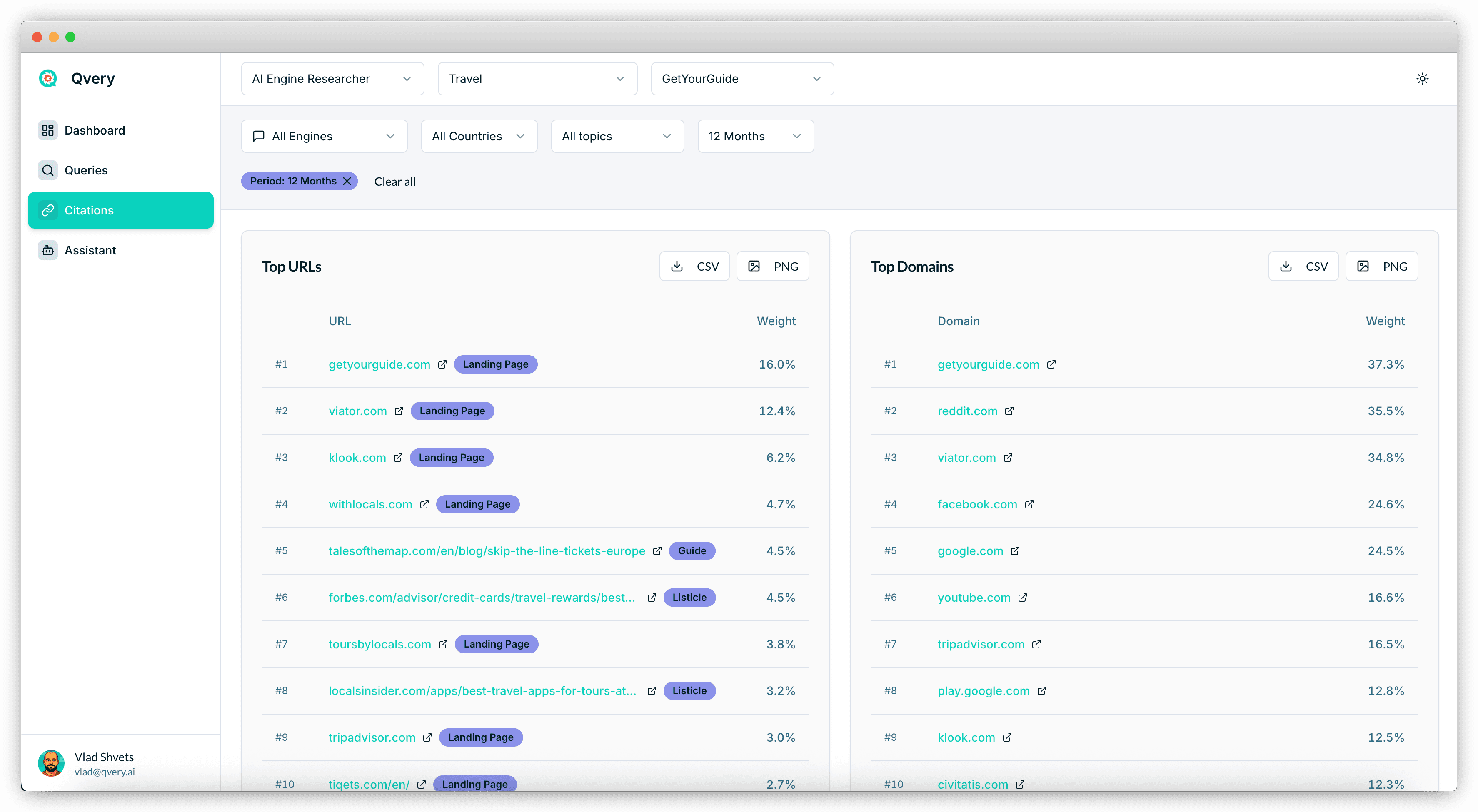
Next, compare your cited publications against a competitor's. The publications citing a rival but not you are your pitch list, ranked by the outlets AI engines already trust in your category.
When a placement lands, check whether the citation appears on both ChatGPT and Google AI Mode. A citation on both engines reaches everyone; a citation on one reaches only the people who use that engine. Audiences use both.
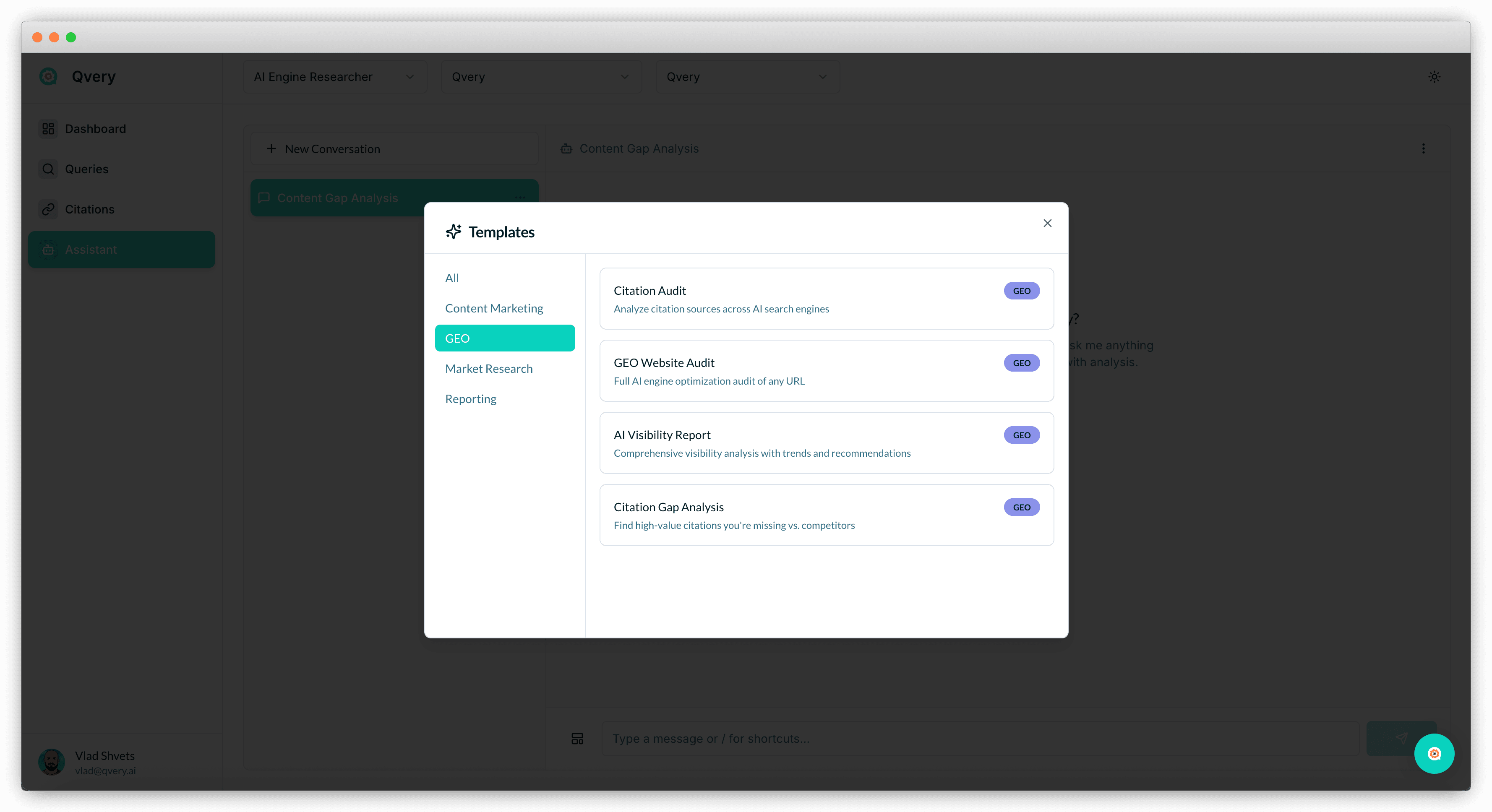
When you are ready to act, ask the Qvery Assistant to surface your press list in one line.
The PR Department Travel Brands Need Now
Most travel PR teams I talk to are still graded on coverage volume, because that is what the dashboards were built to count. Rebuilding the scorecard around citations is genuinely uncomfortable, and I get why teams resist it.
Count citations and the budget reallocates itself: the launch blitz that wins the week loses to the one durable feature your competitor cannot pitch a journalist to undo.
The next time your brand lands a big press hit, do one thing before you frame it on the wall. Ask ChatGPT and Google AI Mode the question that placement was supposed to win, and see whether the engines remembered it at all.
We ran the Citations view for a travel brand three weeks after they landed the kind of press hit most founders frame on the office wall. A glossy feature in a major outlet, a quote from the CEO, a launch announcement that bounced around the news cycle for about as long as a press embargo stays secret, then vanished.
When we asked ChatGPT and Google AI Mode the exact questions that brand wanted to own, the ones about where to stay and what to book, the celebrated placement was nowhere. The coverage existed, but the citation did not, and that is the gap nobody on the PR team had thought to check.
Travel PR has always been measured in coverage: the embargo lifted, the byline secured. None of that tells you whether ChatGPT recommends your hotel when a traveler asks where to stay in Patagonia without a car. The news cycle spikes and decays in days. AI engines pull from durable, evergreen pages, so a placement that only lived for a weekend leaves nothing behind for them to cite.
In Travel, the Shortlist Is the Whole Consideration Set
Travel is a trust purchase. Nobody books an expensive multi-day trip on a whim, and the moment a traveler asks ChatGPT or Google AI Mode "where to stay in Patagonia without a car," the shortlist it returns is the entire consideration set. Three hotels make the shortlist. Every other option is one the traveler never learns existed.
A press release counts who saw the coverage this week. The Citations view counts whether the engines still surface you months later, which is the number that decides whether you make the shortlist.
AI engines overwhelmingly cite brand websites and niche publications, which make up 87.75% of all citations across ChatGPT and Google AI Mode. They lean on evergreen editorial, traveler reviews, and the destination guides that get updated year after year. What they almost never cite is the thing PR teams are built to produce: time-sensitive news.
So the goal shifts. You are not chasing coverage that spikes and decays. You are earning editorial placements that compound as trust signals, the kind a competitor cannot simply buy back next quarter.
AI Engines Cite the Evergreen and Ignore the News Cycle
We classify the content type behind every citation across millions of AI citations on ChatGPT and Google AI Mode since January 2026. When you break down what Google AI Mode cites by content type, traditional PR barely registers. Listicles dominate at 47.0% of classified content, with discussion and forum posts close behind at 31.4%. Reviews account for another 15.1%. How-to and reference pages split the small remainder, and news sits dead last at just 0.3%.
The format your PR agency optimizes for, the timely announcement, is the single least-cited content type AI engines pull from. They favor the destination guide that has been quietly updated for four years over the launch piece that trended for a weekend. An AI engine treats that guide like the friend who has been to the place, and the launch story like the friend who just saw an ad for it.
The citation web is also a long tail, which is why a single good placement matters. Across every cited domain we track, 46.5% are cited exactly once, and 75.4% are cited five times or fewer. One evergreen feature on the right travel publication can become a citation no rival holds, because the source pool is far more fragmented than the ten blue links ever were.
A clip dies on the news cycle's timeline. A citation lives on the buyer's, surfacing months after the journalist has moved on.
Travel Has Its Own Citation Physics
There is one source AI engines trust in travel more than almost anywhere else, and it tells you exactly where the trust signals live.
Within travel queries, TripAdvisor is the #4 most-cited domain (and #5 across the entire dataset). It accounts for 0.82% of all citations across categories, yet jumps to 3.5% of travel-query citations. That is a 4.3x over-index in your category, and 89% of those citations come from Google AI Mode specifically. TripAdvisor in travel is the one houseguest the engines never get tired of, while G2 and the directories are quietly being shown the door.
Meanwhile the directory and review-site real estate that brands used to lean on is shrinking. Software review and directory sites combined sit at just 1.19% of citations and are declining, with G2, the leading review site, down 78% from January to March.
That decline is the broader signal that review sites are losing citation share while AI engines reweight toward original editorial and lived experience. For travel brands, that gap is an opening. The shelf space directories are vacating gets filled by earned editorial and by the user-generated trust that traveler reviews represent.
UGC overall is 1.90% of all citations, and in travel the TripAdvisor profile is the closest thing to a permanent trust artifact you control. Which means your PR and reviews strategies are the same compounding signal, not separate departments arguing over budget.
What we still cannot predict is which travel features the engines keep citing six months out and which quietly fall off. The pattern so far is evergreen format plus a named brand, but the sample is young and we are watching it move.
The Travel PR Tactics That Earn Citations
Once you can see which travel publications the engines pull from, your pitch list rewrites itself. The destination roundup that gets refreshed every year is worth more than ten launch announcements, so spend your outreach budget there.
Pitch evergreen formats. Destination guides, "where to stay and eat" roundups, and expert lists are the formats AI engines reach for. A spot in a publication's "12 Best Surf Towns in South America" roundup matters because listicles are the most-cited classifiable content type on Google AI Mode, 47.0% of what it classifies, while the launch announcement competes for the 0.3% that goes to news. A precise destination guide signals fit, and in AI search fit beats authority, which is exactly what a generic press release cannot do.
Give journalists something citable. Editors and AI engines both reward what only you can provide. For a travel brand that is your booking data, average lead times by destination, which months a region empties out, the price a real guest paid versus the rack rate. A journalist who can anchor a piece on your numbers names you in it, and that named mention is the citation.
Target what AI already cites. Your competitor comparison just handed you the list. Spend your outreach budget where the engines already pull, not where the media-kit logos look impressive. Every outlet you earn is its own trust signal in the engines. One impressive media-kit logo does nothing if the engines never cite that outlet in your category.
Stack TripAdvisor onto editorial. When a feature links your destination page to its TripAdvisor reviews, you stack the strongest travel signal there is on top of an editorial one. A feature that points both signals at one brand is hard for a competitor to replicate.
Measure citation, not coverage. A clip report counts who saw the coverage. The Citations view shows whether the engines remember it, which is the only thing that affects whether you appear when a traveler asks.
The Citations View Turns PR From a Clip Report Into a Pitch List
You cannot run citation-first PR if you cannot see your citations. This is what the workflow looks like inside AI Engine Researcher, the live Qvery agent that tracks your brand across ChatGPT and Google AI Mode.
Open the Citations view. Every source that cited your brand appears with its domain, URL, citation weight, and which engine it came from. Scan the editorial sources and you immediately see which travel magazines, newspapers, and editorial sites are feeding the engines your recommendation, with the weight each carries and which engine surfaced it.
Next, compare your cited publications against a competitor's. The publications citing a rival but not you are your pitch list, ranked by the outlets AI engines already trust in your category.
When a placement lands, check whether the citation appears on both ChatGPT and Google AI Mode. A citation on both engines reaches everyone; a citation on one reaches only the people who use that engine. Audiences use both.
When you are ready to act, ask the Qvery Assistant to surface your press list in one line.
The PR Department Travel Brands Need Now
Most travel PR teams I talk to are still graded on coverage volume, because that is what the dashboards were built to count. Rebuilding the scorecard around citations is genuinely uncomfortable, and I get why teams resist it.
Count citations and the budget reallocates itself: the launch blitz that wins the week loses to the one durable feature your competitor cannot pitch a journalist to undo.
The next time your brand lands a big press hit, do one thing before you frame it on the wall. Ask ChatGPT and Google AI Mode the question that placement was supposed to win, and see whether the engines remembered it at all.
We ran the Citations view for a travel brand three weeks after they landed the kind of press hit most founders frame on the office wall. A glossy feature in a major outlet, a quote from the CEO, a launch announcement that bounced around the news cycle for about as long as a press embargo stays secret, then vanished.
When we asked ChatGPT and Google AI Mode the exact questions that brand wanted to own, the ones about where to stay and what to book, the celebrated placement was nowhere. The coverage existed, but the citation did not, and that is the gap nobody on the PR team had thought to check.
Travel PR has always been measured in coverage: the embargo lifted, the byline secured. None of that tells you whether ChatGPT recommends your hotel when a traveler asks where to stay in Patagonia without a car. The news cycle spikes and decays in days. AI engines pull from durable, evergreen pages, so a placement that only lived for a weekend leaves nothing behind for them to cite.
In Travel, the Shortlist Is the Whole Consideration Set
Travel is a trust purchase. Nobody books an expensive multi-day trip on a whim, and the moment a traveler asks ChatGPT or Google AI Mode "where to stay in Patagonia without a car," the shortlist it returns is the entire consideration set. Three hotels make the shortlist. Every other option is one the traveler never learns existed.
A press release counts who saw the coverage this week. The Citations view counts whether the engines still surface you months later, which is the number that decides whether you make the shortlist.
AI engines overwhelmingly cite brand websites and niche publications, which make up 87.75% of all citations across ChatGPT and Google AI Mode. They lean on evergreen editorial, traveler reviews, and the destination guides that get updated year after year. What they almost never cite is the thing PR teams are built to produce: time-sensitive news.
So the goal shifts. You are not chasing coverage that spikes and decays. You are earning editorial placements that compound as trust signals, the kind a competitor cannot simply buy back next quarter.
AI Engines Cite the Evergreen and Ignore the News Cycle
We classify the content type behind every citation across millions of AI citations on ChatGPT and Google AI Mode since January 2026. When you break down what Google AI Mode cites by content type, traditional PR barely registers. Listicles dominate at 47.0% of classified content, with discussion and forum posts close behind at 31.4%. Reviews account for another 15.1%. How-to and reference pages split the small remainder, and news sits dead last at just 0.3%.
The format your PR agency optimizes for, the timely announcement, is the single least-cited content type AI engines pull from. They favor the destination guide that has been quietly updated for four years over the launch piece that trended for a weekend. An AI engine treats that guide like the friend who has been to the place, and the launch story like the friend who just saw an ad for it.
The citation web is also a long tail, which is why a single good placement matters. Across every cited domain we track, 46.5% are cited exactly once, and 75.4% are cited five times or fewer. One evergreen feature on the right travel publication can become a citation no rival holds, because the source pool is far more fragmented than the ten blue links ever were.
A clip dies on the news cycle's timeline. A citation lives on the buyer's, surfacing months after the journalist has moved on.
Travel Has Its Own Citation Physics
There is one source AI engines trust in travel more than almost anywhere else, and it tells you exactly where the trust signals live.
Within travel queries, TripAdvisor is the #4 most-cited domain (and #5 across the entire dataset). It accounts for 0.82% of all citations across categories, yet jumps to 3.5% of travel-query citations. That is a 4.3x over-index in your category, and 89% of those citations come from Google AI Mode specifically. TripAdvisor in travel is the one houseguest the engines never get tired of, while G2 and the directories are quietly being shown the door.
Meanwhile the directory and review-site real estate that brands used to lean on is shrinking. Software review and directory sites combined sit at just 1.19% of citations and are declining, with G2, the leading review site, down 78% from January to March.
That decline is the broader signal that review sites are losing citation share while AI engines reweight toward original editorial and lived experience. For travel brands, that gap is an opening. The shelf space directories are vacating gets filled by earned editorial and by the user-generated trust that traveler reviews represent.
UGC overall is 1.90% of all citations, and in travel the TripAdvisor profile is the closest thing to a permanent trust artifact you control. Which means your PR and reviews strategies are the same compounding signal, not separate departments arguing over budget.
What we still cannot predict is which travel features the engines keep citing six months out and which quietly fall off. The pattern so far is evergreen format plus a named brand, but the sample is young and we are watching it move.
The Travel PR Tactics That Earn Citations
Once you can see which travel publications the engines pull from, your pitch list rewrites itself. The destination roundup that gets refreshed every year is worth more than ten launch announcements, so spend your outreach budget there.
Pitch evergreen formats. Destination guides, "where to stay and eat" roundups, and expert lists are the formats AI engines reach for. A spot in a publication's "12 Best Surf Towns in South America" roundup matters because listicles are the most-cited classifiable content type on Google AI Mode, 47.0% of what it classifies, while the launch announcement competes for the 0.3% that goes to news. A precise destination guide signals fit, and in AI search fit beats authority, which is exactly what a generic press release cannot do.
Give journalists something citable. Editors and AI engines both reward what only you can provide. For a travel brand that is your booking data, average lead times by destination, which months a region empties out, the price a real guest paid versus the rack rate. A journalist who can anchor a piece on your numbers names you in it, and that named mention is the citation.
Target what AI already cites. Your competitor comparison just handed you the list. Spend your outreach budget where the engines already pull, not where the media-kit logos look impressive. Every outlet you earn is its own trust signal in the engines. One impressive media-kit logo does nothing if the engines never cite that outlet in your category.
Stack TripAdvisor onto editorial. When a feature links your destination page to its TripAdvisor reviews, you stack the strongest travel signal there is on top of an editorial one. A feature that points both signals at one brand is hard for a competitor to replicate.
Measure citation, not coverage. A clip report counts who saw the coverage. The Citations view shows whether the engines remember it, which is the only thing that affects whether you appear when a traveler asks.
The Citations View Turns PR From a Clip Report Into a Pitch List
You cannot run citation-first PR if you cannot see your citations. This is what the workflow looks like inside AI Engine Researcher, the live Qvery agent that tracks your brand across ChatGPT and Google AI Mode.
Open the Citations view. Every source that cited your brand appears with its domain, URL, citation weight, and which engine it came from. Scan the editorial sources and you immediately see which travel magazines, newspapers, and editorial sites are feeding the engines your recommendation, with the weight each carries and which engine surfaced it.
Next, compare your cited publications against a competitor's. The publications citing a rival but not you are your pitch list, ranked by the outlets AI engines already trust in your category.
When a placement lands, check whether the citation appears on both ChatGPT and Google AI Mode. A citation on both engines reaches everyone; a citation on one reaches only the people who use that engine. Audiences use both.
When you are ready to act, ask the Qvery Assistant to surface your press list in one line.
The PR Department Travel Brands Need Now
Most travel PR teams I talk to are still graded on coverage volume, because that is what the dashboards were built to count. Rebuilding the scorecard around citations is genuinely uncomfortable, and I get why teams resist it.
Count citations and the budget reallocates itself: the launch blitz that wins the week loses to the one durable feature your competitor cannot pitch a journalist to undo.
The next time your brand lands a big press hit, do one thing before you frame it on the wall. Ask ChatGPT and Google AI Mode the question that placement was supposed to win, and see whether the engines remembered it at all.
We ran the Citations view for a travel brand three weeks after they landed the kind of press hit most founders frame on the office wall. A glossy feature in a major outlet, a quote from the CEO, a launch announcement that bounced around the news cycle for about as long as a press embargo stays secret, then vanished.
When we asked ChatGPT and Google AI Mode the exact questions that brand wanted to own, the ones about where to stay and what to book, the celebrated placement was nowhere. The coverage existed, but the citation did not, and that is the gap nobody on the PR team had thought to check.
Travel PR has always been measured in coverage: the embargo lifted, the byline secured. None of that tells you whether ChatGPT recommends your hotel when a traveler asks where to stay in Patagonia without a car. The news cycle spikes and decays in days. AI engines pull from durable, evergreen pages, so a placement that only lived for a weekend leaves nothing behind for them to cite.
In Travel, the Shortlist Is the Whole Consideration Set
Travel is a trust purchase. Nobody books an expensive multi-day trip on a whim, and the moment a traveler asks ChatGPT or Google AI Mode "where to stay in Patagonia without a car," the shortlist it returns is the entire consideration set. Three hotels make the shortlist. Every other option is one the traveler never learns existed.
A press release counts who saw the coverage this week. The Citations view counts whether the engines still surface you months later, which is the number that decides whether you make the shortlist.
AI engines overwhelmingly cite brand websites and niche publications, which make up 87.75% of all citations across ChatGPT and Google AI Mode. They lean on evergreen editorial, traveler reviews, and the destination guides that get updated year after year. What they almost never cite is the thing PR teams are built to produce: time-sensitive news.
So the goal shifts. You are not chasing coverage that spikes and decays. You are earning editorial placements that compound as trust signals, the kind a competitor cannot simply buy back next quarter.
AI Engines Cite the Evergreen and Ignore the News Cycle
We classify the content type behind every citation across millions of AI citations on ChatGPT and Google AI Mode since January 2026. When you break down what Google AI Mode cites by content type, traditional PR barely registers. Listicles dominate at 47.0% of classified content, with discussion and forum posts close behind at 31.4%. Reviews account for another 15.1%. How-to and reference pages split the small remainder, and news sits dead last at just 0.3%.
The format your PR agency optimizes for, the timely announcement, is the single least-cited content type AI engines pull from. They favor the destination guide that has been quietly updated for four years over the launch piece that trended for a weekend. An AI engine treats that guide like the friend who has been to the place, and the launch story like the friend who just saw an ad for it.
The citation web is also a long tail, which is why a single good placement matters. Across every cited domain we track, 46.5% are cited exactly once, and 75.4% are cited five times or fewer. One evergreen feature on the right travel publication can become a citation no rival holds, because the source pool is far more fragmented than the ten blue links ever were.
A clip dies on the news cycle's timeline. A citation lives on the buyer's, surfacing months after the journalist has moved on.
Travel Has Its Own Citation Physics
There is one source AI engines trust in travel more than almost anywhere else, and it tells you exactly where the trust signals live.
Within travel queries, TripAdvisor is the #4 most-cited domain (and #5 across the entire dataset). It accounts for 0.82% of all citations across categories, yet jumps to 3.5% of travel-query citations. That is a 4.3x over-index in your category, and 89% of those citations come from Google AI Mode specifically. TripAdvisor in travel is the one houseguest the engines never get tired of, while G2 and the directories are quietly being shown the door.
Meanwhile the directory and review-site real estate that brands used to lean on is shrinking. Software review and directory sites combined sit at just 1.19% of citations and are declining, with G2, the leading review site, down 78% from January to March.
That decline is the broader signal that review sites are losing citation share while AI engines reweight toward original editorial and lived experience. For travel brands, that gap is an opening. The shelf space directories are vacating gets filled by earned editorial and by the user-generated trust that traveler reviews represent.
UGC overall is 1.90% of all citations, and in travel the TripAdvisor profile is the closest thing to a permanent trust artifact you control. Which means your PR and reviews strategies are the same compounding signal, not separate departments arguing over budget.
What we still cannot predict is which travel features the engines keep citing six months out and which quietly fall off. The pattern so far is evergreen format plus a named brand, but the sample is young and we are watching it move.
The Travel PR Tactics That Earn Citations
Once you can see which travel publications the engines pull from, your pitch list rewrites itself. The destination roundup that gets refreshed every year is worth more than ten launch announcements, so spend your outreach budget there.
Pitch evergreen formats. Destination guides, "where to stay and eat" roundups, and expert lists are the formats AI engines reach for. A spot in a publication's "12 Best Surf Towns in South America" roundup matters because listicles are the most-cited classifiable content type on Google AI Mode, 47.0% of what it classifies, while the launch announcement competes for the 0.3% that goes to news. A precise destination guide signals fit, and in AI search fit beats authority, which is exactly what a generic press release cannot do.
Give journalists something citable. Editors and AI engines both reward what only you can provide. For a travel brand that is your booking data, average lead times by destination, which months a region empties out, the price a real guest paid versus the rack rate. A journalist who can anchor a piece on your numbers names you in it, and that named mention is the citation.
Target what AI already cites. Your competitor comparison just handed you the list. Spend your outreach budget where the engines already pull, not where the media-kit logos look impressive. Every outlet you earn is its own trust signal in the engines. One impressive media-kit logo does nothing if the engines never cite that outlet in your category.
Stack TripAdvisor onto editorial. When a feature links your destination page to its TripAdvisor reviews, you stack the strongest travel signal there is on top of an editorial one. A feature that points both signals at one brand is hard for a competitor to replicate.
Measure citation, not coverage. A clip report counts who saw the coverage. The Citations view shows whether the engines remember it, which is the only thing that affects whether you appear when a traveler asks.
The Citations View Turns PR From a Clip Report Into a Pitch List
You cannot run citation-first PR if you cannot see your citations. This is what the workflow looks like inside AI Engine Researcher, the live Qvery agent that tracks your brand across ChatGPT and Google AI Mode.
Open the Citations view. Every source that cited your brand appears with its domain, URL, citation weight, and which engine it came from. Scan the editorial sources and you immediately see which travel magazines, newspapers, and editorial sites are feeding the engines your recommendation, with the weight each carries and which engine surfaced it.
Next, compare your cited publications against a competitor's. The publications citing a rival but not you are your pitch list, ranked by the outlets AI engines already trust in your category.
When a placement lands, check whether the citation appears on both ChatGPT and Google AI Mode. A citation on both engines reaches everyone; a citation on one reaches only the people who use that engine. Audiences use both.
When you are ready to act, ask the Qvery Assistant to surface your press list in one line.
The PR Department Travel Brands Need Now
Most travel PR teams I talk to are still graded on coverage volume, because that is what the dashboards were built to count. Rebuilding the scorecard around citations is genuinely uncomfortable, and I get why teams resist it.
Count citations and the budget reallocates itself: the launch blitz that wins the week loses to the one durable feature your competitor cannot pitch a journalist to undo.
The next time your brand lands a big press hit, do one thing before you frame it on the wall. Ask ChatGPT and Google AI Mode the question that placement was supposed to win, and see whether the engines remembered it at all.

© 2026 Qvery AI OÜ