By
Vlad Shvets
Google Shopping Feeds and AI Visibility: What to Audit in Google AI Mode Product Answers
Google AI Mode put a shopping unit in 50.42% of its product answers and an ad in 0.42%. Here is the audit to run on your own product questions, and why it doesn't prove your feed reached an answer.
Google AI Mode put a shopping unit in 50.42% of its product answers and an ad in 0.42%. Here is the audit to run on your own product questions, and why it doesn't prove your feed reached an answer.
Google AI Mode put a shopping unit in 50.42% of its product answers and an ad in 0.42%. Here is the audit to run on your own product questions, and why it doesn't prove your feed reached an answer.
If you run ecommerce marketing, someone has probably told you this year that your Google Merchant Center feed is now an AI search input, and that the fix is a rewrite: longer titles, benefit statements, every attribute filled. It's a reasonable guess about how Google AI Mode builds a product answer.
The trouble is that the feed sits behind the answer, where you can't see it. The only part you can check from outside is what lands on the page.
So we asked Google AI Mode the same product questions two ways in September 2026, once broad and once with a single buying constraint added, and logged which answers carried a shopping unit and which carried an ad.
Shopping units appeared in 50.42% of the answers. Ad units appeared in 0.42%. That makes the shopping block worth auditing on your own product questions. It does not show that your feed, or a change to it, reached any of those answers.
Everything here is about Google AI Mode's answer page, so none of it tells you how ChatGPT handles products.
Pair Every Product Question Before You Open Google AI Mode
The way you set the audit up decides what it can tell you, so build it before reading a single answer.
Start with the needs your products answer, then write each one twice. The broad version asks for options in a category: running shoes for beginners. The constraint-led version keeps the same category, need, and country, and adds exactly one buying condition: running shoes for beginners with wide feet.
Pick the constraint for each pair before you look at any answers. A constraint chosen after reading the results will find whatever difference you were hoping for.
Then record two things on every Google AI Mode answer:
The shopping block: whether a product unit with a title and a price or a named merchant is on the page.
The ad block: whether a paid unit with a link is on the page.
Some answers arrive with no shopping or ad block at all. You can log those as empty or as unknown, and the choice changes how firm your result is. Keep both readings in the record from day one.
Write what this audit can never settle at the top of the sheet:
Whether Google read your Merchant Center feed to build the answer.
Whether a feed change moved anything.
Which feed field, if any, matters.
Whether shopping units and ads compete for the same answer.
Anything about ChatGPT, because these blocks are recorded on Google AI Mode answers only.
Half of Google AI Mode's Product Answers Carried a Shopping Unit; Ads Almost Never Did
Across both versions of every question, shopping units appeared in 50.42% of Google AI Mode's answers and ad units in 0.42%, each a share of all Google AI Mode answers to these questions. The shopping share is 121.00 times the ad share.
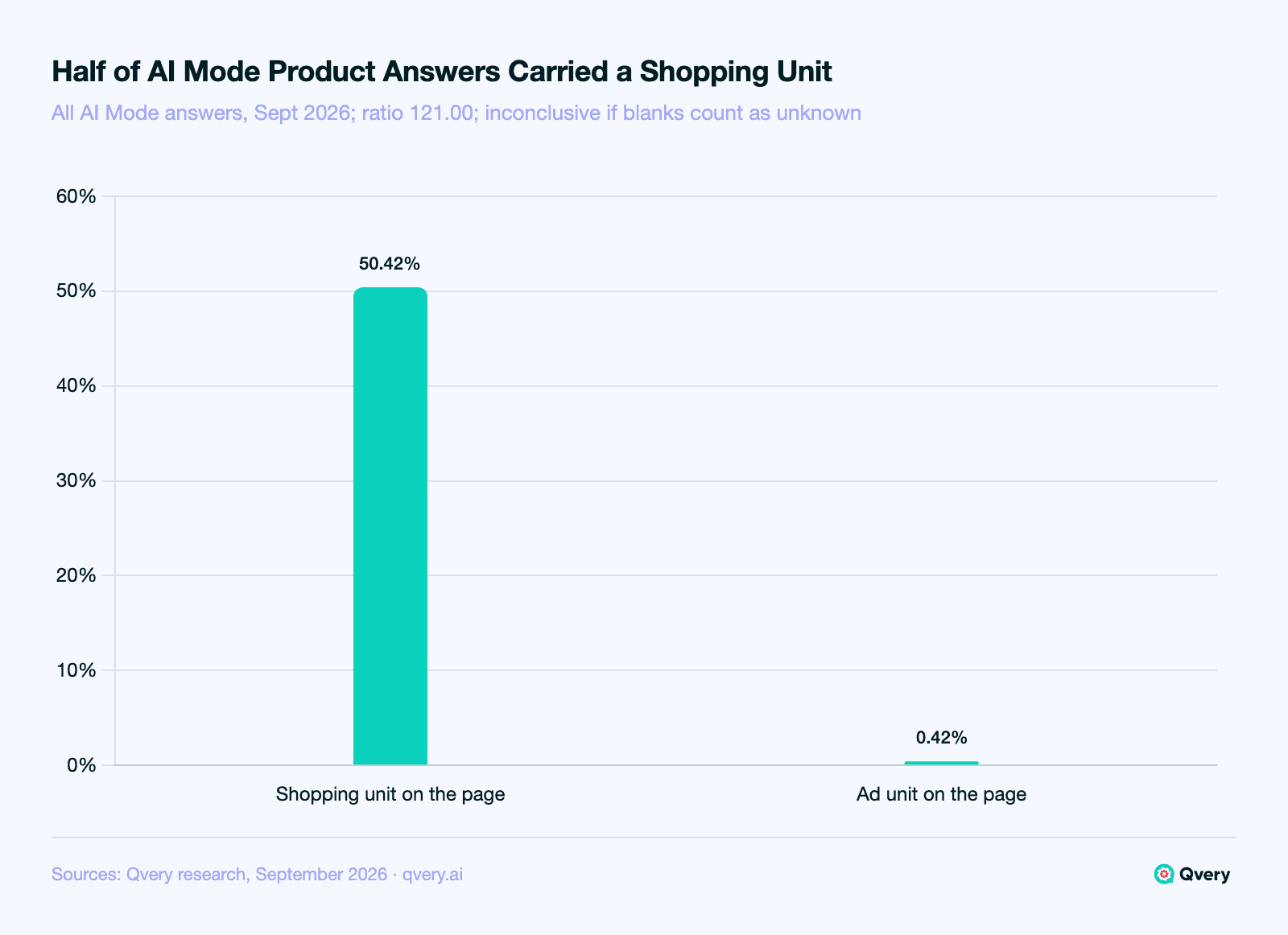
That ratio comes with one condition: the accounting rule from the last section. When an answer came back with no shopping or ad block, we logged it as having no unit.
Log those answers as unknown and the comparison can't be called either way.
That's why the record keeps both readings.
What the number does give you is a working fact: in Google AI Mode, the unit worth checking is the shopping block. A paid unit on the same answer is rare enough that ads tell you little about this surface.
Eyeful Media's version of the advice goes further: "The actual focus should stay on accurate product data, consistent brand information, and clear signals that AI systems can interpret and reuse with confidence."
That may well be true, and nothing here argues against clean product data. But the answer page records what Google AI Mode served, not what it was fed, so it can't test whether your data was an input.
For the structured-listing basics that sit on your side of the page, see why AI engines can't read many product pages. For which sources recommendation answers cite, see what AI engines cite for product recommendations.
One Added Constraint Settled Nothing, So Audit Both Shapes
The paired questions are where you'd expect a difference to show. Shopping units appeared in 56.67% of answers to the constraint-led questions and 44.17% of answers to the broad ones, each a share of all answers in that set.
The result is indeterminate. We registered a direction before collecting, and the gap landed in the band where it neither supports nor rules out that direction.
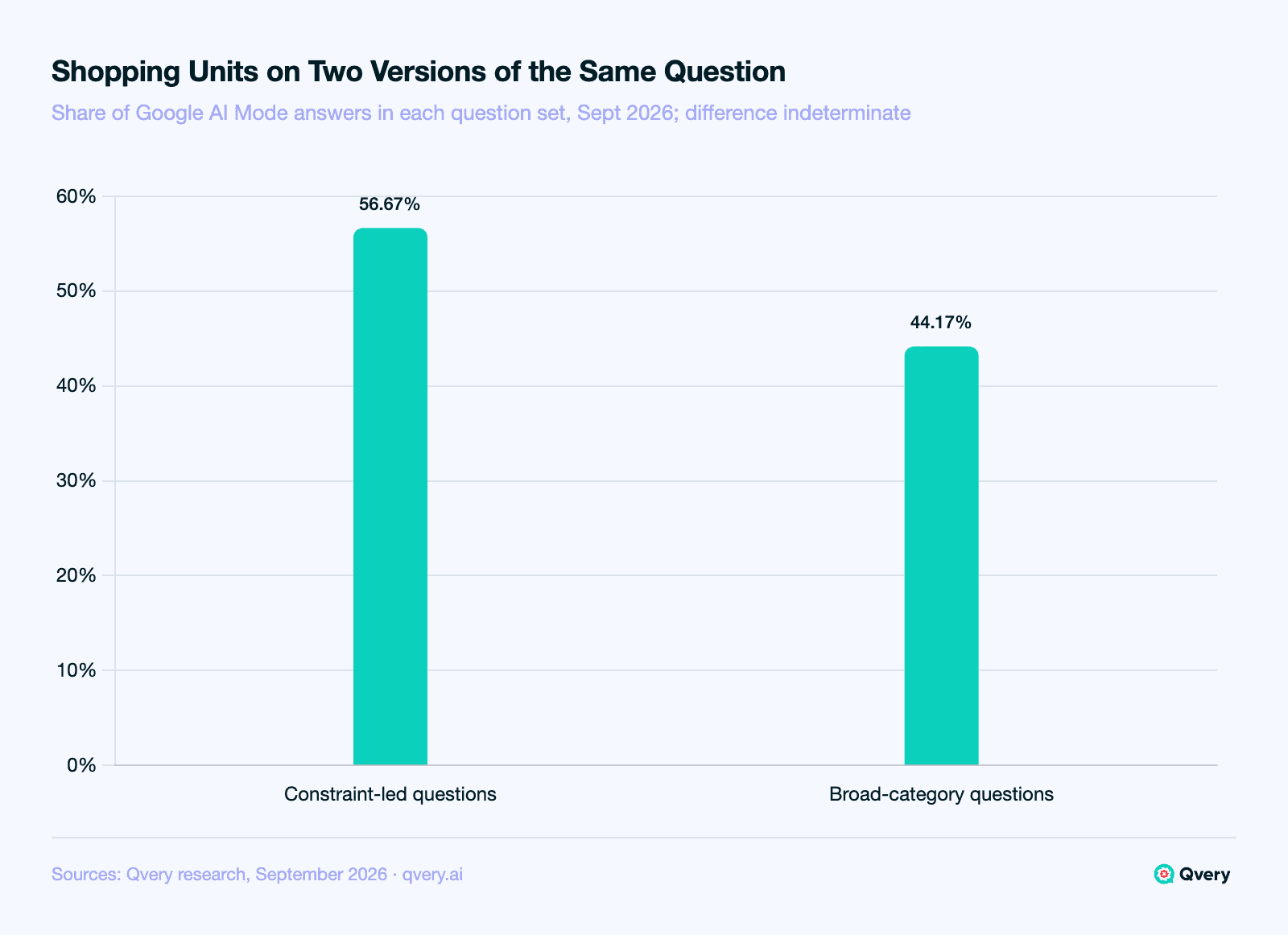
So one added constraint did not resolve the question.
It isn't a finding that constraints change what the answer page carries, and it isn't a finding that they don't.
For your audit, that means running both shapes. A broad question can't stand in for its constraint-led twin, because this data gives you no reason to assume they behave alike or differently.
Run the pair. Read each side on its own.
A second argument often travels with the feed advice.
Parcel Perform writes that AI answer engines "reward brands that make their content, data, and experience effortless to interpret and cite". A contrast inside Google AI Mode's answer page tests neither half of that: it doesn't look at which sources get cited, or at any other engine.
Two Merchants Are Not a Recommendation List
The obvious next question is which merchants show up. We set a bar before looking: a merchant counts only if a shopping unit names it explicitly, in enough separate answers, and a ranked list needs at least three merchants that clear it.
Neither set produced a list. Two merchants cleared the bar in the broad set and two in the constraint-led set, one short of a ranking.
So no merchant is named here. Two names from a thin sample would read like a recommendation the data can't make.
Use the same rule in your own audit:
Count explicit names only, from the merchant field of the shopping unit, never from a product title or a URL.
Count once per answer, however many units that merchant has in it.
Write down a failed list when too few merchants clear your bar, instead of reading names off a handful of answers.
The strongest version of the feed argument is about listings. Width.ai argues that "Because GEO is the same discipline as answer engine optimization, the work Pumice does, making each listing complete, structured, and entity-clear, is exactly what gets a product mentioned, cited, and recommended in AI answers."
This data can't adjudicate that. It records whether a shopping unit was present, and the merchant side never formed a list. Nothing here says whether listing completeness, a feed field, or any optimization gets a product or a merchant named, cited, or recommended.
Track the Paired Questions in Qvery
The shopping-block audit is your own collection work: someone on your team asks the questions in Google AI Mode and logs the two blocks. Qvery is where you track the questions themselves.
Add each pair as queries in Qvery, the broad version and its constraint-led twin. Qvery tracks them daily on ChatGPT and Google AI Mode and reports your visibility, share of voice, and average rank, in any of 200+ countries.
Every citation is tied to the query and the engine that produced it. To find which of your paired questions you're missing from, ask Qvery Assistant in plain language and it answers from your own data.
That tells you where your brand appears in the answers, not what the shopping block on those pages carried, so keep both records together. Start a free 7-day trial, no credit card required, and load your first ten pairs this week.
Where These Numbers Stop
Log blank blocks as unknown instead of empty, and both comparisons turn inconclusive.
The data cannot decide whether a feed or a feed field affects an AI answer, whether ads and shopping compete, or which merchants Google AI Mode names or recommends. It says nothing about shopping on any other engine, and ChatGPT's answers support no shopping or ad claim at all.
We extracted no naming rate and no recommendation status, and nothing here is compared with an earlier period.
Audit the Shopping Block, Leave the Feed Theory Open
Write your top product needs as broad and constraint-led pairs, ask them in Google AI Mode, and log both blocks on every answer under both readings of a blank one.
Audit the shopping units your product questions surface, and don't treat their presence as evidence that your Merchant Center feed, or a change to it, reached an AI answer.
If you run ecommerce marketing, someone has probably told you this year that your Google Merchant Center feed is now an AI search input, and that the fix is a rewrite: longer titles, benefit statements, every attribute filled. It's a reasonable guess about how Google AI Mode builds a product answer.
The trouble is that the feed sits behind the answer, where you can't see it. The only part you can check from outside is what lands on the page.
So we asked Google AI Mode the same product questions two ways in September 2026, once broad and once with a single buying constraint added, and logged which answers carried a shopping unit and which carried an ad.
Shopping units appeared in 50.42% of the answers. Ad units appeared in 0.42%. That makes the shopping block worth auditing on your own product questions. It does not show that your feed, or a change to it, reached any of those answers.
Everything here is about Google AI Mode's answer page, so none of it tells you how ChatGPT handles products.
Pair Every Product Question Before You Open Google AI Mode
The way you set the audit up decides what it can tell you, so build it before reading a single answer.
Start with the needs your products answer, then write each one twice. The broad version asks for options in a category: running shoes for beginners. The constraint-led version keeps the same category, need, and country, and adds exactly one buying condition: running shoes for beginners with wide feet.
Pick the constraint for each pair before you look at any answers. A constraint chosen after reading the results will find whatever difference you were hoping for.
Then record two things on every Google AI Mode answer:
The shopping block: whether a product unit with a title and a price or a named merchant is on the page.
The ad block: whether a paid unit with a link is on the page.
Some answers arrive with no shopping or ad block at all. You can log those as empty or as unknown, and the choice changes how firm your result is. Keep both readings in the record from day one.
Write what this audit can never settle at the top of the sheet:
Whether Google read your Merchant Center feed to build the answer.
Whether a feed change moved anything.
Which feed field, if any, matters.
Whether shopping units and ads compete for the same answer.
Anything about ChatGPT, because these blocks are recorded on Google AI Mode answers only.
Half of Google AI Mode's Product Answers Carried a Shopping Unit; Ads Almost Never Did
Across both versions of every question, shopping units appeared in 50.42% of Google AI Mode's answers and ad units in 0.42%, each a share of all Google AI Mode answers to these questions. The shopping share is 121.00 times the ad share.
That ratio comes with one condition: the accounting rule from the last section. When an answer came back with no shopping or ad block, we logged it as having no unit.
Log those answers as unknown and the comparison can't be called either way.
That's why the record keeps both readings.
What the number does give you is a working fact: in Google AI Mode, the unit worth checking is the shopping block. A paid unit on the same answer is rare enough that ads tell you little about this surface.
Eyeful Media's version of the advice goes further: "The actual focus should stay on accurate product data, consistent brand information, and clear signals that AI systems can interpret and reuse with confidence."
That may well be true, and nothing here argues against clean product data. But the answer page records what Google AI Mode served, not what it was fed, so it can't test whether your data was an input.
For the structured-listing basics that sit on your side of the page, see why AI engines can't read many product pages. For which sources recommendation answers cite, see what AI engines cite for product recommendations.
One Added Constraint Settled Nothing, So Audit Both Shapes
The paired questions are where you'd expect a difference to show. Shopping units appeared in 56.67% of answers to the constraint-led questions and 44.17% of answers to the broad ones, each a share of all answers in that set.
The result is indeterminate. We registered a direction before collecting, and the gap landed in the band where it neither supports nor rules out that direction.
So one added constraint did not resolve the question.
It isn't a finding that constraints change what the answer page carries, and it isn't a finding that they don't.
For your audit, that means running both shapes. A broad question can't stand in for its constraint-led twin, because this data gives you no reason to assume they behave alike or differently.
Run the pair. Read each side on its own.
A second argument often travels with the feed advice.
Parcel Perform writes that AI answer engines "reward brands that make their content, data, and experience effortless to interpret and cite". A contrast inside Google AI Mode's answer page tests neither half of that: it doesn't look at which sources get cited, or at any other engine.
Two Merchants Are Not a Recommendation List
The obvious next question is which merchants show up. We set a bar before looking: a merchant counts only if a shopping unit names it explicitly, in enough separate answers, and a ranked list needs at least three merchants that clear it.
Neither set produced a list. Two merchants cleared the bar in the broad set and two in the constraint-led set, one short of a ranking.
So no merchant is named here. Two names from a thin sample would read like a recommendation the data can't make.
Use the same rule in your own audit:
Count explicit names only, from the merchant field of the shopping unit, never from a product title or a URL.
Count once per answer, however many units that merchant has in it.
Write down a failed list when too few merchants clear your bar, instead of reading names off a handful of answers.
The strongest version of the feed argument is about listings. Width.ai argues that "Because GEO is the same discipline as answer engine optimization, the work Pumice does, making each listing complete, structured, and entity-clear, is exactly what gets a product mentioned, cited, and recommended in AI answers."
This data can't adjudicate that. It records whether a shopping unit was present, and the merchant side never formed a list. Nothing here says whether listing completeness, a feed field, or any optimization gets a product or a merchant named, cited, or recommended.
Track the Paired Questions in Qvery
The shopping-block audit is your own collection work: someone on your team asks the questions in Google AI Mode and logs the two blocks. Qvery is where you track the questions themselves.
Add each pair as queries in Qvery, the broad version and its constraint-led twin. Qvery tracks them daily on ChatGPT and Google AI Mode and reports your visibility, share of voice, and average rank, in any of 200+ countries.
Every citation is tied to the query and the engine that produced it. To find which of your paired questions you're missing from, ask Qvery Assistant in plain language and it answers from your own data.
That tells you where your brand appears in the answers, not what the shopping block on those pages carried, so keep both records together. Start a free 7-day trial, no credit card required, and load your first ten pairs this week.
Where These Numbers Stop
Log blank blocks as unknown instead of empty, and both comparisons turn inconclusive.
The data cannot decide whether a feed or a feed field affects an AI answer, whether ads and shopping compete, or which merchants Google AI Mode names or recommends. It says nothing about shopping on any other engine, and ChatGPT's answers support no shopping or ad claim at all.
We extracted no naming rate and no recommendation status, and nothing here is compared with an earlier period.
Audit the Shopping Block, Leave the Feed Theory Open
Write your top product needs as broad and constraint-led pairs, ask them in Google AI Mode, and log both blocks on every answer under both readings of a blank one.
Audit the shopping units your product questions surface, and don't treat their presence as evidence that your Merchant Center feed, or a change to it, reached an AI answer.
If you run ecommerce marketing, someone has probably told you this year that your Google Merchant Center feed is now an AI search input, and that the fix is a rewrite: longer titles, benefit statements, every attribute filled. It's a reasonable guess about how Google AI Mode builds a product answer.
The trouble is that the feed sits behind the answer, where you can't see it. The only part you can check from outside is what lands on the page.
So we asked Google AI Mode the same product questions two ways in September 2026, once broad and once with a single buying constraint added, and logged which answers carried a shopping unit and which carried an ad.
Shopping units appeared in 50.42% of the answers. Ad units appeared in 0.42%. That makes the shopping block worth auditing on your own product questions. It does not show that your feed, or a change to it, reached any of those answers.
Everything here is about Google AI Mode's answer page, so none of it tells you how ChatGPT handles products.
Pair Every Product Question Before You Open Google AI Mode
The way you set the audit up decides what it can tell you, so build it before reading a single answer.
Start with the needs your products answer, then write each one twice. The broad version asks for options in a category: running shoes for beginners. The constraint-led version keeps the same category, need, and country, and adds exactly one buying condition: running shoes for beginners with wide feet.
Pick the constraint for each pair before you look at any answers. A constraint chosen after reading the results will find whatever difference you were hoping for.
Then record two things on every Google AI Mode answer:
The shopping block: whether a product unit with a title and a price or a named merchant is on the page.
The ad block: whether a paid unit with a link is on the page.
Some answers arrive with no shopping or ad block at all. You can log those as empty or as unknown, and the choice changes how firm your result is. Keep both readings in the record from day one.
Write what this audit can never settle at the top of the sheet:
Whether Google read your Merchant Center feed to build the answer.
Whether a feed change moved anything.
Which feed field, if any, matters.
Whether shopping units and ads compete for the same answer.
Anything about ChatGPT, because these blocks are recorded on Google AI Mode answers only.
Half of Google AI Mode's Product Answers Carried a Shopping Unit; Ads Almost Never Did
Across both versions of every question, shopping units appeared in 50.42% of Google AI Mode's answers and ad units in 0.42%, each a share of all Google AI Mode answers to these questions. The shopping share is 121.00 times the ad share.
That ratio comes with one condition: the accounting rule from the last section. When an answer came back with no shopping or ad block, we logged it as having no unit.
Log those answers as unknown and the comparison can't be called either way.
That's why the record keeps both readings.
What the number does give you is a working fact: in Google AI Mode, the unit worth checking is the shopping block. A paid unit on the same answer is rare enough that ads tell you little about this surface.
Eyeful Media's version of the advice goes further: "The actual focus should stay on accurate product data, consistent brand information, and clear signals that AI systems can interpret and reuse with confidence."
That may well be true, and nothing here argues against clean product data. But the answer page records what Google AI Mode served, not what it was fed, so it can't test whether your data was an input.
For the structured-listing basics that sit on your side of the page, see why AI engines can't read many product pages. For which sources recommendation answers cite, see what AI engines cite for product recommendations.
One Added Constraint Settled Nothing, So Audit Both Shapes
The paired questions are where you'd expect a difference to show. Shopping units appeared in 56.67% of answers to the constraint-led questions and 44.17% of answers to the broad ones, each a share of all answers in that set.
The result is indeterminate. We registered a direction before collecting, and the gap landed in the band where it neither supports nor rules out that direction.
So one added constraint did not resolve the question.
It isn't a finding that constraints change what the answer page carries, and it isn't a finding that they don't.
For your audit, that means running both shapes. A broad question can't stand in for its constraint-led twin, because this data gives you no reason to assume they behave alike or differently.
Run the pair. Read each side on its own.
A second argument often travels with the feed advice.
Parcel Perform writes that AI answer engines "reward brands that make their content, data, and experience effortless to interpret and cite". A contrast inside Google AI Mode's answer page tests neither half of that: it doesn't look at which sources get cited, or at any other engine.
Two Merchants Are Not a Recommendation List
The obvious next question is which merchants show up. We set a bar before looking: a merchant counts only if a shopping unit names it explicitly, in enough separate answers, and a ranked list needs at least three merchants that clear it.
Neither set produced a list. Two merchants cleared the bar in the broad set and two in the constraint-led set, one short of a ranking.
So no merchant is named here. Two names from a thin sample would read like a recommendation the data can't make.
Use the same rule in your own audit:
Count explicit names only, from the merchant field of the shopping unit, never from a product title or a URL.
Count once per answer, however many units that merchant has in it.
Write down a failed list when too few merchants clear your bar, instead of reading names off a handful of answers.
The strongest version of the feed argument is about listings. Width.ai argues that "Because GEO is the same discipline as answer engine optimization, the work Pumice does, making each listing complete, structured, and entity-clear, is exactly what gets a product mentioned, cited, and recommended in AI answers."
This data can't adjudicate that. It records whether a shopping unit was present, and the merchant side never formed a list. Nothing here says whether listing completeness, a feed field, or any optimization gets a product or a merchant named, cited, or recommended.
Track the Paired Questions in Qvery
The shopping-block audit is your own collection work: someone on your team asks the questions in Google AI Mode and logs the two blocks. Qvery is where you track the questions themselves.
Add each pair as queries in Qvery, the broad version and its constraint-led twin. Qvery tracks them daily on ChatGPT and Google AI Mode and reports your visibility, share of voice, and average rank, in any of 200+ countries.
Every citation is tied to the query and the engine that produced it. To find which of your paired questions you're missing from, ask Qvery Assistant in plain language and it answers from your own data.
That tells you where your brand appears in the answers, not what the shopping block on those pages carried, so keep both records together. Start a free 7-day trial, no credit card required, and load your first ten pairs this week.
Where These Numbers Stop
Log blank blocks as unknown instead of empty, and both comparisons turn inconclusive.
The data cannot decide whether a feed or a feed field affects an AI answer, whether ads and shopping compete, or which merchants Google AI Mode names or recommends. It says nothing about shopping on any other engine, and ChatGPT's answers support no shopping or ad claim at all.
We extracted no naming rate and no recommendation status, and nothing here is compared with an earlier period.
Audit the Shopping Block, Leave the Feed Theory Open
Write your top product needs as broad and constraint-led pairs, ask them in Google AI Mode, and log both blocks on every answer under both readings of a blank one.
Audit the shopping units your product questions surface, and don't treat their presence as evidence that your Merchant Center feed, or a change to it, reached an AI answer.
If you run ecommerce marketing, someone has probably told you this year that your Google Merchant Center feed is now an AI search input, and that the fix is a rewrite: longer titles, benefit statements, every attribute filled. It's a reasonable guess about how Google AI Mode builds a product answer.
The trouble is that the feed sits behind the answer, where you can't see it. The only part you can check from outside is what lands on the page.
So we asked Google AI Mode the same product questions two ways in September 2026, once broad and once with a single buying constraint added, and logged which answers carried a shopping unit and which carried an ad.
Shopping units appeared in 50.42% of the answers. Ad units appeared in 0.42%. That makes the shopping block worth auditing on your own product questions. It does not show that your feed, or a change to it, reached any of those answers.
Everything here is about Google AI Mode's answer page, so none of it tells you how ChatGPT handles products.
Pair Every Product Question Before You Open Google AI Mode
The way you set the audit up decides what it can tell you, so build it before reading a single answer.
Start with the needs your products answer, then write each one twice. The broad version asks for options in a category: running shoes for beginners. The constraint-led version keeps the same category, need, and country, and adds exactly one buying condition: running shoes for beginners with wide feet.
Pick the constraint for each pair before you look at any answers. A constraint chosen after reading the results will find whatever difference you were hoping for.
Then record two things on every Google AI Mode answer:
The shopping block: whether a product unit with a title and a price or a named merchant is on the page.
The ad block: whether a paid unit with a link is on the page.
Some answers arrive with no shopping or ad block at all. You can log those as empty or as unknown, and the choice changes how firm your result is. Keep both readings in the record from day one.
Write what this audit can never settle at the top of the sheet:
Whether Google read your Merchant Center feed to build the answer.
Whether a feed change moved anything.
Which feed field, if any, matters.
Whether shopping units and ads compete for the same answer.
Anything about ChatGPT, because these blocks are recorded on Google AI Mode answers only.
Half of Google AI Mode's Product Answers Carried a Shopping Unit; Ads Almost Never Did
Across both versions of every question, shopping units appeared in 50.42% of Google AI Mode's answers and ad units in 0.42%, each a share of all Google AI Mode answers to these questions. The shopping share is 121.00 times the ad share.
That ratio comes with one condition: the accounting rule from the last section. When an answer came back with no shopping or ad block, we logged it as having no unit.
Log those answers as unknown and the comparison can't be called either way.
That's why the record keeps both readings.
What the number does give you is a working fact: in Google AI Mode, the unit worth checking is the shopping block. A paid unit on the same answer is rare enough that ads tell you little about this surface.
Eyeful Media's version of the advice goes further: "The actual focus should stay on accurate product data, consistent brand information, and clear signals that AI systems can interpret and reuse with confidence."
That may well be true, and nothing here argues against clean product data. But the answer page records what Google AI Mode served, not what it was fed, so it can't test whether your data was an input.
For the structured-listing basics that sit on your side of the page, see why AI engines can't read many product pages. For which sources recommendation answers cite, see what AI engines cite for product recommendations.
One Added Constraint Settled Nothing, So Audit Both Shapes
The paired questions are where you'd expect a difference to show. Shopping units appeared in 56.67% of answers to the constraint-led questions and 44.17% of answers to the broad ones, each a share of all answers in that set.
The result is indeterminate. We registered a direction before collecting, and the gap landed in the band where it neither supports nor rules out that direction.
So one added constraint did not resolve the question.
It isn't a finding that constraints change what the answer page carries, and it isn't a finding that they don't.
For your audit, that means running both shapes. A broad question can't stand in for its constraint-led twin, because this data gives you no reason to assume they behave alike or differently.
Run the pair. Read each side on its own.
A second argument often travels with the feed advice.
Parcel Perform writes that AI answer engines "reward brands that make their content, data, and experience effortless to interpret and cite". A contrast inside Google AI Mode's answer page tests neither half of that: it doesn't look at which sources get cited, or at any other engine.
Two Merchants Are Not a Recommendation List
The obvious next question is which merchants show up. We set a bar before looking: a merchant counts only if a shopping unit names it explicitly, in enough separate answers, and a ranked list needs at least three merchants that clear it.
Neither set produced a list. Two merchants cleared the bar in the broad set and two in the constraint-led set, one short of a ranking.
So no merchant is named here. Two names from a thin sample would read like a recommendation the data can't make.
Use the same rule in your own audit:
Count explicit names only, from the merchant field of the shopping unit, never from a product title or a URL.
Count once per answer, however many units that merchant has in it.
Write down a failed list when too few merchants clear your bar, instead of reading names off a handful of answers.
The strongest version of the feed argument is about listings. Width.ai argues that "Because GEO is the same discipline as answer engine optimization, the work Pumice does, making each listing complete, structured, and entity-clear, is exactly what gets a product mentioned, cited, and recommended in AI answers."
This data can't adjudicate that. It records whether a shopping unit was present, and the merchant side never formed a list. Nothing here says whether listing completeness, a feed field, or any optimization gets a product or a merchant named, cited, or recommended.
Track the Paired Questions in Qvery
The shopping-block audit is your own collection work: someone on your team asks the questions in Google AI Mode and logs the two blocks. Qvery is where you track the questions themselves.
Add each pair as queries in Qvery, the broad version and its constraint-led twin. Qvery tracks them daily on ChatGPT and Google AI Mode and reports your visibility, share of voice, and average rank, in any of 200+ countries.
Every citation is tied to the query and the engine that produced it. To find which of your paired questions you're missing from, ask Qvery Assistant in plain language and it answers from your own data.
That tells you where your brand appears in the answers, not what the shopping block on those pages carried, so keep both records together. Start a free 7-day trial, no credit card required, and load your first ten pairs this week.
Where These Numbers Stop
Log blank blocks as unknown instead of empty, and both comparisons turn inconclusive.
The data cannot decide whether a feed or a feed field affects an AI answer, whether ads and shopping compete, or which merchants Google AI Mode names or recommends. It says nothing about shopping on any other engine, and ChatGPT's answers support no shopping or ad claim at all.
We extracted no naming rate and no recommendation status, and nothing here is compared with an earlier period.
Audit the Shopping Block, Leave the Feed Theory Open
Write your top product needs as broad and constraint-led pairs, ask them in Google AI Mode, and log both blocks on every answer under both readings of a blank one.
Audit the shopping units your product questions surface, and don't treat their presence as evidence that your Merchant Center feed, or a change to it, reached an AI answer.

© 2026 Qvery AI OÜ