By
Vlad Shvets
Institutional or Retail Buyers: Does Your Crypto Company's Site Play the Same Role in AI Answers?
Brand-owned domains were cited in 92.50% of AI answers to institutional crypto buying questions and 87.00% of retail ones. The owned rate matches; the domain audit lists don't.
Brand-owned domains were cited in 92.50% of AI answers to institutional crypto buying questions and 87.00% of retail ones. The owned rate matches; the domain audit lists don't.
Brand-owned domains were cited in 92.50% of AI answers to institutional crypto buying questions and 87.00% of retail ones. The owned rate matches; the domain audit lists don't.
If you sell crypto services to businesses and to consumers, you've probably heard that AI answers in crypto lean on companies' own pages. That's the starting point of our crypto brand AI visibility guide and of getting ChatGPT to recommend your crypto brand.
The open question is whether that holds on both sides of your market. A treasury team buying in bulk and a first-time buyer picking a wallet ask very different questions, and it's easy to assume the institutional side is a different citation world.
So we asked ChatGPT and Google AI Mode institutional and business buying questions, and retail and consumer ones, in September 2026, and recorded which domains each answer cited.
Brand-owned domains appeared in 92.50% of institutional and business answers and 87.00% of retail and consumer answers, a difference we registered as equivalent. Had the rates split, the audit would weight one side over the other; they didn't.
What differs is the set of domains behind those answers. The two audit lists don't transfer, so you keep one owned-site posture and run two domain lists. This measures cited domains, not which companies were named or recommended.
Your Own Site Turns Up Just as Often for Institutional and Retail Buyers
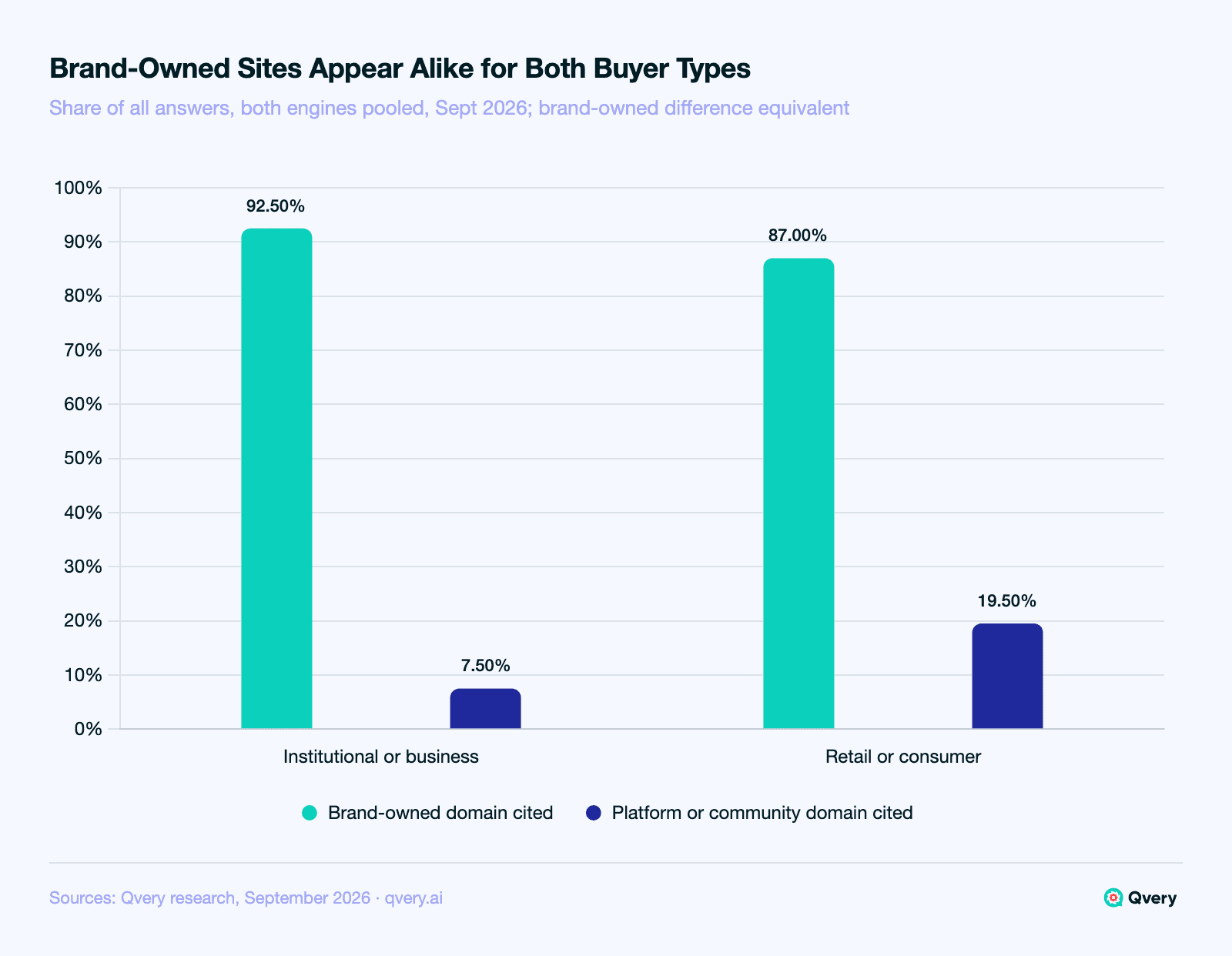
Across both engines, at least one brand-owned domain appeared in 92.50% of answers to institutional and business buying questions and 87.00% of answers to retail and consumer ones, each a share of all answers of that kind.
The two sides are answered alike on this measure. For your audit, owned pages stay in scope for both audiences; the institutional side isn't a separate world where your own site drops out.
The chart's second line is platform and community domains: 7.50% of institutional answers and 19.50% of retail answers. It's descriptive only. We registered no test on it, so it isn't set against the owned rate.
This measures whether at least one brand-owned domain was cited. It doesn't show that the same domains appear on both sides, that any particular crypto company's site was cited, or that owned pages matter more than third-party coverage.
One LinkedIn post frames the advice as: "Ensure your brand's content is crawlable & visible on the public web (blogs, news, social posts)." This data shows owned domains present on both sides. It doesn't test whether crawlability explains that.
ChatGPT Alone Shows the Same Pattern
Pooling two engines can hide an engine that behaves differently, so we checked ChatGPT on its own. A brand-owned domain appeared in 97.50% of ChatGPT's institutional answers and 92.50% of its retail answers, again equivalent.
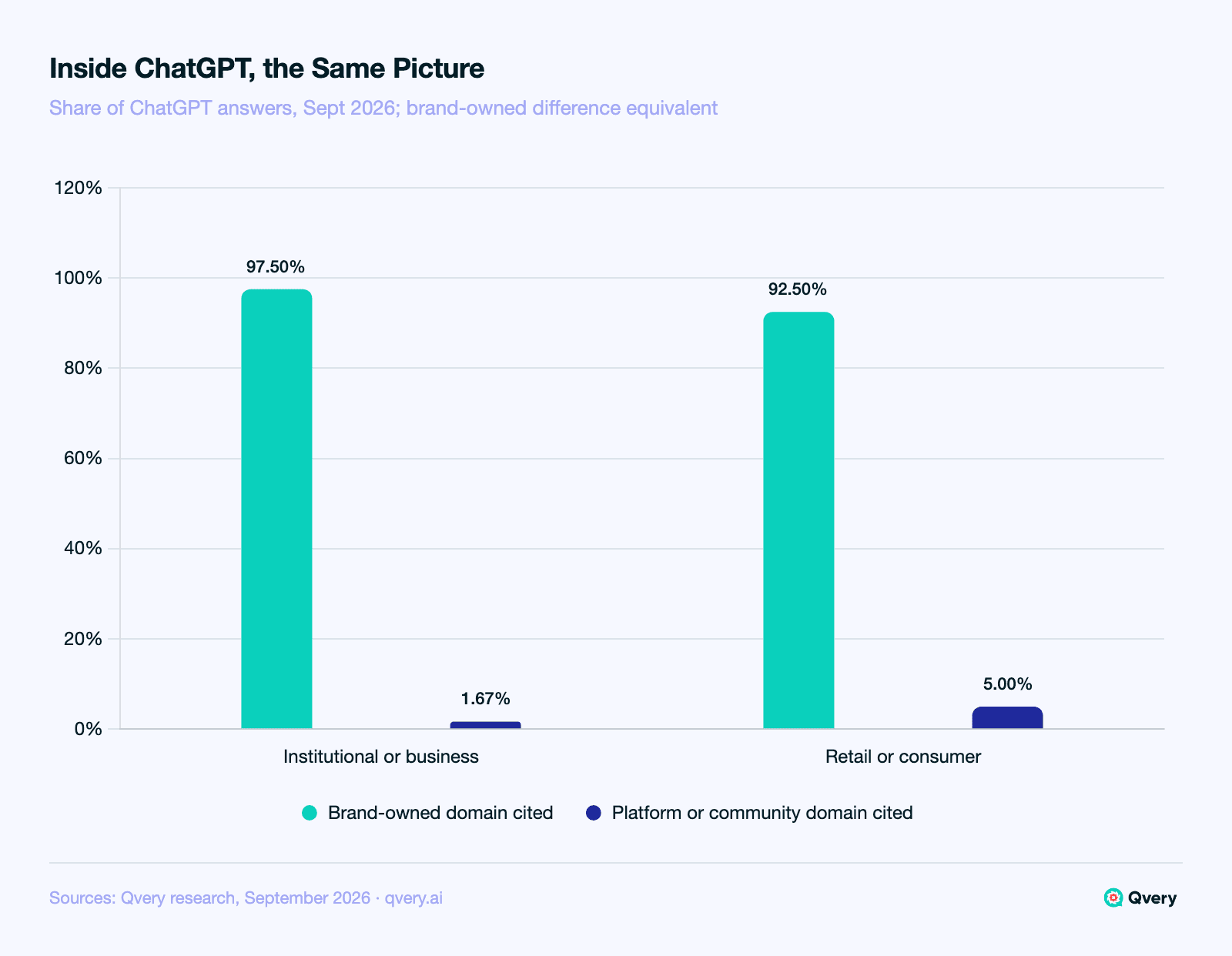
Platform and community domains appeared in 1.67% and 5.00% of those ChatGPT answers, descriptive only.
This is a check inside ChatGPT, not a comparison between engines. Google AI Mode answered too few questions in each set to carry a percentage of its own, so none is printed.
The Domains Behind Those Answers Split Into Two Audit Lists
Equal owned rates don't mean the same domains. For each side, we took the smallest set of domains that together appeared in 80% of the answers that cited any source, then checked how much of the other side each list covers.
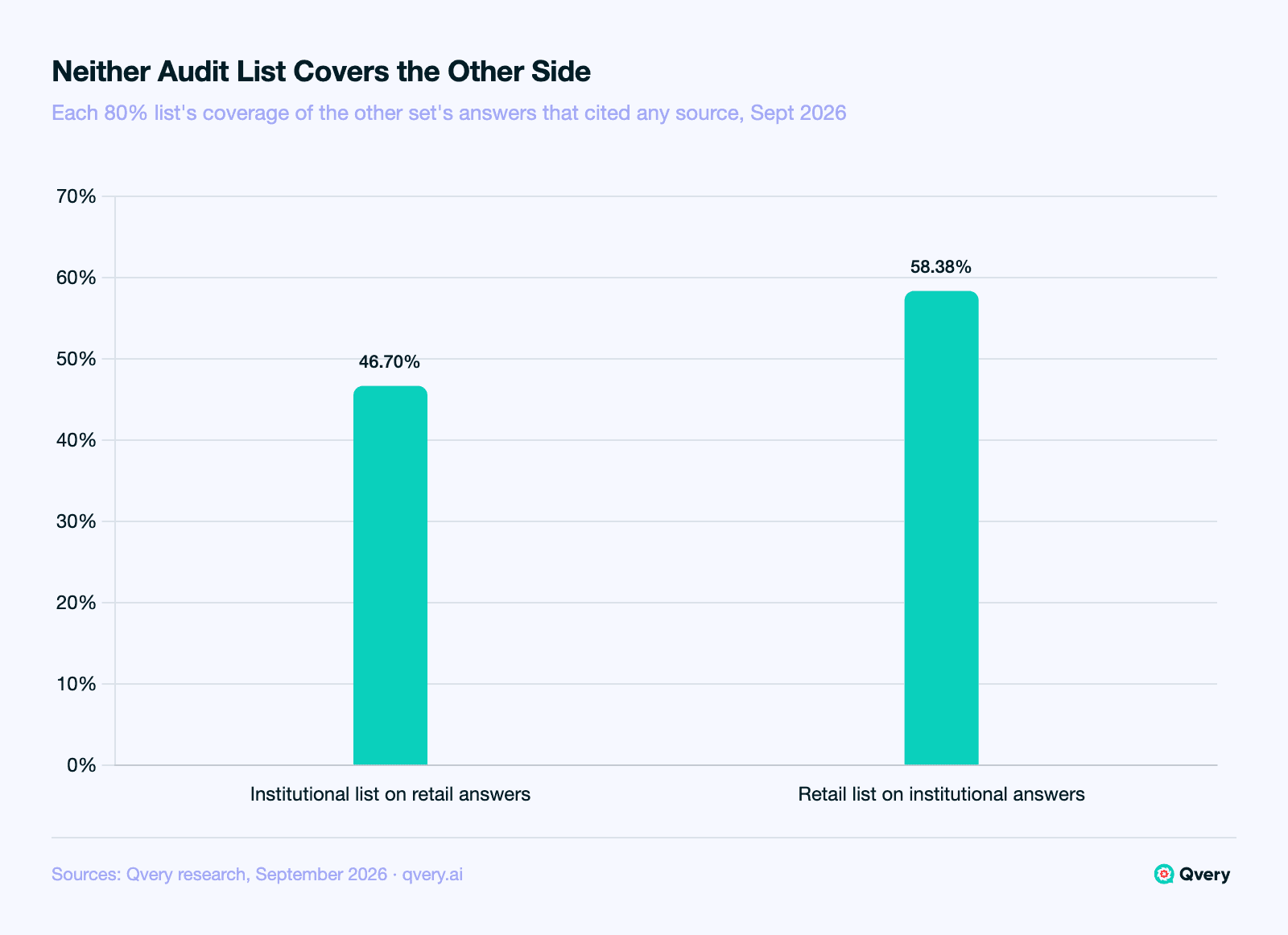
The institutional list covered 46.70% of the retail answers that cited any source. The retail list covered 58.38% of the institutional answers that cited any source. Both fall below the line where one list could serve both sides, so each side needs its own list.
Here are the two lists, 20 domains each:
Institutional and business: coinbase.com, eco.com, bitcoinfoundation.org, chainalysis.com, fireblocks.com, cointracker.io, kraken.com, sumsub.com, amberdata.io, deel.com, zodia-custody.com, cryptoworth.com, securities-administrators.ca, spark.money, fidelitydigitalassets.com, koinly.io, oobit.com, ajg.com, alchemy.com, and au.marsh.com.
Retail and consumer: help.coinbase.com, bitcoinfoundation.org, coinbureau.com, reddit.com, trezor.io, spark.money, zerion.io, coinbase.com, google.com, gov.uk, investopedia.com, chainabuse.com, coinspot.com.au, jobbers.io, wise.com, bitwave.io, circle.com, eco.com, fca.org.uk, and finance.yahoo.com.
Four domains sit on both: bitcoinfoundation.org, coinbase.com, eco.com, and spark.money. That overlap is description only; the two-list call comes from the coverage figures, not from counting shared names.
reddit.com sits on the retail list and not the institutional one. If community threads are part of your retail plan, UGC marketing for crypto brands covers that side.
Build your audit list from retail questions alone and a large share of institutional answers cite nothing on it. The reverse holds too.
Cointelligence argues that AI search "prioritizes providing the most relevant and helpful answer to their query, based on their likely intent and the context of their search." The separate lists fit that. The equal owned rates are a reminder that the two contexts don't differ on everything we measured.
One ChatGPT answer we collected put the institutional case directly: for a business buying crypto in bulk, the best platform "usually means an institutional OTC desk or prime brokerage."
The separate lists are consistent with that. They don't evaluate which provider suits which buyer, and they don't show that the cited domains belong to institutional or retail providers.
Run Both Audit Lists in Qvery
Add your institutional and business buying questions to Qvery as one set of queries and your retail and consumer questions as another. Qvery tracks them daily on ChatGPT and Google AI Mode, in any of 200+ countries, and reports your visibility, share of voice, and average rank.
Every citation is tied to the query and the engine that produced it, so you can see which domains each set of questions cites, and whether yours is among them. To check one side quickly, ask Qvery Assistant which domains your institutional questions cited this week.
That shows which domains are cited, not what any of it returns. Start a free 7-day trial, no credit card required, and set up both question sets today.
What These Numbers Don't Cover
This measures cited domains in one September 2026 set of crypto buying questions. Google AI Mode answered too few questions in each set for a per-set percentage, so none is published for it.
Equal owned rates don't mean the two sides cite the same domains; the audit lists point the other way. Nothing here says a particular crypto company's site is or isn't an important citation surface.
Nothing measures naming, recommendation, provider suitability, spend, conversion, or return, and nothing explains why any domain was cited. The pooled rates count every answer once, and ChatGPT answered more of the questions than Google AI Mode, so they lean toward ChatGPT. Nothing is compared with an earlier collection.
Two Lists, One Owned-Site Posture
Keep your own pages in the audit for both audiences, and run two separate domain lists: one built from institutional and business buying questions, one from retail and consumer ones. Re-check both on your own questions, in both engines.
If you sell crypto services to businesses and to consumers, you've probably heard that AI answers in crypto lean on companies' own pages. That's the starting point of our crypto brand AI visibility guide and of getting ChatGPT to recommend your crypto brand.
The open question is whether that holds on both sides of your market. A treasury team buying in bulk and a first-time buyer picking a wallet ask very different questions, and it's easy to assume the institutional side is a different citation world.
So we asked ChatGPT and Google AI Mode institutional and business buying questions, and retail and consumer ones, in September 2026, and recorded which domains each answer cited.
Brand-owned domains appeared in 92.50% of institutional and business answers and 87.00% of retail and consumer answers, a difference we registered as equivalent. Had the rates split, the audit would weight one side over the other; they didn't.
What differs is the set of domains behind those answers. The two audit lists don't transfer, so you keep one owned-site posture and run two domain lists. This measures cited domains, not which companies were named or recommended.
Your Own Site Turns Up Just as Often for Institutional and Retail Buyers
Across both engines, at least one brand-owned domain appeared in 92.50% of answers to institutional and business buying questions and 87.00% of answers to retail and consumer ones, each a share of all answers of that kind.
The two sides are answered alike on this measure. For your audit, owned pages stay in scope for both audiences; the institutional side isn't a separate world where your own site drops out.
The chart's second line is platform and community domains: 7.50% of institutional answers and 19.50% of retail answers. It's descriptive only. We registered no test on it, so it isn't set against the owned rate.
This measures whether at least one brand-owned domain was cited. It doesn't show that the same domains appear on both sides, that any particular crypto company's site was cited, or that owned pages matter more than third-party coverage.
One LinkedIn post frames the advice as: "Ensure your brand's content is crawlable & visible on the public web (blogs, news, social posts)." This data shows owned domains present on both sides. It doesn't test whether crawlability explains that.
ChatGPT Alone Shows the Same Pattern
Pooling two engines can hide an engine that behaves differently, so we checked ChatGPT on its own. A brand-owned domain appeared in 97.50% of ChatGPT's institutional answers and 92.50% of its retail answers, again equivalent.
Platform and community domains appeared in 1.67% and 5.00% of those ChatGPT answers, descriptive only.
This is a check inside ChatGPT, not a comparison between engines. Google AI Mode answered too few questions in each set to carry a percentage of its own, so none is printed.
The Domains Behind Those Answers Split Into Two Audit Lists
Equal owned rates don't mean the same domains. For each side, we took the smallest set of domains that together appeared in 80% of the answers that cited any source, then checked how much of the other side each list covers.
The institutional list covered 46.70% of the retail answers that cited any source. The retail list covered 58.38% of the institutional answers that cited any source. Both fall below the line where one list could serve both sides, so each side needs its own list.
Here are the two lists, 20 domains each:
Institutional and business: coinbase.com, eco.com, bitcoinfoundation.org, chainalysis.com, fireblocks.com, cointracker.io, kraken.com, sumsub.com, amberdata.io, deel.com, zodia-custody.com, cryptoworth.com, securities-administrators.ca, spark.money, fidelitydigitalassets.com, koinly.io, oobit.com, ajg.com, alchemy.com, and au.marsh.com.
Retail and consumer: help.coinbase.com, bitcoinfoundation.org, coinbureau.com, reddit.com, trezor.io, spark.money, zerion.io, coinbase.com, google.com, gov.uk, investopedia.com, chainabuse.com, coinspot.com.au, jobbers.io, wise.com, bitwave.io, circle.com, eco.com, fca.org.uk, and finance.yahoo.com.
Four domains sit on both: bitcoinfoundation.org, coinbase.com, eco.com, and spark.money. That overlap is description only; the two-list call comes from the coverage figures, not from counting shared names.
reddit.com sits on the retail list and not the institutional one. If community threads are part of your retail plan, UGC marketing for crypto brands covers that side.
Build your audit list from retail questions alone and a large share of institutional answers cite nothing on it. The reverse holds too.
Cointelligence argues that AI search "prioritizes providing the most relevant and helpful answer to their query, based on their likely intent and the context of their search." The separate lists fit that. The equal owned rates are a reminder that the two contexts don't differ on everything we measured.
One ChatGPT answer we collected put the institutional case directly: for a business buying crypto in bulk, the best platform "usually means an institutional OTC desk or prime brokerage."
The separate lists are consistent with that. They don't evaluate which provider suits which buyer, and they don't show that the cited domains belong to institutional or retail providers.
Run Both Audit Lists in Qvery
Add your institutional and business buying questions to Qvery as one set of queries and your retail and consumer questions as another. Qvery tracks them daily on ChatGPT and Google AI Mode, in any of 200+ countries, and reports your visibility, share of voice, and average rank.
Every citation is tied to the query and the engine that produced it, so you can see which domains each set of questions cites, and whether yours is among them. To check one side quickly, ask Qvery Assistant which domains your institutional questions cited this week.
That shows which domains are cited, not what any of it returns. Start a free 7-day trial, no credit card required, and set up both question sets today.
What These Numbers Don't Cover
This measures cited domains in one September 2026 set of crypto buying questions. Google AI Mode answered too few questions in each set for a per-set percentage, so none is published for it.
Equal owned rates don't mean the two sides cite the same domains; the audit lists point the other way. Nothing here says a particular crypto company's site is or isn't an important citation surface.
Nothing measures naming, recommendation, provider suitability, spend, conversion, or return, and nothing explains why any domain was cited. The pooled rates count every answer once, and ChatGPT answered more of the questions than Google AI Mode, so they lean toward ChatGPT. Nothing is compared with an earlier collection.
Two Lists, One Owned-Site Posture
Keep your own pages in the audit for both audiences, and run two separate domain lists: one built from institutional and business buying questions, one from retail and consumer ones. Re-check both on your own questions, in both engines.
If you sell crypto services to businesses and to consumers, you've probably heard that AI answers in crypto lean on companies' own pages. That's the starting point of our crypto brand AI visibility guide and of getting ChatGPT to recommend your crypto brand.
The open question is whether that holds on both sides of your market. A treasury team buying in bulk and a first-time buyer picking a wallet ask very different questions, and it's easy to assume the institutional side is a different citation world.
So we asked ChatGPT and Google AI Mode institutional and business buying questions, and retail and consumer ones, in September 2026, and recorded which domains each answer cited.
Brand-owned domains appeared in 92.50% of institutional and business answers and 87.00% of retail and consumer answers, a difference we registered as equivalent. Had the rates split, the audit would weight one side over the other; they didn't.
What differs is the set of domains behind those answers. The two audit lists don't transfer, so you keep one owned-site posture and run two domain lists. This measures cited domains, not which companies were named or recommended.
Your Own Site Turns Up Just as Often for Institutional and Retail Buyers
Across both engines, at least one brand-owned domain appeared in 92.50% of answers to institutional and business buying questions and 87.00% of answers to retail and consumer ones, each a share of all answers of that kind.
The two sides are answered alike on this measure. For your audit, owned pages stay in scope for both audiences; the institutional side isn't a separate world where your own site drops out.
The chart's second line is platform and community domains: 7.50% of institutional answers and 19.50% of retail answers. It's descriptive only. We registered no test on it, so it isn't set against the owned rate.
This measures whether at least one brand-owned domain was cited. It doesn't show that the same domains appear on both sides, that any particular crypto company's site was cited, or that owned pages matter more than third-party coverage.
One LinkedIn post frames the advice as: "Ensure your brand's content is crawlable & visible on the public web (blogs, news, social posts)." This data shows owned domains present on both sides. It doesn't test whether crawlability explains that.
ChatGPT Alone Shows the Same Pattern
Pooling two engines can hide an engine that behaves differently, so we checked ChatGPT on its own. A brand-owned domain appeared in 97.50% of ChatGPT's institutional answers and 92.50% of its retail answers, again equivalent.
Platform and community domains appeared in 1.67% and 5.00% of those ChatGPT answers, descriptive only.
This is a check inside ChatGPT, not a comparison between engines. Google AI Mode answered too few questions in each set to carry a percentage of its own, so none is printed.
The Domains Behind Those Answers Split Into Two Audit Lists
Equal owned rates don't mean the same domains. For each side, we took the smallest set of domains that together appeared in 80% of the answers that cited any source, then checked how much of the other side each list covers.
The institutional list covered 46.70% of the retail answers that cited any source. The retail list covered 58.38% of the institutional answers that cited any source. Both fall below the line where one list could serve both sides, so each side needs its own list.
Here are the two lists, 20 domains each:
Institutional and business: coinbase.com, eco.com, bitcoinfoundation.org, chainalysis.com, fireblocks.com, cointracker.io, kraken.com, sumsub.com, amberdata.io, deel.com, zodia-custody.com, cryptoworth.com, securities-administrators.ca, spark.money, fidelitydigitalassets.com, koinly.io, oobit.com, ajg.com, alchemy.com, and au.marsh.com.
Retail and consumer: help.coinbase.com, bitcoinfoundation.org, coinbureau.com, reddit.com, trezor.io, spark.money, zerion.io, coinbase.com, google.com, gov.uk, investopedia.com, chainabuse.com, coinspot.com.au, jobbers.io, wise.com, bitwave.io, circle.com, eco.com, fca.org.uk, and finance.yahoo.com.
Four domains sit on both: bitcoinfoundation.org, coinbase.com, eco.com, and spark.money. That overlap is description only; the two-list call comes from the coverage figures, not from counting shared names.
reddit.com sits on the retail list and not the institutional one. If community threads are part of your retail plan, UGC marketing for crypto brands covers that side.
Build your audit list from retail questions alone and a large share of institutional answers cite nothing on it. The reverse holds too.
Cointelligence argues that AI search "prioritizes providing the most relevant and helpful answer to their query, based on their likely intent and the context of their search." The separate lists fit that. The equal owned rates are a reminder that the two contexts don't differ on everything we measured.
One ChatGPT answer we collected put the institutional case directly: for a business buying crypto in bulk, the best platform "usually means an institutional OTC desk or prime brokerage."
The separate lists are consistent with that. They don't evaluate which provider suits which buyer, and they don't show that the cited domains belong to institutional or retail providers.
Run Both Audit Lists in Qvery
Add your institutional and business buying questions to Qvery as one set of queries and your retail and consumer questions as another. Qvery tracks them daily on ChatGPT and Google AI Mode, in any of 200+ countries, and reports your visibility, share of voice, and average rank.
Every citation is tied to the query and the engine that produced it, so you can see which domains each set of questions cites, and whether yours is among them. To check one side quickly, ask Qvery Assistant which domains your institutional questions cited this week.
That shows which domains are cited, not what any of it returns. Start a free 7-day trial, no credit card required, and set up both question sets today.
What These Numbers Don't Cover
This measures cited domains in one September 2026 set of crypto buying questions. Google AI Mode answered too few questions in each set for a per-set percentage, so none is published for it.
Equal owned rates don't mean the two sides cite the same domains; the audit lists point the other way. Nothing here says a particular crypto company's site is or isn't an important citation surface.
Nothing measures naming, recommendation, provider suitability, spend, conversion, or return, and nothing explains why any domain was cited. The pooled rates count every answer once, and ChatGPT answered more of the questions than Google AI Mode, so they lean toward ChatGPT. Nothing is compared with an earlier collection.
Two Lists, One Owned-Site Posture
Keep your own pages in the audit for both audiences, and run two separate domain lists: one built from institutional and business buying questions, one from retail and consumer ones. Re-check both on your own questions, in both engines.
If you sell crypto services to businesses and to consumers, you've probably heard that AI answers in crypto lean on companies' own pages. That's the starting point of our crypto brand AI visibility guide and of getting ChatGPT to recommend your crypto brand.
The open question is whether that holds on both sides of your market. A treasury team buying in bulk and a first-time buyer picking a wallet ask very different questions, and it's easy to assume the institutional side is a different citation world.
So we asked ChatGPT and Google AI Mode institutional and business buying questions, and retail and consumer ones, in September 2026, and recorded which domains each answer cited.
Brand-owned domains appeared in 92.50% of institutional and business answers and 87.00% of retail and consumer answers, a difference we registered as equivalent. Had the rates split, the audit would weight one side over the other; they didn't.
What differs is the set of domains behind those answers. The two audit lists don't transfer, so you keep one owned-site posture and run two domain lists. This measures cited domains, not which companies were named or recommended.
Your Own Site Turns Up Just as Often for Institutional and Retail Buyers
Across both engines, at least one brand-owned domain appeared in 92.50% of answers to institutional and business buying questions and 87.00% of answers to retail and consumer ones, each a share of all answers of that kind.
The two sides are answered alike on this measure. For your audit, owned pages stay in scope for both audiences; the institutional side isn't a separate world where your own site drops out.
The chart's second line is platform and community domains: 7.50% of institutional answers and 19.50% of retail answers. It's descriptive only. We registered no test on it, so it isn't set against the owned rate.
This measures whether at least one brand-owned domain was cited. It doesn't show that the same domains appear on both sides, that any particular crypto company's site was cited, or that owned pages matter more than third-party coverage.
One LinkedIn post frames the advice as: "Ensure your brand's content is crawlable & visible on the public web (blogs, news, social posts)." This data shows owned domains present on both sides. It doesn't test whether crawlability explains that.
ChatGPT Alone Shows the Same Pattern
Pooling two engines can hide an engine that behaves differently, so we checked ChatGPT on its own. A brand-owned domain appeared in 97.50% of ChatGPT's institutional answers and 92.50% of its retail answers, again equivalent.
Platform and community domains appeared in 1.67% and 5.00% of those ChatGPT answers, descriptive only.
This is a check inside ChatGPT, not a comparison between engines. Google AI Mode answered too few questions in each set to carry a percentage of its own, so none is printed.
The Domains Behind Those Answers Split Into Two Audit Lists
Equal owned rates don't mean the same domains. For each side, we took the smallest set of domains that together appeared in 80% of the answers that cited any source, then checked how much of the other side each list covers.
The institutional list covered 46.70% of the retail answers that cited any source. The retail list covered 58.38% of the institutional answers that cited any source. Both fall below the line where one list could serve both sides, so each side needs its own list.
Here are the two lists, 20 domains each:
Institutional and business: coinbase.com, eco.com, bitcoinfoundation.org, chainalysis.com, fireblocks.com, cointracker.io, kraken.com, sumsub.com, amberdata.io, deel.com, zodia-custody.com, cryptoworth.com, securities-administrators.ca, spark.money, fidelitydigitalassets.com, koinly.io, oobit.com, ajg.com, alchemy.com, and au.marsh.com.
Retail and consumer: help.coinbase.com, bitcoinfoundation.org, coinbureau.com, reddit.com, trezor.io, spark.money, zerion.io, coinbase.com, google.com, gov.uk, investopedia.com, chainabuse.com, coinspot.com.au, jobbers.io, wise.com, bitwave.io, circle.com, eco.com, fca.org.uk, and finance.yahoo.com.
Four domains sit on both: bitcoinfoundation.org, coinbase.com, eco.com, and spark.money. That overlap is description only; the two-list call comes from the coverage figures, not from counting shared names.
reddit.com sits on the retail list and not the institutional one. If community threads are part of your retail plan, UGC marketing for crypto brands covers that side.
Build your audit list from retail questions alone and a large share of institutional answers cite nothing on it. The reverse holds too.
Cointelligence argues that AI search "prioritizes providing the most relevant and helpful answer to their query, based on their likely intent and the context of their search." The separate lists fit that. The equal owned rates are a reminder that the two contexts don't differ on everything we measured.
One ChatGPT answer we collected put the institutional case directly: for a business buying crypto in bulk, the best platform "usually means an institutional OTC desk or prime brokerage."
The separate lists are consistent with that. They don't evaluate which provider suits which buyer, and they don't show that the cited domains belong to institutional or retail providers.
Run Both Audit Lists in Qvery
Add your institutional and business buying questions to Qvery as one set of queries and your retail and consumer questions as another. Qvery tracks them daily on ChatGPT and Google AI Mode, in any of 200+ countries, and reports your visibility, share of voice, and average rank.
Every citation is tied to the query and the engine that produced it, so you can see which domains each set of questions cites, and whether yours is among them. To check one side quickly, ask Qvery Assistant which domains your institutional questions cited this week.
That shows which domains are cited, not what any of it returns. Start a free 7-day trial, no credit card required, and set up both question sets today.
What These Numbers Don't Cover
This measures cited domains in one September 2026 set of crypto buying questions. Google AI Mode answered too few questions in each set for a per-set percentage, so none is published for it.
Equal owned rates don't mean the two sides cite the same domains; the audit lists point the other way. Nothing here says a particular crypto company's site is or isn't an important citation surface.
Nothing measures naming, recommendation, provider suitability, spend, conversion, or return, and nothing explains why any domain was cited. The pooled rates count every answer once, and ChatGPT answered more of the questions than Google AI Mode, so they lean toward ChatGPT. Nothing is compared with an earlier collection.
Two Lists, One Owned-Site Posture
Keep your own pages in the audit for both audiences, and run two separate domain lists: one built from institutional and business buying questions, one from retail and consumer ones. Re-check both on your own questions, in both engines.

© 2026 Qvery AI OÜ