By
Vlad Shvets
ChatGPT Statistics 2026: 45+ Numbers on the Search Engine Nobody Calls a Search Engine
ChatGPT has 900 million weekly users and quietly became where product research starts. Here are 45+ verified statistics on its scale, the traffic it sends, what it cites, and how often it's wrong.
ChatGPT has 900 million weekly users and quietly became where product research starts. Here are 45+ verified statistics on its scale, the traffic it sends, what it cites, and how often it's wrong.
ChatGPT has 900 million weekly users and quietly became where product research starts. Here are 45+ verified statistics on its scale, the traffic it sends, what it cites, and how often it's wrong.
As of early 2026, ChatGPT had more than 900 million weekly active users and over 50 million paying subscribers¹. A billion people, give or take, now open an app to ask it things. That's the entire job description of a search engine, which ChatGPT is at some pains not to be called.
The number that should stop a marketer, though, isn't the size. It's the quality. ChatGPT sends very little traffic to the rest of the web, but the traffic it does send converts at 7.1%, second only to paid search and ahead of organic, social, direct, and email². Tiny volume, extraordinary intent. That combination is why "how much traffic does ChatGPT send" is the wrong question, and "does its answer name you at all" is the right one.
We pulled the most credible, independently verified statistics on ChatGPT we could find, from OpenAI's own filings, an OpenAI-coauthored academic study, Pew, Adobe, Gartner, the Tow Center, the BBC, and the clickstream firms that measure where the traffic goes.
A few figures come from our own AI-citation data at Qvery. Everything else is footnoted to its original source. Read together, they describe a surface that quietly became the front door to product research for a large slice of the planet, that sends fewer visitors than Google but far better ones, that cites two community-run websites above almost everything else, and that is confidently wrong often enough to matter.
Highlights
ChatGPT reached 900 million weekly active users and 50 million paying subscribers by early 2026¹, on track to be the fastest product ever to a billion.
By mid-2025, 700 million users were sending 18 billion messages a week, about 10% of the world's adults³.
Roughly 49% of ChatGPT messages are "Asking", seeking information to inform a decision, which is the job a search engine does³.
Among people already using AI, 72% make it their primary way to research products and brands⁴.
ChatGPT referral traffic converts at 7.1%, second only to paid search², yet only 2.8% of ChatGPT answers include a citation, up from 0.6%².
ChatGPT cites Wikipedia 124 times more often than Google AI Mode does⁵, and its top two sources are Wikipedia and Reddit.
Tested on news sourcing, ChatGPT was wrong about the source on 134 of 200 answers, and expressed doubt only 15 times⁶.
In our own data, only 10.9% of the domains ChatGPT cites also rank in Google's organic top 10¹⁸.
The Scale: A Billion People, Give or Take
ChatGPT's growth stopped being a startup story and became a demographic one. The weekly user count ran from 800 million in October 2025⁷ to over 900 million by early 2026¹, and OpenAI says it was the fastest product ever to 10 million and 100 million users, with a billion in sight¹. The mobile app crossed 1 billion monthly active users in May 2026, faster than Maps, TikTok, Instagram, or YouTube ever managed⁸.
The message volume is the part that conveys the real surface area. By July 2025, users were sending 2.5 billion messages a day, roughly 29,000 every second³. That is a firehose of human intent, questions, comparisons, and decisions, flowing through a single answer box.

One nuance changes how you should read all of this. ChatGPT's own destination traffic plateaued around November 2025, hovering near 1 billion monthly visits⁹, even as the traffic it sends outward kept climbing. ChatGPT isn't really growing as a destination anymore. It's growing as the thing that decides your next destination. For a marketer, the second matters far more than the first.
It Is Not a Chatbot Anymore, It Is How People Look Things Up
The most useful data on what ChatGPT is for comes from an OpenAI-coauthored study of 700 million users. The breakdown: about 49% of messages are "Asking," 40% "Doing," and 11% "Expressing"³. Nearly half of all use is decision support, the same core job as a query in a search box. The three most common topics, "Practical Guidance," "Seeking Information," and "Writing," account for nearly 80% of all conversations³.
Two shifts prove this is now mainstream rather than a technologist's habit. The early user base was about 80% male by first name; by mid-2025 that had fallen to 48%, a near-flip to parity³. And users whose main language is not English are now over half of the total¹⁰, led by Spanish, Portuguese, and Arabic. This is not Silicon Valley talking to itself.
44% of US adults now use ChatGPT, up from 34% a year earlier¹², making it the most-used AI assistant in every age group¹¹.
About half of US adults ages 18 to 49 use an AI chatbot to search for information¹¹.
The share of employed adults using ChatGPT for work rose 20 points in two years, to 28%¹².
OpenAI says ChatGPT search usage nearly tripled in the year to early 2026¹, and about 34.5% of ChatGPT queries now trigger a live web search⁹.
Put the behavior and the reach together and the label problem resolves itself. When half of a mainstream product's use is people asking for information to make a decision, and a third of those answers reach out to the live web, you're looking at a search engine. It just refuses to file the paperwork.
ChatGPT Is Where the Buying Journey Now Starts
This is where visibility turns into revenue. Among consumers who have adopted AI, 72% now use it as their primary way to research products and brands⁴, and 36% say they are replacing traditional search with AI assistants⁴. The behavior is moving up the funnel: 34% research on an AI assistant before they ever run a normal search⁴, which means the consideration set is often decided before Google loads.
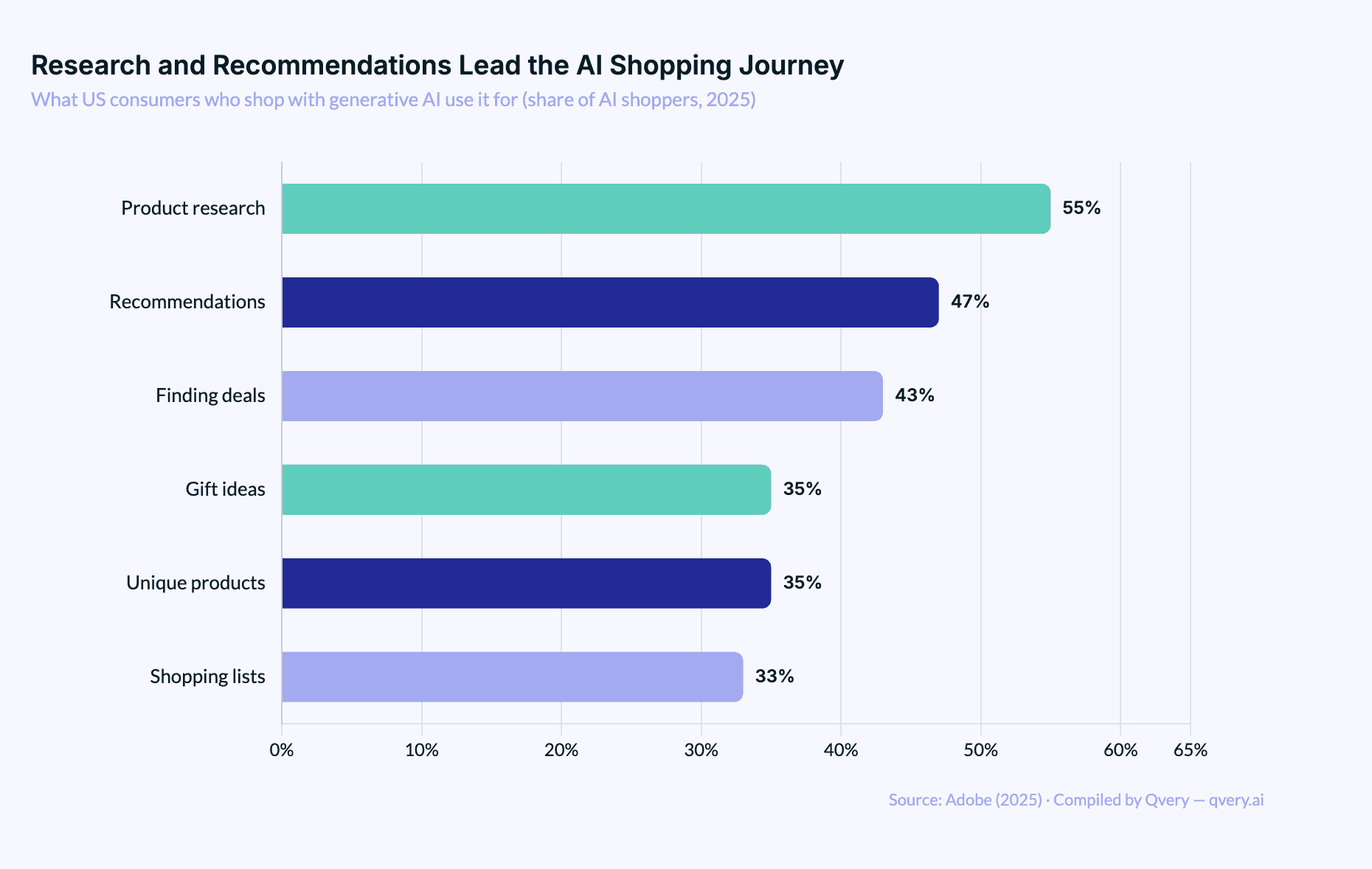
Shopping specifically has crossed from novelty to habit. 39% of US consumers had used generative AI to shop and 53% planned to¹³, and among those who do, research and recommendations lead the use cases.
The assistance also changes the buyer. AI-assisted shoppers report being 65% more confident in the purchase and 68% less likely to return it¹⁴. So the prize here is buyer quality, not traffic volume: AI-assisted shoppers arrive more confident and return less. If your brand is the one the assistant names during that research, you inherit that confidence. If it's not, you inherit the return rate of whoever was.
The Traffic Is Tiny, and It Converts Like Nothing Else
Now the referral channel almost nobody has staffed. ChatGPT does not send Google-sized traffic, and it never will, because the whole point is answering without a click. But the traffic it sends behaves like the best channel you have.
Alongside the 7.1% conversion rate², AI-referred retail visitors show a 23% lower bounce rate, 12% more pages per visit, and 41% longer sessions than other traffic⁴. The conversion gap tells the clearest story of all.

In eighteen months, AI referrals went from the worst-converting source on the site to the best, and outbound referral traffic from ChatGPT alone grew 206% in 2025⁹. The volume is still small, which is exactly why the window is open: only 2.8% of ChatGPT answers currently include a citation, up from 0.6% at the start of 2025². Most answers name no one. Being one of the few that get named is cheap right now and won't stay that way.
Two details make the channel concrete. When ChatGPT began placing clickable brand links in answers in May 2026, tracked referrals jumped 157.7% in a week and homepage visits 354.7%², a channel switched on by a single product change. The destinations those referrals reach are strikingly concentrated.
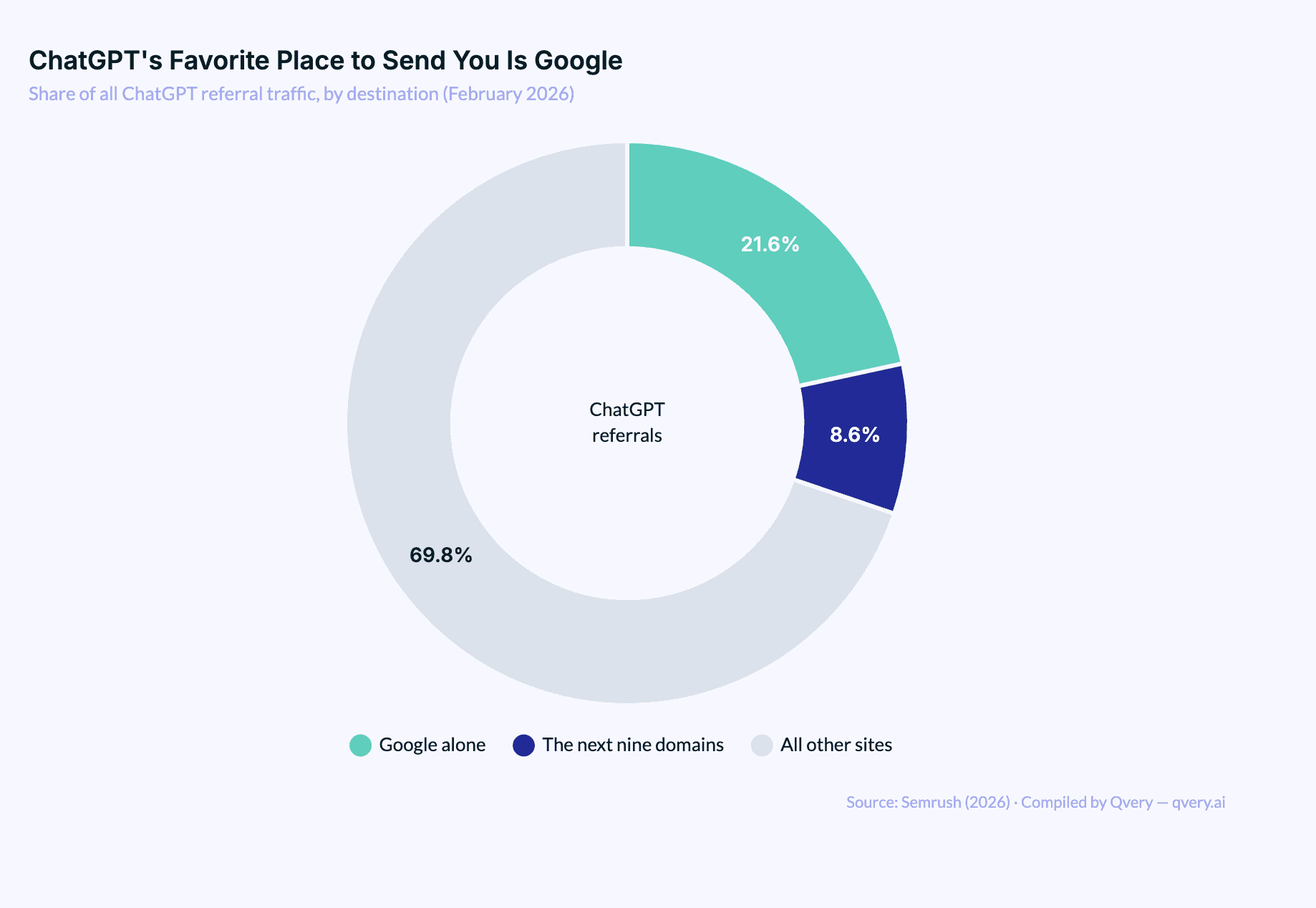
ChatGPT's single favorite place to send you is Google, at 21.6% of all its referral traffic⁹. Asking ChatGPT and being pointed back to a search box is a little like asking a sommelier for a recommendation and being handed the wine list. It also tells you how concentrated this channel is, and how much room there is below the top ten.
What ChatGPT Cites, and Why It Is Strange
To earn one of those rare citations, you have to know what ChatGPT trusts, and the answer is genuinely odd. Its two most-cited domains are Wikipedia and Reddit, and before an autumn 2025 shift it cited them about five times as often as the next domain¹⁵.
Its taste is also volatile: ChatGPT's Reddit citations ran near 60% of responses in early August 2025, then fell to around 10% by mid-September¹⁵. In regulated categories the dependence is startling, with Reddit appearing in 176.89% of ChatGPT finance answers, nearly twice per response¹⁶.
ChatGPT's two favorite sources are an encyclopedia anyone can edit and a forum where the top reply is frequently a joke, and it trusts them above most experts. That's either humbling or alarming depending on your profession. Our own data shows how engine-specific this is:
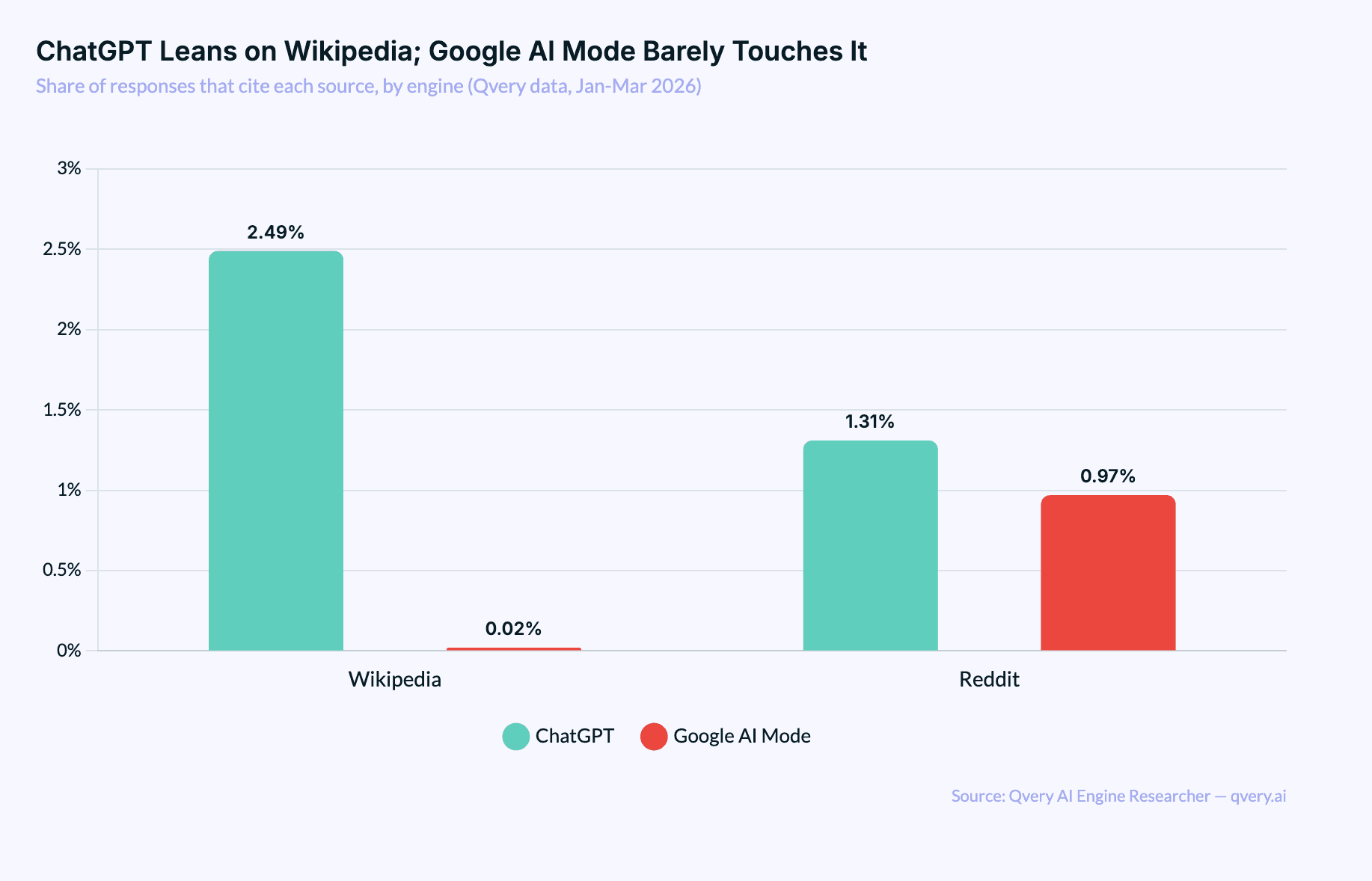
ChatGPT cites Wikipedia in 2.49% of responses versus Google AI Mode's 0.02%, a 124x gap⁵, and 98.8% of all Wikipedia citations in AI search come from ChatGPT⁵.
ChatGPT's reference-content citations run 3.26% of the total (84% of it Wikipedia) against Google AI Mode's 0.10%⁵, because ChatGPT outsources definitions while Google's engine synthesizes them internally.
ChatGPT cites Reddit 35% more often than Google AI Mode does¹⁷, and cites Quora exactly zero times, a source that is entirely Google-AI-exclusive¹⁷.
The strategic read is blunt. A single "optimize for AI search" plan is wrong on arrival, because the two biggest engines do not agree on what to trust. And Google rankings will not carry you across: only 10.9% of the domains ChatGPT cites also rank in Google's organic top 10⁵. The reassuring counterweight is that 87.75% of all AI citations go to brand sites, niche publications, and specialist pages, not the household names like Wikipedia and YouTube¹⁸. Your own content still does most of the work. You just have to be the version of it the engine reaches for.
ChatGPT Has Joined the B2B Buying Committee
This is no longer only a consumer story. In a survey of B2B buyers, 45% used generative AI during a recent purchase, primarily to gather information on vendors and products, drawing on an average of seven sources¹⁹. Organizational adoption is near-universal: 88% of companies now report regular AI use in at least one business function, up from 78% a year earlier²⁰.
The part worth dwelling on is the trust ceiling. Even as they adopt it, 51% of B2B buyers say they are more likely to encounter misleading information from generative AI than from a sales rep¹⁹.
So buyers are using AI to build the shortlist and then double-checking it against humans. For a vendor, that's the whole game in one sentence: being cited puts you on the list, and being accurate when cited keeps you there. Treat AI answers as a channel you earn, and you get to write the shortlist your competitors are stuck validating.
Confidently Wrong: The Accuracy Problem Nobody Priced In
Here is the tension that makes all of the above urgent rather than comfortable. The surface winning the highest-intent traffic on the web is wrong a lot. Tested on 1,600 news-sourcing questions, leading AI search engines were incorrect on more than 60% of queries⁶. ChatGPT specifically misidentified the source on 134 of 200 answers, expressed doubt only 15 times, and never once declined to answer⁶. It's wrong about a third to two-thirds of the time and hedges roughly never, the exact personality profile of the most confident person in every meeting.
Expert-graded studies land in the same place. Journalists at the BBC judged 51% of AI answers about the news to have significant issues, with 19% introducing outright factual errors and 13% of quotes altered or fabricated²¹. A larger international study across 18 countries found 45% of answers had at least one significant issue and 31% had serious sourcing problems²². ChatGPT was the most accurate of the assistants tested, and it still misrepresented sources 15% of the time²¹.
Read the accuracy data next to the intent data and the opportunity is obvious. Millions of high-intent buyers are getting confident answers that are wrong a meaningful share of the time, from a system that badly wants sources it can stand behind.
Become the source it can quote correctly and you win twice: you get the citation, and you get quoted right. The alternative is being paraphrased, occasionally invented, by a machine your customers are quietly learning not to fully trust.
How to See Whether ChatGPT Recommends You
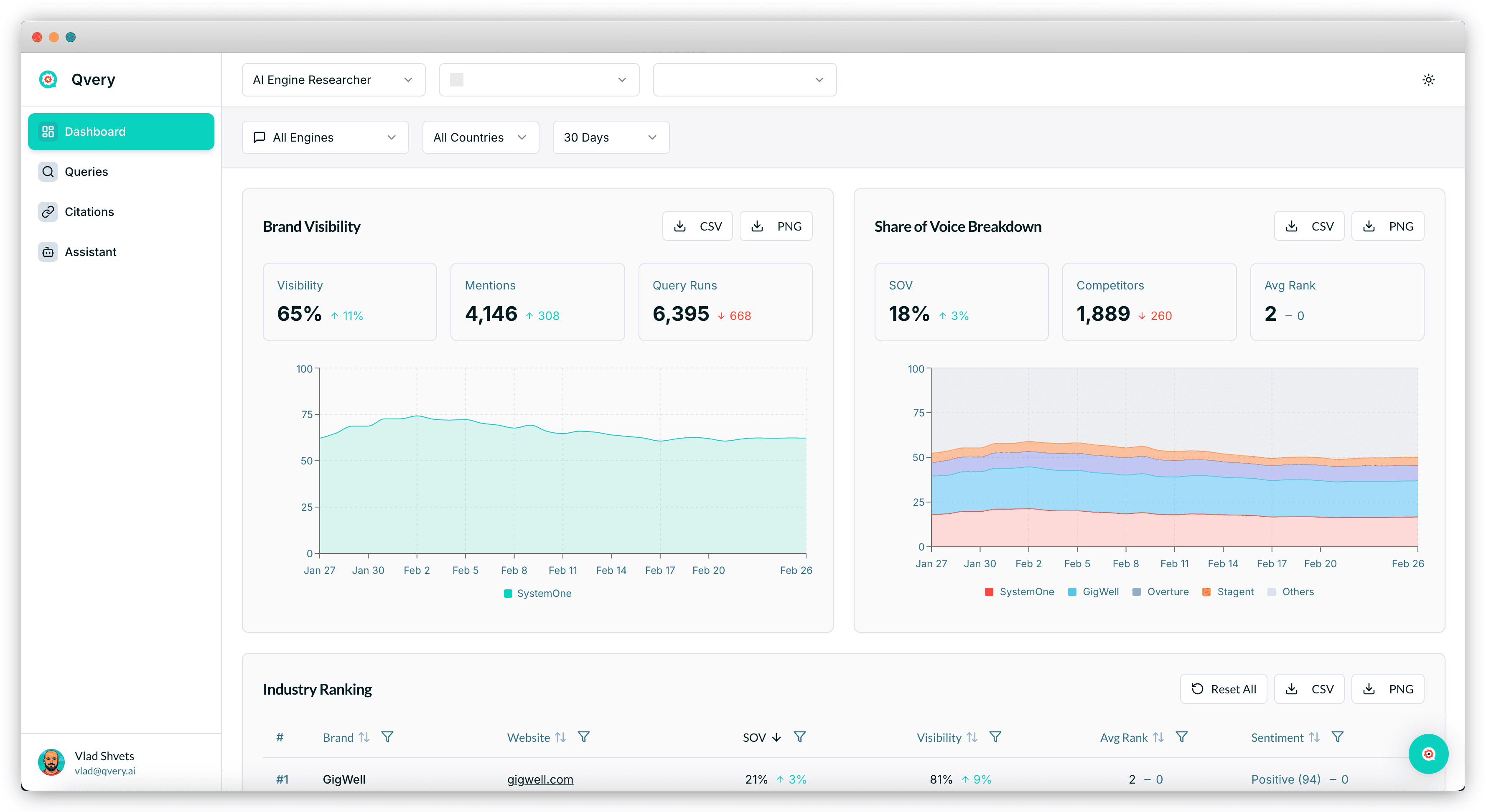
This is the problem Qvery solves. Qvery tracks how your brand shows up across ChatGPT and Google AI Mode, generates the queries your customers ask, and shows you which sources the engine pulls from when your category comes up. You enter your brand and see where you stand in a few minutes, instead of guessing whether the answer recommends you, a competitor, or no one.
ChatGPT isn't going to send you the traffic Google once did, and it doesn't need to. It sends fewer visitors who convert like paid search and arrive already convinced, and the only lever you control is whether the answer names you when it counts. That's measurable now, which makes it the first thing worth measuring.
Frequently Asked Questions
How many people use ChatGPT?
ChatGPT had more than 900 million weekly active users and over 50 million paying subscribers as of early 2026¹, and its app passed 1 billion monthly users in May 2026⁸.
How fast is ChatGPT growing?
Weekly users went from 700 million in mid-2025 to 800 million in October to over 900 million by early 2026¹ ³ ⁷, and OpenAI says it is the fastest product ever to reach 10 million and 100 million users¹.
Do people use ChatGPT as a search engine?
Increasingly, yes. About 49% of ChatGPT messages are information-seeking "Asking"³, roughly half of US adults 18 to 49 use a chatbot to search¹¹, and ChatGPT search usage nearly tripled in a year¹.
How much traffic does ChatGPT send to websites?
Not much by volume, but it is growing fast: outbound referrals from ChatGPT grew 206% in 2025⁹. The bigger story is quality, not quantity.
Does ChatGPT traffic convert?
Exceptionally well. ChatGPT referral traffic converts at 7.1%, second only to paid search and ahead of organic, social, and direct².
How often does ChatGPT cite its sources?
Rarely, but more than before: only 2.8% of ChatGPT answers included a citation as of August 2025, up from 0.6% in January².
What sources does ChatGPT cite most?
Wikipedia and Reddit lead by a wide margin, historically cited about five times more than the next domain¹⁵. ChatGPT cites Wikipedia in 2.49% of responses⁵.
Does ChatGPT cite the same sources as Google AI Mode?
No. ChatGPT cites Wikipedia 124 times more often than Google AI Mode⁵, cites Reddit 35% more¹⁷, and never cites Quora, which is 100% Google-AI exclusive¹⁷.
Does ranking on Google get you cited by ChatGPT?
Mostly not. Only 10.9% of the domains ChatGPT cites also rank in Google's organic top 10¹⁸, so AI visibility is a separate discipline from traditional search.
How accurate is ChatGPT?
On news sourcing it is unreliable: leading AI tools were wrong on 60%+ of queries⁶, and ChatGPT misidentified the source on 134 of 200 answers⁶.
Does ChatGPT make up facts and quotes?
Sometimes. In one expert study, 19% of AI answers introduced factual errors and 13% of quotes were altered or fabricated²¹.
How many messages does ChatGPT handle?
By mid-2025, users sent 2.5 billion messages a day, about 29,000 per second³, totaling 18 billion a week³.
Who uses ChatGPT the most?
Younger adults: nearly half of all messages come from users under 26³, and 58% of US adults under 30 use it¹².
Is ChatGPT mostly used for work or personal life?
Personal. Non-work messages grew from 53% to more than 70% of all usage between 2024 and 2025³.
Is ChatGPT a global product or a US one?
Global. Users whose main language is not English are now over half of active users, led by Spanish, Portuguese, and Arabic¹⁰.
Do people shop with ChatGPT?
Yes. 39% of US consumers have used generative AI to shop and 53% planned to¹³, mostly for research and recommendations.
Is AI-assisted shopping better for retailers?
It appears so. AI-assisted shoppers are 65% more confident and 68% less likely to return the product¹⁴, and AI referrals converted 31% better than other sources in the 2025 holiday season¹⁴.
Do B2B buyers use ChatGPT?
Yes. 45% of B2B buyers used generative AI in a recent purchase, mainly to research vendors and products¹⁹.
Do buyers trust ChatGPT's answers?
Cautiously. 51% of B2B buyers say they are more likely to be misled by generative AI than by a sales rep¹⁹, so they validate AI findings against other sources.
What percentage of ChatGPT answers use live web search?
About 34.5% of ChatGPT queries trigger a live web search as of early 2026, down from 46% in late 2024⁹.
Where does ChatGPT send the traffic it does refer?
It is highly concentrated: over 30% of ChatGPT referrals go to just ten domains, and 21.6% to Google alone⁹.
What should a brand do about ChatGPT?
Measure whether ChatGPT names you, then earn placement in the sources it trusts, especially community and reference content. Tracking your visibility across ChatGPT and Google AI Mode is what Qvery is built to do.
Sources
NBER (Chatterji et al.): How People Use ChatGPT, Working Paper 34255 (2025)
Adobe: The Explosive Rise of Generative AI Referral Traffic (2025)
Qvery: Wikipedia AI Citations, ChatGPT's Favorite Source That Google AI Ignores (2026)
Columbia Journalism Review, Tow Center: AI Search Has a Citation Problem (2025)
TechCrunch: Sam Altman Says ChatGPT Has Hit 800M Weekly Active Users (2025)
Semrush (Datos clickstream): ChatGPT Traffic Analysis, 17 Months of Data (2026)
Pew Research Center: Americans and AI 2026, How Use Differs by Age (2026)
Pew Research Center: 34% of US Adults Have Used ChatGPT (2025)
Adobe Analytics: Retail Traffic From Generative AI Jumps 1,200 Percent (2025)
Semrush: The Most-Cited Domains in AI, a 3-Month Study (2025)
Semrush: How AI Search Really Works, AI Visibility Study (2025)
Qvery: Reddit Is the Most Important Website for AI Search Visibility (2026)
Gartner: 69% of B2B Buyers Turn to Sales Reps to Validate AI-Generated Insights (2026)
BBC: Representation of BBC News Content in AI Assistants (2025)
European Broadcasting Union and BBC: AI Assistants Misrepresent News Content 45% of the Time (2025)
As of early 2026, ChatGPT had more than 900 million weekly active users and over 50 million paying subscribers¹. A billion people, give or take, now open an app to ask it things. That's the entire job description of a search engine, which ChatGPT is at some pains not to be called.
The number that should stop a marketer, though, isn't the size. It's the quality. ChatGPT sends very little traffic to the rest of the web, but the traffic it does send converts at 7.1%, second only to paid search and ahead of organic, social, direct, and email². Tiny volume, extraordinary intent. That combination is why "how much traffic does ChatGPT send" is the wrong question, and "does its answer name you at all" is the right one.
We pulled the most credible, independently verified statistics on ChatGPT we could find, from OpenAI's own filings, an OpenAI-coauthored academic study, Pew, Adobe, Gartner, the Tow Center, the BBC, and the clickstream firms that measure where the traffic goes.
A few figures come from our own AI-citation data at Qvery. Everything else is footnoted to its original source. Read together, they describe a surface that quietly became the front door to product research for a large slice of the planet, that sends fewer visitors than Google but far better ones, that cites two community-run websites above almost everything else, and that is confidently wrong often enough to matter.
Highlights
ChatGPT reached 900 million weekly active users and 50 million paying subscribers by early 2026¹, on track to be the fastest product ever to a billion.
By mid-2025, 700 million users were sending 18 billion messages a week, about 10% of the world's adults³.
Roughly 49% of ChatGPT messages are "Asking", seeking information to inform a decision, which is the job a search engine does³.
Among people already using AI, 72% make it their primary way to research products and brands⁴.
ChatGPT referral traffic converts at 7.1%, second only to paid search², yet only 2.8% of ChatGPT answers include a citation, up from 0.6%².
ChatGPT cites Wikipedia 124 times more often than Google AI Mode does⁵, and its top two sources are Wikipedia and Reddit.
Tested on news sourcing, ChatGPT was wrong about the source on 134 of 200 answers, and expressed doubt only 15 times⁶.
In our own data, only 10.9% of the domains ChatGPT cites also rank in Google's organic top 10¹⁸.
The Scale: A Billion People, Give or Take
ChatGPT's growth stopped being a startup story and became a demographic one. The weekly user count ran from 800 million in October 2025⁷ to over 900 million by early 2026¹, and OpenAI says it was the fastest product ever to 10 million and 100 million users, with a billion in sight¹. The mobile app crossed 1 billion monthly active users in May 2026, faster than Maps, TikTok, Instagram, or YouTube ever managed⁸.
The message volume is the part that conveys the real surface area. By July 2025, users were sending 2.5 billion messages a day, roughly 29,000 every second³. That is a firehose of human intent, questions, comparisons, and decisions, flowing through a single answer box.
One nuance changes how you should read all of this. ChatGPT's own destination traffic plateaued around November 2025, hovering near 1 billion monthly visits⁹, even as the traffic it sends outward kept climbing. ChatGPT isn't really growing as a destination anymore. It's growing as the thing that decides your next destination. For a marketer, the second matters far more than the first.
It Is Not a Chatbot Anymore, It Is How People Look Things Up
The most useful data on what ChatGPT is for comes from an OpenAI-coauthored study of 700 million users. The breakdown: about 49% of messages are "Asking," 40% "Doing," and 11% "Expressing"³. Nearly half of all use is decision support, the same core job as a query in a search box. The three most common topics, "Practical Guidance," "Seeking Information," and "Writing," account for nearly 80% of all conversations³.
Two shifts prove this is now mainstream rather than a technologist's habit. The early user base was about 80% male by first name; by mid-2025 that had fallen to 48%, a near-flip to parity³. And users whose main language is not English are now over half of the total¹⁰, led by Spanish, Portuguese, and Arabic. This is not Silicon Valley talking to itself.
44% of US adults now use ChatGPT, up from 34% a year earlier¹², making it the most-used AI assistant in every age group¹¹.
About half of US adults ages 18 to 49 use an AI chatbot to search for information¹¹.
The share of employed adults using ChatGPT for work rose 20 points in two years, to 28%¹².
OpenAI says ChatGPT search usage nearly tripled in the year to early 2026¹, and about 34.5% of ChatGPT queries now trigger a live web search⁹.
Put the behavior and the reach together and the label problem resolves itself. When half of a mainstream product's use is people asking for information to make a decision, and a third of those answers reach out to the live web, you're looking at a search engine. It just refuses to file the paperwork.
ChatGPT Is Where the Buying Journey Now Starts
This is where visibility turns into revenue. Among consumers who have adopted AI, 72% now use it as their primary way to research products and brands⁴, and 36% say they are replacing traditional search with AI assistants⁴. The behavior is moving up the funnel: 34% research on an AI assistant before they ever run a normal search⁴, which means the consideration set is often decided before Google loads.
Shopping specifically has crossed from novelty to habit. 39% of US consumers had used generative AI to shop and 53% planned to¹³, and among those who do, research and recommendations lead the use cases.
The assistance also changes the buyer. AI-assisted shoppers report being 65% more confident in the purchase and 68% less likely to return it¹⁴. So the prize here is buyer quality, not traffic volume: AI-assisted shoppers arrive more confident and return less. If your brand is the one the assistant names during that research, you inherit that confidence. If it's not, you inherit the return rate of whoever was.
The Traffic Is Tiny, and It Converts Like Nothing Else
Now the referral channel almost nobody has staffed. ChatGPT does not send Google-sized traffic, and it never will, because the whole point is answering without a click. But the traffic it sends behaves like the best channel you have.
Alongside the 7.1% conversion rate², AI-referred retail visitors show a 23% lower bounce rate, 12% more pages per visit, and 41% longer sessions than other traffic⁴. The conversion gap tells the clearest story of all.
In eighteen months, AI referrals went from the worst-converting source on the site to the best, and outbound referral traffic from ChatGPT alone grew 206% in 2025⁹. The volume is still small, which is exactly why the window is open: only 2.8% of ChatGPT answers currently include a citation, up from 0.6% at the start of 2025². Most answers name no one. Being one of the few that get named is cheap right now and won't stay that way.
Two details make the channel concrete. When ChatGPT began placing clickable brand links in answers in May 2026, tracked referrals jumped 157.7% in a week and homepage visits 354.7%², a channel switched on by a single product change. The destinations those referrals reach are strikingly concentrated.
ChatGPT's single favorite place to send you is Google, at 21.6% of all its referral traffic⁹. Asking ChatGPT and being pointed back to a search box is a little like asking a sommelier for a recommendation and being handed the wine list. It also tells you how concentrated this channel is, and how much room there is below the top ten.
What ChatGPT Cites, and Why It Is Strange
To earn one of those rare citations, you have to know what ChatGPT trusts, and the answer is genuinely odd. Its two most-cited domains are Wikipedia and Reddit, and before an autumn 2025 shift it cited them about five times as often as the next domain¹⁵.
Its taste is also volatile: ChatGPT's Reddit citations ran near 60% of responses in early August 2025, then fell to around 10% by mid-September¹⁵. In regulated categories the dependence is startling, with Reddit appearing in 176.89% of ChatGPT finance answers, nearly twice per response¹⁶.
ChatGPT's two favorite sources are an encyclopedia anyone can edit and a forum where the top reply is frequently a joke, and it trusts them above most experts. That's either humbling or alarming depending on your profession. Our own data shows how engine-specific this is:
ChatGPT cites Wikipedia in 2.49% of responses versus Google AI Mode's 0.02%, a 124x gap⁵, and 98.8% of all Wikipedia citations in AI search come from ChatGPT⁵.
ChatGPT's reference-content citations run 3.26% of the total (84% of it Wikipedia) against Google AI Mode's 0.10%⁵, because ChatGPT outsources definitions while Google's engine synthesizes them internally.
ChatGPT cites Reddit 35% more often than Google AI Mode does¹⁷, and cites Quora exactly zero times, a source that is entirely Google-AI-exclusive¹⁷.
The strategic read is blunt. A single "optimize for AI search" plan is wrong on arrival, because the two biggest engines do not agree on what to trust. And Google rankings will not carry you across: only 10.9% of the domains ChatGPT cites also rank in Google's organic top 10⁵. The reassuring counterweight is that 87.75% of all AI citations go to brand sites, niche publications, and specialist pages, not the household names like Wikipedia and YouTube¹⁸. Your own content still does most of the work. You just have to be the version of it the engine reaches for.
ChatGPT Has Joined the B2B Buying Committee
This is no longer only a consumer story. In a survey of B2B buyers, 45% used generative AI during a recent purchase, primarily to gather information on vendors and products, drawing on an average of seven sources¹⁹. Organizational adoption is near-universal: 88% of companies now report regular AI use in at least one business function, up from 78% a year earlier²⁰.
The part worth dwelling on is the trust ceiling. Even as they adopt it, 51% of B2B buyers say they are more likely to encounter misleading information from generative AI than from a sales rep¹⁹.
So buyers are using AI to build the shortlist and then double-checking it against humans. For a vendor, that's the whole game in one sentence: being cited puts you on the list, and being accurate when cited keeps you there. Treat AI answers as a channel you earn, and you get to write the shortlist your competitors are stuck validating.
Confidently Wrong: The Accuracy Problem Nobody Priced In
Here is the tension that makes all of the above urgent rather than comfortable. The surface winning the highest-intent traffic on the web is wrong a lot. Tested on 1,600 news-sourcing questions, leading AI search engines were incorrect on more than 60% of queries⁶. ChatGPT specifically misidentified the source on 134 of 200 answers, expressed doubt only 15 times, and never once declined to answer⁶. It's wrong about a third to two-thirds of the time and hedges roughly never, the exact personality profile of the most confident person in every meeting.
Expert-graded studies land in the same place. Journalists at the BBC judged 51% of AI answers about the news to have significant issues, with 19% introducing outright factual errors and 13% of quotes altered or fabricated²¹. A larger international study across 18 countries found 45% of answers had at least one significant issue and 31% had serious sourcing problems²². ChatGPT was the most accurate of the assistants tested, and it still misrepresented sources 15% of the time²¹.
Read the accuracy data next to the intent data and the opportunity is obvious. Millions of high-intent buyers are getting confident answers that are wrong a meaningful share of the time, from a system that badly wants sources it can stand behind.
Become the source it can quote correctly and you win twice: you get the citation, and you get quoted right. The alternative is being paraphrased, occasionally invented, by a machine your customers are quietly learning not to fully trust.
How to See Whether ChatGPT Recommends You
This is the problem Qvery solves. Qvery tracks how your brand shows up across ChatGPT and Google AI Mode, generates the queries your customers ask, and shows you which sources the engine pulls from when your category comes up. You enter your brand and see where you stand in a few minutes, instead of guessing whether the answer recommends you, a competitor, or no one.
ChatGPT isn't going to send you the traffic Google once did, and it doesn't need to. It sends fewer visitors who convert like paid search and arrive already convinced, and the only lever you control is whether the answer names you when it counts. That's measurable now, which makes it the first thing worth measuring.
Frequently Asked Questions
How many people use ChatGPT?
ChatGPT had more than 900 million weekly active users and over 50 million paying subscribers as of early 2026¹, and its app passed 1 billion monthly users in May 2026⁸.
How fast is ChatGPT growing?
Weekly users went from 700 million in mid-2025 to 800 million in October to over 900 million by early 2026¹ ³ ⁷, and OpenAI says it is the fastest product ever to reach 10 million and 100 million users¹.
Do people use ChatGPT as a search engine?
Increasingly, yes. About 49% of ChatGPT messages are information-seeking "Asking"³, roughly half of US adults 18 to 49 use a chatbot to search¹¹, and ChatGPT search usage nearly tripled in a year¹.
How much traffic does ChatGPT send to websites?
Not much by volume, but it is growing fast: outbound referrals from ChatGPT grew 206% in 2025⁹. The bigger story is quality, not quantity.
Does ChatGPT traffic convert?
Exceptionally well. ChatGPT referral traffic converts at 7.1%, second only to paid search and ahead of organic, social, and direct².
How often does ChatGPT cite its sources?
Rarely, but more than before: only 2.8% of ChatGPT answers included a citation as of August 2025, up from 0.6% in January².
What sources does ChatGPT cite most?
Wikipedia and Reddit lead by a wide margin, historically cited about five times more than the next domain¹⁵. ChatGPT cites Wikipedia in 2.49% of responses⁵.
Does ChatGPT cite the same sources as Google AI Mode?
No. ChatGPT cites Wikipedia 124 times more often than Google AI Mode⁵, cites Reddit 35% more¹⁷, and never cites Quora, which is 100% Google-AI exclusive¹⁷.
Does ranking on Google get you cited by ChatGPT?
Mostly not. Only 10.9% of the domains ChatGPT cites also rank in Google's organic top 10¹⁸, so AI visibility is a separate discipline from traditional search.
How accurate is ChatGPT?
On news sourcing it is unreliable: leading AI tools were wrong on 60%+ of queries⁶, and ChatGPT misidentified the source on 134 of 200 answers⁶.
Does ChatGPT make up facts and quotes?
Sometimes. In one expert study, 19% of AI answers introduced factual errors and 13% of quotes were altered or fabricated²¹.
How many messages does ChatGPT handle?
By mid-2025, users sent 2.5 billion messages a day, about 29,000 per second³, totaling 18 billion a week³.
Who uses ChatGPT the most?
Younger adults: nearly half of all messages come from users under 26³, and 58% of US adults under 30 use it¹².
Is ChatGPT mostly used for work or personal life?
Personal. Non-work messages grew from 53% to more than 70% of all usage between 2024 and 2025³.
Is ChatGPT a global product or a US one?
Global. Users whose main language is not English are now over half of active users, led by Spanish, Portuguese, and Arabic¹⁰.
Do people shop with ChatGPT?
Yes. 39% of US consumers have used generative AI to shop and 53% planned to¹³, mostly for research and recommendations.
Is AI-assisted shopping better for retailers?
It appears so. AI-assisted shoppers are 65% more confident and 68% less likely to return the product¹⁴, and AI referrals converted 31% better than other sources in the 2025 holiday season¹⁴.
Do B2B buyers use ChatGPT?
Yes. 45% of B2B buyers used generative AI in a recent purchase, mainly to research vendors and products¹⁹.
Do buyers trust ChatGPT's answers?
Cautiously. 51% of B2B buyers say they are more likely to be misled by generative AI than by a sales rep¹⁹, so they validate AI findings against other sources.
What percentage of ChatGPT answers use live web search?
About 34.5% of ChatGPT queries trigger a live web search as of early 2026, down from 46% in late 2024⁹.
Where does ChatGPT send the traffic it does refer?
It is highly concentrated: over 30% of ChatGPT referrals go to just ten domains, and 21.6% to Google alone⁹.
What should a brand do about ChatGPT?
Measure whether ChatGPT names you, then earn placement in the sources it trusts, especially community and reference content. Tracking your visibility across ChatGPT and Google AI Mode is what Qvery is built to do.
Sources
NBER (Chatterji et al.): How People Use ChatGPT, Working Paper 34255 (2025)
Adobe: The Explosive Rise of Generative AI Referral Traffic (2025)
Qvery: Wikipedia AI Citations, ChatGPT's Favorite Source That Google AI Ignores (2026)
Columbia Journalism Review, Tow Center: AI Search Has a Citation Problem (2025)
TechCrunch: Sam Altman Says ChatGPT Has Hit 800M Weekly Active Users (2025)
Semrush (Datos clickstream): ChatGPT Traffic Analysis, 17 Months of Data (2026)
Pew Research Center: Americans and AI 2026, How Use Differs by Age (2026)
Pew Research Center: 34% of US Adults Have Used ChatGPT (2025)
Adobe Analytics: Retail Traffic From Generative AI Jumps 1,200 Percent (2025)
Semrush: The Most-Cited Domains in AI, a 3-Month Study (2025)
Semrush: How AI Search Really Works, AI Visibility Study (2025)
Qvery: Reddit Is the Most Important Website for AI Search Visibility (2026)
Gartner: 69% of B2B Buyers Turn to Sales Reps to Validate AI-Generated Insights (2026)
BBC: Representation of BBC News Content in AI Assistants (2025)
European Broadcasting Union and BBC: AI Assistants Misrepresent News Content 45% of the Time (2025)
As of early 2026, ChatGPT had more than 900 million weekly active users and over 50 million paying subscribers¹. A billion people, give or take, now open an app to ask it things. That's the entire job description of a search engine, which ChatGPT is at some pains not to be called.
The number that should stop a marketer, though, isn't the size. It's the quality. ChatGPT sends very little traffic to the rest of the web, but the traffic it does send converts at 7.1%, second only to paid search and ahead of organic, social, direct, and email². Tiny volume, extraordinary intent. That combination is why "how much traffic does ChatGPT send" is the wrong question, and "does its answer name you at all" is the right one.
We pulled the most credible, independently verified statistics on ChatGPT we could find, from OpenAI's own filings, an OpenAI-coauthored academic study, Pew, Adobe, Gartner, the Tow Center, the BBC, and the clickstream firms that measure where the traffic goes.
A few figures come from our own AI-citation data at Qvery. Everything else is footnoted to its original source. Read together, they describe a surface that quietly became the front door to product research for a large slice of the planet, that sends fewer visitors than Google but far better ones, that cites two community-run websites above almost everything else, and that is confidently wrong often enough to matter.
Highlights
ChatGPT reached 900 million weekly active users and 50 million paying subscribers by early 2026¹, on track to be the fastest product ever to a billion.
By mid-2025, 700 million users were sending 18 billion messages a week, about 10% of the world's adults³.
Roughly 49% of ChatGPT messages are "Asking", seeking information to inform a decision, which is the job a search engine does³.
Among people already using AI, 72% make it their primary way to research products and brands⁴.
ChatGPT referral traffic converts at 7.1%, second only to paid search², yet only 2.8% of ChatGPT answers include a citation, up from 0.6%².
ChatGPT cites Wikipedia 124 times more often than Google AI Mode does⁵, and its top two sources are Wikipedia and Reddit.
Tested on news sourcing, ChatGPT was wrong about the source on 134 of 200 answers, and expressed doubt only 15 times⁶.
In our own data, only 10.9% of the domains ChatGPT cites also rank in Google's organic top 10¹⁸.
The Scale: A Billion People, Give or Take
ChatGPT's growth stopped being a startup story and became a demographic one. The weekly user count ran from 800 million in October 2025⁷ to over 900 million by early 2026¹, and OpenAI says it was the fastest product ever to 10 million and 100 million users, with a billion in sight¹. The mobile app crossed 1 billion monthly active users in May 2026, faster than Maps, TikTok, Instagram, or YouTube ever managed⁸.
The message volume is the part that conveys the real surface area. By July 2025, users were sending 2.5 billion messages a day, roughly 29,000 every second³. That is a firehose of human intent, questions, comparisons, and decisions, flowing through a single answer box.
One nuance changes how you should read all of this. ChatGPT's own destination traffic plateaued around November 2025, hovering near 1 billion monthly visits⁹, even as the traffic it sends outward kept climbing. ChatGPT isn't really growing as a destination anymore. It's growing as the thing that decides your next destination. For a marketer, the second matters far more than the first.
It Is Not a Chatbot Anymore, It Is How People Look Things Up
The most useful data on what ChatGPT is for comes from an OpenAI-coauthored study of 700 million users. The breakdown: about 49% of messages are "Asking," 40% "Doing," and 11% "Expressing"³. Nearly half of all use is decision support, the same core job as a query in a search box. The three most common topics, "Practical Guidance," "Seeking Information," and "Writing," account for nearly 80% of all conversations³.
Two shifts prove this is now mainstream rather than a technologist's habit. The early user base was about 80% male by first name; by mid-2025 that had fallen to 48%, a near-flip to parity³. And users whose main language is not English are now over half of the total¹⁰, led by Spanish, Portuguese, and Arabic. This is not Silicon Valley talking to itself.
44% of US adults now use ChatGPT, up from 34% a year earlier¹², making it the most-used AI assistant in every age group¹¹.
About half of US adults ages 18 to 49 use an AI chatbot to search for information¹¹.
The share of employed adults using ChatGPT for work rose 20 points in two years, to 28%¹².
OpenAI says ChatGPT search usage nearly tripled in the year to early 2026¹, and about 34.5% of ChatGPT queries now trigger a live web search⁹.
Put the behavior and the reach together and the label problem resolves itself. When half of a mainstream product's use is people asking for information to make a decision, and a third of those answers reach out to the live web, you're looking at a search engine. It just refuses to file the paperwork.
ChatGPT Is Where the Buying Journey Now Starts
This is where visibility turns into revenue. Among consumers who have adopted AI, 72% now use it as their primary way to research products and brands⁴, and 36% say they are replacing traditional search with AI assistants⁴. The behavior is moving up the funnel: 34% research on an AI assistant before they ever run a normal search⁴, which means the consideration set is often decided before Google loads.
Shopping specifically has crossed from novelty to habit. 39% of US consumers had used generative AI to shop and 53% planned to¹³, and among those who do, research and recommendations lead the use cases.
The assistance also changes the buyer. AI-assisted shoppers report being 65% more confident in the purchase and 68% less likely to return it¹⁴. So the prize here is buyer quality, not traffic volume: AI-assisted shoppers arrive more confident and return less. If your brand is the one the assistant names during that research, you inherit that confidence. If it's not, you inherit the return rate of whoever was.
The Traffic Is Tiny, and It Converts Like Nothing Else
Now the referral channel almost nobody has staffed. ChatGPT does not send Google-sized traffic, and it never will, because the whole point is answering without a click. But the traffic it sends behaves like the best channel you have.
Alongside the 7.1% conversion rate², AI-referred retail visitors show a 23% lower bounce rate, 12% more pages per visit, and 41% longer sessions than other traffic⁴. The conversion gap tells the clearest story of all.
In eighteen months, AI referrals went from the worst-converting source on the site to the best, and outbound referral traffic from ChatGPT alone grew 206% in 2025⁹. The volume is still small, which is exactly why the window is open: only 2.8% of ChatGPT answers currently include a citation, up from 0.6% at the start of 2025². Most answers name no one. Being one of the few that get named is cheap right now and won't stay that way.
Two details make the channel concrete. When ChatGPT began placing clickable brand links in answers in May 2026, tracked referrals jumped 157.7% in a week and homepage visits 354.7%², a channel switched on by a single product change. The destinations those referrals reach are strikingly concentrated.
ChatGPT's single favorite place to send you is Google, at 21.6% of all its referral traffic⁹. Asking ChatGPT and being pointed back to a search box is a little like asking a sommelier for a recommendation and being handed the wine list. It also tells you how concentrated this channel is, and how much room there is below the top ten.
What ChatGPT Cites, and Why It Is Strange
To earn one of those rare citations, you have to know what ChatGPT trusts, and the answer is genuinely odd. Its two most-cited domains are Wikipedia and Reddit, and before an autumn 2025 shift it cited them about five times as often as the next domain¹⁵.
Its taste is also volatile: ChatGPT's Reddit citations ran near 60% of responses in early August 2025, then fell to around 10% by mid-September¹⁵. In regulated categories the dependence is startling, with Reddit appearing in 176.89% of ChatGPT finance answers, nearly twice per response¹⁶.
ChatGPT's two favorite sources are an encyclopedia anyone can edit and a forum where the top reply is frequently a joke, and it trusts them above most experts. That's either humbling or alarming depending on your profession. Our own data shows how engine-specific this is:
ChatGPT cites Wikipedia in 2.49% of responses versus Google AI Mode's 0.02%, a 124x gap⁵, and 98.8% of all Wikipedia citations in AI search come from ChatGPT⁵.
ChatGPT's reference-content citations run 3.26% of the total (84% of it Wikipedia) against Google AI Mode's 0.10%⁵, because ChatGPT outsources definitions while Google's engine synthesizes them internally.
ChatGPT cites Reddit 35% more often than Google AI Mode does¹⁷, and cites Quora exactly zero times, a source that is entirely Google-AI-exclusive¹⁷.
The strategic read is blunt. A single "optimize for AI search" plan is wrong on arrival, because the two biggest engines do not agree on what to trust. And Google rankings will not carry you across: only 10.9% of the domains ChatGPT cites also rank in Google's organic top 10⁵. The reassuring counterweight is that 87.75% of all AI citations go to brand sites, niche publications, and specialist pages, not the household names like Wikipedia and YouTube¹⁸. Your own content still does most of the work. You just have to be the version of it the engine reaches for.
ChatGPT Has Joined the B2B Buying Committee
This is no longer only a consumer story. In a survey of B2B buyers, 45% used generative AI during a recent purchase, primarily to gather information on vendors and products, drawing on an average of seven sources¹⁹. Organizational adoption is near-universal: 88% of companies now report regular AI use in at least one business function, up from 78% a year earlier²⁰.
The part worth dwelling on is the trust ceiling. Even as they adopt it, 51% of B2B buyers say they are more likely to encounter misleading information from generative AI than from a sales rep¹⁹.
So buyers are using AI to build the shortlist and then double-checking it against humans. For a vendor, that's the whole game in one sentence: being cited puts you on the list, and being accurate when cited keeps you there. Treat AI answers as a channel you earn, and you get to write the shortlist your competitors are stuck validating.
Confidently Wrong: The Accuracy Problem Nobody Priced In
Here is the tension that makes all of the above urgent rather than comfortable. The surface winning the highest-intent traffic on the web is wrong a lot. Tested on 1,600 news-sourcing questions, leading AI search engines were incorrect on more than 60% of queries⁶. ChatGPT specifically misidentified the source on 134 of 200 answers, expressed doubt only 15 times, and never once declined to answer⁶. It's wrong about a third to two-thirds of the time and hedges roughly never, the exact personality profile of the most confident person in every meeting.
Expert-graded studies land in the same place. Journalists at the BBC judged 51% of AI answers about the news to have significant issues, with 19% introducing outright factual errors and 13% of quotes altered or fabricated²¹. A larger international study across 18 countries found 45% of answers had at least one significant issue and 31% had serious sourcing problems²². ChatGPT was the most accurate of the assistants tested, and it still misrepresented sources 15% of the time²¹.
Read the accuracy data next to the intent data and the opportunity is obvious. Millions of high-intent buyers are getting confident answers that are wrong a meaningful share of the time, from a system that badly wants sources it can stand behind.
Become the source it can quote correctly and you win twice: you get the citation, and you get quoted right. The alternative is being paraphrased, occasionally invented, by a machine your customers are quietly learning not to fully trust.
How to See Whether ChatGPT Recommends You
This is the problem Qvery solves. Qvery tracks how your brand shows up across ChatGPT and Google AI Mode, generates the queries your customers ask, and shows you which sources the engine pulls from when your category comes up. You enter your brand and see where you stand in a few minutes, instead of guessing whether the answer recommends you, a competitor, or no one.
ChatGPT isn't going to send you the traffic Google once did, and it doesn't need to. It sends fewer visitors who convert like paid search and arrive already convinced, and the only lever you control is whether the answer names you when it counts. That's measurable now, which makes it the first thing worth measuring.
Frequently Asked Questions
How many people use ChatGPT?
ChatGPT had more than 900 million weekly active users and over 50 million paying subscribers as of early 2026¹, and its app passed 1 billion monthly users in May 2026⁸.
How fast is ChatGPT growing?
Weekly users went from 700 million in mid-2025 to 800 million in October to over 900 million by early 2026¹ ³ ⁷, and OpenAI says it is the fastest product ever to reach 10 million and 100 million users¹.
Do people use ChatGPT as a search engine?
Increasingly, yes. About 49% of ChatGPT messages are information-seeking "Asking"³, roughly half of US adults 18 to 49 use a chatbot to search¹¹, and ChatGPT search usage nearly tripled in a year¹.
How much traffic does ChatGPT send to websites?
Not much by volume, but it is growing fast: outbound referrals from ChatGPT grew 206% in 2025⁹. The bigger story is quality, not quantity.
Does ChatGPT traffic convert?
Exceptionally well. ChatGPT referral traffic converts at 7.1%, second only to paid search and ahead of organic, social, and direct².
How often does ChatGPT cite its sources?
Rarely, but more than before: only 2.8% of ChatGPT answers included a citation as of August 2025, up from 0.6% in January².
What sources does ChatGPT cite most?
Wikipedia and Reddit lead by a wide margin, historically cited about five times more than the next domain¹⁵. ChatGPT cites Wikipedia in 2.49% of responses⁵.
Does ChatGPT cite the same sources as Google AI Mode?
No. ChatGPT cites Wikipedia 124 times more often than Google AI Mode⁵, cites Reddit 35% more¹⁷, and never cites Quora, which is 100% Google-AI exclusive¹⁷.
Does ranking on Google get you cited by ChatGPT?
Mostly not. Only 10.9% of the domains ChatGPT cites also rank in Google's organic top 10¹⁸, so AI visibility is a separate discipline from traditional search.
How accurate is ChatGPT?
On news sourcing it is unreliable: leading AI tools were wrong on 60%+ of queries⁶, and ChatGPT misidentified the source on 134 of 200 answers⁶.
Does ChatGPT make up facts and quotes?
Sometimes. In one expert study, 19% of AI answers introduced factual errors and 13% of quotes were altered or fabricated²¹.
How many messages does ChatGPT handle?
By mid-2025, users sent 2.5 billion messages a day, about 29,000 per second³, totaling 18 billion a week³.
Who uses ChatGPT the most?
Younger adults: nearly half of all messages come from users under 26³, and 58% of US adults under 30 use it¹².
Is ChatGPT mostly used for work or personal life?
Personal. Non-work messages grew from 53% to more than 70% of all usage between 2024 and 2025³.
Is ChatGPT a global product or a US one?
Global. Users whose main language is not English are now over half of active users, led by Spanish, Portuguese, and Arabic¹⁰.
Do people shop with ChatGPT?
Yes. 39% of US consumers have used generative AI to shop and 53% planned to¹³, mostly for research and recommendations.
Is AI-assisted shopping better for retailers?
It appears so. AI-assisted shoppers are 65% more confident and 68% less likely to return the product¹⁴, and AI referrals converted 31% better than other sources in the 2025 holiday season¹⁴.
Do B2B buyers use ChatGPT?
Yes. 45% of B2B buyers used generative AI in a recent purchase, mainly to research vendors and products¹⁹.
Do buyers trust ChatGPT's answers?
Cautiously. 51% of B2B buyers say they are more likely to be misled by generative AI than by a sales rep¹⁹, so they validate AI findings against other sources.
What percentage of ChatGPT answers use live web search?
About 34.5% of ChatGPT queries trigger a live web search as of early 2026, down from 46% in late 2024⁹.
Where does ChatGPT send the traffic it does refer?
It is highly concentrated: over 30% of ChatGPT referrals go to just ten domains, and 21.6% to Google alone⁹.
What should a brand do about ChatGPT?
Measure whether ChatGPT names you, then earn placement in the sources it trusts, especially community and reference content. Tracking your visibility across ChatGPT and Google AI Mode is what Qvery is built to do.
Sources
NBER (Chatterji et al.): How People Use ChatGPT, Working Paper 34255 (2025)
Adobe: The Explosive Rise of Generative AI Referral Traffic (2025)
Qvery: Wikipedia AI Citations, ChatGPT's Favorite Source That Google AI Ignores (2026)
Columbia Journalism Review, Tow Center: AI Search Has a Citation Problem (2025)
TechCrunch: Sam Altman Says ChatGPT Has Hit 800M Weekly Active Users (2025)
Semrush (Datos clickstream): ChatGPT Traffic Analysis, 17 Months of Data (2026)
Pew Research Center: Americans and AI 2026, How Use Differs by Age (2026)
Pew Research Center: 34% of US Adults Have Used ChatGPT (2025)
Adobe Analytics: Retail Traffic From Generative AI Jumps 1,200 Percent (2025)
Semrush: The Most-Cited Domains in AI, a 3-Month Study (2025)
Semrush: How AI Search Really Works, AI Visibility Study (2025)
Qvery: Reddit Is the Most Important Website for AI Search Visibility (2026)
Gartner: 69% of B2B Buyers Turn to Sales Reps to Validate AI-Generated Insights (2026)
BBC: Representation of BBC News Content in AI Assistants (2025)
European Broadcasting Union and BBC: AI Assistants Misrepresent News Content 45% of the Time (2025)
As of early 2026, ChatGPT had more than 900 million weekly active users and over 50 million paying subscribers¹. A billion people, give or take, now open an app to ask it things. That's the entire job description of a search engine, which ChatGPT is at some pains not to be called.
The number that should stop a marketer, though, isn't the size. It's the quality. ChatGPT sends very little traffic to the rest of the web, but the traffic it does send converts at 7.1%, second only to paid search and ahead of organic, social, direct, and email². Tiny volume, extraordinary intent. That combination is why "how much traffic does ChatGPT send" is the wrong question, and "does its answer name you at all" is the right one.
We pulled the most credible, independently verified statistics on ChatGPT we could find, from OpenAI's own filings, an OpenAI-coauthored academic study, Pew, Adobe, Gartner, the Tow Center, the BBC, and the clickstream firms that measure where the traffic goes.
A few figures come from our own AI-citation data at Qvery. Everything else is footnoted to its original source. Read together, they describe a surface that quietly became the front door to product research for a large slice of the planet, that sends fewer visitors than Google but far better ones, that cites two community-run websites above almost everything else, and that is confidently wrong often enough to matter.
Highlights
ChatGPT reached 900 million weekly active users and 50 million paying subscribers by early 2026¹, on track to be the fastest product ever to a billion.
By mid-2025, 700 million users were sending 18 billion messages a week, about 10% of the world's adults³.
Roughly 49% of ChatGPT messages are "Asking", seeking information to inform a decision, which is the job a search engine does³.
Among people already using AI, 72% make it their primary way to research products and brands⁴.
ChatGPT referral traffic converts at 7.1%, second only to paid search², yet only 2.8% of ChatGPT answers include a citation, up from 0.6%².
ChatGPT cites Wikipedia 124 times more often than Google AI Mode does⁵, and its top two sources are Wikipedia and Reddit.
Tested on news sourcing, ChatGPT was wrong about the source on 134 of 200 answers, and expressed doubt only 15 times⁶.
In our own data, only 10.9% of the domains ChatGPT cites also rank in Google's organic top 10¹⁸.
The Scale: A Billion People, Give or Take
ChatGPT's growth stopped being a startup story and became a demographic one. The weekly user count ran from 800 million in October 2025⁷ to over 900 million by early 2026¹, and OpenAI says it was the fastest product ever to 10 million and 100 million users, with a billion in sight¹. The mobile app crossed 1 billion monthly active users in May 2026, faster than Maps, TikTok, Instagram, or YouTube ever managed⁸.
The message volume is the part that conveys the real surface area. By July 2025, users were sending 2.5 billion messages a day, roughly 29,000 every second³. That is a firehose of human intent, questions, comparisons, and decisions, flowing through a single answer box.
One nuance changes how you should read all of this. ChatGPT's own destination traffic plateaued around November 2025, hovering near 1 billion monthly visits⁹, even as the traffic it sends outward kept climbing. ChatGPT isn't really growing as a destination anymore. It's growing as the thing that decides your next destination. For a marketer, the second matters far more than the first.
It Is Not a Chatbot Anymore, It Is How People Look Things Up
The most useful data on what ChatGPT is for comes from an OpenAI-coauthored study of 700 million users. The breakdown: about 49% of messages are "Asking," 40% "Doing," and 11% "Expressing"³. Nearly half of all use is decision support, the same core job as a query in a search box. The three most common topics, "Practical Guidance," "Seeking Information," and "Writing," account for nearly 80% of all conversations³.
Two shifts prove this is now mainstream rather than a technologist's habit. The early user base was about 80% male by first name; by mid-2025 that had fallen to 48%, a near-flip to parity³. And users whose main language is not English are now over half of the total¹⁰, led by Spanish, Portuguese, and Arabic. This is not Silicon Valley talking to itself.
44% of US adults now use ChatGPT, up from 34% a year earlier¹², making it the most-used AI assistant in every age group¹¹.
About half of US adults ages 18 to 49 use an AI chatbot to search for information¹¹.
The share of employed adults using ChatGPT for work rose 20 points in two years, to 28%¹².
OpenAI says ChatGPT search usage nearly tripled in the year to early 2026¹, and about 34.5% of ChatGPT queries now trigger a live web search⁹.
Put the behavior and the reach together and the label problem resolves itself. When half of a mainstream product's use is people asking for information to make a decision, and a third of those answers reach out to the live web, you're looking at a search engine. It just refuses to file the paperwork.
ChatGPT Is Where the Buying Journey Now Starts
This is where visibility turns into revenue. Among consumers who have adopted AI, 72% now use it as their primary way to research products and brands⁴, and 36% say they are replacing traditional search with AI assistants⁴. The behavior is moving up the funnel: 34% research on an AI assistant before they ever run a normal search⁴, which means the consideration set is often decided before Google loads.
Shopping specifically has crossed from novelty to habit. 39% of US consumers had used generative AI to shop and 53% planned to¹³, and among those who do, research and recommendations lead the use cases.
The assistance also changes the buyer. AI-assisted shoppers report being 65% more confident in the purchase and 68% less likely to return it¹⁴. So the prize here is buyer quality, not traffic volume: AI-assisted shoppers arrive more confident and return less. If your brand is the one the assistant names during that research, you inherit that confidence. If it's not, you inherit the return rate of whoever was.
The Traffic Is Tiny, and It Converts Like Nothing Else
Now the referral channel almost nobody has staffed. ChatGPT does not send Google-sized traffic, and it never will, because the whole point is answering without a click. But the traffic it sends behaves like the best channel you have.
Alongside the 7.1% conversion rate², AI-referred retail visitors show a 23% lower bounce rate, 12% more pages per visit, and 41% longer sessions than other traffic⁴. The conversion gap tells the clearest story of all.
In eighteen months, AI referrals went from the worst-converting source on the site to the best, and outbound referral traffic from ChatGPT alone grew 206% in 2025⁹. The volume is still small, which is exactly why the window is open: only 2.8% of ChatGPT answers currently include a citation, up from 0.6% at the start of 2025². Most answers name no one. Being one of the few that get named is cheap right now and won't stay that way.
Two details make the channel concrete. When ChatGPT began placing clickable brand links in answers in May 2026, tracked referrals jumped 157.7% in a week and homepage visits 354.7%², a channel switched on by a single product change. The destinations those referrals reach are strikingly concentrated.
ChatGPT's single favorite place to send you is Google, at 21.6% of all its referral traffic⁹. Asking ChatGPT and being pointed back to a search box is a little like asking a sommelier for a recommendation and being handed the wine list. It also tells you how concentrated this channel is, and how much room there is below the top ten.
What ChatGPT Cites, and Why It Is Strange
To earn one of those rare citations, you have to know what ChatGPT trusts, and the answer is genuinely odd. Its two most-cited domains are Wikipedia and Reddit, and before an autumn 2025 shift it cited them about five times as often as the next domain¹⁵.
Its taste is also volatile: ChatGPT's Reddit citations ran near 60% of responses in early August 2025, then fell to around 10% by mid-September¹⁵. In regulated categories the dependence is startling, with Reddit appearing in 176.89% of ChatGPT finance answers, nearly twice per response¹⁶.
ChatGPT's two favorite sources are an encyclopedia anyone can edit and a forum where the top reply is frequently a joke, and it trusts them above most experts. That's either humbling or alarming depending on your profession. Our own data shows how engine-specific this is:
ChatGPT cites Wikipedia in 2.49% of responses versus Google AI Mode's 0.02%, a 124x gap⁵, and 98.8% of all Wikipedia citations in AI search come from ChatGPT⁵.
ChatGPT's reference-content citations run 3.26% of the total (84% of it Wikipedia) against Google AI Mode's 0.10%⁵, because ChatGPT outsources definitions while Google's engine synthesizes them internally.
ChatGPT cites Reddit 35% more often than Google AI Mode does¹⁷, and cites Quora exactly zero times, a source that is entirely Google-AI-exclusive¹⁷.
The strategic read is blunt. A single "optimize for AI search" plan is wrong on arrival, because the two biggest engines do not agree on what to trust. And Google rankings will not carry you across: only 10.9% of the domains ChatGPT cites also rank in Google's organic top 10⁵. The reassuring counterweight is that 87.75% of all AI citations go to brand sites, niche publications, and specialist pages, not the household names like Wikipedia and YouTube¹⁸. Your own content still does most of the work. You just have to be the version of it the engine reaches for.
ChatGPT Has Joined the B2B Buying Committee
This is no longer only a consumer story. In a survey of B2B buyers, 45% used generative AI during a recent purchase, primarily to gather information on vendors and products, drawing on an average of seven sources¹⁹. Organizational adoption is near-universal: 88% of companies now report regular AI use in at least one business function, up from 78% a year earlier²⁰.
The part worth dwelling on is the trust ceiling. Even as they adopt it, 51% of B2B buyers say they are more likely to encounter misleading information from generative AI than from a sales rep¹⁹.
So buyers are using AI to build the shortlist and then double-checking it against humans. For a vendor, that's the whole game in one sentence: being cited puts you on the list, and being accurate when cited keeps you there. Treat AI answers as a channel you earn, and you get to write the shortlist your competitors are stuck validating.
Confidently Wrong: The Accuracy Problem Nobody Priced In
Here is the tension that makes all of the above urgent rather than comfortable. The surface winning the highest-intent traffic on the web is wrong a lot. Tested on 1,600 news-sourcing questions, leading AI search engines were incorrect on more than 60% of queries⁶. ChatGPT specifically misidentified the source on 134 of 200 answers, expressed doubt only 15 times, and never once declined to answer⁶. It's wrong about a third to two-thirds of the time and hedges roughly never, the exact personality profile of the most confident person in every meeting.
Expert-graded studies land in the same place. Journalists at the BBC judged 51% of AI answers about the news to have significant issues, with 19% introducing outright factual errors and 13% of quotes altered or fabricated²¹. A larger international study across 18 countries found 45% of answers had at least one significant issue and 31% had serious sourcing problems²². ChatGPT was the most accurate of the assistants tested, and it still misrepresented sources 15% of the time²¹.
Read the accuracy data next to the intent data and the opportunity is obvious. Millions of high-intent buyers are getting confident answers that are wrong a meaningful share of the time, from a system that badly wants sources it can stand behind.
Become the source it can quote correctly and you win twice: you get the citation, and you get quoted right. The alternative is being paraphrased, occasionally invented, by a machine your customers are quietly learning not to fully trust.
How to See Whether ChatGPT Recommends You
This is the problem Qvery solves. Qvery tracks how your brand shows up across ChatGPT and Google AI Mode, generates the queries your customers ask, and shows you which sources the engine pulls from when your category comes up. You enter your brand and see where you stand in a few minutes, instead of guessing whether the answer recommends you, a competitor, or no one.
ChatGPT isn't going to send you the traffic Google once did, and it doesn't need to. It sends fewer visitors who convert like paid search and arrive already convinced, and the only lever you control is whether the answer names you when it counts. That's measurable now, which makes it the first thing worth measuring.
Frequently Asked Questions
How many people use ChatGPT?
ChatGPT had more than 900 million weekly active users and over 50 million paying subscribers as of early 2026¹, and its app passed 1 billion monthly users in May 2026⁸.
How fast is ChatGPT growing?
Weekly users went from 700 million in mid-2025 to 800 million in October to over 900 million by early 2026¹ ³ ⁷, and OpenAI says it is the fastest product ever to reach 10 million and 100 million users¹.
Do people use ChatGPT as a search engine?
Increasingly, yes. About 49% of ChatGPT messages are information-seeking "Asking"³, roughly half of US adults 18 to 49 use a chatbot to search¹¹, and ChatGPT search usage nearly tripled in a year¹.
How much traffic does ChatGPT send to websites?
Not much by volume, but it is growing fast: outbound referrals from ChatGPT grew 206% in 2025⁹. The bigger story is quality, not quantity.
Does ChatGPT traffic convert?
Exceptionally well. ChatGPT referral traffic converts at 7.1%, second only to paid search and ahead of organic, social, and direct².
How often does ChatGPT cite its sources?
Rarely, but more than before: only 2.8% of ChatGPT answers included a citation as of August 2025, up from 0.6% in January².
What sources does ChatGPT cite most?
Wikipedia and Reddit lead by a wide margin, historically cited about five times more than the next domain¹⁵. ChatGPT cites Wikipedia in 2.49% of responses⁵.
Does ChatGPT cite the same sources as Google AI Mode?
No. ChatGPT cites Wikipedia 124 times more often than Google AI Mode⁵, cites Reddit 35% more¹⁷, and never cites Quora, which is 100% Google-AI exclusive¹⁷.
Does ranking on Google get you cited by ChatGPT?
Mostly not. Only 10.9% of the domains ChatGPT cites also rank in Google's organic top 10¹⁸, so AI visibility is a separate discipline from traditional search.
How accurate is ChatGPT?
On news sourcing it is unreliable: leading AI tools were wrong on 60%+ of queries⁶, and ChatGPT misidentified the source on 134 of 200 answers⁶.
Does ChatGPT make up facts and quotes?
Sometimes. In one expert study, 19% of AI answers introduced factual errors and 13% of quotes were altered or fabricated²¹.
How many messages does ChatGPT handle?
By mid-2025, users sent 2.5 billion messages a day, about 29,000 per second³, totaling 18 billion a week³.
Who uses ChatGPT the most?
Younger adults: nearly half of all messages come from users under 26³, and 58% of US adults under 30 use it¹².
Is ChatGPT mostly used for work or personal life?
Personal. Non-work messages grew from 53% to more than 70% of all usage between 2024 and 2025³.
Is ChatGPT a global product or a US one?
Global. Users whose main language is not English are now over half of active users, led by Spanish, Portuguese, and Arabic¹⁰.
Do people shop with ChatGPT?
Yes. 39% of US consumers have used generative AI to shop and 53% planned to¹³, mostly for research and recommendations.
Is AI-assisted shopping better for retailers?
It appears so. AI-assisted shoppers are 65% more confident and 68% less likely to return the product¹⁴, and AI referrals converted 31% better than other sources in the 2025 holiday season¹⁴.
Do B2B buyers use ChatGPT?
Yes. 45% of B2B buyers used generative AI in a recent purchase, mainly to research vendors and products¹⁹.
Do buyers trust ChatGPT's answers?
Cautiously. 51% of B2B buyers say they are more likely to be misled by generative AI than by a sales rep¹⁹, so they validate AI findings against other sources.
What percentage of ChatGPT answers use live web search?
About 34.5% of ChatGPT queries trigger a live web search as of early 2026, down from 46% in late 2024⁹.
Where does ChatGPT send the traffic it does refer?
It is highly concentrated: over 30% of ChatGPT referrals go to just ten domains, and 21.6% to Google alone⁹.
What should a brand do about ChatGPT?
Measure whether ChatGPT names you, then earn placement in the sources it trusts, especially community and reference content. Tracking your visibility across ChatGPT and Google AI Mode is what Qvery is built to do.
Sources
NBER (Chatterji et al.): How People Use ChatGPT, Working Paper 34255 (2025)
Adobe: The Explosive Rise of Generative AI Referral Traffic (2025)
Qvery: Wikipedia AI Citations, ChatGPT's Favorite Source That Google AI Ignores (2026)
Columbia Journalism Review, Tow Center: AI Search Has a Citation Problem (2025)
TechCrunch: Sam Altman Says ChatGPT Has Hit 800M Weekly Active Users (2025)
Semrush (Datos clickstream): ChatGPT Traffic Analysis, 17 Months of Data (2026)
Pew Research Center: Americans and AI 2026, How Use Differs by Age (2026)
Pew Research Center: 34% of US Adults Have Used ChatGPT (2025)
Adobe Analytics: Retail Traffic From Generative AI Jumps 1,200 Percent (2025)
Semrush: The Most-Cited Domains in AI, a 3-Month Study (2025)
Semrush: How AI Search Really Works, AI Visibility Study (2025)
Qvery: Reddit Is the Most Important Website for AI Search Visibility (2026)
Gartner: 69% of B2B Buyers Turn to Sales Reps to Validate AI-Generated Insights (2026)
BBC: Representation of BBC News Content in AI Assistants (2025)
European Broadcasting Union and BBC: AI Assistants Misrepresent News Content 45% of the Time (2025)

© 2026 Qvery AI OÜ