By
Vlad Shvets
Blogger Marketing for Travel Brands
AI engines cite a fragmented long tail of travel blogs and destination guides, not the big aggregators. Niche bloggers are how a travel brand earns the citations no competitor holds.
AI engines cite a fragmented long tail of travel blogs and destination guides, not the big aggregators. Niche bloggers are how a travel brand earns the citations no competitor holds.
AI engines cite a fragmented long tail of travel blogs and destination guides, not the big aggregators. Niche bloggers are how a travel brand earns the citations no competitor holds.
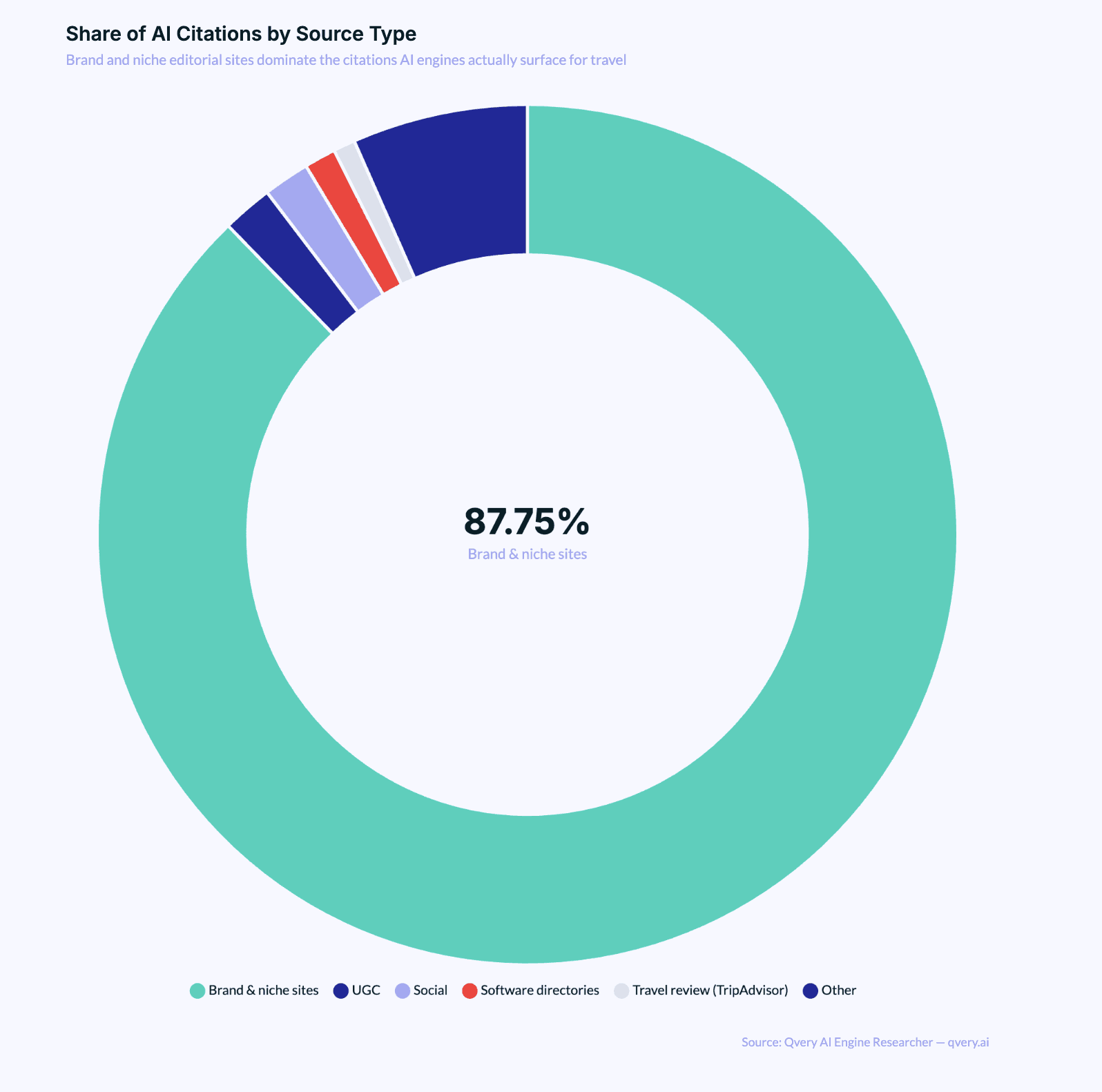
Travel is the most fragmented vertical we track. Brand websites and niche sites account for 87.75% of every citation AI engines hand out, measured across millions of AI citations on ChatGPT and Google AI Mode since January 2026.
That number includes brands' own pages, but the niche end of it is enormous and fragmented: 46.5% of all cited domains get cited exactly once. AI search spreads citations across thousands of small travel blogs you have never heard of, not a fixed leaderboard of big sites. It runs more like a phone book where half the entries are honeymoon diaries than like a top-10 chart.
If your whole AI visibility plan is winning a few big booking sites, you are fighting over the 3.5% of travel citations TripAdvisor already owns and ceding the rest. A destination guide a couple wrote after their honeymoon in Tulum gets cited, and so does a best-boutique-stays-in-Lisbon post with 400 monthly readers. No competitor has locked up that long tail. Bloggers own it.
Why The Long Tail Is The Whole Game In Travel
When someone asks an AI engine "where should I stay in Oaxaca for a week with kids," the engine does not pull a single authoritative source.
It pulls a family travel blog, a regional tourism site someone built in 2019, a "12 things to do in Oaxaca" roundup, and a TripAdvisor thread, blending all four into a single recommendation.
Google leans on a stable handful of high-authority sites; in travel, AI engines pull a wider, blog-heavier set where most cited domains appear only once. Many of those guides sit in the long tail, the 46.5% of cited domains that get cited exactly once across the dataset.
Travel also tracks Google's organic results more closely than any other vertical we measure: the AI-vs-Google SERP overlap in travel and tours is 26.8%, the highest of any vertical, nearly double the 13.9% overall overlap. The long tail shows up in the source-type mix, not in some gap between AI and Google.
SaaS concentrates the other way. There Reddit alone is the #3 most-cited domain, and a small set of well-known sources soak up most citations. Travel spreads thin and wide instead, which is exactly why a fragmented citation landscape rewards specificity over size.
The concentration math says the same thing from the other end. The top 50 domains across the dataset account for only about 20% of citations, and no single domain exceeds 3.5%, a dataset-wide ceiling that is a different 3.5% from TripAdvisor's within-travel share below. The rest is fragmented across thousands of niche guides, each one winnable on its own.
The aggregators still matter, just less than their reputation suggests. TripAdvisor over-indexes 4.3x in travel versus the dataset average, yet even within travel queries it is just 3.5% of citations. The rest of the visibility belongs to small guides, the kind a solo writer publishes between trips.
The Travel Citation Data Points One Direction: Editorial Blogs
The long tail runs deeper than people expect: 75.4% of all cited domains are cited five times or fewer. You do not defend a citation the way you defend a popular list. You find it, one niche guide at a time.
Reddit is quieter in travel than people assume. Across the dataset Reddit is the #2 most-cited well-known domain, but in travel specifically it sits at 0.75%, below the dataset average, and TripAdvisor and long-form destination guides absorb the citations Reddit gets in other verticals. That is worth knowing before you pour a quarter's budget into r/travel, where the travel citations were never living in the first place.
The review and directory sites are losing relative ground. Software review and directory sites combined sit at just 1.19% of all citations and declined sharply from January to March 2026. As the directories fade, first-hand editorial guides gain relative weight by default.
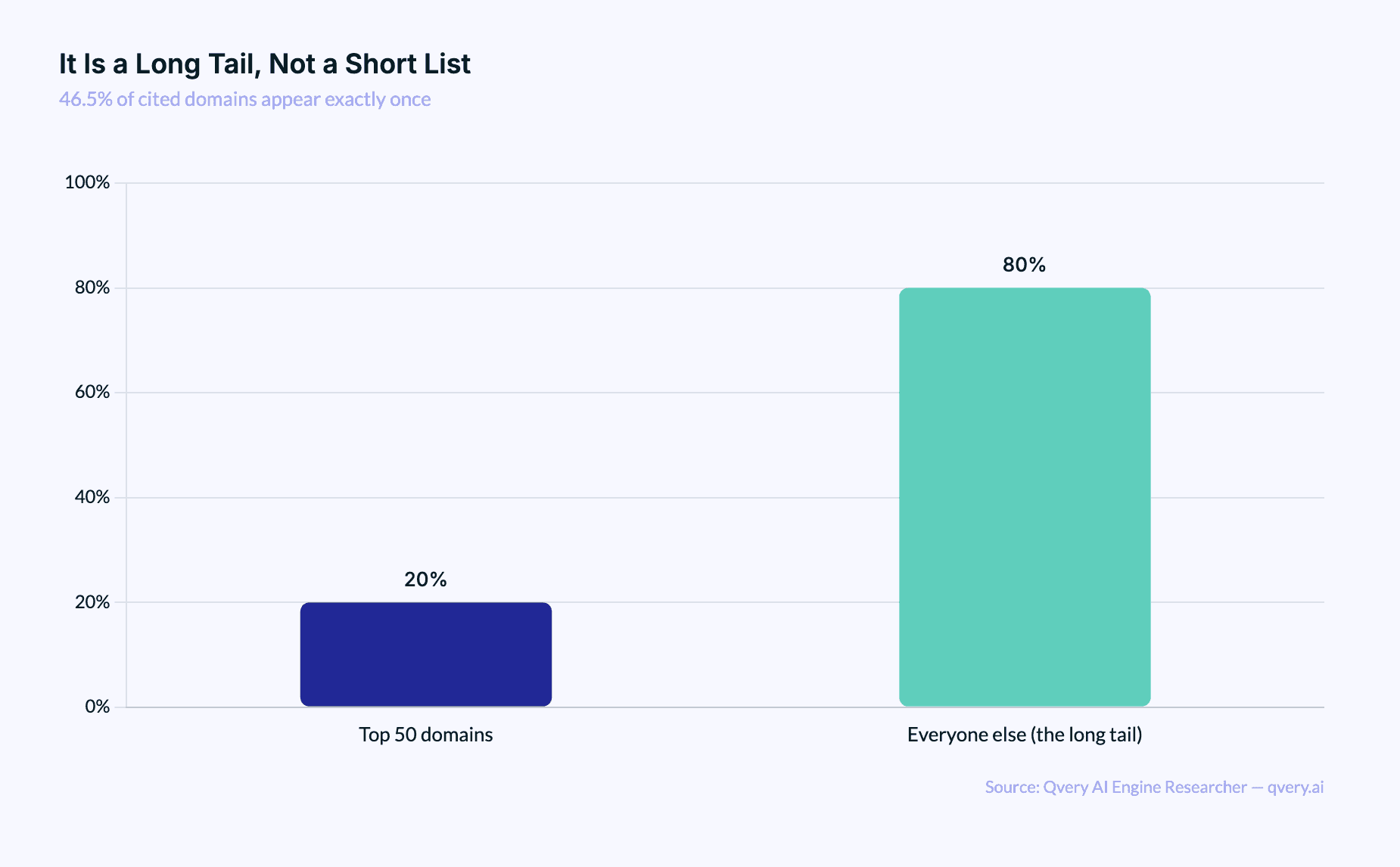
Put those together and you get a strategy a small travel brand can execute. You do not need to dethrone TripAdvisor. You need to be the named recommendation in two hundred one-off guides. Each gets cited once; together they outweigh any single big placement.
Citation breadth is insurance. Lose one guide and the other hundred and ninety-nine still answer the query, so the metric to track is how many distinct guides name you: distinct domains, counted, not placements booked.

Your Blogger Outreach Pipeline Already Lives In Your Citations View
We built the Citations view because manually hunting down which travel blogs cite you, one Google search at a time, is exactly the busywork we started Qvery to kill. You cannot pitch bloggers you have not identified, and you cannot prove the work paid off without a baseline. Both of those start in the Citations view of AI Engine Researcher.
Open the Citations view and filter to the Individual Blogger website-type tag. Qvery categorizes every citation by website type and article type as it comes in, so that one filter isolates the travel bloggers and destination guides citing your brand from the media publications, forums, review sites, and your own pages. Each row shows the domain, the exact URL, the citation weight, and which engine cited it, ChatGPT or Google AI Mode.
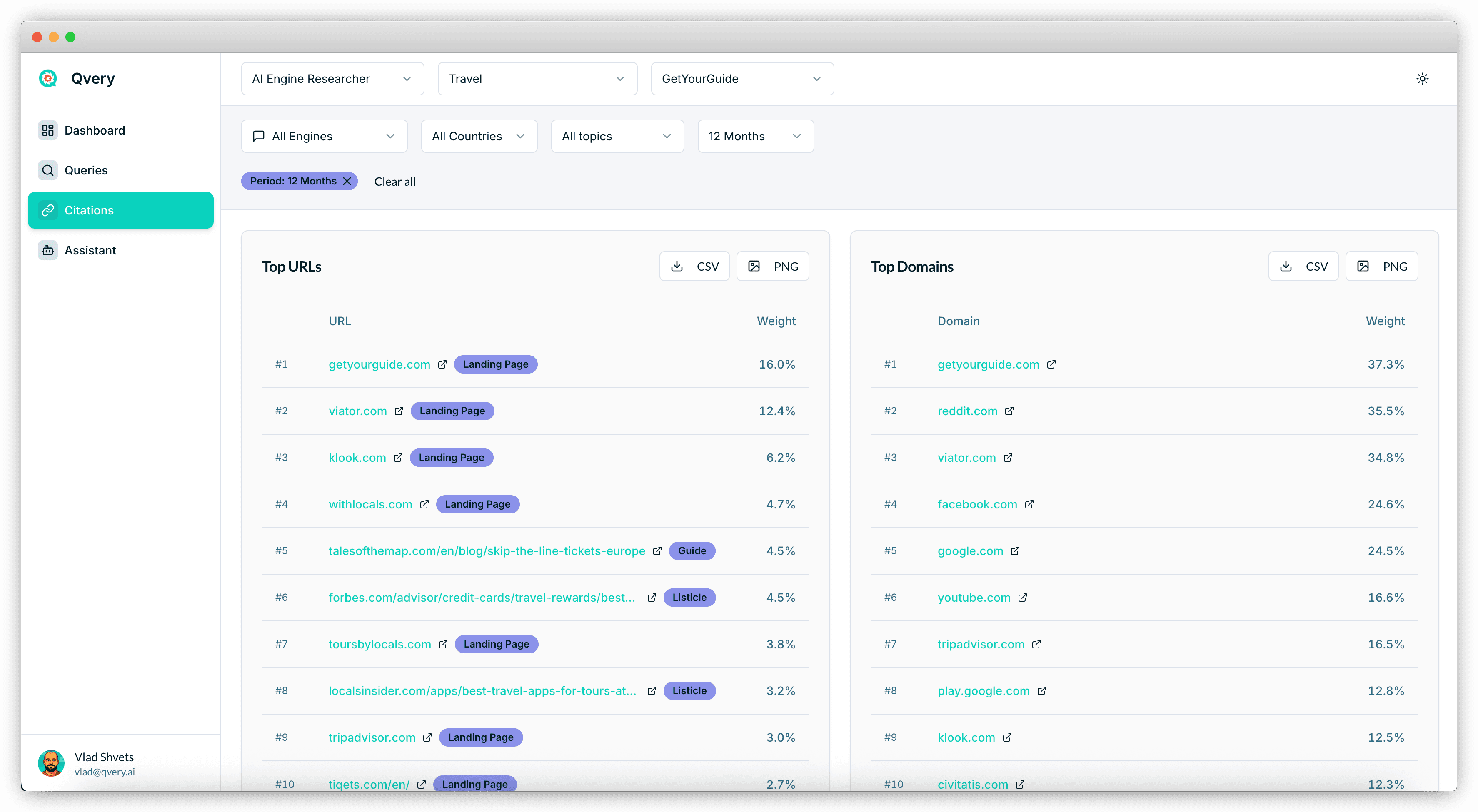
Here is what that looks like in practice. Say you run a boutique-hotel booking brand and you filter to Individual Blogger. The view shows your brand named in a handful of distinct travel guides, mostly on Google AI Mode, while your closest competitor shows up in roughly three times as many. That gap is not a vanity number. It is a specific set of URLs, each one a writer who covers your category and a post an engine already retrieves. The list is your pipeline before you have written a single email.
Next, read the tag breakdown so you know the shape of your footprint before you act. Citations carry two dimensions of tags, website type (Individual Blogger, Media Publication, Forum / Community, Software Review Site, and so on) and article type (Listicle, Review, How-To / Guide, Discussion, News). For most travel brands the strategy clicks here: blogger and listicle citations are large and fragmented while review-site citations shrink. The gap between them is your opening.
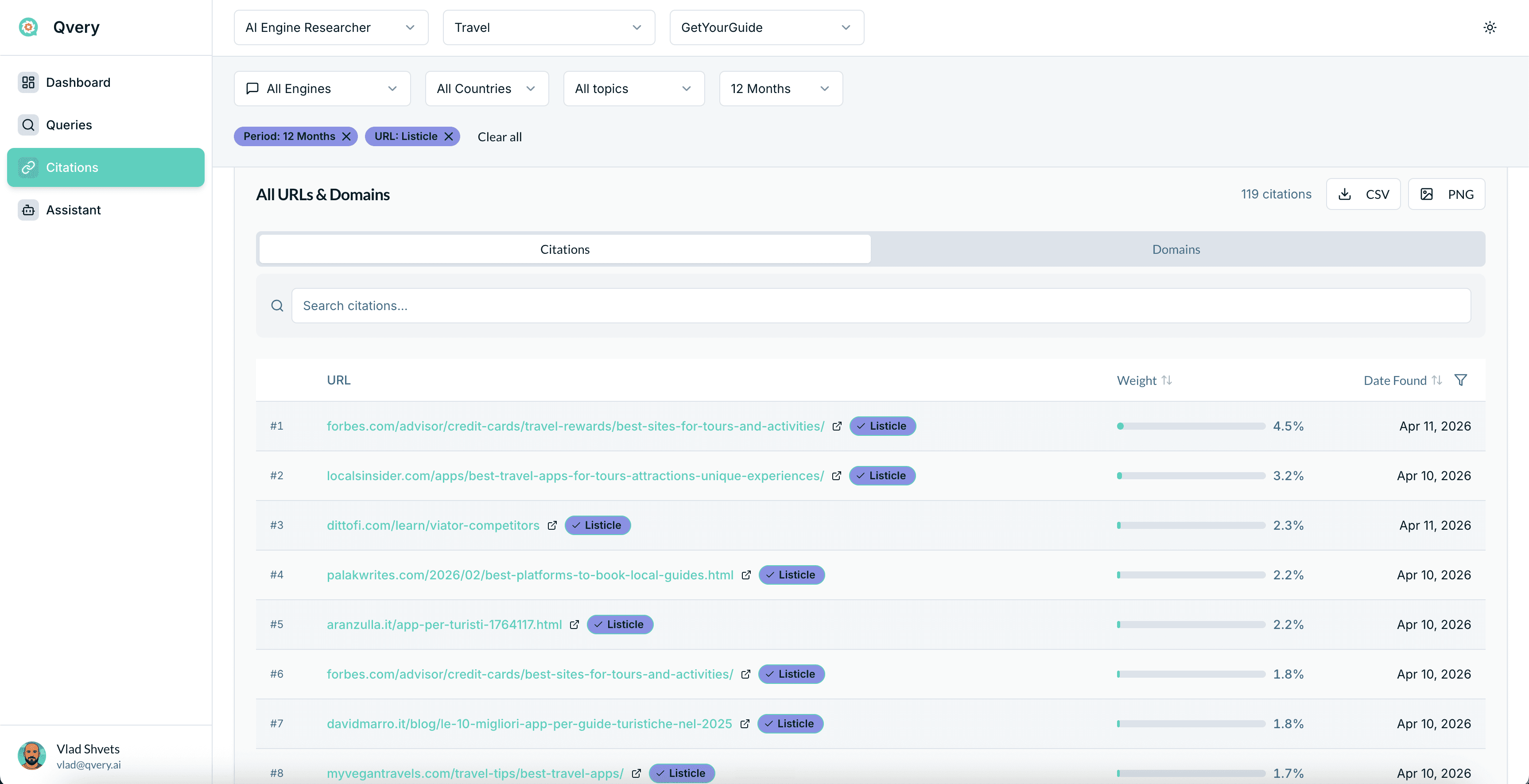
Then filter to citations where a competitor appears but your brand does not, to find the bloggers citing a rival and skipping you. Sorted by citation weight, that list is your outreach pipeline, so you start with the guides AI engines lean on most. A blogger who already recommends a competitor by name has shown they cover your category and write the kind of post engines cite. They are the warmest prospect you have.
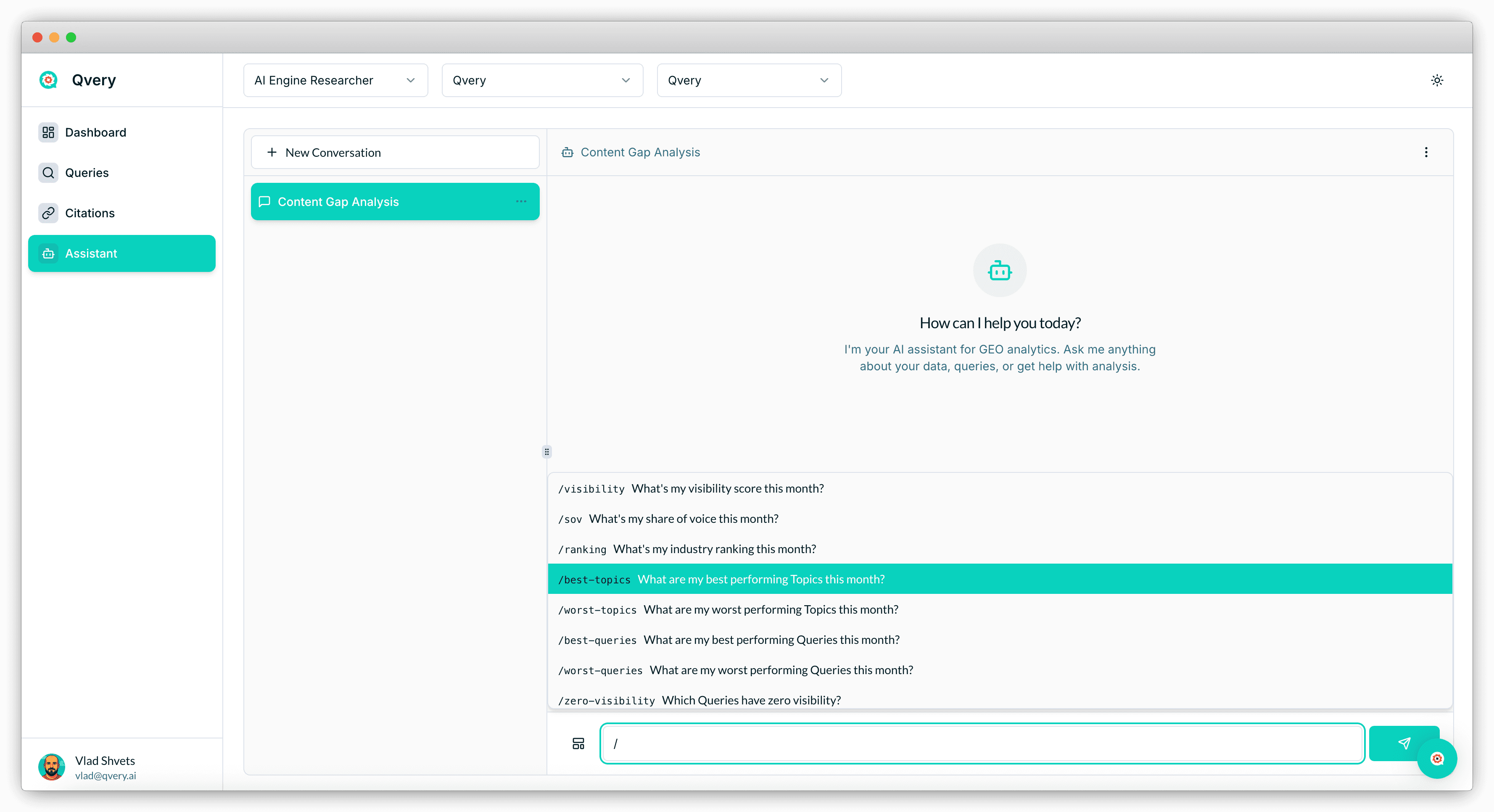
From there, export the filtered list straight from the Citations view, or ask the Qvery Assistant the /top-sources shortcut for your highest-weight citation sources in chat. When you are ready to turn that list into action, the UGC Agent is the agent that operationalizes blogger and forum discovery into outreach.
First-Hand Detail, Not Press Releases, Is What Bloggers Get Cited For
Knowing which bloggers AI engines cite gets you the target list. Earning a place in their next post is the harder part, and it is what moves your visibility.
Most of the travel brands we work with see the same thing: the footprint grows when outreach is a relationship, not a one-off placement. Here is what works, in order.
Pitch trusted bloggers. Use the competitor-gap list, not a media database you bought. A blogger who appears in your Citations view writes posts that engines retrieve. A blogger with a huge Instagram following but no citations in your category does not move your AI visibility (the algorithm has never heard of them, and neither has ChatGPT).
Hand over something only you can verify. The guides that get cited are specific: a real stay, original photos, a first-hand "we tried this and here is what went wrong." A price, a walk-time, an occupancy figure, anything only you can confirm gives the engine something concrete to quote with your name attached. The pitch that lands is not a paragraph of brand copy; it is three verifiable facts the writer cannot get anywhere else, plus a photo set and an offer to fact-check the section before it ships. A press release dressed as a guest post gets cited by no one.
Prioritize evergreen guides. AI engines favor evergreen content over time-sensitive news, which is why News makes up only 0.3% of Google AI Mode's classified content mix. A "best time to visit Patagonia" guide keeps getting cited for years. A press announcement about a seasonal promo stops mattering the week the promo ends. Spend the relationship capital on the post that compounds.
Build relationships. The long tail rewards breadth, so a single blogger who updates and expands their guide over years is worth more than ten cold placements that go stale. Writers cite the brand that answered their questions fast and gave them something concrete to quote. Do that often enough and you compound across guides.
Start By Comparing Your Blogger Footprint To Your Closest Competitor
The travel citation mix shifts every month. A source-type split that is true in June may move by August, and I am not going to pretend the exact numbers hold. But the direction has been steady all year: first-hand niche blog content gaining relative weight while the aggregators lose it. The precise figures are a moving target; the shape of the opportunity is not.
What that means for the next quarter:
Baseline first. Filter to Individual Blogger and record how many distinct guides name you today, by engine.
Find the gap. Run the competitor-gap filter and sort by citation weight to surface the guides citing a rival and skipping you.
Pitch the top of the list. Start with the highest-weight guides and lead every pitch with verifiable, first-hand detail.
Open your Citations view, filter to Individual Blogger, and put your footprint next to your closest competitor's. The widest gap, the bloggers citing them but not you, is your outreach list. Pitch those first.
Travel is the most fragmented vertical we track. Brand websites and niche sites account for 87.75% of every citation AI engines hand out, measured across millions of AI citations on ChatGPT and Google AI Mode since January 2026.
That number includes brands' own pages, but the niche end of it is enormous and fragmented: 46.5% of all cited domains get cited exactly once. AI search spreads citations across thousands of small travel blogs you have never heard of, not a fixed leaderboard of big sites. It runs more like a phone book where half the entries are honeymoon diaries than like a top-10 chart.
If your whole AI visibility plan is winning a few big booking sites, you are fighting over the 3.5% of travel citations TripAdvisor already owns and ceding the rest. A destination guide a couple wrote after their honeymoon in Tulum gets cited, and so does a best-boutique-stays-in-Lisbon post with 400 monthly readers. No competitor has locked up that long tail. Bloggers own it.
Why The Long Tail Is The Whole Game In Travel
When someone asks an AI engine "where should I stay in Oaxaca for a week with kids," the engine does not pull a single authoritative source.
It pulls a family travel blog, a regional tourism site someone built in 2019, a "12 things to do in Oaxaca" roundup, and a TripAdvisor thread, blending all four into a single recommendation.
Google leans on a stable handful of high-authority sites; in travel, AI engines pull a wider, blog-heavier set where most cited domains appear only once. Many of those guides sit in the long tail, the 46.5% of cited domains that get cited exactly once across the dataset.
Travel also tracks Google's organic results more closely than any other vertical we measure: the AI-vs-Google SERP overlap in travel and tours is 26.8%, the highest of any vertical, nearly double the 13.9% overall overlap. The long tail shows up in the source-type mix, not in some gap between AI and Google.
SaaS concentrates the other way. There Reddit alone is the #3 most-cited domain, and a small set of well-known sources soak up most citations. Travel spreads thin and wide instead, which is exactly why a fragmented citation landscape rewards specificity over size.
The concentration math says the same thing from the other end. The top 50 domains across the dataset account for only about 20% of citations, and no single domain exceeds 3.5%, a dataset-wide ceiling that is a different 3.5% from TripAdvisor's within-travel share below. The rest is fragmented across thousands of niche guides, each one winnable on its own.
The aggregators still matter, just less than their reputation suggests. TripAdvisor over-indexes 4.3x in travel versus the dataset average, yet even within travel queries it is just 3.5% of citations. The rest of the visibility belongs to small guides, the kind a solo writer publishes between trips.
The Travel Citation Data Points One Direction: Editorial Blogs
The long tail runs deeper than people expect: 75.4% of all cited domains are cited five times or fewer. You do not defend a citation the way you defend a popular list. You find it, one niche guide at a time.
Reddit is quieter in travel than people assume. Across the dataset Reddit is the #2 most-cited well-known domain, but in travel specifically it sits at 0.75%, below the dataset average, and TripAdvisor and long-form destination guides absorb the citations Reddit gets in other verticals. That is worth knowing before you pour a quarter's budget into r/travel, where the travel citations were never living in the first place.
The review and directory sites are losing relative ground. Software review and directory sites combined sit at just 1.19% of all citations and declined sharply from January to March 2026. As the directories fade, first-hand editorial guides gain relative weight by default.
Put those together and you get a strategy a small travel brand can execute. You do not need to dethrone TripAdvisor. You need to be the named recommendation in two hundred one-off guides. Each gets cited once; together they outweigh any single big placement.
Citation breadth is insurance. Lose one guide and the other hundred and ninety-nine still answer the query, so the metric to track is how many distinct guides name you: distinct domains, counted, not placements booked.
Your Blogger Outreach Pipeline Already Lives In Your Citations View
We built the Citations view because manually hunting down which travel blogs cite you, one Google search at a time, is exactly the busywork we started Qvery to kill. You cannot pitch bloggers you have not identified, and you cannot prove the work paid off without a baseline. Both of those start in the Citations view of AI Engine Researcher.
Open the Citations view and filter to the Individual Blogger website-type tag. Qvery categorizes every citation by website type and article type as it comes in, so that one filter isolates the travel bloggers and destination guides citing your brand from the media publications, forums, review sites, and your own pages. Each row shows the domain, the exact URL, the citation weight, and which engine cited it, ChatGPT or Google AI Mode.
Here is what that looks like in practice. Say you run a boutique-hotel booking brand and you filter to Individual Blogger. The view shows your brand named in a handful of distinct travel guides, mostly on Google AI Mode, while your closest competitor shows up in roughly three times as many. That gap is not a vanity number. It is a specific set of URLs, each one a writer who covers your category and a post an engine already retrieves. The list is your pipeline before you have written a single email.
Next, read the tag breakdown so you know the shape of your footprint before you act. Citations carry two dimensions of tags, website type (Individual Blogger, Media Publication, Forum / Community, Software Review Site, and so on) and article type (Listicle, Review, How-To / Guide, Discussion, News). For most travel brands the strategy clicks here: blogger and listicle citations are large and fragmented while review-site citations shrink. The gap between them is your opening.
Then filter to citations where a competitor appears but your brand does not, to find the bloggers citing a rival and skipping you. Sorted by citation weight, that list is your outreach pipeline, so you start with the guides AI engines lean on most. A blogger who already recommends a competitor by name has shown they cover your category and write the kind of post engines cite. They are the warmest prospect you have.
From there, export the filtered list straight from the Citations view, or ask the Qvery Assistant the /top-sources shortcut for your highest-weight citation sources in chat. When you are ready to turn that list into action, the UGC Agent is the agent that operationalizes blogger and forum discovery into outreach.
First-Hand Detail, Not Press Releases, Is What Bloggers Get Cited For
Knowing which bloggers AI engines cite gets you the target list. Earning a place in their next post is the harder part, and it is what moves your visibility.
Most of the travel brands we work with see the same thing: the footprint grows when outreach is a relationship, not a one-off placement. Here is what works, in order.
Pitch trusted bloggers. Use the competitor-gap list, not a media database you bought. A blogger who appears in your Citations view writes posts that engines retrieve. A blogger with a huge Instagram following but no citations in your category does not move your AI visibility (the algorithm has never heard of them, and neither has ChatGPT).
Hand over something only you can verify. The guides that get cited are specific: a real stay, original photos, a first-hand "we tried this and here is what went wrong." A price, a walk-time, an occupancy figure, anything only you can confirm gives the engine something concrete to quote with your name attached. The pitch that lands is not a paragraph of brand copy; it is three verifiable facts the writer cannot get anywhere else, plus a photo set and an offer to fact-check the section before it ships. A press release dressed as a guest post gets cited by no one.
Prioritize evergreen guides. AI engines favor evergreen content over time-sensitive news, which is why News makes up only 0.3% of Google AI Mode's classified content mix. A "best time to visit Patagonia" guide keeps getting cited for years. A press announcement about a seasonal promo stops mattering the week the promo ends. Spend the relationship capital on the post that compounds.
Build relationships. The long tail rewards breadth, so a single blogger who updates and expands their guide over years is worth more than ten cold placements that go stale. Writers cite the brand that answered their questions fast and gave them something concrete to quote. Do that often enough and you compound across guides.
Start By Comparing Your Blogger Footprint To Your Closest Competitor
The travel citation mix shifts every month. A source-type split that is true in June may move by August, and I am not going to pretend the exact numbers hold. But the direction has been steady all year: first-hand niche blog content gaining relative weight while the aggregators lose it. The precise figures are a moving target; the shape of the opportunity is not.
What that means for the next quarter:
Baseline first. Filter to Individual Blogger and record how many distinct guides name you today, by engine.
Find the gap. Run the competitor-gap filter and sort by citation weight to surface the guides citing a rival and skipping you.
Pitch the top of the list. Start with the highest-weight guides and lead every pitch with verifiable, first-hand detail.
Open your Citations view, filter to Individual Blogger, and put your footprint next to your closest competitor's. The widest gap, the bloggers citing them but not you, is your outreach list. Pitch those first.
Travel is the most fragmented vertical we track. Brand websites and niche sites account for 87.75% of every citation AI engines hand out, measured across millions of AI citations on ChatGPT and Google AI Mode since January 2026.
That number includes brands' own pages, but the niche end of it is enormous and fragmented: 46.5% of all cited domains get cited exactly once. AI search spreads citations across thousands of small travel blogs you have never heard of, not a fixed leaderboard of big sites. It runs more like a phone book where half the entries are honeymoon diaries than like a top-10 chart.
If your whole AI visibility plan is winning a few big booking sites, you are fighting over the 3.5% of travel citations TripAdvisor already owns and ceding the rest. A destination guide a couple wrote after their honeymoon in Tulum gets cited, and so does a best-boutique-stays-in-Lisbon post with 400 monthly readers. No competitor has locked up that long tail. Bloggers own it.
Why The Long Tail Is The Whole Game In Travel
When someone asks an AI engine "where should I stay in Oaxaca for a week with kids," the engine does not pull a single authoritative source.
It pulls a family travel blog, a regional tourism site someone built in 2019, a "12 things to do in Oaxaca" roundup, and a TripAdvisor thread, blending all four into a single recommendation.
Google leans on a stable handful of high-authority sites; in travel, AI engines pull a wider, blog-heavier set where most cited domains appear only once. Many of those guides sit in the long tail, the 46.5% of cited domains that get cited exactly once across the dataset.
Travel also tracks Google's organic results more closely than any other vertical we measure: the AI-vs-Google SERP overlap in travel and tours is 26.8%, the highest of any vertical, nearly double the 13.9% overall overlap. The long tail shows up in the source-type mix, not in some gap between AI and Google.
SaaS concentrates the other way. There Reddit alone is the #3 most-cited domain, and a small set of well-known sources soak up most citations. Travel spreads thin and wide instead, which is exactly why a fragmented citation landscape rewards specificity over size.
The concentration math says the same thing from the other end. The top 50 domains across the dataset account for only about 20% of citations, and no single domain exceeds 3.5%, a dataset-wide ceiling that is a different 3.5% from TripAdvisor's within-travel share below. The rest is fragmented across thousands of niche guides, each one winnable on its own.
The aggregators still matter, just less than their reputation suggests. TripAdvisor over-indexes 4.3x in travel versus the dataset average, yet even within travel queries it is just 3.5% of citations. The rest of the visibility belongs to small guides, the kind a solo writer publishes between trips.
The Travel Citation Data Points One Direction: Editorial Blogs
The long tail runs deeper than people expect: 75.4% of all cited domains are cited five times or fewer. You do not defend a citation the way you defend a popular list. You find it, one niche guide at a time.
Reddit is quieter in travel than people assume. Across the dataset Reddit is the #2 most-cited well-known domain, but in travel specifically it sits at 0.75%, below the dataset average, and TripAdvisor and long-form destination guides absorb the citations Reddit gets in other verticals. That is worth knowing before you pour a quarter's budget into r/travel, where the travel citations were never living in the first place.
The review and directory sites are losing relative ground. Software review and directory sites combined sit at just 1.19% of all citations and declined sharply from January to March 2026. As the directories fade, first-hand editorial guides gain relative weight by default.
Put those together and you get a strategy a small travel brand can execute. You do not need to dethrone TripAdvisor. You need to be the named recommendation in two hundred one-off guides. Each gets cited once; together they outweigh any single big placement.
Citation breadth is insurance. Lose one guide and the other hundred and ninety-nine still answer the query, so the metric to track is how many distinct guides name you: distinct domains, counted, not placements booked.
Your Blogger Outreach Pipeline Already Lives In Your Citations View
We built the Citations view because manually hunting down which travel blogs cite you, one Google search at a time, is exactly the busywork we started Qvery to kill. You cannot pitch bloggers you have not identified, and you cannot prove the work paid off without a baseline. Both of those start in the Citations view of AI Engine Researcher.
Open the Citations view and filter to the Individual Blogger website-type tag. Qvery categorizes every citation by website type and article type as it comes in, so that one filter isolates the travel bloggers and destination guides citing your brand from the media publications, forums, review sites, and your own pages. Each row shows the domain, the exact URL, the citation weight, and which engine cited it, ChatGPT or Google AI Mode.
Here is what that looks like in practice. Say you run a boutique-hotel booking brand and you filter to Individual Blogger. The view shows your brand named in a handful of distinct travel guides, mostly on Google AI Mode, while your closest competitor shows up in roughly three times as many. That gap is not a vanity number. It is a specific set of URLs, each one a writer who covers your category and a post an engine already retrieves. The list is your pipeline before you have written a single email.
Next, read the tag breakdown so you know the shape of your footprint before you act. Citations carry two dimensions of tags, website type (Individual Blogger, Media Publication, Forum / Community, Software Review Site, and so on) and article type (Listicle, Review, How-To / Guide, Discussion, News). For most travel brands the strategy clicks here: blogger and listicle citations are large and fragmented while review-site citations shrink. The gap between them is your opening.
Then filter to citations where a competitor appears but your brand does not, to find the bloggers citing a rival and skipping you. Sorted by citation weight, that list is your outreach pipeline, so you start with the guides AI engines lean on most. A blogger who already recommends a competitor by name has shown they cover your category and write the kind of post engines cite. They are the warmest prospect you have.
From there, export the filtered list straight from the Citations view, or ask the Qvery Assistant the /top-sources shortcut for your highest-weight citation sources in chat. When you are ready to turn that list into action, the UGC Agent is the agent that operationalizes blogger and forum discovery into outreach.
First-Hand Detail, Not Press Releases, Is What Bloggers Get Cited For
Knowing which bloggers AI engines cite gets you the target list. Earning a place in their next post is the harder part, and it is what moves your visibility.
Most of the travel brands we work with see the same thing: the footprint grows when outreach is a relationship, not a one-off placement. Here is what works, in order.
Pitch trusted bloggers. Use the competitor-gap list, not a media database you bought. A blogger who appears in your Citations view writes posts that engines retrieve. A blogger with a huge Instagram following but no citations in your category does not move your AI visibility (the algorithm has never heard of them, and neither has ChatGPT).
Hand over something only you can verify. The guides that get cited are specific: a real stay, original photos, a first-hand "we tried this and here is what went wrong." A price, a walk-time, an occupancy figure, anything only you can confirm gives the engine something concrete to quote with your name attached. The pitch that lands is not a paragraph of brand copy; it is three verifiable facts the writer cannot get anywhere else, plus a photo set and an offer to fact-check the section before it ships. A press release dressed as a guest post gets cited by no one.
Prioritize evergreen guides. AI engines favor evergreen content over time-sensitive news, which is why News makes up only 0.3% of Google AI Mode's classified content mix. A "best time to visit Patagonia" guide keeps getting cited for years. A press announcement about a seasonal promo stops mattering the week the promo ends. Spend the relationship capital on the post that compounds.
Build relationships. The long tail rewards breadth, so a single blogger who updates and expands their guide over years is worth more than ten cold placements that go stale. Writers cite the brand that answered their questions fast and gave them something concrete to quote. Do that often enough and you compound across guides.
Start By Comparing Your Blogger Footprint To Your Closest Competitor
The travel citation mix shifts every month. A source-type split that is true in June may move by August, and I am not going to pretend the exact numbers hold. But the direction has been steady all year: first-hand niche blog content gaining relative weight while the aggregators lose it. The precise figures are a moving target; the shape of the opportunity is not.
What that means for the next quarter:
Baseline first. Filter to Individual Blogger and record how many distinct guides name you today, by engine.
Find the gap. Run the competitor-gap filter and sort by citation weight to surface the guides citing a rival and skipping you.
Pitch the top of the list. Start with the highest-weight guides and lead every pitch with verifiable, first-hand detail.
Open your Citations view, filter to Individual Blogger, and put your footprint next to your closest competitor's. The widest gap, the bloggers citing them but not you, is your outreach list. Pitch those first.
Travel is the most fragmented vertical we track. Brand websites and niche sites account for 87.75% of every citation AI engines hand out, measured across millions of AI citations on ChatGPT and Google AI Mode since January 2026.
That number includes brands' own pages, but the niche end of it is enormous and fragmented: 46.5% of all cited domains get cited exactly once. AI search spreads citations across thousands of small travel blogs you have never heard of, not a fixed leaderboard of big sites. It runs more like a phone book where half the entries are honeymoon diaries than like a top-10 chart.
If your whole AI visibility plan is winning a few big booking sites, you are fighting over the 3.5% of travel citations TripAdvisor already owns and ceding the rest. A destination guide a couple wrote after their honeymoon in Tulum gets cited, and so does a best-boutique-stays-in-Lisbon post with 400 monthly readers. No competitor has locked up that long tail. Bloggers own it.
Why The Long Tail Is The Whole Game In Travel
When someone asks an AI engine "where should I stay in Oaxaca for a week with kids," the engine does not pull a single authoritative source.
It pulls a family travel blog, a regional tourism site someone built in 2019, a "12 things to do in Oaxaca" roundup, and a TripAdvisor thread, blending all four into a single recommendation.
Google leans on a stable handful of high-authority sites; in travel, AI engines pull a wider, blog-heavier set where most cited domains appear only once. Many of those guides sit in the long tail, the 46.5% of cited domains that get cited exactly once across the dataset.
Travel also tracks Google's organic results more closely than any other vertical we measure: the AI-vs-Google SERP overlap in travel and tours is 26.8%, the highest of any vertical, nearly double the 13.9% overall overlap. The long tail shows up in the source-type mix, not in some gap between AI and Google.
SaaS concentrates the other way. There Reddit alone is the #3 most-cited domain, and a small set of well-known sources soak up most citations. Travel spreads thin and wide instead, which is exactly why a fragmented citation landscape rewards specificity over size.
The concentration math says the same thing from the other end. The top 50 domains across the dataset account for only about 20% of citations, and no single domain exceeds 3.5%, a dataset-wide ceiling that is a different 3.5% from TripAdvisor's within-travel share below. The rest is fragmented across thousands of niche guides, each one winnable on its own.
The aggregators still matter, just less than their reputation suggests. TripAdvisor over-indexes 4.3x in travel versus the dataset average, yet even within travel queries it is just 3.5% of citations. The rest of the visibility belongs to small guides, the kind a solo writer publishes between trips.
The Travel Citation Data Points One Direction: Editorial Blogs
The long tail runs deeper than people expect: 75.4% of all cited domains are cited five times or fewer. You do not defend a citation the way you defend a popular list. You find it, one niche guide at a time.
Reddit is quieter in travel than people assume. Across the dataset Reddit is the #2 most-cited well-known domain, but in travel specifically it sits at 0.75%, below the dataset average, and TripAdvisor and long-form destination guides absorb the citations Reddit gets in other verticals. That is worth knowing before you pour a quarter's budget into r/travel, where the travel citations were never living in the first place.
The review and directory sites are losing relative ground. Software review and directory sites combined sit at just 1.19% of all citations and declined sharply from January to March 2026. As the directories fade, first-hand editorial guides gain relative weight by default.
Put those together and you get a strategy a small travel brand can execute. You do not need to dethrone TripAdvisor. You need to be the named recommendation in two hundred one-off guides. Each gets cited once; together they outweigh any single big placement.
Citation breadth is insurance. Lose one guide and the other hundred and ninety-nine still answer the query, so the metric to track is how many distinct guides name you: distinct domains, counted, not placements booked.
Your Blogger Outreach Pipeline Already Lives In Your Citations View
We built the Citations view because manually hunting down which travel blogs cite you, one Google search at a time, is exactly the busywork we started Qvery to kill. You cannot pitch bloggers you have not identified, and you cannot prove the work paid off without a baseline. Both of those start in the Citations view of AI Engine Researcher.
Open the Citations view and filter to the Individual Blogger website-type tag. Qvery categorizes every citation by website type and article type as it comes in, so that one filter isolates the travel bloggers and destination guides citing your brand from the media publications, forums, review sites, and your own pages. Each row shows the domain, the exact URL, the citation weight, and which engine cited it, ChatGPT or Google AI Mode.
Here is what that looks like in practice. Say you run a boutique-hotel booking brand and you filter to Individual Blogger. The view shows your brand named in a handful of distinct travel guides, mostly on Google AI Mode, while your closest competitor shows up in roughly three times as many. That gap is not a vanity number. It is a specific set of URLs, each one a writer who covers your category and a post an engine already retrieves. The list is your pipeline before you have written a single email.
Next, read the tag breakdown so you know the shape of your footprint before you act. Citations carry two dimensions of tags, website type (Individual Blogger, Media Publication, Forum / Community, Software Review Site, and so on) and article type (Listicle, Review, How-To / Guide, Discussion, News). For most travel brands the strategy clicks here: blogger and listicle citations are large and fragmented while review-site citations shrink. The gap between them is your opening.
Then filter to citations where a competitor appears but your brand does not, to find the bloggers citing a rival and skipping you. Sorted by citation weight, that list is your outreach pipeline, so you start with the guides AI engines lean on most. A blogger who already recommends a competitor by name has shown they cover your category and write the kind of post engines cite. They are the warmest prospect you have.
From there, export the filtered list straight from the Citations view, or ask the Qvery Assistant the /top-sources shortcut for your highest-weight citation sources in chat. When you are ready to turn that list into action, the UGC Agent is the agent that operationalizes blogger and forum discovery into outreach.
First-Hand Detail, Not Press Releases, Is What Bloggers Get Cited For
Knowing which bloggers AI engines cite gets you the target list. Earning a place in their next post is the harder part, and it is what moves your visibility.
Most of the travel brands we work with see the same thing: the footprint grows when outreach is a relationship, not a one-off placement. Here is what works, in order.
Pitch trusted bloggers. Use the competitor-gap list, not a media database you bought. A blogger who appears in your Citations view writes posts that engines retrieve. A blogger with a huge Instagram following but no citations in your category does not move your AI visibility (the algorithm has never heard of them, and neither has ChatGPT).
Hand over something only you can verify. The guides that get cited are specific: a real stay, original photos, a first-hand "we tried this and here is what went wrong." A price, a walk-time, an occupancy figure, anything only you can confirm gives the engine something concrete to quote with your name attached. The pitch that lands is not a paragraph of brand copy; it is three verifiable facts the writer cannot get anywhere else, plus a photo set and an offer to fact-check the section before it ships. A press release dressed as a guest post gets cited by no one.
Prioritize evergreen guides. AI engines favor evergreen content over time-sensitive news, which is why News makes up only 0.3% of Google AI Mode's classified content mix. A "best time to visit Patagonia" guide keeps getting cited for years. A press announcement about a seasonal promo stops mattering the week the promo ends. Spend the relationship capital on the post that compounds.
Build relationships. The long tail rewards breadth, so a single blogger who updates and expands their guide over years is worth more than ten cold placements that go stale. Writers cite the brand that answered their questions fast and gave them something concrete to quote. Do that often enough and you compound across guides.
Start By Comparing Your Blogger Footprint To Your Closest Competitor
The travel citation mix shifts every month. A source-type split that is true in June may move by August, and I am not going to pretend the exact numbers hold. But the direction has been steady all year: first-hand niche blog content gaining relative weight while the aggregators lose it. The precise figures are a moving target; the shape of the opportunity is not.
What that means for the next quarter:
Baseline first. Filter to Individual Blogger and record how many distinct guides name you today, by engine.
Find the gap. Run the competitor-gap filter and sort by citation weight to surface the guides citing a rival and skipping you.
Pitch the top of the list. Start with the highest-weight guides and lead every pitch with verifiable, first-hand detail.
Open your Citations view, filter to Individual Blogger, and put your footprint next to your closest competitor's. The widest gap, the bloggers citing them but not you, is your outreach list. Pitch those first.

© 2026 Qvery AI OÜ