By
Vlad Shvets
8 Best AI Visibility Tools for SaaS Brands (Compared)
Eight AI visibility tools read against what a SaaS team needs: being named on category questions, share of voice, cited sources, several products, and the plan that covers both engines.
Eight AI visibility tools read against what a SaaS team needs: being named on category questions, share of voice, cited sources, several products, and the plan that covers both engines.
Eight AI visibility tools read against what a SaaS team needs: being named on category questions, share of voice, cited sources, several products, and the plan that covers both engines.
A buyer types "best CRM for a five-person sales team" into ChatGPT and gets four names back, which is now a shortlist whether your sales team likes it or not. Review sites sit in that layer: in our September SaaS study, G2 was cited in 8.75% of recommendation answers (63 of 720 valid answers, ChatGPT and Google AI Mode pooled).
The eight tools below were chosen by rule: Qvery first, since we publish this, then the five highest-ranked tools on our leaderboard that document both engines and publish prices, then the two that document the most of five SaaS criteria. Dageno AI and LLMrefs tied on those criteria and were cut at the cap. Every page was read, and every price checked, in September 2026.
The Five Things a SaaS Team Needs a Tracker to Show
Software gets bought on category questions, not on brand names, so a tracker earns its fee on five things.
Being named in the answer. Whether the product shows up when someone asks for the best tool in its category. Every tool here documents some version of this, in words like "appears", "mentioned" or "presence".
Share of voice against rivals. Category answers name several vendors, so your share only means something next to your competitors'. Documented by Qvery, Peec AI, AthenaHQ, Superlines, Ahrefs (for AI Mode), and Scrunch as a plan row; OtterlyAI and Profound do not document it.
Cited sources. Which pages each answer drew on: G2, a rival's comparison page, or your own docs. All eight document this somewhere.
Several brands in one account. A company with two products, or a parent with several brands, needs each measured on its own. Documented by Peec AI, AthenaHQ, Superlines, OtterlyAI, and Profound, and by Qvery and Scrunch on a named tier; Ahrefs does not document it.
Category and use-case questions. "Best CRM for startups" rather than your product name. Every tool here documents tracking prompts you write, Profound on Enterprise and Scrunch as a plan row, and Peec AI, AthenaHQ, Superlines, and OtterlyAI write about category questions by name. None ships a ready-made SaaS question set.
Documented means the vendor's own page says it. Not documented means the page is silent, which is a demo question and never a verdict; no vendor here says outright that it lacks any of the five.
Tracking both ChatGPT and Google AI Mode is the entry bar for this list, but the plan that covers both is often not the cheapest one, so each entry names that plan separately. Our guide to generating LLM tracking queries covers building the question list you will bring to each demo.
Eight tools, eight ways of saying your brand came up. None documents whether it was the brand the engine recommended.
1. Qvery: Your Category Questions, Run Daily in Both Engines
Key Features:
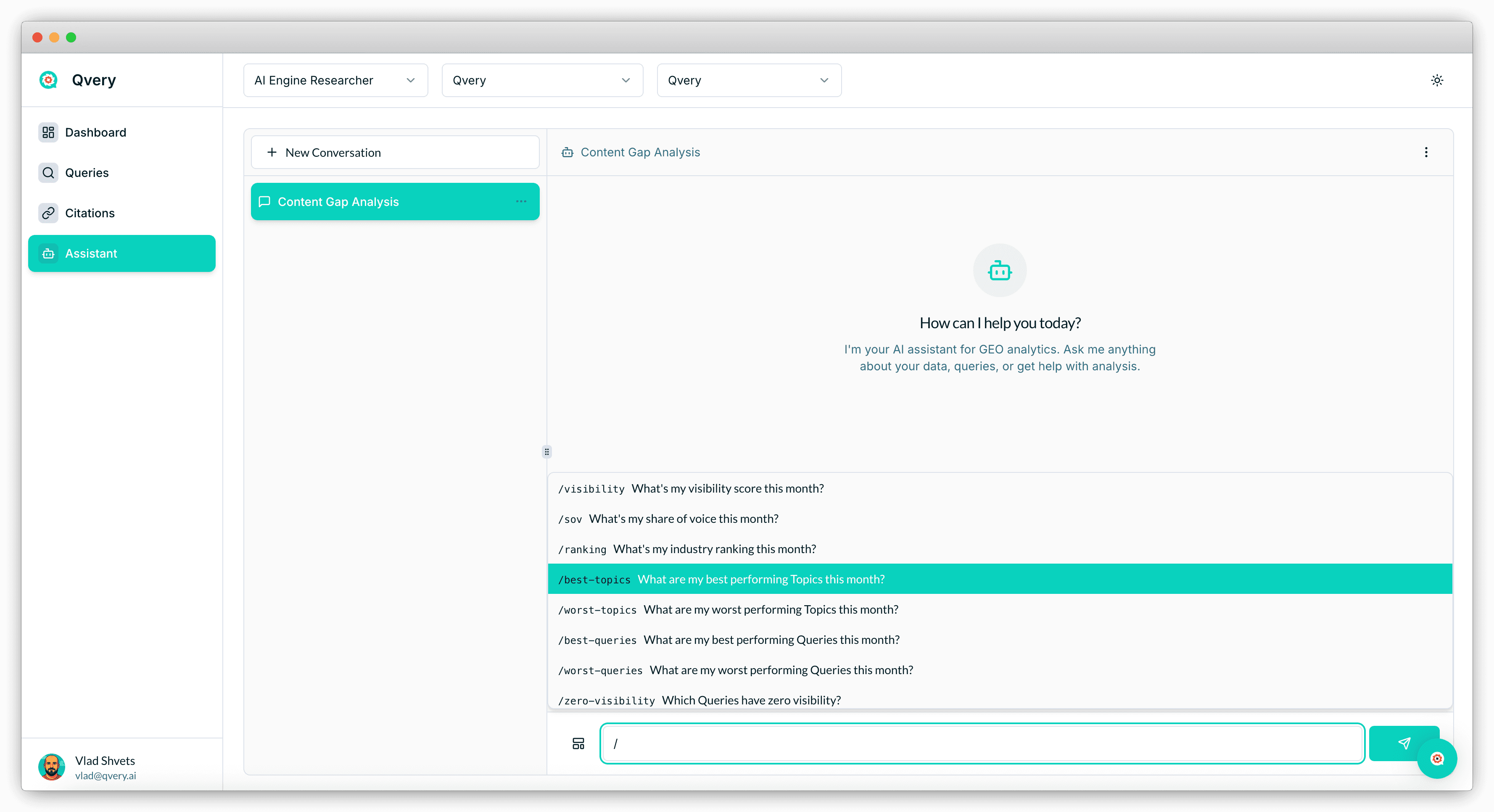
Visibility, share of voice, and average rank in ChatGPT and Google AI Mode, updated daily, in 200+ countries.
Citations tied to their source question, so each cited page is attached to the query and engine that produced it.
Queries you write: topics and queries are generated at onboarding, then you add and edit the category and use-case questions buyers ask.
Qvery Assistant answers plain-language questions about your own visibility, citation, topic, and query data, and can add queries, run a data refresh, or export a report.
Pricing:
Starter: €49 per month, 1 brand, 25 tracked queries.
Growth: €99 per month, 1 brand, 50 tracked queries.
Business: €199, unlimited brands, 100 tracked queries (the page prints no billing period for this tier).
Both engines, daily runs, unlimited countries, and unlimited seats are on every tier, including Starter.
Reddit Score: 85.0% Positive, over 20 mentions about the tool. What redditors say:
"tracking mentions in local publications and external sites is key for AI visibility, like Qvery AI does." (r/smallbusiness)
Start with the states. On every tier, Qvery documents being named (as visibility, share of voice, and rank), share of voice, cited sources, and your own category questions. The fifth, several brands, is on Business, which the pricing page lists as "Unlimited Brands".
What it does not claim is a recommended-versus-mentioned status, and no SaaS-specific question set ships with it; you bring the questions. We publish this list, so hold our entry to the same five criteria as everyone else's. Start your free trial, with 7 days free on the paid plans and no credit card.
2. Peec AI: A CRM Prompt on Its Own Homepage
Key Features:
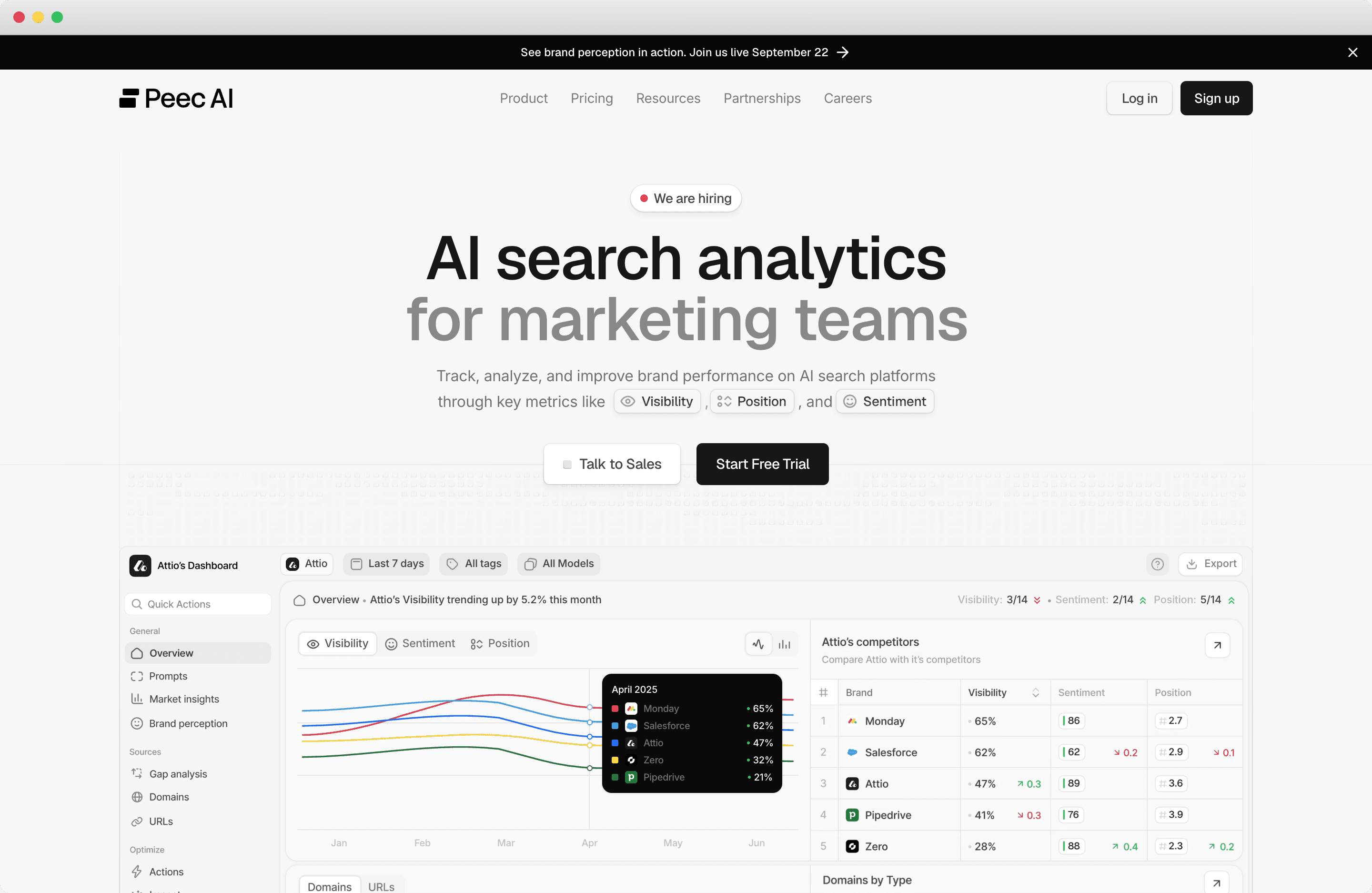
Visibility defined as the "Percentage of AI responses where your brand appears."
Share of voice against every tracked brand in the same answers.
Sources and citations by URL and domain, named separately for ChatGPT and Google AI Mode.
Multi-brand tracking, and a category prompt ("What are the best CRMs for Startups?") shown as an example on its homepage.
Pricing:
Starter: $95 per month, 50 prompts, choose 3 models.
Pro: $245 per month, 150 prompts, choose 3 models.
Advanced: $495 per month, 350 prompts, choose 3 models, multi-country.
Enterprise: custom, billed annually, all models, API access.
Reddit Score: 68.6% Positive, over 51 mentions about the tool. What redditors say:
"I have only tested Peec and have been very satisfied." (r/SaaS)
At 51 mentions this is the most-discussed dedicated tracker on the list, so the score rests on a reasonable base.
Peec AI documents each of the five criteria in writing, and the homepage example is a SaaS category question, which saves you imagining how your own will look. For a product marketer that is the closest thing on this list to a screenshot of the job.
On plans, its pages say ChatGPT and Google AI Mode are "Included by default in every plan", while each self-serve tier reads "Choose 3 models". Ask whether both engines count inside your three, and whether it can separate a recommendation from a mention.
3. AthenaHQ: Software Teams Named in Its Own Case Copy
Key Features:
Brand mention frequency tracking, with competitor share of voice comparison.
Source Intelligence, which it describes as revealing "the sources shaping AI answers."
Several brands and business units tracked centrally, by its own account.
Evaluation-stage prompts: "Athena helped software teams win evaluation-stage prompts by increasing citation coverage, recommendation rate, and share of voice."
Pricing:
Essential: free, with $25 of credit and 300 credits; its engine list leaves out Google AI Mode.
Starter: $295 per month, 3,600 credits, AI Mode included; API access and extra credits cost more.
Enterprise: custom, adding multi-region and multi-language support.
Reddit Score: 57.1% Positive, over 7 mentions about the tool. What redditors say:
A SaaS team comparing content-and-visibility tools in r/SaaS filed Athena HQ, with Otterly and Scrunch AI, as too basic for its full content workflow; the poster says they know the team of the tool they picked. (r/SaaS)
Seven mentions is enough for a score and not much more.
AthenaHQ documents every criterion, two of them in customer-result sentences, so read those as AthenaHQ's words about its clients rather than a feature list. Its "recommendation rate" is named but not defined on the page.
Both engines start at Starter, $295 a month. Ask how "recommendation rate" is counted, whether it separates recommended from mentioned in each engine, and how many credits one run of your question list burns.
4. Superlines: A Governed Prompt Set, Three Engines at a Time
Key Features:
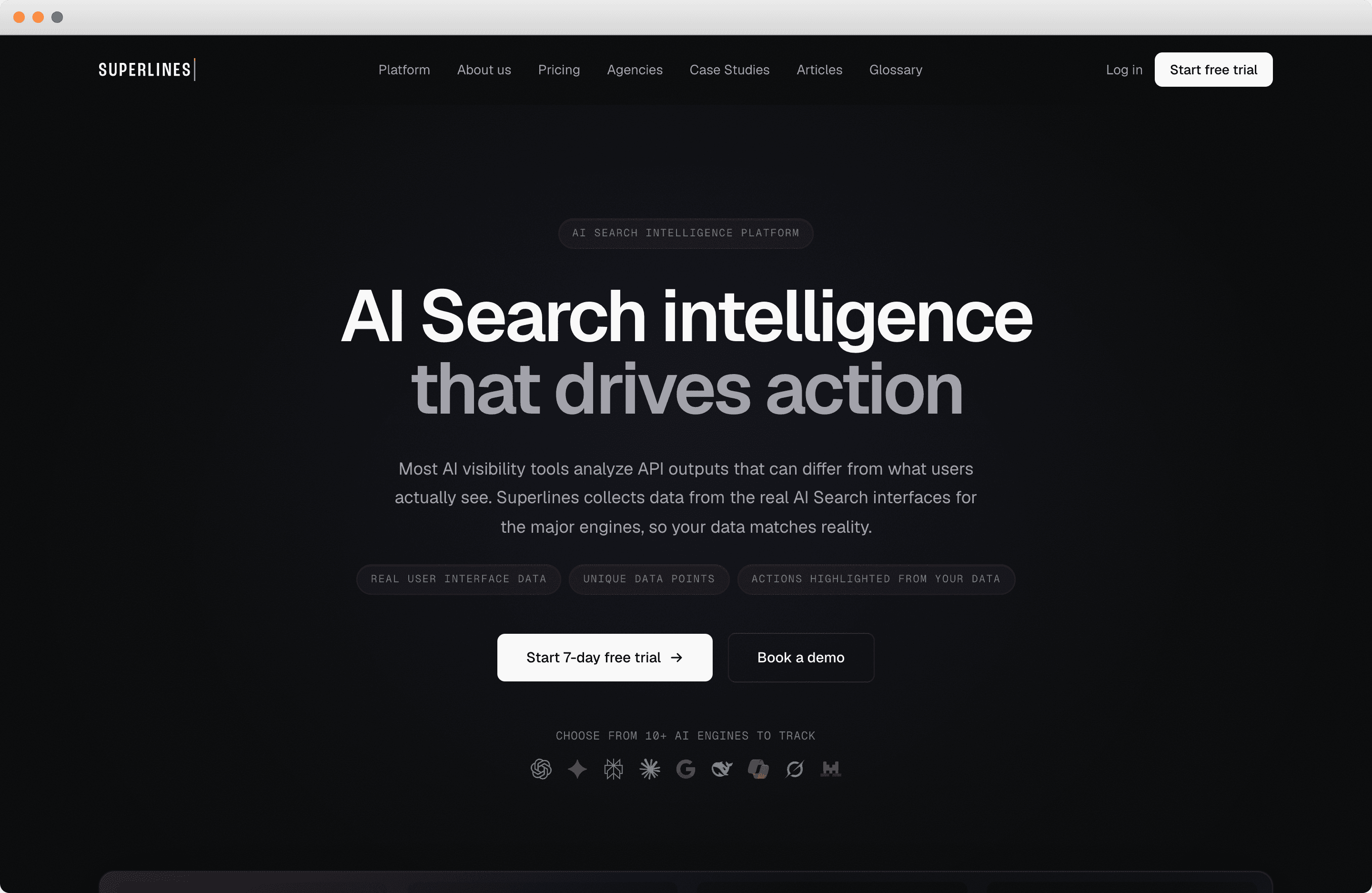
Category prompt sets: "Build a governed set of tracked prompts for your category, use cases, and competitors."
Where your brand appears in AI answers, tracked continuously.
Share of mentions against competitors, with trend data.
Labeled sources for every citation, plus data through an MCP server or REST API.
Pricing:
Starter: €79 per month, or €69 per month billed annually, 50 prompts, 1 brand.
Pro: €199 per month, or €175 per month billed annually, 150 prompts, 3 brands.
Growth: €379 per month, or €333 per month billed annually, 300 prompts, 7 brands.
Enterprise: custom ("Tailored pricing"), up to 10 answer engines, unlimited brands.
Each tier below Enterprise says "Pick any 3 answer engines", so ChatGPT and Google AI Mode take two of the three.
Reddit Score: Too few mentions to score. We found one mention, and a score needs five.
Superlines documents every criterion, and its prompt-set line reads like it was written for a SaaS product marketer: category, use cases, competitors, in that order. Its brand ladder (one, three, seven, unlimited) makes the several-products question easy to price.
Both engines fit on Starter if you spend two picks on them, leaving one for anything else. Ask whether its sources are individual URLs, and whether it can tell a recommendation from a mention.
5. OtterlyAI: Category Research With Google AI Mode Sold Separately
Key Features:
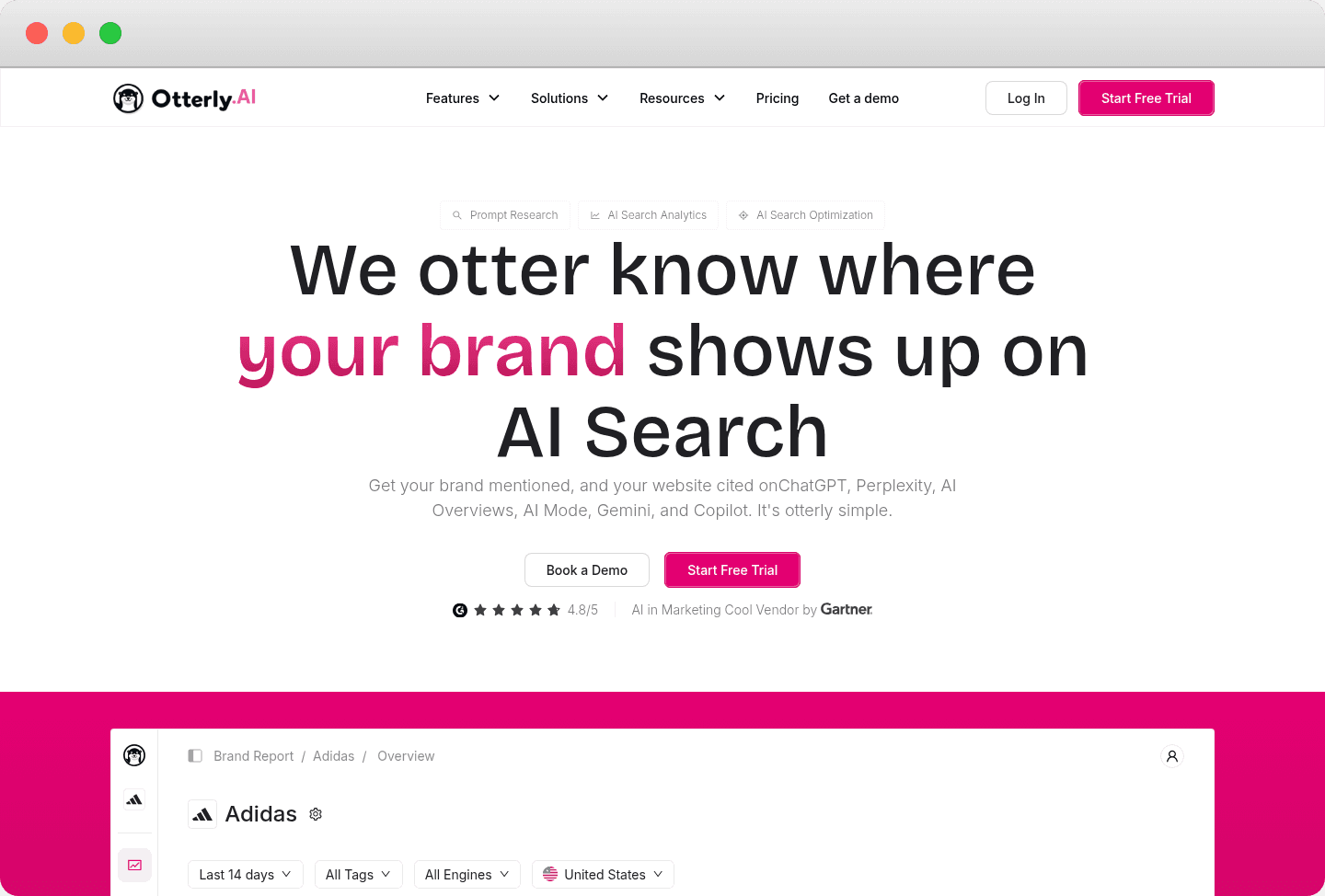
Mention tracking: "Know when you're mentioned, when you're not, and how you stack up against competitors."
Category research: "Uncover prompts, topics, and intent patterns that drive AI-generated answers in your category."
Every domain and URL cited, checked daily, with link-position changes.
Workspaces for several brands: 1 on Lite, unlimited on Standard and Premium.
Pricing:
Lite: $29 per month, 15 prompts, or $25 per month billed annually.
Standard: $189 per month, 100 prompts, or $160 per month billed annually.
Premium: $489 per month, 400 prompts, or $422 per month billed annually.
Enterprise: custom, from 1,000 prompts.
The self-serve tiers track ChatGPT, Google AI Overviews, Perplexity, and MS Copilot. Google AI Mode is an add-on: $9 on Lite, $59 on Standard, $149 on Premium, per month.
Reddit Score: 69.2% Positive, over 13 mentions about the tool. What redditors say:
A r/SaaS roundup of AI search trackers credits it with user-friendly dashboards, unlimited brand reports, and link citation analysis. (r/SaaS)
The r/SaaS content-workflow comparison mentioned under AthenaHQ put Otterly in the same too-basic group. (r/SaaS)
OtterlyAI documents being named, cited URLs, several workspaces, and category research, and its category-research line is the one to test first for a SaaS team. "How you stack up against competitors" is not written as share of voice, so share of voice stays a demo question.
The both-engine price is the tier plus the add-on: Lite comes to $38 a month and Standard to $248. Ask to see a share-of-voice view and a recommended-versus-mentioned split before choosing a tier.
6. Profound: Agency Mode for Several Products
Key Features:
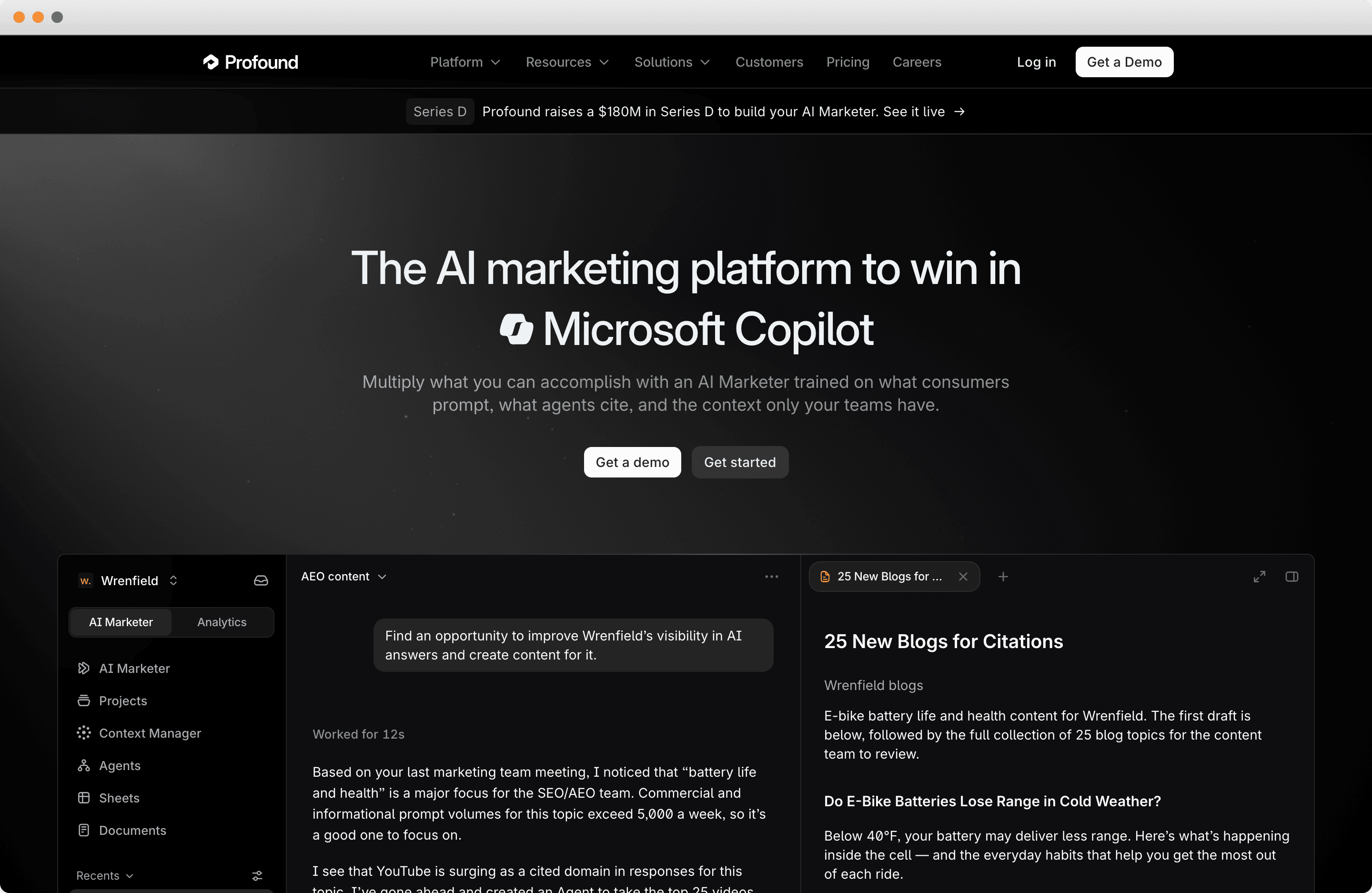
Answer Engine Insights, which "Tracks how AI answer engines mention, rank, and describe a brand."
Citation Analysis of the websites that influence answers about you.
Agency Mode, managing several brand environments in one platform.
Up to nine engines on Enterprise, Google AI Mode among them.
Pricing:
Trial: free, 50 prompts run daily for 7 days on ChatGPT, Gemini, and Google AI Overviews, one region.
Enterprise: custom, with a tailored prompt tracking plan.
Reddit Score: Too few mentions to score. One mention came up in the sample, four short of the floor.
Profound documents being named (as mention and rank), cited sources, several brands, and, on Enterprise, prompts you edit or add. Share of voice is not documented. Its pricing FAQ says trial users get "a recommended prompt set based on their industry and cannot customize their prompts."
So the trial cannot run your own category questions, and it cannot run Google AI Mode. Both happen in an Enterprise demo, where the price is quoted rather than published.
7. Ahrefs: AI Mode Share of Voice Next to Your SEO Data
Key Features:
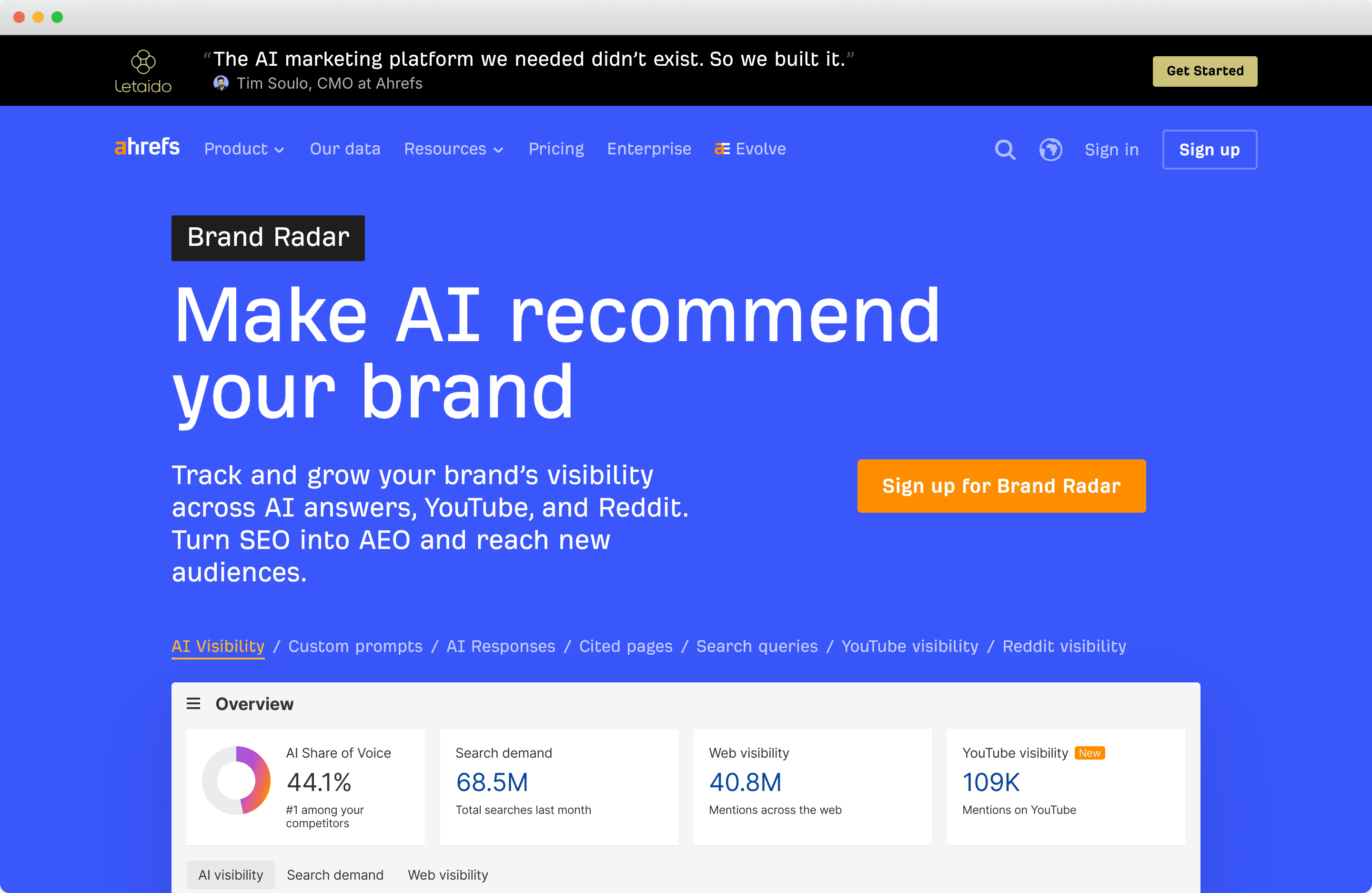
AI Mode share of voice against a competitor you choose, and daily AI Mode monitoring, both in Brand Radar.
A free AI Mode report counting the answers that mention your brand and listing the top 5 cited pages.
Stored raw responses searchable for brand mentions and linked citations.
Platform choice in Brand Radar, with AI Overviews and AI Mode and ChatGPT among the platforms listed.
Pricing:
Brand Radar: "Select platforms" at $199 per month, or "All platforms" at $699 per month; Ahrefs says it is sold as a standalone tool.
Core plans: Lite $129, Standard $249, Advanced $449 per month, with 5, 10, and 20 tracked AI prompts.
Enterprise: $1,499 per month, annual commitment required.
Reddit Score: 48.3% Positive, over 378 mentions about the tool. What redditors say:
"My only slight gripe is how many features are exclusive to the advanced plan." (r/bigseo)
Nearly all 378 mentions are about Ahrefs the SEO suite; the score is the suite's reputation, not Brand Radar's.
Ahrefs documents being named, share of voice, and cited pages, all written about AI Mode, and Brand Radar's custom prompts let you "Add your own questions". Several brands are not documented, and none of the quotes is extended to ChatGPT here.
The both-engine price on the page is $699 a month for all platforms; whether the $199 option can be set to ChatGPT plus AI Mode is a question for sales. If you already pay for Ahrefs, our look at Semrush alternatives for AI visibility weighs keeping a suite against adding a specialist.
A mention count from a free report and a share-of-voice line from a paid product are two different things, even on one page.
8. Scrunch: Presence Compared Across Platforms
Key Features:
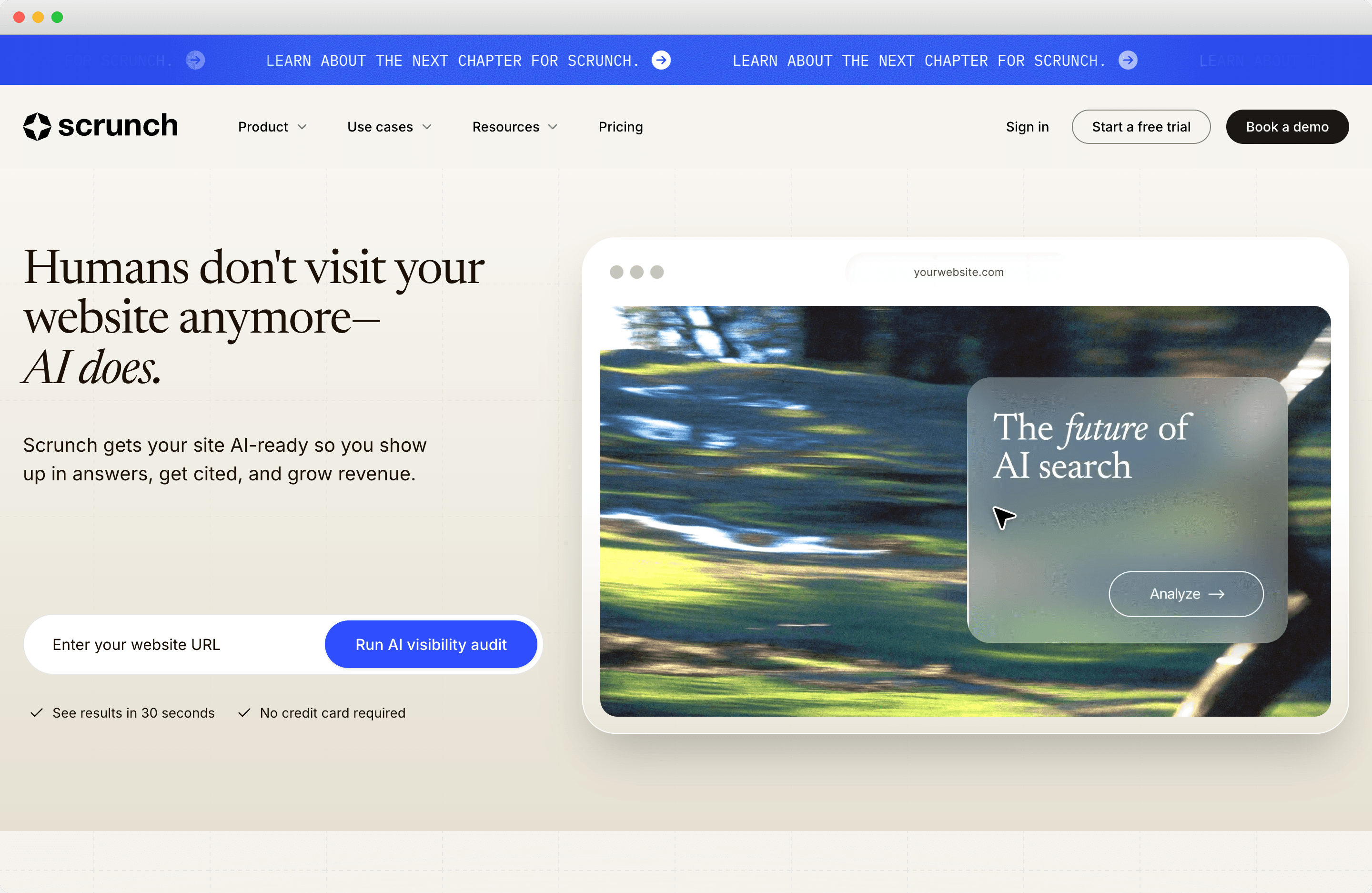
Cross-platform comparison of "brand presence, competitive presence, position, sentiment, or citations."
A filter by AI platform, with ChatGPT and Google AI Mode among the options.
Plan rows for citations and sources, and for competitors (5 on Core, custom on Enterprise).
Brand workspaces: 1 on Core, a custom number on Enterprise.
Pricing:
Core: $250 per month, 125 prompts, 1 brand workspace, and four engines (ChatGPT, Perplexity, Google AI Overviews, Copilot), with a 7-day free trial.
Enterprise: custom, nine engines including Google AI Mode.
Reddit Score: 50.0% Positive, over 5 mentions about the tool. What redditors say:
The r/SaaS content-workflow comparison put Scrunch AI in its too-basic group, next to Otterly and Athena HQ. (r/SaaS)
Five mentions is exactly the minimum we score at.
Scrunch is here as one of the leaderboard's five highest-ranked tools that document both engines and publish a price. Its pricing table documents presence, cited sources, share of voice, brand workspaces, and "Prompt Management" as plan rows, so your category questions are yours to write.
Google AI Mode is on the Enterprise engine list, not Core's. For a SaaS team that needs both engines, that means a sales call before any data.
What This Review Does Not Cover
We read vendor pages in September 2026 and checked every price on the live pricing page that day. No tool was trialed, no SaaS question set was run through any of them, and a quote on a page is documentation, not proof it works as described.
The order is the roster's: Qvery first, then documented criteria as our research scored them before the pricing-table re-read, ties broken by leaderboard rank. It names no winner. A Reddit Score reflects how people talk about a tool, not whether it measures correctly. The G2 figure is the SaaS study's measurement, not this review's.
Shortlist, Then Make Them Run Your Questions
Pick the criteria your team cannot go without and keep only the tools whose pages document them; the five-criteria list at the top shows who does. Then confirm which plan covers both ChatGPT and Google AI Mode, and what that plan costs.
In each demo, run your own category and use-case questions against your own competitors, one engine at a time. Ask to see the cited pages for each answer and whether your product was recommended or only named. Whichever tool shows that on the plan you would pay for is the one to sign.
A buyer types "best CRM for a five-person sales team" into ChatGPT and gets four names back, which is now a shortlist whether your sales team likes it or not. Review sites sit in that layer: in our September SaaS study, G2 was cited in 8.75% of recommendation answers (63 of 720 valid answers, ChatGPT and Google AI Mode pooled).
The eight tools below were chosen by rule: Qvery first, since we publish this, then the five highest-ranked tools on our leaderboard that document both engines and publish prices, then the two that document the most of five SaaS criteria. Dageno AI and LLMrefs tied on those criteria and were cut at the cap. Every page was read, and every price checked, in September 2026.
The Five Things a SaaS Team Needs a Tracker to Show
Software gets bought on category questions, not on brand names, so a tracker earns its fee on five things.
Being named in the answer. Whether the product shows up when someone asks for the best tool in its category. Every tool here documents some version of this, in words like "appears", "mentioned" or "presence".
Share of voice against rivals. Category answers name several vendors, so your share only means something next to your competitors'. Documented by Qvery, Peec AI, AthenaHQ, Superlines, Ahrefs (for AI Mode), and Scrunch as a plan row; OtterlyAI and Profound do not document it.
Cited sources. Which pages each answer drew on: G2, a rival's comparison page, or your own docs. All eight document this somewhere.
Several brands in one account. A company with two products, or a parent with several brands, needs each measured on its own. Documented by Peec AI, AthenaHQ, Superlines, OtterlyAI, and Profound, and by Qvery and Scrunch on a named tier; Ahrefs does not document it.
Category and use-case questions. "Best CRM for startups" rather than your product name. Every tool here documents tracking prompts you write, Profound on Enterprise and Scrunch as a plan row, and Peec AI, AthenaHQ, Superlines, and OtterlyAI write about category questions by name. None ships a ready-made SaaS question set.
Documented means the vendor's own page says it. Not documented means the page is silent, which is a demo question and never a verdict; no vendor here says outright that it lacks any of the five.
Tracking both ChatGPT and Google AI Mode is the entry bar for this list, but the plan that covers both is often not the cheapest one, so each entry names that plan separately. Our guide to generating LLM tracking queries covers building the question list you will bring to each demo.
Eight tools, eight ways of saying your brand came up. None documents whether it was the brand the engine recommended.
1. Qvery: Your Category Questions, Run Daily in Both Engines
Key Features:
Visibility, share of voice, and average rank in ChatGPT and Google AI Mode, updated daily, in 200+ countries.
Citations tied to their source question, so each cited page is attached to the query and engine that produced it.
Queries you write: topics and queries are generated at onboarding, then you add and edit the category and use-case questions buyers ask.
Qvery Assistant answers plain-language questions about your own visibility, citation, topic, and query data, and can add queries, run a data refresh, or export a report.
Pricing:
Starter: €49 per month, 1 brand, 25 tracked queries.
Growth: €99 per month, 1 brand, 50 tracked queries.
Business: €199, unlimited brands, 100 tracked queries (the page prints no billing period for this tier).
Both engines, daily runs, unlimited countries, and unlimited seats are on every tier, including Starter.
Reddit Score: 85.0% Positive, over 20 mentions about the tool. What redditors say:
"tracking mentions in local publications and external sites is key for AI visibility, like Qvery AI does." (r/smallbusiness)
Start with the states. On every tier, Qvery documents being named (as visibility, share of voice, and rank), share of voice, cited sources, and your own category questions. The fifth, several brands, is on Business, which the pricing page lists as "Unlimited Brands".
What it does not claim is a recommended-versus-mentioned status, and no SaaS-specific question set ships with it; you bring the questions. We publish this list, so hold our entry to the same five criteria as everyone else's. Start your free trial, with 7 days free on the paid plans and no credit card.
2. Peec AI: A CRM Prompt on Its Own Homepage
Key Features:
Visibility defined as the "Percentage of AI responses where your brand appears."
Share of voice against every tracked brand in the same answers.
Sources and citations by URL and domain, named separately for ChatGPT and Google AI Mode.
Multi-brand tracking, and a category prompt ("What are the best CRMs for Startups?") shown as an example on its homepage.
Pricing:
Starter: $95 per month, 50 prompts, choose 3 models.
Pro: $245 per month, 150 prompts, choose 3 models.
Advanced: $495 per month, 350 prompts, choose 3 models, multi-country.
Enterprise: custom, billed annually, all models, API access.
Reddit Score: 68.6% Positive, over 51 mentions about the tool. What redditors say:
"I have only tested Peec and have been very satisfied." (r/SaaS)
At 51 mentions this is the most-discussed dedicated tracker on the list, so the score rests on a reasonable base.
Peec AI documents each of the five criteria in writing, and the homepage example is a SaaS category question, which saves you imagining how your own will look. For a product marketer that is the closest thing on this list to a screenshot of the job.
On plans, its pages say ChatGPT and Google AI Mode are "Included by default in every plan", while each self-serve tier reads "Choose 3 models". Ask whether both engines count inside your three, and whether it can separate a recommendation from a mention.
3. AthenaHQ: Software Teams Named in Its Own Case Copy
Key Features:
Brand mention frequency tracking, with competitor share of voice comparison.
Source Intelligence, which it describes as revealing "the sources shaping AI answers."
Several brands and business units tracked centrally, by its own account.
Evaluation-stage prompts: "Athena helped software teams win evaluation-stage prompts by increasing citation coverage, recommendation rate, and share of voice."
Pricing:
Essential: free, with $25 of credit and 300 credits; its engine list leaves out Google AI Mode.
Starter: $295 per month, 3,600 credits, AI Mode included; API access and extra credits cost more.
Enterprise: custom, adding multi-region and multi-language support.
Reddit Score: 57.1% Positive, over 7 mentions about the tool. What redditors say:
A SaaS team comparing content-and-visibility tools in r/SaaS filed Athena HQ, with Otterly and Scrunch AI, as too basic for its full content workflow; the poster says they know the team of the tool they picked. (r/SaaS)
Seven mentions is enough for a score and not much more.
AthenaHQ documents every criterion, two of them in customer-result sentences, so read those as AthenaHQ's words about its clients rather than a feature list. Its "recommendation rate" is named but not defined on the page.
Both engines start at Starter, $295 a month. Ask how "recommendation rate" is counted, whether it separates recommended from mentioned in each engine, and how many credits one run of your question list burns.
4. Superlines: A Governed Prompt Set, Three Engines at a Time
Key Features:
Category prompt sets: "Build a governed set of tracked prompts for your category, use cases, and competitors."
Where your brand appears in AI answers, tracked continuously.
Share of mentions against competitors, with trend data.
Labeled sources for every citation, plus data through an MCP server or REST API.
Pricing:
Starter: €79 per month, or €69 per month billed annually, 50 prompts, 1 brand.
Pro: €199 per month, or €175 per month billed annually, 150 prompts, 3 brands.
Growth: €379 per month, or €333 per month billed annually, 300 prompts, 7 brands.
Enterprise: custom ("Tailored pricing"), up to 10 answer engines, unlimited brands.
Each tier below Enterprise says "Pick any 3 answer engines", so ChatGPT and Google AI Mode take two of the three.
Reddit Score: Too few mentions to score. We found one mention, and a score needs five.
Superlines documents every criterion, and its prompt-set line reads like it was written for a SaaS product marketer: category, use cases, competitors, in that order. Its brand ladder (one, three, seven, unlimited) makes the several-products question easy to price.
Both engines fit on Starter if you spend two picks on them, leaving one for anything else. Ask whether its sources are individual URLs, and whether it can tell a recommendation from a mention.
5. OtterlyAI: Category Research With Google AI Mode Sold Separately
Key Features:
Mention tracking: "Know when you're mentioned, when you're not, and how you stack up against competitors."
Category research: "Uncover prompts, topics, and intent patterns that drive AI-generated answers in your category."
Every domain and URL cited, checked daily, with link-position changes.
Workspaces for several brands: 1 on Lite, unlimited on Standard and Premium.
Pricing:
Lite: $29 per month, 15 prompts, or $25 per month billed annually.
Standard: $189 per month, 100 prompts, or $160 per month billed annually.
Premium: $489 per month, 400 prompts, or $422 per month billed annually.
Enterprise: custom, from 1,000 prompts.
The self-serve tiers track ChatGPT, Google AI Overviews, Perplexity, and MS Copilot. Google AI Mode is an add-on: $9 on Lite, $59 on Standard, $149 on Premium, per month.
Reddit Score: 69.2% Positive, over 13 mentions about the tool. What redditors say:
A r/SaaS roundup of AI search trackers credits it with user-friendly dashboards, unlimited brand reports, and link citation analysis. (r/SaaS)
The r/SaaS content-workflow comparison mentioned under AthenaHQ put Otterly in the same too-basic group. (r/SaaS)
OtterlyAI documents being named, cited URLs, several workspaces, and category research, and its category-research line is the one to test first for a SaaS team. "How you stack up against competitors" is not written as share of voice, so share of voice stays a demo question.
The both-engine price is the tier plus the add-on: Lite comes to $38 a month and Standard to $248. Ask to see a share-of-voice view and a recommended-versus-mentioned split before choosing a tier.
6. Profound: Agency Mode for Several Products
Key Features:
Answer Engine Insights, which "Tracks how AI answer engines mention, rank, and describe a brand."
Citation Analysis of the websites that influence answers about you.
Agency Mode, managing several brand environments in one platform.
Up to nine engines on Enterprise, Google AI Mode among them.
Pricing:
Trial: free, 50 prompts run daily for 7 days on ChatGPT, Gemini, and Google AI Overviews, one region.
Enterprise: custom, with a tailored prompt tracking plan.
Reddit Score: Too few mentions to score. One mention came up in the sample, four short of the floor.
Profound documents being named (as mention and rank), cited sources, several brands, and, on Enterprise, prompts you edit or add. Share of voice is not documented. Its pricing FAQ says trial users get "a recommended prompt set based on their industry and cannot customize their prompts."
So the trial cannot run your own category questions, and it cannot run Google AI Mode. Both happen in an Enterprise demo, where the price is quoted rather than published.
7. Ahrefs: AI Mode Share of Voice Next to Your SEO Data
Key Features:
AI Mode share of voice against a competitor you choose, and daily AI Mode monitoring, both in Brand Radar.
A free AI Mode report counting the answers that mention your brand and listing the top 5 cited pages.
Stored raw responses searchable for brand mentions and linked citations.
Platform choice in Brand Radar, with AI Overviews and AI Mode and ChatGPT among the platforms listed.
Pricing:
Brand Radar: "Select platforms" at $199 per month, or "All platforms" at $699 per month; Ahrefs says it is sold as a standalone tool.
Core plans: Lite $129, Standard $249, Advanced $449 per month, with 5, 10, and 20 tracked AI prompts.
Enterprise: $1,499 per month, annual commitment required.
Reddit Score: 48.3% Positive, over 378 mentions about the tool. What redditors say:
"My only slight gripe is how many features are exclusive to the advanced plan." (r/bigseo)
Nearly all 378 mentions are about Ahrefs the SEO suite; the score is the suite's reputation, not Brand Radar's.
Ahrefs documents being named, share of voice, and cited pages, all written about AI Mode, and Brand Radar's custom prompts let you "Add your own questions". Several brands are not documented, and none of the quotes is extended to ChatGPT here.
The both-engine price on the page is $699 a month for all platforms; whether the $199 option can be set to ChatGPT plus AI Mode is a question for sales. If you already pay for Ahrefs, our look at Semrush alternatives for AI visibility weighs keeping a suite against adding a specialist.
A mention count from a free report and a share-of-voice line from a paid product are two different things, even on one page.
8. Scrunch: Presence Compared Across Platforms
Key Features:
Cross-platform comparison of "brand presence, competitive presence, position, sentiment, or citations."
A filter by AI platform, with ChatGPT and Google AI Mode among the options.
Plan rows for citations and sources, and for competitors (5 on Core, custom on Enterprise).
Brand workspaces: 1 on Core, a custom number on Enterprise.
Pricing:
Core: $250 per month, 125 prompts, 1 brand workspace, and four engines (ChatGPT, Perplexity, Google AI Overviews, Copilot), with a 7-day free trial.
Enterprise: custom, nine engines including Google AI Mode.
Reddit Score: 50.0% Positive, over 5 mentions about the tool. What redditors say:
The r/SaaS content-workflow comparison put Scrunch AI in its too-basic group, next to Otterly and Athena HQ. (r/SaaS)
Five mentions is exactly the minimum we score at.
Scrunch is here as one of the leaderboard's five highest-ranked tools that document both engines and publish a price. Its pricing table documents presence, cited sources, share of voice, brand workspaces, and "Prompt Management" as plan rows, so your category questions are yours to write.
Google AI Mode is on the Enterprise engine list, not Core's. For a SaaS team that needs both engines, that means a sales call before any data.
What This Review Does Not Cover
We read vendor pages in September 2026 and checked every price on the live pricing page that day. No tool was trialed, no SaaS question set was run through any of them, and a quote on a page is documentation, not proof it works as described.
The order is the roster's: Qvery first, then documented criteria as our research scored them before the pricing-table re-read, ties broken by leaderboard rank. It names no winner. A Reddit Score reflects how people talk about a tool, not whether it measures correctly. The G2 figure is the SaaS study's measurement, not this review's.
Shortlist, Then Make Them Run Your Questions
Pick the criteria your team cannot go without and keep only the tools whose pages document them; the five-criteria list at the top shows who does. Then confirm which plan covers both ChatGPT and Google AI Mode, and what that plan costs.
In each demo, run your own category and use-case questions against your own competitors, one engine at a time. Ask to see the cited pages for each answer and whether your product was recommended or only named. Whichever tool shows that on the plan you would pay for is the one to sign.
A buyer types "best CRM for a five-person sales team" into ChatGPT and gets four names back, which is now a shortlist whether your sales team likes it or not. Review sites sit in that layer: in our September SaaS study, G2 was cited in 8.75% of recommendation answers (63 of 720 valid answers, ChatGPT and Google AI Mode pooled).
The eight tools below were chosen by rule: Qvery first, since we publish this, then the five highest-ranked tools on our leaderboard that document both engines and publish prices, then the two that document the most of five SaaS criteria. Dageno AI and LLMrefs tied on those criteria and were cut at the cap. Every page was read, and every price checked, in September 2026.
The Five Things a SaaS Team Needs a Tracker to Show
Software gets bought on category questions, not on brand names, so a tracker earns its fee on five things.
Being named in the answer. Whether the product shows up when someone asks for the best tool in its category. Every tool here documents some version of this, in words like "appears", "mentioned" or "presence".
Share of voice against rivals. Category answers name several vendors, so your share only means something next to your competitors'. Documented by Qvery, Peec AI, AthenaHQ, Superlines, Ahrefs (for AI Mode), and Scrunch as a plan row; OtterlyAI and Profound do not document it.
Cited sources. Which pages each answer drew on: G2, a rival's comparison page, or your own docs. All eight document this somewhere.
Several brands in one account. A company with two products, or a parent with several brands, needs each measured on its own. Documented by Peec AI, AthenaHQ, Superlines, OtterlyAI, and Profound, and by Qvery and Scrunch on a named tier; Ahrefs does not document it.
Category and use-case questions. "Best CRM for startups" rather than your product name. Every tool here documents tracking prompts you write, Profound on Enterprise and Scrunch as a plan row, and Peec AI, AthenaHQ, Superlines, and OtterlyAI write about category questions by name. None ships a ready-made SaaS question set.
Documented means the vendor's own page says it. Not documented means the page is silent, which is a demo question and never a verdict; no vendor here says outright that it lacks any of the five.
Tracking both ChatGPT and Google AI Mode is the entry bar for this list, but the plan that covers both is often not the cheapest one, so each entry names that plan separately. Our guide to generating LLM tracking queries covers building the question list you will bring to each demo.
Eight tools, eight ways of saying your brand came up. None documents whether it was the brand the engine recommended.
1. Qvery: Your Category Questions, Run Daily in Both Engines
Key Features:
Visibility, share of voice, and average rank in ChatGPT and Google AI Mode, updated daily, in 200+ countries.
Citations tied to their source question, so each cited page is attached to the query and engine that produced it.
Queries you write: topics and queries are generated at onboarding, then you add and edit the category and use-case questions buyers ask.
Qvery Assistant answers plain-language questions about your own visibility, citation, topic, and query data, and can add queries, run a data refresh, or export a report.
Pricing:
Starter: €49 per month, 1 brand, 25 tracked queries.
Growth: €99 per month, 1 brand, 50 tracked queries.
Business: €199, unlimited brands, 100 tracked queries (the page prints no billing period for this tier).
Both engines, daily runs, unlimited countries, and unlimited seats are on every tier, including Starter.
Reddit Score: 85.0% Positive, over 20 mentions about the tool. What redditors say:
"tracking mentions in local publications and external sites is key for AI visibility, like Qvery AI does." (r/smallbusiness)
Start with the states. On every tier, Qvery documents being named (as visibility, share of voice, and rank), share of voice, cited sources, and your own category questions. The fifth, several brands, is on Business, which the pricing page lists as "Unlimited Brands".
What it does not claim is a recommended-versus-mentioned status, and no SaaS-specific question set ships with it; you bring the questions. We publish this list, so hold our entry to the same five criteria as everyone else's. Start your free trial, with 7 days free on the paid plans and no credit card.
2. Peec AI: A CRM Prompt on Its Own Homepage
Key Features:
Visibility defined as the "Percentage of AI responses where your brand appears."
Share of voice against every tracked brand in the same answers.
Sources and citations by URL and domain, named separately for ChatGPT and Google AI Mode.
Multi-brand tracking, and a category prompt ("What are the best CRMs for Startups?") shown as an example on its homepage.
Pricing:
Starter: $95 per month, 50 prompts, choose 3 models.
Pro: $245 per month, 150 prompts, choose 3 models.
Advanced: $495 per month, 350 prompts, choose 3 models, multi-country.
Enterprise: custom, billed annually, all models, API access.
Reddit Score: 68.6% Positive, over 51 mentions about the tool. What redditors say:
"I have only tested Peec and have been very satisfied." (r/SaaS)
At 51 mentions this is the most-discussed dedicated tracker on the list, so the score rests on a reasonable base.
Peec AI documents each of the five criteria in writing, and the homepage example is a SaaS category question, which saves you imagining how your own will look. For a product marketer that is the closest thing on this list to a screenshot of the job.
On plans, its pages say ChatGPT and Google AI Mode are "Included by default in every plan", while each self-serve tier reads "Choose 3 models". Ask whether both engines count inside your three, and whether it can separate a recommendation from a mention.
3. AthenaHQ: Software Teams Named in Its Own Case Copy
Key Features:
Brand mention frequency tracking, with competitor share of voice comparison.
Source Intelligence, which it describes as revealing "the sources shaping AI answers."
Several brands and business units tracked centrally, by its own account.
Evaluation-stage prompts: "Athena helped software teams win evaluation-stage prompts by increasing citation coverage, recommendation rate, and share of voice."
Pricing:
Essential: free, with $25 of credit and 300 credits; its engine list leaves out Google AI Mode.
Starter: $295 per month, 3,600 credits, AI Mode included; API access and extra credits cost more.
Enterprise: custom, adding multi-region and multi-language support.
Reddit Score: 57.1% Positive, over 7 mentions about the tool. What redditors say:
A SaaS team comparing content-and-visibility tools in r/SaaS filed Athena HQ, with Otterly and Scrunch AI, as too basic for its full content workflow; the poster says they know the team of the tool they picked. (r/SaaS)
Seven mentions is enough for a score and not much more.
AthenaHQ documents every criterion, two of them in customer-result sentences, so read those as AthenaHQ's words about its clients rather than a feature list. Its "recommendation rate" is named but not defined on the page.
Both engines start at Starter, $295 a month. Ask how "recommendation rate" is counted, whether it separates recommended from mentioned in each engine, and how many credits one run of your question list burns.
4. Superlines: A Governed Prompt Set, Three Engines at a Time
Key Features:
Category prompt sets: "Build a governed set of tracked prompts for your category, use cases, and competitors."
Where your brand appears in AI answers, tracked continuously.
Share of mentions against competitors, with trend data.
Labeled sources for every citation, plus data through an MCP server or REST API.
Pricing:
Starter: €79 per month, or €69 per month billed annually, 50 prompts, 1 brand.
Pro: €199 per month, or €175 per month billed annually, 150 prompts, 3 brands.
Growth: €379 per month, or €333 per month billed annually, 300 prompts, 7 brands.
Enterprise: custom ("Tailored pricing"), up to 10 answer engines, unlimited brands.
Each tier below Enterprise says "Pick any 3 answer engines", so ChatGPT and Google AI Mode take two of the three.
Reddit Score: Too few mentions to score. We found one mention, and a score needs five.
Superlines documents every criterion, and its prompt-set line reads like it was written for a SaaS product marketer: category, use cases, competitors, in that order. Its brand ladder (one, three, seven, unlimited) makes the several-products question easy to price.
Both engines fit on Starter if you spend two picks on them, leaving one for anything else. Ask whether its sources are individual URLs, and whether it can tell a recommendation from a mention.
5. OtterlyAI: Category Research With Google AI Mode Sold Separately
Key Features:
Mention tracking: "Know when you're mentioned, when you're not, and how you stack up against competitors."
Category research: "Uncover prompts, topics, and intent patterns that drive AI-generated answers in your category."
Every domain and URL cited, checked daily, with link-position changes.
Workspaces for several brands: 1 on Lite, unlimited on Standard and Premium.
Pricing:
Lite: $29 per month, 15 prompts, or $25 per month billed annually.
Standard: $189 per month, 100 prompts, or $160 per month billed annually.
Premium: $489 per month, 400 prompts, or $422 per month billed annually.
Enterprise: custom, from 1,000 prompts.
The self-serve tiers track ChatGPT, Google AI Overviews, Perplexity, and MS Copilot. Google AI Mode is an add-on: $9 on Lite, $59 on Standard, $149 on Premium, per month.
Reddit Score: 69.2% Positive, over 13 mentions about the tool. What redditors say:
A r/SaaS roundup of AI search trackers credits it with user-friendly dashboards, unlimited brand reports, and link citation analysis. (r/SaaS)
The r/SaaS content-workflow comparison mentioned under AthenaHQ put Otterly in the same too-basic group. (r/SaaS)
OtterlyAI documents being named, cited URLs, several workspaces, and category research, and its category-research line is the one to test first for a SaaS team. "How you stack up against competitors" is not written as share of voice, so share of voice stays a demo question.
The both-engine price is the tier plus the add-on: Lite comes to $38 a month and Standard to $248. Ask to see a share-of-voice view and a recommended-versus-mentioned split before choosing a tier.
6. Profound: Agency Mode for Several Products
Key Features:
Answer Engine Insights, which "Tracks how AI answer engines mention, rank, and describe a brand."
Citation Analysis of the websites that influence answers about you.
Agency Mode, managing several brand environments in one platform.
Up to nine engines on Enterprise, Google AI Mode among them.
Pricing:
Trial: free, 50 prompts run daily for 7 days on ChatGPT, Gemini, and Google AI Overviews, one region.
Enterprise: custom, with a tailored prompt tracking plan.
Reddit Score: Too few mentions to score. One mention came up in the sample, four short of the floor.
Profound documents being named (as mention and rank), cited sources, several brands, and, on Enterprise, prompts you edit or add. Share of voice is not documented. Its pricing FAQ says trial users get "a recommended prompt set based on their industry and cannot customize their prompts."
So the trial cannot run your own category questions, and it cannot run Google AI Mode. Both happen in an Enterprise demo, where the price is quoted rather than published.
7. Ahrefs: AI Mode Share of Voice Next to Your SEO Data
Key Features:
AI Mode share of voice against a competitor you choose, and daily AI Mode monitoring, both in Brand Radar.
A free AI Mode report counting the answers that mention your brand and listing the top 5 cited pages.
Stored raw responses searchable for brand mentions and linked citations.
Platform choice in Brand Radar, with AI Overviews and AI Mode and ChatGPT among the platforms listed.
Pricing:
Brand Radar: "Select platforms" at $199 per month, or "All platforms" at $699 per month; Ahrefs says it is sold as a standalone tool.
Core plans: Lite $129, Standard $249, Advanced $449 per month, with 5, 10, and 20 tracked AI prompts.
Enterprise: $1,499 per month, annual commitment required.
Reddit Score: 48.3% Positive, over 378 mentions about the tool. What redditors say:
"My only slight gripe is how many features are exclusive to the advanced plan." (r/bigseo)
Nearly all 378 mentions are about Ahrefs the SEO suite; the score is the suite's reputation, not Brand Radar's.
Ahrefs documents being named, share of voice, and cited pages, all written about AI Mode, and Brand Radar's custom prompts let you "Add your own questions". Several brands are not documented, and none of the quotes is extended to ChatGPT here.
The both-engine price on the page is $699 a month for all platforms; whether the $199 option can be set to ChatGPT plus AI Mode is a question for sales. If you already pay for Ahrefs, our look at Semrush alternatives for AI visibility weighs keeping a suite against adding a specialist.
A mention count from a free report and a share-of-voice line from a paid product are two different things, even on one page.
8. Scrunch: Presence Compared Across Platforms
Key Features:
Cross-platform comparison of "brand presence, competitive presence, position, sentiment, or citations."
A filter by AI platform, with ChatGPT and Google AI Mode among the options.
Plan rows for citations and sources, and for competitors (5 on Core, custom on Enterprise).
Brand workspaces: 1 on Core, a custom number on Enterprise.
Pricing:
Core: $250 per month, 125 prompts, 1 brand workspace, and four engines (ChatGPT, Perplexity, Google AI Overviews, Copilot), with a 7-day free trial.
Enterprise: custom, nine engines including Google AI Mode.
Reddit Score: 50.0% Positive, over 5 mentions about the tool. What redditors say:
The r/SaaS content-workflow comparison put Scrunch AI in its too-basic group, next to Otterly and Athena HQ. (r/SaaS)
Five mentions is exactly the minimum we score at.
Scrunch is here as one of the leaderboard's five highest-ranked tools that document both engines and publish a price. Its pricing table documents presence, cited sources, share of voice, brand workspaces, and "Prompt Management" as plan rows, so your category questions are yours to write.
Google AI Mode is on the Enterprise engine list, not Core's. For a SaaS team that needs both engines, that means a sales call before any data.
What This Review Does Not Cover
We read vendor pages in September 2026 and checked every price on the live pricing page that day. No tool was trialed, no SaaS question set was run through any of them, and a quote on a page is documentation, not proof it works as described.
The order is the roster's: Qvery first, then documented criteria as our research scored them before the pricing-table re-read, ties broken by leaderboard rank. It names no winner. A Reddit Score reflects how people talk about a tool, not whether it measures correctly. The G2 figure is the SaaS study's measurement, not this review's.
Shortlist, Then Make Them Run Your Questions
Pick the criteria your team cannot go without and keep only the tools whose pages document them; the five-criteria list at the top shows who does. Then confirm which plan covers both ChatGPT and Google AI Mode, and what that plan costs.
In each demo, run your own category and use-case questions against your own competitors, one engine at a time. Ask to see the cited pages for each answer and whether your product was recommended or only named. Whichever tool shows that on the plan you would pay for is the one to sign.
A buyer types "best CRM for a five-person sales team" into ChatGPT and gets four names back, which is now a shortlist whether your sales team likes it or not. Review sites sit in that layer: in our September SaaS study, G2 was cited in 8.75% of recommendation answers (63 of 720 valid answers, ChatGPT and Google AI Mode pooled).
The eight tools below were chosen by rule: Qvery first, since we publish this, then the five highest-ranked tools on our leaderboard that document both engines and publish prices, then the two that document the most of five SaaS criteria. Dageno AI and LLMrefs tied on those criteria and were cut at the cap. Every page was read, and every price checked, in September 2026.
The Five Things a SaaS Team Needs a Tracker to Show
Software gets bought on category questions, not on brand names, so a tracker earns its fee on five things.
Being named in the answer. Whether the product shows up when someone asks for the best tool in its category. Every tool here documents some version of this, in words like "appears", "mentioned" or "presence".
Share of voice against rivals. Category answers name several vendors, so your share only means something next to your competitors'. Documented by Qvery, Peec AI, AthenaHQ, Superlines, Ahrefs (for AI Mode), and Scrunch as a plan row; OtterlyAI and Profound do not document it.
Cited sources. Which pages each answer drew on: G2, a rival's comparison page, or your own docs. All eight document this somewhere.
Several brands in one account. A company with two products, or a parent with several brands, needs each measured on its own. Documented by Peec AI, AthenaHQ, Superlines, OtterlyAI, and Profound, and by Qvery and Scrunch on a named tier; Ahrefs does not document it.
Category and use-case questions. "Best CRM for startups" rather than your product name. Every tool here documents tracking prompts you write, Profound on Enterprise and Scrunch as a plan row, and Peec AI, AthenaHQ, Superlines, and OtterlyAI write about category questions by name. None ships a ready-made SaaS question set.
Documented means the vendor's own page says it. Not documented means the page is silent, which is a demo question and never a verdict; no vendor here says outright that it lacks any of the five.
Tracking both ChatGPT and Google AI Mode is the entry bar for this list, but the plan that covers both is often not the cheapest one, so each entry names that plan separately. Our guide to generating LLM tracking queries covers building the question list you will bring to each demo.
Eight tools, eight ways of saying your brand came up. None documents whether it was the brand the engine recommended.
1. Qvery: Your Category Questions, Run Daily in Both Engines
Key Features:
Visibility, share of voice, and average rank in ChatGPT and Google AI Mode, updated daily, in 200+ countries.
Citations tied to their source question, so each cited page is attached to the query and engine that produced it.
Queries you write: topics and queries are generated at onboarding, then you add and edit the category and use-case questions buyers ask.
Qvery Assistant answers plain-language questions about your own visibility, citation, topic, and query data, and can add queries, run a data refresh, or export a report.
Pricing:
Starter: €49 per month, 1 brand, 25 tracked queries.
Growth: €99 per month, 1 brand, 50 tracked queries.
Business: €199, unlimited brands, 100 tracked queries (the page prints no billing period for this tier).
Both engines, daily runs, unlimited countries, and unlimited seats are on every tier, including Starter.
Reddit Score: 85.0% Positive, over 20 mentions about the tool. What redditors say:
"tracking mentions in local publications and external sites is key for AI visibility, like Qvery AI does." (r/smallbusiness)
Start with the states. On every tier, Qvery documents being named (as visibility, share of voice, and rank), share of voice, cited sources, and your own category questions. The fifth, several brands, is on Business, which the pricing page lists as "Unlimited Brands".
What it does not claim is a recommended-versus-mentioned status, and no SaaS-specific question set ships with it; you bring the questions. We publish this list, so hold our entry to the same five criteria as everyone else's. Start your free trial, with 7 days free on the paid plans and no credit card.
2. Peec AI: A CRM Prompt on Its Own Homepage
Key Features:
Visibility defined as the "Percentage of AI responses where your brand appears."
Share of voice against every tracked brand in the same answers.
Sources and citations by URL and domain, named separately for ChatGPT and Google AI Mode.
Multi-brand tracking, and a category prompt ("What are the best CRMs for Startups?") shown as an example on its homepage.
Pricing:
Starter: $95 per month, 50 prompts, choose 3 models.
Pro: $245 per month, 150 prompts, choose 3 models.
Advanced: $495 per month, 350 prompts, choose 3 models, multi-country.
Enterprise: custom, billed annually, all models, API access.
Reddit Score: 68.6% Positive, over 51 mentions about the tool. What redditors say:
"I have only tested Peec and have been very satisfied." (r/SaaS)
At 51 mentions this is the most-discussed dedicated tracker on the list, so the score rests on a reasonable base.
Peec AI documents each of the five criteria in writing, and the homepage example is a SaaS category question, which saves you imagining how your own will look. For a product marketer that is the closest thing on this list to a screenshot of the job.
On plans, its pages say ChatGPT and Google AI Mode are "Included by default in every plan", while each self-serve tier reads "Choose 3 models". Ask whether both engines count inside your three, and whether it can separate a recommendation from a mention.
3. AthenaHQ: Software Teams Named in Its Own Case Copy
Key Features:
Brand mention frequency tracking, with competitor share of voice comparison.
Source Intelligence, which it describes as revealing "the sources shaping AI answers."
Several brands and business units tracked centrally, by its own account.
Evaluation-stage prompts: "Athena helped software teams win evaluation-stage prompts by increasing citation coverage, recommendation rate, and share of voice."
Pricing:
Essential: free, with $25 of credit and 300 credits; its engine list leaves out Google AI Mode.
Starter: $295 per month, 3,600 credits, AI Mode included; API access and extra credits cost more.
Enterprise: custom, adding multi-region and multi-language support.
Reddit Score: 57.1% Positive, over 7 mentions about the tool. What redditors say:
A SaaS team comparing content-and-visibility tools in r/SaaS filed Athena HQ, with Otterly and Scrunch AI, as too basic for its full content workflow; the poster says they know the team of the tool they picked. (r/SaaS)
Seven mentions is enough for a score and not much more.
AthenaHQ documents every criterion, two of them in customer-result sentences, so read those as AthenaHQ's words about its clients rather than a feature list. Its "recommendation rate" is named but not defined on the page.
Both engines start at Starter, $295 a month. Ask how "recommendation rate" is counted, whether it separates recommended from mentioned in each engine, and how many credits one run of your question list burns.
4. Superlines: A Governed Prompt Set, Three Engines at a Time
Key Features:
Category prompt sets: "Build a governed set of tracked prompts for your category, use cases, and competitors."
Where your brand appears in AI answers, tracked continuously.
Share of mentions against competitors, with trend data.
Labeled sources for every citation, plus data through an MCP server or REST API.
Pricing:
Starter: €79 per month, or €69 per month billed annually, 50 prompts, 1 brand.
Pro: €199 per month, or €175 per month billed annually, 150 prompts, 3 brands.
Growth: €379 per month, or €333 per month billed annually, 300 prompts, 7 brands.
Enterprise: custom ("Tailored pricing"), up to 10 answer engines, unlimited brands.
Each tier below Enterprise says "Pick any 3 answer engines", so ChatGPT and Google AI Mode take two of the three.
Reddit Score: Too few mentions to score. We found one mention, and a score needs five.
Superlines documents every criterion, and its prompt-set line reads like it was written for a SaaS product marketer: category, use cases, competitors, in that order. Its brand ladder (one, three, seven, unlimited) makes the several-products question easy to price.
Both engines fit on Starter if you spend two picks on them, leaving one for anything else. Ask whether its sources are individual URLs, and whether it can tell a recommendation from a mention.
5. OtterlyAI: Category Research With Google AI Mode Sold Separately
Key Features:
Mention tracking: "Know when you're mentioned, when you're not, and how you stack up against competitors."
Category research: "Uncover prompts, topics, and intent patterns that drive AI-generated answers in your category."
Every domain and URL cited, checked daily, with link-position changes.
Workspaces for several brands: 1 on Lite, unlimited on Standard and Premium.
Pricing:
Lite: $29 per month, 15 prompts, or $25 per month billed annually.
Standard: $189 per month, 100 prompts, or $160 per month billed annually.
Premium: $489 per month, 400 prompts, or $422 per month billed annually.
Enterprise: custom, from 1,000 prompts.
The self-serve tiers track ChatGPT, Google AI Overviews, Perplexity, and MS Copilot. Google AI Mode is an add-on: $9 on Lite, $59 on Standard, $149 on Premium, per month.
Reddit Score: 69.2% Positive, over 13 mentions about the tool. What redditors say:
A r/SaaS roundup of AI search trackers credits it with user-friendly dashboards, unlimited brand reports, and link citation analysis. (r/SaaS)
The r/SaaS content-workflow comparison mentioned under AthenaHQ put Otterly in the same too-basic group. (r/SaaS)
OtterlyAI documents being named, cited URLs, several workspaces, and category research, and its category-research line is the one to test first for a SaaS team. "How you stack up against competitors" is not written as share of voice, so share of voice stays a demo question.
The both-engine price is the tier plus the add-on: Lite comes to $38 a month and Standard to $248. Ask to see a share-of-voice view and a recommended-versus-mentioned split before choosing a tier.
6. Profound: Agency Mode for Several Products
Key Features:
Answer Engine Insights, which "Tracks how AI answer engines mention, rank, and describe a brand."
Citation Analysis of the websites that influence answers about you.
Agency Mode, managing several brand environments in one platform.
Up to nine engines on Enterprise, Google AI Mode among them.
Pricing:
Trial: free, 50 prompts run daily for 7 days on ChatGPT, Gemini, and Google AI Overviews, one region.
Enterprise: custom, with a tailored prompt tracking plan.
Reddit Score: Too few mentions to score. One mention came up in the sample, four short of the floor.
Profound documents being named (as mention and rank), cited sources, several brands, and, on Enterprise, prompts you edit or add. Share of voice is not documented. Its pricing FAQ says trial users get "a recommended prompt set based on their industry and cannot customize their prompts."
So the trial cannot run your own category questions, and it cannot run Google AI Mode. Both happen in an Enterprise demo, where the price is quoted rather than published.
7. Ahrefs: AI Mode Share of Voice Next to Your SEO Data
Key Features:
AI Mode share of voice against a competitor you choose, and daily AI Mode monitoring, both in Brand Radar.
A free AI Mode report counting the answers that mention your brand and listing the top 5 cited pages.
Stored raw responses searchable for brand mentions and linked citations.
Platform choice in Brand Radar, with AI Overviews and AI Mode and ChatGPT among the platforms listed.
Pricing:
Brand Radar: "Select platforms" at $199 per month, or "All platforms" at $699 per month; Ahrefs says it is sold as a standalone tool.
Core plans: Lite $129, Standard $249, Advanced $449 per month, with 5, 10, and 20 tracked AI prompts.
Enterprise: $1,499 per month, annual commitment required.
Reddit Score: 48.3% Positive, over 378 mentions about the tool. What redditors say:
"My only slight gripe is how many features are exclusive to the advanced plan." (r/bigseo)
Nearly all 378 mentions are about Ahrefs the SEO suite; the score is the suite's reputation, not Brand Radar's.
Ahrefs documents being named, share of voice, and cited pages, all written about AI Mode, and Brand Radar's custom prompts let you "Add your own questions". Several brands are not documented, and none of the quotes is extended to ChatGPT here.
The both-engine price on the page is $699 a month for all platforms; whether the $199 option can be set to ChatGPT plus AI Mode is a question for sales. If you already pay for Ahrefs, our look at Semrush alternatives for AI visibility weighs keeping a suite against adding a specialist.
A mention count from a free report and a share-of-voice line from a paid product are two different things, even on one page.
8. Scrunch: Presence Compared Across Platforms
Key Features:
Cross-platform comparison of "brand presence, competitive presence, position, sentiment, or citations."
A filter by AI platform, with ChatGPT and Google AI Mode among the options.
Plan rows for citations and sources, and for competitors (5 on Core, custom on Enterprise).
Brand workspaces: 1 on Core, a custom number on Enterprise.
Pricing:
Core: $250 per month, 125 prompts, 1 brand workspace, and four engines (ChatGPT, Perplexity, Google AI Overviews, Copilot), with a 7-day free trial.
Enterprise: custom, nine engines including Google AI Mode.
Reddit Score: 50.0% Positive, over 5 mentions about the tool. What redditors say:
The r/SaaS content-workflow comparison put Scrunch AI in its too-basic group, next to Otterly and Athena HQ. (r/SaaS)
Five mentions is exactly the minimum we score at.
Scrunch is here as one of the leaderboard's five highest-ranked tools that document both engines and publish a price. Its pricing table documents presence, cited sources, share of voice, brand workspaces, and "Prompt Management" as plan rows, so your category questions are yours to write.
Google AI Mode is on the Enterprise engine list, not Core's. For a SaaS team that needs both engines, that means a sales call before any data.
What This Review Does Not Cover
We read vendor pages in September 2026 and checked every price on the live pricing page that day. No tool was trialed, no SaaS question set was run through any of them, and a quote on a page is documentation, not proof it works as described.
The order is the roster's: Qvery first, then documented criteria as our research scored them before the pricing-table re-read, ties broken by leaderboard rank. It names no winner. A Reddit Score reflects how people talk about a tool, not whether it measures correctly. The G2 figure is the SaaS study's measurement, not this review's.
Shortlist, Then Make Them Run Your Questions
Pick the criteria your team cannot go without and keep only the tools whose pages document them; the five-criteria list at the top shows who does. Then confirm which plan covers both ChatGPT and Google AI Mode, and what that plan costs.
In each demo, run your own category and use-case questions against your own competitors, one engine at a time. Ask to see the cited pages for each answer and whether your product was recommended or only named. Whichever tool shows that on the plan you would pay for is the one to sign.

© 2026 Qvery AI OÜ