By
Vlad Shvets
9 Best AI Visibility Tools for Ecommerce Brands (Reviewed)
The 9 best AI visibility tools for ecommerce brands, ranked for product and AI-shopping visibility, with pricing and real Reddit data.
The 9 best AI visibility tools for ecommerce brands, ranked for product and AI-shopping visibility, with pricing and real Reddit data.
The 9 best AI visibility tools for ecommerce brands, ranked for product and AI-shopping visibility, with pricing and real Reddit data.
A shopper asks ChatGPT for the best running shoes for flat feet, gets five brands back, and buys one without ever seeing a shelf, an ad, or a product page.
Ecommerce spent twenty years optimizing every step of the path to purchase, and the newest step now happens entirely inside an answer.
For a retail brand, that answer is the new shelf, and getting recommended by AI now matters as much as ranking on Google. The nine tools below are ranked by how close to the product and the market they get, and one of them is ours, so it leads with the bias in plain view.
1. Qvery: Country-Level Answers for Cross-Border Sellers
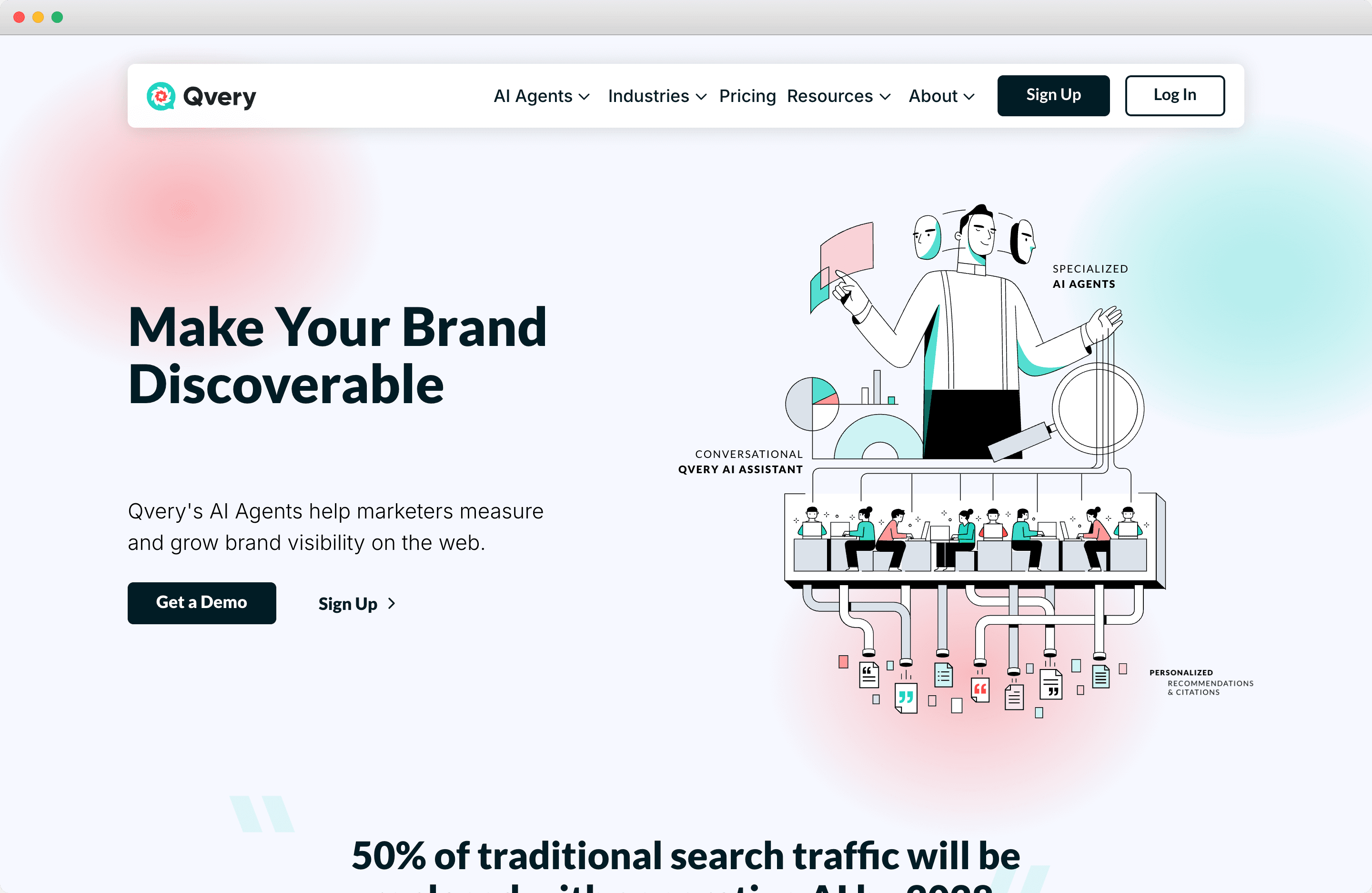
Key Features:
Daily tracking of whether ChatGPT and Google AI Mode recommend your brand on the category and buying queries shoppers ask, in 200+ countries.
Per-market share of voice, so you see where you win the recommendation in one country and lose it in another, not just a global average.
Qvery Assistant: a conversational layer over your own data. Ask which buying queries a rival wins in a given market, and run first-party actions like adding queries, triggering a run, or exporting a report.
Every citation captured, so you see the review sites and roundups AI leans on when it names a competitor.
Unlimited seats and brands from Business up, which fits a house of store brands selling across borders.
Pricing:
Lite: EUR 99/mo for 1 brand and 50 queries.
Business: EUR 199/mo for unlimited brands, 100 queries, and Slack support.
Enterprise: custom pricing for 500+ queries. The free trial needs no credit card.
Reddit Score: 97% Positive. What redditors say:
It surfaces in threads on how AI search is reshaping the way local service businesses win customers. (r/sweatystartup)
It shows up for a SaaS marketer whose trial signups climb while AI keeps naming rivals. (r/SaaSMarketing)
Mostly positive, a handful neutral, and no negative mentions on record.
This is our product, so weigh the bias, then judge the fit. Qvery measures whether AI puts your brand on the shortlist when a shopper asks what to buy, daily across ChatGPT and Google AI Mode, and it does that market by market in 200+ countries.
For a cross-border seller, the market-by-market part is the point. Ask the Assistant where you lose the recommendation in France or win it in Brazil, and it answers from your own account, then adds queries or triggers a run without leaving the chat.
2. Profound: Best for Tracking Product Placement in AI Shopping
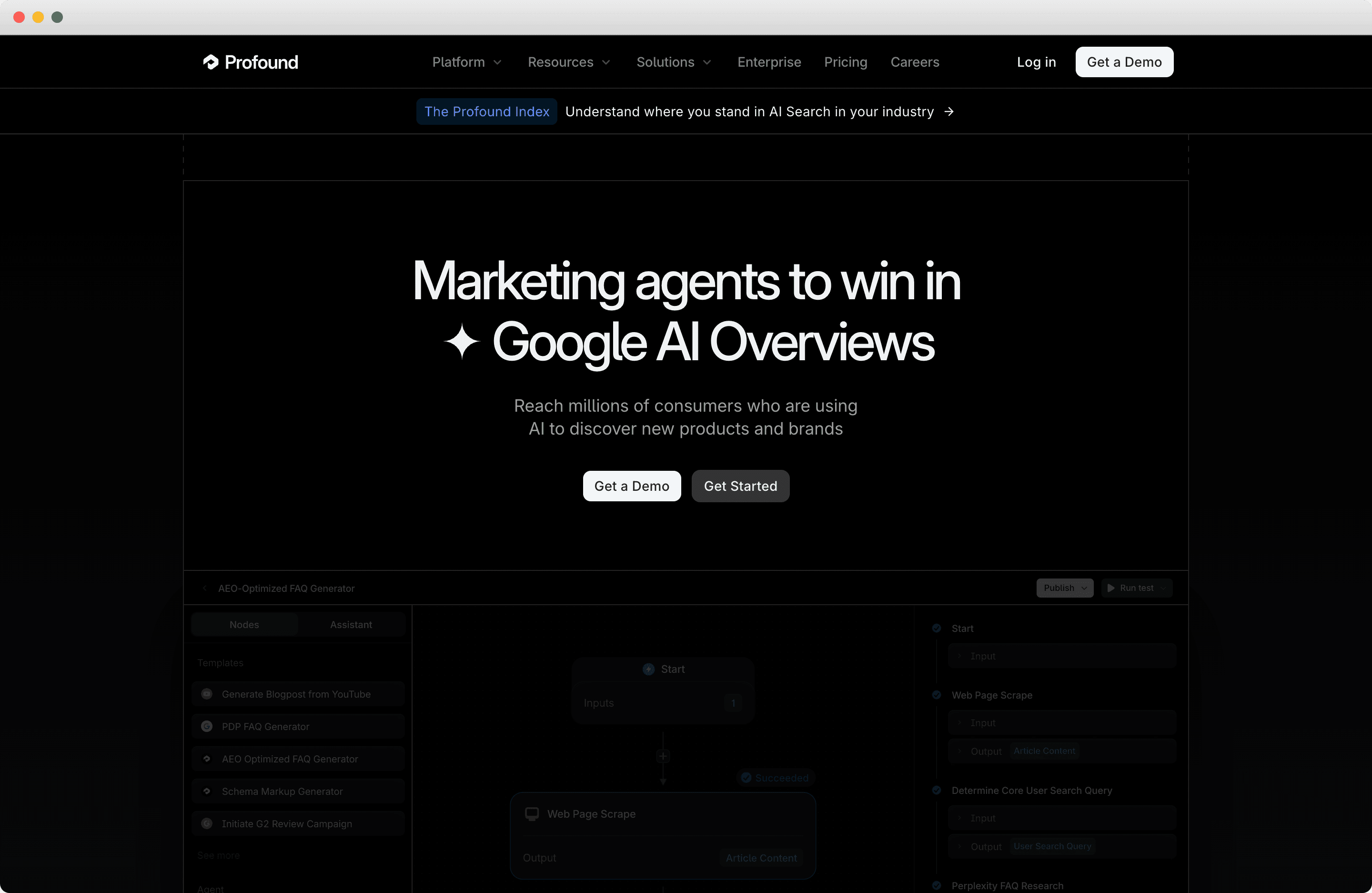
Key Features:
Shopping: a dedicated feature that tracks how your products place in AI shopping answers.
Answer Engine Insights across up to nine AI platforms.
Prompt Volumes to weight visibility by the buying queries that carry demand.
Agent Analytics tying AI crawling to what gets recommended.
Pricing:
Starter: $99/mo for ChatGPT tracking and 50 prompts.
Growth: $399/mo total for 3 engines and 100 prompts.
Enterprise: custom pricing with wider coverage and SOC 2. Free trial available.
Reddit Score: 64% Positive. What redditors say:
“Profound is the most full-featured and priced like it.” (r/SaaS)
“Ive found success with Profound.” (r/SEO_LLM)
Rated for depth, with price the recurring caveat.
Most tools measure whether a brand gets mentioned. Profound goes a level deeper for retail with its Shopping feature, tracking how individual products place when AI does the recommending, the exact question an ecommerce team loses sleep over.
Pair that with prompt-demand data and you can tell whether you are missing on the queries that convert, not just the ones that flatter your dashboard. The depth costs more than a lightweight tracker, and reviewers say so, but once AI shopping is a real revenue channel for you, this is the most complete view on the list.
3. Otterly: Best for Ecommerce Content Visibility
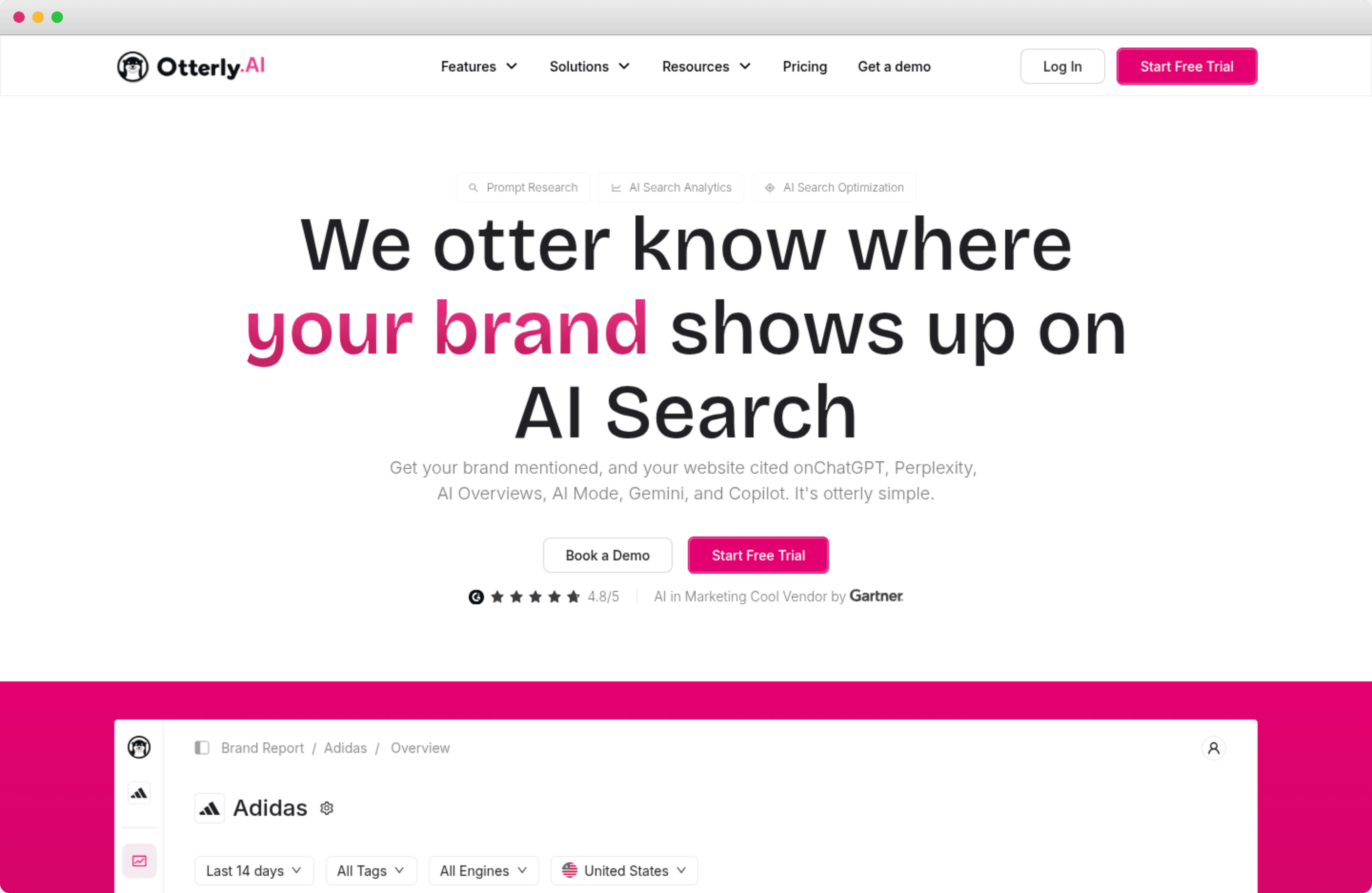
Key Features:
AI Search Analytics across ChatGPT, Gemini, Perplexity, and more.
Content Audit and GEO recommendations for product and category pages.
Link Citations Analysis to see which reviews and roundups cite you.
A clean Brand Visibility Index anyone on the team can read.
Pricing:
Lite: $29/mo for 15 prompts and 4 engines.
Standard: $189/mo for 100 prompts and a Looker Studio connector.
Premium: $489/mo for 400 prompts and personal onboarding. Free trial available.
Reddit Score: 71% Positive. What redditors say:
“Currently using Otterly AI, its doing pretty good so far, we've been using it for one month and a half now.” (r/SEO_LLM)
“peec and otterly are decent, i landed on crowdreply.” (r/aeo)
A budget-friendly pick for teams that want the content angle covered.
Ecommerce visibility is often won on content, the buying guides, category explainers, and comparison pages AI loves to cite. Otterly is built around that, auditing your pages for AI-readiness and pointing you at what to fix, all from a $29 starting point.
The citation analysis is where retail teams get the most value, showing which review sites and roundups an engine trusts in your category. Knowing that a rival gets cited by a gear-review blog is the kind of lead that turns into an outreach plan.
4. Goodie AI: Best for Agentic Commerce

Key Features:
Agentic Commerce Suite built for products surfacing in AI shopping, including Amazon Rufus.
Visibility monitoring across up to eleven answer engines.
Optimization Actions and an AEO Writer to close product-content gaps.
Revenue attribution tying AI visibility to sales.
Pricing:
Explorer: $399/mo for 3 engines, 100 prompts, and 3 seats, with a 30-day money-back guarantee.
Pro: custom pricing with 6 engines and agentic commerce.
Enterprise: custom pricing with a dedicated strategist.
Reddit Score: Limited public footprint. Public chatter is light, but Goodie is built squarely for commerce and enterprise brands, and its Amazon Rufus coverage is a signal of how seriously it takes AI shopping.
Few tools name agentic commerce as a first-class feature, and that is exactly Goodie's pitch. Its Agentic Commerce Suite watches whether your products surface when AI shops on a customer's behalf, and its coverage stretches to Amazon Rufus, where a lot of retail discovery is heading.
Revenue attribution is what makes it a boardroom-friendly buy for a retail brand. Tying AI visibility work to sales, rather than to a visibility score alone, gives an ecommerce team the one number a finance lead will ask about first.
5. Scrunch AI: Best for Product-Level AI Visibility
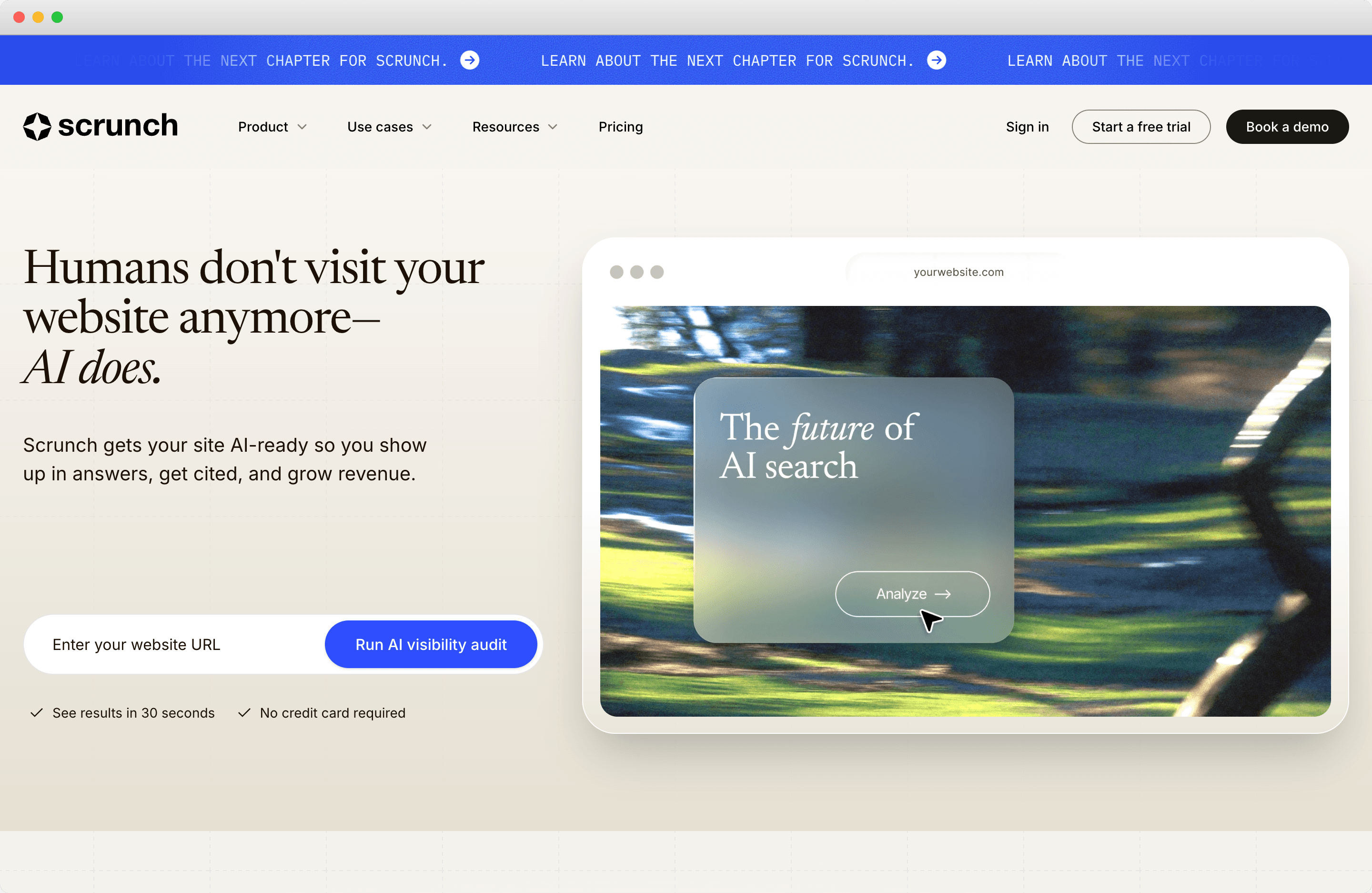
Key Features:
Product-level AI search performance, so you measure visibility per product, not just per brand.
Agent Experience Platform that formats product content for how AI reads it.
AI agent traffic tracking across up to nine LLMs.
Site audits tuned for AI consumption.
Pricing:
Core: $250/mo for 125 prompts, 5 site audits, and 5 user licenses.
Enterprise: custom pricing with all nine LLMs, API access, and SSO. Free trial available.
Reddit Score: Limited public footprint. Reddit chatter is light, but Scrunch is one of the most-referenced enterprise names in third-party AEO roundups, and product-level tracking is exactly what a large catalog needs.
Brand-level scores flatter you when one hero product carries the whole catalog. Scrunch measures visibility product by product, so a retailer can find the specific items AI keeps skipping while the bestseller hogs the spotlight.
Its Agent Experience Platform then gives you a way to fix it, formatting product pages so engines can read and cite them cleanly. That granularity earns its enterprise footing once your catalog runs into the hundreds of SKUs, where a brand-level average hides more than it reveals.
6. Yotpo Discover: Best for Review-Driven AI Visibility
Key Features:
AI-driven review displays and summaries that feed the review signals AI reads.
AI visibility tracking across ChatGPT and Gemini.
UGC galleries and seller ratings that build trust signals.
180-plus integrations with Shopify, BigCommerce, and more.
Pricing:
Free: $0 with limited features and starter credits.
Starter: $89/mo for up to 500 orders a month.
Pro: $169/mo with AI-driven displays, Premium and Enterprise custom.
Reddit Score: Limited public footprint for its AI-visibility layer specifically, though Yotpo itself is a household name in ecommerce reviews and loyalty, which is the exact trust signal AI engines lean on.
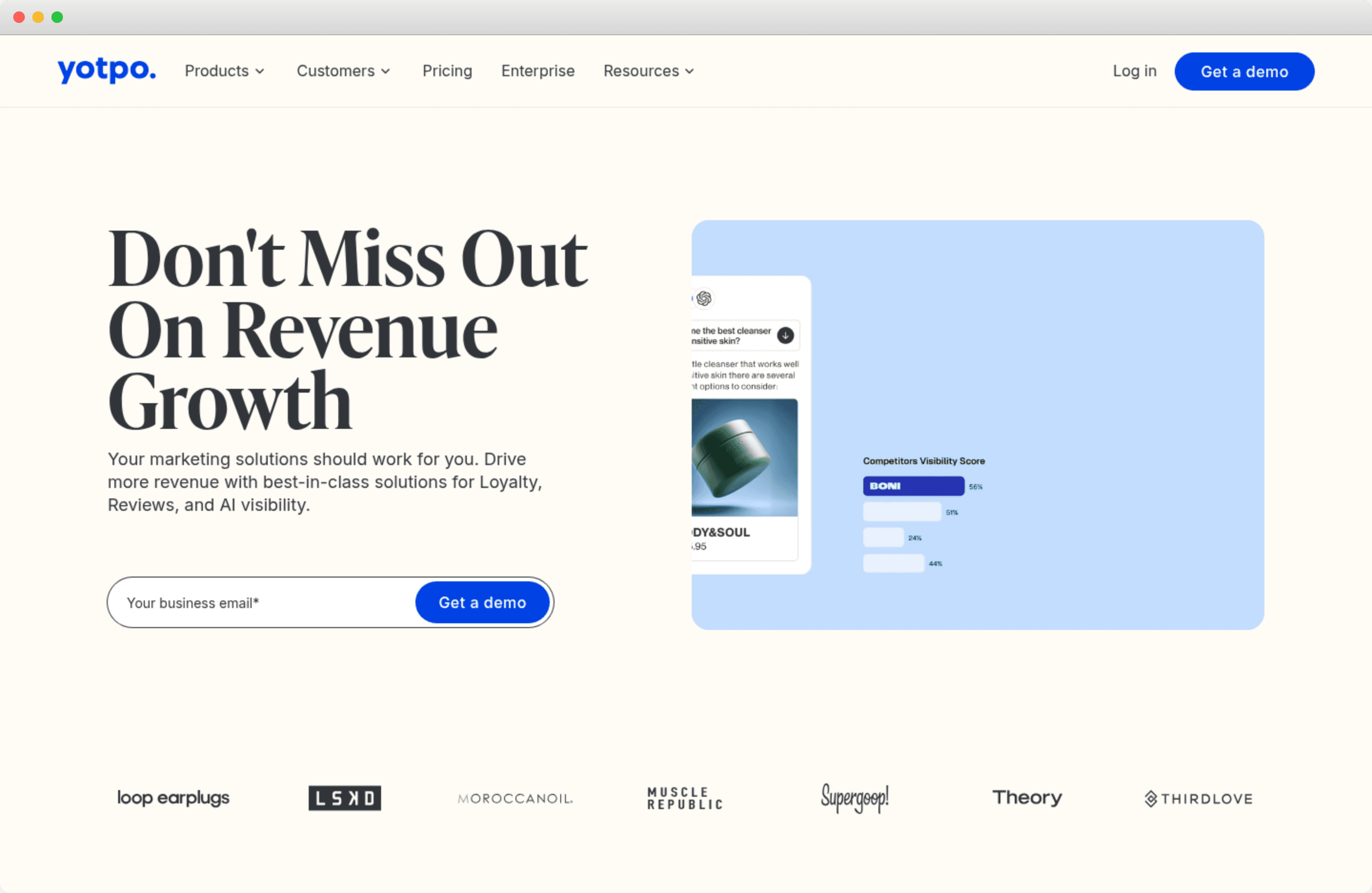
AI recommendations run on reviews, and Yotpo has spent years owning that layer for ecommerce. Its newer AI-visibility tracking builds on a foundation most tools lack: the review and UGC engine that generates the signals ChatGPT and Gemini read when they decide which brand to trust.
For a Shopify or BigCommerce brand already collecting reviews through Yotpo, adding visibility tracking keeps the whole trust-and-discovery cycle in one place. It is less a pure tracker and more a way to connect the reviews you gather to the recommendations you earn.
7. GrowByData: Best for Multi-Channel Retail Visibility
Key Features:
Multi-channel monitoring across organic, paid, AI Overviews, and SERP features.
LLM monitoring across ChatGPT, Perplexity, and Google AI Mode.
Hyperlocal SERP tracking down to city and zip level.
Competitor intelligence on share of voice, pricing, and promotions.
Pricing:
Custom, quote-based pricing with a dedicated engagement team.
Built for enterprise retail and agencies rather than self-serve signup.
Competitive visibility audits available on request.
Reddit Score: Limited public footprint. GrowByData works with enterprise retail and agencies through a hands-on model, so its presence lives in commerce circles rather than open Reddit threads.
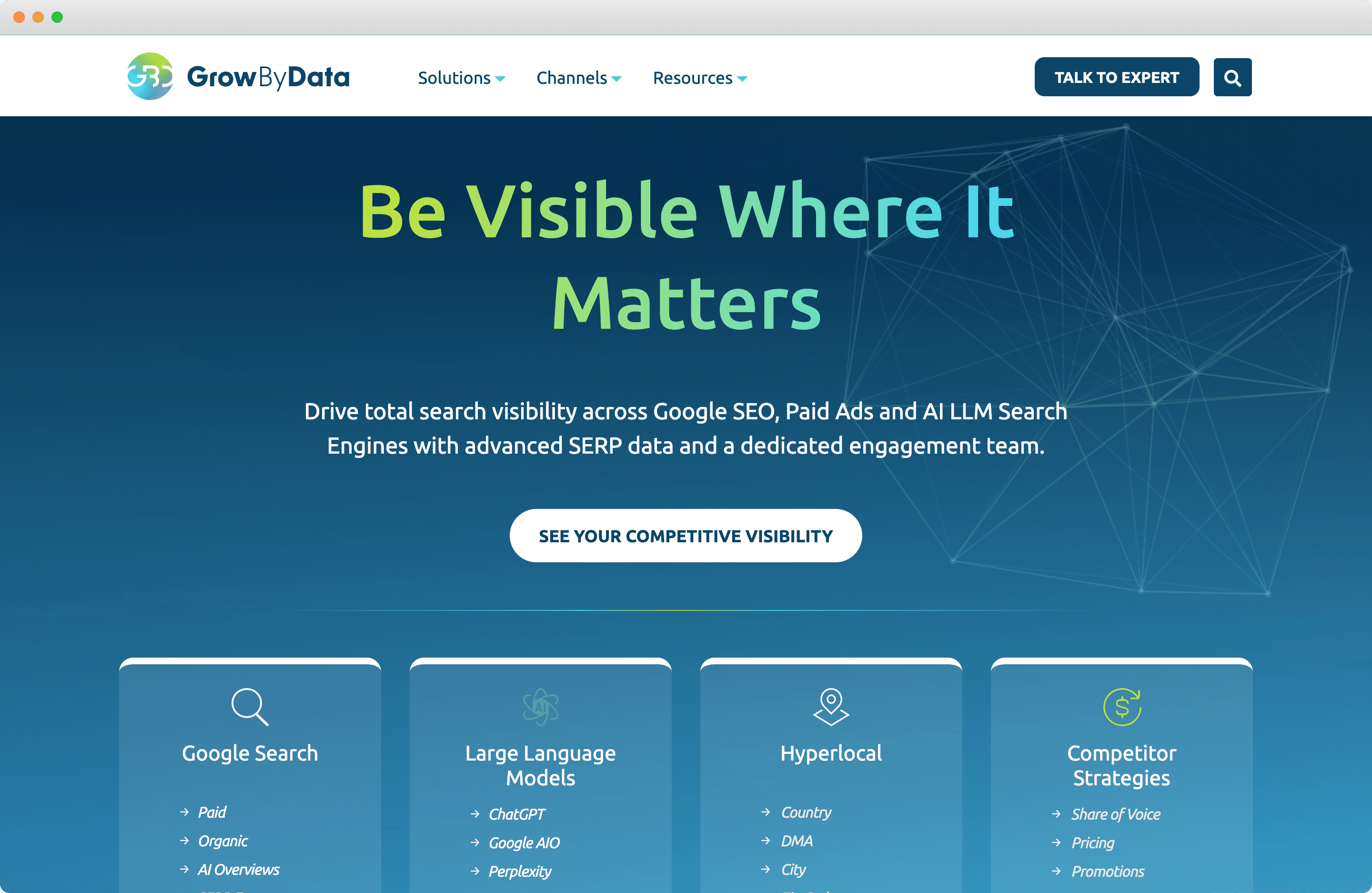
Retail visibility rarely stops at one channel, and GrowByData is built for the brand that has to watch organic, paid, shopping, and AI answers at once. It ties them together with competitor intelligence on pricing and promotions, the levers that move a retail sale.
The hands-on engagement model suits enterprise retailers who want a team, not just a dashboard, and the hyperlocal SERP tracking matters for brands whose availability changes by market. It is the heavyweight option for retail groups managing visibility at real scale.
8. Writesonic: Best for Ecommerce Content at Scale
Key Features:
Tracking across ten AI platforms, a broad spread for a content-first tool.
AI content generation for product and category pages at volume.
Shopping and agentic commerce features for retail.
Action Center to turn findings into on-page fixes.
Pricing:
Starter: $79/mo for 50 prompts tracked daily and 15 AI articles a month.
Basic: $199/mo for 100 prompts and 25 articles.
Growth: $399/mo for 200 prompts and 50 articles. Free trial available.
Reddit Score: Limited public footprint. Writesonic's AEO product is newer than its well-known AI writing suite, so tool-specific reviews are still emerging, while the brand itself is already widely used.
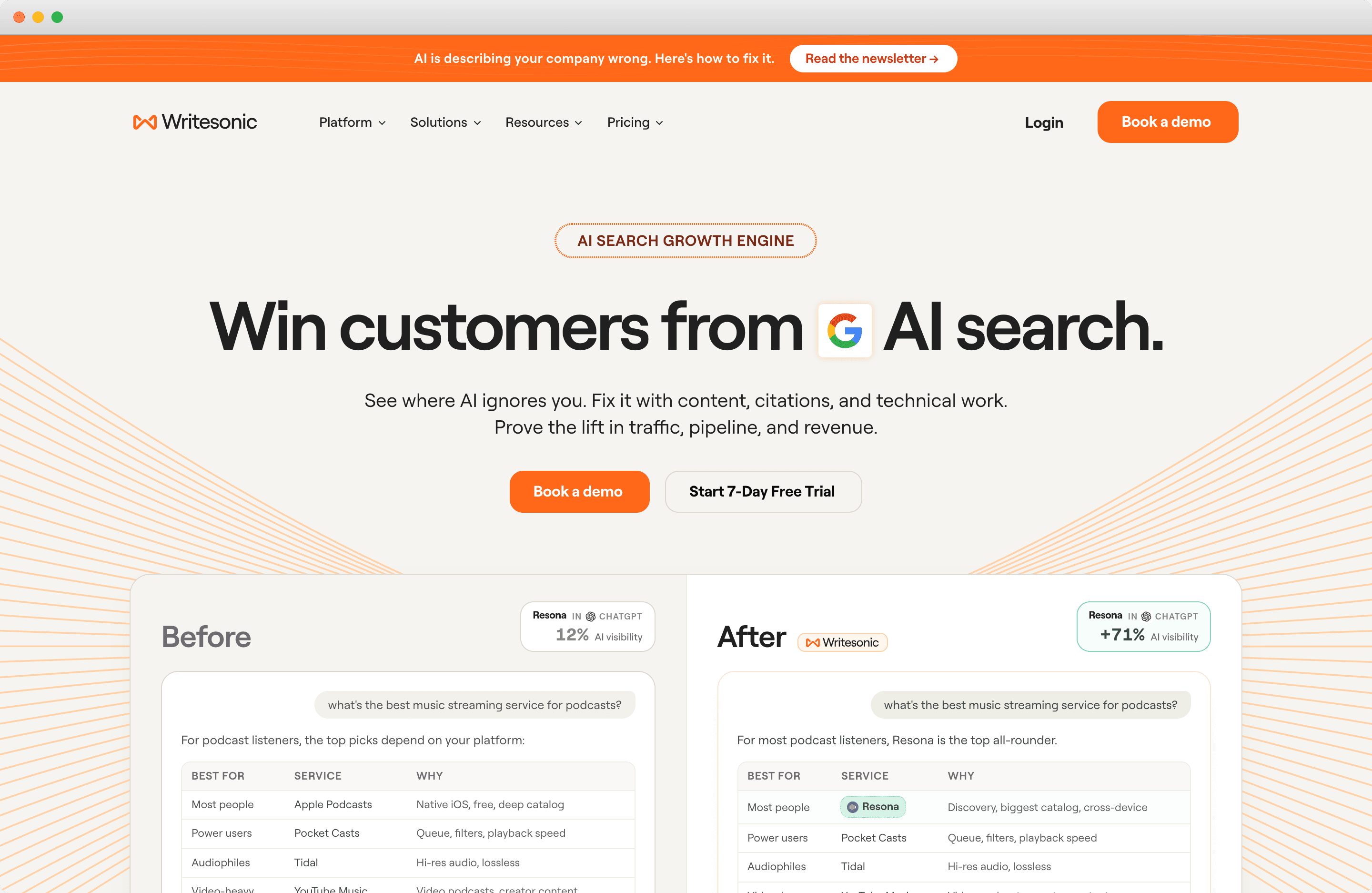
A large catalog means a lot of pages, and a lot of pages means content is usually the ecommerce bottleneck. Writesonic pairs AI-visibility tracking across ten engines with the content generation to fill the gaps it finds, which suits a lean retail team that cannot hand-write a guide for every category.
Its Shopping and agentic-commerce features keep the retail angle in view, and the Action Center turns a tracking insight into an on-page task. When your team has to produce as much content as it measures, that pairing does real work.
9. Similarweb: Best for Retail Market Intelligence
Key Features:
AI brand visibility tracking inside a broad digital-intelligence platform.
Retail and Amazon analytics for market and category context.
Competitive benchmarking and demand analysis.
AI agents for SEO strategy and demand research.
Pricing:
Custom pricing across self-service and enterprise packages.
Free trial available to explore the platform.
Contact sales for retail-specific configurations.
Reddit Score: Limited public footprint for its AI-visibility layer, though Similarweb is a publicly traded digital-intelligence company whose retail and market data are widely used across ecommerce.
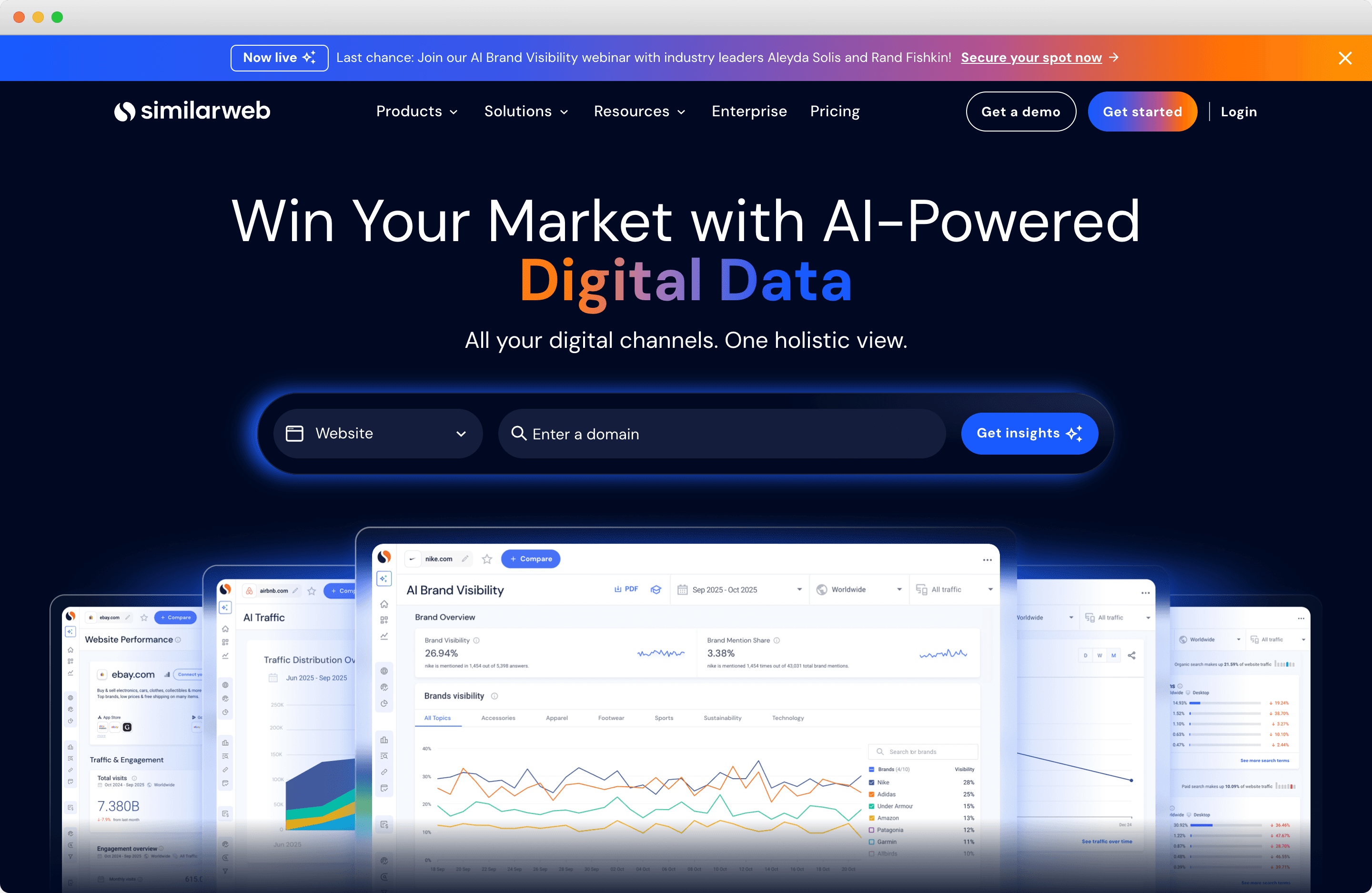
Sometimes AI visibility is one question inside a bigger one: where is the whole category heading. Similarweb answers that, folding AI brand-visibility tracking into retail analytics, demand analysis, and Amazon data, so an ecommerce strategist sees their AI presence in full market context.
That breadth is the appeal for a larger retailer already using Similarweb for competitive research. AI visibility becomes another lens on the market rather than a standalone tool, which is what a market-intelligence team wants from it.
What to Buy at Each Budget
The ecommerce decision comes down to how close to the product you need to get, and how much you can spend getting there.
Under $100 a month: Otterly at $29 for the content angle, Yotpo's $89 Starter if reviews are your strongest asset, and Qvery's EUR 99 Lite if you would rather ask questions than read charts.
Low hundreds: Goodie for agentic commerce and Amazon Rufus, Scrunch for product-level tracking, Writesonic for content at scale, Profound's Starter for shopping placement.
Enterprise and custom: GrowByData and Similarweb for full retail market intelligence, Profound's top tier for procurement-grade security.
Whichever tier you start in, measure the buying queries that matter in your top market first, and add countries as the channel proves itself. The shelf you are fighting for is a sentence in a chatbot, and the brands that measure it are the ones that end up on it.
A shopper asks ChatGPT for the best running shoes for flat feet, gets five brands back, and buys one without ever seeing a shelf, an ad, or a product page.
Ecommerce spent twenty years optimizing every step of the path to purchase, and the newest step now happens entirely inside an answer.
For a retail brand, that answer is the new shelf, and getting recommended by AI now matters as much as ranking on Google. The nine tools below are ranked by how close to the product and the market they get, and one of them is ours, so it leads with the bias in plain view.
1. Qvery: Country-Level Answers for Cross-Border Sellers
Key Features:
Daily tracking of whether ChatGPT and Google AI Mode recommend your brand on the category and buying queries shoppers ask, in 200+ countries.
Per-market share of voice, so you see where you win the recommendation in one country and lose it in another, not just a global average.
Qvery Assistant: a conversational layer over your own data. Ask which buying queries a rival wins in a given market, and run first-party actions like adding queries, triggering a run, or exporting a report.
Every citation captured, so you see the review sites and roundups AI leans on when it names a competitor.
Unlimited seats and brands from Business up, which fits a house of store brands selling across borders.
Pricing:
Lite: EUR 99/mo for 1 brand and 50 queries.
Business: EUR 199/mo for unlimited brands, 100 queries, and Slack support.
Enterprise: custom pricing for 500+ queries. The free trial needs no credit card.
Reddit Score: 97% Positive. What redditors say:
It surfaces in threads on how AI search is reshaping the way local service businesses win customers. (r/sweatystartup)
It shows up for a SaaS marketer whose trial signups climb while AI keeps naming rivals. (r/SaaSMarketing)
Mostly positive, a handful neutral, and no negative mentions on record.
This is our product, so weigh the bias, then judge the fit. Qvery measures whether AI puts your brand on the shortlist when a shopper asks what to buy, daily across ChatGPT and Google AI Mode, and it does that market by market in 200+ countries.
For a cross-border seller, the market-by-market part is the point. Ask the Assistant where you lose the recommendation in France or win it in Brazil, and it answers from your own account, then adds queries or triggers a run without leaving the chat.
2. Profound: Best for Tracking Product Placement in AI Shopping
Key Features:
Shopping: a dedicated feature that tracks how your products place in AI shopping answers.
Answer Engine Insights across up to nine AI platforms.
Prompt Volumes to weight visibility by the buying queries that carry demand.
Agent Analytics tying AI crawling to what gets recommended.
Pricing:
Starter: $99/mo for ChatGPT tracking and 50 prompts.
Growth: $399/mo total for 3 engines and 100 prompts.
Enterprise: custom pricing with wider coverage and SOC 2. Free trial available.
Reddit Score: 64% Positive. What redditors say:
“Profound is the most full-featured and priced like it.” (r/SaaS)
“Ive found success with Profound.” (r/SEO_LLM)
Rated for depth, with price the recurring caveat.
Most tools measure whether a brand gets mentioned. Profound goes a level deeper for retail with its Shopping feature, tracking how individual products place when AI does the recommending, the exact question an ecommerce team loses sleep over.
Pair that with prompt-demand data and you can tell whether you are missing on the queries that convert, not just the ones that flatter your dashboard. The depth costs more than a lightweight tracker, and reviewers say so, but once AI shopping is a real revenue channel for you, this is the most complete view on the list.
3. Otterly: Best for Ecommerce Content Visibility
Key Features:
AI Search Analytics across ChatGPT, Gemini, Perplexity, and more.
Content Audit and GEO recommendations for product and category pages.
Link Citations Analysis to see which reviews and roundups cite you.
A clean Brand Visibility Index anyone on the team can read.
Pricing:
Lite: $29/mo for 15 prompts and 4 engines.
Standard: $189/mo for 100 prompts and a Looker Studio connector.
Premium: $489/mo for 400 prompts and personal onboarding. Free trial available.
Reddit Score: 71% Positive. What redditors say:
“Currently using Otterly AI, its doing pretty good so far, we've been using it for one month and a half now.” (r/SEO_LLM)
“peec and otterly are decent, i landed on crowdreply.” (r/aeo)
A budget-friendly pick for teams that want the content angle covered.
Ecommerce visibility is often won on content, the buying guides, category explainers, and comparison pages AI loves to cite. Otterly is built around that, auditing your pages for AI-readiness and pointing you at what to fix, all from a $29 starting point.
The citation analysis is where retail teams get the most value, showing which review sites and roundups an engine trusts in your category. Knowing that a rival gets cited by a gear-review blog is the kind of lead that turns into an outreach plan.
4. Goodie AI: Best for Agentic Commerce
Key Features:
Agentic Commerce Suite built for products surfacing in AI shopping, including Amazon Rufus.
Visibility monitoring across up to eleven answer engines.
Optimization Actions and an AEO Writer to close product-content gaps.
Revenue attribution tying AI visibility to sales.
Pricing:
Explorer: $399/mo for 3 engines, 100 prompts, and 3 seats, with a 30-day money-back guarantee.
Pro: custom pricing with 6 engines and agentic commerce.
Enterprise: custom pricing with a dedicated strategist.
Reddit Score: Limited public footprint. Public chatter is light, but Goodie is built squarely for commerce and enterprise brands, and its Amazon Rufus coverage is a signal of how seriously it takes AI shopping.
Few tools name agentic commerce as a first-class feature, and that is exactly Goodie's pitch. Its Agentic Commerce Suite watches whether your products surface when AI shops on a customer's behalf, and its coverage stretches to Amazon Rufus, where a lot of retail discovery is heading.
Revenue attribution is what makes it a boardroom-friendly buy for a retail brand. Tying AI visibility work to sales, rather than to a visibility score alone, gives an ecommerce team the one number a finance lead will ask about first.
5. Scrunch AI: Best for Product-Level AI Visibility
Key Features:
Product-level AI search performance, so you measure visibility per product, not just per brand.
Agent Experience Platform that formats product content for how AI reads it.
AI agent traffic tracking across up to nine LLMs.
Site audits tuned for AI consumption.
Pricing:
Core: $250/mo for 125 prompts, 5 site audits, and 5 user licenses.
Enterprise: custom pricing with all nine LLMs, API access, and SSO. Free trial available.
Reddit Score: Limited public footprint. Reddit chatter is light, but Scrunch is one of the most-referenced enterprise names in third-party AEO roundups, and product-level tracking is exactly what a large catalog needs.
Brand-level scores flatter you when one hero product carries the whole catalog. Scrunch measures visibility product by product, so a retailer can find the specific items AI keeps skipping while the bestseller hogs the spotlight.
Its Agent Experience Platform then gives you a way to fix it, formatting product pages so engines can read and cite them cleanly. That granularity earns its enterprise footing once your catalog runs into the hundreds of SKUs, where a brand-level average hides more than it reveals.
6. Yotpo Discover: Best for Review-Driven AI Visibility
Key Features:
AI-driven review displays and summaries that feed the review signals AI reads.
AI visibility tracking across ChatGPT and Gemini.
UGC galleries and seller ratings that build trust signals.
180-plus integrations with Shopify, BigCommerce, and more.
Pricing:
Free: $0 with limited features and starter credits.
Starter: $89/mo for up to 500 orders a month.
Pro: $169/mo with AI-driven displays, Premium and Enterprise custom.
Reddit Score: Limited public footprint for its AI-visibility layer specifically, though Yotpo itself is a household name in ecommerce reviews and loyalty, which is the exact trust signal AI engines lean on.
AI recommendations run on reviews, and Yotpo has spent years owning that layer for ecommerce. Its newer AI-visibility tracking builds on a foundation most tools lack: the review and UGC engine that generates the signals ChatGPT and Gemini read when they decide which brand to trust.
For a Shopify or BigCommerce brand already collecting reviews through Yotpo, adding visibility tracking keeps the whole trust-and-discovery cycle in one place. It is less a pure tracker and more a way to connect the reviews you gather to the recommendations you earn.
7. GrowByData: Best for Multi-Channel Retail Visibility
Key Features:
Multi-channel monitoring across organic, paid, AI Overviews, and SERP features.
LLM monitoring across ChatGPT, Perplexity, and Google AI Mode.
Hyperlocal SERP tracking down to city and zip level.
Competitor intelligence on share of voice, pricing, and promotions.
Pricing:
Custom, quote-based pricing with a dedicated engagement team.
Built for enterprise retail and agencies rather than self-serve signup.
Competitive visibility audits available on request.
Reddit Score: Limited public footprint. GrowByData works with enterprise retail and agencies through a hands-on model, so its presence lives in commerce circles rather than open Reddit threads.
Retail visibility rarely stops at one channel, and GrowByData is built for the brand that has to watch organic, paid, shopping, and AI answers at once. It ties them together with competitor intelligence on pricing and promotions, the levers that move a retail sale.
The hands-on engagement model suits enterprise retailers who want a team, not just a dashboard, and the hyperlocal SERP tracking matters for brands whose availability changes by market. It is the heavyweight option for retail groups managing visibility at real scale.
8. Writesonic: Best for Ecommerce Content at Scale
Key Features:
Tracking across ten AI platforms, a broad spread for a content-first tool.
AI content generation for product and category pages at volume.
Shopping and agentic commerce features for retail.
Action Center to turn findings into on-page fixes.
Pricing:
Starter: $79/mo for 50 prompts tracked daily and 15 AI articles a month.
Basic: $199/mo for 100 prompts and 25 articles.
Growth: $399/mo for 200 prompts and 50 articles. Free trial available.
Reddit Score: Limited public footprint. Writesonic's AEO product is newer than its well-known AI writing suite, so tool-specific reviews are still emerging, while the brand itself is already widely used.
A large catalog means a lot of pages, and a lot of pages means content is usually the ecommerce bottleneck. Writesonic pairs AI-visibility tracking across ten engines with the content generation to fill the gaps it finds, which suits a lean retail team that cannot hand-write a guide for every category.
Its Shopping and agentic-commerce features keep the retail angle in view, and the Action Center turns a tracking insight into an on-page task. When your team has to produce as much content as it measures, that pairing does real work.
9. Similarweb: Best for Retail Market Intelligence
Key Features:
AI brand visibility tracking inside a broad digital-intelligence platform.
Retail and Amazon analytics for market and category context.
Competitive benchmarking and demand analysis.
AI agents for SEO strategy and demand research.
Pricing:
Custom pricing across self-service and enterprise packages.
Free trial available to explore the platform.
Contact sales for retail-specific configurations.
Reddit Score: Limited public footprint for its AI-visibility layer, though Similarweb is a publicly traded digital-intelligence company whose retail and market data are widely used across ecommerce.
Sometimes AI visibility is one question inside a bigger one: where is the whole category heading. Similarweb answers that, folding AI brand-visibility tracking into retail analytics, demand analysis, and Amazon data, so an ecommerce strategist sees their AI presence in full market context.
That breadth is the appeal for a larger retailer already using Similarweb for competitive research. AI visibility becomes another lens on the market rather than a standalone tool, which is what a market-intelligence team wants from it.
What to Buy at Each Budget
The ecommerce decision comes down to how close to the product you need to get, and how much you can spend getting there.
Under $100 a month: Otterly at $29 for the content angle, Yotpo's $89 Starter if reviews are your strongest asset, and Qvery's EUR 99 Lite if you would rather ask questions than read charts.
Low hundreds: Goodie for agentic commerce and Amazon Rufus, Scrunch for product-level tracking, Writesonic for content at scale, Profound's Starter for shopping placement.
Enterprise and custom: GrowByData and Similarweb for full retail market intelligence, Profound's top tier for procurement-grade security.
Whichever tier you start in, measure the buying queries that matter in your top market first, and add countries as the channel proves itself. The shelf you are fighting for is a sentence in a chatbot, and the brands that measure it are the ones that end up on it.
A shopper asks ChatGPT for the best running shoes for flat feet, gets five brands back, and buys one without ever seeing a shelf, an ad, or a product page.
Ecommerce spent twenty years optimizing every step of the path to purchase, and the newest step now happens entirely inside an answer.
For a retail brand, that answer is the new shelf, and getting recommended by AI now matters as much as ranking on Google. The nine tools below are ranked by how close to the product and the market they get, and one of them is ours, so it leads with the bias in plain view.
1. Qvery: Country-Level Answers for Cross-Border Sellers
Key Features:
Daily tracking of whether ChatGPT and Google AI Mode recommend your brand on the category and buying queries shoppers ask, in 200+ countries.
Per-market share of voice, so you see where you win the recommendation in one country and lose it in another, not just a global average.
Qvery Assistant: a conversational layer over your own data. Ask which buying queries a rival wins in a given market, and run first-party actions like adding queries, triggering a run, or exporting a report.
Every citation captured, so you see the review sites and roundups AI leans on when it names a competitor.
Unlimited seats and brands from Business up, which fits a house of store brands selling across borders.
Pricing:
Lite: EUR 99/mo for 1 brand and 50 queries.
Business: EUR 199/mo for unlimited brands, 100 queries, and Slack support.
Enterprise: custom pricing for 500+ queries. The free trial needs no credit card.
Reddit Score: 97% Positive. What redditors say:
It surfaces in threads on how AI search is reshaping the way local service businesses win customers. (r/sweatystartup)
It shows up for a SaaS marketer whose trial signups climb while AI keeps naming rivals. (r/SaaSMarketing)
Mostly positive, a handful neutral, and no negative mentions on record.
This is our product, so weigh the bias, then judge the fit. Qvery measures whether AI puts your brand on the shortlist when a shopper asks what to buy, daily across ChatGPT and Google AI Mode, and it does that market by market in 200+ countries.
For a cross-border seller, the market-by-market part is the point. Ask the Assistant where you lose the recommendation in France or win it in Brazil, and it answers from your own account, then adds queries or triggers a run without leaving the chat.
2. Profound: Best for Tracking Product Placement in AI Shopping
Key Features:
Shopping: a dedicated feature that tracks how your products place in AI shopping answers.
Answer Engine Insights across up to nine AI platforms.
Prompt Volumes to weight visibility by the buying queries that carry demand.
Agent Analytics tying AI crawling to what gets recommended.
Pricing:
Starter: $99/mo for ChatGPT tracking and 50 prompts.
Growth: $399/mo total for 3 engines and 100 prompts.
Enterprise: custom pricing with wider coverage and SOC 2. Free trial available.
Reddit Score: 64% Positive. What redditors say:
“Profound is the most full-featured and priced like it.” (r/SaaS)
“Ive found success with Profound.” (r/SEO_LLM)
Rated for depth, with price the recurring caveat.
Most tools measure whether a brand gets mentioned. Profound goes a level deeper for retail with its Shopping feature, tracking how individual products place when AI does the recommending, the exact question an ecommerce team loses sleep over.
Pair that with prompt-demand data and you can tell whether you are missing on the queries that convert, not just the ones that flatter your dashboard. The depth costs more than a lightweight tracker, and reviewers say so, but once AI shopping is a real revenue channel for you, this is the most complete view on the list.
3. Otterly: Best for Ecommerce Content Visibility
Key Features:
AI Search Analytics across ChatGPT, Gemini, Perplexity, and more.
Content Audit and GEO recommendations for product and category pages.
Link Citations Analysis to see which reviews and roundups cite you.
A clean Brand Visibility Index anyone on the team can read.
Pricing:
Lite: $29/mo for 15 prompts and 4 engines.
Standard: $189/mo for 100 prompts and a Looker Studio connector.
Premium: $489/mo for 400 prompts and personal onboarding. Free trial available.
Reddit Score: 71% Positive. What redditors say:
“Currently using Otterly AI, its doing pretty good so far, we've been using it for one month and a half now.” (r/SEO_LLM)
“peec and otterly are decent, i landed on crowdreply.” (r/aeo)
A budget-friendly pick for teams that want the content angle covered.
Ecommerce visibility is often won on content, the buying guides, category explainers, and comparison pages AI loves to cite. Otterly is built around that, auditing your pages for AI-readiness and pointing you at what to fix, all from a $29 starting point.
The citation analysis is where retail teams get the most value, showing which review sites and roundups an engine trusts in your category. Knowing that a rival gets cited by a gear-review blog is the kind of lead that turns into an outreach plan.
4. Goodie AI: Best for Agentic Commerce
Key Features:
Agentic Commerce Suite built for products surfacing in AI shopping, including Amazon Rufus.
Visibility monitoring across up to eleven answer engines.
Optimization Actions and an AEO Writer to close product-content gaps.
Revenue attribution tying AI visibility to sales.
Pricing:
Explorer: $399/mo for 3 engines, 100 prompts, and 3 seats, with a 30-day money-back guarantee.
Pro: custom pricing with 6 engines and agentic commerce.
Enterprise: custom pricing with a dedicated strategist.
Reddit Score: Limited public footprint. Public chatter is light, but Goodie is built squarely for commerce and enterprise brands, and its Amazon Rufus coverage is a signal of how seriously it takes AI shopping.
Few tools name agentic commerce as a first-class feature, and that is exactly Goodie's pitch. Its Agentic Commerce Suite watches whether your products surface when AI shops on a customer's behalf, and its coverage stretches to Amazon Rufus, where a lot of retail discovery is heading.
Revenue attribution is what makes it a boardroom-friendly buy for a retail brand. Tying AI visibility work to sales, rather than to a visibility score alone, gives an ecommerce team the one number a finance lead will ask about first.
5. Scrunch AI: Best for Product-Level AI Visibility
Key Features:
Product-level AI search performance, so you measure visibility per product, not just per brand.
Agent Experience Platform that formats product content for how AI reads it.
AI agent traffic tracking across up to nine LLMs.
Site audits tuned for AI consumption.
Pricing:
Core: $250/mo for 125 prompts, 5 site audits, and 5 user licenses.
Enterprise: custom pricing with all nine LLMs, API access, and SSO. Free trial available.
Reddit Score: Limited public footprint. Reddit chatter is light, but Scrunch is one of the most-referenced enterprise names in third-party AEO roundups, and product-level tracking is exactly what a large catalog needs.
Brand-level scores flatter you when one hero product carries the whole catalog. Scrunch measures visibility product by product, so a retailer can find the specific items AI keeps skipping while the bestseller hogs the spotlight.
Its Agent Experience Platform then gives you a way to fix it, formatting product pages so engines can read and cite them cleanly. That granularity earns its enterprise footing once your catalog runs into the hundreds of SKUs, where a brand-level average hides more than it reveals.
6. Yotpo Discover: Best for Review-Driven AI Visibility
Key Features:
AI-driven review displays and summaries that feed the review signals AI reads.
AI visibility tracking across ChatGPT and Gemini.
UGC galleries and seller ratings that build trust signals.
180-plus integrations with Shopify, BigCommerce, and more.
Pricing:
Free: $0 with limited features and starter credits.
Starter: $89/mo for up to 500 orders a month.
Pro: $169/mo with AI-driven displays, Premium and Enterprise custom.
Reddit Score: Limited public footprint for its AI-visibility layer specifically, though Yotpo itself is a household name in ecommerce reviews and loyalty, which is the exact trust signal AI engines lean on.
AI recommendations run on reviews, and Yotpo has spent years owning that layer for ecommerce. Its newer AI-visibility tracking builds on a foundation most tools lack: the review and UGC engine that generates the signals ChatGPT and Gemini read when they decide which brand to trust.
For a Shopify or BigCommerce brand already collecting reviews through Yotpo, adding visibility tracking keeps the whole trust-and-discovery cycle in one place. It is less a pure tracker and more a way to connect the reviews you gather to the recommendations you earn.
7. GrowByData: Best for Multi-Channel Retail Visibility
Key Features:
Multi-channel monitoring across organic, paid, AI Overviews, and SERP features.
LLM monitoring across ChatGPT, Perplexity, and Google AI Mode.
Hyperlocal SERP tracking down to city and zip level.
Competitor intelligence on share of voice, pricing, and promotions.
Pricing:
Custom, quote-based pricing with a dedicated engagement team.
Built for enterprise retail and agencies rather than self-serve signup.
Competitive visibility audits available on request.
Reddit Score: Limited public footprint. GrowByData works with enterprise retail and agencies through a hands-on model, so its presence lives in commerce circles rather than open Reddit threads.
Retail visibility rarely stops at one channel, and GrowByData is built for the brand that has to watch organic, paid, shopping, and AI answers at once. It ties them together with competitor intelligence on pricing and promotions, the levers that move a retail sale.
The hands-on engagement model suits enterprise retailers who want a team, not just a dashboard, and the hyperlocal SERP tracking matters for brands whose availability changes by market. It is the heavyweight option for retail groups managing visibility at real scale.
8. Writesonic: Best for Ecommerce Content at Scale
Key Features:
Tracking across ten AI platforms, a broad spread for a content-first tool.
AI content generation for product and category pages at volume.
Shopping and agentic commerce features for retail.
Action Center to turn findings into on-page fixes.
Pricing:
Starter: $79/mo for 50 prompts tracked daily and 15 AI articles a month.
Basic: $199/mo for 100 prompts and 25 articles.
Growth: $399/mo for 200 prompts and 50 articles. Free trial available.
Reddit Score: Limited public footprint. Writesonic's AEO product is newer than its well-known AI writing suite, so tool-specific reviews are still emerging, while the brand itself is already widely used.
A large catalog means a lot of pages, and a lot of pages means content is usually the ecommerce bottleneck. Writesonic pairs AI-visibility tracking across ten engines with the content generation to fill the gaps it finds, which suits a lean retail team that cannot hand-write a guide for every category.
Its Shopping and agentic-commerce features keep the retail angle in view, and the Action Center turns a tracking insight into an on-page task. When your team has to produce as much content as it measures, that pairing does real work.
9. Similarweb: Best for Retail Market Intelligence
Key Features:
AI brand visibility tracking inside a broad digital-intelligence platform.
Retail and Amazon analytics for market and category context.
Competitive benchmarking and demand analysis.
AI agents for SEO strategy and demand research.
Pricing:
Custom pricing across self-service and enterprise packages.
Free trial available to explore the platform.
Contact sales for retail-specific configurations.
Reddit Score: Limited public footprint for its AI-visibility layer, though Similarweb is a publicly traded digital-intelligence company whose retail and market data are widely used across ecommerce.
Sometimes AI visibility is one question inside a bigger one: where is the whole category heading. Similarweb answers that, folding AI brand-visibility tracking into retail analytics, demand analysis, and Amazon data, so an ecommerce strategist sees their AI presence in full market context.
That breadth is the appeal for a larger retailer already using Similarweb for competitive research. AI visibility becomes another lens on the market rather than a standalone tool, which is what a market-intelligence team wants from it.
What to Buy at Each Budget
The ecommerce decision comes down to how close to the product you need to get, and how much you can spend getting there.
Under $100 a month: Otterly at $29 for the content angle, Yotpo's $89 Starter if reviews are your strongest asset, and Qvery's EUR 99 Lite if you would rather ask questions than read charts.
Low hundreds: Goodie for agentic commerce and Amazon Rufus, Scrunch for product-level tracking, Writesonic for content at scale, Profound's Starter for shopping placement.
Enterprise and custom: GrowByData and Similarweb for full retail market intelligence, Profound's top tier for procurement-grade security.
Whichever tier you start in, measure the buying queries that matter in your top market first, and add countries as the channel proves itself. The shelf you are fighting for is a sentence in a chatbot, and the brands that measure it are the ones that end up on it.
A shopper asks ChatGPT for the best running shoes for flat feet, gets five brands back, and buys one without ever seeing a shelf, an ad, or a product page.
Ecommerce spent twenty years optimizing every step of the path to purchase, and the newest step now happens entirely inside an answer.
For a retail brand, that answer is the new shelf, and getting recommended by AI now matters as much as ranking on Google. The nine tools below are ranked by how close to the product and the market they get, and one of them is ours, so it leads with the bias in plain view.
1. Qvery: Country-Level Answers for Cross-Border Sellers
Key Features:
Daily tracking of whether ChatGPT and Google AI Mode recommend your brand on the category and buying queries shoppers ask, in 200+ countries.
Per-market share of voice, so you see where you win the recommendation in one country and lose it in another, not just a global average.
Qvery Assistant: a conversational layer over your own data. Ask which buying queries a rival wins in a given market, and run first-party actions like adding queries, triggering a run, or exporting a report.
Every citation captured, so you see the review sites and roundups AI leans on when it names a competitor.
Unlimited seats and brands from Business up, which fits a house of store brands selling across borders.
Pricing:
Lite: EUR 99/mo for 1 brand and 50 queries.
Business: EUR 199/mo for unlimited brands, 100 queries, and Slack support.
Enterprise: custom pricing for 500+ queries. The free trial needs no credit card.
Reddit Score: 97% Positive. What redditors say:
It surfaces in threads on how AI search is reshaping the way local service businesses win customers. (r/sweatystartup)
It shows up for a SaaS marketer whose trial signups climb while AI keeps naming rivals. (r/SaaSMarketing)
Mostly positive, a handful neutral, and no negative mentions on record.
This is our product, so weigh the bias, then judge the fit. Qvery measures whether AI puts your brand on the shortlist when a shopper asks what to buy, daily across ChatGPT and Google AI Mode, and it does that market by market in 200+ countries.
For a cross-border seller, the market-by-market part is the point. Ask the Assistant where you lose the recommendation in France or win it in Brazil, and it answers from your own account, then adds queries or triggers a run without leaving the chat.
2. Profound: Best for Tracking Product Placement in AI Shopping
Key Features:
Shopping: a dedicated feature that tracks how your products place in AI shopping answers.
Answer Engine Insights across up to nine AI platforms.
Prompt Volumes to weight visibility by the buying queries that carry demand.
Agent Analytics tying AI crawling to what gets recommended.
Pricing:
Starter: $99/mo for ChatGPT tracking and 50 prompts.
Growth: $399/mo total for 3 engines and 100 prompts.
Enterprise: custom pricing with wider coverage and SOC 2. Free trial available.
Reddit Score: 64% Positive. What redditors say:
“Profound is the most full-featured and priced like it.” (r/SaaS)
“Ive found success with Profound.” (r/SEO_LLM)
Rated for depth, with price the recurring caveat.
Most tools measure whether a brand gets mentioned. Profound goes a level deeper for retail with its Shopping feature, tracking how individual products place when AI does the recommending, the exact question an ecommerce team loses sleep over.
Pair that with prompt-demand data and you can tell whether you are missing on the queries that convert, not just the ones that flatter your dashboard. The depth costs more than a lightweight tracker, and reviewers say so, but once AI shopping is a real revenue channel for you, this is the most complete view on the list.
3. Otterly: Best for Ecommerce Content Visibility
Key Features:
AI Search Analytics across ChatGPT, Gemini, Perplexity, and more.
Content Audit and GEO recommendations for product and category pages.
Link Citations Analysis to see which reviews and roundups cite you.
A clean Brand Visibility Index anyone on the team can read.
Pricing:
Lite: $29/mo for 15 prompts and 4 engines.
Standard: $189/mo for 100 prompts and a Looker Studio connector.
Premium: $489/mo for 400 prompts and personal onboarding. Free trial available.
Reddit Score: 71% Positive. What redditors say:
“Currently using Otterly AI, its doing pretty good so far, we've been using it for one month and a half now.” (r/SEO_LLM)
“peec and otterly are decent, i landed on crowdreply.” (r/aeo)
A budget-friendly pick for teams that want the content angle covered.
Ecommerce visibility is often won on content, the buying guides, category explainers, and comparison pages AI loves to cite. Otterly is built around that, auditing your pages for AI-readiness and pointing you at what to fix, all from a $29 starting point.
The citation analysis is where retail teams get the most value, showing which review sites and roundups an engine trusts in your category. Knowing that a rival gets cited by a gear-review blog is the kind of lead that turns into an outreach plan.
4. Goodie AI: Best for Agentic Commerce
Key Features:
Agentic Commerce Suite built for products surfacing in AI shopping, including Amazon Rufus.
Visibility monitoring across up to eleven answer engines.
Optimization Actions and an AEO Writer to close product-content gaps.
Revenue attribution tying AI visibility to sales.
Pricing:
Explorer: $399/mo for 3 engines, 100 prompts, and 3 seats, with a 30-day money-back guarantee.
Pro: custom pricing with 6 engines and agentic commerce.
Enterprise: custom pricing with a dedicated strategist.
Reddit Score: Limited public footprint. Public chatter is light, but Goodie is built squarely for commerce and enterprise brands, and its Amazon Rufus coverage is a signal of how seriously it takes AI shopping.
Few tools name agentic commerce as a first-class feature, and that is exactly Goodie's pitch. Its Agentic Commerce Suite watches whether your products surface when AI shops on a customer's behalf, and its coverage stretches to Amazon Rufus, where a lot of retail discovery is heading.
Revenue attribution is what makes it a boardroom-friendly buy for a retail brand. Tying AI visibility work to sales, rather than to a visibility score alone, gives an ecommerce team the one number a finance lead will ask about first.
5. Scrunch AI: Best for Product-Level AI Visibility
Key Features:
Product-level AI search performance, so you measure visibility per product, not just per brand.
Agent Experience Platform that formats product content for how AI reads it.
AI agent traffic tracking across up to nine LLMs.
Site audits tuned for AI consumption.
Pricing:
Core: $250/mo for 125 prompts, 5 site audits, and 5 user licenses.
Enterprise: custom pricing with all nine LLMs, API access, and SSO. Free trial available.
Reddit Score: Limited public footprint. Reddit chatter is light, but Scrunch is one of the most-referenced enterprise names in third-party AEO roundups, and product-level tracking is exactly what a large catalog needs.
Brand-level scores flatter you when one hero product carries the whole catalog. Scrunch measures visibility product by product, so a retailer can find the specific items AI keeps skipping while the bestseller hogs the spotlight.
Its Agent Experience Platform then gives you a way to fix it, formatting product pages so engines can read and cite them cleanly. That granularity earns its enterprise footing once your catalog runs into the hundreds of SKUs, where a brand-level average hides more than it reveals.
6. Yotpo Discover: Best for Review-Driven AI Visibility
Key Features:
AI-driven review displays and summaries that feed the review signals AI reads.
AI visibility tracking across ChatGPT and Gemini.
UGC galleries and seller ratings that build trust signals.
180-plus integrations with Shopify, BigCommerce, and more.
Pricing:
Free: $0 with limited features and starter credits.
Starter: $89/mo for up to 500 orders a month.
Pro: $169/mo with AI-driven displays, Premium and Enterprise custom.
Reddit Score: Limited public footprint for its AI-visibility layer specifically, though Yotpo itself is a household name in ecommerce reviews and loyalty, which is the exact trust signal AI engines lean on.
AI recommendations run on reviews, and Yotpo has spent years owning that layer for ecommerce. Its newer AI-visibility tracking builds on a foundation most tools lack: the review and UGC engine that generates the signals ChatGPT and Gemini read when they decide which brand to trust.
For a Shopify or BigCommerce brand already collecting reviews through Yotpo, adding visibility tracking keeps the whole trust-and-discovery cycle in one place. It is less a pure tracker and more a way to connect the reviews you gather to the recommendations you earn.
7. GrowByData: Best for Multi-Channel Retail Visibility
Key Features:
Multi-channel monitoring across organic, paid, AI Overviews, and SERP features.
LLM monitoring across ChatGPT, Perplexity, and Google AI Mode.
Hyperlocal SERP tracking down to city and zip level.
Competitor intelligence on share of voice, pricing, and promotions.
Pricing:
Custom, quote-based pricing with a dedicated engagement team.
Built for enterprise retail and agencies rather than self-serve signup.
Competitive visibility audits available on request.
Reddit Score: Limited public footprint. GrowByData works with enterprise retail and agencies through a hands-on model, so its presence lives in commerce circles rather than open Reddit threads.
Retail visibility rarely stops at one channel, and GrowByData is built for the brand that has to watch organic, paid, shopping, and AI answers at once. It ties them together with competitor intelligence on pricing and promotions, the levers that move a retail sale.
The hands-on engagement model suits enterprise retailers who want a team, not just a dashboard, and the hyperlocal SERP tracking matters for brands whose availability changes by market. It is the heavyweight option for retail groups managing visibility at real scale.
8. Writesonic: Best for Ecommerce Content at Scale
Key Features:
Tracking across ten AI platforms, a broad spread for a content-first tool.
AI content generation for product and category pages at volume.
Shopping and agentic commerce features for retail.
Action Center to turn findings into on-page fixes.
Pricing:
Starter: $79/mo for 50 prompts tracked daily and 15 AI articles a month.
Basic: $199/mo for 100 prompts and 25 articles.
Growth: $399/mo for 200 prompts and 50 articles. Free trial available.
Reddit Score: Limited public footprint. Writesonic's AEO product is newer than its well-known AI writing suite, so tool-specific reviews are still emerging, while the brand itself is already widely used.
A large catalog means a lot of pages, and a lot of pages means content is usually the ecommerce bottleneck. Writesonic pairs AI-visibility tracking across ten engines with the content generation to fill the gaps it finds, which suits a lean retail team that cannot hand-write a guide for every category.
Its Shopping and agentic-commerce features keep the retail angle in view, and the Action Center turns a tracking insight into an on-page task. When your team has to produce as much content as it measures, that pairing does real work.
9. Similarweb: Best for Retail Market Intelligence
Key Features:
AI brand visibility tracking inside a broad digital-intelligence platform.
Retail and Amazon analytics for market and category context.
Competitive benchmarking and demand analysis.
AI agents for SEO strategy and demand research.
Pricing:
Custom pricing across self-service and enterprise packages.
Free trial available to explore the platform.
Contact sales for retail-specific configurations.
Reddit Score: Limited public footprint for its AI-visibility layer, though Similarweb is a publicly traded digital-intelligence company whose retail and market data are widely used across ecommerce.
Sometimes AI visibility is one question inside a bigger one: where is the whole category heading. Similarweb answers that, folding AI brand-visibility tracking into retail analytics, demand analysis, and Amazon data, so an ecommerce strategist sees their AI presence in full market context.
That breadth is the appeal for a larger retailer already using Similarweb for competitive research. AI visibility becomes another lens on the market rather than a standalone tool, which is what a market-intelligence team wants from it.
What to Buy at Each Budget
The ecommerce decision comes down to how close to the product you need to get, and how much you can spend getting there.
Under $100 a month: Otterly at $29 for the content angle, Yotpo's $89 Starter if reviews are your strongest asset, and Qvery's EUR 99 Lite if you would rather ask questions than read charts.
Low hundreds: Goodie for agentic commerce and Amazon Rufus, Scrunch for product-level tracking, Writesonic for content at scale, Profound's Starter for shopping placement.
Enterprise and custom: GrowByData and Similarweb for full retail market intelligence, Profound's top tier for procurement-grade security.
Whichever tier you start in, measure the buying queries that matter in your top market first, and add countries as the channel proves itself. The shelf you are fighting for is a sentence in a chatbot, and the brands that measure it are the ones that end up on it.

© 2026 Qvery AI OÜ