By
Vlad Shvets
12 Best AI Share of Voice Tools (Compared)
The 12 best AI share of voice tools, ranked for competitive benchmarking across AI engines, with pricing and real Reddit data.
The 12 best AI share of voice tools, ranked for competitive benchmarking across AI engines, with pricing and real Reddit data.
The 12 best AI share of voice tools, ranked for competitive benchmarking across AI engines, with pricing and real Reddit data.
A share of voice number is easy to put on a slide and hard to trust. Two tools can hand you a different figure for the same brand in the same week, because they asked different questions, watched different engines, and refreshed on different days.
Share of voice still beats raw visibility as the metric that moves a strategy, since coming fourth on a three-name shortlist is a polite way of not existing. The twelve tools below are ranked by how well their number holds up under questioning, and one of them is ours.
1. Qvery: Share of Voice You Can Interrogate
Key Features:
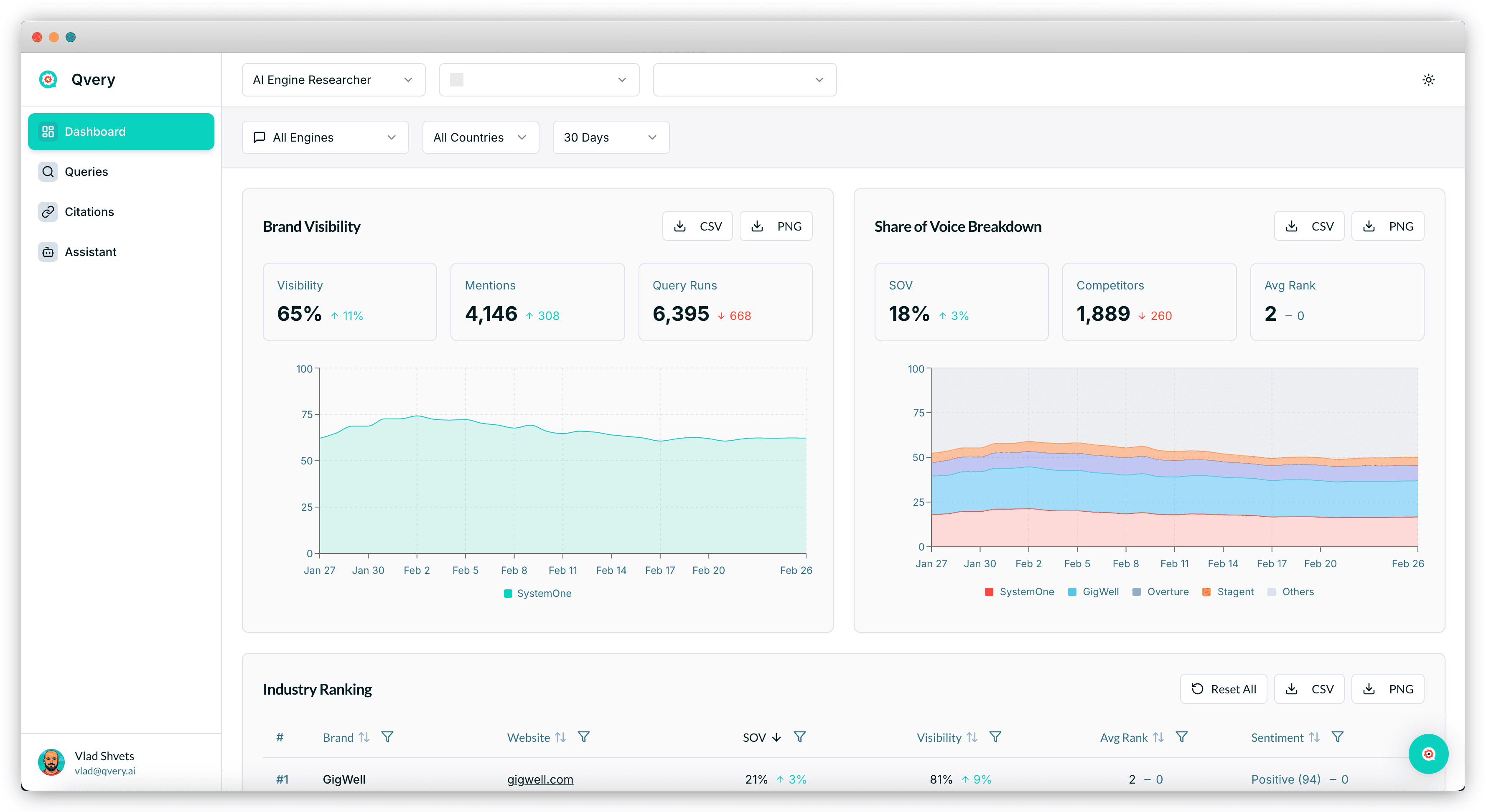
Qvery Assistant: a conversational layer over your own data. Ask which competitor gained share of voice or which queries you are losing in plain language, and run first-party actions like adding queries, triggering a run, or exporting a report.
Share of voice across ChatGPT and Google AI Mode in 200+ countries, tracked daily with topics and queries generated for you.
Competitor benchmarking that shows where a rival wins the answer and you do not.
Every citation captured, so you see the sources feeding a competitor's lead.
Unlimited seats and monthly optimization plans that turn the gap into a to-do list.
Pricing:
Lite: EUR 99/mo for 1 brand and 50 queries.
Business: EUR 199/mo for unlimited brands, 100 queries, and Slack support.
Enterprise: custom pricing for 500+ queries. The free trial needs no credit card.
Reddit Score: 97% Positive. What redditors say:
It is where a CPA turned after asking why ChatGPT keeps recommending a colleague instead of them. (r/Accounting)
It comes up for a decades-old firm watching ChatGPT recommend newer competitors in its place. (r/LawFirm)
Mostly positive, a handful neutral, and no negative mentions on record.
We build this, so here is the methodology instead of a trust-me. Qvery measures share of voice daily across ChatGPT and Google AI Mode, against the specific competitors you name, in the countries you sell in. The number is only the start.
The difference is that you can question it. Ask the Assistant which three queries a rival pulled ahead on this week and you get the list plus the citations behind their lead, then add queries or trigger a fresh run from the same chat.
2. Peec AI: Best for Clean Competitive Share of Voice
Key Features:
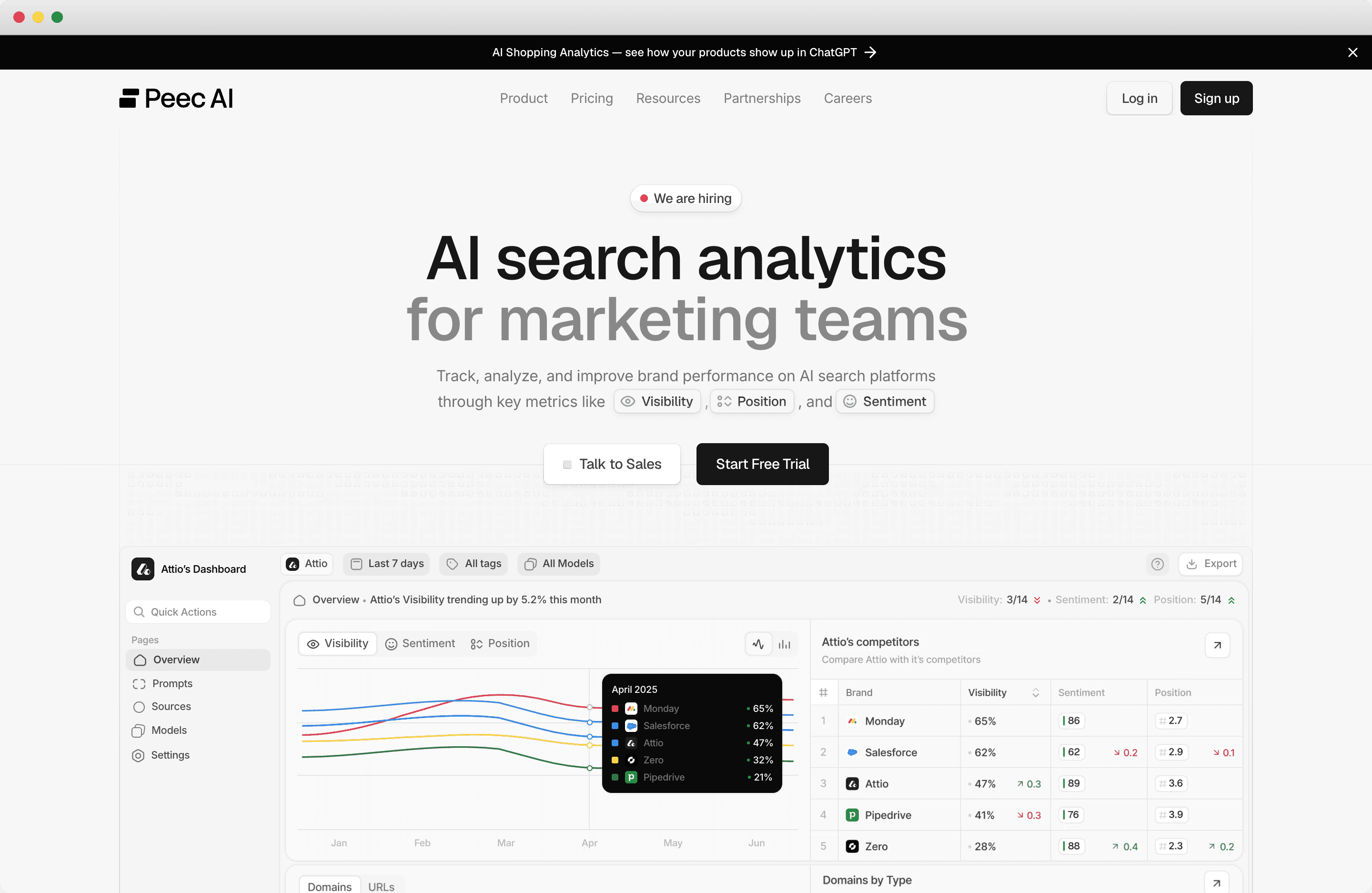
Share of voice and position monitoring across ChatGPT, Google AI, Perplexity, Gemini, and Claude.
Competitive benchmarking against the specific rivals you name.
Sentiment analysis of how AI describes your brand next to theirs.
Unlimited users and multi-country tracking on a clean interface.
Pricing:
Starter: EUR 95/mo for 50 prompts and daily tracking.
Pro: EUR 245/mo for 150 prompts and 2 projects.
Advanced: EUR 495/mo for 350 prompts and multi-country tracking. Free trial available.
Reddit Score: 78% Positive. What redditors say:
“Peec ai is the stronger option if competitive share of voice is the main output your clients care about.” (r/aeo)
“Peec is one of the best for AI analytics, Profound for agent marketing, Airops for content update.” (r/aeo)
It is the tool people name first when share of voice is the point.
Reddit basically hands Peec this category. When the output your team cares about is competitive share of voice, reviewers point here more than anywhere else, and the reason is a clean read on how you stack up against named rivals across five models.
Add sentiment analysis and unlimited seats, and you get a share of voice tool a whole team can live in without a budget fight. It is the pragmatic answer for brands that want the comparison numbers and will handle their own content work from there.
3. Profound: Best for Enterprise Share of Voice Depth
Key Features:
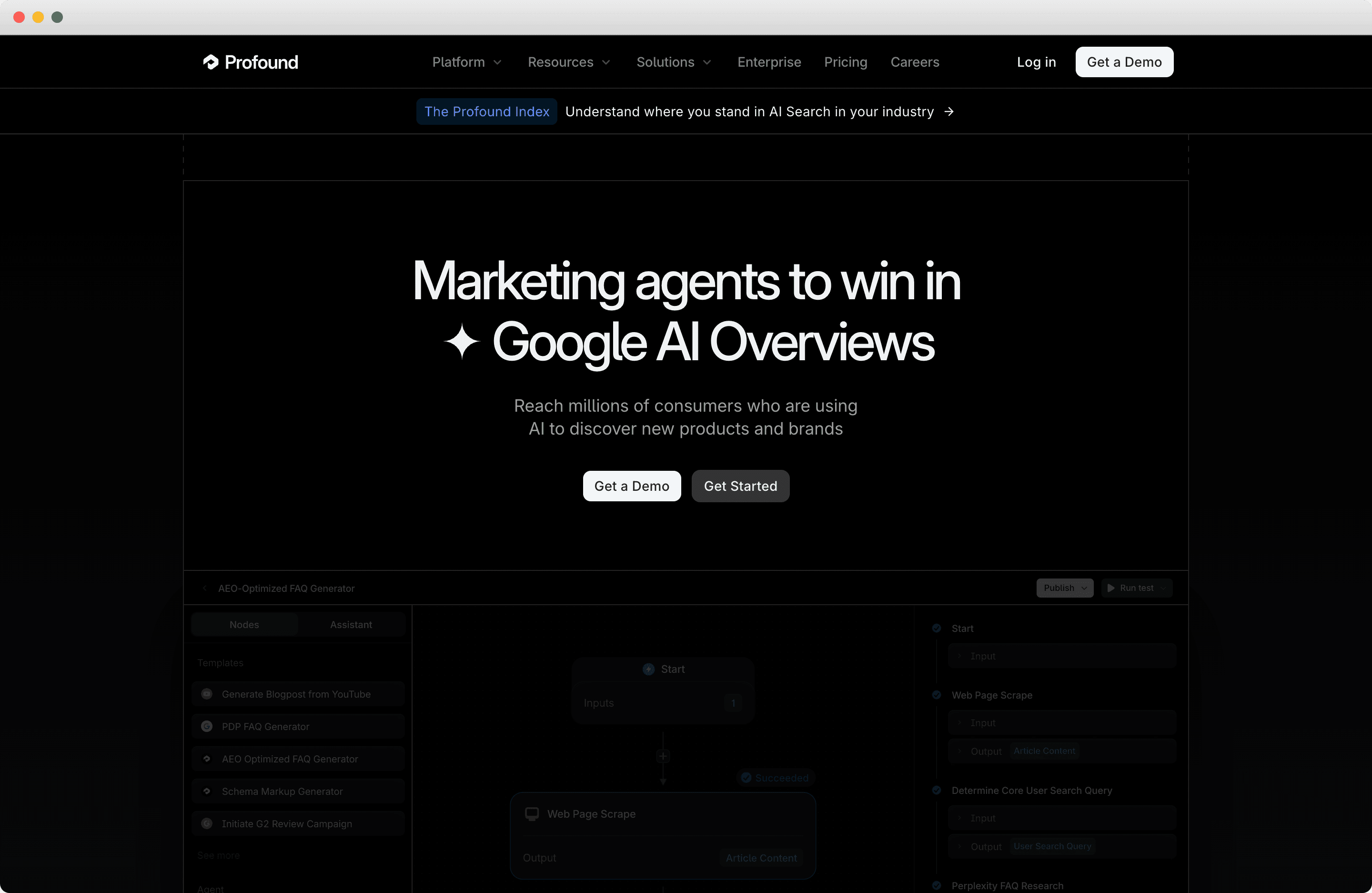
Answer Engine Insights benchmarking your presence across nine AI platforms.
Prompt Volumes so you weight share of voice by real query demand.
Agent Analytics tying share of voice to how AI crawls your site.
Content-producing agents to close the gaps the benchmarks reveal.
Pricing:
Starter: $99/mo for ChatGPT tracking and 50 prompts.
Growth: $399/mo total for 3 engines and 100 prompts.
Enterprise: custom pricing with wider engine coverage and SOC 2. Free trial available.
Reddit Score: 64% Positive. What redditors say:
“Profound is the most full-featured and priced like it.” (r/SaaS)
“Ive found success with Profound.” (r/SEO_LLM)
Praised for depth, with price the recurring caveat.
Weighting share of voice by real demand is where Profound pulls ahead of a simple percentage. Prompt Volumes tells you a rival's lead on a high-demand query matters more than a tie on one nobody asks, so your benchmark reflects the questions that carry pipeline.
Layer nine-engine coverage and agent analytics on top, and enterprise teams get a share of voice read they can defend in a strategy review. The trade-off is price, which redditors will happily remind you of, and it is the tool you buy once the number is worth funding properly.
4. Otterly: Best for a Simple Brand Visibility Index
Key Features:
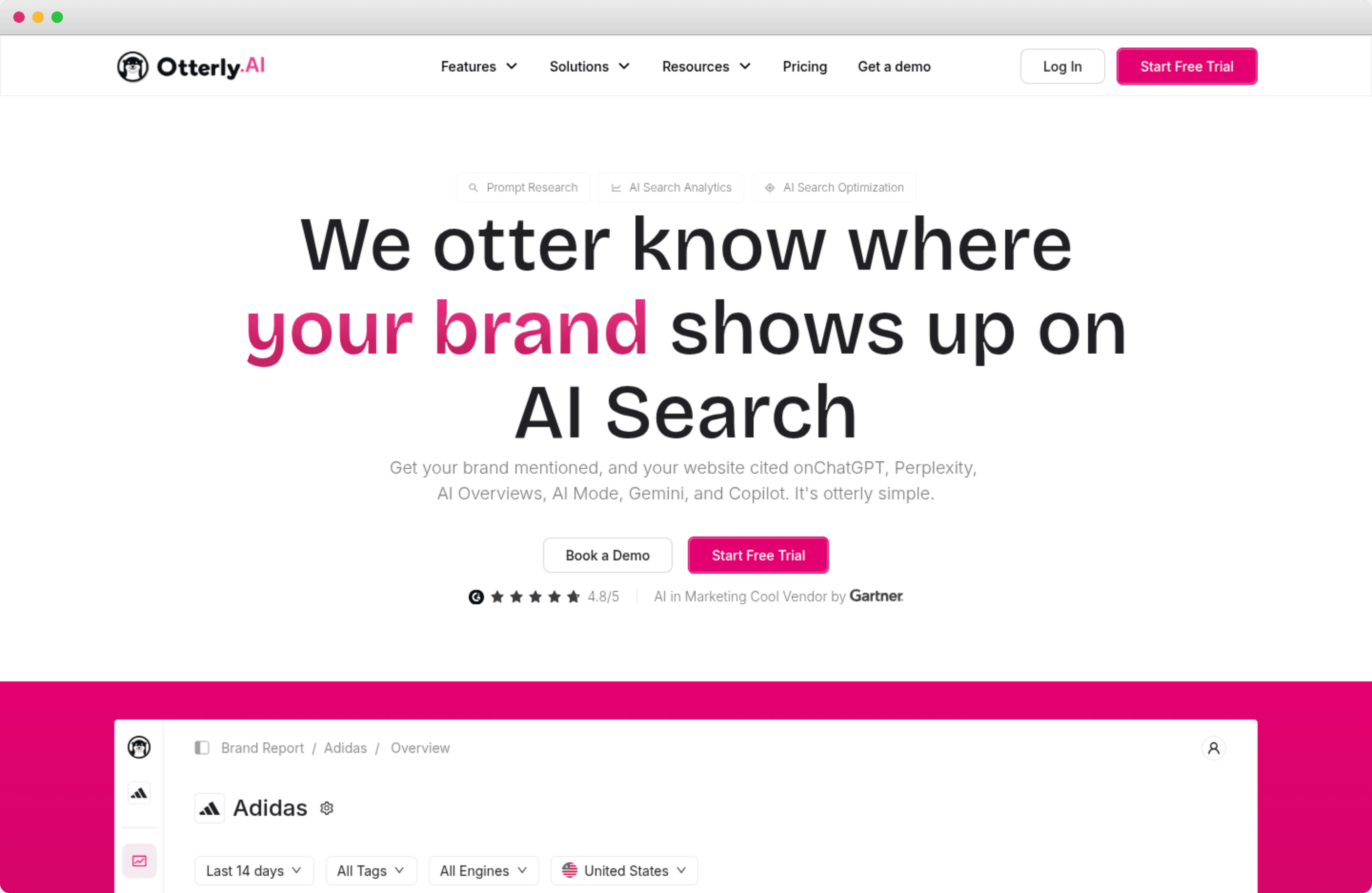
Brand Visibility Index that turns share of voice into one number leadership understands.
AI Search Analytics across ChatGPT, Gemini, Perplexity, and more.
Link Citations Analysis showing what feeds a competitor's share.
Content Audit and GEO recommendations for closing the gap.
Pricing:
Lite: $29/mo for 15 prompts and 4 engines.
Standard: $189/mo for 100 prompts and a Looker Studio connector.
Premium: $489/mo for 400 prompts and personal onboarding. Free trial available.
Reddit Score: 71% Positive. What redditors say:
“Currently using Otterly AI, its doing pretty good so far, we've been using it for one month and a half now.” (r/SEO_LLM)
“Peec and otterly are decent, i landed on crowdreply.” (r/aeo)
A reliable pick for teams that want share of voice without a learning curve.
Not every team wants a matrix of models and metrics. Otterly boils share of voice down to a Brand Visibility Index that a CMO can read in one glance and a content lead can act on the same afternoon, all starting at $29.
The index is not the whole story, and Otterly knows it, so the citation analysis sits right beside it to show what is driving a rival's share. For a team that wants the headline number and the reason behind it, that pairing is plenty.
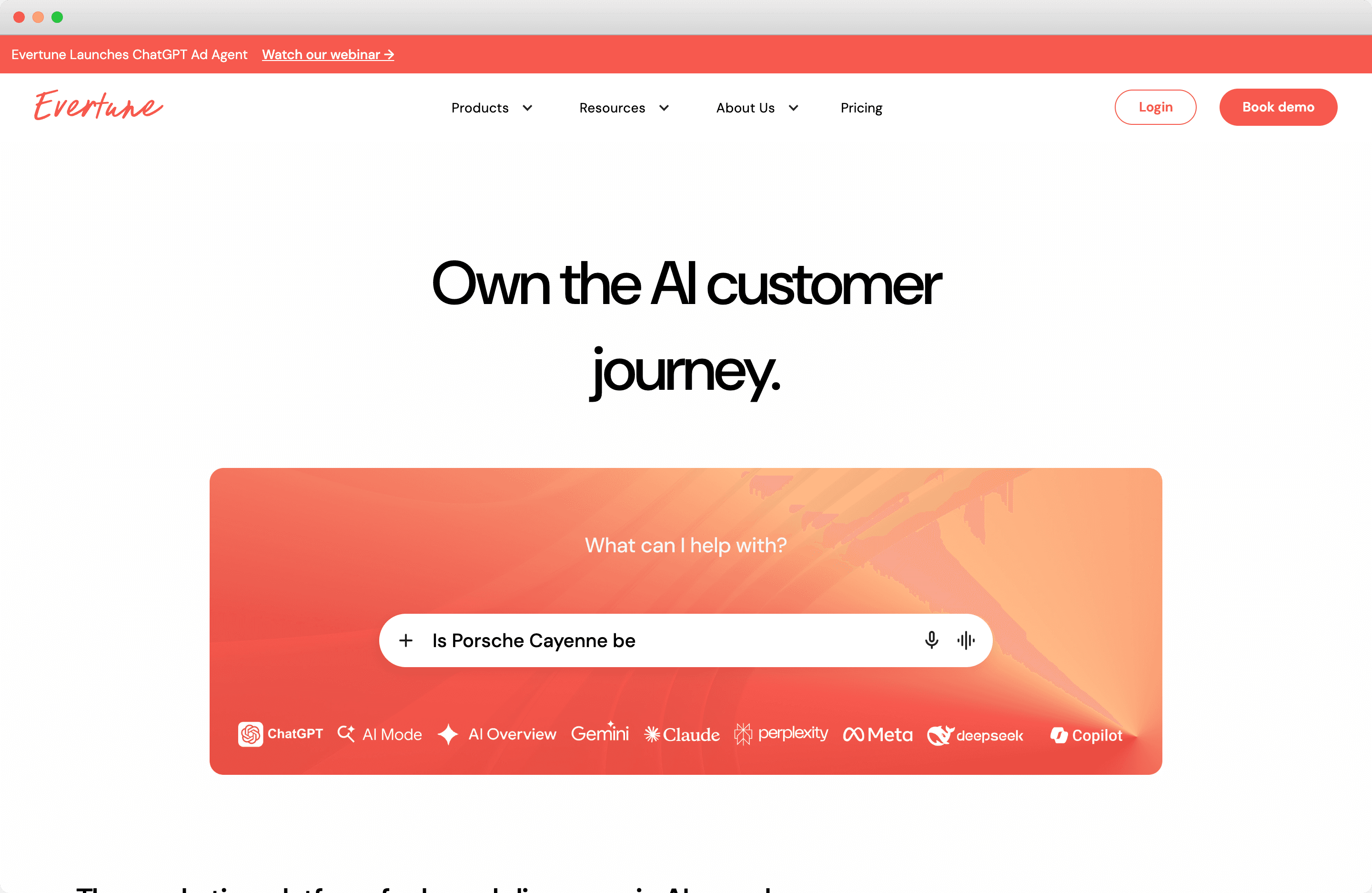
5. Evertune: Best for Share of Voice Across Many Models
Key Features:
Competitor Intelligence tracking your positioning against rivals across up to eleven models.
User Insights built on a very large prompt dataset for demand-weighted share.
AI Content Activation to turn share of voice gaps into content.
Data warehouse integrations so share of voice lands in your analytics stack.
Pricing:
Pro: $800/mo for 100,000 prompts analyzed and up to eleven models.
Enterprise: custom pricing with unlimited prompts and product-level analysis.
Reddit Score: Limited public footprint. Evertune keeps a quiet Reddit profile, but it is venture-backed and built for mid-market to enterprise brands, with one of the larger prompt datasets behind its competitor benchmarks.
Breadth of models is Evertune's answer to share of voice. Tracking positioning across up to eleven engines means a rival cannot dominate one platform you were not watching, which is exactly how blind spots turn into lost deals.
Because the numbers flow into Snowflake, Databricks, and the major cloud warehouses, share of voice stops living in a silo and joins the same reporting a brand team already trusts, which is what makes it a serious pick for larger organizations.
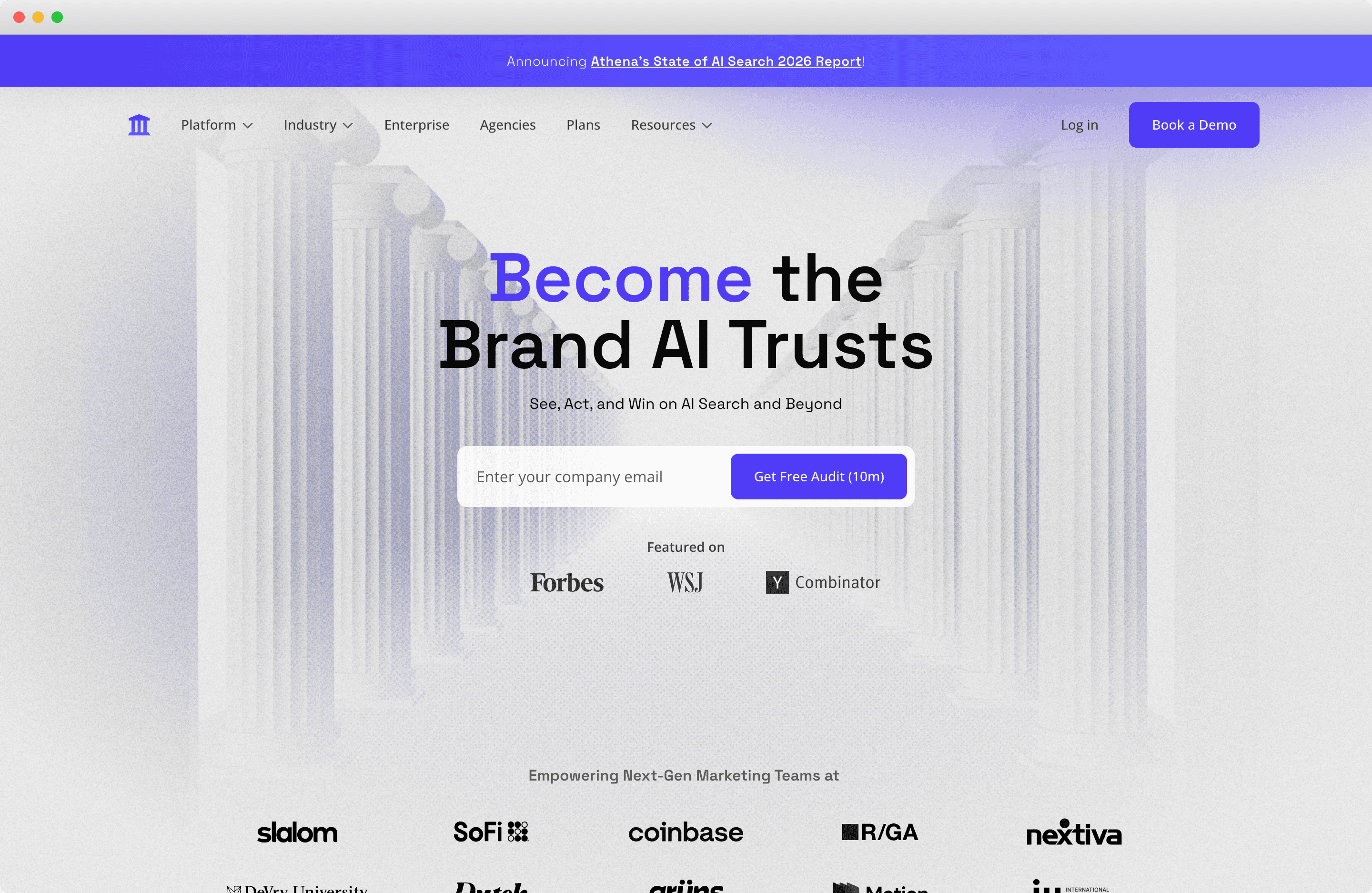
6. AthenaHQ: Best for Benchmarking Against Named Rivals
Key Features:
Competitor intelligence and benchmarking across up to nine LLMs.
Content gap analysis that shows where rivals win share and you do not.
Real-time sentiment monitoring alongside the share numbers.
Board-ready reporting to take share of voice up the chain.
Pricing:
Essential: free, with $25 in credit and five AI models.
Starter: $295/mo for 3,600 credits and nine models.
Enterprise: custom pricing with a Citation Engine and SSO.
Reddit Score: Limited public footprint. Athena turns up in buyers' shortlists alongside Profound and Otterly, as in a thread weighing “babylovegrowth, profound, AthenaHQ, Otterly” and their trade-offs (r/GrowthHacking), though hands-on reviews are still thin.
AthenaHQ frames share of voice as a rivalry you can name. Its competitor intelligence pits you against specific brands, and the content gap analysis turns each losing query into a topic to go win, so the number leads somewhere instead of just sitting on a slide.
The board-ready reporting is what gets it into serious rooms. When you have to defend AEO spend to leadership, showing share of voice climbing against a named competitor is a far easier story than explaining raw visibility, and Athena packages it for exactly that audience.
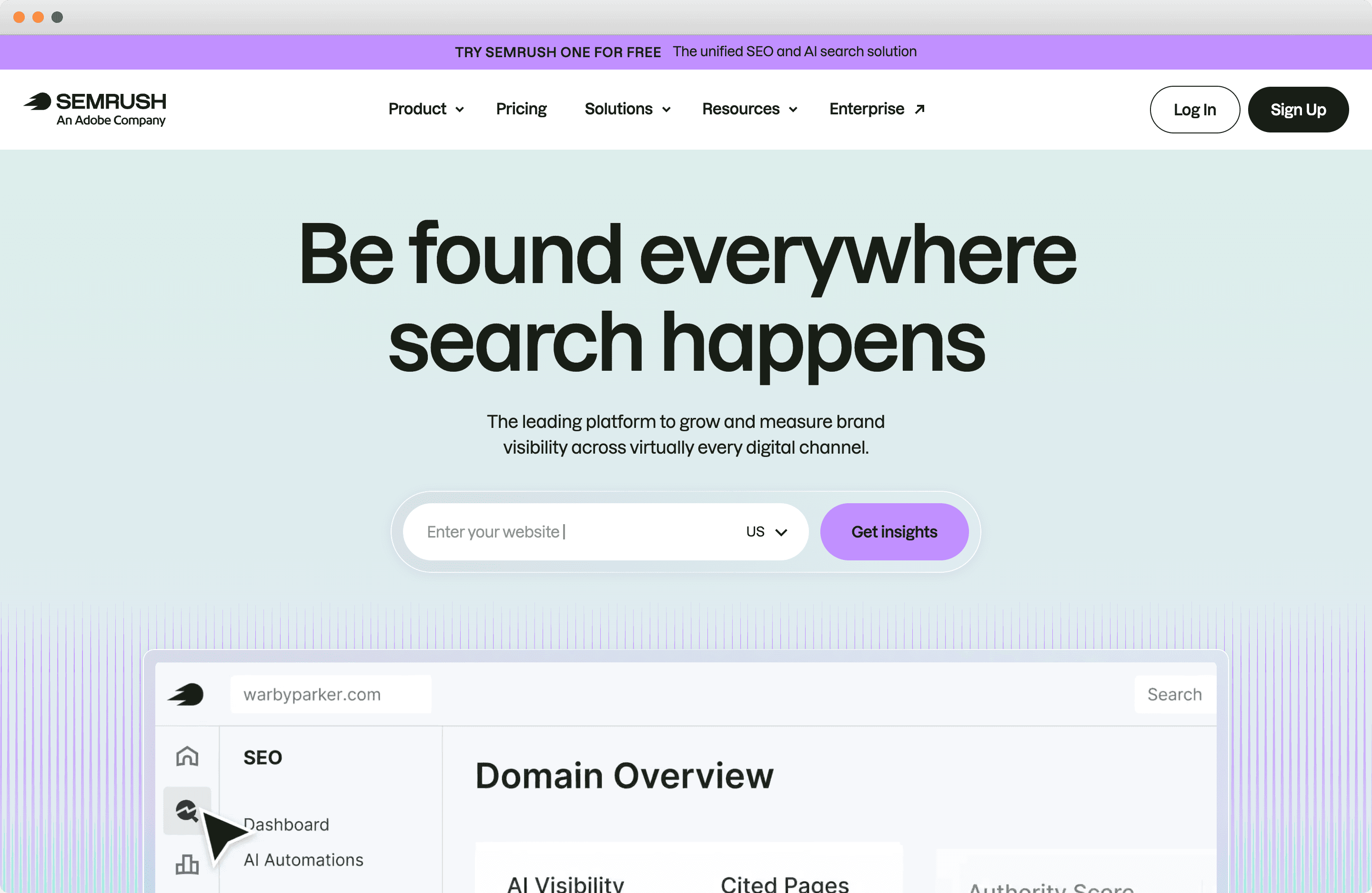
7. Semrush: Best for Share of Voice Beside Your SEO Data
Key Features:
Share of Voice analysis across AI engines on the higher tiers.
AI Visibility toolkit next to your organic rankings in one login.
AI sentiment monitoring to read the tone behind the share.
The full Semrush suite for context on where that share comes from.
Pricing:
Free: $0 for basic AI visibility features.
Paid AI visibility from around $139/mo, with Share of Voice on the Advanced tier.
Enterprise: custom pricing with full LLM coverage. Free tier available.
Reddit Score: 73% Positive. What redditors say:
“I prefer the Semrush AI Visibility toolkit because it covers the main AI channels, allows you to cross-reference with traditional Google search and doesn't cost an arm and a leg.” (r/digital_marketing)
“For my own consultancy and as a contractor, I use Semrush One because it's affordable, has accurate tracking and allows me to create AI and SEO reports side by side.” (r/SEO_tools_reviews)
Valued for putting AI share next to the search data teams already trust.
Share of voice makes more sense when you can see where it comes from, and Semrush puts the AI number right beside the organic rankings and content data that explain it. For a team that already reports in Semrush, that context arrives without a second subscription.
Cross-referencing AI share with traditional search is the move reviewers keep praising. It turns a standalone metric into part of a bigger visibility story, which is the version leadership tends to believe.
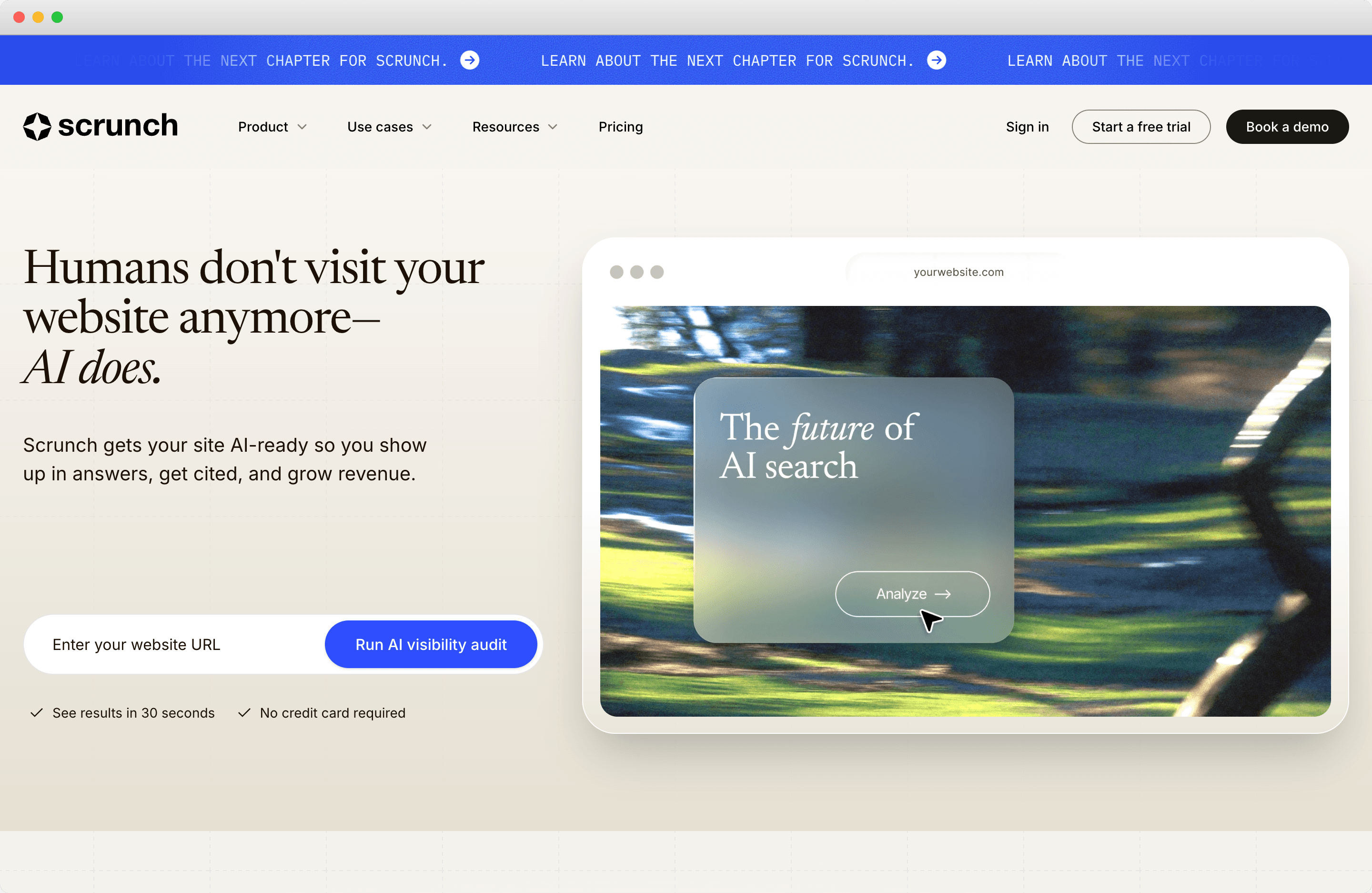
8. Scrunch AI: Best for Product-Level Share of Voice
Key Features:
Product-level AI search performance, so you measure share for individual products, not just the brand.
Competitor tracking across nine LLMs.
Agent Experience Platform to improve the share the benchmark reveals.
Sentiment analysis and AI Search Trends for context.
Pricing:
Core: $250/mo for 125 prompts and 5 user licenses.
Enterprise: custom pricing with all nine LLMs, API access, and SSO. Free trial available.
Reddit Score: Limited public footprint. Reddit chatter is light, but Scrunch is one of the most-referenced enterprise AEO names in third-party roundups, with venture backing aimed at exactly this kind of measurement.
Brand-level share of voice hides a lot when you sell more than one thing. Scrunch measures share product by product, so you catch the case where your flagship dominates AI answers while the product you most need to grow gets skipped entirely.
That granularity suits enterprise catalogs, and the Agent Experience Platform gives you a lever to lift the products that are losing share rather than just naming them. It is share of voice for teams whose problem is a specific SKU, not a headline.
9. Rankscale: Best for Share of Voice Across Every Engine

Key Features:
Share of voice tracking across a very wide range of AI engines.
Competitor analysis and citation analysis in one view.
Query fan-out and sources-box analysis for how AI builds an answer.
Unlimited seats and white-label dashboards for teams and agencies.
Pricing:
Pro: $99/mo for 1,200 credits and 10 brand dashboards.
Growth: $385/mo with white-label options and a REST API.
Enterprise: $780/mo for larger volume and dedicated support. Free trial available.
Reddit Score: Limited but positive footprint. Chatter is light, but the early verdict is encouraging: “I thought Rankscale was pretty comprehensive for the price. Not the prettiest UI but good coverage for the price.” (r/SEO_Experts)
If your buyers are scattered across a dozen engines, measuring share on only the big two undercounts your rivals. Rankscale tracks share across a very wide range of engines, so a competitor cannot build a quiet lead on a platform you were ignoring.
The query fan-out analysis adds a useful wrinkle, showing how AI expands a single question into many, and where you win or lose share across that spread. Reviewers rate the coverage highly for the price, which keeps it accessible for teams testing the waters.
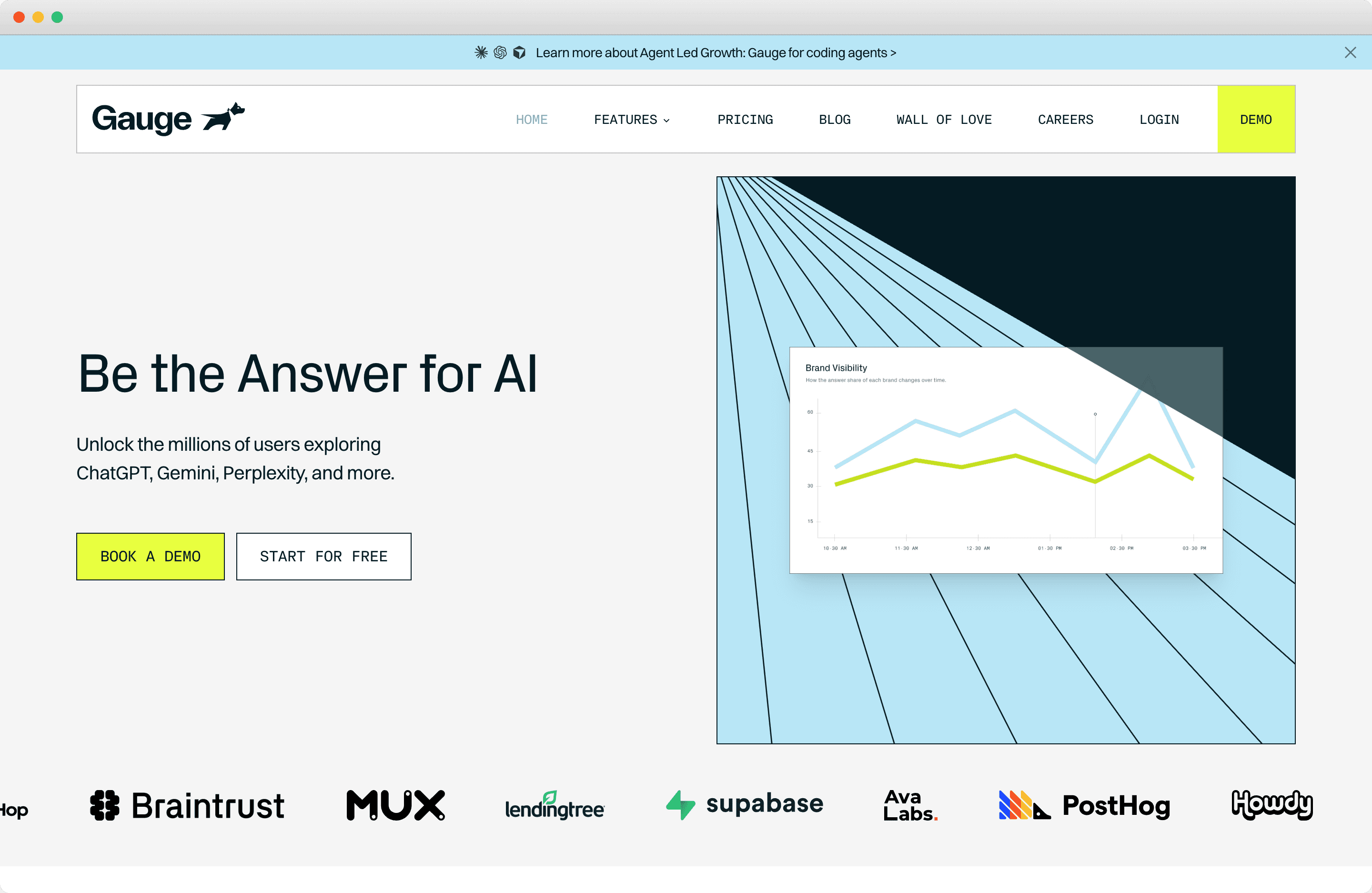
10. Gauge: Best for Competitor Positioning in AI Answers
Key Features:
Competitor positioning analysis in AI answers across eight platforms.
Content gap identification to reclaim lost share.
Ask Gauge AI agent for share of voice insights on demand.
GA4 and Search Console integration to tie share to traffic.
Pricing:
Growth: $599/mo for 600 prompts daily, 6 platforms, and 10 seats, with a one-week free trial.
Enterprise: custom pricing with all models and unlimited seats.
Reddit Score: Limited public footprint. Gauge keeps a low public profile, but it is built for B2B SaaS, fintech, and developer-tools teams, the segments where AI answer positioning is fought hardest.
Gauge treats share of voice as a positioning question. It analyzes how you sit against competitors inside AI answers and where the gaps are, then lets you ask its agent for the read rather than exporting a spreadsheet and interpreting it yourself.
The GA4 and Search Console hooks are the practical touch. Connecting share of voice to actual traffic gives B2B teams a way to argue that positioning gains show up downstream, which is the argument that keeps a tool funded.
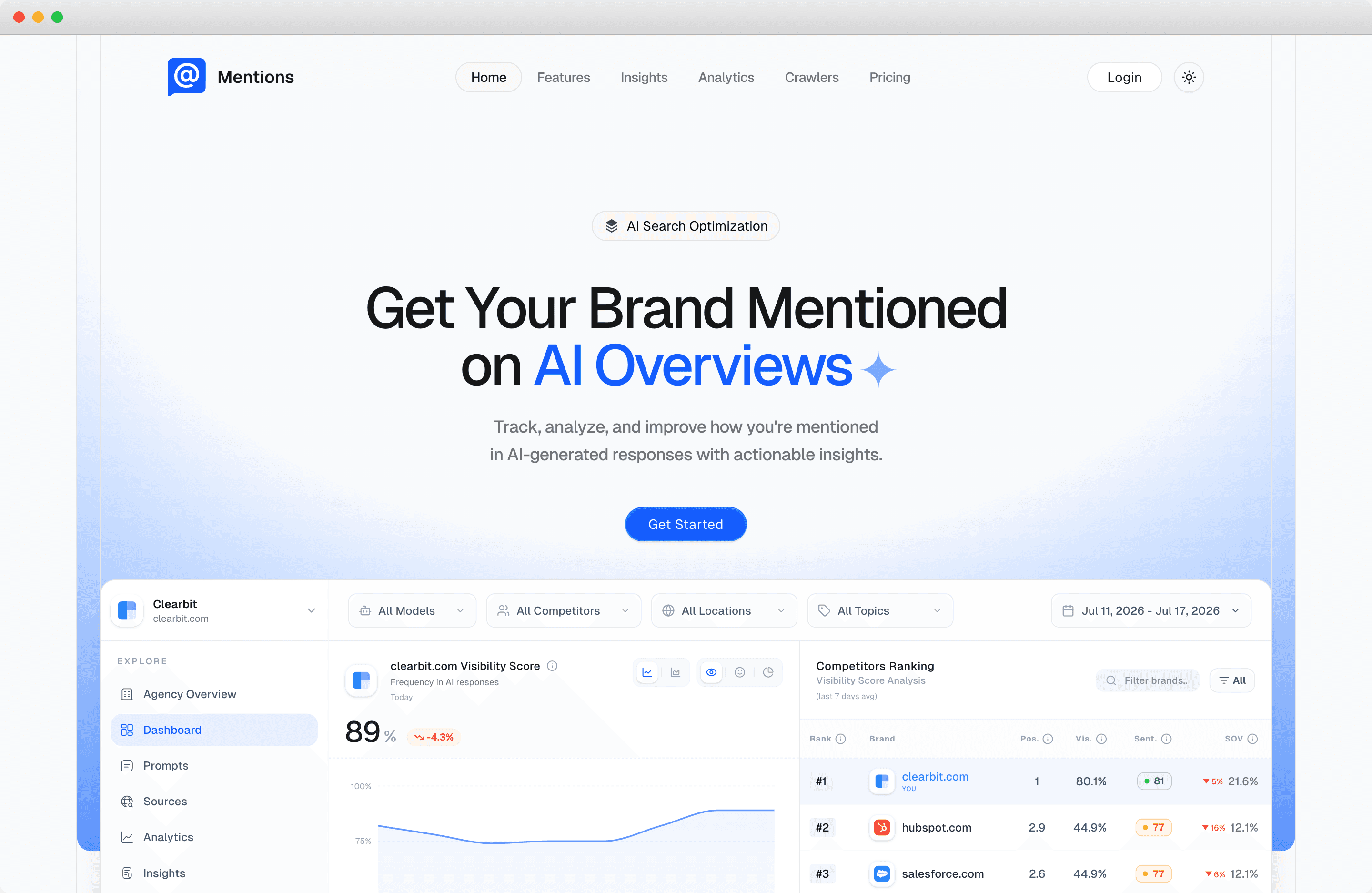
11. Mentions.so: Best for Open-Web Share of Voice
Key Features:
Share of voice analysis across AI models with competitor ranking.
Open-web share of voice tracking alongside AI answers.
Sentiment analysis and source domain tracking for context.
Real-time mention feed so you catch share swings early.
Pricing:
Free trial available to test the workflow.
Paid plans scale by tracked brands and engines.
Custom pricing for larger teams.
Reddit Score: Limited public footprint. Mentions.so is a newer, focused entrant aimed at B2B SaaS brands, so hands-on reviews are still sparse.
Mentions.so widens the frame past the chatbots. It tracks your share of voice across AI models and the open web together, on the theory that the forums and articles feeding AI answers are worth watching before they show up in a recommendation.
The real-time mention feed makes it feel less like a monthly report and more like a monitor, so a swing in share against a competitor reaches you while there is still time to respond rather than in next quarter's review.
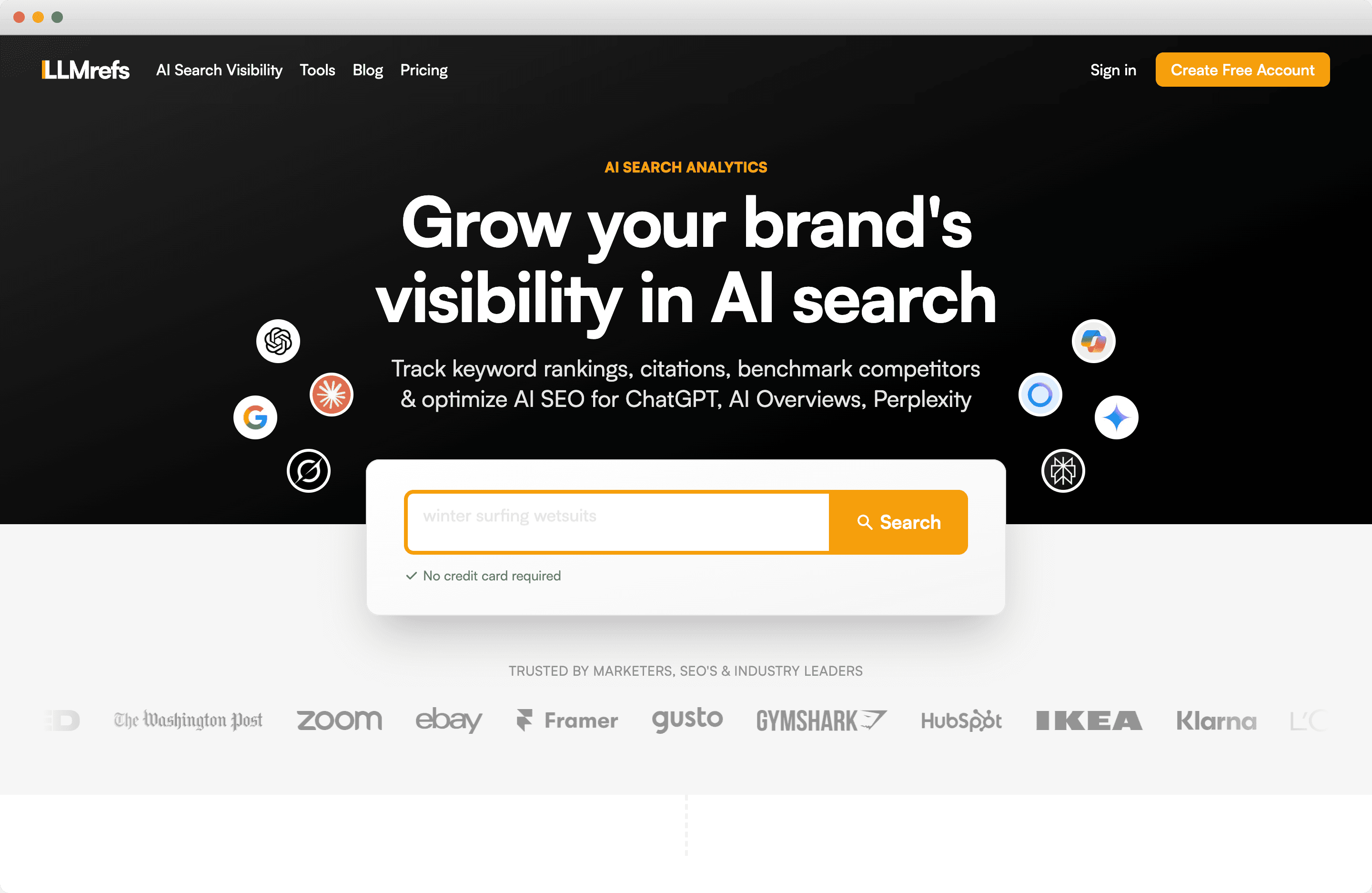
12. LLMrefs: Best for Share of Voice by Position
Key Features:
Share of voice and position metrics across a wide range of AI engines.
Competitor benchmarking with citation source identification.
Auto-generated prompt variations from real conversations.
Geo-targeting across 20-plus countries for international share.
Pricing:
Free trial available to test the workflow.
Paid tiers scale by projects and engines, with unlimited seats.
Custom pricing for larger rosters.
Reddit Score: Limited public footprint, though the signal that exists is favorable: LLMrefs earned a detailed six-month review from a marketer running it across 15 brands (r/HonestBuyerReviews), the kind of test that surfaces whether share numbers hold up.
LLMrefs closes the list by pairing share of voice with position, so you know not just how often you appear against rivals but where in the answer you land. First mention and fifth mention are not the same thing, and this is one of the few tools that treats them differently.
Its auto-generated prompt variations stop the benchmark from hinging on one lucky phrasing. By tracking share across the many ways a real person might ask the same question, it avoids looking great on one wording and invisible on the rest.
Three Questions Before You Trust the Number
Before any of these tools earns a place in your reporting, make its share of voice number answer three things.
What query set is behind it? A number built on ten prompts you wrote once is not the same as one built on queries refreshed against real demand, which is where Profound and Evertune pull ahead.
Which engines does it watch? Share measured on the big two undercounts rivals who lead elsewhere, so Rankscale, LLMrefs, and Mentions.so cast a wider net, while Peec and Otterly keep it clean and cheap.
Can you ask it why the number moved? Semrush ties share to your search data, Scrunch and Gauge go product- and positioning-deep, and Qvery lets you question the number in plain language instead of exporting it.
Run the tool you shortlist against the two or three competitors you keep losing deals to, and keep the one whose number you would defend in a strategy review rather than the one that simply looks highest.
A share of voice number is easy to put on a slide and hard to trust. Two tools can hand you a different figure for the same brand in the same week, because they asked different questions, watched different engines, and refreshed on different days.
Share of voice still beats raw visibility as the metric that moves a strategy, since coming fourth on a three-name shortlist is a polite way of not existing. The twelve tools below are ranked by how well their number holds up under questioning, and one of them is ours.
1. Qvery: Share of Voice You Can Interrogate
Key Features:
Qvery Assistant: a conversational layer over your own data. Ask which competitor gained share of voice or which queries you are losing in plain language, and run first-party actions like adding queries, triggering a run, or exporting a report.
Share of voice across ChatGPT and Google AI Mode in 200+ countries, tracked daily with topics and queries generated for you.
Competitor benchmarking that shows where a rival wins the answer and you do not.
Every citation captured, so you see the sources feeding a competitor's lead.
Unlimited seats and monthly optimization plans that turn the gap into a to-do list.
Pricing:
Lite: EUR 99/mo for 1 brand and 50 queries.
Business: EUR 199/mo for unlimited brands, 100 queries, and Slack support.
Enterprise: custom pricing for 500+ queries. The free trial needs no credit card.
Reddit Score: 97% Positive. What redditors say:
It is where a CPA turned after asking why ChatGPT keeps recommending a colleague instead of them. (r/Accounting)
It comes up for a decades-old firm watching ChatGPT recommend newer competitors in its place. (r/LawFirm)
Mostly positive, a handful neutral, and no negative mentions on record.
We build this, so here is the methodology instead of a trust-me. Qvery measures share of voice daily across ChatGPT and Google AI Mode, against the specific competitors you name, in the countries you sell in. The number is only the start.
The difference is that you can question it. Ask the Assistant which three queries a rival pulled ahead on this week and you get the list plus the citations behind their lead, then add queries or trigger a fresh run from the same chat.
2. Peec AI: Best for Clean Competitive Share of Voice
Key Features:
Share of voice and position monitoring across ChatGPT, Google AI, Perplexity, Gemini, and Claude.
Competitive benchmarking against the specific rivals you name.
Sentiment analysis of how AI describes your brand next to theirs.
Unlimited users and multi-country tracking on a clean interface.
Pricing:
Starter: EUR 95/mo for 50 prompts and daily tracking.
Pro: EUR 245/mo for 150 prompts and 2 projects.
Advanced: EUR 495/mo for 350 prompts and multi-country tracking. Free trial available.
Reddit Score: 78% Positive. What redditors say:
“Peec ai is the stronger option if competitive share of voice is the main output your clients care about.” (r/aeo)
“Peec is one of the best for AI analytics, Profound for agent marketing, Airops for content update.” (r/aeo)
It is the tool people name first when share of voice is the point.
Reddit basically hands Peec this category. When the output your team cares about is competitive share of voice, reviewers point here more than anywhere else, and the reason is a clean read on how you stack up against named rivals across five models.
Add sentiment analysis and unlimited seats, and you get a share of voice tool a whole team can live in without a budget fight. It is the pragmatic answer for brands that want the comparison numbers and will handle their own content work from there.
3. Profound: Best for Enterprise Share of Voice Depth
Key Features:
Answer Engine Insights benchmarking your presence across nine AI platforms.
Prompt Volumes so you weight share of voice by real query demand.
Agent Analytics tying share of voice to how AI crawls your site.
Content-producing agents to close the gaps the benchmarks reveal.
Pricing:
Starter: $99/mo for ChatGPT tracking and 50 prompts.
Growth: $399/mo total for 3 engines and 100 prompts.
Enterprise: custom pricing with wider engine coverage and SOC 2. Free trial available.
Reddit Score: 64% Positive. What redditors say:
“Profound is the most full-featured and priced like it.” (r/SaaS)
“Ive found success with Profound.” (r/SEO_LLM)
Praised for depth, with price the recurring caveat.
Weighting share of voice by real demand is where Profound pulls ahead of a simple percentage. Prompt Volumes tells you a rival's lead on a high-demand query matters more than a tie on one nobody asks, so your benchmark reflects the questions that carry pipeline.
Layer nine-engine coverage and agent analytics on top, and enterprise teams get a share of voice read they can defend in a strategy review. The trade-off is price, which redditors will happily remind you of, and it is the tool you buy once the number is worth funding properly.
4. Otterly: Best for a Simple Brand Visibility Index
Key Features:
Brand Visibility Index that turns share of voice into one number leadership understands.
AI Search Analytics across ChatGPT, Gemini, Perplexity, and more.
Link Citations Analysis showing what feeds a competitor's share.
Content Audit and GEO recommendations for closing the gap.
Pricing:
Lite: $29/mo for 15 prompts and 4 engines.
Standard: $189/mo for 100 prompts and a Looker Studio connector.
Premium: $489/mo for 400 prompts and personal onboarding. Free trial available.
Reddit Score: 71% Positive. What redditors say:
“Currently using Otterly AI, its doing pretty good so far, we've been using it for one month and a half now.” (r/SEO_LLM)
“Peec and otterly are decent, i landed on crowdreply.” (r/aeo)
A reliable pick for teams that want share of voice without a learning curve.
Not every team wants a matrix of models and metrics. Otterly boils share of voice down to a Brand Visibility Index that a CMO can read in one glance and a content lead can act on the same afternoon, all starting at $29.
The index is not the whole story, and Otterly knows it, so the citation analysis sits right beside it to show what is driving a rival's share. For a team that wants the headline number and the reason behind it, that pairing is plenty.
5. Evertune: Best for Share of Voice Across Many Models
Key Features:
Competitor Intelligence tracking your positioning against rivals across up to eleven models.
User Insights built on a very large prompt dataset for demand-weighted share.
AI Content Activation to turn share of voice gaps into content.
Data warehouse integrations so share of voice lands in your analytics stack.
Pricing:
Pro: $800/mo for 100,000 prompts analyzed and up to eleven models.
Enterprise: custom pricing with unlimited prompts and product-level analysis.
Reddit Score: Limited public footprint. Evertune keeps a quiet Reddit profile, but it is venture-backed and built for mid-market to enterprise brands, with one of the larger prompt datasets behind its competitor benchmarks.
Breadth of models is Evertune's answer to share of voice. Tracking positioning across up to eleven engines means a rival cannot dominate one platform you were not watching, which is exactly how blind spots turn into lost deals.
Because the numbers flow into Snowflake, Databricks, and the major cloud warehouses, share of voice stops living in a silo and joins the same reporting a brand team already trusts, which is what makes it a serious pick for larger organizations.
6. AthenaHQ: Best for Benchmarking Against Named Rivals
Key Features:
Competitor intelligence and benchmarking across up to nine LLMs.
Content gap analysis that shows where rivals win share and you do not.
Real-time sentiment monitoring alongside the share numbers.
Board-ready reporting to take share of voice up the chain.
Pricing:
Essential: free, with $25 in credit and five AI models.
Starter: $295/mo for 3,600 credits and nine models.
Enterprise: custom pricing with a Citation Engine and SSO.
Reddit Score: Limited public footprint. Athena turns up in buyers' shortlists alongside Profound and Otterly, as in a thread weighing “babylovegrowth, profound, AthenaHQ, Otterly” and their trade-offs (r/GrowthHacking), though hands-on reviews are still thin.
AthenaHQ frames share of voice as a rivalry you can name. Its competitor intelligence pits you against specific brands, and the content gap analysis turns each losing query into a topic to go win, so the number leads somewhere instead of just sitting on a slide.
The board-ready reporting is what gets it into serious rooms. When you have to defend AEO spend to leadership, showing share of voice climbing against a named competitor is a far easier story than explaining raw visibility, and Athena packages it for exactly that audience.
7. Semrush: Best for Share of Voice Beside Your SEO Data
Key Features:
Share of Voice analysis across AI engines on the higher tiers.
AI Visibility toolkit next to your organic rankings in one login.
AI sentiment monitoring to read the tone behind the share.
The full Semrush suite for context on where that share comes from.
Pricing:
Free: $0 for basic AI visibility features.
Paid AI visibility from around $139/mo, with Share of Voice on the Advanced tier.
Enterprise: custom pricing with full LLM coverage. Free tier available.
Reddit Score: 73% Positive. What redditors say:
“I prefer the Semrush AI Visibility toolkit because it covers the main AI channels, allows you to cross-reference with traditional Google search and doesn't cost an arm and a leg.” (r/digital_marketing)
“For my own consultancy and as a contractor, I use Semrush One because it's affordable, has accurate tracking and allows me to create AI and SEO reports side by side.” (r/SEO_tools_reviews)
Valued for putting AI share next to the search data teams already trust.
Share of voice makes more sense when you can see where it comes from, and Semrush puts the AI number right beside the organic rankings and content data that explain it. For a team that already reports in Semrush, that context arrives without a second subscription.
Cross-referencing AI share with traditional search is the move reviewers keep praising. It turns a standalone metric into part of a bigger visibility story, which is the version leadership tends to believe.
8. Scrunch AI: Best for Product-Level Share of Voice
Key Features:
Product-level AI search performance, so you measure share for individual products, not just the brand.
Competitor tracking across nine LLMs.
Agent Experience Platform to improve the share the benchmark reveals.
Sentiment analysis and AI Search Trends for context.
Pricing:
Core: $250/mo for 125 prompts and 5 user licenses.
Enterprise: custom pricing with all nine LLMs, API access, and SSO. Free trial available.
Reddit Score: Limited public footprint. Reddit chatter is light, but Scrunch is one of the most-referenced enterprise AEO names in third-party roundups, with venture backing aimed at exactly this kind of measurement.
Brand-level share of voice hides a lot when you sell more than one thing. Scrunch measures share product by product, so you catch the case where your flagship dominates AI answers while the product you most need to grow gets skipped entirely.
That granularity suits enterprise catalogs, and the Agent Experience Platform gives you a lever to lift the products that are losing share rather than just naming them. It is share of voice for teams whose problem is a specific SKU, not a headline.
9. Rankscale: Best for Share of Voice Across Every Engine
Key Features:
Share of voice tracking across a very wide range of AI engines.
Competitor analysis and citation analysis in one view.
Query fan-out and sources-box analysis for how AI builds an answer.
Unlimited seats and white-label dashboards for teams and agencies.
Pricing:
Pro: $99/mo for 1,200 credits and 10 brand dashboards.
Growth: $385/mo with white-label options and a REST API.
Enterprise: $780/mo for larger volume and dedicated support. Free trial available.
Reddit Score: Limited but positive footprint. Chatter is light, but the early verdict is encouraging: “I thought Rankscale was pretty comprehensive for the price. Not the prettiest UI but good coverage for the price.” (r/SEO_Experts)
If your buyers are scattered across a dozen engines, measuring share on only the big two undercounts your rivals. Rankscale tracks share across a very wide range of engines, so a competitor cannot build a quiet lead on a platform you were ignoring.
The query fan-out analysis adds a useful wrinkle, showing how AI expands a single question into many, and where you win or lose share across that spread. Reviewers rate the coverage highly for the price, which keeps it accessible for teams testing the waters.
10. Gauge: Best for Competitor Positioning in AI Answers
Key Features:
Competitor positioning analysis in AI answers across eight platforms.
Content gap identification to reclaim lost share.
Ask Gauge AI agent for share of voice insights on demand.
GA4 and Search Console integration to tie share to traffic.
Pricing:
Growth: $599/mo for 600 prompts daily, 6 platforms, and 10 seats, with a one-week free trial.
Enterprise: custom pricing with all models and unlimited seats.
Reddit Score: Limited public footprint. Gauge keeps a low public profile, but it is built for B2B SaaS, fintech, and developer-tools teams, the segments where AI answer positioning is fought hardest.
Gauge treats share of voice as a positioning question. It analyzes how you sit against competitors inside AI answers and where the gaps are, then lets you ask its agent for the read rather than exporting a spreadsheet and interpreting it yourself.
The GA4 and Search Console hooks are the practical touch. Connecting share of voice to actual traffic gives B2B teams a way to argue that positioning gains show up downstream, which is the argument that keeps a tool funded.
11. Mentions.so: Best for Open-Web Share of Voice
Key Features:
Share of voice analysis across AI models with competitor ranking.
Open-web share of voice tracking alongside AI answers.
Sentiment analysis and source domain tracking for context.
Real-time mention feed so you catch share swings early.
Pricing:
Free trial available to test the workflow.
Paid plans scale by tracked brands and engines.
Custom pricing for larger teams.
Reddit Score: Limited public footprint. Mentions.so is a newer, focused entrant aimed at B2B SaaS brands, so hands-on reviews are still sparse.
Mentions.so widens the frame past the chatbots. It tracks your share of voice across AI models and the open web together, on the theory that the forums and articles feeding AI answers are worth watching before they show up in a recommendation.
The real-time mention feed makes it feel less like a monthly report and more like a monitor, so a swing in share against a competitor reaches you while there is still time to respond rather than in next quarter's review.
12. LLMrefs: Best for Share of Voice by Position
Key Features:
Share of voice and position metrics across a wide range of AI engines.
Competitor benchmarking with citation source identification.
Auto-generated prompt variations from real conversations.
Geo-targeting across 20-plus countries for international share.
Pricing:
Free trial available to test the workflow.
Paid tiers scale by projects and engines, with unlimited seats.
Custom pricing for larger rosters.
Reddit Score: Limited public footprint, though the signal that exists is favorable: LLMrefs earned a detailed six-month review from a marketer running it across 15 brands (r/HonestBuyerReviews), the kind of test that surfaces whether share numbers hold up.
LLMrefs closes the list by pairing share of voice with position, so you know not just how often you appear against rivals but where in the answer you land. First mention and fifth mention are not the same thing, and this is one of the few tools that treats them differently.
Its auto-generated prompt variations stop the benchmark from hinging on one lucky phrasing. By tracking share across the many ways a real person might ask the same question, it avoids looking great on one wording and invisible on the rest.
Three Questions Before You Trust the Number
Before any of these tools earns a place in your reporting, make its share of voice number answer three things.
What query set is behind it? A number built on ten prompts you wrote once is not the same as one built on queries refreshed against real demand, which is where Profound and Evertune pull ahead.
Which engines does it watch? Share measured on the big two undercounts rivals who lead elsewhere, so Rankscale, LLMrefs, and Mentions.so cast a wider net, while Peec and Otterly keep it clean and cheap.
Can you ask it why the number moved? Semrush ties share to your search data, Scrunch and Gauge go product- and positioning-deep, and Qvery lets you question the number in plain language instead of exporting it.
Run the tool you shortlist against the two or three competitors you keep losing deals to, and keep the one whose number you would defend in a strategy review rather than the one that simply looks highest.
A share of voice number is easy to put on a slide and hard to trust. Two tools can hand you a different figure for the same brand in the same week, because they asked different questions, watched different engines, and refreshed on different days.
Share of voice still beats raw visibility as the metric that moves a strategy, since coming fourth on a three-name shortlist is a polite way of not existing. The twelve tools below are ranked by how well their number holds up under questioning, and one of them is ours.
1. Qvery: Share of Voice You Can Interrogate
Key Features:
Qvery Assistant: a conversational layer over your own data. Ask which competitor gained share of voice or which queries you are losing in plain language, and run first-party actions like adding queries, triggering a run, or exporting a report.
Share of voice across ChatGPT and Google AI Mode in 200+ countries, tracked daily with topics and queries generated for you.
Competitor benchmarking that shows where a rival wins the answer and you do not.
Every citation captured, so you see the sources feeding a competitor's lead.
Unlimited seats and monthly optimization plans that turn the gap into a to-do list.
Pricing:
Lite: EUR 99/mo for 1 brand and 50 queries.
Business: EUR 199/mo for unlimited brands, 100 queries, and Slack support.
Enterprise: custom pricing for 500+ queries. The free trial needs no credit card.
Reddit Score: 97% Positive. What redditors say:
It is where a CPA turned after asking why ChatGPT keeps recommending a colleague instead of them. (r/Accounting)
It comes up for a decades-old firm watching ChatGPT recommend newer competitors in its place. (r/LawFirm)
Mostly positive, a handful neutral, and no negative mentions on record.
We build this, so here is the methodology instead of a trust-me. Qvery measures share of voice daily across ChatGPT and Google AI Mode, against the specific competitors you name, in the countries you sell in. The number is only the start.
The difference is that you can question it. Ask the Assistant which three queries a rival pulled ahead on this week and you get the list plus the citations behind their lead, then add queries or trigger a fresh run from the same chat.
2. Peec AI: Best for Clean Competitive Share of Voice
Key Features:
Share of voice and position monitoring across ChatGPT, Google AI, Perplexity, Gemini, and Claude.
Competitive benchmarking against the specific rivals you name.
Sentiment analysis of how AI describes your brand next to theirs.
Unlimited users and multi-country tracking on a clean interface.
Pricing:
Starter: EUR 95/mo for 50 prompts and daily tracking.
Pro: EUR 245/mo for 150 prompts and 2 projects.
Advanced: EUR 495/mo for 350 prompts and multi-country tracking. Free trial available.
Reddit Score: 78% Positive. What redditors say:
“Peec ai is the stronger option if competitive share of voice is the main output your clients care about.” (r/aeo)
“Peec is one of the best for AI analytics, Profound for agent marketing, Airops for content update.” (r/aeo)
It is the tool people name first when share of voice is the point.
Reddit basically hands Peec this category. When the output your team cares about is competitive share of voice, reviewers point here more than anywhere else, and the reason is a clean read on how you stack up against named rivals across five models.
Add sentiment analysis and unlimited seats, and you get a share of voice tool a whole team can live in without a budget fight. It is the pragmatic answer for brands that want the comparison numbers and will handle their own content work from there.
3. Profound: Best for Enterprise Share of Voice Depth
Key Features:
Answer Engine Insights benchmarking your presence across nine AI platforms.
Prompt Volumes so you weight share of voice by real query demand.
Agent Analytics tying share of voice to how AI crawls your site.
Content-producing agents to close the gaps the benchmarks reveal.
Pricing:
Starter: $99/mo for ChatGPT tracking and 50 prompts.
Growth: $399/mo total for 3 engines and 100 prompts.
Enterprise: custom pricing with wider engine coverage and SOC 2. Free trial available.
Reddit Score: 64% Positive. What redditors say:
“Profound is the most full-featured and priced like it.” (r/SaaS)
“Ive found success with Profound.” (r/SEO_LLM)
Praised for depth, with price the recurring caveat.
Weighting share of voice by real demand is where Profound pulls ahead of a simple percentage. Prompt Volumes tells you a rival's lead on a high-demand query matters more than a tie on one nobody asks, so your benchmark reflects the questions that carry pipeline.
Layer nine-engine coverage and agent analytics on top, and enterprise teams get a share of voice read they can defend in a strategy review. The trade-off is price, which redditors will happily remind you of, and it is the tool you buy once the number is worth funding properly.
4. Otterly: Best for a Simple Brand Visibility Index
Key Features:
Brand Visibility Index that turns share of voice into one number leadership understands.
AI Search Analytics across ChatGPT, Gemini, Perplexity, and more.
Link Citations Analysis showing what feeds a competitor's share.
Content Audit and GEO recommendations for closing the gap.
Pricing:
Lite: $29/mo for 15 prompts and 4 engines.
Standard: $189/mo for 100 prompts and a Looker Studio connector.
Premium: $489/mo for 400 prompts and personal onboarding. Free trial available.
Reddit Score: 71% Positive. What redditors say:
“Currently using Otterly AI, its doing pretty good so far, we've been using it for one month and a half now.” (r/SEO_LLM)
“Peec and otterly are decent, i landed on crowdreply.” (r/aeo)
A reliable pick for teams that want share of voice without a learning curve.
Not every team wants a matrix of models and metrics. Otterly boils share of voice down to a Brand Visibility Index that a CMO can read in one glance and a content lead can act on the same afternoon, all starting at $29.
The index is not the whole story, and Otterly knows it, so the citation analysis sits right beside it to show what is driving a rival's share. For a team that wants the headline number and the reason behind it, that pairing is plenty.
5. Evertune: Best for Share of Voice Across Many Models
Key Features:
Competitor Intelligence tracking your positioning against rivals across up to eleven models.
User Insights built on a very large prompt dataset for demand-weighted share.
AI Content Activation to turn share of voice gaps into content.
Data warehouse integrations so share of voice lands in your analytics stack.
Pricing:
Pro: $800/mo for 100,000 prompts analyzed and up to eleven models.
Enterprise: custom pricing with unlimited prompts and product-level analysis.
Reddit Score: Limited public footprint. Evertune keeps a quiet Reddit profile, but it is venture-backed and built for mid-market to enterprise brands, with one of the larger prompt datasets behind its competitor benchmarks.
Breadth of models is Evertune's answer to share of voice. Tracking positioning across up to eleven engines means a rival cannot dominate one platform you were not watching, which is exactly how blind spots turn into lost deals.
Because the numbers flow into Snowflake, Databricks, and the major cloud warehouses, share of voice stops living in a silo and joins the same reporting a brand team already trusts, which is what makes it a serious pick for larger organizations.
6. AthenaHQ: Best for Benchmarking Against Named Rivals
Key Features:
Competitor intelligence and benchmarking across up to nine LLMs.
Content gap analysis that shows where rivals win share and you do not.
Real-time sentiment monitoring alongside the share numbers.
Board-ready reporting to take share of voice up the chain.
Pricing:
Essential: free, with $25 in credit and five AI models.
Starter: $295/mo for 3,600 credits and nine models.
Enterprise: custom pricing with a Citation Engine and SSO.
Reddit Score: Limited public footprint. Athena turns up in buyers' shortlists alongside Profound and Otterly, as in a thread weighing “babylovegrowth, profound, AthenaHQ, Otterly” and their trade-offs (r/GrowthHacking), though hands-on reviews are still thin.
AthenaHQ frames share of voice as a rivalry you can name. Its competitor intelligence pits you against specific brands, and the content gap analysis turns each losing query into a topic to go win, so the number leads somewhere instead of just sitting on a slide.
The board-ready reporting is what gets it into serious rooms. When you have to defend AEO spend to leadership, showing share of voice climbing against a named competitor is a far easier story than explaining raw visibility, and Athena packages it for exactly that audience.
7. Semrush: Best for Share of Voice Beside Your SEO Data
Key Features:
Share of Voice analysis across AI engines on the higher tiers.
AI Visibility toolkit next to your organic rankings in one login.
AI sentiment monitoring to read the tone behind the share.
The full Semrush suite for context on where that share comes from.
Pricing:
Free: $0 for basic AI visibility features.
Paid AI visibility from around $139/mo, with Share of Voice on the Advanced tier.
Enterprise: custom pricing with full LLM coverage. Free tier available.
Reddit Score: 73% Positive. What redditors say:
“I prefer the Semrush AI Visibility toolkit because it covers the main AI channels, allows you to cross-reference with traditional Google search and doesn't cost an arm and a leg.” (r/digital_marketing)
“For my own consultancy and as a contractor, I use Semrush One because it's affordable, has accurate tracking and allows me to create AI and SEO reports side by side.” (r/SEO_tools_reviews)
Valued for putting AI share next to the search data teams already trust.
Share of voice makes more sense when you can see where it comes from, and Semrush puts the AI number right beside the organic rankings and content data that explain it. For a team that already reports in Semrush, that context arrives without a second subscription.
Cross-referencing AI share with traditional search is the move reviewers keep praising. It turns a standalone metric into part of a bigger visibility story, which is the version leadership tends to believe.
8. Scrunch AI: Best for Product-Level Share of Voice
Key Features:
Product-level AI search performance, so you measure share for individual products, not just the brand.
Competitor tracking across nine LLMs.
Agent Experience Platform to improve the share the benchmark reveals.
Sentiment analysis and AI Search Trends for context.
Pricing:
Core: $250/mo for 125 prompts and 5 user licenses.
Enterprise: custom pricing with all nine LLMs, API access, and SSO. Free trial available.
Reddit Score: Limited public footprint. Reddit chatter is light, but Scrunch is one of the most-referenced enterprise AEO names in third-party roundups, with venture backing aimed at exactly this kind of measurement.
Brand-level share of voice hides a lot when you sell more than one thing. Scrunch measures share product by product, so you catch the case where your flagship dominates AI answers while the product you most need to grow gets skipped entirely.
That granularity suits enterprise catalogs, and the Agent Experience Platform gives you a lever to lift the products that are losing share rather than just naming them. It is share of voice for teams whose problem is a specific SKU, not a headline.
9. Rankscale: Best for Share of Voice Across Every Engine
Key Features:
Share of voice tracking across a very wide range of AI engines.
Competitor analysis and citation analysis in one view.
Query fan-out and sources-box analysis for how AI builds an answer.
Unlimited seats and white-label dashboards for teams and agencies.
Pricing:
Pro: $99/mo for 1,200 credits and 10 brand dashboards.
Growth: $385/mo with white-label options and a REST API.
Enterprise: $780/mo for larger volume and dedicated support. Free trial available.
Reddit Score: Limited but positive footprint. Chatter is light, but the early verdict is encouraging: “I thought Rankscale was pretty comprehensive for the price. Not the prettiest UI but good coverage for the price.” (r/SEO_Experts)
If your buyers are scattered across a dozen engines, measuring share on only the big two undercounts your rivals. Rankscale tracks share across a very wide range of engines, so a competitor cannot build a quiet lead on a platform you were ignoring.
The query fan-out analysis adds a useful wrinkle, showing how AI expands a single question into many, and where you win or lose share across that spread. Reviewers rate the coverage highly for the price, which keeps it accessible for teams testing the waters.
10. Gauge: Best for Competitor Positioning in AI Answers
Key Features:
Competitor positioning analysis in AI answers across eight platforms.
Content gap identification to reclaim lost share.
Ask Gauge AI agent for share of voice insights on demand.
GA4 and Search Console integration to tie share to traffic.
Pricing:
Growth: $599/mo for 600 prompts daily, 6 platforms, and 10 seats, with a one-week free trial.
Enterprise: custom pricing with all models and unlimited seats.
Reddit Score: Limited public footprint. Gauge keeps a low public profile, but it is built for B2B SaaS, fintech, and developer-tools teams, the segments where AI answer positioning is fought hardest.
Gauge treats share of voice as a positioning question. It analyzes how you sit against competitors inside AI answers and where the gaps are, then lets you ask its agent for the read rather than exporting a spreadsheet and interpreting it yourself.
The GA4 and Search Console hooks are the practical touch. Connecting share of voice to actual traffic gives B2B teams a way to argue that positioning gains show up downstream, which is the argument that keeps a tool funded.
11. Mentions.so: Best for Open-Web Share of Voice
Key Features:
Share of voice analysis across AI models with competitor ranking.
Open-web share of voice tracking alongside AI answers.
Sentiment analysis and source domain tracking for context.
Real-time mention feed so you catch share swings early.
Pricing:
Free trial available to test the workflow.
Paid plans scale by tracked brands and engines.
Custom pricing for larger teams.
Reddit Score: Limited public footprint. Mentions.so is a newer, focused entrant aimed at B2B SaaS brands, so hands-on reviews are still sparse.
Mentions.so widens the frame past the chatbots. It tracks your share of voice across AI models and the open web together, on the theory that the forums and articles feeding AI answers are worth watching before they show up in a recommendation.
The real-time mention feed makes it feel less like a monthly report and more like a monitor, so a swing in share against a competitor reaches you while there is still time to respond rather than in next quarter's review.
12. LLMrefs: Best for Share of Voice by Position
Key Features:
Share of voice and position metrics across a wide range of AI engines.
Competitor benchmarking with citation source identification.
Auto-generated prompt variations from real conversations.
Geo-targeting across 20-plus countries for international share.
Pricing:
Free trial available to test the workflow.
Paid tiers scale by projects and engines, with unlimited seats.
Custom pricing for larger rosters.
Reddit Score: Limited public footprint, though the signal that exists is favorable: LLMrefs earned a detailed six-month review from a marketer running it across 15 brands (r/HonestBuyerReviews), the kind of test that surfaces whether share numbers hold up.
LLMrefs closes the list by pairing share of voice with position, so you know not just how often you appear against rivals but where in the answer you land. First mention and fifth mention are not the same thing, and this is one of the few tools that treats them differently.
Its auto-generated prompt variations stop the benchmark from hinging on one lucky phrasing. By tracking share across the many ways a real person might ask the same question, it avoids looking great on one wording and invisible on the rest.
Three Questions Before You Trust the Number
Before any of these tools earns a place in your reporting, make its share of voice number answer three things.
What query set is behind it? A number built on ten prompts you wrote once is not the same as one built on queries refreshed against real demand, which is where Profound and Evertune pull ahead.
Which engines does it watch? Share measured on the big two undercounts rivals who lead elsewhere, so Rankscale, LLMrefs, and Mentions.so cast a wider net, while Peec and Otterly keep it clean and cheap.
Can you ask it why the number moved? Semrush ties share to your search data, Scrunch and Gauge go product- and positioning-deep, and Qvery lets you question the number in plain language instead of exporting it.
Run the tool you shortlist against the two or three competitors you keep losing deals to, and keep the one whose number you would defend in a strategy review rather than the one that simply looks highest.
A share of voice number is easy to put on a slide and hard to trust. Two tools can hand you a different figure for the same brand in the same week, because they asked different questions, watched different engines, and refreshed on different days.
Share of voice still beats raw visibility as the metric that moves a strategy, since coming fourth on a three-name shortlist is a polite way of not existing. The twelve tools below are ranked by how well their number holds up under questioning, and one of them is ours.
1. Qvery: Share of Voice You Can Interrogate
Key Features:
Qvery Assistant: a conversational layer over your own data. Ask which competitor gained share of voice or which queries you are losing in plain language, and run first-party actions like adding queries, triggering a run, or exporting a report.
Share of voice across ChatGPT and Google AI Mode in 200+ countries, tracked daily with topics and queries generated for you.
Competitor benchmarking that shows where a rival wins the answer and you do not.
Every citation captured, so you see the sources feeding a competitor's lead.
Unlimited seats and monthly optimization plans that turn the gap into a to-do list.
Pricing:
Lite: EUR 99/mo for 1 brand and 50 queries.
Business: EUR 199/mo for unlimited brands, 100 queries, and Slack support.
Enterprise: custom pricing for 500+ queries. The free trial needs no credit card.
Reddit Score: 97% Positive. What redditors say:
It is where a CPA turned after asking why ChatGPT keeps recommending a colleague instead of them. (r/Accounting)
It comes up for a decades-old firm watching ChatGPT recommend newer competitors in its place. (r/LawFirm)
Mostly positive, a handful neutral, and no negative mentions on record.
We build this, so here is the methodology instead of a trust-me. Qvery measures share of voice daily across ChatGPT and Google AI Mode, against the specific competitors you name, in the countries you sell in. The number is only the start.
The difference is that you can question it. Ask the Assistant which three queries a rival pulled ahead on this week and you get the list plus the citations behind their lead, then add queries or trigger a fresh run from the same chat.
2. Peec AI: Best for Clean Competitive Share of Voice
Key Features:
Share of voice and position monitoring across ChatGPT, Google AI, Perplexity, Gemini, and Claude.
Competitive benchmarking against the specific rivals you name.
Sentiment analysis of how AI describes your brand next to theirs.
Unlimited users and multi-country tracking on a clean interface.
Pricing:
Starter: EUR 95/mo for 50 prompts and daily tracking.
Pro: EUR 245/mo for 150 prompts and 2 projects.
Advanced: EUR 495/mo for 350 prompts and multi-country tracking. Free trial available.
Reddit Score: 78% Positive. What redditors say:
“Peec ai is the stronger option if competitive share of voice is the main output your clients care about.” (r/aeo)
“Peec is one of the best for AI analytics, Profound for agent marketing, Airops for content update.” (r/aeo)
It is the tool people name first when share of voice is the point.
Reddit basically hands Peec this category. When the output your team cares about is competitive share of voice, reviewers point here more than anywhere else, and the reason is a clean read on how you stack up against named rivals across five models.
Add sentiment analysis and unlimited seats, and you get a share of voice tool a whole team can live in without a budget fight. It is the pragmatic answer for brands that want the comparison numbers and will handle their own content work from there.
3. Profound: Best for Enterprise Share of Voice Depth
Key Features:
Answer Engine Insights benchmarking your presence across nine AI platforms.
Prompt Volumes so you weight share of voice by real query demand.
Agent Analytics tying share of voice to how AI crawls your site.
Content-producing agents to close the gaps the benchmarks reveal.
Pricing:
Starter: $99/mo for ChatGPT tracking and 50 prompts.
Growth: $399/mo total for 3 engines and 100 prompts.
Enterprise: custom pricing with wider engine coverage and SOC 2. Free trial available.
Reddit Score: 64% Positive. What redditors say:
“Profound is the most full-featured and priced like it.” (r/SaaS)
“Ive found success with Profound.” (r/SEO_LLM)
Praised for depth, with price the recurring caveat.
Weighting share of voice by real demand is where Profound pulls ahead of a simple percentage. Prompt Volumes tells you a rival's lead on a high-demand query matters more than a tie on one nobody asks, so your benchmark reflects the questions that carry pipeline.
Layer nine-engine coverage and agent analytics on top, and enterprise teams get a share of voice read they can defend in a strategy review. The trade-off is price, which redditors will happily remind you of, and it is the tool you buy once the number is worth funding properly.
4. Otterly: Best for a Simple Brand Visibility Index
Key Features:
Brand Visibility Index that turns share of voice into one number leadership understands.
AI Search Analytics across ChatGPT, Gemini, Perplexity, and more.
Link Citations Analysis showing what feeds a competitor's share.
Content Audit and GEO recommendations for closing the gap.
Pricing:
Lite: $29/mo for 15 prompts and 4 engines.
Standard: $189/mo for 100 prompts and a Looker Studio connector.
Premium: $489/mo for 400 prompts and personal onboarding. Free trial available.
Reddit Score: 71% Positive. What redditors say:
“Currently using Otterly AI, its doing pretty good so far, we've been using it for one month and a half now.” (r/SEO_LLM)
“Peec and otterly are decent, i landed on crowdreply.” (r/aeo)
A reliable pick for teams that want share of voice without a learning curve.
Not every team wants a matrix of models and metrics. Otterly boils share of voice down to a Brand Visibility Index that a CMO can read in one glance and a content lead can act on the same afternoon, all starting at $29.
The index is not the whole story, and Otterly knows it, so the citation analysis sits right beside it to show what is driving a rival's share. For a team that wants the headline number and the reason behind it, that pairing is plenty.
5. Evertune: Best for Share of Voice Across Many Models
Key Features:
Competitor Intelligence tracking your positioning against rivals across up to eleven models.
User Insights built on a very large prompt dataset for demand-weighted share.
AI Content Activation to turn share of voice gaps into content.
Data warehouse integrations so share of voice lands in your analytics stack.
Pricing:
Pro: $800/mo for 100,000 prompts analyzed and up to eleven models.
Enterprise: custom pricing with unlimited prompts and product-level analysis.
Reddit Score: Limited public footprint. Evertune keeps a quiet Reddit profile, but it is venture-backed and built for mid-market to enterprise brands, with one of the larger prompt datasets behind its competitor benchmarks.
Breadth of models is Evertune's answer to share of voice. Tracking positioning across up to eleven engines means a rival cannot dominate one platform you were not watching, which is exactly how blind spots turn into lost deals.
Because the numbers flow into Snowflake, Databricks, and the major cloud warehouses, share of voice stops living in a silo and joins the same reporting a brand team already trusts, which is what makes it a serious pick for larger organizations.
6. AthenaHQ: Best for Benchmarking Against Named Rivals
Key Features:
Competitor intelligence and benchmarking across up to nine LLMs.
Content gap analysis that shows where rivals win share and you do not.
Real-time sentiment monitoring alongside the share numbers.
Board-ready reporting to take share of voice up the chain.
Pricing:
Essential: free, with $25 in credit and five AI models.
Starter: $295/mo for 3,600 credits and nine models.
Enterprise: custom pricing with a Citation Engine and SSO.
Reddit Score: Limited public footprint. Athena turns up in buyers' shortlists alongside Profound and Otterly, as in a thread weighing “babylovegrowth, profound, AthenaHQ, Otterly” and their trade-offs (r/GrowthHacking), though hands-on reviews are still thin.
AthenaHQ frames share of voice as a rivalry you can name. Its competitor intelligence pits you against specific brands, and the content gap analysis turns each losing query into a topic to go win, so the number leads somewhere instead of just sitting on a slide.
The board-ready reporting is what gets it into serious rooms. When you have to defend AEO spend to leadership, showing share of voice climbing against a named competitor is a far easier story than explaining raw visibility, and Athena packages it for exactly that audience.
7. Semrush: Best for Share of Voice Beside Your SEO Data
Key Features:
Share of Voice analysis across AI engines on the higher tiers.
AI Visibility toolkit next to your organic rankings in one login.
AI sentiment monitoring to read the tone behind the share.
The full Semrush suite for context on where that share comes from.
Pricing:
Free: $0 for basic AI visibility features.
Paid AI visibility from around $139/mo, with Share of Voice on the Advanced tier.
Enterprise: custom pricing with full LLM coverage. Free tier available.
Reddit Score: 73% Positive. What redditors say:
“I prefer the Semrush AI Visibility toolkit because it covers the main AI channels, allows you to cross-reference with traditional Google search and doesn't cost an arm and a leg.” (r/digital_marketing)
“For my own consultancy and as a contractor, I use Semrush One because it's affordable, has accurate tracking and allows me to create AI and SEO reports side by side.” (r/SEO_tools_reviews)
Valued for putting AI share next to the search data teams already trust.
Share of voice makes more sense when you can see where it comes from, and Semrush puts the AI number right beside the organic rankings and content data that explain it. For a team that already reports in Semrush, that context arrives without a second subscription.
Cross-referencing AI share with traditional search is the move reviewers keep praising. It turns a standalone metric into part of a bigger visibility story, which is the version leadership tends to believe.
8. Scrunch AI: Best for Product-Level Share of Voice
Key Features:
Product-level AI search performance, so you measure share for individual products, not just the brand.
Competitor tracking across nine LLMs.
Agent Experience Platform to improve the share the benchmark reveals.
Sentiment analysis and AI Search Trends for context.
Pricing:
Core: $250/mo for 125 prompts and 5 user licenses.
Enterprise: custom pricing with all nine LLMs, API access, and SSO. Free trial available.
Reddit Score: Limited public footprint. Reddit chatter is light, but Scrunch is one of the most-referenced enterprise AEO names in third-party roundups, with venture backing aimed at exactly this kind of measurement.
Brand-level share of voice hides a lot when you sell more than one thing. Scrunch measures share product by product, so you catch the case where your flagship dominates AI answers while the product you most need to grow gets skipped entirely.
That granularity suits enterprise catalogs, and the Agent Experience Platform gives you a lever to lift the products that are losing share rather than just naming them. It is share of voice for teams whose problem is a specific SKU, not a headline.
9. Rankscale: Best for Share of Voice Across Every Engine
Key Features:
Share of voice tracking across a very wide range of AI engines.
Competitor analysis and citation analysis in one view.
Query fan-out and sources-box analysis for how AI builds an answer.
Unlimited seats and white-label dashboards for teams and agencies.
Pricing:
Pro: $99/mo for 1,200 credits and 10 brand dashboards.
Growth: $385/mo with white-label options and a REST API.
Enterprise: $780/mo for larger volume and dedicated support. Free trial available.
Reddit Score: Limited but positive footprint. Chatter is light, but the early verdict is encouraging: “I thought Rankscale was pretty comprehensive for the price. Not the prettiest UI but good coverage for the price.” (r/SEO_Experts)
If your buyers are scattered across a dozen engines, measuring share on only the big two undercounts your rivals. Rankscale tracks share across a very wide range of engines, so a competitor cannot build a quiet lead on a platform you were ignoring.
The query fan-out analysis adds a useful wrinkle, showing how AI expands a single question into many, and where you win or lose share across that spread. Reviewers rate the coverage highly for the price, which keeps it accessible for teams testing the waters.
10. Gauge: Best for Competitor Positioning in AI Answers
Key Features:
Competitor positioning analysis in AI answers across eight platforms.
Content gap identification to reclaim lost share.
Ask Gauge AI agent for share of voice insights on demand.
GA4 and Search Console integration to tie share to traffic.
Pricing:
Growth: $599/mo for 600 prompts daily, 6 platforms, and 10 seats, with a one-week free trial.
Enterprise: custom pricing with all models and unlimited seats.
Reddit Score: Limited public footprint. Gauge keeps a low public profile, but it is built for B2B SaaS, fintech, and developer-tools teams, the segments where AI answer positioning is fought hardest.
Gauge treats share of voice as a positioning question. It analyzes how you sit against competitors inside AI answers and where the gaps are, then lets you ask its agent for the read rather than exporting a spreadsheet and interpreting it yourself.
The GA4 and Search Console hooks are the practical touch. Connecting share of voice to actual traffic gives B2B teams a way to argue that positioning gains show up downstream, which is the argument that keeps a tool funded.
11. Mentions.so: Best for Open-Web Share of Voice
Key Features:
Share of voice analysis across AI models with competitor ranking.
Open-web share of voice tracking alongside AI answers.
Sentiment analysis and source domain tracking for context.
Real-time mention feed so you catch share swings early.
Pricing:
Free trial available to test the workflow.
Paid plans scale by tracked brands and engines.
Custom pricing for larger teams.
Reddit Score: Limited public footprint. Mentions.so is a newer, focused entrant aimed at B2B SaaS brands, so hands-on reviews are still sparse.
Mentions.so widens the frame past the chatbots. It tracks your share of voice across AI models and the open web together, on the theory that the forums and articles feeding AI answers are worth watching before they show up in a recommendation.
The real-time mention feed makes it feel less like a monthly report and more like a monitor, so a swing in share against a competitor reaches you while there is still time to respond rather than in next quarter's review.
12. LLMrefs: Best for Share of Voice by Position
Key Features:
Share of voice and position metrics across a wide range of AI engines.
Competitor benchmarking with citation source identification.
Auto-generated prompt variations from real conversations.
Geo-targeting across 20-plus countries for international share.
Pricing:
Free trial available to test the workflow.
Paid tiers scale by projects and engines, with unlimited seats.
Custom pricing for larger rosters.
Reddit Score: Limited public footprint, though the signal that exists is favorable: LLMrefs earned a detailed six-month review from a marketer running it across 15 brands (r/HonestBuyerReviews), the kind of test that surfaces whether share numbers hold up.
LLMrefs closes the list by pairing share of voice with position, so you know not just how often you appear against rivals but where in the answer you land. First mention and fifth mention are not the same thing, and this is one of the few tools that treats them differently.
Its auto-generated prompt variations stop the benchmark from hinging on one lucky phrasing. By tracking share across the many ways a real person might ask the same question, it avoids looking great on one wording and invisible on the rest.
Three Questions Before You Trust the Number
Before any of these tools earns a place in your reporting, make its share of voice number answer three things.
What query set is behind it? A number built on ten prompts you wrote once is not the same as one built on queries refreshed against real demand, which is where Profound and Evertune pull ahead.
Which engines does it watch? Share measured on the big two undercounts rivals who lead elsewhere, so Rankscale, LLMrefs, and Mentions.so cast a wider net, while Peec and Otterly keep it clean and cheap.
Can you ask it why the number moved? Semrush ties share to your search data, Scrunch and Gauge go product- and positioning-deep, and Qvery lets you question the number in plain language instead of exporting it.
Run the tool you shortlist against the two or three competitors you keep losing deals to, and keep the one whose number you would defend in a strategy review rather than the one that simply looks highest.

© 2026 Qvery AI OÜ