By
Vlad Shvets
How Online Legal Services Get Recommended by AI Engines
Ask an AI engine which online legal service to use and the answer is built out of the services' own pages: LegalZoom, Rocket Lawyer, ZenBusiness, DocuSign. Ask it to find a lawyer and you get a completely different roster. The directory playbook belongs to the second question.
Ask an AI engine which online legal service to use and the answer is built out of the services' own pages: LegalZoom, Rocket Lawyer, ZenBusiness, DocuSign. Ask it to find a lawyer and you get a completely different roster. The directory playbook belongs to the second question.
Ask an AI engine which online legal service to use and the answer is built out of the services' own pages: LegalZoom, Rocket Lawyer, ZenBusiness, DocuSign. Ask it to find a lawyer and you get a completely different roster. The directory playbook belongs to the second question.
Someone about to form an LLC does not know what a registered agent is, and they are not going to read four comparison pages to find out. They ask, they get two or three services named with a sentence each, and one of those gets the sign-up.
If you sell LLC formation, wills, trademark filings, document templates or e-signature, that moment is most of your funnel now, and almost every piece of legal marketing advice you can find was written about a different question. The standard playbook says work the legal directories. Get the Avvo profile right, claim the Justia listing, chase Super Lawyers.
That advice is real, and it belongs to lawyers.
So we ran both: the questions someone types when buying an online legal service, and, in the same window on the same engines, the questions someone types when hiring a lawyer.
The short version: the services themselves are most of the answer to the first question, and the roster answering the second one shares nothing with it.
A caveat that matters more here than usual: these are two separate sets of questions, and every comparison below runs between them rather than inside either one. And appearing alongside an answer is not the same as causing it.
The Services Themselves Are Most Of The Answer
Across a targeted set of the questions a buyer asks when choosing an online legal service, run on ChatGPT and Google AI Mode in August 2026, here is the roster ChatGPT's answers were assembled from.
Every source below is ChatGPT's. We could not resolve what Google AI Mode's answers pointed to in this set, so nothing here describes its sources.
LegalZoom and Juro sit tied at the top of it. Then DocuSign and Clio, then Forbes, Rocket Lawyer, Thomson Reuters, LexisNexis and PandaDoc, and behind those Nolo, Ironclad, ZenBusiness and a thin tail of smaller names.
Sort that list by what each company sells and it splits in two.
The online legal services in it are LegalZoom, Rocket Lawyer, ZenBusiness, DocuSign, PandaDoc and Nolo. Those are the ones a consumer or a small business buys directly, and they are being cited on their own domains: the pricing page, the help center, the what-is-an-LLC explainer.
The rest, Juro and Clio and LexisNexis and Thomson Reuters and Ironclad, are software sold to law firms. Different buyer, different product, same answer. It is worth knowing they are in there so you do not mistake a contract-lifecycle vendor for a competitor.
Forbes is the only general publication in the leading group, which makes the editorial layer here thin and, for once, reachable.
One more thing about the shape of that list. No single name owns it.
The leaders sit close together and the roster stays flat a long way down, which is not how every category behaves. Ask a crypto buying question and one exchange carries better than a third of the answers on its own.
Legal has no equivalent, which is good news if you are small: there is no incumbent to dislodge, only a dozen pages to be better than.
I am giving you rank and not percentages, and the reason is worth one line: each half of this collection is small enough that a percentage would imply more precision than it has. The order is solid. A decimal place would not be.
Ask For A Lawyer And Not One Of Those Names Survives
The same collection carried a second set of questions, asked the same day on the same engines: find me a divorce lawyer, an employment lawyer, a firm for a contract dispute.
Here is that roster: Justia, Super Lawyers, Avvo, Expertise, then the Texas state bar, the Law Society of England and Wales, the Michigan bar's referral service, FindLaw.
Not one name from that roster appears in this one. Three domains do turn up on both sides, all of them at the very bottom: Avvo once among the buying answers, NerdWallet a few times among the lawyer ones, and a state filing page once each. The leading rosters themselves do not intersect.
That is the whole reason the directory playbook does not transfer. Justia and Avvo and Super Lawyers carry most of the lawyer answer, exactly as the advice says, and we have published the size of that directory layer and how it grows in smaller metros. None of them showed up when the question was which service to use.
Bar associations and law societies appear only in the lawyer answers. Zero in the buying ones.
They are a credential layer for people, and an online service is not a person.
Two questions from the same vertical, asked the same day on the same engines, returned rosters with nothing in common. Nothing in a legal marketing plan is safe to reuse across that line, including the parts that look generic.
The practical read: if your visibility work was designed off legal SEO advice, it is probably pointed at the directory layer, and the directory layer is not where your buyers' answers come from.
Nobody Can Tell You What Share Of These Answers Is Vendor-Owned
The obvious next number is what proportion of the answer is vendor-owned. We computed it.
We are not publishing it, and it is worth explaining why, because you are going to be quoted a figure like it by somebody.
The classifier we used called anything that was not a directory, a bar body, a search platform or an editorial publisher "vendor-owned". On the buying side that is roughly right. On the lawyer side it counted an individual law firm's own website as a vendor, which is not what anybody means by the word.
So the number compared two different things, and it would have been wrong in one direction, flattering the vendor layer on the side where firms have their own sites. Two of our own domain classifiers had already failed independent checking earlier in the same body of work, which is why this one got looked at rather than shipped.
Resolving it needs a hand-audited list of legal-software vendor domains applied to both halves, and until that exists the hypothesis is unresolved rather than answered.
The version that survives without a classifier is the one above: the roster, read by hand, name by name. It says the same thing and it does not depend on a definition anyone can argue with.
When somebody quotes you a vendor-owned share for this vertical, ask them what they counted a law firm's own website as.
Most of the time nobody has asked.
Point Your Tracking At The Services, Not The Directories
Three moves. These are my read of what this implies, not results the collection established.
First, build the query set out of what a buyer buys. Nobody types "legal services" into anything. The questions that produced everything above look like this:
Best online LLC formation service
Online will making service
Best e-signature service for contracts
Trademark filing service recommendations
LLC formation service for a nonresident founder under $300
That last one is the shape worth copying. The constraint is what makes the question specific, and specific questions are where a smaller service can win.
Second, track the service roster, not the directory roster. Your competitors in these answers are the other services, cited on their own pages. Put your pricing page, your help center and your explainer pages on one side, and the equivalent pages at LegalZoom and Rocket Lawyer on the other. That is the comparison the engine is effectively running.
Third, treat the editorial layer as the one reachable third party. You cannot pitch a bar association and the directories are answering someone else's question. A general-publication roundup is the one door in this roster that opens from outside, which makes it worth more here than it would be in a vertical with a rich third-party layer.
In a vertical with a thick third-party layer you can spend a year working it and never run out of doors. Here there is one, which makes it both cheaper to work and far more crowded than it looks.
Watch Your Explainer Pages Against LegalZoom's In Qvery
You enter your brand and Qvery generates the topics and queries to start from. You open Qvery Assistant and rewrite them until they read like the questions your buyers type, constraints included.
From then on Qvery runs them daily across ChatGPT and Google AI Mode, tracks your visibility, share of voice and average rank against the services you compete with, and captures every citation tied to the query and the engine that produced it.
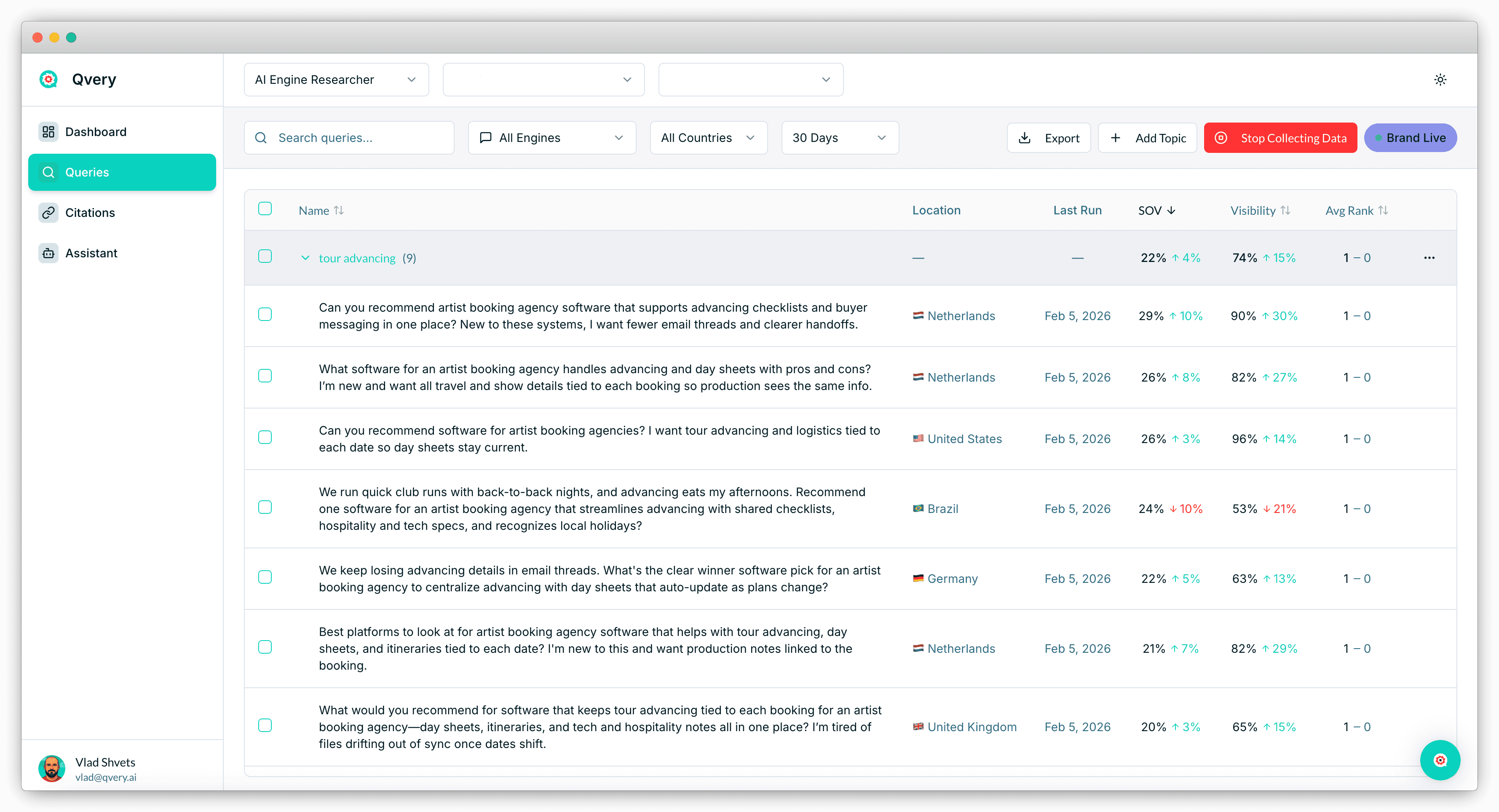
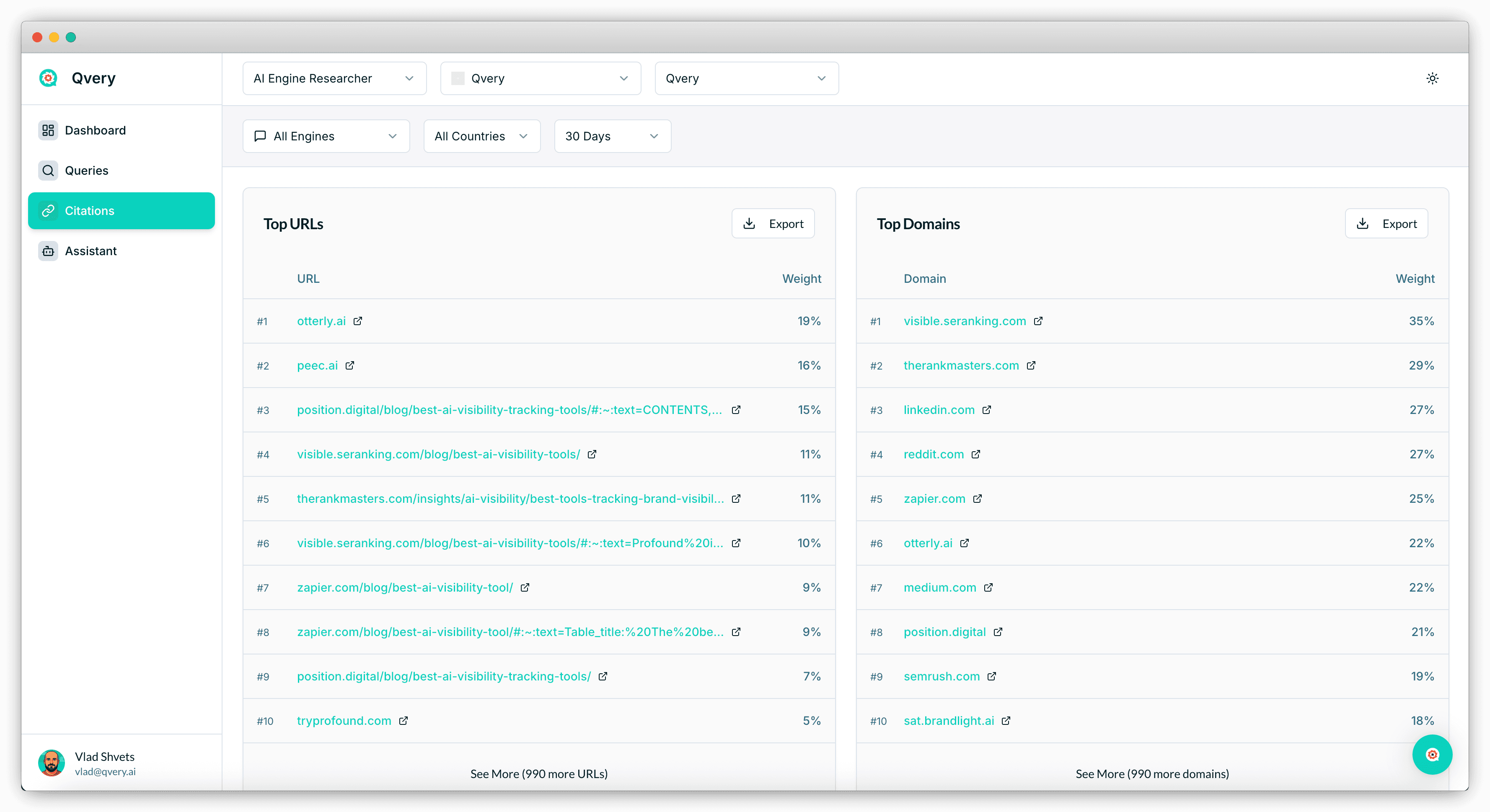
Then open Citations and look at the domains, not the totals. What you are checking is whether your own pages appear at all, and which competitor's pages sit where yours should be. If LegalZoom's explainer is carrying a question your explainer was written for, that is a page-level fix with a name on it.
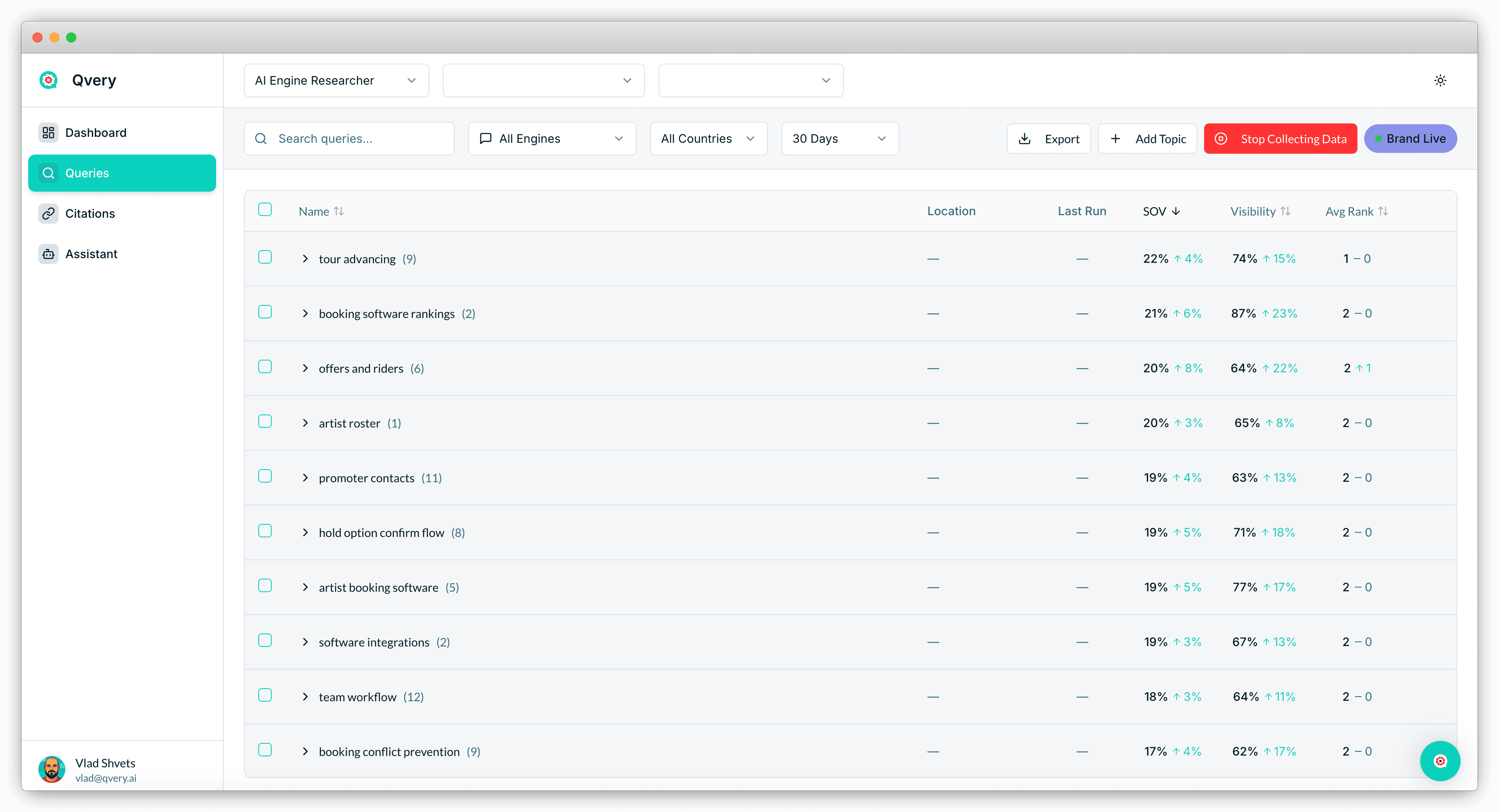
Topic level is where you check whether the whole question family is moving or just one query in it.
What Qvery will not do is sort that roster into services, firm software and publications for you. That labelling is yours, and after this article you can do it in an afternoon.
Start your free trial and pull your first month of citations by domain.
Check One Explainer This Week
Take the single question you most want to win, the one closest to a sign-up. Run it on both engines and write down every page that comes back.
Then open the competitor page that got cited and read it beside your own. In this vertical the answer is being built out of pages like that one, and it is the cheapest thing on this list to go and fix.
Someone about to form an LLC does not know what a registered agent is, and they are not going to read four comparison pages to find out. They ask, they get two or three services named with a sentence each, and one of those gets the sign-up.
If you sell LLC formation, wills, trademark filings, document templates or e-signature, that moment is most of your funnel now, and almost every piece of legal marketing advice you can find was written about a different question. The standard playbook says work the legal directories. Get the Avvo profile right, claim the Justia listing, chase Super Lawyers.
That advice is real, and it belongs to lawyers.
So we ran both: the questions someone types when buying an online legal service, and, in the same window on the same engines, the questions someone types when hiring a lawyer.
The short version: the services themselves are most of the answer to the first question, and the roster answering the second one shares nothing with it.
A caveat that matters more here than usual: these are two separate sets of questions, and every comparison below runs between them rather than inside either one. And appearing alongside an answer is not the same as causing it.
The Services Themselves Are Most Of The Answer
Across a targeted set of the questions a buyer asks when choosing an online legal service, run on ChatGPT and Google AI Mode in August 2026, here is the roster ChatGPT's answers were assembled from.
Every source below is ChatGPT's. We could not resolve what Google AI Mode's answers pointed to in this set, so nothing here describes its sources.
LegalZoom and Juro sit tied at the top of it. Then DocuSign and Clio, then Forbes, Rocket Lawyer, Thomson Reuters, LexisNexis and PandaDoc, and behind those Nolo, Ironclad, ZenBusiness and a thin tail of smaller names.
Sort that list by what each company sells and it splits in two.
The online legal services in it are LegalZoom, Rocket Lawyer, ZenBusiness, DocuSign, PandaDoc and Nolo. Those are the ones a consumer or a small business buys directly, and they are being cited on their own domains: the pricing page, the help center, the what-is-an-LLC explainer.
The rest, Juro and Clio and LexisNexis and Thomson Reuters and Ironclad, are software sold to law firms. Different buyer, different product, same answer. It is worth knowing they are in there so you do not mistake a contract-lifecycle vendor for a competitor.
Forbes is the only general publication in the leading group, which makes the editorial layer here thin and, for once, reachable.
One more thing about the shape of that list. No single name owns it.
The leaders sit close together and the roster stays flat a long way down, which is not how every category behaves. Ask a crypto buying question and one exchange carries better than a third of the answers on its own.
Legal has no equivalent, which is good news if you are small: there is no incumbent to dislodge, only a dozen pages to be better than.
I am giving you rank and not percentages, and the reason is worth one line: each half of this collection is small enough that a percentage would imply more precision than it has. The order is solid. A decimal place would not be.
Ask For A Lawyer And Not One Of Those Names Survives
The same collection carried a second set of questions, asked the same day on the same engines: find me a divorce lawyer, an employment lawyer, a firm for a contract dispute.
Here is that roster: Justia, Super Lawyers, Avvo, Expertise, then the Texas state bar, the Law Society of England and Wales, the Michigan bar's referral service, FindLaw.
Not one name from that roster appears in this one. Three domains do turn up on both sides, all of them at the very bottom: Avvo once among the buying answers, NerdWallet a few times among the lawyer ones, and a state filing page once each. The leading rosters themselves do not intersect.
That is the whole reason the directory playbook does not transfer. Justia and Avvo and Super Lawyers carry most of the lawyer answer, exactly as the advice says, and we have published the size of that directory layer and how it grows in smaller metros. None of them showed up when the question was which service to use.
Bar associations and law societies appear only in the lawyer answers. Zero in the buying ones.
They are a credential layer for people, and an online service is not a person.
Two questions from the same vertical, asked the same day on the same engines, returned rosters with nothing in common. Nothing in a legal marketing plan is safe to reuse across that line, including the parts that look generic.
The practical read: if your visibility work was designed off legal SEO advice, it is probably pointed at the directory layer, and the directory layer is not where your buyers' answers come from.
Nobody Can Tell You What Share Of These Answers Is Vendor-Owned
The obvious next number is what proportion of the answer is vendor-owned. We computed it.
We are not publishing it, and it is worth explaining why, because you are going to be quoted a figure like it by somebody.
The classifier we used called anything that was not a directory, a bar body, a search platform or an editorial publisher "vendor-owned". On the buying side that is roughly right. On the lawyer side it counted an individual law firm's own website as a vendor, which is not what anybody means by the word.
So the number compared two different things, and it would have been wrong in one direction, flattering the vendor layer on the side where firms have their own sites. Two of our own domain classifiers had already failed independent checking earlier in the same body of work, which is why this one got looked at rather than shipped.
Resolving it needs a hand-audited list of legal-software vendor domains applied to both halves, and until that exists the hypothesis is unresolved rather than answered.
The version that survives without a classifier is the one above: the roster, read by hand, name by name. It says the same thing and it does not depend on a definition anyone can argue with.
When somebody quotes you a vendor-owned share for this vertical, ask them what they counted a law firm's own website as.
Most of the time nobody has asked.
Point Your Tracking At The Services, Not The Directories
Three moves. These are my read of what this implies, not results the collection established.
First, build the query set out of what a buyer buys. Nobody types "legal services" into anything. The questions that produced everything above look like this:
Best online LLC formation service
Online will making service
Best e-signature service for contracts
Trademark filing service recommendations
LLC formation service for a nonresident founder under $300
That last one is the shape worth copying. The constraint is what makes the question specific, and specific questions are where a smaller service can win.
Second, track the service roster, not the directory roster. Your competitors in these answers are the other services, cited on their own pages. Put your pricing page, your help center and your explainer pages on one side, and the equivalent pages at LegalZoom and Rocket Lawyer on the other. That is the comparison the engine is effectively running.
Third, treat the editorial layer as the one reachable third party. You cannot pitch a bar association and the directories are answering someone else's question. A general-publication roundup is the one door in this roster that opens from outside, which makes it worth more here than it would be in a vertical with a rich third-party layer.
In a vertical with a thick third-party layer you can spend a year working it and never run out of doors. Here there is one, which makes it both cheaper to work and far more crowded than it looks.
Watch Your Explainer Pages Against LegalZoom's In Qvery
You enter your brand and Qvery generates the topics and queries to start from. You open Qvery Assistant and rewrite them until they read like the questions your buyers type, constraints included.
From then on Qvery runs them daily across ChatGPT and Google AI Mode, tracks your visibility, share of voice and average rank against the services you compete with, and captures every citation tied to the query and the engine that produced it.
Then open Citations and look at the domains, not the totals. What you are checking is whether your own pages appear at all, and which competitor's pages sit where yours should be. If LegalZoom's explainer is carrying a question your explainer was written for, that is a page-level fix with a name on it.
Topic level is where you check whether the whole question family is moving or just one query in it.
What Qvery will not do is sort that roster into services, firm software and publications for you. That labelling is yours, and after this article you can do it in an afternoon.
Start your free trial and pull your first month of citations by domain.
Check One Explainer This Week
Take the single question you most want to win, the one closest to a sign-up. Run it on both engines and write down every page that comes back.
Then open the competitor page that got cited and read it beside your own. In this vertical the answer is being built out of pages like that one, and it is the cheapest thing on this list to go and fix.
Someone about to form an LLC does not know what a registered agent is, and they are not going to read four comparison pages to find out. They ask, they get two or three services named with a sentence each, and one of those gets the sign-up.
If you sell LLC formation, wills, trademark filings, document templates or e-signature, that moment is most of your funnel now, and almost every piece of legal marketing advice you can find was written about a different question. The standard playbook says work the legal directories. Get the Avvo profile right, claim the Justia listing, chase Super Lawyers.
That advice is real, and it belongs to lawyers.
So we ran both: the questions someone types when buying an online legal service, and, in the same window on the same engines, the questions someone types when hiring a lawyer.
The short version: the services themselves are most of the answer to the first question, and the roster answering the second one shares nothing with it.
A caveat that matters more here than usual: these are two separate sets of questions, and every comparison below runs between them rather than inside either one. And appearing alongside an answer is not the same as causing it.
The Services Themselves Are Most Of The Answer
Across a targeted set of the questions a buyer asks when choosing an online legal service, run on ChatGPT and Google AI Mode in August 2026, here is the roster ChatGPT's answers were assembled from.
Every source below is ChatGPT's. We could not resolve what Google AI Mode's answers pointed to in this set, so nothing here describes its sources.
LegalZoom and Juro sit tied at the top of it. Then DocuSign and Clio, then Forbes, Rocket Lawyer, Thomson Reuters, LexisNexis and PandaDoc, and behind those Nolo, Ironclad, ZenBusiness and a thin tail of smaller names.
Sort that list by what each company sells and it splits in two.
The online legal services in it are LegalZoom, Rocket Lawyer, ZenBusiness, DocuSign, PandaDoc and Nolo. Those are the ones a consumer or a small business buys directly, and they are being cited on their own domains: the pricing page, the help center, the what-is-an-LLC explainer.
The rest, Juro and Clio and LexisNexis and Thomson Reuters and Ironclad, are software sold to law firms. Different buyer, different product, same answer. It is worth knowing they are in there so you do not mistake a contract-lifecycle vendor for a competitor.
Forbes is the only general publication in the leading group, which makes the editorial layer here thin and, for once, reachable.
One more thing about the shape of that list. No single name owns it.
The leaders sit close together and the roster stays flat a long way down, which is not how every category behaves. Ask a crypto buying question and one exchange carries better than a third of the answers on its own.
Legal has no equivalent, which is good news if you are small: there is no incumbent to dislodge, only a dozen pages to be better than.
I am giving you rank and not percentages, and the reason is worth one line: each half of this collection is small enough that a percentage would imply more precision than it has. The order is solid. A decimal place would not be.
Ask For A Lawyer And Not One Of Those Names Survives
The same collection carried a second set of questions, asked the same day on the same engines: find me a divorce lawyer, an employment lawyer, a firm for a contract dispute.
Here is that roster: Justia, Super Lawyers, Avvo, Expertise, then the Texas state bar, the Law Society of England and Wales, the Michigan bar's referral service, FindLaw.
Not one name from that roster appears in this one. Three domains do turn up on both sides, all of them at the very bottom: Avvo once among the buying answers, NerdWallet a few times among the lawyer ones, and a state filing page once each. The leading rosters themselves do not intersect.
That is the whole reason the directory playbook does not transfer. Justia and Avvo and Super Lawyers carry most of the lawyer answer, exactly as the advice says, and we have published the size of that directory layer and how it grows in smaller metros. None of them showed up when the question was which service to use.
Bar associations and law societies appear only in the lawyer answers. Zero in the buying ones.
They are a credential layer for people, and an online service is not a person.
Two questions from the same vertical, asked the same day on the same engines, returned rosters with nothing in common. Nothing in a legal marketing plan is safe to reuse across that line, including the parts that look generic.
The practical read: if your visibility work was designed off legal SEO advice, it is probably pointed at the directory layer, and the directory layer is not where your buyers' answers come from.
Nobody Can Tell You What Share Of These Answers Is Vendor-Owned
The obvious next number is what proportion of the answer is vendor-owned. We computed it.
We are not publishing it, and it is worth explaining why, because you are going to be quoted a figure like it by somebody.
The classifier we used called anything that was not a directory, a bar body, a search platform or an editorial publisher "vendor-owned". On the buying side that is roughly right. On the lawyer side it counted an individual law firm's own website as a vendor, which is not what anybody means by the word.
So the number compared two different things, and it would have been wrong in one direction, flattering the vendor layer on the side where firms have their own sites. Two of our own domain classifiers had already failed independent checking earlier in the same body of work, which is why this one got looked at rather than shipped.
Resolving it needs a hand-audited list of legal-software vendor domains applied to both halves, and until that exists the hypothesis is unresolved rather than answered.
The version that survives without a classifier is the one above: the roster, read by hand, name by name. It says the same thing and it does not depend on a definition anyone can argue with.
When somebody quotes you a vendor-owned share for this vertical, ask them what they counted a law firm's own website as.
Most of the time nobody has asked.
Point Your Tracking At The Services, Not The Directories
Three moves. These are my read of what this implies, not results the collection established.
First, build the query set out of what a buyer buys. Nobody types "legal services" into anything. The questions that produced everything above look like this:
Best online LLC formation service
Online will making service
Best e-signature service for contracts
Trademark filing service recommendations
LLC formation service for a nonresident founder under $300
That last one is the shape worth copying. The constraint is what makes the question specific, and specific questions are where a smaller service can win.
Second, track the service roster, not the directory roster. Your competitors in these answers are the other services, cited on their own pages. Put your pricing page, your help center and your explainer pages on one side, and the equivalent pages at LegalZoom and Rocket Lawyer on the other. That is the comparison the engine is effectively running.
Third, treat the editorial layer as the one reachable third party. You cannot pitch a bar association and the directories are answering someone else's question. A general-publication roundup is the one door in this roster that opens from outside, which makes it worth more here than it would be in a vertical with a rich third-party layer.
In a vertical with a thick third-party layer you can spend a year working it and never run out of doors. Here there is one, which makes it both cheaper to work and far more crowded than it looks.
Watch Your Explainer Pages Against LegalZoom's In Qvery
You enter your brand and Qvery generates the topics and queries to start from. You open Qvery Assistant and rewrite them until they read like the questions your buyers type, constraints included.
From then on Qvery runs them daily across ChatGPT and Google AI Mode, tracks your visibility, share of voice and average rank against the services you compete with, and captures every citation tied to the query and the engine that produced it.
Then open Citations and look at the domains, not the totals. What you are checking is whether your own pages appear at all, and which competitor's pages sit where yours should be. If LegalZoom's explainer is carrying a question your explainer was written for, that is a page-level fix with a name on it.
Topic level is where you check whether the whole question family is moving or just one query in it.
What Qvery will not do is sort that roster into services, firm software and publications for you. That labelling is yours, and after this article you can do it in an afternoon.
Start your free trial and pull your first month of citations by domain.
Check One Explainer This Week
Take the single question you most want to win, the one closest to a sign-up. Run it on both engines and write down every page that comes back.
Then open the competitor page that got cited and read it beside your own. In this vertical the answer is being built out of pages like that one, and it is the cheapest thing on this list to go and fix.
Someone about to form an LLC does not know what a registered agent is, and they are not going to read four comparison pages to find out. They ask, they get two or three services named with a sentence each, and one of those gets the sign-up.
If you sell LLC formation, wills, trademark filings, document templates or e-signature, that moment is most of your funnel now, and almost every piece of legal marketing advice you can find was written about a different question. The standard playbook says work the legal directories. Get the Avvo profile right, claim the Justia listing, chase Super Lawyers.
That advice is real, and it belongs to lawyers.
So we ran both: the questions someone types when buying an online legal service, and, in the same window on the same engines, the questions someone types when hiring a lawyer.
The short version: the services themselves are most of the answer to the first question, and the roster answering the second one shares nothing with it.
A caveat that matters more here than usual: these are two separate sets of questions, and every comparison below runs between them rather than inside either one. And appearing alongside an answer is not the same as causing it.
The Services Themselves Are Most Of The Answer
Across a targeted set of the questions a buyer asks when choosing an online legal service, run on ChatGPT and Google AI Mode in August 2026, here is the roster ChatGPT's answers were assembled from.
Every source below is ChatGPT's. We could not resolve what Google AI Mode's answers pointed to in this set, so nothing here describes its sources.
LegalZoom and Juro sit tied at the top of it. Then DocuSign and Clio, then Forbes, Rocket Lawyer, Thomson Reuters, LexisNexis and PandaDoc, and behind those Nolo, Ironclad, ZenBusiness and a thin tail of smaller names.
Sort that list by what each company sells and it splits in two.
The online legal services in it are LegalZoom, Rocket Lawyer, ZenBusiness, DocuSign, PandaDoc and Nolo. Those are the ones a consumer or a small business buys directly, and they are being cited on their own domains: the pricing page, the help center, the what-is-an-LLC explainer.
The rest, Juro and Clio and LexisNexis and Thomson Reuters and Ironclad, are software sold to law firms. Different buyer, different product, same answer. It is worth knowing they are in there so you do not mistake a contract-lifecycle vendor for a competitor.
Forbes is the only general publication in the leading group, which makes the editorial layer here thin and, for once, reachable.
One more thing about the shape of that list. No single name owns it.
The leaders sit close together and the roster stays flat a long way down, which is not how every category behaves. Ask a crypto buying question and one exchange carries better than a third of the answers on its own.
Legal has no equivalent, which is good news if you are small: there is no incumbent to dislodge, only a dozen pages to be better than.
I am giving you rank and not percentages, and the reason is worth one line: each half of this collection is small enough that a percentage would imply more precision than it has. The order is solid. A decimal place would not be.
Ask For A Lawyer And Not One Of Those Names Survives
The same collection carried a second set of questions, asked the same day on the same engines: find me a divorce lawyer, an employment lawyer, a firm for a contract dispute.
Here is that roster: Justia, Super Lawyers, Avvo, Expertise, then the Texas state bar, the Law Society of England and Wales, the Michigan bar's referral service, FindLaw.
Not one name from that roster appears in this one. Three domains do turn up on both sides, all of them at the very bottom: Avvo once among the buying answers, NerdWallet a few times among the lawyer ones, and a state filing page once each. The leading rosters themselves do not intersect.
That is the whole reason the directory playbook does not transfer. Justia and Avvo and Super Lawyers carry most of the lawyer answer, exactly as the advice says, and we have published the size of that directory layer and how it grows in smaller metros. None of them showed up when the question was which service to use.
Bar associations and law societies appear only in the lawyer answers. Zero in the buying ones.
They are a credential layer for people, and an online service is not a person.
Two questions from the same vertical, asked the same day on the same engines, returned rosters with nothing in common. Nothing in a legal marketing plan is safe to reuse across that line, including the parts that look generic.
The practical read: if your visibility work was designed off legal SEO advice, it is probably pointed at the directory layer, and the directory layer is not where your buyers' answers come from.
Nobody Can Tell You What Share Of These Answers Is Vendor-Owned
The obvious next number is what proportion of the answer is vendor-owned. We computed it.
We are not publishing it, and it is worth explaining why, because you are going to be quoted a figure like it by somebody.
The classifier we used called anything that was not a directory, a bar body, a search platform or an editorial publisher "vendor-owned". On the buying side that is roughly right. On the lawyer side it counted an individual law firm's own website as a vendor, which is not what anybody means by the word.
So the number compared two different things, and it would have been wrong in one direction, flattering the vendor layer on the side where firms have their own sites. Two of our own domain classifiers had already failed independent checking earlier in the same body of work, which is why this one got looked at rather than shipped.
Resolving it needs a hand-audited list of legal-software vendor domains applied to both halves, and until that exists the hypothesis is unresolved rather than answered.
The version that survives without a classifier is the one above: the roster, read by hand, name by name. It says the same thing and it does not depend on a definition anyone can argue with.
When somebody quotes you a vendor-owned share for this vertical, ask them what they counted a law firm's own website as.
Most of the time nobody has asked.
Point Your Tracking At The Services, Not The Directories
Three moves. These are my read of what this implies, not results the collection established.
First, build the query set out of what a buyer buys. Nobody types "legal services" into anything. The questions that produced everything above look like this:
Best online LLC formation service
Online will making service
Best e-signature service for contracts
Trademark filing service recommendations
LLC formation service for a nonresident founder under $300
That last one is the shape worth copying. The constraint is what makes the question specific, and specific questions are where a smaller service can win.
Second, track the service roster, not the directory roster. Your competitors in these answers are the other services, cited on their own pages. Put your pricing page, your help center and your explainer pages on one side, and the equivalent pages at LegalZoom and Rocket Lawyer on the other. That is the comparison the engine is effectively running.
Third, treat the editorial layer as the one reachable third party. You cannot pitch a bar association and the directories are answering someone else's question. A general-publication roundup is the one door in this roster that opens from outside, which makes it worth more here than it would be in a vertical with a rich third-party layer.
In a vertical with a thick third-party layer you can spend a year working it and never run out of doors. Here there is one, which makes it both cheaper to work and far more crowded than it looks.
Watch Your Explainer Pages Against LegalZoom's In Qvery
You enter your brand and Qvery generates the topics and queries to start from. You open Qvery Assistant and rewrite them until they read like the questions your buyers type, constraints included.
From then on Qvery runs them daily across ChatGPT and Google AI Mode, tracks your visibility, share of voice and average rank against the services you compete with, and captures every citation tied to the query and the engine that produced it.
Then open Citations and look at the domains, not the totals. What you are checking is whether your own pages appear at all, and which competitor's pages sit where yours should be. If LegalZoom's explainer is carrying a question your explainer was written for, that is a page-level fix with a name on it.
Topic level is where you check whether the whole question family is moving or just one query in it.
What Qvery will not do is sort that roster into services, firm software and publications for you. That labelling is yours, and after this article you can do it in an afternoon.
Start your free trial and pull your first month of citations by domain.
Check One Explainer This Week
Take the single question you most want to win, the one closest to a sign-up. Run it on both engines and write down every page that comes back.
Then open the competitor page that got cited and read it beside your own. In this vertical the answer is being built out of pages like that one, and it is the cheapest thing on this list to go and fix.

© 2026 Qvery AI OÜ