By
Vlad Shvets
What Answers An Insurance Question In AI Search
Cover somebody requires and cover a buyer chooses are answered by different websites. Two lists of about the same length, sharing two rows, with a public body in more than half of the answers that cited anything.
Cover somebody requires and cover a buyer chooses are answered by different websites. Two lists of about the same length, sharing two rows, with a public body in more than half of the answers that cited anything.
Cover somebody requires and cover a buyer chooses are answered by different websites. Two lists of about the same length, sharing two rows, with a public body in more than half of the answers that cited anything.
Your brand-term visibility is fine. Somebody types your company name into ChatGPT and gets a reasonable description of you, and a marketing dashboard somewhere reports that as a win.
Buyers do not start there. They ask which renters insurance to get for a first flat, what pet cover pays out and what it excludes, whether they need professional indemnity for a two-person consultancy. Your name is not in the question.
Between that buyer and you sits a layer of other people's websites. Which websites, and how many, changes depending on whether the cover is something a landlord, a lender or a regulator is forcing on the buyer, or something they are choosing for themselves.
This is a measurement piece. It makes no promise about growth, and it leaves motor insurance out: we have written about the comparison layer in car insurance separately, and nothing below speaks to that line.
The Layer Between You And The Buyer
An answer to a category question comes with sources under it. Some belong to insurers and some do not, and which layers turn up tells you which parts of the surface an insurer can work on at all.
Sort your lines into two piles first.
Required cover is what somebody else insists on. Landlord insurance, professional indemnity, public liability, business cover a client contract demands, cover a lender requires before completion.
Discretionary cover is what the buyer chooses. Pet, travel, dental, vision, life, gadget, income protection.
The same insurer often sells both. The two piles are answered by measurably different parts of the web, so tracking them as one book of business gives you a number that fits neither.
Count The Audit List For Each Pile
Start with size. Take one pile of questions, find the smallest set of domains covering half of the answers that cited any source, then the set covering four fifths. Repeat for the other pile.
Across a targeted set of insurance questions we ran on ChatGPT and Google AI Mode in September 2026, the two piles came out at almost identical sizes. Directional, not a census.
Cover somebody requires: four domains cover half of the answers that cited any source. Sixteen cover four fifths.
Cover you choose: five cover half. Fifteen cover four fifths.
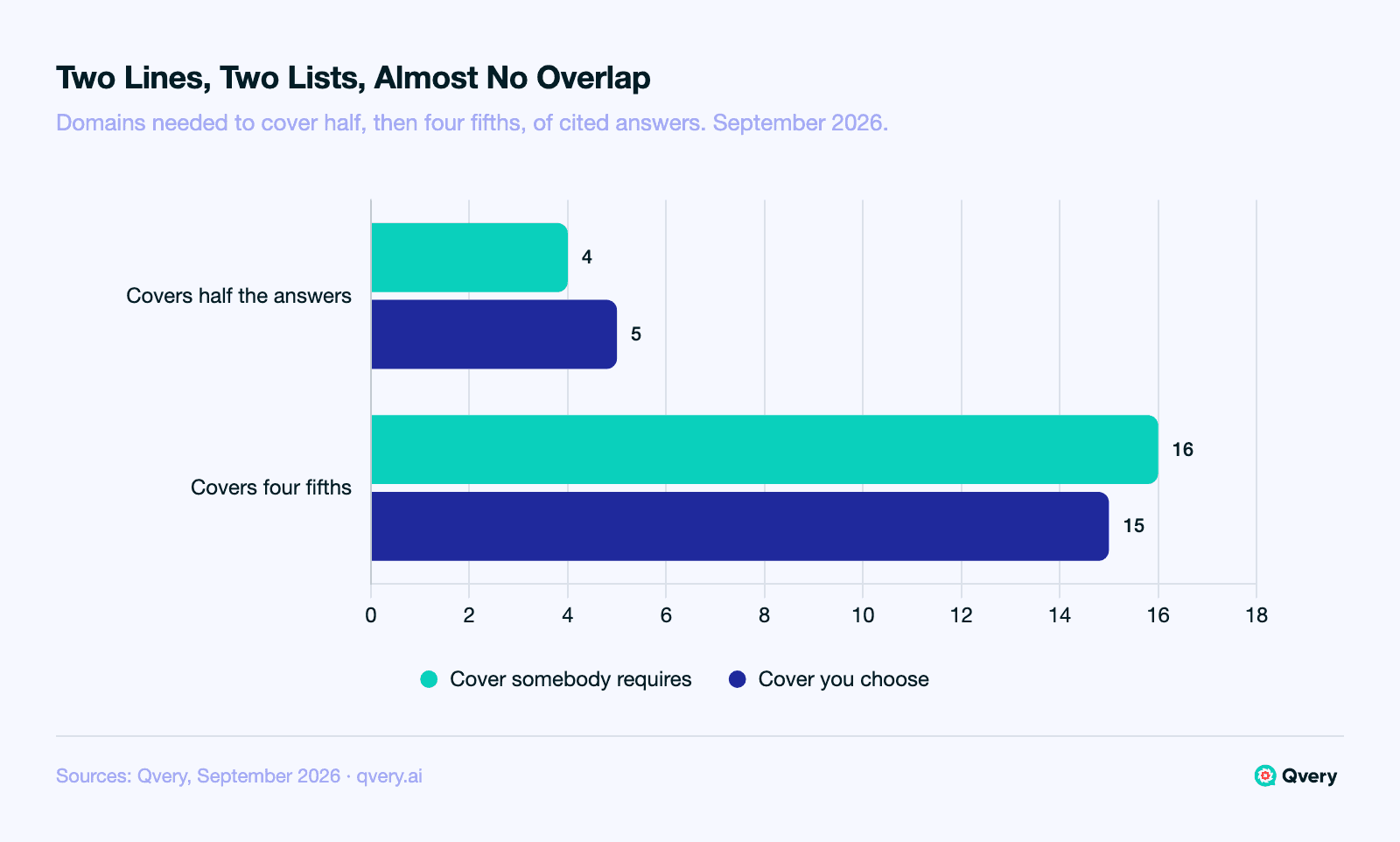
Sixteen and fifteen. Two lists the same length, which looks like good news right up to the moment you compare their contents.
They share two rows: NerdWallet and MoneyHelper. Two out of the smaller list's fifteen, a shared fraction of 0.13.
Here is the required-cover list in full, in the order the coverage was reached:
consumerfinance.gov, Progressive, NerdWallet, The Hartford
MoneyHelper, Aon, MoneyGeek, Zensurance, business.gov.au, AAMI, Florida's insurance regulator
The Zebra, AXA, a Canadian mortgage broker, business.gov.uk, Next Insurance
And the discretionary-cover list:
Forbes, NerdWallet, Humana, MoneyHelper, the NAIC
HealthCare.gov, Allianz travel, YouTube, the AA, a UK dental plan finder, MoneySmart, VSP
Reddit, gov.uk, Quebec's health insurance board
The first four rows cover half of the required-side answers that cited any source; the first five cover half of the discretionary ones.
We went into this expecting one closed comparison layer to own the whole category, so one audit list would serve every line. The data says otherwise, and the instruction inverts: build the list per pile.
For an insurer with a broad book, that is two lists to keep rather than one. Whether that means two owners is your call. What the data settles is that a single list will describe one pile and misdescribe the other.
The two lists came out the same length, which is the trap. Same size, different contents, and only the contents tell you what to do.
What Answers Each Pile
Classify each cited domain by the kind of site it is and the two lists start making sense.
Marketplace and broker sources were present in 25.21% of answers that cited any source on the required side and 4.07% on the discretionary side. That is the sharpest split in the study: the broker layer turns up alongside the cover somebody else is forcing, and largely not alongside the cover a buyer chooses.
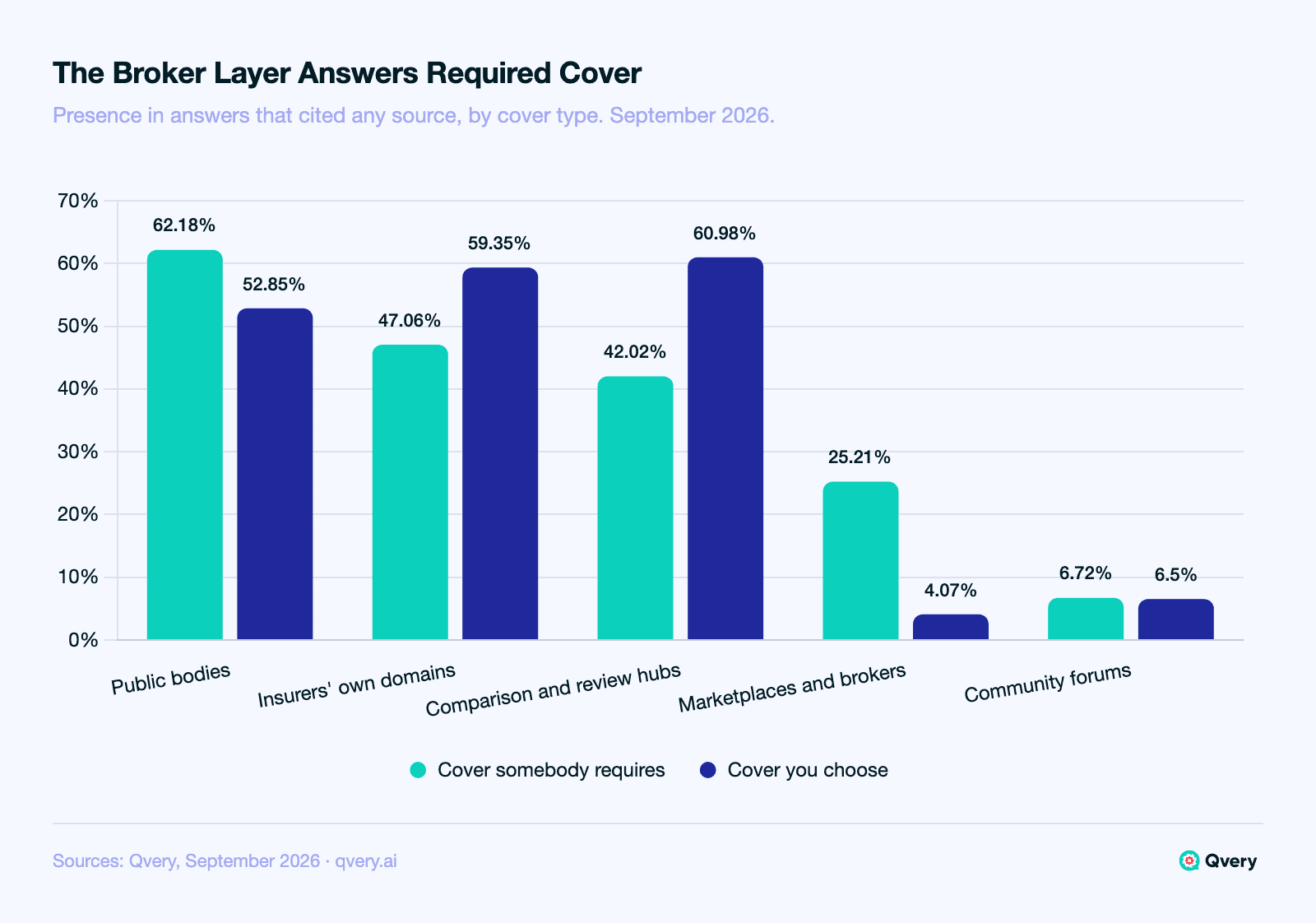
Then the layer nobody plans for. Public bodies were present in 62.18% of answers that cited any source on the required side and 52.85% on the discretionary side.
In both piles, more than half of the answers that cited any source cited a regulator, an ombudsman or a public guidance service. In the questions we ran, a government page was standing alongside the commercial sources most of the time.
Two layers we deliberately do not call. Of the answers that cited any source, comparison and review hubs were present in 42.02% on the required side and 60.98% on the discretionary one, insurers' own domains in 47.06% and 59.35%.
Both ratios land in the band we set in advance for figures too close to separate, so we report them and leave them uncalled.
Community sources were even across the two piles, present in 6.72% and 6.5% of the answers that cited any source, and low on both.
The limits, once. We counted which domains the answers cited. We did not read the answers, did not measure why one comparison site was cited over another, and cannot tell you whether a citation sold a policy.
The required pile is also visibly jurisdiction-shaped. What a landlord or a regulator demands differs by country and by state.
What An Insurer Can Do About A Closed Layer
Judgment from here, not findings. Ranked by what I would try first.
Your own pages. Some insurer's own domain was present in 47.06% and 59.35% of the answers that cited any source. Whether yours is among them is the first thing to check, and it is the only layer with no gatekeeper between you and the page.
The public-body adjacency. You cannot get cited as a regulator. You can be the page that explains what the regulator requires, in the words buyers use, which is a real content brief rather than a wish.
Brokers and marketplaces, for required cover only. It barely appears on the discretionary side, so effort there is misdirected if that is your book.
Comparison hubs last. They are the most expensive layer to enter and the one you control least.
Pick one layer for the quarter and name the page that has to exist. A plan that lists four layers is not a plan.
Read The Citations Before You Read The Score
Set up one topic per line of business, grouped by pile, with your buyers' category questions under them as queries. Qvery generates a starting set at onboarding and you edit it in plain language.
The instinct is to open the visibility score first. Open the Citations view instead. The score tells you where you stand; the citations tell you what you would have to change.
Every answer keeps the sources cited in it, tied to the query and the engine that produced it. The Citations view ranks the URLs and the domains behind those answers, each with a weight, filterable by engine and country, and the ranking exports. Your own version of this article's list comes out of it:
Open the Citations view for one pile's topics and read the Top Domains ranking.
Take rows from the top until another row stops changing what you would do. That is your working list.
Do the same for the other pile.
Mark every row present, absent or stale for your brand, and mark the rows that sit on both lists.
A note on method. Our counts used a stricter definition than a top-ranked cut.
We took the smallest set of domains that together cover four fifths of the answers that cited any source, choosing them one at a time by how many still-uncovered answers each one adds. A ranked list read from the top is a close and usable version of the same thing.
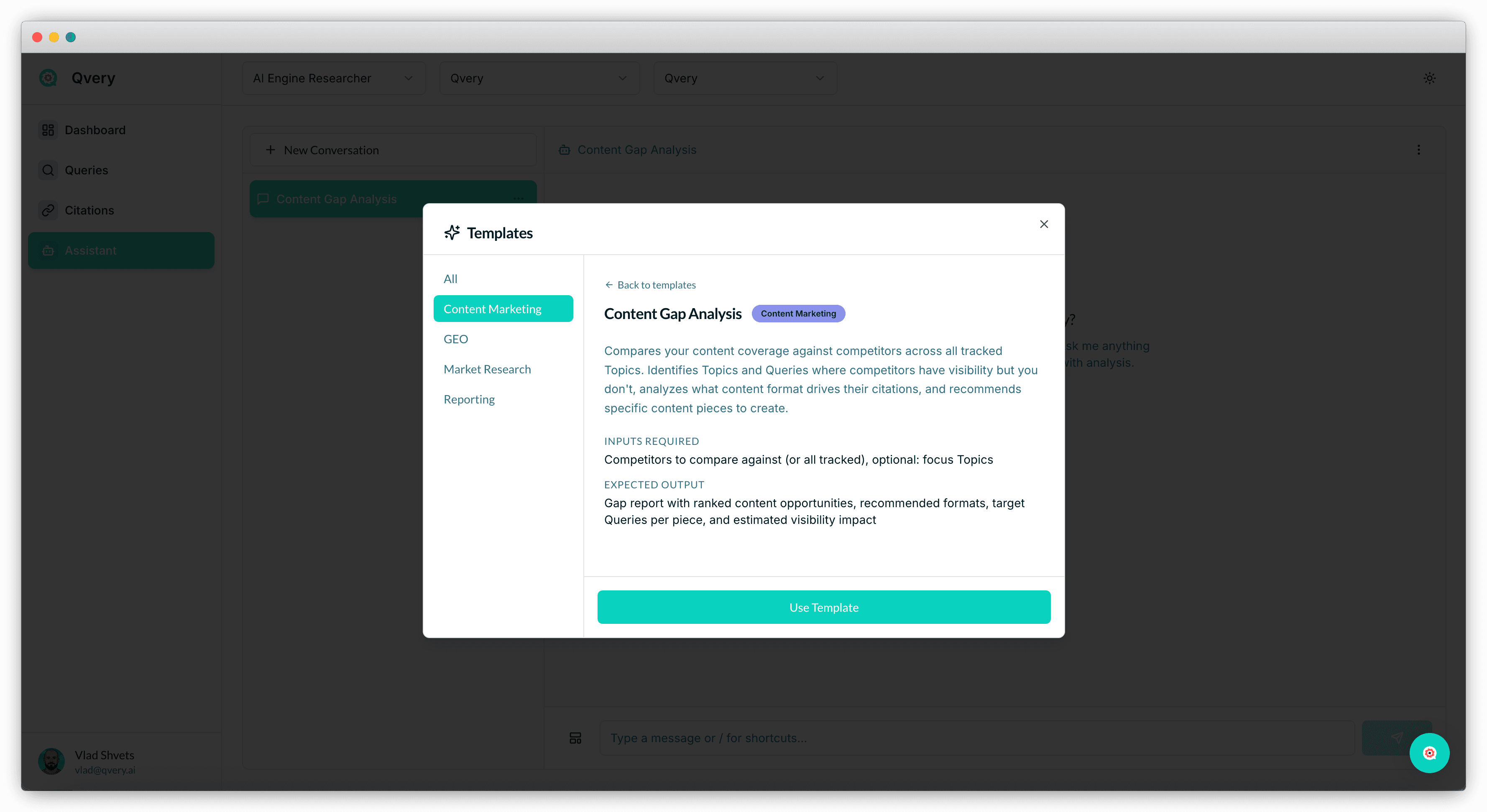
When the list turns into a question about what to write, there is a Content Gap Analysis template in the Assistant. Its own description says it compares your content coverage against competitors across tracked topics, identifies where they have visibility and you do not, and recommends pieces to create.
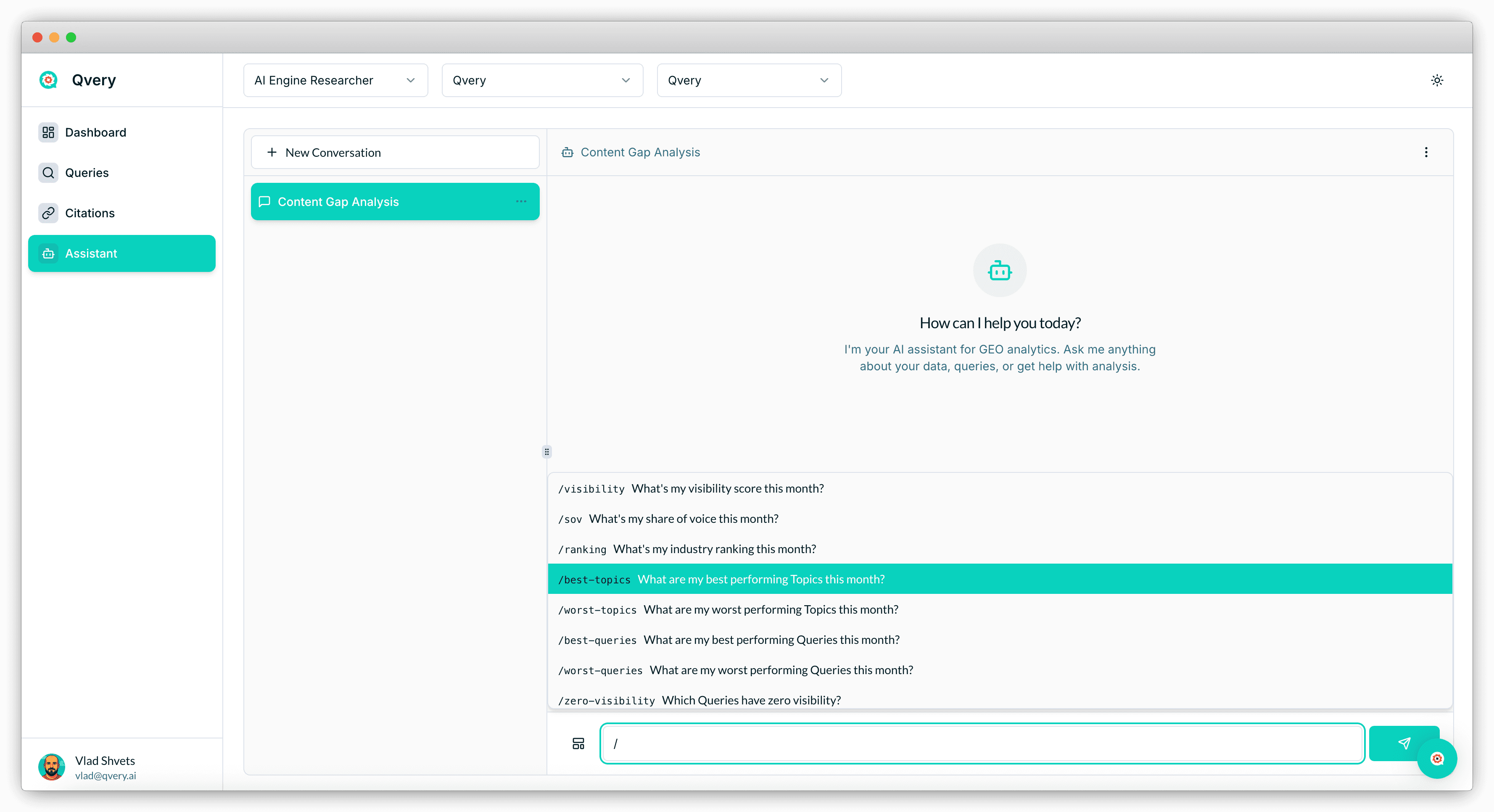
Then ask which queries return zero visibility. Run it once per pile. An insurer whose two piles come back very differently has learned where the next quarter goes, and that is a comparison only your own account can make.
The Citations view records and ranks which sources an answer cited. It does not label a source as a regulator, a broker or a comparison hub, and it does not tell you which insurers the answer named. That read is yours, done once.
Start a Qvery trial and load one line of business. Seven days free, no credit card, which is time to get a line configured and the first days of citations in.
Open the Citations view for one line before the next campaign brief goes out. If the brief does not mention a single domain on that list, it was written for the wrong web.
Your brand-term visibility is fine. Somebody types your company name into ChatGPT and gets a reasonable description of you, and a marketing dashboard somewhere reports that as a win.
Buyers do not start there. They ask which renters insurance to get for a first flat, what pet cover pays out and what it excludes, whether they need professional indemnity for a two-person consultancy. Your name is not in the question.
Between that buyer and you sits a layer of other people's websites. Which websites, and how many, changes depending on whether the cover is something a landlord, a lender or a regulator is forcing on the buyer, or something they are choosing for themselves.
This is a measurement piece. It makes no promise about growth, and it leaves motor insurance out: we have written about the comparison layer in car insurance separately, and nothing below speaks to that line.
The Layer Between You And The Buyer
An answer to a category question comes with sources under it. Some belong to insurers and some do not, and which layers turn up tells you which parts of the surface an insurer can work on at all.
Sort your lines into two piles first.
Required cover is what somebody else insists on. Landlord insurance, professional indemnity, public liability, business cover a client contract demands, cover a lender requires before completion.
Discretionary cover is what the buyer chooses. Pet, travel, dental, vision, life, gadget, income protection.
The same insurer often sells both. The two piles are answered by measurably different parts of the web, so tracking them as one book of business gives you a number that fits neither.
Count The Audit List For Each Pile
Start with size. Take one pile of questions, find the smallest set of domains covering half of the answers that cited any source, then the set covering four fifths. Repeat for the other pile.
Across a targeted set of insurance questions we ran on ChatGPT and Google AI Mode in September 2026, the two piles came out at almost identical sizes. Directional, not a census.
Cover somebody requires: four domains cover half of the answers that cited any source. Sixteen cover four fifths.
Cover you choose: five cover half. Fifteen cover four fifths.
Sixteen and fifteen. Two lists the same length, which looks like good news right up to the moment you compare their contents.
They share two rows: NerdWallet and MoneyHelper. Two out of the smaller list's fifteen, a shared fraction of 0.13.
Here is the required-cover list in full, in the order the coverage was reached:
consumerfinance.gov, Progressive, NerdWallet, The Hartford
MoneyHelper, Aon, MoneyGeek, Zensurance, business.gov.au, AAMI, Florida's insurance regulator
The Zebra, AXA, a Canadian mortgage broker, business.gov.uk, Next Insurance
And the discretionary-cover list:
Forbes, NerdWallet, Humana, MoneyHelper, the NAIC
HealthCare.gov, Allianz travel, YouTube, the AA, a UK dental plan finder, MoneySmart, VSP
Reddit, gov.uk, Quebec's health insurance board
The first four rows cover half of the required-side answers that cited any source; the first five cover half of the discretionary ones.
We went into this expecting one closed comparison layer to own the whole category, so one audit list would serve every line. The data says otherwise, and the instruction inverts: build the list per pile.
For an insurer with a broad book, that is two lists to keep rather than one. Whether that means two owners is your call. What the data settles is that a single list will describe one pile and misdescribe the other.
The two lists came out the same length, which is the trap. Same size, different contents, and only the contents tell you what to do.
What Answers Each Pile
Classify each cited domain by the kind of site it is and the two lists start making sense.
Marketplace and broker sources were present in 25.21% of answers that cited any source on the required side and 4.07% on the discretionary side. That is the sharpest split in the study: the broker layer turns up alongside the cover somebody else is forcing, and largely not alongside the cover a buyer chooses.
Then the layer nobody plans for. Public bodies were present in 62.18% of answers that cited any source on the required side and 52.85% on the discretionary side.
In both piles, more than half of the answers that cited any source cited a regulator, an ombudsman or a public guidance service. In the questions we ran, a government page was standing alongside the commercial sources most of the time.
Two layers we deliberately do not call. Of the answers that cited any source, comparison and review hubs were present in 42.02% on the required side and 60.98% on the discretionary one, insurers' own domains in 47.06% and 59.35%.
Both ratios land in the band we set in advance for figures too close to separate, so we report them and leave them uncalled.
Community sources were even across the two piles, present in 6.72% and 6.5% of the answers that cited any source, and low on both.
The limits, once. We counted which domains the answers cited. We did not read the answers, did not measure why one comparison site was cited over another, and cannot tell you whether a citation sold a policy.
The required pile is also visibly jurisdiction-shaped. What a landlord or a regulator demands differs by country and by state.
What An Insurer Can Do About A Closed Layer
Judgment from here, not findings. Ranked by what I would try first.
Your own pages. Some insurer's own domain was present in 47.06% and 59.35% of the answers that cited any source. Whether yours is among them is the first thing to check, and it is the only layer with no gatekeeper between you and the page.
The public-body adjacency. You cannot get cited as a regulator. You can be the page that explains what the regulator requires, in the words buyers use, which is a real content brief rather than a wish.
Brokers and marketplaces, for required cover only. It barely appears on the discretionary side, so effort there is misdirected if that is your book.
Comparison hubs last. They are the most expensive layer to enter and the one you control least.
Pick one layer for the quarter and name the page that has to exist. A plan that lists four layers is not a plan.
Read The Citations Before You Read The Score
Set up one topic per line of business, grouped by pile, with your buyers' category questions under them as queries. Qvery generates a starting set at onboarding and you edit it in plain language.
The instinct is to open the visibility score first. Open the Citations view instead. The score tells you where you stand; the citations tell you what you would have to change.
Every answer keeps the sources cited in it, tied to the query and the engine that produced it. The Citations view ranks the URLs and the domains behind those answers, each with a weight, filterable by engine and country, and the ranking exports. Your own version of this article's list comes out of it:
Open the Citations view for one pile's topics and read the Top Domains ranking.
Take rows from the top until another row stops changing what you would do. That is your working list.
Do the same for the other pile.
Mark every row present, absent or stale for your brand, and mark the rows that sit on both lists.
A note on method. Our counts used a stricter definition than a top-ranked cut.
We took the smallest set of domains that together cover four fifths of the answers that cited any source, choosing them one at a time by how many still-uncovered answers each one adds. A ranked list read from the top is a close and usable version of the same thing.
When the list turns into a question about what to write, there is a Content Gap Analysis template in the Assistant. Its own description says it compares your content coverage against competitors across tracked topics, identifies where they have visibility and you do not, and recommends pieces to create.
Then ask which queries return zero visibility. Run it once per pile. An insurer whose two piles come back very differently has learned where the next quarter goes, and that is a comparison only your own account can make.
The Citations view records and ranks which sources an answer cited. It does not label a source as a regulator, a broker or a comparison hub, and it does not tell you which insurers the answer named. That read is yours, done once.
Start a Qvery trial and load one line of business. Seven days free, no credit card, which is time to get a line configured and the first days of citations in.
Open the Citations view for one line before the next campaign brief goes out. If the brief does not mention a single domain on that list, it was written for the wrong web.
Your brand-term visibility is fine. Somebody types your company name into ChatGPT and gets a reasonable description of you, and a marketing dashboard somewhere reports that as a win.
Buyers do not start there. They ask which renters insurance to get for a first flat, what pet cover pays out and what it excludes, whether they need professional indemnity for a two-person consultancy. Your name is not in the question.
Between that buyer and you sits a layer of other people's websites. Which websites, and how many, changes depending on whether the cover is something a landlord, a lender or a regulator is forcing on the buyer, or something they are choosing for themselves.
This is a measurement piece. It makes no promise about growth, and it leaves motor insurance out: we have written about the comparison layer in car insurance separately, and nothing below speaks to that line.
The Layer Between You And The Buyer
An answer to a category question comes with sources under it. Some belong to insurers and some do not, and which layers turn up tells you which parts of the surface an insurer can work on at all.
Sort your lines into two piles first.
Required cover is what somebody else insists on. Landlord insurance, professional indemnity, public liability, business cover a client contract demands, cover a lender requires before completion.
Discretionary cover is what the buyer chooses. Pet, travel, dental, vision, life, gadget, income protection.
The same insurer often sells both. The two piles are answered by measurably different parts of the web, so tracking them as one book of business gives you a number that fits neither.
Count The Audit List For Each Pile
Start with size. Take one pile of questions, find the smallest set of domains covering half of the answers that cited any source, then the set covering four fifths. Repeat for the other pile.
Across a targeted set of insurance questions we ran on ChatGPT and Google AI Mode in September 2026, the two piles came out at almost identical sizes. Directional, not a census.
Cover somebody requires: four domains cover half of the answers that cited any source. Sixteen cover four fifths.
Cover you choose: five cover half. Fifteen cover four fifths.
Sixteen and fifteen. Two lists the same length, which looks like good news right up to the moment you compare their contents.
They share two rows: NerdWallet and MoneyHelper. Two out of the smaller list's fifteen, a shared fraction of 0.13.
Here is the required-cover list in full, in the order the coverage was reached:
consumerfinance.gov, Progressive, NerdWallet, The Hartford
MoneyHelper, Aon, MoneyGeek, Zensurance, business.gov.au, AAMI, Florida's insurance regulator
The Zebra, AXA, a Canadian mortgage broker, business.gov.uk, Next Insurance
And the discretionary-cover list:
Forbes, NerdWallet, Humana, MoneyHelper, the NAIC
HealthCare.gov, Allianz travel, YouTube, the AA, a UK dental plan finder, MoneySmart, VSP
Reddit, gov.uk, Quebec's health insurance board
The first four rows cover half of the required-side answers that cited any source; the first five cover half of the discretionary ones.
We went into this expecting one closed comparison layer to own the whole category, so one audit list would serve every line. The data says otherwise, and the instruction inverts: build the list per pile.
For an insurer with a broad book, that is two lists to keep rather than one. Whether that means two owners is your call. What the data settles is that a single list will describe one pile and misdescribe the other.
The two lists came out the same length, which is the trap. Same size, different contents, and only the contents tell you what to do.
What Answers Each Pile
Classify each cited domain by the kind of site it is and the two lists start making sense.
Marketplace and broker sources were present in 25.21% of answers that cited any source on the required side and 4.07% on the discretionary side. That is the sharpest split in the study: the broker layer turns up alongside the cover somebody else is forcing, and largely not alongside the cover a buyer chooses.
Then the layer nobody plans for. Public bodies were present in 62.18% of answers that cited any source on the required side and 52.85% on the discretionary side.
In both piles, more than half of the answers that cited any source cited a regulator, an ombudsman or a public guidance service. In the questions we ran, a government page was standing alongside the commercial sources most of the time.
Two layers we deliberately do not call. Of the answers that cited any source, comparison and review hubs were present in 42.02% on the required side and 60.98% on the discretionary one, insurers' own domains in 47.06% and 59.35%.
Both ratios land in the band we set in advance for figures too close to separate, so we report them and leave them uncalled.
Community sources were even across the two piles, present in 6.72% and 6.5% of the answers that cited any source, and low on both.
The limits, once. We counted which domains the answers cited. We did not read the answers, did not measure why one comparison site was cited over another, and cannot tell you whether a citation sold a policy.
The required pile is also visibly jurisdiction-shaped. What a landlord or a regulator demands differs by country and by state.
What An Insurer Can Do About A Closed Layer
Judgment from here, not findings. Ranked by what I would try first.
Your own pages. Some insurer's own domain was present in 47.06% and 59.35% of the answers that cited any source. Whether yours is among them is the first thing to check, and it is the only layer with no gatekeeper between you and the page.
The public-body adjacency. You cannot get cited as a regulator. You can be the page that explains what the regulator requires, in the words buyers use, which is a real content brief rather than a wish.
Brokers and marketplaces, for required cover only. It barely appears on the discretionary side, so effort there is misdirected if that is your book.
Comparison hubs last. They are the most expensive layer to enter and the one you control least.
Pick one layer for the quarter and name the page that has to exist. A plan that lists four layers is not a plan.
Read The Citations Before You Read The Score
Set up one topic per line of business, grouped by pile, with your buyers' category questions under them as queries. Qvery generates a starting set at onboarding and you edit it in plain language.
The instinct is to open the visibility score first. Open the Citations view instead. The score tells you where you stand; the citations tell you what you would have to change.
Every answer keeps the sources cited in it, tied to the query and the engine that produced it. The Citations view ranks the URLs and the domains behind those answers, each with a weight, filterable by engine and country, and the ranking exports. Your own version of this article's list comes out of it:
Open the Citations view for one pile's topics and read the Top Domains ranking.
Take rows from the top until another row stops changing what you would do. That is your working list.
Do the same for the other pile.
Mark every row present, absent or stale for your brand, and mark the rows that sit on both lists.
A note on method. Our counts used a stricter definition than a top-ranked cut.
We took the smallest set of domains that together cover four fifths of the answers that cited any source, choosing them one at a time by how many still-uncovered answers each one adds. A ranked list read from the top is a close and usable version of the same thing.
When the list turns into a question about what to write, there is a Content Gap Analysis template in the Assistant. Its own description says it compares your content coverage against competitors across tracked topics, identifies where they have visibility and you do not, and recommends pieces to create.
Then ask which queries return zero visibility. Run it once per pile. An insurer whose two piles come back very differently has learned where the next quarter goes, and that is a comparison only your own account can make.
The Citations view records and ranks which sources an answer cited. It does not label a source as a regulator, a broker or a comparison hub, and it does not tell you which insurers the answer named. That read is yours, done once.
Start a Qvery trial and load one line of business. Seven days free, no credit card, which is time to get a line configured and the first days of citations in.
Open the Citations view for one line before the next campaign brief goes out. If the brief does not mention a single domain on that list, it was written for the wrong web.
Your brand-term visibility is fine. Somebody types your company name into ChatGPT and gets a reasonable description of you, and a marketing dashboard somewhere reports that as a win.
Buyers do not start there. They ask which renters insurance to get for a first flat, what pet cover pays out and what it excludes, whether they need professional indemnity for a two-person consultancy. Your name is not in the question.
Between that buyer and you sits a layer of other people's websites. Which websites, and how many, changes depending on whether the cover is something a landlord, a lender or a regulator is forcing on the buyer, or something they are choosing for themselves.
This is a measurement piece. It makes no promise about growth, and it leaves motor insurance out: we have written about the comparison layer in car insurance separately, and nothing below speaks to that line.
The Layer Between You And The Buyer
An answer to a category question comes with sources under it. Some belong to insurers and some do not, and which layers turn up tells you which parts of the surface an insurer can work on at all.
Sort your lines into two piles first.
Required cover is what somebody else insists on. Landlord insurance, professional indemnity, public liability, business cover a client contract demands, cover a lender requires before completion.
Discretionary cover is what the buyer chooses. Pet, travel, dental, vision, life, gadget, income protection.
The same insurer often sells both. The two piles are answered by measurably different parts of the web, so tracking them as one book of business gives you a number that fits neither.
Count The Audit List For Each Pile
Start with size. Take one pile of questions, find the smallest set of domains covering half of the answers that cited any source, then the set covering four fifths. Repeat for the other pile.
Across a targeted set of insurance questions we ran on ChatGPT and Google AI Mode in September 2026, the two piles came out at almost identical sizes. Directional, not a census.
Cover somebody requires: four domains cover half of the answers that cited any source. Sixteen cover four fifths.
Cover you choose: five cover half. Fifteen cover four fifths.
Sixteen and fifteen. Two lists the same length, which looks like good news right up to the moment you compare their contents.
They share two rows: NerdWallet and MoneyHelper. Two out of the smaller list's fifteen, a shared fraction of 0.13.
Here is the required-cover list in full, in the order the coverage was reached:
consumerfinance.gov, Progressive, NerdWallet, The Hartford
MoneyHelper, Aon, MoneyGeek, Zensurance, business.gov.au, AAMI, Florida's insurance regulator
The Zebra, AXA, a Canadian mortgage broker, business.gov.uk, Next Insurance
And the discretionary-cover list:
Forbes, NerdWallet, Humana, MoneyHelper, the NAIC
HealthCare.gov, Allianz travel, YouTube, the AA, a UK dental plan finder, MoneySmart, VSP
Reddit, gov.uk, Quebec's health insurance board
The first four rows cover half of the required-side answers that cited any source; the first five cover half of the discretionary ones.
We went into this expecting one closed comparison layer to own the whole category, so one audit list would serve every line. The data says otherwise, and the instruction inverts: build the list per pile.
For an insurer with a broad book, that is two lists to keep rather than one. Whether that means two owners is your call. What the data settles is that a single list will describe one pile and misdescribe the other.
The two lists came out the same length, which is the trap. Same size, different contents, and only the contents tell you what to do.
What Answers Each Pile
Classify each cited domain by the kind of site it is and the two lists start making sense.
Marketplace and broker sources were present in 25.21% of answers that cited any source on the required side and 4.07% on the discretionary side. That is the sharpest split in the study: the broker layer turns up alongside the cover somebody else is forcing, and largely not alongside the cover a buyer chooses.
Then the layer nobody plans for. Public bodies were present in 62.18% of answers that cited any source on the required side and 52.85% on the discretionary side.
In both piles, more than half of the answers that cited any source cited a regulator, an ombudsman or a public guidance service. In the questions we ran, a government page was standing alongside the commercial sources most of the time.
Two layers we deliberately do not call. Of the answers that cited any source, comparison and review hubs were present in 42.02% on the required side and 60.98% on the discretionary one, insurers' own domains in 47.06% and 59.35%.
Both ratios land in the band we set in advance for figures too close to separate, so we report them and leave them uncalled.
Community sources were even across the two piles, present in 6.72% and 6.5% of the answers that cited any source, and low on both.
The limits, once. We counted which domains the answers cited. We did not read the answers, did not measure why one comparison site was cited over another, and cannot tell you whether a citation sold a policy.
The required pile is also visibly jurisdiction-shaped. What a landlord or a regulator demands differs by country and by state.
What An Insurer Can Do About A Closed Layer
Judgment from here, not findings. Ranked by what I would try first.
Your own pages. Some insurer's own domain was present in 47.06% and 59.35% of the answers that cited any source. Whether yours is among them is the first thing to check, and it is the only layer with no gatekeeper between you and the page.
The public-body adjacency. You cannot get cited as a regulator. You can be the page that explains what the regulator requires, in the words buyers use, which is a real content brief rather than a wish.
Brokers and marketplaces, for required cover only. It barely appears on the discretionary side, so effort there is misdirected if that is your book.
Comparison hubs last. They are the most expensive layer to enter and the one you control least.
Pick one layer for the quarter and name the page that has to exist. A plan that lists four layers is not a plan.
Read The Citations Before You Read The Score
Set up one topic per line of business, grouped by pile, with your buyers' category questions under them as queries. Qvery generates a starting set at onboarding and you edit it in plain language.
The instinct is to open the visibility score first. Open the Citations view instead. The score tells you where you stand; the citations tell you what you would have to change.
Every answer keeps the sources cited in it, tied to the query and the engine that produced it. The Citations view ranks the URLs and the domains behind those answers, each with a weight, filterable by engine and country, and the ranking exports. Your own version of this article's list comes out of it:
Open the Citations view for one pile's topics and read the Top Domains ranking.
Take rows from the top until another row stops changing what you would do. That is your working list.
Do the same for the other pile.
Mark every row present, absent or stale for your brand, and mark the rows that sit on both lists.
A note on method. Our counts used a stricter definition than a top-ranked cut.
We took the smallest set of domains that together cover four fifths of the answers that cited any source, choosing them one at a time by how many still-uncovered answers each one adds. A ranked list read from the top is a close and usable version of the same thing.
When the list turns into a question about what to write, there is a Content Gap Analysis template in the Assistant. Its own description says it compares your content coverage against competitors across tracked topics, identifies where they have visibility and you do not, and recommends pieces to create.
Then ask which queries return zero visibility. Run it once per pile. An insurer whose two piles come back very differently has learned where the next quarter goes, and that is a comparison only your own account can make.
The Citations view records and ranks which sources an answer cited. It does not label a source as a regulator, a broker or a comparison hub, and it does not tell you which insurers the answer named. That read is yours, done once.
Start a Qvery trial and load one line of business. Seven days free, no credit card, which is time to get a line configured and the first days of citations in.
Open the Citations view for one line before the next campaign brief goes out. If the brief does not mention a single domain on that list, it was written for the wrong web.

© 2026 Qvery AI OÜ