By
Vlad Shvets
Google Statistics 2026: 45+ Numbers on the Search Empire AI Was Supposed to Kill
AI was supposed to end Google. Instead Google owns 90% of search, its ad revenue is at a record, and it rebuilt search around AI. Here are 45+ verified statistics on the empire and the click that's quietly dying.
AI was supposed to end Google. Instead Google owns 90% of search, its ad revenue is at a record, and it rebuilt search around AI. Here are 45+ verified statistics on the empire and the click that's quietly dying.
AI was supposed to end Google. Instead Google owns 90% of search, its ad revenue is at a record, and it rebuilt search around AI. Here are 45+ verified statistics on the empire and the click that's quietly dying.
The internet has been writing Google's obituary since roughly 2023. Google, apparently not a subscriber, went and took 91.27% of the world's search market anyway¹. In its own 2026 earnings it reported that search queries are at an all-time high and Search ad revenue grew 19%, with people "coming back to Search more"².
So the popular story, that AI is killing Google, is wrong in an interesting way. Google isn't losing search. It's absorbing AI into search and keeping both the queries and the money. The thing that's dying is the click to everyone else's website.
We pulled the most credible, independently verified statistics on Google we could find, from StatCounter, Alphabet's own SEC filings, the federal antitrust ruling, Gartner, Bain, and the clickstream firms that measure where searches end.
A few figures come from our own AI-citation data at Qvery. Everything else is footnoted to its original source. Read together, they describe a search empire that is bigger, richer, and more dominant than ever, quietly rebuilding itself around AI, while the open web it used to feed gets a smaller and smaller share of the clicks.
Highlights
Google holds 91.27% of worldwide search, and no rival cracks 5%¹.
Google processes more than 5 trillion searches a year³, roughly 13.7 billion a day.
Google Search advertising generated $224.5 billion in 2025, about 56% of all of Alphabet⁴.
68% of Google searches now end without a click, up from about 45% a decade ago⁵.
Google's AI Mode passed 1 billion monthly users a year after launch, with queries more than doubling every quarter⁶.
Gartner predicted traditional search volume would fall 25% by 2026⁷, yet Google says query volume is at a record².
Paid clicks rose 6% and cost-per-click rose 7% in 2025, even as AI answers spread⁴.
In our own data, only 13.9% of the domains AI engines cite also rank in Google's organic top 10⁸.
Still the Most Dominant Business on the Internet
Start with the number that makes everything else make sense. Google holds 91.27% of the worldwide search market, and the entire field behind it is under 9%: Bing at 4.68%, Yahoo at 1.28%, Yandex at 0.79%¹. After a decade of predicted disruption, no competitor has taken a fifth of what Google has.
The dominance is lopsided by device, and it favors Google exactly where the searches are. On mobile, Google runs 96.05% of search¹⁰, locked in by Android and Safari defaults, and mobile is now 51.51% of all web page views¹³.
The strongest measure comes from the federal court that ruled Google an illegal monopolist: by actual query volume, Google held an 89.2% share of US general search, rising to 94.9% on mobile, and received nine times more queries than all rivals combined, nineteen times more on mobile⁹.
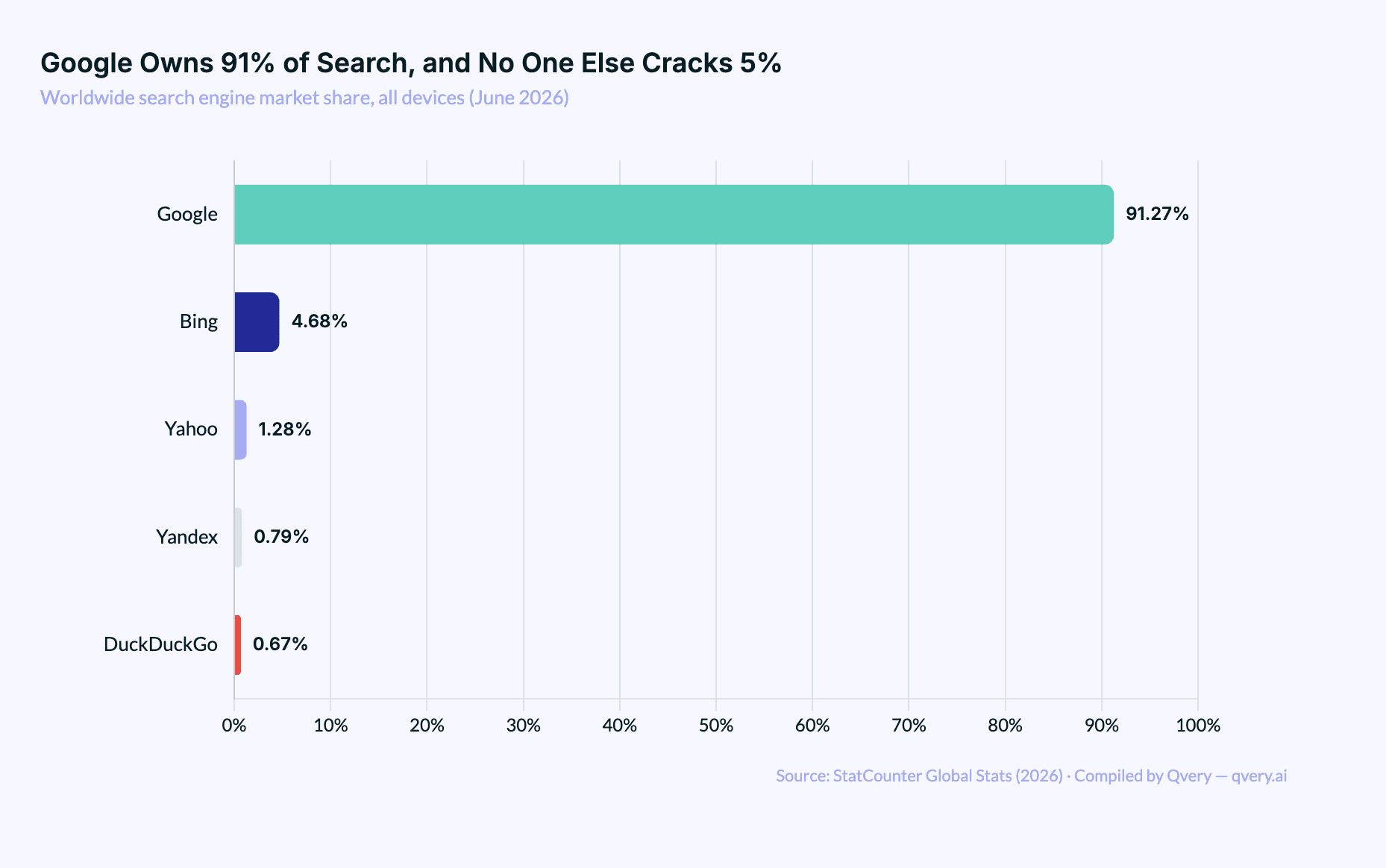
Two facts puncture the idea that this is inevitable or permanent, though. Google's share instead rose from 80% to 89.2% over the decade the court examined⁹, so the trend has been up, not down. And the dominance is not universal: in China, the world's largest internet market, Google is a rounding error at 2.28% share, behind Baidu and even Bing¹¹. The empire runs on defaults and distribution, not magic, which is precisely why it spends what it spends to defend them.
The Scale Is Almost Hard to Picture
In early 2025 Google put a number on its volume for the first time since 2016: more than 5 trillion searches a year³. That works out to roughly 13.7 billion a day, or about 158,000 every second. The widely repeated "8.5 billion searches a day" figure has no real primary source and is, if anything, an undercount.
The scale keeps compounding because search keeps finding new questions. Google says 15% of searches every day are queries it has never seen before¹², which is the technical reason it leans harder on automated systems each year, and why more data makes the results better and the moat deeper. Commercial intent runs at the same scale: people shop more than a billion times a day across Google³, a firehose of buying intent that funds everything else.
The obvious question is whether all this volume is finally shrinking under AI. In its own annual report, Google attributes a $26.4 billion rise in Search revenue partly to "increases in search queries" from more usage on mobile⁴. Whatever AI is doing to the web, it has not yet dented the number of times people ask Google something.
The Money Machine Is Still Accelerating
The "search is dying" thesis runs hardest into Google's own filings. Google Search advertising is large and still growing, on both volume and price at once.
Google Search and other advertising generated $224.5 billion in 2025, up from $198.1 billion in 2024 and $175.0 billion in 2023⁴.
That single line is about 56% of Alphabet's entire $402.8 billion in revenue⁴.
In the fourth quarter alone, Search brought in $63.1 billion, up 17% year over year¹⁴.
Both levers moved up: paid clicks rose 6% and cost-per-click rose 7% in 2025⁴.
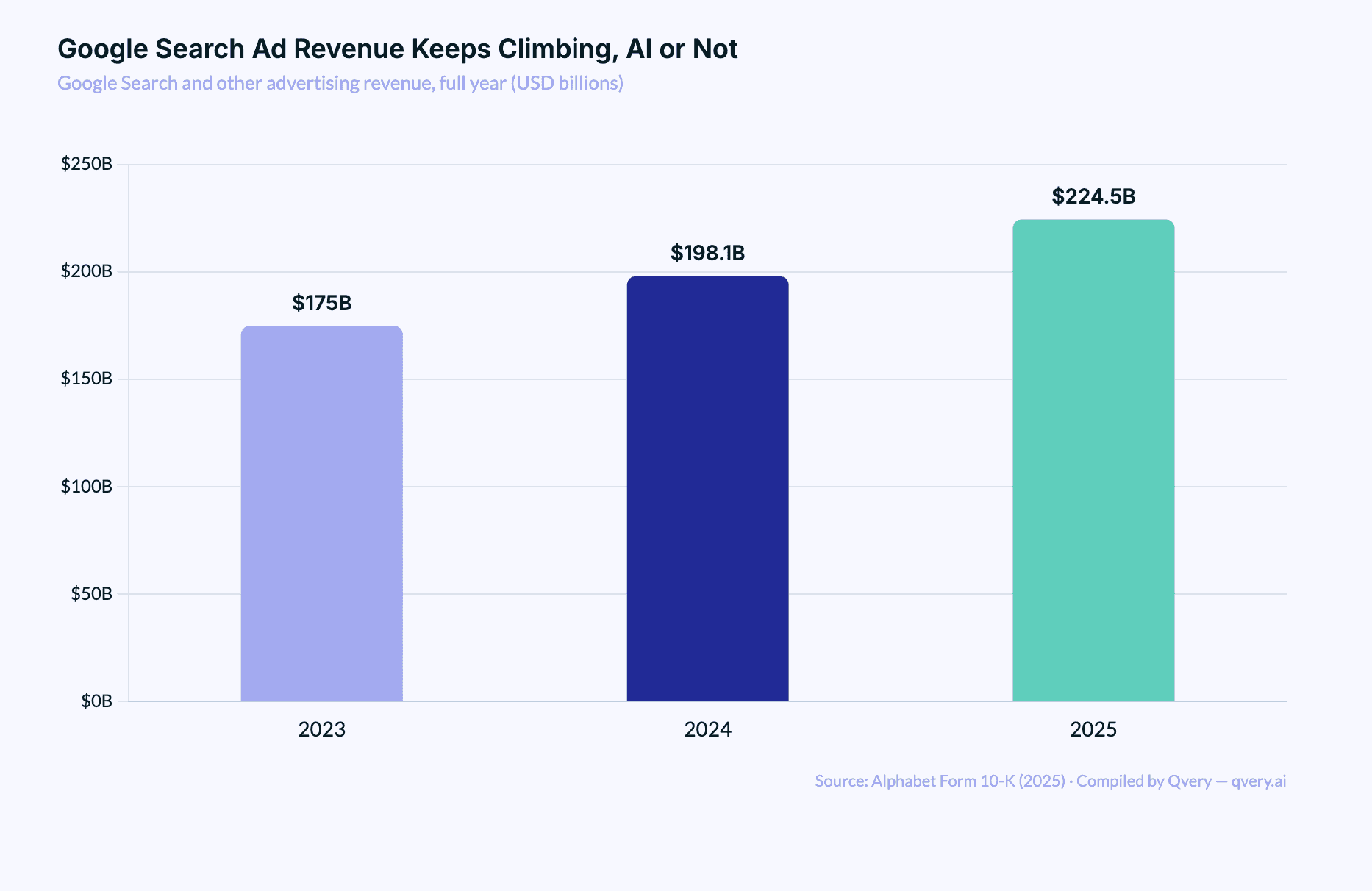
The clicks-and-price detail quietly demolishes a popular argument. If AI answers were cannibalizing valuable search, you'd expect Google to be monetizing fewer, cheaper clicks. Instead it's selling more clicks at a higher price while AI Overviews roll out⁴.
Search advertising alone is a bigger business than almost any company on earth, which is an awkward thing to hold in your head while insisting the format is finished. The court put the prize in context: advertisers spent more than $150 billion to reach search users in 2021⁹, and Google's ad revenue had already grown from about $47 billion in 2014 to over $146 billion in 2021, against Bing's under $12 billion⁹.
The Zero-Click Decade
Now the part that is genuinely shrinking, and it is not Google. It is the click to the open web. As of early 2026, 68% of Google searches ended without a click to any website⁵. This is not a sudden AI event but the end of a decade-long slide.
Zero-click searches went from about 45% in 2016 to 49% in 2019 to 68% in 2026, a 23-point rise⁵.
In 2024, 58.5% of US searches were zero-click, and for every 1,000 searches only 360 clicks reached the open web¹⁵.
Almost 30% of all clicks stay on Google's own properties like YouTube, Maps, and Shopping¹⁵.
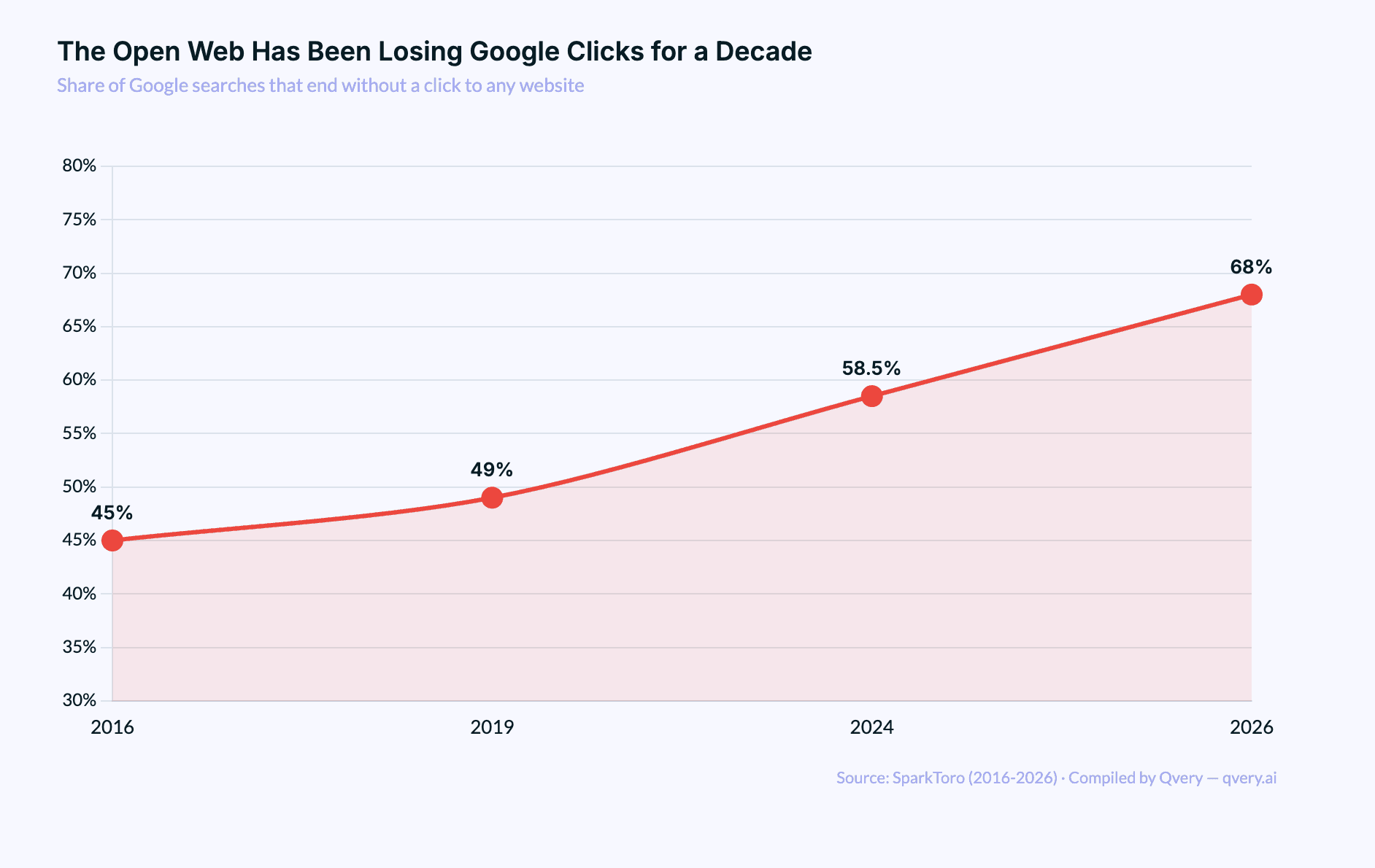
Zero-click sounded like a niche SEO worry in 2019, back before it was the business model. The honest reading is that Google spent a decade answering more questions on its own results page, keeping users inside its walls, and AI Overviews are the most powerful version of a machine Google was already building. The click drying up is not a bug the open web can patch. It is the strategy working.
AI Is Not Killing Google, Google Is Eating AI
Everyone spent two years asking whether AI would kill Google. Google's answer was to install the AI in the same building and keep collecting the rent. Its own AI surfaces now operate at a scale no challenger comes close to.
AI Overviews reached over 2 billion monthly users and drive "over 10% more queries" for the searches that show them¹⁶.
AI Mode went from 100 million monthly users in mid-2025 to over 1 billion a year later, with queries more than doubling every quarter⁶ ¹⁶.
Google shipped over 250 AI Search launches in a single quarter, and reported Search saw more usage in Q4 than ever before¹⁸.
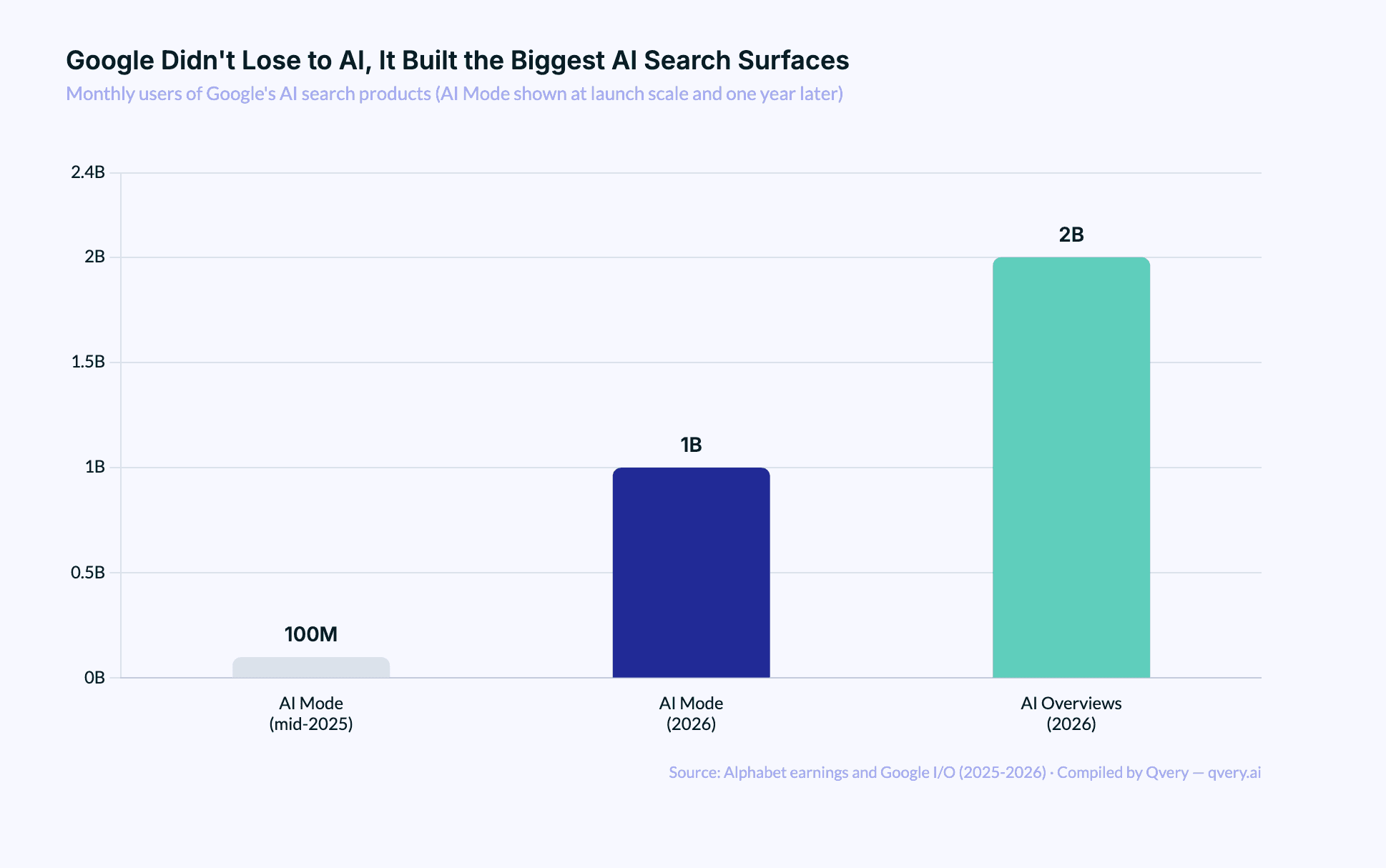
Crucially, Google reports this AI is additive, not cannibalistic: AI Mode is already driving incremental total query growth for Search¹⁷, and by 2026 queries hit an all-time high with Search ad revenue up 19%². That reversal is what the forecasts missed.
Traffic to the open web is down, and Google's own usage and revenue are up. The queries and the money stay inside Google. Only the click to your website is disappearing, and that distinction is the whole story.
What This Costs the Open Web
The consequences land on everyone who used to depend on Google for traffic. Over a single recent year, Google's referral share to more than 75,000 tracked websites fell about 22%⁵. And the AI engines rising to replace it are not replacing the traffic: they send less than 1% of all web traffic out to sites⁵. Intent is moving to AI; referrals are not moving with it.
The forecasters called the direction, if not the mechanism. Gartner predicted traditional search volume would drop 25% by 2026⁷, and Bain estimated zero-click behavior is cutting organic web traffic 15% to 25%, with about 80% of consumers relying on zero-click results for at least 40% of searches¹⁹. The first real dent in search habit is now visible: worldwide search-engine use fell from 82.4% to 79.3% of online adults, dropping below 80% for the first time²⁰.
Before anyone declares search over, though, the same data says it still leads by a lot. For researching brands and products, 45.8% of people use search engines versus 22.1% who use AI, and search remains the single top source of brand awareness at 32.4%²⁰. Search is not collapsing. It is being joined at the top of the funnel by a second surface, and brands now have to be visible in both.
Ranking on Google No Longer Wins AI Search
Which raises the question every marketer should be asking: does winning Google still win the AI answer? Our data says mostly not. Across the queries we track, only 13.9% of the domains AI engines cite also rank in Google's organic top 10⁸. Even a first-place Google ranking is close to a coin flip: a domain at position one has a 48.8% chance of being cited by an AI engine, falling to 17.3% at position 10⁸.
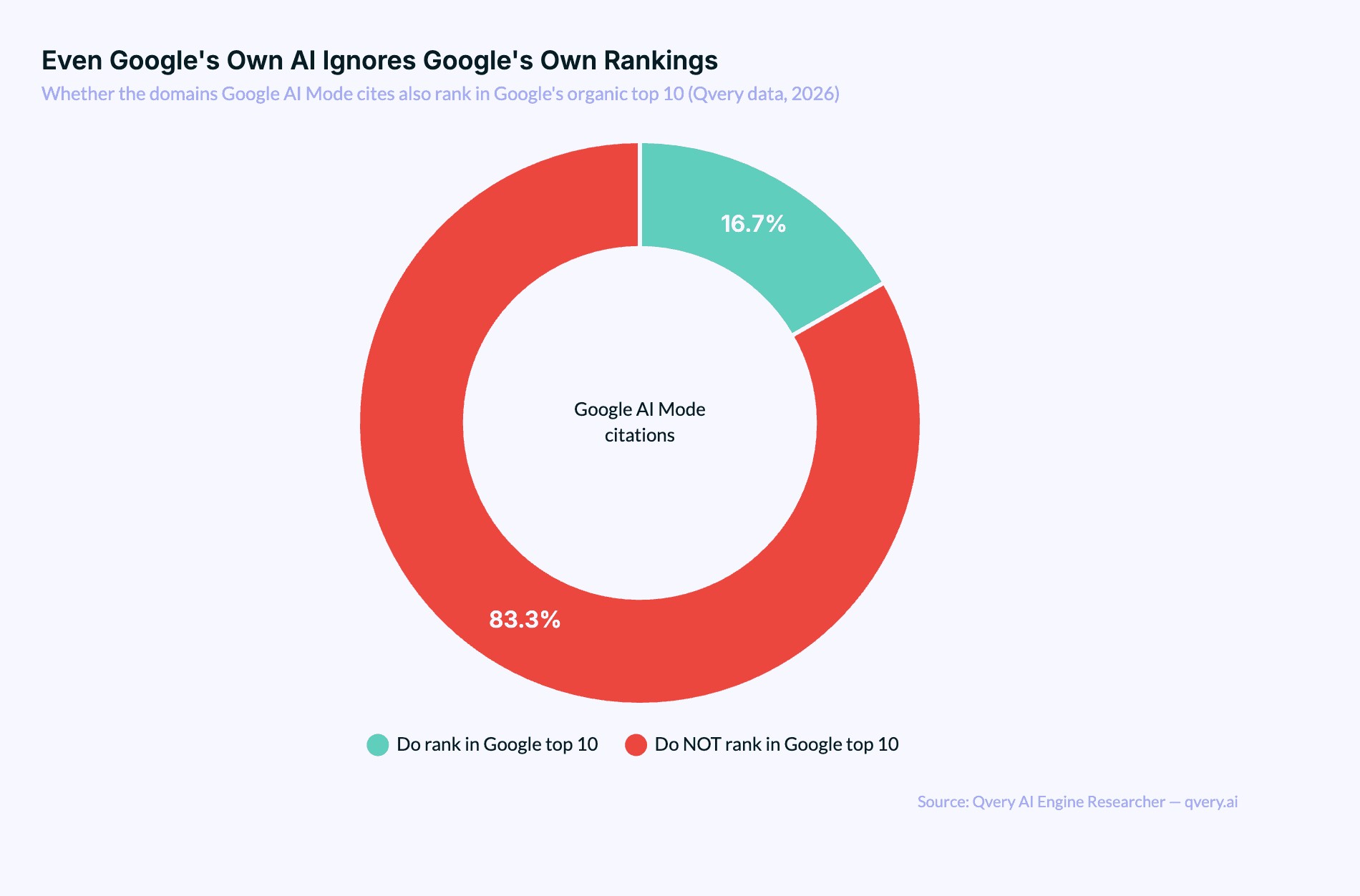
The sharpest version of this is inside Google's own house. Google AI Mode's citations overlap Google's organic top 10 only 16.7% of the time, which means 83.3% of what it cites does not rank in Google's own results⁸. Even Google's AI largely ignores Google's rankings.
Somewhere an SEO team is filing a complaint with itself. The takeaway is simple and a little uncomfortable: the search empire is bigger than ever, but the skill that won it, ranking on Google, is no longer the skill that wins the answer sitting on top of it.
How to See Whether AI Search Names You
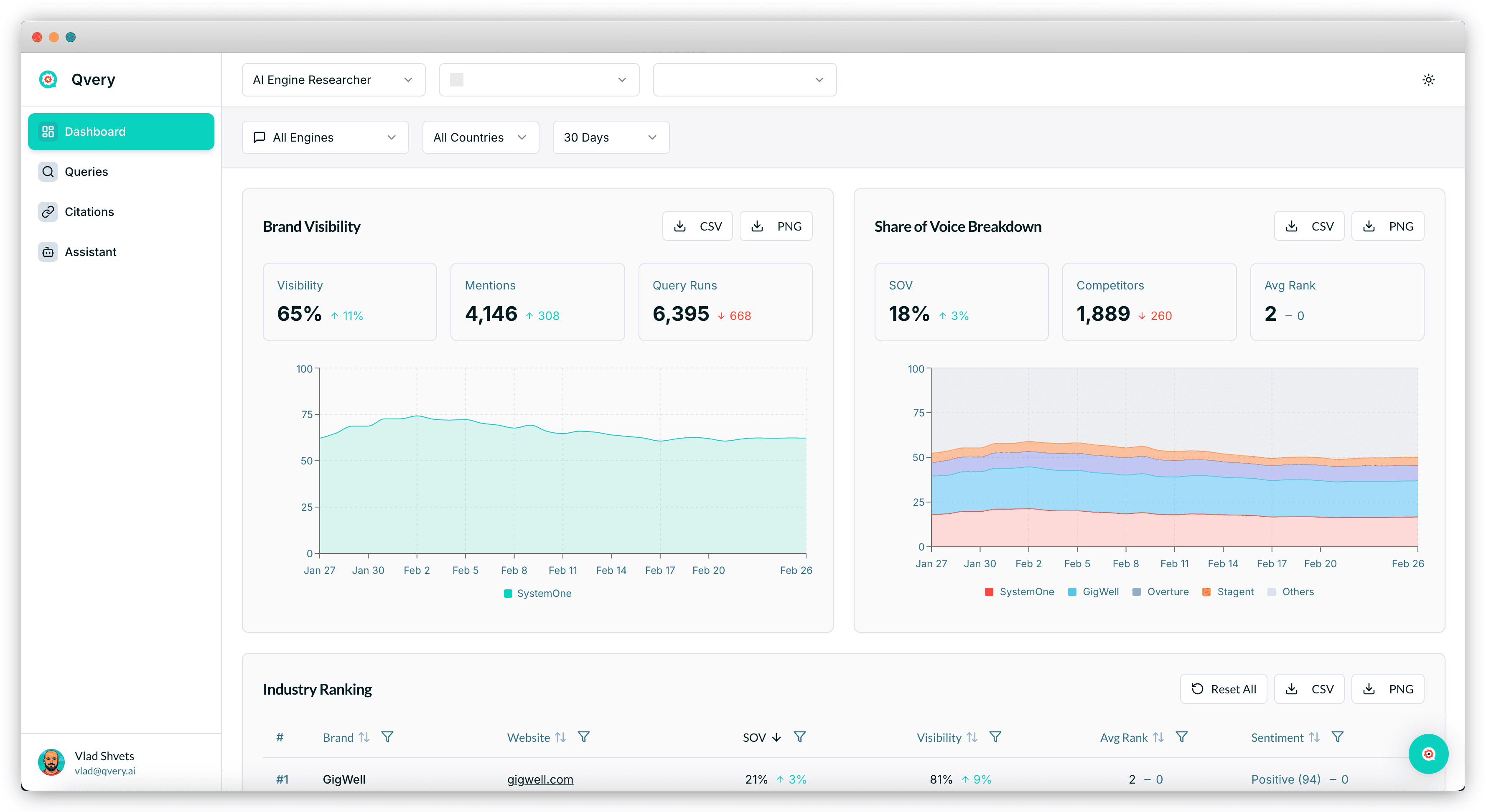
This is the problem Qvery solves. Qvery tracks how your brand shows up across ChatGPT and Google AI Mode, generates the queries your customers ask, and shows you which sources each engine pulls from when your category comes up. You enter your brand and see where you stand in a few minutes, instead of assuming your Google rankings carry over.
Google isn't going anywhere. It still owns the top of the funnel, and it's rebuilding that funnel around AI faster than anyone else. The change is that being found now means being visible in two places at once, the classic results and the AI answer above them, and those two are drifting apart. Knowing where you stand in each is the first move, and it's finally measurable.
Frequently Asked Questions
What is Google's search market share in 2026?
Google holds 91.27% of worldwide search, with no competitor above 5% (Bing is second at 4.68%)¹.
How many searches does Google process?
More than 5 trillion searches a year³, which works out to roughly 13.7 billion per day.
Is Google losing market share to AI?
Not in share terms. Google's search share rose from 80% to 89.2% by query volume over the decade the antitrust court examined⁹, and it still leads every rival combined by roughly nine to one⁹.
How much money does Google Search make?
Google Search and other advertising generated $224.5 billion in 2025, about 56% of Alphabet's total revenue⁴.
Is Google's search revenue still growing?
Yes. It rose from $198.1 billion in 2024 to $224.5 billion in 2025⁴, and Q4 2025 Search revenue was up 17% year over year¹⁴.
What is the zero-click search rate?
As of early 2026, 68% of Google searches ended without a click⁵, up from about 45% a decade earlier.
How long has zero-click search been rising?
Steadily for a decade: roughly 45% in 2016, 49% in 2019, 58.5% in 2024, and 68% in 2026⁵ ¹⁵.
How much Google traffic reaches the open web?
In 2024, for every 1,000 US searches only 360 clicks reached a non-Google property¹⁵, and nearly 30% of clicks stayed on Google's own sites¹⁵.
How big is Google AI Mode?
AI Mode passed 1 billion monthly users a year after launch, up from 100 million in mid-2025, with queries more than doubling every quarter⁶ ¹⁶.
How many people use AI Overviews?
Over 2 billion monthly users, and Google says they drive over 10% more queries for the searches that show them¹⁶.
Is AI reducing Google's total search volume?
Google says the opposite: AI Mode is driving incremental total query growth¹⁷, and queries hit an all-time high in 2026².
What did Gartner predict about search?
Gartner predicted traditional search volume would drop 25% by 2026 as chatbots take share⁷, though Google's own query volume has kept rising².
How much will AI reduce organic traffic?
Bain estimates zero-click behavior is cutting organic web traffic 15% to 25%¹⁹, and Google's referral share to 75,000+ sites fell about 22% in a recent year⁵.
Do AI engines send much referral traffic?
Very little. AI tools collectively send less than 1% of all web traffic out to sites⁵, even as they capture research intent.
Is search-engine usage declining?
Slightly. Worldwide monthly search-engine use fell from 82.4% to 79.3% of online adults, below 80% for the first time²⁰.
Do people prefer search or AI for research?
Search still leads by two to one: 45.8% use search engines to research brands versus 22.1% who use AI²⁰.
How dominant is Google on mobile?
Near-total: 96.05% of mobile search¹⁰, locked in by Android and Safari defaults, and mobile is now most web activity¹³.
Where is Google not dominant?
China, where Google holds just 2.28% of search behind Baidu and Bing¹¹.
Why does Google pay for default placement?
Because defaults drive the volume. Google paid $26.3 billion in traffic-acquisition costs in 2021 to be the default on browsers and devices⁹.
Does ranking on Google get you cited by AI?
Often not. Only 13.9% of AI-cited domains rank in Google's organic top 10⁸, and even a #1 ranking has just a 48.8% chance of being cited⁸.
Does Google's own AI use Google's rankings?
Mostly not. 83.3% of the domains Google AI Mode cites do not appear in Google's organic top 10⁸.
What should a brand do about all this?
Stay visible in both places: classic Google results and the AI answers above them. Start by measuring your visibility across ChatGPT and Google AI Mode, which is what Qvery is built to do.
Sources
StatCounter Global Stats: Search Engine Market Share Worldwide (2026)
Google: AI, Personalization and the Future of Shopping (2025)
Qvery: AI Engine Citations vs Google Organic SERPs, Only 13.9% Overlap (2026)
US District Court, District of Columbia: United States v. Google LLC, Memorandum Opinion (2024)
StatCounter Global Stats: Mobile Search Engine Market Share Worldwide (2026)
StatCounter Global Stats: Search Engine Market Share in China (2026)
StatCounter Global Stats: Desktop vs Mobile vs Tablet Market Share Worldwide (2026)
Alphabet Inc.: Q4 and Fiscal Year 2025 Results, Form 8-K (2025)
SparkToro (data by Datos): 2024 Zero-Click Search Study (2024)
Bain and Company: Goodbye Clicks, Hello AI, Zero-Click Search Redefines Marketing (2025)
DataReportal (We Are Social and GWI): Digital 2026 Mid-Year Global Update Report (2026)
The internet has been writing Google's obituary since roughly 2023. Google, apparently not a subscriber, went and took 91.27% of the world's search market anyway¹. In its own 2026 earnings it reported that search queries are at an all-time high and Search ad revenue grew 19%, with people "coming back to Search more"².
So the popular story, that AI is killing Google, is wrong in an interesting way. Google isn't losing search. It's absorbing AI into search and keeping both the queries and the money. The thing that's dying is the click to everyone else's website.
We pulled the most credible, independently verified statistics on Google we could find, from StatCounter, Alphabet's own SEC filings, the federal antitrust ruling, Gartner, Bain, and the clickstream firms that measure where searches end.
A few figures come from our own AI-citation data at Qvery. Everything else is footnoted to its original source. Read together, they describe a search empire that is bigger, richer, and more dominant than ever, quietly rebuilding itself around AI, while the open web it used to feed gets a smaller and smaller share of the clicks.
Highlights
Google holds 91.27% of worldwide search, and no rival cracks 5%¹.
Google processes more than 5 trillion searches a year³, roughly 13.7 billion a day.
Google Search advertising generated $224.5 billion in 2025, about 56% of all of Alphabet⁴.
68% of Google searches now end without a click, up from about 45% a decade ago⁵.
Google's AI Mode passed 1 billion monthly users a year after launch, with queries more than doubling every quarter⁶.
Gartner predicted traditional search volume would fall 25% by 2026⁷, yet Google says query volume is at a record².
Paid clicks rose 6% and cost-per-click rose 7% in 2025, even as AI answers spread⁴.
In our own data, only 13.9% of the domains AI engines cite also rank in Google's organic top 10⁸.
Still the Most Dominant Business on the Internet
Start with the number that makes everything else make sense. Google holds 91.27% of the worldwide search market, and the entire field behind it is under 9%: Bing at 4.68%, Yahoo at 1.28%, Yandex at 0.79%¹. After a decade of predicted disruption, no competitor has taken a fifth of what Google has.
The dominance is lopsided by device, and it favors Google exactly where the searches are. On mobile, Google runs 96.05% of search¹⁰, locked in by Android and Safari defaults, and mobile is now 51.51% of all web page views¹³.
The strongest measure comes from the federal court that ruled Google an illegal monopolist: by actual query volume, Google held an 89.2% share of US general search, rising to 94.9% on mobile, and received nine times more queries than all rivals combined, nineteen times more on mobile⁹.
Two facts puncture the idea that this is inevitable or permanent, though. Google's share instead rose from 80% to 89.2% over the decade the court examined⁹, so the trend has been up, not down. And the dominance is not universal: in China, the world's largest internet market, Google is a rounding error at 2.28% share, behind Baidu and even Bing¹¹. The empire runs on defaults and distribution, not magic, which is precisely why it spends what it spends to defend them.
The Scale Is Almost Hard to Picture
In early 2025 Google put a number on its volume for the first time since 2016: more than 5 trillion searches a year³. That works out to roughly 13.7 billion a day, or about 158,000 every second. The widely repeated "8.5 billion searches a day" figure has no real primary source and is, if anything, an undercount.
The scale keeps compounding because search keeps finding new questions. Google says 15% of searches every day are queries it has never seen before¹², which is the technical reason it leans harder on automated systems each year, and why more data makes the results better and the moat deeper. Commercial intent runs at the same scale: people shop more than a billion times a day across Google³, a firehose of buying intent that funds everything else.
The obvious question is whether all this volume is finally shrinking under AI. In its own annual report, Google attributes a $26.4 billion rise in Search revenue partly to "increases in search queries" from more usage on mobile⁴. Whatever AI is doing to the web, it has not yet dented the number of times people ask Google something.
The Money Machine Is Still Accelerating
The "search is dying" thesis runs hardest into Google's own filings. Google Search advertising is large and still growing, on both volume and price at once.
Google Search and other advertising generated $224.5 billion in 2025, up from $198.1 billion in 2024 and $175.0 billion in 2023⁴.
That single line is about 56% of Alphabet's entire $402.8 billion in revenue⁴.
In the fourth quarter alone, Search brought in $63.1 billion, up 17% year over year¹⁴.
Both levers moved up: paid clicks rose 6% and cost-per-click rose 7% in 2025⁴.
The clicks-and-price detail quietly demolishes a popular argument. If AI answers were cannibalizing valuable search, you'd expect Google to be monetizing fewer, cheaper clicks. Instead it's selling more clicks at a higher price while AI Overviews roll out⁴.
Search advertising alone is a bigger business than almost any company on earth, which is an awkward thing to hold in your head while insisting the format is finished. The court put the prize in context: advertisers spent more than $150 billion to reach search users in 2021⁹, and Google's ad revenue had already grown from about $47 billion in 2014 to over $146 billion in 2021, against Bing's under $12 billion⁹.
The Zero-Click Decade
Now the part that is genuinely shrinking, and it is not Google. It is the click to the open web. As of early 2026, 68% of Google searches ended without a click to any website⁵. This is not a sudden AI event but the end of a decade-long slide.
Zero-click searches went from about 45% in 2016 to 49% in 2019 to 68% in 2026, a 23-point rise⁵.
In 2024, 58.5% of US searches were zero-click, and for every 1,000 searches only 360 clicks reached the open web¹⁵.
Almost 30% of all clicks stay on Google's own properties like YouTube, Maps, and Shopping¹⁵.
Zero-click sounded like a niche SEO worry in 2019, back before it was the business model. The honest reading is that Google spent a decade answering more questions on its own results page, keeping users inside its walls, and AI Overviews are the most powerful version of a machine Google was already building. The click drying up is not a bug the open web can patch. It is the strategy working.
AI Is Not Killing Google, Google Is Eating AI
Everyone spent two years asking whether AI would kill Google. Google's answer was to install the AI in the same building and keep collecting the rent. Its own AI surfaces now operate at a scale no challenger comes close to.
AI Overviews reached over 2 billion monthly users and drive "over 10% more queries" for the searches that show them¹⁶.
AI Mode went from 100 million monthly users in mid-2025 to over 1 billion a year later, with queries more than doubling every quarter⁶ ¹⁶.
Google shipped over 250 AI Search launches in a single quarter, and reported Search saw more usage in Q4 than ever before¹⁸.
Crucially, Google reports this AI is additive, not cannibalistic: AI Mode is already driving incremental total query growth for Search¹⁷, and by 2026 queries hit an all-time high with Search ad revenue up 19%². That reversal is what the forecasts missed.
Traffic to the open web is down, and Google's own usage and revenue are up. The queries and the money stay inside Google. Only the click to your website is disappearing, and that distinction is the whole story.
What This Costs the Open Web
The consequences land on everyone who used to depend on Google for traffic. Over a single recent year, Google's referral share to more than 75,000 tracked websites fell about 22%⁵. And the AI engines rising to replace it are not replacing the traffic: they send less than 1% of all web traffic out to sites⁵. Intent is moving to AI; referrals are not moving with it.
The forecasters called the direction, if not the mechanism. Gartner predicted traditional search volume would drop 25% by 2026⁷, and Bain estimated zero-click behavior is cutting organic web traffic 15% to 25%, with about 80% of consumers relying on zero-click results for at least 40% of searches¹⁹. The first real dent in search habit is now visible: worldwide search-engine use fell from 82.4% to 79.3% of online adults, dropping below 80% for the first time²⁰.
Before anyone declares search over, though, the same data says it still leads by a lot. For researching brands and products, 45.8% of people use search engines versus 22.1% who use AI, and search remains the single top source of brand awareness at 32.4%²⁰. Search is not collapsing. It is being joined at the top of the funnel by a second surface, and brands now have to be visible in both.
Ranking on Google No Longer Wins AI Search
Which raises the question every marketer should be asking: does winning Google still win the AI answer? Our data says mostly not. Across the queries we track, only 13.9% of the domains AI engines cite also rank in Google's organic top 10⁸. Even a first-place Google ranking is close to a coin flip: a domain at position one has a 48.8% chance of being cited by an AI engine, falling to 17.3% at position 10⁸.
The sharpest version of this is inside Google's own house. Google AI Mode's citations overlap Google's organic top 10 only 16.7% of the time, which means 83.3% of what it cites does not rank in Google's own results⁸. Even Google's AI largely ignores Google's rankings.
Somewhere an SEO team is filing a complaint with itself. The takeaway is simple and a little uncomfortable: the search empire is bigger than ever, but the skill that won it, ranking on Google, is no longer the skill that wins the answer sitting on top of it.
How to See Whether AI Search Names You
This is the problem Qvery solves. Qvery tracks how your brand shows up across ChatGPT and Google AI Mode, generates the queries your customers ask, and shows you which sources each engine pulls from when your category comes up. You enter your brand and see where you stand in a few minutes, instead of assuming your Google rankings carry over.
Google isn't going anywhere. It still owns the top of the funnel, and it's rebuilding that funnel around AI faster than anyone else. The change is that being found now means being visible in two places at once, the classic results and the AI answer above them, and those two are drifting apart. Knowing where you stand in each is the first move, and it's finally measurable.
Frequently Asked Questions
What is Google's search market share in 2026?
Google holds 91.27% of worldwide search, with no competitor above 5% (Bing is second at 4.68%)¹.
How many searches does Google process?
More than 5 trillion searches a year³, which works out to roughly 13.7 billion per day.
Is Google losing market share to AI?
Not in share terms. Google's search share rose from 80% to 89.2% by query volume over the decade the antitrust court examined⁹, and it still leads every rival combined by roughly nine to one⁹.
How much money does Google Search make?
Google Search and other advertising generated $224.5 billion in 2025, about 56% of Alphabet's total revenue⁴.
Is Google's search revenue still growing?
Yes. It rose from $198.1 billion in 2024 to $224.5 billion in 2025⁴, and Q4 2025 Search revenue was up 17% year over year¹⁴.
What is the zero-click search rate?
As of early 2026, 68% of Google searches ended without a click⁵, up from about 45% a decade earlier.
How long has zero-click search been rising?
Steadily for a decade: roughly 45% in 2016, 49% in 2019, 58.5% in 2024, and 68% in 2026⁵ ¹⁵.
How much Google traffic reaches the open web?
In 2024, for every 1,000 US searches only 360 clicks reached a non-Google property¹⁵, and nearly 30% of clicks stayed on Google's own sites¹⁵.
How big is Google AI Mode?
AI Mode passed 1 billion monthly users a year after launch, up from 100 million in mid-2025, with queries more than doubling every quarter⁶ ¹⁶.
How many people use AI Overviews?
Over 2 billion monthly users, and Google says they drive over 10% more queries for the searches that show them¹⁶.
Is AI reducing Google's total search volume?
Google says the opposite: AI Mode is driving incremental total query growth¹⁷, and queries hit an all-time high in 2026².
What did Gartner predict about search?
Gartner predicted traditional search volume would drop 25% by 2026 as chatbots take share⁷, though Google's own query volume has kept rising².
How much will AI reduce organic traffic?
Bain estimates zero-click behavior is cutting organic web traffic 15% to 25%¹⁹, and Google's referral share to 75,000+ sites fell about 22% in a recent year⁵.
Do AI engines send much referral traffic?
Very little. AI tools collectively send less than 1% of all web traffic out to sites⁵, even as they capture research intent.
Is search-engine usage declining?
Slightly. Worldwide monthly search-engine use fell from 82.4% to 79.3% of online adults, below 80% for the first time²⁰.
Do people prefer search or AI for research?
Search still leads by two to one: 45.8% use search engines to research brands versus 22.1% who use AI²⁰.
How dominant is Google on mobile?
Near-total: 96.05% of mobile search¹⁰, locked in by Android and Safari defaults, and mobile is now most web activity¹³.
Where is Google not dominant?
China, where Google holds just 2.28% of search behind Baidu and Bing¹¹.
Why does Google pay for default placement?
Because defaults drive the volume. Google paid $26.3 billion in traffic-acquisition costs in 2021 to be the default on browsers and devices⁹.
Does ranking on Google get you cited by AI?
Often not. Only 13.9% of AI-cited domains rank in Google's organic top 10⁸, and even a #1 ranking has just a 48.8% chance of being cited⁸.
Does Google's own AI use Google's rankings?
Mostly not. 83.3% of the domains Google AI Mode cites do not appear in Google's organic top 10⁸.
What should a brand do about all this?
Stay visible in both places: classic Google results and the AI answers above them. Start by measuring your visibility across ChatGPT and Google AI Mode, which is what Qvery is built to do.
Sources
StatCounter Global Stats: Search Engine Market Share Worldwide (2026)
Google: AI, Personalization and the Future of Shopping (2025)
Qvery: AI Engine Citations vs Google Organic SERPs, Only 13.9% Overlap (2026)
US District Court, District of Columbia: United States v. Google LLC, Memorandum Opinion (2024)
StatCounter Global Stats: Mobile Search Engine Market Share Worldwide (2026)
StatCounter Global Stats: Search Engine Market Share in China (2026)
StatCounter Global Stats: Desktop vs Mobile vs Tablet Market Share Worldwide (2026)
Alphabet Inc.: Q4 and Fiscal Year 2025 Results, Form 8-K (2025)
SparkToro (data by Datos): 2024 Zero-Click Search Study (2024)
Bain and Company: Goodbye Clicks, Hello AI, Zero-Click Search Redefines Marketing (2025)
DataReportal (We Are Social and GWI): Digital 2026 Mid-Year Global Update Report (2026)
The internet has been writing Google's obituary since roughly 2023. Google, apparently not a subscriber, went and took 91.27% of the world's search market anyway¹. In its own 2026 earnings it reported that search queries are at an all-time high and Search ad revenue grew 19%, with people "coming back to Search more"².
So the popular story, that AI is killing Google, is wrong in an interesting way. Google isn't losing search. It's absorbing AI into search and keeping both the queries and the money. The thing that's dying is the click to everyone else's website.
We pulled the most credible, independently verified statistics on Google we could find, from StatCounter, Alphabet's own SEC filings, the federal antitrust ruling, Gartner, Bain, and the clickstream firms that measure where searches end.
A few figures come from our own AI-citation data at Qvery. Everything else is footnoted to its original source. Read together, they describe a search empire that is bigger, richer, and more dominant than ever, quietly rebuilding itself around AI, while the open web it used to feed gets a smaller and smaller share of the clicks.
Highlights
Google holds 91.27% of worldwide search, and no rival cracks 5%¹.
Google processes more than 5 trillion searches a year³, roughly 13.7 billion a day.
Google Search advertising generated $224.5 billion in 2025, about 56% of all of Alphabet⁴.
68% of Google searches now end without a click, up from about 45% a decade ago⁵.
Google's AI Mode passed 1 billion monthly users a year after launch, with queries more than doubling every quarter⁶.
Gartner predicted traditional search volume would fall 25% by 2026⁷, yet Google says query volume is at a record².
Paid clicks rose 6% and cost-per-click rose 7% in 2025, even as AI answers spread⁴.
In our own data, only 13.9% of the domains AI engines cite also rank in Google's organic top 10⁸.
Still the Most Dominant Business on the Internet
Start with the number that makes everything else make sense. Google holds 91.27% of the worldwide search market, and the entire field behind it is under 9%: Bing at 4.68%, Yahoo at 1.28%, Yandex at 0.79%¹. After a decade of predicted disruption, no competitor has taken a fifth of what Google has.
The dominance is lopsided by device, and it favors Google exactly where the searches are. On mobile, Google runs 96.05% of search¹⁰, locked in by Android and Safari defaults, and mobile is now 51.51% of all web page views¹³.
The strongest measure comes from the federal court that ruled Google an illegal monopolist: by actual query volume, Google held an 89.2% share of US general search, rising to 94.9% on mobile, and received nine times more queries than all rivals combined, nineteen times more on mobile⁹.
Two facts puncture the idea that this is inevitable or permanent, though. Google's share instead rose from 80% to 89.2% over the decade the court examined⁹, so the trend has been up, not down. And the dominance is not universal: in China, the world's largest internet market, Google is a rounding error at 2.28% share, behind Baidu and even Bing¹¹. The empire runs on defaults and distribution, not magic, which is precisely why it spends what it spends to defend them.
The Scale Is Almost Hard to Picture
In early 2025 Google put a number on its volume for the first time since 2016: more than 5 trillion searches a year³. That works out to roughly 13.7 billion a day, or about 158,000 every second. The widely repeated "8.5 billion searches a day" figure has no real primary source and is, if anything, an undercount.
The scale keeps compounding because search keeps finding new questions. Google says 15% of searches every day are queries it has never seen before¹², which is the technical reason it leans harder on automated systems each year, and why more data makes the results better and the moat deeper. Commercial intent runs at the same scale: people shop more than a billion times a day across Google³, a firehose of buying intent that funds everything else.
The obvious question is whether all this volume is finally shrinking under AI. In its own annual report, Google attributes a $26.4 billion rise in Search revenue partly to "increases in search queries" from more usage on mobile⁴. Whatever AI is doing to the web, it has not yet dented the number of times people ask Google something.
The Money Machine Is Still Accelerating
The "search is dying" thesis runs hardest into Google's own filings. Google Search advertising is large and still growing, on both volume and price at once.
Google Search and other advertising generated $224.5 billion in 2025, up from $198.1 billion in 2024 and $175.0 billion in 2023⁴.
That single line is about 56% of Alphabet's entire $402.8 billion in revenue⁴.
In the fourth quarter alone, Search brought in $63.1 billion, up 17% year over year¹⁴.
Both levers moved up: paid clicks rose 6% and cost-per-click rose 7% in 2025⁴.
The clicks-and-price detail quietly demolishes a popular argument. If AI answers were cannibalizing valuable search, you'd expect Google to be monetizing fewer, cheaper clicks. Instead it's selling more clicks at a higher price while AI Overviews roll out⁴.
Search advertising alone is a bigger business than almost any company on earth, which is an awkward thing to hold in your head while insisting the format is finished. The court put the prize in context: advertisers spent more than $150 billion to reach search users in 2021⁹, and Google's ad revenue had already grown from about $47 billion in 2014 to over $146 billion in 2021, against Bing's under $12 billion⁹.
The Zero-Click Decade
Now the part that is genuinely shrinking, and it is not Google. It is the click to the open web. As of early 2026, 68% of Google searches ended without a click to any website⁵. This is not a sudden AI event but the end of a decade-long slide.
Zero-click searches went from about 45% in 2016 to 49% in 2019 to 68% in 2026, a 23-point rise⁵.
In 2024, 58.5% of US searches were zero-click, and for every 1,000 searches only 360 clicks reached the open web¹⁵.
Almost 30% of all clicks stay on Google's own properties like YouTube, Maps, and Shopping¹⁵.
Zero-click sounded like a niche SEO worry in 2019, back before it was the business model. The honest reading is that Google spent a decade answering more questions on its own results page, keeping users inside its walls, and AI Overviews are the most powerful version of a machine Google was already building. The click drying up is not a bug the open web can patch. It is the strategy working.
AI Is Not Killing Google, Google Is Eating AI
Everyone spent two years asking whether AI would kill Google. Google's answer was to install the AI in the same building and keep collecting the rent. Its own AI surfaces now operate at a scale no challenger comes close to.
AI Overviews reached over 2 billion monthly users and drive "over 10% more queries" for the searches that show them¹⁶.
AI Mode went from 100 million monthly users in mid-2025 to over 1 billion a year later, with queries more than doubling every quarter⁶ ¹⁶.
Google shipped over 250 AI Search launches in a single quarter, and reported Search saw more usage in Q4 than ever before¹⁸.
Crucially, Google reports this AI is additive, not cannibalistic: AI Mode is already driving incremental total query growth for Search¹⁷, and by 2026 queries hit an all-time high with Search ad revenue up 19%². That reversal is what the forecasts missed.
Traffic to the open web is down, and Google's own usage and revenue are up. The queries and the money stay inside Google. Only the click to your website is disappearing, and that distinction is the whole story.
What This Costs the Open Web
The consequences land on everyone who used to depend on Google for traffic. Over a single recent year, Google's referral share to more than 75,000 tracked websites fell about 22%⁵. And the AI engines rising to replace it are not replacing the traffic: they send less than 1% of all web traffic out to sites⁵. Intent is moving to AI; referrals are not moving with it.
The forecasters called the direction, if not the mechanism. Gartner predicted traditional search volume would drop 25% by 2026⁷, and Bain estimated zero-click behavior is cutting organic web traffic 15% to 25%, with about 80% of consumers relying on zero-click results for at least 40% of searches¹⁹. The first real dent in search habit is now visible: worldwide search-engine use fell from 82.4% to 79.3% of online adults, dropping below 80% for the first time²⁰.
Before anyone declares search over, though, the same data says it still leads by a lot. For researching brands and products, 45.8% of people use search engines versus 22.1% who use AI, and search remains the single top source of brand awareness at 32.4%²⁰. Search is not collapsing. It is being joined at the top of the funnel by a second surface, and brands now have to be visible in both.
Ranking on Google No Longer Wins AI Search
Which raises the question every marketer should be asking: does winning Google still win the AI answer? Our data says mostly not. Across the queries we track, only 13.9% of the domains AI engines cite also rank in Google's organic top 10⁸. Even a first-place Google ranking is close to a coin flip: a domain at position one has a 48.8% chance of being cited by an AI engine, falling to 17.3% at position 10⁸.
The sharpest version of this is inside Google's own house. Google AI Mode's citations overlap Google's organic top 10 only 16.7% of the time, which means 83.3% of what it cites does not rank in Google's own results⁸. Even Google's AI largely ignores Google's rankings.
Somewhere an SEO team is filing a complaint with itself. The takeaway is simple and a little uncomfortable: the search empire is bigger than ever, but the skill that won it, ranking on Google, is no longer the skill that wins the answer sitting on top of it.
How to See Whether AI Search Names You
This is the problem Qvery solves. Qvery tracks how your brand shows up across ChatGPT and Google AI Mode, generates the queries your customers ask, and shows you which sources each engine pulls from when your category comes up. You enter your brand and see where you stand in a few minutes, instead of assuming your Google rankings carry over.
Google isn't going anywhere. It still owns the top of the funnel, and it's rebuilding that funnel around AI faster than anyone else. The change is that being found now means being visible in two places at once, the classic results and the AI answer above them, and those two are drifting apart. Knowing where you stand in each is the first move, and it's finally measurable.
Frequently Asked Questions
What is Google's search market share in 2026?
Google holds 91.27% of worldwide search, with no competitor above 5% (Bing is second at 4.68%)¹.
How many searches does Google process?
More than 5 trillion searches a year³, which works out to roughly 13.7 billion per day.
Is Google losing market share to AI?
Not in share terms. Google's search share rose from 80% to 89.2% by query volume over the decade the antitrust court examined⁹, and it still leads every rival combined by roughly nine to one⁹.
How much money does Google Search make?
Google Search and other advertising generated $224.5 billion in 2025, about 56% of Alphabet's total revenue⁴.
Is Google's search revenue still growing?
Yes. It rose from $198.1 billion in 2024 to $224.5 billion in 2025⁴, and Q4 2025 Search revenue was up 17% year over year¹⁴.
What is the zero-click search rate?
As of early 2026, 68% of Google searches ended without a click⁵, up from about 45% a decade earlier.
How long has zero-click search been rising?
Steadily for a decade: roughly 45% in 2016, 49% in 2019, 58.5% in 2024, and 68% in 2026⁵ ¹⁵.
How much Google traffic reaches the open web?
In 2024, for every 1,000 US searches only 360 clicks reached a non-Google property¹⁵, and nearly 30% of clicks stayed on Google's own sites¹⁵.
How big is Google AI Mode?
AI Mode passed 1 billion monthly users a year after launch, up from 100 million in mid-2025, with queries more than doubling every quarter⁶ ¹⁶.
How many people use AI Overviews?
Over 2 billion monthly users, and Google says they drive over 10% more queries for the searches that show them¹⁶.
Is AI reducing Google's total search volume?
Google says the opposite: AI Mode is driving incremental total query growth¹⁷, and queries hit an all-time high in 2026².
What did Gartner predict about search?
Gartner predicted traditional search volume would drop 25% by 2026 as chatbots take share⁷, though Google's own query volume has kept rising².
How much will AI reduce organic traffic?
Bain estimates zero-click behavior is cutting organic web traffic 15% to 25%¹⁹, and Google's referral share to 75,000+ sites fell about 22% in a recent year⁵.
Do AI engines send much referral traffic?
Very little. AI tools collectively send less than 1% of all web traffic out to sites⁵, even as they capture research intent.
Is search-engine usage declining?
Slightly. Worldwide monthly search-engine use fell from 82.4% to 79.3% of online adults, below 80% for the first time²⁰.
Do people prefer search or AI for research?
Search still leads by two to one: 45.8% use search engines to research brands versus 22.1% who use AI²⁰.
How dominant is Google on mobile?
Near-total: 96.05% of mobile search¹⁰, locked in by Android and Safari defaults, and mobile is now most web activity¹³.
Where is Google not dominant?
China, where Google holds just 2.28% of search behind Baidu and Bing¹¹.
Why does Google pay for default placement?
Because defaults drive the volume. Google paid $26.3 billion in traffic-acquisition costs in 2021 to be the default on browsers and devices⁹.
Does ranking on Google get you cited by AI?
Often not. Only 13.9% of AI-cited domains rank in Google's organic top 10⁸, and even a #1 ranking has just a 48.8% chance of being cited⁸.
Does Google's own AI use Google's rankings?
Mostly not. 83.3% of the domains Google AI Mode cites do not appear in Google's organic top 10⁸.
What should a brand do about all this?
Stay visible in both places: classic Google results and the AI answers above them. Start by measuring your visibility across ChatGPT and Google AI Mode, which is what Qvery is built to do.
Sources
StatCounter Global Stats: Search Engine Market Share Worldwide (2026)
Google: AI, Personalization and the Future of Shopping (2025)
Qvery: AI Engine Citations vs Google Organic SERPs, Only 13.9% Overlap (2026)
US District Court, District of Columbia: United States v. Google LLC, Memorandum Opinion (2024)
StatCounter Global Stats: Mobile Search Engine Market Share Worldwide (2026)
StatCounter Global Stats: Search Engine Market Share in China (2026)
StatCounter Global Stats: Desktop vs Mobile vs Tablet Market Share Worldwide (2026)
Alphabet Inc.: Q4 and Fiscal Year 2025 Results, Form 8-K (2025)
SparkToro (data by Datos): 2024 Zero-Click Search Study (2024)
Bain and Company: Goodbye Clicks, Hello AI, Zero-Click Search Redefines Marketing (2025)
DataReportal (We Are Social and GWI): Digital 2026 Mid-Year Global Update Report (2026)
The internet has been writing Google's obituary since roughly 2023. Google, apparently not a subscriber, went and took 91.27% of the world's search market anyway¹. In its own 2026 earnings it reported that search queries are at an all-time high and Search ad revenue grew 19%, with people "coming back to Search more"².
So the popular story, that AI is killing Google, is wrong in an interesting way. Google isn't losing search. It's absorbing AI into search and keeping both the queries and the money. The thing that's dying is the click to everyone else's website.
We pulled the most credible, independently verified statistics on Google we could find, from StatCounter, Alphabet's own SEC filings, the federal antitrust ruling, Gartner, Bain, and the clickstream firms that measure where searches end.
A few figures come from our own AI-citation data at Qvery. Everything else is footnoted to its original source. Read together, they describe a search empire that is bigger, richer, and more dominant than ever, quietly rebuilding itself around AI, while the open web it used to feed gets a smaller and smaller share of the clicks.
Highlights
Google holds 91.27% of worldwide search, and no rival cracks 5%¹.
Google processes more than 5 trillion searches a year³, roughly 13.7 billion a day.
Google Search advertising generated $224.5 billion in 2025, about 56% of all of Alphabet⁴.
68% of Google searches now end without a click, up from about 45% a decade ago⁵.
Google's AI Mode passed 1 billion monthly users a year after launch, with queries more than doubling every quarter⁶.
Gartner predicted traditional search volume would fall 25% by 2026⁷, yet Google says query volume is at a record².
Paid clicks rose 6% and cost-per-click rose 7% in 2025, even as AI answers spread⁴.
In our own data, only 13.9% of the domains AI engines cite also rank in Google's organic top 10⁸.
Still the Most Dominant Business on the Internet
Start with the number that makes everything else make sense. Google holds 91.27% of the worldwide search market, and the entire field behind it is under 9%: Bing at 4.68%, Yahoo at 1.28%, Yandex at 0.79%¹. After a decade of predicted disruption, no competitor has taken a fifth of what Google has.
The dominance is lopsided by device, and it favors Google exactly where the searches are. On mobile, Google runs 96.05% of search¹⁰, locked in by Android and Safari defaults, and mobile is now 51.51% of all web page views¹³.
The strongest measure comes from the federal court that ruled Google an illegal monopolist: by actual query volume, Google held an 89.2% share of US general search, rising to 94.9% on mobile, and received nine times more queries than all rivals combined, nineteen times more on mobile⁹.
Two facts puncture the idea that this is inevitable or permanent, though. Google's share instead rose from 80% to 89.2% over the decade the court examined⁹, so the trend has been up, not down. And the dominance is not universal: in China, the world's largest internet market, Google is a rounding error at 2.28% share, behind Baidu and even Bing¹¹. The empire runs on defaults and distribution, not magic, which is precisely why it spends what it spends to defend them.
The Scale Is Almost Hard to Picture
In early 2025 Google put a number on its volume for the first time since 2016: more than 5 trillion searches a year³. That works out to roughly 13.7 billion a day, or about 158,000 every second. The widely repeated "8.5 billion searches a day" figure has no real primary source and is, if anything, an undercount.
The scale keeps compounding because search keeps finding new questions. Google says 15% of searches every day are queries it has never seen before¹², which is the technical reason it leans harder on automated systems each year, and why more data makes the results better and the moat deeper. Commercial intent runs at the same scale: people shop more than a billion times a day across Google³, a firehose of buying intent that funds everything else.
The obvious question is whether all this volume is finally shrinking under AI. In its own annual report, Google attributes a $26.4 billion rise in Search revenue partly to "increases in search queries" from more usage on mobile⁴. Whatever AI is doing to the web, it has not yet dented the number of times people ask Google something.
The Money Machine Is Still Accelerating
The "search is dying" thesis runs hardest into Google's own filings. Google Search advertising is large and still growing, on both volume and price at once.
Google Search and other advertising generated $224.5 billion in 2025, up from $198.1 billion in 2024 and $175.0 billion in 2023⁴.
That single line is about 56% of Alphabet's entire $402.8 billion in revenue⁴.
In the fourth quarter alone, Search brought in $63.1 billion, up 17% year over year¹⁴.
Both levers moved up: paid clicks rose 6% and cost-per-click rose 7% in 2025⁴.
The clicks-and-price detail quietly demolishes a popular argument. If AI answers were cannibalizing valuable search, you'd expect Google to be monetizing fewer, cheaper clicks. Instead it's selling more clicks at a higher price while AI Overviews roll out⁴.
Search advertising alone is a bigger business than almost any company on earth, which is an awkward thing to hold in your head while insisting the format is finished. The court put the prize in context: advertisers spent more than $150 billion to reach search users in 2021⁹, and Google's ad revenue had already grown from about $47 billion in 2014 to over $146 billion in 2021, against Bing's under $12 billion⁹.
The Zero-Click Decade
Now the part that is genuinely shrinking, and it is not Google. It is the click to the open web. As of early 2026, 68% of Google searches ended without a click to any website⁵. This is not a sudden AI event but the end of a decade-long slide.
Zero-click searches went from about 45% in 2016 to 49% in 2019 to 68% in 2026, a 23-point rise⁵.
In 2024, 58.5% of US searches were zero-click, and for every 1,000 searches only 360 clicks reached the open web¹⁵.
Almost 30% of all clicks stay on Google's own properties like YouTube, Maps, and Shopping¹⁵.
Zero-click sounded like a niche SEO worry in 2019, back before it was the business model. The honest reading is that Google spent a decade answering more questions on its own results page, keeping users inside its walls, and AI Overviews are the most powerful version of a machine Google was already building. The click drying up is not a bug the open web can patch. It is the strategy working.
AI Is Not Killing Google, Google Is Eating AI
Everyone spent two years asking whether AI would kill Google. Google's answer was to install the AI in the same building and keep collecting the rent. Its own AI surfaces now operate at a scale no challenger comes close to.
AI Overviews reached over 2 billion monthly users and drive "over 10% more queries" for the searches that show them¹⁶.
AI Mode went from 100 million monthly users in mid-2025 to over 1 billion a year later, with queries more than doubling every quarter⁶ ¹⁶.
Google shipped over 250 AI Search launches in a single quarter, and reported Search saw more usage in Q4 than ever before¹⁸.
Crucially, Google reports this AI is additive, not cannibalistic: AI Mode is already driving incremental total query growth for Search¹⁷, and by 2026 queries hit an all-time high with Search ad revenue up 19%². That reversal is what the forecasts missed.
Traffic to the open web is down, and Google's own usage and revenue are up. The queries and the money stay inside Google. Only the click to your website is disappearing, and that distinction is the whole story.
What This Costs the Open Web
The consequences land on everyone who used to depend on Google for traffic. Over a single recent year, Google's referral share to more than 75,000 tracked websites fell about 22%⁵. And the AI engines rising to replace it are not replacing the traffic: they send less than 1% of all web traffic out to sites⁵. Intent is moving to AI; referrals are not moving with it.
The forecasters called the direction, if not the mechanism. Gartner predicted traditional search volume would drop 25% by 2026⁷, and Bain estimated zero-click behavior is cutting organic web traffic 15% to 25%, with about 80% of consumers relying on zero-click results for at least 40% of searches¹⁹. The first real dent in search habit is now visible: worldwide search-engine use fell from 82.4% to 79.3% of online adults, dropping below 80% for the first time²⁰.
Before anyone declares search over, though, the same data says it still leads by a lot. For researching brands and products, 45.8% of people use search engines versus 22.1% who use AI, and search remains the single top source of brand awareness at 32.4%²⁰. Search is not collapsing. It is being joined at the top of the funnel by a second surface, and brands now have to be visible in both.
Ranking on Google No Longer Wins AI Search
Which raises the question every marketer should be asking: does winning Google still win the AI answer? Our data says mostly not. Across the queries we track, only 13.9% of the domains AI engines cite also rank in Google's organic top 10⁸. Even a first-place Google ranking is close to a coin flip: a domain at position one has a 48.8% chance of being cited by an AI engine, falling to 17.3% at position 10⁸.
The sharpest version of this is inside Google's own house. Google AI Mode's citations overlap Google's organic top 10 only 16.7% of the time, which means 83.3% of what it cites does not rank in Google's own results⁸. Even Google's AI largely ignores Google's rankings.
Somewhere an SEO team is filing a complaint with itself. The takeaway is simple and a little uncomfortable: the search empire is bigger than ever, but the skill that won it, ranking on Google, is no longer the skill that wins the answer sitting on top of it.
How to See Whether AI Search Names You
This is the problem Qvery solves. Qvery tracks how your brand shows up across ChatGPT and Google AI Mode, generates the queries your customers ask, and shows you which sources each engine pulls from when your category comes up. You enter your brand and see where you stand in a few minutes, instead of assuming your Google rankings carry over.
Google isn't going anywhere. It still owns the top of the funnel, and it's rebuilding that funnel around AI faster than anyone else. The change is that being found now means being visible in two places at once, the classic results and the AI answer above them, and those two are drifting apart. Knowing where you stand in each is the first move, and it's finally measurable.
Frequently Asked Questions
What is Google's search market share in 2026?
Google holds 91.27% of worldwide search, with no competitor above 5% (Bing is second at 4.68%)¹.
How many searches does Google process?
More than 5 trillion searches a year³, which works out to roughly 13.7 billion per day.
Is Google losing market share to AI?
Not in share terms. Google's search share rose from 80% to 89.2% by query volume over the decade the antitrust court examined⁹, and it still leads every rival combined by roughly nine to one⁹.
How much money does Google Search make?
Google Search and other advertising generated $224.5 billion in 2025, about 56% of Alphabet's total revenue⁴.
Is Google's search revenue still growing?
Yes. It rose from $198.1 billion in 2024 to $224.5 billion in 2025⁴, and Q4 2025 Search revenue was up 17% year over year¹⁴.
What is the zero-click search rate?
As of early 2026, 68% of Google searches ended without a click⁵, up from about 45% a decade earlier.
How long has zero-click search been rising?
Steadily for a decade: roughly 45% in 2016, 49% in 2019, 58.5% in 2024, and 68% in 2026⁵ ¹⁵.
How much Google traffic reaches the open web?
In 2024, for every 1,000 US searches only 360 clicks reached a non-Google property¹⁵, and nearly 30% of clicks stayed on Google's own sites¹⁵.
How big is Google AI Mode?
AI Mode passed 1 billion monthly users a year after launch, up from 100 million in mid-2025, with queries more than doubling every quarter⁶ ¹⁶.
How many people use AI Overviews?
Over 2 billion monthly users, and Google says they drive over 10% more queries for the searches that show them¹⁶.
Is AI reducing Google's total search volume?
Google says the opposite: AI Mode is driving incremental total query growth¹⁷, and queries hit an all-time high in 2026².
What did Gartner predict about search?
Gartner predicted traditional search volume would drop 25% by 2026 as chatbots take share⁷, though Google's own query volume has kept rising².
How much will AI reduce organic traffic?
Bain estimates zero-click behavior is cutting organic web traffic 15% to 25%¹⁹, and Google's referral share to 75,000+ sites fell about 22% in a recent year⁵.
Do AI engines send much referral traffic?
Very little. AI tools collectively send less than 1% of all web traffic out to sites⁵, even as they capture research intent.
Is search-engine usage declining?
Slightly. Worldwide monthly search-engine use fell from 82.4% to 79.3% of online adults, below 80% for the first time²⁰.
Do people prefer search or AI for research?
Search still leads by two to one: 45.8% use search engines to research brands versus 22.1% who use AI²⁰.
How dominant is Google on mobile?
Near-total: 96.05% of mobile search¹⁰, locked in by Android and Safari defaults, and mobile is now most web activity¹³.
Where is Google not dominant?
China, where Google holds just 2.28% of search behind Baidu and Bing¹¹.
Why does Google pay for default placement?
Because defaults drive the volume. Google paid $26.3 billion in traffic-acquisition costs in 2021 to be the default on browsers and devices⁹.
Does ranking on Google get you cited by AI?
Often not. Only 13.9% of AI-cited domains rank in Google's organic top 10⁸, and even a #1 ranking has just a 48.8% chance of being cited⁸.
Does Google's own AI use Google's rankings?
Mostly not. 83.3% of the domains Google AI Mode cites do not appear in Google's organic top 10⁸.
What should a brand do about all this?
Stay visible in both places: classic Google results and the AI answers above them. Start by measuring your visibility across ChatGPT and Google AI Mode, which is what Qvery is built to do.
Sources
StatCounter Global Stats: Search Engine Market Share Worldwide (2026)
Google: AI, Personalization and the Future of Shopping (2025)
Qvery: AI Engine Citations vs Google Organic SERPs, Only 13.9% Overlap (2026)
US District Court, District of Columbia: United States v. Google LLC, Memorandum Opinion (2024)
StatCounter Global Stats: Mobile Search Engine Market Share Worldwide (2026)
StatCounter Global Stats: Search Engine Market Share in China (2026)
StatCounter Global Stats: Desktop vs Mobile vs Tablet Market Share Worldwide (2026)
Alphabet Inc.: Q4 and Fiscal Year 2025 Results, Form 8-K (2025)
SparkToro (data by Datos): 2024 Zero-Click Search Study (2024)
Bain and Company: Goodbye Clicks, Hello AI, Zero-Click Search Redefines Marketing (2025)
DataReportal (We Are Social and GWI): Digital 2026 Mid-Year Global Update Report (2026)

© 2026 Qvery AI OÜ