By
Vlad Shvets
Does Domain Authority Decide Which SaaS Brands ChatGPT Names? Roundups Track It More Closely
Among SaaS brands ChatGPT names, presence on the cited roundup pages tracked naming more closely than backlinks rank or organic traffic. Referring domains: undecided.
Among SaaS brands ChatGPT names, presence on the cited roundup pages tracked naming more closely than backlinks rank or organic traffic. Referring domains: undecided.
Among SaaS brands ChatGPT names, presence on the cited roundup pages tracked naming more closely than backlinks rank or organic traffic. Referring domains: undecided.
When ChatGPT keeps naming a competitor, the obvious suspect is authority: a bigger backlink profile. We tested that suspicion against the September 2026 SaaS recommendation answers ChatGPT gave, for the SaaS brands it named at least five times whose official site and authority data we could match.
How often a brand sits on the roundup pages ChatGPT cites tracked how often ChatGPT named it more closely than DataForSEO's backlinks rank or US organic traffic did. Referring domains came out undecided. This is association among brands ChatGPT already names, on one engine, in one month, and it measures naming, not recommendation.
Key Takeaways
Roundup occupancy correlated with naming rate at a Spearman rho of 0.6374 (95% interval 0.4963 to 0.7555).
DataForSEO backlinks rank correlated at 0.3458 (0.1534 to 0.5260), and occupancy's lead over it held even with the unreadable roundup pages counted against it.
US organic traffic correlated at 0.2670 (0.0694 to 0.4567), with occupancy's lead holding the same way.
Referring domains correlated at 0.3761 (0.1840 to 0.5741), and occupancy's lead over it fell just short of the bar we set, so that comparison is inconclusive.
These are correlations: they do not show that any metric causes naming, and they do not justify a budget move by themselves.
How the numbers were built, briefly. A brand counts as named when ChatGPT's answer names it; a blind re-coding of a sample of answers agreed with the coding well above the bar we set before collecting. Each brand is its official site, with product names merged into it.
Authority is three DataForSEO inputs: the backlinks summary rank (a 0 to 1000 score, not Ahrefs' Domain Rating), referring domains, and US organic traffic. Occupancy is the share of cited roundup pages, pages listing at least three products, that list the brand.
We compared the correlations by resampling brands, and a handful of cited roundup pages that could not be read were treated as working against the prediction every time, never as a brand's absence.
Roundup Occupancy Tracks Naming More Closely Than Backlinks Rank
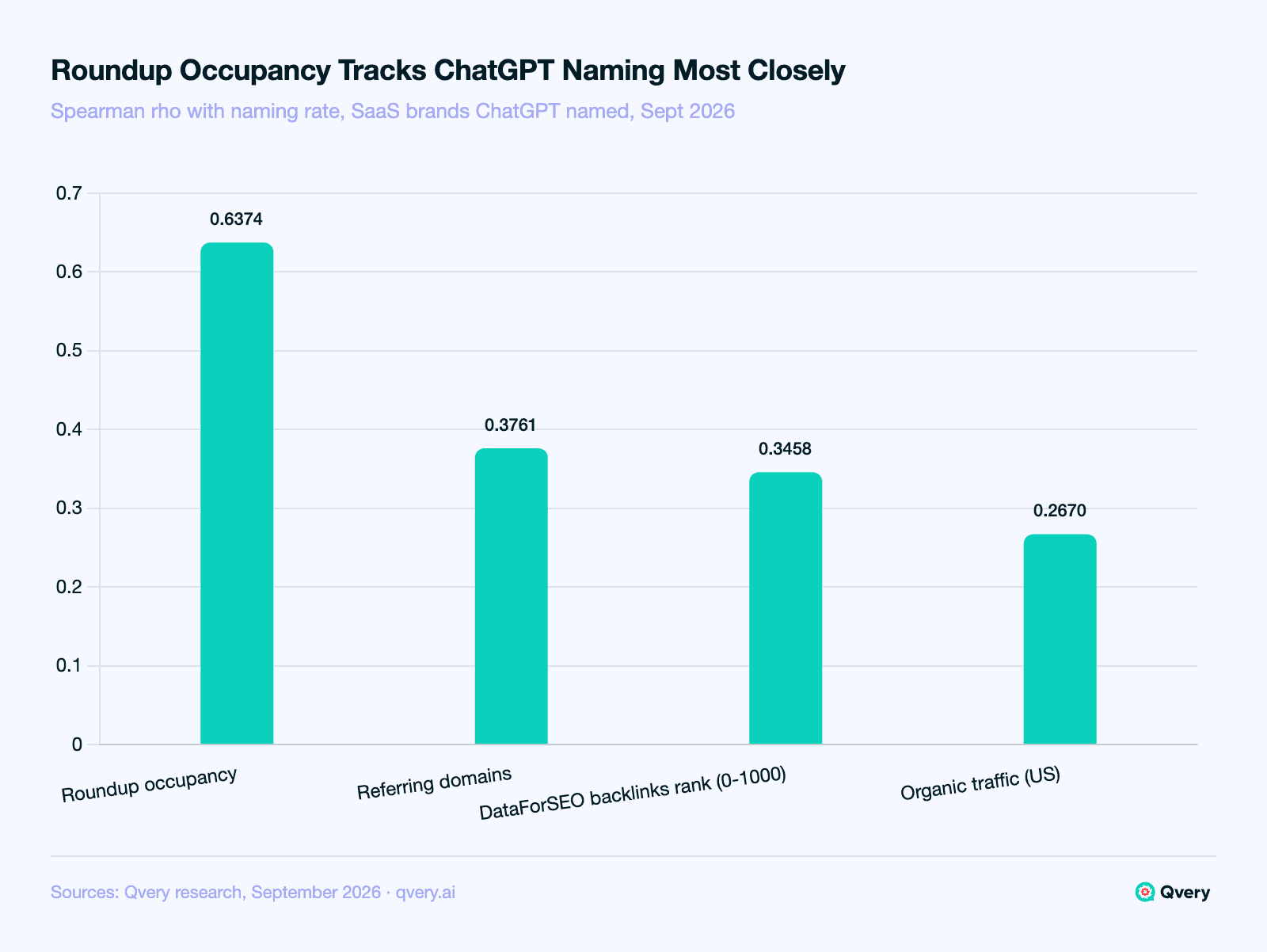
Occupancy's correlation with naming, 0.6374, sits well above backlinks rank's 0.3458. The two intervals overlap only slightly, and when we resampled the brands, occupancy stayed ahead of rank in almost every draw, clearing the bar we registered even under the adverse treatment of the unreadable pages.
For a SaaS team, that is a question about proxies. If you use a backlinks score to guess whether ChatGPT will name you, the roundup pages the answers cite are the closer proxy in this corpus. Our reading of listicles as the most cited content type covers why those pages show up at all.
Organic Traffic Tracks Naming Less Closely Still
US organic traffic correlated with naming at 0.2670, the weakest of the four, and occupancy's lead over it held in every resample of the brands before the unreadable pages were counted, and cleared the bar after. Traffic volume is not the lever here either, at least not as a guide to which brands ChatGPT names.
Referring Domains Stay Undecided
Referring domains correlated at 0.3761. Occupancy led it in the resampling too, but once the unreadable roundup pages were counted against the prediction, the lead fell just short of the bar we set in advance. That is an inconclusive result, not a loss for referring domains and not a win.
The practical reading is to keep referring domains in the audit. It would be wrong to stretch the first two results into a claim that link metrics do not matter; one of the three authority inputs is still open.
Track the Questions and Inspect the Citations in Qvery
In Qvery you add and edit your own category's buyer questions and read visibility, share of voice, and average rank across ChatGPT and Google AI Mode every day, in 200+ countries. Every citation is tied to the query and engine that produced it, so you can see which roundup pages the engines cite for your category, and whether you are on them. Qvery Assistant answers plain-language questions about your own data in the app.
The comparison in this post, authority data against occupancy, is our research method, not something Qvery computes for you. Start a free 7-day trial to see the citations for your own questions; checkout is self-serve and no credit card is required.
The Limits of These Numbers
These are associations among SaaS brands ChatGPT already names at least five times; brands it never names are not in the set, so nothing here says what gets a brand named for the first time. The study measures naming, not recommendation, on one engine (ChatGPT), in one corpus, in September 2026. A small number of cited roundup pages could not be read; they were counted against the prediction, never as absence. No causal or budget claim follows.
Add Roundup Presence Beside Your Authority Metrics
Put roundup presence into the measurement loop you already run: for the questions your buyers ask, check which roundup pages ChatGPT cites and whether you are listed on them, next to your backlinks and traffic numbers. Do not move budget on this corpus alone.
When ChatGPT keeps naming a competitor, the obvious suspect is authority: a bigger backlink profile. We tested that suspicion against the September 2026 SaaS recommendation answers ChatGPT gave, for the SaaS brands it named at least five times whose official site and authority data we could match.
How often a brand sits on the roundup pages ChatGPT cites tracked how often ChatGPT named it more closely than DataForSEO's backlinks rank or US organic traffic did. Referring domains came out undecided. This is association among brands ChatGPT already names, on one engine, in one month, and it measures naming, not recommendation.
Key Takeaways
Roundup occupancy correlated with naming rate at a Spearman rho of 0.6374 (95% interval 0.4963 to 0.7555).
DataForSEO backlinks rank correlated at 0.3458 (0.1534 to 0.5260), and occupancy's lead over it held even with the unreadable roundup pages counted against it.
US organic traffic correlated at 0.2670 (0.0694 to 0.4567), with occupancy's lead holding the same way.
Referring domains correlated at 0.3761 (0.1840 to 0.5741), and occupancy's lead over it fell just short of the bar we set, so that comparison is inconclusive.
These are correlations: they do not show that any metric causes naming, and they do not justify a budget move by themselves.
How the numbers were built, briefly. A brand counts as named when ChatGPT's answer names it; a blind re-coding of a sample of answers agreed with the coding well above the bar we set before collecting. Each brand is its official site, with product names merged into it.
Authority is three DataForSEO inputs: the backlinks summary rank (a 0 to 1000 score, not Ahrefs' Domain Rating), referring domains, and US organic traffic. Occupancy is the share of cited roundup pages, pages listing at least three products, that list the brand.
We compared the correlations by resampling brands, and a handful of cited roundup pages that could not be read were treated as working against the prediction every time, never as a brand's absence.
Roundup Occupancy Tracks Naming More Closely Than Backlinks Rank
Occupancy's correlation with naming, 0.6374, sits well above backlinks rank's 0.3458. The two intervals overlap only slightly, and when we resampled the brands, occupancy stayed ahead of rank in almost every draw, clearing the bar we registered even under the adverse treatment of the unreadable pages.
For a SaaS team, that is a question about proxies. If you use a backlinks score to guess whether ChatGPT will name you, the roundup pages the answers cite are the closer proxy in this corpus. Our reading of listicles as the most cited content type covers why those pages show up at all.
Organic Traffic Tracks Naming Less Closely Still
US organic traffic correlated with naming at 0.2670, the weakest of the four, and occupancy's lead over it held in every resample of the brands before the unreadable pages were counted, and cleared the bar after. Traffic volume is not the lever here either, at least not as a guide to which brands ChatGPT names.
Referring Domains Stay Undecided
Referring domains correlated at 0.3761. Occupancy led it in the resampling too, but once the unreadable roundup pages were counted against the prediction, the lead fell just short of the bar we set in advance. That is an inconclusive result, not a loss for referring domains and not a win.
The practical reading is to keep referring domains in the audit. It would be wrong to stretch the first two results into a claim that link metrics do not matter; one of the three authority inputs is still open.
Track the Questions and Inspect the Citations in Qvery
In Qvery you add and edit your own category's buyer questions and read visibility, share of voice, and average rank across ChatGPT and Google AI Mode every day, in 200+ countries. Every citation is tied to the query and engine that produced it, so you can see which roundup pages the engines cite for your category, and whether you are on them. Qvery Assistant answers plain-language questions about your own data in the app.
The comparison in this post, authority data against occupancy, is our research method, not something Qvery computes for you. Start a free 7-day trial to see the citations for your own questions; checkout is self-serve and no credit card is required.
The Limits of These Numbers
These are associations among SaaS brands ChatGPT already names at least five times; brands it never names are not in the set, so nothing here says what gets a brand named for the first time. The study measures naming, not recommendation, on one engine (ChatGPT), in one corpus, in September 2026. A small number of cited roundup pages could not be read; they were counted against the prediction, never as absence. No causal or budget claim follows.
Add Roundup Presence Beside Your Authority Metrics
Put roundup presence into the measurement loop you already run: for the questions your buyers ask, check which roundup pages ChatGPT cites and whether you are listed on them, next to your backlinks and traffic numbers. Do not move budget on this corpus alone.
When ChatGPT keeps naming a competitor, the obvious suspect is authority: a bigger backlink profile. We tested that suspicion against the September 2026 SaaS recommendation answers ChatGPT gave, for the SaaS brands it named at least five times whose official site and authority data we could match.
How often a brand sits on the roundup pages ChatGPT cites tracked how often ChatGPT named it more closely than DataForSEO's backlinks rank or US organic traffic did. Referring domains came out undecided. This is association among brands ChatGPT already names, on one engine, in one month, and it measures naming, not recommendation.
Key Takeaways
Roundup occupancy correlated with naming rate at a Spearman rho of 0.6374 (95% interval 0.4963 to 0.7555).
DataForSEO backlinks rank correlated at 0.3458 (0.1534 to 0.5260), and occupancy's lead over it held even with the unreadable roundup pages counted against it.
US organic traffic correlated at 0.2670 (0.0694 to 0.4567), with occupancy's lead holding the same way.
Referring domains correlated at 0.3761 (0.1840 to 0.5741), and occupancy's lead over it fell just short of the bar we set, so that comparison is inconclusive.
These are correlations: they do not show that any metric causes naming, and they do not justify a budget move by themselves.
How the numbers were built, briefly. A brand counts as named when ChatGPT's answer names it; a blind re-coding of a sample of answers agreed with the coding well above the bar we set before collecting. Each brand is its official site, with product names merged into it.
Authority is three DataForSEO inputs: the backlinks summary rank (a 0 to 1000 score, not Ahrefs' Domain Rating), referring domains, and US organic traffic. Occupancy is the share of cited roundup pages, pages listing at least three products, that list the brand.
We compared the correlations by resampling brands, and a handful of cited roundup pages that could not be read were treated as working against the prediction every time, never as a brand's absence.
Roundup Occupancy Tracks Naming More Closely Than Backlinks Rank
Occupancy's correlation with naming, 0.6374, sits well above backlinks rank's 0.3458. The two intervals overlap only slightly, and when we resampled the brands, occupancy stayed ahead of rank in almost every draw, clearing the bar we registered even under the adverse treatment of the unreadable pages.
For a SaaS team, that is a question about proxies. If you use a backlinks score to guess whether ChatGPT will name you, the roundup pages the answers cite are the closer proxy in this corpus. Our reading of listicles as the most cited content type covers why those pages show up at all.
Organic Traffic Tracks Naming Less Closely Still
US organic traffic correlated with naming at 0.2670, the weakest of the four, and occupancy's lead over it held in every resample of the brands before the unreadable pages were counted, and cleared the bar after. Traffic volume is not the lever here either, at least not as a guide to which brands ChatGPT names.
Referring Domains Stay Undecided
Referring domains correlated at 0.3761. Occupancy led it in the resampling too, but once the unreadable roundup pages were counted against the prediction, the lead fell just short of the bar we set in advance. That is an inconclusive result, not a loss for referring domains and not a win.
The practical reading is to keep referring domains in the audit. It would be wrong to stretch the first two results into a claim that link metrics do not matter; one of the three authority inputs is still open.
Track the Questions and Inspect the Citations in Qvery
In Qvery you add and edit your own category's buyer questions and read visibility, share of voice, and average rank across ChatGPT and Google AI Mode every day, in 200+ countries. Every citation is tied to the query and engine that produced it, so you can see which roundup pages the engines cite for your category, and whether you are on them. Qvery Assistant answers plain-language questions about your own data in the app.
The comparison in this post, authority data against occupancy, is our research method, not something Qvery computes for you. Start a free 7-day trial to see the citations for your own questions; checkout is self-serve and no credit card is required.
The Limits of These Numbers
These are associations among SaaS brands ChatGPT already names at least five times; brands it never names are not in the set, so nothing here says what gets a brand named for the first time. The study measures naming, not recommendation, on one engine (ChatGPT), in one corpus, in September 2026. A small number of cited roundup pages could not be read; they were counted against the prediction, never as absence. No causal or budget claim follows.
Add Roundup Presence Beside Your Authority Metrics
Put roundup presence into the measurement loop you already run: for the questions your buyers ask, check which roundup pages ChatGPT cites and whether you are listed on them, next to your backlinks and traffic numbers. Do not move budget on this corpus alone.
When ChatGPT keeps naming a competitor, the obvious suspect is authority: a bigger backlink profile. We tested that suspicion against the September 2026 SaaS recommendation answers ChatGPT gave, for the SaaS brands it named at least five times whose official site and authority data we could match.
How often a brand sits on the roundup pages ChatGPT cites tracked how often ChatGPT named it more closely than DataForSEO's backlinks rank or US organic traffic did. Referring domains came out undecided. This is association among brands ChatGPT already names, on one engine, in one month, and it measures naming, not recommendation.
Key Takeaways
Roundup occupancy correlated with naming rate at a Spearman rho of 0.6374 (95% interval 0.4963 to 0.7555).
DataForSEO backlinks rank correlated at 0.3458 (0.1534 to 0.5260), and occupancy's lead over it held even with the unreadable roundup pages counted against it.
US organic traffic correlated at 0.2670 (0.0694 to 0.4567), with occupancy's lead holding the same way.
Referring domains correlated at 0.3761 (0.1840 to 0.5741), and occupancy's lead over it fell just short of the bar we set, so that comparison is inconclusive.
These are correlations: they do not show that any metric causes naming, and they do not justify a budget move by themselves.
How the numbers were built, briefly. A brand counts as named when ChatGPT's answer names it; a blind re-coding of a sample of answers agreed with the coding well above the bar we set before collecting. Each brand is its official site, with product names merged into it.
Authority is three DataForSEO inputs: the backlinks summary rank (a 0 to 1000 score, not Ahrefs' Domain Rating), referring domains, and US organic traffic. Occupancy is the share of cited roundup pages, pages listing at least three products, that list the brand.
We compared the correlations by resampling brands, and a handful of cited roundup pages that could not be read were treated as working against the prediction every time, never as a brand's absence.
Roundup Occupancy Tracks Naming More Closely Than Backlinks Rank
Occupancy's correlation with naming, 0.6374, sits well above backlinks rank's 0.3458. The two intervals overlap only slightly, and when we resampled the brands, occupancy stayed ahead of rank in almost every draw, clearing the bar we registered even under the adverse treatment of the unreadable pages.
For a SaaS team, that is a question about proxies. If you use a backlinks score to guess whether ChatGPT will name you, the roundup pages the answers cite are the closer proxy in this corpus. Our reading of listicles as the most cited content type covers why those pages show up at all.
Organic Traffic Tracks Naming Less Closely Still
US organic traffic correlated with naming at 0.2670, the weakest of the four, and occupancy's lead over it held in every resample of the brands before the unreadable pages were counted, and cleared the bar after. Traffic volume is not the lever here either, at least not as a guide to which brands ChatGPT names.
Referring Domains Stay Undecided
Referring domains correlated at 0.3761. Occupancy led it in the resampling too, but once the unreadable roundup pages were counted against the prediction, the lead fell just short of the bar we set in advance. That is an inconclusive result, not a loss for referring domains and not a win.
The practical reading is to keep referring domains in the audit. It would be wrong to stretch the first two results into a claim that link metrics do not matter; one of the three authority inputs is still open.
Track the Questions and Inspect the Citations in Qvery
In Qvery you add and edit your own category's buyer questions and read visibility, share of voice, and average rank across ChatGPT and Google AI Mode every day, in 200+ countries. Every citation is tied to the query and engine that produced it, so you can see which roundup pages the engines cite for your category, and whether you are on them. Qvery Assistant answers plain-language questions about your own data in the app.
The comparison in this post, authority data against occupancy, is our research method, not something Qvery computes for you. Start a free 7-day trial to see the citations for your own questions; checkout is self-serve and no credit card is required.
The Limits of These Numbers
These are associations among SaaS brands ChatGPT already names at least five times; brands it never names are not in the set, so nothing here says what gets a brand named for the first time. The study measures naming, not recommendation, on one engine (ChatGPT), in one corpus, in September 2026. A small number of cited roundup pages could not be read; they were counted against the prediction, never as absence. No causal or budget claim follows.
Add Roundup Presence Beside Your Authority Metrics
Put roundup presence into the measurement loop you already run: for the questions your buyers ask, check which roundup pages ChatGPT cites and whether you are listed on them, next to your backlinks and traffic numbers. Do not move budget on this corpus alone.

© 2026 Qvery AI OÜ