By
Vlad Shvets
How Coding Bootcamps Get Recommended by AI Engines
We split bootcamp questions into job-outcome and price asks. Your own site carries about half the cited answers either way; the verified-review hubs and the outcomes-audit council show up exactly where outcomes are the question. The plan follows.
We split bootcamp questions into job-outcome and price asks. Your own site carries about half the cited answers either way; the verified-review hubs and the outcomes-audit council show up exactly where outcomes are the question. The plan follows.
We split bootcamp questions into job-outcome and price asks. Your own site carries about half the cited answers either way; the verified-review hubs and the outcomes-audit council show up exactly where outcomes are the question. The plan follows.
Bootcamp marketing lives and dies on one suspicious question: do graduates get jobs? The standing AI-visibility advice for the category says the answer gets decided on the verified-review hubs, so own your Course Report and SwitchUp profiles first and the rest follows.
We split bootcamp questions into the two kinds prospective students ask, job-outcome asks and price-and-financing asks, ran both on ChatGPT and Google AI Mode, and read what the answers cited.
The short version: your own site carries about half the cited answers whatever the question, and the verification layer, the review hubs plus the outcomes-audit council, shows up almost exclusively where outcomes are the question. The advice was half right, and the half matters.
The frame first: a snapshot of answers that shift; plan from the pattern, not the decimals.
Outcome Questions Call the Verifiers
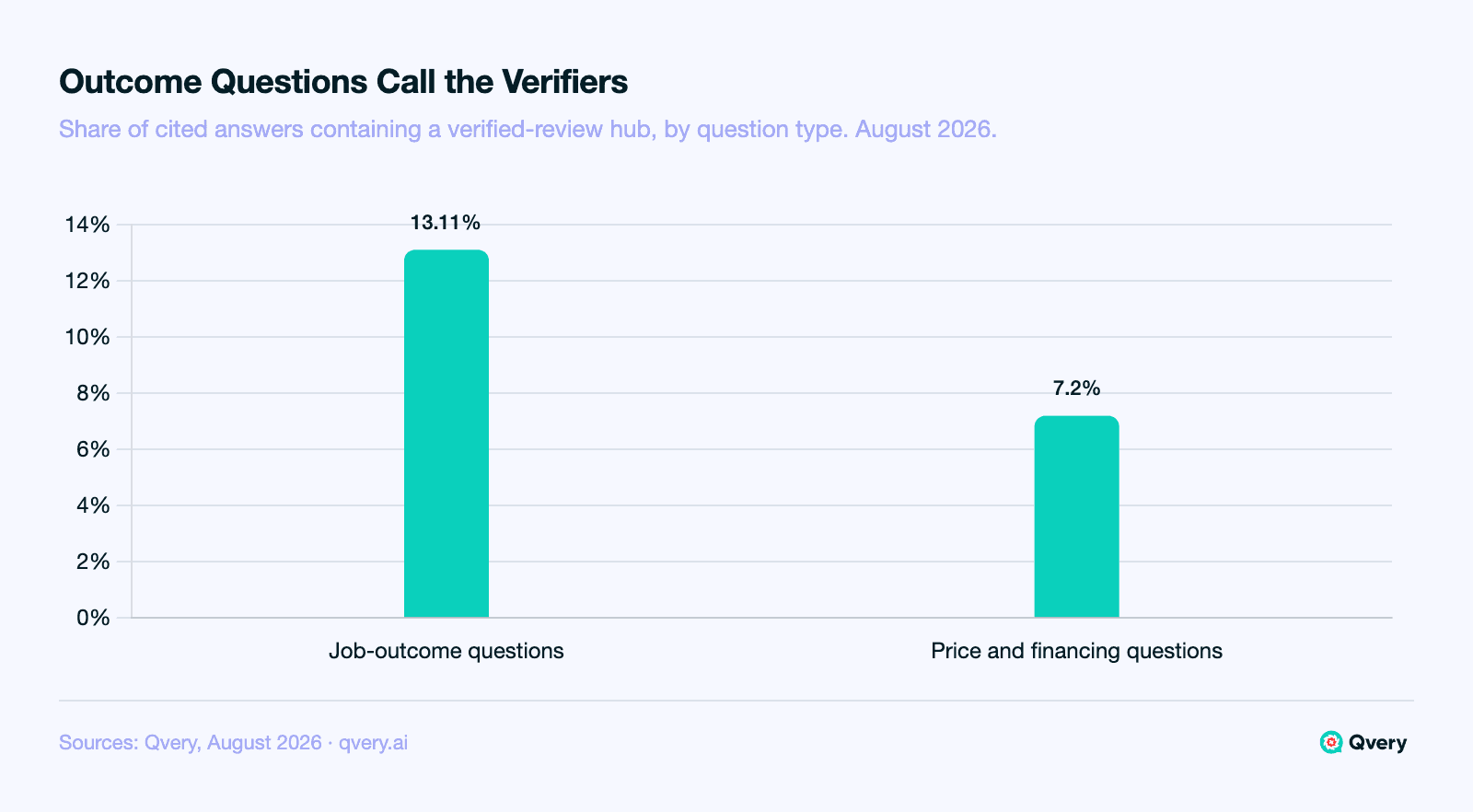
Across a targeted set of bootcamp questions we ran on ChatGPT and Google AI Mode in August 2026 (US-weighted, with a UK, Canadian, and Australian mix), a verified-review hub was in 13.11% of the job-outcome answers that cited any source, against 7.20% of the price ones: nearly double. SwitchUp led at 7.38% of the outcome side, Course Report at 5.74%, Career Karma present but rare.
And a source nobody's playbook mentions beat both hubs. This is a read we had not set out to test, so treat it as direction: cirr.org, the council that audits bootcamp outcomes reporting, was in 16.39% of the outcome answers that cited any source, and 0.00% of the price ones.
When the question is "do graduates get jobs," the engines go looking for whoever audits the answer.
Verification sources appear where verification is the question. A bootcamp whose outcomes exist only as a marketing claim, unreviewed on the hubs and unreported to the council, is absent from the exact layer those answers are built on.
Your Own Site Carries Half the Answers Either Way
The layer the hub-first advice underrates is the operator's own estate. Bootcamp operators' own sites were in 47.54% of the job-outcome answers that cited any source and 52.00% of the price ones. Springboard, CareerFoundry, Le Wagon, Flatiron and their peers are being read directly, for tuition pages, outcomes pages, and financing terms.
No question type keeps the operator out of the room. Which means the room your prospect's answer is assembled in contains your competitor's tuition page whether or not it contains yours, the same vendor-estate pattern we keep measuring in software categories.
The steady middle belongs to general editorial, with Forbes in 22.13% and 18.40% of the two sides' cited answers, and to category directories. Reddit, for the record: effectively absent from both sides of these answers this August.
(One reading note: a large share of Google AI Mode's citations resolve to Google's own domain rather than an external source, so these reads lean on the ChatGPT side of the record.)
The Play for a Bootcamp
Our judgment given the pattern, not a proven sequence:
Publish outcomes like a filing, not a brochure. CIRR-style reporting, methodology stated, on a stable URL. The outcome answers cite whoever holds auditable numbers; be one of them.
Work the two hubs that show up. SwitchUp and Course Report earn their maintenance on the outcome questions: review velocity, responses, current cohort data.
Treat tuition and financing pages as citation surfaces. Half the price answers read the operators directly. A clear price in prose beats a "request syllabus" wall.
Skip the Reddit line item until the data says otherwise. In these answers it carried nothing.
See Which Verifiers Answer for Your Bootcamp in Qvery
Whether your school's answers lean on the hubs, the council, or your competitors' tuition pages is measurable, per question, this week.
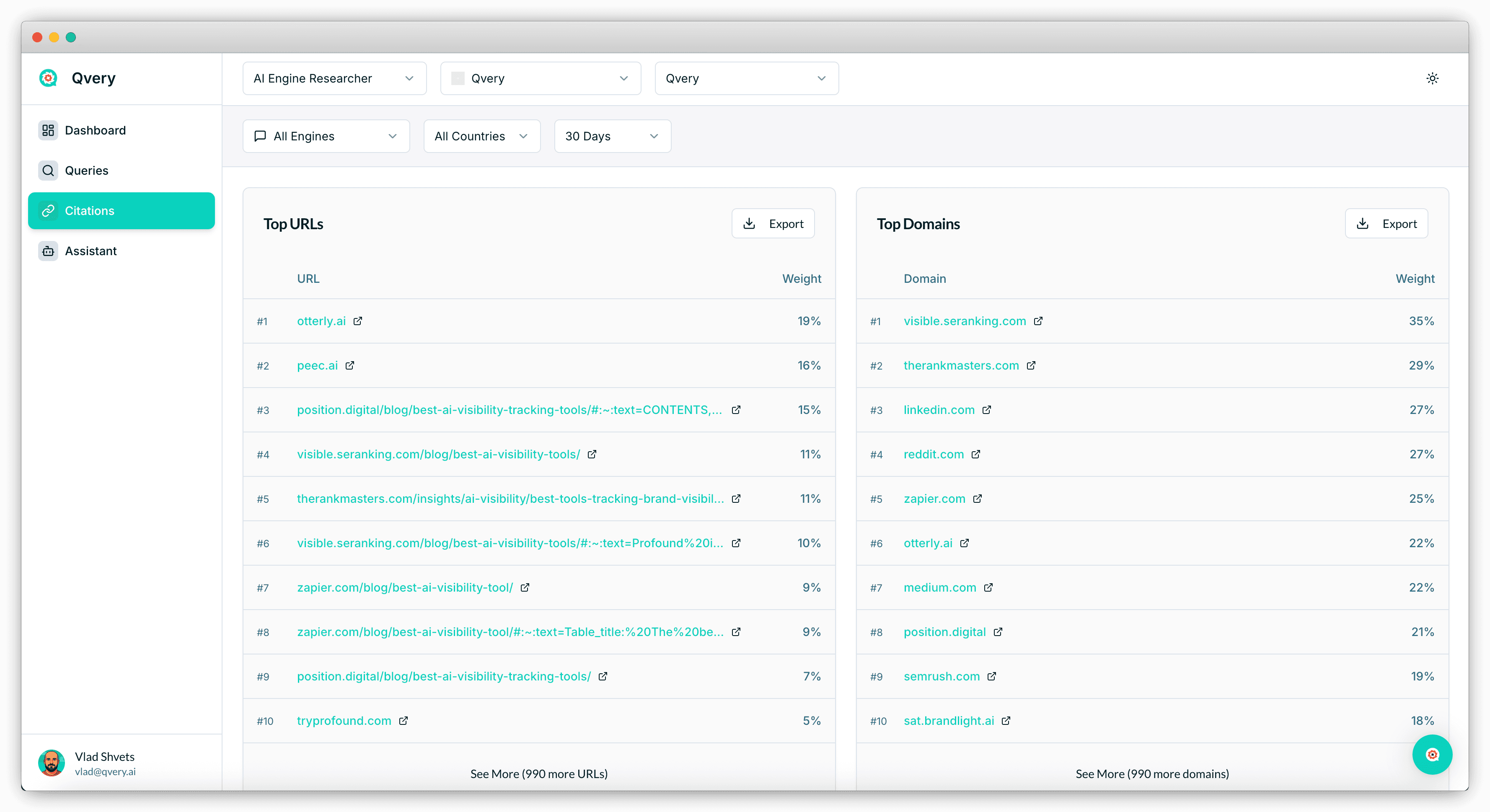
In Qvery, track the outcome and price questions prospects ask about your programs; Qvery runs them daily on ChatGPT and Google AI Mode and captures every citation tied to the query and engine that produced it. Open Citations and read which verification sources carry your category, and whether the operator estate being quoted is yours.
A free 7-day trial covers your program's questions end to end: sign up for Qvery and find out whether the outcomes answer about your school is being written from your reporting or around it.
One move this week: put your outcomes page and your SwitchUp profile side by side and ask which one an auditor would trust. The engines are asking the same thing.
Bootcamp marketing lives and dies on one suspicious question: do graduates get jobs? The standing AI-visibility advice for the category says the answer gets decided on the verified-review hubs, so own your Course Report and SwitchUp profiles first and the rest follows.
We split bootcamp questions into the two kinds prospective students ask, job-outcome asks and price-and-financing asks, ran both on ChatGPT and Google AI Mode, and read what the answers cited.
The short version: your own site carries about half the cited answers whatever the question, and the verification layer, the review hubs plus the outcomes-audit council, shows up almost exclusively where outcomes are the question. The advice was half right, and the half matters.
The frame first: a snapshot of answers that shift; plan from the pattern, not the decimals.
Outcome Questions Call the Verifiers
Across a targeted set of bootcamp questions we ran on ChatGPT and Google AI Mode in August 2026 (US-weighted, with a UK, Canadian, and Australian mix), a verified-review hub was in 13.11% of the job-outcome answers that cited any source, against 7.20% of the price ones: nearly double. SwitchUp led at 7.38% of the outcome side, Course Report at 5.74%, Career Karma present but rare.
And a source nobody's playbook mentions beat both hubs. This is a read we had not set out to test, so treat it as direction: cirr.org, the council that audits bootcamp outcomes reporting, was in 16.39% of the outcome answers that cited any source, and 0.00% of the price ones.
When the question is "do graduates get jobs," the engines go looking for whoever audits the answer.
Verification sources appear where verification is the question. A bootcamp whose outcomes exist only as a marketing claim, unreviewed on the hubs and unreported to the council, is absent from the exact layer those answers are built on.
Your Own Site Carries Half the Answers Either Way
The layer the hub-first advice underrates is the operator's own estate. Bootcamp operators' own sites were in 47.54% of the job-outcome answers that cited any source and 52.00% of the price ones. Springboard, CareerFoundry, Le Wagon, Flatiron and their peers are being read directly, for tuition pages, outcomes pages, and financing terms.
No question type keeps the operator out of the room. Which means the room your prospect's answer is assembled in contains your competitor's tuition page whether or not it contains yours, the same vendor-estate pattern we keep measuring in software categories.
The steady middle belongs to general editorial, with Forbes in 22.13% and 18.40% of the two sides' cited answers, and to category directories. Reddit, for the record: effectively absent from both sides of these answers this August.
(One reading note: a large share of Google AI Mode's citations resolve to Google's own domain rather than an external source, so these reads lean on the ChatGPT side of the record.)
The Play for a Bootcamp
Our judgment given the pattern, not a proven sequence:
Publish outcomes like a filing, not a brochure. CIRR-style reporting, methodology stated, on a stable URL. The outcome answers cite whoever holds auditable numbers; be one of them.
Work the two hubs that show up. SwitchUp and Course Report earn their maintenance on the outcome questions: review velocity, responses, current cohort data.
Treat tuition and financing pages as citation surfaces. Half the price answers read the operators directly. A clear price in prose beats a "request syllabus" wall.
Skip the Reddit line item until the data says otherwise. In these answers it carried nothing.
See Which Verifiers Answer for Your Bootcamp in Qvery
Whether your school's answers lean on the hubs, the council, or your competitors' tuition pages is measurable, per question, this week.
In Qvery, track the outcome and price questions prospects ask about your programs; Qvery runs them daily on ChatGPT and Google AI Mode and captures every citation tied to the query and engine that produced it. Open Citations and read which verification sources carry your category, and whether the operator estate being quoted is yours.
A free 7-day trial covers your program's questions end to end: sign up for Qvery and find out whether the outcomes answer about your school is being written from your reporting or around it.
One move this week: put your outcomes page and your SwitchUp profile side by side and ask which one an auditor would trust. The engines are asking the same thing.
Bootcamp marketing lives and dies on one suspicious question: do graduates get jobs? The standing AI-visibility advice for the category says the answer gets decided on the verified-review hubs, so own your Course Report and SwitchUp profiles first and the rest follows.
We split bootcamp questions into the two kinds prospective students ask, job-outcome asks and price-and-financing asks, ran both on ChatGPT and Google AI Mode, and read what the answers cited.
The short version: your own site carries about half the cited answers whatever the question, and the verification layer, the review hubs plus the outcomes-audit council, shows up almost exclusively where outcomes are the question. The advice was half right, and the half matters.
The frame first: a snapshot of answers that shift; plan from the pattern, not the decimals.
Outcome Questions Call the Verifiers
Across a targeted set of bootcamp questions we ran on ChatGPT and Google AI Mode in August 2026 (US-weighted, with a UK, Canadian, and Australian mix), a verified-review hub was in 13.11% of the job-outcome answers that cited any source, against 7.20% of the price ones: nearly double. SwitchUp led at 7.38% of the outcome side, Course Report at 5.74%, Career Karma present but rare.
And a source nobody's playbook mentions beat both hubs. This is a read we had not set out to test, so treat it as direction: cirr.org, the council that audits bootcamp outcomes reporting, was in 16.39% of the outcome answers that cited any source, and 0.00% of the price ones.
When the question is "do graduates get jobs," the engines go looking for whoever audits the answer.
Verification sources appear where verification is the question. A bootcamp whose outcomes exist only as a marketing claim, unreviewed on the hubs and unreported to the council, is absent from the exact layer those answers are built on.
Your Own Site Carries Half the Answers Either Way
The layer the hub-first advice underrates is the operator's own estate. Bootcamp operators' own sites were in 47.54% of the job-outcome answers that cited any source and 52.00% of the price ones. Springboard, CareerFoundry, Le Wagon, Flatiron and their peers are being read directly, for tuition pages, outcomes pages, and financing terms.
No question type keeps the operator out of the room. Which means the room your prospect's answer is assembled in contains your competitor's tuition page whether or not it contains yours, the same vendor-estate pattern we keep measuring in software categories.
The steady middle belongs to general editorial, with Forbes in 22.13% and 18.40% of the two sides' cited answers, and to category directories. Reddit, for the record: effectively absent from both sides of these answers this August.
(One reading note: a large share of Google AI Mode's citations resolve to Google's own domain rather than an external source, so these reads lean on the ChatGPT side of the record.)
The Play for a Bootcamp
Our judgment given the pattern, not a proven sequence:
Publish outcomes like a filing, not a brochure. CIRR-style reporting, methodology stated, on a stable URL. The outcome answers cite whoever holds auditable numbers; be one of them.
Work the two hubs that show up. SwitchUp and Course Report earn their maintenance on the outcome questions: review velocity, responses, current cohort data.
Treat tuition and financing pages as citation surfaces. Half the price answers read the operators directly. A clear price in prose beats a "request syllabus" wall.
Skip the Reddit line item until the data says otherwise. In these answers it carried nothing.
See Which Verifiers Answer for Your Bootcamp in Qvery
Whether your school's answers lean on the hubs, the council, or your competitors' tuition pages is measurable, per question, this week.
In Qvery, track the outcome and price questions prospects ask about your programs; Qvery runs them daily on ChatGPT and Google AI Mode and captures every citation tied to the query and engine that produced it. Open Citations and read which verification sources carry your category, and whether the operator estate being quoted is yours.
A free 7-day trial covers your program's questions end to end: sign up for Qvery and find out whether the outcomes answer about your school is being written from your reporting or around it.
One move this week: put your outcomes page and your SwitchUp profile side by side and ask which one an auditor would trust. The engines are asking the same thing.
Bootcamp marketing lives and dies on one suspicious question: do graduates get jobs? The standing AI-visibility advice for the category says the answer gets decided on the verified-review hubs, so own your Course Report and SwitchUp profiles first and the rest follows.
We split bootcamp questions into the two kinds prospective students ask, job-outcome asks and price-and-financing asks, ran both on ChatGPT and Google AI Mode, and read what the answers cited.
The short version: your own site carries about half the cited answers whatever the question, and the verification layer, the review hubs plus the outcomes-audit council, shows up almost exclusively where outcomes are the question. The advice was half right, and the half matters.
The frame first: a snapshot of answers that shift; plan from the pattern, not the decimals.
Outcome Questions Call the Verifiers
Across a targeted set of bootcamp questions we ran on ChatGPT and Google AI Mode in August 2026 (US-weighted, with a UK, Canadian, and Australian mix), a verified-review hub was in 13.11% of the job-outcome answers that cited any source, against 7.20% of the price ones: nearly double. SwitchUp led at 7.38% of the outcome side, Course Report at 5.74%, Career Karma present but rare.
And a source nobody's playbook mentions beat both hubs. This is a read we had not set out to test, so treat it as direction: cirr.org, the council that audits bootcamp outcomes reporting, was in 16.39% of the outcome answers that cited any source, and 0.00% of the price ones.
When the question is "do graduates get jobs," the engines go looking for whoever audits the answer.
Verification sources appear where verification is the question. A bootcamp whose outcomes exist only as a marketing claim, unreviewed on the hubs and unreported to the council, is absent from the exact layer those answers are built on.
Your Own Site Carries Half the Answers Either Way
The layer the hub-first advice underrates is the operator's own estate. Bootcamp operators' own sites were in 47.54% of the job-outcome answers that cited any source and 52.00% of the price ones. Springboard, CareerFoundry, Le Wagon, Flatiron and their peers are being read directly, for tuition pages, outcomes pages, and financing terms.
No question type keeps the operator out of the room. Which means the room your prospect's answer is assembled in contains your competitor's tuition page whether or not it contains yours, the same vendor-estate pattern we keep measuring in software categories.
The steady middle belongs to general editorial, with Forbes in 22.13% and 18.40% of the two sides' cited answers, and to category directories. Reddit, for the record: effectively absent from both sides of these answers this August.
(One reading note: a large share of Google AI Mode's citations resolve to Google's own domain rather than an external source, so these reads lean on the ChatGPT side of the record.)
The Play for a Bootcamp
Our judgment given the pattern, not a proven sequence:
Publish outcomes like a filing, not a brochure. CIRR-style reporting, methodology stated, on a stable URL. The outcome answers cite whoever holds auditable numbers; be one of them.
Work the two hubs that show up. SwitchUp and Course Report earn their maintenance on the outcome questions: review velocity, responses, current cohort data.
Treat tuition and financing pages as citation surfaces. Half the price answers read the operators directly. A clear price in prose beats a "request syllabus" wall.
Skip the Reddit line item until the data says otherwise. In these answers it carried nothing.
See Which Verifiers Answer for Your Bootcamp in Qvery
Whether your school's answers lean on the hubs, the council, or your competitors' tuition pages is measurable, per question, this week.
In Qvery, track the outcome and price questions prospects ask about your programs; Qvery runs them daily on ChatGPT and Google AI Mode and captures every citation tied to the query and engine that produced it. Open Citations and read which verification sources carry your category, and whether the operator estate being quoted is yours.
A free 7-day trial covers your program's questions end to end: sign up for Qvery and find out whether the outcomes answer about your school is being written from your reporting or around it.
One move this week: put your outcomes page and your SwitchUp profile side by side and ask which one an auditor would trust. The engines are asking the same thing.

© 2026 Qvery AI OÜ