By
Vlad Shvets
How Cash Home Buyers Get Recommended When Trust Is the Whole Game
We split home-sale questions by suspicion and read what the answers cite. On 'is this legit' questions the community layer never appeared; the BBB and complaint registries did, at nearly four times the rate. The trust playbook, measured.
We split home-sale questions by suspicion and read what the answers cite. On 'is this legit' questions the community layer never appeared; the BBB and complaint registries did, at nearly four times the rate. The trust playbook, measured.
We split home-sale questions by suspicion and read what the answers cite. On 'is this legit' questions the community layer never appeared; the BBB and complaint registries did, at nearly four times the rate. The trust playbook, measured.
The "we buy houses" business runs on the most suspicious customer on the internet. Every cash-buyer marketer knows the real query behind the query: not "who buys houses fast," but "is this company going to lowball my grandmother." The received playbook says that suspicion gets settled on Reddit, so go win the threads.
We split city-anchored home-sale questions by their trust load, the skeptical cash-sale asks against plain listing-services asks, ran both on ChatGPT and Google AI Mode, and read what the answers leaned on.
The short version: on the skeptical questions, the community layer never appeared, and the accreditation layer showed up at nearly four times its normal rate. The trust fight is happening at the BBB, not in the threads.
Before the numbers, the limit: this is a moving surface, read once.
Suspicion Summons the BBB, Not Reddit
Across a targeted set of city-anchored home-sale questions we ran on ChatGPT and Google AI Mode in August 2026 (US-weighted, with a UK, Canadian, and Australian mix), an accreditation or complaint-registry source was in 15.70% of the cash-sale answers that cited any source, against 4.07% of the listing-services ones. bbb.org alone was in 9.09% of the skeptical side's cited answers, with a complaints-watchdog site close behind at 4.96%.
And the layer the playbook bets on? Community sources were in 0.00% of the cash-sale answers that cited any source, and 4.07% of the listing ones. Zero, on exactly the questions where "real people's verdicts" were supposed to decide.
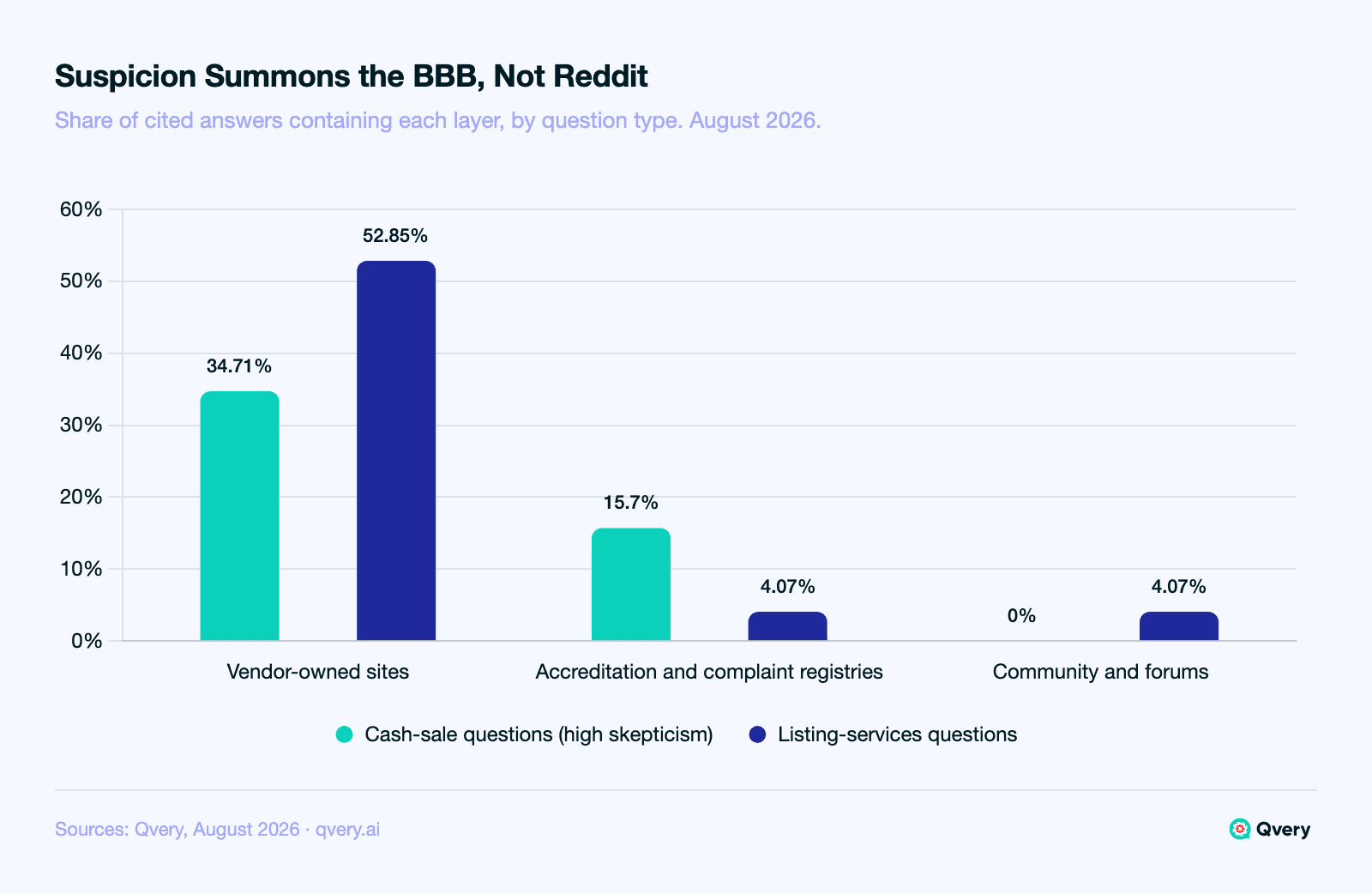
When the question smells like fraud, the engines reach for the referee, not the crowd.
The old advice to "get BBB accredited" has been repeated for a decade without anyone checking what it buys. In these answers, it buys presence in the exact moment a seller is deciding whether you are legit.
Skeptical Questions Lean Away From the Vendors Themselves
The second split is who loses when suspicion rises.
Vendor-owned sites were in 34.71% of the cash-sale answers that cited any source, against 52.85% of the listing-services ones. Ask where to list a house and the engines happily quote the services themselves; ask whether a cash buyer is trustworthy and they reach past the sellers for corroboration.
The vendors who do make the skeptical answers are the big, documented ones: opendoor.com was in 14.05% of those cited answers, with the established iBuyer layer behind it. And the matching layer shows up here too: homelight.com in 8.26%, the discount-broker matchers in the mix, the same intermediary pattern we measured in the agent-hiring answers wearing a different hat.
(One reading note: a large share of Google AI Mode's citations resolve to Google's own domain rather than an external source, so these external-source reads lean on the ChatGPT side of the record.)
What a Cash Buyer Does With a Trust Fight at the BBB
Our judgment on the pattern, not a proven sequence:
Work the BBB profile like a landing page. Accreditation, complaint responses, current details. It is the single most-cited trust surface on the questions that decide you, and most operators treat it as a plaque.
Answer your complaints where they are registered. A responded complaint on an accreditation registry is content the engines read; an ignored one is too.
Publish the corroboration the engines reach for. Process transparency, real fee breakdowns, named-market pages. The skeptical answers cite vendors a third of the time; documented beats loud.
Put the Reddit budget on probation. Community can matter elsewhere and in other months; on these questions it carried nothing. Measure before you spend.
Watch the Trust Layer That Answers Your Market in Qvery
This is one August read across many metros. Your market's mix is the one that matters, and it will move.
In Qvery, track the skeptical questions sellers ask about your brand and category, and Qvery runs them daily on ChatGPT and Google AI Mode, capturing every citation tied to the query and engine that produced it. Open Citations and read whether your market's trust answers lean on the registries, the watchdogs, or the vendors, and whether your name is inside them.
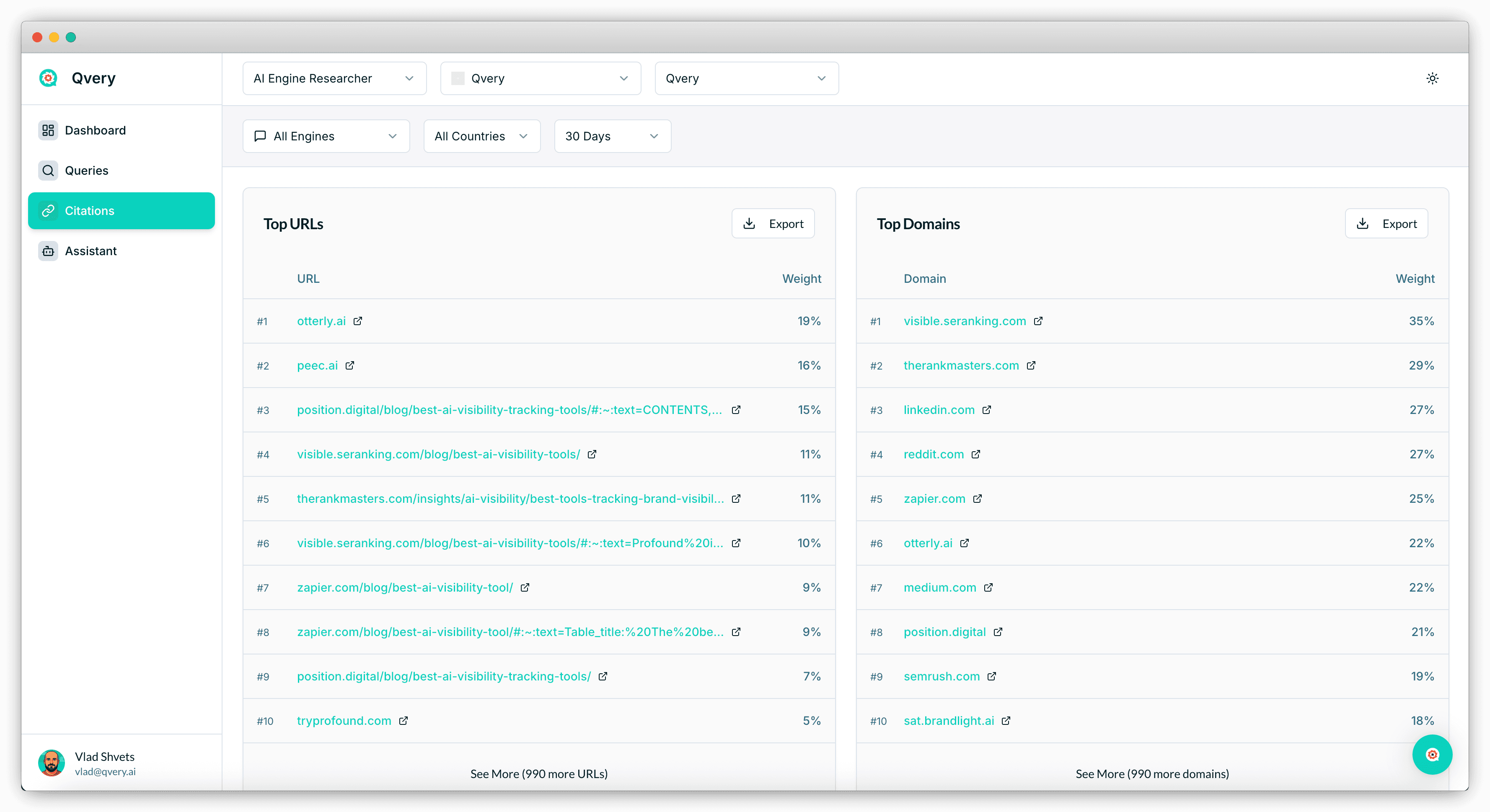
Whether the cited BBB page is your clean profile or your competitor's complaint log is a click away from there.
Sign up for Qvery, start the free 7-day trial, and run your own market's "is it legit" questions before your next reputation dollar goes to the wrong layer.
One move this week: open your BBB profile and read it the way a suspicious seller's AI answer will. If what it says is thin, that thinness is currently your pitch.
The "we buy houses" business runs on the most suspicious customer on the internet. Every cash-buyer marketer knows the real query behind the query: not "who buys houses fast," but "is this company going to lowball my grandmother." The received playbook says that suspicion gets settled on Reddit, so go win the threads.
We split city-anchored home-sale questions by their trust load, the skeptical cash-sale asks against plain listing-services asks, ran both on ChatGPT and Google AI Mode, and read what the answers leaned on.
The short version: on the skeptical questions, the community layer never appeared, and the accreditation layer showed up at nearly four times its normal rate. The trust fight is happening at the BBB, not in the threads.
Before the numbers, the limit: this is a moving surface, read once.
Suspicion Summons the BBB, Not Reddit
Across a targeted set of city-anchored home-sale questions we ran on ChatGPT and Google AI Mode in August 2026 (US-weighted, with a UK, Canadian, and Australian mix), an accreditation or complaint-registry source was in 15.70% of the cash-sale answers that cited any source, against 4.07% of the listing-services ones. bbb.org alone was in 9.09% of the skeptical side's cited answers, with a complaints-watchdog site close behind at 4.96%.
And the layer the playbook bets on? Community sources were in 0.00% of the cash-sale answers that cited any source, and 4.07% of the listing ones. Zero, on exactly the questions where "real people's verdicts" were supposed to decide.
When the question smells like fraud, the engines reach for the referee, not the crowd.
The old advice to "get BBB accredited" has been repeated for a decade without anyone checking what it buys. In these answers, it buys presence in the exact moment a seller is deciding whether you are legit.
Skeptical Questions Lean Away From the Vendors Themselves
The second split is who loses when suspicion rises.
Vendor-owned sites were in 34.71% of the cash-sale answers that cited any source, against 52.85% of the listing-services ones. Ask where to list a house and the engines happily quote the services themselves; ask whether a cash buyer is trustworthy and they reach past the sellers for corroboration.
The vendors who do make the skeptical answers are the big, documented ones: opendoor.com was in 14.05% of those cited answers, with the established iBuyer layer behind it. And the matching layer shows up here too: homelight.com in 8.26%, the discount-broker matchers in the mix, the same intermediary pattern we measured in the agent-hiring answers wearing a different hat.
(One reading note: a large share of Google AI Mode's citations resolve to Google's own domain rather than an external source, so these external-source reads lean on the ChatGPT side of the record.)
What a Cash Buyer Does With a Trust Fight at the BBB
Our judgment on the pattern, not a proven sequence:
Work the BBB profile like a landing page. Accreditation, complaint responses, current details. It is the single most-cited trust surface on the questions that decide you, and most operators treat it as a plaque.
Answer your complaints where they are registered. A responded complaint on an accreditation registry is content the engines read; an ignored one is too.
Publish the corroboration the engines reach for. Process transparency, real fee breakdowns, named-market pages. The skeptical answers cite vendors a third of the time; documented beats loud.
Put the Reddit budget on probation. Community can matter elsewhere and in other months; on these questions it carried nothing. Measure before you spend.
Watch the Trust Layer That Answers Your Market in Qvery
This is one August read across many metros. Your market's mix is the one that matters, and it will move.
In Qvery, track the skeptical questions sellers ask about your brand and category, and Qvery runs them daily on ChatGPT and Google AI Mode, capturing every citation tied to the query and engine that produced it. Open Citations and read whether your market's trust answers lean on the registries, the watchdogs, or the vendors, and whether your name is inside them.
Whether the cited BBB page is your clean profile or your competitor's complaint log is a click away from there.
Sign up for Qvery, start the free 7-day trial, and run your own market's "is it legit" questions before your next reputation dollar goes to the wrong layer.
One move this week: open your BBB profile and read it the way a suspicious seller's AI answer will. If what it says is thin, that thinness is currently your pitch.
The "we buy houses" business runs on the most suspicious customer on the internet. Every cash-buyer marketer knows the real query behind the query: not "who buys houses fast," but "is this company going to lowball my grandmother." The received playbook says that suspicion gets settled on Reddit, so go win the threads.
We split city-anchored home-sale questions by their trust load, the skeptical cash-sale asks against plain listing-services asks, ran both on ChatGPT and Google AI Mode, and read what the answers leaned on.
The short version: on the skeptical questions, the community layer never appeared, and the accreditation layer showed up at nearly four times its normal rate. The trust fight is happening at the BBB, not in the threads.
Before the numbers, the limit: this is a moving surface, read once.
Suspicion Summons the BBB, Not Reddit
Across a targeted set of city-anchored home-sale questions we ran on ChatGPT and Google AI Mode in August 2026 (US-weighted, with a UK, Canadian, and Australian mix), an accreditation or complaint-registry source was in 15.70% of the cash-sale answers that cited any source, against 4.07% of the listing-services ones. bbb.org alone was in 9.09% of the skeptical side's cited answers, with a complaints-watchdog site close behind at 4.96%.
And the layer the playbook bets on? Community sources were in 0.00% of the cash-sale answers that cited any source, and 4.07% of the listing ones. Zero, on exactly the questions where "real people's verdicts" were supposed to decide.
When the question smells like fraud, the engines reach for the referee, not the crowd.
The old advice to "get BBB accredited" has been repeated for a decade without anyone checking what it buys. In these answers, it buys presence in the exact moment a seller is deciding whether you are legit.
Skeptical Questions Lean Away From the Vendors Themselves
The second split is who loses when suspicion rises.
Vendor-owned sites were in 34.71% of the cash-sale answers that cited any source, against 52.85% of the listing-services ones. Ask where to list a house and the engines happily quote the services themselves; ask whether a cash buyer is trustworthy and they reach past the sellers for corroboration.
The vendors who do make the skeptical answers are the big, documented ones: opendoor.com was in 14.05% of those cited answers, with the established iBuyer layer behind it. And the matching layer shows up here too: homelight.com in 8.26%, the discount-broker matchers in the mix, the same intermediary pattern we measured in the agent-hiring answers wearing a different hat.
(One reading note: a large share of Google AI Mode's citations resolve to Google's own domain rather than an external source, so these external-source reads lean on the ChatGPT side of the record.)
What a Cash Buyer Does With a Trust Fight at the BBB
Our judgment on the pattern, not a proven sequence:
Work the BBB profile like a landing page. Accreditation, complaint responses, current details. It is the single most-cited trust surface on the questions that decide you, and most operators treat it as a plaque.
Answer your complaints where they are registered. A responded complaint on an accreditation registry is content the engines read; an ignored one is too.
Publish the corroboration the engines reach for. Process transparency, real fee breakdowns, named-market pages. The skeptical answers cite vendors a third of the time; documented beats loud.
Put the Reddit budget on probation. Community can matter elsewhere and in other months; on these questions it carried nothing. Measure before you spend.
Watch the Trust Layer That Answers Your Market in Qvery
This is one August read across many metros. Your market's mix is the one that matters, and it will move.
In Qvery, track the skeptical questions sellers ask about your brand and category, and Qvery runs them daily on ChatGPT and Google AI Mode, capturing every citation tied to the query and engine that produced it. Open Citations and read whether your market's trust answers lean on the registries, the watchdogs, or the vendors, and whether your name is inside them.
Whether the cited BBB page is your clean profile or your competitor's complaint log is a click away from there.
Sign up for Qvery, start the free 7-day trial, and run your own market's "is it legit" questions before your next reputation dollar goes to the wrong layer.
One move this week: open your BBB profile and read it the way a suspicious seller's AI answer will. If what it says is thin, that thinness is currently your pitch.
The "we buy houses" business runs on the most suspicious customer on the internet. Every cash-buyer marketer knows the real query behind the query: not "who buys houses fast," but "is this company going to lowball my grandmother." The received playbook says that suspicion gets settled on Reddit, so go win the threads.
We split city-anchored home-sale questions by their trust load, the skeptical cash-sale asks against plain listing-services asks, ran both on ChatGPT and Google AI Mode, and read what the answers leaned on.
The short version: on the skeptical questions, the community layer never appeared, and the accreditation layer showed up at nearly four times its normal rate. The trust fight is happening at the BBB, not in the threads.
Before the numbers, the limit: this is a moving surface, read once.
Suspicion Summons the BBB, Not Reddit
Across a targeted set of city-anchored home-sale questions we ran on ChatGPT and Google AI Mode in August 2026 (US-weighted, with a UK, Canadian, and Australian mix), an accreditation or complaint-registry source was in 15.70% of the cash-sale answers that cited any source, against 4.07% of the listing-services ones. bbb.org alone was in 9.09% of the skeptical side's cited answers, with a complaints-watchdog site close behind at 4.96%.
And the layer the playbook bets on? Community sources were in 0.00% of the cash-sale answers that cited any source, and 4.07% of the listing ones. Zero, on exactly the questions where "real people's verdicts" were supposed to decide.
When the question smells like fraud, the engines reach for the referee, not the crowd.
The old advice to "get BBB accredited" has been repeated for a decade without anyone checking what it buys. In these answers, it buys presence in the exact moment a seller is deciding whether you are legit.
Skeptical Questions Lean Away From the Vendors Themselves
The second split is who loses when suspicion rises.
Vendor-owned sites were in 34.71% of the cash-sale answers that cited any source, against 52.85% of the listing-services ones. Ask where to list a house and the engines happily quote the services themselves; ask whether a cash buyer is trustworthy and they reach past the sellers for corroboration.
The vendors who do make the skeptical answers are the big, documented ones: opendoor.com was in 14.05% of those cited answers, with the established iBuyer layer behind it. And the matching layer shows up here too: homelight.com in 8.26%, the discount-broker matchers in the mix, the same intermediary pattern we measured in the agent-hiring answers wearing a different hat.
(One reading note: a large share of Google AI Mode's citations resolve to Google's own domain rather than an external source, so these external-source reads lean on the ChatGPT side of the record.)
What a Cash Buyer Does With a Trust Fight at the BBB
Our judgment on the pattern, not a proven sequence:
Work the BBB profile like a landing page. Accreditation, complaint responses, current details. It is the single most-cited trust surface on the questions that decide you, and most operators treat it as a plaque.
Answer your complaints where they are registered. A responded complaint on an accreditation registry is content the engines read; an ignored one is too.
Publish the corroboration the engines reach for. Process transparency, real fee breakdowns, named-market pages. The skeptical answers cite vendors a third of the time; documented beats loud.
Put the Reddit budget on probation. Community can matter elsewhere and in other months; on these questions it carried nothing. Measure before you spend.
Watch the Trust Layer That Answers Your Market in Qvery
This is one August read across many metros. Your market's mix is the one that matters, and it will move.
In Qvery, track the skeptical questions sellers ask about your brand and category, and Qvery runs them daily on ChatGPT and Google AI Mode, capturing every citation tied to the query and engine that produced it. Open Citations and read whether your market's trust answers lean on the registries, the watchdogs, or the vendors, and whether your name is inside them.
Whether the cited BBB page is your clean profile or your competitor's complaint log is a click away from there.
Sign up for Qvery, start the free 7-day trial, and run your own market's "is it legit" questions before your next reputation dollar goes to the wrong layer.
One move this week: open your BBB profile and read it the way a suspicious seller's AI answer will. If what it says is thin, that thinness is currently your pitch.

© 2026 Qvery AI OÜ