By
Vlad Shvets
11 Best AI Citation Tracking Tools (Reviewed)
The 11 best AI citation tracking tools, ranked by how deeply they reveal which sources AI engines cite, with pricing and real Reddit data.
The 11 best AI citation tracking tools, ranked by how deeply they reveal which sources AI engines cite, with pricing and real Reddit data.
The 11 best AI citation tracking tools, ranked by how deeply they reveal which sources AI engines cite, with pricing and real Reddit data.
Every answer ChatGPT gives is assembled from pages it decided to trust, a Reddit thread here, a review roundup there, a comparison article somewhere else. Mention monitoring tells you the engine talked about you. Citation tracking tells you which pages did the persuading.
The eleven tools below all read that supply chain, and they differ on how much of it they expose and what they let you do about it. We ranked them by citation depth and put ours first, since Reddit alone shapes so much of AI visibility that knowing which threads cite you beats knowing that some do.
1. Qvery: Every Citation, Captured and Traceable
Key Features:
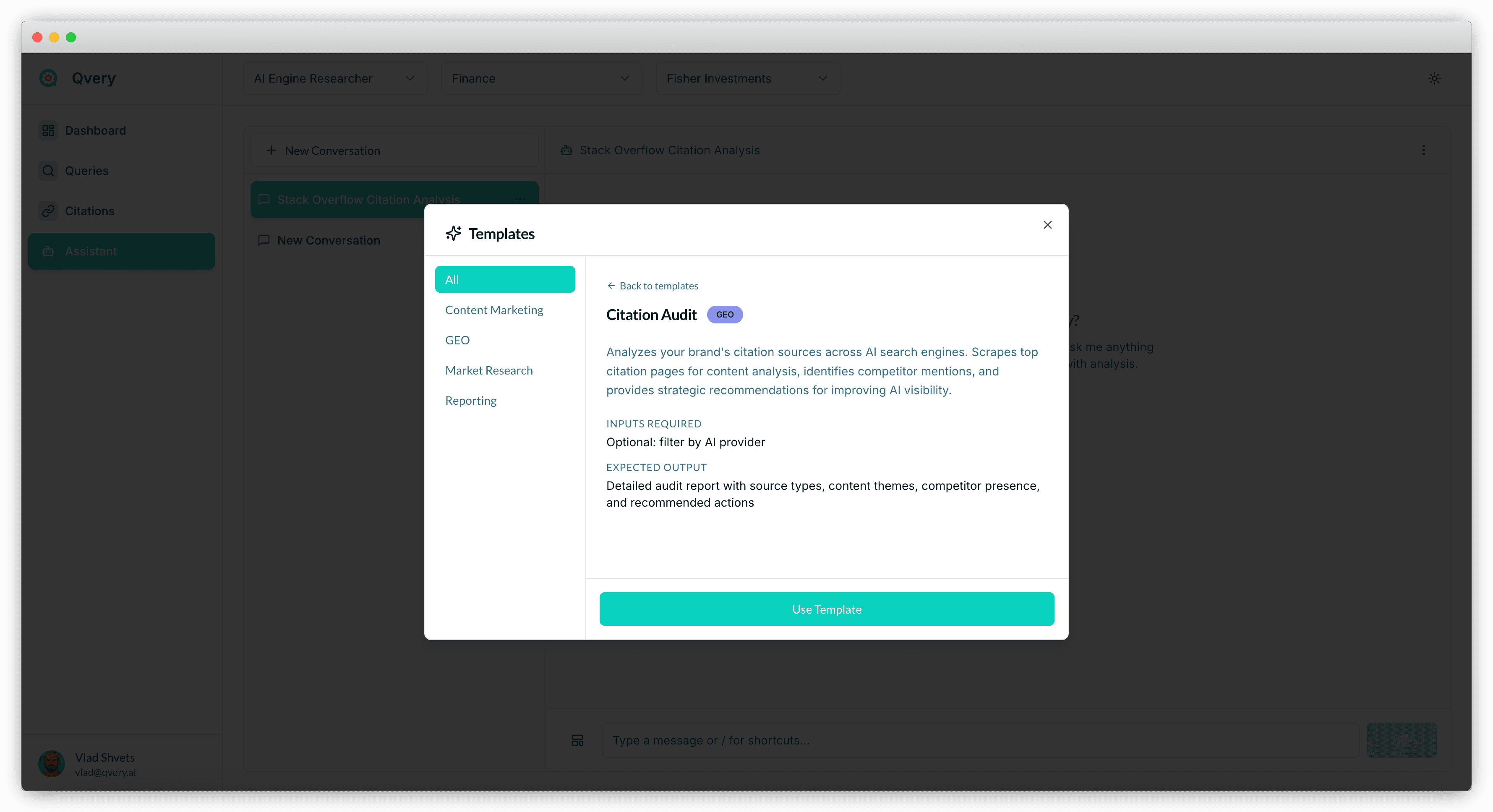
Every citation captured daily, across ChatGPT and Google AI Mode, so you see which sources feed your recommendations and which feed a competitor's.
Citations tied to queries, so you know not just what gets cited but for which questions.
Qvery Assistant: ask which domains started citing your rival last month, or which sources you are missing on a query you should own, in plain language against your data.
Share of voice and visibility in the same view, connecting citations to outcomes.
Monthly optimization plans that turn a citation gap into an outreach list.
Pricing:
Lite: EUR 99/mo for 1 brand and 50 queries.
Business: EUR 199/mo for unlimited brands, 100 queries, and Slack support.
Enterprise: custom pricing for 500+ queries. The free trial needs no credit card.
Reddit Score: 97% Positive. What redditors say:
Qvery is what founders reach for when the gap is stark, like the one whose two-million-dollar business is one ChatGPT has never heard of. (r/SEO_LLM)
It is where a CPA turned after asking why ChatGPT keeps recommending a colleague instead of them. (r/Accounting)
Mostly positive, a handful neutral, and no negative mentions on record.
Here is the inversion worth admitting: we sell citation tracking, and our own citation footprint is thin. We can see precisely how thin, which is what a citation tool is supposed to reveal. Most citation tools hand you a list of sources and leave the reading to you, and Qvery hands that reading to an agent.
You capture every citation daily across ChatGPT and Google AI Mode, then ask the Assistant what changed, which domain started feeding a rival, and where you are missing on a query you should own. It connects those citations to queries and share of voice, so a gap becomes an outreach list instead of a longer report.
2. Profound: Best for Citations Plus Agent Analytics
Key Features:
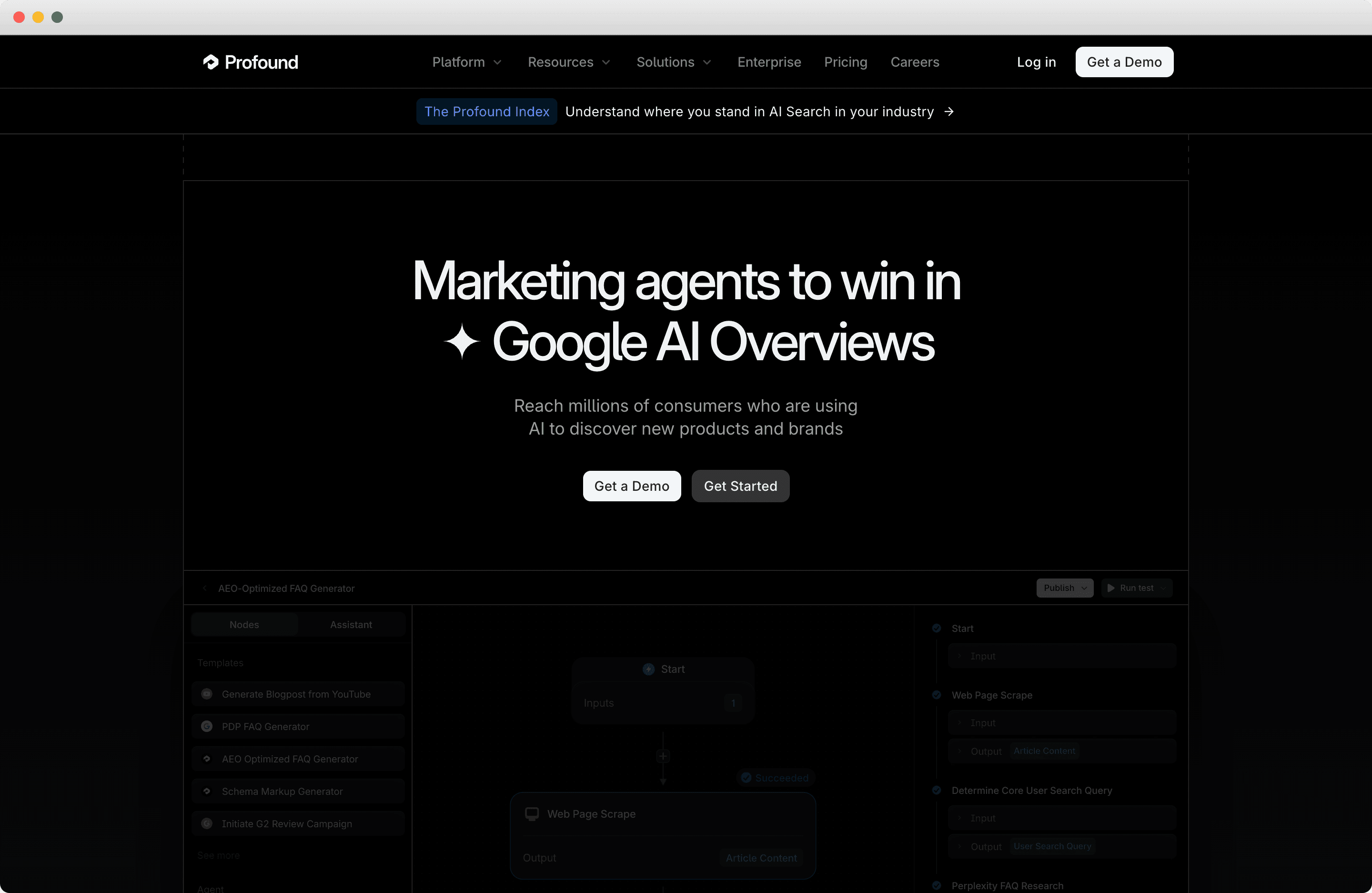
Agent Analytics: tracks AI bot crawling and attribution, connecting what gets crawled to what gets cited.
Answer Engine Insights across nine AI platforms with source-level detail.
Prompt Volumes so you weight citations by the queries that carry demand.
Content-producing agents to earn the citations your gaps reveal.
Pricing:
Starter: $99/mo for ChatGPT tracking and 50 prompts.
Growth: $399/mo total for 3 engines and 100 prompts.
Enterprise: custom pricing with wider coverage and SOC 2. Free trial available.
Reddit Score: 64% Positive. What redditors say:
“Ive found success with Profound.” (r/SEO_LLM)
“Profound is the most full-featured and priced like it.” (r/SaaS)
Rated for depth, with price the recurring caveat.
Profound looks at citations from both ends. It shows the sources feeding your answers and, through Agent Analytics, tracks the AI bots crawling your own site, so you can connect what engines read to what they end up citing. Few tools join those two views as cleanly.
Pairing that with prompt-demand data means a citation on a high-traffic query counts for more than one nobody asks about, and the content agents give enterprise teams a path from a gap to a published fix. The trade-off is price, which reviewers note in almost every thread.
3. Otterly: Best for Link Citation Analysis
Key Features:
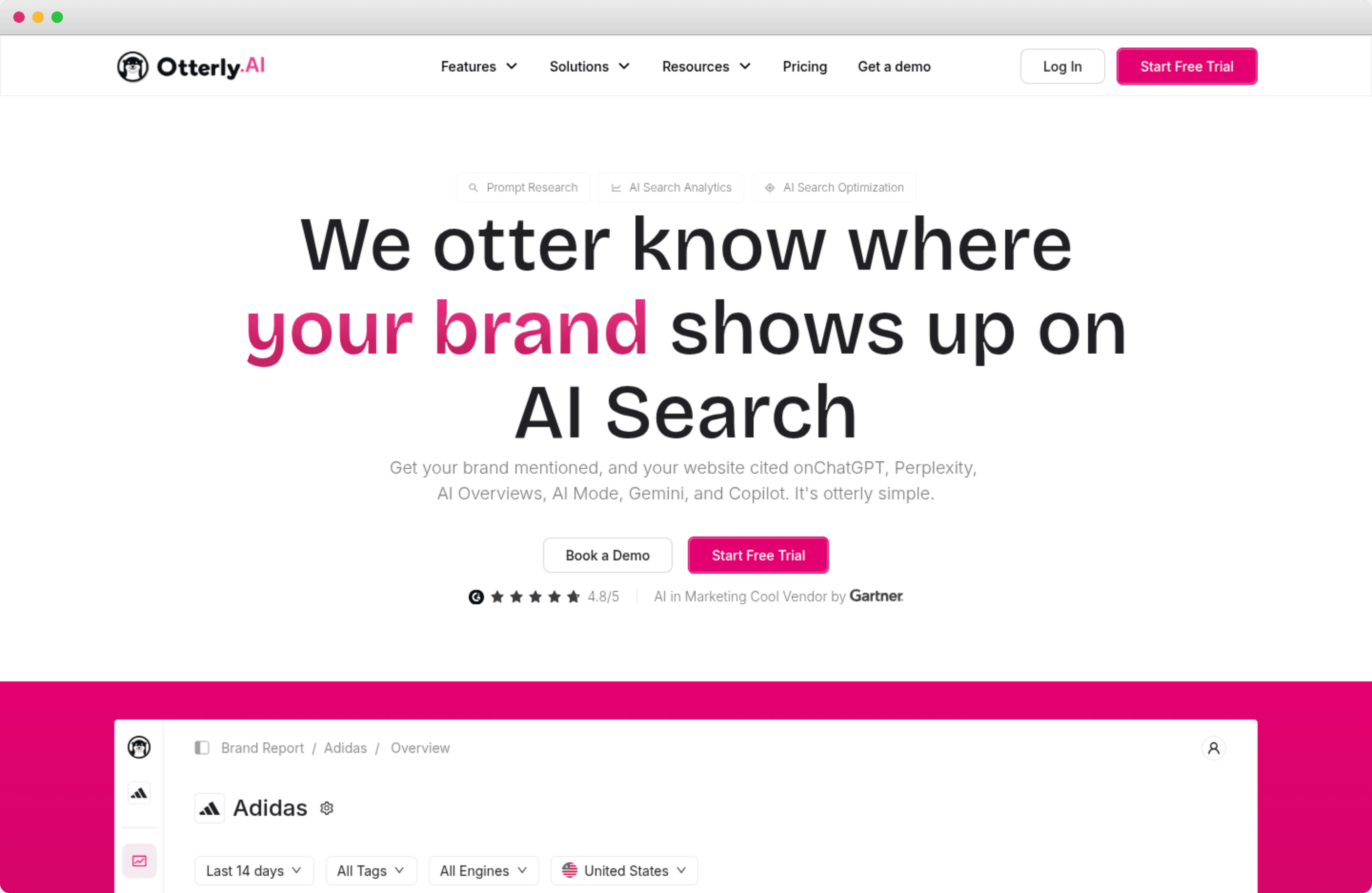
Link Citations Analysis that maps the sources behind your AI visibility.
AI Search Analytics across ChatGPT, Gemini, Perplexity, and more.
Content Audit and GEO recommendations to earn more citations.
A clean Brand Visibility Index tying citations to a single score.
Pricing:
Lite: $29/mo for 15 prompts and 4 engines.
Standard: $189/mo for 100 prompts and a Looker Studio connector.
Premium: $489/mo for 400 prompts and personal onboarding. Free trial available.
Reddit Score: 71% Positive. What redditors say:
“Currently using Otterly AI, its doing pretty good so far, we've been using it for one month and a half now.” (r/SEO_LLM)
“peec and otterly are decent, i landed on crowdreply.” (r/aeo)
A dependable pick for teams that want their citation sources laid out plainly.
Otterly makes citation analysis approachable. Its Link Citations Analysis lays out the sources feeding your visibility without demanding you learn a new discipline, and at $29 to start, it is one of the cheapest ways to see what AI is reading about you.
What lifts it above a raw source list is the follow-through. The content audit and GEO recommendations turn “these pages cite your rival” into “here is what to publish or pitch,” so the analysis leaves you with a move, not just a map.
4. Scrunch AI: Best for Getting Cited by AI Agents
Key Features:
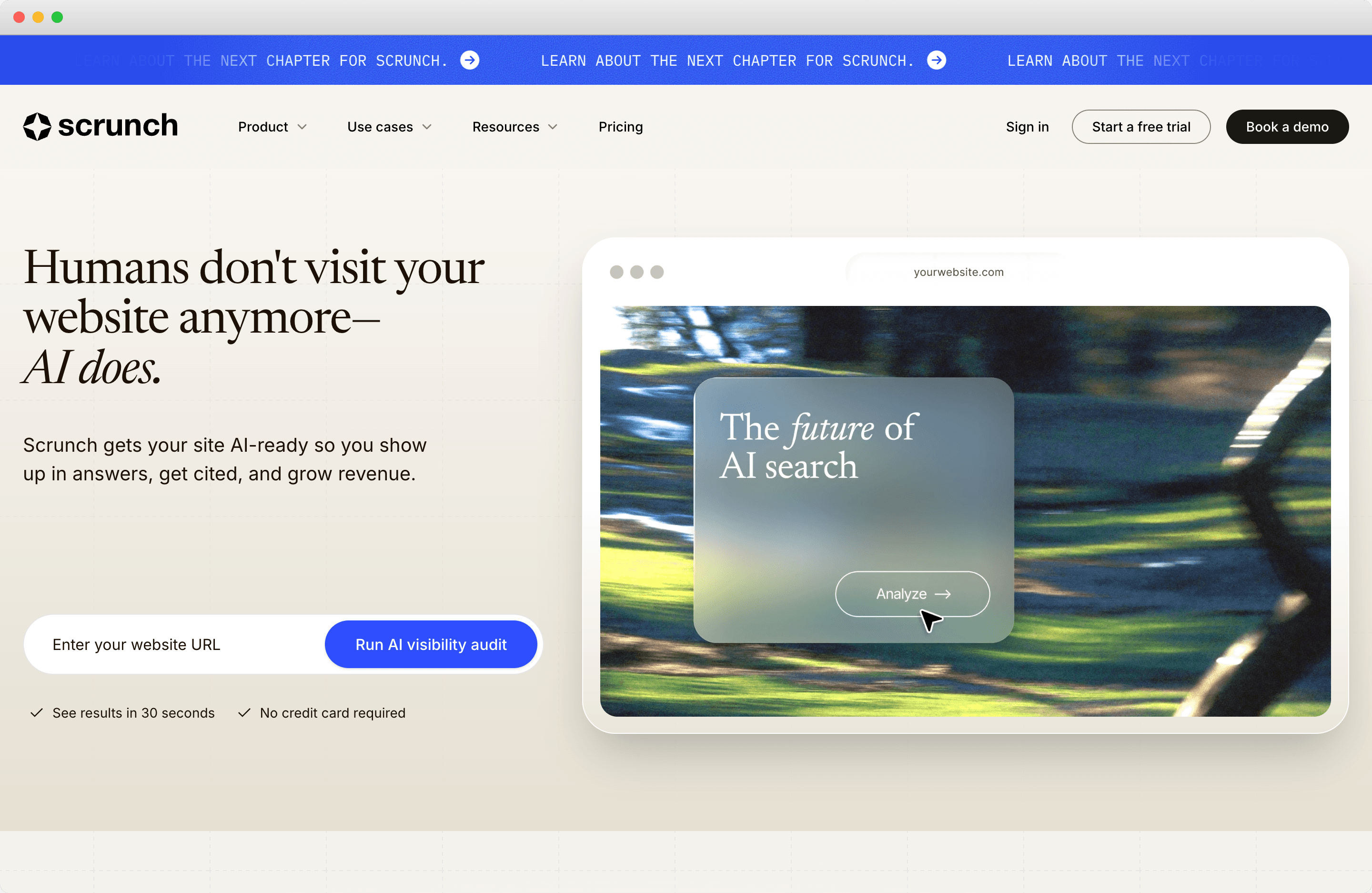
AI agent traffic tracking, showing when bots crawl the pages that become citations.
Agent Experience Platform that formats content so engines cite it cleanly.
Product-level citation performance across nine LLMs.
Site audits tuned for AI consumption.
Pricing:
Core: $250/mo for 125 prompts, 5 site audits, and 5 user licenses.
Enterprise: custom pricing with all nine LLMs, API access, and SSO. Free trial available.
Reddit Score: Limited public footprint. Reddit chatter is light, but Scrunch is one of the most-referenced enterprise names in third-party AEO roundups, and being cited by agents is the exact problem it was built to solve.
Scrunch treats citation as something you engineer, not just observe. The Agent Experience Platform formats your content for how AI systems read it, and the agent traffic tracking shows when bots visit the pages you want cited, so you can see cause and effect rather than a static tally.
That approach suits brands with complex sites and large catalogs, where product-level citation data reveals which pages engines trust and which they skip. It is citation tracking for teams ready to change what gets cited, not only count it.
5. AthenaHQ: Best for a Dedicated Citation Engine
Key Features:
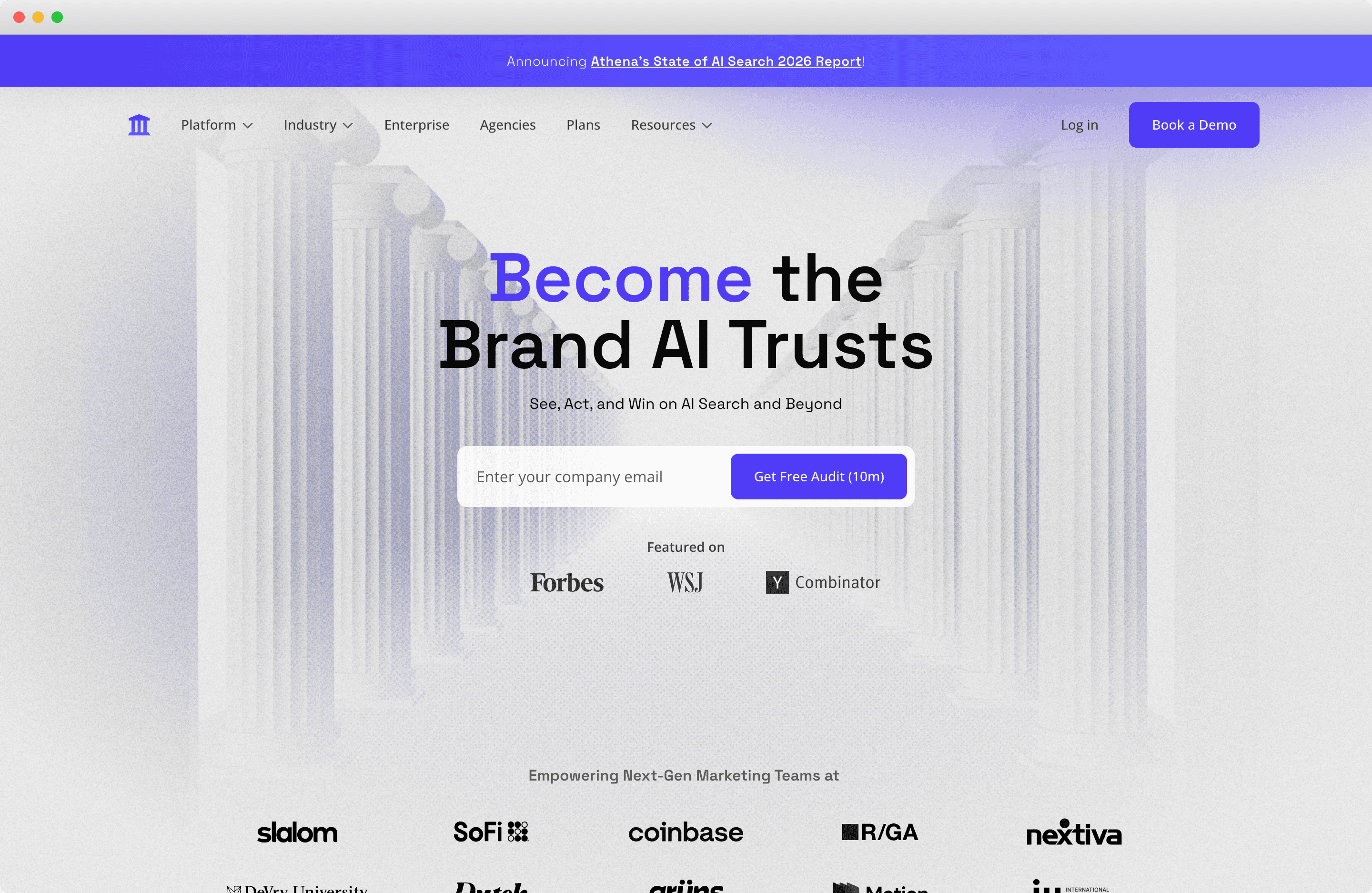
Citation source analysis that maps where your mentions come from.
Athena Citation Engine on the enterprise tier for targeted link building.
Content gap analysis tied to the sources rivals win.
Tracking across up to nine LLMs.
Pricing:
Essential: free, with $25 in credit and five AI models.
Starter: $295/mo for 3,600 credits and nine models.
Enterprise: custom pricing with the Citation Engine and SSO.
Reddit Score: Limited public footprint. Athena appears in buyers' shortlists next to Profound and Otterly, as in a thread weighing “babylovegrowth, profound, AthenaHQ, Otterly” and their trade-offs (r/GrowthHacking), though hands-on reviews stay thin.
Where most tools stop at analyzing citations, AthenaHQ builds a workflow around earning them. Its enterprise Citation Engine turns the source analysis into a targeted link-building plan, so the tool that finds your citation gaps also hands you a route to fill them.
The content gap analysis reinforces that loop, pointing at the exact topics where competitors get cited and you do not. For an in-house specialist who owns citation strategy, having discovery and action in one place is the appeal.
6. LLMrefs: Best for Filtering Citations by Source
Key Features:
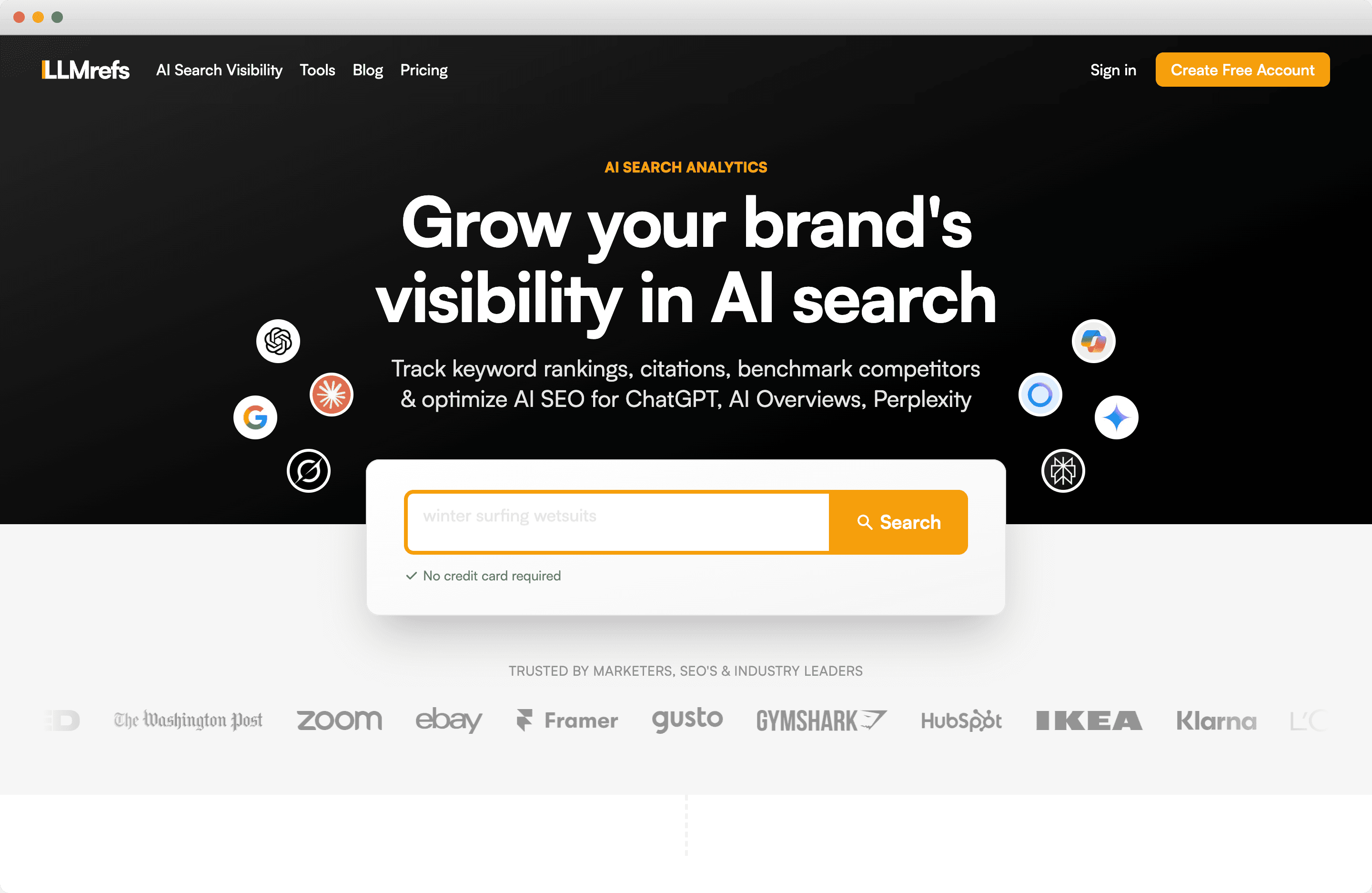
Citation source identification and filtering, so you can slice mentions by where they come from.
Tracking across a wide range of AI engines with share of voice and position.
Auto-generated prompt variations from real conversations.
Geo-targeting across 20-plus countries.
Pricing:
Free trial available to test the workflow.
Paid tiers scale by projects and engines, with unlimited seats.
Custom pricing for larger rosters.
Reddit Score: Limited public footprint, though the signal is favorable: LLMrefs earned a detailed six-month review from a marketer running it across 15 client brands (r/HonestBuyerReviews), a test that leans hard on citation accuracy.
LLMrefs is built for people who want to interrogate their citations, not just see them. The source identification and filtering separate the review sites from the forums from the news, so you can tell where your visibility comes from and where a single source is carrying you.
The auto-generated prompt variations stop that analysis from hinging on one phrasing, tracking citations across the many ways a real person asks the same question. It is a citation tool for the marketer who suspects the averages are hiding the real story.
7. Peec AI: Best for Citation Sources Beside Share of Voice
Key Features:
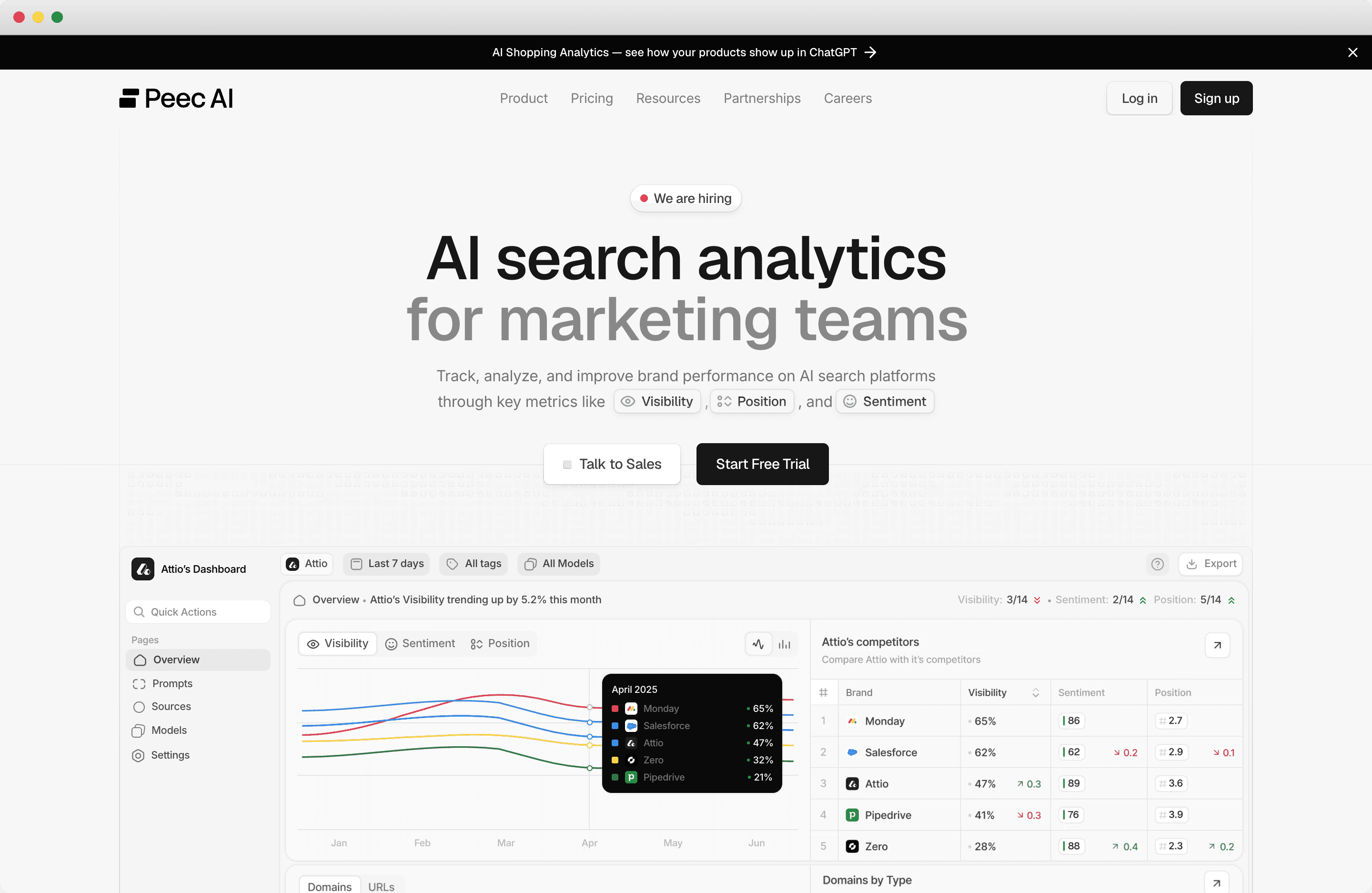
Citation source identification alongside share of voice and position.
Competitive benchmarking that shows which sources give rivals their edge.
Clean tracking across five AI models.
Unlimited users and multi-country tracking.
Pricing:
Starter: EUR 95/mo for 50 prompts and daily tracking.
Pro: EUR 245/mo for 150 prompts and 2 projects.
Advanced: EUR 495/mo for 350 prompts and multi-country tracking. Free trial available.
Reddit Score: 78% Positive. What redditors say:
“Peec is one of the best for AI analytics, Profound for agent marketing, Airops for content update.” (r/aeo)
“Peec ai is the stronger option if competitive share of voice is the main output your clients care about.” (r/aeo)
Redditors specifically credit it for surfacing citation sources cleanly.
Peec AI earns its spot because citations and share of voice belong together, and it puts them in the same clean view. You can see not only that a competitor leads on a query but which sources hand them that lead, which is the pairing that turns a benchmark into an outreach target.
Reddit gives it a specific nod for surfacing sources well, and with unlimited users on every plan, the whole team can dig into the citation data without a seat-count conversation. For price-conscious teams, it is a lot of citation insight for the money.
8. Knowatoa: Best for Citation Tracking on a Budget
Key Features:
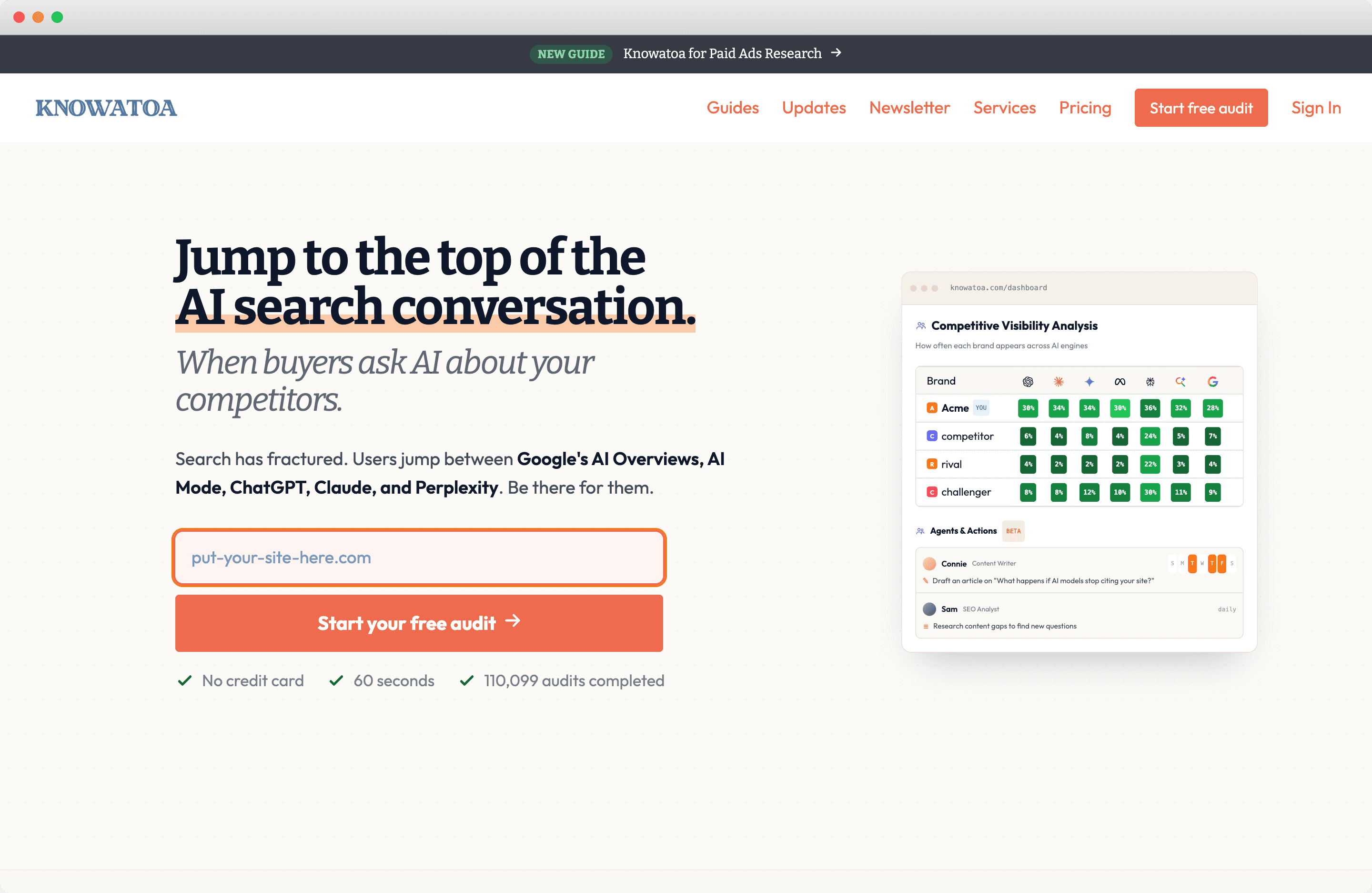
Citation tracking and source analysis across seven AI engines.
Gap analysis to spot where competitors get cited and you do not.
AI agents Sam and Connie for research and content drafting.
A free audit tool to see your citation picture before you pay.
Pricing:
Starter: $59/mo for 3 AI services and small teams.
Growth: $199/mo for all 7 services, AI agents, and a dedicated account rep.
Enterprise: custom pricing with priority feature requests. Free trial available.
Reddit Score: Limited public footprint. Knowatoa is a newer, focused entrant, so tool-specific reviews are still sparse, though the free audit lets you see your citations before committing a budget.
At $59 to start with a free audit on top, Knowatoa is the most accessible way onto this list. It tracks citations and sources across seven engines and runs a gap analysis, so a small team can find out who cites their rivals without an enterprise contract.
The built-in agents stretch that budget further. Sam researches and Connie drafts, so once the gap analysis names a source you are missing, you are not stuck waiting on a content team to act on it.
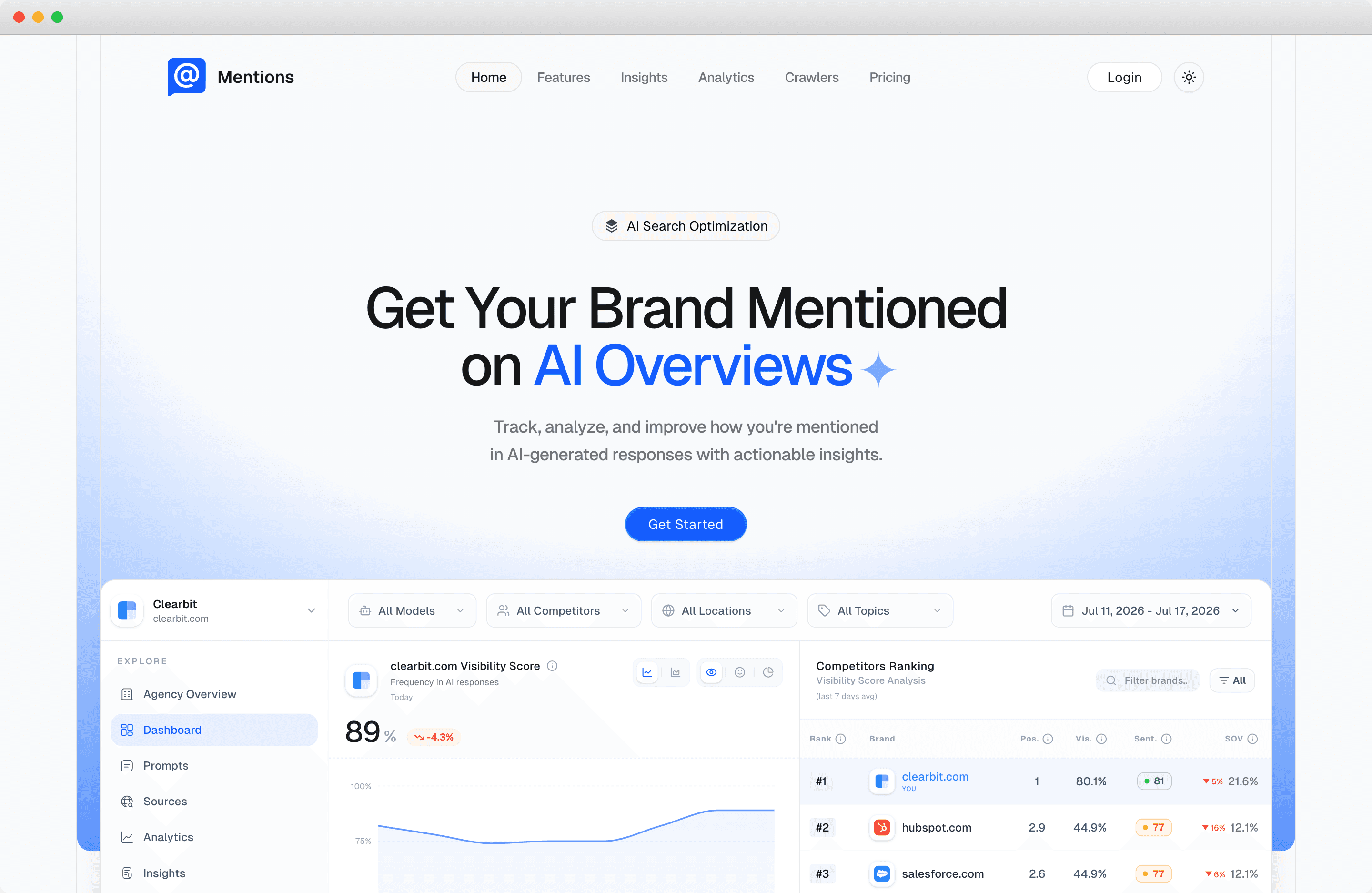
9. Mentions.so: Best for Source Domain Tracking
Key Features:
Source domain tracking that shows which domains feed AI mentions of you.
Mentions and citations monitoring across AI models.
Real-time mention feed to catch new citations as they land.
Sentiment analysis and open-web tracking for context.
Pricing:
Free trial available to test the workflow.
Paid plans scale by tracked brands and engines.
Custom pricing for larger teams.
Reddit Score: Limited public footprint. Mentions.so is a newer entrant focused on B2B SaaS brand tracking, so hands-on reviews are still few.
Mentions.so zeroes in on the domains doing the work. Its source domain tracking tells you which sites an engine keeps pulling from when it mentions you, so you learn where a relationship or a placement is earning your visibility unnoticed.
The real-time feed turns citation tracking into something closer to monitoring, flagging a new citation as it appears rather than in a monthly export, which is how you catch a source starting to favor a competitor early enough to respond.
10. Rankscale: Best for Sources-Box Analysis

Key Features:
Citation analysis and sources-box analysis, showing how AI assembles the sources behind an answer.
Coverage across a very wide range of AI engines.
Query fan-out tracking to see citations across question variants.
Page audits on how citable your own pages are.
Pricing:
Pro: $99/mo for 1,200 credits and 10 brand dashboards.
Growth: $385/mo with white-label options and a REST API.
Enterprise: $780/mo for larger volume and dedicated support. Free trial available.
Reddit Score: Limited but positive footprint. Chatter is light, but the early read is good: “I thought Rankscale was pretty comprehensive for the price. Not the prettiest UI but good coverage for the price.” (r/SEO_Experts)
Rankscale looks specifically at the sources box, the strip of citations an engine shows behind its answer, and analyzes how that set is built. Watching it across a wide range of engines means you catch a source dominating on Perplexity that never shows on ChatGPT.
Its query fan-out tracking pairs neatly with citation work, revealing how the sources shift as a question gets rephrased. Reviewers rate the coverage highly for the price, which keeps it in reach for teams still proving the value of citation tracking.
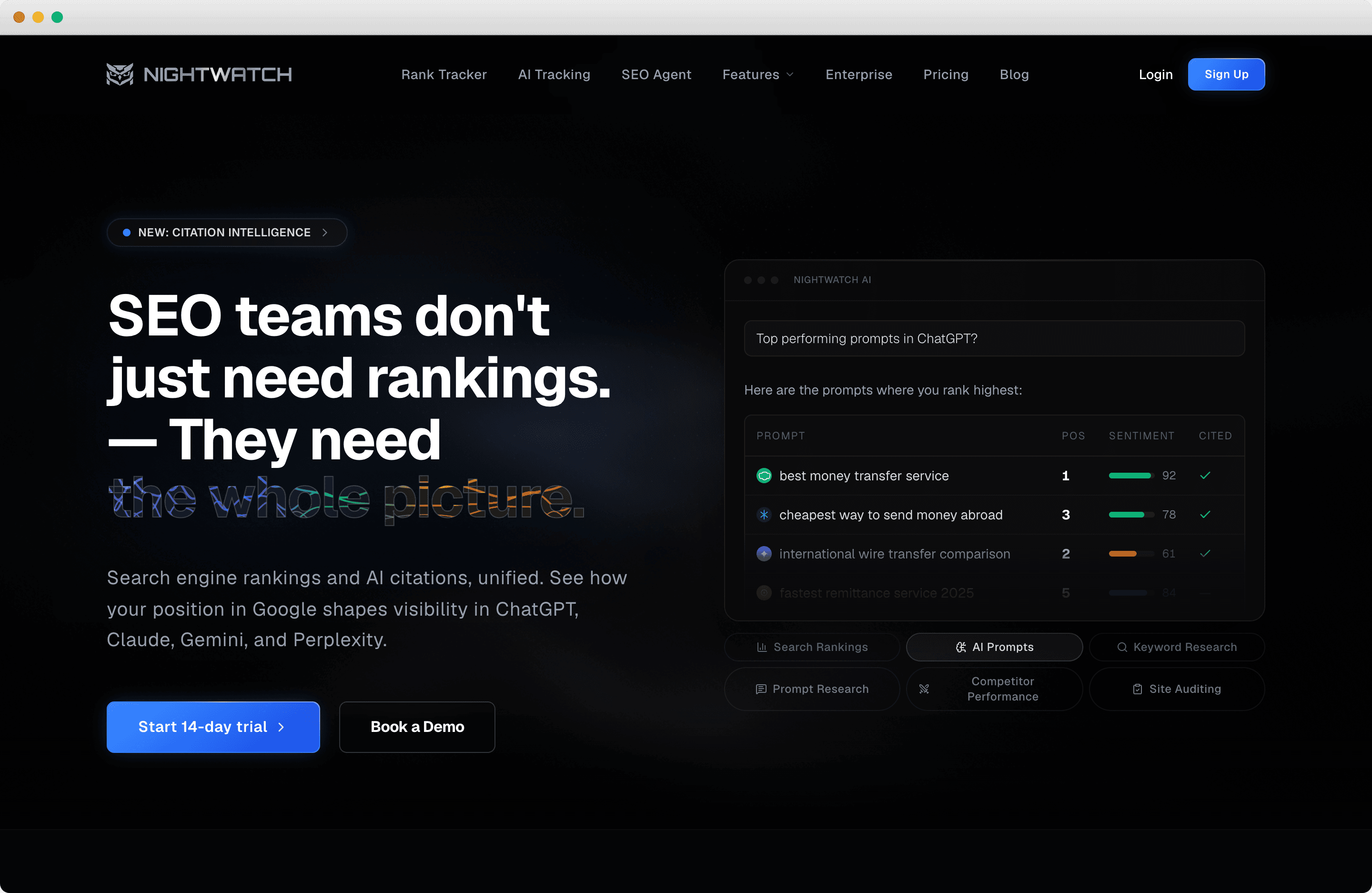
11. Nightwatch: Best for Linking Rankings to Citations
Key Features:
Citation Intelligence that connects your search rankings to your AI citations.
Tracking across twelve engines, from Google and Bing to ChatGPT and Perplexity.
NightOwl SEO Agent for automated gap analysis.
Three years of SERP history for context on how citations built.
Pricing:
Starter: $79/mo for 500 search terms and 50 AI prompts.
Professional: $159/mo with white-label reports and API access.
Agency: $399/mo for 100 websites and a dedicated account manager. Free trial available.
Reddit Score: Limited public footprint on AEO threads specifically, though Nightwatch has a long, trusted history in rank tracking that it has extended into AI citation intelligence.
Nightwatch answers a question most citation tools ignore: does your Google ranking have anything to do with whether AI cites you? Its Citation Intelligence connects the two, so a page climbing in search and one gaining citations stop looking like unrelated events.
That bridge is rare, and it suits teams that still live in classic SEO and want to bring citation tracking into a familiar frame. Three years of SERP history gives the connection context, showing how a source built its authority over time rather than in a single snapshot.
Match the Tool to the Job
Every tool here shows you sources, so what matters is who acts on them.
For PR teams: Mentions.so and its real-time feed catch a source shifting toward a competitor early, and Nightwatch ties a placement's ranking to whether AI cites it.
For content teams: Otterly, AthenaHQ, and Knowatoa turn a citation gap into a publishing or outreach list, cheaply at the low end and with a dedicated Citation Engine at the top.
For agencies and analysts: Profound and Scrunch go deepest on agent-level attribution, LLMrefs and Rankscale slice sources the most finely, and Peec keeps citations beside share of voice for client reporting.
For anyone who would rather ask than read: Qvery answers which sources feed a rival, on which queries, straight back from your own data.
Wherever you land, start reading the sources before your next campaign rather than after it, because the page that decides your next recommendation is being read right now.
Every answer ChatGPT gives is assembled from pages it decided to trust, a Reddit thread here, a review roundup there, a comparison article somewhere else. Mention monitoring tells you the engine talked about you. Citation tracking tells you which pages did the persuading.
The eleven tools below all read that supply chain, and they differ on how much of it they expose and what they let you do about it. We ranked them by citation depth and put ours first, since Reddit alone shapes so much of AI visibility that knowing which threads cite you beats knowing that some do.
1. Qvery: Every Citation, Captured and Traceable
Key Features:
Every citation captured daily, across ChatGPT and Google AI Mode, so you see which sources feed your recommendations and which feed a competitor's.
Citations tied to queries, so you know not just what gets cited but for which questions.
Qvery Assistant: ask which domains started citing your rival last month, or which sources you are missing on a query you should own, in plain language against your data.
Share of voice and visibility in the same view, connecting citations to outcomes.
Monthly optimization plans that turn a citation gap into an outreach list.
Pricing:
Lite: EUR 99/mo for 1 brand and 50 queries.
Business: EUR 199/mo for unlimited brands, 100 queries, and Slack support.
Enterprise: custom pricing for 500+ queries. The free trial needs no credit card.
Reddit Score: 97% Positive. What redditors say:
Qvery is what founders reach for when the gap is stark, like the one whose two-million-dollar business is one ChatGPT has never heard of. (r/SEO_LLM)
It is where a CPA turned after asking why ChatGPT keeps recommending a colleague instead of them. (r/Accounting)
Mostly positive, a handful neutral, and no negative mentions on record.
Here is the inversion worth admitting: we sell citation tracking, and our own citation footprint is thin. We can see precisely how thin, which is what a citation tool is supposed to reveal. Most citation tools hand you a list of sources and leave the reading to you, and Qvery hands that reading to an agent.
You capture every citation daily across ChatGPT and Google AI Mode, then ask the Assistant what changed, which domain started feeding a rival, and where you are missing on a query you should own. It connects those citations to queries and share of voice, so a gap becomes an outreach list instead of a longer report.
2. Profound: Best for Citations Plus Agent Analytics
Key Features:
Agent Analytics: tracks AI bot crawling and attribution, connecting what gets crawled to what gets cited.
Answer Engine Insights across nine AI platforms with source-level detail.
Prompt Volumes so you weight citations by the queries that carry demand.
Content-producing agents to earn the citations your gaps reveal.
Pricing:
Starter: $99/mo for ChatGPT tracking and 50 prompts.
Growth: $399/mo total for 3 engines and 100 prompts.
Enterprise: custom pricing with wider coverage and SOC 2. Free trial available.
Reddit Score: 64% Positive. What redditors say:
“Ive found success with Profound.” (r/SEO_LLM)
“Profound is the most full-featured and priced like it.” (r/SaaS)
Rated for depth, with price the recurring caveat.
Profound looks at citations from both ends. It shows the sources feeding your answers and, through Agent Analytics, tracks the AI bots crawling your own site, so you can connect what engines read to what they end up citing. Few tools join those two views as cleanly.
Pairing that with prompt-demand data means a citation on a high-traffic query counts for more than one nobody asks about, and the content agents give enterprise teams a path from a gap to a published fix. The trade-off is price, which reviewers note in almost every thread.
3. Otterly: Best for Link Citation Analysis
Key Features:
Link Citations Analysis that maps the sources behind your AI visibility.
AI Search Analytics across ChatGPT, Gemini, Perplexity, and more.
Content Audit and GEO recommendations to earn more citations.
A clean Brand Visibility Index tying citations to a single score.
Pricing:
Lite: $29/mo for 15 prompts and 4 engines.
Standard: $189/mo for 100 prompts and a Looker Studio connector.
Premium: $489/mo for 400 prompts and personal onboarding. Free trial available.
Reddit Score: 71% Positive. What redditors say:
“Currently using Otterly AI, its doing pretty good so far, we've been using it for one month and a half now.” (r/SEO_LLM)
“peec and otterly are decent, i landed on crowdreply.” (r/aeo)
A dependable pick for teams that want their citation sources laid out plainly.
Otterly makes citation analysis approachable. Its Link Citations Analysis lays out the sources feeding your visibility without demanding you learn a new discipline, and at $29 to start, it is one of the cheapest ways to see what AI is reading about you.
What lifts it above a raw source list is the follow-through. The content audit and GEO recommendations turn “these pages cite your rival” into “here is what to publish or pitch,” so the analysis leaves you with a move, not just a map.
4. Scrunch AI: Best for Getting Cited by AI Agents
Key Features:
AI agent traffic tracking, showing when bots crawl the pages that become citations.
Agent Experience Platform that formats content so engines cite it cleanly.
Product-level citation performance across nine LLMs.
Site audits tuned for AI consumption.
Pricing:
Core: $250/mo for 125 prompts, 5 site audits, and 5 user licenses.
Enterprise: custom pricing with all nine LLMs, API access, and SSO. Free trial available.
Reddit Score: Limited public footprint. Reddit chatter is light, but Scrunch is one of the most-referenced enterprise names in third-party AEO roundups, and being cited by agents is the exact problem it was built to solve.
Scrunch treats citation as something you engineer, not just observe. The Agent Experience Platform formats your content for how AI systems read it, and the agent traffic tracking shows when bots visit the pages you want cited, so you can see cause and effect rather than a static tally.
That approach suits brands with complex sites and large catalogs, where product-level citation data reveals which pages engines trust and which they skip. It is citation tracking for teams ready to change what gets cited, not only count it.
5. AthenaHQ: Best for a Dedicated Citation Engine
Key Features:
Citation source analysis that maps where your mentions come from.
Athena Citation Engine on the enterprise tier for targeted link building.
Content gap analysis tied to the sources rivals win.
Tracking across up to nine LLMs.
Pricing:
Essential: free, with $25 in credit and five AI models.
Starter: $295/mo for 3,600 credits and nine models.
Enterprise: custom pricing with the Citation Engine and SSO.
Reddit Score: Limited public footprint. Athena appears in buyers' shortlists next to Profound and Otterly, as in a thread weighing “babylovegrowth, profound, AthenaHQ, Otterly” and their trade-offs (r/GrowthHacking), though hands-on reviews stay thin.
Where most tools stop at analyzing citations, AthenaHQ builds a workflow around earning them. Its enterprise Citation Engine turns the source analysis into a targeted link-building plan, so the tool that finds your citation gaps also hands you a route to fill them.
The content gap analysis reinforces that loop, pointing at the exact topics where competitors get cited and you do not. For an in-house specialist who owns citation strategy, having discovery and action in one place is the appeal.
6. LLMrefs: Best for Filtering Citations by Source
Key Features:
Citation source identification and filtering, so you can slice mentions by where they come from.
Tracking across a wide range of AI engines with share of voice and position.
Auto-generated prompt variations from real conversations.
Geo-targeting across 20-plus countries.
Pricing:
Free trial available to test the workflow.
Paid tiers scale by projects and engines, with unlimited seats.
Custom pricing for larger rosters.
Reddit Score: Limited public footprint, though the signal is favorable: LLMrefs earned a detailed six-month review from a marketer running it across 15 client brands (r/HonestBuyerReviews), a test that leans hard on citation accuracy.
LLMrefs is built for people who want to interrogate their citations, not just see them. The source identification and filtering separate the review sites from the forums from the news, so you can tell where your visibility comes from and where a single source is carrying you.
The auto-generated prompt variations stop that analysis from hinging on one phrasing, tracking citations across the many ways a real person asks the same question. It is a citation tool for the marketer who suspects the averages are hiding the real story.
7. Peec AI: Best for Citation Sources Beside Share of Voice
Key Features:
Citation source identification alongside share of voice and position.
Competitive benchmarking that shows which sources give rivals their edge.
Clean tracking across five AI models.
Unlimited users and multi-country tracking.
Pricing:
Starter: EUR 95/mo for 50 prompts and daily tracking.
Pro: EUR 245/mo for 150 prompts and 2 projects.
Advanced: EUR 495/mo for 350 prompts and multi-country tracking. Free trial available.
Reddit Score: 78% Positive. What redditors say:
“Peec is one of the best for AI analytics, Profound for agent marketing, Airops for content update.” (r/aeo)
“Peec ai is the stronger option if competitive share of voice is the main output your clients care about.” (r/aeo)
Redditors specifically credit it for surfacing citation sources cleanly.
Peec AI earns its spot because citations and share of voice belong together, and it puts them in the same clean view. You can see not only that a competitor leads on a query but which sources hand them that lead, which is the pairing that turns a benchmark into an outreach target.
Reddit gives it a specific nod for surfacing sources well, and with unlimited users on every plan, the whole team can dig into the citation data without a seat-count conversation. For price-conscious teams, it is a lot of citation insight for the money.
8. Knowatoa: Best for Citation Tracking on a Budget
Key Features:
Citation tracking and source analysis across seven AI engines.
Gap analysis to spot where competitors get cited and you do not.
AI agents Sam and Connie for research and content drafting.
A free audit tool to see your citation picture before you pay.
Pricing:
Starter: $59/mo for 3 AI services and small teams.
Growth: $199/mo for all 7 services, AI agents, and a dedicated account rep.
Enterprise: custom pricing with priority feature requests. Free trial available.
Reddit Score: Limited public footprint. Knowatoa is a newer, focused entrant, so tool-specific reviews are still sparse, though the free audit lets you see your citations before committing a budget.
At $59 to start with a free audit on top, Knowatoa is the most accessible way onto this list. It tracks citations and sources across seven engines and runs a gap analysis, so a small team can find out who cites their rivals without an enterprise contract.
The built-in agents stretch that budget further. Sam researches and Connie drafts, so once the gap analysis names a source you are missing, you are not stuck waiting on a content team to act on it.
9. Mentions.so: Best for Source Domain Tracking
Key Features:
Source domain tracking that shows which domains feed AI mentions of you.
Mentions and citations monitoring across AI models.
Real-time mention feed to catch new citations as they land.
Sentiment analysis and open-web tracking for context.
Pricing:
Free trial available to test the workflow.
Paid plans scale by tracked brands and engines.
Custom pricing for larger teams.
Reddit Score: Limited public footprint. Mentions.so is a newer entrant focused on B2B SaaS brand tracking, so hands-on reviews are still few.
Mentions.so zeroes in on the domains doing the work. Its source domain tracking tells you which sites an engine keeps pulling from when it mentions you, so you learn where a relationship or a placement is earning your visibility unnoticed.
The real-time feed turns citation tracking into something closer to monitoring, flagging a new citation as it appears rather than in a monthly export, which is how you catch a source starting to favor a competitor early enough to respond.
10. Rankscale: Best for Sources-Box Analysis
Key Features:
Citation analysis and sources-box analysis, showing how AI assembles the sources behind an answer.
Coverage across a very wide range of AI engines.
Query fan-out tracking to see citations across question variants.
Page audits on how citable your own pages are.
Pricing:
Pro: $99/mo for 1,200 credits and 10 brand dashboards.
Growth: $385/mo with white-label options and a REST API.
Enterprise: $780/mo for larger volume and dedicated support. Free trial available.
Reddit Score: Limited but positive footprint. Chatter is light, but the early read is good: “I thought Rankscale was pretty comprehensive for the price. Not the prettiest UI but good coverage for the price.” (r/SEO_Experts)
Rankscale looks specifically at the sources box, the strip of citations an engine shows behind its answer, and analyzes how that set is built. Watching it across a wide range of engines means you catch a source dominating on Perplexity that never shows on ChatGPT.
Its query fan-out tracking pairs neatly with citation work, revealing how the sources shift as a question gets rephrased. Reviewers rate the coverage highly for the price, which keeps it in reach for teams still proving the value of citation tracking.
11. Nightwatch: Best for Linking Rankings to Citations
Key Features:
Citation Intelligence that connects your search rankings to your AI citations.
Tracking across twelve engines, from Google and Bing to ChatGPT and Perplexity.
NightOwl SEO Agent for automated gap analysis.
Three years of SERP history for context on how citations built.
Pricing:
Starter: $79/mo for 500 search terms and 50 AI prompts.
Professional: $159/mo with white-label reports and API access.
Agency: $399/mo for 100 websites and a dedicated account manager. Free trial available.
Reddit Score: Limited public footprint on AEO threads specifically, though Nightwatch has a long, trusted history in rank tracking that it has extended into AI citation intelligence.
Nightwatch answers a question most citation tools ignore: does your Google ranking have anything to do with whether AI cites you? Its Citation Intelligence connects the two, so a page climbing in search and one gaining citations stop looking like unrelated events.
That bridge is rare, and it suits teams that still live in classic SEO and want to bring citation tracking into a familiar frame. Three years of SERP history gives the connection context, showing how a source built its authority over time rather than in a single snapshot.
Match the Tool to the Job
Every tool here shows you sources, so what matters is who acts on them.
For PR teams: Mentions.so and its real-time feed catch a source shifting toward a competitor early, and Nightwatch ties a placement's ranking to whether AI cites it.
For content teams: Otterly, AthenaHQ, and Knowatoa turn a citation gap into a publishing or outreach list, cheaply at the low end and with a dedicated Citation Engine at the top.
For agencies and analysts: Profound and Scrunch go deepest on agent-level attribution, LLMrefs and Rankscale slice sources the most finely, and Peec keeps citations beside share of voice for client reporting.
For anyone who would rather ask than read: Qvery answers which sources feed a rival, on which queries, straight back from your own data.
Wherever you land, start reading the sources before your next campaign rather than after it, because the page that decides your next recommendation is being read right now.
Every answer ChatGPT gives is assembled from pages it decided to trust, a Reddit thread here, a review roundup there, a comparison article somewhere else. Mention monitoring tells you the engine talked about you. Citation tracking tells you which pages did the persuading.
The eleven tools below all read that supply chain, and they differ on how much of it they expose and what they let you do about it. We ranked them by citation depth and put ours first, since Reddit alone shapes so much of AI visibility that knowing which threads cite you beats knowing that some do.
1. Qvery: Every Citation, Captured and Traceable
Key Features:
Every citation captured daily, across ChatGPT and Google AI Mode, so you see which sources feed your recommendations and which feed a competitor's.
Citations tied to queries, so you know not just what gets cited but for which questions.
Qvery Assistant: ask which domains started citing your rival last month, or which sources you are missing on a query you should own, in plain language against your data.
Share of voice and visibility in the same view, connecting citations to outcomes.
Monthly optimization plans that turn a citation gap into an outreach list.
Pricing:
Lite: EUR 99/mo for 1 brand and 50 queries.
Business: EUR 199/mo for unlimited brands, 100 queries, and Slack support.
Enterprise: custom pricing for 500+ queries. The free trial needs no credit card.
Reddit Score: 97% Positive. What redditors say:
Qvery is what founders reach for when the gap is stark, like the one whose two-million-dollar business is one ChatGPT has never heard of. (r/SEO_LLM)
It is where a CPA turned after asking why ChatGPT keeps recommending a colleague instead of them. (r/Accounting)
Mostly positive, a handful neutral, and no negative mentions on record.
Here is the inversion worth admitting: we sell citation tracking, and our own citation footprint is thin. We can see precisely how thin, which is what a citation tool is supposed to reveal. Most citation tools hand you a list of sources and leave the reading to you, and Qvery hands that reading to an agent.
You capture every citation daily across ChatGPT and Google AI Mode, then ask the Assistant what changed, which domain started feeding a rival, and where you are missing on a query you should own. It connects those citations to queries and share of voice, so a gap becomes an outreach list instead of a longer report.
2. Profound: Best for Citations Plus Agent Analytics
Key Features:
Agent Analytics: tracks AI bot crawling and attribution, connecting what gets crawled to what gets cited.
Answer Engine Insights across nine AI platforms with source-level detail.
Prompt Volumes so you weight citations by the queries that carry demand.
Content-producing agents to earn the citations your gaps reveal.
Pricing:
Starter: $99/mo for ChatGPT tracking and 50 prompts.
Growth: $399/mo total for 3 engines and 100 prompts.
Enterprise: custom pricing with wider coverage and SOC 2. Free trial available.
Reddit Score: 64% Positive. What redditors say:
“Ive found success with Profound.” (r/SEO_LLM)
“Profound is the most full-featured and priced like it.” (r/SaaS)
Rated for depth, with price the recurring caveat.
Profound looks at citations from both ends. It shows the sources feeding your answers and, through Agent Analytics, tracks the AI bots crawling your own site, so you can connect what engines read to what they end up citing. Few tools join those two views as cleanly.
Pairing that with prompt-demand data means a citation on a high-traffic query counts for more than one nobody asks about, and the content agents give enterprise teams a path from a gap to a published fix. The trade-off is price, which reviewers note in almost every thread.
3. Otterly: Best for Link Citation Analysis
Key Features:
Link Citations Analysis that maps the sources behind your AI visibility.
AI Search Analytics across ChatGPT, Gemini, Perplexity, and more.
Content Audit and GEO recommendations to earn more citations.
A clean Brand Visibility Index tying citations to a single score.
Pricing:
Lite: $29/mo for 15 prompts and 4 engines.
Standard: $189/mo for 100 prompts and a Looker Studio connector.
Premium: $489/mo for 400 prompts and personal onboarding. Free trial available.
Reddit Score: 71% Positive. What redditors say:
“Currently using Otterly AI, its doing pretty good so far, we've been using it for one month and a half now.” (r/SEO_LLM)
“peec and otterly are decent, i landed on crowdreply.” (r/aeo)
A dependable pick for teams that want their citation sources laid out plainly.
Otterly makes citation analysis approachable. Its Link Citations Analysis lays out the sources feeding your visibility without demanding you learn a new discipline, and at $29 to start, it is one of the cheapest ways to see what AI is reading about you.
What lifts it above a raw source list is the follow-through. The content audit and GEO recommendations turn “these pages cite your rival” into “here is what to publish or pitch,” so the analysis leaves you with a move, not just a map.
4. Scrunch AI: Best for Getting Cited by AI Agents
Key Features:
AI agent traffic tracking, showing when bots crawl the pages that become citations.
Agent Experience Platform that formats content so engines cite it cleanly.
Product-level citation performance across nine LLMs.
Site audits tuned for AI consumption.
Pricing:
Core: $250/mo for 125 prompts, 5 site audits, and 5 user licenses.
Enterprise: custom pricing with all nine LLMs, API access, and SSO. Free trial available.
Reddit Score: Limited public footprint. Reddit chatter is light, but Scrunch is one of the most-referenced enterprise names in third-party AEO roundups, and being cited by agents is the exact problem it was built to solve.
Scrunch treats citation as something you engineer, not just observe. The Agent Experience Platform formats your content for how AI systems read it, and the agent traffic tracking shows when bots visit the pages you want cited, so you can see cause and effect rather than a static tally.
That approach suits brands with complex sites and large catalogs, where product-level citation data reveals which pages engines trust and which they skip. It is citation tracking for teams ready to change what gets cited, not only count it.
5. AthenaHQ: Best for a Dedicated Citation Engine
Key Features:
Citation source analysis that maps where your mentions come from.
Athena Citation Engine on the enterprise tier for targeted link building.
Content gap analysis tied to the sources rivals win.
Tracking across up to nine LLMs.
Pricing:
Essential: free, with $25 in credit and five AI models.
Starter: $295/mo for 3,600 credits and nine models.
Enterprise: custom pricing with the Citation Engine and SSO.
Reddit Score: Limited public footprint. Athena appears in buyers' shortlists next to Profound and Otterly, as in a thread weighing “babylovegrowth, profound, AthenaHQ, Otterly” and their trade-offs (r/GrowthHacking), though hands-on reviews stay thin.
Where most tools stop at analyzing citations, AthenaHQ builds a workflow around earning them. Its enterprise Citation Engine turns the source analysis into a targeted link-building plan, so the tool that finds your citation gaps also hands you a route to fill them.
The content gap analysis reinforces that loop, pointing at the exact topics where competitors get cited and you do not. For an in-house specialist who owns citation strategy, having discovery and action in one place is the appeal.
6. LLMrefs: Best for Filtering Citations by Source
Key Features:
Citation source identification and filtering, so you can slice mentions by where they come from.
Tracking across a wide range of AI engines with share of voice and position.
Auto-generated prompt variations from real conversations.
Geo-targeting across 20-plus countries.
Pricing:
Free trial available to test the workflow.
Paid tiers scale by projects and engines, with unlimited seats.
Custom pricing for larger rosters.
Reddit Score: Limited public footprint, though the signal is favorable: LLMrefs earned a detailed six-month review from a marketer running it across 15 client brands (r/HonestBuyerReviews), a test that leans hard on citation accuracy.
LLMrefs is built for people who want to interrogate their citations, not just see them. The source identification and filtering separate the review sites from the forums from the news, so you can tell where your visibility comes from and where a single source is carrying you.
The auto-generated prompt variations stop that analysis from hinging on one phrasing, tracking citations across the many ways a real person asks the same question. It is a citation tool for the marketer who suspects the averages are hiding the real story.
7. Peec AI: Best for Citation Sources Beside Share of Voice
Key Features:
Citation source identification alongside share of voice and position.
Competitive benchmarking that shows which sources give rivals their edge.
Clean tracking across five AI models.
Unlimited users and multi-country tracking.
Pricing:
Starter: EUR 95/mo for 50 prompts and daily tracking.
Pro: EUR 245/mo for 150 prompts and 2 projects.
Advanced: EUR 495/mo for 350 prompts and multi-country tracking. Free trial available.
Reddit Score: 78% Positive. What redditors say:
“Peec is one of the best for AI analytics, Profound for agent marketing, Airops for content update.” (r/aeo)
“Peec ai is the stronger option if competitive share of voice is the main output your clients care about.” (r/aeo)
Redditors specifically credit it for surfacing citation sources cleanly.
Peec AI earns its spot because citations and share of voice belong together, and it puts them in the same clean view. You can see not only that a competitor leads on a query but which sources hand them that lead, which is the pairing that turns a benchmark into an outreach target.
Reddit gives it a specific nod for surfacing sources well, and with unlimited users on every plan, the whole team can dig into the citation data without a seat-count conversation. For price-conscious teams, it is a lot of citation insight for the money.
8. Knowatoa: Best for Citation Tracking on a Budget
Key Features:
Citation tracking and source analysis across seven AI engines.
Gap analysis to spot where competitors get cited and you do not.
AI agents Sam and Connie for research and content drafting.
A free audit tool to see your citation picture before you pay.
Pricing:
Starter: $59/mo for 3 AI services and small teams.
Growth: $199/mo for all 7 services, AI agents, and a dedicated account rep.
Enterprise: custom pricing with priority feature requests. Free trial available.
Reddit Score: Limited public footprint. Knowatoa is a newer, focused entrant, so tool-specific reviews are still sparse, though the free audit lets you see your citations before committing a budget.
At $59 to start with a free audit on top, Knowatoa is the most accessible way onto this list. It tracks citations and sources across seven engines and runs a gap analysis, so a small team can find out who cites their rivals without an enterprise contract.
The built-in agents stretch that budget further. Sam researches and Connie drafts, so once the gap analysis names a source you are missing, you are not stuck waiting on a content team to act on it.
9. Mentions.so: Best for Source Domain Tracking
Key Features:
Source domain tracking that shows which domains feed AI mentions of you.
Mentions and citations monitoring across AI models.
Real-time mention feed to catch new citations as they land.
Sentiment analysis and open-web tracking for context.
Pricing:
Free trial available to test the workflow.
Paid plans scale by tracked brands and engines.
Custom pricing for larger teams.
Reddit Score: Limited public footprint. Mentions.so is a newer entrant focused on B2B SaaS brand tracking, so hands-on reviews are still few.
Mentions.so zeroes in on the domains doing the work. Its source domain tracking tells you which sites an engine keeps pulling from when it mentions you, so you learn where a relationship or a placement is earning your visibility unnoticed.
The real-time feed turns citation tracking into something closer to monitoring, flagging a new citation as it appears rather than in a monthly export, which is how you catch a source starting to favor a competitor early enough to respond.
10. Rankscale: Best for Sources-Box Analysis
Key Features:
Citation analysis and sources-box analysis, showing how AI assembles the sources behind an answer.
Coverage across a very wide range of AI engines.
Query fan-out tracking to see citations across question variants.
Page audits on how citable your own pages are.
Pricing:
Pro: $99/mo for 1,200 credits and 10 brand dashboards.
Growth: $385/mo with white-label options and a REST API.
Enterprise: $780/mo for larger volume and dedicated support. Free trial available.
Reddit Score: Limited but positive footprint. Chatter is light, but the early read is good: “I thought Rankscale was pretty comprehensive for the price. Not the prettiest UI but good coverage for the price.” (r/SEO_Experts)
Rankscale looks specifically at the sources box, the strip of citations an engine shows behind its answer, and analyzes how that set is built. Watching it across a wide range of engines means you catch a source dominating on Perplexity that never shows on ChatGPT.
Its query fan-out tracking pairs neatly with citation work, revealing how the sources shift as a question gets rephrased. Reviewers rate the coverage highly for the price, which keeps it in reach for teams still proving the value of citation tracking.
11. Nightwatch: Best for Linking Rankings to Citations
Key Features:
Citation Intelligence that connects your search rankings to your AI citations.
Tracking across twelve engines, from Google and Bing to ChatGPT and Perplexity.
NightOwl SEO Agent for automated gap analysis.
Three years of SERP history for context on how citations built.
Pricing:
Starter: $79/mo for 500 search terms and 50 AI prompts.
Professional: $159/mo with white-label reports and API access.
Agency: $399/mo for 100 websites and a dedicated account manager. Free trial available.
Reddit Score: Limited public footprint on AEO threads specifically, though Nightwatch has a long, trusted history in rank tracking that it has extended into AI citation intelligence.
Nightwatch answers a question most citation tools ignore: does your Google ranking have anything to do with whether AI cites you? Its Citation Intelligence connects the two, so a page climbing in search and one gaining citations stop looking like unrelated events.
That bridge is rare, and it suits teams that still live in classic SEO and want to bring citation tracking into a familiar frame. Three years of SERP history gives the connection context, showing how a source built its authority over time rather than in a single snapshot.
Match the Tool to the Job
Every tool here shows you sources, so what matters is who acts on them.
For PR teams: Mentions.so and its real-time feed catch a source shifting toward a competitor early, and Nightwatch ties a placement's ranking to whether AI cites it.
For content teams: Otterly, AthenaHQ, and Knowatoa turn a citation gap into a publishing or outreach list, cheaply at the low end and with a dedicated Citation Engine at the top.
For agencies and analysts: Profound and Scrunch go deepest on agent-level attribution, LLMrefs and Rankscale slice sources the most finely, and Peec keeps citations beside share of voice for client reporting.
For anyone who would rather ask than read: Qvery answers which sources feed a rival, on which queries, straight back from your own data.
Wherever you land, start reading the sources before your next campaign rather than after it, because the page that decides your next recommendation is being read right now.
Every answer ChatGPT gives is assembled from pages it decided to trust, a Reddit thread here, a review roundup there, a comparison article somewhere else. Mention monitoring tells you the engine talked about you. Citation tracking tells you which pages did the persuading.
The eleven tools below all read that supply chain, and they differ on how much of it they expose and what they let you do about it. We ranked them by citation depth and put ours first, since Reddit alone shapes so much of AI visibility that knowing which threads cite you beats knowing that some do.
1. Qvery: Every Citation, Captured and Traceable
Key Features:
Every citation captured daily, across ChatGPT and Google AI Mode, so you see which sources feed your recommendations and which feed a competitor's.
Citations tied to queries, so you know not just what gets cited but for which questions.
Qvery Assistant: ask which domains started citing your rival last month, or which sources you are missing on a query you should own, in plain language against your data.
Share of voice and visibility in the same view, connecting citations to outcomes.
Monthly optimization plans that turn a citation gap into an outreach list.
Pricing:
Lite: EUR 99/mo for 1 brand and 50 queries.
Business: EUR 199/mo for unlimited brands, 100 queries, and Slack support.
Enterprise: custom pricing for 500+ queries. The free trial needs no credit card.
Reddit Score: 97% Positive. What redditors say:
Qvery is what founders reach for when the gap is stark, like the one whose two-million-dollar business is one ChatGPT has never heard of. (r/SEO_LLM)
It is where a CPA turned after asking why ChatGPT keeps recommending a colleague instead of them. (r/Accounting)
Mostly positive, a handful neutral, and no negative mentions on record.
Here is the inversion worth admitting: we sell citation tracking, and our own citation footprint is thin. We can see precisely how thin, which is what a citation tool is supposed to reveal. Most citation tools hand you a list of sources and leave the reading to you, and Qvery hands that reading to an agent.
You capture every citation daily across ChatGPT and Google AI Mode, then ask the Assistant what changed, which domain started feeding a rival, and where you are missing on a query you should own. It connects those citations to queries and share of voice, so a gap becomes an outreach list instead of a longer report.
2. Profound: Best for Citations Plus Agent Analytics
Key Features:
Agent Analytics: tracks AI bot crawling and attribution, connecting what gets crawled to what gets cited.
Answer Engine Insights across nine AI platforms with source-level detail.
Prompt Volumes so you weight citations by the queries that carry demand.
Content-producing agents to earn the citations your gaps reveal.
Pricing:
Starter: $99/mo for ChatGPT tracking and 50 prompts.
Growth: $399/mo total for 3 engines and 100 prompts.
Enterprise: custom pricing with wider coverage and SOC 2. Free trial available.
Reddit Score: 64% Positive. What redditors say:
“Ive found success with Profound.” (r/SEO_LLM)
“Profound is the most full-featured and priced like it.” (r/SaaS)
Rated for depth, with price the recurring caveat.
Profound looks at citations from both ends. It shows the sources feeding your answers and, through Agent Analytics, tracks the AI bots crawling your own site, so you can connect what engines read to what they end up citing. Few tools join those two views as cleanly.
Pairing that with prompt-demand data means a citation on a high-traffic query counts for more than one nobody asks about, and the content agents give enterprise teams a path from a gap to a published fix. The trade-off is price, which reviewers note in almost every thread.
3. Otterly: Best for Link Citation Analysis
Key Features:
Link Citations Analysis that maps the sources behind your AI visibility.
AI Search Analytics across ChatGPT, Gemini, Perplexity, and more.
Content Audit and GEO recommendations to earn more citations.
A clean Brand Visibility Index tying citations to a single score.
Pricing:
Lite: $29/mo for 15 prompts and 4 engines.
Standard: $189/mo for 100 prompts and a Looker Studio connector.
Premium: $489/mo for 400 prompts and personal onboarding. Free trial available.
Reddit Score: 71% Positive. What redditors say:
“Currently using Otterly AI, its doing pretty good so far, we've been using it for one month and a half now.” (r/SEO_LLM)
“peec and otterly are decent, i landed on crowdreply.” (r/aeo)
A dependable pick for teams that want their citation sources laid out plainly.
Otterly makes citation analysis approachable. Its Link Citations Analysis lays out the sources feeding your visibility without demanding you learn a new discipline, and at $29 to start, it is one of the cheapest ways to see what AI is reading about you.
What lifts it above a raw source list is the follow-through. The content audit and GEO recommendations turn “these pages cite your rival” into “here is what to publish or pitch,” so the analysis leaves you with a move, not just a map.
4. Scrunch AI: Best for Getting Cited by AI Agents
Key Features:
AI agent traffic tracking, showing when bots crawl the pages that become citations.
Agent Experience Platform that formats content so engines cite it cleanly.
Product-level citation performance across nine LLMs.
Site audits tuned for AI consumption.
Pricing:
Core: $250/mo for 125 prompts, 5 site audits, and 5 user licenses.
Enterprise: custom pricing with all nine LLMs, API access, and SSO. Free trial available.
Reddit Score: Limited public footprint. Reddit chatter is light, but Scrunch is one of the most-referenced enterprise names in third-party AEO roundups, and being cited by agents is the exact problem it was built to solve.
Scrunch treats citation as something you engineer, not just observe. The Agent Experience Platform formats your content for how AI systems read it, and the agent traffic tracking shows when bots visit the pages you want cited, so you can see cause and effect rather than a static tally.
That approach suits brands with complex sites and large catalogs, where product-level citation data reveals which pages engines trust and which they skip. It is citation tracking for teams ready to change what gets cited, not only count it.
5. AthenaHQ: Best for a Dedicated Citation Engine
Key Features:
Citation source analysis that maps where your mentions come from.
Athena Citation Engine on the enterprise tier for targeted link building.
Content gap analysis tied to the sources rivals win.
Tracking across up to nine LLMs.
Pricing:
Essential: free, with $25 in credit and five AI models.
Starter: $295/mo for 3,600 credits and nine models.
Enterprise: custom pricing with the Citation Engine and SSO.
Reddit Score: Limited public footprint. Athena appears in buyers' shortlists next to Profound and Otterly, as in a thread weighing “babylovegrowth, profound, AthenaHQ, Otterly” and their trade-offs (r/GrowthHacking), though hands-on reviews stay thin.
Where most tools stop at analyzing citations, AthenaHQ builds a workflow around earning them. Its enterprise Citation Engine turns the source analysis into a targeted link-building plan, so the tool that finds your citation gaps also hands you a route to fill them.
The content gap analysis reinforces that loop, pointing at the exact topics where competitors get cited and you do not. For an in-house specialist who owns citation strategy, having discovery and action in one place is the appeal.
6. LLMrefs: Best for Filtering Citations by Source
Key Features:
Citation source identification and filtering, so you can slice mentions by where they come from.
Tracking across a wide range of AI engines with share of voice and position.
Auto-generated prompt variations from real conversations.
Geo-targeting across 20-plus countries.
Pricing:
Free trial available to test the workflow.
Paid tiers scale by projects and engines, with unlimited seats.
Custom pricing for larger rosters.
Reddit Score: Limited public footprint, though the signal is favorable: LLMrefs earned a detailed six-month review from a marketer running it across 15 client brands (r/HonestBuyerReviews), a test that leans hard on citation accuracy.
LLMrefs is built for people who want to interrogate their citations, not just see them. The source identification and filtering separate the review sites from the forums from the news, so you can tell where your visibility comes from and where a single source is carrying you.
The auto-generated prompt variations stop that analysis from hinging on one phrasing, tracking citations across the many ways a real person asks the same question. It is a citation tool for the marketer who suspects the averages are hiding the real story.
7. Peec AI: Best for Citation Sources Beside Share of Voice
Key Features:
Citation source identification alongside share of voice and position.
Competitive benchmarking that shows which sources give rivals their edge.
Clean tracking across five AI models.
Unlimited users and multi-country tracking.
Pricing:
Starter: EUR 95/mo for 50 prompts and daily tracking.
Pro: EUR 245/mo for 150 prompts and 2 projects.
Advanced: EUR 495/mo for 350 prompts and multi-country tracking. Free trial available.
Reddit Score: 78% Positive. What redditors say:
“Peec is one of the best for AI analytics, Profound for agent marketing, Airops for content update.” (r/aeo)
“Peec ai is the stronger option if competitive share of voice is the main output your clients care about.” (r/aeo)
Redditors specifically credit it for surfacing citation sources cleanly.
Peec AI earns its spot because citations and share of voice belong together, and it puts them in the same clean view. You can see not only that a competitor leads on a query but which sources hand them that lead, which is the pairing that turns a benchmark into an outreach target.
Reddit gives it a specific nod for surfacing sources well, and with unlimited users on every plan, the whole team can dig into the citation data without a seat-count conversation. For price-conscious teams, it is a lot of citation insight for the money.
8. Knowatoa: Best for Citation Tracking on a Budget
Key Features:
Citation tracking and source analysis across seven AI engines.
Gap analysis to spot where competitors get cited and you do not.
AI agents Sam and Connie for research and content drafting.
A free audit tool to see your citation picture before you pay.
Pricing:
Starter: $59/mo for 3 AI services and small teams.
Growth: $199/mo for all 7 services, AI agents, and a dedicated account rep.
Enterprise: custom pricing with priority feature requests. Free trial available.
Reddit Score: Limited public footprint. Knowatoa is a newer, focused entrant, so tool-specific reviews are still sparse, though the free audit lets you see your citations before committing a budget.
At $59 to start with a free audit on top, Knowatoa is the most accessible way onto this list. It tracks citations and sources across seven engines and runs a gap analysis, so a small team can find out who cites their rivals without an enterprise contract.
The built-in agents stretch that budget further. Sam researches and Connie drafts, so once the gap analysis names a source you are missing, you are not stuck waiting on a content team to act on it.
9. Mentions.so: Best for Source Domain Tracking
Key Features:
Source domain tracking that shows which domains feed AI mentions of you.
Mentions and citations monitoring across AI models.
Real-time mention feed to catch new citations as they land.
Sentiment analysis and open-web tracking for context.
Pricing:
Free trial available to test the workflow.
Paid plans scale by tracked brands and engines.
Custom pricing for larger teams.
Reddit Score: Limited public footprint. Mentions.so is a newer entrant focused on B2B SaaS brand tracking, so hands-on reviews are still few.
Mentions.so zeroes in on the domains doing the work. Its source domain tracking tells you which sites an engine keeps pulling from when it mentions you, so you learn where a relationship or a placement is earning your visibility unnoticed.
The real-time feed turns citation tracking into something closer to monitoring, flagging a new citation as it appears rather than in a monthly export, which is how you catch a source starting to favor a competitor early enough to respond.
10. Rankscale: Best for Sources-Box Analysis
Key Features:
Citation analysis and sources-box analysis, showing how AI assembles the sources behind an answer.
Coverage across a very wide range of AI engines.
Query fan-out tracking to see citations across question variants.
Page audits on how citable your own pages are.
Pricing:
Pro: $99/mo for 1,200 credits and 10 brand dashboards.
Growth: $385/mo with white-label options and a REST API.
Enterprise: $780/mo for larger volume and dedicated support. Free trial available.
Reddit Score: Limited but positive footprint. Chatter is light, but the early read is good: “I thought Rankscale was pretty comprehensive for the price. Not the prettiest UI but good coverage for the price.” (r/SEO_Experts)
Rankscale looks specifically at the sources box, the strip of citations an engine shows behind its answer, and analyzes how that set is built. Watching it across a wide range of engines means you catch a source dominating on Perplexity that never shows on ChatGPT.
Its query fan-out tracking pairs neatly with citation work, revealing how the sources shift as a question gets rephrased. Reviewers rate the coverage highly for the price, which keeps it in reach for teams still proving the value of citation tracking.
11. Nightwatch: Best for Linking Rankings to Citations
Key Features:
Citation Intelligence that connects your search rankings to your AI citations.
Tracking across twelve engines, from Google and Bing to ChatGPT and Perplexity.
NightOwl SEO Agent for automated gap analysis.
Three years of SERP history for context on how citations built.
Pricing:
Starter: $79/mo for 500 search terms and 50 AI prompts.
Professional: $159/mo with white-label reports and API access.
Agency: $399/mo for 100 websites and a dedicated account manager. Free trial available.
Reddit Score: Limited public footprint on AEO threads specifically, though Nightwatch has a long, trusted history in rank tracking that it has extended into AI citation intelligence.
Nightwatch answers a question most citation tools ignore: does your Google ranking have anything to do with whether AI cites you? Its Citation Intelligence connects the two, so a page climbing in search and one gaining citations stop looking like unrelated events.
That bridge is rare, and it suits teams that still live in classic SEO and want to bring citation tracking into a familiar frame. Three years of SERP history gives the connection context, showing how a source built its authority over time rather than in a single snapshot.
Match the Tool to the Job
Every tool here shows you sources, so what matters is who acts on them.
For PR teams: Mentions.so and its real-time feed catch a source shifting toward a competitor early, and Nightwatch ties a placement's ranking to whether AI cites it.
For content teams: Otterly, AthenaHQ, and Knowatoa turn a citation gap into a publishing or outreach list, cheaply at the low end and with a dedicated Citation Engine at the top.
For agencies and analysts: Profound and Scrunch go deepest on agent-level attribution, LLMrefs and Rankscale slice sources the most finely, and Peec keeps citations beside share of voice for client reporting.
For anyone who would rather ask than read: Qvery answers which sources feed a rival, on which queries, straight back from your own data.
Wherever you land, start reading the sources before your next campaign rather than after it, because the page that decides your next recommendation is being read right now.

© 2026 Qvery AI OÜ