By
Vlad Shvets
How Stray Travel Owns Its Citations in AI Search
The traveler planning a New Zealand trip used to read four blog posts, two forum threads, and a Lonely Planet chapter before booking anything. Now that same traveler asks ChatGPT for a two-week itinerary, asks Google AI Mode which route to drive, asks both for the best tour operator in Queenstown. Most of the buying decision happens before they ever land on a brand's website.
Stray Travel had spent years building one of the deepest libraries of New Zealand travel expertise online. The team's question was uncomfortably simple: was any of that content actually showing up when AI engines answered traveler questions? And if it was, was Stray getting the credit, or was another source quoting Stray's expertise while taking the citation?
The Challenge
The hard part wasn't a lack of content. Stray's site has plenty. The hard part was that none of the team's existing tools could answer the new question.
Google Analytics shows you traffic. Search Console shows you rankings. Neither tells you whether your page is the source AI engines cite when a traveler asks where to start.
That blind spot mattered more for a category like multi-day New Zealand travel than for most. Travelers ask AI for entire itineraries, not single queries. One citation can shape a two-week trip. If Stray's content wasn't the source feeding that itinerary, somebody else's was.
We needed to know which of our pages AI actually cites, where other sources edge us out, and what to change on our site to fix it. Qvery gave us a way to see all of it in one place.
— Hannah Lobb, Marketing Manager at Stray Travel
Why They Chose Qvery
Stray didn't want another analytics tool. They wanted one workflow that mapped where they stood, surfaced what to change, and connected directly to the next thing the team should ship. Measurement that didn't end in a decision wasn't useful. Measurement that translated into a fix list and a content brief was.
Qvery Assistant was the part that closed the loop. Audit on one screen, fix list on the next. Hannah's team could run the whole cycle without leaving the product.
How They Use Qvery
Every work sprint starts with the GEO Audit template. It pulls citation ownership, source mix, and the technical gaps holding specific pages back from being retrieved. Within a few minutes the team has a ranked list: pages Stray owns the citation on, pages where another source is doing the talking, pages AI engines aren't pulling from at all.
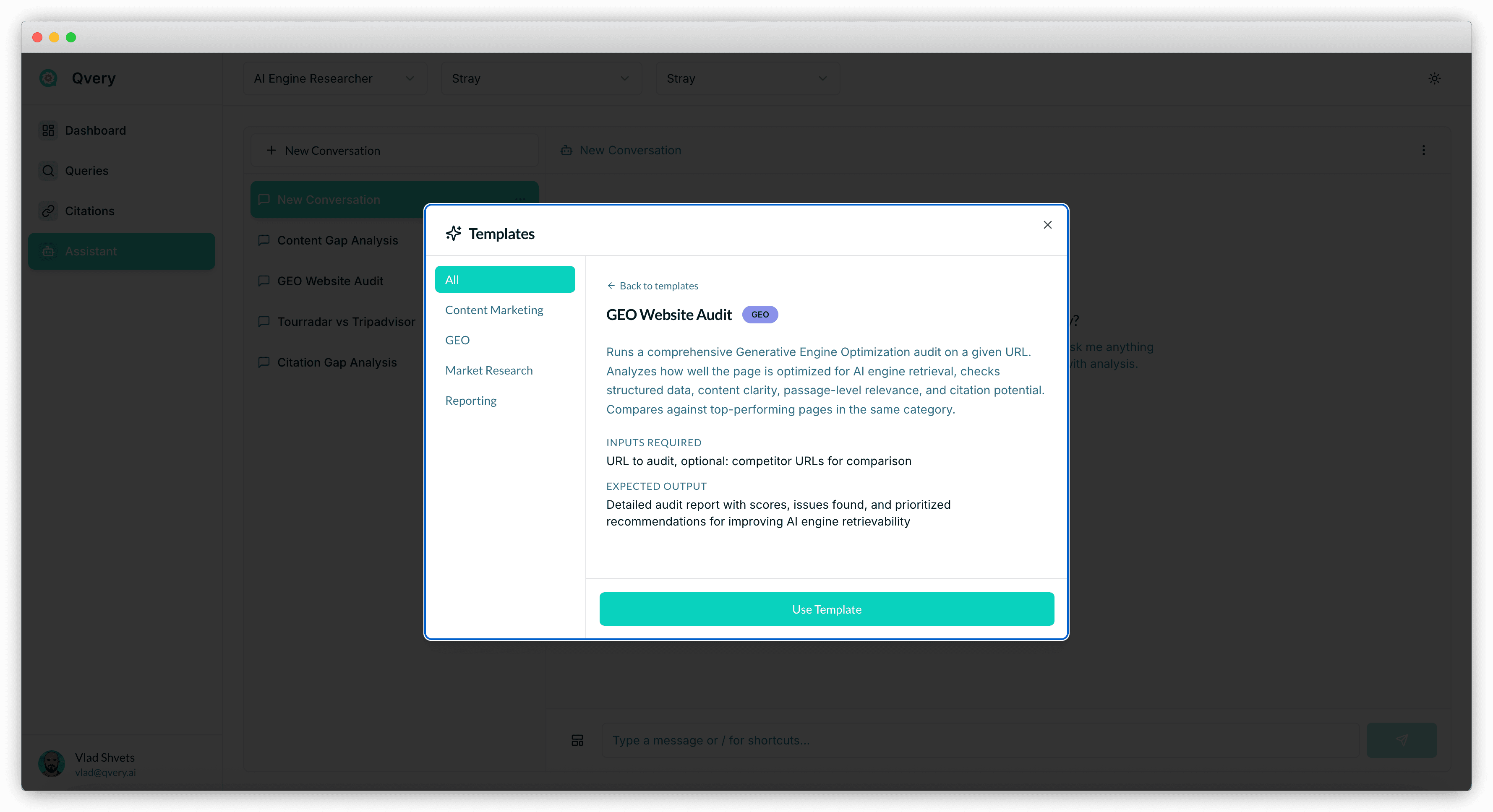
From there the work splits in two. The technical side is structured data, semantic HTML, and page structure fixes that improve retrievability.
The editorial side is new content briefs targeting the gaps the audit surfaced. Both feed into the same content brief template Stray's team writes against. The audit doesn't sit in a deck. It turns into shipped work.
Results
Stray has stopped treating AI search as a black box. The team knows which pages are pulling weight, which need help, and which gaps are worth chasing next. Visibility is being moved deliberately, not hoped for.
The bigger result is operational. The audit-to-shipped-work loop runs on a cadence now. Hannah's team isn't waiting for a quarterly read to know whether the work is landing. They check in Qvery, they ship, they check again. That's the whole motion.
If you want to see how your brand shows up in AI search, sign up for Qvery or reach out for a demo.